
Articles | Volume 29, issue 5
https://doi.org/10.5194/hess-29-1259-2025
© Author(s) 2025. This work is distributed under
the Creative Commons Attribution 4.0 License.
the Creative Commons Attribution 4.0 License.
https://doi.org/10.5194/hess-29-1259-2025
© Author(s) 2025. This work is distributed under
the Creative Commons Attribution 4.0 License.
the Creative Commons Attribution 4.0 License.
Research article
| 
10 Mar 2025
Research article |
| 10 Mar 2025
| 10 Mar 2025
Improvement of the KarstMod modelling platform for a better assessment of karst groundwater resources
Vianney Sivelle
CORRESPONDING AUTHOR

HSM, Univ Montpellier, CNRS, IRD, Montpellier, France
Guillaume Cinkus
HSM, Univ Montpellier, CNRS, IRD, Montpellier, France
EMMAH, INRAE, Avignon Université, 84000 Avignon, France
Naomi Mazzilli
EMMAH, INRAE, Avignon Université, 84000 Avignon, France
David Labat
Géosciences Environnement Toulouse UMR CNRS IRD Université Paul Sabatier CNES, 14 Avenue Edouard Belin, 31400 Toulouse, France
Bruno Arfib
Aix-Marseille Univ, CNRS, IRD, INRAE, Coll de France, CEREGE, Aix-en-Provence, France
Nicolas Massei
Univ Rouen Normandie, Univ Caen Normandie, CNRS, M2C, UMR 6143, 76000 Rouen, France
Yohann Cousquer
HSM, Univ Montpellier, CNRS, IRD, Montpellier, France
Dominique Bertin
GEONOSIS, 650 chemin du Serre, 30140, St-Jean-du-Pin, France
Hervé Jourde
HSM, Univ Montpellier, CNRS, IRD, Montpellier, France
Related authors
Nathan Rispal, Bruno Arfib, Philippe Audra, Pierre Henry, Benoît Viguier, Alexandre Zappelli, Ludovic Mocochain, Marianna Jagercikova, Christine Vallet-Coulomb, Hélène Miche, Laurent Cadilhac, Vianney Sivelle, and Olivier Delestre
Hydrol. Earth Syst. Sci., 30, 4699–4720, https://doi.org/10.5194/hess-30-4699-2026, https://doi.org/10.5194/hess-30-4699-2026, 2026
Short summary
Short summary
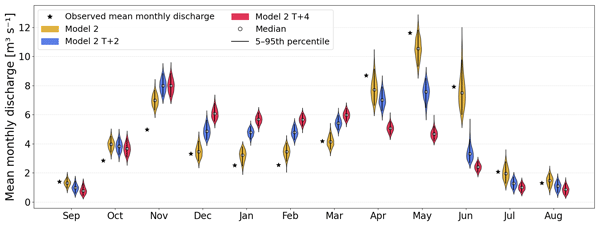
In mountain karst regions, seasonal snow is a key component of groundwater recharge, making them highly vulnerable to climate change. Using a rainfall-snow-discharge model in the southern French Alps, we show that warming shifts high-flow periods and causes a strong summer flow decline. Rapid karst flow paths lead to quick spring responses, limiting storage above the base level and increasing sensitivity to future hydrological change.
Süleyman Selim Çallı, Kübra Özdemir Çallı, Brahim Akdim, Bruno Arfib, Aleksey Benderev, Sandra Beranger, Avi Burg, Onur Can, Jean-Baptiste Charlier, Mehmet Çelik, Arda Melih Çetin, Fehdi Chemseddine, Miroslava Deliyska, Lucio Di Matteo, Marco Dionigi, Romeo Eftimi, Jutta Eybl, Davide Fronzi, Nico Goldscheider, Ergin Gökkaya, Jorge Jodar, Herve Jourde, Eva Kaminsky, Konstantina Katsanou, Alireza Kavousi, Melike Kaya, David Labat, Tanja Liesch, Peter Malik, Christian Massari, Cyril Mayaud, Naomi Mazzilli, Pavel Pracny, Natasa Ravbar, Nathan Rispal, Simon Seelig, Vianney Sivelle, Marc Steinmann, Daniela Valigi, Gerfried Winkler, Ahmet Kemal Yahşi, and Andreas Hartmann
Earth Syst. Sci. Data Discuss., https://doi.org/10.5194/essd-2026-281, https://doi.org/10.5194/essd-2026-281, 2026
Revised manuscript under review for ESSD
Short summary
Short summary
Karst groundwater systems are vital but highly sensitive to climate change. Their complex underground flow makes them hard to manage without good data, so we gathered 118 high-quality records of spring discharge across Mediterranean mountain ranges. With an average of 19 years of data – including one nearly century-long record – this collection provides the detailed information needed to better predict water availability and protect these vulnerable groundwater sources.
Nathan Rispal, Bruno Arfib, Philippe Audra, Pierre Henry, Benoît Viguier, Alexandre Zappelli, Ludovic Mocochain, Marianna Jagercikova, Christine Vallet-Coulomb, Hélène Miche, Laurent Cadilhac, Vianney Sivelle, and Olivier Delestre
Hydrol. Earth Syst. Sci., 30, 4699–4720, https://doi.org/10.5194/hess-30-4699-2026, https://doi.org/10.5194/hess-30-4699-2026, 2026
Short summary
Short summary
In mountain karst regions, seasonal snow is a key component of groundwater recharge, making them highly vulnerable to climate change. Using a rainfall-snow-discharge model in the southern French Alps, we show that warming shifts high-flow periods and causes a strong summer flow decline. Rapid karst flow paths lead to quick spring responses, limiting storage above the base level and increasing sensitivity to future hydrological change.
Süleyman Selim Çallı, Kübra Özdemir Çallı, Brahim Akdim, Bruno Arfib, Aleksey Benderev, Sandra Beranger, Avi Burg, Onur Can, Jean-Baptiste Charlier, Mehmet Çelik, Arda Melih Çetin, Fehdi Chemseddine, Miroslava Deliyska, Lucio Di Matteo, Marco Dionigi, Romeo Eftimi, Jutta Eybl, Davide Fronzi, Nico Goldscheider, Ergin Gökkaya, Jorge Jodar, Herve Jourde, Eva Kaminsky, Konstantina Katsanou, Alireza Kavousi, Melike Kaya, David Labat, Tanja Liesch, Peter Malik, Christian Massari, Cyril Mayaud, Naomi Mazzilli, Pavel Pracny, Natasa Ravbar, Nathan Rispal, Simon Seelig, Vianney Sivelle, Marc Steinmann, Daniela Valigi, Gerfried Winkler, Ahmet Kemal Yahşi, and Andreas Hartmann
Earth Syst. Sci. Data Discuss., https://doi.org/10.5194/essd-2026-281, https://doi.org/10.5194/essd-2026-281, 2026
Revised manuscript under review for ESSD
Short summary
Short summary
Karst groundwater systems are vital but highly sensitive to climate change. Their complex underground flow makes them hard to manage without good data, so we gathered 118 high-quality records of spring discharge across Mediterranean mountain ranges. With an average of 19 years of data – including one nearly century-long record – this collection provides the detailed information needed to better predict water availability and protect these vulnerable groundwater sources.
Sivarama Krishna Reddy Chidepudi, Nicolas Massei, Abderrahim Jardani, Bastien Dieppois, Abel Henriot, and Matthieu Fournier
Hydrol. Earth Syst. Sci., 29, 841–861, https://doi.org/10.5194/hess-29-841-2025, https://doi.org/10.5194/hess-29-841-2025, 2025
Short summary
Short summary
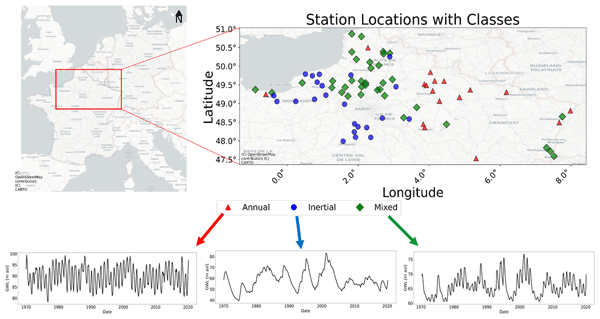
This study explores how deep learning can improve our understanding of groundwater levels, using an approach that combines climate data and physical characteristics of aquifers. By focusing on different types of groundwater levels and employing techniques like clustering and wavelet transform, the study highlights the importance of targeting relevant information. This research not only advances groundwater simulation but also emphasizes the benefits of different modelling approaches.
Raoul A. Collenteur, Ezra Haaf, Mark Bakker, Tanja Liesch, Andreas Wunsch, Jenny Soonthornrangsan, Jeremy White, Nick Martin, Rui Hugman, Ed de Sousa, Didier Vanden Berghe, Xinyang Fan, Tim J. Peterson, Jānis Bikše, Antoine Di Ciacca, Xinyue Wang, Yang Zheng, Maximilian Nölscher, Julian Koch, Raphael Schneider, Nikolas Benavides Höglund, Sivarama Krishna Reddy Chidepudi, Abel Henriot, Nicolas Massei, Abderrahim Jardani, Max Gustav Rudolph, Amir Rouhani, J. Jaime Gómez-Hernández, Seifeddine Jomaa, Anna Pölz, Tim Franken, Morteza Behbooei, Jimmy Lin, and Rojin Meysami
Hydrol. Earth Syst. Sci., 28, 5193–5208, https://doi.org/10.5194/hess-28-5193-2024, https://doi.org/10.5194/hess-28-5193-2024, 2024
Short summary
Short summary
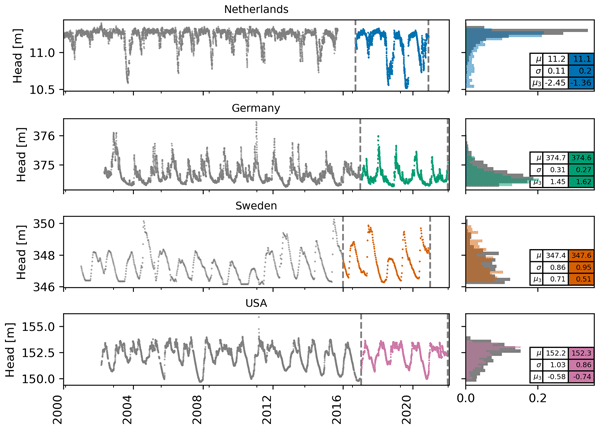
We show the results of the 2022 Groundwater Time Series Modelling Challenge; 15 teams applied data-driven models to simulate hydraulic heads, and three model groups were identified: lumped, machine learning, and deep learning. For all wells, reasonable performance was obtained by at least one team from each group. There was not one team that performed best for all wells. In conclusion, the challenge was a successful initiative to compare different models and learn from each other.
Hugo Pellet, Bruno Arfib, Pierre Henry, Stéphanie Touron, and Ghislain Gassier
Hydrol. Earth Syst. Sci., 28, 4035–4057, https://doi.org/10.5194/hess-28-4035-2024, https://doi.org/10.5194/hess-28-4035-2024, 2024
Short summary
Short summary
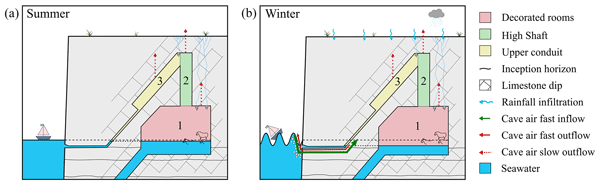
Conservation of decorated caves is highly dependent on airflows and is correlated with rock formation permeability. We present the first conceptual model of flows around the Paleolithic decorated Cosquer coastal cave (southeastern France), quantify air permeability, and show how its variation affects water levels inside the cave. This study highlights that airflows may change in karst unsaturated zones in response to changes in the water cycle and may thus be affected by climate change.
Guillaume Cinkus, Naomi Mazzilli, Hervé Jourde, Andreas Wunsch, Tanja Liesch, Nataša Ravbar, Zhao Chen, and Nico Goldscheider
Hydrol. Earth Syst. Sci., 27, 2397–2411, https://doi.org/10.5194/hess-27-2397-2023, https://doi.org/10.5194/hess-27-2397-2023, 2023
Short summary
Short summary
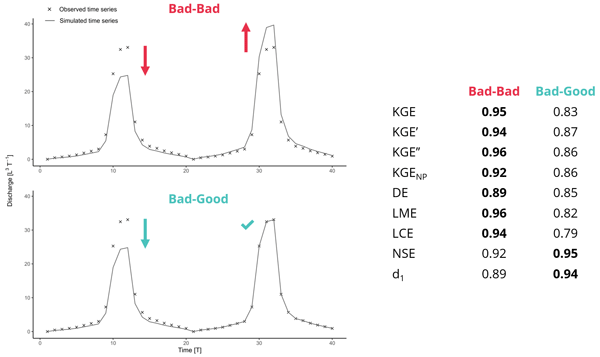
The Kling–Gupta Efficiency (KGE) is a performance criterion extensively used to evaluate hydrological models. We conduct a critical study on the KGE and its variant to examine counterbalancing errors. Results show that, when assessing a simulation, concurrent over- and underestimation of discharge can lead to an overall higher criterion score without an associated increase in model relevance. We suggest that one carefully choose performance criteria and use scaling factors.
Guillaume Cinkus, Andreas Wunsch, Naomi Mazzilli, Tanja Liesch, Zhao Chen, Nataša Ravbar, Joanna Doummar, Jaime Fernández-Ortega, Juan Antonio Barberá, Bartolomé Andreo, Nico Goldscheider, and Hervé Jourde
Hydrol. Earth Syst. Sci., 27, 1961–1985, https://doi.org/10.5194/hess-27-1961-2023, https://doi.org/10.5194/hess-27-1961-2023, 2023
Short summary
Short summary
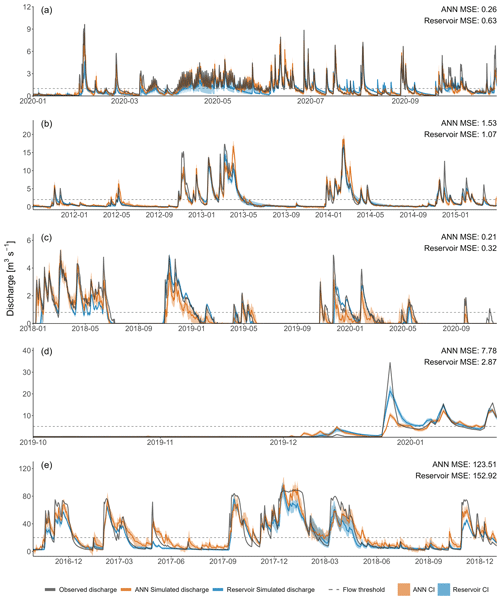
Numerous modelling approaches can be used for studying karst water resources, which can make it difficult for a stakeholder or researcher to choose the appropriate method. We conduct a comparison of two widely used karst modelling approaches: artificial neural networks (ANNs) and reservoir models. Results show that ANN models are very flexible and seem great for reproducing high flows. Reservoir models can work with relatively short time series and seem to accurately reproduce low flows.
Leïla Serène, Christelle Batiot-Guilhe, Naomi Mazzilli, Christophe Emblanch, Milanka Babic, Julien Dupont, Roland Simler, Matthieu Blanc, and Gérard Massonnat
Hydrol. Earth Syst. Sci., 26, 5035–5049, https://doi.org/10.5194/hess-26-5035-2022, https://doi.org/10.5194/hess-26-5035-2022, 2022
Short summary
Short summary
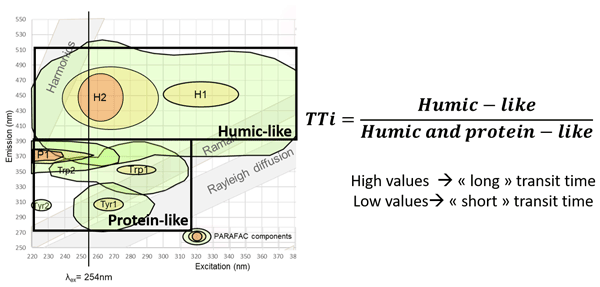
This work aims to develop the Transit Time index (TTi) as a natural tracer of karst groundwater transit time, usable in the 0–6-month range. Based on the fluorescence of organic matter, TTi shows its relevance to detect a small proportion of fast infiltration water within a mix, while other natural transit time tracers provide no or less sensitive information. Comparison of the average TTi of different karst springs also provides consistent results with the expected relative transit times.
Lisa Baulon, Nicolas Massei, Delphine Allier, Matthieu Fournier, and Hélène Bessiere
Hydrol. Earth Syst. Sci., 26, 2829–2854, https://doi.org/10.5194/hess-26-2829-2022, https://doi.org/10.5194/hess-26-2829-2022, 2022
Short summary
Short summary
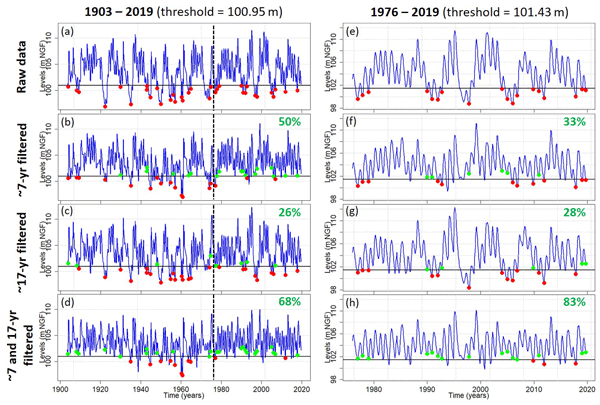
Aquifers often act as low-pass filters, dampening high-frequency (intra-annual) and amplifying low-frequency (LFV, multi-annual to multidecadal) variabilities originating from climate variability. By processing groundwater level signals, we show the key role of LFV in the occurrence of groundwater extremes (GWEs). Results highlight how changes in LFV may impact future GWEs as well as the importance of correct representation of LFV in general circulation model outputs for GWE projection.
Andreas Wunsch, Tanja Liesch, Guillaume Cinkus, Nataša Ravbar, Zhao Chen, Naomi Mazzilli, Hervé Jourde, and Nico Goldscheider
Hydrol. Earth Syst. Sci., 26, 2405–2430, https://doi.org/10.5194/hess-26-2405-2022, https://doi.org/10.5194/hess-26-2405-2022, 2022
Short summary
Short summary
Modeling complex karst water resources is difficult enough, but often there are no or too few climate stations available within or close to the catchment to deliver input data for modeling purposes. We apply image recognition algorithms to time-distributed, spatially gridded meteorological data to simulate karst spring discharge. Our models can also learn the approximate catchment location of a spring independently.
Manuel Fossa, Bastien Dieppois, Nicolas Massei, Matthieu Fournier, Benoit Laignel, and Jean-Philippe Vidal
Hydrol. Earth Syst. Sci., 25, 5683–5702, https://doi.org/10.5194/hess-25-5683-2021, https://doi.org/10.5194/hess-25-5683-2021, 2021
Short summary
Short summary
Hydro-climate observations (such as precipitation, temperature, and river discharge time series) reveal very complex behavior inherited from complex interactions among the physical processes that drive hydro-climate viability. This study shows how even small perturbations of a physical process can have large consequences on some others. Those interactions vary spatially, thus showing the importance of both temporal and spatial dimensions in better understanding hydro-climate variability.
Cited articles
Andréassian, V.: On the (im)possible validation of hydrogeological models, C. R. Geosci., 355, 1–9, https://doi.org/10.5802/crgeos.142, 2023.
Avias, J. V.: Gestion active de l'exsurgence karstique de la Source du Lez (Hérault, France) 1957–1994, Hydrogéologie (Orléans), 113–127, Bureau de recherches géologiques et minières, Orléans, ISBN 0246-1641, 1995.
Bailly-Comte, V., Martin, J. B., Jourde, H., Screaton, E. J., Pistre, S., and Langston, A.: Water exchange and pressure transfer between conduits and matrix and their influence on hydrodynamics of two karst aquifers with sinking streams, J. Hydrol., 12, 55–66, https://doi.org/10.1016/j.jhydrol.2010.03.005, 2010.
Bennett, N. D., Croke, B. F. W., Guariso, G., Guillaume, J. H. A., Hamilton, S. H., Jakeman, A. J., Marsili-Libelli, S., Newham, L. T. H., Norton, J. P., Perrin, C., Pierce, S. A., Robson, B., Seppelt, R., Voinov, A. A., Fath, B. D., and Andreassian, V.: Characterising performance of environmental models, Environ. Modell. Softw., 40, 1–20, https://doi.org/10.1016/j.envsoft.2012.09.011, 2013.
Bérard, P.: Alimentation en eau de la ville de Montpellier: captage de la source du Lez – etude des relations entre la source et son réservoir aquifère [Water supply of Montpellier: Lez Spring catchment – study of the relationship between the spring and its aquifer], BRGM, Montpellier, France, Bureau de recherches géologiques et minières, Orléans, 1983.
Bergström, S.: The HBV model – its structure and applications, SMHI reports hydrology, ISSN 0283-1104, 1992.
Beven, K.: On explanatory depth and predictive power, Hydrol. Process., 15, 3069–3072, https://doi.org/10.1002/hyp.500, 2001.
Beven, K.: A manifesto for the equifinality thesis, J. Hydrol., 320, 18–36, https://doi.org/10.1016/j.jhydrol.2005.07.007, 2006.
Bittner, D., Narany, T. S., Kohl, B., Disse, M., and Chiogna, G.: Modeling the hydrological impact of land use change in a dolomite-dominated karst system, J. Hydrol., 567, 267–279, https://doi.org/10.1016/j.jhydrol.2018.10.017, 2018.
Bittner, D., Richieri, B., and Chiogna, G.: Unraveling the time-dependent relevance of input model uncertainties for a lumped hydrologic model of a pre-alpine karst system, Hydrogeol. J., 29, 2363–2379, https://doi.org/10.1007/s10040-021-02377-1, 2021.
Çallı, S. S., Çallı, K. Ö., Tuğrul Yılmaz, M., and Çelik, M.: Contribution of the satellite-data driven snow routine to a karst hydrological model, J. Hydrol., 607, 127511, https://doi.org/10.1016/j.jhydrol.2022.127511, 2022.
Chang, Y., Hartmann, A., Liu, L., Jiang, G., and Wu, J.: Identifying More Realistic Model Structures by Electrical Conductivity Observations of the Karst Spring, Water Resour. Res., 57, e2020WR028587, https://doi.org/10.1029/2020WR028587, 2021.
Chen, Z. and Goldscheider, N.: Modeling spatially and temporally varied hydraulic behavior of a folded karst system with dominant conduit drainage at catchment scale, Hochifen–Gottesacker, Alps, J. Hydrol., 514, 41–52, https://doi.org/10.1016/j.jhydrol.2014.04.005, 2014.
Chen, Z., Hartmann, A., Wagener, T., and Goldscheider, N.: Dynamics of water fluxes and storages in an Alpine karst catchment under current and potential future climate conditions, Hydrol. Earth Syst. Sci., 22, 3807–3823, https://doi.org/10.5194/hess-22-3807-2018, 2018.
Cinkus, G., Wunsch, A., Mazzilli, N., Liesch, T., Chen, Z., Ravbar, N., Doummar, J., Fernández-Ortega, J., Barberá, J. A., Andreo, B., Goldscheider, N., and Jourde, H.: Comparison of artificial neural networks and reservoir models for simulating karst spring discharge on five test sites in the Alpine and Mediterranean regions, Hydrol. Earth Syst. Sci., 27, 1961–1985, https://doi.org/10.5194/hess-27-1961-2023, 2023a.
Cinkus, G., Mazzilli, N., Jourde, H., Wunsch, A., Liesch, T., Ravbar, N., Chen, Z., and Goldscheider, N.: When best is the enemy of good – critical evaluation of performance criteria in hydrological models, Hydrol. Earth Syst. Sci., 27, 2397–2411, https://doi.org/10.5194/hess-27-2397-2023, 2023b.
Clauzon, V., Mayolle, S., Leonardi, V., Brunet, P., Soliva, R., Marchand, P., Massonnat, G., Rolando, J.-P., and Pistre, S.: Fault zones in limestones: impact on karstogenesis and groundwater flow (Lez aquifer, southern France), Hydrogeol. J., 28, 2387–2408, https://doi.org/10.1007/s10040-020-02189-9, 2020.
Cos, J., Doblas-Reyes, F., Jury, M., Marcos, R., Bretonnière, P.-A., and Samsó, M.: The Mediterranean climate change hotspot in the CMIP5 and CMIP6 projections, Earth Syst. Dynam., 13, 321–340, https://doi.org/10.5194/esd-13-321-2022, 2022.
Cousquer, Y. and Jourde, H.: Reducing Uncertainty of Karst Aquifer Modeling with Complementary Hydrological Observations for the Sustainable Management of Groundwater Resources, J. Hydrol., 612, 128130, https://doi.org/10.1016/j.jhydrol.2022.128130, 2022.
Cousquer, Y., Sivelle, V., and Jourde, H.: Estimating the Structural Uncertainty of Lumped Parameter Models in Karst Hydrology: a Bayesian Model Averaging (BMA), IAHS 2022 Scientific assembly, International Association of Hydrological Science, https://doi.org/10.5194/iahs2022-522, 2022.
Criss, R. E. and Winston, W. E.: Do Nash values have value? Discussion and alternate proposals, Hydrol. Process., 22, 2723–2725, https://doi.org/10.1002/hyp.7072, 2008.
Dakhlaoui, H. and Djebbi, K.: Evaluating the impact of rainfall–runoff model structural uncertainty on the hydrological rating of regional climate model simulations, J. Water Clim. Change, 12, 3820–3838, https://doi.org/10.2166/wcc.2021.004, 2021.
Darbandsari, P. and Coulibaly, P.: Inter-comparison of lumped hydrological models in data-scarce watersheds using different precipitation forcing data sets: Case study of Northern Ontario, Canada, J. Hydrol., 31, 100730, https://doi.org/10.1016/j.ejrh.2020.100730, 2020.
Diffenbaugh, N. S. and Giorgi, F.: Climate change hotspots in the CMIP5 global climate model ensemble, Climatic Change, 114, 813–822, https://doi.org/10.1007/s10584-012-0570-x, 2012.
Doummar, J., Sauter, M., and Geyer, T.: Simulation of flow processes in a large scale karst system with an integrated catchment model (Mike She) – Identification of relevant parameters influencing spring discharge, J. Hydrol., 426/427, 112–123, https://doi.org/10.1016/j.jhydrol.2012.01.021, 2012.
Doummar, J., Hassan Kassem, A., and Gurdak, J. J.: Impact of historic and future climate on spring recharge and discharge based on an integrated numerical modelling approach: Application on a snow-governed semi-arid karst catchment area, J. Hydrol., 565, 636–649, https://doi.org/10.1016/j.jhydrol.2018.08.062, 2018.
Dubois, E., Doummar, J., Pistre, S., and Larocque, M.: Calibration of a lumped karst system model and application to the Qachqouch karst spring (Lebanon) under climate change conditions, Hydrol. Earth Syst. Sci., 24, 4275–4290, https://doi.org/10.5194/hess-24-4275-2020, 2020.
Duran, L., Massei, N., Lecoq, N., Fournier, M., and Labat, D.: Analyzing multi-scale hydrodynamic processes in karst with a coupled conceptual modeling and signal decomposition approach, J. Hydrol., 583, 124625, https://doi.org/10.1016/j.jhydrol.2020.124625, 2020.
Ebel, B. A. and Loague, K.: Physics-based hydrologic-response simulation: Seeing through the fog of equifinality, Hydrol. Process., 20, 2887–2900, https://doi.org/10.1002/hyp.6388, 2006.
Eberhart, R. and Kennedy, J.: Particle swarm optimization, in: Proceedings of the IEEE international conference on neural networks, Houston, TX, USA, 12 June 1997, 1942–1948, https://doi.org/10.1109/ICNN.1995.488968, 1995.
Elshall, A. S., Arik, A. D., El-Kadi, A. I., Pierce, S., Ye, M., Burnett, K. M., Wada, C. A., Bremer, L. L., and Chun, G.: Groundwater sustainability: a review of the interactions between science and policy, Environ. Res. Lett., 15, 093004, https://doi.org/10.1088/1748-9326/ab8e8c, 2020.
Ferreira, P. M. de L., Paz, A. R. da, and Bravo, J. M.: Objective functions used as performance metrics for hydrological models: state-of-the-art and critical analysis, RBRH, 25, e42, https://doi.org/10.1590/2318-0331.252020190155, 2020.
Ficchì, A., Perrin, C., and Andréassian, V.: Impact of temporal resolution of inputs on hydrological model performance: An analysis based on 2400 flood events, J. Hydrol., 538, 454–470, https://doi.org/10.1016/j.jhydrol.2016.04.016, 2016.
Fiorillo, F., Leone, G., Pagnozzi, M., and Esposito, L.: Long-term trends in karst spring discharge and relation to climate factors and changes, Hydrogeol. J., 29, 347–377, https://doi.org/10.1007/s10040-020-02265-0, 2021.
Fleury, P., Plagnes, V., and Bakalowicz, M.: Modelling of the functioning of karst aquifers with a reservoir model: Application to Fontaine de Vaucluse (South of France), J. Hydrol., 345, 38–49, https://doi.org/10.1016/j.jhydrol.2007.07.014, 2007.
Fleury, P., Ladouche, B., Conroux, Y., Jourde, H., and Dörfliger, N.: Modelling the hydrologic functions of a karst aquifer under active water management – The Lez spring, J. Hydrol., 365, 235–243, https://doi.org/10.1016/j.jhydrol.2008.11.037, 2009.
Ford, D. and Williams, P.: Karst hydrogeology and geomorphology, John Wiley & Sons, Hoboken, NJ, USA, 2013.
Frank, S., Goeppert, N., and Goldscheider, N.: Improved understanding of dynamic water and mass budgets of high-alpine karst systems obtained from studying a well-defined catchment area, Hydrological Processes, 35, e14033, https://doi.org/10.1002/hyp.14033, 2021.
Freedman, D., Pisani, R., Purves, R., and Adhikari, A.: Statistics, WW Norton and Company New York, ISBN 0393929728, 2007.
Guinot, V., Savéan, M., Jourde, H., and Neppel, L.: Conceptual rainfall–runoff model with a two-parameter, infinite characteristic time transfer function, Hydrol. Process., 29, 4756–4778, https://doi.org/10.1002/hyp.10523, 2015.
Gupta, A. and Govindaraju, R. S.: Propagation of structural uncertainty in watershed hydrologic models, J. Hydrol., 575, 66–81, https://doi.org/10.1016/j.jhydrol.2019.05.026, 2019.
Gupta, H. V., Kling, H., Yilmaz, K. K., and Martinez, G. F.: Decomposition of the mean squared error and NSE performance criteria: Implications for improving hydrological modelling, J. Hydrol., 377, 80–91, https://doi.org/10.1016/j.jhydrol.2009.08.003, 2009.
Hartmann, A., Lange, J., Vivó Aguado, À., Mizyed, N., Smiatek, G., and Kunstmann, H.: A multi-model approach for improved simulations of future water availability at a large Eastern Mediterranean karst spring, J. Hydrol., 468–469, 130–138, https://doi.org/10.1016/j.jhydrol.2012.08.024, 2012.
Hartmann, A., Wagener, T., Rimmer, A., Lange, J., Brielmann, H., and Weiler, M.: Testing the realism of model structures to identify karst system processes using water quality and quantity signatures, Water Resour. Res., 49, 3345–3358, https://doi.org/10.1002/wrcr.20229, 2013.
Hauduc, H., Neumann, M. B., Muschalla, D., Gamerith, V., Gillot, S., and Vanrolleghem, P. A.: Efficiency criteria for environmental model quality assessment: A review and its application to wastewater treatment, Environ. Modell. Softw., 68, 196–204, https://doi.org/10.1016/j.envsoft.2015.02.004, 2015.
Jackson, E. K., Roberts, W., Nelsen, B., Williams, G. P., Nelson, E. J., and Ames, D. P.: Introductory overview: Error metrics for hydrologic modelling – A review of common practices and an open source library to facilitate use and adoption, Environ. Modell. Softw., 119, 32–48, https://doi.org/10.1016/j.envsoft.2019.05.001, 2019.
Jeannin, P.-Y., Artigue, G., Butscher, C., Chang, Y., Charlier, J.-B., Duran, L., Gill, L., Hartmann, A., Johannet, A., Jourde, H., Kavousi, A., Liesch, T., Liu, Y., Lüthi, M., Malard, A., Mazzilli, N., Pardo-Igúzquiza, E., Thiéry, D., Reimann, T., Schuler, P., Wöhling, T., and Wunsch, A.: Karst modelling challenge 1: Results of hydrological modelling, J. Hydrol., 600, 126508, https://doi.org/10.1016/j.jhydrol.2021.126508, 2021.
Jiang, T., Chen, Y. D., Xu, C., Chen, X., Chen, X., and Singh, V. P.: Comparison of hydrological impacts of climate change simulated by six hydrological models in the Dongjiang Basin, South China, J. Hydrol., 336, 316–333, https://doi.org/10.1016/j.jhydrol.2007.01.010, 2007.
Jones, R. N., Chiew, F. H. S., Boughton, W. C., and Zhang, L.: Estimating the sensitivity of mean annual runoff to climate change using selected hydrological models, Adv. Water Resour., 29, 1419–1429, https://doi.org/10.1016/j.advwatres.2005.11.001, 2006.
Jourde, H., Lafare, A., Mazzilli, N., Belaud, G., Neppel, L., Dörfliger, N., and Cernesson, F.: Flash flood mitigation as a positive consequence of anthropogenic forcing on the groundwater resource in a karst catchment, Environ. Earth Sci., 71, 573–583, https://doi.org/10.1007/s12665-013-2678-3, 2014.
Klemeš, V.: Operational testing of hydrological simulation models, Hydrol. Sci. J., 31, 13–24, https://doi.org/10.1080/02626668609491024, 1986.
Knoben, W. J. M., Freer, J. E., Peel, M. C., Fowler, K. J. A., and Woods, R. A.: A Brief Analysis of Conceptual Model Structure Uncertainty Using 36 Models and 559 Catchments, Water Resour. Res., 56, e2019WR025975, https://doi.org/10.1029/2019WR025975, 2020.
Labat, D., Argouze, R., Mazzilli, N., Ollivier, C., and Sivelle, V.: Impact of Withdrawals on Karst Watershed Water Supply, Water, 14, 1339, https://doi.org/10.3390/w14091339, 2022.
Lee, A.: pyswarm: Particle swarm optimization (PSO) with constraint support, https://github.com/tisimst/pyswarm (last access: 25 May 2021), 2014.
Liu, Y., Wagener, T., and Hartmann, A.: Assessing Streamflow Sensitivity to Precipitation Variability in Karst-Influenced Catchments With Unclosed Water Balances, Water Resour. Res., 57, e2020WR028598, https://doi.org/10.1029/2020WR028598, 2021.
Mazzilli, N. and Bertin, D.: KarstMod User Guide – version 2.2, https://hal.science/hal-01832693v1 (last access: 15 September 2024), 2019.
Mazzilli, N., Jourde, H., Guinot, V., Bailly-Comte, V., and Fleury, P.: Hydrological modelling of a karst aquifer under active groundwater management using a parsimonious conceptual model, H2Karst – 9th Conference on Limestone Hydrogeology, 4, 2011.
Mazzilli, N., Guinot, V., and Jourde, H.: Sensitivity analysis of conceptual model calibration to initialisation bias. Application to karst spring discharge models, Adv. Water Resour., 42, 1–16, https://doi.org/10.1016/j.advwatres.2012.03.020, 2012.
Mazzilli, N., Guinot, V., Jourde, H., Lecoq, N., Labat, D., Arfib, B., Baudement, C., Danquigny, C., Dal Soglio, L., and Bertin, D.: KarstMod: A modelling platform for rainfall – discharge analysis and modelling dedicated to karst systems, Environ. Modell. Softw., 122, 103927, https://doi.org/10.1016/j.envsoft.2017.03.015, 2019.
Mazzilli, N., Sivelle, V., Cinkus, G., Jourde, H., and Bertin, D.: KarstMod User Guide – version 3.0, https://hal.science/hal-01832693v2 (last access: 15 September 2024), 2022.
Mazzilli, N., Sivelle, V., Cinkus, G., Jourde, H., and Bertin, D.: KarstMod 3.0.11, HAL [code], https://hal.science/hal-02071006 (last access: 2 March 2023), 2023.
McMillan, H., Jackson, B., Clark, M., Kavetski, D., and Woods, R.: Rainfall uncertainty in hydrological modelling: An evaluation of multiplicative error models, J. Hydrol., 400, 83–94, https://doi.org/10.1016/j.jhydrol.2011.01.026, 2011.
Moges, E., Demissie, Y., Larsen, L., and Yassin, F.: Review: Sources of Hydrological Model Uncertainties and Advances in Their Analysis, Water, 13, 28, https://doi.org/10.3390/w13010028, 2021.
Moriasi, D. N., Arnold, J. G., Liew, M. W. V., Bingner, R. L., Harmel, R. D., and Veith, T. L.: Model Evaluation Guidelines for Systematic Quantification of Accuracy in Watershed Simulations, T. ASABE, 50, 885–900, https://doi.org/10.13031/2013.23153, 2007.
Nash, J. E. and Sutcliffe, J. V.: River flow forecasting through conceptual models part I – A discussion of principles, J. Hydrol., 10, 282–290, https://doi.org/10.1016/0022-1694(70)90255-6, 1970.
Nerantzaki, S. D. and Nikolaidis, N. P.: The response of three Mediterranean karst springs to drought and the impact of climate change, J. Hydrol., 591, 125296, https://doi.org/10.1016/j.jhydrol.2020.125296, 2020.
Ollivier, C., Mazzilli, N., Olioso, A., Chalikakis, K., Carrière, S. D., Danquigny, C., and Emblanch, C.: Karst recharge-discharge semi distributed model to assess spatial variability of flows, Sci. Total Environ., 703, 134368, https://doi.org/10.1016/j.scitotenv.2019.134368, 2020.
Oudin, L., Hervieu, F., Michel, C., Perrin, C., Andréassian, V., Anctil, F., and Loumagne, C.: Which potential evapotranspiration input for a lumped rainfall–runoff model? Part 2 – Towards a simple and efficient potential evapotranspiration model for rainfall–runoff modelling, J. Hydrol., 303, 290–306, https://doi.org/10.1016/j.jhydrol.2004.08.026, 2005.
Pandi, D., Kothandaraman, S., and Kuppusamy, M.: Hydrological models: a review, International J. Hydrol., 12, 223–242, https://doi.org/10.1504/IJHST.2021.117540, 2021.
Pechlivanidis, I., Jackson, B., McMillan, H., and Gupta, H. V.: Using an informational entropy-based metric as a diagnostic of flow duration to drive model parameter identification, Global NEST J., 14, 325–334, https://doi.org/10.30955/gnj.000879, 2013.
Perrin, C., Michel, C., and Andréassian, V.: Does a large number of parameters enhance model performance? Comparative assessment of common catchment model structures on 429 catchments, J. Hydrol., 242, 275–301, https://doi.org/10.1016/S0022-1694(00)00393-0, 2001.
Pianosi, F., Sarrazin, F., and Wagener, T.: A Matlab toolbox for Global Sensitivity Analysis, Environ. Modell. Softw., 70, 80–85, https://doi.org/10.1016/j.envsoft.2015.04.009, 2015.
Pianosi, F., Sarrazin, F., and Wagener, T.: How successfully is open-source research software adopted? Results and implications of surveying the users of a sensitivity analysis toolbox, Environ. Modell. Softw., 124, 104579, https://doi.org/10.1016/j.envsoft.2019.104579, 2020.
Pool, S., Vis, M., and Seibert, J.: Evaluating model performance: towards a non-parametric variant of the Kling-Gupta efficiency, Hydrol. Sci. J., 63, 1941–1953, https://doi.org/10.1080/02626667.2018.1552002, 2018.
Poulain, A., Watlet, A., Kaufmann, O., Van Camp, M., Jourde, H., Mazzilli, N., Rochez, G., Deleu, R., Quinif, Y., and Hallet, V.: Assessment of groundwater recharge processes through karst vadose zone by cave percolation monitoring, Hydrol. Process., 32, 2069–2083, https://doi.org/10.1002/hyp.13138, 2018.
Sarrazin, F., Hartmann, A., Pianosi, F., Rosolem, R., and Wagener, T.: V2Karst V1.1: a parsimonious large-scale integrated vegetation–recharge model to simulate the impact of climate and land cover change in karst regions, Geosci. Model Dev., 11, 4933–4964, https://doi.org/10.5194/gmd-11-4933-2018, 2018.
Schwemmle, R., Demand, D., and Weiler, M.: Technical note: Diagnostic efficiency – specific evaluation of model performance, Hydrol. Earth Syst. Sci., 25, 2187–2198, https://doi.org/10.5194/hess-25-2187-2021, 2021.
Shmueli, G.: To Explain or to Predict?, Stat. Sci., 25, 289–310, https://doi.org/10.1214/10-STS330, 2010.
Sivelle, V. and Jourde, H.: A methodology for the assessment of groundwater resource variability in karst catchments with sparse temporal measurements, Hydrogeol. J., 29, 137–157, https://doi.org/10.1007/s10040-020-02239-2, 2020.
Sivelle, V., Labat, D., Mazzilli, N., Massei, N., and Jourde, H.: Dynamics of the Flow Exchanges between Matrix and Conduits in Karstified Watersheds at Multiple Temporal Scales, Water, 11, 569, https://doi.org/10.3390/w11030569, 2019.
Sivelle, V., Jourde, H., Bittner, D., Mazzilli, N., and Tramblay, Y.: Assessment of the relative impacts of climate changes and anthropogenic forcing on spring discharge of a Mediterranean karst system, J. Hydrol., 598, 126396, https://doi.org/10.1016/j.jhydrol.2021.126396, 2021.
Sivelle, V., Pérotin, L., Ladouche, B., de Montety, V., Bailly-Comte, V., Champollion, C., and Jourde, H.: A lumped parameter model to evaluate the relevance of excess air as a tracer of exchanged flows between transmissive and capacitive compartments of karst systems, Front. Water, 4, 930115, https://doi.org/10.3389/frwa.2022.930115, 2022a.
Sivelle, V., Jourde, H., Bittner, D., Richieri, B., Labat, D., Hartmann, A., and Chiogna, G.: Considering land cover and land use (LCLU) in lumped parameter modeling in forest dominated karst catchments, J. Hydrol., 612, 128264, https://doi.org/10.1016/j.jhydrol.2022.128264, 2022b.
Smiatek, G., Kaspar, S., and Kunstmann, H.: Hydrological Climate Change Impact Analysis for the Figeh Spring near Damascus, Syria, J. Hydrometeorol., 14, 577–593, https://doi.org/10.1175/JHM-D-12-065.1, 2013.
Sobol, I. M.: On quasi-Monte Carlo integrations, Math. Comput. Simulat., 47, 103–112, https://doi.org/10.1016/S0378-4754(98)00096-2, 1998.
Sophocleous, M.: Interactions between groundwater and surface water: the state of the science, Hydrogeol. J., 10, 52–67, https://doi.org/10.1007/s10040-001-0170-8, 2002.
Stevanović, Z.: Karst waters in potable water supply: a global scale overview, Environ. Earth Sci., 78, 662, https://doi.org/10.1007/s12665-019-8670-9, 2019.
Westerberg, I. K., Sikorska-Senoner, A. E., Viviroli, D., Vis, M., and Seibert, J.: Hydrological model calibration with uncertain discharge data, Hydrol. Sci. J., 67, 2441–2456, https://doi.org/10.1080/02626667.2020.1735638, 2020.
Zhou, S., Wang, Y., Li, Z., Chang, J., and Guo, A.: Quantifying the Uncertainty Interaction Between the Model Input and Structure on Hydrological Processes, Water Resour. Manag., 35, 3915–3935, https://doi.org/10.1007/s11269-021-02883-7, 2021.
Short summary
KarstMod provides a platform for global modelling of the rain level–flow relationship in karstic basins. The platform provides a set of tools to assess the dynamics of the compartments considered in the model and to detect possible flaws in structure and parameterization. This platform is developed as part of the French observatory network on karst hydrology (SNO KARST), which aims to strengthen the sharing of knowledge and promote interdisciplinary research on karst systems at a national level.
KarstMod provides a platform for global modelling of the rain level–flow relationship in karstic...


