
Articles | Volume 18, issue 4
https://doi.org/10.5194/hess-18-1273-2014
© Author(s) 2014. This work is distributed under
the Creative Commons Attribution 3.0 License.
the Creative Commons Attribution 3.0 License.
https://doi.org/10.5194/hess-18-1273-2014
© Author(s) 2014. This work is distributed under
the Creative Commons Attribution 3.0 License.
the Creative Commons Attribution 3.0 License.
Research article
| 
03 Apr 2014
Research article |
| 03 Apr 2014
Modelling overbank flood recharge at a continental scale
Water for a Healthy Country, National Research Flagship, CSIRO Land and Water, PMB 2 Glen Osmond, SA, 5064, Australia
R. Crosbie
Water for a Healthy Country, National Research Flagship, CSIRO Land and Water, PMB 2 Glen Osmond, SA, 5064, Australia
L. Peeters
Water for a Healthy Country, National Research Flagship, CSIRO Land and Water, PMB 2 Glen Osmond, SA, 5064, Australia
K. Joehnk
Water for a Healthy Country, National Research Flagship, CSIRO Land and Water, PMB 1666 Canberra, ACT, 2601, Australia
C. Ticehurst
Water for a Healthy Country, National Research Flagship, CSIRO Land and Water, PMB 1666 Canberra, ACT, 2601, Australia
Related authors

Simone Gelsinari, Valentijn R. N. Pauwels, Edoardo Daly, Jos van Dam, Remko Uijlenhoet, Nicholas Fewster-Young, and Rebecca Doble
Hydrol. Earth Syst. Sci., 25, 2261–2277, https://doi.org/10.5194/hess-25-2261-2021, https://doi.org/10.5194/hess-25-2261-2021, 2021
Short summary
Short summary
Estimates of recharge to groundwater are often driven by biophysical processes occurring in the soil column and, particularly in remote areas, are also always affected by uncertainty. Using data assimilation techniques to merge remotely sensed observations with outputs of numerical models is one way to reduce this uncertainty. Here, we show the benefits of using such a technique with satellite evapotranspiration rates and coupled hydrogeological models applied to a semi-arid site in Australia.
Jose M. Bastias Espejo, Chris Turnadge, Russell S. Crosbie, Philipp Blum, and Gabriel C. Rau
Hydrol. Earth Syst. Sci., 27, 3447–3462, https://doi.org/10.5194/hess-27-3447-2023, https://doi.org/10.5194/hess-27-3447-2023, 2023
Short summary
Short summary
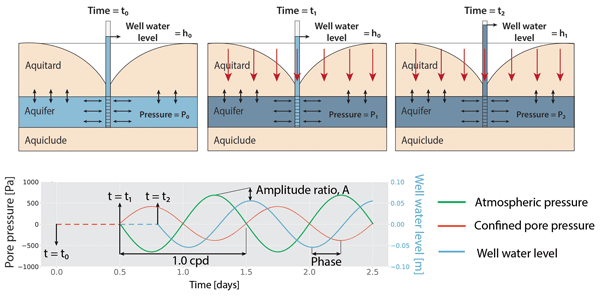
Analytical models estimate subsurface properties from subsurface–tidal load interactions. However, they have limited accuracy in representing subsurface physics and parameter estimation. We derived a new analytical solution which models flow to wells due to atmospheric tides. We applied it to field data and compared our findings with subsurface knowledge. Our results enhance understanding of subsurface systems, providing valuable information on their behavior.
Malgorzata Golub, Wim Thiery, Rafael Marcé, Don Pierson, Inne Vanderkelen, Daniel Mercado-Bettin, R. Iestyn Woolway, Luke Grant, Eleanor Jennings, Benjamin M. Kraemer, Jacob Schewe, Fang Zhao, Katja Frieler, Matthias Mengel, Vasiliy Y. Bogomolov, Damien Bouffard, Marianne Côté, Raoul-Marie Couture, Andrey V. Debolskiy, Bram Droppers, Gideon Gal, Mingyang Guo, Annette B. G. Janssen, Georgiy Kirillin, Robert Ladwig, Madeline Magee, Tadhg Moore, Marjorie Perroud, Sebastiano Piccolroaz, Love Raaman Vinnaa, Martin Schmid, Tom Shatwell, Victor M. Stepanenko, Zeli Tan, Bronwyn Woodward, Huaxia Yao, Rita Adrian, Mathew Allan, Orlane Anneville, Lauri Arvola, Karen Atkins, Leon Boegman, Cayelan Carey, Kyle Christianson, Elvira de Eyto, Curtis DeGasperi, Maria Grechushnikova, Josef Hejzlar, Klaus Joehnk, Ian D. Jones, Alo Laas, Eleanor B. Mackay, Ivan Mammarella, Hampus Markensten, Chris McBride, Deniz Özkundakci, Miguel Potes, Karsten Rinke, Dale Robertson, James A. Rusak, Rui Salgado, Leon van der Linden, Piet Verburg, Danielle Wain, Nicole K. Ward, Sabine Wollrab, and Galina Zdorovennova
Geosci. Model Dev., 15, 4597–4623, https://doi.org/10.5194/gmd-15-4597-2022, https://doi.org/10.5194/gmd-15-4597-2022, 2022
Short summary
Short summary
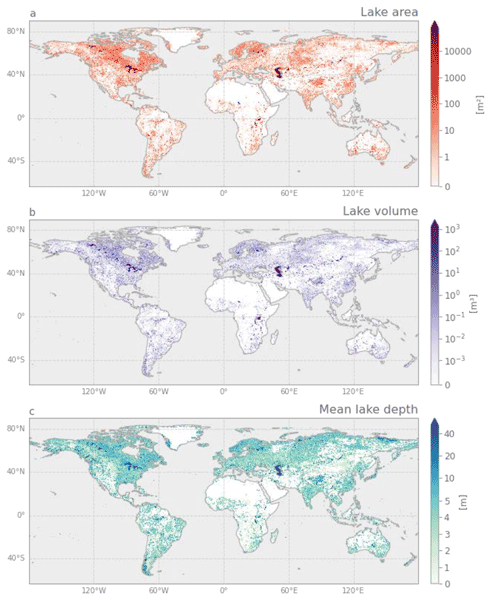
Lakes and reservoirs are warming across the globe. To better understand how lakes are changing and to project their future behavior amidst various sources of uncertainty, simulations with a range of lake models are required. This in turn requires international coordination across different lake modelling teams worldwide. Here we present a protocol for and results from coordinated simulations of climate change impacts on lakes worldwide.
Simone Gelsinari, Valentijn R. N. Pauwels, Edoardo Daly, Jos van Dam, Remko Uijlenhoet, Nicholas Fewster-Young, and Rebecca Doble
Hydrol. Earth Syst. Sci., 25, 2261–2277, https://doi.org/10.5194/hess-25-2261-2021, https://doi.org/10.5194/hess-25-2261-2021, 2021
Short summary
Short summary
Estimates of recharge to groundwater are often driven by biophysical processes occurring in the soil column and, particularly in remote areas, are also always affected by uncertainty. Using data assimilation techniques to merge remotely sensed observations with outputs of numerical models is one way to reduce this uncertainty. Here, we show the benefits of using such a technique with satellite evapotranspiration rates and coupled hydrogeological models applied to a semi-arid site in Australia.
Cited articles
Bates, P. D. and De Roo, A. P. J.: A simple raster-based model for flood inundation simulation, J. Hydrol., 236, 54–77, https://doi.org/10.1016/S0022-1694(00)00278-X, 2000.
Brunner, P. and Simmons, C. T.: HydroGeoSphere: A Fully Integrated, Physically Based Hydrological Model, Ground Water, 50, 170–176, https://doi.org/10.1111/j.1745-6584.2011.00882.x, 2011.
Brunner, P., Cook, P. G., and Simmons, C. T.: Hydrogeologic controls on disconnection between surface water and groundwater, Water Resour. Res., 45, https://doi.org/10.1029/2008WR006953, 2009.
Collis-George, N. and Freebairn, D. M.: A laboratory and field study of border check irrigation, Aust. J. Soil Res., 17, 75–87, https://doi.org/10.1071/SR9790075, 1979.
Cook, F. J., Knight, J. H., Doble, R. C., and Raine, S. R.: An improved solution for the infiltration advance problem in irrigation hydraulics, Irrig. Sci., 31, 1113–1123, https://doi.org/10.1007/s00271-012-0392-7, 2013.
Coram, J. E., Dyson, P. R., Houlder, P. A., and Evans, W. R.: Australian groundwater flow systems contributing to dryland salinity. Project Report for the National Land and Water Resources Audit, Bureau of Rural Sciences, Canberra, 2000.
Crosbie, R. S., Binning, P., and Kalma, J. D.: A time series approach to inferring groundwater recharge using the water table fluctuation method, Water Resour. Res., 41, W01008, https://doi.org/10.1029/2004WR003077, 2005.
Crosbie, R. S., McCallum, J. L., Walker, G. R., and Chiew, F. H. S.: Modelling the climate change impact on groundwater recharge in the Murray-Darling Basin, Hydrogeol. J., 18, 1639–1656, 2010.
Crosbie, R. S., Peeters, L., Doble, R. C., Joehnk, K., Carrara, E., Daamen, C. C., and Frost, A. J.: AWRA-G: A groundwater component for a continental scale land surface model, MODSIM2011, 19th International Congress on Modelling and Simulation, Perth, Australia, 4015–4021, 2011.
Crosbie, R. S., Taylor, A. R., Davis, A. C., Lamontagne, S., and Munday, T.: Evaluation of infiltration from losing-disconnected rivers using a geophysical characterisation of the riverbed and a simplified infiltration model, J. Hydrol., 508, 102–113, https://doi.org/10.1016/j.jhydrol.2013.07.045, 2014.
Dahan, O., Tatarsky, B., Enzel, Y., Kulls, C., Seely, M., and Benito, G.: Dynamics of Flood Water Infiltration and Ground Water Recharge in Hyperarid Desert, Ground Water, 46, 450–461, 2008.
Dellepiane, S. G. and Angiati, E.: A New Method for Cross-Normalization and Multitemporal Visualization of SAR Images for the Detection of Flooded Areas, Geoscience and Remote Sensing, IEEE Trans., 50, 2765–2779, https://doi.org/10.1109/tgrs.2011.2174999, 2012.
Doble, R. C., Crosbie, R. S., and Smerdon, B. D.: Aquifer recharge from overbank floods, Conceptual and Modelling Studies of Integrated Groundwater, Surface Water and Ecological Systems (Proceedings of Symposium H01 held during IUGG2011), Melbourne, Australia, 2011.
Doble, R. C., Crosbie, R. S., Smerdon, B. D., Peeters, L., and Cook, F. J.: Groundwater recharge from overbank floods, Water Resour. Res., 48, W09522, https://doi.org/10.1029/2011wr011441, 2012.
DSE, and DPI: Farm water use efficiency technical reference booklet, Department of Sustainability and Environment and Department of Primary Industries, Victoria, 2004.
Frost, A. J., Bacon, D., Boxall, S., Srikanthan, R., Grant, I. F., Van Dijk, A. I. J. M., Renzullo, L. J., Stenson, M. P., Daamen, C. C., Carrara, E., Barratt, D., Theiveyanathan, T., and Henderson, B. L.: Australian water balance assessment: operational challenges, WIRADA (2012) Water Information Research and Development Alliance: Science Symposium Proceedings, Melbourne, 1–5 August 2011, 2011.
Gouweleeuw, B., Ticehurst, C. J., Gallant, J., Lerat, J., Thew, P., and Minchin, S.: Condamine-Balonne Project: Flood extent and volume estimation. Report prepared for the National Water Commission, CSIRO Water for a Healthy Country, 2011.
Guerschman, J. P., Byrne, G., Ticehurst, C., Gouweleeuw, B., Dyce, P., and Van Dijk, A. I. J. M.: Remote sensing of the dynamics of floods and water bodies in Australia: spatial and temporal scale issues for different applications In AGU 2010 The Meeting of the Americas, 8–13 August 2010, 2010.
Guerschman, J. P., Warren, G., Byrne, G., Lymburner, L., Mueller, N., and Van Dijk, A. I.: MODIS-based standing water detection for flood and large reservoir mapping: algorithm development and applications for the Australian continent, CSIRO, 2011.
Healy, R. and Cook, P.: Using groundwater levels to estimate recharge, Hydrogeol. J., 10, 91–109, https://doi.org/10.1007/s10040-001-0178-0, 2002.
Hostache, R., Matgen, P., Schumann, G., Puech, C., Hoffmann, L., and Pfister, L.: Water Level Estimation and Reduction of Hydraulic Model Calibration Uncertainties Using Satellite SAR Images of Floods, Geoscience and Remote Sensing, IEEE Trans., 47, 431–441, https://doi.org/10.1109/tgrs.2008.2008718, 2009.
Isbell, R. F.: The Australian Soil Classification, CSIRO Publishing, Collingwood, 2002.
Jeffrey, S. J., Carter, J. O., Moodie, K. B., and Beswick, A. R.: Using spatial interpolation to construct a comprehensive archive of Australian climate data, Environ. Modell. Softw., 16, 309–330, 2001.
Joehnk, K. D., Crosbie, R. S., Peeters, L., and Doble, R. C.: AWRA-G: groundwater component of AWRA, CSIRO: Water for a Healthy Country National Research Flagship, Australia, 2012.
Johnston, R. M., Barry, S. J., Bleys, E., Bui, E. N., Moran, C. J., Simon, D. A. P., Carlile, P., McKenzie, N. J., Henderson, B. L., Chapman, G., Imhoff, M., Maschmedt, D., Howe, D., Grose, C., Schoknecht, N., Powell, B., and Grundy, M.: ASRIS: the database, Soil Res., 41, 1021–1036, https://doi.org/10.1071/SR02033, 2003.
Jolly, I. D.: The effects of river management on the hydrology and hydroecology of arid and semi-arid floodplains, in: Floodplain Processes, edited by: Anderson, M. G., Walling, D. E., and Bates, P. D., John Wiley & Sons Ltd., Chichester, New York, 577–609, 1996.
Jolly, I. D., Walker, G. R., and Narayan, K. A.: Floodwater recharge processes in the Chowilla Anabranch system, Aust. J. Soil Res., 32, 417–435, 1994.
Jolly, I. D., Narayan, K. A., Armstrong, D., and Walker, G. R.: The impact of flooding on modelling salt transport processes to streams, Environ. Modell. Softw., 13, 87–104, 1998.
Knight, J.: An Improved Solution for the lnfiltration-advance Problem in Irrigation Hydraulics, 7th Australasian Conference on Hydraulics and Fluid Mechanics 1980: Preprints of Papers, Barton, A.C.T., Australasian Conference on Hydraulics and Fluid Mechanics (7th: 1980: Brisbane, Qld.), 258–260, 1980.
Kollet, S. J. and Maxwell, R. M.: Capturing the influence of groundwater dynamics on land surface processes using an integrated, distributed watershed model, Water Resour. Res., 44, W02402, https://doi.org/10.1029/2007wr006004, 2008.
Leighton, B., Lerat, J., and Stenson, M.: AWRA and Source Integration: Purpose, Requirements and Data Exchanges, CSIRO: Water for a Healthy Country National Research Flagship, 2011.
Lemieux, J. M., Sudicky, E. A., Peltier, W. R., and Tarasov, L.: Dynamics of groundwater recharge and seepage over the Canadian landscape during the Wisconsinian glaciation, J. Geophys. Res., 113, F01011, https://doi.org/10.1029/2007jf000838, 2008.
Lewis, M. R. and Milne, W. E.: Analysis of border irrigation, Agr. Eng., 19, 267–272, 1938.
Lindström, G.: Development and testing of the HYPE (Hydrological Predictions for the Environment) water quality model for different spatial scales, Nord. Hydrol., 41, 295–319, https://doi.org/10.2166/nh.2010.007, 2010.
Liu, S. F., Raymond, O. L., Stewart, A. J., Sweet, I. P., Duggan, M. B., Charlick, C., Phillips, D., and Retter, A. J.: Surface geology of Australia 1:1,000,000 scale, Northern Territory [Digital Dataset], The Commonwealth of Australia, Geoscience Australia, available at: http://www.ga.gov.au, Canberra, 2006.
Long, D. and Singh, V. P.: Integration of the GG model with SEBAL to produce time series of evapotranspiration of high spatial resolution at watershed scales, J. Geophys. Res.-Atmos., 115, D21128, https://doi.org/10.1029/2010jd014092, 2010.
Macumber, P. G.: Interactions between groundwater and surface systems in northern Victoria, PhD Thesis, University of Melbourne, Melbourne, Vic., p. 506, 1983.
Martinis, S., Twele, A., and Voigt, S.: Unsupervised Extraction of Flood-Induced Backscatter Changes in SAR Data Using Markov Image Modeling on Irregular Graphs, Geoscience and Remote Sensing, IEEE Trans., 49, 251–263, https://doi.org/10.1109/tgrs.2010.2052816, 2011.
Maxwell, R. M. and Miller, N. L.: Development of a Coupled Land Surface and Groundwater Model, J. Hydrometeorol., 6, 233–247, https://doi.org/10.1175/jhm422.1, 2005.
Overton, I. C.: Modelling floodplain inundation on a regulated river: integrating GIS, remote sensing and hydrological models, River Res. Applic., 21, 991–1001, 2005.
Peeters, L. J. M., Crosbie, R. S., Doble, R. C., and Van Dijk, A. I. J. M.: Conceptual evaluation of continental land-surface model behaviour, Environ. Modell. Softw., 43, 49–59, https://doi.org/10.1016/j.envsoft.2013.01.007, 2013.
Peterson, T. J., Cheng, X., Western, A. W., Siriwardena, L., and Wealands, W. R.: Novel indicator geostatistics for water table mapping that incorporate elevation, land use, stream network and physical constraints to provide probabilistic estimation of heads and fluxes, MODSIM2011, 19th International Congress on Modelling and Simulation, Perth, Australia, 4015–4021, 2011.
Philip, J. R.: Absorption and infiltration in two- and three- dimensional systems, Water in the Unsaturated Zone, Paris, 1966.
Philip, J. R.: Theory of infiltration, Adv. Hydrosci., 5, 215–296, 1969.
Philip, J. R. and Farrell, D. A.: General Solution of the Infiltration-Advance Problem in Irrigation Hydraulics, J. Geophys. Res., 69, 621–631, https://doi.org/10.1029/JZ069i004p00621, 1964.
Raymond, O. L., Liu, S. F., Kilgour, P., Retter, A. J., and Connolly, D. P.: Surface geology of Australia 1:1,000,000 scale, Victoria, 3rd Edn. [Digital Dataset], Geoscience Australia, available at: http://www.ga.gov.au, Canberra, 2007a.
Raymond, O. L., Liu, S. F., Kilgour, P., Retter, A. J., Stewart, A. J., and Stewart, G.: Surface geology of Australia 1:1,000,000 scale, New South Wales, 2nd Edn. [Digital Dataset], Geoscience Australia, available at: http://www.ga.gov.au, Canberra, 2007b.
Reager, J. T. and Famiglietti, J. S.: Characteristic mega-basin water storage behavior using GRACE, Water Resour. Res., 49, 3314–3329, https://doi.org/10.1002/wrcr.20264, 2013.
Shentsis, I. and Rosenthal, E.: Recharge of aquifers by flood events in an arid region, Hydrol. Process., 17, 695–712, 2003.
Singh, V. and Woolhiser, D.: Mathematical Modeling of Watershed Hydrology, J. Hydrol. Eng, 7, 270–292, https://doi.org/10.1061/(ASCE)1084-0699(2002)7:4(270), 2002.
Stewart, A. J., Sweet, I. P., Needham, R. S., Raymond, O. L., Whitaker, A. J., Liu, S. F., Phillips, D., Retter, A. J., Connolly, D. P., and Stewart, G.: Surface geology of Australia 1:1,000,000 scale, Western Australia [Digital Dataset], Geoscience Australia, http://www.ga.gov.au, Canberra, 2008.
Strömqvist, J., Arheimer, B., Dahné, J., Chantal, D., and Göran, L.: Water and nutrient predictions in ungauged basins: set-up and evaluation of a model at the national scale, Hydrol/ Sci/ J/, 57, 229–247, https://doi.org/10.1080/02626667.2011.637497, 2012.
Therrien, R., McLaren, R. G., Sudicky, E. A., and Panday, S. M.: Hydrogeosphere – a three-dimensional numerical model describing fully-integrated subsurface and surface flow and solute transport, Groundwater Simul. Group, Waterloo, Ont., Canada, Université Laval, University of Waterloo, 275 pp., 2006.
Ticehurst, C. J., Dyce, P., and Guerschman, J. P.: Using passive microwave and optical remote sensing to monitor flood inundation in support of hydrologic modelling, 18th World MACS/MODSIM Congress, Cairns, Australia, 2009.
Tregoning, P., McClusky, S., van Dijk, A. I. J. M., Crosbie, R. S., and Peña-Arancibia, J. L.: Assessment of GRACE satellites for groundwater estimation. Waterlines report, National Water Commission, Canberra, Australia, 2012.
van Dijk, A. I. J. M.: The Australian Water Resources Assessment System. Technical Report 3. Landscape Model (version 0.5) Technical Description, CSIRO: Water for a Healthy Country National Research Flagship, available at: http://www.clw.csiro.au/publications/waterforahealthycountry/2010/wfhc-aus-water-resources-assessment-system.pdf, 2010.
van Dijk, A. I. J. M. and Renzullo, L. J.: Water resource monitoring systems and the role of satellite observations, Hydrol. Earth Syst. Sci., 15, 39–55, https://doi.org/10.5194/hess-15-39-2011, 2011.
Van Dijk, A. I. J. M., Bacon, D., Barratt, D., Crosbie, R. S., Daamen, C. C., Fitch, P., Frost, A. J., Guerschman, J. P., Henderson, B. L., King, E. A., McVicar, T. R., Renzullo, L. J., Stenson, M. P., and Viney, N. R.: Design and development of the Australian Water Resources Assessment system, WIRADA (2012) Water Information Research and Development Alliance: Science Symposium Proceedings, Melbourne, 1–5 August 2011, 2011.
Vaze, J., Viney, N., Stenson, M., Renzullo, L., Dijk, A. V., Dutta, D., Crosbie, R., Lerat, J., Penton, D., Vleeshouwer, J., Peeters, L., Teng, J., Kim, S., Hughes, J., Dawes, W., Zhang, Y., Leighton, B., Perraud, J.-M., Joehnk, K., A.Yang, Wang, B., Frost, A., Elmahdi, A., Smith, A., and Daamen, C.: The Australian Water Resource Assessment Modelling System (AWRA), MODSIM 2013, Adapting to change: the multiple roles of modelling, 20th International Congress on Modelling and Simulation (MODSIM2013), Adelaide, Australia, 1–6 December 2013, available at: www.mssanz.org.au/modsim2013, 2013.
Viney, N. R., Vaze, J., Wang, B., Zhang, Y., Yang, A., Vleeshouwer, J., Ramchurn, A., and Frost, A.: Comparison of prediction performance of AWRA-L with other models, CSIRO Water for a Healthy Country Flagship, Australia, 2013.
Wada, Y.: Global depletion of groundwater resources, Geophys. Res. Lett., 37, L20402, https://doi.org/10.1029/2010GL044571, 2010.
Wada, Y., van Beek, L. P. H., and Bierkens, M. F. P.: Nonsustainable groundwater sustaining irrigation: A global assessment, Water Resour. Res., 48, W00L06, https://doi.org/10.1029/2011wr010562, 2012.
Westerhoff, R. S., Kleuskens, M. P. H., Winsemius, H. C., Huizinga, H. J., Brakenridge, G. R., and Bishop, C.: Automated global water mapping based on wide-swath orbital synthetic-aperture radar, Hydrol. Earth Syst. Sci., 17, 651–663, https://doi.org/10.5194/hess-17-651-2013, 2013.
Whitaker, A. J., Champion, D. C., Sweet, I. P., Kilgour, P., and Connolly, D. P.: Surface geology of Australia 1:1,000,000 scale, Queensland, 2nd Edn. [Digital Dataset] Geoscience Australia, available at: http://www.ga.gov.au, Canberra, 2007.
Whitaker, A. J., Glanville, H. D., English, P. M., Stewart, A. J., Retter, A. J., Connolly, D. P., Stewart, G. A., and Fisher, C. L.: Surface geology of Australia 1:1,000,000 scale, South Australia, 1st Edn. [Digital Dataset] Geoscience Australia, available at: http://www.ga.gov.au, Canberra, 2008.
Zhang, L. and Dawes, W.: WAVES - An integrated energy and water balance model, CSIRO Land and WaterTechnical Report No. 31/98, 218, 1998.


