Articles | Volume 25, issue 4
https://doi.org/10.5194/hess-25-1923-2021
© Author(s) 2021. This work is distributed under
the Creative Commons Attribution 4.0 License.
https://doi.org/10.5194/hess-25-1923-2021
© Author(s) 2021. This work is distributed under
the Creative Commons Attribution 4.0 License.
Impacts of climate change on groundwater flooding and ecohydrology in lowland karst
Department of Civil, Structural and Environmental Engineering,
Trinity College Dublin, University of Dublin, Museum Building, College Green, Dublin 2, Ireland
Paul Nolan
Irish Centre for High-End Computing (ICHEC), 2, Seventh floor, Tower Building, Trinity Technology and Enterprise Campus, Grand Canal Quay, Dublin 2, Ireland
Ted McCormack
Groundwater and Geothermal Unit, Geological Survey of Ireland, Beggar's Bush, Haddington Road, Dublin 4, Ireland
Paul Johnston
Department of Civil, Structural and Environmental Engineering,
Trinity College Dublin, University of Dublin, Museum Building, College Green, Dublin 2, Ireland
Owen Naughton
Groundwater and Geothermal Unit, Geological Survey of Ireland, Beggar's Bush, Haddington Road, Dublin 4, Ireland
Saheba Bhatnagar
Department of Civil, Structural and Environmental Engineering,
Trinity College Dublin, University of Dublin, Museum Building, College Green, Dublin 2, Ireland
Laurence Gill
Department of Civil, Structural and Environmental Engineering,
Trinity College Dublin, University of Dublin, Museum Building, College Green, Dublin 2, Ireland
Related authors
No articles found.
Yining Zang, Pauline C. Treble, Kei Yoshimura, Jayson Gabriel Pinza, Fengbo Zhang, Kübra Özdemir Çallı, Xiaojun Mei, Admin Husic, Alena Gessert, Andrej Stroj, Bartolomé Andreo, Bernard Ladouche, Christine Stumpp, Diana Mance, Eleni Zagana, Fen Huang, Giuseppe Sappa, Harald Kunstmann, Heike Brielmann, Hong Zhou, Huaying Wu, Jakob Garvelmann, James Berglund, Jean-Baptiste Charlier, Jens Lange, Juan Antonio Barberá Fornell, Junbing Pu, Konstantina Katsanou, Kun Ren, Laura Toran, Laurence Gill, Maria Filippini, Martin Kralik, Matías Mudarra Martínez, Min Zhao, Mingming Luo, Nico Goldscheider, Nikolaos Lambrakis, Pantaleone De Vita, Qiong Xiao, Shi Yu, Silvia Iacurto, Silvio Coda, Ted McCormack, Vincenzo Allocca, W. George Darling, Walter D’Alessandro, Xulei Guo, Yundi Hu, Zhijun Wang, Eva Kaminsky, Jiří Faimon, Marek Lang, Pavel Pracný, and Andreas Hartmann
Earth Syst. Sci. Data Discuss., https://doi.org/10.5194/essd-2025-812, https://doi.org/10.5194/essd-2025-812, 2026
Preprint under review for ESSD
Short summary
Short summary
We developed the first global database of water from karst springs and cave drips that records different forms of oxygen and hydrogen, which naturally trace how rainwater moves through rocks. By gathering and checking thousands of measurements from around the globe and linking them with flow and rainfall data, the database provides a comprehensive view of water movement, allows scientists to compare regions, understand groundwater processes, and support sustainable water management worldwide.
Mariana P. Silva, Mark G. Healy, and Laurence Gill
Biogeosciences, 21, 3143–3163, https://doi.org/10.5194/bg-21-3143-2024, https://doi.org/10.5194/bg-21-3143-2024, 2024
Short summary
Short summary
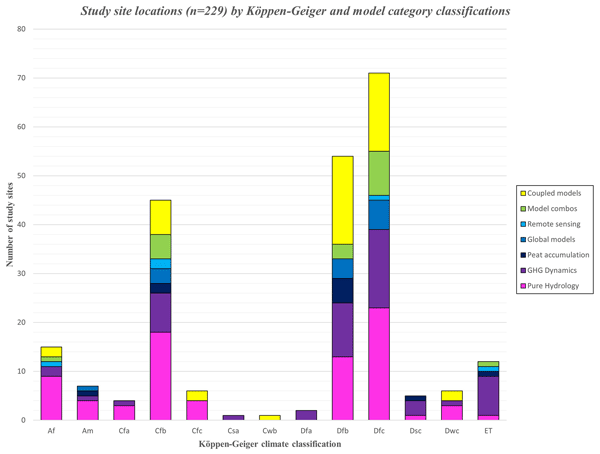
Peatland restoration combats climate change and protects ecosystem health in many northern regions. This review gathers data about models used on northern peatlands to further envision their application in the specific scenario of restoration. A total of 211 papers were included in the review: location trends for peatland modelling were catalogued, and key themes in model outputs were highlighted. Valuable context is provided for future efforts in modelling the peatland restoration process.
Saheba Bhatnagar, Mahesh Kumar Sha, Laurence Gill, Bavo Langerock, and Bidisha Ghosh
Biogeosciences Discuss., https://doi.org/10.5194/bg-2022-88, https://doi.org/10.5194/bg-2022-88, 2022
Revised manuscript not accepted
Short summary
Short summary
Different land types emit a different quantity of methane, with wetlands being one of the largest sources of methane emissions, contributing to climate change. This study finds variations in land types using the methane total column data from Sentinel 5-precursor satellite with a machine learning algorithm. The variations in land types were identified with high confidence, demonstrating that the methane emissions from the wetland and other land types substantially affect the total column.
Jan Knappe, Celia Somlai, and Laurence W. Gill
Biogeosciences, 19, 1067–1085, https://doi.org/10.5194/bg-19-1067-2022, https://doi.org/10.5194/bg-19-1067-2022, 2022
Short summary
Short summary
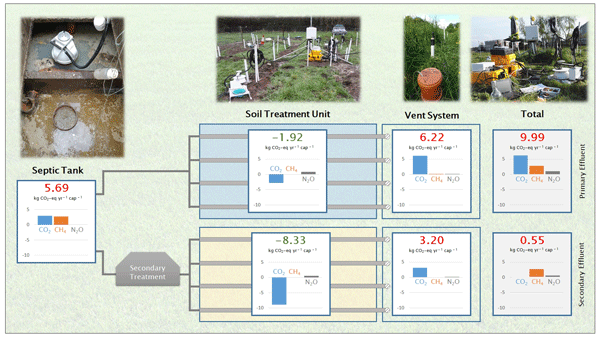
Two domestic on-site wastewater treatment systems have been monitored for greenhouse gas (carbon dioxide, methane and nitrous oxide) emissions coming from the process units, soil and vent pipes. This has enabled the net greenhouse gas per person to be quantified for the first time, as well as the impact of pre-treatment on the effluent before being discharged to soil. These decentralised wastewater treatment systems serve approx. 20 % of the population in both Europe and the United States.
Cited articles
Ahilan, S., O'Sullivan, J. J., and Bruen, M.: Influences on flood frequency distributions in Irish river catchments, Hydrol. Earth Syst. Sci., 16, 1137–1150, https://doi.org/10.5194/hess-16-1137-2012, 2012.
Bhatnagar, S., Gill, L. W., Waldren, S., Sharkey, N., Naughton, O., Johnston, P., Coxon, C., Morrissey, P., and Ghosh, B.: Ecohydrological metrics for vegetation communities in turloughs (ephemeral karstic wetlands), Ecohydrology, in review, 2021.
Bieniek, P. A., Bhatt, U. S., Walsh, J. E., Rupp, T. S., Zhang,
J., Krieger, J. R., and Lader, R.: Dynamical Downscaling of
Era-Interim Temperature and Precipitation for Alaska, J. Appl. Meteorol. Clim., 55, 635–654, 2016.
Blöschl, G., Hall, J., Viglione, A., Perdigão, R.
A. P., Parajka, J., Merz, B., Lun, D., Arheimer, B., Aronica,
G. T., Bilibashi, A., Boháč, M., Bonacci, O.,
Borga, M., Čanjevac, I., Castellarin, A., Chirico, G.
B., Claps, P., Frolova, N., Ganora, D., Gorbachova,
L., Gül, A., Hannaford, J., Harrigan, S., Kireeva, M.,
Kiss, A., Kjeldsen, T. R., Kohnová, S., Koskela, J. J.,
Ledvinka, O., Macdonald, N., Mavrova-Guirguinova, M., Mediero,
L., Merz, R., Molnar, P., Montanari, A., Murphy, C., Osuch,
M., Ovcharuk, V., Radevski, I., Salinas, J. L., Sauquet,
E., Šraj, M., Szolgay, J., Volpi, E., Wilson, D., Zaimi,
K., and Živković, N.: Changing Climate Both Increases and
Decreases European River Floods, Nature, 573, 108–111
https://doi.org/10.1038/s41586-019-1495-6, 2019.
Brenner, S., Coxon, G., Howden, N. J. K., Freer, J., and Hartmann, A.: Process-based modelling to evaluate simulated groundwater levels and frequencies in a Chalk catchment in south-western England, Nat. Hazards Earth Syst. Sci., 18, 445–461, https://doi.org/10.5194/nhess-18-445-2018, 2018.
Cavicchia, L. and von Storch, H.: The simulation of medicanes in a
high-resolution regional climate model, Clim. Dynam., 39, 2273–2290,
https://doi.org/10.1007/s00382-011-1220-0, 2012
Chen, Z., Hartmann, A., Wagener, T., and Goldscheider, N.: Dynamics of water fluxes and storages in an Alpine karst catchment under current and potential future climate conditions, Hydrol. Earth Syst. Sci., 22, 3807–3823, https://doi.org/10.5194/hess-22-3807-2018, 2018.
Cobby, D., Morris, S. E, Parkes, A., and Robinson, V.: Groundwater Flood Risk Management: Advances Towards Meeting the Requirements of the Eu Floods Directive, J. Flood Risk Manag., 2, 111–119,
https://doi.org/10.1111/j.1753-318X.2009.01025.x, 2009.
Daloz, A., Camargo, S., Kossin, J., Emanuel, K., Jones, J., Kim,
D., LaRow, T., Lim, Y.-K., Roberts, M., Vidale, P. L.,
Patricola, C., Scoccimarro, E., Shaevitz, D., Wang, H.,
Wehner, M., and Zhao, M.: Cluster Analysis of Downscaled and
Explicitly Simulated North Atlantic Tropical Cyclone Tracks, J. Climatol., 28, 1333–1361, https://doi.org/10.1175/JCLI-D-13-00646.1, 2015.
Di Luca, A., Argueso, D., Evans, J., Elía, R., and
Laprise, R.: Quantifying the Overall Added Value of Dynamical
Downscaling and the Contribution from Different Spatial Scales, J. Geophys. Res.-Atmos., 121, 1575–1590, https://doi.org/10.1002/2015JD024009, 2016.
Donat, M. G., Leckebusch, G. C., Wild, S., and Ulbrich, U.: Benefits and
Limitations of Regional Multi-Model Ensembles for Storm Loss Estimations, Clim. Res., 44, 211–225, 2010.
Dragoni, W. and Sukhija, B. S.: Climate Change and Groundwater: A Short
Review, Geol. Soc. Spec. Publ., 288, 1–12, https://doi.org/10.1144/SP288.1, 2008.
Drew, D. P.: Hydrogeology of Lowland Karst in Ireland, Q. J. Eng. Geol. Hydrogeol., 41, 61–72, https://doi.org/10.1144/1470-9236/07-027, 2008.
Feser, F.: Enhanced Detectability of Added Value in Limited-Area Model
Results Separated into Different Spatial Scales, Mon. Weather Rev., 134, 2180–2190, https://doi.org/10.1175/MWR3183.1, 2006.
Feser, F. and Barcikowska, M.: The Influence of Spectral Nudging
on Typhoon Formation in Regional Climate Models, Environ. Res. Lett., 7, 014024, https://doi.org/10.1088/1748-9326/7/1/014024, 2012.
Feser, F., Rockel, B., von Storch, H., Winterfeldt, J.,
and Zahn, M.: Regional Climate Models Add Value to Global Model
Data: A Review and Selected Examples, B. Am. Meteorol. Soc., 92, 1181–1192,
https://doi.org/10.1175/2011bams3061.1, 2011.
Finch, J. W., Bradford, R. B., and Hudson, J. A.: The Spatial Distribution
of Groundwater Flooding in a Chalk Catchment in Southern England,
Hydrol. Process., 18, 959–971, https://doi.org/10.1002/hyp.1340, 2004.
Flanagan, J. and Nolan, P.: Towards a Definitive Historical High-resolution
Climate Dataset for Ireland – Promoting Climate Research in Ireland, EPA
Research 350, available at:
https://www.epa.ie/pubs/reports/research/climate/researchreport350/, last access: 11 November 2020.
Flanagan, J., Nolan, P., McGrath, R., and Werner, C.: Towards a definitive historical high-resolution climate dataset for Ireland – promoting climate research in Ireland, Adv. Sci. Res., 15, 263–276, https://doi.org/10.5194/asr-15-263-2019, 2019.
Fleury, P., Ladouche, B., Conroux, Y., Jourde, H., and
Dörfliger, N.: Modelling the Hydrologic Functions of a Karst
Aquifer under Active Water Management – the Lez Spring, J. Hydrol., 365, 235–243, https://doi.org/10.1016/j.jhydrol.2008.11.037, 2009.
Ford, D. C. and Williams, P.: Karst Hydrogeology and Geomorphology, John Wiley, Chichester, 562, https://doi.org/10.1002/9781118684986, 2007.
Franzke, C.: A Novel Method to Test for Significant Trends in Extreme
Values in Serially Dependent Time Series, Geophys. Res. Lett., 40, 1391–1395, https://doi.org/10.1002/grl.50301, 2013.
Gill, L. W., Naughton, O., and Johnston, P. M.: Modeling a Network of
Turloughs in Lowland Karst, Water Resour. Res., 49, 3487–3503,
https://doi.org/10.1002/wrcr.20299, 2013a.
Gill, L. W., Naughton, O., Johnston, P. M., Basu, B., and Ghosh, B.:
Characterisation of Hydrogeological Connections in a Lowland Karst Network
Using Time Series Analysis of Water Levels in Ephemeral Groundwater-Fed
Lakes (Turloughs), J. Hydrol., 499, 289–302,
https://doi.org/10.1016/j.jhydrol.2013.07.002, 2013b.
Gleeson, E., McGrath, R., and Treanor, M.: Ireland's Climate: The Road Ahead Met Éireann, Dublin, available at: http://hdl.handle.net/2262/71304 (last access: 8 May 2020), 2013.
Griffis, V. W. and Stedinger, J. R.: Log-Pearson Type 3 Distribution and
Its Application in Flood Frequency Analysis. I: Distribution
Characteristics, J. Hydrol. Eng., 12, 482–491,
https://doi.org/10.1061/(ASCE)1084-0699(2007)12:5(482), 2007.
GSI: GW Flood Project Final Report & Mapping, available at: https://www.gsi.ie/enie/publications/Pages/GWFlood-Project-Monitoring-Modellingand-Mapping-Karst-Groundwater-Flooding-in-Ireland.aspx, last access: 2 December 2020.
Hartmann, Andreas.: Experiences in Calibrating and Evaluating Lumped Karst
Hydrological Models, Geol. Soc. Spec. Publ., 466, 331, https://doi.org/10.1144/sp466.18, 2017.
Hartmann, A., Barberá, J., Lange, J., Andreo, B., and
Weiler, M.: Progress in the Hydrologic Simulation of Time Variant
Recharge Areas of Karst Systems – Exemplified at a Karst Spring in Southern
Spain, Adv. Water Resour., 54, 149–160,
https://doi.org/10.1016/j.advwatres.2013.01.010, 2013.
Howard, K. E. N. and Griffith, A.: Can the Impacts of Climate Change on
Groundwater Resources Be Studied without the Use of Transient Models?, Hydrolog. Sci. J., 54, 754–764, https://doi.org/10.1623/hysj.54.4.754, 2009.
Hughes, A. G., Vounaki, T., Peach, D. W., Ireson, A. M., Jackson, C. R., Butler, A. P., Bloomfield, J. P., Finch, J., and Wheater, H. S.: Flood Risk from
Groundwater: Examples from a Chalk Catchment in Southern England, J. Flood Risk Manag., 4, 143–155, https://doi.org/10.1111/j.1753-318X.2011.01095.x, 2011.
ICHEC: EPA Hydroclimate Data, available at: https://erddap.ichec.ie/erddap/files/EPA_Hydroclimate, last access: 10 April 2020.
Innovyze: Infoworks ICM Software, available at: https://www.innovyze.com/en-us/products/infoworks-icm (last access: 15 May 2020), 2019.
IPCC, Climate Change 2013: The Physical Science Basis, Contribution of Working Group I to the Fifth Assessment Report of the Intergovernmental Panel on Climate Change, edited by: Stocker, T. F., Qin, D., Plattner, G.-K., Tignor, M., Allen, S. K., Boschung, J., Nauels, A., Xia, Y., Bex, V., and Midgley, P. M., Cambridge University Press, Cambridge, United Kingdom and New York, NY, USA, 1535 pp., 2013.
Irvine, K., Coxon, C., Gill, L., Kimberley, S., and Waldren, S.: Turloughs
(Ireland), in: The Wetland Book, edited by: Finlayson, C. M., Milton, G., Prentice, R., and Davidson, N., Springer, Dordrecht, 1069–1077, 2018.
Jackson, C. R., Bloomfield, J. P., and Mackay, J. D.: Evidence for changes in historic and future groundwater levels in the UK, Progress in Physical Geography: Earth and Environment, 39, 49–67, https://doi.org/10.1177/030913331455066, 2015.
Kanada, S., Nakano, M., Hayashi, S., Kato, T., Nakamura,
M., Kurihara, K., and Kitoh, A.: Reproducibility of Maximum
Daily Precipitation Amount over Japan by a High-Resolution Non-Hydrostatic
Model, SOLA, 4, 105–108, https://doi.org/10.2151/sola.2008-027, 2008.
Kanamaru, H. and Kanamitsu, M.: Fifty-Seven-Year California
Reanalysis Downscaling at 10 Km (Card10). Part Ii: Comparison with North
American Regional Reanalysis, J. Climate, 20, 5572–5592, https://doi.org/10.1175/2007JCLI1522.1, 2007.
Kendon, E., Roberts, N., Senior, C., and Roberts, M.:
Realism of Rainfall in a Very High-Resolution Regional Climate Model, J. Climate, 25, 5791–5806, https://doi.org/10.1175/JCLI-D-11-00562.1,
2012.
Kendon, E., Roberts, N., Fowler, H., Roberts, M., Chan,
S., and Senior, C.: Heavier Summer Downpours with Climate Change Revealed by Weather Forecast Resolution Model, Nat. Clim. Change, 4, 570–576, https://doi.org/10.1038/nclimate2258, 2014.
Kimberley, S., Naughton, O., Johnston, P. M., Gill, L. W., and Waldren, S.: The influence of flood duration on the surface soil properties and grazing
management of karst wetlands (turloughs) in Ireland, Hydrobiologia, 692,
29–40, https://doi.org/10.1007/s10750-012-1000-9, 2012.
Lucas-Picher, P., Wulff-Nielsen, M., Christensen, J. H.,
Aðalgeirsdóttir, G., Mottram, R., and Simonsen,
S. B.: Very High Resolution Regional Climate Model Simulations over
Greenland: Identifying Added Value, J. Geophys. Res.-Atmos., 117, https://doi.org/10.1029/2011jd016267, 2012.
Mayaud, C., Gabrovšek, F., Blatnik, M., Kogovšek,
B., Petrič, M., and Ravbar, N.: Understanding
Flooding in Poljes: A Modelling Perspective, J. Hydrol., 575, 874–889,
https://doi.org/10.1016/j.jhydrol.2019.04.092, 2019.
McGrath, R. and Lynch, P.: Ireland in a Warmer World: Scientific
Predictions of the Irish Climate in the Twenty-first Century, Community
Climate Change Consortium for Ireland (C4I), available at:
https://www.epa.ie/pubs/reports/research/climate/EPA_climate_change_regional_models_ERTDI36.pdf (last access: 11 November 2020), 2008.
McGrath, R., Nishimura, E., Nolan, P., Semmler, T., Sweeney, C., and Wang, S.: Climate Change: Regional Climate Model Predictions for Ireland, Final Project Report published by the Environmental Protection Agency at: http://epa.ie/pubs/reports/research/climate/EPA_climate_change_regional_models_ERTDI36.pdf (last accessed: 8 May 2020), 2005.
Meixner, T., Manning, A. H., Stonestrom, D. A., Allen, D. M.,
Ajami, H., Blasch, K. W., Brookfield, A. E., Castro, C. L., Clark, Jordan F., Gochis, D. J., Flint, A. L., Neff, K. L.,
Niraula, R., Rodell, M., Scanlon, B. R., Singha, K., and
Walvoord, M. A.: Implications of Projected Climate Change for
Groundwater Recharge in the Western United States, J. Hydrol., 534, 124–138,
https://doi.org/10.1016/j.jhydrol.2015.12.027, 2016.
Morris, J., Bailey, A. P., Lawson, C. S., Leeds-Harrison, P. B., Alsop, D.,
and Vivash, R.: The Economic Dimensions of Integrating Flood Management and
Agri-Environment through Washland Creation: A Case from Somerset, England,
J. Environ. Manage., 88, 372–381,
https://doi.org/10.1016/j.jenvman.2007.03.023, 2008.
Morrissey, P. J., McCormack, T., Naughton, O., Johnston, P. M.,
and Gill, L. W.: Modelling Groundwater Flooding in a Lowland Karst
Catchment, J. Hydrol., 580, 124361,
https://doi.org/10.1016/j.jhydrol.2019.124361, 2020.
Moss, R. H., Edmonds, J. A., Hibbard, K. A., et al.: The next generation of scenarios for climate change research and assessment, Nature, 463, 747–756, https://doi.org/10.1038/nature08823, 2010.
Mudarra, M., Hartmann, A., and Andreo, B.: Combining experimental methods
and modeling to quantify the complex recharge behavior of karst aquifers.
Water Resour. Res., 55, 1384–1404,
https://doi.org/10.1029/2017WR021819, 2019
Murphy, C., Wilby, R. L., Matthews, T. K. R., Thorne, P.,
Broderick, C., Fealy, R., Hall, J., Harrigan, S., Jones, P.,
McCarthy, G., MacDonald, N., Noone, S., and Ryan, C.:
Multi-Century Trends to Wetter Winters and Drier Summers in the England and
Wales Precipitation Series Explained by Observational and Sampling Bias in
Early Records, Int. J. Climatol., 40, 610–619, https://doi.org/10.1002/joc.6208, 2019.
Naughton, O., Johnston, P. M., and Gill, L. W.: Groundwater Flooding in
Irish Karst: The Hydrological Characterisation of Ephemeral Lakes
(Turloughs), J. Hydrol., 470–471, 82–97,
https://doi.org/10.1016/j.jhydrol.2012.08.012, 2012.
Naughton, O., Johnston, P. M., McCormack, T., and Gill, L. W.: Groundwater
Flood Risk Mapping and Management: Examples from a Lowland Karst Catchment
in Ireland, J. Flood Risk Manag., 10, 53–64,
https://doi.org/10.1111/jfr3.12145, 2017.
Naughton, O., Gill, L. W., Johnston, P. M., Morrissey, P. J., Regan, S.,
McCormack, T., and Drew, D.: The Hydrogeology of the Gort Lowlands, Irish J. Earth Sci., 36, 1–20, https://doi.org/10.3318/ijes.2018.36.3,
2018.
Nerantzaki, S. D. and Nikolaidis, N. P.: The response of three
Mediterranean karst springs to drought and the impact of climate change,
J. Hydrol., 591, 125296, https://doi.org/10.1016/j.jhydrol.2020.125296, 2020.
Nolan, P.: Ensemble of Regional Climate Model Projections for Ireland, EPA
climate change research report No. 159, EPA, Wexford, Ireland, 2015.
Nolan, P., Lynch, P. and Sweeney, C.: Simulating the future wind energy
resource of Ireland using the COSMO-CLM model, Wind Energy, 17, 19–37, https://doi.org/10.1002/we.1554, 2014.
Nolan, P., O'Sullivan, J., and McGrath, R.: Impacts of Climate Change on
Mid-Twenty-First-Century Rainfall in Ireland: A High-Resolution Regional
Climate Model Ensemble Approach: Impacts of Climate Change on
Mid-21st-Century Rainfall in Ireland, Int. J. Climatol., 37, 4347–4363, https://doi.org/10.1002/joc.5091, 2017.
Nolan, P. and Flanagan, J.: High-Resolution Climate Projections for Ireland – A Multi-model Ensemble Approach, EPA Research Report, 339, available at:
http://epa.ie/pubs/reports/research/climate/researchreport339/, last access: 11 November 2020.
Noone, S., Broderick, C., Duffy, C., Matthews, T., Wilby, R. L., and Murphy,
C.: A 250-Year Drought Catalogue for the Island of Ireland (1765–2015),
Int. J. Climatol., 37, 239–254, https://doi.org/10.1002/joc.4999, 2017.
O'Sullivan, J., Sweeney, C., Nolan, P., and Gleeson, E.: A high-resolution,
multi-model analysis of Irish temperatures for the mid-21st century.
International, J. Climatol., 36, 1256–1267, https://doi.org/10.1002/joc.4419, 2015.
OPW: Climate Change Sectoral Adaption Plan – Flood Risk Managment (2019–2024), Office of Public Works, Jonathan Swift Street, Trim, Co. Meath,
Ireland, 2019.
Pardo-Igúzquiza, E., Collados-Lara, A. J., and Pulido-Velazquez, D.:
Potential future impact of climate change on recharge in the Sierra de las
Nieves (southern Spain) high-relief karst aquifer using regional climate
models and statistical corrections, Environ. Earth Sci., 78, 598,
https://doi.org/10.3390/w12010219, 2019.
Pinault, J.-L., Amraoui, N., and Golaz, C.: Groundwater-Induced Flooding in
Macropore-Dominated Hydrological System in the Context of Climate Changes,
Water Resour. Res., 41, W05001, https://doi.org/10.1029/2004WR003169, 2005.
Porst G. and Irvine K.: Distinctiveness of macroinvertebrate communities in
turloughs (temporary ponds) and their response to environmental variables
Aquatic Conserv, Mar. Freshw. Ecosyst., 19, 456–465,
https://doi.org/10.1002/aqc.1016, 2009.
Porst, G., Naughton, O., Gill, L., Johnston, P., and Irvine, K.: Adaptation,
phenology and disturbance of macroinvertebrates in temporary water bodies,
Hydrobiologia, 696, 47–62, https://doi.org/10.1007/s10750-012-1181-2, 2012.
Rauscher, S. A., Coppola, E., Piani, C., and Giorgi, F.: Resolution effects
on regional climate model simulations of seasonal precipitation over Europe,
Clim. Dynam., 35, 685–711, https://doi.org/10.1007/s00382-009-0607-7, 2010.
Rockel, B., Will, A., and Hense, A.: The regional climate model COSMO-CLM (CCLM), Meteorol. Z,, 17, 347–348, https://doi.org/10.1127/0941-2948/2008/0309, 2008.
Shaw, E., Beven, K., Chappell, N., and Lamb, R.: Hydrology in Practice, CRC Press, London, 2011.
Shkol'nik, I. M., Meleshko, V. P., Efimov, S. V., and Stafeeva, E. N.:
Changes in Climate Extremes on the Territory of Siberia by the Middle of
the 21st Century: An Ensemble Forecast Based on the Mgo Regional Climate
Model, Russ. Meteorol. Hydrol., 37, 71–84, https://doi.org/10.3103/S106837391202001X, 2012.
Spraggs, G., Peaver, L., Jones, P., and Ede, P.: Re-construction of historic
drought in the Anglian Region (UK) over the period 1798–2010 and the
implications for water resources and drought management, J.
Hydrol., 526, 231–252, https://doi.org/10.1016/j.jhydrol.2015.01.015, 2015.
van Vuuren, D. P., Edmonds, J., Kainuma, M. L. T., Riahi, K., Thomson, A.,
Matsui, T., et al.: The representative concentration pathways: an overview, Clim. Change, 109, 5–31, https://doi.org/10.1007/s10584-011-0148-z, 2011.
Waldren, S., Allott, N., Coxon, C., Cunha Periera, H., Gill, L., Gonzalez, A., Irvine, K., Johnston, P., Kimberley, S., Murphy, M., Naughton, O., O'Rourke, A., Penck, M., Porst, G., and Sharkey, N.: Turlough Hydrology, Ecology and Conservation, Unpublished Report, National Parks & Wildlife Services, Department of Arts, Heritage and the Gaeltacht, Dublin, Ireland, 2015.
Werner, C., Nolan, P., and Naughton, O.: High-resolution Gridded Datasets of
Hydro-climate Indices for Ireland, Environmental Protection Agency,
Johnstown Castle, Ireland, 2019.
Winterfeldt, J., Geyer, B., and Weisse, R.: Using Quikscat in
the Added Value Assessment of Dynamically Downscaled Wind Speed, 31, 1028–1039, https://doi.org/10.1002/joc.2105, 2011.
Short summary
Lowland karst aquifers provide important wetland habitat resulting from seasonal flooding on the land surface. This flooding is controlled by surcharging of the karst system, which is very sensitive to changes in rainfall. This study investigates the predicted impacts of climate change on a lowland karst catchment in Ireland and highlights the relative vulnerability to future changing climate conditions of karst systems and any associated wetland habitats.
Lowland karst aquifers provide important wetland habitat resulting from seasonal flooding on the...