Articles | Volume 27, issue 11
https://doi.org/10.5194/hess-27-2123-2023
Research article
 | 
07 Jun 2023
Research article |  | 07 Jun 2023

A gridded multi-site precipitation generator for complex terrain: an evaluation in the Austrian Alps

Hetal P. Dabhi, Mathias W. Rotach, and Michael Oberguggenberger

Related authors

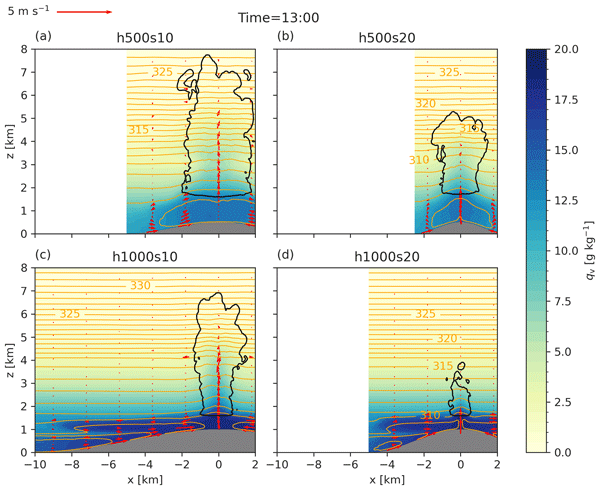
Adverse impact of terrain steepness on thermally driven initiation of orographic convection
Matthias Göbel, Stefano Serafin, and Mathias W. Rotach
Weather Clim. Dynam., 4, 725–745, https://doi.org/10.5194/wcd-4-725-2023,https://doi.org/10.5194/wcd-4-725-2023, 2023
Short summary
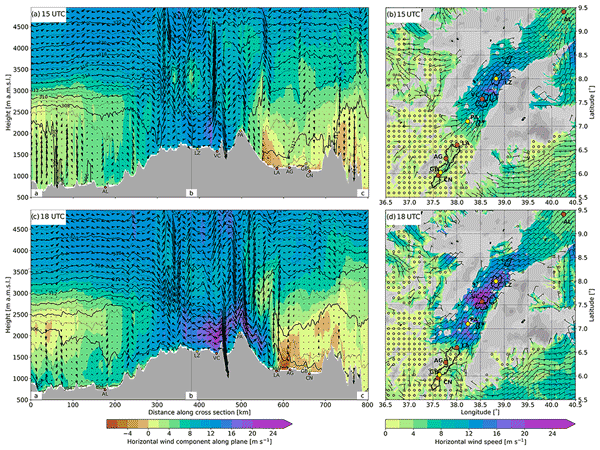
Dynamics of gap winds in the Great Rift Valley, Ethiopia: emphasis on strong winds at Lake Abaya
Cornelius Immanuel Weiß, Alexander Gohm, Mathias Walter Rotach, and Thomas Torora Minda
Weather Clim. Dynam., 3, 1003–1019, https://doi.org/10.5194/wcd-3-1003-2022,https://doi.org/10.5194/wcd-3-1003-2022, 2022
Short summary
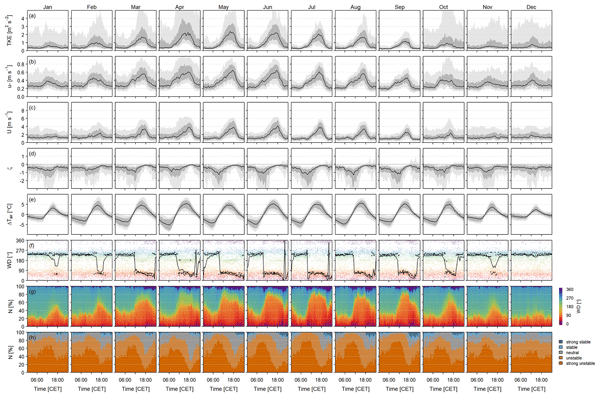
Energy and mass exchange at an urban site in mountainous terrain – the Alpine city of Innsbruck
Helen Claire Ward, Mathias Walter Rotach, Alexander Gohm, Martin Graus, Thomas Karl, Maren Haid, Lukas Umek, and Thomas Muschinski
Atmos. Chem. Phys., 22, 6559–6593, https://doi.org/10.5194/acp-22-6559-2022,https://doi.org/10.5194/acp-22-6559-2022, 2022
Short summary
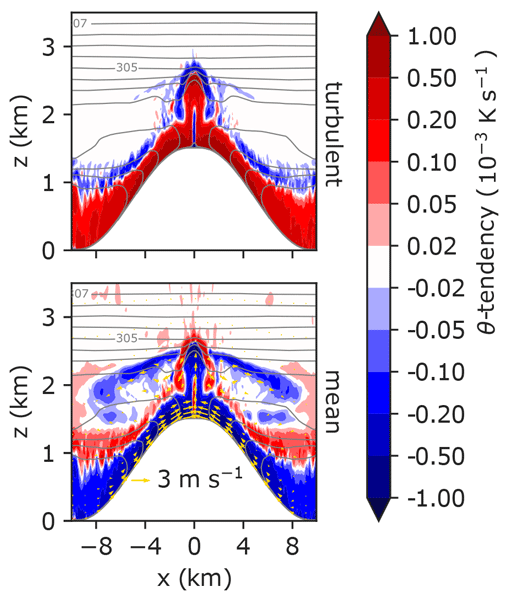
Numerically consistent budgets of potential temperature, momentum, and moisture in Cartesian coordinates: application to the WRF model
Matthias Göbel, Stefano Serafin, and Mathias W. Rotach
Geosci. Model Dev., 15, 669–681, https://doi.org/10.5194/gmd-15-669-2022,https://doi.org/10.5194/gmd-15-669-2022, 2022
Short summary
A process-based evaluation of the Intermediate Complexity Atmospheric Research Model (ICAR) 1.0.1
Johannes Horak, Marlis Hofer, Ethan Gutmann, Alexander Gohm, and Mathias W. Rotach
Geosci. Model Dev., 14, 1657–1680, https://doi.org/10.5194/gmd-14-1657-2021,https://doi.org/10.5194/gmd-14-1657-2021, 2021
Short summary

Cited articles

Abermann, J., Lambrecht, A., Fischer, A., and Kuhn, M.: Quantifying changes and trends in glacier area and volume in the Austrian Ötztal Alps (1969–1997–2006), The Cryosphere, 3, 205–215, https://doi.org/10.5194/tc-3-205-2009, 2009. a, b
Ailliot, P., Thompson, C., and Thomson, P.: Space-time modelling of precipitation by using a hidden Markov model and censored Gaussian distributions, J. Roy. Stat. Soc. Ser. C, 58, 405–426, https://doi.org/10.1111/J.1467-9876.2008.00654.X, 2009. a
Ailliot, P., Allard, D., Monbet, V., and Naveau, P.: Stochastic weather generators: An overview of weather type models, Journal de la Sociéé Française de Statistique, 156, 101–113, 2015. a
Akaike, H.: A new look at the statistical model identification, IEEE T. Automat. Control, 19, 716–723, https://doi.org/10.1109/TAC.1974.1100705, 1974. a
Apipattanavis, S., Podestá, G., Rajagopalan, B., and Katz, R. W.: A semiparametric multivariate and multisite weather generator, Water Resour. Res., 43, W11401, https://doi.org/10.1029/2006WR005714, 2007. a
Download
Short summary
Spatiotemporally consistent high-resolution precipitation data on climate are needed for climate change impact assessments, but obtaining these data is challenging for areas with complex topography. We present a model that generates synthetic gridded daily precipitation data at a 1 km spatial resolution using observed meteorological station data as input, thereby providing data where historical observations are unavailable. We evaluate this model for a mountainous region in the European Alps.
Share