Articles | Volume 26, issue 14
https://doi.org/10.5194/hess-26-3885-2022
© Author(s) 2022. This work is distributed under
the Creative Commons Attribution 4.0 License.
https://doi.org/10.5194/hess-26-3885-2022
© Author(s) 2022. This work is distributed under
the Creative Commons Attribution 4.0 License.
Inter- and intra-event rainfall partitioning dynamics of two typical xerophytic shrubs in the Loess Plateau of China
Jinxia An
State Key Laboratory of Urban and Regional Ecology, Research Center
for Eco-Environmental Sciences, Chinese Academy of Sciences, Beijing 100085, China
College of Resources and Environment, University of Chinese Academy of Sciences, Beijing 100049, China
Guangyao Gao
CORRESPONDING AUTHOR
State Key Laboratory of Urban and Regional Ecology, Research Center
for Eco-Environmental Sciences, Chinese Academy of Sciences, Beijing 100085, China
College of Resources and Environment, University of Chinese Academy of Sciences, Beijing 100049, China
National Observation and Research Station of Earth Critical Zone on
the Loess Plateau in Shaanxi, Xi'an 710061, China
Chuan Yuan
State Key Laboratory of Subtropical Silviculture, Zhejiang A&F
University, Hangzhou 311300, China
Juan Pinos
Surface Hydrology and Erosion Group, Institute of Environmental
Assessment and Water Research (IDAEA-CSIC), Barcelona 08034, Spain
Bojie Fu
State Key Laboratory of Urban and Regional Ecology, Research Center
for Eco-Environmental Sciences, Chinese Academy of Sciences, Beijing 100085, China
College of Resources and Environment, University of Chinese Academy of Sciences, Beijing 100049, China
National Observation and Research Station of Earth Critical Zone on
the Loess Plateau in Shaanxi, Xi'an 710061, China
Related authors
No articles found.
Shan Sang, Yan Li, Shuang Zong, Lu Yu, Shuai Wang, Yanxu Liu, Xutong Wu, Shuang Song, Wenwu Zhao, Xuhui Wang, and Bojie Fu
EGUsphere, https://doi.org/10.5194/egusphere-2025-5597, https://doi.org/10.5194/egusphere-2025-5597, 2025
This preprint is open for discussion and under review for Geoscientific Model Development (GMD).
Short summary
Short summary
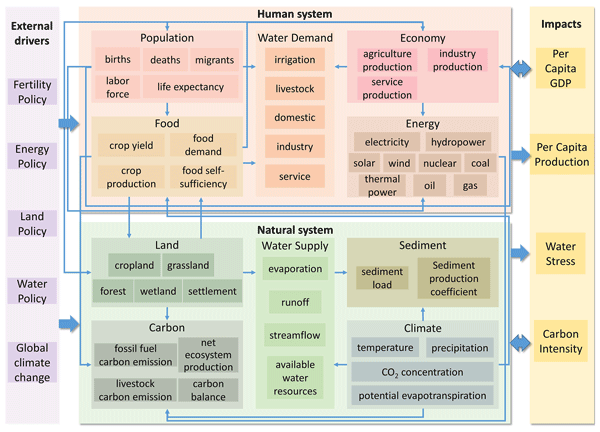
Regional coupled human–natural systems models are essential for regional sustainability. We developed a new model, CHANS-SD-YRB, using System Dynamics for the Yellow River Basin in China, which faces severe human-water conflicts. The model links 10 components, including Population, Economy, Energy, Food, Water, Sediment, Land, Carbon, and Climate to simulate basin’s key human-natural interactions. The model is applicable for sustainable development through scenario analyses and predictions.
Yichu Huang, Xiaoming Feng, Chaowei Zhou, and Bojie Fu
EGUsphere, https://doi.org/10.5194/egusphere-2024-3393, https://doi.org/10.5194/egusphere-2024-3393, 2024
Preprint archived
Short summary
Short summary
This study uses an integrated water-energy-land optimization model to explore sustainable water use pathways in the Yellow River Basin. We find water conflicts between energy and irrigation water use, and quantify the mitigation and spillover effects of water transfer. We also highlight the critical role of energy production, implying that the energy sector transformation is key to the water system of the Yellow River Basin.
Nannan An, Nan Lu, Weiliang Chen, Yongzhe Chen, Hao Shi, Fuzhong Wu, and Bojie Fu
Earth Syst. Sci. Data, 16, 1771–1810, https://doi.org/10.5194/essd-16-1771-2024, https://doi.org/10.5194/essd-16-1771-2024, 2024
Short summary
Short summary
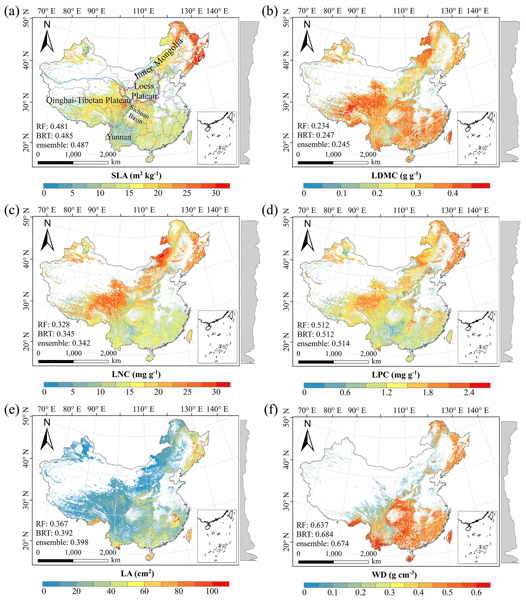
This study generated a spatially continuous plant functional trait dataset (~1 km) in China in combination with field observations, environmental variables and vegetation indices using machine learning methods. Results showed that wood density, leaf P concentration and specific leaf area showed good accuracy with an average R2 of higher than 0.45. This dataset could provide data support for development of Earth system models to predict vegetation distribution and ecosystem functions.
Juan Pinos, Markus Flury, Jérôme Latron, and Pilar Llorens
Hydrol. Earth Syst. Sci., 27, 2865–2881, https://doi.org/10.5194/hess-27-2865-2023, https://doi.org/10.5194/hess-27-2865-2023, 2023
Short summary
Short summary
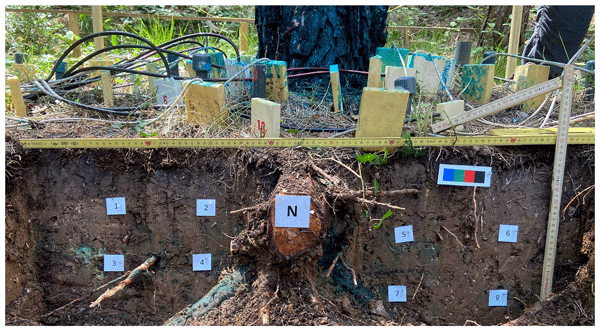
We investigated how stemflow (intercepted rainwater by the tree crown that travels down the stem) infiltrates within the soil. We simulated stemflow, applying coloured water along a tree trunk. Coloured patterns, observed when we excavated the soil after the experiment, were used to view and quantify preferential flow in the soil. We found that stemflow was mainly funnelled belowground along tree roots and macropores. Soil moisture near the trunk was affected both vertically and horizontally.
Yongzhe Chen, Xiaoming Feng, Bojie Fu, Haozhi Ma, Constantin M. Zohner, Thomas W. Crowther, Yuanyuan Huang, Xutong Wu, and Fangli Wei
Earth Syst. Sci. Data, 15, 897–910, https://doi.org/10.5194/essd-15-897-2023, https://doi.org/10.5194/essd-15-897-2023, 2023
Short summary
Short summary
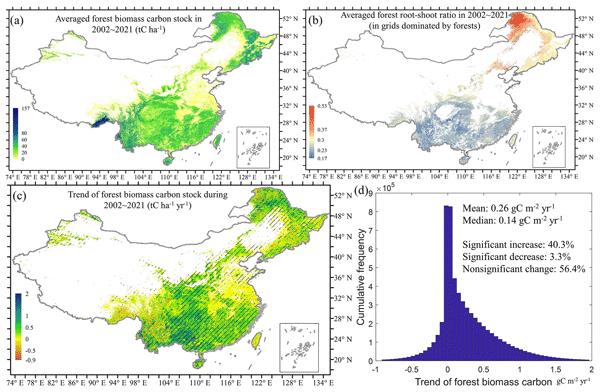
This study presented a long-term (2002–2021) above- and belowground biomass dataset for woody vegetation in China at 1 km resolution. It was produced by combining various types of remote sensing observations with adequate plot measurements. Over 2002–2021, China’s woody biomass increased at a high rate, especially in the central and southern parts. This dataset can be applied to evaluate forest carbon sinks across China and the efficiency of ecological restoration programs in China.
Shuang Song, Shuai Wang, Xutong Wu, Yongyuan Huang, and Bojie Fu
Hydrol. Earth Syst. Sci., 26, 2035–2044, https://doi.org/10.5194/hess-26-2035-2022, https://doi.org/10.5194/hess-26-2035-2022, 2022
Short summary
Short summary
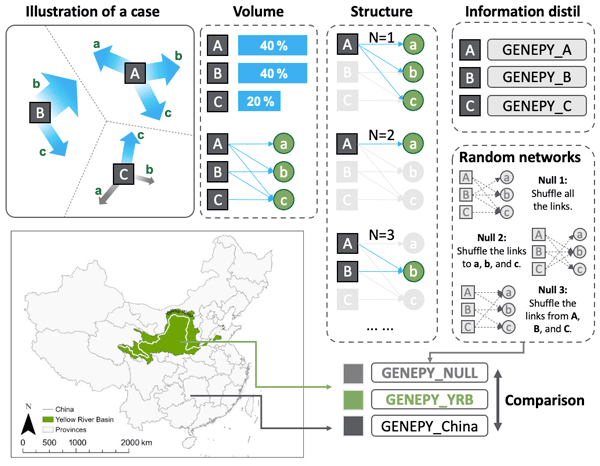
A reasonable assessment of the contribution of the water resources in a river basin to domestic crops supplies will be the first step in balancing the water–food nexus. Our results showed that although the Yellow River basin had reduced its virtual water outflow, its importance to crop production in China had been increasing when water footprint networks were considered. Our complexity-based approach provides a new perspective for understanding changes in a basin with a severe water shortage.
Bojie Fu, Xutong Wu, Zhuangzhuang Wang, Xilin Wu, and Shuai Wang
Earth Syst. Dynam., 13, 795–808, https://doi.org/10.5194/esd-13-795-2022, https://doi.org/10.5194/esd-13-795-2022, 2022
Short summary
Short summary
To understand the dynamics of a coupled human and natural system (CHANS) and promote its sustainability, we propose a conceptual
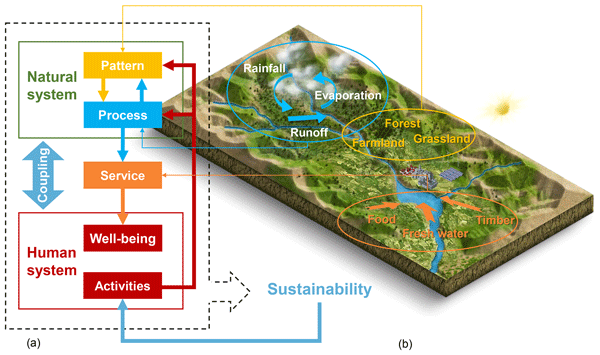
pattern–process–service–sustainabilitycascade framework. The use of this framework is systematically illustrated by a review of CHANS research experience in China's Loess Plateau in terms of coupling landscape patterns and ecological processes, linking ecological processes to ecosystem services, and promoting social–ecological sustainability.
Maierdang Keyimu, Zongshan Li, Bojie Fu, Guohua Liu, Fanjiang Zeng, Weiliang Chen, Zexin Fan, Keyan Fang, Xiuchen Wu, and Xiaochun Wang
Clim. Past, 17, 2381–2392, https://doi.org/10.5194/cp-17-2381-2021, https://doi.org/10.5194/cp-17-2381-2021, 2021
Short summary
Short summary
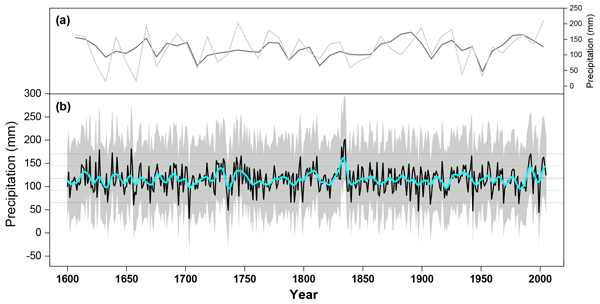
We created a residual tree-ring width chronology and reconstructed non-growth-season precipitation (NGSP) over the period spanning 1600–2005 in the southeastern Tibetan Plateau (SETP), China. Reconstruction model verification as well as similar variations of NGSP reconstruction and Palmer Drought Severity Index reconstructions from the surrounding region indicate the reliability of the present reconstruction. Our reconstruction is representative of NGSP variability of a large region in the SETP.
Xuejing Leng, Xiaoming Feng, Bojie Fu, and Yu Zhang
Hydrol. Earth Syst. Sci. Discuss., https://doi.org/10.5194/hess-2021-377, https://doi.org/10.5194/hess-2021-377, 2021
Manuscript not accepted for further review
Short summary
Short summary
At present, there is a lack of time series of runoff generated by glacial regions in the world. In this paper, we quantified glacial runoff (including meltwater runoff and delayed runoff) in arid regions of China from 1961 to 2015 by using remote sensing datasets of glacier mass balance with high resolution. Glacier runoff is the water resource used by oases in arid regions of China. The long-term glacial runoff data can indicate the climate risk faced by different basins in arid regions.
Yongzhe Chen, Xiaoming Feng, and Bojie Fu
Earth Syst. Sci. Data, 13, 1–31, https://doi.org/10.5194/essd-13-1-2021, https://doi.org/10.5194/essd-13-1-2021, 2021
Short summary
Short summary
Soil moisture can greatly influence the ecosystem but is hard to monitor at the global scale. By calibrating and combining 11 different products derived from satellite observation, we developed a new global surface soil moisture dataset spanning from 2003 to 2018 with high accuracy. Using this new dataset, not only can the global long-term trends be derived, but also the seasonal variation and spatial distribution of surface soil moisture at different latitudes can be better studied.
Cited articles
Cayuela, C., Llorens, P., Sanchez-Costa, E., Levia, D. F., and Latron, J.:
Effect of biotic and abiotic factors on inter- and intra-event variability
in stemflow rates in oak and pine stands in a Mediterranean mountain area,
J. Hydrol., 560, 396–406, 2018.
Chao, P. N. and Gong, G. T.: Salix (Salicaceae), in: Flora of China, edited by: Wu, Z. Y.,
Raven, P. H., and Hong, D. Y., Science Press, Beijing and Missouri Botanical
Garden Press, St. Louis, 162–274, http://www.iplant.cn/info/Salix?t=foc (last access: 21 July 2022), 1999.
Chesson, P., Gebauer, R. L., Schwinning, S., Huntly, N., Wiegand, K.,
Ernest, M. S., Sher, A., Novoplansky, A., and Weltzin, J. F.: Resource
pulses, species interactions, and diversity maintenance in arid and
semi-arid environments, Oecologia, 141, 236–253, 2004.
Chu, X., Han, G., Xing, Q., Xia, J., Sun, B., Yu, J. B., and Li, D.: Dual
effect of precipitation redistribution on net ecosystem CO2 exchange of
a coastal wetland in the Yellow River Delta, Agr. Forest Meteorol., 249,
286–296, 2018.
Dunkerley, D.: Stemflow production and intrastorm rainfall intensity
variation: an experimental analysis using laboratory rainfall simulation,
Earth. Surf. Proc. Land., 39, 1741–1752, 2014.
Garcia-Estringana, P., Alonso-Blázquez, N., and Alegre, J.: Water
storage capacity, stemflow and water funneling in Mediterranean shrubs, J.
Hydrol., 389, 363–372, 2010.
Germer, S., Werther, L., and Elsenbeer, H.: Have we underestimated stemflow?
Lessons from an open tropical rainforest, J. Hydrol., 395, 169–179, 2010.
Gordon, D. A. R., Coenders-Gerrits, M., Sellers, B. A., Sadeghi, S. M. M., and Van Stan II, J. T.: Rainfall interception and redistribution by a common North American understory and pasture forb, Eupatorium capillifolium (Lam. dogfennel), Hydrol. Earth Syst. Sci., 24, 4587–4599, https://doi.org/10.5194/hess-24-4587-2020, 2020.
Hanchi, A. and Rapp, M.: Stemflow determination in forest stands, Forest
Ecol. Manag., 97, 231-235, 1997.
Honda, E. A., Mendonça, A. H., and Durigan, G.: Factors affecting the
stemflow of trees in the Brazilian Cerrado, Ecohydrology, 8, 1351–1362,
2015.
Iida, S., Shimizu, T., Kabeya, N., Nobuhiro, T., Tamai, K., Shimizu, A.,
Ito, E., Ohnuki, Y., Abe, T., Tsuboyama, Y., Chann, S., and Keth, N.:
Calibration of tipping-bucket flow meters and rain gauges to measure gross
rainfall, throughfall, and stemflow applied to data from a Japanese
temperate coniferous forest and a Cambodian tropical deciduous forest,
Hydrol. Process., 26, 2445–2454, 2012.
Jia, X., Zha, T. S., Gong, J. N., Wang, B., Zhang, Y. Q., Wu, B., Qin, S.
G., and Peltola, H.: Carbon and water exchange over a temperate semi-arid
shrubland during three years of contrasting precipitation and soil moisture
patterns, Agr. Forest Meteorol., 228, 120–129, 2016.
Jia, X. X., Shao, M. A., Wei, X. R., and Wang, Y. Q.: Hillslope scale
temporal stability of soil water storage in diverse soil layers, J. Hydrol.,
498, 254–264, 2013.
Jian, S. Q., Hu, C. H., Zhang, G. D., and Zhang, J. P.: Study on the
throughfall, stemflow, and interception of two shrubs in the semiarid Loess
region of China, Agr. Forest Meteorol., 279, 107713, https://doi.org/10.1016/j.agrformet.2019.107713, 2019.
Lacombe, G., Valentin, C., Sounyafong, P., de Rouw, A., Soulileuth, B.,
Silvera, N., Pierret, A., Sengtaheuanghoung, O., and Ribolzi, O.: Linking
crop structure, throughfall, soil surface conditions, runoff and soil
detachment: 10 land uses analyzed in Northern Laos, Sci. Total Environ.,
616–617, 1330–1338, 2018.
Levia, D. F. and Frost, E. E.: A review and evaluation of stemflow
literature in the hydrologic and biogeochemical cycles of forested and
agricultural ecosystems, J. Hydrol., 274, 1–29, 2003.
Levia, D. F. and Germer, S.: A review of stemflow generation dynamics and
stemflow-environment interactions in forests and shrublands, Rev. Geophys.,
53, 673–714, 2015.
Levia, D. F. and Herwitz, S. R.: Interspecific variation of bark water
storage capacity of three deciduous tree species in relation to stemflow
yield and solute flux to forest soils, Catena, 64, 117–137, 2005.
Levia, D. F., Van Stan II, J. T., Mage, S. M., and Kelley-Hauske, P. W.:
Temporal variability of stemflow volume in a beech-yellow poplar forest in
relation to tree species and size, J. Hydrol., 380, 112–120, 2010.
Levia, D. F., Hudson, S. A., Llorens, P., and Nanko, K.: Throughfall drop size
distributions: a review and prospectus for future research, WIREs Water, 4, e1225, https://doi.org/10.1002/wat2.1225,
2017.
Li, X., Xiao, Q. F., Niu, J. Z., Dymond, S., van Doorn, N. S., Yu, X. X.,
Xie, B. Y., Lv, X. Z., Zhang, K. B., and Li, J.: Process-based rainfall
interception by small trees in Northern China: The effect of rainfall traits
and crown structure characteristics, Agr. Forest Meteorol., 218–219, 65–73,
2016.
Liu, Y. X., Chang, Z. Y., and Gennady, P. Y.: Caragana (Fabaceae), in: Flora of China, edited
by: Wu, Z. Y., Raven, P. H., and Hong, D. Y., Science Press, Beijing and
Missouri Botanical Garden Press, St. Louis, 528–545, http://www.iplant.cn/info/Caragana?t=foc (last access: 21 July 2022), 2010.
Llorens, P. and Domingo, F.: Rainfall partitioning by vegetation under
Mediterranean conditions. A review of studies in Europe, J. Hydrol., 335,
37–54, 2007.
Magliano, P. N., Whitworth-Hulse, J. I., and Baldi, G.: Interception,
throughfall and stemflow partition in drylands: Global synthesis and
meta-analysis, J. Hydrol., 568, 638–645, 2019a.
Magliano, P. N., Whitworth-Hulse, J. I., Florio, E. L., Aguirre, E. C., and
Blanco, L. J.: Interception loss, throughfall and stemflow by Larrea
divaricata: The role of rainfall characteristics and plant morphological
attributes, Ecol. Res., 34, 753–764, 2019b.
Martinez-Meza, E. and Whitford, W. G.: Stemflow, throughfall and channelization
of stemflow by roots in three Chihuahuan desert shrubs, J. Arid Environ.,
32, 271–287, 1996.
Molina, A. J., Llorens, P., Garcia-Estringana, P., Moreno de Las Heras, M.,
Cayuela, C., Gallart, F., and Latron, J.: Contributions of throughfall,
forest and soil characteristics to near-surface soil water-content
variability at the plot scale in a mountainous Mediterranean area, Sci.
Total Environ., 647, 1421–1432, 2019.
Owens, M. K., Lyons, R. K., and Alejandro, C. L.: Rainfall partitioning
within semiarid juniper communities: effects of event size and canopy cover,
Hydrol. Process., 20, 3179–3189, 2006.
Pinos, J., Latron, J., Levia, D. F., and Llorens, P.: Drivers of the
circumferential variation of stemflow inputs on the boles of Pinus sylvestris L. (Scots pine), Ecohydrology, 14, e2348, https://doi.org/10.1002/eco.2348, 2021.
Rivera, D. N. and Van Stan II, J. T.: Grand theft hydro? Stemflow
interception and redirection by neighbouring Tradescantia ohiensis Raf.
(spiderwort) plants, Ecohydrology, 13, e2239, https://doi.org/10.1002/eco.2239, 2020.
Sadeghi, S. M. M., Gordon, D. A., and Van Stan II, J. T.: A Global Synthesis
of Throughfall and Stemflow Hydrometeorology, in: Precipitation Partitioning by Vegetation,
edited by: Van Stan II, J. T.,
Gutmann, E., and Friesen, J., Springer Nature Switzerland, Cham, 49–70, https://doi.org/10.1007/978-3-030-29702-2_4, 2020.
Soulsby, C., Braun, H., Sprenger, M., Weiler, M., and Tetzlaff, D.:
Influence of forest and shrub canopies on precipitation partitioning and
isotopic signatures, Hydrol. Process., 31, 4282–4296, 2017.
Spencer, S. A. and van Meerveld, H. J.: Double funnelling in a mature
coastal British Columbia Forest: spatial patterns of stemflow after
infiltration, Hydrol. Process., 30, 4185–4201, 2016.
Staelens, J., De Schrijver, A., Verheyen, K., and Verhoest, N.E.C.: Rainfall
partitioning into throughfall, stemflow, and interception within a single
beech (Fagus sylvatica L.) canopy: influence of foliation, rain event
characteristics, and meteorology, Hydrol. Process., 22, 33–45, 2008.
Tonello, K. C., Rosa, A. G., Pereira, L. C., Matus, G. N., Guandique, M. E.
G., and Navarrete, A. A.: Rainfall partitioning in the Cerrado and its
influence on net rainfall nutrient fluxes, Agr. Forest Meteorol., 303,
108372, https://doi.org/10.1016/j.agrformet.2021.108372, 2021.
Van Stan II, J. T., Wagner, S., Guillemette, F., Whitetree, A., Lewis, J.,
Silva, L., and Stubbins, A.: Temporal dynamics in the concentration, flux,
and optical properties of tree-derived dissolved organic matter in an
epiphyte-laden oak-cedar forest, J. Geophys. Res.-Biogeo., 122,
2982–2997, 2017.
Van Stan II, J. T., Gutmann, E., and Friesen, J. (Eds.): Precipitation
Partitioning by Vegetation – A Global Synthesis, Precipitation
Partitioning by Vegetation, Springer Nature Switzerland, https://doi.org/10.1007/978-3-030-29702-2, 2020.
Wang, X.-P., Wang, Z.-N., Berndtsson, R., Zhang, Y.-F., and Pan, Y.-X.: Desert shrub stemflow and its significance in soil moisture replenishment, Hydrol. Earth Syst. Sci., 15, 561–567, https://doi.org/10.5194/hess-15-561-2011, 2011.
Wang, X. P., Zhang, Y. F., Hu, R., Pan, Y. X., and Berndtsson, R.: Canopy
storage capacity of xerophytic shrubs in Northwestern China, J. Hydrol.,
454, 152–159, 2012.
Whitworth-Hulse, J. I., Magliano, P. N., Zeballos, S. R., Gurvich, D. E.,
Spalazzi, F., and Kowaljow, E.: Advantages of rainfall partitioning by the
global invader Ligustrum lucidum over the dominant native Lithraea
molleoides in a dry forest, Agr. Forest Meteorol., 290, 108013, https://doi.org/10.1016/j.agrformet.2020.108013, 2020a.
Whitworth-Hulse, J. I., Magliano, P. N., Zeballos, S. R., Aguiar, S., and
Baldi, G.: Global patterns of rainfall partitioning by invasive woody
plants, Global Ecol. Biogeogr., 30, 235–246, 2020b.
Xiao-Yan Li, Zhi-Peng Yang, Yue-Tan Li, and Henry Lin: Connecting ecohydrology and hydropedology in desert shrubs: stemflow as a source of preferential flow in soils, Hydrol. Earth Syst. Sci., 13, 1133–1144, https://doi.org/10.5194/hess-13-1133-2009, 2009.
Xu, H. and Li, Y.: Water-use strategy of three central Asian desert shrubs
and their responses to rain pulse events, Plant Soil, 285, 5–17, 2006.
Yang, X. L., Shao, M. A., and Wei, X. R.: Stemflow production differ
significantly among tree and shrub species on the Chinese Loess Plateau, J.
Hydrol., 568, 427–436, 2019.
Yuan, C., Gao, G. Y., and Fu, B. J.: Stemflow of a xerophytic shrub (Salix psammophila) in northern China: Implication for beneficial branch
architecture to produce stemflow, J. Hydrol., 539, 577–588, 2016.
Yuan, C., Gao, G., and Fu, B.: Comparisons of stemflow and its bio-/abiotic influential factors between two xerophytic shrub species, Hydrol. Earth Syst. Sci., 21, 1421–1438, https://doi.org/10.5194/hess-21-1421-2017, 2017.
Yuan, C., Gao, G., Fu, B., He, D., Duan, X., and Wei, X.: Temporally dependent effects of rainfall characteristics on inter- and intra-event branch-scale stemflow variability in two xerophytic shrubs, Hydrol. Earth Syst. Sci., 23, 4077–4095, https://doi.org/10.5194/hess-23-4077-2019, 2019.
Yue, K., De Frenne, P., Fornara, D. A., Van Meerbeek, K., Li, W., Peng, X.,
Ni, X., Peng, Y., Wu, F., Yang, Y., and Penuelas, J.: Global patterns and
drivers of rainfall partitioning by trees and shrubs, Glob. Change Biol., 27,
3350–3357, 2021.
Zhang, H., Fu, C., Liao, A., Zhang, C., Liu, J., Wang, N., and He, B.:
Exploring the stemflow dynamics and driving factors at both inter- and
intra-event scales in a typical subtropical deciduous forest, Hydrol.
Process., 35, e14091, https://doi.org/10.1002/hyp.14091, 2021.
Zhang, Y., Li, X. Y., Li, W., Wu, X. C., Shi, F. Z., Fang, W. W., and Pei,
T. T.: Modeling rainfall interception loss by two xerophytic shrubs in the
Loess Plateau, Hydrol. Process., 31, 1926–1937, 2017.
Zhang, Y. F., Wang, X. P., Pan, Y. X., and Hu, R.: Variations of nutrients
in gross rainfall, stemflow, and throughfall within revegetated desert
ecosystems, Water Air Soil Pollut., 227, 183, https://doi.org/10.1007/s11270-016-2878-z, 2016.
Zhang, Y. F., Wang, X. P., Hu, R., and Pan, Y. X.: Meteorological influences
on process-based spatial-temporal pattern of throughfall of a xerophytic
shrub in arid lands of northern China, Sci. Total Environ., 619–620,
1003–1013, 2018.
Zhang, Y. F., Wang, X. P., Pan, Y. X., Hu, R., Chen, N., and Sandel, R. O.:
Global quantitative synthesis of effects of biotic and abiotic factors on
stemflow production in woody ecosystems, Global Ecol. Biogeogr., 30,
1713–1723, 2021.
Short summary
An in-depth investigation was conducted of all rainfall-partitioning components at inter- and intra-event scales for two xerophytic shrubs. Inter-event rainfall partitioning amount and percentage depended more on rainfall amount, and rainfall intensity and duration controlled intra-event rainfall-partitioning variables. One shrub has larger branch angle, small branch and smaller canopy area to produce stemflow more efficiently, and the other has larger biomass to intercept more rainfall.
An in-depth investigation was conducted of all rainfall-partitioning components at inter- and...