Articles | Volume 26, issue 10
https://doi.org/10.5194/hess-26-2605-2022
© Author(s) 2022. This work is distributed under
the Creative Commons Attribution 4.0 License.
https://doi.org/10.5194/hess-26-2605-2022
© Author(s) 2022. This work is distributed under
the Creative Commons Attribution 4.0 License.
Recent hydrological response of glaciers in the Canadian Rockies to changing climate and glacier configuration
Dhiraj Pradhananga
CORRESPONDING AUTHOR
Centre for Hydrology, University of Saskatchewan, 1151 Sidney Street, Canmore, Alberta T1W 3G1, Canada
Department of Meteorology, Tri-Chandra Multiple Campus, Tribhuvan University, Kathmandu, Nepal
The Small Earth Nepal, P.O. Box 20533, Kathmandu, Nepal
John W. Pomeroy
Centre for Hydrology, University of Saskatchewan, 1151 Sidney Street, Canmore, Alberta T1W 3G1, Canada
Related authors
Dhiraj Pradhananga, John W. Pomeroy, Caroline Aubry-Wake, D. Scott Munro, Joseph Shea, Michael N. Demuth, Nammy Hang Kirat, Brian Menounos, and Kriti Mukherjee
Earth Syst. Sci. Data, 13, 2875–2894, https://doi.org/10.5194/essd-13-2875-2021, https://doi.org/10.5194/essd-13-2875-2021, 2021
Short summary
Short summary
This paper presents hydrological, meteorological, glaciological and geospatial data of Peyto Glacier Basin in the Canadian Rockies. They include high-resolution DEMs derived from air photos and lidar surveys and long-term hydrological and glaciological model forcing datasets derived from bias-corrected reanalysis products. These data are crucial for studying climate change and variability in the basin and understanding the hydrological responses of the basin to both glacier and climate change.
André Bertoncini and John W. Pomeroy
Hydrol. Earth Syst. Sci., 29, 983–1000, https://doi.org/10.5194/hess-29-983-2025, https://doi.org/10.5194/hess-29-983-2025, 2025
Short summary
Short summary
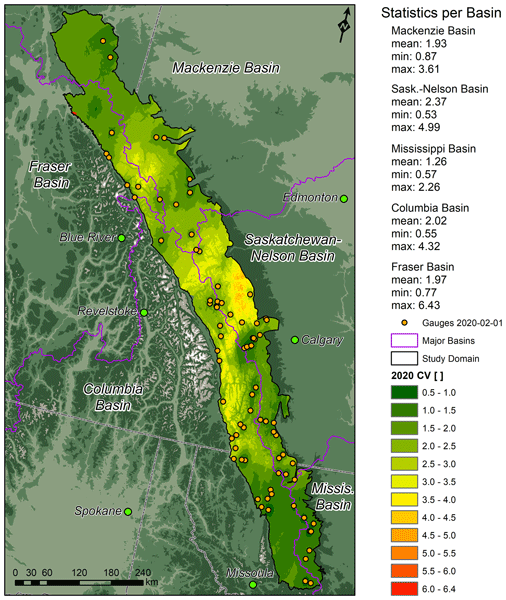
Rainfall and snowfall spatial estimation for hydrological purposes is often compromised in cold mountain regions due to inaccessibility, creating sparse gauge networks with few high-elevation gauges. This study developed a framework for quantifying gauge network uncertainty, considering elevation to aid in future gauge placement in mountain regions. Results show that gauge placement above 2000 m is the most cost-effective measure to decrease gauge network uncertainty in the Canadian Rockies.
Kevin R. Shook, Paul H. Whitfield, Christopher Spence, and John W. Pomeroy
Hydrol. Earth Syst. Sci., 28, 5173–5192, https://doi.org/10.5194/hess-28-5173-2024, https://doi.org/10.5194/hess-28-5173-2024, 2024
Short summary
Short summary
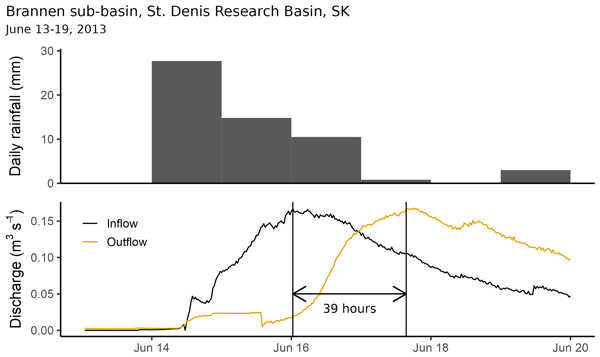
Recent studies suggest that the velocities of water running off landscapes in the Canadian Prairies may be much smaller than generally assumed. Analyses of historical flows for 23 basins in central Alberta show that many of the rivers responded more slowly and that the flows are much slower than would be estimated from equations developed elsewhere. The effects of slow flow velocities on the development of hydrological models of the region are discussed, as are the possible causes.
Phillip Harder, Warren D. Helgason, and John W. Pomeroy
The Cryosphere, 18, 3277–3295, https://doi.org/10.5194/tc-18-3277-2024, https://doi.org/10.5194/tc-18-3277-2024, 2024
Short summary
Short summary
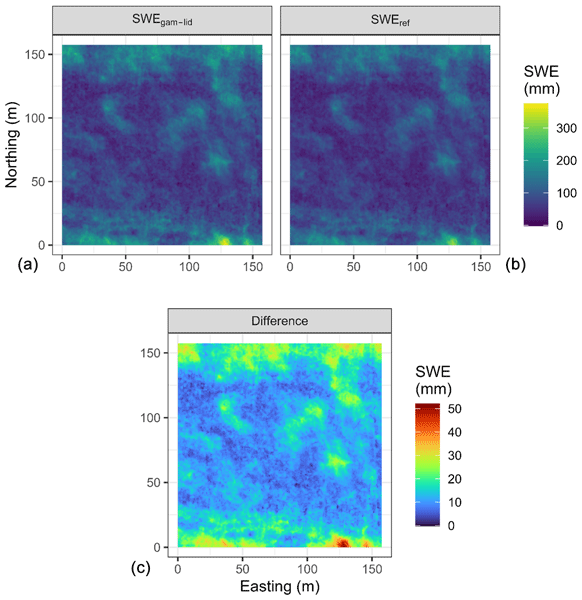
Remote sensing the amount of water in snow (SWE) at high spatial resolutions is an unresolved challenge. In this work, we tested a drone-mounted passive gamma spectrometer to quantify SWE. We found that the gamma observations could resolve the average and spatial variability of SWE down to 22.5 m resolutions. Further, by combining drone gamma SWE and lidar snow depth we could estimate SWE at sub-metre resolutions which is a new opportunity to improve the measurement of shallow snowpacks.
Mazda Kompanizare, Diogo Costa, Merrin L. Macrae, John W. Pomeroy, and Richard M. Petrone
Hydrol. Earth Syst. Sci., 28, 2785–2807, https://doi.org/10.5194/hess-28-2785-2024, https://doi.org/10.5194/hess-28-2785-2024, 2024
Short summary
Short summary
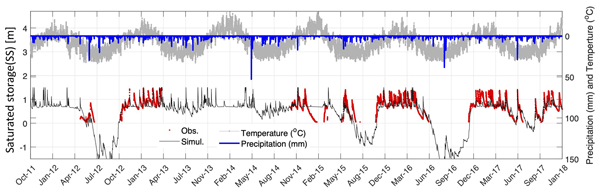
A new agricultural tile drainage module was developed in the Cold Region Hydrological Model platform. Tile flow and water levels are simulated by considering the effect of capillary fringe thickness, drainable water and seasonal regional groundwater dynamics. The model was applied to a small well-instrumented farm in southern Ontario, Canada, where there are concerns about the impacts of agricultural drainage into Lake Erie.
Zhihua He, Kevin Shook, Christopher Spence, John W. Pomeroy, and Colin Whitfield
Hydrol. Earth Syst. Sci., 27, 3525–3546, https://doi.org/10.5194/hess-27-3525-2023, https://doi.org/10.5194/hess-27-3525-2023, 2023
Short summary
Short summary
This study evaluated the impacts of climate change on snowmelt, soil moisture, and streamflow over the Canadian Prairies. The entire prairie region was divided into seven basin types. We found strong variations of hydrological sensitivity to precipitation and temperature changes in different land covers and basins, which suggests that different water management and adaptation methods are needed to address enhanced water stress due to expected climate change in different regions of the prairies.
Marcos R. C. Cordeiro, Kang Liang, Henry F. Wilson, Jason Vanrobaeys, David A. Lobb, Xing Fang, and John W. Pomeroy
Hydrol. Earth Syst. Sci., 26, 5917–5931, https://doi.org/10.5194/hess-26-5917-2022, https://doi.org/10.5194/hess-26-5917-2022, 2022
Short summary
Short summary
This study addresses the issue of increasing interest in the hydrological impacts of converting cropland to perennial forage cover in the Canadian Prairies. By developing customized models using the Cold Regions Hydrological Modelling (CRHM) platform, this long-term (1992–2013) modelling study is expected to provide stakeholders with science-based information regarding the hydrological impacts of land use conversion from annual crop to perennial forage cover in the Canadian Prairies.
Christopher Spence, Zhihua He, Kevin R. Shook, John W. Pomeroy, Colin J. Whitfield, and Jared D. Wolfe
Hydrol. Earth Syst. Sci., 26, 5555–5575, https://doi.org/10.5194/hess-26-5555-2022, https://doi.org/10.5194/hess-26-5555-2022, 2022
Short summary
Short summary
We learnt how streamflow from small creeks could be altered by wetland removal in the Canadian Prairies, where this practice is pervasive. Every creek basin in the region was placed into one of seven groups. We selected one of these groups and used its traits to simulate streamflow. The model worked well enough so that we could trust the results even if we removed the wetlands. Wetland removal did not change low flow amounts very much, but it doubled high flow and tripled average flow.
Christopher Spence, Zhihua He, Kevin R. Shook, Balew A. Mekonnen, John W. Pomeroy, Colin J. Whitfield, and Jared D. Wolfe
Hydrol. Earth Syst. Sci., 26, 1801–1819, https://doi.org/10.5194/hess-26-1801-2022, https://doi.org/10.5194/hess-26-1801-2022, 2022
Short summary
Short summary
We determined how snow and flow in small creeks change with temperature and precipitation in the Canadian Prairie, a region where water resources are often under stress. We tried something new. Every watershed in the region was placed in one of seven groups based on their landscape traits. We selected one of these groups and used its traits to build a model of snow and streamflow. It worked well, and by the 2040s there may be 20 %–40 % less snow and 30 % less streamflow than the 1980s.
Dhiraj Pradhananga, John W. Pomeroy, Caroline Aubry-Wake, D. Scott Munro, Joseph Shea, Michael N. Demuth, Nammy Hang Kirat, Brian Menounos, and Kriti Mukherjee
Earth Syst. Sci. Data, 13, 2875–2894, https://doi.org/10.5194/essd-13-2875-2021, https://doi.org/10.5194/essd-13-2875-2021, 2021
Short summary
Short summary
This paper presents hydrological, meteorological, glaciological and geospatial data of Peyto Glacier Basin in the Canadian Rockies. They include high-resolution DEMs derived from air photos and lidar surveys and long-term hydrological and glaciological model forcing datasets derived from bias-corrected reanalysis products. These data are crucial for studying climate change and variability in the basin and understanding the hydrological responses of the basin to both glacier and climate change.
Paul H. Whitfield, Philip D. A. Kraaijenbrink, Kevin R. Shook, and John W. Pomeroy
Hydrol. Earth Syst. Sci., 25, 2513–2541, https://doi.org/10.5194/hess-25-2513-2021, https://doi.org/10.5194/hess-25-2513-2021, 2021
Short summary
Short summary
Using only warm season streamflow records, regime and change classifications were produced for ~ 400 watersheds in the Nelson and Mackenzie River basins, and trends in water storage and vegetation were detected from satellite imagery. Three areas show consistent changes: north of 60° (increased streamflow and basin greenness), in the western Boreal Plains (decreased streamflow and basin greenness), and across the Prairies (three different patterns of increased streamflow and basin wetness).
Chris M. DeBeer, Howard S. Wheater, John W. Pomeroy, Alan G. Barr, Jennifer L. Baltzer, Jill F. Johnstone, Merritt R. Turetsky, Ronald E. Stewart, Masaki Hayashi, Garth van der Kamp, Shawn Marshall, Elizabeth Campbell, Philip Marsh, Sean K. Carey, William L. Quinton, Yanping Li, Saman Razavi, Aaron Berg, Jeffrey J. McDonnell, Christopher Spence, Warren D. Helgason, Andrew M. Ireson, T. Andrew Black, Mohamed Elshamy, Fuad Yassin, Bruce Davison, Allan Howard, Julie M. Thériault, Kevin Shook, Michael N. Demuth, and Alain Pietroniro
Hydrol. Earth Syst. Sci., 25, 1849–1882, https://doi.org/10.5194/hess-25-1849-2021, https://doi.org/10.5194/hess-25-1849-2021, 2021
Short summary
Short summary
This article examines future changes in land cover and hydrological cycling across the interior of western Canada under climate conditions projected for the 21st century. Key insights into the mechanisms and interactions of Earth system and hydrological process responses are presented, and this understanding is used together with model application to provide a synthesis of future change. This has allowed more scientifically informed projections than have hitherto been available.
Julie M. Thériault, Stephen J. Déry, John W. Pomeroy, Hilary M. Smith, Juris Almonte, André Bertoncini, Robert W. Crawford, Aurélie Desroches-Lapointe, Mathieu Lachapelle, Zen Mariani, Selina Mitchell, Jeremy E. Morris, Charlie Hébert-Pinard, Peter Rodriguez, and Hadleigh D. Thompson
Earth Syst. Sci. Data, 13, 1233–1249, https://doi.org/10.5194/essd-13-1233-2021, https://doi.org/10.5194/essd-13-1233-2021, 2021
Short summary
Short summary
This article discusses the data that were collected during the Storms and Precipitation Across the continental Divide (SPADE) field campaign in spring 2019 in the Canadian Rockies, along the Alberta and British Columbia border. Various instruments were installed at five field sites to gather information about atmospheric conditions focussing on precipitation. Details about the field sites, the instrumentation used, the variables collected, and the collection methods and intervals are presented.
Vincent Vionnet, Christopher B. Marsh, Brian Menounos, Simon Gascoin, Nicholas E. Wayand, Joseph Shea, Kriti Mukherjee, and John W. Pomeroy
The Cryosphere, 15, 743–769, https://doi.org/10.5194/tc-15-743-2021, https://doi.org/10.5194/tc-15-743-2021, 2021
Short summary
Short summary
Mountain snow cover provides critical supplies of fresh water to downstream users. Its accurate prediction requires inclusion of often-ignored processes. A multi-scale modelling strategy is presented that efficiently accounts for snow redistribution. Model accuracy is assessed via airborne lidar and optical satellite imagery. With redistribution the model captures the elevation–snow depth relation. Redistribution processes are required to reproduce spatial variability, such as around ridges.
Richard Essery, Hyungjun Kim, Libo Wang, Paul Bartlett, Aaron Boone, Claire Brutel-Vuilmet, Eleanor Burke, Matthias Cuntz, Bertrand Decharme, Emanuel Dutra, Xing Fang, Yeugeniy Gusev, Stefan Hagemann, Vanessa Haverd, Anna Kontu, Gerhard Krinner, Matthieu Lafaysse, Yves Lejeune, Thomas Marke, Danny Marks, Christoph Marty, Cecile B. Menard, Olga Nasonova, Tomoko Nitta, John Pomeroy, Gerd Schädler, Vladimir Semenov, Tatiana Smirnova, Sean Swenson, Dmitry Turkov, Nander Wever, and Hua Yuan
The Cryosphere, 14, 4687–4698, https://doi.org/10.5194/tc-14-4687-2020, https://doi.org/10.5194/tc-14-4687-2020, 2020
Short summary
Short summary
Climate models are uncertain in predicting how warming changes snow cover. This paper compares 22 snow models with the same meteorological inputs. Predicted trends agree with observations at four snow research sites: winter snow cover does not start later, but snow now melts earlier in spring than in the 1980s at two of the sites. Cold regions where snow can last until late summer are predicted to be particularly sensitive to warming because the snow then melts faster at warmer times of year.
Cited articles
Barry, R. G.:
The status of research on glaciers and global glacier recession: a review, Prog. Phys. Geog., 30, 285–306, https://doi.org/10.1191/0309133306pp478ra, 2006.
Bolch, T., Menounos, B., and Wheate, R.:
Landsat-based inventory of glaciers in western Canada, 1985–2005, Remote Sens. Environ., 114, 127–137, https://doi.org/10.1016/j.rse.2009.08.015, 2010.
Casassa, G., López, P., Pouyaud, B., and Escobar, F.:
Detection of changes in glacial run-off in alpine basins: Examples from North America, the Alps, central Asia and the Andes, Hydrol. Process., 41, 31–41, https://doi.org/10.1002/hyp.7194, 2009.
Castellazzi, P., Burgess, D., Rivera, A., Huang, J., Longuevergne, L., and Demuth, M. N.:
Glacial Melt and Potential Impacts on Water Resources in the Canadian Rocky Mountains, Water Resour. Res., 55, 10191–10217, https://doi.org/10.1029/2018WR024295, 2019.
Centre for Hydrology: CRHM: The Cold Regions Hydrological Mode, Centre for Hydrology [code], https://research-groups.usask.ca/hydrology/modelling/crhm.php#TechnicalDetails, last access: 9 May 2022.
Chernos, M., MacDonald, R. J., Nemeth, M. W., and Craig, J. R.:
Current and future projections of glacier contribution to streamflow in the upper Athabasca River Basin, Can. Water Resour. J./Rev. Can. des ressources hydriques, 45, 324–344, https://doi.org/10.1080/07011784.2020.1815587, 2020.
Clarke, G. K. C., Jarosch, A. H., Anslow, F. S., Radić, V., and Menounos, B.:
Projected deglaciation of western Canada in the twenty-first century, Nat. Geosci., 8, 372–377, https://doi.org/10.1038/ngeo2407, 2015.
Comeau, L. E. L., Pietroniro, A., and Demuth, M. N.:
Glacier contribution to the North and South Saskatchewan Rivers, Hydrol. Process., 23, pp. 2640–2653, 2009.
DeBeer, C. M., Wheater, H. S., Carey, S. K., and Chun, K. P.:
Recent climatic, cryospheric, and hydrological changes over the interior of western Canada: a review and synthesis, Hydrol. Earth Syst. Sci., 20, 1573–1598, https://doi.org/10.5194/hess-20-1573-2016, 2016.
Dee, D. P., Uppala, S. M., Simmons, A. J., Berrisford, P., Poli, P., Kobayashi, S., Andrae, U., Balmaseda, M. A., Balsamo, G., Bauer, P., Bechtold, P., Beljaars, A. C. M., van de Berg, L., Bidlot, J., Bormann, N., Delsol, C., Dragani, R., Fuentes, M., Geer, A. J., Haimberger, L., Healy, S. B., Hersbach, H., Hólm, E. V., Isaksen, L., Kållberg, P., Köhler, M., Matricardi, M., Mcnally, A. P., Monge-Sanz, B. M., Morcrette, J. J., Park, B. K., Peubey, C., de Rosnay, P., Tavolato, C., Thépaut, J. N., and Vitart, F.:
The ERA-Interim reanalysis: Configuration and performance of the data assimilation system, Q. J. Roy. Meteorol. Soc., 137, 553–597, https://doi.org/10.1002/qj.828, 2011.
Demuth, M. N. and Keller, R.:
An assessment of the mass balance of Peyto glacier (1966-1995) and its relation to Recent and past-century climatic variability, in: Peyto Glacier: One Century of Science, edited by: Demuth, M. N., Munro, D. S., and Young, G. J., National Hydrology Research Institute, Saskatoon, Saskatchewan, pp. 83–132, 2006.
de Woul, M., Hock, R., Braun, M., Thorsteinsson, T., Jóhannesson, T., and Halldórsdóttir, S.:
Firn layer impact on glacial runoff: a case study at Hofsjökull, Iceland, Hydrol. Process., 20, 2171–2185, https://doi.org/10.1002/hyp.6201, 2006.
Ellis, C. R., Pomeroy, J. W., Brown, T., and MacDonald, J.:
Simulation of snow accumulation and melt in needleleaf forest environments, Hydrol. Earth Syst. Sci., 14, 925–940, https://doi.org/10.5194/hess-14-925-2010, 2010.
Fang, X. and Pomeroy, J. W.:
Diagnosis of future changes in hydrology for a Canadian Rockies headwater basin, Hydrol. Earth Syst. Sci., 24, 2731–2754, https://doi.org/10.5194/hess-24-2731-2020, 2020.
Fang, X., Pomeroy, J. W., Ellis, C. R., MacDonald, M. K., DeBeer, C. M., and Brown, T.:
Multi-variable evaluation of hydrological model predictions for a headwater basin in the Canadian Rocky Mountains, Hydrol. Earth Syst. Sci., 17, 1635–1659, https://doi.org/10.5194/hess-17-1635-2013, 2013.
Fountain, A. G. and Tangborn, W. V.:
The effect of glaciers on streamflow variations, Water Resour. Res., 21, 579–586, https://doi.org/10.1029/WR021i004p00579, 1985.
Gudmundsson, L., Bremnes, J. B., Haugen, J. E., and Engen-Skaugen, T.: Technical Note: Downscaling RCM precipitation to the station scale using statistical transformations – a comparison of methods, Hydrol. Earth Syst. Sci., 16, 3383–3390, https://doi.org/10.5194/hess-16-3383-2012, 2012.
Harder, P. and Pomeroy, J. W.:
Estimating precipitation phase using a psychrometric energy balance method, Hydrol. Process., 27, 1901–1914, https://doi.org/10.1002/hyp.9799, 2013.
Harder, P., Pomeroy, J. W., and Westbrook, C. J.:
Hydrological resilience of a Canadian Rockies headwaters basin subject to changing climate, extreme weather, and forest management, Hydrol. Process., 29, 3905–3924, https://doi.org/10.1002/hyp.10596, 2015.
Hopkinson, C. and Young, G. J.:
The effect of glacier wastage on the flow of the Bow River at Banff, Alberta, 1951–1993, Hydrol. Process., 12, 1745–1762, https://doi.org/10.1002/(SICI)1099-1085(199808/09)12:10/11<1745::AID-HYP692>3.0.CO;2-S, 1998.
Hynčica, M. and Huth, R.:
Long-term changes in precipitation phase in Europe in cold half year, Atmos. Res., 227, 79–88, https://doi.org/10.1016/j.atmosres.2019.04.032, 2019.
Intsiful, A. and Ambinakudige, S.:
Glacier Cover Change Assessment of the Columbia Icefield in the Canadian Rocky Mountains, Canada (1985–2018), Geosciences, 11, 19, https://doi.org/10.3390/GEOSCIENCES11010019, 2021.
Kehrl, L. M., Hawley, R. L., Osterberg, E. C., Winski, D. A., and Lee, A. P.:
Volume loss from lower Peyto Glacier, Alberta, Canada, between 1966 and 2010, J. Glaciol., 60, 51–56, https://doi.org/10.3189/2014JoG13J039, 2014.
Kienzle, S. W., Nemeth, M. W., Byrne, J. M., and Macdonald, R. J.:
Simulating the hydrological impacts of climate change in the upper North Saskatchewan River basin, Alberta, Canada, J. Hydrol., 412–413, 76–89, https://doi.org/10.1016/j.jhydrol.2011.01.058, 2012.
Krogh, S. A. and Pomeroy, J. W.:
Recent changes to the hydrological cycle of an Arctic basin at the tundra–taiga transition, Hydrol. Earth Syst. Sci., 22, 3993–4014, https://doi.org/10.5194/hess-22-3993-2018, 2018.
Marks, D., Winstral, A., Flerchinger, G., Reba, M., Pomeroy, J., Link, T., and Elder, K.:
Comparing Simulated and Measured Sensible and Latent Heat Fluxes over Snow under a Pine Canopy to Improve an Energy Balance Snowmelt Model, J. Hydrometeorol., 9, 1506–1522, https://doi.org/10.1175/2008JHM874.1, 2008.
Marshall, S. J., White, E. C., Demuth, M. N., Bolch, T., Wheate, R., Menounos, B., Beedle, M. J., and Shea, J. M.:
Glacier Water Resources on the Eastern Slopes of the Canadian Rocky Mountains, Can. Water Resour. J., 36, 109–134, https://doi.org/10.4296/cwrj3602823, 2011.
Moore, R. D., Fleming, S. W., Menounos, B., Wheate, R., Fountain, A., Stahl, K., Holm, K., and Jakob, M.:
Glacier change in western North America: influences on hydrology, geomorphic hazards and water quality, Hydrol. Process., 23, 42–61, https://doi.org/10.1002/hyp.7162, 2009.
Neupane, R. P., Adamowski, J. F., White, J. D., and Kumar, S.:
Future streamflow simulation in a snow-dominated Rocky Mountain headwater catchment, Hydrol. Res., 49, 1172–1190, https://doi.org/10.2166/NH.2017.024, 2018.
Pomeroy, J. W., Gray, D. M., Brown, T., Hedstrom, N. R., Quinton, W. L., Granger, R. J., and Carey, S. K.:
The cold regions hydrological model: a platform for basing process representation and model structure on physical evidence, Hydrol. Process., 21, 2650–2667, https://doi.org/10.1002/hyp.6787, 2007.
Pradhananga, D. and Pomeroy, J. W.:
Diagnosing changes in glacier hydrology from physical principles using a hydrological model with snow redistribution, sublimation, firnification and energy balance ablation algorithms, J. Hydrol., 608, https://doi.org/10.1016/j.jhydrol.2022.127545, 2022.
Pradhananga, D., Pomeroy, J., Aubry-Wake, C., Munro, D., Shea, J., Demuth, M., Kirat, N., Menounos, B., and Mukherjee, K.: Hydrometeorological, glaciological and geospatial research data from the Peyto Glacier Research Basin in the Canadian Rockies, Federated Research Data Repository [data set], https://doi.org/10.20383/101.0259, 2020.
Pradhananga, D., Pomeroy, J. W., Aubry-Wake, C., Munro, D. S., Shea, J., Demuth, M. N., Kirat, N. H., Menounos, B., and Mukherjee, K.:
Hydrometeorological, glaciological and geospatial research data from the Peyto Glacier Research Basin in the Canadian Rockies, Earth Syst. Sci. Data, 13, 2875–2894, https://doi.org/10.5194/essd-13-2875-2021, 2021.
R Core Team:
R: A language and environment for statistical computing, R Foundation for Statistical Computing, Vienna, Australia, https://www.r-project.org/ (last access: 9 May 2022), 2017.
Reynolds, J. R. and Young, G. J.:
Changes in areal extent, elevation and volume of Athabasca Glacier, Alberta, Canada, as estimated from a series of maps produced between 1919 and 1979, Ann. Glaciol., 24, 60–65, 1997.
Riedel, J. L., Wilson, S., Baccus, W., Larrabee, M., Fudge, T. J., Fountain, A., and Riedel, C. J. L.:
Glacier status and contribution to streamflow in the Olympic Mountains, Washington, USA, J. Glaciol., 61, 8–16, https://doi.org/10.3189/2015JoG14J138, 2015.
Schiefer, E., Menounos, B., and Wheate, R.:
Recent volume loss of British Columbian glaciers, Canada, Geophys. Res. Lett., 34, 1–6, https://doi.org/10.1029/2007GL030780, 2007.
Sedgwick, J. K. and Henoch, W. E. S.:
1966 Peyto Glacier Map, Banff National Park, Alberta, Environment Canada, IWD 1010, ., 1975.
Stahl, K. and Moore, R. D.:
Influence of watershed glacier coverage on summer streamflow in British Columbia, Canada, Water Resour. Res., 42, 1–5, https://doi.org/10.1029/2006WR005022, 2006.
Tennant, C. and Menounos, B.:
Glacier change of the Columbia Icefield, Canadian Rocky Mountains, 1919–2009, J. Glaciol., 59, 671–686, https://doi.org/10.3189/2013JoG12J135, 2013.
Tennant, C., Menounos, B., Wheate, R., and Clague, J. J.:
Area change of glaciers in the Canadian Rocky Mountains, 1919 to 2006, The Cryosphere, 6, 1541–1552, https://doi.org/10.5194/tc-6-1541-2012, 2012.
Uppala, S. M., KÅllberg, P. W., Simmons, A. J., Andrae, U., Bechtold, V. D. C., Fiorino, M., Gibson, J. K., Haseler, J., Hernandez, A., Kelly, G. A., Li, X., Onogi, K., Saarinen, S., Sokka, N., Allan, R. P., Andersson, E., Arpe, K., Balmaseda, M. A., Beljaars, A. C. M., Berg, L. Van De, Bidlot, J., Bormann, N., Caires, S., Chevallier, F., Dethof, A., Dragosavac, M., Fisher, M., Fuentes, M., Hagemann, S., Hólm, E., Hoskins, B. J., Isaksen, L., Janssen, P. A. E. M., Jenne, R., Mcnally, A. P., Mahfouf, J.-F., Morcrette, J.-J., Rayner, N. A., Saunders, R. W., Simon, P., Sterl, A., Trenberth, K. E., Untch, A., Vasiljevic, D., Viterbo, P., and Woollen, J.:
The ERA-40 re-analysis, Q. J. Roy. Meteorol. Soc., 131, 2961–3012, https://doi.org/10.1256/qj.04.176, 2005.
Wilcoxon, F.:
Individual Comparisons by Ranking Methods, Biometrics Bull., 1, 80, https://doi.org/10.2307/3001968, 1945.

Short summary
This study considers the combined impacts of climate and glacier changes due to recession on the hydrology and water balance of two high-elevation glaciers. Peyto and Athabasca glacier basins in the Canadian Rockies have undergone continuous glacier loss over the last 3 to 5 decades, leading to an increase in ice exposure and changes to the elevation and slope of the glacier surfaces. Streamflow from these glaciers continues to increase more due to climate warming than glacier recession.
This study considers the combined impacts of climate and glacier changes due to recession on the...