
Articles | Volume 28, issue 10
https://doi.org/10.5194/hess-28-2297-2024
© Author(s) 2024. This work is distributed under
the Creative Commons Attribution 4.0 License.
the Creative Commons Attribution 4.0 License.
https://doi.org/10.5194/hess-28-2297-2024
© Author(s) 2024. This work is distributed under
the Creative Commons Attribution 4.0 License.
the Creative Commons Attribution 4.0 License.
Research article
| 
30 May 2024
Research article |
| 30 May 2024
| 30 May 2024
Real-time biological early-warning system based on freshwater mussels’ valvometry data
Ashkan Pilbala
Department of Civil, Environmental and Mechanical Engineering, University of Trento, Trento, Italy
Nicoletta Riccardi
Water Research Institute (IRSA), National Research Council of Italy (CNR), Verbania, Italy
Nina Benistati
Department of Engineering, University of Palermo, Palermo, Italy
Vanessa Modesto
Water Research Institute (IRSA), National Research Council of Italy (CNR), Verbania, Italy
Donatella Termini
Department of Engineering, University of Palermo, Palermo, Italy
National Biodiversity Future Center (NBFC), Palermo, Italy
Dario Manca
Water Research Institute (IRSA), National Research Council of Italy (CNR), Verbania, Italy
Augusto Benigni
Research Institute for Geo-hydrological Protection (IRPI), National Research Council of Italy (CNR), Perugia, Italy
Cristiano Corradini
Research Institute for Geo-hydrological Protection (IRPI), National Research Council of Italy (CNR), Perugia, Italy
Tommaso Lazzarin
Department of Civil, Environmental and Architectural Engineering, University of Padua, Padua, Italy
Tommaso Moramarco
Research Institute for Geo-hydrological Protection (IRPI), National Research Council of Italy (CNR), Perugia, Italy
Luigi Fraccarollo
Department of Civil, Environmental and Mechanical Engineering, University of Trento, Trento, Italy
Sebastiano Piccolroaz
CORRESPONDING AUTHOR

Department of Civil, Environmental and Mechanical Engineering, University of Trento, Trento, Italy
Related authors
No articles found.
Farhad Bahmanpouri, Tommaso Lazzarin, Silvia Barbetta, Tommaso Moramarco, and Daniele P. Viero
Hydrol. Earth Syst. Sci., 28, 3717–3737, https://doi.org/10.5194/hess-28-3717-2024, https://doi.org/10.5194/hess-28-3717-2024, 2024
Short summary
Short summary
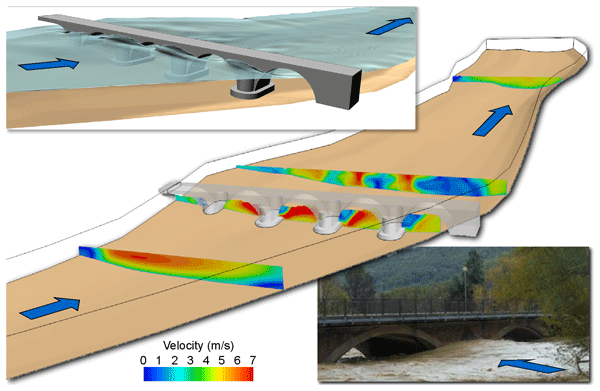
The entropy model is a reliable tool to estimate flood discharge in rivers using observed level and surface velocity. Often, level and velocity sensors are placed on bridges, which may disturb the flow. Using accurate numerical models, we explored the entropy model reliability nearby a multi-arch bridge. We found that it is better to place sensors and to estimate the discharge upstream of bridges; downstream, the entropy model needs the river-wide distribution of surface velocity as input data.
Malgorzata Golub, Wim Thiery, Rafael Marcé, Don Pierson, Inne Vanderkelen, Daniel Mercado-Bettin, R. Iestyn Woolway, Luke Grant, Eleanor Jennings, Benjamin M. Kraemer, Jacob Schewe, Fang Zhao, Katja Frieler, Matthias Mengel, Vasiliy Y. Bogomolov, Damien Bouffard, Marianne Côté, Raoul-Marie Couture, Andrey V. Debolskiy, Bram Droppers, Gideon Gal, Mingyang Guo, Annette B. G. Janssen, Georgiy Kirillin, Robert Ladwig, Madeline Magee, Tadhg Moore, Marjorie Perroud, Sebastiano Piccolroaz, Love Raaman Vinnaa, Martin Schmid, Tom Shatwell, Victor M. Stepanenko, Zeli Tan, Bronwyn Woodward, Huaxia Yao, Rita Adrian, Mathew Allan, Orlane Anneville, Lauri Arvola, Karen Atkins, Leon Boegman, Cayelan Carey, Kyle Christianson, Elvira de Eyto, Curtis DeGasperi, Maria Grechushnikova, Josef Hejzlar, Klaus Joehnk, Ian D. Jones, Alo Laas, Eleanor B. Mackay, Ivan Mammarella, Hampus Markensten, Chris McBride, Deniz Özkundakci, Miguel Potes, Karsten Rinke, Dale Robertson, James A. Rusak, Rui Salgado, Leon van der Linden, Piet Verburg, Danielle Wain, Nicole K. Ward, Sabine Wollrab, and Galina Zdorovennova
Geosci. Model Dev., 15, 4597–4623, https://doi.org/10.5194/gmd-15-4597-2022, https://doi.org/10.5194/gmd-15-4597-2022, 2022
Short summary
Short summary
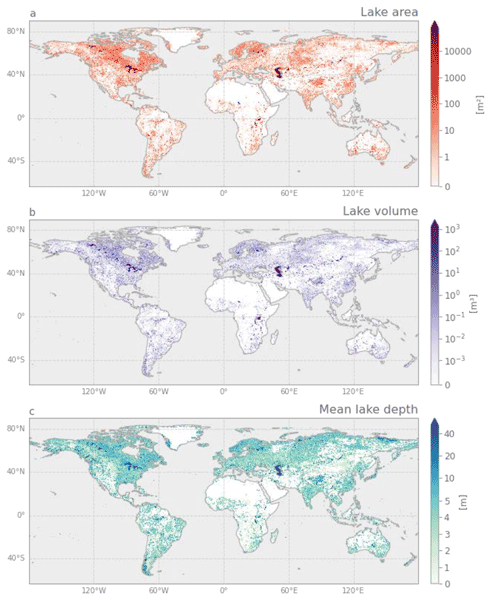
Lakes and reservoirs are warming across the globe. To better understand how lakes are changing and to project their future behavior amidst various sources of uncertainty, simulations with a range of lake models are required. This in turn requires international coordination across different lake modelling teams worldwide. Here we present a protocol for and results from coordinated simulations of climate change impacts on lakes worldwide.
Cited articles
Akberali, H. B. and Davenport, J.: The detection of salinity changes by the marine bivalve molluscs Scrobicularia plana (da Costa) and Mytilus edulis L., J. Exp. Mar. Biol. Ecol., 58, 59–71, 1982. a
Antala, M., Juszczak, R., van der Tol, C., and Rastogi, A.: Impact of climate change-induced alterations in peatland vegetation phenology and composition on carbon balance, Sci. Total Environ., 827, 154294, https://doi.org/10.1016/j.scitotenv.2022.154294, 2022. a
Bae, M.-J. and Park, Y.-S.: Biological early warning system based on the responses of aquatic organisms to disturbances: a review, Sci. Total Environ., 466, 635–649, 2014. a
Bahmanpouri, F., Lazzarin, T., Barbetta, S., Moramarco, T., and Viero, D. P.: Estimating flood discharge at river bridges using the entropy theory. Insights from Computational Fluid Dynamics flow fields, Hydrol. Earth Syst. Sci. Discuss. [preprint], https://doi.org/10.5194/hess-2023-253, in review, 2023. a
Barron, O., Silberstein, R., Ali, R., Donohue, R., McFarlane, D. J., Davies, P., Hodgson, G., Smart, N., and Donn, M.: Climate change effects on water-dependent ecosystems in south-western Australia, J. Hydrol., 434, 95–109, 2012. a
Beggel, S. and Geist, J.: Acute effects of salinity exposure on glochidia viability and host infection of the freshwater mussel Anodonta anatina (Linnaeus, 1758), Sci. Total Environ., 502, 659–665, 2015. a
Borcherding, J.: Valve movement of the mussel Dreissena polymorpha as a monitoring system for bodies of water, Schriftenreihe des Vereins für Wasser-, Boden-und Lufthygiene, 89, 361–373, 1992. a
Butterworth, F. M., Villalobos-Pietrini, R., and Gonsebatt, M. E.: Introduction: Biomonitors and Biomarkers as Indicators of Environmental Change, Volume 2, in: Biomonitors and Biomarkers as Indicators of Environmental Change 2: A Handbook, 1–8, Springer, ISBN 0306463873, 2001. a
Cairns, J.: Biological monitoring – concept and scope, in: Environmental biomonitoring, assessment, prediction and management, edited by: Cairns, J., Patil, G. P., and Waters, W. E., Int. Co-op Publ. House, ISBN 0899740081, 1979. a
Cao, Q., Yu, G., Sun, S., Dou, Y., Li, H., and Qiao, Z.: Monitoring water quality of the Haihe River based on ground-based hyperspectral remote sensing, Water, 14, 22, https://doi.org/10.3390/w14010022, 2022. a
Chowdury, M. S. U., Emran, T. B., Ghosh, S., Pathak, A., Alam, M. M., Absar, N., Andersson, K., and Hossain, M. S.: IoT based real-time river water quality monitoring system, Procedia Comput. Sci., 155, 161–168, 2019. a
Davenport, J.: The isolation response of mussels (Mytilus edulis L.) exposed to falling sea-water concentrations, J. Mar. Biol. Assoc. UK, 59, 123–132, 1979. a
Davenport, J.: The opening response of mussels (Mytilus edulis) exposed to rising sea-water concentrations, J. Mar. Biol. Assoc. UK, 61, 667–678, 1981. a
Dvoretsky, A. G. and Dvoretsky, V. G.: Shellfish as biosensors in online monitoring of aquatic ecosystems: A review of Russian studies, Fishes, 8, 102, https://doi.org/10.3390/fishes8020102, 2023. a
Folegot, S., Bruno, M. C., Larsen, S., Kaffas, K., Pisaturo, G. R., Andreoli, A., Comiti, F., and Maurizio, R.: The effects of a sediment flushing on Alpine macroinvertebrate communities, Hydrobiologia, 848, 3921–3941, 2021. a
Gerhardt, A., Ingram, M. K., Kang, I. J., and Ulitzur, S.: In situ on‐line toxicity biomonitoring in water: Recent developments, Environ. Toxicol. Chem., 25, 2263–2271, 2006. a
Gitelson, A., Garbuzov, G., Szilagyi, F., Mittenzwey, K. H., Karnieli, A., and Kaiser, A.: Quantitative remote sensing methods for real-time monitoring of inland waters quality, Int. J. Remote Sens., 14, 1269–1295, 1993. a
Goldberg, E. D.: The mussel watch-a first step in global marine monitoring, Pollution Bulletin, 6, 111–114, https://doi.org/10.1016/0025-326X(75)90271-4, 1975. a
Gruber, D. and Diamond, J: Automated Biomonitoring: Living Sensors as Environmental Monitors, Ellis Horwood books in aquaculture and fisheries support, E. Horwood, ISBN 9780745803104, 1988. a
Gsell, A. S., Scharfenberger, U., Özkundakci, D., Walters, A., Hansson, L.-A., Janssen, A. B. G., Nõges, P., Reid, P. C., Schindler, D. E., and Van Donk, E.: Evaluating early-warning indicators of critical transitions in natural aquatic ecosystems, P. Natl. Acad. Sci. USA, 113, E8089–E8095, 2016. a
Guterres, B. V., Junior, J. N. J., Guerreiro, A. S., Fonseca, V. B., Botelho, S. S. C., and Sandrini, J. Z.: Intelligent classifiers on the construction of pollution biosensors based on bivalves behavior, in: Brazilian Conference on Intelligent Systems, Springer, 588–603, https://doi.org/10.1007/978-3-030-61380-8_40, 2020. a
Hernandez-Ramirez, A. G., Martinez-Tavera, E., Rodriguez-Espinosa, P. F., Mendoza-Pérez, J. A., Tabla-Hernandez, J., Escobedo-Urías, D. C., Jonathan, M. P., and Sujitha, S. B.: Detection, provenance and associated environmental risks of water quality pollutants during anomaly events in River Atoyac, Central Mexico: A real-time monitoring approach, Sci. Total Environ., 669, 1019–1032, 2019. a
Higgins, P. J.: Effects of food availability on the valve movements and feeding behavior of juvenile Crassostrea virginica (Gmelin). I. Valve movements and periodic activity, J. Exp. Mar. Biol. Ecol., 45, 229–244, 1980. a
Hollins, M., Goble, A. K., Whitsel, B. L., and Tommerdahl, M.: Time course and action spectrum of vibrotactile adaptation, Somatosens. Mot. Res., 7, 205–221, 1990. a
Holt, E. A. and Miller, S. W.: Bioindicators: Using organisms to measure, Nature, 3, 8–13, 2011. a
Kramer, K. J. M. and Foekema, E. M.: The “Musselmonitor®” as Biological Early Warning System: The First Decade, Biomonitors and biomarkers as indicators of environmental change 2: a handbook, 59–87, https://doi.org/10.1007/978-1-4615-1305-6_4, 2001. a, b
Lamarck, J.-B. P. A. d. M.: Histoire naturelle des animaux sans vertèbres ... précédée d'une introduction offrant la détermination des caractères essentiels de l'animal, sa distinction du végétal et des autres corps naturels, enfin, l'exposition des principes fondamentaux de la zoologi, vol. t.1, Paris: published by the author, https://www.biodiversitylibrary.org/item/47694 (last access: 15 April 2024), 1815. a
Lewsey, C., Cid, G., and Kruse, E.: Assessing climate change impacts on coastal infrastructure in the Eastern Caribbean, Mar. Policy, 28, 393–409, 2004. a
Li, L., Zheng, B., and Liu, L.: Biomonitoring and bioindicators used for river ecosystems: definitions, approaches and trends, Procedia Environ. Sci., 2, 1510–1524, 2010. a
Makanda, K., Nzama, S., and Kanyerere, T.: Assessing the role of water resources protection practice for sustainable water resources management: a review, Water, 14, 3153, https://doi.org/10.3390/w14193153, 2022. a
Marceau, F.: Recherches sur la morphologie, l'histologie et la physiologie comparées de muscles adducteurs des mollusques acéphales, Archives de Zoologie Paris, 295–469, https://eurekamag.com/research/023/471/023471788.php (last access: 15 April 2024), 1909. a
Martel, P., Kovacs, T., Voss, R., and Megraw, S.: Evaluation of caged freshwater mussels as an alternative method for environmental effects monitoring (EEM) studies, Environ. Pollut., 124, 471–483, 2003. a
Meng, F., Fu, G., and Butler, D.: Cost-effective river water quality management using integrated real-time control technology, Environ. Sci. Technol., 51, 9876–9886, 2017. a
Metcalfe, R. A., Mackereth, R. W., Grantham, B., Jones, N., Pyrce, R. S., Haxton, T., Luce, J. J., and Stainton, R.: Aquatic ecosystem assessments for rivers, Ministry of Natural Resources, Peterborough, ON, Canada, ISBN 978-1-4606-3215-4, 2013. a
Nagai, K., Honjo, T., Go, J., Yamashita, H., and Oh, S. J.: Detecting the shellfish killer Heterocapsa circularisquama (Dinophyceae) by measuring bivalve valve activity with a Hall element sensor, Aquaculture, 255, 395–401, 2006. a
Nawar, A. K. and Altaleb, M. K.: A low-cost real-time monitoring system for the river level in wasit province, in: 2021 International Conference on Advance of Sustainable Engineering and its Application (ICASEA), IEEE, 54–58, ISBN 166549736X, 2021. a
Pähtz, T. and Durán, O.: The cessation threshold of nonsuspended sediment transport across aeolian and fluvial environments, J. Geophys. Res.-Earth, 123, 1638–1666, 2018. a
Pasika, S. and Gandla, S. T.: Smart water quality monitoring system with cost-effective using IoT, Heliyon, 6, e04096, https://doi.org/10.1016/j.heliyon.2020.e04096, 2020. a
Piccolroaz, S., Toffolon, M., Robinson, C. T., and Siviglia, A.: Exploring and quantifying river thermal response to heatwaves, Water, 10, 1098, https://doi.org/10.3390/w10081098, 2018. a
Qu, S., Wang, L., Lin, A., Yu, D., and Yuan, M.: Distinguishing the impacts of climate change and anthropogenic factors on vegetation dynamics in the Yangtze River Basin, China, Ecol. Indic., 108, 105724, https://doi.org/10.1016/j.ecolind.2019.105724, 2020. a
Rhif, M., Ben Abbes, A., Farah, I. R., Martínez, B., and Sang, Y.: Wavelet transform application for/in non-stationary time-series analysis: A review, Appl. Sci., 9, 1345, https://doi.org/10.3390/app9071345, 2019. a
Robson, A. A., Thomas, G. R., De Leaniz, C. G., and Wilson, R. P.: Valve gape and exhalant pumping in bivalves: optimization of measurement, Aquat. Biol., 6, 191–200, 2009. a
Salánki, J., Farkas, A., Kamardina, T., and Rózsa, K. S.: Molluscs in biological monitoring of water quality, Toxicol. Lett., 140–141, 403–410, https://doi.org/10.1016/S0378-4274(03)00036-5, 2003. a
Scanlon, B. R., Fakhreddine, S., Rateb, A., de Graaf, I., Famiglietti, J., Gleeson, T., Grafton, R. Q., Jobbagy, E., Kebede, S., and Kolusu, S. R.: Global water resources and the role of groundwater in a resilient water future, Nature Reviews Earth & Environment, 4, 87–101, 2023. a
Schöne, B. R. and Krause Jr., R. A.: Retrospective environmental biomonitoring–Mussel Watch expanded, Global Planet. Change, 144, 228–251, 2016. a
Schuring, B. J. and Geense, M. J.: Een electronische schakeling voor het registreren van openingshoek van de mossel Mytilus edulis L, TNO-Rapport CL, 72, 1972. a
Siddig, A. A. H., Ellison, A. M., Ochs, A., Villar-Leeman, C., and Lau, M. K.: How do ecologists select and use indicator species to monitor ecological change? Insights from 14 years of publication in Ecological Indicators, Ecol. Indic., 60, 223–230, 2016. a
Sukanya, S. and Joseph, S.: Climate change impacts on water resources: An overview, in: Visualization Techniques for Climate Change with Machine Learning and Artificial Intelligence, 55–76, https://doi.org/10.1016/B978-0-323-99714-0.00008-X, Elsevier, 2023. a
Swapna, M., Viswanadhula, U. M., Aluvalu, R., Vardharajan, V., and Kotecha, K.: Bio-signals in medical applications and challenges using artificial intelligence, Journal of Sensor and Actuator Networks, 11, 17, https://doi.org/10.3390/jsan11010017, 2022. a
Termini, D., Benistati, N., Tosato, L., Pilbala, A., Modesto, V., Fraccarollo, L., Manca, D., Moramarco, T., and Riccardi, N.: Identification of hydrodynamic changes in rivers by means of freshwater mussels' behavioural response: an experimental investigation, Ecohydrology, e2544, https://doi.org/10.1002/eco.2544, 2023. a, b, c, d, e
Tran, D., Ciret, P., Ciutat, A., Durrieu, G., and Massabuau, J.: Estimation of potential and limits of bivalve closure response to detect contaminants: application to cadmium, Environ. Toxicol. Chem., 22, 914–920, 2003. a
Tran, D., Fournier, E., Durrieu, G., and Massabuau, J.: Inorganic mercury detection by valve closure response in the freshwater clam Corbicula fluminea: integration of time and water metal concentration changes, Environ. Toxicol. Chem., 26, 1545–1551, 2007. a
Weiskopf, S. R., Rubenstein, M. A., Crozier, L. G., Gaichas, S., Griffis, R., Halofsky, J. E., Hyde, K. J. W., Morelli, T. L., Morisette, J. T., and Muñoz, R. C.: Climate change effects on biodiversity, ecosystems, ecosystem services, and natural resource management in the United States, Sci. Total Environ., 733, 137782, https://doi.org/10.1016/j.scitotenv.2020.137782, 2020. a
Wilson, R., Steinfurth, A., Ropert-Coudert, Y., Kato, A., and Kurita, M.: Lip-reading in remote subjects: an attempt to quantify and separate ingestion, breathing and vocalisation in free-living animals using penguins as a model, Mar. Biol., 140, 17–27, 2002. a
Zieritz, A., Sousa, R., Aldridge, D. C., Douda, K., Esteves, E., Ferreira‐Rodríguez, N., Mageroy, J. H., Nizzoli, D., Osterling, M., and Reis, J.: A global synthesis of ecosystem services provided and disrupted by freshwater bivalve molluscs, Biol. Rev., 97, 1967–1998, 2022. a
Short summary
This study investigates the impact of floods on the aquatic ecosystem using freshwater mussels instrumented with sensors to monitor the opening of their valves. Signal analysis techniques were used to gain insight into their responses in terms of changes in the intensity and frequency of valve opening. The approach used in the study enables the development of real-time monitoring systems for ecological purposes and provides a pathway for practical biological early-warning systems.
This study investigates the impact of floods on the aquatic ecosystem using freshwater mussels...


