
Articles | Volume 26, issue 12
https://doi.org/10.5194/hess-26-3103-2022
© Author(s) 2022. This work is distributed under
the Creative Commons Attribution 4.0 License.
the Creative Commons Attribution 4.0 License.
https://doi.org/10.5194/hess-26-3103-2022
© Author(s) 2022. This work is distributed under
the Creative Commons Attribution 4.0 License.
the Creative Commons Attribution 4.0 License.
Research article
| 
20 Jun 2022
Research article |
| 20 Jun 2022
| 20 Jun 2022
Seasonal forecasting of lake water quality and algal bloom risk using a continuous Gaussian Bayesian network
Leah A. Jackson-Blake
CORRESPONDING AUTHOR
Norwegian Institute for Water Research (NIVA), 0599 Oslo, Norway
François Clayer
Norwegian Institute for Water Research (NIVA), 0599 Oslo, Norway
Sigrid Haande
Norwegian Institute for Water Research (NIVA), 0599 Oslo, Norway
James E. Sample
Norwegian Institute for Water Research (NIVA), 0599 Oslo, Norway
S. Jannicke Moe
Norwegian Institute for Water Research (NIVA), 0599 Oslo, Norway
Related authors
François Clayer, Leah Jackson-Blake, Daniel Mercado-Bettín, Muhammed Shikhani, Andrew French, Tadhg Moore, James Sample, Magnus Norling, Maria-Dolores Frias, Sixto Herrera, Elvira de Eyto, Eleanor Jennings, Karsten Rinke, Leon van der Linden, and Rafael Marcé
Hydrol. Earth Syst. Sci., 27, 1361–1381, https://doi.org/10.5194/hess-27-1361-2023, https://doi.org/10.5194/hess-27-1361-2023, 2023
Short summary
Short summary
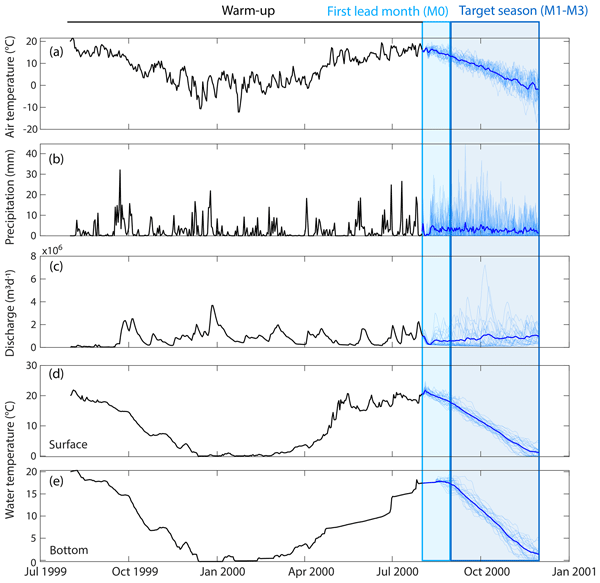
We assessed the predictive skill of forecasting tools over the next season for water discharge and lake temperature. Tools were forced with seasonal weather predictions; however, most of the prediction skill originates from legacy effects and not from seasonal weather predictions. Yet, when skills from seasonal weather predictions are present, additional skill comes from interaction effects. Skilful lake seasonal predictions require better weather predictions and realistic antecedent conditions.
Leah A. Jackson-Blake, François Clayer, Elvira de Eyto, Andrew S. French, María Dolores Frías, Daniel Mercado-Bettín, Tadhg Moore, Laura Puértolas, Russell Poole, Karsten Rinke, Muhammed Shikhani, Leon van der Linden, and Rafael Marcé
Hydrol. Earth Syst. Sci., 26, 1389–1406, https://doi.org/10.5194/hess-26-1389-2022, https://doi.org/10.5194/hess-26-1389-2022, 2022
Short summary
Short summary
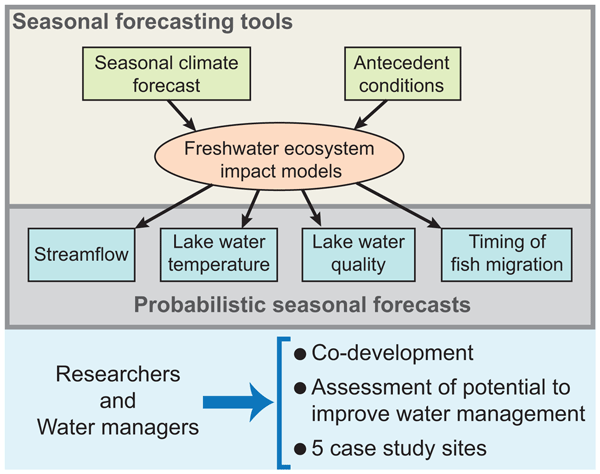
We explore, together with stakeholders, whether seasonal forecasting of water quantity, quality, and ecology can help support water management at five case study sites, primarily in Europe. Reliable forecasting, a season in advance, has huge potential to improve decision-making. However, managers were reluctant to use the forecasts operationally. Key barriers were uncertainty and often poor historic performance. The importance of practical hands-on experience was also highlighted.
Anna-Maria Virkkala, Isabel Wargowsky, Judith Vogt, McKenzie A. Kuhn, Simran Madaan, Tiffany Windholz, Kyle A. Arndt, Gerard Rocher-Ros, Mathias Göckede, David Olefeldt, Edward A. G. Schuur, David Bastviken, Richard O'Keefe, Brendan M. Rogers, Jennifer D. Watts, Kelcy Kent, Kristoffer Aalstad, Kelly Aho, Joonatan Ala-Könni, Haley Alcock, Inge Althuizen, Christopher D. Arp, Jun Asanuma, Mika Aurela, Sivakiruthika Balathandayuthabani, Katrin Attermeyer, Alan Barr, Maialen Barret, Ochirbat Batkhishig, Christina Biasi, Mats P. Björkman, Andrew Black, Elena Blanc-Betes, Pascal Bodmer, Julia Boike, Abdullah Bolek, Frédéric Bouchard, Ingeborg Bussmann, Lea Cabrol, Eleonora Canfora, Sean Carey, Karel Castro-Morales, Namyi Chae, Andreas Christen, Torben R. Christensen, Casper T. Christiansen, Housen Chu, Graham Clark, Francois Clayer, Patrick Crill, Christopher Cunada, Scott J. Davidson, Joshua F. Dean, Sigrid Dengel, Matteo Detto, Catherine Dieleman, Florent Domine, Egor Dyukarev, Colin Edgar, Bo Elberling, Craig A. Emmerton, Eugenie Euskirchen, Grant Falvo, Thomas Friborg, Michelle Garneau, Mariasilvia Giamberini, Mikhail V. Glagolev, Miquel A. Gonzalez-Meler, Gustaf Granath, Jón Guðmundsson, Konsta Happonen, Yoshinobu Harazono, Lorna Harris, Josh Hashemi, Nicholas Hasson, Janna Heerah, Liam Heffernan, Manuel Helbig, Warren Helgason, Michal Heliasz, Greg Henry, Geert Hensgens, Tetsuya Hiyama, Beth Holmes, Macall Hock, David Holl, Jutta Holst, Thomas Holst, Gabriel Hould-Gosselin, Elyn Humphreys, Jacqueline Hung, Jussi Huotari, Hiroki Ikawa, Danil V. Ilyasov, Mamoru Ishikawa, Go Iwahana, Hiroki Iwata, Marcin Antoni Jackowicz-Korczynski, Joachim Jansen, Järvi Järveoja, Vincent E. J. Jassey, Rasmus Jensen, Katharina Jentzsch, Robert G. Jespersen, Carl-Fredrik Johannesson, Cheristy P. Jones, Anders Jonsson, Ji Young Jung, Sari Juutinen, Evan Kane, Jan Karlsson, Sergey Karsanaev, Kuno Kasak, Julia Kelly, Kasha Kempton, Marcus Klaus, George W. Kling, Natascha Kljun, Jacqueline Knutson, Hideki Kobayashi, John Kochendorfer, Kukka-Maaria Kohonen, Pasi Kolari, Mika Korkiakoski, Aino Korrensalo, Pirkko Kortelainen, Egle Koster, Kajar Koster, Ayumi Kotani, Praveena Krishnan, Juliya Kurbatova, Lars Kutzbach, Min Jung Kwon, Ethan D. Kyzivat, Jessica Lagroix, Theodore Langhorst, Elena Lapshina, Tuula Larmola, Klaus S. Larsen, Isabelle Laurion, Justin Ledman, Hanna Lee, A. Joshua Leffler, Lance Lesack, Anders Lindroth, David Lipson, Annalea Lohila, Efrén López-Blanco, Vincent L. St. Louis, Erik Lundin, Miska Luoto, Takashi Machimura, Marta Magnani, Avni Malhotra, Marja Maljanen, Ivan Mammarella, Elisa Männistö, Luca Belelli Marchesini, Phil Marsh, Pertti J. Martikainen, Maija E. Marushchak, Mikhail Mastepanov, Alex Mavrovic, Trofim Maximov, Christina Minions, Daniel F. Nadeau, Marco Montemayor, Tomoaki Morishita, Patrick Murphy, Erin Nicholls, Mats B. Nilsson, Anastasia Niyazova, Jenni Nordén, Koffi Dodji Noumonvi, Hannu Nykänen, Walter Oechel, Anne Ojala, Tomohiro Okadera, Sujan Pal, Alexey V. Panov, Tim Papakyriakou, Dario Papale, Sang-Jong Park, Frans-Jan W. Parmentier, Gilberto Pastorello, Mike Peacock, Matthias Peichl, Roman Petrov, Kyra St. Pierre, Norbert Pirk, Jessica Plein, Vilmantas Preskienis, Anatoly Prokushkin, Jukka Pumpanen, Hilary A. Rains, Niklas Rakos, Aleksi Räsänen, Helena Rautakoski, Riikka Rinnan, Janne Rinne, Adrian Rocha, Nigel Roulet, Alexandre Roy, Anna Rutgersson, Aleksandr F. Sabrekov, Torsten Sachs, Erik Sahlée, Alejandro Salazar, Henrique Oliveira Sawakuchi, Christopher Schulze, Roger Seco, Armando Sepulveda-Jauregui, Svetlana Serikova, Abbey Serrone, Hanna M. Silvennoinen, Sofie Sjogersten, June Skeeter, Jo Snöälv, Sebastian Sobek, Oliver Sonnentag, Emily H. Stanley, Maria Strack, Lena Strom, Patrick Sullivan, Ryan Sullivan, Anna Sytiuk, Torbern Tagesson, Pierre Taillardat, Julie Talbot, Suzanne E. Tank, Mario Tenuta, Irina Terenteva, Frederic Thalasso, Antoine Thiboult, Halldor Thorgeirsson, Fenix Garcia Tigreros, Margaret Torn, Amy Townsend-Small, Claire Treat, Alain Tremblay, Carlo Trotta, Eeva-Stiina Tuittila, Merritt Turetsky, Masahito Ueyama, Muhammad Umair, Aki Vähä, Lona van Delden, Maarten van Hardenbroek, Andrej Varlagin, Ruth K. Varner, Tarmo Virtanen, Elena Veretennikova, Timo Vesala, Carolina Voigt, Jorien E. Vonk, Robert Wagner, Katey Walter Anthony, Qinxue Wang, Masataka Watanabe, Hailey Webb, Jeffrey M. Welker, Andreas Westergaard-Nielsen, Sebastian Westermann, Jeffrey R. White, Christian Wille, Scott N. Williamson, Scott Zolkos, Donatella Zona, and Susan M. Natali
Earth Syst. Sci. Data, 18, 6357–6409, https://doi.org/10.5194/essd-18-6357-2026, https://doi.org/10.5194/essd-18-6357-2026, 2026
Short summary
Short summary
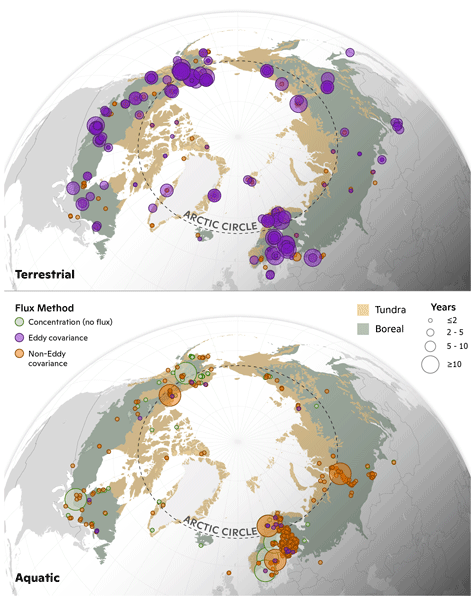
This dataset includes monthly measurements of carbon dioxide and methane exchange between land, water, and the atmosphere from over 1000 sites in Arctic and boreal regions. It combines measurements from a variety of ecosystems, including wetlands, forests, tundra, lakes, and rivers, gathered by over 260 researchers from 1984–2024. This dataset can be used to improve and reduce uncertainty in carbon budgets in order to strengthen our understanding of climate feedbacks in a warming world.
Jacqueline K. Knutson, François Clayer, Peter Dörsch, Sebastian Westermann, and Heleen A. de Wit
Biogeosciences, 22, 3899–3914, https://doi.org/10.5194/bg-22-3899-2025, https://doi.org/10.5194/bg-22-3899-2025, 2025
Short summary
Short summary
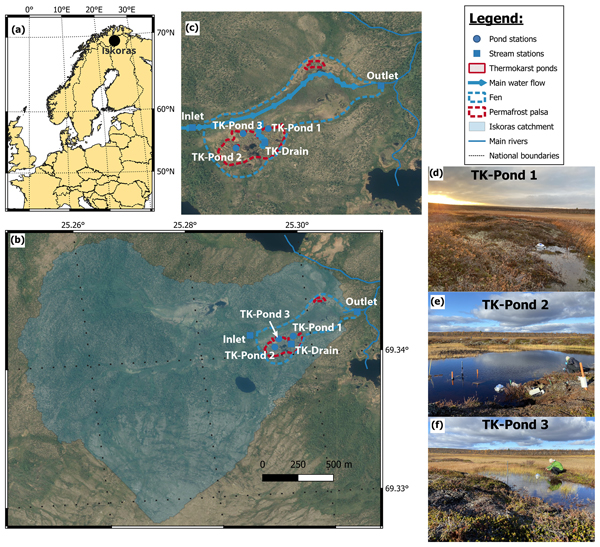
Thawing permafrost at Iškoras in northern Norway is transforming peat plateaus into thermokarst ponds and wetlands. These small ponds show striking oversaturation of dissolved greenhouse gases, such as carbon dioxide (CO2) and methane (CH4), partly owing to organic matter processing. Streams nearby emit CO2, driven by turbulence. As permafrost disappears, carbon dynamics will change, potentially increasing emissions of CH4. This study highlights the need to integrate these changes into climate models.
François Clayer, Jan Erik Thrane, Kuria Ndungu, Andrew King, Peter Dörsch, and Thomas Rohrlack
Biogeosciences, 21, 1903–1921, https://doi.org/10.5194/bg-21-1903-2024, https://doi.org/10.5194/bg-21-1903-2024, 2024
Short summary
Short summary
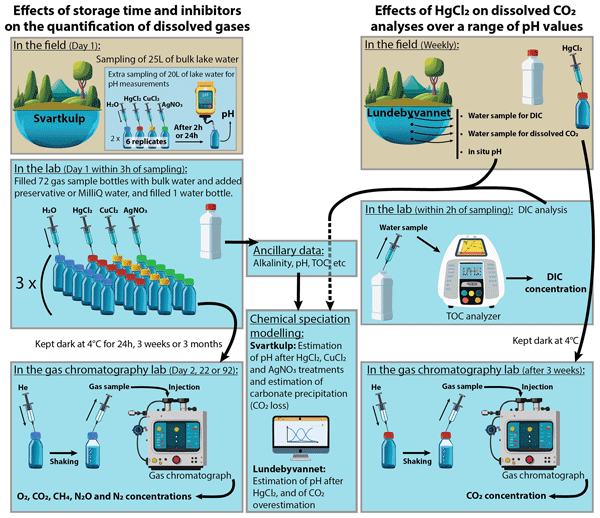
Determination of dissolved greenhouse gas (GHG) in freshwater allows us to estimate GHG fluxes. Mercuric chloride (HgCl2) is used to preserve water samples prior to GHG analysis despite its environmental and health impacts and interferences with water chemistry in freshwater. Here, we tested the effects of HgCl2, two substitutes and storage time on GHG in water from two boreal lakes. Preservation with HgCl2 caused overestimation of CO2 concentration with consequences for GHG flux estimation.
François Clayer, Leah Jackson-Blake, Daniel Mercado-Bettín, Muhammed Shikhani, Andrew French, Tadhg Moore, James Sample, Magnus Norling, Maria-Dolores Frias, Sixto Herrera, Elvira de Eyto, Eleanor Jennings, Karsten Rinke, Leon van der Linden, and Rafael Marcé
Hydrol. Earth Syst. Sci., 27, 1361–1381, https://doi.org/10.5194/hess-27-1361-2023, https://doi.org/10.5194/hess-27-1361-2023, 2023
Short summary
Short summary
We assessed the predictive skill of forecasting tools over the next season for water discharge and lake temperature. Tools were forced with seasonal weather predictions; however, most of the prediction skill originates from legacy effects and not from seasonal weather predictions. Yet, when skills from seasonal weather predictions are present, additional skill comes from interaction effects. Skilful lake seasonal predictions require better weather predictions and realistic antecedent conditions.
Y. Liu, Q. Liu, J. E. Sample, K. Hancke, and A.-B. Salberg
ISPRS Ann. Photogramm. Remote Sens. Spatial Inf. Sci., V-3-2022, 439–445, https://doi.org/10.5194/isprs-annals-V-3-2022-439-2022, https://doi.org/10.5194/isprs-annals-V-3-2022-439-2022, 2022
Leah A. Jackson-Blake, François Clayer, Elvira de Eyto, Andrew S. French, María Dolores Frías, Daniel Mercado-Bettín, Tadhg Moore, Laura Puértolas, Russell Poole, Karsten Rinke, Muhammed Shikhani, Leon van der Linden, and Rafael Marcé
Hydrol. Earth Syst. Sci., 26, 1389–1406, https://doi.org/10.5194/hess-26-1389-2022, https://doi.org/10.5194/hess-26-1389-2022, 2022
Short summary
Short summary
We explore, together with stakeholders, whether seasonal forecasting of water quantity, quality, and ecology can help support water management at five case study sites, primarily in Europe. Reliable forecasting, a season in advance, has huge potential to improve decision-making. However, managers were reluctant to use the forecasts operationally. Key barriers were uncertainty and often poor historic performance. The importance of practical hands-on experience was also highlighted.
Cited articles
Aguilera, P. A., Fernández, A., Fernández, R., Rumí, R., and
Salmerón, A.: Bayesian networks in environmental modelling, Environ. Model. Softw., 26, 1376–1388, https://doi.org/10.1016/j.envsoft.2011.06.004, 2011.
Barton, D. N., Saloranta, T., Moe, S. J., Eggestad, H. O., and Kuikka, S.:
Bayesian belief networks as a meta-modelling tool in integrated river basin
management – Pros and cons in evaluating nutrient abatement decisions
under uncertainty in a Norwegian river basin, Ecol. Econ., 66, 91–104, https://doi.org/10.1016/j.ecolecon.2008.02.012, 2008.
Bergström, A.-K. and Karlsson, J.: Light and nutrient control phytoplankton biomass responses to global change in northern lakes, Global
Change Biol., 25, 2021–2029, https://doi.org/10.1111/gcb.14623, 2019.
Bertani, I., Steger, C. E., Obenour, D. R., Fahnenstiel, G. L., Bridgeman, T. B., Johengen, T. H., Sayers, M. J., Shuchman, R. A., and Scavia, D.: Tracking cyanobacteria blooms: Do different monitoring approaches tell the same story?, Sci. Total Environ., 575, 294–308, 2017.
Boukabour, S. and Masmoudi, A.: Semiparametric Bayesian networks for continuous data, in: Communications in Statistics – Theory and Methods, Taylor & Francis, 1–23, https://doi.org/10.1080/03610926.2020.1738486, 2020.
Bruno Soares, M. and Dessai, S.: Barriers and enablers to the use of seasonal climate forecasts amongst organisations in Europe, Climatic Change, 137, 89–103, https://doi.org/10.1007/s10584-016-1671-8, 2016.
Carpenter, S. R., Cole, J. J., Kitchell, J. F., and Pace, M. L.: Impact of
dissolved organic carbon, phosphorus, and grazing on phytoplankton biomass and production in experimental lakes, Limnol. Oceanogr., 43, 73-80,
https://doi.org/10.4319/lo.1998.43.1.0073, 1998.
Chicco, D. and Jurman, G.: The advantages of the Matthews correlation
coefficient (MCC) over F1 score and accuracy in binary classification
evaluation, BMC Genom., 21, 1–13, 2020.
Couture, R.-M., Tominaga, K., Starrfelt, J., Moe, S. J., Kaste, Ø., and
Wright, R. F.: Modelling phosphorus loading and algal blooms in a Nordic
agricultural catchment-lake system under changing land-use and climate,
Environ. Sci.: Proc. Imp., 16, 1588–1599, 2014.
Couture, R.-M., Moe, S. J., Lin, Y., Kaste, Ø., Haande, S., and Solheim,
A. L.: Simulating water quality and ecological status of Lake Vansjø,
Norway, under land-use and climate change by linking process-oriented models
with a Bayesian network, Sci. Total Environ., 621, 713–724, 2018.
D'Agostino, R. and Pearson, E. S.: Tests for departure from normality. Empirical results for the distributions of b2 and
de Wit, H. A., Valinia, S., Weyhenmeyer, G. A., Futter, M. N., Kortelainen,
P., Austnes, K., Hessen, D. O., Räike, A., Laudon, H., and Vuorenmaa, J.: Current browning of surface waters will be further promoted by wetter climate, Environ. Sci. Technol. Lett., 3, 430–435, 2016.
Direktoratsgruppen Vanndirektivet: Klassifisering av miljøtilstand i
vann, 222, https://www.vannportalen.no/veiledere/klassifiseringsveileder/ (last access: 10 May 2022), 2018.
Dudgeon, D., Arthington, A. H., Gessner, M. O., Kawabata, Z.-I., Knowler, D.
J., Lévêque, C., Naiman, R. J., Prieur-Richard, A.-H., Soto, D., and
Stiassny, M. L.: Freshwater biodiversity: importance, threats, status and
conservation challenges, Biol. Rev., 81, 163–182, 2006.
ECOSTAT: Common implementation strategy for the Water Framework Directive (2000/60/EC), Guidance document no. 13: Overall approach to the
classification of ecological status and ecological potential, Office for
Official Publications of the European Communities, Luxembourg, 53 pp.,
https://circabc.europa.eu/sd/a/06480e87-27a6-41e6-b165-0581c2b046ad/Guidance No 13 - Classification of Ecological Status (WGA).pdf (last access: 9 June 2022), 2005.
Geiger, D. and Heckerman, D.: Learning Gaussian Networks, in: Uncertainty
Proceedings 1994, Elsevier, 235–243, https://doi.org/10.1016/B978-1-55860-332-5.50035-3, 1994.
Gozlan, R., Karimov, B., Zadereev, E., Kuznetsova, D., and Brucet, S.: Status, trends, and future dynamics of freshwater ecosystems in Europe and
Central Asia, Inland Waters, 9, 78–94, 2019.
Gudimov, A., O'Connor, E., Dittrich, M., Jarjanazi, H., Palmer, M. E.,
Stainsby, E., Winter, J. G., Young, J. D., and Arhonditsis, G. B.: Continuous Bayesian Network for Studying the Causal Links between Phosphorus Loading and Plankton Patterns in Lake Simcoe, Ontario, Canada, Environ. Sci. Technol., 46, 7283–7292, https://doi.org/10.1021/es300983r, 2012.
Haande, S., Solheim, A., Moe, J., and Brænden, R.: Klassifisering av
økologisk tilstand i elver og innsjøer i Vannområde Morsa iht,
Vanndirektivet, ISBN 978-82-577-5901-8, https://niva.brage.unit.no/niva-xmlui/handle/11250/215455 (last access: 10 May 2022), 2011.
Hanea, A., Morales Napoles, O., and Ababei, D.: Non-parametric Bayesian
networks: Improving theory and reviewing applications, Reliabil. Eng. Syst. Safe., 144, 265–284, https://doi.org/10.1016/j.ress.2015.07.027, 2015.
Hanlon, C. G.: Relationships Between Total Phosphorus Concentrations, Sampling Frequency, and Wind Velocity in a Shallow, Polymictic Lake, Lake
Reserv. Manage., 15, 39–46, https://doi.org/10.1080/07438149909353950, 1999.
Heisler, J., Glibert, P. M., Burkholder, J. M., Anderson, D. M., Cochlan, W., Dennison, W. C., Dortch, Q., Gobler, C. J., Heil, C. A., Humphries, E., Lewitus, A., Magnien, R., Marshall, H. G., Sellner, K., Stockwell, D. A.,
Stoecker, D. K., and Suddleson, M.: Eutrophication and harmful algal blooms:
A scientific consensus, Harmful Algae, 8, 3–13, https://doi.org/10.1016/j.hal.2008.08.006, 2008.
Ho, J. C. and Michalak, A. M.: Phytoplankton blooms in Lake Erie impacted by
both long-term and springtime phosphorus loading, J. Great Lakes Res., 43, 221–228, https://doi.org/10.1016/j.jglr.2017.04.001, 2017.
Huber, V., Wagner, C., Gerten, D., and Adrian, R.: To bloom or not to bloom:
contrasting responses of cyanobacteria to recent heat waves explained by
critical thresholds of abiotic drivers, Oecologia, 169, 245–256, 2012.
Huisman, J., Codd, G. A., Paerl, H. W., Ibelings, B. W., Verspagen, J. M.,
and Visser, P. M.: Cyanobacterial blooms, Nat. Rev. Microbiol., 16, 471–483, 2018.
Hyndman, R. J. and Athanasopoulos, G.: Forecasting: principles and practice,
3rd Edn., OTexts, Melbourne, Australia, https://otexts.com/fpp3/ (last access: 10 May 2022), 2021.
Ibelings, B. W., Fastner, J., Bormans, M., and Visser, P. M.: Cyanobacterial
blooms. Ecology, prevention, mitigation and control: Editorial to a CYANOCOST Special Issue, Aquat. Ecol., 50, 327–331, 2016.
Jackson-Blake, L.: LeahJB/gbn-vansjo, GitHub [code],
https://github.com/LeahJB/gbn-vansjo, 2022a.
Jackson-Blake, L.: LeahJB/gbn-vansjo: First release of gbn-vansjo (v0.1), Zenodo [data set and code], https://doi.org/10.5281/zenodo.6535592, 2022b.
Jackson-Blake, L. A., Clayer, F., de Eyto, E., French, A. S., Frías, M.
D., Mercado-Bettín, D., Moore, T., Puértolas, L., Poole, R., Rinke,
K., Shikhani, M., van der Linden, L., and Marcé, R.: Opportunities for
seasonal forecasting to support water management outside the tropics, Hydrol. Earth Syst. Sci., 26, 1389–1406, https://doi.org/10.5194/hess-26-1389-2022, 2022.
Kaikkonen, L., Parviainen, T., Rahikainen, M., Uusitalo, L., and Lehikoinen,
A.: Bayesian Networks in Environmental Risk Assessment: A Review, Integrat.
Environ. Assess. Manage., 17, 62–78, https://doi.org/10.1002/ieam.4332, 2021.
Kosten, S., Huszar, V. L. M., Bécares, E., Costa, L. S., van Donk, E.,
Hansson, L.-A., Jeppesen, E., Kruk, C., Lacerot, G., Mazzeo, N., De Meester,
L., Moss, B., Lürling, M., Nõges, T., Romo, S., and Scheffer, M.:
Warmer climates boost cyanobacterial dominance in shallow lakes, Global
Change Biol., 18, 118–126, https://doi.org/10.1111/j.1365-2486.2011.02488.x, 2012.
Kristensen, P., Whalley, C., Zal, F. N. N., and Christiansen, T.: European
waters assessment of status and pressures 2018, EEA Report No. 7/2018, EEA,
https://www.eea.europa.eu/publications/state-of-water (last access:
10 May 2022), 2018.
Lürling, M., Mello, M. M. E., van Oosterhout, F., de Senerpont Domis, L., and Marinho, M. M.: Response of Natural Cyanobacteria and Algae Assemblages to a Nutrient Pulse and Elevated Temperature, Front. Microbiol., 9, 1851, https://doi.org/10.3389/fmicb.2018.01851, 2018.
Lussana, C., Tveito, O. E., Dobler, A., and Tunheim, K.: seNorge_2018, daily precipitation, and temperature datasets over Norway, Earth Syst. Sci. Data, 11, 1531–1551, https://doi.org/10.5194/essd-11-1531-2019, 2019.
Marcot, B. G. and Penman, T. D.: Advances in Bayesian network modelling:
Integration of modelling technologies, Environ. Model. Softw., 111, 386–393, 2019.
Masmoudi, K. and Masmoudi, A.: A new class of continuous Bayesian networks,
Int. J. Approx. Reason., 109, 125–138, https://doi.org/10.1016/j.ijar.2019.03.010, 2019.
Matilainen, A., Vepsäläinen, M., and Sillanpää, M.: Natural
organic matter removal by coagulation during drinking water treatment: A
review, Adv. Colloid Interf. Sci., 159, 189–197, https://doi.org/10.1016/j.cis.2010.06.007, 2010.
Mercado-Bettín, D., Clayer, F., Shikhani, M., Moore, T. N., Frías,
M. D., Jackson-Blake, L., Sample, J., Iturbide, M., Herrera, S., and French,
A. S.: Forecasting water temperature in lakes and reservoirs using seasonal
climate prediction, Water Res., 201, 117286, https://doi.org/10.1016/j.watres.2021.117286, 2021.
Merel, S., Walker, D., Chicana, R., Snyder, S., Baurès, E., and Thomas,
O.: State of knowledge and concerns on cyanobacterial blooms and cyanotoxins, Environ. Int., 59, 303–327, 2013.
Moe, S. J., Haande, S., and Couture, R.-M.: Climate change, cyanobacteria
blooms and ecological status of lakes: A Bayesian network approach, Ecol. Model., 337, 330–347, 2016.
Moe, S. J., Couture, R.-M., Haande, S., Lyche Solheim, A., and Jackson-Blake, L.: Predicting Lake Quality for the Next Generation: Impacts of Catchment Management and Climatic Factors in a Probabilistic Model Framework, Water, 11, 1767, https://doi.org/10.3390/w11091767, 2019.
Nagai, T., Imai, A., Matsushige, K., and Fukushima, T.: Effect of iron
complexation with dissolved organic matter on the growth of cyanobacteria in
a eutrophic lake, Aquat. Microb. Ecol., 44, 231–239, 2006.
Nojavan, F. A., Qian, S. S., and Stow, C. A.: Comparative analysis of
discretization methods in Bayesian networks, Environ. Model. Softw., 87, 64–71, https://doi.org/10.1016/j.envsoft.2016.10.007, 2017.
Paerl, H. W. and Huisman, J.: Climate change: a catalyst for global
expansion of harmful cyanobacterial blooms, Environ. Microbiol. Rep., 1, 27–37, 2009.
Pearl, J.: Fusion, propagation, and structuring in belief networks, Artific. Intell., 29, 241–288, 1986.
Pedregosa, F., Varoquaux, G., Gramfort, A., Michel, V., Thirion, B., Grisel,
O., Blondel, M., Prettenhofer, P., Weiss, R., and Dubourg, V.: Scikit-learn:
Machine learning in Python, J. Mach. Learn. Res., 12, 2825–2830, 2011.
Qian, S. S. and Miltner, R. J.: A continuous variable Bayesian networks model for water quality modeling: A case study of setting nitrogen criterion for small rivers and streams in Ohio, USA, Environ. Model. Softw., 69, 14–22, https://doi.org/10.1016/j.envsoft.2015.03.001, 2015.
Reid, A. J., Carlson, A. K., Creed, I. F., Eliason, E. J., Gell, P. A., Johnson, P. T. J., Kidd, K. A., MacCormack, T. J., Olden, J. D., Ormerod, S.
J., Smol, J. P., Taylor, W. W., Tockner, K., Vermaire, J. C., Dudgeon, D.,
and Cooke, S. J.: Emerging threats and persistent conservation challenges
for freshwater biodiversity, Biol. Rev., 94, 849–873, https://doi.org/10.1111/brv.12480, 2019.
Rigosi, A., Hanson, P., Hamilton, D. P., Hipsey, M., Rusak, J. A., Bois, J.,
Sparber, K., Chorus, I., Watkinson, A. J., and Qin, B.: Determining the
probability of cyanobacterial blooms: the application of Bayesian networks in multiple lake systems, Ecol. Appl., 25, 186–199, 2015.
Robarts, R. D. and Zohary, T.: Temperature effects on photosynthetic capacity, respiration, and growth rates of bloom-forming cyanobacteria, N. Z. J. Mar. Freshw. Res., 21, 391–399, 1987.
Rousso, B. Z., Bertone, E., Stewart, R., and Hamilton, D. P.: A systematic
literature review of forecasting and predictive models for cyanobacteria blooms in freshwater lakes, Water Res., 182, 115959, https://doi.org/10.1016/j.watres.2020.115959, 2020.
Scutari, M.: Learning Bayesian networks with the bnlearn R package, J. Stat. Softw., 35, 1–22, https://doi.org/10.18637/jss.v035.i03, 2010.
Senar, O. E., Creed, I. F., and Trick, C. G.: Lake browning may fuel
phytoplankton biomass and trigger shifts in phytoplankton communities in
temperate lakes, Aquat. Sci., 83, 21, https://doi.org/10.1007/s00027-021-00780-0, 2021.
Shachter, R. D. and Kenley, C. R.: Gaussian influence diagrams, Manage. Sci.,
35, 527–550, 1989.
Shan, K., Shang, M., Zhou, B., Li, L., Wang, X., Yang, H., and Song, L.:
Application of Bayesian network including Microcystis morphospecies for
microcystin risk assessment in three cyanobacterial bloom-plagued lakes, China, Harmful Algae, 83, 14–24, 2019.
Skarbøvik, E., Haande, S., Bechmann, M., and Skjelbred, B.:
Vannovervåking i Morsa 2020, Innsjøer, elver og bekker, november 2019–oktober 2020, NIBIO Rapport 7(57),
https://nibio.brage.unit.no/nibio-xmlui/handle/11250/2758688 (last access: 10 May 2022), 2021.
Solheim, A. L., Rekolainen, S., Moe, S. J., Carvalho, L., Phillips, G.,
Ptacnik, R., Penning, W. E., Toth, L. G., O'Toole, C., Schartau, A.-K. L.,
and Hesthagen, T.: Ecological threshold responses in European lakes and their applicability for the Water Framework Directive (WFD) implementation: synthesis of lakes results from the REBECCA project, Aquat. Ecol., 42, 317–334, https://doi.org/10.1007/s10452-008-9188-5, 2008.
Solheim, A. L., Phillips, G., Drakare, S., Free, G., Järvinen, M.,
Skjelbred, B., Tierney, D., and Trodd, W.: Northern lake phytoplankton
ecological assessment methods, Luxemburg, Publication Office of the European Union, EUR 26503 EN, 259, https://doi.org/10.2788/70684, 2014.
Søndergaard, M., Bjerring, R., and Jeppesen, E.: Persistent internal
phosphorus loading during summer in shallow eutrophic lakes, Hydrobiologia,
710, 95–107, https://doi.org/10.1007/s10750-012-1091-3, 2013.
Stumpf, R. P., Wynne, T. T., Baker, D. B., and Fahnenstiel, G. L.: Interannual variability of cyanobacterial blooms in Lake Erie, PLoS ONE, 7, e42444, https://doi.org/10.1371/journal.pone.0042444, 2012.
Taranu, Z. E., Zurawell, R. W., Pick, F., and Gregory-Eaves, I.: Predicting
cyanobacterial dynamics in the face of global change: the importance of scale and environmental context, Global Change Biol., 18, 3477–3490, 2012.
Taranu, Z. E., Gregory-Eaves, I., Leavitt, P. R., Bunting, L., Buchaca, T.,
Catalan, J., Domaizon, I., Guilizzoni, P., Lami, A., and McGowan, S.: Acceleration of cyanobacterial dominance in north temperate-subarctic lakes
during the Anthropocene, Ecol. Lett., 18, 375–384, 2015.
Uusitalo, L.: Advantages and challenges of Bayesian networks in environmental modelling, Ecol. Model., 203, 312–318, https://doi.org/10.1016/j.ecolmodel.2006.11.033, 2007.
Vanndirektivet, D.: Klassifisering av miljøtilstand i vann. Veileder 02:2018, Direktoratsgruppen for gjennomføringen av vannforskriften, 222, https://www.vannportalen.no/veiledere/klassifiseringsveileder/ (last access: 9 June 2022), 2018.
Welch, E. B. and Cooke, G. D.: Internal phosphorus loading in shallow lakes:
importance and control, Lake Reserv. Manage., 21, 209–217, 2005.
Williams, B. J. and Cole, B.: Mining monitored data for decision-making with
a Bayesian network model, Ecol. Model., 249, 26–36,
https://doi.org/10.1016/j.ecolmodel.2012.07.008, 2013.
Wong, T.-T.: Performance evaluation of classification algorithms by k-fold
and leave-one-out cross validation, Pattern Recog., 48, 2839–2846,
https://doi.org/10.1016/j.patcog.2015.03.009, 2015.
Yang, Y., Colom, W., Pierson, D., and Pettersson, K.: Water column stability
and summer phytoplankton dynamics in a temperate lake (Lake Erken, Sweden),
Inland Waters, 6, 499–508, https://doi.org/10.1080/IW-6.4.874, 2016.
Short summary
We develop a Gaussian Bayesian network (GBN) for seasonal forecasting of lake water quality and algal bloom risk in a nutrient-impacted lake in southern Norway. Bayesian networks are powerful tools for environmental modelling but are almost exclusively discrete. We demonstrate that a continuous GBN is a promising alternative approach. Predictive performance of the GBN was similar or improved compared to a discrete network, and it was substantially less time-consuming and subjective to develop.
We develop a Gaussian Bayesian network (GBN) for seasonal forecasting of lake water quality and...


