
Articles | Volume 29, issue 2
https://doi.org/10.5194/hess-29-535-2025
© Author(s) 2025. This work is distributed under
the Creative Commons Attribution 4.0 License.
the Creative Commons Attribution 4.0 License.
https://doi.org/10.5194/hess-29-535-2025
© Author(s) 2025. This work is distributed under
the Creative Commons Attribution 4.0 License.
the Creative Commons Attribution 4.0 License.
Research article
| 
27 Jan 2025
Research article |
| 27 Jan 2025
| 27 Jan 2025
Effect of floodplain trees on apparent friction coefficient in straight compound channels

Institute of Environmental Engineering, Warsaw University of Life Sciences, Warsaw, Poland
Adam Kiczko
Institute of Environmental Engineering, Warsaw University of Life Sciences, Warsaw, Poland
Marcin Krukowski
Institute of Environmental Engineering, Warsaw University of Life Sciences, Warsaw, Poland
Elżbieta Kubrak
Institute of Environmental Engineering, Warsaw University of Life Sciences, Warsaw, Poland
Janusz Kubrak
Institute of Environmental Engineering, Warsaw University of Life Sciences, Warsaw, Poland
Grzegorz Majewski
Institute of Environmental Engineering, Warsaw University of Life Sciences, Warsaw, Poland
Andrzej Brandyk
Institute of Environmental Engineering, Warsaw University of Life Sciences, Warsaw, Poland
Related authors
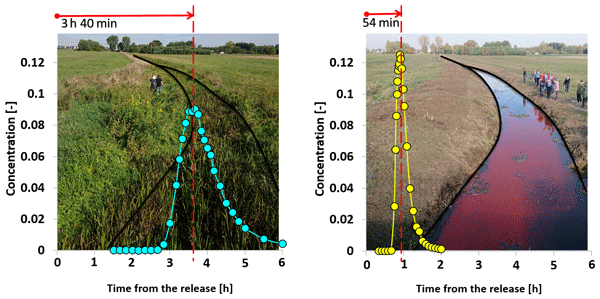
Monika Barbara Kalinowska, Kaisa Västilä, Michael Nones, Adam Kiczko, Emilia Karamuz, Andrzej Brandyk, Adam Kozioł, and Marcin Krukowski
Hydrol. Earth Syst. Sci., 27, 953–968, https://doi.org/10.5194/hess-27-953-2023, https://doi.org/10.5194/hess-27-953-2023, 2023
Short summary
Short summary
Vegetation is commonly found in rivers and channels. Using field investigations, we evaluated the influence of different vegetation coverages on the flow and mixing in the small naturally vegetated channel. The obtained results are expected to be helpful for practitioners, enlarge our still limited knowledge, and show the further required scientific directions for a better understanding of the influence of vegetation on the flow and mixing of dissolved substances in real natural conditions.
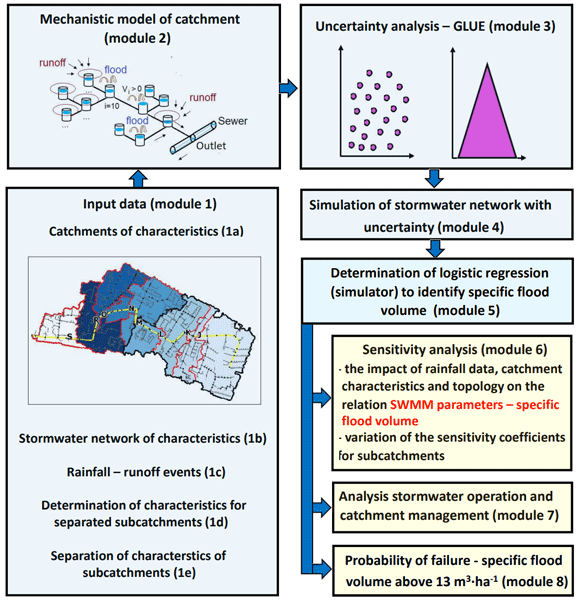
Francesco Fatone, Bartosz Szeląg, Przemysław Kowal, Arthur McGarity, Adam Kiczko, Grzegorz Wałek, Ewa Wojciechowska, Michał Stachura, and Nicolas Caradot
Hydrol. Earth Syst. Sci., 27, 3329–3349, https://doi.org/10.5194/hess-27-3329-2023, https://doi.org/10.5194/hess-27-3329-2023, 2023
Short summary
Short summary
A novel methodology for the development of a stormwater network performance simulator including advanced risk assessment was proposed. The applied tool enables the analysis of the influence of spatial variability in catchment and stormwater network characteristics on the relation between (SWMM) model parameters and specific flood volume, as an alternative approach to mechanistic models. The proposed method can be used at the stage of catchment model development and spatial planning management.
Monika Barbara Kalinowska, Kaisa Västilä, Michael Nones, Adam Kiczko, Emilia Karamuz, Andrzej Brandyk, Adam Kozioł, and Marcin Krukowski
Hydrol. Earth Syst. Sci., 27, 953–968, https://doi.org/10.5194/hess-27-953-2023, https://doi.org/10.5194/hess-27-953-2023, 2023
Short summary
Short summary
Vegetation is commonly found in rivers and channels. Using field investigations, we evaluated the influence of different vegetation coverages on the flow and mixing in the small naturally vegetated channel. The obtained results are expected to be helpful for practitioners, enlarge our still limited knowledge, and show the further required scientific directions for a better understanding of the influence of vegetation on the flow and mixing of dissolved substances in real natural conditions.
Bartosz Szeląg, Adam Kiczko, Grzegorz Wałek, Ewa Wojciechowska, Michał Stachura, and Francesco Fatone
Hydrol. Earth Syst. Sci. Discuss., https://doi.org/10.5194/hess-2022-109, https://doi.org/10.5194/hess-2022-109, 2022
Manuscript not accepted for further review
Short summary
Short summary
A methodology for the development of a sewer network performance simulator and risk assesssment is given. The influence of catchment characteristics, sewer network and SWMM parameters on specific flood volume was taken into account in comparison with developed methods. The influence of spatial variability of catchment and sewer network characteristics on the relation between SWMM parameters and sewage flooding was determined, which can be used for spatial planning and urban catchment management.
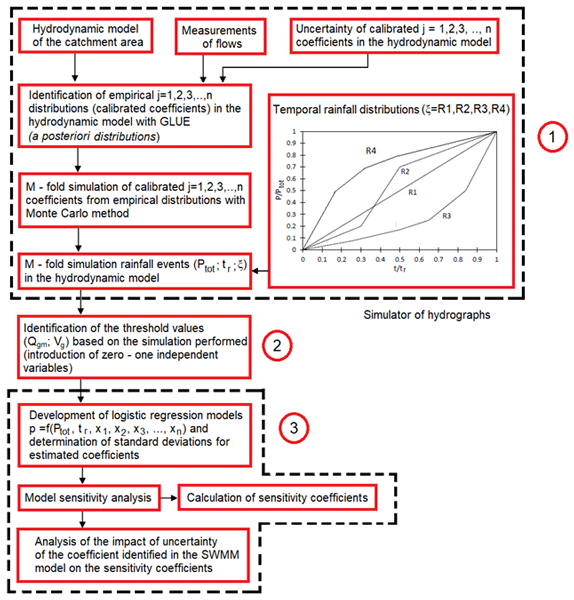
Francesco Fatone, Bartosz Szeląg, Adam Kiczko, Dariusz Majerek, Monika Majewska, Jakub Drewnowski, and Grzegorz Łagód
Hydrol. Earth Syst. Sci., 25, 5493–5516, https://doi.org/10.5194/hess-25-5493-2021, https://doi.org/10.5194/hess-25-5493-2021, 2021
Short summary
Short summary
A sensitivity analysis based on a simulator of hydrograph parameters (volume, maximum flow) is shown. The method allows us to analyze the impact of calibrated hydrodynamic model parameters, including rainfall distribution and intensity, on the hydrograph. A sensitivity coefficient and the effect of the simulator uncertainty on calculation results are presented. This approach can be used to select hydrographs for calibration and validation of models, which has not been taken into account so far.
Cited articles
Bousmar, D. and Zech, Y.: Momentum transfer for practical flow computation in compound channels, J. Hydraul. Eng., 125, 696–706, 1999.
Bretschneider, H. and Özbek, T.: Durchflußermittlung bei geoemtrisch gegliederten Gerinnen, Wasserwirtschaft, 87, 4, 1997.
Christodoulou, G. C.: Apparent shear stress in smooth compound channels, Water Resour. Manag., 66, 235–247, 1992.
Czernuszenko, W., Kozioł, A., and Rowiński, P. M.: Measurements of 3D turbulence structure in a compound channel, Arch. Hydroeng. Environ. Mech., 54, 3–21, 2007.
Devi, K. and Khatua, K. K.: Prediction of apparent shear stress in an asymmetric compound channel, ISH Journal of Hydraulic Engineering, 26, 1–11, https://doi.org/10.1080/09715010.2018.1429326, 2018.
Devi, K., Das, B. S., Khuntia, J. R., and Khatua, K. K.: Boundary Shear Stress Distributions in Compound Channels Having Narrowing and Enlarging Floodplains, edited by: Jha, R., Singh, V. P., Singh, V., Roy, L. B., and Thendiyath, R., in: River Hydraulics. Water Science and Technology Library, vol. 110, Springer, Cham, https://doi.org/10.1007/978-3-030-81768-8_11, 2022.
Einstein, H. A.: Der hydraulische Oder Profil-Radius, Schweiz. Bauztg., 103, 89–91, 1934.
Fernandes, J. N.: Apparent roughness coefficient in overbank flows, SN Appl. Sci. 3, 696, https://doi.org/10.1007/s42452-021-04677-3, 2021.
Khozani, Z. S., Khosravi, K., Pham, B. T., Kløve, B., Wan Mohtar, W. H. M., and Yaseen, Z. M.: Determination of compound channel apparent shear stress: application of novel data mining models, J. Hydroinform., 21, 798–811, https://doi.org/10.2166/hydro.2019.037, 2019.
Knight, D. W. and Demetriou, J. D.: Flood plain and main channel flow interaction, J. Hydraul. Eng., 109, 1073–1092, 1983.
Kozioł, A. P.: Badania laboratoryjne warunków przepływu w korytach o złożonych przekrojach poprzecznych porośniętych roślinnością wysoką [Laboratory research of flow conditions in compound channels covered with high vegetation], Ph.D. Thesis, Studies at the Faculty of Land Reclamation and Environmental Engineering, Warsaw University of Life Sciences – SGGW, Poland, p. 188, 1999.
Kozioł, A.: Badanie czasowej i przestrzennej makroskali turbulencji w korycie o złożonym przekroju poprzecznym [Investigation of the time and spatial macro-scale of turbulence in a compound channel], Acta Scientiarum Polonorum – Architectura, 7, 15–23, 2008.
Kozioł, A. P.: Turbulent kinetic energy of water in a compound channel, Annals of Warsaw University of Life Sciences – SGGW, Land Reclamation, Poland, 43, 193–205, https://doi.org/10.2478/v10060-011-0055-z, 2011.
Kozioł, A.: The Kolmogoroff's microscale eddies in a compound channel, Annals of Warsaw University of Life Sciences – SGGW, Land Reclamation, Poland, 44, 121–132, https://doi.org/10.2478/v10060-011-0068-7, 2012.
Kozioł, A.: Three-Dimensional Turbulence Intensity in a Compound Channel, J. Hydraul. Eng., 139, 852–864, https://doi.org/10.1061/(ASCE)HY.1943-7900.0000739, 2013.
Kozioł, A.: Scales of turbulent eddies in a compound channel, Acta Geophys., 63, 514–532, https://doi.org/10.2478/s11600-014-0247-0, 2015.
Kozioł, A. P.: Badania laboratoryjne wpł ywu drzew w korytach rzek nizinnych na turbulentne charakterystyki strumienia wody [Laboratory research on the influence of trees in riverbed of lowland rivers on turbulent water stream characteristics], Studies at the Faculty of Land Reclamation and Environmental Engineering, Warsaw University of Life Sciences Press, Poland, p. 227, ISBN 978-83-7583-810-7, 2019.
Kozioł, A. and Kubrak, J.: Measurements of Turbulence Structure in a Compound Channel, in: Rivers – Physical, Fluvial and Environmental Processes, edited by: Rowiński, P. and Radecki-Pawlik, A., Springer International Publishing, Switzerland, 229–254, https://doi.org/10.1007/978-3-319-17719-9_10, 2015.
Kubrak, E., Kubrak, J., Kozioł, A., Kiczko, A., and Krukowski, M.: Apparent friction coefficient used for flow calculation in straight compound channels, Water, 11, 745, https://doi.org/10.3390/w11040745, 2019a.
Kubrak, E., Kubrak, J., Kuśmierczuk, K., Kozioł, A., Kiczko, A., and Rowiński, P.: Influence of stream interactions on the carrying capacity of two-stage channels, J. Hydraul. Eng., 145, 7 pp., https://doi.org/10.1061/(ASCE)HY.1943-7900.0001585, 2019b.
Mazurczyk, A.: Scales of turbulence in compound channels with trees on floodplains, Publs. Inst. Geophys. Pol. Acad. Sc., E-6, 1–8, 2007.
Moreta, P. J. M. and Martin-Vide, J. P.: Apparent friction coefficient in straight compound channels, J. Hydraul. Res., 48, 169–177, 2010.
Myers, W. R. C.: Momentum Transfer in a Compound Channel, J. Hydraul. Res., 2, 139–150, https://doi.org/10.1080/00221687809499626, 1978.
Nuding, A.: Zur Durchflußermittlung bei gegliederten Gerinnen. Wasserwirtschaft, 88, 130–132, 1998.
Prinos, P. and Townsend, R. D.: Comparison of methods for predicting discharge in compound open channels, Adv. Water Res., 7, 180–187, 1984.
Rowiński, P., Czernuszenko, W., Kozioł, A., Kuśmierczuk, K., and Kubrak, J.: Longitudinal turbulence characteristics in a compound channel under various roughness conditions, Proc. 3rd Int. Conf. on Hydro-Science and -Engineering, Cottbus/Berlin, Germany, 1998.
Rowiński, P. M., Czernuszenko W., Kozioł, A. P., and Kubrak J.: Properties of Streamwise Turbulent Flow Filed in an Open Two-Stage Channel, Archives of Hydro-Engineering and Environmental Mechanics, 49, 37–57, 2002.
Shiono, K. and Knight, D. W.: Turbulent open-channel flows with variable depth across the channel, J. Fluid Mech., 222, 617–646, 1991.
Tominaga, A. and Nezu, I.: Turbulent structure in compound open-channel flows, J. Hydraul. Eng., 117, 21–41, 1991.
Van Prooijen, B. C., Booij, R., and Uijttewaal, W. S. J.: Measurement and analysis methods of large scale coherent structures in a wide shallow channel, in: Proceedings of the 10th International Symposium on Applications of Laser Techniques to Fluid Mechanics, Calouste Gulbenkian Foundation, Lisbon, Portugal, 10–13 July 2000.
Wright, P. R. and Carstens, H. R.: Linear momentum flux to overbank section, J. Hydraul. Div., 96, 1781–1793, 1970.
Tymiński, T.: Hydraulic Model Investigation of Flow Conditions for Floodplains with Coniferous and Deciduous Shrubs, Pol. J. Environ. Stud., 21, 1047–1052, 2012.
Tymiński, T. and Kałuża, T.: Investigation of mechanical properties and flow resistance of flexible riverbank vegetation, Pol. J. Environ. Stud., 21, 201–207, 2012.
Wormleaton, P. R., Allen, J., and Hadjipanos, P.: Discharge assessment in compound channel flow, J. Hydraul. Div., 108, 975–994, 1982.
Zhao, Y., Chen, D., Qin, J., Wang, L. and Luo, Y.: Study on the Coefficient of Apparent Shear Stress along Lines Dividing a Compound Cross-Section, Water, 16, 1648, https://doi.org/10.3390/w16121648, 2024.
Zheleznakov, G. V.: Interaction of channel and floodplain streams, In Proceedings of the 14th IAHR Congress, Paris 5, IAHR, Paris, France, 145–148, 29 August–3 September 1971.
Short summary
Floodplain trees play a crucial role in increasing flow resistance. Their impact extends beyond floodplains to affect the main channel. The experiments reveal the influence of floodplain trees on the discharge capacity of channels with varying roughness. We determine resistance coefficients for different roughness levels of the main channel bottom. The research contributes to a deeper understanding of open-channel flow dynamics and has practical implications for river engineering.
Floodplain trees play a crucial role in increasing flow resistance. Their impact extends beyond...


