Articles | Volume 26, issue 3
https://doi.org/10.5194/hess-26-571-2022
© Author(s) 2022. This work is distributed under
the Creative Commons Attribution 4.0 License.
https://doi.org/10.5194/hess-26-571-2022
© Author(s) 2022. This work is distributed under
the Creative Commons Attribution 4.0 License.
Future projections of High Atlas snowpack and runoff under climate change
Alexandre Tuel
CORRESPONDING AUTHOR
Ralph M. Parsons Laboratory, Massachusetts Institute of Technology, 15 Vassar St., Cambridge, 02139, USA
current affiliation: Institute of Geography, Oeschger Centre for Climate Change Research, University of Bern, Bern, Switzerland
Nabil El Moçayd
International Water Research Institute, University Mohammed VI Polytechnique, Lot 660 Hay Moulay Rachid, 43150 Ben Guerir, Morocco
Moulay Driss Hasnaoui
Ministry of Equipment, Transport, Logistics and Water, Department of Water, Rabat, Morocco
Elfatih A. B. Eltahir
Ralph M. Parsons Laboratory, Massachusetts Institute of Technology, 15 Vassar St., Cambridge, 02139, USA
Related authors
Alexandre Tuel and Olivia Martius
Weather Clim. Dynam., 5, 263–292, https://doi.org/10.5194/wcd-5-263-2024, https://doi.org/10.5194/wcd-5-263-2024, 2024
Short summary
Short summary
Warm and cold spells often have damaging consequences for agriculture, power demand, human health and infrastructure, especially when they occur over large areas and persist for a week or more. Here, we split the Northern Hemisphere extratropics into coherent regions where 3-week warm and cold spells in winter and summer are associated with the same large-scale circulation patterns. To understand their physical drivers, we analyse the associated circulation and temperature budget anomalies.
Alexandre Tuel and Olivia Martius
Earth Syst. Dynam., 14, 955–987, https://doi.org/10.5194/esd-14-955-2023, https://doi.org/10.5194/esd-14-955-2023, 2023
Short summary
Short summary
Weather persistence on sub-seasonal to seasonal timescales has been a topic of research since the early days of meteorology. Stationary or recurrent behavior are common features of weather dynamics and are strongly related to fundamental physical processes, weather predictability and surface weather impacts. In this review, we propose a typology for the broad concepts related to persistence and discuss various methods that have been used to characterize persistence in weather data.
Pauline Rivoire, Olivia Martius, Philippe Naveau, and Alexandre Tuel
Nat. Hazards Earth Syst. Sci., 23, 2857–2871, https://doi.org/10.5194/nhess-23-2857-2023, https://doi.org/10.5194/nhess-23-2857-2023, 2023
Short summary
Short summary
Heavy precipitation can lead to floods and landslides, resulting in widespread damage and significant casualties. Some of its impacts can be mitigated if reliable forecasts and warnings are available. In this article, we assess the capacity of the precipitation forecast provided by ECMWF to predict heavy precipitation events on a subseasonal-to-seasonal (S2S) timescale over Europe. We find that the forecast skill of such events is generally higher in winter than in summer.
Alexandre Tuel, Bettina Schaefli, Jakob Zscheischler, and Olivia Martius
Hydrol. Earth Syst. Sci., 26, 2649–2669, https://doi.org/10.5194/hess-26-2649-2022, https://doi.org/10.5194/hess-26-2649-2022, 2022
Short summary
Short summary
River discharge is strongly influenced by the temporal structure of precipitation. Here, we show how extreme precipitation events that occur a few days or weeks after a previous event have a larger effect on river discharge than events occurring in isolation. Windows of 2 weeks or less between events have the most impact. Similarly, periods of persistent high discharge tend to be associated with the occurrence of several extreme precipitation events in close succession.
Nabil El Moçayd and Abdelaziz Chaqdid
EGUsphere, https://doi.org/10.5194/egusphere-2026-5092, https://doi.org/10.5194/egusphere-2026-5092, 2026
This preprint is open for discussion and under review for Geoscientific Model Development (GMD).
Short summary
Short summary
Surrogate models reduce the computational cost of uncertainty quantification, but their performance depends on how accuracy is defined. Using extreme precipitation, we show that accurate pointwise prediction does not guarantee faithful representation of the response distribution. Observed extremes also occupy low-probability model responses, showing that climatological calibration may not ensure accurate extremes, with implications for climate impact and risk assessment.
Alexandre Tuel and Olivia Martius
Weather Clim. Dynam., 5, 263–292, https://doi.org/10.5194/wcd-5-263-2024, https://doi.org/10.5194/wcd-5-263-2024, 2024
Short summary
Short summary
Warm and cold spells often have damaging consequences for agriculture, power demand, human health and infrastructure, especially when they occur over large areas and persist for a week or more. Here, we split the Northern Hemisphere extratropics into coherent regions where 3-week warm and cold spells in winter and summer are associated with the same large-scale circulation patterns. To understand their physical drivers, we analyse the associated circulation and temperature budget anomalies.
Bouchra Zellou, Nabil El Moçayd, and El Houcine Bergou
Nat. Hazards Earth Syst. Sci., 23, 3543–3583, https://doi.org/10.5194/nhess-23-3543-2023, https://doi.org/10.5194/nhess-23-3543-2023, 2023
Short summary
Short summary
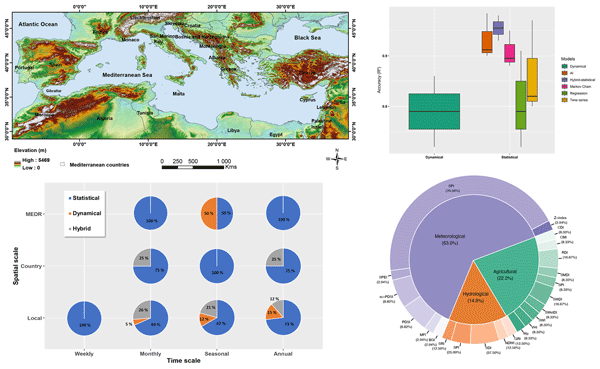
In this study, we underscore the critical importance of strengthening drought prediction capabilities in the Mediterranean region. We present an in-depth evaluation of current drought forecasting approaches, encompassing statistical, dynamical, and hybrid statistical–dynamical models, and highlight unexplored research opportunities. Additionally, we suggest viable directions to enhance drought prediction and early warning systems within the area.
Alexandre Tuel and Olivia Martius
Earth Syst. Dynam., 14, 955–987, https://doi.org/10.5194/esd-14-955-2023, https://doi.org/10.5194/esd-14-955-2023, 2023
Short summary
Short summary
Weather persistence on sub-seasonal to seasonal timescales has been a topic of research since the early days of meteorology. Stationary or recurrent behavior are common features of weather dynamics and are strongly related to fundamental physical processes, weather predictability and surface weather impacts. In this review, we propose a typology for the broad concepts related to persistence and discuss various methods that have been used to characterize persistence in weather data.
Pauline Rivoire, Olivia Martius, Philippe Naveau, and Alexandre Tuel
Nat. Hazards Earth Syst. Sci., 23, 2857–2871, https://doi.org/10.5194/nhess-23-2857-2023, https://doi.org/10.5194/nhess-23-2857-2023, 2023
Short summary
Short summary
Heavy precipitation can lead to floods and landslides, resulting in widespread damage and significant casualties. Some of its impacts can be mitigated if reliable forecasts and warnings are available. In this article, we assess the capacity of the precipitation forecast provided by ECMWF to predict heavy precipitation events on a subseasonal-to-seasonal (S2S) timescale over Europe. We find that the forecast skill of such events is generally higher in winter than in summer.
Alexandre Tuel, Bettina Schaefli, Jakob Zscheischler, and Olivia Martius
Hydrol. Earth Syst. Sci., 26, 2649–2669, https://doi.org/10.5194/hess-26-2649-2022, https://doi.org/10.5194/hess-26-2649-2022, 2022
Short summary
Short summary
River discharge is strongly influenced by the temporal structure of precipitation. Here, we show how extreme precipitation events that occur a few days or weeks after a previous event have a larger effect on river discharge than events occurring in isolation. Windows of 2 weeks or less between events have the most impact. Similarly, periods of persistent high discharge tend to be associated with the occurrence of several extreme precipitation events in close succession.
Cited articles
Agence du Bassin Hydraulique de l'Oum-Er-Rbia: Plan Directeur d'Aménagement Intégré des Ressources en Eau du Bassin de l'Oum-Er-Rbia et des bassins côtiers atlantiques, Tech. rep., Agence
du Bassin Hydraulique de l'Oum-Er-Rbia, available at:
http://www.abhoer.ma/index.cfm?gen=true&id=28 (last access: 1 February 2022), 2012. a
Akdim, B.: Karst landscape and hydrology in Morocco: research trends and
perspectives, Environ. Earth Sci., 74, 251–265, https://doi.org/10.1007/s12665-015-4254-5, 2015. a
Ayt Ougougdal, H., Yacoubi Khebiza, M., Messouli, M., and Lachir, A.: Assessment of Future Water Demand and Supply under IPCC Climate Change and
Socio-Economic Scenarios, Using a Combination of Models in Ourika Watershed,
High Atlas, Morocco, Water, 12, 1751, https://doi.org/10.3390/w12061751, 2020. a, b
Baba, M. W., Gascoin, S., Kinnard, C., Marchane, A., and Hanich, L.: Effect of Digital Elevation Model Resolution on the Simulation of the Snow Cover
Evolution in the High Atlas, Water Resour. Res., 55, 5360–5378,
https://doi.org/10.1029/2018WR023789, 2019. a, b
Berghuijs, W. R., Woods, R. A., and Hrachowitz, M.: A precipitation shift from snow towards rain leads to a decrease in streamflow, Nat. Clim. Change,
4, 583–586, https://doi.org/10.1038/nclimate2246, 2014. a
Berghuijs, W. R., Larsen, J. R., van Emmerik, T. H. M., and Woods, R. A.: A
Global Assessment of Runoff Sensitivity to Changes in Precipitation, Potential Evaporation, and Other Factors, Water Resour. Res., 53, 8475–8486, https://doi.org/10.1002/2017WR021593, 2017. a
Born, K., Fink, A. H., and Paeth, H.: Dry and wet periods in the northwestern
Maghreb for present day and future climate conditions, Meteorol. Z., 17, 533–551, https://doi.org/10.1127/0941-2948/2008/0313, 2008. a
Boudhar, A., Hanich, L., Boulet, G., Duchemin, B., Berjamy, B., and Chehbouni, A.: Evaluation of the Snowmelt Runoff model in the Moroccan High Atlas Mountains using two snow-cover estimates, Hydrolog. Sci. J., 54, 1094–1113, https://doi.org/10.1623/hysj.54.6.1094, 2009. a, b, c, d
Boudhar, A., Duchemin, B., Hanich, L., Jarlan, L., Chaponnière, A.,
Maisongrande, P., Boulet, G., and Chehbouni, A.: Long-term analysis of
snow-covered area in the Moroccan High-Atlas through remote sensing, Int. J. Appl. Earth Obs. Geoinf., 12, S109–S115, https://doi.org/10.1016/j.jag.2009.09.008, 2010. a
Boudhar, A., Duchemin, B., Hanich, L., Boulet, G., and Chehbouni, A.: Spatial
distribution of the air temperature in mountainous areas using satellite
thermal infra-red data, Comptes Rendus – Geoscience, 343, 32–42,
https://doi.org/10.1016/j.crte.2010.11.004, 2011. a
Boudhar, A., Boulet, G., Hanich, L., Sicart, J. E., and Chehbouni, A.: Energy
fluxes and melt rate of a seasonal snow cover in the Moroccan High Atlas,
Hydrolog. Sci. J., 61, 931–943, https://doi.org/10.1080/02626667.2014.965173, 2016. a
Cramer, W., Guiot, J., Fader, M., Garrabou, J., Gattuso, J.-P., Iglesias, A.,
Lange, M. A., Lionello, P., Llasat, M. C., Paz, S., Peñuelas, J., Snoussi, M., Toreti, A., Tsimplis, M. N., and Xoplaki, E.: Climate change and interconnected risks to sustainable development in the Mediterranean, Nat. Clim. Change, 8, 972–980, https://doi.org/10.1038/s41558-018-0299-2, 2018. a
Davenport, F. V., Herrera-Estrada, J. E., Burke, M., and Diffenbaugh, N. S.:
Flood Size Increases Nonlinearly Across the Western United States in Response to Lower Snow-Precipitation Ratios, Water Resour. Res., 56, e2019WR025571, https://doi.org/10.1029/2019WR025571, 2020. a, b, c, d
Dee, D. P., Uppala, S. M., Simmons, A. J., Berrisford, P., Poli, P., Kobayashi, S., Andrae, U., Balmaseda, M. A., Balsamo, G., Bauer, P., Bechtold, P., Beljaars, A. C., van de Berg, L., Bidlot, J., Bormann, N., Delsol, C., Dragani, R., Fuentes, M., Geer, A. J., Haimberger, L., Healy, S. B., Hersbach, H., Hólm, E. V., Isaksen, L., Kållberg, P., Köhler,
M., Matricardi, M., Mcnally, A. P., Monge-Sanz, B. M., Morcrette, J. J., Park, B. K., Peubey, C., de Rosnay, P., Tavolato, C., Thépaut, J. N., and Vitart, F.: The ERA-Interim reanalysis: Configuration and performance of
the data assimilation system, Q. J. Roy. Meteorol. Soc., 137, 553–597, https://doi.org/10.1002/qj.828, 2011. a, b
Derin, Y., Anagnostou, E., Berne, A., Borga, M., Boudevillain, B., Buytaert,
W., Chang, C. H., Delrieu, G., Hong, Y., Hsu, Y. C., Lavado-Casimiro, W.,
Manz, B., Moges, S., Nikolopoulos, E. I., Sahlu, D., Salerno, F.,
Rodríguez-Sánchez, J. P., Vergara, H. J., and Yilmaz, K. K.: Multiregional satellite precipitation products evaluation over complex
terrain, J. Hydrometeorol., 17, 1817–1836, https://doi.org/10.1175/JHM-D-15-0197.1, 2016. a
Driouech, F., ElRhaz, K., Moufouma-Okia, W., Arjdal, K., and Balhane, S.:
Assessing Future Changes of Climate Extreme Events in the CORDEX-MENA Region
Using Regional Climate Model ALADIN-Climate, Earth Syst. Environ., 4, 477–492, https://doi.org/10.1007/s41748-020-00169-3, 2020. a
Drobinski, P., Da Silva, N., Bastin, S., Mailler, S., Muller, C., Ahrens, B.,
Christensen, O. B., and Lionello, P.: How warmer and drier will the Mediterranean region be at the end of the twenty-first century?, Reg. Environ. Change, 20, 78, https://doi.org/10.1007/s10113-020-01659-w, 2020. a
Duan, K., Sun, G., McNulty, S. G., Caldwell, P. V., Cohen, E. C., Sun, S.,
Aldridge, H. D., Zhou, D., Zhang, L., and Zhang, Y.: Future shift of the
relative roles of precipitation and temperature in controlling annual runoff
in the conterminous United States, Hydrol. Earth Syst. Sci., 21, 5517–5529, https://doi.org/10.5194/hess-21-5517-2017, 2017. a
Durre, I., Menne, M. J., Gleason, B. E., Houston, T. G., and Vose, R. S.:
Comprehensive Automated Quality Assurance of Daily Surface Observations, J. Appl. Meteorol. Clim., 49, 1615–1633, https://doi.org/10.1175/2010JAMC2375.1, 2010. a
El Khalki, E. M., Tramblay, Y., El Mehdi Saidi, M., Bouvier, C., Hanich, L., Benrhanem, M., and Alaouri, M.: Comparison of modeling approaches for flood forecasting in the High Atlas Mountains of Morocco, Arab. J. Geosci., 11, 410, https://doi.org/10.1007/s12517-018-3752-7, 2018. a
El Moçayd, N., Kang, S., and Eltahir, E. A. B.: Climate change impacts
on the Water Highway project in Morocco, Hydrol. Earth Syst. Sci., 24, 1467–1483, https://doi.org/10.5194/hess-24-1467-2020, 2020. a
Follum, M. L., Downer, C. W., Niemann, J. D., Roylance, S. M., and Vuyovich,
C. M.: A radiation-derived temperature-index snow routine for the GSSHA
hydrologic model, J. Hydrol., 529, 723–736, https://doi.org/10.1016/j.jhydrol.2015.08.044, 2015. a, b
Funk, C., Peterson, P., Landsfeld, M., Pedreros, D., Verdin, J., Shukla, S.,
Husak, G., Rowland, J., Harrison, L., Hoell, A., and Michaelsen, J.: The
climate hazards infrared precipitation with stations – a new environmental
record for monitoring extremes, Scient. Data, 2, 150066,
https://doi.org/10.1038/sdata.2015.66, 2015. a, b
Gudmundsson, L., Do, H. X., Leonard, M., and Westra, S.: The Global Streamflow Indices and Metadata Archive (GSIM) – Part 2: Quality control, time-series indices and homogeneity assessment, Earth Syst. Sci. Data, 10, 787–804, https://doi.org/10.5194/essd-10-787-2018, 2018. a
Hall, D. K. and Riggs, G. A.: MODIS/Terra Snow Cover Daily L3 Global 500 m SIN Grid, Version 6, MOD10A1 and MYD10A1, https://doi.org/10.5067/MODIS/MOD10A1.006, 2016. a
Hashemi, H., Nordin, M., Lakshmi, V., Huffman, G. J., and Knight, R.: Bias
correction of long-term satellite monthly precipitation product (TRMM 3B43)
over the conterminous United States, J. Hydrometeorol., 18, 2491–2509, https://doi.org/10.1175/JHM-D-17-0025.1, 2017. a
Hssaisoune, M., Bouchaou, L., Sifeddine, A., Bouimetarhan, I., and Chehbouni,
A.: Moroccan groundwater resources and evolution with global climate changes, Geosciences, 10, 81, https://doi.org/10.3390/geosciences10020081, 2020. a, b
Huffman, G. J., Adler, R. F., Bolvin, D. T., Gu, G., Nelkin, E. J., Bowman, K. P., Hong, Y., Stocker, E. F., and Wolff, D. B.: The TRMM Multisatellite
Precipitation Analysis (TMPA): Quasi-global, multiyear, combined-sensor
precipitation estimates at fine scales, J. Hydrometeorol., 8, 38–55, https://doi.org/10.1175/JHM560.1, 2007. a, b
Jarvis, A., Guevara, E., Reuter, H. I., and Nelson, A. D.: Hole-filled SRTM for the globe Version 4, CGIAR-CSI SRTM 90 m Database, available at:
http://srtm.csi.cgiar.org (last access: 1 February 2022), 2008. a
Jaw, T., Li, J., Hsu, K.-L., Sorooshian, S., and Driouech, F.: Evaluation for
Moroccan dynamically downscaled precipitation from GCM CHAM5 and its regional
hydrologic response, J. Hydrol.: Reg. Stud., 3, 359–378,
https://doi.org/10.1016/j.ejrh.2015.02.008, 2015. a
Knippertz, P., Christoph, M., and Speth, P.: Long-term precipitation
variability in Morocco and the link to the large-scale circulation in recent
and future climates, Meteorol. Atmos. Phys., 83, 67–88,
https://doi.org/10.1007/s00703-002-0561-y, 2003. a, b, c, d
Lionello, P. and Scarascia, L.: The relation between climate change in the
Mediterranean region and global warming, Reg. Environ. Change, 18, 1481–1493, https://doi.org/10.1007/s10113-018-1290-1, 2018. a
López-Moreno, J. I., Gascoin, S., Herrero, J., Sproles, E. A., Pons, M.,
Alonso-González, E., Hanich, L., Boudhar, A., Musselman, K. N., Molotch, N. P., Sickman, J., and Pomeroy, J.: Different sensitivities of snowpacks to warming in Mediterranean climate mountain areas, Environ. Res. Lett., 12, 074006, https://doi.org/10.1088/1748-9326/aa70cb, 2017. a, b, c
Marchane, A., Jarlan, L., Hanich, L., Boudhar, A., Gascoin, S., Tavernier, A., Filali, N., Le Page, M., Hagolle, O., and Berjamy, B.: Assessment of daily MODIS snow cover products to monitor snow cover dynamics over the Moroccan Atlas mountain range, Remote Sens. Environ., 160, 72–86,
https://doi.org/10.1016/j.rse.2015.01.002, 2015. a, b, c, d, e, f
Marchane, A., Tramblay, Y., Hanich, L., Ruelland, D., and Jarlan, L.: Climate
change impacts on surface water resources in the Rheraya catchment (High
Atlas, Morocco), Hydrolog. Sci. J., 62, 979–995, https://doi.org/10.1080/02626667.2017.1283042, 2017. a
Michelangeli, P. A., Vrac, M., and Loukos, H.: Probabilistic downscaling
approaches: Application to wind cumulative distribution functions, Geophys. Res. Lett., 36, L11708, https://doi.org/10.1029/2009GL038401, 2009. a
Milewski, A., Elkadiri, R., and Durham, M.: Assessment and comparison of TMPA
satellite precipitation products in varying climatic and topographic regimes
in Morocco, Remote Sens., 7, 5697–5717, https://doi.org/10.3390/rs70505697, 2015. a, b
Nash, J. E. and Sutcliffe, J. V.: River flow forecasting through conceptual
models part – A discussion of principles, J. Hydrol., 10, 282–290, https://doi.org/10.1016/0022-1694(70)90255-6, 1970. a
Ouatiki, H., Boudhar, A., Tramblay, Y., Jarlan, L., Benabdelouhab, T., Hanich, L., El Meslouhi, M. R., and Chehbouni, A.: Evaluation of TRMM 3B42 V7
rainfall product over the Oum Er Rbia watershed in Morocco, Climate, 5, 1, https://doi.org/10.3390/cli5010001, 2017. a, b, c
Pal, J. S., Giorgi, F., Bi, X., Elguindi, N., Solmon, F., Gao, X., Rauscher,
S. A., Francisco, R., Zakey, A., Winter, J., Ashfaq, M., Syed, F. S., Bell, J. L., Differbaugh, N. S., Karmacharya, J., Konari, A., Martinez, D., Da Rocha, R. P., Sloan, L. C., and Steiner, A. L.: Regional climate modeling
for the developing world: The ICTP RegCM3 and RegCNET, B. Am. Meteorol. Soc., 88, 1395–1409, https://doi.org/10.1175/BAMS-88-9-1395, 2007. a
Schulz, O. and de Jong, C.: Snowmelt and sublimation: Field experiments and
modelling in the High Atlas Mountains of Morocco, Hydrol. Earth Syst. Sci., 8, 1076–1089, https://doi.org/10.5194/hess-8-1076-2004, 2004. a
Shepherd, T. G.: Storyline approach to the construction of regional climate
change information, P. Roy. Soc. A, 475, 20190013, https://doi.org/10.1098/rspa.2019.0013, 2019. a
Steinschneider, S., Yang, Y. C. E., and Brown, C.: Panel regression techniques for identifying impacts of anthropogenic landscape change on hydrologic response, Water Resour. Res., 49, 7874–7886, https://doi.org/10.1002/2013WR013818, 2013. a
Taylor, K. E., Stouffer, R. J., and Meehl, G. A.: An overview of CMIP5 and the experiment design, B. Am. Meteorol. Soc., 93, 485–498, https://doi.org/10.1175/BAMS-D-11-00094.1, 2012. a, b
Tramblay, Y., Jarlan, L., Hanich, L., and Somot, S.: Future Scenarios of
Surface Water Resources Availability in North African Dams, Water Resour.
Manage., 32, 1291–1306, https://doi.org/10.1007/s11269-017-1870-8, 2018. a
Tuel, A. and Eltahir, E. A.: Seasonal Precipitation Forecast Over Morocco,
Water Resour. Res., 54, 9118–9130, https://doi.org/10.1029/2018WR022984, 2018. a
Tuel, A. and Eltahir, E. A. B.: Why Is the Mediterranean a Climate Change Hot
Spot?, J. Climate, 33, 5829–5843, https://doi.org/10.1175/JCLI-D-19-0910.1, 2020. a, b, c
Vrac, M.: Multivariate bias adjustment of high-dimensional climate simulations: the Rank Resampling for Distributions and Dependences (R2D2) bias correction, Hydrol. Earth Syst. Sci., 22, 3175–3196, https://doi.org/10.5194/hess-22-3175-2018, 2018 a
Wan, Z., Hook, S., and Hulley, G.: MOD11A1 MODIS/Terra Land Surface
Temperature/Emissivity Daily L3 Global 1 km SIN Grid V006, NASA EOSDIS Land
Processes DAAC, https://doi.org/10.5067/MODIS/MOD11A1.006, 2015. a
Wang, W., Zou, S., Shao, Q., Xing, W., Chen, X., Jiao, X., Luo, Y., Yong, B.,
and Yu, Z.: The analytical derivation of multiple elasticities of runoff to
climate change and catchment characteristics alteration, J. Hydrol., 541, 1042–1056, https://doi.org/10.1016/j.jhydrol.2016.08.014, 2016. a
Short summary
Snowmelt in the High Atlas is critical for irrigation in Morocco but is threatened by climate change. We assess future trends in High Atlas snowpack by modelling it under historical and future climate scenarios and estimate their impact on runoff. We find that the combined warming and drying will result in a roughly 80 % decline in snowpack, a 5 %–30 % decrease in runoff efficiency and 50 %–60 % decline in runoff under a business-as-usual scenario.
Snowmelt in the High Atlas is critical for irrigation in Morocco but is threatened by climate...
Altmetrics
Final-revised paper
Preprint