Articles | Volume 22, issue 8
https://doi.org/10.5194/hess-22-4155-2018
© Author(s) 2018. This work is distributed under
the Creative Commons Attribution 4.0 License.
https://doi.org/10.5194/hess-22-4155-2018
© Author(s) 2018. This work is distributed under
the Creative Commons Attribution 4.0 License.
Convective suppression before and during the United States Northern Great Plains flash drought of 2017
Montana State University, Department of Land Resources and Environmental Sciences, Bozeman, MT 59717, USA
Northern Arizona University, School of Informatics, Computing, and Cyber Systems, Flagstaff, AZ 86011, USA
Gabriel T. Bromley
Montana State University, Department of Land Resources and Environmental Sciences, Bozeman, MT 59717, USA
Benjamin L. Ruddell
Northern Arizona University, School of Informatics, Computing, and Cyber Systems, Flagstaff, AZ 86011, USA
Skylar Williams
Montana State University, Department of Land Resources and Environmental Sciences, Bozeman, MT 59717, USA
Paul C. Stoy
Montana State University, Department of Land Resources and Environmental Sciences, Bozeman, MT 59717, USA
Related authors
Tobias Gerken, Kenneth J. Davis, Klaus Keller, and Sha Feng
Atmos. Chem. Phys., 25, 13327–13341, https://doi.org/10.5194/acp-25-13327-2025, https://doi.org/10.5194/acp-25-13327-2025, 2025
Short summary
Short summary
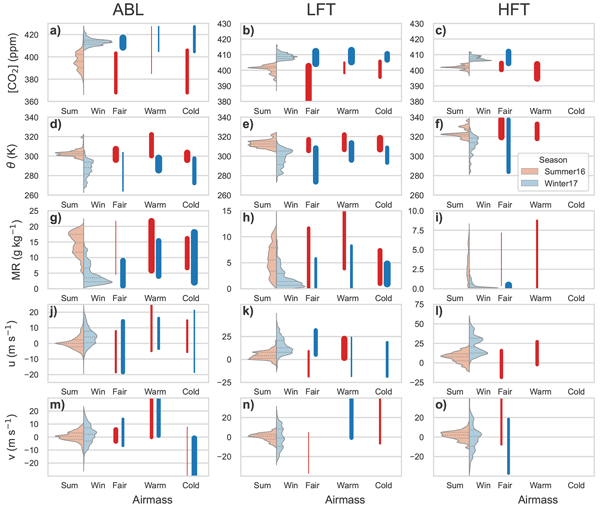
We apply the Patient Rule Induction Method (PRIM) technique to airborne CO2 and meteorological data to better understand atmospheric conditions and implications for carbon dioxide model-observation-mismatches. We found PRIM is capable of separating observations from different seasons and levels based on atmospheric conditions. Large magnitude carbon dioxide model-observation-differences were associated with non-typical atmospheric conditions, with implications for transport model evaluation.
Sadegh Ranjbar, Danielle Losos, Sophie Hoffman, Yafang Zhong, Jason A. Otkin, Ankur R. Desai, Martha C. Anderson, Christopher R. Hain, and Paul C. Stoy
Hydrol. Earth Syst. Sci., 30, 4927–4955, https://doi.org/10.5194/hess-30-4927-2026, https://doi.org/10.5194/hess-30-4927-2026, 2026
Short summary
Short summary
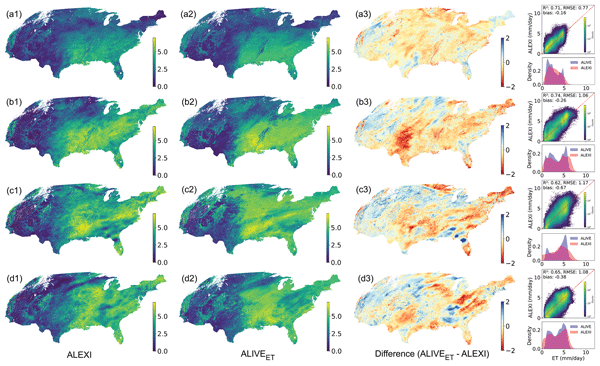
Water moves from land to air in a process called evapotranspiration, which affects weather, crops, and water supply. Using satellites and AI, we created a system that tracks this water movement every five minutes, day and night, even through clouds. This provides continuous insights that can help manage water, predict weather, and better understand the water cycle.
Tobias Gerken, Kenneth J. Davis, Klaus Keller, and Sha Feng
Atmos. Chem. Phys., 25, 13327–13341, https://doi.org/10.5194/acp-25-13327-2025, https://doi.org/10.5194/acp-25-13327-2025, 2025
Short summary
Short summary
We apply the Patient Rule Induction Method (PRIM) technique to airborne CO2 and meteorological data to better understand atmospheric conditions and implications for carbon dioxide model-observation-mismatches. We found PRIM is capable of separating observations from different seasons and levels based on atmospheric conditions. Large magnitude carbon dioxide model-observation-differences were associated with non-typical atmospheric conditions, with implications for transport model evaluation.
Anam M. Khan, Olivia E. Clifton, Jesse O. Bash, Sam Bland, Nathan Booth, Philip Cheung, Lisa Emberson, Johannes Flemming, Erick Fredj, Stefano Galmarini, Laurens Ganzeveld, Orestis Gazetas, Ignacio Goded, Christian Hogrefe, Christopher D. Holmes, László Horváth, Vincent Huijnen, Qian Li, Paul A. Makar, Ivan Mammarella, Giovanni Manca, J. William Munger, Juan L. Pérez-Camanyo, Jonathan Pleim, Limei Ran, Roberto San Jose, Donna Schwede, Sam J. Silva, Ralf Staebler, Shihan Sun, Amos P. K. Tai, Eran Tas, Timo Vesala, Tamás Weidinger, Zhiyong Wu, Leiming Zhang, and Paul C. Stoy
Atmos. Chem. Phys., 25, 8613–8635, https://doi.org/10.5194/acp-25-8613-2025, https://doi.org/10.5194/acp-25-8613-2025, 2025
Short summary
Short summary
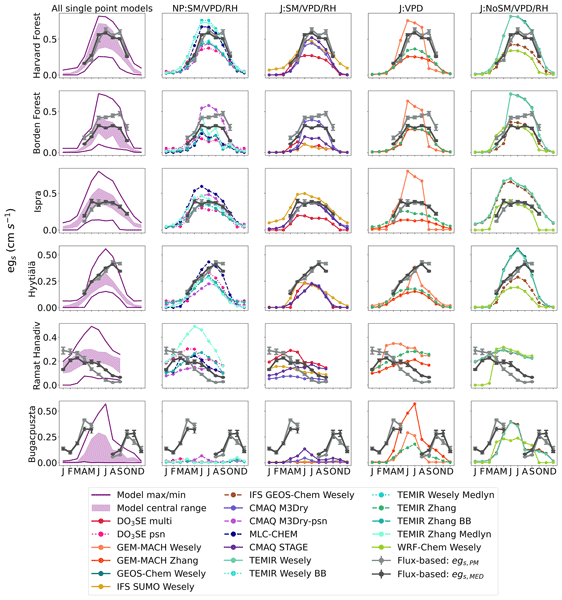
Vegetation removes tropospheric ozone through stomatal uptake, and accurately modeling the stomatal uptake of ozone is important for modeling dry deposition and air quality. We evaluated the stomatal component of ozone dry deposition modeled by atmospheric chemistry models at six sites. We find that models and observation-based estimates agree at times during the growing season at all sites, but some models overestimated the stomatal component during the dry summers at a seasonally dry site.
Cited articles
Alley, W. M.: The Palmer Drought Severity Index: Limitations and
assumptions, J. Climate Appl. Meteor., 23, 1100–1109,
https://doi.org/10.1175/1520-0450(1984)023<1100:TPDSIL>2.0.CO;2, 1984. a
Betts, A. K., Desjardins, R., Worth, D., and Cerkowniak, D.: Impact of land use
change on the diurnal cycle climate of the Canadian Prairies, J. Geophys.
Res.-Atmos., 118, 11996–12011, https://doi.org/10.1002/2013JD020717, 2013. a
Betts, A. K., Desjardins, R., Worth, D., and Beckage, B.: Climate coupling
between temperature, humidity, precipitation, and cloud cover over the
Canadian Prairies, J. Geophys. Res.-Atmos., 119, 2014JD022511,
https://doi.org/10.1002/2014JD022511, 2014. a
Carbone, R. E. and Tuttle, J. D.: Rainfall occurrence in the U.S. warm
season: The diurnal cycle, J. Climate, 21, 4132–4146,
https://doi.org/10.1175/2008JCLI2275.1, 2008. a, b
Fan, Y. and van den Dool, H.: Climate Prediction Center global monthly soil
moisture data set at 0.5∘ resolution for 1948 to present, J. Geophys.
Res., 109, D10102, https://doi.org/10.1029/2003JD004345, 2004. a, b
Ferguson, C. R. and Wood, E. F.: Observed land-atmosphere coupling from
satellite remote sensing and reanalysis, J. Hydrometeor., 12, 1221–1254,
https://doi.org/10.1175/2011JHM1380.1, 2011. a
Ford, T. W. and Labosier, C. F.: Meteorological conditions associated with the
onset of flash drought in the Eastern United States, Agr. Forest
Meteorol., 247, 414–423, https://doi.org/10.1016/j.agrformet.2017.08.031, 2017. a, b, c
Gameda, S., Qian, B., Campbell, C., and Desjardins, R.: Climatic trends
associated with summer fallow in the Canadian Prairies, Agr. Forest
Meteorol., 142, 170–185, https://doi.org/10.1016/j.agrformet.2006.03.026, 2007. a
Guttman, N. B.: Comparing the Palmer Drought Index and the Standardized
Precipitation Index, J. Am. Water Resour. Assoc., 34, 113–121, https://doi.org/10.1111/j.1752-1688.1998.tb05964.x, 1998. a
Guttman, N. B.: Accepting the Standardized Precipitation Index: A
calculation algorithm, J. Am. Water Resour. Assoc., 35, 311–322, https://doi.org/10.1111/j.1752-1688.1999.tb03592.x, 1999. a
Hanesiak, J. M., Raddatz, R. L., and Lobban, S.: Local Initiation of deep
convection on the Canadian Prairie Provinces, Bound.-Lay. Meteorol.,
110, 455–470, https://doi.org/10.1023/B:BOUN.0000007242.89023.e5, 2004. a
Juang, J.-Y., Katul, G. G., Porporato, A., Stoy, P. C., Siqueira, M. S., Detto,
M., Kim, H.-S., and Oren, R.: Eco-hydrological controls on summertime
convective rainfall triggers, Glob. Change Biol., 13, 1–10,
https://doi.org/10.1111/j.1365-2486.2006.01315.x, 2007a. a, b
Juang, J.-Y., Porporato, A., Stoy, P. C., Siqueira, M. S., Oishi, A. C., Detto,
M., Kim, H.-S., and Katul, G. G.: Hydrologic and atmospheric controls on
initiation of convective precipitation events, Water Resour. Res., 43,
W03421, https://doi.org/10.1029/2006WR004954, 2007b. a
Long, J. A., Lawrence, R. L., Miller, P. R., Marshall, L. A., and Greenwood,
M. C.: Adoption of cropping sequences in northeast Montana: A
spatio-temporal analysis, Agriculture, Ecosystems & Environment, 197,
77–87, https://doi.org/10.1016/j.agee.2014.07.022, 2014. a
Lytinska, Z., Parfiniewicz, J., and Piwkowski, H.: The prediction of air mass
thunderstorms and hails, in: Proc. WMO Symp. on the Interpretation of
Broad-Scale NWP Products for Local Forecasting Purposes, vol.
450, 128–130, WMO, Warsaw, 1976. a
Mahmood, R., Pielke, R. A., Hubbard, K. G., Niyogi, D., Dirmeyer, P. A.,
McAlpine, C., Carleton, A. M., Hale, R., Gameda, S., Beltrán-Przekurat, A.,
Baker, B., McNider, R., Legates, D. R., Shepherd, M., Du, J., Blanken, P. D.,
Frauenfeld, O. W., Nair, U., and Fall, S.: Land cover changes and their
biogeophysical effects on climate, Int. J. Climatol., 34, 929–953,
https://doi.org/10.1002/joc.3736, 2014. a
Menne, M. J., Durre, I., Korzeniewski, B., McNeill, S., Thomas, K., Yin, X.,
Anthony, S., Ray, R., Vose, R. S., Gleason, B. E., and Houston, T. G.: Global
Historical Climatology Network – Daily (GHCN-Daily), Version 3,
https://doi.org/10.7289/V5D21VHZ, 2012a. a
Menne, M. J., Durre, I., Vose, R. S., Gleason, B. E., and Houston, T. G.: An
Overview of the Global Historical Climatology Network-Daily
Database, J. Atmos. Oceanic Technol., 29, 897–910,
https://doi.org/10.1175/JTECH-D-11-00103.1, 2012b. a
Menne, M. J., Durre, I., Korzeniewski, B., McNeal, S., Thomas, K., Yin, X.,
Anthony, S., Ray, R., Vose, R. S., Gleason, B. E., and Houston, T. G.:
Global Historical Climatology Network – Daily (GHCN-Daily), Version 3.22 NOAA National Climatic Data Center, https://doi.org/10.7289/V5D21VHZ (last assess:
January 2018), 2012.
Miller, P. R., McConkey, B. G., Clayton, G. W., Brandt, S. A., Staricka, J. A.,
Johnston, A. M., Lafond, G. P., Schatz, B. G., Baltensperger, D. D., and
Neill, K. E.: Pulse crop adaptation in the Northern Great Plains,
Agron. J., 94, 261–272, 2002. a
Milly, P. C. D. and Dunne, K. A.: Potential evapotranspiration and continental
drying, Nature Clim. Change, 6, 946–949, https://doi.org/10.1038/nclimate3046,
2016. a
Milly, P. C. D. and Dunne, K. A.: A hydrologic drying bias in water-resource
impact analyses of anthropogenic climate change, J. Am. Water Resour. Assoc., 53, 822–838, https://doi.org/10.1111/1752-1688.12538,
2017. a
Miralles, D. G., Teuling, A. J., van Heerwaarden, C. C., and Vilà-Guerau de
Arellano, J.: Mega-heatwave temperatures due to combined soil desiccation and
atmospheric heat accumulation, Nature Geosci., 7, 345–349,
https://doi.org/10.1038/ngeo2141, 2014. a
Mo, K. C. and Lettenmaier, D. P.: Precipitation deficit flash droughts over the
United States, J. Hydrometeor., 17, 1169–1184,
https://doi.org/10.1175/JHM-D-15-0158.1, 2016. a
Montana DNRC: Montana Drougth Impacts and Outlook, Tech. Rep. May 2017,
The Montana Department of Natural Resources & Conservation, available at:
http://dnrc.mt.gov/divisions/water/drought-management/drought-documents/drought-report-documents/MTDroughtReportMAY2017.pdf
(last access: August 2018),
2017. a
Myoung, B. and Nielsen-Gammon, J. W.: The convective instability pathway to
warm season drought in Texas. Part I: The role of convective
inhibition and its modulation by soil moisture, J. Climate, 23, 4461–4473,
https://doi.org/10.1175/2010JCLI2946.1, 2010a. a
Myoung, B. and Nielsen-Gammon, J. W.: The convective instability pathway to
warm season drought in Texas. Part II: Free-tropospheric modulation
of convective inhibition, J. Climate, 23, 4474–4488,
https://doi.org/10.1175/2010JCLI2947.1, 2010b. a
National Drought Mitigation Center: USDM data, available at:
http://droughtmonitor.unl.edu (last access: October 2017),
2017.
Otkin, J. A., Anderson, M. C., Hain, C., Svoboda, M., Johnson, D., Mueller, R.,
Tadesse, T., Wardlow, B., and Brown, J.: Assessing the evolution of soil
moisture and vegetation conditions during the 2012 United States flash
drought, Agr. Forest Meteorol., 218–219, 230–242,
https://doi.org/10.1016/j.agrformet.2015.12.065, 2016. a, b, c
Otkin, J. A., Svoboda, M., Hunt, E. D., Ford, T. W., Anderson, M. C., Hain, C.,
and Basara, J. B.: Flash droughts: a review and assessment of the challenges
imposed by rapid onset droughts in the united states, B. Am. Meteor.
Soc., 99, 911–919, https://doi.org/10.1175/BAMS-D-17-0149.1, 2017.
a
Palmer, W. C.: Meteorological Drought, Tech. Rep. 45, US Department of
Commerce, Weather Bureau, Washington, D.C., 1965. a
Roundy, J. K., Ferguson, C. R., and Wood, E. F.: Temporal variability of
land-atmosphere coupling and its implications for drought over the
Southeast United States, J. Hydrometeor, 14, 622–635,
https://doi.org/10.1175/JHM-D-12-090.1, 2012. a
Ruddell, B. L. and Kumar, P.: Ecohydrologic process networks: 1.
Identification, Water Resour. Res., 45, W03419,
https://doi.org/10.1029/2008WR007279, 2009. a
Seager, R., Feldman, J., Lis, N., Ting, M., Williams, A. P., Nakamura, J., Liu,
H., and Henderson, N.: Whither the 100th Meridian? The once and future
physical and human geography of America’s arid–humid divide. Part
II: The meridian moves east, Earth Interact., 22, 1–24,
https://doi.org/10.1175/EI-D-17-0012.1, 2018. a
Smith, A., Lott, N., and Vose, R.: The Integrated Surface Database: Recent Developments and
Partnerships, B. Am. Meteorol. Soc., 92, 704–708, https://doi.org/10.1175/2011BAMS3015.1,
2011.
Svoboda, M., LeComte, D., Hayes, M., Heim, R., Gleason, K., Angel, J., Rippey,
B., Tinker, R., Palecki, M., Stooksbury, D., Miskus, D., and Stephens, S.:
The Drought Monitor, B. Am. Meteor. Soc., 83, 1181–1190,
https://doi.org/10.1175/1520-0477-83.8.1181, 2002. a, b, c
Tuttle, J. D. and Davis, C. A.: Corridors of warm season precipitation in the
central United States, Mon. Weather Rev., 134, 2297–2317,
https://doi.org/10.1175/MWR3188.1, 2006. a
Vick, E. S., Stoy, P. C., Tang, A. C., and Gerken, T.: The surface-atmosphere
exchange of carbon dioxide, water, and sensible heat across a dryland
wheat-fallow rotation, Agriculture, Ecosystems & Environment, 232, 129–140,
https://doi.org/10.1016/j.agee.2016.07.018, 2016. a
Short summary
An unprecedented flash drought took place across parts of the US Northern Great Plains and Canadian Prairie Provinces during the summer of 2017 that in some areas was the worst in recorded history. We show that this drought was preceded by a breakdown of land–atmosphere coupling, reducing the likelihood of convective precipitation. It may be useful to monitor land–atmosphere coupling to track and potentially forecast drought development.
An unprecedented flash drought took place across parts of the US Northern Great Plains and...