
Articles | Volume 21, issue 9
https://doi.org/10.5194/hess-21-4681-2017
© Author(s) 2017. This work is distributed under
the Creative Commons Attribution 3.0 License.
the Creative Commons Attribution 3.0 License.
Special issue:
https://doi.org/10.5194/hess-21-4681-2017
© Author(s) 2017. This work is distributed under
the Creative Commons Attribution 3.0 License.
the Creative Commons Attribution 3.0 License.
Research article
| Highlight paper
| 
15 Sep 2017
Research article | Highlight paper |
| 15 Sep 2017
A national-scale seasonal hydrological forecast system: development and evaluation over Britain
Centre for Ecology & Hydrology, Wallingford, Oxfordshire, OX10 8BB, UK
Helen N. Davies
Centre for Ecology & Hydrology, Wallingford, Oxfordshire, OX10 8BB, UK
Alison L. Kay
Centre for Ecology & Hydrology, Wallingford, Oxfordshire, OX10 8BB, UK
Anca Brookshaw
ECMWF, Shinfield Park, Reading, RG2 9AX, UK
Met Office Hadley Centre, FitzRoy Road, Exeter, Devon, EX1 3PB, UK
Adam A. Scaife
Met Office Hadley Centre, FitzRoy Road, Exeter, Devon, EX1 3PB, UK
College of Engineering, Mathematics and Physical Sciences, University of Exeter, Exeter, EX4 4QF, UK
Related authors
Mark D. Rhodes-Smith, Victoria A. Bell, Nicky Stringer, Helen Baron, Helen Davies, and Jeff Knight
EGUsphere, https://doi.org/10.5194/egusphere-2025-2506, https://doi.org/10.5194/egusphere-2025-2506, 2025
Short summary
Short summary
River flow forecasts up to three months ahead can allow early preparations for future floods and droughts. We test a new forecasting system using weather forecasts made by selecting historical weather patterns that match current conditions and running them through a simulation of Great Britain's rivers. Our tests show that this system performs particularly well in the winter and spring, in northern Scotland and in southern England. We now use this system to produce forecasts regularly.
Alison L. Kay, Nick Dunstone, Gillian Kay, Victoria A. Bell, and Jamie Hannaford
Nat. Hazards Earth Syst. Sci., 24, 2953–2970, https://doi.org/10.5194/nhess-24-2953-2024, https://doi.org/10.5194/nhess-24-2953-2024, 2024
Short summary
Short summary
Hydrological hazards affect people and ecosystems, but extremes are not fully understood due to limited observations. A large climate ensemble and simple hydrological model are used to assess unprecedented but plausible floods and droughts. The chain gives extreme flows outside the observed range: summer 2022 ~ 28 % lower and autumn 2023 ~ 42 % higher. Spatial dependence and temporal persistence are analysed. Planning for such events could help water supply resilience and flood risk management.
Adam Griffin, Alison L. Kay, Paul Sayers, Victoria Bell, Elizabeth Stewart, and Sam Carr
Hydrol. Earth Syst. Sci., 28, 2635–2650, https://doi.org/10.5194/hess-28-2635-2024, https://doi.org/10.5194/hess-28-2635-2024, 2024
Short summary
Short summary
Widespread flooding is a major problem in the UK and is greatly affected by climate change and land-use change. To look at how widespread flooding changes in the future, climate model data (UKCP18) were used with a hydrological model (Grid-to-Grid) across the UK, and 14 400 events were identified between two time slices: 1980–2010 and 2050–2080. There was a strong increase in the number of winter events in the future time slice and in the peak return periods.
Simon Parry, Jonathan D. Mackay, Thomas Chitson, Jamie Hannaford, Eugene Magee, Maliko Tanguy, Victoria A. Bell, Katie Facer-Childs, Alison Kay, Rosanna Lane, Robert J. Moore, Stephen Turner, and John Wallbank
Hydrol. Earth Syst. Sci., 28, 417–440, https://doi.org/10.5194/hess-28-417-2024, https://doi.org/10.5194/hess-28-417-2024, 2024
Short summary
Short summary
We studied drought in a dataset of possible future river flows and groundwater levels in the UK and found different outcomes for these two sources of water. Throughout the UK, river flows are likely to be lower in future, with droughts more prolonged and severe. However, whilst these changes are also found in some boreholes, in others, higher levels and less severe drought are indicated for the future. This has implications for the future balance between surface water and groundwater below.
Emma L. Robinson, Matthew J. Brown, Alison L. Kay, Rosanna A. Lane, Rhian Chapman, Victoria A. Bell, and Eleanor M. Blyth
Earth Syst. Sci. Data, 15, 4433–4461, https://doi.org/10.5194/essd-15-4433-2023, https://doi.org/10.5194/essd-15-4433-2023, 2023
Short summary
Short summary
This work presents two new Penman–Monteith potential evaporation datasets for the UK, calculated with the same methodology applied to historical climate data (Hydro-PE HadUK-Grid) and an ensemble of future climate projections (Hydro-PE UKCP18 RCM). Both include an optional correction for evaporation of rain that lands on the surface of vegetation. The historical data are consistent with existing PE datasets, and the future projections include effects of rising atmospheric CO2 on vegetation.
Alison L. Kay, Victoria A. Bell, Helen N. Davies, Rosanna A. Lane, and Alison C. Rudd
Earth Syst. Sci. Data, 15, 2533–2546, https://doi.org/10.5194/essd-15-2533-2023, https://doi.org/10.5194/essd-15-2533-2023, 2023
Short summary
Short summary
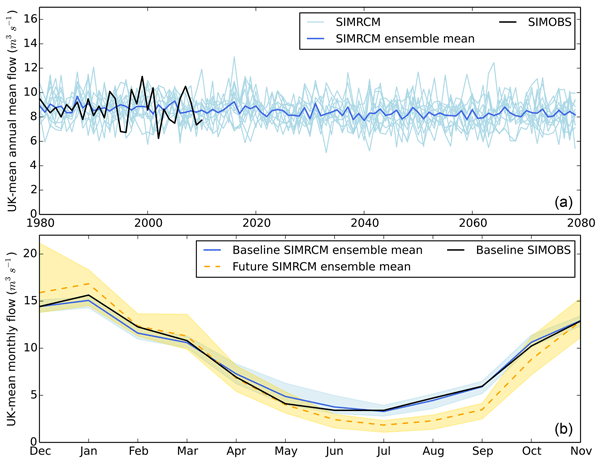
Climate change will affect the water cycle, including river flows and soil moisture. We have used both observational data (1980–2011) and the latest UK climate projections (1980–2080) to drive a national-scale grid-based hydrological model. The data, covering Great Britain and Northern Ireland, suggest potential future decreases in summer flows, low flows, and summer/autumn soil moisture, and possible future increases in winter and high flows. Society must plan how to adapt to such impacts.
Jamie Hannaford, Jonathan D. Mackay, Matthew Ascott, Victoria A. Bell, Thomas Chitson, Steven Cole, Christian Counsell, Mason Durant, Christopher R. Jackson, Alison L. Kay, Rosanna A. Lane, Majdi Mansour, Robert Moore, Simon Parry, Alison C. Rudd, Michael Simpson, Katie Facer-Childs, Stephen Turner, John R. Wallbank, Steven Wells, and Amy Wilcox
Earth Syst. Sci. Data, 15, 2391–2415, https://doi.org/10.5194/essd-15-2391-2023, https://doi.org/10.5194/essd-15-2391-2023, 2023
Short summary
Short summary
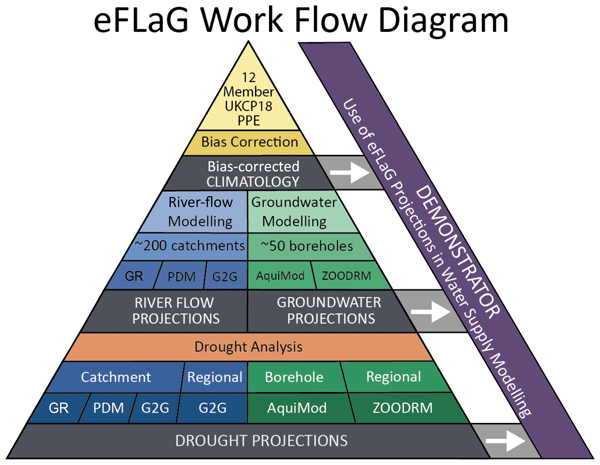
The eFLaG dataset is a nationally consistent set of projections of future climate change impacts on hydrology. eFLaG uses the latest available UK climate projections (UKCP18) run through a series of computer simulation models which enable us to produce future projections of river flows, groundwater levels and groundwater recharge. These simulations are designed for use by water resource planners and managers but could also be used for a wide range of other purposes.
Larissa Nora van der Laan, Anouk Vlug, Adam A. Scaife, Fabien Maussion, and Kristian Förster
The Cryosphere, 19, 3879–3896, https://doi.org/10.5194/tc-19-3879-2025, https://doi.org/10.5194/tc-19-3879-2025, 2025
Short summary
Short summary
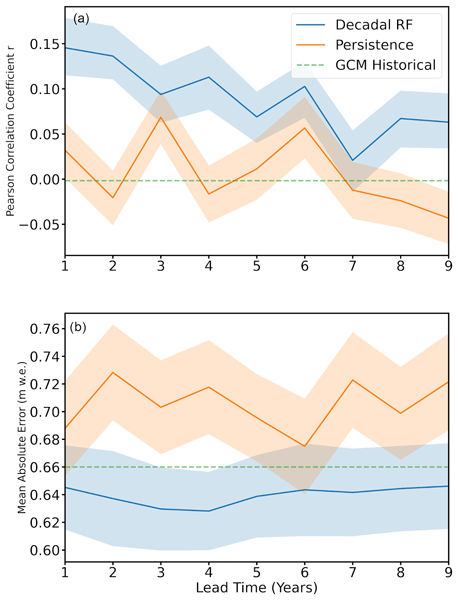
Usually, glacier models are supplied with climate information from long (e.g., 100-year) simulations by global climate models. In this paper, we test the feasibility of supplying glacier models with shorter simulations to get more accurate information on 5–10-year timescales. Reliable information on these timescales is very important, especially for water management experts, to know how much meltwater to expect, affecting rivers, agriculture and drinking water.
Mark D. Rhodes-Smith, Victoria A. Bell, Nicky Stringer, Helen Baron, Helen Davies, and Jeff Knight
EGUsphere, https://doi.org/10.5194/egusphere-2025-2506, https://doi.org/10.5194/egusphere-2025-2506, 2025
Short summary
Short summary
River flow forecasts up to three months ahead can allow early preparations for future floods and droughts. We test a new forecasting system using weather forecasts made by selecting historical weather patterns that match current conditions and running them through a simulation of Great Britain's rivers. Our tests show that this system performs particularly well in the winter and spring, in northern Scotland and in southern England. We now use this system to produce forecasts regularly.
Alison L. Kay, Nick Dunstone, Gillian Kay, Victoria A. Bell, and Jamie Hannaford
Nat. Hazards Earth Syst. Sci., 24, 2953–2970, https://doi.org/10.5194/nhess-24-2953-2024, https://doi.org/10.5194/nhess-24-2953-2024, 2024
Short summary
Short summary
Hydrological hazards affect people and ecosystems, but extremes are not fully understood due to limited observations. A large climate ensemble and simple hydrological model are used to assess unprecedented but plausible floods and droughts. The chain gives extreme flows outside the observed range: summer 2022 ~ 28 % lower and autumn 2023 ~ 42 % higher. Spatial dependence and temporal persistence are analysed. Planning for such events could help water supply resilience and flood risk management.
Adam Griffin, Alison L. Kay, Paul Sayers, Victoria Bell, Elizabeth Stewart, and Sam Carr
Hydrol. Earth Syst. Sci., 28, 2635–2650, https://doi.org/10.5194/hess-28-2635-2024, https://doi.org/10.5194/hess-28-2635-2024, 2024
Short summary
Short summary
Widespread flooding is a major problem in the UK and is greatly affected by climate change and land-use change. To look at how widespread flooding changes in the future, climate model data (UKCP18) were used with a hydrological model (Grid-to-Grid) across the UK, and 14 400 events were identified between two time slices: 1980–2010 and 2050–2080. There was a strong increase in the number of winter events in the future time slice and in the peak return periods.
Lisa Degenhardt, Gregor C. Leckebusch, and Adam A. Scaife
Weather Clim. Dynam., 5, 587–607, https://doi.org/10.5194/wcd-5-587-2024, https://doi.org/10.5194/wcd-5-587-2024, 2024
Short summary
Short summary
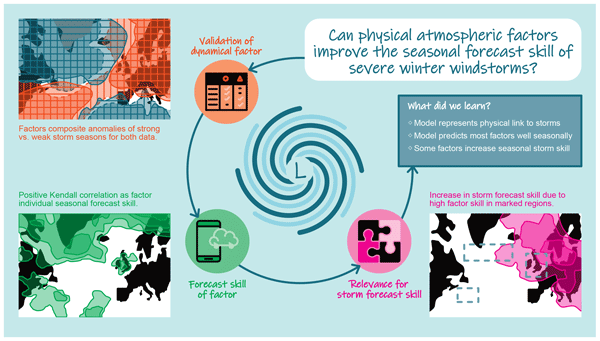
This study investigates how dynamical factors that are known to influence cyclone or windstorm development and strengthening also influence the seasonal forecast skill of severe winter windstorms. This study shows which factors are well represented in the seasonal forecast model, the Global Seasonal forecasting system version 5 (GloSea5), and which might need improvement to refine the forecast of severe winter windstorms.
Simon Parry, Jonathan D. Mackay, Thomas Chitson, Jamie Hannaford, Eugene Magee, Maliko Tanguy, Victoria A. Bell, Katie Facer-Childs, Alison Kay, Rosanna Lane, Robert J. Moore, Stephen Turner, and John Wallbank
Hydrol. Earth Syst. Sci., 28, 417–440, https://doi.org/10.5194/hess-28-417-2024, https://doi.org/10.5194/hess-28-417-2024, 2024
Short summary
Short summary
We studied drought in a dataset of possible future river flows and groundwater levels in the UK and found different outcomes for these two sources of water. Throughout the UK, river flows are likely to be lower in future, with droughts more prolonged and severe. However, whilst these changes are also found in some boreholes, in others, higher levels and less severe drought are indicated for the future. This has implications for the future balance between surface water and groundwater below.
Matthew D. K. Priestley, David B. Stephenson, Adam A. Scaife, Daniel Bannister, Christopher J. T. Allen, and David Wilkie
Nat. Hazards Earth Syst. Sci., 23, 3845–3861, https://doi.org/10.5194/nhess-23-3845-2023, https://doi.org/10.5194/nhess-23-3845-2023, 2023
Short summary
Short summary
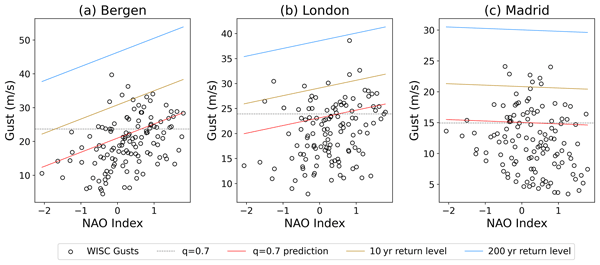
This research presents a model for estimating extreme gusts associated with European windstorms. Using observed storm footprints we are able to calculate the return level of events at the 200-year return period. The largest gusts are found across NW Europe, and these are larger when the North Atlantic Oscillation is positive. Using theoretical future climate states we find that return levels are likely to increase across NW Europe to levels that are unprecedented compared to historical storms.
Emma L. Robinson, Matthew J. Brown, Alison L. Kay, Rosanna A. Lane, Rhian Chapman, Victoria A. Bell, and Eleanor M. Blyth
Earth Syst. Sci. Data, 15, 4433–4461, https://doi.org/10.5194/essd-15-4433-2023, https://doi.org/10.5194/essd-15-4433-2023, 2023
Short summary
Short summary
This work presents two new Penman–Monteith potential evaporation datasets for the UK, calculated with the same methodology applied to historical climate data (Hydro-PE HadUK-Grid) and an ensemble of future climate projections (Hydro-PE UKCP18 RCM). Both include an optional correction for evaporation of rain that lands on the surface of vegetation. The historical data are consistent with existing PE datasets, and the future projections include effects of rising atmospheric CO2 on vegetation.
Alison L. Kay, Victoria A. Bell, Helen N. Davies, Rosanna A. Lane, and Alison C. Rudd
Earth Syst. Sci. Data, 15, 2533–2546, https://doi.org/10.5194/essd-15-2533-2023, https://doi.org/10.5194/essd-15-2533-2023, 2023
Short summary
Short summary
Climate change will affect the water cycle, including river flows and soil moisture. We have used both observational data (1980–2011) and the latest UK climate projections (1980–2080) to drive a national-scale grid-based hydrological model. The data, covering Great Britain and Northern Ireland, suggest potential future decreases in summer flows, low flows, and summer/autumn soil moisture, and possible future increases in winter and high flows. Society must plan how to adapt to such impacts.
Jamie Hannaford, Jonathan D. Mackay, Matthew Ascott, Victoria A. Bell, Thomas Chitson, Steven Cole, Christian Counsell, Mason Durant, Christopher R. Jackson, Alison L. Kay, Rosanna A. Lane, Majdi Mansour, Robert Moore, Simon Parry, Alison C. Rudd, Michael Simpson, Katie Facer-Childs, Stephen Turner, John R. Wallbank, Steven Wells, and Amy Wilcox
Earth Syst. Sci. Data, 15, 2391–2415, https://doi.org/10.5194/essd-15-2391-2023, https://doi.org/10.5194/essd-15-2391-2023, 2023
Short summary
Short summary
The eFLaG dataset is a nationally consistent set of projections of future climate change impacts on hydrology. eFLaG uses the latest available UK climate projections (UKCP18) run through a series of computer simulation models which enable us to produce future projections of river flows, groundwater levels and groundwater recharge. These simulations are designed for use by water resource planners and managers but could also be used for a wide range of other purposes.
Philip E. Bett, Adam A. Scaife, Steven C. Hardiman, Hazel E. Thornton, Xiaocen Shen, Lin Wang, and Bo Pang
Weather Clim. Dynam., 4, 213–228, https://doi.org/10.5194/wcd-4-213-2023, https://doi.org/10.5194/wcd-4-213-2023, 2023
Short summary
Short summary
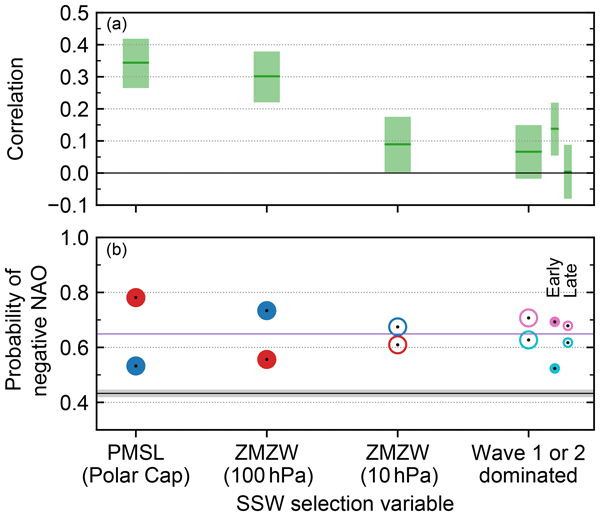
Sudden-stratospheric-warming (SSW) events can severely affect the subsequent weather at the surface. We use a large ensemble of climate model hindcasts to investigate features of the climate that make strong impacts more likely through negative NAO conditions. This allows a more robust assessment than using observations alone. Air pressure over the Arctic prior to an SSW and the zonal-mean zonal wind in the lower stratosphere have the strongest relationship with the subsequent NAO response.
Andy Jones, Jim M. Haywood, Adam A. Scaife, Olivier Boucher, Matthew Henry, Ben Kravitz, Thibaut Lurton, Pierre Nabat, Ulrike Niemeier, Roland Séférian, Simone Tilmes, and Daniele Visioni
Atmos. Chem. Phys., 22, 2999–3016, https://doi.org/10.5194/acp-22-2999-2022, https://doi.org/10.5194/acp-22-2999-2022, 2022
Short summary
Short summary
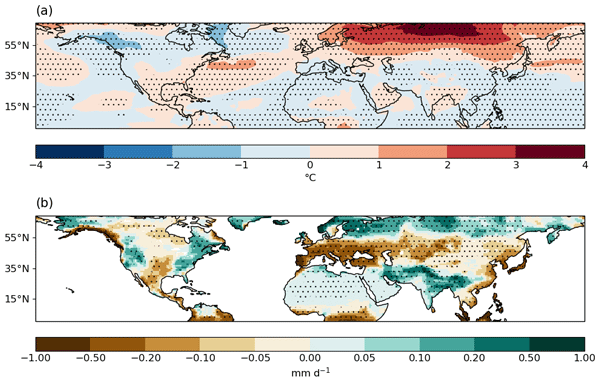
Simulations by six Earth-system models of geoengineering by introducing sulfuric acid aerosols into the tropical stratosphere are compared. A robust impact on the northern wintertime North Atlantic Oscillation is found, exacerbating precipitation reduction over parts of southern Europe. In contrast, the models show no consistency with regard to impacts on the Quasi-Biennial Oscillation, although results do indicate a risk that the oscillation could become locked into a permanent westerly phase.
Adam A. Scaife, Mark P. Baldwin, Amy H. Butler, Andrew J. Charlton-Perez, Daniela I. V. Domeisen, Chaim I. Garfinkel, Steven C. Hardiman, Peter Haynes, Alexey Yu Karpechko, Eun-Pa Lim, Shunsuke Noguchi, Judith Perlwitz, Lorenzo Polvani, Jadwiga H. Richter, John Scinocca, Michael Sigmond, Theodore G. Shepherd, Seok-Woo Son, and David W. J. Thompson
Atmos. Chem. Phys., 22, 2601–2623, https://doi.org/10.5194/acp-22-2601-2022, https://doi.org/10.5194/acp-22-2601-2022, 2022
Short summary
Short summary
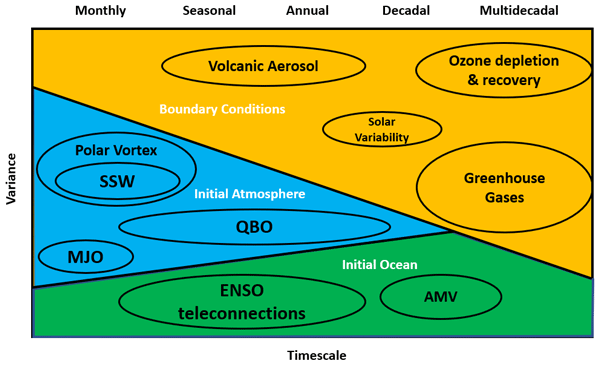
Great progress has been made in computer modelling and simulation of the whole climate system, including the stratosphere. Since the late 20th century we also gained a much clearer understanding of how the stratosphere interacts with the lower atmosphere. The latest generation of numerical prediction systems now explicitly represents the stratosphere and its interaction with surface climate, and here we review its role in long-range predictions and projections from weeks to decades ahead.
Seán Donegan, Conor Murphy, Shaun Harrigan, Ciaran Broderick, Dáire Foran Quinn, Saeed Golian, Jeff Knight, Tom Matthews, Christel Prudhomme, Adam A. Scaife, Nicky Stringer, and Robert L. Wilby
Hydrol. Earth Syst. Sci., 25, 4159–4183, https://doi.org/10.5194/hess-25-4159-2021, https://doi.org/10.5194/hess-25-4159-2021, 2021
Short summary
Short summary
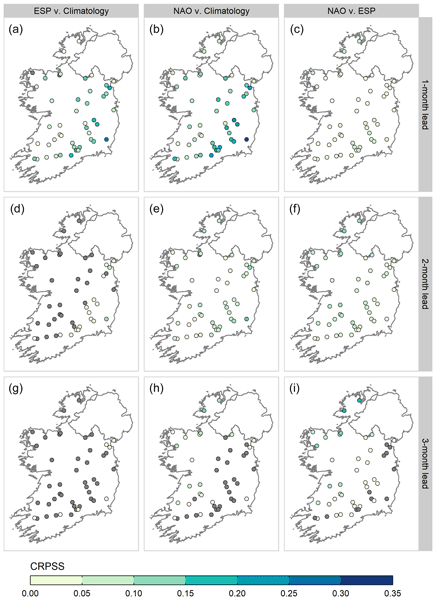
We benchmarked the skill of ensemble streamflow prediction (ESP) for a diverse sample of 46 Irish catchments. We found that ESP is skilful in the majority of catchments up to several months ahead. However, the level of skill was strongly dependent on lead time, initialisation month, and individual catchment location and storage properties. We also conditioned ESP with the winter North Atlantic Oscillation and show that improvements in forecast skill, reliability, and discrimination are possible.
Simon J. Dadson, Eleanor Blyth, Douglas Clark, Helen Davies, Richard Ellis, Huw Lewis, Toby Marthews, and Ponnambalan Rameshwaran
Hydrol. Earth Syst. Sci. Discuss., https://doi.org/10.5194/hess-2021-60, https://doi.org/10.5194/hess-2021-60, 2021
Manuscript not accepted for further review
Short summary
Short summary
Flood prediction helps national and regional planning and real-time flood response. In this study we apply and test a new way to make wide area predictions of flooding which can be combined with weather forecasting and climate models to give faster predictions of flooded areas. By simplifying the detailed floodplain topography we can keep track of the fraction of land flooded for hazard mapping purposes. When tested this approach accurately reproduces benchmark datasets for England.
Cited articles
Arribas, A., Glover, M., Maidens, A., Peterson, K., Gordon, M., MacLachlan, C., Graham, R., Fereday, D., Camp, J., Scaife, A. A., Xavier, P., McLean, A., Colman, A., and Cusack, S.: The GloSea4 ensemble prediction system for seasonal forecasting, Mon. Weather Rev., 139, 1891–1910, 2011.
Athanasiadis, P., Bellucci, A., Hermanson, L., Scaife, A. A., MacLachlan, C., Arribas, A., Materia, S., Borrelli, A., and Gualdi, S.: The representation of atmospheric blocking and the associated low frequency variability in two seasonal prediction systems, J. Climate, 27, 9082–9100, 2014.
Bell, V. A., Kay, A. L., Jones, R. G., and Moore, R. J.: Development of a high resolution grid-based river flow model for use with regional climate model output, Hydrol. Earth Syst. Sci., 11, 532–549, https://doi.org/10.5194/hess-11-532-2007, 2007.
Bell, V. A., Kay, A. L., Jones, R. G., Moore, R. J., and Reynard, N. S.: Use of soil data in a grid-based hydrological model to estimate spatial variation in changing flood risk across the UK, J. Hydrol., 377, 335–350, 2009.
Bell, V. A., Davies, H. N., Kay, A. L., Marsh, T. J., Brookshaw, A., and Jenkins, A.: Developing a large-scale water-balance approach to seasonal forecasting: application to the 2012 drought in Britain, Hydrol. Process., 27, 3003–3012, 2013.
Bell, V. A., Kay, A. L., Davies, H. N., and Jones, R. G.: An assessment of the possible impacts of climate change on snow and peak river flows across Britain, Climatic Change, 136, 539–553, 2016.
Bierkens, M. F. P. and van Beek L. P. H.: Seasonal predictability of European discharge: NAO and hydrological response time, J. Hydrometeorol., 10, 953–968, 2009.
Blockley, E. W., Martin, M. J., McLaren, A. J., Ryan, A. G., Waters, J., Lea, D. J., Mirouze, I., Peterson, K. A., Sellar, A., and Storkey, D.: Recent development of the Met Office operational ocean forecasting system: an overview and assessment of the new Global FOAM forecasts, Geosci. Model Dev., 7, 2613–2638, https://doi.org/10.5194/gmd-7-2613-2014, 2014.
Centre for Ecology & Hydrology 2016, Hydrological Summary for the United Kingdom: December 2015, Centre for Ecology & Hydrology, Wallingford, UK, 12 pp., 2016.
Charles, A., Timbal, B., Fernandez, E., and Hendon, H.: Analog downscaling of seasonal rainfall forecasts in the Murray Darling basin, Mon. Weather Rev., 141, 1099–1117, 2012.
Cole, S. J. and Moore, R. J.: Distributed hydrological modelling using weather radar in gauged and ungauged basins, Adv. Water Resour., 32, 1107–1120, 2009.
Davies, H. and Bell, V.: Assessment of methods for extracting low resolution river networks from high resolution digital data, Hydrolog. Sci. J., 54, 17–28, 2008.
Dixon, H., Hannaford, J., and Fry, M. J.: The effective management of national hydrometric data: Experiences from the United Kingdom, Hydrolog. Sci. J., 58, 1383–1399, 2013.
Eade, R., Smith, D., Scaife, A. A., Wallace, E., Dunstone, N., Hermanson, L., and Robinson, N.: Do seasonal-to-decadal climate predictions underestimate the predictability of the real world?, Geophys. Res. Lett., 41, 5620–5628, 2014.
Hough, M. N. and Jones, R. J. A.: The United Kingdom Meteorological Office rainfall and evaporation calculation system: MORECS version 2.0 – an overview, Hydrol. Earth Syst. Sci., 1, 227–239, https://doi.org/10.5194/hess-1-227-1997, 1997.
Kharin, V. V. and Zwiers, F. W.: On the ROC Score of Probability Forecasts, J. Climate, 16, 4145–4150, 2003.
Kumar, A.: Finite Samples and Uncertainty Estimates for Skill Measures for Seasonal Prediction, Mon. Weather Rev., 137, 2622–2631, 2009.
Lavers, D., Luo, L., and Wood, E. F.: A multiple model assessment of seasonal climate forecast skill for applications, Geophys. Res. Lett., 36, L23711, https://doi.org/10.1029/2009GL041365, 2009.
Lavers, D. A., Prudhomme, C., and Hannah, D. M.: Large-scale climate, precipitation and British river flows: identifying hydroclimatological connections and dynamics, J. Hydrol., 395, 242–255, 2010a.
Lavers, D. A., Prudhomme, C., and Hannah, D. M.: Large-scale climatic influences on precipitation and discharge for a British river basin, Hydrol. Process., 24, 2555–2563, 2010b.
MacLachlan, C., Arribas, A., Peterson, K. A., Maidens, A., Fereday, D., Scaife, A. A., Gordon, M., Vellinga, M., Williams, A., Comer, R. E., Camp, J., and Xavier, P.: Description of GloSea5: the Met Office high resolution seasonal forecast system, Q. J. Roy. Meteorol. Soc., 141, 1072–1084, 2015.
Manzanas, R., Gutiérrez, J. M., Fernández, J., van Meijgaard, E., Calmanti, S., Magariño, M. E., Cofiño, A. S., and Herrera, S.: Dynamical and statistical downscaling of seasonal temperature forecasts in Europe: Added value for user applications, Climate Services, https://doi.org/10.1016/j.cliser.2017.06.004, in press, 2017.
McGregor, G. R. and Phillips, I. D.: Specification and prediction of monthly and seasonal rainfall over the south-west peninsula of England, Q. J. Roy. Meteorol. Soc., 130, 193–210, 2004.
Moore, R. J., Cole, S. J., Bell, V. A., and Jones, D. A.: Issues in flood forecasting: ungauged basins, extreme floods and uncertainty, in: IAHS Publ. 305, Frontiers in Flood Research, edited by: Tchiguirinskaia, I., Thein, K. N. N., and Hubert, P., 8th Kovacs Colloquium, June/July 2006, UNESCO, Paris, 103–122, 2006.
Murphy, J. M.: Assessment of the practical utility of extended range ensemble forecasts, Q. J. Roy. Meteorol. Soc., 116, 89–125, 1990.
Perry, M., Hollis, D., and Elms, M.: The generation of daily gridded datasets of temperature and rainfall for the UK, Climate memorandum No. 24, UK Met Office, Exeter, UK, 2009.
Prudhomme, C., Hannaford, J., Boorman, D., Knight, J., Bell, V., Jackson, C., Svensson, C., Parry, S., Bachiller-Jareno, N., Davies, H. N., Davis, R., Harrigan, S., Mackay, J., Mackenzie, A., Rudd, A. C., Smith, K., Ward, R., and Jenkins, A.: Hydrological Outlook UK: an operational streamflow and groundwater level forecasting system at monthly to seasonal time scales, in review, 2017.
Scaife, A. A., Copsey, D., Gordon, C., Harris, C., Hinton, T., Keeley, S., O'Neill, A., Roberts, M., and Williams, K.: Improved Atlantic winter blocking in a climate model, Geophys. Res. Lett., 38, L23703, https://doi.org/10.1029/2011GL049573, 2011.
Scaife, A. A., Arribas, A., Blockley, E., Brookshaw, A., Clark, R. T., Dunstone, N., Eade, R., Fereday, D., Folland, C. K., Gordon, M., Hermanson, L., Knight, J. R., Lea, D. J., Maclachlan, C., Maidens, A., Martin, M., Peterson, A. K., Smith, D., Vellinga, M., Wallace, E., Waters, J., and Williams, A.: Skillful long-range prediction of European and North American winters, Geophys. Res. Lett., 41, 2514–2519, 2014.
Scaife, A. A., Karpechko, A. Y., Baldwin, M. P., Brookshaw, A., Butler, A. H., Eade, R., Gordon, M., MacLachlan, C., Martin, N., Dunstone, N., and Smith, D.: Seasonal winter forecasts and the stratosphere, Atmos. Sci. Lett., 17, 51–56, 2016.
Svensson, C.: Seasonal river flow forecasts for the United Kingdom using persistence and historical analogues, Hydrolog. Sci. J., 61, 19–35, 2016.
Svensson, C. and Prudhomme, C.: Prediction of British summer river flows using winter predictors, Theor. Appl. Climatol., 82, 1–15, 2005.
Svensson, C., Brookshaw, A., Scaife, A. A., Bell, V. A., Mackay, J. D., Jackson, C. R., Hannaford, J., Davies, H. N., Arribas, A., and Stanley, S.: Long-range forecasts of UK winter hydrology, Environ. Res. Lett., 10, 064006, https://doi.org/10.1088/1748-9326/10/6/064006, 2015.
Wedgbrow, C. S., Wilby, R. L., Fox, H. R., and O'Hare, G.: Prospects for seasonal forecasting of summer drought and low river flow anomalies in England and Wales, Int. J. Climatol., 22, 219–236, 2002.
Wilby, R. L.: Seasonal forecasting of river flows in the British Isles using North Atlantic pressure patterns, J. Chart. Inst. Water Environ. Manage., 15, 56–63, 2001.
Yuan, X., Wood, E. F., and Ma, Z.: A review on climate-model-based seasonal hydrologic forecasting: physical understanding and system development, WIREs Water, 2, 523–536, 2015.
Short summary
The research presented here provides the first evaluation of the skill of a seasonal hydrological forecast for the UK. The forecast scheme combines rainfall forecasts from the Met Office GloSea5 forecast system with a national-scale hydrological model to provide estimates of river flows 1 to 3 months ahead. The skill in the combined model is assessed for different seasons and regions of Britain, and the analysis indicates that Autumn/Winter flows can be forecast with reasonable confidence.
The research presented here provides the first evaluation of the skill of a seasonal...


Special issue