
Articles | Volume 30, issue 10
https://doi.org/10.5194/hess-30-3203-2026
© Author(s) 2026. This work is distributed under
the Creative Commons Attribution 4.0 License.
the Creative Commons Attribution 4.0 License.
https://doi.org/10.5194/hess-30-3203-2026
© Author(s) 2026. This work is distributed under
the Creative Commons Attribution 4.0 License.
the Creative Commons Attribution 4.0 License.
Research article
| 
22 May 2026
Research article |
| 22 May 2026
| 22 May 2026
Derivation and validation of estimation model of rainfall kinetic energy under the canopy
Department of Hydraulic Engineering, State Key Laboratory of Hydroscience and Engineering, Tsinghua University, Beijing 100084, China

Department of Hydraulic Engineering, State Key Laboratory of Hydroscience and Engineering, Tsinghua University, Beijing 100084, China
Related authors
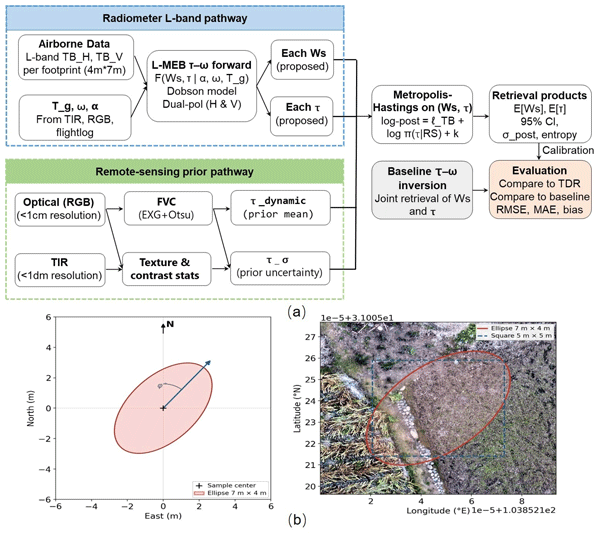
Zixi Li, Yan Li, Rui Tong, Peizhe Cheng, Fuqiang Tian, and Yao Zhuang
Hydrol. Earth Syst. Sci., 30, 4909–4925, https://doi.org/10.5194/hess-30-4909-2026, https://doi.org/10.5194/hess-30-4909-2026, 2026
Short summary
Short summary
Satellite soil moisture is too coarse and ground measurements are too sparse to describe field conditions. Drone microwave sensing helps fill this gap, but mixed signals from vegetation and surface variability reduce accuracy. We combine drone microwave, optical, and thermal data in a Bayesian framework to improve soil moisture estimates and quantify uncertainty. Field tests in China show higher accuracy, lower bias, and highlight small-scale heterogeneity as a key source of uncertainty.
Bu Li, Ting Sun, Fuqiang Tian, and Guangheng Ni
EGUsphere, https://doi.org/10.5194/egusphere-2026-4628, https://doi.org/10.5194/egusphere-2026-4628, 2026
Short summary
Short summary
Hydrological models are increasingly combining scientific knowledge with AI to improve predictions, but it remains unclear whether these improvements also affect the reliability of model results. We found that AI improved prediction accuracy but also increased uncertainty in the processes it directly represented, while internal water storage retained and accumulated this uncertainty. These findings provide guidance for developing more reliable models for understanding water systems.
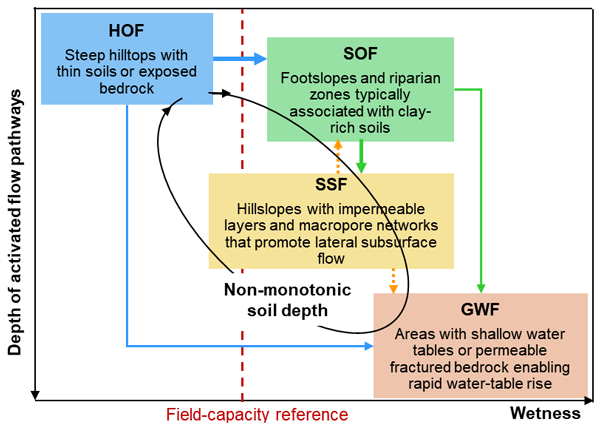
Zhen Cui and Fuqiang Tian
Hydrol. Earth Syst. Sci., 30, 5281–5296, https://doi.org/10.5194/hess-30-5281-2026, https://doi.org/10.5194/hess-30-5281-2026, 2026
Short summary
Short summary
This study synthesizes storm-runoff thresholds from 138 catchments worldwide to clarify why threshold behavior differs across environments. We show that runoff thresholds are often shaped by catchment wetness, storage, soils, geology, and flow-path connectivity, not rainfall alone. The results support a connectivity-based framework for interpreting runoff generation across diverse landscapes.
Zixi Li, Yan Li, Rui Tong, Peizhe Cheng, Fuqiang Tian, and Yao Zhuang
Hydrol. Earth Syst. Sci., 30, 4909–4925, https://doi.org/10.5194/hess-30-4909-2026, https://doi.org/10.5194/hess-30-4909-2026, 2026
Short summary
Short summary
Satellite soil moisture is too coarse and ground measurements are too sparse to describe field conditions. Drone microwave sensing helps fill this gap, but mixed signals from vegetation and surface variability reduce accuracy. We combine drone microwave, optical, and thermal data in a Bayesian framework to improve soil moisture estimates and quantify uncertainty. Field tests in China show higher accuracy, lower bias, and highlight small-scale heterogeneity as a key source of uncertainty.
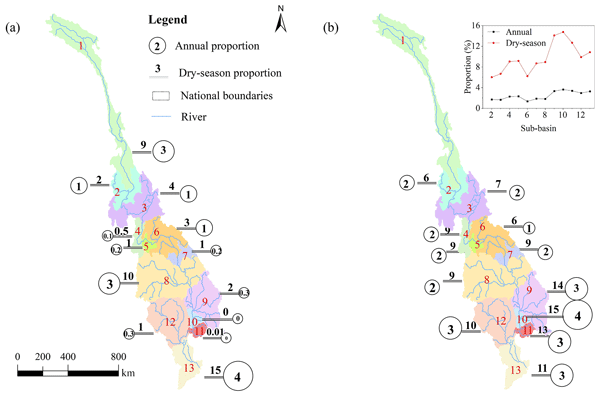
Hongling Zhao, Zilong Zhao, Khosro Morovati, Dongsheng Zhang, and Fuqiang Tian
Hydrol. Earth Syst. Sci., 30, 2433–2453, https://doi.org/10.5194/hess-30-2433-2026, https://doi.org/10.5194/hess-30-2433-2026, 2026
Short summary
Short summary
This study quantifies irrigation water pressure and upstream–downstream interactions in the Lancang–Mekong Basin under climate change. Results show increasing irrigation pressure, with dry-season demand reaching 59 % of available water by 2040. Key subregions exhibit a structural shift from internally to externally driven pressures, highlighting spatial heterogeneity and nonlinear dynamics. Findings inform vulnerable components, transboundary responsibility, and differentiated water governance.
Fuqiang Tian, Murugesu Sivapalan, Sondoss El Sawah, Melissa Haeffner, Anthony Jakeman, Heidi Kreibich, Leyang Liu, Haoyang Lyu, Ana Mijic, Jiale Wang, Jing Wei, and Günter Blöschl
EGUsphere, https://doi.org/10.5194/egusphere-2026-1727, https://doi.org/10.5194/egusphere-2026-1727, 2026
Short summary
Short summary
This opinion paper shows how sociohydrology can better support water management by moving from understanding systems to guiding action. Drawing on ten years of work in the Panta Rhei initiative, it offers a simple way to compare cases, trace how actions lead to intended and unintended outcomes, and improve monitoring, learning, fairness, and legitimacy in decision-making.

Keer Zhang, Zilong Zhao, and Fuqiang Tian
Hydrol. Earth Syst. Sci., 30, 671–691, https://doi.org/10.5194/hess-30-671-2026, https://doi.org/10.5194/hess-30-671-2026, 2026
Short summary
Short summary
Focusing on Drought-Flood Abrupt Alternation (DFAA) under climate change, this study investigates the mitigating role of reservoirs on DFAA in Lancang-Mekong River Basin. The drought-to-flood (DTF) probability is higher than the flood-to-drought (FTD) at all intensities. Reservoirs markedly reduce wet season’s FTD and year-round DTF, effectively shorten DFAA’s monthly span. The reservoir's mitigating effect on the total risk of DFAA is positively correlated with their total storage.
Yi Nan, Fuqiang Tian, and Mahmut Tudaji
EGUsphere, https://doi.org/10.5194/egusphere-2025-4445, https://doi.org/10.5194/egusphere-2025-4445, 2025
Preprint archived
Short summary
Short summary
This study used a hydrological model to investigate how equifinality affects uncertainty in surface–subsurface runoff partitioning. Results show that substantial uncertainty in subsurface runoff contribution can arise from small differences in performance, and that runoff ratio is an important attribute associated with subsurface runoff and its uncertainty. These findings can provide a priori guidance on the likely magnitude of uncertainty in a given catchment based on its attributes.
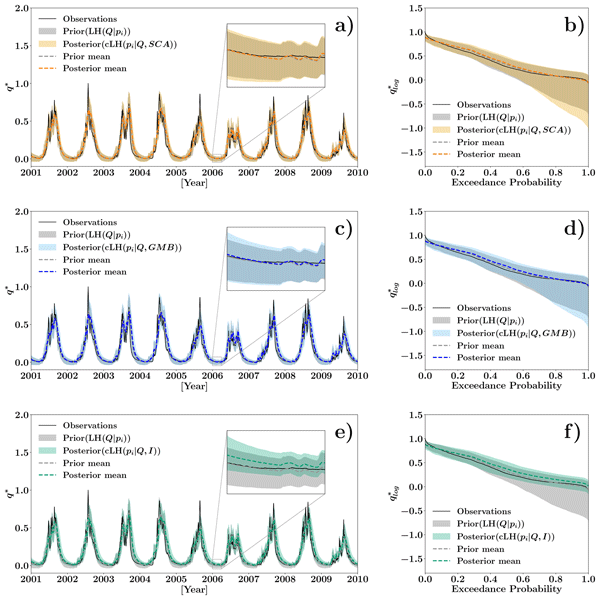
Diego Avesani, Yi Nan, and Fuqiang Tian
Hydrol. Earth Syst. Sci., 29, 5755–5775, https://doi.org/10.5194/hess-29-5755-2025, https://doi.org/10.5194/hess-29-5755-2025, 2025
Short summary
Short summary
Our study explores how different data sources (snow cover, glacier mass balance, and water isotopes) can improve hydrological modeling in large mountain basins. Using a Bayesian framework, we show that isotopes are particularly useful for reducing uncertainty in low-flow conditions, while snow and glacier data help during melt seasons. By addressing equifinality, our approach enhances model reliability, improving water management and streamflow predictions in mountainous regions.
Ruidong Li, Jiapei Liu, Ting Sun, Jian Shao, Fuqiang Tian, and Guangheng Ni
Hydrol. Earth Syst. Sci., 29, 5677–5694, https://doi.org/10.5194/hess-29-5677-2025, https://doi.org/10.5194/hess-29-5677-2025, 2025
Short summary
Short summary
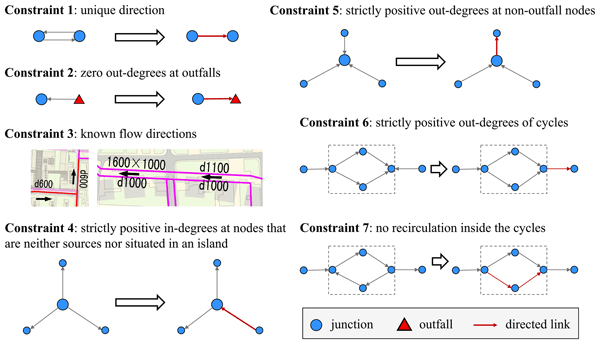
This work presents a new approach to simulate sewer drainage effects from incomplete information in the context of urban flooding, given missing information like flow directions and nodal depths. Tested in Yinchuan, China, our approach exhibits high accuracy in reproducing flood depths and reliably outperforms existing methods in various rainfall scenarios. Our method offers a reliable tool for cities with limited sewer data to improve flood simulation performance.
Khosro Morovati, Hongling Zhao, and Fuqiang Tian
EGUsphere, https://doi.org/10.5194/egusphere-2025-3472, https://doi.org/10.5194/egusphere-2025-3472, 2025
Short summary
Short summary
We studied how dams and climate change have altered the flow of the Mekong River and its connection with a large lake in Cambodia. Using long-term data and a a hydrodynamic response-time model, we found that water flow has become more irregular and less synchronized. These changes have shortened the time when water flows into the lake, threatening ecosystems and farming. Our findings help improve early warning systems and guide future river management.
Mahmut Tudaji, Yi Nan, and Fuqiang Tian
Hydrol. Earth Syst. Sci., 29, 2633–2654, https://doi.org/10.5194/hess-29-2633-2025, https://doi.org/10.5194/hess-29-2633-2025, 2025
Short summary
Short summary
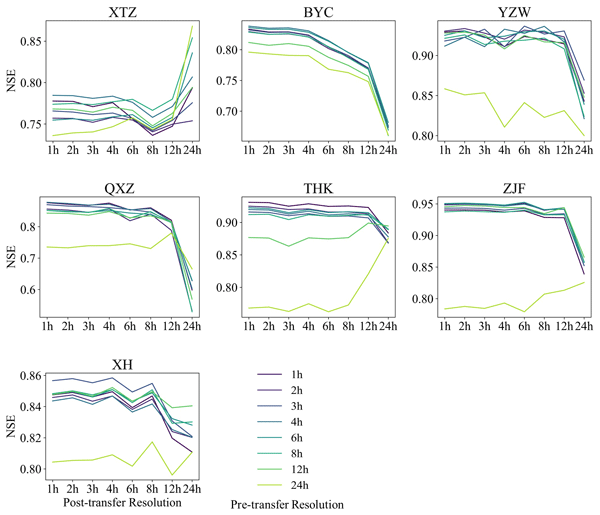
We assessed the value of high-resolution data and parameter transferability across temporal scales based on seven catchments in northern China. We found that higher-resolution data do not always improve model performance, questioning the need for such data. Model parameters are transferable across different data resolutions but not across computational time steps. It is recommended to utilize a smaller computational time step when building hydrological models even without high-resolution data.
Zhen Cui and Fuqiang Tian
Hydrol. Earth Syst. Sci., 29, 2275–2291, https://doi.org/10.5194/hess-29-2275-2025, https://doi.org/10.5194/hess-29-2275-2025, 2025
Short summary
Short summary
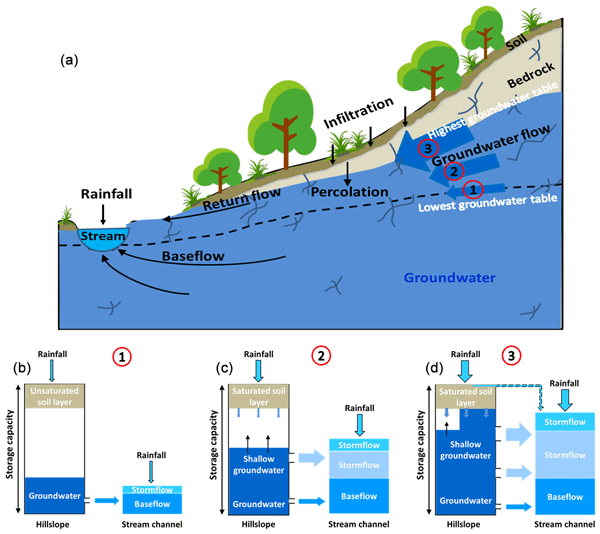
This study investigates stormflow patterns in a forested watershed in north China, highlighting the fact that delayed stormflow is governed by soil water content (SWC) and groundwater level (GWL). When SWC exceeds its storage capacity, excess water infiltrates, recharging groundwater and gradually elevating GWL. Rising GWL enhances subsurface connectivity and lateral flow, synchronizing watershed responses and, in extreme cases, causing a delayed stormflow peak to merge with the direct stormflow peak.
Mahmut Tudaji, Yi Nan, and Fuqiang Tian
Hydrol. Earth Syst. Sci., 29, 1919–1937, https://doi.org/10.5194/hess-29-1919-2025, https://doi.org/10.5194/hess-29-1919-2025, 2025
Short summary
Short summary
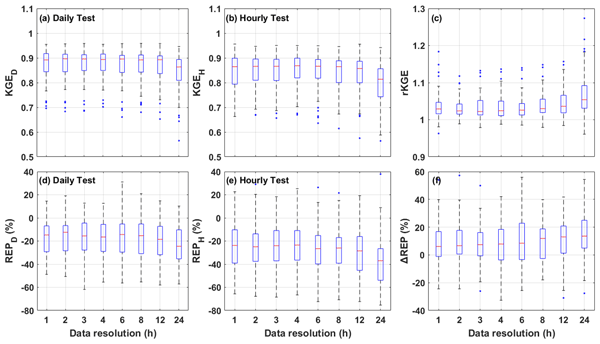
Common intuition holds that higher input data resolution leads to better results. To assess the benefits of high-resolution data, we conduct simulation experiments using data with various temporal resolutions across multiple catchments and find that higher-resolution data do not always improve model performance, challenging the necessity of pursuing such data. In catchments with small areas or significant flow variability, high-resolution data is more valuable.
Mengjiao Zhang, Yi Nan, and Fuqiang Tian
Hydrol. Earth Syst. Sci., 29, 1033–1060, https://doi.org/10.5194/hess-29-1033-2025, https://doi.org/10.5194/hess-29-1033-2025, 2025
Short summary
Short summary
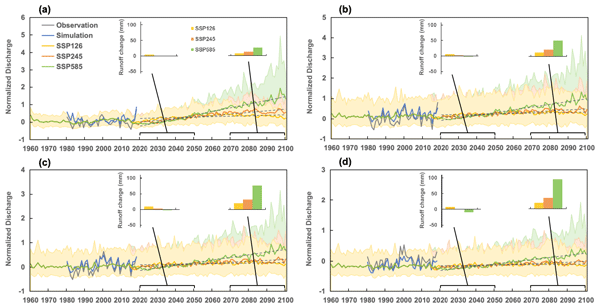
Owing to differences in the existing published results, we conducted a detailed analysis of the runoff components and future trends in the Yarlung Tsangpo River basin and found that the contributions of snowmelt and glacier melt runoff to streamflow (both ~5 %) are limited and much lower than previous results. The streamflow in this area will continuously increase in the future, but the overestimated contribution of glacier melt could lead to an underestimation of this increasing trend.
Khosro Morovati, Keer Zhang, Lidi Shi, Yadu Pokhrel, Maozhou Wu, Paradis Someth, Sarann Ly, and Fuqiang Tian
Hydrol. Earth Syst. Sci., 28, 5133–5147, https://doi.org/10.5194/hess-28-5133-2024, https://doi.org/10.5194/hess-28-5133-2024, 2024
Short summary
Short summary
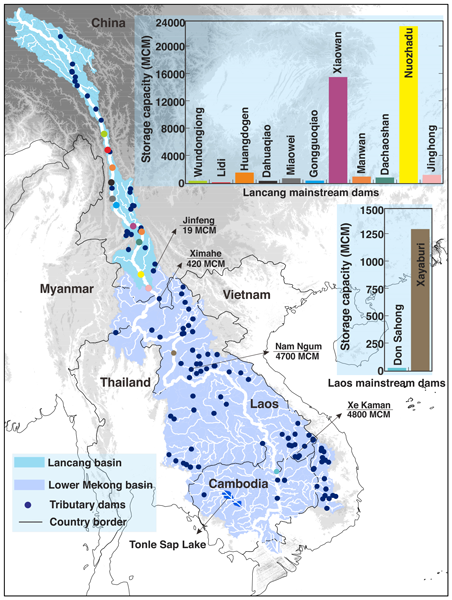
This study examines large daily river flow fluctuations in the dammed Mekong River, developing integrated 3D hydrodynamic and response time models alongside a hydrological model with an embedded reservoir module. This approach allows estimation of travel times between hydrological stations and contributions of subbasins and upstream regions. Findings show a power correlation between upstream discharge and travel time, and significant fluctuations occurred even before dam construction.
Bu Li, Ting Sun, Fuqiang Tian, Mahmut Tudaji, Li Qin, and Guangheng Ni
Hydrol. Earth Syst. Sci., 28, 4521–4538, https://doi.org/10.5194/hess-28-4521-2024, https://doi.org/10.5194/hess-28-4521-2024, 2024
Short summary
Short summary
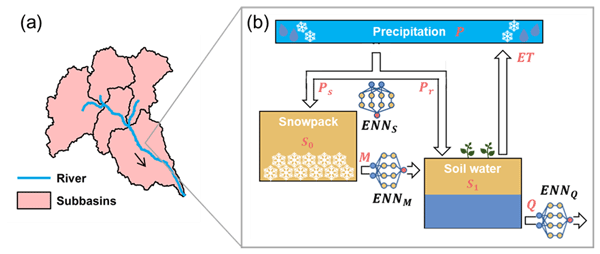
This paper developed hybrid semi-distributed hydrological models by employing a process-based model as the backbone and utilizing deep learning to parameterize and replace internal modules. The main contribution is to provide a high-performance tool enriched with explicit hydrological knowledge for hydrological prediction and to improve understanding about the hydrological sensitivities to climate change in large alpine basins.
Zhen Cui, Fuqiang Tian, Zilong Zhao, Zitong Xu, Yongjie Duan, Jie Wen, and Mohd Yawar Ali Khan
Hydrol. Earth Syst. Sci., 28, 3613–3632, https://doi.org/10.5194/hess-28-3613-2024, https://doi.org/10.5194/hess-28-3613-2024, 2024
Short summary
Short summary
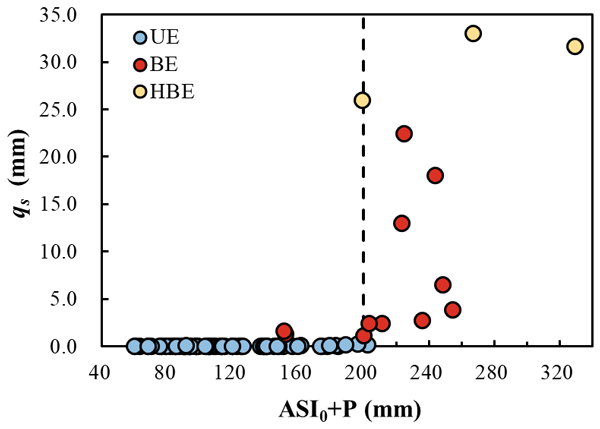
We investigated the response characteristics and occurrence conditions of bimodal hydrographs using 10 years of hydrometric and isotope data in a semi-humid forested watershed in north China. Our findings indicate that bimodal hydrographs occur when the combined total of the event rainfall and antecedent soil moisture index exceeds 200 mm. Additionally, we determined that delayed stormflow is primarily contributed to by shallow groundwater.
Yi Nan and Fuqiang Tian
Hydrol. Earth Syst. Sci., 28, 669–689, https://doi.org/10.5194/hess-28-669-2024, https://doi.org/10.5194/hess-28-669-2024, 2024
Short summary
Short summary
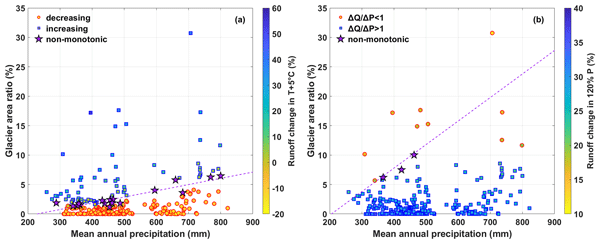
This paper utilized a tracer-aided model validated by multiple datasets in a large mountainous basin on the Tibetan Plateau to analyze hydrological sensitivity to climate change. The spatial pattern of the local hydrological sensitivities and the influence factors were analyzed in particular. The main finding of this paper is that the local hydrological sensitivity in mountainous basins is determined by the relationship between the glacier area ratio and the mean annual precipitation.
Guta Wakbulcho Abeshu, Fuqiang Tian, Thomas Wild, Mengqi Zhao, Sean Turner, A. F. M. Kamal Chowdhury, Chris R. Vernon, Hongchang Hu, Yuan Zhuang, Mohamad Hejazi, and Hong-Yi Li
Geosci. Model Dev., 16, 5449–5472, https://doi.org/10.5194/gmd-16-5449-2023, https://doi.org/10.5194/gmd-16-5449-2023, 2023
Short summary
Short summary
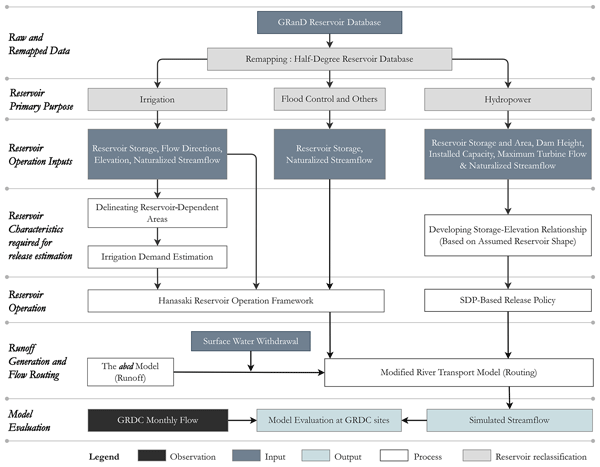
Most existing global hydrologic models do not explicitly represent hydropower reservoirs. We are introducing a new water management module to Xanthos that distinguishes between the operational characteristics of irrigation, hydropower, and flood control reservoirs. We show that this explicit representation of hydropower reservoirs can lead to a significantly more realistic simulation of reservoir storage and releases in over 44 % of the hydropower reservoirs included in this study.
Heidi Kreibich, Kai Schröter, Giuliano Di Baldassarre, Anne F. Van Loon, Maurizio Mazzoleni, Guta Wakbulcho Abeshu, Svetlana Agafonova, Amir AghaKouchak, Hafzullah Aksoy, Camila Alvarez-Garreton, Blanca Aznar, Laila Balkhi, Marlies H. Barendrecht, Sylvain Biancamaria, Liduin Bos-Burgering, Chris Bradley, Yus Budiyono, Wouter Buytaert, Lucinda Capewell, Hayley Carlson, Yonca Cavus, Anaïs Couasnon, Gemma Coxon, Ioannis Daliakopoulos, Marleen C. de Ruiter, Claire Delus, Mathilde Erfurt, Giuseppe Esposito, Didier François, Frédéric Frappart, Jim Freer, Natalia Frolova, Animesh K. Gain, Manolis Grillakis, Jordi Oriol Grima, Diego A. Guzmán, Laurie S. Huning, Monica Ionita, Maxim Kharlamov, Dao Nguyen Khoi, Natalie Kieboom, Maria Kireeva, Aristeidis Koutroulis, Waldo Lavado-Casimiro, Hong-Yi Li, Maria Carmen LLasat, David Macdonald, Johanna Mård, Hannah Mathew-Richards, Andrew McKenzie, Alfonso Mejia, Eduardo Mario Mendiondo, Marjolein Mens, Shifteh Mobini, Guilherme Samprogna Mohor, Viorica Nagavciuc, Thanh Ngo-Duc, Huynh Thi Thao Nguyen, Pham Thi Thao Nhi, Olga Petrucci, Nguyen Hong Quan, Pere Quintana-Seguí, Saman Razavi, Elena Ridolfi, Jannik Riegel, Md Shibly Sadik, Nivedita Sairam, Elisa Savelli, Alexey Sazonov, Sanjib Sharma, Johanna Sörensen, Felipe Augusto Arguello Souza, Kerstin Stahl, Max Steinhausen, Michael Stoelzle, Wiwiana Szalińska, Qiuhong Tang, Fuqiang Tian, Tamara Tokarczyk, Carolina Tovar, Thi Van Thu Tran, Marjolein H. J. van Huijgevoort, Michelle T. H. van Vliet, Sergiy Vorogushyn, Thorsten Wagener, Yueling Wang, Doris E. Wendt, Elliot Wickham, Long Yang, Mauricio Zambrano-Bigiarini, and Philip J. Ward
Earth Syst. Sci. Data, 15, 2009–2023, https://doi.org/10.5194/essd-15-2009-2023, https://doi.org/10.5194/essd-15-2009-2023, 2023
Short summary
Short summary
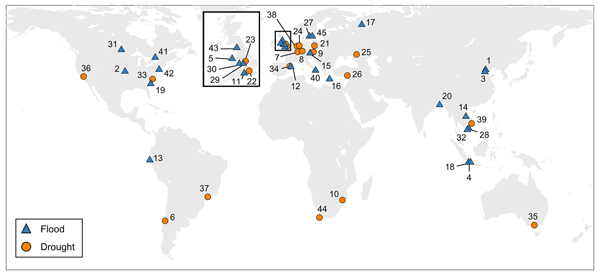
As the adverse impacts of hydrological extremes increase in many regions of the world, a better understanding of the drivers of changes in risk and impacts is essential for effective flood and drought risk management. We present a dataset containing data of paired events, i.e. two floods or two droughts that occurred in the same area. The dataset enables comparative analyses and allows detailed context-specific assessments. Additionally, it supports the testing of socio-hydrological models.
Ruidong Li, Ting Sun, Fuqiang Tian, and Guang-Heng Ni
Geosci. Model Dev., 16, 751–778, https://doi.org/10.5194/gmd-16-751-2023, https://doi.org/10.5194/gmd-16-751-2023, 2023
Short summary
Short summary
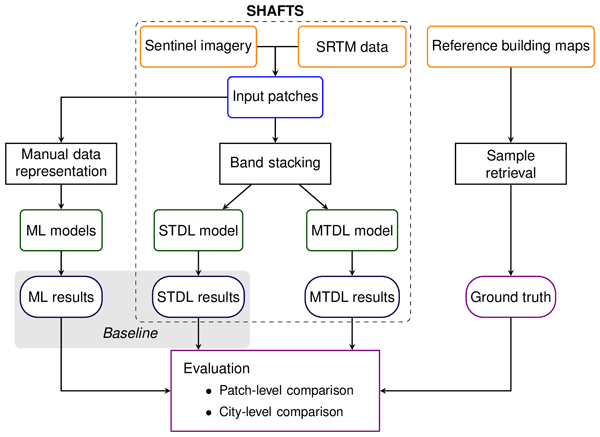
We developed SHAFTS (Simultaneous building Height And FootprinT extraction from Sentinel imagery), a multi-task deep-learning-based Python package, to estimate average building height and footprint from Sentinel imagery. Evaluation in 46 cities worldwide shows that SHAFTS achieves significant improvement over existing machine-learning-based methods.
Yi Nan, Zhihua He, Fuqiang Tian, Zhongwang Wei, and Lide Tian
Hydrol. Earth Syst. Sci., 26, 4147–4167, https://doi.org/10.5194/hess-26-4147-2022, https://doi.org/10.5194/hess-26-4147-2022, 2022
Short summary
Short summary
Tracer-aided hydrological models are useful tool to reduce uncertainty of hydrological modeling in cold basins, but there is little guidance on the sampling strategy for isotope analysis, which is important for large mountainous basins. This study evaluated the reliance of the tracer-aided modeling performance on the availability of isotope data in the Yarlung Tsangpo river basin, and provides implications for collecting water isotope data for running tracer-aided hydrological models.

Yongping Wei, Jing Wei, Gen Li, Shuanglei Wu, David Yu, Mohammad Ghoreishi, You Lu, Felipe Augusto Arguello Souza, Murugesu Sivapalan, and Fuqiang Tian
Hydrol. Earth Syst. Sci., 26, 2131–2146, https://doi.org/10.5194/hess-26-2131-2022, https://doi.org/10.5194/hess-26-2131-2022, 2022
Short summary
Short summary
There is increasing tension among the riparian countries of transboundary rivers. This article proposes a socio-hydrological framework that incorporates the slow and less visible societal processes into existing hydro-economic models, revealing the slow and hidden feedbacks between societal and hydrological processes. This framework will contribute to process-based understanding of the complex mechanism that drives conflict and cooperation in transboundary river management.

Liying Guo, Jing Wei, Keer Zhang, Jiale Wang, and Fuqiang Tian
Hydrol. Earth Syst. Sci., 26, 1165–1185, https://doi.org/10.5194/hess-26-1165-2022, https://doi.org/10.5194/hess-26-1165-2022, 2022
Short summary
Short summary
Data support is crucial for the research of conflict and cooperation on transboundary rivers. Conventional, manual constructions of datasets cannot meet the requirements for fast updates in the big data era. This study brings up a revised methodological framework, based on the conventional method, and a toolkit for the news media dataset tracking of conflict and cooperation dynamics on transboundary rivers. A dataset with good tradeoffs between data relevance and coverage is generated.
Yi Nan, Zhihua He, Fuqiang Tian, Zhongwang Wei, and Lide Tian
Hydrol. Earth Syst. Sci., 25, 6151–6172, https://doi.org/10.5194/hess-25-6151-2021, https://doi.org/10.5194/hess-25-6151-2021, 2021
Short summary
Short summary
Hydrological modeling has large problems of uncertainty in cold regions. Tracer-aided hydrological models are increasingly used to reduce uncertainty and refine the parameterizations of hydrological processes, with limited application in large basins due to the unavailability of spatially distributed precipitation isotopes. This study explored the utility of isotopic general circulation models in driving a tracer-aided hydrological model in a large basin on the Tibetan Plateau.

Kunbiao Li, Fuqiang Tian, Mohd Yawar Ali Khan, Ran Xu, Zhihua He, Long Yang, Hui Lu, and Yingzhao Ma
Earth Syst. Sci. Data, 13, 5455–5467, https://doi.org/10.5194/essd-13-5455-2021, https://doi.org/10.5194/essd-13-5455-2021, 2021
Short summary
Short summary
Due to complex climate and topography, there is still a lack of a high-quality rainfall dataset for hydrological modeling over the Tibetan Plateau. This study aims to establish a high-accuracy daily rainfall product over the southern Tibetan Plateau through merging satellite rainfall estimates based on a high-density rainfall gauge network. Statistical and hydrological evaluation indicated that the new dataset outperforms the raw satellite estimates and several other products of similar types.
Cited articles
Alivio, M. B., Bezak, N., and Mikoš, M.: The size distribution metrics and kinetic energy of raindrops above and below an isolated tree canopy in urban environment, Urban For. Urban Gree., 85, 127971, https://doi.org/10.1016/j.ufug.2023.127971, 2023.
Atlas, D., Srivastava, R. C., and Sekhon, R. S.: Doppler radar characteristics of precipitation at vertical incidence, Rev. Geophys., 11, 1–35, https://doi.org/10.1029/RG011i001p00001, 1973.
Brasil, J. B., Andrade, E. M. D., Araújo de Queiroz Palácio, H., Fernández-Raga, M., Carvalho Ribeiro Filho, J., Medeiros, P. H. A., and Guerreiro, M. S.: Canopy effects on rainfall partition and throughfall drop size distribution in a tropical dry forest, Atmosphere-Basel, 13, 1126, https://doi.org/10.3390/atmos13071126, 2022.
Chen, C., Jia, Y., Zhang, J., Yang, L., Wang, Y., and Kang, F.: Development of a 3D point cloud reconstruction-based apple canopy liquid sedimentation model, J. Clean. Prod., 451, 142038, https://doi.org/10.1016/j.jclepro.2024.142038, 2024.
de Moraes Frasson, R. P. and Krajewski, W. F.: Rainfall interception by maize canopy: Development and application of a process-based model, J. Hydrol., 489, 246–255, https://doi.org/10.1016/j.jhydrol.2013.03.019, 2013.
Du, S., Lindenbergh, R., Ledoux, H., Stoter, J., and Nan, L.: AdTree: Accurate, detailed, and automatic modelling of laser-scanned trees, Remote Sens.-Basel, 11, 2074, https://doi.org/10.3390/rs11182074, 2019.
Fernández-Raga, M., Fraile, R., Keizer, J. J., Teijeiro, M. E. V., Castro, A., Palencia, C., and Marques, R. L. D. C.: The kinetic energy of rain measured with an optical disdrometer: An application to splash erosion, Atmos. Res., 96, 225–240, https://doi.org/10.1016/j.atmosres.2009.07.013, 2010.
Gash, J. H. C. and Morton, A. J.: An application of the Rutter model to the estimation of the interception loss from Thetford forest, J. Hydrol., 38, 49–58, https://doi.org/10.1016/0022-1694(78)90131-2, 1978.
Geißler, C., Nadrowski, K., Kühn, P., Baruffol, M., and Bruelheide, H.: Kinetic Energy of Throughfall in Subtropical Forests of SE China – Effects of Tree Canopy Structure, Functional Traits, and Biodiversity, PLoS ONE, 8, e49618, https://doi.org/10.1371/journal.pone.0049618, 2013.
Hosoi, F. and Omasa, K.: Voxel-based 3-D modeling of individual trees for estimating leaf area density using high-resolution portable scanning lidar, IEEE T. Geosci. Remote, 44, 3610–3618, https://doi.org/10.1109/TGRS.2006.881743, 2006.
Howard, M., Hathaway, J. M., Tirpak, R. A., Lisenbee, W. A., and Sims, S.: Quantifying urban tree canopy interception in the southeastern United States, Urban For. Urban Gree., 77, 127741, https://doi.org/10.1016/j.ufug.2022.127741, 2022.
Katayama, A., Nanko, K., Jeong, S., Kume, T., Shinohara, Y., and Seitz, S.: Short communication: Concentrated impacts by tree canopy drips – hotspots of soil erosion in forests, Earth Surf. Dynam., 11, 1275–1282, https://doi.org/10.5194/esurf-11-1275-2023, 2023.
Konrad, W., Ebner, M., Traiser, C., and Roth-Nebelsick, A.: Leaf Surface Wettability and Implications for Drop Shedding and Evaporation from Forest Canopies, Pure Appl. Geophys., 169, 835–845, https://doi.org/10.1007/s00024-011-0330-2, 2012.
Levia, D. F., Carlyle-Moses, D., and Tanaka, T.: Forest hydrology and biogeochemistry: synthesis of past research and future directions, Springer Sci. Bus. Media, 216, https://doi.org/10.1007/978-94-007-1363-5, 2011.
Levia, D. F., Hudson, S. A., Llorens, P., and Nanko, K.: Throughfall drop size distributions: a review and prospectus for future research, WIRes Water, 4, e1225, https://doi.org/10.1002/wat2.1225, 2017.
Levia, D. F., Nanko, K., Amasaki, H., Giambelluca, T. W., Hotta, N., Iida, S., Mudd, R. G., Nullet, M. A., Sakai, N., Shinohara, Y., Sun, X., Suzuki, M., Tanaka, N., Tantasirin, C., and Yamada, K.: Throughfall partitioning by trees, Hydrol. Process., 33, 1698–1708, https://doi.org/10.1002/hyp.13432, 2019.
Li, G., Wan, L., Cui, M., Wu, B., and Zhou, J.: Influence of canopy interception and rainfall kinetic energy on soil erosion under forests, Forests, 10, 509, https://doi.org/10.3390/f10060509, 2019.
Li, Z.: The open data of “Derivation and validation of estimation model of rainfall kinetic energy under the canopy”, Zenodo [data set], https://doi.org/10.5281/zenodo.15472339, 2025.
Li, Z. and Tian, F.: Derivation and validation of a theoretical canopy interception model based on raindrop microphysical processes, Water Resour. Res., 61, e2024WR038296, https://doi.org/10.1029/2024WR038296, 2025.
Li, Z., Tian, F., Wang, D., and Peng, Z.: A stochastic simulation method for estimating vegetation interception capacity based on mechanical-geometric analysis, Water Resour. Res., 61, e2025WR040267, https://doi.org/10.1029/2025WR040267, 2025.
Maćkiewicz, A. and Ratajczak, W.: Principal components analysis (PCA), Comput. Geosci., 19, 303–342, 1993.
Miralles, D. G., Gash, J. H., Holmes, T. R., de Jeu, R. A., and Dolman, A. J.: Global canopy interception from satellite observations, J. Geophys. Res.-Atmos., 115, D16122, https://doi.org/10.1029/2009JD013530, 2010.
Momiyama, H., Kumagai, T. O., Fujime, N., Egusa, T., and Shimizu, T.: Forest canopy interception can reduce flood discharge: Inferences from model assumption analysis, J. Hydrol., 623, 129843, https://doi.org/10.1016/j.jhydrol.2023.129843, 2023.
Montero-Martinez, G., Garcia-Garcia, F., and Arenal-Casas, S.: The change of rainfall kinetic energy content with altitude, J. Hydrol., 584, 124685, https://doi.org/10.1016/j.jhydrol.2020.124685, 2020.
Mostafa, H., Saha, K. K., Tsoulias, N., and Zude-Sasse, M.: Using LiDAR technique and modified Community Land Model for calculating water interception of cherry tree canopy, Agr. Water Manage., 272, 107816, https://doi.org/10.1016/j.agwat.2022.107816, 2022.
Mou, J.: Formula for calculating raindrop velocity, Chin. J. Soil Water Conserv., 3, 40–41, 1983.
Murakami, S.: Water and energy balance of canopy interception as evidence of splash droplet evaporation hypothesis, Hydrolog. Sci. J., 66, 1248–1264, https://doi.org/10.1080/02626667.2021.1924378, 2021.
Nanko, K., Mizugaki, S., and Onda, Y.: Estimation of soil splash detachment rates on the forest floor of an unmanaged Japanese cypress plantation based on field measurements of throughfall drop sizes and velocities, Catena, 72, 348–360, https://doi.org/10.1016/j.catena.2007.07.002, 2008a.
Nanko, K., Onda, Y., Ito, A., and Moriwaki, H.: Effect of canopy thickness and canopy saturation on the amount and kinetic energy of throughfall: An experimental approach, Geophys. Res. Lett., 35, L05402, https://doi.org/10.1029/2007GL033010, 2008b.
Nanko, K., Watanabe, A., Hotta, N., and Suzuki, M.: Physical interpretation of the difference in drop size distributions of leaf drips among tree species, Agr. Forest Meteorol., 169, 74–84, https://doi.org/10.1016/j.agrformet.2012.09.018, 2013.
Nanko, K., Keim, R. F., Hudson, S. A., and Levia, D. F.: Throughfall drop sizes suggest canopy flowpaths vary by phenophase, J. Hydrol., 612, 128144, https://doi.org/10.1016/j.jhydrol.2022.128144, 2022.
Nanko, K., Levia, D. F., Iida, S. I., Shinohara, Y., and Sakai, N.: Machine learning reveals the contrasting roles of rainfall and canopy structure metrics on the formation of canopy drip and splash throughfall, J. Geophys. Res.-Biogeo., 130, e2024JG008340, https://doi.org/10.1029/2024JG008340, 2025.
Pflug, S., Voortman, B. R., Cornelissen, J. H., and Witte, J. P. M.: The effect of plant size and branch traits on rainfall interception of 10 temperate tree species, Ecohydrology, 14, e2349, https://doi.org/10.1002/eco.2349, 2021.
Rutter, A. J., Kershaw, K. A., Robins, P. C., and Morton, A. J.: A predictive model of rainfall interception in forests, 1. Derivation of the model from observations in a plantation of Corsican pine, Agr. Meteorol., 9, 367–384, https://doi.org/10.1016/0002-1571(71)90034-3, 1971.
Senn, J. A., Fassnacht, F. E., Eichel, J., Seitz, S., and Schmidtlein, S.: A new concept for estimating the influence of vegetation on throughfall kinetic energy using aerial laser scanning, Earth Surf. Proc. Land., 45, 1487–1498, https://doi.org/10.1002/esp.4820, 2020.
Tu, L., Xiong, W., Wang, Y., Yu, P., Liu, Z., Han, X., and Xu, L.: Integrated effects of rainfall regime and canopy structure on interception loss: A comparative modelling analysis for an artificial larch forest, Ecohydrology, 14, e2283, https://doi.org/10.1002/eco.2283, 2021.
Valente, F., David, J. S., and Gash, J. H. C.: Modelling interception loss for two sparse eucalypt and pine forests in central Portugal using reformulated Rutter and Gash analytical models, J. Hydrol., 190, 141–162, https://doi.org/10.1016/S0022-1694(96)03066-1, 1997.
Van Dijk, A. I. J. M., Bruijnzeel, L. A., and Rosewell, C. J.: Rainfall intensity–kinetic energy relationships: a critical literature appraisal, J. Hydrol., 261, 1–23, https://doi.org/10.1016/S0022-1694(02)00020-3, 2002.
Wang, S., Liu, C., Li, W., Jia, S., and Yue, H.: Hybrid model for estimating forest canopy heights using fused multimodal spaceborne LiDAR data and optical imagery, Int. J. Appl. Earth Obs., 122, 103431, https://doi.org/10.1016/j.jag.2023.103431, 2023.
Xiao, Q., McPherson, E. G., Ustin, S. L., and Grismer, M. E.: A new approach to modeling tree rainfall interception, J. Geophys. Res., 105, 29173–29188, https://doi.org/10.1029/2000JD900343, 2000.
Yao, W. and Chen, G.: Raindrop falling velocity and terminal velocity formula, J. Hohai Univ. Nat. Sci. Ed., 21, 21–27, 1993.
Zhang, R., Seki, K., and Wang, L.: Quantifying the contribution of meteorological factors and plant traits to canopy interception under maize cropland, Agr. Water Manage., 279, 108195, https://doi.org/10.1016/j.agwat.2023.108195, 2023.
Zhang, W., Liu, W., Li, W., Zhu, X., Chen, C., Zeng, H., and Yang, B.: Characteristics of throughfall kinetic energy under the banana (Musa nana Lour.) canopy: The role of leaf shapes, Catena, 197, 104985, https://doi.org/10.1016/j.catena.2020.104985, 2021.
Short summary
Forests can change the kinetic energy of rain below them. We built a new model that breaks down the canopy into layers, and tracks two types of raindrop: direct splashes and water dripping from leaves. The model was validated through nine rainfall events. The canopy doesn't always reduce the rain's force, and sometimes it increases it, depending on the specific structure of the leaves and branches.
Forests can change the kinetic energy of rain below them. We built a new model that breaks down...


