
Articles | Volume 30, issue 4
https://doi.org/10.5194/hess-30-985-2026
© Author(s) 2026. This work is distributed under
the Creative Commons Attribution 4.0 License.
the Creative Commons Attribution 4.0 License.
https://doi.org/10.5194/hess-30-985-2026
© Author(s) 2026. This work is distributed under
the Creative Commons Attribution 4.0 License.
the Creative Commons Attribution 4.0 License.
Review article
| 
19 Feb 2026
Review article |
| 19 Feb 2026
| 19 Feb 2026
A review of current best practices and future directions in assimilating GRACE/-FO terrestrial water storage data into numerical models

Institute of Geodesy and Geoinformation, University of Bonn, Bonn, Germany
Gabriëlle De Lannoy
Department of Earth and Environmental Sciences, Catholic University Leuven, Leuven, Belgium
Matthew Rodell
Earth Sciences Division, NASA Goddard Space Flight Center, Greenbelt, MD, USA
Yorck Ewerdwalbesloh
Institute of Geodesy and Geoinformation, University of Bonn, Bonn, Germany
Helena Gerdener
Institute of Geodesy and Geoinformation, University of Bonn, Bonn, Germany
Mehdi Khaki
School of Engineering, University of Newcastle, Callaghan, New South Wales, Australia
Bailing Li
Hydrological Sciences Laboratory, NASA Goddard Space Flight Center, Greenbelt, MD, USA
ESSIC University of Maryland, College Park, MD, USA
Fupeng Li
Institute of Geodesy and Geoinformation, University of Bonn, Bonn, Germany
Maike Schumacher
Department of Sustainability and Planning, Aalborg University, Aalborg, Denmark
Natthachet Tangdamrongsub
Water Engineering and Management, Faculty of Civil and Environmental Engineering, Asian Institute of Technology, Klong Luang, Pathum Thani, 12120, Thailand
Mohammad J. Tourian
Institute of Geodesy, University of Stuttgart, Stuttgart, Germany
Wanshu Nie
Hydrological Sciences Laboratory, NASA Goddard Space Flight Center, Greenbelt, MD, USA
Science Applications International Corporation, Reston, VA, USA
Jürgen Kusche
Institute of Geodesy and Geoinformation, University of Bonn, Bonn, Germany
Related authors
Anna Klos, Jürgen Kusche, Anne Springer, Artur Lenczuk, Yorck Ewerdwalbesloh, Christian Mielke, Susanna Werth, Jan Mikocki, Kinga Klos, Jakub Rados, Malgorzata Sieczak, and Janusz Bogusz
Earth Syst. Sci. Data Discuss., https://doi.org/10.5194/essd-2026-469, https://doi.org/10.5194/essd-2026-469, 2026
Revised manuscript under review for ESSD
Short summary
Short summary
We provide long, daily displacement time series from thousands of stations across Europe, which have been carefully preselected to study hydrospheric changes in long-term, seasonal and short-term temporal scales. These changes correlate well with precipitation, dry and wet periods. This dataset provides a more detailed picture of regional changes in hydrosphere than previously available datasets.
Bernd Uebbing, Kristin Vielberg, Roelof Rietbroek, Bene Aschenneller, Armin Köhl, and Jürgen Kusche
Earth Syst. Sci. Data, 18, 6945–6972, https://doi.org/10.5194/essd-18-6945-2026, https://doi.org/10.5194/essd-18-6945-2026, 2026
Short summary
Short summary
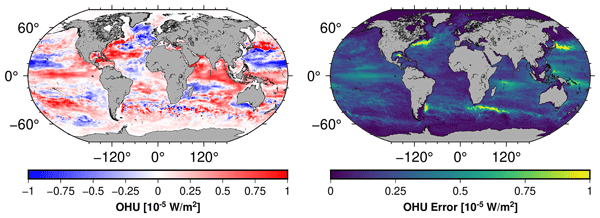
About 90% of the excess heat in the Earth system is stored within the oceans leading to significant ocean warming and corresponding (volumetric) sea level change. We quantify global and regional ocean heat content change (OHC) by consistently combining space-geodetic altimetry, gravity and in situ temperature profile observations. Our results agree well with published estimates and highlight the benefit of consistently processing space-geodetic datasets for deriving high quality OHC estimates.
Rémi Madelon, K. Arthur Endsley, John S. Kimball, Gabriëlle J. M. De Lannoy, Oliver Sonnentag, Haley Alcock, Alex Mavrovic, Scott N. Williamson, Vincent Maire, Arnaud Mialon, and Alexandre Roy
Biogeosciences, 23, 6359–6407, https://doi.org/10.5194/bg-23-6359-2026, https://doi.org/10.5194/bg-23-6359-2026, 2026
Short summary
Short summary
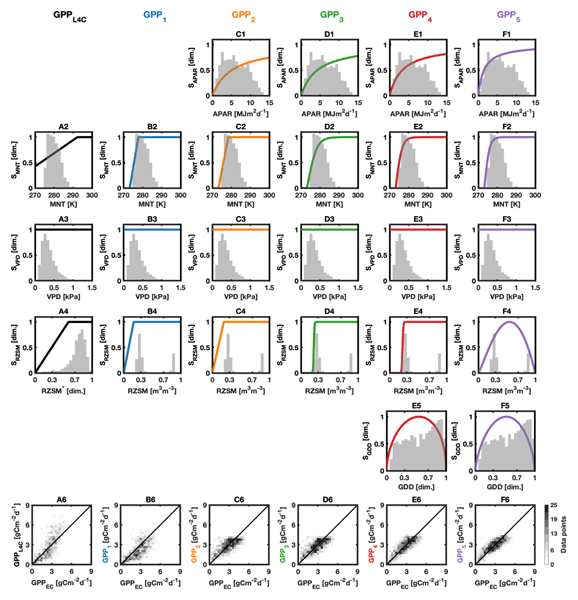
This study aims to improve estimates of carbon dioxide release and uptake in the North American Arctic and subarctic regions. Several modeling approaches were tested, showing that a better representation of sunlight and temperature effects on ecosystems leads to improved estimates. This work provides new perspectives to better assess whether these regions act as sources or sinks of greenhouse gases and how they may influence the climate system by amplifying or slowing global warming.
Miao Tang, Shin-Chan Han, In-Young Yeo, Mehdi Khaki, Thomas Loudis Papanikolaou, and Xinghai Yang
Earth Syst. Sci. Data, 18, 6589–6611, https://doi.org/10.5194/essd-18-6589-2026, https://doi.org/10.5194/essd-18-6589-2026, 2026
Short summary
Short summary
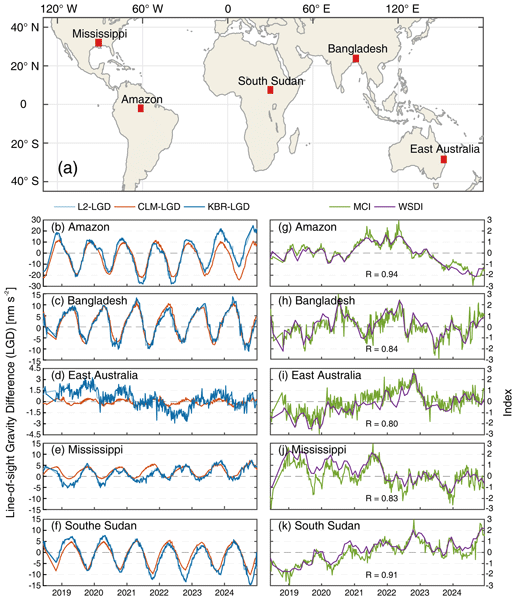
This study presents a new global dataset that quantifies Earth’s mass changes by using gravity signals recorded from the GRACE (Gravity Recovery and Climate Experiment) spacecrafts. This dataset captures instantaneous mass changes and can reveal short-term dynamics that standard monthly data products do not provide. This enables prompt detection of rapid events such as flash droughts and floods and offers critical information to support improved monitoring of short-term water and mass variations.
Loudi Yap, Jürgen Kusche, Bamidele Oloruntoba, Helena Gerdener, and Harrie-Jan Hendricks Franssen
Hydrol. Earth Syst. Sci., 30, 5023–5047, https://doi.org/10.5194/hess-30-5023-2026, https://doi.org/10.5194/hess-30-5023-2026, 2026
Short summary
Short summary
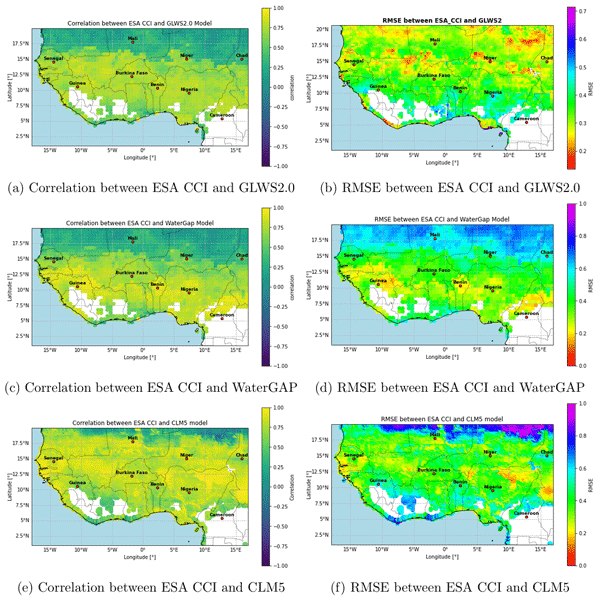
Rainfall shifts in West Africa affects agricultural productivity, highlighting how much water is stored in the soil. Soil moisture from 2003 to 2019 was assessed using satellite, model, and in-situ data. The European Space Agency Climate Change Initiative Soil Moisture dataset best tracked local conditions, while the Gravity Recovery and Climate Experiment Follow-On (GRACE-/FO)-based Global Land Water Storage version 2.0 captured regional variability, improving understanding of root-zone water.
Julia Pfeffer, Benoît Meyssignac, Rory Bingham, Alejandro Blazquez, Marie Bouih, Carla Braitenberg, Luca Brocca, Henryk Dobslaw, Ramiro Ferrari, Ehsan Forootan, Helena Gerdener, Muhammad Tahir Javed, Laura Jensen, Volker Klemann, Anna Kremer, Jürgen Kusche, Gilles Larnicol, Muhammad Usman Liaqat, Francesco Leopardi, Elisavet-Maria Mamagiannou, Gerardo Maurizio, Roland Pail, Isabelle Panet, Thomas Papanikolaou, Peyman Saemian, Ingo Sasgen, Maike Schumacher, Marius Schlaak, Linus Shihora, Alireza Sobouti, Nico Sneeuw, Mohammad Javad Tourian, Dimitrios Tsoulis, Georgios Vergos, Bert Wouters, Fan Yang, and Ilias Daras
EGUsphere, https://doi.org/10.5194/egusphere-2026-4642, https://doi.org/10.5194/egusphere-2026-4642, 2026
This preprint is open for discussion and under review for Earth Observation (EO).
Short summary
Short summary
The ESA SING project demonstrates how the future satellite gravity missions NGGM and MAGIC will improve observations of continental water storage, oceans, glaciers, sea level, earthquakes, and climate change. Their more accurate, higher-resolution gravity measurements will enhance Earth system monitoring, improve climate and hazard assessments, and strengthen operational services for water management, disaster preparedness, and environmental decision-making.
Pierre Laluet, Jacopo Dari, Louise Busschaert, Zdenko Heyvaert, Gabrielle De Lannoy, Pia Langhans, Sara Modanesi, Christian Massari, Luca Brocca, Carla Saltalippi, Renato Morbidelli, Clément Albergel, and Wouter Dorigo
Earth Syst. Sci. Data, 18, 4833–4853, https://doi.org/10.5194/essd-18-4833-2026, https://doi.org/10.5194/essd-18-4833-2026, 2026
Short summary
Short summary
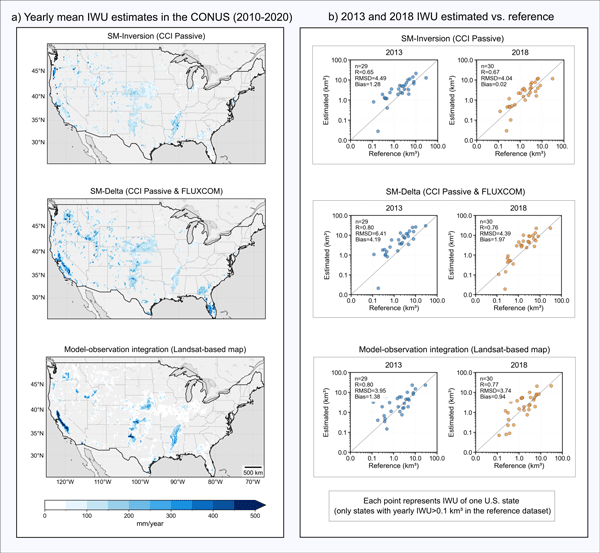
We developed a long-term dataset collection of irrigation water use based on about two decades of satellite observations, three distinct approaches, and many input datasets. The collection provides monthly estimates for major agricultural regions and helps describe how irrigation varies across locations, seasons, and years. It offers a foundation for improving how irrigation is quantified, compared across methods, and integrated into large-scale hydrological and climate studies.
Anna Klos, Jürgen Kusche, Anne Springer, Artur Lenczuk, Yorck Ewerdwalbesloh, Christian Mielke, Susanna Werth, Jan Mikocki, Kinga Klos, Jakub Rados, Malgorzata Sieczak, and Janusz Bogusz
Earth Syst. Sci. Data Discuss., https://doi.org/10.5194/essd-2026-469, https://doi.org/10.5194/essd-2026-469, 2026
Revised manuscript under review for ESSD
Short summary
Short summary
We provide long, daily displacement time series from thousands of stations across Europe, which have been carefully preselected to study hydrospheric changes in long-term, seasonal and short-term temporal scales. These changes correlate well with precipitation, dry and wet periods. This dataset provides a more detailed picture of regional changes in hydrosphere than previously available datasets.
Francesco Avanzi, Hans Lievens, Michael Matiu, Paolo Filippucci, Oscar M. Baez Villanueva, Simone Gabellani, Fabio Delogu, Lorenzo Alfieri, Andrea Libertino, Pere Quintana-Seguì, Diego G. Miralles, Luca Brocca, Christian Massari, and Gabriëlle J. M. De Lannoy
EGUsphere, https://doi.org/10.5194/egusphere-2026-2851, https://doi.org/10.5194/egusphere-2026-2851, 2026
Short summary
Short summary
We developed a new system to map and monitor snow and stored water across large mountain regions using satellite data and computer simulations. Tested in four major European river basins, the system reproduced snow conditions with high accuracy and realistically captured how snow changes with elevation. Because it does not rely on ground measurements, it can help provide consistent information on snow-water resources worldwide, supporting water management and climate adaptation.
Viola Steidl, Jürgen Kusche, Fupeng Li, and Xiao Xiang Zhu
EGUsphere, https://doi.org/10.5194/egusphere-2026-2312, https://doi.org/10.5194/egusphere-2026-2312, 2026
Short summary
Short summary
Terrestrial water storage is an indicator of water availability, but forecasting its changes is difficult as it depends on processes acting at varying spatial and temporal scales. We introduce a hierarchical machine learning model that represents the Earth at two scales, the grid scale and the hydrological basin scale, to forecast global water storage changes up to six months ahead. We identify where model skill fades and which challenges to address to improve its forecasts.
Zanpin Xing, Xiaojun Li, Frédéric Frappart, Gabrielle De Lannoy, Thomas Jagdhuber, Jian Peng, Lei Fan, Hongliang Ma, Lanka Karthikeyan, Xiangzhuo Liu, Mengjia Wang, Lin Zhao, Yongqin Liu, and Jean-Pierre Wigneron
Earth Syst. Sci. Data, 18, 4047–4073, https://doi.org/10.5194/essd-18-4047-2026, https://doi.org/10.5194/essd-18-4047-2026, 2026
Short summary
Short summary
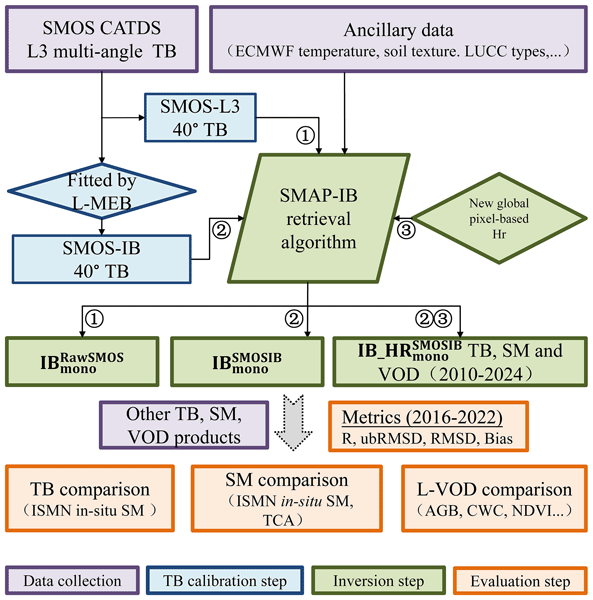
Microwave satellite observations of Earth’s land surface are important for tracking global soil moisture and vegetation water content. We use data from the Soil Moisture and Ocean Salinity satellite to first reduce noise and contamination in microwave signals, then produce more reliable long-term records of these variables. Tests against ground stations and other satellites show that the new record performs better than existing products and supports drought, freeze-thaw, and carbon monitoring.
Lucas Boeykens, Devon Dunmire, Jonas-Frederik Jans, Willem Waegeman, Gabriëlle De Lannoy, Ezra Beernaert, Niko E. C. Verhoest, and Hans Lievens
The Cryosphere, 20, 3187–3216, https://doi.org/10.5194/tc-20-3187-2026, https://doi.org/10.5194/tc-20-3187-2026, 2026
Short summary
Short summary
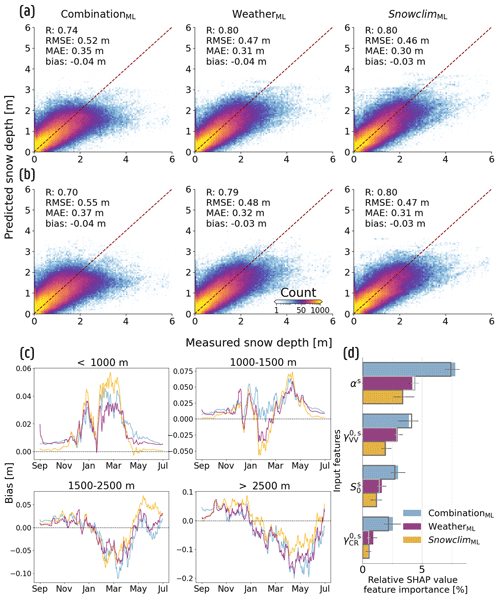
We used AI to better estimate the height of the snowpack present on the ground across the European Alps, by using novel satellite data, complemented by weather information or snow depth estimates from a computer model. We found that both combinations improve the accuracy of our AI-based snow depth estimates, performing almost equally well. This helps us better monitor how much water is stored as snow, which is vital for drinking water, farming, and clean energy production in Europe.
Franklin Robertson, Michael Bosilovich, Matthew Rodell, Richard Allan, Bryant Loomis, Hiroko Beaudoing, Joaquin Munoz-Sabater, and Jason Roberts
EGUsphere, https://doi.org/10.5194/egusphere-2026-2539, https://doi.org/10.5194/egusphere-2026-2539, 2026
Short summary
Short summary
Water availability for societies and ecosystems depends upon Terrestrial Water Storage (TWS). By exploiting Gravity Recovery and Climate Experiment gravimetric measurements and TWS reconstructions from reanalysis, global hydrologic modeling and machine learning approaches, we provide evidence that previously documented TWS decline since 2002 extends back to the 1980s and is explained by coincident decline in regional precipitation combined with a growing influence of human water management.
Louise Busschaert, Michel Bechtold, Sara Modanesi, Christian Massari, Dirk Raes, Sujay V. Kumar, and Gabriëlle J. M. De Lannoy
Hydrol. Earth Syst. Sci., 30, 2579–2611, https://doi.org/10.5194/hess-30-2579-2026, https://doi.org/10.5194/hess-30-2579-2026, 2026
Short summary
Short summary
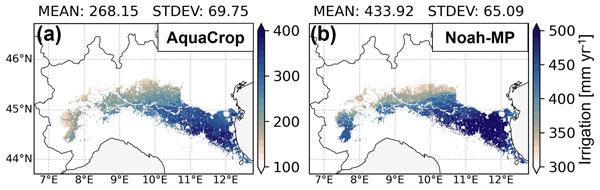
Two models, AquaCrop (crop model) and Noah-MP (land surface model), were compared estimating irrigation in Italy's Po Valley. Noah-MP simulated higher water use (434 mm/yr) than AquaCrop (268 mm/yr), mainly due to extra water losses like runoff. Once losses were accounted for, both aligned with basin-scale reports of around 500 to 600 mm/yr. The study highlights how complex irrigation modeling is, and the need for better observational data to validate results.
Gabriëlle J. M. De Lannoy, Louise Busschaert, Michel Bechtold, Niccolò Lanfranco, Shannon de Roos, Zdenko Heyvaert, Martynas Bielinis, Jonas Mortelmans, Samuel A. Scherrer, Maxime Van den Bossche, Sujay Kumar, David M. Mocko, Eric Kemp, Lee Heng, Pasquale Steduto, and Dirk Raes
Geosci. Model Dev., 19, 2551–2575, https://doi.org/10.5194/gmd-19-2551-2026, https://doi.org/10.5194/gmd-19-2551-2026, 2026
Short summary
Short summary
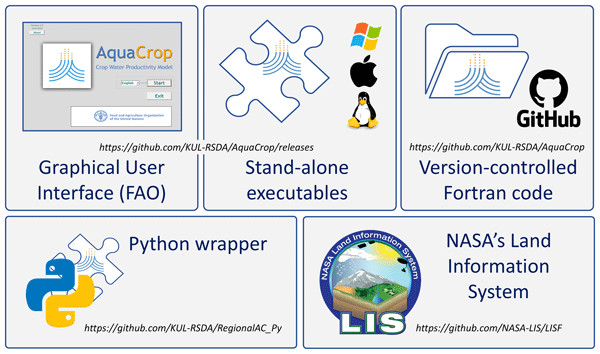
The AquaCrop model has been incorporated into the NASA Land Information System, to advance regional crop growth simulations at any spatial resolution, with a range of different input sources for meteorology, soil and crop parameters. This system also facilitates the assimilation of satellite data to update the crop and water conditions during model simulations. We present three exploratory applications to highlight pathways for future research on regional-scale crop estimation.
Charlotte Hacker, Benjamin D. Gutknecht, Anno Löcher, and Jürgen Kusche
Earth Syst. Sci. Data, 18, 1747–1781, https://doi.org/10.5194/essd-18-1747-2026, https://doi.org/10.5194/essd-18-1747-2026, 2026
Short summary
Short summary
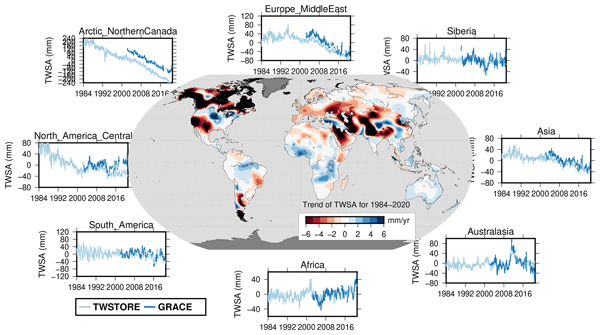
Terrestrial water storage anomalies (TWSA) enable the study of changes in water storage. However, observational records of TWSA are limited to 2002 onwards. To overcome this limitation, we provide a long-term TWSA data set for the global land from 1984 to 2020 by combining a data-driven approach with time‑variable gravity observations from geodetic tracking data. The data set retains seasonal consistency and adds reliable long‑term signals due to the data combination.
Devon Dunmire, Michel Bechtold, Lucas Boeykens, and Gabriëlle J. M. De Lannoy
The Cryosphere, 20, 609–628, https://doi.org/10.5194/tc-20-609-2026, https://doi.org/10.5194/tc-20-609-2026, 2026
Short summary
Short summary
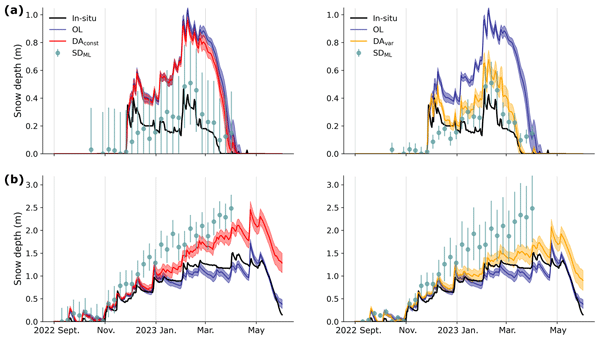
Snow is vital for society and the climate, yet estimates of snowpack remain uncertain due to observational and modeling limitations. Data assimilation (DA) helps by integrating observations with models. Here, we integrate snow depth retrievals into a physically-based snow model across the European Alps. This work offers advancements for snow data assimilation, such as incorporating a dynamic observational uncertainty, which is essential for forecasting and water resource management.
Leire Retegui-Schiettekatte, Manuela Girotto, Maike Schumacher, Mohammad Shamsudduha, Henrik Madsen, and Ehsan Forootan
EGUsphere, https://doi.org/10.5194/egusphere-2025-5625, https://doi.org/10.5194/egusphere-2025-5625, 2026
Short summary
Short summary
An improved method is used to integrate satellite-derived terrestrial water storage and surface soil moisture observations into a hydrological model within the Brahmaputra River basin (South Asia). This integration leads to a more realistic representation of the water stored in the land, allowing us to better understand its changes in space and time, which is crucial in this basin due to its increasing water demand and vulnerability to extreme events due to climate change.
Peyman Abbaszadeh, Fadji Zaouna Maina, Chen Yang, Dan Rosen, Sujay Kumar, Matthew Rodell, and Reed Maxwell
Hydrol. Earth Syst. Sci., 29, 5429–5452, https://doi.org/10.5194/hess-29-5429-2025, https://doi.org/10.5194/hess-29-5429-2025, 2025
Short summary
Short summary
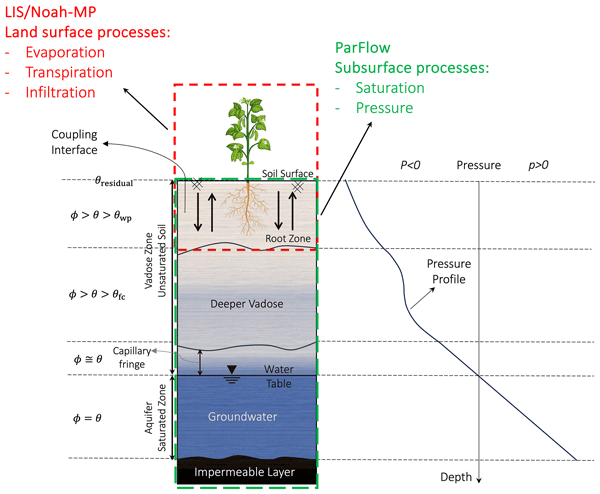
To manage Earth's water resources effectively amid climate change, it is crucial to understand both surface and groundwater processes. We developed a new modeling system that combines two advanced tools, ParFlow and LIS (Land Information System)/Noah-MP, to better simulate both land surface and groundwater interactions. By testing this integrated model in the Upper Colorado River Basin, we found it improves predictions of hydrologic processes, especially in complex terrains.
Fan Yang, Maike Schumacher, Leire Retegui-Schiettekatte, Albert I. J. M. van Dijk, and Ehsan Forootan
Geosci. Model Dev., 18, 6195–6217, https://doi.org/10.5194/gmd-18-6195-2025, https://doi.org/10.5194/gmd-18-6195-2025, 2025
Short summary
Short summary
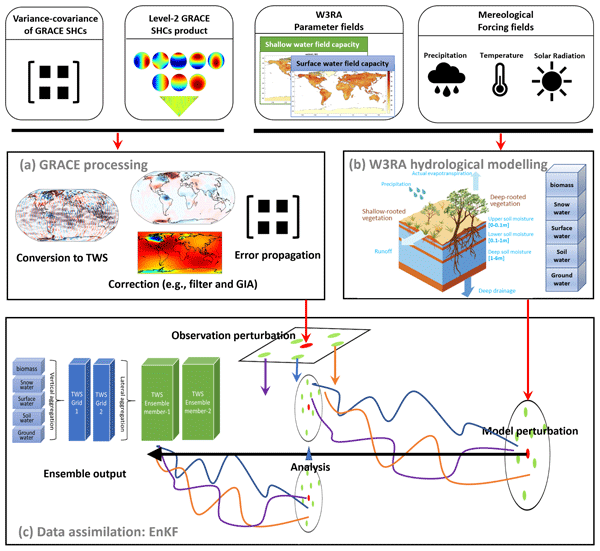
Satellite gravimetry enables direct measurement of total water storage (TWS), a capability that was previously unattainable. In this study, we present an open-source land data assimilation system with global hydrological model, which temporally, vertically, and laterally dis-aggregates satellite-based TWS. This study provides a practical framework establishing operational water management with current and future satellite gravity missions.
Meng Zhao, Erica L. McCormick, Geruo A, Alexandra G. Konings, and Bailing Li
Hydrol. Earth Syst. Sci., 29, 2293–2307, https://doi.org/10.5194/hess-29-2293-2025, https://doi.org/10.5194/hess-29-2293-2025, 2025
Short summary
Short summary
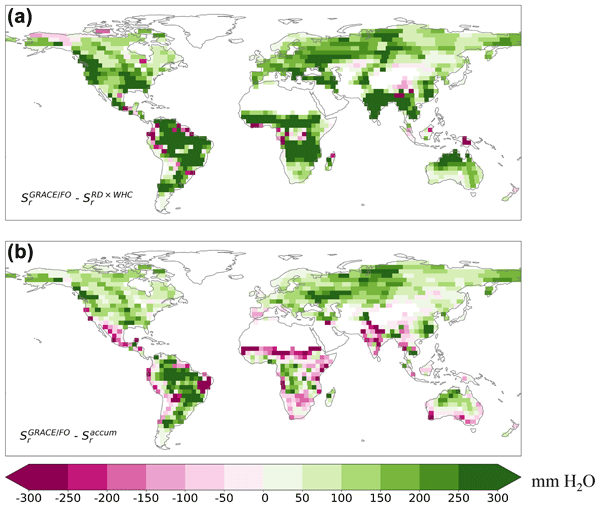
Root-zone water storage capacity (Sr) helps plants survive droughts and influences water and climate systems. Using GRACE (Gravity Recovery and Climate Experiment) satellite data, we estimated Sr globally and found that it exceeds 2 m soil storage in nearly half of the vegetated areas, far more than previously thought. Incorporating our Sr estimates into a global hydrological model improves evapotranspiration simulations, particularly during droughts, highlighting the value of our approach for advancing water resource and ecosystem modeling.
Peyman Saemian, Omid Elmi, Molly Stroud, Ryan Riggs, Benjamin M. Kitambo, Fabrice Papa, George H. Allen, and Mohammad J. Tourian
Earth Syst. Sci. Data, 17, 2063–2085, https://doi.org/10.5194/essd-17-2063-2025, https://doi.org/10.5194/essd-17-2063-2025, 2025
Short summary
Short summary
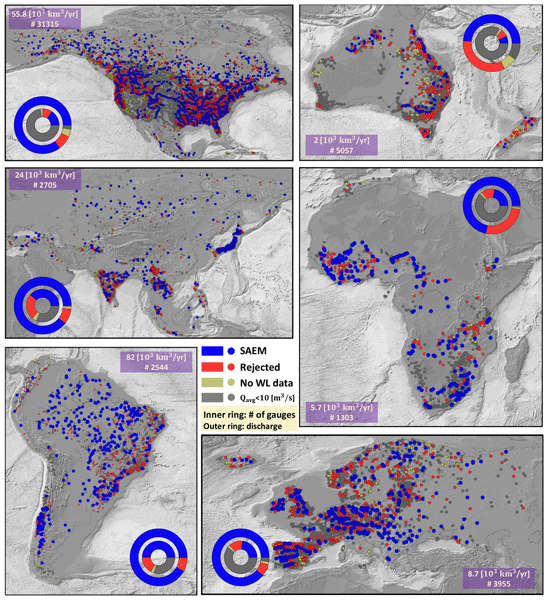
Our study addresses the need for better river discharge data, crucial for water management, by expanding global gauge networks with satellite data. We used satellite altimetry to estimate river discharge for over 8700 stations worldwide, filling gaps in existing records. Our data set, SAEM, supports a better understanding of water systems, helping to manage water resources more effectively, especially in regions with limited monitoring infrastructure.
Torsten Kanzow, Angelika Humbert, Thomas Mölg, Mirko Scheinert, Matthias Braun, Hans Burchard, Francesca Doglioni, Philipp Hochreuther, Martin Horwath, Oliver Huhn, Maria Kappelsberger, Jürgen Kusche, Erik Loebel, Katrina Lutz, Ben Marzeion, Rebecca McPherson, Mahdi Mohammadi-Aragh, Marco Möller, Carolyne Pickler, Markus Reinert, Monika Rhein, Martin Rückamp, Janin Schaffer, Muhammad Shafeeque, Sophie Stolzenberger, Ralph Timmermann, Jenny Turton, Claudia Wekerle, and Ole Zeising
The Cryosphere, 19, 1789–1824, https://doi.org/10.5194/tc-19-1789-2025, https://doi.org/10.5194/tc-19-1789-2025, 2025
Short summary
Short summary
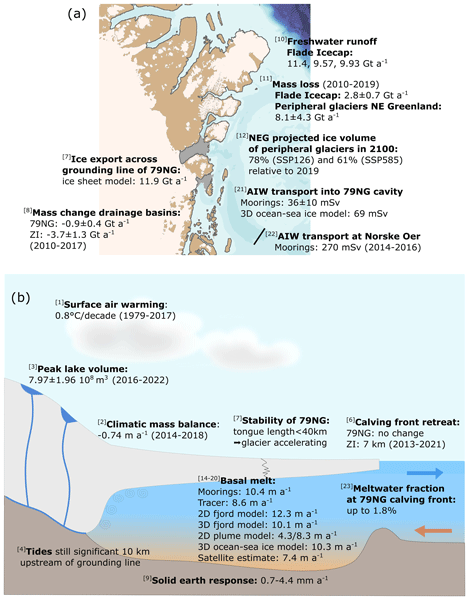
The Greenland Ice Sheet represents the second-largest contributor to global sea-level rise. We quantify atmosphere, ice and ocean processes related to the mass balance of glaciers in northeast Greenland, focusing on Greenland’s largest floating ice tongue, the 79° N Glacier. We find that together, the different in situ and remote sensing observations and model simulations reveal a consistent picture of a coupled atmosphere–ice sheet–ocean system that has entered a phase of major change.
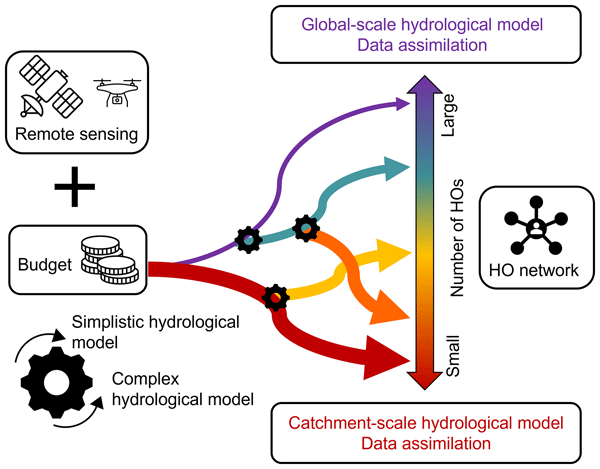
Paolo Nasta, Günter Blöschl, Heye R. Bogena, Steffen Zacharias, Roland Baatz, Gabriëlle De Lannoy, Karsten H. Jensen, Salvatore Manfreda, Laurent Pfister, Ana M. Tarquis, Ilja van Meerveld, Marc Voltz, Yijian Zeng, William Kustas, Xin Li, Harry Vereecken, and Nunzio Romano
Hydrol. Earth Syst. Sci., 29, 465–483, https://doi.org/10.5194/hess-29-465-2025, https://doi.org/10.5194/hess-29-465-2025, 2025
Short summary
Short summary
The Unsolved Problems in Hydrology (UPH) initiative has emphasized the need to establish networks of multi-decadal hydrological observatories to tackle catchment-scale challenges on a global scale. This opinion paper provocatively discusses two endmembers of possible future hydrological observatory (HO) networks for a given hypothesized community budget: a comprehensive set of moderately instrumented observatories or, alternatively, a small number of highly instrumented supersites.
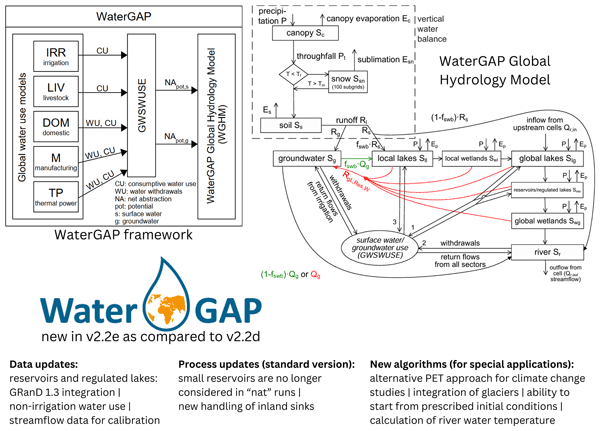
Hannes Müller Schmied, Tim Trautmann, Sebastian Ackermann, Denise Cáceres, Martina Flörke, Helena Gerdener, Ellen Kynast, Thedini Asali Peiris, Leonie Schiebener, Maike Schumacher, and Petra Döll
Geosci. Model Dev., 17, 8817–8852, https://doi.org/10.5194/gmd-17-8817-2024, https://doi.org/10.5194/gmd-17-8817-2024, 2024
Short summary
Short summary
Assessing water availability and water use at the global scale is challenging but essential for a range of purposes. We describe the newest version of the global hydrological model WaterGAP, which has been used for numerous water resource assessments since 1996. We show the effects of new model features, as well as model evaluations, against water abstraction statistics and observed streamflow and water storage anomalies. The publicly available model output for several variants is described.
Louise Busschaert, Michel Bechtold, Sara Modanesi, Christian Massari, Dirk Raes, Sujay V. Kumar, and Gabrielle J. M. De Lannoy
EGUsphere, https://doi.org/10.2139/ssrn.4974019, https://doi.org/10.2139/ssrn.4974019, 2024
Preprint archived
Short summary
Short summary
This study estimates irrigation in the Po Valley using AquaCrop and Noah-MP models with sprinkler irrigation. Noah-MP shows higher annual rates than AquaCrop due to more water losses. After adjusting, both align with reported irrigation ranges (500–600 mm/yr). Soil moisture estimates from both models match satellite data, though both have limitations in vegetation and evapotranspiration modeling. The study emphasizes the need for observations to improve irrigation estimates.
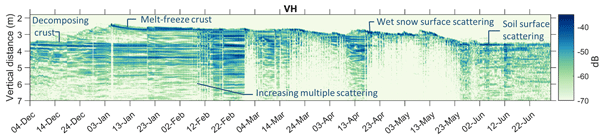
Isis Brangers, Hans-Peter Marshall, Gabrielle De Lannoy, Devon Dunmire, Christian Mätzler, and Hans Lievens
The Cryosphere, 18, 3177–3193, https://doi.org/10.5194/tc-18-3177-2024, https://doi.org/10.5194/tc-18-3177-2024, 2024
Short summary
Short summary
To better understand the interactions between C-band radar waves and snow, a tower-based experiment was set up in the Idaho Rocky Mountains. The reflections were collected in the time domain to measure the backscatter profile from the various snowpack and ground surface layers. The results demonstrate that C-band radar is sensitive to seasonal patterns in snow accumulation but that changes in microstructure, stratigraphy and snow wetness may complicate satellite-based snow depth retrievals.
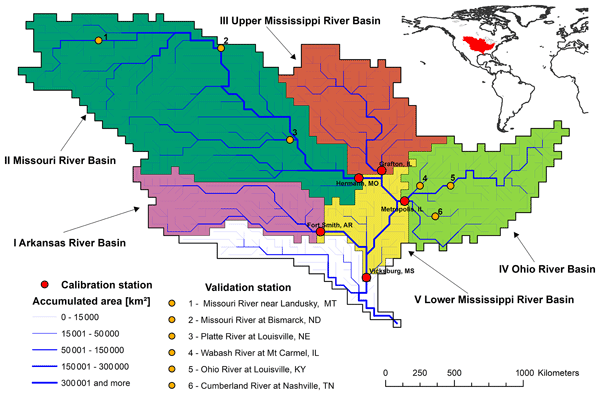
Petra Döll, Howlader Mohammad Mehedi Hasan, Kerstin Schulze, Helena Gerdener, Lara Börger, Somayeh Shadkam, Sebastian Ackermann, Seyed-Mohammad Hosseini-Moghari, Hannes Müller Schmied, Andreas Güntner, and Jürgen Kusche
Hydrol. Earth Syst. Sci., 28, 2259–2295, https://doi.org/10.5194/hess-28-2259-2024, https://doi.org/10.5194/hess-28-2259-2024, 2024
Short summary
Short summary
Currently, global hydrological models do not benefit from observations of model output variables to reduce and quantify model output uncertainty. For the Mississippi River basin, we explored three approaches for using both streamflow and total water storage anomaly observations to adjust the parameter sets in a global hydrological model. We developed a method for considering the observation uncertainties to quantify the uncertainty of model output and provide recommendations.
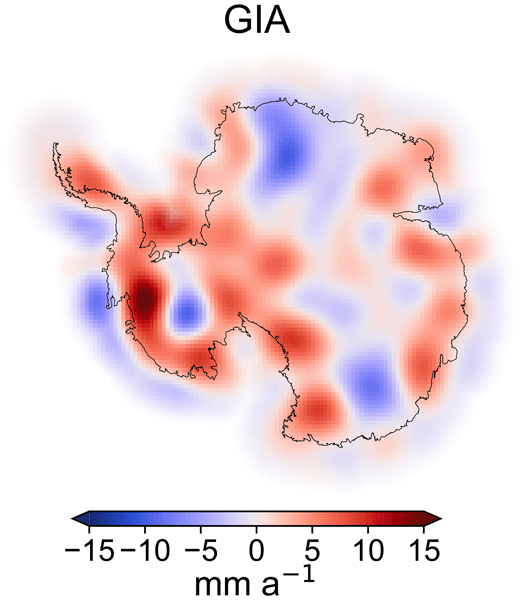
Matthias O. Willen, Martin Horwath, Eric Buchta, Mirko Scheinert, Veit Helm, Bernd Uebbing, and Jürgen Kusche
The Cryosphere, 18, 775–790, https://doi.org/10.5194/tc-18-775-2024, https://doi.org/10.5194/tc-18-775-2024, 2024
Short summary
Short summary
Shrinkage of the Antarctic ice sheet (AIS) leads to sea level rise. Satellite gravimetry measures AIS mass changes. We apply a new method that overcomes two limitations: low spatial resolution and large uncertainties due to the Earth's interior mass changes. To do so, we additionally include data from satellite altimetry and climate and firn modelling, which are evaluated in a globally consistent way with thoroughly characterized errors. The results are in better agreement with independent data.
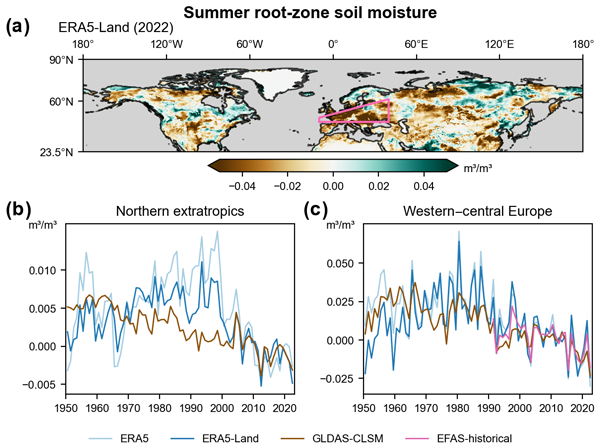
Dominik L. Schumacher, Mariam Zachariah, Friederike Otto, Clair Barnes, Sjoukje Philip, Sarah Kew, Maja Vahlberg, Roop Singh, Dorothy Heinrich, Julie Arrighi, Maarten van Aalst, Mathias Hauser, Martin Hirschi, Verena Bessenbacher, Lukas Gudmundsson, Hiroko K. Beaudoing, Matthew Rodell, Sihan Li, Wenchang Yang, Gabriel A. Vecchi, Luke J. Harrington, Flavio Lehner, Gianpaolo Balsamo, and Sonia I. Seneviratne
Earth Syst. Dynam., 15, 131–154, https://doi.org/10.5194/esd-15-131-2024, https://doi.org/10.5194/esd-15-131-2024, 2024
Short summary
Short summary
The 2022 summer was accompanied by widespread soil moisture deficits, including an unprecedented drought in Europe. Combining several observation-based estimates and models, we find that such an event has become at least 5 and 20 times more likely due to human-induced climate change in western Europe and the northern extratropics, respectively. Strong regional warming fuels soil desiccation; hence, projections indicate even more potent future droughts as we progress towards a 2 °C warmer world.
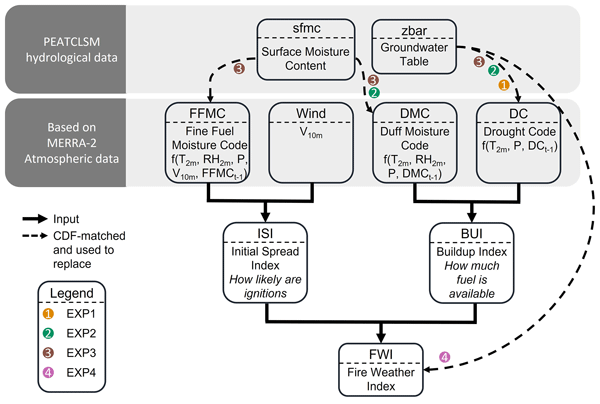
Jonas Mortelmans, Anne Felsberg, Gabriëlle J. M. De Lannoy, Sander Veraverbeke, Robert D. Field, Niels Andela, and Michel Bechtold
Nat. Hazards Earth Syst. Sci., 24, 445–464, https://doi.org/10.5194/nhess-24-445-2024, https://doi.org/10.5194/nhess-24-445-2024, 2024
Short summary
Short summary
With global warming increasing the frequency and intensity of wildfires in the boreal region, accurate risk assessments are becoming more crucial than ever before. The Canadian Fire Weather Index (FWI) is a renowned system, yet its effectiveness in peatlands, where hydrology plays a key role, is limited. By incorporating groundwater data from numerical models and satellite observations, our modified FWI improves the accuracy of fire danger predictions, especially over summer.
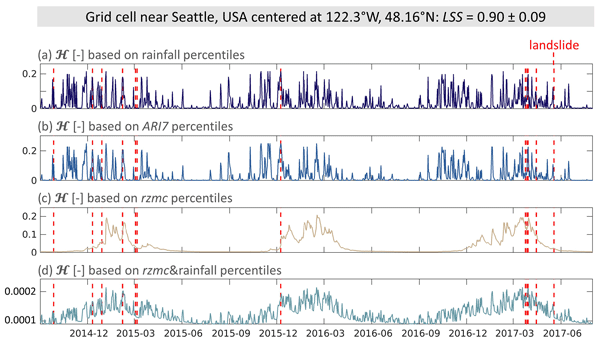
Anne Felsberg, Zdenko Heyvaert, Jean Poesen, Thomas Stanley, and Gabriëlle J. M. De Lannoy
Nat. Hazards Earth Syst. Sci., 23, 3805–3821, https://doi.org/10.5194/nhess-23-3805-2023, https://doi.org/10.5194/nhess-23-3805-2023, 2023
Short summary
Short summary
The Probabilistic Hydrological Estimation of LandSlides (PHELS) model combines ensembles of landslide susceptibility and of hydrological predictor variables to provide daily, global ensembles of hazard for hydrologically triggered landslides. Testing different hydrological predictors showed that the combination of rainfall and soil moisture performed best, with the lowest number of missed and false alarms. The ensemble approach allowed the estimation of the associated prediction uncertainty.
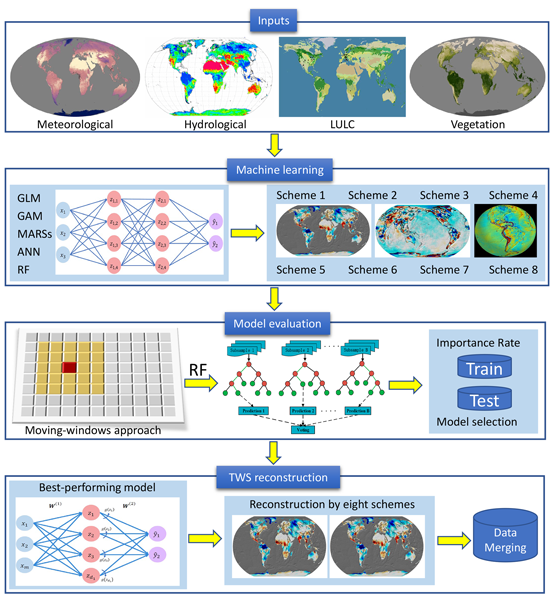
Jiabo Yin, Louise J. Slater, Abdou Khouakhi, Le Yu, Pan Liu, Fupeng Li, Yadu Pokhrel, and Pierre Gentine
Earth Syst. Sci. Data, 15, 5597–5615, https://doi.org/10.5194/essd-15-5597-2023, https://doi.org/10.5194/essd-15-5597-2023, 2023
Short summary
Short summary
This study presents long-term (i.e., 1940–2022) and high-resolution (i.e., 0.25°) monthly time series of TWS anomalies over the global land surface. The reconstruction is achieved by using a set of machine learning models with a large number of predictors, including climatic and hydrological variables, land use/land cover data, and vegetation indicators (e.g., leaf area index). Our proposed GTWS-MLrec performs overall as well as, or is more reliable than, previous TWS datasets.
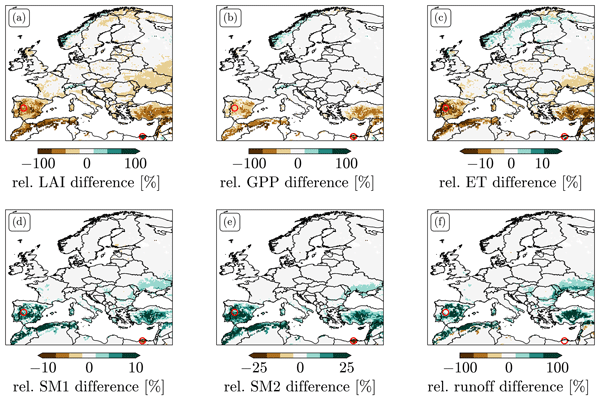
Samuel Scherrer, Gabriëlle De Lannoy, Zdenko Heyvaert, Michel Bechtold, Clement Albergel, Tarek S. El-Madany, and Wouter Dorigo
Hydrol. Earth Syst. Sci., 27, 4087–4114, https://doi.org/10.5194/hess-27-4087-2023, https://doi.org/10.5194/hess-27-4087-2023, 2023
Short summary
Short summary
We explored different options for data assimilation (DA) of the remotely sensed leaf area index (LAI). We found strong biases between LAI predicted by Noah-MP and observations. LAI DA that does not take these biases into account can induce unphysical patterns in the resulting LAI and flux estimates and leads to large changes in the climatology of root zone soil moisture. We tested two bias-correction approaches and explored alternative solutions to treating bias in LAI DA.
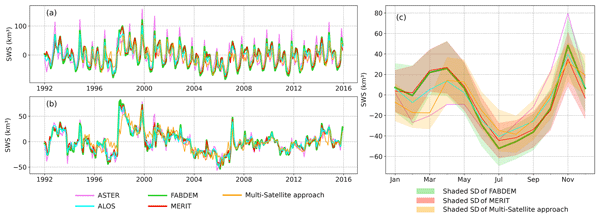
Benjamin M. Kitambo, Fabrice Papa, Adrien Paris, Raphael M. Tshimanga, Frederic Frappart, Stephane Calmant, Omid Elmi, Ayan Santos Fleischmann, Melanie Becker, Mohammad J. Tourian, Rômulo A. Jucá Oliveira, and Sly Wongchuig
Earth Syst. Sci. Data, 15, 2957–2982, https://doi.org/10.5194/essd-15-2957-2023, https://doi.org/10.5194/essd-15-2957-2023, 2023
Short summary
Short summary
The surface water storage (SWS) in the Congo River basin (CB) remains unknown. In this study, the multi-satellite and hypsometric curve approaches are used to estimate SWS in the CB over 1992–2015. The results provide monthly SWS characterized by strong variability with an annual mean amplitude of ~101 ± 23 km3. The evaluation of SWS against independent datasets performed well. This SWS dataset contributes to the better understanding of the Congo basin’s surface hydrology using remote sensing.
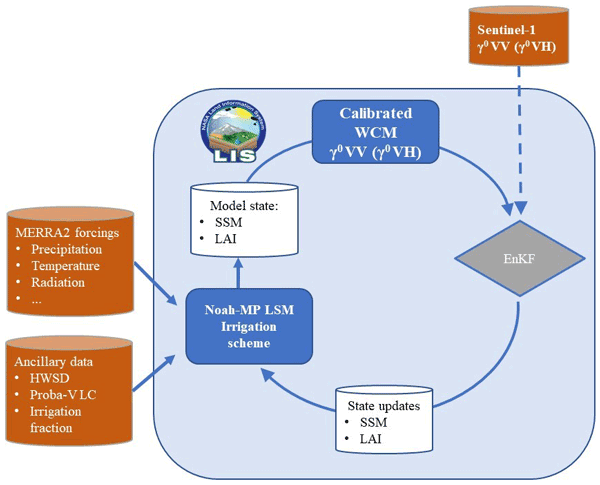
Sara Modanesi, Christian Massari, Michel Bechtold, Hans Lievens, Angelica Tarpanelli, Luca Brocca, Luca Zappa, and Gabriëlle J. M. De Lannoy
Hydrol. Earth Syst. Sci., 26, 4685–4706, https://doi.org/10.5194/hess-26-4685-2022, https://doi.org/10.5194/hess-26-4685-2022, 2022
Short summary
Short summary
Given the crucial impact of irrigation practices on the water cycle, this study aims at estimating irrigation through the development of an innovative data assimilation system able to ingest high-resolution Sentinel-1 radar observations into the Noah-MP land surface model. The developed methodology has important implications for global water resource management and the comprehension of human impacts on the water cycle and identifies main challenges and outlooks for future research.
Anne Felsberg, Jean Poesen, Michel Bechtold, Matthias Vanmaercke, and Gabriëlle J. M. De Lannoy
Nat. Hazards Earth Syst. Sci., 22, 3063–3082, https://doi.org/10.5194/nhess-22-3063-2022, https://doi.org/10.5194/nhess-22-3063-2022, 2022
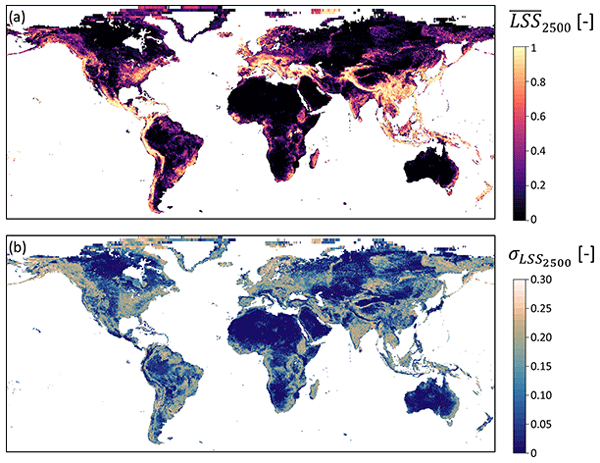
Short summary
Short summary
In this study we assessed global landslide susceptibility at the coarse 36 km spatial resolution of global satellite soil moisture observations to prepare for a subsequent combination of the two. Specifically, we focus therefore on the susceptibility of hydrologically triggered landslides. We introduce ensemble techniques, common in, for example, meteorology but not yet in the landslide community, to retrieve reliable estimates of the total prediction uncertainty.

Louise Busschaert, Shannon de Roos, Wim Thiery, Dirk Raes, and Gabriëlle J. M. De Lannoy
Hydrol. Earth Syst. Sci., 26, 3731–3752, https://doi.org/10.5194/hess-26-3731-2022, https://doi.org/10.5194/hess-26-3731-2022, 2022
Short summary
Short summary
Increasing amounts of water are used for agriculture. Therefore, we looked into how irrigation requirements will evolve under a changing climate over Europe. Our results show that, by the end of the century and under high emissions, irrigation water will increase by 30 % on average compared to the year 2000. Also, the irrigation requirement is likely to vary more from 1 year to another. However, if emissions are mitigated, these effects are reduced.

Mohammad J. Tourian, Omid Elmi, Yasin Shafaghi, Sajedeh Behnia, Peyman Saemian, Ron Schlesinger, and Nico Sneeuw
Earth Syst. Sci. Data, 14, 2463–2486, https://doi.org/10.5194/essd-14-2463-2022, https://doi.org/10.5194/essd-14-2463-2022, 2022
Short summary
Short summary
HydroSat as a global water cycle database provides estimates of and uncertainty in geometric quantities of the water cycle: (1) surface water extent of lakes and rivers, (2) water level time series of lakes and rivers, (3) terrestrial water storage anomaly, (4) water storage anomaly of lakes and reservoirs, and (5) river discharge estimates for large and small rivers.
Wanshu Nie, Sujay V. Kumar, Kristi R. Arsenault, Christa D. Peters-Lidard, Iliana E. Mladenova, Karim Bergaoui, Abheera Hazra, Benjamin F. Zaitchik, Sarith P. Mahanama, Rachael McDonnell, David M. Mocko, and Mahdi Navari
Hydrol. Earth Syst. Sci., 26, 2365–2386, https://doi.org/10.5194/hess-26-2365-2022, https://doi.org/10.5194/hess-26-2365-2022, 2022
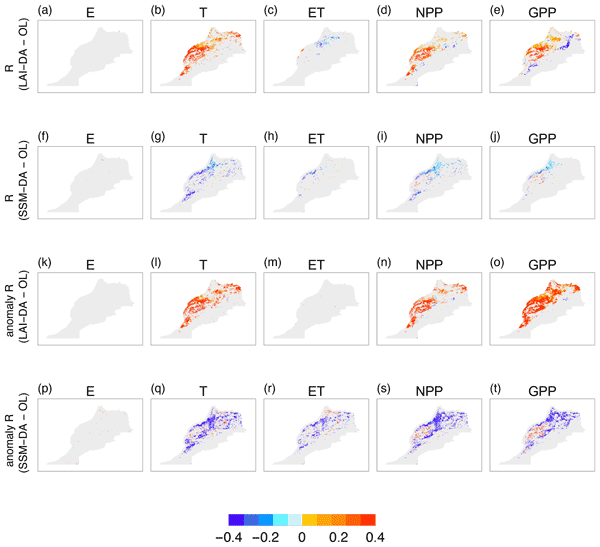
Short summary
Short summary
The MENA (Middle East and North Africa) region faces significant food and water insecurity and hydrological hazards. Here we investigate the value of assimilating remote sensing data sets into an Earth system model to help build an effective drought monitoring system and support risk mitigation and management by countries in the region. We highlight incorporating satellite-informed vegetation conditions into the model as being one of the key processes for a successful application for the region.
Benjamin Kitambo, Fabrice Papa, Adrien Paris, Raphael M. Tshimanga, Stephane Calmant, Ayan Santos Fleischmann, Frederic Frappart, Melanie Becker, Mohammad J. Tourian, Catherine Prigent, and Johary Andriambeloson
Hydrol. Earth Syst. Sci., 26, 1857–1882, https://doi.org/10.5194/hess-26-1857-2022, https://doi.org/10.5194/hess-26-1857-2022, 2022
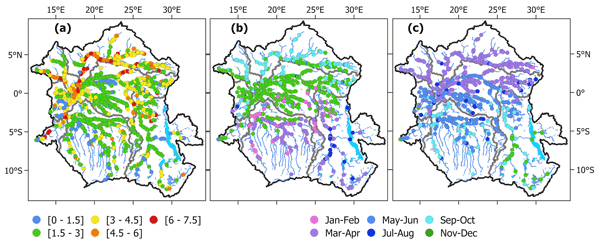
Short summary
Short summary
This study presents a better characterization of surface hydrology variability in the Congo River basin, the second largest river system in the world. We jointly use a large record of in situ and satellite-derived observations to monitor the spatial distribution and different timings of the Congo River basin's annual flood dynamic, including its peculiar bimodal pattern.
Hans Lievens, Isis Brangers, Hans-Peter Marshall, Tobias Jonas, Marc Olefs, and Gabriëlle De Lannoy
The Cryosphere, 16, 159–177, https://doi.org/10.5194/tc-16-159-2022, https://doi.org/10.5194/tc-16-159-2022, 2022
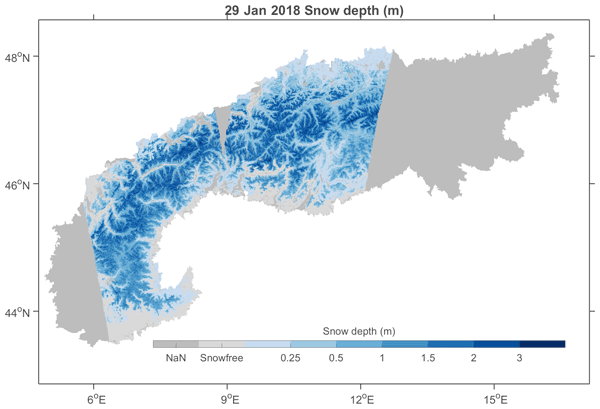
Short summary
Short summary
Snow depth observations at high spatial resolution from the Sentinel-1 satellite mission are presented over the European Alps. The novel observations can improve our knowledge of seasonal snow mass in areas with complex topography, where satellite-based estimates are currently lacking, and benefit a number of applications including water resource management, flood forecasting, and numerical weather prediction.
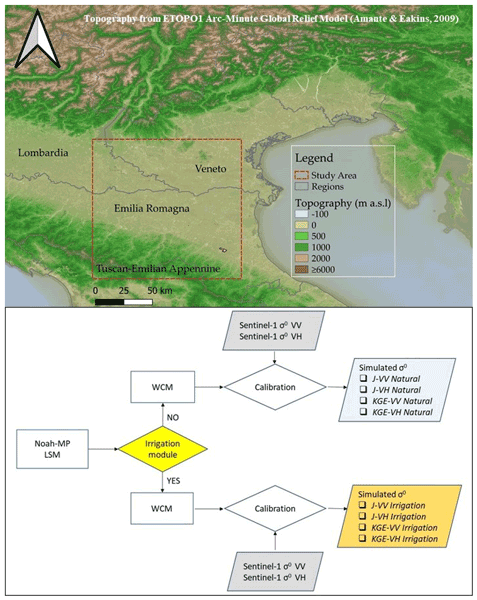
Sara Modanesi, Christian Massari, Alexander Gruber, Hans Lievens, Angelica Tarpanelli, Renato Morbidelli, and Gabrielle J. M. De Lannoy
Hydrol. Earth Syst. Sci., 25, 6283–6307, https://doi.org/10.5194/hess-25-6283-2021, https://doi.org/10.5194/hess-25-6283-2021, 2021
Short summary
Short summary
Worldwide, the amount of water used for agricultural purposes is rising and the quantification of irrigation is becoming a crucial topic. Land surface models are not able to correctly simulate irrigation. Remote sensing observations offer an opportunity to fill this gap as they are directly affected by irrigation. We equipped a land surface model with an observation operator able to transform Sentinel-1 backscatter observations into realistic vegetation and soil states via data assimilation.
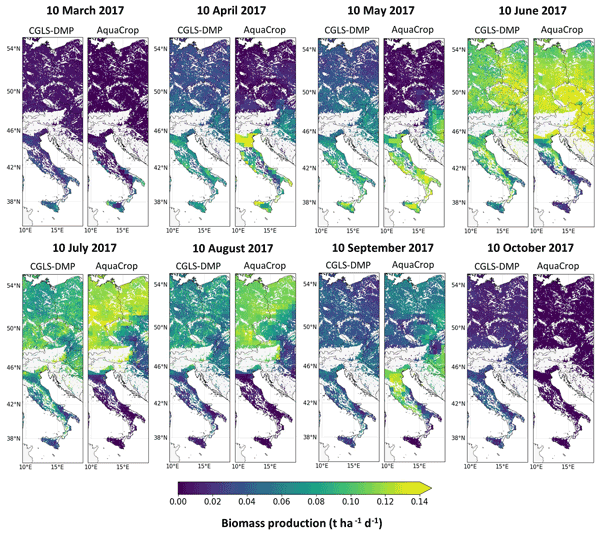
Shannon de Roos, Gabriëlle J. M. De Lannoy, and Dirk Raes
Geosci. Model Dev., 14, 7309–7328, https://doi.org/10.5194/gmd-14-7309-2021, https://doi.org/10.5194/gmd-14-7309-2021, 2021
Short summary
Short summary
A spatially distributed version of the field-scale crop model AquaCrop v6.1 was developed for applications at various spatial scales. Multi-year 1 km simulations over central Europe were evaluated against biomass and surface soil moisture products derived from optical and microwave satellite missions, as well as in situ observations of soil moisture. The regional version of the AquaCrop model provides a suitable setup for subsequent satellite-based data assimilation.
Cited articles
A, G., Wahr, J., and Zhong, S.: Computations of the viscoelastic response of a 3-D compressible Earth to surface loading: an application to Glacial Isostatic Adjustment in Antarctica and Canada, Geophysical Journal International, 192, 557–572, https://doi.org/10.1093/gji/ggs030, 2012. a
Albergel, C., Munier, S., Leroux, D. J., Dewaele, H., Fairbairn, D., Barbu, A. L., Gelati, E., Dorigo, W., Faroux, S., Meurey, C., Le Moigne, P., Decharme, B., Mahfouf, J.-F., and Calvet, J.-C.: Sequential assimilation of satellite-derived vegetation and soil moisture products using SURFEX_v8.0: LDAS-Monde assessment over the Euro-Mediterranean area, Geoscientific Model Development, 10, 3889–3912, https://doi.org/10.5194/gmd-10-3889-2017, 2017. a
Anderson, J. L.: An adaptive covariance inflation error correction algorithm for ensemble filters, Tellus A: Dynamic Meteorology and Oceanography, 59, 210–224, https://doi.org/10.1111/j.1600-0870.2006.00216.x, 2007. a
Anderson, J. L. and Anderson, S. L.: A Monte Carlo Implementation of the Nonlinear Filtering Problem to Produce Ensemble Assimilations and Forecasts, Monthly Weather Review, 127, 2741–2758, https://doi.org/10.1175/1520-0493(1999)127<2741:AMCIOT>2.0.CO;2, 1999. a
Arciniega-Esparza, S., Hernández-Espriú, J. A., Salinas-Calleros, G., Birkel, C., and Sanchez, R.: Assessing hydrological drought propagation through assimilation of GRACE for groundwater storage anomalies modelling in northeastern Mexico, Journal of Hydrology, 661, 133826, https://doi.org/10.1016/j.jhydrol.2025.133826, 2025. a
Arcucci, R., Zhu, J., Hu, S., and Guo, Y.-K.: Deep Data Assimilation: Integrating Deep Learning with Data Assimilation, Applied Sciences, 11, 1114, https://doi.org/10.3390/app11031114, 2021. a
Baatz, R., Hendricks Franssen, H. J., Euskirchen, E., Sihi, D., Dietze, M., Ciavatta, S., Fennel, K., Beck, H., De Lannoy, G., Pauwels, V. R. N., Raiho, A., Montzka, C., Williams, M., Mishra, U., Poppe, C., Zacharias, S., Lausch, A., Samaniego, L., Van Looy, K., Bogena, H., Adamescu, M., Mirtl, M., Fox, A., Goergen, K., Naz, B. S., Zeng, Y., and Vereecken, H.: Reanalysis in Earth System Science: Toward Terrestrial Ecosystem Reanalysis, Reviews of Geophysics, 59, e2020RG000715, https://doi.org/10.1029/2020RG000715, 2021. a
Bahrami, A., Goïta, K., Magagi, R., Davison, B., Razavi, S., Elshamy, M., and Princz, D.: Data assimilation of satellite-based terrestrial water storage changes into a hydrology land-surface model, Journal of Hydrology, 597, 125744, https://doi.org/10.1016/j.jhydrol.2020.125744, 2021. a, b, c, d, e, f
Balsamo, G., Albergel, C., Beljaars, A., Boussetta, S., Brun, E., Cloke, H., Dee, D., Dutra, E., Muñoz-Sabater, J., Pappenberger, F., de Rosnay, P., Stockdale, T., and Vitart, F.: ERA-Interim/Land: a global land surface reanalysis data set, Hydrology and Earth System Sciences, 19, 389–407, https://doi.org/10.5194/hess-19-389-2015, 2015. a
Banerjee, C. and Kumar, D. N.: Integration of GRACE Data for Improvement of Hydrological Models, in: Hydrology in a Changing World: Challenges in Modeling, edited by Singh, S. K. and Dhanya, C., Springer Water, Springer International Publishing, Cham, 1–22, ISBN 978-3-030-02197-9, https://doi.org/10.1007/978-3-030-02197-9_1, 2019. a
Benke, K. K., Lowell, K. E., and Hamilton, A. J.: Parameter uncertainty, sensitivity analysis and prediction error in a water-balance hydrological model, Mathematical and Computer Modelling, 47, 1134–1149, https://doi.org/10.1016/j.mcm.2007.05.017, 2008. a
Berry, T. and Harlim, J.: Correcting biased observation model error in data assimilation, Monthly Weather Review, 145, 2833–2853, https://doi.org/10.1175/MWR-D-16-0428.1, 2017. a
Blewitt, G.: Self-consistency in reference frames, geocenter definition, and surface loading of the solid Earth, Journal of Geophysical Research: Solid Earth, 108, https://doi.org/10.1029/2002JB002082, 2003. a
Bocquet, M.: Surrogate modeling for the climate sciences dynamics with machine learning and data assimilation, Frontiers in Applied Mathematics and Statistics, 9, https://doi.org/10.3389/fams.2023.1133226, 2023. a
Carlson, G., Werth, S., and Shirzaei, M.: A novel hybrid GNSS, GRACE, and InSAR joint inversion approach to constrain water loss during a record-setting drought in California, Remote Sensing of Environment, 311, 114303, https://doi.org/10.1016/j.rse.2024.114303, 2024. a
Caron, L., Ivins, E., Larour, E., Adhikari, S., Nilsson, J., and Blewitt, G.: GIA model statistics for GRACE hydrology, cryosphere, and ocean science, Geophysical Research Letters, 45, 2203–2212, https://doi.org/10.1002/2017GL076644, 2018. a
Cesare, S., Dionisio, S., Saponara, M., Bravo-Berguño, D., Massotti, L., Teixeira da Encarnação, J., and Christophe, B.: Drag and Attitude Control for the Next Generation Gravity Mission, Remote Sensing, 14, https://doi.org/10.3390/rs14122916, 2022. a
Chen, J., Wilson, C., Li, J., and Zhang, Z.: Reducing leakage error in GRACE-observed long-term ice mass change: a case study in West Antarctica, Journal of Geodesy, 89, 925–940, https://doi.org/10.1007/s00190-015-0824-2, 2015. a
Chen, J., Cazenave, A., Dahle, C., Llovel, W., Panet, I., Pfeffer, J., and Moreira, L.: Applications and Challenges of GRACE and GRACE Follow-On Satellite Gravimetry, Surveys in Geophysics, 43, 305–345, https://doi.org/10.1007/s10712-021-09685-x, 2022. a
Chen, W., Huang, C., and Yang, Z.-L.: More severe drought detected by the assimilation of brightness temperature and terrestrial water storage anomalies in Texas during 2010–2013, Journal of Hydrology, 603, 126802, https://doi.org/10.1016/j.jhydrol.2021.126802, 2021. a
Cheng, M. and Ries, J.: C20 and C30 Variations From SLR for GRACE/GRACE-FO Science Applications, Journal of Geophysical Research: Solid Earth, 128, e2022JB025459, https://doi.org/10.1029/2022JB025459, 2023. a, b
Chi, H., Seo, H., and Kim, Y.: Hydrological trends captured by assimilating GRACE total water storage data into the CLM5-BGC model, Journal of Hydrology, 629, 130527, https://doi.org/10.1016/j.jhydrol.2023.130527, 2024. a, b, c, d
Collischonn, W., Allasia, D., Da Silva, B. C., and Tucci, C. E.: The MGB-IPH model for large-scale rainfall–runoff modelling, Hydrological Sciences Journal, 52, 878–895, 2007. a
Condon, L. E., Kollet, S., Bierkens, M. F. P., Fogg, G. E., Maxwell, R. M., Hill, M. C., Fransen, H. H., Verhoef, A., Van Loon, A. F., Sulis, M., and Abesser, C.: Global Groundwater Modeling and Monitoring: Opportunities and Challenges, Water Resources Research, 57, e2020WR029500, https://doi.org/10.1029/2020WR029500, 2021. a
Cox, C. M. and Chao, B. F.: Detection of a Large-Scale Mass Redistribution in the Terrestrial System Since 1998, Science, https://doi.org/10.1126/science.1072188, 2002. a
Crisan, D.: Particle Filters– A Theoretical Perspective, in: Sequential Monte Carlo Methods in Practice, edited by Doucet, A., Freitas, N., and Gordon, N., Springer New York, New York, NY, 17–41, ISBN 9781441928870, 9781475734379, https://doi.org/10.1007/978-1-4757-3437-9_2, 2001. a, b
Daras, I., March, G., Pail, R., Hughes, C. W., Braitenberg, C., Güntner, A., Eicker, A., Wouters, B., Heller-Kaikov, B., Pivetta, T., and Pastorutti, A.: Mass-change And Geosciences International Constellation (MAGIC) expected impact on science and applications, Geophysical Journal International, 236, 1288–1308, https://doi.org/10.1093/gji/ggad472, 2024. a, b
De Lannoy, G. J. M., Houser, P. R., Verhoest, N. E. C., Pauwels, V. R. N., and Gish, T. J.: Upscaling of point soil moisture measurements to field averages at the OPE3 test site, Journal of Hydrology, 343, 1–11, https://doi.org/10.1016/j.jhydrol.2007.06.004, 2007. a
De Lannoy, G. J. M., de Rosnay, P., and Reichle, R. H.: Soil Moisture Data Assimilation, in: Handbook of Hydrometeorological Ensemble Forecasting, edited by Duan, Q., Pappenberger, F., Thielen, J., Wood, A., Cloke, H. L., and Schaake, J. C., Springer, Berlin, Heidelberg, 1–43, ISBN 9783642404573, https://doi.org/10.1007/978-3-642-40457-3_32-1, 2016. a
De Lannoy, G. J. M., Bechtold, M., Albergel, C., Brocca, L., Calvet, J.-C., Carrassi, A., Crow, W. T., de Rosnay, P., Durand, M., Forman, B., Geppert, G., Girotto, M., Hendricks Franssen, H.-J., Jonas, T., Kumar, S., Lievens, H., Lu, Y., Massari, C., Pauwels, V. R. N., Reichle, R. H., and Steele-Dunne, S.: Perspective on satellite-based land data assimilation to estimate water cycle components in an era of advanced data availability and model sophistication, Frontiers in Water, 4, https://doi.org/10.3389/frwa.2022.981745, 2022. a
Decharme, B., Martin, E., and Faroux, S.: Reconciling soil thermal and hydrological lower boundary conditions in land surface models, Journal of Geophysical Research: Atmospheres, 118, 7819–7834, 2013. a
Dee, D. P.: Bias and data assimilation, Quarterly Journal of the Royal Meteorological Society, 131, 3323–3343, https://doi.org/10.1256/qj.05.137, 2005. a
Deggim, S., Eicker, A., Schawohl, L., Gerdener, H., Schulze, K., Engels, O., Kusche, J., Saraswati, A. T., van Dam, T., Ellenbeck, L., Dettmering, D., Schwatke, C., Mayr, S., Klein, I., and Longuevergne, L.: RECOG RL01: correcting GRACE total water storage estimates for global lakes/reservoirs and earthquakes, Earth Syst. Sci. Data, 13, 2227–2244, https://doi.org/10.5194/essd-13-2227-2021, 2021. a, b, c
Dorigo, W. A., Scipal, K., Parinussa, R. M., Liu, Y. Y., Wagner, W., de Jeu, R. A. M., and Naeimi, V.: Error characterisation of global active and passive microwave soil moisture datasets, Hydrology and Earth System Sciences, 14, 2605–2616, https://doi.org/10.5194/hess-14-2605-2010, 2010. a
Drusch, M., Wood, E. F., and Gao, H.: Observation operators for the direct assimilation of TRMM microwave imager retrieved soil moisture, Geophysical Research Letters, 32, 2005GL023623, https://doi.org/10.1029/2005GL023623, 2005. a
Döll, P., Hoffmann-Dobrev, H., Portmann, F., Siebert, S., Eicker, A., Rodell, M., Strassberg, G., and Scanlon, B.: Impact of water withdrawals from groundwater and surface water on continental water storage variations, Journal of Geodynamics, 59–60, 143–156, https://doi.org/10.1016/j.jog.2011.05.001, 2012. a
Eicker, A. and Springer, A.: Monthly and sub-monthly hydrological variability: in-orbit validation by GRACE level 1B observations, Journal of Geodesy, 90, 573–584, 2016. a
Einarsson, I., Hoechner, A., Wang, R., and Kusche, J.: Gravity changes due to the Sumatra-Andaman and Nias earthquakes as detected by the GRACE satellites: a reexamination, Geophysical Journal International, 183, 733–747, https://doi.org/10.1111/j.1365-246X.2010.04756.x, 2010. a
Ek, M., Mitchell, K., Lin, Y., Rogers, E., Grunmann, P., Koren, V., Gayno, G., and Tarpley, J.: Implementation of Noah land surface model advances in the National Centers for Environmental Prediction operational mesoscale Eta model, Journal of Geophysical Research: Atmospheres, 108, https://doi.org/10.1029/2002JD003296, 2003. a
Evensen, G.: Sequential data assimilation with a nonlinear quasi‐geostrophic model using Monte Carlo methods to forecast error statistics, Journal of Geophysical Research: Oceans, 99, 10143–10162, https://doi.org/10.1029/94JC00572, 1994. a
Evensen, G.: Data Assimilation: The Ensemble Kalman Filter, Springer Berlin Heidelberg, Berlin, Heidelberg, ISBN 9783642037108, 9783642037115, https://doi.org/10.1007/978-3-642-03711-5, 2009. a
Evensen, G., Vossepoel, F. C., and van Leeuwen, P. J.: Localization and Inflation, in: Data Assimilation Fundamentals: A Unified Formulation of the State and Parameter Estimation Problem, edited by Evensen, G., Vossepoel, F. C., and van Leeuwen, P. J., Springer International Publishing, Cham, 111–122, ISBN 9783030967093, https://doi.org/10.1007/978-3-030-96709-3_10, 2022. a
Eyre, J. R.: Observation bias correction schemes in data assimilation systems: a theoretical study of some of their properties, Quarterly Journal of the Royal Meteorological Society, 142, 2284–2291, https://doi.org/10.1002/qj.2819, 2016. a
Fairbairn, D., De Rosnay, P., and Weston, P.: Evaluation of an Adaptive Soil Moisture Bias Correction Approach in the ECMWF Land Data Assimilation System, Remote Sensing, 16, 493, https://doi.org/10.3390/rs16030493, 2024. a
Felsberg, A., Lannoy, G. J. M. D., Girotto, M., Poesen, J., Reichle, R. H., and Stanley, T.: Global Soil Water Estimates as Landslide Predictor: The Effectiveness of SMOS, SMAP, and GRACE Observations, Land Surface Simulations, and Data Assimilation, Journal of Hydrometeorology, 22, 1065–1084, https://doi.org/10.1175/JHM-D-20-0228.1, 2021. a
Flechtner, F., Neumayer, K.-H., Dahle, C., Dobslaw, H., Fagiolini, E., Raimondo, J.-C., and Güntner, A.: What Can be Expected from the GRACE-FO Laser Ranging Interferometer for Earth Science Applications?, Surveys in Geophysics, 37, 453–470, https://doi.org/10.1007/s10712-015-9338-y, 2016. a
Flechtner, F., Reigber, C., Rummel, R., and Balmino, G.: Satellite Gravimetry: A Review of Its Realization, Surveys in Geophysics, 42, 1029–1074, https://doi.org/10.1007/s10712-021-09658-0, 2021. a
Forman, B. A. and Reichle, R. H.: The spatial scale of model errors and assimilated retrievals in a terrestrial water storage assimilation system, Water Resources Research, 49, 7457–7468, https://doi.org/10.1002/2012WR012885, 2013. a, b, c, d
Forootan, E., Mehrnegar, N., Schumacher, M., Schiettekatte, L. A. R., Jagdhuber, T., Farzaneh, S., Van Dijk, A. I., Shamsudduha, M., and Shum, C.: Global groundwater droughts are more severe than they appear in hydrological models: An investigation through a Bayesian merging of GRACE and GRACE-FO data with a water balance model, Science of The Total Environment, 912, 169476, https://doi.org/10.1016/j.scitotenv.2023.169476, 2024. a
Foroumandi, E., Nourani, V., Jeanne Huang, J., and Moradkhani, H.: Drought monitoring by downscaling GRACE-derived terrestrial water storage anomalies: A deep learning approach, Journal of Hydrology, 616, 128838, https://doi.org/10.1016/j.jhydrol.2022.128838, 2023. a
Gerdener, H.: A global drought monitoring framework using GRACE/-FO data assimilation, Dissertation, Rheinische Friedrich-Wilhelms-Universität Bonn, https://doi.org/10.48565/BONNDOC-438, 2024. a, b, c
Gerdener, H., Kusche, J., Schulze, K., Ghazaryan, G., and Dubovyk, O.: Revising precipitation – water storages – vegetation signatures with GRACE-based data assimilation, Journal of Hydrology, 612, 128096, https://doi.org/10.1016/j.jhydrol.2022.128096, 2022. a, b
Gerdener, H., Kusche, J., Schulze, K., Döll, P., and Klos, A.: The global land water storage data set release 2 (GLWS2.0) derived via assimilating GRACE and GRACE-FO data into a global hydrological model, Journal of Geodesy, 97, 73, https://doi.org/10.1007/s00190-023-01763-9, 2023. a, b, c, d, e, f, g, h, i, j
Getirana, A., Jung, H. C., Arsenault, K., Shukla, S., Kumar, S., Peters‐Lidard, C., Maigari, I., and Mamane, B.: Satellite Gravimetry Improves Seasonal Streamflow Forecast Initialization in Africa, Water Resources Research, 56, e2019WR026259, https://doi.org/10.1029/2019WR026259, 2020a. a, b
Getirana, A., Rodell, M., Kumar, S., Beaudoing, H. K., Arsenault, K., Zaitchik, B., Save, H., and Bettadpur, S.: GRACE Improves Seasonal Groundwater Forecast Initialization over the United States, Journal of Hydrometeorology, 21, 59–71, https://doi.org/10.1175/JHM-D-19-0096.1, 2020b. a, b, c, d, e, f, g, h
Ghobadi‐Far, K., Han, S., McCullough, C. M., Wiese, D. N., Ray, R. D., Sauber, J., Shihora, L., and Dobslaw, H.: Along‐Orbit Analysis of GRACE Follow‐On Inter‐Satellite Laser Ranging Measurements for Sub‐Monthly Surface Mass Variations, Journal of Geophysical Research: Solid Earth, 127, e2021JB022983, https://doi.org/10.1029/2021JB022983, 2022. a
Girotto, M., De Lannoy, G. J. M., Reichle, R. H., Rodell, M., Draper, C., Bhanja, S. N., and Mukherjee, A.: Benefits and pitfalls of GRACE data assimilation: A case study of terrestrial water storage depletion in India, Geophysical Research Letters, 44, 4107–4115, https://doi.org/10.1002/2017GL072994, 2017. a, b, c, d, e, f, g, h
Girotto, M., Reichle, R. H., Rodell, M., Liu, Q., Mahanama, S., and De Lannoy, G. J. M.: Multi-sensor assimilation of SMOS brightness temperature and GRACE terrestrial water storage observations for soil moisture and shallow groundwater estimation, Remote Sensing of Environment, 227, 12–27, https://doi.org/10.1016/j.rse.2019.04.001, 2019. a, b, c, d, e, f, g, h, i
Girotto, M., Musselman, K. N., and Essery, R. L. H.: Data Assimilation Improves Estimates of Climate-Sensitive Seasonal Snow, Current Climate Change Reports, 6, 81–94, https://doi.org/10.1007/s40641-020-00159-7, 2020. a
Girotto, M., Reichle, R., Rodell, M., and Maggioni, V.: Data Assimilation of Terrestrial Water Storage Observations to Estimate Precipitation Fluxes: A Synthetic Experiment, Remote Sensing, 13, 1223, https://doi.org/10.3390/rs13061223, 2021. a, b
Gorugantula, S. S. and Kambhammettu, B. P.: Sequential downscaling of GRACE products to map groundwater level changes in Krishna river basin, Hydrological Sciences Journal, 1846–1859, https://doi.org/10.1080/02626667.2022.2106142, 2022. a
Gou, J. and Soja, B.: Global high-resolution total water storage anomalies from self-supervised data assimilation using deep learning algorithms, Nature Water, 2, 139–150, https://doi.org/10.1038/s44221-024-00194-w, 2024. a, b, c
Gouweleeuw, B. T., Kvas, A., Gruber, C., Gain, A. K., Mayer-Gürr, T., Flechtner, F., and Güntner, A.: Daily GRACE gravity field solutions track major flood events in the Ganges–Brahmaputra Delta, Hydrology and Earth System Sciences, 22, 2867–2880, https://doi.org/10.5194/hess-22-2867-2018, 2018. a
Gruber, A., Su, C. H., Zwieback, S., Crow, W., Dorigo, W., and Wagner, W.: Recent advances in (soil moisture) triple collocation analysis, International Journal of Applied Earth Observation and Geoinformation, 45, 200–211, https://doi.org/10.1016/j.jag.2015.09.002, 2016. a
Haagmans, R., Siemes, C., Massotti, L., Carraz, O., and Silvestrin, P.: ESA’s next-generation gravity mission concepts, Rendiconti Lincei. Scienze Fisiche e Naturali, 31, S15–S25, 2020. a
Han, S., Shum, C. K., Jekeli, C., and Alsdorf, D.: Improved estimation of terrestrial water storage changes from GRACE, Geophysical Research Letters, 32, 2005GL022382, https://doi.org/10.1029/2005GL022382, 2005. a
Han, S., Shum, C. K., and Jekeli, C.: Precise estimation of in situ geopotential differences from GRACE low‐low satellite‐to‐satellite tracking and accelerometer data, Journal of Geophysical Research: Solid Earth, 111, 2005JB003719, https://doi.org/10.1029/2005JB003719, 2006. a
Harvey, N., McCullough, C. M., and Save, H.: Modeling GRACE-FO accelerometer data for the version 04 release, Advances in Space Research, 69, 1393–1407, https://doi.org/10.1016/j.asr.2021.10.056, 2022. a
He, X., Li, Y., Liu, S., Xu, T., Chen, F., Li, Z., Zhang, Z., Liu, R., Song, L., Xu, Z., Peng, Z., and Zheng, C.: Improving regional climate simulations based on a hybrid data assimilation and machine learning method, Hydrology and Earth System Sciences, 27, 1583–1606, https://doi.org/10.5194/hess-27-1583-2023, 2023. a
Heller-Kaikov, B., Pail, R., and Daras, I.: Mission design aspects for the mass change and geoscience international constellation (MAGIC), Geophysical Journal International, 235, 718–735, https://doi.org/10.1093/gji/ggad266, 2023. a
Herrera, P. A., Marazuela, M. A., and Hofmann, T.: Parameter estimation and uncertainty analysis in hydrological modeling, WIREs Water, 9, e1569, https://doi.org/10.1002/wat2.1569, 2022. a
Houborg, R., Rodell, M., Li, B., Reichle, R., and Zaitchik, B. F.: Drought indicators based on model‐assimilated Gravity Recovery and Climate Experiment (GRACE) terrestrial water storage observations, Water Resources Research, 48, 2011WR011291, https://doi.org/10.1029/2011WR011291, 2012. a, b, c, d, e, f, g, h
Humphrey, V., Gudmundsson, L., and Seneviratne, S. I.: Assessing Global Water Storage Variability from GRACE: Trends, Seasonal Cycle, Subseasonal Anomalies and Extremes, Surveys in Geophysics, 37, 357–395, https://doi.org/10.1007/s10712-016-9367-1, 2016. a
Humphrey, V., Gudmundsson, L., and Seneviratne, S. I.: A global reconstruction of climate-driven subdecadal water storage variability, Geophysical Research Letters, 44, 2300–2309, 2017. a
Humphrey, V., Rodell, M., and Eicker, A.: Using Satellite-Based Terrestrial Water Storage Data: A Review, Surveys in Geophysics, 44, 1489–1517, https://doi.org/10.1007/s10712-022-09754-9, 2023. a, b
Hunt, B. R., Kostelich, E. J., and Szunyogh, I.: Efficient data assimilation for spatiotemporal chaos: A local ensemble transform Kalman filter, Physica D: Nonlinear Phenomena, 230, 112–126, https://doi.org/10.1016/j.physd.2006.11.008, 2007. a
Jensen, L., Eicker, A., Dobslaw, H., Stacke, T., and Humphrey, V.: Long-Term Wetting and Drying Trends in Land Water Storage Derived From GRACE and CMIP5 Models, Journal of Geophysical Research: Atmospheres, 124, 9808–9823, https://doi.org/10.1029/2018JD029989, 2019. a
Jensen, L., Gerdener, H., Eicker, A., Kusche, J., and Fiedler, S.: Observations indicate regionally misleading wetting and drying trends in CMIP6, npj Climate and Atmospheric Science, 7, 1–12, https://doi.org/10.1038/s41612-024-00788-x, 2024. a, b
Jing, W., Zhang, P., and Zhao, X.: A comparison of different GRACE solutions in terrestrial water storage trend estimation over Tibetan Plateau, Scientific Reports, 9, 1765, https://doi.org/10.1038/s41598-018-38337-1, 2019. a
Jyolsna, P., Kambhammettu, B., and Gorugantula, S.: Application of random forest and multi-linear regression methods in downscaling GRACE derived groundwater storage changes, Hydrological Sciences Journal, 66, 874–887, 2021. a
Keller, J. D. and Potthast, R.: AI-based data assimilation: Learning the functional of analysis estimation, arXiv [preprint], https://doi.org/10.48550/arxiv.2406.00390, 2024. a
Khaki, M. and Awange, J.: The application of multi-mission satellite data assimilation for studying water storage changes over South America, Science of The Total Environment, 647, 1557–1572, https://doi.org/10.1016/j.scitotenv.2018.08.079, 2019. a, b, c
Khaki, M., Ait-El-Fquih, B., Hoteit, I., Forootan, E., Awange, J., and Kuhn, M.: A two-update ensemble Kalman filter for land hydrological data assimilation with an uncertain constraint, Journal of Hydrology, 555, 447–462, https://doi.org/10.1016/j.jhydrol.2017.10.032, 2017a. a
Khaki, M., Hoteit, I., Kuhn, M., Awange, J., Forootan, E., van Dijk, A. I. J. M., Schumacher, M., and Pattiaratchi, C.: Assessing sequential data assimilation techniques for integrating GRACE data into a hydrological model, Advances in Water Resources, 107, 301–316, https://doi.org/10.1016/j.advwatres.2017.07.001, 2017b. a, b, c, d, e, f
Khaki, M., Schumacher, M., Forootan, E., Kuhn, M., Awange, J. L., and van Dijk, A. I. J. M.: Accounting for spatial correlation errors in the assimilation of GRACE into hydrological models through localization, Advances in Water Resources, 108, 99–112, https://doi.org/10.1016/j.advwatres.2017.07.024, 2017c. a, b, c, d, e, f, g, h, i
Khaki, M., Ait-El-Fquih, B., Hoteit, I., Forootan, E., Awange, J., and Kuhn, M.: Unsupervised ensemble Kalman filtering with an uncertain constraint for land hydrological data assimilation, Journal of Hydrology, 564, 175–190, https://doi.org/10.1016/j.jhydrol.2018.06.080, 2018a. a, b
Khaki, M., Forootan, E., Kuhn, M., Awange, J., Papa, F., and Shum, C. K.: A study of Bangladesh's sub-surface water storages using satellite products and data assimilation scheme, Science of The Total Environment, 625, 963–977, https://doi.org/10.1016/j.scitotenv.2017.12.289, 2018b. a
Khaki, M., Forootan, E., Kuhn, M., Awange, J., van Dijk, A. I. J. M., Schumacher, M., and Sharifi, M. A.: Determining water storage depletion within Iran by assimilating GRACE data into the W3RA hydrological model, Advances in Water Resources, 114, 1–18, https://doi.org/10.1016/j.advwatres.2018.02.008, 2018c. a, b
Khaki, M., Hamilton, F., Forootan, E., Hoteit, I., Awange, J., and Kuhn, M.: Nonparametric Data Assimilation Scheme for Land Hydrological Applications, Water Resources Research, 54, 4946–4964, https://doi.org/10.1029/2018WR022854, 2018d. a, b, c
Khaki, M., Hoteit, I., Kuhn, M., Forootan, E., and Awange, J.: Assessing data assimilation frameworks for using multi-mission satellite products in a hydrological context, Science of The Total Environment, 647, 1031–1043, https://doi.org/10.1016/j.scitotenv.2018.08.032, 2019. a, b, c
Kim, J.-S., Seo, K.-W., Kim, B.-H., Ryu, D., Chen, J., and Wilson, C.: High-Resolution Terrestrial Water Storage Estimates From GRACE and Land Surface Models, Water Resources Research, 60, e2023WR035483, https://doi.org/10.1029/2023WR035483, 2024. a
Kirchgessner, P., Nerger, L., and Bunse-Gerstner, A.: On the Choice of an Optimal Localization Radius in Ensemble Kalman Filter Methods, Monthly Weather Review, 142, 2165–2175, https://doi.org/10.1175/MWR-D-13-00246.1, 2014. a
Klees, R., Zapreeva, E. A., Winsemius, H. C., and Savenije, H. H. G.: The bias in GRACE estimates of continental water storage variations, Hydrology and Earth System Sciences, 11, 1227–1241, https://doi.org/10.5194/hess-11-1227-2007, 2007. a
Klees, R., Liu, X., Wittwer, T., Gunter, B., Revtova, E., Tenzer, R., Ditmar, P., Winsemius, H., and Savenije, H.: A comparison of global and regional GRACE models for land hydrology, Surveys in Geophysics, 29, 335–359, 2008a. a
Klees, R., Revtova, E. A., Gunter, B. C., Ditmar, P., Oudman, E., Winsemius, H. C., and Savenije, H. H. G.: The design of an optimal filter for monthly GRACE gravity models, Geophysical Journal International, 175, 417–432, https://doi.org/10.1111/j.1365-246X.2008.03922.x, 2008b. a
Klos, A., Karegar, M. A., Kusche, J., and Springer, A.: Quantifying Noise in Daily GPS Height Time Series: Harmonic Function Versus GRACE-Assimilating Modeling Approaches, IEEE Geoscience and Remote Sensing Letters, 18, 627–631, https://doi.org/10.1109/LGRS.2020.2983045, 2021. a, b
Koster, R. D. and Mahanama, S. P.: Land surface controls on hydroclimatic means and variability, Journal of Hydrometeorology, 13, 1604–1620, https://doi.org/10.1175/JHM-D-12-050.1, 2012. a
Koster, R. D., Suarez, M. J., Ducharne, A., Stieglitz, M., and Kumar, P.: A catchment‐based approach to modeling land surface processes in a general circulation model: 1. Model structure, Journal of Geophysical Research: Atmospheres, 105, 24809–24822, https://doi.org/10.1029/2000JD900327, 2000. a, b
Kowalczyk, E., Wang, Y., Law, R., Davies, H., McGregor, J., and Abramowitz, G.: The CSIRO Atmosphere Biosphere Land Exchange (CABLE) model for use in climate models and as an offline model, CSIRO Marine and Atmospheric Research Paper, 13, 42, https://doi.org/10.4225/08/58615c6a9a51d, 2006. a
Kumar, S. V., Reichle, R. H., Koster, R. D., Crow, W. T., and Peters-Lidard, C. D.: Role of Subsurface Physics in the Assimilation of Surface Soil Moisture Observations, Journal of Hydrometeorology, 10, 1534–1547, https://doi.org/10.1175/2009JHM1134.1, 2009. a
Kumar, S. V., Reichle, R. H., Harrison, K. W., Peters‐Lidard, C. D., Yatheendradas, S., and Santanello, J. A.: A comparison of methods for a priori bias correction in soil moisture data assimilation, Water Resources Research, 48, 2010WR010261, https://doi.org/10.1029/2010WR010261, 2012. a
Kumar, S. V., Zaitchik, B. F., Peters-Lidard, C. D., Rodell, M., Reichle, R., Li, B., Jasinski, M., Mocko, D., Getirana, A., De Lannoy, G., Cosh, M. H., Hain, C. R., Anderson, M., Arsenault, K. R., Xia, Y., and Ek, M.: Assimilation of Gridded GRACE Terrestrial Water Storage Estimates in the North American Land Data Assimilation System, Journal of Hydrometeorology, 17, 1951–1972, https://doi.org/10.1175/JHM-D-15-0157.1, 2016. a, b, c, d, e, f, g, h, i
Kumar, S. V., Dirmeyer, P. A., Peters-Lidard, C. D., Bindlish, R., and Bolten, J.: Information theoretic evaluation of satellite soil moisture retrievals, Remote Sensing of Environment, 204, 392–400, https://doi.org/10.1016/j.rse.2017.10.016, 2018. a, b
Kusche, J.: Approximate decorrelation and non-isotropic smoothing of time-variable GRACE-type gravity field models, Journal of Geodesy, 81, 733–749, https://doi.org/10.1007/s00190-007-0143-3, 2007. a, b
Kusche, J., Strohmenger, C., Gerdener, H., Uebbing, B., Springer, A., Ewerdwalbesloh, Y., Eicker, A., Braitenberg, C., Pastorutti, A., Pail, R., Zingerle, P., Schlaak, M., Reguzzoni, M., Rossi, L., Migliaccio, F., and Daras, I.: Benefit of MAGIC and multipair quantum satellite gravity missions in Earth science applications, Geophysical Journal International, 242, ggaf195, https://doi.org/10.1093/gji/ggaf195, 2025. a, b
Kvas, A., Behzadpour, S., Ellmer, M., Klinger, B., Strasser, S., Zehentner, N., and Mayer-Gürr, T.: ITSG-Grace2018: Overview and evaluation of a new GRACE-only gravity field time series, Journal of Geophysical Research: Solid Earth, 124, 9332–9344, https://doi.org/10.1029/2019JB017415, 2019. a
Landerer, F. W. and Swenson, S. C.: Accuracy of scaled GRACE terrestrial water storage estimates, Water Resources Research, 48, https://doi.org/10.1029/2011WR011453, 2012. a, b
Landerer, F. W., Flechtner, F. M., Save, H., Webb, F. H., Bandikova, T., Bertiger, W. I., Bettadpur, S. V., Byun, S. H., Dahle, C., Dobslaw, H., Fahnestock, E., Harvey, N., Kang, Z., Kruizinga, G. L. H., Loomis, B. D., McCullough, C., Murböck, M., Nagel, P., Paik, M., Pie, N., Poole, S., Strekalov, D., Tamisiea, M. E., Wang, F., Watkins, M. M., Wen, H.-Y., Wiese, D. N., and Yuan, D.-N.: Extending the Global Mass Change Data Record: GRACE Follow-On Instrument and Science Data Performance, Geophysical Research Letters, 47, https://doi.org/10.1029/2020GL088306, 2020. a
Lawrence, D. M., Oleson, K. W., Flanner, M. G., Thornton, P. E., Swenson, S. C., Lawrence, P. J., Zeng, X., Yang, Z.-L., Levis, S., Sakaguchi, K., Bonan, G. B., and Slater, A. G.: Parameterization improvements and functional and structural advances in version 4 of the Community Land Model, Journal of Advances in Modeling Earth Systems, 3, https://doi.org/10.1029/2011MS00045, 2011. a
Lawrence, D. M., Fisher, R. A., Koven, C. D., Oleson, K. W., Swenson, S. C., Bonan, G., Collier, N., Ghimire, B., Van Kampenhout, L., Kennedy, D., Kluzek, E., Lawrence, P. J., Li, F., Li, H., Lombardozzi, D., Riley, W. J., Sacks, W. J., Shi, M., Vertenstein, M., Wieder, W. R., Xu, C., Ali, A. A., Badger, A. M., Bisht, G., Van Den Broeke, M., Brunke, M. A., Burns, S. P., Buzan, J., Clark, M., Craig, A., Dahlin, K., Drewniak, B., Fisher, J. B., Flanner, M., Fox, A. M., Gentine, P., Hoffman, F., Keppel‐Aleks, G., Knox, R., Kumar, S., Lenaerts, J., Leung, L. R., Lipscomb, W. H., Lu, Y., Pandey, A., Pelletier, J. D., Perket, J., Randerson, J. T., Ricciuto, D. M., Sanderson, B. M., Slater, A., Subin, Z. M., Tang, J., Thomas, R. Q., Val Martin, M., and Zeng, X.: The Community Land Model version 5: Description of new features, benchmarking, and impact of forcing uncertainty, Journal of Advances in Modeling Earth Systems, 11, 4245–4287, 2019. a
Lecomte, H., Rosat, S., and Mandea, M.: Gap filling between GRACE and GRACE-FO missions: assessment of interpolation techniques, Journal of Geodesy, 98, 107, https://doi.org/10.1007/s00190-024-01917-3, 2024. a
Lenczuk, A., Weigelt, M., Kosek, W., and Mikocki, J.: Autoregressive Reconstruction of Total Water Storage within GRACE and GRACE Follow-On Gap Period, Energies, 15, 4827, https://doi.org/10.3390/en15134827, 2022. a
Li, B. and Rodell: Spatial variability and its scale dependency of observed and modeled soil moisture over different climate regions, Hydrology and Earth System Science, 17, 1177–1188, https://doi.org/10.5194/hess-17-1177-2013, 2013. a
Li, B., Rodell, M., Zaitchik, B. F., Reichle, R. H., Koster, R. D., and van Dam, T. M.: Assimilation of GRACE terrestrial water storage into a land surface model: Evaluation and potential value for drought monitoring in western and central Europe, Journal of Hydrology, 446–447, 103–115, https://doi.org/10.1016/j.jhydrol.2012.04.035, 2012. a, b, c, d, e, f, g
Li, B., Rodell, M., and Famiglietti, J. S.: Groundwater variability across temporal and spatial scales in the central and northeastern U.S., Journal of Hydrology, 525, 769–780, https://doi.org/10.1016/j.jhydrol.2015.04.033, 2015. a
Li, B., Rodell, M., Kumar, S., Beaudoing, H. K., Getirana, A., Zaitchik, B. F., De Goncalves, L. G., Cossetin, C., Bhanja, S., Mukherjee, A., Tian, S., Tangdamrongsub, N., Long, D., Nanteza, J., Lee, J., Policelli, F., Goni, I. B., Daira, D., Bila, M., De Lannoy, G., Mocko, D., Steele‐Dunne, S. C., Save, H., and Bettadpur, S.: Global GRACE Data Assimilation for Groundwater and Drought Monitoring: Advances and Challenges, Water Resources Research, 55, 7564–7586, https://doi.org/10.1029/2018WR024618, 2019. a, b, c, d, e, f, g, h, i, j, k, l, m, n, o
Li, F., Kusche, J., Sneeuw, N., Siebert, S., Gerdener, H., Wang, Z., Chao, N., Chen, G., and Tian, K.: Forecasting next year's global land water storage using GRACE data, Geophysical Research Letters, 51, e2024GL109101, https://doi.org/10.1029/2024GL109101, 2024. a, b
Li, F., Springer, A., Kusche, J., Gutknecht, B. D., and Ewerdwalbesloh, Y.: Reanalysis and Forecasting of Total Water Storage and Hydrological States by Combining Machine Learning With CLM Model Simulations and GRACE Data Assimilation, Water Resources Research, 61, e2024WR037926, https://doi.org/10.1029/2024WR037926, 2025. a
Liang, X., Wood, E. F., and Lettenmaier, D. P.: Surface soil moisture parameterization of the VIC-2L model: Evaluation and modification, Global and Planetary Change, 13, 195–206, 1996. a
Libero, G. and Ciriello, V.: Dominant spatiotemporal structures in total water storage anomalies, Advances in Water Resources, 203, 105015, https://doi.org/10.1016/j.advwatres.2025.105015, 2025. a
Lindström, G., Johansson, B., Persson, M., Gardelin, M., and Bergström, S.: Development and test of the distributed HBV-96 hydrological model, Journal of Hydrology, 201, 272–288, 1997. a
Liu, D., Mishra, A. K., Yu, Z., Lü, H., and Li, Y.: Support vector machine and data assimilation framework for Groundwater Level Forecasting using GRACE satellite data, Journal of Hydrology, 603, 126929, https://doi.org/10.1016/j.jhydrol.2021.126929, 2021. a, b, c, d
Longuevergne, L., Scanlon, B. R., and Wilson, C. R.: GRACE Hydrological estimates for small basins: Evaluating processing approaches on the High Plains Aquifer, USA, Water Resources Research, 46, https://doi.org/10.1029/2009WR008564, 2010. a
Loomis, B. D., Rachlin, K. E., and Luthcke, S. B.: Improved Earth Oblateness Rate Reveals Increased Ice Sheet Losses and Mass-Driven Sea Level Rise, Geophysical Research Letters, 46, 6910–6917, https://doi.org/10.1029/2019GL082929, 2019. a
Loomis, B. D., Rachlin, K. E., Wiese, D. N., Landerer, F. W., and Luthcke, S. B.: Replacing GRACE/GRACE‐FO With Satellite Laser Ranging: Impacts on Antarctic Ice Sheet Mass Change, Geophysical Research Letters, 47, e2019GL085488, https://doi.org/10.1029/2019GL085488, 2020. a
Lorenz, C., Tourian, M. J., Devaraju, B., Sneeuw, N., and Kunstmann, H.: Basin-scale runoff prediction: An Ensemble Kalman Filter framework based on global hydrometeorological data sets, Water Resources Research, 51, https://doi.org/10.1002/2014WR016794, 2015. a
Löcher, A. and Kusche, J.: A hybrid approach for recovering high-resolution temporal gravity fields from satellite laser ranging, Journal of Geodesy, 95, 6, https://doi.org/10.1007/s00190-020-01460-x, 2021. a
Maina, F. Z., Xue, Y., Kumar, S. V., Getirana, A., McLarty, S., Appana, R., Forman, B., Zaitchik, B., Loomis, B., Maggioni, V., and Zhou, Y.: Development of a multidecadal land reanalysis over High Mountain Asia, Scientific Data, 11, 827, https://doi.org/10.1038/s41597-024-03643-z, 2024. a
Massotti, L., Siemes, C., March, G., Haagmans, R., and Silvestrin, P.: Next Generation Gravity Mission Elements of the Mass Change and Geoscience International Constellation: From Orbit Selection to Instrument and Mission Design, Remote Sensing, 13, https://doi.org/10.3390/rs13193935, 2021. a
Maxwell, R. M., Condon, L. E., and Kollet, S. J.: A high-resolution simulation of groundwater and surface water over most of the continental US with the integrated hydrologic model ParFlow v3, Geoscientific Model Development, 8, 923–937, https://doi.org/10.5194/gmd-8-923-2015, 2015. a
Mayer-Gürr, T., Behzadpur, S., Ellmer, M., Kvas, A., Klinger, B., Strasser, S., and Zehentner, N.: ITSG-Grace2018-monthly, daily and static gravity field solutions from GRACE, GFZ Data Services [data set], https://doi.org/10.5880/ICGEM.2018.003, 2018. a
Mehrnegar, N., Jones, O., Singer, M. B., Schumacher, M., Jagdhuber, T., Scanlon, B. R., Rateb, A., and Forootan, E.: Exploring groundwater and soil water storage changes across the CONUS at 12.5 km resolution by a Bayesian integration of GRACE data into W3RA, Science of the Total Environment, 758, 143579, https://doi.org/10.1016/j.scitotenv.2020.143579, 2021. a
Mehrnegar, N., Schumacher, M., Jagdhuber, T., and Forootan, E.: Making the Best Use of GRACE, GRACE‐FO and SMAP Data Through a Constrained Bayesian Data‐Model Integration, Water Resources Research, 59, e2023WR034544, https://doi.org/10.1029/2023WR034544, 2023. a, b, c
Miro, M. E. and Famiglietti, J. S.: Downscaling GRACE remote sensing datasets to high-resolution groundwater storage change maps of California’s Central Valley, Remote Sensing, 10, 143, https://doi.org/10.3390/rs10010143, 2018. a
Mitchell, H. L., Houtekamer, P. L., and Pellerin, G.: Ensemble Size, Balance, and Model-Error Representation in an Ensemble Kalman Filter, Monthly Weather Review, 130, 2791–2808, https://doi.org/10.1175/1520-0493(2002)130<2791:ESBAME>2.0.CO;2, 2002. a
Mo, S., Zhong, Y., Forootan, E., Mehrnegar, N., Yin, X., Wu, J., Feng, W., and Shi, X.: Bayesian convolutional neural networks for predicting the terrestrial water storage anomalies during GRACE and GRACE-FO gap, Journal of Hydrology, 604, 127244, https://doi.org/10.1016/j.jhydrol.2021.127244, 2022. a
Müller Schmied, H., Cáceres, D., Eisner, S., Flörke, M., Herbert, C., Niemann, C., Peiris, T. A., Popat, E., Portmann, F. T., Reinecke, R., Schumacher, M., Shadkam, S., Telteu, C.-E., Trautmann, T., and Döll, P.: The global water resources and use model WaterGAP v2.2d: model description and evaluation, Geoscientific Model Development, 14, 1037–1079, https://doi.org/10.5194/gmd-14-1037-2021, 2021. a
Najder, J., Sośnica, K., Strugarek, D., and Zajdel, R.: A Simulation Study for Future Geodetic Satellites Tracked by Satellite Laser Ranging, Journal of Geophysical Research: Solid Earth, 128, e2022JB026192, https://doi.org/10.1029/2022JB026192, 2023. a
Nerger, L., Hiller, W., and Schröter, J.: A comparison of error subspace Kalman filters, Tellus A: Dynamic Meteorology and Oceanography, 57, https://doi.org/10.3402/tellusa.v57i5.14732, 2005. a
Nie, W., Kumar, S. V., Getirana, A., Zhao, L., Wrzesien, M. L., Konapala, G., Ahmad, S. K., Locke, K. A., Holmes, T. R., Loomis, B. D., and Rodell, M.: Nonstationarity in the global terrestrial water cycle and its interlinkages in the Anthropocene, Proceedings of the National Academy of Sciences, 121, e2403707121, https://doi.org/10.1073/pnas.2403707121, 2024. a, b, c, d
Niu, G.-Y., Yang, Z.-L., Mitchell, K. E., Chen, F., Ek, M. B., Barlage, M., Kumar, A., Manning, K., Niyogi, D., Rosero, E., Tewari, M., and Xia, Y.: The community Noah land surface model with multiparameterization options (Noah-MP): 1. Model description and evaluation with local-scale measurements, Journal of Geophysical Research: Atmospheres, 116, D12109, https://doi.org/10.1029/2010JD015139, 2011. a, b
Novák, A., Janák, J., and Korekáčová, B.: Joint analysis of selected GRACE monthly spherical harmonic solutions and monthly MASCON solutions, Contributions to Geophysics and Geodesy, 51, 47–61, https://doi.org/10.31577/congeo.2021.51.1.3, 2021. a
Oleson, K. W., Niu, G. ‐Y., Yang, Z. ‐L., Lawrence, D. M., Thornton, P. E., Lawrence, P. J., Stöckli, R., Dickinson, R. E., Bonan, G. B., Levis, S., Dai, A., and Qian, T.: Improvements to the Community Land Model and their impact on the hydrological cycle, Journal of Geophysical Research: Biogeosciences, 113, 2007JG000563, https://doi.org/10.1029/2007JG000563, 2008. a
Overgaard, J., Rosbjerg, D., and Butts, M. B.: Land-surface modelling in hydrological perspective – a review, Biogeosciences, 3, 229–241, https://doi.org/10.5194/bg-3-229-2006, 2006. a
Peltier, W. R.: Global glacial isostasy and the surface of the ice-age Earth: the ICE-5G (VM2) model and GRACE, Annual Review of Earth and Planetary Sciences., 32, 111–149, https://doi.org/10.1146/annurev.earth.32.082503.144359, 2004. a
Peters-Lidard, C. D., Houser, P. R., Tian, Y., Kumar, S. V., Geiger, J., Olden, S., Lighty, L., Doty, B., Dirmeyer, P., Adams, J., Mitchell, K., Wood, E. F., and Sheffield, J.: High-performance Earth system modeling with NASA/GSFC’s Land Information System, Innovations in Systems and Software Engineering, 3, 157–165, 2007. a
Pietroniro, A., Fortin, V., Kouwen, N., Neal, C., Turcotte, R., Davison, B., Verseghy, D., Soulis, E. D., Caldwell, R., Evora, N., and Pellerin, P.: Development of the MESH modelling system for hydrological ensemble forecasting of the Laurentian Great Lakes at the regional scale, Hydrology and Earth System Sciences, 11, 1279–1294, https://doi.org/10.5194/hess-11-1279-2007, 2007. a
Polcher, J., Bertrand, N., Biemans, H., Clark, D. B., Floerke, M., Gedney, N., Gerten, D., Stacke, T., van Vliet, M., and Voss, F.: Improvements in hydrological processes in general hydrological models and land surface models within WATCH, WATCH – European Commission, https://nora.nerc.ac.uk/id/eprint/16487/ (last access: 28 January 2026), 2011. a
Reager, J. T., Thomas, A. C., Sproles, E. A., Rodell, M., Beaudoing, H. K., Li, B., and Famiglietti, J. S.: Assimilation of GRACE Terrestrial Water Storage Observations into a Land Surface Model for the Assessment of Regional Flood Potential, Remote Sensing, 7, 14663–14679, https://doi.org/10.3390/rs71114663, 2015. a, b, c, d, e
Reichle, R. H., Koster, R. D., Liu, P., Mahanama, S. P. P., Njoku, E. G., and Owe, M.: Comparison and assimilation of global soil moisture retrievals from the Advanced Microwave Scanning Radiometer for the Earth Observing System (AMSR‐E) and the Scanning Multichannel Microwave Radiometer (SMMR), Journal of Geophysical Research: Atmospheres, 112, 2006JD008033, https://doi.org/10.1029/2006JD008033, 2007. a, b
Retab, A., Save, H., Sun, A., and Scanlon, B.: Rapid mapping of global flood precursors and impacts using novel five-day GRACE solutions, Scientific Reports, 14, 13841, https://doi.org/10.1038/s41598-024-64491-w, 2024. a
Retegui-Schiettekatte, L., Schumacher, M., Madsen, H., and Forootan, E.: Assessing daily GRACE Data Assimilation during flood events of the Brahmaputra River Basin, Science of The Total Environment, 975, 179181, https://doi.org/10.1016/j.scitotenv.2025.179181, 2025. a, b, c
Rietbroek, R., Fritsche, M., Dahle, C., Brunnabend, S.-E., Behnisch, M., Kusche, J., Flechtner, F., Schröter, J., and Dietrich, R.: Can GPS-Derived Surface Loading Bridge a GRACE Mission Gap?, Surveys in Geophysics, 35, 1267–1283, https://doi.org/10.1007/s10712-013-9276-5, 2014. a
Rodell, M. and Reager, J. T.: Water cycle science enabled by the GRACE and GRACE-FO satellite missions, Nature Water, 1, 47–59, https://doi.org/10.1038/s44221-022-00005-0, 2023. a
Rodell, M. and Li, B.: Changing intensity of hydroclimatic extreme events revealed by GRACE and GRACE-FO, Nature Water, 1, 241–248, https://doi.org/10.1038/s44221-023-00040-5, 2023. a
Rodell, M., Houser, P. R., Jambor, U., Gottschalck, J., Mitchell, K., Meng, C.-J., Arsenault, K., Cosgrove, B., Radakovich, J., Bosilovich, M., Entin, J. K., Walker, J. P., Lohmann, D., and Toll, D.: The Global Land Data Assimilation System, Bulletin of the American Meteorological Society, 85, 381–394, https://doi.org/10.1175/BAMS-85-3-381, 2004. a
Rodell, M., Famiglietti, J. S., Wiese, D. N., Reager, J. T., Beaudoing, H. K., Landerer, F. W., and Lo, M.-H.: Emerging trends in global freshwater availability, Nature, 557, 651–659, https://doi.org/10.1038/s41586-018-0123-1, 2018. a, b
Rodell, M., Barnoud, A., Robertson, F. R., Allan, R. P., Bellas-Manley, A., Bosilovich, M. G., Chambers, D., Landerer, F., Loomis, B., Nerem, R. S., O’Neill, M. M., Wiese, D., and Seneviratne, S. I.: An Abrupt Decline in Global Terrestrial Water Storage and Its Relationship with Sea Level Change, Surveys in Geophysics, 45, 1875–1902, https://doi.org/10.1007/s10712-024-09860-w, 2024. a
Ruiz, J. J., Pulido, M., and Miyoshi, T.: Estimating model parameters with ensemble-based data assimilation: A review, Journal of the Meteorological Society of Japan Series II, 91, 79–99, https://doi.org/10.2151/jmsj.2013-201, 2013. a
Sakumura, C., Bettadpur, S., Save, H., and McCullough, C.: High‐frequency terrestrial water storage signal capture via a regularized sliding window mascon product from GRACE, Journal of Geophysical Research: Solid Earth, 121, 4014–4030, https://doi.org/10.1002/2016JB012843, 2016. a
Scanlon, B. R., Zhang, Z., Save, H., Sun, A. Y., Schmied, H. M., van Beek, L. P. H., Wiese, D. N., Wada, Y., Long, D., Reedy, R. C., Longuevergne, L., Döll, P., and Bierkens, M. F. P.: Global models underestimate large decadal declining and rising water storage trends relative to GRACE satellite data, Proceedings of the National Academy of Sciences, 115, E1080–E1089, https://doi.org/10.1073/pnas.1704665115, 2018. a, b, c, d, e
Scanlon, B. R., Zhang, Z., Rateb, A., Sun, A., Wiese, D., Save, H., Beaudoing, H., Lo, M. H., Müller‐Schmied, H., Döll, P., Van Beek, R., Swenson, S., Lawrence, D., Croteau, M., and Reedy, R. C.: Tracking Seasonal Fluctuations in Land Water Storage Using Global Models and GRACE Satellites, Geophysical Research Letters, 46, 5254–5264, https://doi.org/10.1029/2018GL081836, 2019. a, b
Schellekens, J., Dutra, E., Martínez-de la Torre, A., Balsamo, G., van Dijk, A., Sperna Weiland, F., Minvielle, M., Calvet, J.-C., Decharme, B., Eisner, S., Fink, G., Flörke, M., Peßenteiner, S., van Beek, R., Polcher, J., Beck, H., Orth, R., Calton, B., Burke, S., Dorigo, W., and Weedon, G. P.: A global water resources ensemble of hydrological models: the eartH2Observe Tier-1 dataset, Earth Syst. Sci. Data, 9, 389–413, https://doi.org/10.5194/essd-9-389-2017, 2017. a
Schulze, K., Kusche, J., Gerdener, H., Döll, P., and Schmied, H. M.: Benefits and pitfalls of GRACE and streamflow assimilation for improving the streamflow simulations of the WaterGAP Global Hydrology Model, Journal of Advances in Modeling Earth Systems, 16, e2023MS004092, https://doi.org/10.1029/2023MS004092, 2024. a, b, c, d
Schumacher, M., Forootan, E., van Dijk, A. I. J. M., Müller Schmied, H., Crosbie, R. S., Kusche, J., and Döll, P.: Improving drought simulations within the Murray-Darling Basin by combined calibration/assimilation of GRACE data into the WaterGAP Global Hydrology Model, Remote Sensing of Environment, 204, 212–228, https://doi.org/10.1016/j.rse.2017.10.029, 2018. a, b, c
Seyoum, W. M., Kwon, D., and Milewski, A. M.: Downscaling GRACE TWSA Data into High-Resolution Groundwater Level Anomaly Using Machine Learning-Based Models in a Glacial Aquifer System, Remote Sensing, 11, https://doi.org/10.3390/rs11070824, 2019. a, b
Shannon, C. E.: A Mathematical Theory of Communication, Bell System Technical Journal, 27, 379–423, https://doi.org/10.1002/j.1538-7305.1948.tb01338.x, 1948. a
Shihora, L., Balidakis, K., Dill, R., Dahle, C., Ghobadi‐Far, K., Bonin, J., and Dobslaw, H.: Non‐Tidal Background Modeling for Satellite Gravimetry Based on Operational ECWMF and ERA5 Reanalysis Data: AOD1B RL07, Journal of Geophysical Research: Solid Earth, 127, e2022JB024360, https://doi.org/10.1029/2022JB024360, 2022. a
Shihora, L., Liu, Z., Balidakis, K., Wilms, J., Dahle, C., Flechtner, F., Dill, R., and Dobslaw, H.: Accounting for residual errors in atmosphere–ocean background models applied in satellite gravimetry, Journal of Geodesy, 98, https://doi.org/10.1007/s00190-024-01832-7, 2024. a
Shokri, A., Walker, J. P., Van Dijk, A. I. J. M., and Pauwels, V. R. N.: Performance of Different Ensemble Kalman Filter Structures to Assimilate GRACE Terrestrial Water Storage Estimates Into a High‐Resolution Hydrological Model: A Synthetic Study, Water Resources Research, 54, 8931–8951, https://doi.org/10.1029/2018WR022785, 2018. a, b, c
Shokri, A., Walker, J. P., Van Dijk, A. I. J. M., and Pauwels, V. R. N.: On the Use of Adaptive Ensemble Kalman Filtering to Mitigate Error Misspecifications in GRACE Data Assimilation, Water Resources Research, 55, 7622–7637, https://doi.org/10.1029/2018WR024670, 2019. a, b, c
Soltani, S. S., Ataie-Ashtiani, B., and Simmons, C. T.: Review of assimilating GRACE terrestrial water storage data into hydrological models: Advances, challenges and opportunities, Earth-Science Reviews, 213, 103487, https://doi.org/10.1016/j.earscirev.2020.103487, 2021. a
Soltani, S. S., Ataie-Ashtiani, B., Al Bitar, A., Simmons, C. T., Younes, A., and Fahs, M.: Assimilating multivariate remote sensing data into a fully coupled subsurface-land surface hydrological model, Journal of Hydrology, 641, 131 812, https://doi.org/10.1016/j.jhydrol.2024.131812, 2024. a, b, c, d
Sood, A. and Smakhtin, V.: Global hydrological models: a review, Hydrological Sciences Journal, 60, 549–565, 2015. a
Springer, A.: A water storage reanalysis over the European continent: assimilation of GRACE data into a high-resolution hydrological model and validation, Thesis, Universitäts- und Landesbibliothek Bonn, https://bonndoc.ulb.uni-bonn.de/xmlui/handle/20.500.11811/7987 (last access: 10 December 2025), 2019. a, b
Stampoulis, D., Reager, J. T., David, C. H., Andreadis, K. M., Famiglietti, J. S., Farr, T. G., Trangsrud, A. R., Basilio, R. R., Sabo, J. L., Osterman, G. B., Lundgren, P. R., and Liu, Z.: Model-data fusion of hydrologic simulations and GRACE terrestrial water storage observations to estimate changes in water table depth, Advances in Water Resources, 128, 13–27, https://doi.org/10.1016/j.advwatres.2019.04.004, 2019. a, b, c
Stoffelen, A.: Toward the true near-surface wind speed: Error modeling and calibration using triple collocation, Journal of Geophysical Research: Oceans, 103, 7755–7766, https://doi.org/10.1029/97JC03180, 1998. a
Su, H., Yang, Z., Dickinson, R. E., Wilson, C. R., and Niu, G.: Multisensor snow data assimilation at the continental scale: The value of Gravity Recovery and Climate Experiment terrestrial water storage information, Journal of Geophysical Research: Atmospheres, 115, 2009JD013035, https://doi.org/10.1029/2009JD013035, 2010. a, b, c, d, e
Sun, Y., Riva, R., and Ditmar, P.: Optimizing estimates of annual variations and trends in geocenter motion and J2 from a combination of GRACE data and geophysical models, Journal of Geophysical Research: Solid Earth, 121, 8352–8370, https://doi.org/10.1002/2016JB013073, 2016. a
Sutanudjaja, E. H., van Beek, R., Wanders, N., Wada, Y., Bosmans, J. H. C., Drost, N., van der Ent, R. J., de Graaf, I. E. M., Hoch, J. M., de Jong, K., Karssenberg, D., López López, P., Peßenteiner, S., Schmitz, O., Straatsma, M. W., Vannametee, E., Wisser, D., and Bierkens, M. F. P.: PCR-GLOBWB 2: a 5 arcmin global hydrological and water resources model, Geoscientific Model Development, 11, 2429–2453, https://doi.org/10.5194/gmd-11-2429-2018, 2018. a
Swenson, S. and Wahr, J.: Post-processing removal of correlated errors in GRACE data, Geophysical Research Letters, 33, https://doi.org/10.1029/2005GL025285, 2006. a
Tang, G., Clark, M. P., Papalexiou, S. M., Ma, Z., and Hong, Y.: Have satellite precipitation products improved over last two decades? A comprehensive comparison of GPM IMERG with nine satellite and reanalysis datasets, Remote Sensing of Environment, 240, 111697, https://doi.org/10.1016/j.rse.2020.111697, 2020. a, b
Tangdamrongsub, N., Steele-Dunne, S. C., Gunter, B. C., Ditmar, P. G., and Weerts, A. H.: Data assimilation of GRACE terrestrial water storage estimates into a regional hydrological model of the Rhine River basin,Hydrology and Earth System Sciences, 19, 2079–2100, https://doi.org/10.5194/hess-19-2079-2015, 2015. a, b, c, d
Tangdamrongsub, N., Steele-Dunne, S. C., Gunter, B. C., Ditmar, P. G., Sutanudjaja, E. H., Sun, Y., Xia, T., and Wang, Z.: Improving estimates of water resources in a semi-arid region by assimilating GRACE data into the PCR-GLOBWB hydrological model, Hydrology and Earth System Sciences, 21, 2053–2074, https://doi.org/10.5194/hess-21-2053-2017, 2017. a, b, c, d, e
Tangdamrongsub, N., Han, S.-C., Tian, S., Müller Schmied, H., Sutanudjaja, E. H., Ran, J., and Feng, W.: Evaluation of Groundwater Storage Variations Estimated from GRACE Data Assimilation and State-of-the-Art Land Surface Models in Australia and the North China Plain, Remote Sensing, 10, 483, https://doi.org/10.3390/rs10030483, 2018. a, b, c, d
Tangdamrongsub, N., Han, S.-C., Yeo, I.-Y., Dong, J., Steele-Dunne, S. C., Willgoose, G., and Walker, J. P.: Multivariate data assimilation of GRACE, SMOS, SMAP measurements for improved regional soil moisture and groundwater storage estimates, Advances in Water Resources, 135, 103477, https://doi.org/10.1016/j.advwatres.2019.103477, 2020. a, b, c, d, e, f
Tapley, B. D., Bettadpur, S., Watkins, M., and Reigber, C.: The gravity recovery and climate experiment: Mission overview and early results, Geophysical Research Letters, 31, https://doi.org/10.1029/2004GL019779, 2004. a
Telteu, C.-E., Müller Schmied, H., Thiery, W., Leng, G., Burek, P., Liu, X., Boulange, J. E. S., Andersen, L. S., Grillakis, M., Gosling, S. N., Satoh, Y., Rakovec, O., Stacke, T., Chang, J., Wanders, N., Shah, H. L., Trautmann, T., Mao, G., Hanasaki, N., Koutroulis, A., Pokhrel, Y., Samaniego, L., Wada, Y., Mishra, V., Liu, J., Döll, P., Zhao, F., Gädeke, A., Rabin, S. S., and Herz, F.: Understanding each other's models: an introduction and a standard representation of 16 global water models to support intercomparison, improvement, and communication, Geoscientific Model Development, 14, 3843–3878, https://doi.org/10.5194/gmd-14-3843-2021, 2021. a
Tiaden, J., Nestler, B., Diepers, H.-J., and Steinbach, I.: The multiphase-field model with an integrated concept for modelling solute diffusion, Physica D: Nonlinear Phenomena, 115, 73–86, 1998. a
Tian, S., Tregoning, P., Renzullo, L. J., Van Dijk, A. I., Walker, J. P., Pauwels, V. R., and Allgeyer, S.: Improved water balance component estimates through joint assimilation of GRACE water storage and SMOS soil moisture retrievals, Water Resources Research, 53, 1820–1840, 2017. a, b, c, d, e, f, g, h, i
Tippett, M. K., Anderson, J. L., Bishop, C. H., Hamill, T. M., and Whitaker, J. S.: Ensemble Square Root Filters, Monthly Weather Review, 131, 1485–1490, https://doi.org/10.1175/1520-0493(2003)131<1485:ESRF>2.0.CO;2, 2003. a
Tourian, M. J., Saemian, P., Ferreira, V. G., Sneeuw, N., Frappart, F., and Papa, F.: A copula-supported Bayesian framework for spatial downscaling of GRACE-derived terrestrial water storage flux, Remote Sensing of Environment, 295, 113685, https://doi.org/10.1016/j.rse.2023.113685, 2023. a, b
Uz, M., Atman, K. G., Akyilmaz, O., Shum, C., Keleş, M., Ay, T., Tandoğdu, B., Zhang, Y., and Mercan, H.: Bridging the gap between GRACE and GRACE-FO missions with deep learning aided water storage simulations, Science of The Total Environment, 830, 154701, https://doi.org/10.1016/j.scitotenv.2022.154701, 2022. a
van Dam, T. and Wahr, J.: Modeling environment loading effects: a review, Physics and Chemistry of the Earth, 23, 1077–1087, https://doi.org/10.1016/S0079-1946(98)00147-5, 1998. a
Van Der Knijff, J., Younis, J., and De Roo, A.: LISFLOOD: a GIS-based distributed model for river basin scale water balance and flood simulation, International Journal of Geographical Information Science, 24, 189–212, 2010. a
Van Dijk, A.: The Australian Water Resources Assessment System Technical Report 3. Landscape Model (version 0.5) Technical Description, CSIRO: Water for a Healthy Country National Research Flagship, https://awo.bom.gov.au/assets/notes/publications/Van_Dijk_AWRA05_TechReport3.pdf (last access: 28 January 2026), 2010. a
van Dijk, A. I. J. M., Renzullo, L. J., Wada, Y., and Tregoning, P.: A global water cycle reanalysis (2003–2012) merging satellite gravimetry and altimetry observations with a hydrological multi-model ensemble, Hydrology and Earth System Sciences, 18, 2955–2973, https://doi.org/10.5194/hess-18-2955-2014, 2014. a, b, c, d, e, f, g
Van Loon, S. and Fletcher, S. J.: Foundations for Universal Non-Gaussian Data Assimilation, Geophysical Research Letters, 50, e2023GL105148, https://doi.org/10.1029/2023GL105148, 2023. a
Vereecken, H., Amelung, W., Bauke, S. L., Bogena, H., Brüggemann, N., Montzka, C., Vanderborght, J., Bechtold, M., Blöschl, G., Carminati, A., Javaux, M., Konings, A. G., Kusche, J., Neuweiler, I., Or, D., Steele-Dunne, S., Verhoef, A., Young, M., and Zhang, Y.: Soil hydrology in the Earth system, Nature Reviews Earth & Environment, 3, 573–587, https://doi.org/10.1038/s43017-022-00324-6, 2022. a
Viney, N., Vaze, J., Crosbie, R., Wang, B., Dawes, W., and Frost, A.: AWRA-L v4. 5: technical description of model algorithms and inputs, CSIRO: Water for a Healthy Country National Research Flagship, https://discovery.csiro.au/discovery/fulldisplay/alma9910243329401981/61CSIRO_INST:CSIRO (last access: 28 January 2026), 2015. a
Vishwakarma, B. D., Horwath, M., Devaraju, B., Groh, A., and Sneeuw, N.: A Data-Driven Approach for Repairing the Hydrological Catchment Signal Damage Due to Filtering of GRACE Products, Water Resources Research, 53, 9824–9844, https://doi.org/10.1002/2017WR021150, 2017. a
Vishwakarma, B. D., Horwath, M., Groh, A., and Bamber, J. L.: Accounting for GIA signal in GRACE products, Geophysical Journal International, 228, 2056–2060, https://doi.org/10.1093/gji/ggab464, 2021a. a
Wahr, J., Molenaar, M., and Bryan, F.: Time variability of the Earth's gravity field: Hydrological and oceanic effects and their possible detection using GRACE, Journal of Geophysical Research: Solid Earth, 103, 30205–30229, https://doi.org/10.1029/98JB02844, 1998. a, b
Wang, J., Forman, B. A., Girotto, M., and Reichle, R. H.: Estimating Terrestrial Snow Mass via Multi‐Sensor Assimilation of Synthetic AMSR‐E Brightness Temperature Spectral Differences and Synthetic GRACE Terrestrial Water Storage Retrievals, Water Resources Research, 57, e2021WR029880, https://doi.org/10.1029/2021WR029880, 2021. a, b, c, d, e
Wang, P., Wang, S.-Y., Li, J., Chen, J., and Qi, Z.: Comparison of GRACE/GRACE-FO Spherical Harmonic and Mascon Products in Interpreting GNSS Vertical Loading Deformations over the Amazon Basin, Remote Sensing, 15, 252, https://doi.org/10.3390/rs15010252, 2023. a, b
Watkins, M. M., Wiese, D. N., Yuan, D.-N., Boening, C., and Landerer, F. W.: Improved methods for observing Earth's time variable mass distribution with GRACE using spherical cap mascons, Journal of Geophysical Research: Solid Earth, 120, 2648–2671, https://doi.org/10.1002/2014JB011547, 2015. a
Whitaker, J. S. and Hamill, T. M.: Evaluating methods to account for system errors in ensemble data assimilation, Monthly Weather Review, 140, 3078–3089, https://doi.org/10.1175/MWR-D-11-00276.1, 2012. a
White, A. M., Gardner, W. P., Borsa, A. A., Argus, D. F., and Martens, H. R.: A Review of GNSS/GPS in Hydrogeodesy: Hydrologic Loading Applications and Their Implications for Water Resource Research, Water Resources Research, 58, e2022WR032078, https://doi.org/10.1029/2022WR032078, 2022. a
Wiese, D. N., Bienstock, B., Blackwood, C., Chrone, J., Loomis, B. D., Sauber, J., Rodell, M., Baize, R., Bearden, D., Case, K., Horner, S., Luthcke, S., Reager, J. T., Srinivasan, M., Tsaoussi, L., Webb, F., Whitehurst, A., and Zlotnicki, V.: The Mass Change Designated Observable Study: Overview and Results, Earth and Space Science, 9, e2022EA002311, https://doi.org/10.1029/2022EA002311, 2022. a, b
Wongchuig, S., Paiva, R., Siqueira, V., Papa, F., Fleischmann, A., Biancamaria, S., Paris, A., Parrens, M., and Al Bitar, A.: Multi‐Satellite Data Assimilation for Large‐Scale Hydrological‐Hydrodynamic Prediction: Proof of Concept in the Amazon Basin, Water Resources Research, 60, e2024WR037155, https://doi.org/10.1029/2024WR037155, 2024. a, b, c
Wu, W.-Y., Yang, Z.-L., Zhao, L., and Lin, P.: The impact of multi-sensor land data assimilation on river discharge estimation, Remote Sensing of Environment, 279, 113138, https://doi.org/10.1016/j.rse.2022.113138, 2022. a, b, c, d
World Wide Fund for Nature: WWF Water Risk Filter Indicator & Scenario Documentation (2.0), Zenodo, https://doi.org/10.5281/zenodo.13693590, 2024. a
Yang, F., Schumacher, M., Retegui-Schiettekatte, L., van Dijk, A. I. J. M., and Forootan, E.: PyGLDA: a fine-scale python-based global land data assimilation system for integrating satellite gravity data into hydrological models, Geoscientific Model Development, 18, 6195–6217, https://doi.org/10.5194/gmd-18-6195-2025, 2025. a
Yin, W., Hu, L., Zhang, M., Wang, J., and Han, S.-C.: Statistical Downscaling of GRACE-Derived Groundwater Storage Using ET Data in the North China Plain, Journal of Geophysical Research: Atmospheres, 123, 5973–5987, https://doi.org/10.1029/2017JD027468, 2018. a
Yin, W., Han, S.-C., Zheng, W., Yeo, I.-Y., Hu, L., Tangdamrongsub, N., and Ghobadi-Far, K.: Improved water storage estimates within the North China Plain by assimilating GRACE data into the CABLE model, Journal of Hydrology, 590, 125348, https://doi.org/10.1016/j.jhydrol.2020.125348, 2020. a, b
Zhang, X., Li, J., Dong, Q., Wang, Z., Zhang, H., and Liu, X.: Bridging the gap between GRACE and GRACE-FO using a hydrological model, Science of The Total Environment, 822, 153659, https://doi.org/10.1016/j.scitotenv.2022.153659, 2022. a
Zhao, K. and Li, X.: Estimating terrestrial water storage changes in the Tarim River Basin using GRACE data, Geophysical Journal International, 211, 1449–1460, 2017. a
Short summary
The GRACE (Gravity Recovery and Climate Experiment) and GRACE Follow-On satellites monitor changes in Earth's water storage by observing gravity variations. By integrating these observations into hydrological models through data assimilation, estimates of groundwater, soil moisture, and hydrological trends are improved, helping to monitor droughts, floods, and human water use. This review highlights recent advances in GRACE data assimilation, identifies key challenges, and discusses future directions with upcoming satellite missions.
The GRACE (Gravity Recovery and Climate Experiment) and GRACE Follow-On satellites monitor...


