
Articles | Volume 30, issue 22
https://doi.org/10.5194/hess-30-7197-2026
© Author(s) 2026. This work is distributed under
the Creative Commons Attribution 4.0 License.
https://doi.org/10.5194/hess-30-7197-2026
© Author(s) 2026. This work is distributed under
the Creative Commons Attribution 4.0 License.
Research article
| 
23 Nov 2026
Research article |
| 23 Nov 2026
New insights from fully-integrated surface-subsurface hydrological modeling in high-elevation glaciated environments

Institute of Geography and Oeschger Centre for Climate Change Research, University of Bern, Bern, Switzerland
Department of Geography and Geosciences, GeoZentrum Nordbayern, Friedrich-Alexander-University Erlangen-Nuremberg, Erlangen, Germany
Florentin Hofmeister
Chair of Hydrology and River Basin Management, School of Engineering and Design, Technical University of Munich, Munich, Germany
Bavarian Academy of Sciences and Humanities, Munich, Germany
Bettina Schaefli
Institute of Geography and Oeschger Centre for Climate Change Research, University of Bern, Bern, Switzerland
Gabriele Chiogna
Department of Geography and Geosciences, GeoZentrum Nordbayern, Friedrich-Alexander-University Erlangen-Nuremberg, Erlangen, Germany
Related authors
Florentin Hofmeister, Xinyang Fan, Madlene Pfeiffer, Ben Marzeion, Bettina Schaefli, and Gabriele Chiogna
Hydrol. Earth Syst. Sci., 30, 6265–6288, https://doi.org/10.5194/hess-30-6265-2026, https://doi.org/10.5194/hess-30-6265-2026, 2026
Short summary
Short summary
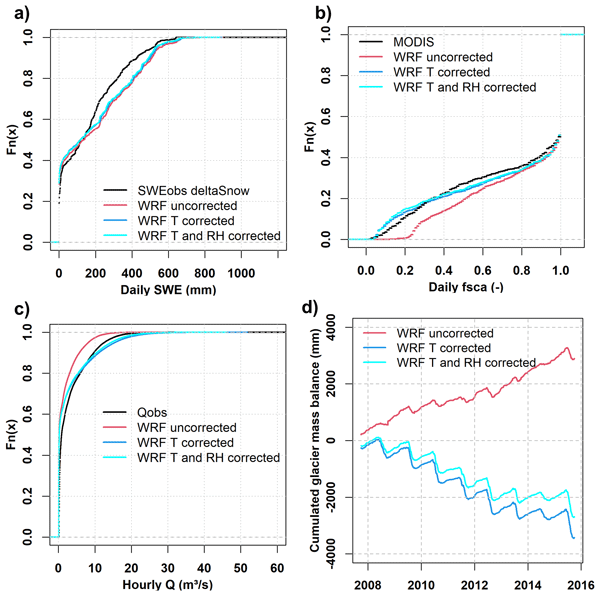
We developed a new approach to improve the climate data used to study water and glaciers in high-mountain regions. By correcting unrealistic air temperatures and moisture while keeping the data physically consistent, we achieved much better agreement with measurements and more accurate simulations of snow, glacier change, and river flow. The method also preserved long-term warming trends, making it useful for studying future climate impacts in mountain areas.
Xinyang Fan, Florentin Hofmeister, Bettina Schaefli, and Gabriele Chiogna
EGUsphere, https://doi.org/10.5194/egusphere-2025-1500, https://doi.org/10.5194/egusphere-2025-1500, 2025
Preprint archived
Short summary
Short summary
We adopt a fully-distributed, physics-based hydrological modeling approach, to understand streamflow variations and their interactions with groundwater in a high-elevation glaciated environment. We demonstrate opportunities and challenges of integrating point-scale groundwater observations into a distributed model. This study sheds new lights on surface-subsurface processes in high alpine environments and highlights the importance of improving subsurface representation in hydrological modeling.
Raoul A. Collenteur, Ezra Haaf, Mark Bakker, Tanja Liesch, Andreas Wunsch, Jenny Soonthornrangsan, Jeremy White, Nick Martin, Rui Hugman, Ed de Sousa, Didier Vanden Berghe, Xinyang Fan, Tim J. Peterson, Jānis Bikše, Antoine Di Ciacca, Xinyue Wang, Yang Zheng, Maximilian Nölscher, Julian Koch, Raphael Schneider, Nikolas Benavides Höglund, Sivarama Krishna Reddy Chidepudi, Abel Henriot, Nicolas Massei, Abderrahim Jardani, Max Gustav Rudolph, Amir Rouhani, J. Jaime Gómez-Hernández, Seifeddine Jomaa, Anna Pölz, Tim Franken, Morteza Behbooei, Jimmy Lin, and Rojin Meysami
Hydrol. Earth Syst. Sci., 28, 5193–5208, https://doi.org/10.5194/hess-28-5193-2024, https://doi.org/10.5194/hess-28-5193-2024, 2024
Short summary
Short summary
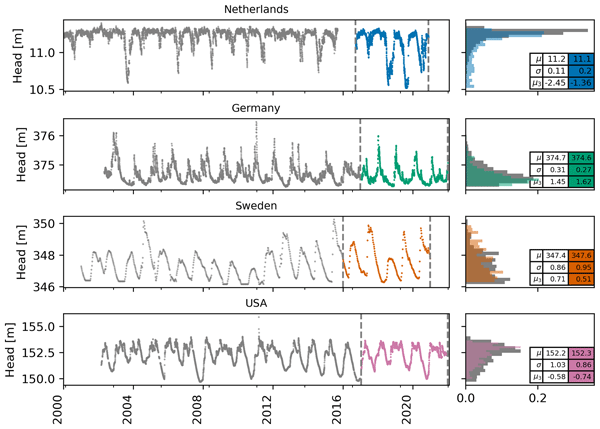
We show the results of the 2022 Groundwater Time Series Modelling Challenge; 15 teams applied data-driven models to simulate hydraulic heads, and three model groups were identified: lumped, machine learning, and deep learning. For all wells, reasonable performance was obtained by at least one team from each group. There was not one team that performed best for all wells. In conclusion, the challenge was a successful initiative to compare different models and learn from each other.
Justine Berg, Pascal Horton, Martina Kauzlaric, Alexandra von der Esch, and Bettina Schaefli
Hydrol. Earth Syst. Sci., 30, 6511–6530, https://doi.org/10.5194/hess-30-6511-2026, https://doi.org/10.5194/hess-30-6511-2026, 2026
Short summary
Short summary
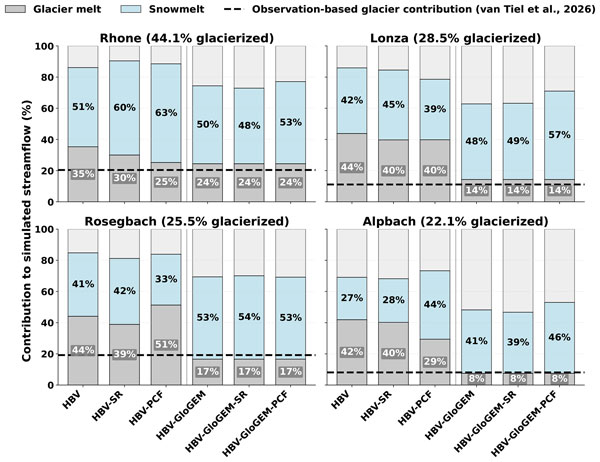
Snow and glacier melt are essential for water supply in mountain regions, but it is challenging to determine how much each source contributes to streamflow. To improve these estimates, we simulated 14 headwater catchments in Switzerland using a hydrological model modified to include snow redistribution and integrating glacier melt from a glacier evolution model. This allowed more accurate estimates of snow and glacier melt contributions, supporting future predictions of water availability.
Florentin Hofmeister, Xinyang Fan, Madlene Pfeiffer, Ben Marzeion, Bettina Schaefli, and Gabriele Chiogna
Hydrol. Earth Syst. Sci., 30, 6265–6288, https://doi.org/10.5194/hess-30-6265-2026, https://doi.org/10.5194/hess-30-6265-2026, 2026
Short summary
Short summary
We developed a new approach to improve the climate data used to study water and glaciers in high-mountain regions. By correcting unrealistic air temperatures and moisture while keeping the data physically consistent, we achieved much better agreement with measurements and more accurate simulations of snow, glacier change, and river flow. The method also preserved long-term warming trends, making it useful for studying future climate impacts in mountain areas.
Harsh Beria, Lionel Benoit, Grégoire Mariethoz, Natalie Claire Ceperley, and Bettina Schaefli
EGUsphere, https://doi.org/10.5194/egusphere-2026-4249, https://doi.org/10.5194/egusphere-2026-4249, 2026
Short summary
Short summary
Mountain streams can rise within minutes of heavy rain, but much of the streamwater may have been stored underground for far longer. We combine hydrological measurements with stable water isotopes to simulate streamflow in a Swiss Alpine catchment. The simulations show that >80 % of summer streamflow came from groundwater, while direct rainfall contributions were small and brief. Fast stream rises therefore do not necessarily mean that rainwater moves quickly through the landscape.
Felix Pfluger, Samuel Weber, Natalie Barbosa, Florentin Hofmeister, Johannes Leinauer, Peter Wegmann, and Michael Krautblatter
Earth Surf. Dynam., 14, 601–634, https://doi.org/10.5194/esurf-14-601-2026, https://doi.org/10.5194/esurf-14-601-2026, 2026
Short summary
Short summary
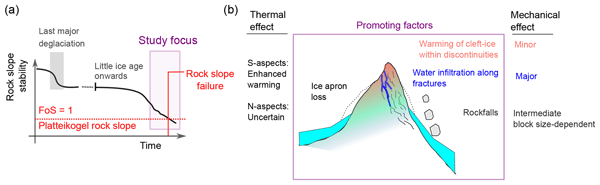
The 2024 Platteikogel rock slope failure (Tyrol, Austria) highlights how cryospheric changes promote slope failure. We demonstrate how the system feedback of ice apron loss, permafrost warming, increase in rockfall activity, and changes in groundwater conditions accelerate mechanical destabilization, and as a consequence likely peaked in the observed failure. Today, rapidly vanishing ice aprons potentially mark source zones for future rock slides.
Pau Wiersma, Jan Magnusson, Nadav Peleg, Bettina Schaefli, and Gregoire Mariethoz
Hydrol. Earth Syst. Sci., 30, 3331–3350, https://doi.org/10.5194/hess-30-3331-2026, https://doi.org/10.5194/hess-30-3331-2026, 2026
Short summary
Short summary
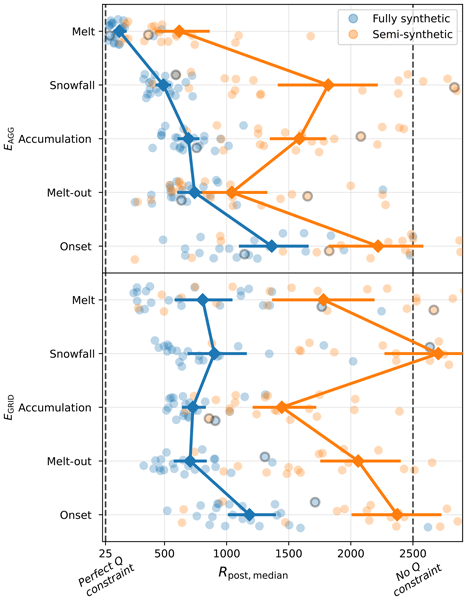
Streamflow observations contain information about snow, but their potential to constrain seasonal snow mass reconstructions remains underexplored. Using inverse hydrological modeling, we show that streamflow is particularly effective at constraining catchment-aggregated melt rates, but that non-uniqueness in the snow–streamflow relationship and uncertainties in the inverse modeling chain can easily limit inversion performance.
Malve Heinz, Annelie Holzkämper, Rohini Kumar, Sélène Ledain, Pascal Horton, and Bettina Schaefli
Hydrol. Earth Syst. Sci., 30, 2879–2911, https://doi.org/10.5194/hess-30-2879-2026, https://doi.org/10.5194/hess-30-2879-2026, 2026
Short summary
Short summary
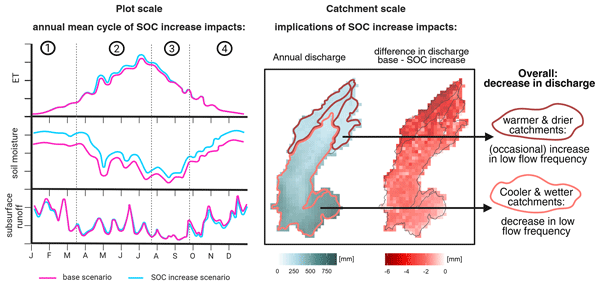
Droughts increasingly threaten agriculture. Improving soils to store more water, for example by increasing soil organic carbon, can help. We simulated this in a Swiss catchment and found that more soil carbon slightly increased soil water storage and evapotranspiration, modestly reduced floods, and shortened periods with very little streamflow. However in warmer, drier areas, these periods with little streamflow could sometimes last longer.
Adrià Fontrodona-Bach, Bettina Schaefli, Ross Woods, and Joshua R. Larsen
Hydrol. Earth Syst. Sci., 30, 2613–2636, https://doi.org/10.5194/hess-30-2613-2026, https://doi.org/10.5194/hess-30-2613-2026, 2026
Short summary
Short summary
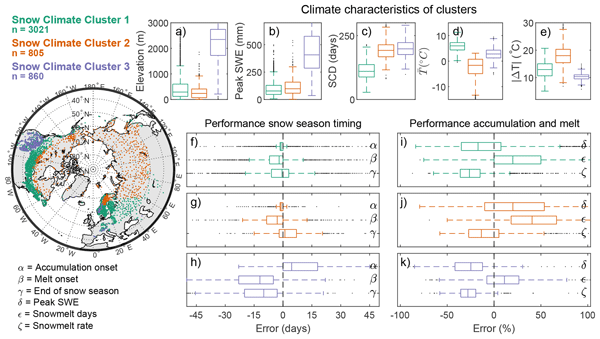
Investigating changing snow in response to global warming can be done with a simple model and only temperature and precipitation data, simplifying snow dynamics with assumptions and parameters. We provide a large-scale and long-term evaluation of this approach and its performance across diverse climates. Temperature thresholds are more robust over cold climates but melt parameters are more robust over warmer climates with deep snow. The model performs well across climates despite its simplicity.
Timo Schaffhauser, Florentin Hofmeister, Gabriele Chiogna, Fabian Merk, Ye Tuo, Julian Machnitzke, Lucas Alcamo, Jingshui Huang, and Markus Disse
Hydrol. Earth Syst. Sci., 29, 3227–3256, https://doi.org/10.5194/hess-29-3227-2025, https://doi.org/10.5194/hess-29-3227-2025, 2025
Short summary
Short summary
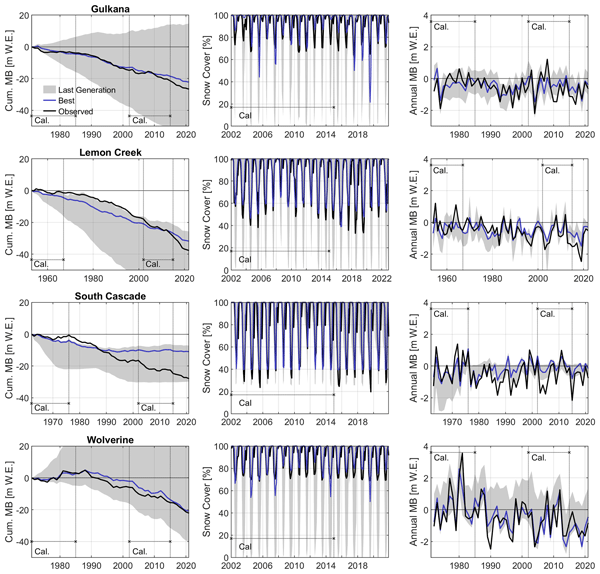
The glacier-expanded SWAT (Soil Water Assessment Tool) version, SWAT-GL, was tested in four different catchments, highlighting the capabilities of the glacier routine. It was evaluated based on the representation of glacier mass balance, snow cover and glacier hypsometry. The glacier changes over a long timescale could be adequately represented, leading to promising potential future applications in glaciated and high mountain environments and significantly outperforming standard SWAT models.
Xinyang Fan, Florentin Hofmeister, Bettina Schaefli, and Gabriele Chiogna
EGUsphere, https://doi.org/10.5194/egusphere-2025-1500, https://doi.org/10.5194/egusphere-2025-1500, 2025
Preprint archived
Short summary
Short summary
We adopt a fully-distributed, physics-based hydrological modeling approach, to understand streamflow variations and their interactions with groundwater in a high-elevation glaciated environment. We demonstrate opportunities and challenges of integrating point-scale groundwater observations into a distributed model. This study sheds new lights on surface-subsurface processes in high alpine environments and highlights the importance of improving subsurface representation in hydrological modeling.
Malve Heinz, Maria Eliza Turek, Bettina Schaefli, Andreas Keiser, and Annelie Holzkämper
Hydrol. Earth Syst. Sci., 29, 1807–1827, https://doi.org/10.5194/hess-29-1807-2025, https://doi.org/10.5194/hess-29-1807-2025, 2025
Short summary
Short summary
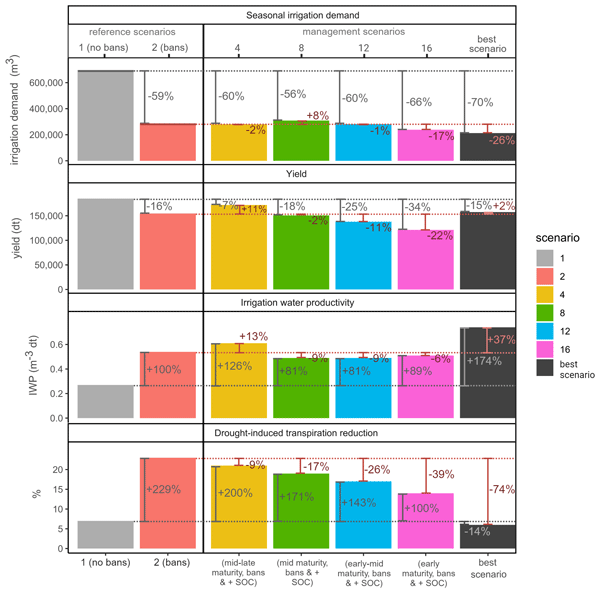
Potato farmers in Switzerland are facing drier conditions and water restrictions. We explored how improving soil health and planting early-maturing potato varieties might help them to adapt. Using a computer model, we simulated potato yields and irrigation water needs under water scarcity. Our results show that earlier-maturing potato varieties reduce the reliance on irrigation but result in lower yields. However, improving soil health can significantly reduce yield losses.
Anne-Laure Argentin, Pascal Horton, Bettina Schaefli, Jamal Shokory, Felix Pitscheider, Leona Repnik, Mattia Gianini, Simone Bizzi, Stuart N. Lane, and Francesco Comiti
Hydrol. Earth Syst. Sci., 29, 1725–1748, https://doi.org/10.5194/hess-29-1725-2025, https://doi.org/10.5194/hess-29-1725-2025, 2025
Short summary
Short summary
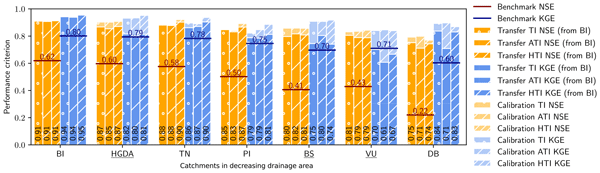
In this article, we show that by taking the optimal parameters calibrated with a semi-lumped model for the discharge at a catchment's outlet, we can accurately simulate runoff at various points within the study area, including three nested and three neighboring catchments. In addition, we demonstrate that employing more intricate melt models, which better represent physical processes, enhances the transfer of parameters in the simulation, until we observe overparameterization.
Tom Müller, Mauro Fischer, Stuart N. Lane, and Bettina Schaefli
The Cryosphere, 19, 423–458, https://doi.org/10.5194/tc-19-423-2025, https://doi.org/10.5194/tc-19-423-2025, 2025
Short summary
Short summary
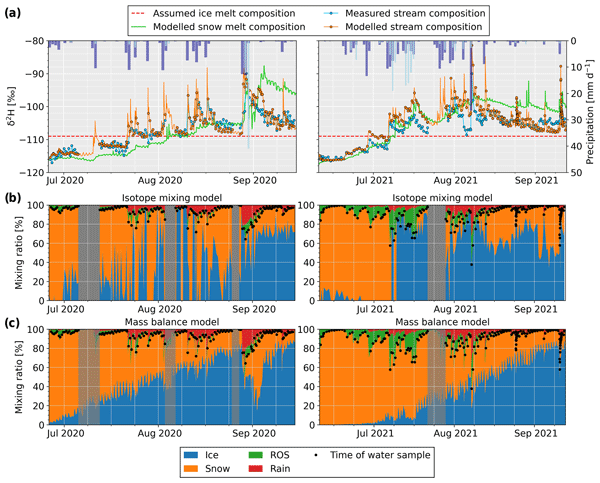
Based on extensive field observations in a highly glacierized catchment in the Swiss Alps, we develop a combined isotopic and glacio-hydrological model. We show that water stable isotopes may help to better constrain model parameters, especially those linked to water transfer. However, we highlight that separating snow and ice melt for temperate glaciers based on isotope mixing models alone is not advised and should only be considered if their isotopic signatures have clearly different values.
Raoul A. Collenteur, Ezra Haaf, Mark Bakker, Tanja Liesch, Andreas Wunsch, Jenny Soonthornrangsan, Jeremy White, Nick Martin, Rui Hugman, Ed de Sousa, Didier Vanden Berghe, Xinyang Fan, Tim J. Peterson, Jānis Bikše, Antoine Di Ciacca, Xinyue Wang, Yang Zheng, Maximilian Nölscher, Julian Koch, Raphael Schneider, Nikolas Benavides Höglund, Sivarama Krishna Reddy Chidepudi, Abel Henriot, Nicolas Massei, Abderrahim Jardani, Max Gustav Rudolph, Amir Rouhani, J. Jaime Gómez-Hernández, Seifeddine Jomaa, Anna Pölz, Tim Franken, Morteza Behbooei, Jimmy Lin, and Rojin Meysami
Hydrol. Earth Syst. Sci., 28, 5193–5208, https://doi.org/10.5194/hess-28-5193-2024, https://doi.org/10.5194/hess-28-5193-2024, 2024
Short summary
Short summary
We show the results of the 2022 Groundwater Time Series Modelling Challenge; 15 teams applied data-driven models to simulate hydraulic heads, and three model groups were identified: lumped, machine learning, and deep learning. For all wells, reasonable performance was obtained by at least one team from each group. There was not one team that performed best for all wells. In conclusion, the challenge was a successful initiative to compare different models and learn from each other.
Moctar Dembélé, Mathieu Vrac, Natalie Ceperley, Sander J. Zwart, Josh Larsen, Simon J. Dadson, Grégoire Mariéthoz, and Bettina Schaefli
Proc. IAHS, 385, 121–127, https://doi.org/10.5194/piahs-385-121-2024, https://doi.org/10.5194/piahs-385-121-2024, 2024
Short summary
Short summary
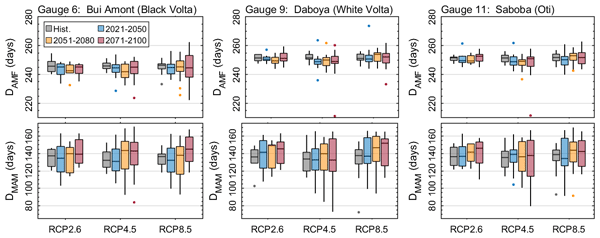
This study assesses the impact of climate change on the timing, seasonality and magnitude of mean annual minimum (MAM) flows and annual maximum flows (AMF) in the Volta River basin (VRB). Several climate change projection data are use to simulate river flow under multiple greenhouse gas emission scenarios. Future projections show that AMF could increase with various magnitude but negligible shift in time across the VRB, while MAM could decrease with up to 14 days of delay in occurrence.
Tom Müller, Matteo Roncoroni, Davide Mancini, Stuart N. Lane, and Bettina Schaefli
Hydrol. Earth Syst. Sci., 28, 735–759, https://doi.org/10.5194/hess-28-735-2024, https://doi.org/10.5194/hess-28-735-2024, 2024
Short summary
Short summary
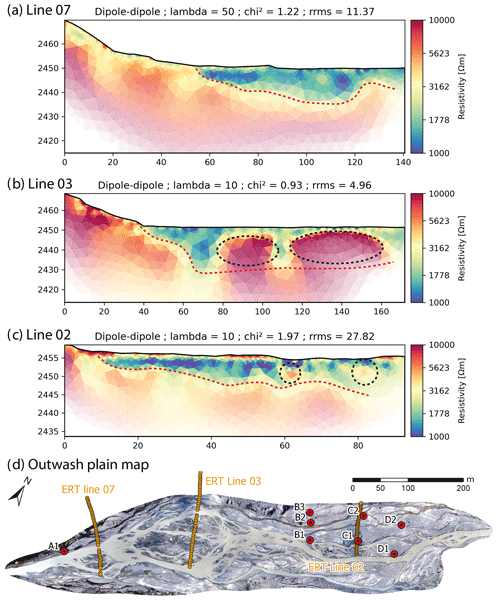
We investigate the role of a newly formed floodplain in an alpine glaciated catchment to store and release water. Based on field measurements, we built a numerical model to simulate the water fluxes and show that recharge occurs mainly due to the ice-melt-fed river. We identify three future floodplains, which could emerge from glacier retreat, and show that their combined storage leads to some additional groundwater storage but contributes little additional baseflow for the downstream river.
Katharina Ramskogler, Bettina Knoflach, Bernhard Elsner, Brigitta Erschbamer, Florian Haas, Tobias Heckmann, Florentin Hofmeister, Livia Piermattei, Camillo Ressl, Svenja Trautmann, Michael H. Wimmer, Clemens Geitner, Johann Stötter, and Erich Tasser
Biogeosciences, 20, 2919–2939, https://doi.org/10.5194/bg-20-2919-2023, https://doi.org/10.5194/bg-20-2919-2023, 2023
Short summary
Short summary
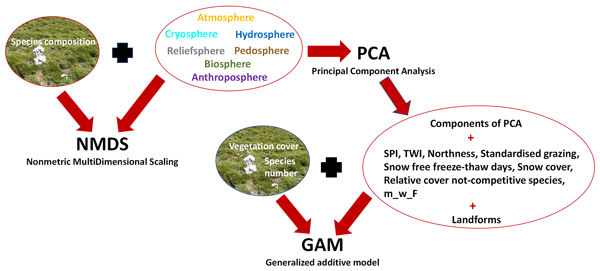
Primary succession in proglacial areas depends on complex driving forces. To concretise the complex effects and interaction processes, 39 known explanatory variables assigned to seven spheres were analysed via principal component analysis and generalised additive models. Key results show that in addition to time- and elevation-dependent factors, also disturbances alter vegetation development. The results are useful for debates on vegetation development in a warming climate.
Adrià Fontrodona-Bach, Bettina Schaefli, Ross Woods, Adriaan J. Teuling, and Joshua R. Larsen
Earth Syst. Sci. Data, 15, 2577–2599, https://doi.org/10.5194/essd-15-2577-2023, https://doi.org/10.5194/essd-15-2577-2023, 2023
Short summary
Short summary
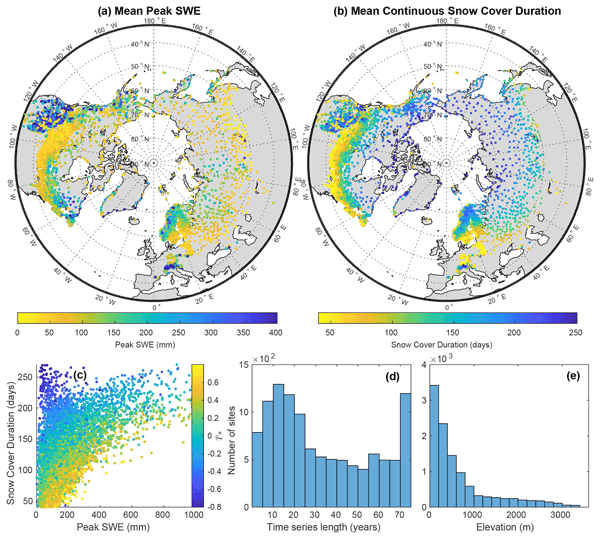
We provide a dataset of snow water equivalent, the depth of liquid water that results from melting a given depth of snow. The dataset contains 11 071 sites over the Northern Hemisphere, spans the period 1950–2022, and is based on daily observations of snow depth on the ground and a model. The dataset fills a lack of accessible historical ground snow data, and it can be used for a variety of applications such as the impact of climate change on global and regional snow and water resources.
Alessio Gentile, Davide Canone, Natalie Ceperley, Davide Gisolo, Maurizio Previati, Giulia Zuecco, Bettina Schaefli, and Stefano Ferraris
Hydrol. Earth Syst. Sci., 27, 2301–2323, https://doi.org/10.5194/hess-27-2301-2023, https://doi.org/10.5194/hess-27-2301-2023, 2023
Short summary
Short summary
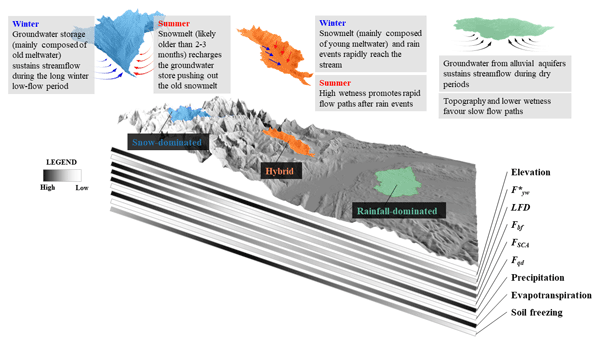
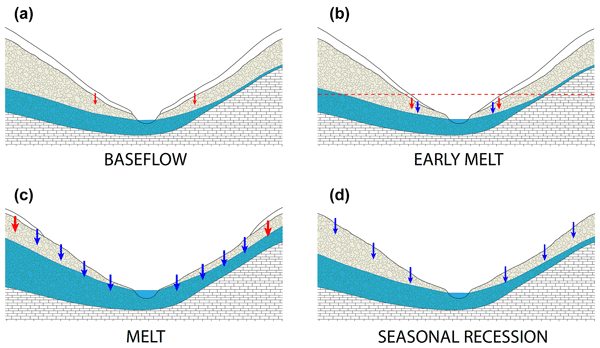
What drives young water fraction, F*yw (i.e., the fraction of water in streamflow younger than 2–3 months), variations with elevation? Why is F*yw counterintuitively low in high-elevation catchments, in spite of steeper topography? In this paper, we present a perceptual model explaining how the longer low-flow duration at high elevations, driven by the persistence of winter snowpacks, increases the proportion of stored (old) water contributing to the stream, thus reducing F*yw.
Anthony Michelon, Natalie Ceperley, Harsh Beria, Joshua Larsen, Torsten Vennemann, and Bettina Schaefli
Hydrol. Earth Syst. Sci., 27, 1403–1430, https://doi.org/10.5194/hess-27-1403-2023, https://doi.org/10.5194/hess-27-1403-2023, 2023
Short summary
Short summary
Streamflow generation processes in high-elevation catchments are largely influenced by snow accumulation and melt. For this work, we collected and analyzed more than 2800 water samples (temperature, electric conductivity, and stable isotopes of water) to characterize the hydrological processes in such a high Alpine environment. Our results underline the critical role of subsurface flow during all melt periods and the presence of snowmelt even during the winter periods.
Tom Müller, Stuart N. Lane, and Bettina Schaefli
Hydrol. Earth Syst. Sci., 26, 6029–6054, https://doi.org/10.5194/hess-26-6029-2022, https://doi.org/10.5194/hess-26-6029-2022, 2022
Short summary
Short summary
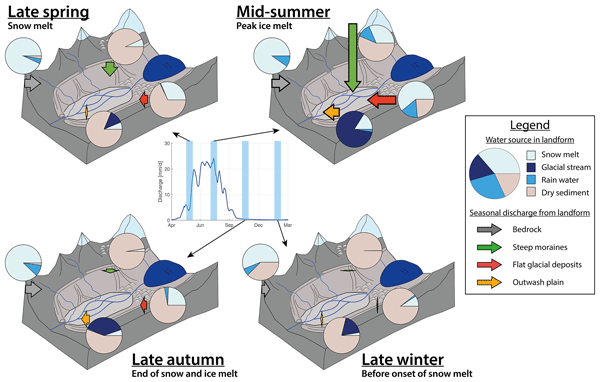
This research provides a comprehensive analysis of groundwater storage in Alpine glacier forefields, a zone rapidly evolving with glacier retreat. Based on data analysis of a case study, it provides a simple perceptual model showing where and how groundwater is stored and released in a high Alpine environment. It especially points out the presence of groundwater storages in both fluvial and bedrock aquifers, which may become more important with future glacier retreat.
Feiko Bernard van Zadelhoff, Adel Albaba, Denis Cohen, Chris Phillips, Bettina Schaefli, Luuk Dorren, and Massimiliano Schwarz
Nat. Hazards Earth Syst. Sci., 22, 2611–2635, https://doi.org/10.5194/nhess-22-2611-2022, https://doi.org/10.5194/nhess-22-2611-2022, 2022
Short summary
Short summary
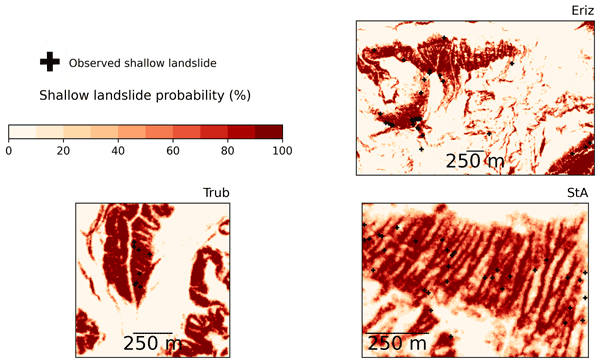
Shallow landslides pose a risk to people, property and infrastructure. Assessment of this hazard and the impact of protective measures can reduce losses. We developed a model (SlideforMAP) that can assess the shallow-landslide risk on a regional scale for specific rainfall events. Trees are an effective and cheap protective measure on a regional scale. Our model can assess their hazard reduction down to the individual tree level.
Alexandre Tuel, Bettina Schaefli, Jakob Zscheischler, and Olivia Martius
Hydrol. Earth Syst. Sci., 26, 2649–2669, https://doi.org/10.5194/hess-26-2649-2022, https://doi.org/10.5194/hess-26-2649-2022, 2022
Short summary
Short summary
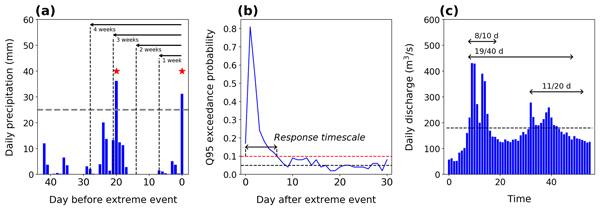
River discharge is strongly influenced by the temporal structure of precipitation. Here, we show how extreme precipitation events that occur a few days or weeks after a previous event have a larger effect on river discharge than events occurring in isolation. Windows of 2 weeks or less between events have the most impact. Similarly, periods of persistent high discharge tend to be associated with the occurrence of several extreme precipitation events in close succession.
Stefan Brönnimann, Peter Stucki, Jörg Franke, Veronika Valler, Yuri Brugnara, Ralf Hand, Laura C. Slivinski, Gilbert P. Compo, Prashant D. Sardeshmukh, Michel Lang, and Bettina Schaefli
Clim. Past, 18, 919–933, https://doi.org/10.5194/cp-18-919-2022, https://doi.org/10.5194/cp-18-919-2022, 2022
Short summary
Short summary
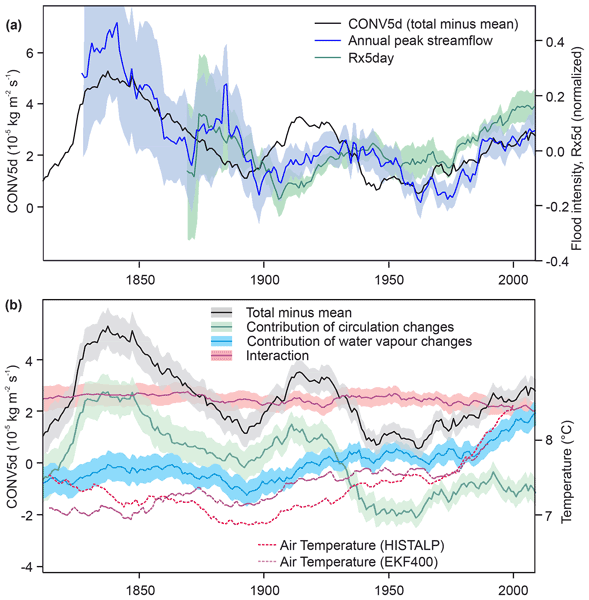
Floods in Europe vary on time scales of several decades. Flood-rich and flood-poor periods alternate. Recently floods have again become more frequent. Long time series of peak stream flow, precipitation, and atmospheric variables reveal that until around 1980, these changes were mostly due to changes in atmospheric circulation. However, in recent decades the role of increasing atmospheric moisture due to climate warming has become more important and is now the main driver of flood changes.
Moctar Dembélé, Mathieu Vrac, Natalie Ceperley, Sander J. Zwart, Josh Larsen, Simon J. Dadson, Grégoire Mariéthoz, and Bettina Schaefli
Hydrol. Earth Syst. Sci., 26, 1481–1506, https://doi.org/10.5194/hess-26-1481-2022, https://doi.org/10.5194/hess-26-1481-2022, 2022
Short summary
Short summary
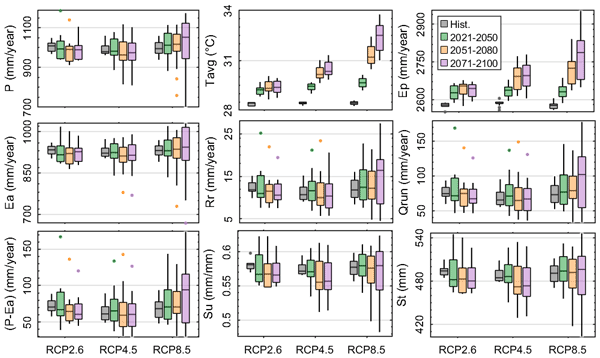
Climate change impacts on water resources in the Volta River basin are investigated under various global warming scenarios. Results reveal contrasting changes in future hydrological processes and water availability, depending on greenhouse gas emission scenarios, with implications for floods and drought occurrence over the 21st century. These findings provide insights for the elaboration of regional adaptation and mitigation strategies for climate change.
Adrien Michel, Bettina Schaefli, Nander Wever, Harry Zekollari, Michael Lehning, and Hendrik Huwald
Hydrol. Earth Syst. Sci., 26, 1063–1087, https://doi.org/10.5194/hess-26-1063-2022, https://doi.org/10.5194/hess-26-1063-2022, 2022
Short summary
Short summary
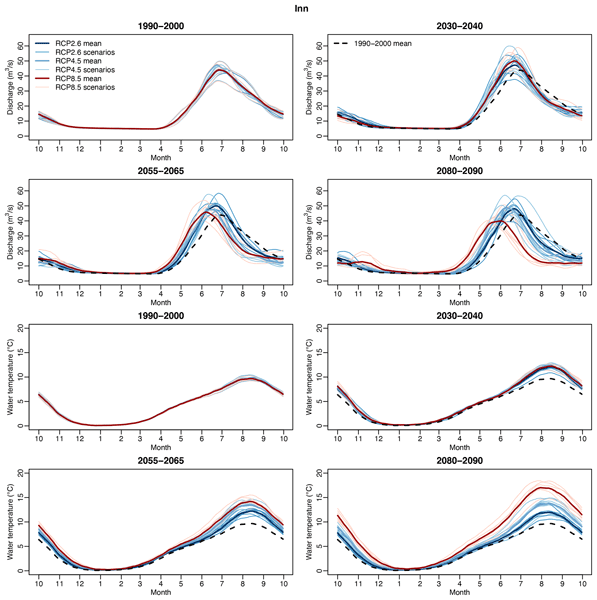
This study presents an extensive study of climate change impacts on river temperature in Switzerland. Results show that, even for low-emission scenarios, water temperature increase will lead to adverse effects for both ecosystems and socio-economic sectors throughout the 21st century. For high-emission scenarios, the effect will worsen. This study also shows that water seasonal warming will be different between the Alpine regions and the lowlands. Finally, efficiency of models is assessed.
Cited articles
Abhervé, R., Roques, C., Gauvain, A., Longuevergne, L., Louaisil, S., Aquilina, L., and de Dreuzy, J.-R.: Calibration of groundwater seepage against the spatial distribution of the stream network to assess catchment-scale hydraulic properties, Hydrol. Earth Syst. Sci., 27, 3221–3239, https://doi.org/10.5194/hess-27-3221-2023, 2023. a
Ala-aho, P., Soulsby, C., Wang, H., and Tetzlaff, D.: Integrated surface-subsurface model to investigate the role of groundwater in headwater catchment runoff generation: A minimalist approach to parameterisation, J. Hydrol., 547, 664–677, https://doi.org/10.1016/j.jhydrol.2017.02.023, 2017. a
Altmann, M., Fischer, P., Haas, F., Pfeiffer, M., Ramskogler, K., Rom, J., Kara-Timmermann, D., Himmelstoß, T., Heckmann, T., and Becht, M.: Simulation of soil erosion in the Little Ice Age glacier foreland of the Zufallferner (South Tyrol, Italy) using Erosion-3D, EGU General Assembly 2025, Vienna, Austria, 27 Apr–2 May 2025, EGU25-5734, https://doi.org/10.5194/egusphere-egu25-5734, 2025. a
Appels, W. M., Bogaart, P. W., and van der Zee, S. E.: Feedbacks between shallow groundwater dynamics and surface topography on runoff generation in flat fields, Water Resour. Res., 53, 10336–10353, https://doi.org/10.1002/2017WR020727, 2017. a
Arnoux, M., Brunner, P., Schaefli, B., Mott, R., Cochand, F., and Hunkeler, D.: Low-flow behavior of alpine catchments with varying quaternary cover under current and future climatic conditions, J. Hydrol., 592, 125591, https://doi.org/10.1016/j.jhydrol.2020.125591, 2021. a
Aubry-Wake, C., McNamara, G., Somers, L. D., McKenzie, J. M., Pomeroy, J. W., and Hellström, R.: Sensitivity of surface water and groundwater contributions to streamflow in a tropical glacierized basin under climate change scenarios, Environ. Res. Lett., 19, 114036, https://doi.org/10.1088/1748-9326/ad7c68, 2024. a, b
Autonome Province of Bolzano: Vedretta Lunga Langenferner, Glacier report, 142, https://assets-eu-01.kc-usercontent.com/53721173-39bb-0184-4b45-ca96e975b8d7/7e806ed1-a48e-4da5-96ce-a67521282f2b/pr186428_glacierreport_022009.pdf (last access: 15 June 2024), 2007. a, b
Avanzi, F., Munerol, F., Milelli, M., Gabellani, S., Massari, C., Girotto, M., Cremonese, E., Galvagno, M., Bruno, G., Morra di Cella, U., Rossi, L., Altamura, M., and Ferraris, L.: Winter snow deficit was a harbinger of summer 2022 socio-hydrologic drought in the Po Basin, Italy, Commun. Earth Environ., 5, 64, https://doi.org/10.1038/s43247-024-01222-z, 2024. a
Bahr, D. B., Meier, M. F., and Peckham, S. D.: The physical basis of glacier volume-area scaling, J. Geophys. Res.: Solid Earth, 102, 20355–20362, https://doi.org/10.1029/97JB01696, 1997. a
Bahr, D. B., Pfeffer, W. T., and Kaser, G.: A review of volume-area scaling of glaciers, Rev. Geophys., 53, 95–140, https://doi.org/10.1002/2014RG000470, 2015. a
Banerjee, A., Kang, S., Guo, W., Meadows, M. E., Wang, W., Sengupta, D., and Zhang, T.: Glacier retreat and lake outburst floods in the central Himalayan region from 2000 to 2022, Nat. Haz., 120, 5485–5508, https://doi.org/10.1007/s11069-024-06415-5, 2024. a
Batjes, N. H., Ribeiro, E., and van Oostrum, A.: Standardised soil profile data to support global mapping and modelling (WoSIS snapshot 2019), Earth Syst. Sci. Data, 12, 299–320, https://doi.org/10.5194/essd-12-299-2020, 2020. a
Beven, K. J. and Kirkby, M. J.: A physically based, variable contributing area model of basin hydrology, Hydrol. Sci. J., 24, 43–69, https://doi.org/10.1080/02626667909491834, 1979. a, b, c
Borzi, I.: Modeling groundwater resources in data-scarce regions for sustainable management: Methodologies and limits, Hydrology, 12, 11, https://doi.org/10.3390/hydrology12010011, 2025. a
Bosco, C., de Rigo, D., Dewitte, O., Poesen, J., and Panagos, P.: Modelling soil erosion at European scale: towards harmonization and reproducibility, Nat. Hazards Earth Syst. Sci., 15, 225–245, https://doi.org/10.5194/nhess-15-225-2015, 2015. a
Brighenti, S., Engel, M., Dinale, R., Tirler, W., Voto, G., and Comiti, F.: Isotopic and chemical signatures of high mountain rivers in catchments with contrasting glacier and rock glacier cover, J. Hydrol., 623, 129779, https://doi.org/10.1016/j.jhydrol.2023.129779, 2023. a, b
Bronstert, A., Niehoff, D., and Schiffler, G. R.: Modelling infiltration and infiltration excess: The importance of fast and local processes, Hydrol. Proc., 37, e14875, https://doi.org/10.1002/hyp.14875, 2023. a
Brutsaert, W.: Evaporation into the atmosphere, Kluwer Academic Publishers, Dordrecht, https://doi.org/10.1007/978-94-017-1497-6, 1982. a
Carletti, F., Michel, A., Casale, F., Burri, A., Bocchiola, D., Bavay, M., and Lehning, M.: A comparison of hydrological models with different level of complexity in Alpine regions in the context of climate change, Hydrol. Earth Syst. Sci., 26, 3447–3475, https://doi.org/10.5194/hess-26-3447-2022, 2022. a
Ceperley, N., Zuecco, G., Beria, H., Carturan, L., Michelon, A., Penna, D., Larsen, J., and Schaefli, B.: Seasonal snow cover decreases young water fractions in high Alpine catchments, Hydrol. Proc., 34, 4794–4813, https://doi.org/10.1002/hyp.13937, 2020. a
Chen, Z., Lucianetti, G., and Hartmann, A.: Understanding groundwater storage and drainage dynamics of a high mountain catchment with complex geology using a semi-distributed process-based modelling approach, J. Hydrol., 625, 130067, https://doi.org/10.1016/j.jhydrol.2023.130067, 2023. a
Coderre, P., Knoben, W., Thébault, C., Vásquez, N., Clark, M., and Pietroniro, A.: The impact of benchmark selection on spatial patterns of model evaluation metrics, EGU General Assembly 2026, Vienna, Austria, 3–8 May 2026, EGU26-15343, https://doi.org/10.5194/egusphere-egu26-15343, 2026. a
Collaud Coen, M. and Vogt, F. P.: mannkendall/Matlab: Bug fix: prob_mk_n (v1.1.0)., Zenodo [code], https://doi.org/10.5281/zenodo.4495589, 2021. a, b
Collaud Coen, M., Andrews, E., Bigi, A., Martucci, G., Romanens, G., Vogt, F. P. A., and Vuilleumier, L.: Effects of the prewhitening method, the time granularity, and the time segmentation on the Mann–Kendall trend detection and the associated Sen's slope, Atmos. Meas. Tech., 13, 6945–6964, https://doi.org/10.5194/amt-13-6945-2020, 2020. a, b
Cornelissen, T., Diekkrüger, B., and Giertz, S.: A comparison of hydrological models for assessing the impact of land use and climate change on discharge in a tropical catchment, J. Hydrol., 498, 221–236, https://doi.org/10.1016/j.jhydrol.2013.06.016, 2013. a
Di Baldassarre, G. and Montanari, A.: Uncertainty in river discharge observations: a quantitative analysis, Hydrol. Earth Syst. Sci., 13, 913–921, https://doi.org/10.5194/hess-13-913-2009, 2009. a
Dobler, C. and Pappenberger, F.: Global sensitivity analyses for a complex hydrological model applied in an Alpine watershed, Hydrol. Proc., 27, 3922–3940, https://doi.org/10.1002/hyp.9520, 2013. a
Drenkhan, F., Buytaert, W., Mackay, J. D., Barrand, N. E., Hannah, D. M., and Huggel, C.: Looking beyond glaciers to understand mountain water security, Nat. Sustain., 6, 130–138, https://doi.org/10.1038/s41893-022-00996-4, 2023. a
Duncan, C., Masek, J., and Fielding, E.: How steep are the Himalaya? Characteristics and implications of along-strike topographic variations, Geology, 31, 75–78, https://doi.org/10.1130/0091-7613(2003)031<0075:HSATHC>2.0.CO;2, 2003. a
Dunne, T.: Relation of field studies and modeling in the prediction of storm runoff, J. Hydrol., 65, 25–48, https://doi.org/10.1016/0022-1694(83)90209-3, 1983. a, b
Dussaillant, I., Hugonnet, R., Huss, M., Berthier, E., Bannwart, J., Paul, F., and Zemp, M.: Annual mass change of the world's glaciers from 1976 to 2024 by temporal downscaling of satellite data with in situ observations, Earth Syst. Sci. Data, 17, 1977–2006, https://doi.org/10.5194/essd-17-1977-2025, 2025. a
Ebbing, J., England, R., Korja, T., Lauritsen, T., Olesen, O., Stratford, W., and Weidle, C.: Structure of the Scandes lithosphere from surface to depth, Tectonophysics, 536, 1–24, https://doi.org/10.1016/j.tecto.2012.02.016, 2012. a
Engdahl, N. B.: Impacts of permeability uncertainty in a coupled surface-subsurface flow model under perturbed recharge scenarios, Water Resour. Res., 60, e2023WR035975, https://doi.org/10.1029/2023WR035975, 2024. a, b, c
Fan, X., Goeppert, N., and Goldscheider, N.: Quantifying the historic and future response of karst spring discharge to climate variability and change at a snow-influenced temperate catchment in central Europe, Hydrogeol. J., 31, 2213–2229, https://doi.org/10.1007/s10040-023-02703-9, 2023a. a
Fan, X., Peterson, T. J., Henley, B. J., and Arora, M.: Groundwater sensitivity to climate variations across Australia, Water Resour. Res., 59, e2023WR035036, https://doi.org/10.1029/2023WR035036, 2023b. a
Fan, X., Hofmeister, F., Schaefli, B., and Chiogna, G.: New insights from fully-integrated surface-subsurface hydrological modeling in high-elevation glaciated environments, Zenodo [data set], https://doi.org/10.5281/zenodo.21246869, 2026a. a
Fan, X., Schaefli, B., Hofmeister, F., and Chiogna, G.: When the Past Matters: How Model Initialization Can Lead to Surprises in Long-Term Simulations in Glaciated Environments, Hydrol. Proc., 40, e70507, https://doi.org/10.1002/hyp.70507, 2026b. a
Fatichi, S., Ivanov, V. Y., and Caporali, E.: A mechanistic ecohydrological model to investigate complex interactions in cold and warm water-controlled environments: 1, Theoretical framework and plot-scale analysis, J. Adv. Model. Earth Syst., 4, M05002, https://doi.org/10.1029/2011MS000086, 2012. a, b
Fatichi, S., Rimkus, S., Burlando, P., Bordoy, R., and Molnar, P.: High-resolution distributed analysis of climate and anthropogenic changes on the hydrology of an Alpine catchment, J. Hydrol., 525, 362–382, https://doi.org/10.1016/j.jhydrol.2015.03.036, 2015. a
Förster, K., Garvelmann, J., Meißl, G., and Strasser, U.: Modelling forest snow processes with a new version of WaSiM, Hydrol. Sci. J., 63, 1540–1557, 2018. a
Freudiger, D., Kohn, I., Seibert, J., Stahl, K., and Weiler, M.: Snow redistribution for the hydrological modeling of alpine catchments, Wiley Interdiscip. Rev.: Water, 4, e1232, https://doi.org/10.1002/wat2.1232, 2017. a
Galos, S. P., Klug, C., Maussion, F., Covi, F., Nicholson, L., Rieg, L., Gurgiser, W., Mölg, T., and Kaser, G.: Reanalysis of a 10-year record (2004–2013) of seasonal mass balances at Langenferner/Vedretta Lunga, Ortler Alps, Italy, The Cryosphere, 11, 1417–1439, https://doi.org/10.5194/tc-11-1417-2017, 2017. a
Garambois, P. A., Roux, H., Larnier, K., Castaings, W., and Dartus, D.: Characterization of process-oriented hydrologic model behavior with temporal sensitivity analysis for flash floods in Mediterranean catchments, Hydrol. Earth Syst. Sci., 17, 2305–2322, https://doi.org/10.5194/hess-17-2305-2013, 2013. a
Gauthier, T. D.: Detecting trends using Spearman's rank correlation coefficient, Environ. Forens., 2, 359–362, https://doi.org/10.1006/enfo.2001.0061, 2001. a
Glaser, B., Antonelli, M., Chini, M., Pfister, L., and Klaus, J.: Technical note: Mapping surface-saturation dynamics with thermal infrared imagery, Hydrol. Earth Syst. Sci., 22, 5987–6003, https://doi.org/10.5194/hess-22-5987-2018, 2018. a, b
Grabs, T., Seibert, J., Bishop, K., and Laudon, H.: Modeling spatial patterns of saturated areas: A comparison of the topographic wetness index and a dynamic distributed model, J. Hydrol., 373, 15–23, https://doi.org/10.1016/j.jhydrol.2009.03.031, 2009. a
Gruber, S.: A mass-conserving fast algorithm to parameterize gravitational transport and deposition using digital elevation models, Water Resour. Res., 43, https://doi.org/10.1029/2006WR004868, 2007. a
Guyennon, N., Valt, M., Salerno, F., Petrangeli, A. B., and Romano, E.: Estimating the snow water equivalent from snow depth measurements in the Italian Alps, Cold Reg. Sci. Technol., 167, 102859, https://doi.org/10.1016/j.coldregions.2019.102859, 2019. a
Hayashi, M.: Alpine hydrogeology: The critical role of groundwater in sourcing the headwaters of the world, Groundwater, 58, 498–510, https://doi.org/10.1111/gwat.12965, 2019. a
Hock, R.: Modelling of glacier melt and discharge, PhD thesis, ETH Zurich, https://doi.org/10.3929/ethz-a-001891975, 1998. a
Hock, R.: A distributed temperature-index ice-and snowmelt model including potential direct solar radiation, J. Glaciol., 45, 101–111, https://doi.org/10.3189/S0022143000003087, 1999. a
Hofmeister, F., Arias-Rodriguez, L. F., Premier, V., Marin, C., Notarnicola, C., Disse, M., and Chiogna, G.: Intercomparison of Sentinel-2 and modelled snow cover maps in a high-elevation Alpine catchment, J. Hydrol. X, 15, 100123, https://doi.org/10.1016/j.hydroa.2022.100123, 2022. a, b, c, d
Hofmeister, F., Graziano, F., Marcolini, G., Willems, W., Disse, M., and Chiogna, G.: Quality assessment of hydrometeorological observational data and their influence on hydrological model results in Alpine catchments, Hydrol. Sci. J., 68, 552–571, https://doi.org/10.1080/02626667.2023.2172335, 2023a. a, b
Hofmeister, F., Venegas, B. R., Sentlinger, G., Tarantik, M., Blume, T., Disse, M., and Chiogna, G.: Automated streamflow measurements in high-elevation Alpine catchments, River Res. Appl., 39, 2079–2091, https://doi.org/10.1002/rra.4203, 2023b. a, b
Höge, M., Kauzlaric, M., Siber, R., Schönenberger, U., Horton, P., Schwanbeck, J., Floriancic, M. G., Viviroli, D., Wilhelm, S., Sikorska-Senoner, A. E., Addor, N., Brunner, M., Pool, S., Zappa, M., and Fenicia, F.: CAMELS-CH: hydro-meteorological time series and landscape attributes for 331 catchments in hydrologic Switzerland, Earth Syst. Sci. Data, 15, 5755–5784, https://doi.org/10.5194/essd-15-5755-2023, 2023. a
Horton, P., Schaefli, B., and Kauzlaric, M.: Why do we have so many different hydrological models? A review based on the case of Switzerland, Wiley Interdiscip. Rev.: Water, 9, e1574, https://doi.org/10.1002/wat2.1574, 2022. a
IPCC: Climate change 2021: The Physical Science Basis. Contribution of Working Group I to the Sixth Assessment Report of the Intergovernmental Panel on Climate Change, Cambridge University Press, https://doi.org/10.1017/9781009157896, 2021. a
Isotta, F. A., Frei, C., and Schwanbeck, J.: Mean Precipitation throughout the Alps 1971–2008, in: Data and Analysis Platform, Hydrological Atlas of Switzerland, https://hydromaps.ch/#en/7/46.111/10.898/bl_hds--b02_b0200_alpine_precip_y_1971_2008v1_0$0/NULL (last access: 15 February 2024), 2018. a
Jansson, P. and Karlberg, L.: Coupled heat and mass transfer model for soil-plant-atmosphere systems, Royal Institute of Technology, Dept of Civil and Environmental Engineering, Stockholm, https://www.researchgate.net/publication/304714926_Coupled_ heat_and_mass_transfer_model_for_soil-plant-atmosphere_systems_Royal_Institute_of_Technology_Department _of_Civil_and_Environmental_Engineering (last access: 15 February 2024), 2004. a
Jarvis, A., Reuter, H., Nelson, A., and Guevara, E.: Hole-filled seamless SRTM data V4, CGIAR-CSI [data set], http://srtm.csi.cgiar.org (last access: 15 February 2024), 2008. a
Kendall, M.: Rank correlation methods, Charles Griffin, London, 196 pp., https://www.scribd.com/document/722213060/Rank-correlation-methods-Kendall-Maurice-G-Maurice-George-1907-Volume-3rd-Edition-1962-New-York-Hafner-Pub-Co-594b4db6dbaf75d161 (last access: 15 February 2024), 1962. a
Knoflach, B., Ramskogler, K., Talluto, M., Hofmeister, F., Haas, F., Heckmann, T., Pfeiffer, M., Piermattei, L., Ressl, C., Wimmer, M. H., et al.: Modelling of vegetation dynamics from satellite time series to determine proglacial primary succession in the course of global warming – A case study in the upper Martell Valley (Eastern Italian Alps), Remote Sens., 13, 4450, https://doi.org/10.3390/rs13214450, 2021. a, b, c, d, e
Krause, S., Bronstert, A., and Zehe, E.: Groundwater–surface water interactions in a North German lowland floodplain – implications for the river discharge dynamics and riparian water balance, J. Hydrol., 347, 404–417, https://doi.org/10.1016/j.jhydrol.2007.09.028, 2007. a
Kumar, R., Samaniego, L., and Attinger, S.: Implications of distributed hydrologic model parameterization on water fluxes at multiple scales and locations, Water Resour. Res., 49, 360–379, https://doi.org/10.1029/2012WR012195, 2013. a, b
Liu, J., Liu, J., Liu, M., Tian, S., Liu, Y., Yang, W., and Liu, Y.: Development of an alpine hydrological model considering the recharge of stream water to alluvial plain aquifers, Environmental Modelling and Software, p. 106567, https://doi.org/10.1016/j.envsoft.2025.106567, 2025. a, b, c
Liu, M., Pei, H., and Shen, Y.: Evaluating dynamics of GRACE groundwater and its drought potential in Taihang Mountain Region, China, J. Hydrol., 612, 128156, https://doi.org/10.1016/j.jhydrol.2022.128156, 2022. a
Livneh, B., Kumar, R., and Samaniego, L.: Influence of soil textural properties on hydrologic fluxes in the Mississippi river basin, Hydrol. Proc., 29, 4638–4655, https://doi.org/10.1002/hyp.10601, 2015. a
Mann, H.: Nonparametric tests against trend, Econometrica, 13, 245–259, https://doi.org/10.2307/1907187, 1945. a
Marcolini, G., Bellin, A., Disse, M., and Chiogna, G.: Variability in snow depth time series in the Adige catchment, J. Hydrol.: Reg. Stud., 13, 240–254, https://doi.org/10.1016/j.ejrh.2017.08.007, 2017. a
Matiu, M., Jacob, A., and Notarnicola, C.: Daily MODIS snow cover maps for the European Alps from 2002 onwards at 250 m horizontal resolution along with a nearly cloud-free version, Data, 5, 1, https://doi.org/10.3390/data5010001, 2019. a
Matiu, M., Crespi, A., Bertoldi, G., Carmagnola, C. M., Marty, C., Morin, S., Schöner, W., Cat Berro, D., Chiogna, G., De Gregorio, L., Kotlarski, S., Majone, B., Resch, G., Terzago, S., Valt, M., Beozzo, W., Cianfarra, P., Gouttevin, I., Marcolini, G., Notarnicola, C., Petitta, M., Scherrer, S. C., Strasser, U., Winkler, M., Zebisch, M., Cicogna, A., Cremonini, R., Debernardi, A., Faletto, M., Gaddo, M., Giovannini, L., Mercalli, L., Soubeyroux, J.-M., Sušnik, A., Trenti, A., Urbani, S., and Weilguni, V.: Observed snow depth trends in the European Alps: 1971 to 2019, The Cryosphere, 15, 1343–1382, https://doi.org/10.5194/tc-15-1343-2021, 2021. a
McGuire, K. J., Klaus, J., and Jackson, C. R.: JAMES BUTTLE REVIEW: Interflow, subsurface stormflow and throughflow: A synthesis of field work and modelling, Hydrol. Proc., 38, e15263, https://doi.org/10.1002/hyp.15263, 2024. a, b, c
Meier, A.: Hydrological insights into glacier melt discharge: A multi-method approach using isotopes in a small alpine environment above 1745 m a.s.l., Master's thesis, University of Bern, https://www.geography.unibe.ch/unibe/portal/fak_naturwis/e_geowiss/c_igeogr/content/e39592/e1608235/e1608239/pane1608241/e1611621/Meier.Anna_2024_komprimiert_ger.pdf (last access: 15 February 2026), 2024. a
Michel, A., Schaefli, B., Wever, N., Zekollari, H., Lehning, M., and Huwald, H.: Future water temperature of rivers in Switzerland under climate change investigated with physics-based models, Hydrol. Earth Syst. Sci., 26, 1063–1087, https://doi.org/10.5194/hess-26-1063-2022, 2022. a, b
Monteith, J.: Evaporation and surface temperature, Q. J. R. Meteorol. Soc., 107, 1–27, 1981. a
Müller, T., Lane, S. N., and Schaefli, B.: Towards a hydrogeomorphological understanding of proglacial catchments: an assessment of groundwater storage and release in an Alpine catchment, Hydrol. Earth Syst. Sci., 26, 6029–6054, https://doi.org/10.5194/hess-26-6029-2022, 2022. a, b, c
Müller, T., Roncoroni, M., Mancini, D., Lane, S. N., and Schaefli, B.: Current and future roles of meltwater–groundwater dynamics in a proglacial Alpine outwash plain, Hydrol. Earth Syst. Sci., 28, 735–759, https://doi.org/10.5194/hess-28-735-2024, 2024. a, b, c
Nan, Y., Tian, L., He, Z., Tian, F., and Shao, L.: The value of water isotope data on improving process understanding in a glacierized catchment on the Tibetan Plateau, Hydrol. Earth Syst. Sci., 25, 3653–3673, https://doi.org/10.5194/hess-25-3653-2021, 2021. a
Nan, Y., Tian, F., McDonnell, J., Ni, G., Tian, L., Li, Z., Yan, D., Xia, X., Wang, T., Han, S., and Li, K.: Glacier meltwater has limited contributions to the total runoff in the major rivers draining the Tibetan Plateau, npj Clim. Atmos. Sci., 8, 155, https://doi.org/10.1038/s41612-025-01060-6, 2025. a, b, c
Nash, J. E. and Sutcliffe, J. V.: River flow forecasting through conceptual models part I – a discussion of principles, J. Hydrol., 10, 282–290, 1970. a
Owen, L. A. and Dortch, J. M.: Nature and timing of Quaternary glaciation in the Himalayan–Tibetan orogen, Quat. Sci. Rev., 88, 14–54, https://doi.org/10.1016/j.quascirev.2013.11.016, 2014. a
Paillex, A., Siebers, A. R., Ebi, C., Mesman, J., and Robinson, C. T.: High stream intermittency in an alpine fluvial network: Val Roseg, Switzerland, Limnol. Oceanogr., 65, 557–568, https://doi.org/10.1002/lno.11324, 2020. a
Paschalis, A., Bonetti, S., Guo, Y., and Fatichi, S.: On the uncertainty induced by pedotransfer functions in terrestrial biosphere modeling, Water Resour. Res., 58, e2021WR031871, https://doi.org/10.1029/2021WR031871, 2022. a
Pistocchi, A.: Simple estimation of snow density in an Alpine region, J. Hydrol. Reg. Stud., 6, 82–89, https://doi.org/10.1016/j.ejrh.2016.03.004, 2016. a
Pomeroy, J., Gray, D., Brown, T., Hedstrom, N., Quinton, W., Granger, R., and Carey, S.: The cold regions hydrological model: a platform for basing process representation and model structure on physical evidence, Hydrol. Proc., 21, 2650–2667, https://doi.org/10.1002/hyp.6787, 2007. a
Pourali, S., Arrowsmith, C., Chrisman, N., Matkan, A., and Mitchell, D.: Topography wetness index application in flood-risk-based land use planning, Appl. Spat. Anal. Policy, 9, 39–54, https://doi.org/10.1007/s12061-014-9130-2, 2016. a, b, c
Puspitarini, H. D., François, B., Zaramella, M., Brown, C., and Borga, M.: The impact of glacier shrinkage on energy production from hydropower-solar complementarity in alpine river basins, Sci. Tot. Environ., 719, 137488, https://doi.org/10.1016/j.scitotenv.2020.137488, 2020. a
Ramskogler, K., Knoflach, B., Elsner, B., Erschbamer, B., Haas, F., Heckmann, T., Hofmeister, F., Piermattei, L., Ressl, C., Trautmann, S., Wimmer, M. H., Geitner, C., Stötter, J., and Tasser, E.: Primary succession and its driving variables – a sphere-spanning approach applied in proglacial areas in the upper Martell Valley (Eastern Italian Alps), Biogeosciences, 20, 2919–2939, https://doi.org/10.5194/bg-20-2919-2023, 2023. a, b, c, d, e, f, g, h, i, j
Reato, A., Borzi, G., Martínez, O. A., and Carol, E.: Role of rock glaciers and other high-altitude depositional units in the hydrology of the mountain watersheds of the Northern Patagonian Andes, Sci. Tot. Environ., 824, 153968, https://doi.org/10.1016/j.scitotenv.2022.153968, 2022. a
Rehfeldt, K. R., Boggs, J. M., and Gelhar, L. W.: Field study of dispersion in a heterogeneous aquifer: 3. Geostatistical analysis of hydraulic conductivity, Water Resour. Res., 28, 3309–3324, https://doi.org/10.1029/92WR01758, 1992. a
Richards, L. A.: Capillary conduction of liquids through porous mediums, Physics, 1, 318–333, https://doi.org/10.1063/1.1745010, 1931. a, b
Riihimäki, H., Kemppinen, J., Kopecký, M., and Luoto, M.: Topographic Wetness Index as a proxy for soil moisture: The importance of flow-routing algorithm and grid resolution, Water Resour. Res., 57, e2021WR029871, https://doi.org/10.1029/2021WR029871, 2021. a
Rinderer, M., van Meerveld, H. J., and Seibert, J.: Topographic controls on shallow groundwater levels in a steep, prealpine catchment: When are the TWI assumptions valid?, Water Resour. Res., 50, 6067–6080, https://doi.org/10.1002/2013WR015009, 2014. a
Rounce, D. R., Hock, R., Maussion, F., Hugonnet, R., Kochtitzky, W., Huss, M., Berthier, E., Brinkerhoff, D., Compagno, L., Copland, L., Farinotti, D., Menounos, B., and McNabb, R.: Global glacier change in the 21st century: Every increase in temperature matters, Science, 379, 78–83, https://doi.org/10.1126/science.abo1324, 2023. a
Schaefli, B. and Huss, M.: Integrating point glacier mass balance observations into hydrologic model identification, Hydrol. Earth Syst. Sci., 15, 1227–1241, https://doi.org/10.5194/hess-15-1227-2011, 2011. a
Schaefli, B., Nicótina, L., Imfeld, C., Da Ronco, P., Bertuzzo, E., and Rinaldo, A.: SEHR-ECHO v1.0: a Spatially Explicit Hydrologic Response model for ecohydrologic applications, Geosci. Model Dev., 7, 2733–2746, https://doi.org/10.5194/gmd-7-2733-2014, 2014. a
Schaffhauser, T., Tuo, Y., Hofmeister, F., Chiogna, G., Huang, J., Merk, F., and Disse, M.: SWAT-GL: A new glacier routine for the hydrological model SWAT, J. Am. Water Resour. Assoc., 60, 755–766, https://doi.org/10.1111/1752-1688.13199, 2024. a, b
Schlögl, S., Marty, C., Bavay, M., and Lehning, M.: Sensitivity of Alpine3D modeled snow cover to modifications in DEM resolution, station coverage and meteorological input quantities, Environ. Model. Softw., 83, 387–396, https://doi.org/10.1016/j.envsoft.2016.02.017, 2016. a
Schmid, E.: High alpine winter discharge development in Switzerland, Zenodo [data set], https://doi.org/10.5281/zenodo.13685009, 2024. a
Seibert, J. and Bergström, S.: A retrospective on hydrological catchment modelling based on half a century with the HBV model, Hydrol. Earth Syst. Sci., 26, 1371–1388, https://doi.org/10.5194/hess-26-1371-2022, 2022. a
Sen, P.: Estimates of the regression coefficient based on Kendall’s τ, J. Am. Stat. Assoc., 63, 1379–1389, https://doi.org/10.1080/01621459.1968.10480934, 1968. a
Shrestha, M., Wang, L., Koike, T., Tsutsui, H., Xue, Y., and Hirabayashi, Y.: Correcting basin-scale snowfall in a mountainous basin using a distributed snowmelt model and remote-sensing data, Hydrol. Earth Syst. Sci., 18, 747–761, https://doi.org/10.5194/hess-18-747-2014, 2014. a
Somers, L. D. and McKenzie, J. M.: A review of groundwater in high mountain environments, Wiley Interdisciplinary Reviews: Water, 7, e1475, https://doi.org/10.1002/wat2.1475, 2020. a, b
Somers, L. D., Gordon, R. P., McKenzie, J. M., Lautz, L. K., Wigmore, O., Glose, A., Glas, R., Aubry-Wake, C., Mark, B., Baraer, M., and Condom, T.: Quantifying groundwater–surface water interactions in a proglacial valley, Cordillera Blanca, Peru, Hydrol. Proc., 30, 2915–2929, https://doi.org/10.1002/hyp.10912, 2016. a
Stutenbecker, L., Costa, A., and Schlunegger, F.: Lithological control on the landscape form of the upper Rhône Basin, Central Swiss Alps, Earth Surf. Dyn., 4, 253–272, https://doi.org/10.5194/esurf-4-253-2016, 2016. a
Talbot, F., Sylvain, J.-D., Drolet, G., Poulin, A., and Arsenault, R.: Enhancing physically based and distributed hydrological model calibration through internal state variable constraints, EGUsphere [preprint], https://doi.org/10.5194/egusphere-2024-3353, 2024. a
Thornton, J. M., Brauchli, T., Mariethoz, G., and Brunner, P.: Efficient multi-objective calibration and uncertainty analysis of distributed snow simulations in rugged alpine terrain, J. Hydrol., 598, 126241, https://doi.org/10.1016/j.jhydrol.2021.126241, 2021. a
Trancoso, R., Larsen, J. R., McAlpine, C., McVicar, T. R., and Phinn, S.: Linking the Budyko framework and the Dunne diagram, J. Hydrol., 535, 581–597, https://doi.org/10.1016/j.jhydrol.2016.02.017, 2016. a, b
Trinh, T., Kavvas, M., Ishida, K., Ercan, A., Chen, Z., Anderson, M., Ho, C., and Nguyen, T.: Integrating global land-cover and soil datasets to update saturated hydraulic conductivity parameterization in hydrologic modeling, Sci. Tot. Environ., 631, 279–288, https://doi.org/10.1016/j.scitotenv.2018.02.267, 2018. a
Tuo, Y., Marcolini, G., Disse, M., and Chiogna, G.: A multi-objective approach to improve SWAT model calibration in alpine catchments, J. Hydrol., 559, 347–360, https://doi.org/10.1016/j.jhydrol.2018.02.055, 2018. a
van Tiel, M., Aubry-Wake, C., Somers, L., Andermann, C., Avanzi, F., Baraer, M., Chiogna, G., Daigre, C., Das, S., Drenkhan, F., Farinotti, D., Fyffe, C., de Graaf, I., Hanus, S., Immerzeel, W., Koch, F., McKenzie, J., Müller, T., Popp, A., Saidaliyeva, Z., Schaefli, B., Schilling, O., Teagai, K., Thornton, J., and Yapiyev, V.: Cryosphere–groundwater connectivity is a missing link in the mountain water cycle, Nature Water, pp. 1–14, https://doi.org/10.1038/s44221-024-00277-8, 2024. a, b, c, d, e, f
Voigt, C., Schulz, K., Koch, F., Wetzel, K.-F., Timmen, L., Rehm, T., Pflug, H., Stolarczuk, N., Förste, C., and Flechtner, F.: Technical note: Introduction of a superconducting gravimeter as novel hydrological sensor for the Alpine research catchment Zugspitze, Hydrol. Earth Syst. Sci., 25, 5047–5064, https://doi.org/10.5194/hess-25-5047-2021, 2021. a
Warscher, M., Strasser, U., Kraller, G., Marke, T., Franz, H., and Kunstmann, H.: Performance of complex snow cover descriptions in a distributed hydrological model system: A case study for the high Alpine terrain of the Berchtesgaden Alps, Water Resour. Res., 49, 2619–2637, https://doi.org/10.1002/wrcr.20219, 20, 2013. a, b, c
Wechsler, T., Stähli, M., Jorde, K., Zappa, M., and Schaefli, B.: The future of Alpine Run-of-River hydropower production: Climate change, environmental flow requirements, and technical production potential, Sci. Tot. Environ., 890, 163934, https://doi.org/10.1016/j.scitotenv.2023.163934, 2023. a
Welch, R. M. and Shaw, J. H.: Structural styles and kinematic evolution of the Front Ranges of the Southern Canadian Rockies, Geosphere, 21, 605–636, https://doi.org/10.1130/GES02814.1, 2025. a
Winkler, M., Schellander, H., and Gruber, S.: Snow water equivalents exclusively from snow depths and their temporal changes: the △snow model, Hydrol. Earth Syst. Sci., 25, 1165–1187, https://doi.org/10.5194/hess-25-1165-2021, 2021. a, b
Woodbury, A. D. and Sudicky, E. A.: The geostatistical characteristics of the Borden aquifer, Water Resour. Res., 27, 533–546, https://doi.org/10.1029/90WR02545, 1991. a
Xiang, L., Wang, H., Steffen, H., Wu, P., Jia, L., Jiang, L., and Shen, Q.: Groundwater storage changes in the Tibetan Plateau and adjacent areas revealed from GRACE satellite gravity data, Earth Planet. Sci. Lett., 449, 228–239, https://doi.org/10.1016/j.epsl.2016.06.002, 2016. a
Xie, S., Zeng, C., Zhang, F., Wang, G., and Xiao, X.: Defining lateral subsurface flow and identifying its water sources in an alpine-permafrost hillslope, Catena, 236, 107765, https://doi.org/10.1016/j.catena.2023.107765, 2024. a
Zhang, Z., Gu, Z., Hu, K., Hu, K., Xu, Y., and Zhao, J.: Spatial variability between glacier mass balance and environmental factors in the High Mountain Asia, J. Arid Land, 14, 441–454, https://doi.org/10.1007/s40333-017-0014-z, 2022. a
Short summary
We adopt a physics-based, fully-integrated hydrological modeling approach to investigate streamflow variations and their interactions with groundwater in a high-elevation glaciated environment. We demonstrate opportunities and challenges of integrating point-scale groundwater observations into a distributed model. This study sheds new lights on surface-subsurface processes in high alpine environments and highlights the importance of improving subsurface representation in hydrological modeling.
We adopt a physics-based, fully-integrated hydrological modeling approach to investigate...


Altmetrics
Final-revised paper
Preprint