
Articles | Volume 30, issue 20
https://doi.org/10.5194/hess-30-6481-2026
© Author(s) 2026. This work is distributed under
the Creative Commons Attribution 4.0 License.
the Creative Commons Attribution 4.0 License.
https://doi.org/10.5194/hess-30-6481-2026
© Author(s) 2026. This work is distributed under
the Creative Commons Attribution 4.0 License.
the Creative Commons Attribution 4.0 License.
Research article
| 
22 Oct 2026
Research article |
| 22 Oct 2026
| 22 Oct 2026
Benchmarking convection-permitting climate simulations for hydrometeorological characterizations: a comparative study of WRF-SAAG and observation-based products in Chile
Sofía Segovia-Escafi
Department of Civil Engineering, Universidad de Chile, RM, Santiago, Chile
Advanced Mining Technology Center (AMTC), Universidad de Chile, RM, Santiago, Chile

Department of Civil Engineering, Universidad de Chile, RM, Santiago, Chile
Advanced Mining Technology Center (AMTC), Universidad de Chile, RM, Santiago, Chile
Miguel Lagos-Zúñiga
Departamento de Obras Civiles, Universidad Técnica Federico Santa María, RM, Santiago, Chile
Lucía Scaff
Department of Geophysics, Universidad de Concepción, Bio-Bio, Concepción, Chile
Andreas F. Prein
Institute for Atmospheric and Climate Science, ETH Zürich, 8092 Zurich, Switzerland
Related authors
No articles found.
Marius Rixen, Praveen K. Pothapakula, Michael Sprenger, Christian Zeman, and Andreas F. Prein
Weather Clim. Dynam., 7, 2065–2086, https://doi.org/10.5194/wcd-7-2065-2026, https://doi.org/10.5194/wcd-7-2065-2026, 2026
Short summary
Short summary
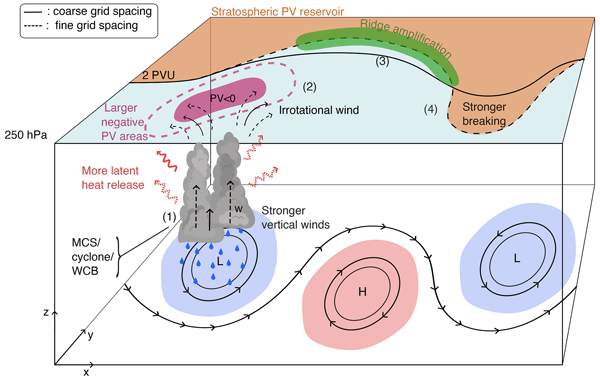
Despite steady improvements in forecasting skill, episodes of low forecast skill, called forecast busts, still persist. Using global ensemble simulations at different grid spacings, we show that coarse-grid simulations fail to resolve key mesoscale diabatic processes, and that errors upscale and propagate downstream, leading to large forecast errors. Fine grid spacing simulations better capture scale interactions in strongly diabatic flow, highlighting the potential of kilometer-scale models.
Millie C. Spencer, Alfonso Fernandez, Emma Tyrrell, Robert Clasing, Enrique Muñoz, Pablo A. Mendoza, Jorge Berkhoff, and Noah P. Molotch
The Cryosphere, 20, 5559–5583, https://doi.org/10.5194/tc-20-5559-2026, https://doi.org/10.5194/tc-20-5559-2026, 2026
Short summary
Short summary
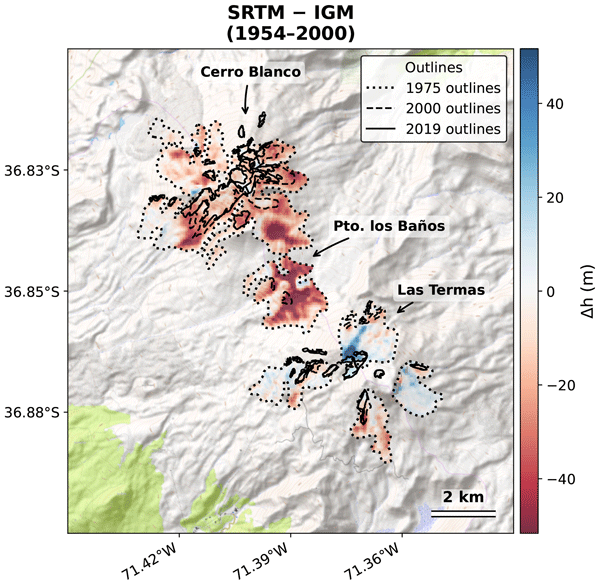
Mountain glaciers are important freshwater reservoirs. Quantifying their loss is essential for forecasting water availability. While glacier retreat is well studied in many regions, glacier loss on the Nevados de Chillán volcanic complex in south-central Chile remains uncertain. Using satellite and drone images, we find all 28 glaciers on Nevados de Chillán lost volume over the past 7 decades, with melt rates accelerating markedly since 2000.
Andres Barrio-Martin, Carlos Calvo-Sancho, Nuria P. Plaza-Martin, Cesar Azorin-Molina, Andreas F. Prein, Tim R. McVicar, Sergio M. Vicente-Serrano, Luis Gimeno, Raquel Nieto, Zhenzhong Zeng, Ana Morata, and Deliang Chen
EGUsphere, https://doi.org/10.5194/egusphere-2026-5202, https://doi.org/10.5194/egusphere-2026-5202, 2026
This preprint is open for discussion and under review for Natural Hazards and Earth System Sciences (NHESS).
Short summary
Short summary
We identified the atmospheric conditions that distinguish ordinary thunderstorms from four severe weather hazards, highlighting numerical proxies for their modelling in the Mediterranean. Severe winds occur in warm, unstable air (summer) or with strong mid-level winds (other seasons); tornadoes are favored by instability near the ground; large hail occurs when instability and strong winds combine; and short-duration heavy precipitation is favored by high moisture and slow-moving thunderstorms.
Jerónimo Sota, Pablo A. Mendoza, and Miguel Lagos-Zúñiga
EGUsphere, https://doi.org/10.5194/egusphere-2026-4067, https://doi.org/10.5194/egusphere-2026-4067, 2026
This preprint is open for discussion and under review for Hydrology and Earth System Sciences (HESS).
Short summary
Short summary
Despite snowmelt runoff from mountainous domains is a vital water source, river flows months ahead remain difficult to predict. This study tested several ways to improve dynamical forecasts across 21 Andean basins using nearly four decades of past data. Results show that some configurations improve forecasts only at specific times or in certain basins, while others can reduce accuracy. The results can help water managers choose more reliable forecasting tools for decision making.
Samir Pokhrel, Verma Utkarsh, Patita Kalyana Sahoo, Praveen K. Pothapakula, Anusha Sunkisala, Nishant Gautam, Kolady P. Pribin, Shivamurthy Yashas, Hemantkumar S. Chaudhari, Archana Rai, Hasibur Rahaman, Andreas F. Prein, Anurag Dipankar, and Subodh Kumar Saha
Weather Clim. Dynam., 7, 1447–1477, https://doi.org/10.5194/wcd-7-1447-2026, https://doi.org/10.5194/wcd-7-1447-2026, 2026
Short summary
Short summary
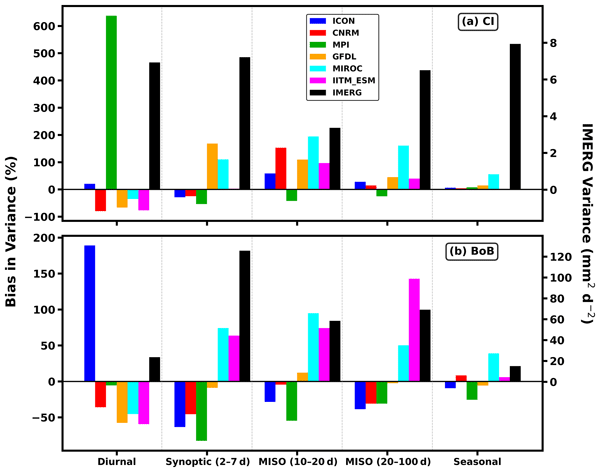
We studied how well climate models simulate Indian monsoon rainfall at different time scales, from daily cycles to longer variations. We found that models may match seasonal averages but still fail to capture when and how rainfall occurs. These errors differ over land and ocean and affect overall monsoon patterns. Improving how models represent rainfall processes across scales is essential for better prediction.
Andreas F. Prein, Praveen K. Pothapakula, Christian Zeman, Morgane Lalonde, Marius Rixen, Anurag Dipankar, Matthieu Leclair, and Andreas Jocksch
Geosci. Model Dev., 19, 5277–5303, https://doi.org/10.5194/gmd-19-5277-2026, https://doi.org/10.5194/gmd-19-5277-2026, 2026
Short summary
Short summary
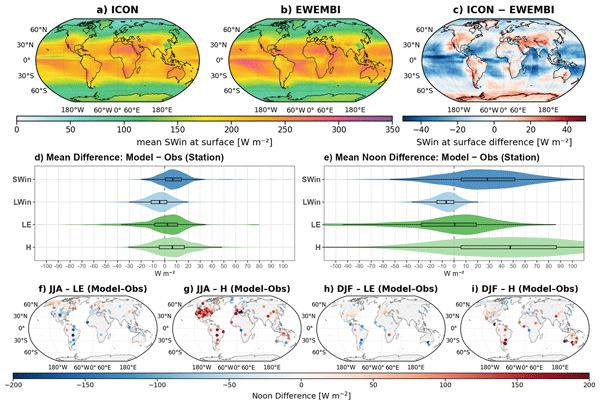
We produce one of the world's most detailed global weather and climate simulations, spanning 4 years and enabling the direct representation of storms rather than approximations. This allows the capture of dangerous events such as strong wind gusts, heavy rain, and powerful tropical and mid-latitude storms everywhere on Earth. Our results show major improvements over traditional climate models, but also reveal remaining challenges in representing large, organized storm systems in the tropics.
Praveen K. Pothapakula, Andreas F. Prein, Anusha Sunkisala, and Anurag Dipankar
Weather Clim. Dynam., 7, 979–1007, https://doi.org/10.5194/wcd-7-979-2026, https://doi.org/10.5194/wcd-7-979-2026, 2026
Short summary
Short summary
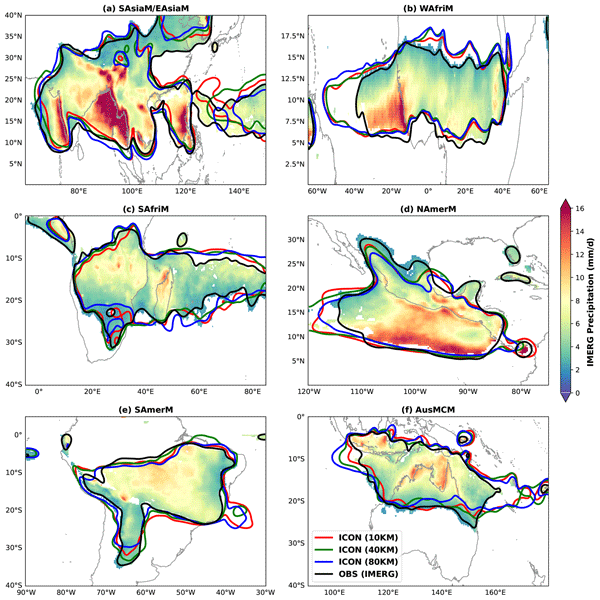
Monsoons provide vital rainfall for billions but are hard to forecast. Using a next-generation climate model, we simulated monsoons at different grid spacings. The model captures key seasonal patterns, but finer grids do not always improve accuracy. They can worsen predictions by overproducing intense rain, as they artificially strengthen weather systems like monsoon lows and waves. Our work shows that smarter model physics is needed for reliable future forecasts and climate projections.
Matías Moreno, Pablo Mendoza, Eduardo Muñoz-Castro, Mauricio Zambrano-Bigiarini, and Alonso Pizarro
EGUsphere, https://doi.org/10.5194/egusphere-2026-2912, https://doi.org/10.5194/egusphere-2026-2912, 2026
Short summary
Short summary
We developed a new method called SPEAK to better evaluate how well hydrological models reproduce spatial patterns such as evapotranspiration across different regions. We tested it in 99 Chilean catchments with different climates and terrain types. Compared with existing methods, SPEAK more accurately represented spatial patterns and was less affected by map resolution or catchment characteristics. This could help improve water resource modelling and planning across diverse local conditions.
Nicolás A. Vásquez, Pablo A. Mendoza, Wouter Knoben, Martyn Clark, Tricia Stadnyk, and Naoki Mizukami
EGUsphere, https://doi.org/10.5194/egusphere-2026-1363, https://doi.org/10.5194/egusphere-2026-1363, 2026
Short summary
Short summary
Although distributed hydrological models are often calibrated using only streamflow data, this practice may provide unrealistic representations of the water cycle. We show that, while streamflow annual cycles can be reasonably simulated, the seasonality of other key variables - such as evapotranspiration, soil moisture, and snow cover - may be severely misrepresented. Our results highlight the need to assess seasonal patterns of variables beyond streamflow when calibrating hydrological models.
Felipe Matus, Marcia Paredes, Miguel Lagos-Zúñiga, Alex Garcés, Diego Pinto, Germán Aguilar, and Santiago Montserrat
Earth Syst. Sci. Data Discuss., https://doi.org/10.5194/essd-2026-18, https://doi.org/10.5194/essd-2026-18, 2026
Revised manuscript accepted for ESSD
Short summary
Short summary
We compiled a detailed catalog of extreme seasonal precipitation events observed in northern Chile during 1979–2019 to better understand how, when, and where these occur. The catalog uses atmospheric data and local meteorological products to identify different types of storms categories occurring in the study area, and the daily meteorological conditions for each event. This information was tested to evaluate landslide occurrence and composite analysis in Chilean arid and semiarid regions.
Eduardo Muñoz-Castro, Bailey J. Anderson, Paul C. Astagneau, Daniel L. Swain, Pablo A. Mendoza, and Manuela I. Brunner
Hydrol. Earth Syst. Sci., 30, 825–848, https://doi.org/10.5194/hess-30-825-2026, https://doi.org/10.5194/hess-30-825-2026, 2026
Short summary
Short summary
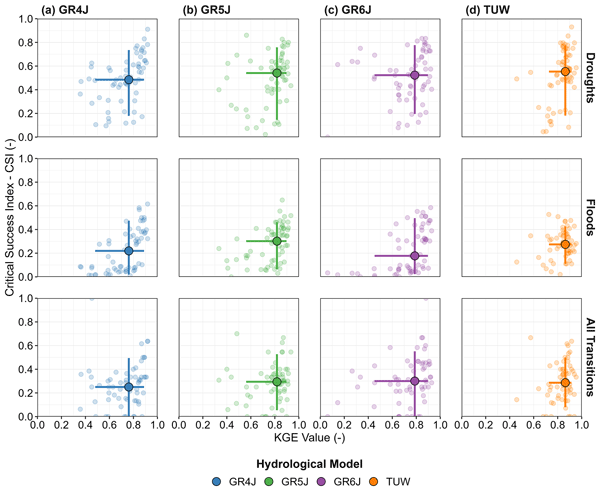
Flood impacts can be enhanced when they occur after droughts, yet the effectiveness of hydrological models in simulating these events remains unclear. Here, we calibrated four conceptual hydrological models across 63 catchments in Chile and Switzerland to assess their ability to detect streamflow extremes and their transitions. We show that drought-to-flood transitions are generally poorly captured, especially in semi-arid high-mountain catchments than in humid low-elevation ones.
Anurag Dipankar, Mauro Bianco, Mona Bukenberger, Till Ehrengruber, Nicoletta Farabullini, Oliver Fuhrer, Abishek Gopal, Daniel Hupp, Andreas Jocksch, Samuel Kellerhals, Clarissa A. Kroll, Xavier Lapillonne, Matthieu Leclair, Magdalena Luz, Christoph Müller, Chia Rui Ong, Carlos Osuna, Praveen Pothapakula, Andreas Prein, Matthias Röthlin, William Sawyer, Christoph Schär, Sebastian Schemm, Giacomo Serafini, Hannes Vogt, Ben Weber, Robert C. Jnglin Wills, Nicolas Gruber, and Thomas C. Schulthess
Geosci. Model Dev., 19, 713–729, https://doi.org/10.5194/gmd-19-713-2026, https://doi.org/10.5194/gmd-19-713-2026, 2026
Short summary
Short summary
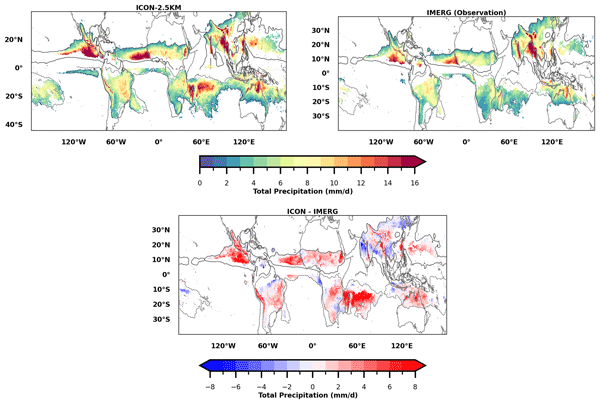
Climate models are becoming more detailed and accurate by simulating weather at scales of just a few kilometers. Simulating at km-scale is computationally demanding requiring powerful supercomputers and efficient code. This work presents a refactored dynamical core of a state-of-the-art climate model using a Python-based approach. The refactored code has passed through a sequence of verification and validation demonstrating its usability in performing km-scale global simulations.
Johannes J. Fürst, David Farías-Barahona, Thomas Bruckner, Lucia Scaff, Martin Mergili, Santiago Montserrat, and Humberto Peña
Nat. Hazards Earth Syst. Sci., 25, 3559–3579, https://doi.org/10.5194/nhess-25-3559-2025, https://doi.org/10.5194/nhess-25-3559-2025, 2025
Short summary
Short summary
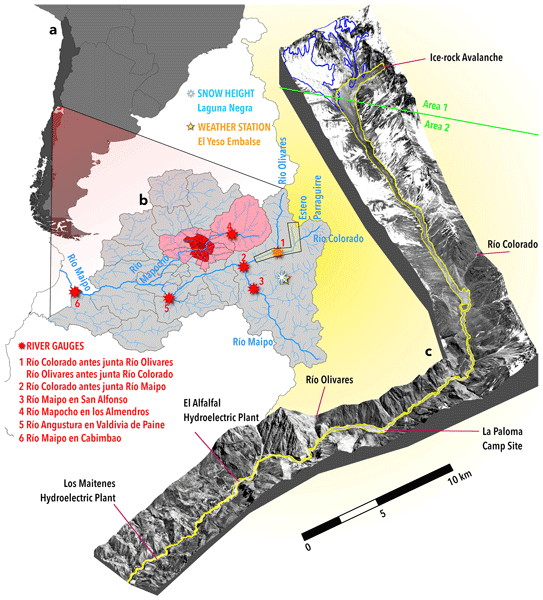
The 1987 Parraguirre ice–rock avalanche developed into a devastating debris flow, causing the loss of many lives and inflicting severe damage near Santiago, Chile. Here, we revise this event, combining various observational records with modelling techniques. In that year, important snow cover coincided with persistent warm periods in spring. We also put forward upward corrections for the trigger and flood volumes involved in this debris flow. Finally, temporary river damming was key for the flow ferocity.
Fabián Lema, Pablo A. Mendoza, Nicolás A. Vásquez, Naoki Mizukami, Mauricio Zambrano-Bigiarini, and Ximena Vargas
Hydrol. Earth Syst. Sci., 29, 1981–2002, https://doi.org/10.5194/hess-29-1981-2025, https://doi.org/10.5194/hess-29-1981-2025, 2025
Short summary
Short summary
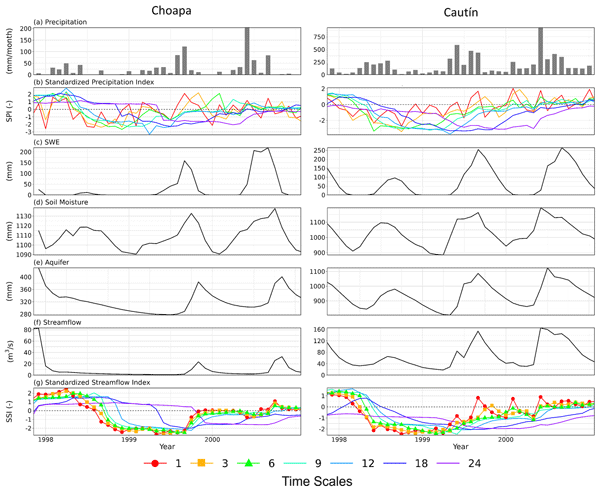
Hydrological droughts affect ecosystems and socioeconomic activities worldwide. Despite the fact that they are commonly described with the Standardized Streamflow Index (SSI), there is limited understanding of what they truly reflect in terms of water cycle processes. Here, we used state-of-the-art hydrological models in Andean basins to examine drivers of SSI fluctuations. The results highlight the importance of careful selection of indices and timescales for accurate drought characterization and monitoring.
Bjorn Stevens, Stefan Adami, Tariq Ali, Hartwig Anzt, Zafer Aslan, Sabine Attinger, Jaana Bäck, Johanna Baehr, Peter Bauer, Natacha Bernier, Bob Bishop, Hendryk Bockelmann, Sandrine Bony, Guy Brasseur, David N. Bresch, Sean Breyer, Gilbert Brunet, Pier Luigi Buttigieg, Junji Cao, Christelle Castet, Yafang Cheng, Ayantika Dey Choudhury, Deborah Coen, Susanne Crewell, Atish Dabholkar, Qing Dai, Francisco Doblas-Reyes, Dale Durran, Ayoub El Gaidi, Charlie Ewen, Eleftheria Exarchou, Veronika Eyring, Florencia Falkinhoff, David Farrell, Piers M. Forster, Ariane Frassoni, Claudia Frauen, Oliver Fuhrer, Shahzad Gani, Edwin Gerber, Debra Goldfarb, Jens Grieger, Nicolas Gruber, Wilco Hazeleger, Rolf Herken, Chris Hewitt, Torsten Hoefler, Huang-Hsiung Hsu, Daniela Jacob, Alexandra Jahn, Christian Jakob, Thomas Jung, Christopher Kadow, In-Sik Kang, Sarah Kang, Karthik Kashinath, Katharina Kleinen-von Königslöw, Daniel Klocke, Uta Kloenne, Milan Klöwer, Chihiro Kodama, Stefan Kollet, Tobias Kölling, Jenni Kontkanen, Steve Kopp, Michal Koran, Markku Kulmala, Hanna Lappalainen, Fakhria Latifi, Bryan Lawrence, June Yi Lee, Quentin Lejeun, Christian Lessig, Chao Li, Thomas Lippert, Jürg Luterbacher, Pekka Manninen, Jochem Marotzke, Satoshi Matsouoka, Charlotte Merchant, Peter Messmer, Gero Michel, Kristel Michielsen, Tomoki Miyakawa, Jens Müller, Ramsha Munir, Sandeep Narayanasetti, Ousmane Ndiaye, Carlos Nobre, Achim Oberg, Riko Oki, Tuba Özkan-Haller, Tim Palmer, Stan Posey, Andreas Prein, Odessa Primus, Mike Pritchard, Julie Pullen, Dian Putrasahan, Johannes Quaas, Krishnan Raghavan, Venkatachalam Ramaswamy, Markus Rapp, Florian Rauser, Markus Reichstein, Aromar Revi, Sonakshi Saluja, Masaki Satoh, Vera Schemann, Sebastian Schemm, Christina Schnadt Poberaj, Thomas Schulthess, Cath Senior, Jagadish Shukla, Manmeet Singh, Julia Slingo, Adam Sobel, Silvina Solman, Jenna Spitzer, Philip Stier, Thomas Stocker, Sarah Strock, Hang Su, Petteri Taalas, John Taylor, Susann Tegtmeier, Georg Teutsch, Adrian Tompkins, Uwe Ulbrich, Pier-Luigi Vidale, Chien-Ming Wu, Hao Xu, Najibullah Zaki, Laure Zanna, Tianjun Zhou, and Florian Ziemen
Earth Syst. Sci. Data, 16, 2113–2122, https://doi.org/10.5194/essd-16-2113-2024, https://doi.org/10.5194/essd-16-2113-2024, 2024
Short summary
Short summary
To manage Earth in the Anthropocene, new tools, new institutions, and new forms of international cooperation will be required. Earth Virtualization Engines is proposed as an international federation of centers of excellence to empower all people to respond to the immense and urgent challenges posed by climate change.
Diego Araya, Pablo A. Mendoza, Eduardo Muñoz-Castro, and James McPhee
Hydrol. Earth Syst. Sci., 27, 4385–4408, https://doi.org/10.5194/hess-27-4385-2023, https://doi.org/10.5194/hess-27-4385-2023, 2023
Short summary
Short summary
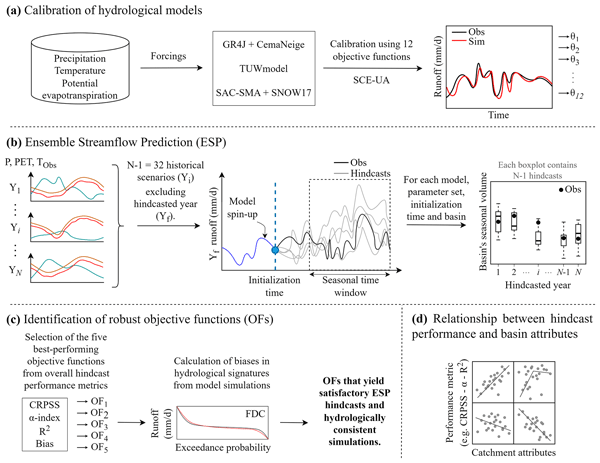
Dynamical systems are used by many agencies worldwide to produce seasonal streamflow forecasts, which are critical for decision-making. Such systems rely on hydrology models, which contain parameters that are typically estimated using a target performance metric (i.e., objective function). This study explores the effects of this decision across mountainous basins in Chile, illustrating tradeoffs between seasonal forecast quality and the models' capability to simulate streamflow characteristics.
Nicolás Cortés-Salazar, Nicolás Vásquez, Naoki Mizukami, Pablo A. Mendoza, and Ximena Vargas
Hydrol. Earth Syst. Sci., 27, 3505–3524, https://doi.org/10.5194/hess-27-3505-2023, https://doi.org/10.5194/hess-27-3505-2023, 2023
Short summary
Short summary
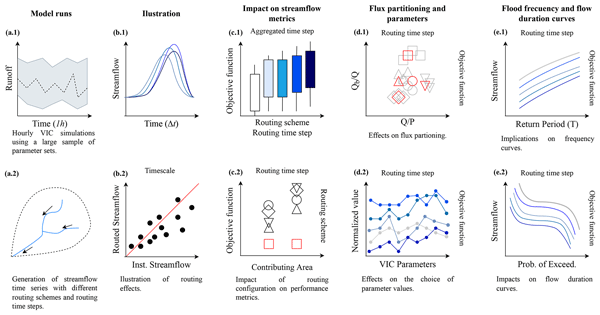
This paper shows how important river models can be for water resource applications that involve hydrological models and, in particular, parameter calibration. To this end, we conduct numerical experiments in a pilot basin using a combination of hydrologic model simulations obtained from a large sample of parameter sets and different routing methods. We find that routing can affect streamflow simulations, even at monthly time steps; the choice of parameters; and relevant streamflow metrics.
Ulises M. Sepúlveda, Pablo A. Mendoza, Naoki Mizukami, and Andrew J. Newman
Hydrol. Earth Syst. Sci., 26, 3419–3445, https://doi.org/10.5194/hess-26-3419-2022, https://doi.org/10.5194/hess-26-3419-2022, 2022
Short summary
Short summary
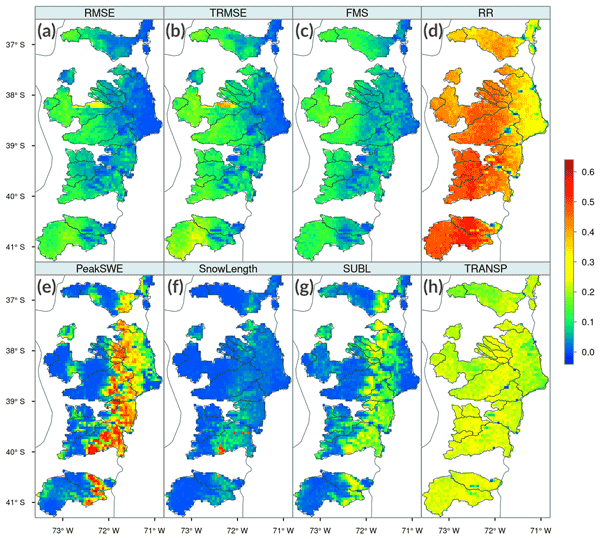
This paper characterizes parameter sensitivities across more than 5500 grid cells for a commonly used macroscale hydrological model, including a suite of eight performance metrics and 43 soil, vegetation and snow parameters. The results show that the model is highly overparameterized and, more importantly, help to provide guidance on the most relevant parameters for specific target processes across diverse climatic types.
Sebastian A. Krogh, Lucia Scaff, James W. Kirchner, Beatrice Gordon, Gary Sterle, and Adrian Harpold
Hydrol. Earth Syst. Sci., 26, 3393–3417, https://doi.org/10.5194/hess-26-3393-2022, https://doi.org/10.5194/hess-26-3393-2022, 2022
Short summary
Short summary
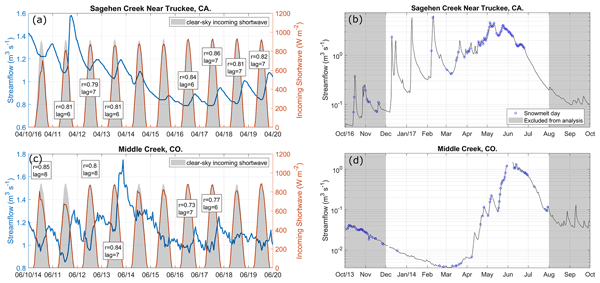
We present a new way to detect snowmelt using daily cycles in streamflow driven by solar radiation. Results show that warmer sites have earlier and more intermittent snowmelt than colder sites, and the timing of early snowmelt events is strongly correlated with the timing of streamflow volume. A space-for-time substitution shows greater sensitivity of streamflow timing to climate change in colder rather than in warmer places, which is then contrasted with land surface simulations.
James M. Done, Gary M. Lackmann, and Andreas F. Prein
Weather Clim. Dynam., 3, 693–711, https://doi.org/10.5194/wcd-3-693-2022, https://doi.org/10.5194/wcd-3-693-2022, 2022
Short summary
Short summary
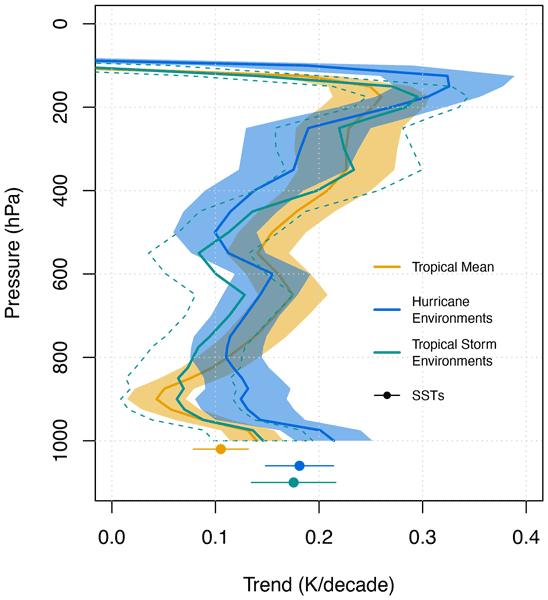
We know that warm oceans generally favour tropical cyclones (TCs). Less is known about the role of air temperature above the oceans extending into the lower stratosphere. Our global analysis of historical records and computer simulations suggests that TCs strengthen in response to historical temperature change while also being influenced by other environmental factors. Ocean warming drives much of the strengthening, with relatively small contributions from temperature changes aloft.
Oscar M. Baez-Villanueva, Mauricio Zambrano-Bigiarini, Pablo A. Mendoza, Ian McNamara, Hylke E. Beck, Joschka Thurner, Alexandra Nauditt, Lars Ribbe, and Nguyen Xuan Thinh
Hydrol. Earth Syst. Sci., 25, 5805–5837, https://doi.org/10.5194/hess-25-5805-2021, https://doi.org/10.5194/hess-25-5805-2021, 2021
Short summary
Short summary
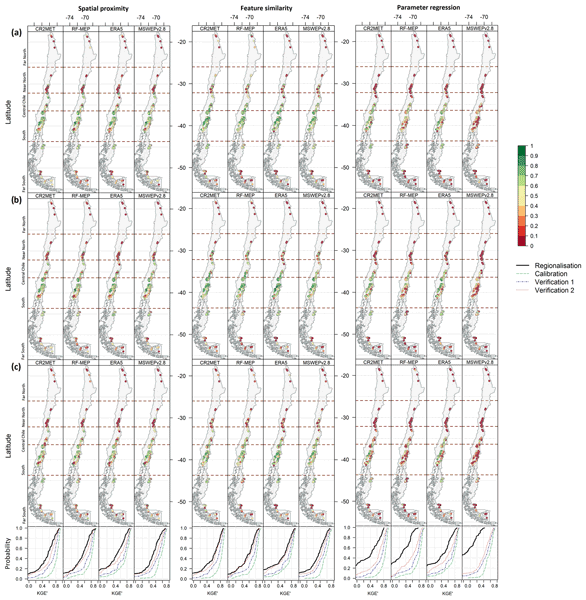
Most rivers worldwide are ungauged, which hinders the sustainable management of water resources. Regionalisation methods use information from gauged rivers to estimate streamflow over ungauged ones. Through hydrological modelling, we assessed how the selection of precipitation products affects the performance of three regionalisation methods. We found that a precipitation product that provides the best results in hydrological modelling does not necessarily perform the best for regionalisation.
Cited articles
Aceituno, P., Boisier, J. P., Garreaud, R., Rondanelli, R., and Rutllant, J. A.: Climate and weather in Chile, in: Water resources of Chile, edited by: Fernández, B. and Gironás, J., Springer, 7–29, https://doi.org/10.1007/978-3-030-56901-3_2, 2021. a, b, c, d
Al-Saeedi, B. A., M. Baez-Villanueva, O., and Ribbe, L.: An optimized representation of precipitation in Jordan: Merging gridded precipitation products and ground-based measurements using machine learning and geostatistical approaches, EGU General Assembly 2024, Vienna, Austria, 14–19 Apr 2024, EGU24-11510, https://doi.org/10.5194/egusphere-egu24-11510, 2024. a
Alvarez-Garreton, C., Mendoza, P. A., Boisier, J. P., Addor, N., Galleguillos, M., Zambrano-Bigiarini, M., Lara, A., Puelma, C., Cortes, G., Garreaud, R., McPhee, J., and Ayala, A.: The CAMELS-CL dataset: catchment attributes and meteorology for large sample studies – Chile dataset, Hydrol. Earth Syst. Sci., 22, 5817–5846, https://doi.org/10.5194/hess-22-5817-2018, 2018. a, b
Alvarez-Garreton, C., Boisier, J. P., Garreaud, R., Seibert, J., and Vis, M.: Progressive water deficits during multiyear droughts in basins with long hydrological memory in Chile, Hydrol. Earth Syst. Sci., 25, 429–446, https://doi.org/10.5194/hess-25-429-2021, 2021. a
AppEEARS Team: Application for Extracting and Exploring Analysis Ready Samples (AppEEARS), https://appeears.earthdatacloud.nasa.gov (last access: 28 February 2026), 2026. a
Araya, D., Mendoza, P. A., Muñoz-Castro, E., and McPhee, J.: Towards robust seasonal streamflow forecasts in mountainous catchments: impact of calibration metric selection in hydrological modeling, Hydrol. Earth Syst. Sci., 27, 4385–4408, https://doi.org/10.5194/hess-27-4385-2023, 2023. a, b, c
Baez-Villanueva, O. M., Zambrano-Bigiarini, M., Beck, H. E., McNamara, I., Ribbe, L., Nauditt, A., Birkel, C., Verbist, K., Giraldo-Osorio, J. D., and Thinh, N. X.: RF-MEP: A novel Random Forest method for merging gridded precipitation products and ground-based measurements, Remote Sens. Environ., 239, 111606, https://doi.org/10.1016/j.rse.2019.111606, 2020. a, b, c
Baez-Villanueva, O. M., Zambrano-Bigiarini, M., Mendoza, P. A., McNamara, I., Beck, H. E., Thurner, J., Nauditt, A., Ribbe, L., and Thinh, N. X.: On the selection of precipitation products for the regionalisation of hydrological model parameters, Hydrol. Earth Syst. Sci., 25, 5805–5837, https://doi.org/10.5194/hess-25-5805-2021, 2021. a, b, c, d, e, f, g
Barrios, A., Trincado, G., and Garreaud, R.: Alternative approaches for estimating missing climate data: application to monthly precipitation records in South-Central Chile, Forest Ecosystems, 5, 1–10, 2018. a
Bartsotas, N., Anagnostou, E., Nikolopoulos, E., and Kallos, G.: Investigating satellite precipitation uncertainty over complex terrain, J. Geophys. Res.-Atmos., 123, 5346–5359, 2018. a
Beck, H. E., van Dijk, A. I. J. M., Levizzani, V., Schellekens, J., Miralles, D. G., Martens, B., and de Roo, A.: MSWEP: 3-hourly 0.25° global gridded precipitation (1979–2015) by merging gauge, satellite, and reanalysis data, Hydrol. Earth Syst. Sci., 21, 589–615, https://doi.org/10.5194/hess-21-589-2017, 2017. a
Bergström, S.: Development and application of a conceptual runoff model for Scandinavian catchments, Report RHO 7, SMHI, Norrköping, Sweden, http://www.diva-portal.org/smash/record.jsf?pid=diva2:1456191&dswid=-4221 (last access: 8 March 2023), 1976. a
Bozkurt, D., Rojas, M., Boisier, J. P., Rondanelli, R., Garreaud, R., and Gallardo, L.: Dynamical downscaling over the complex terrain of southwest South America: present climate conditions and added value analysis, Clim. Dynam., 53, 6745–6767, 2019. a
Buishand, T.: Tests for detecting a shift in the mean of hydrological time series, J. Hydrol., 73, 51–69, 1984. a
Cattani, E., Merino, A., and Levizzani, V.: Evaluation of monthly satellite-derived precipitation products over East Africa, J. Hydrometeorol., 17, 2555–2573, 2016. a
Chen, C., He, M., Chen, Q., Zhang, J., Li, Z., Wang, Z., and Duan, Z.: Triple collocation-based error estimation and data fusion of global gridded precipitation products over the Yangtze River basin, J. Hydrol., 605, 127307, https://doi.org/10.1016/j.jhydrol.2021.127307, 2022. a, b
Chen, C., He, Q., and Li, Y.: Downscaling and merging multiple satellite precipitation products and gauge observations using random forest with the incorporation of spatial autocorrelation, J. Hydrol., 632, 130919, https://doi.org/10.1016/j.jhydrol.2024.130919, 2024. a
Clark, M. P. and Slater, A. G.: Probabilistic quantitative precipitation estimation in complex terrain, J. Hydrometeorol., 7, 3–22, 2006. a
Condom, T., Martínez, R., Pabón, J. D., Costa, F., Pineda, L., Nieto, J. J., López, F., and Villacis, M.: Climatological and hydrological observations for the South American Andes: in situ stations, satellite, and reanalysis data sets, Frontiers in Earth Science, 8, 92, https://doi.org/10.3389/feart.2020.00092, 2020. a
Copernicus Climate Change Service: Soil moisture gridded data from 1978 to present, Copernicus Climate Change Service (C3S) Climate Data Store (CDS) [data set], https://doi.org/10.24381/cds.d7782f18, 2018. a, b
Coron, L., Andréassian, V., Perrin, C., Lerat, J., Vaze, J., Bourqui, M., and Hendrickx, F.: Crash testing hydrological models in contrasted climate conditions: An experiment on 216 Australian catchments, Water Resour. Res., 48, W05552, https://doi.org/10.1029/2011WR011721, 2012. a
Coron, L., Delaigue, O., Thirel, G., Dorchies, D., Perrin, C., Michel, C., Andréassian, V., Bourgin, F., Brigode, P., Moine, N. L., Mathevet, T., Mouelhi, S., Oudin, L., and Pushpalatha, R.: Suite of GR Hydrological Models for Precipitation-Runoff Modelling, https://doi.org/10.32614/CRAN.package.airGR, 2023. a
Cortés, G. and Margulis, S.: Impacts of El Niño and La Niña on interannual snow accumulation in the Andes: Results from a high-resolution 31 year reanalysis, Geophys. Res. Lett., 44, 6859–6867, 2017. a
Cortés-Salazar, N., Vásquez, N., Mizukami, N., Mendoza, P. A., and Vargas, X.: To what extent does river routing matter in hydrological modeling?, Hydrol. Earth Syst. Sci., 27, 3505–3524, https://doi.org/10.5194/hess-27-3505-2023, 2023. a, b
Daly, C., Neilson, R. P., and Phillips, D. L.: A statistical-topographic model for mapping climatological precipitation over mountainous terrain, J. Appl. Meteorol. Clim., 33, 140–158, 1994. a
Daly, C., Halbleib, M., Smith, J. I., Gibson, W. P., Doggett, M. K., Taylor, G. H., Curtis, J., and Pasteris, P. P.: Physiographically sensitive mapping of climatological temperature and precipitation across the conterminous United States, Int. J. Climatol., 28, 2031–2064, 2008. a
Dee, D. P., Uppala, S., Simmons, A. J., Berrisford, P., Poli, P., Kobayashi, S., Andrae, U., Balmaseda, M., Balsamo, G., Bauer, d. P., et al.: The ERA-Interim reanalysis: Configuration and performance of the data assimilation system, Q. J. Roy. Meteor. Soc., 137, 553–597, 2011. a
Dembélé, M., Hrachowitz, M., Savenije, H. H., Mariéthoz, G., and Schaefli, B.: Improving the predictive skill of a distributed hydrological model by calibration on spatial patterns with multiple satellite data sets, Water Resour. Rees., 56, e2019WR026085, https://doi.org/10.1029/2019WR026085, 2020. a
Demirel, M. C., Mai, J., Mendiguren, G., Koch, J., Samaniego, L., and Stisen, S.: Combining satellite data and appropriate objective functions for improved spatial pattern performance of a distributed hydrologic model, Hydrol. Earth Syst. Sci., 22, 1299–1315, https://doi.org/10.5194/hess-22-1299-2018, 2018. a
Derin, Y. and Yilmaz, K. K.: Evaluation of multiple satellite-based precipitation products over complex topography, J. Hydrometeorol., 15, 1498–1516, 2014. a
DGA: Actualización del Balance Hídrico Nacional, Tech. Rep. SIT No. 417, Dirección General de Aguas, Ministerio de Obras Públicas, Santiago, Chile, realizado por: Universidad de Chile & Pontificia Universidad Católica de Chile, https://repositoriodirplan.mop.gob.cl/biblioteca/items/fc5370ee-1498-41b7-8ff9-58d529168e0a (last access: 1 October 2026), 2017. a, b, c, d
DGA: Aplicación de La Metodología de Actualización del Balance Hídrico Nacional en las Cuencas de la Macrozona Norte y Centro, Tech. rep., Dirección General de Aguas, Ministerio de Obras Públicas, Santiago, Chile, https://repositoriodirplan.mop.gob.cl/biblioteca/items/468153aa-b133-4bfa-93e6-618e53d0e3dd/full (last access: 1 October 2026), 2018. a
DGA: Aplicación de La Metodología de Actualización del Balance Hídrico Nacional en las Cuencas de la Macrozona Sur y Parte de la Macrozona Austral, Tech. rep., Dirección General de Aguas, Ministerio de Obras Públicas, Santiago, Chile, https://repositoriodirplan.mop.gob.cl/biblioteca/items/c0634d0a-a41c-49de-abc8-45a2912dbcd6 (last access: 1 October 2026), 2019. a
Dinku, T., Ceccato, P., and Connor, S. J.: Challenges of satellite rainfall estimation over mountainous and arid parts of east Africa, Int. J. Remote Sens., 32, 5965–5979, 2011. a
Duan, Q., Gupta, V. K., and Sorooshian, S.: Shuffled complex evolution approach for effective and efficient global minimization, J. Optimiz. Theory App., 76, 501–521, 1993. a
Evin, G., Le Lay, M., Fouchier, C., Penot, D., Colleoni, F., Mas, A., Garambois, P.-A., and Laurantin, O.: Evaluation of hydrological models on small mountainous catchments: impact of the meteorological forcings, Hydrol. Earth Syst. Sci., 28, 261–281, https://doi.org/10.5194/hess-28-261-2024, 2024. a
Fernández, A., Schumacher, V., Ciocca, I., Rifo, A., Muñoz, A. A., and Justino, F.: Validation of a 9-km WRF dynamical downscaling of temperature and precipitation for the period 1980–2005 over Central South Chile, Theor. Appl. Climatol., 143, 361–378, 2021. a
Fosser, G., Kendon, E. J., Stephenson, D., and Tucker, S.: Convection-permitting models offer promise of more certain extreme rainfall projections, Geophys. Res. Lett., 47, e2020GL088151, https://doi.org/10.1029/2020GL088151, 2020. a
Fowler, K., Peel, M., Western, A., and Zhang, L.: Improved rainfall-runoff calibration for drying climate: Choice of objective function, Water Resour. Res., 54, 3392–3408, 2018. a
Funk, C., Peterson, P., Landsfeld, M., Pedreros, D., Verdin, J., Shukla, S., Husak, G., Rowland, J., Harrison, L., Hoell, A., and Michaelsen, J.: The climate hazards infrared precipitation with stations – a new environmental record for monitoring extremes, Scientific Data, 2, 1–21, 2015. a
Garcia, F., Folton, N., and Oudin, L.: Which objective function to calibrate rainfall–runoff models for low-flow index simulations?, Hydrolog. Sci. J., 62, 1149–1166, 2017. a
Garreaud, R.: Intraseasonal variability of moisture and rainfall over the South American Altiplano, Mon. Weather Rev., 128, 3337–3346, 2000. a
Garreaud, R., Vuille, M., and Clement, A. C.: The climate of the Altiplano: observed current conditions and mechanisms of past changes, Palaeogeogr. Palaeocl., 194, 5–22, 2003. a
Garreaud, R. D., Boisier, J. P., Rondanelli, R., Montecinos, A., Sepúlveda, H. H., and Veloso-Aguila, D.: The central Chile mega drought (2010–2018): a climate dynamics perspective, Int. J. Climatol., 40, 421–439, 2020. a
Gateño, F., Mendoza, P. A., Vásquez, N., Lagos-Zúñiga, M., Jiménez, H., Jerez, C., Vargas, X., Rubio-Álvarez, E., and Montserrat, S.: Screening CMIP6 models for Chile based on past performance and code genealogy, Climatic Change, 177, 87, https://doi.org/10.1007/s10584-024-03742-1, 2024. a
Gebrechorkos, S. H., Leyland, J., Dadson, S. J., Cohen, S., Slater, L., Wortmann, M., Ashworth, P. J., Bennett, G. L., Boothroyd, R., Cloke, H., Delorme, P., Griffith, H., Hardy, R., Hawker, L., McLelland, S., Neal, J., Nicholas, A., Tatem, A. J., Vahidi, E., Liu, Y., Sheffield, J., Parsons, D. R., and Darby, S. E.: Global-scale evaluation of precipitation datasets for hydrological modelling, Hydrol. Earth Syst. Sci., 28, 3099–3118, https://doi.org/10.5194/hess-28-3099-2024, 2024. a
Givovich, F., Mendoza, P. A., Vásquez, N. A., Murillo, O., Muñoz-Castro, E., and Ayala, Á.: Representing subgrid precipitation variability in snowpack and hydrological modeling: Is adding complexity worth it?, J. Hydrol., 662, 134038, https://doi.org/10.1016/j.jhydrol.2025.134038, 2025. a
Gupta, H. V., Kling, H., Yilmaz, K. K., and Martinez, G. F.: Decomposition of the mean squared error and NSE performance criteria: Implications for improving hydrological modelling, J. Hydriol., 377, 80–91, 2009. a
Hara, M., Yoshikane, T., Kawase, H., and Kimura, F.: Estimation of the impact of global warming on snow depth in Japan by the pseudo-global-warming method, Hydrological Research Letters, 2, 61–64, 2008. a
Henn, B., Newman, A. J., Livneh, B., Daly, C., and Lundquist, J. D.: An assessment of differences in gridded precipitation datasets in complex terrain, J. Hydrol., 556, 1205–1219, 2018. a
Hernandez, D., Mendoza, P. A., Boisier, J. P., and Ricchetti, F.: Hydrologic sensitivities and ENSO variability across hydrological regimes in central Chile (28°–41° S), Water Resour. Res., 58, e2021WR031860, https://doi.org/10.1029/2021WR031860, 2022. a, b
Herrera, S., Kotlarski, S., Soares, P. M., Cardoso, R. M., Jaczewski, A., Gutiérrez, J. M., and Maraun, D.: Uncertainty in gridded precipitation products: Influence of station density, interpolation method and grid resolution, Int. J. Climatol., 39, 3717–3729, 2019. a
Hersbach, H., Bell, B., Berrisford, P., Hirahara, S., Horányi, A., Muñoz-Sabater, J., Nicolas, J., Peubey, C., Radu, R., Schepers, D., Simmons, A., Soci, C., Abdalla, S., Abellan, X., Balsamo, G., Bechtold, P., Biavati, G., Bidlot, J., Bonavita, M., De Chiara, G., Dahlgren, P., Dee, D., Diamantakis, M., Dragani, R., Flemming, J., Forbes, R., Fuentes, M., Geer, A., Haimberger, L., Healy, S., Hogan, R. J., Hólm, E., Janisková, M., Keeley, S., Laloyaux, P., Lopez, P., Lupu, C., Radnoti, G., de Rosnay, P., Rozum, I., Vamborg, F., Villaume, S., and Thépaut, J.-N.: The ERA5 global reanalysis, Q. J. Roy. Meteor. Soc., 146, 1999–2049, 2020. a, b, c, d
Hobouchian, M. P., Salio, P., Skabar, Y. G., Vila, D., and Garreaud, R.: Assessment of satellite precipitation estimates over the slopes of the subtropical Andes, Atmos. Res., 190, 43–54, 2017. a
Hong, S.-Y., Noh, Y., and Dudhia, J.: A new vertical diffusion package with an explicit treatment of entrainment processes, Mon. Weather Rev., 134, 2318–2341, 2006. a
Iacono, M. J., Delamere, J. S., Mlawer, E. J., Shephard, M. W., Clough, S. A., and Collins, W. D.: Radiative forcing by long-lived greenhouse gases: Calculations with the AER radiative transfer models, J. Geophys. Res.-Atmos., 113, D13103, https://doi.org/10.1029/2008JD009944, 2008. a
Ikeda, K., Rasmussen, R., Liu, C., Newman, A., Chen, F., Barlage, M., Gutmann, E., Dudhia, J., Dai, A., Luce, C., and Musselman, K.: Snowfall and snowpack in the Western US as captured by convection permitting climate simulations: Current climate and pseudo global warming future climate, Clim. Dynam., 57, 2191–2215, 2021. a
Isotta, F. A., Frei, C., Weilguni, V., Percec Tadic, M., Lassegues, P., Rudolf, B., Pavan, V., Cacciamani, C., Antolini, G., Ratto, S. M., Munari, M., Micheletti, S., Bonati, V., Lussana, C., Ronchi, C., Panettieri, E., Marigo, G., and Vertačnik, G.: The climate of daily precipitation in the Alps: development and analysis of a high-resolution grid dataset from pan-Alpine rain-gauge data, Int. J. Climatol., 34, 1657–1675, 2014. a
Jara, F., Lagos-Zúñiga, M., Fuster, R., Mattar, C., and McPhee, J.: Snow processes and climate sensitivity in an arid mountain region, Northern Chile, Atmosphere, 12, 520, https://doi.org/10.3390/atmos12040520, 2021. a
Katiraie-Boroujerdy, P.-S., Nasrollahi, N., Hsu, K.-l., and Sorooshian, S.: Evaluation of satellite-based precipitation estimation over Iran, J. Arid Environ., 97, 205–219, 2013. a
Kawase, H., Yoshikane, T., Hara, M., Kimura, F., Yasunari, T., Ailikun, B., Ueda, H., and Inoue, T.: Intermodel variability of future changes in the Baiu rainband estimated by the pseudo global warming downscaling method, J. Geophys. Res.-Atmos., 114, D24110, https://doi.org/10.1029/2009JD011803, 2009. a
Kidd, C. and Huffman, G.: Global precipitation measurement, Meteorol. Appl., 18, 334–353, 2011. a
Kling, H., Fuchs, M., and Paulin, M.: Runoff conditions in the upper Danube basin under an ensemble of climate change scenarios, J. Hydrol., 424, 264–277, 2012. a
Kostopoulou, E., Giannakopoulos, C., Anagnostopoulou, C., Tolika, K., Maheras, P., Vafiadis, M., and Founda, D.: Simulating maximum and minimum temperature over Greece: a comparison of three downscaling techniques, Theor. Appl. Climatol., 90, 65–82, 2007. a
Kouakou, C., Paturel, J.-E., Satgé, F., Tramblay, Y., Defrance, D., and Rouché, N.: Comparison of gridded precipitation estimates for regional hydrological modeling in West and Central Africa, Journal of Hydrology: Regional Studies, 47, 101409, https://doi.org/10.1016/j.ejrh.2023.101409, 2023. a, b
Lagos-Zúñiga, M., Mendoza, P. A., Campos, D., and Rondanelli, R.: Trends in seasonal precipitation extremes and associated temperatures along continental Chile, Clim. Dynam., 62, 4205–4222, 2024. a
Lema, F., Mendoza, P. A., Vásquez, N. A., Mizukami, N., Zambrano-Bigiarini, M., and Vargas, X.: Technical note: What does the Standardized Streamflow Index actually reflect? Insights and implications for hydrological drought analysis, Hydrol. Earth Syst. Sci., 29, 1981–2002, https://doi.org/10.5194/hess-29-1981-2025, 2025. a, b, c
Li, Z., Gao, S., Chen, M., Gourley, J. J., and Hong, Y.: Spatiotemporal characteristics of US floods: Current status and forecast under a future warmer climate, Earth's Future, 10, e2022EF002700, https://doi.org/10.1029/2022EF002700, 2022. a
Lindström, G., Johansson, B., Persson, M., Gardelin, M., and Bergström, S.: Development and test of the distributed HBV-96 hydrological model, J. Hydrol., 201, 272–288, 1997.
Liu, C., Ikeda, K., Prein, A., Scaff, L., Dominguez, F., Rasmussen, R., Huang, Y., Dudhia, J., Wang, W., Chen, F., Xue, L., Fita, L., Lagos-Zúñiga, M., Lavado-Casimiro, W., Masiokas, M., Puhales, F., and Yepes, L. J.: Convection-permitting climate simulations over South America: Experimentation during different phases of ENSO, Atmos. Res., 316, 107936, https://doi.org/10.1016/j.atmosres.2025.107936, 2025. a, b, c
Liu, C., Ikeda, K., Dominguez, F., Prein, A. F., Rasmussen, R. M., Zhang, Z., Xue, L., Neale, R. B., Chun, K. P., He, C., Rios-Berrios, R., Simões Reboita, M., Huang, Y., Gomes, H. B., Llopart, M., Dudhia, J., Tian, Y., Scaff, L., Varble, A. C., Morales-Marin, L., Risanto, C. B., Dougherty, E., Llamocca Huamani, J., Veloso-Aguila, D., Rasmussen, K. L., Dai, A., Núñez Ocasio, K. M., Moon, Z. L., Bettolli, M. L., Mu, Y., Paixão Veiga, J. A., Barreiros de Souza, E., Claros, E., Hernandez Rodriguez, L. C., Chen, F., Feng, Z., da Silva, M. L., Fita, L., Balmaceda-Huarte, R., Lagos-Zúñiga, M., Guzmán-Zabalaga, D., Hernández, K. S., Silvestre Espinoza, E., Scremin Puhales, F., Mantovani Jr., J. A., Somos-Valenzuela, M., Giraldo-Osorio, J. D., Müller, O. V., Schneider, T., Newman, A. J., Mendoza, P. A., Bacmeister, J. T., Callaghan, P., Wang, W., Dai, D., Martinez-Villalobos, C., Urdiales-Flores, D., Gonçalves de Gonçalves, L. G., Petry, I., Zhang, Z., Januário, T. E., Wong, A. I., Nuñez Mejia, S., Mayta, V. C., Justino, F., Poveda, G., van Oevelen, P. J., Porfírio da Rocha, R., Ossandón, Á., Minder, J. R., Rehbein, A., Fu, R., Zamuriano, M., Di, L., and Gutmann, E. D.:: Multi-Decadal Convection Permitting Dynamical Downscaling of Current and Future Climates over South America, Version 1, Research Square [preprint], https://doi.org/10.1007/s00382-026-08376-w, 2026. a
Lockhoff, M., Zolina, O., Simmer, C., and Schulz, J.: Evaluation of satellite-retrieved extreme precipitation over Europe using gauge observations, J. Climate, 27, 607–623, 2014. a
Lucas-Picher, P., Argüeso, D., Brisson, E., Tramblay, Y., Berg, P., Lemonsu, A., Kotlarski, S., and Caillaud, C.: Convection-permitting modeling with regional climate models: Latest developments and next steps, WIREs Climate Change, 12, e731, https://doi.org/10.1002/wcc.731, 2021. a
Magaritz, M., Aravena, R., Peña, H., Suzuki, O., and Grilli, A.: Source of ground water in the deserts of northern Chile: evidence of deep circulation of ground water from the Andes, Groundwater, 28, 513–517, 1990. a
Meech, S., Alessandrini, S., Chapman, W., and Delle Monache, L.: Post-processing rainfall in a high-resolution simulation of the 1994 Piedmont flood, Bulletin of Atmospheric Science and Technology, 1, 373–385, 2020. a
Mendoza, P. A., Clark, M. P., Mizukami, N., Gutmann, E. D., Arnold, J. R., Brekke, L. D., and Rajagopalan, B.: How do hydrologic modeling decisions affect the portrayal of climate change impacts?, Hydrol. Process., 30, 1071–1095, 2016. a
Merz, R., Parajka, J., and Blöschl, G.: Time stability of catchment model parameters: Implications for climate impact analyses, Water Resour. Res., 47, W02531, https://doi.org/10.1029/2010WR009505, 2011. a
Miguez-Macho, G., Fan, Y., Weaver, C. P., Walko, R., and Robock, A.: Incorporating water table dynamics in climate modeling: 2. Formulation, validation, and soil moisture simulation, J. Geophys. Res.-Atmos., 112, D13108, https://doi.org/10.1029/2006JD008112, 2007. a
Minville, M., Cartier, D., Guay, C., Leclaire, L.-A., Audet, C., Le Digabel, S., and Merleau, J.: Improving process representation in conceptual hydrological model calibration using climate simulations, Water Resour. Res., 50, 5044–5073, 2014. a
Muñoz, R., Vaghefi, S., Drenkhan, F., Santos, M., Viviroli, D., Muccione, V., and Huggel, C.: Assessing water management strategies in data-scarce mountain regions under uncertain climate and socio-economic changes, Water Resour. Manage., 38, 4083–4100, 2024. a
Muñoz-Castro, E., Anderson, B. J., Astagneau, P. C., Swain, D. L., Mendoza, P. A., and Brunner, M. I.: How well do hydrological models simulate streamflow extremes and drought-to-flood transitions?, Hydrol. Earth Syst. Sci., 30, 825–848, https://doi.org/10.5194/hess-30-825-2026, 2026. a
Murillo, O., Mendoza, P. A., Vásquez, N., Mizukami, N., and Ayala, Á.: Impacts of subgrid temperature distribution along elevation bands in snowpack modeling: Insights from a suite of Andean catchments, Water Resour. Res., 58, e2022WR032113, https://doi.org/10.1029/2022WR032113, 2022. a, b, c
Naabil, E., Lamptey, B., Arnault, J., Olufayo, A., and Kunstmann, H.: Water resources management using the WRF-Hydro modelling system: Case-study of the Tono dam in West Africa, Journal of Hydrology: Regional Studies, 12, 196–209, 2017. a
Nashwan, M. S., Shahid, S., Dewan, A., Ismail, T., and Alias, N.: Performance of five high resolution satellite-based precipitation products in arid region of Egypt: An evaluation, Atmos. Res., 236, 104809, https://doi.org/10.1016/j.atmosres.2019.104809, 2020. a
Newman, A. J., Clark, M. P., Sampson, K., Wood, A., Hay, L. E., Bock, A., Viger, R. J., Blodgett, D., Brekke, L., Arnold, J. R., Hopson, T., and Duan, Q.: Development of a large-sample watershed-scale hydrometeorological data set for the contiguous USA: data set characteristics and assessment of regional variability in hydrologic model performance, Hydrol. Earth Syst. Sci., 19, 209–223, https://doi.org/10.5194/hess-19-209-2015, 2015b. a
Newman, A. J., Mizukami, N., Clark, M. P., Wood, A. W., Nijssen, B., and Nearing, G.: Benchmarking of a physically based hydrologic model, J. Hydrometeorol., 18, 2215–2225, 2017. a
Newman, A. J., Clark, M. P., Longman, R. J., and Giambelluca, T. W.: Methodological intercomparisons of station-based gridded meteorological products: Utility, limitations, and paths forward, J. Hydrometeorol., 20, 531–547, 2019. a
Newman, A. J., Clark, M. P., Wood, A. W., and Arnold, J. R.: Probabilistic spatial meteorological estimates for Alaska and the Yukon, J. Geophys. Res.-Atmos., 125, e2020JD032696, https://doi.org/10.1029/2020JD032696, 2020. a
Niu, G.-Y., Yang, Z.-L., Mitchell, K. E., Chen, F., Ek, M. B., Barlage, M., Kumar, A., Manning, K., Niyogi, D., Rosero, E., Tewari, M., and Xia, Y.: The community Noah land surface model with multiparameterization options (Noah-MP): 1. Model description and evaluation with local-scale measurements, J. Geophys. Res.-Atmos., 116, D12109, https://doi.org/10.1029/2010JD015139, 2011. a
Núñez Ocasio, K. M. and Moon, Z. L.: TAMS: a tracking, classifying, and variable-assigning algorithm for mesoscale convective systems in simulated and satellite-derived datasets, Geosci. Model Dev., 17, 6035–6049, https://doi.org/10.5194/gmd-17-6035-2024, 2024. a
Oudin, L., Hervieu, F., Michel, C., Perrin, C., Andréassian, V., Anctil, F., and Loumagne, C.: Which potential evapotranspiration input for a lumped rainfall–runoff model?: Part 2—Towards a simple and efficient potential evapotranspiration model for rainfall–runoff modelling, J. Hydrol., 303, 290–306, 2005. a
Parajka, J., Merz, R., and Blöschl, G.: Uncertainty and multiple objective calibration in regional water balance modelling: case study in 320 Austrian catchments, Hydrol. Process., 21, 435–446, 2007. a
Pool, S., Fowler, K., and Peel, M.: Benefit of multivariate model calibration for different climatic regions, Water Resour. Res., 60, e2023WR036364, https://doi.org/10.1029/2023WR036364, 2024. a, b
Prein, A. F. and Gobiet, A.: Impacts of uncertainties in European gridded precipitation observations on regional climate analysis, Int. J. Climatol., 37, 305–327, 2017. a
Prein, A. F., Langhans, W., Fosser, G., Ferrone, A., Ban, N., Goergen, K., Keller, M., Tölle, M., Gutjahr, O., Feser, F., Brisson, E., Kollet, S., Schmidli, J., van Lipzig, N. P. M., and Leung, R.: A review on regional convection-permitting climate modeling: Demonstrations, prospects, and challenges, Rev. Geophys., 53, 323–361, 2015. a
Prein, A. F., Ban, N., Ou, T., Tang, J., Sakaguchi, K., Collier, E., Jayanarayanan, S., Li, L., Sobolowski, S., Chen, X., Zhou, X., Lai, H.-W., Sugimoto, S., Zou, L., Hasson, S. l. Ekstrom, M., Pothapakula, P. K., Ahrens, B., Stuart, R., Steen-Larsen, H. C., Leung, R., Belusic, D., Kukulies, J., Curio, J., and Chen, D.: Towards ensemble-based kilometer-scale climate simulations over the third pole region, Clim. Dynam., 60, 4055–4081, 2023. a
Prein, A. F., Feng, Z., Fiolleau, T., Moon, Z. L., Núñez Ocasio, K. M., Kukulies, J., Roca, R., Varble, A. C., Rehbein, A., Liu, C., Ikeda, K., Mu, Y., and Rasmussen, R. M..: Km-scale simulations of mesoscale convective systems over South America – A feature tracker intercomparison, J. Geophys. Res.-Atmos., 129, e2023JD040254, https://doi.org/10.1029/2023JD040254, 2024. a
Rasmussen, R., Liu, C., Ikeda, K., Gochis, D., Yates, D., Chen, F., Tewari, M., Barlage, M., Dudhia, J., Yu, W., Miller, K., Arsenault, K., Grubišić, V., Thompson, G., and Gutmann, E.: High-resolution coupled climate runoff simulations of seasonal snowfall over Colorado: A process study of current and warmer climate, J. Climate, 24, 3015–3048, 2011. a
Rasmussen, R., Baker, B., Kochendorfer, J., Meyers, T., Landolt, S., Fischer, A. P., Black, J., Thériault, J. M., Kucera, P., Gochis, D., Smith, C., Nitu, R., Hall, M., Ikeda, K., and Gutmann, E.: How well are we measuring snow: The NOAA/FAA/NCAR winter precipitation test bed, B. Am. Meteorol. Soc., 93, 811–829, 2012. a
Rehbein, A., Prein, A. F., Ambrizzi, T., Ikeda, K., Liu, C., and Rasmussen, R. M.: 20 Years of MCSs simulations over South America using a convection-permitting model, Clim. Dynam., 63, 1–14, 2025. a
Rienecker, M. M., Suarez, M. J., Gelaro, R., Todling, R., Bacmeister, J., Liu, E., Bosilovich, M. G., Schubert, S. D., Takacs, L., Kim, G.-K., Bloom, S., Chen, J., Collins, D., Conaty, A., da Silva, A., Gu, W., Joiner, J., Koster, R. D., Lucchesi, R., Molod, A., Owens, T., Pawson, S., Pegion, P., Redder, C. R., Reichle, R., Robertson, F. R., Ruddick, A. G., Sienkiewicz, M., and Woollen, J.: MERRA: NASA’s modern-era retrospective analysis for research and applications, J. Climate, 24, 3624–3648, 2011. a
Rondanelli, R.: Cutoff Lows Over Southwestern South America, in: Oxford Research Encyclopedia of Climate Science, Oxford University Press, Oxford, https://doi.org/10.1093/acrefore/9780190228620.013.976, 2025. a
Rummukainen, M.: Added value in regional climate modeling, WIREs Climate Change, 7, 145–159, 2016. a
Running, S., Mu, Q., Zhao, M., and Moreno, A.: MODIS/Terra Net Evapotranspiration Gap-Filled 8-Day L4 Global 500m SIN Grid V061, NASA Land Processes Distributed Active Archive Center [data set], https://doi.org/10.5067/MODIS/MOD16A2GF.061, 2021. a
Saavedra, D., Mendoza, P. A., Addor, N., Llauca, H., and Vargas, X.: A multi-objective approach to select hydrological models and constrain structural uncertainties for climate impact assessments, Hydrol. Process., 36, e14446, https://doi.org/10.1002/hyp.14446, 2022. a
Saha, S., Moorthi, S., Pan, H.-L., et al.: The NCEP climate forecast system reanalysis, B. Am. Meteorol. Soc., 91, 1015–1058, https://doi.org/10.1175/2010BAMS3001.1, 2010. a
Sanhueza, C.: Uso de simulaciones climáticas de alta resolución (SAAG-NCAR) en la modelación hidrológica del río Huasco, Chile, tesis de Ingeniería Civil, Universidad de Chile, Santiago, Chile, https://doi.org/10.58011/e8zv-ar89, 2024. a
Sarricolea, P., Herrera-Ossandon, M., and Meseguer-Ruiz, Ó.: Climatic regionalisation of continental Chile, J. Maps, 13, 66–73, 2017. a
Schär, C., Frei, C., Lüthi, D., and Davies, H. C.: Surrogate climate-change scenarios for regional climate models, Geophys. Res. Lett., 23, 669–672, 1996. a
Scheel, M. L. M., Rohrer, M., Huggel, Ch., Santos Villar, D., Silvestre, E., and Huffman, G. J.: Evaluation of TRMM Multi-satellite Precipitation Analysis (TMPA) performance in the Central Andes region and its dependency on spatial and temporal resolution, Hydrol. Earth Syst. Sci., 15, 2649–2663, https://doi.org/10.5194/hess-15-2649-2011, 2011. a
Schubert, S. and Henderson-Sellers, A.: A statistical model to downscale local daily temperature extremes from synoptic-scale atmospheric circulation patterns in the Australian region, Clim. Dynam., 13, 223–234, 1997. a
Schumacher, V., Fernández, A., Justino, F., and Comin, A.: WRF high resolution dynamical downscaling of precipitation for the Central Andes of Chile and Argentina, Frontiers in Earth Science, 8, 328, https://doi.org/10.3389/feart.2020.00328, 2020a. a
Schumacher, V., Justino, F., Fernández, A., Meseguer Ruiz, O., Sarricolea, P., Comin, A., Peroni Venancio, L., and Althoff, D.: Comparison between observations and gridded data sets over complex terrain in the Chilean Andes: Precipitation and temperature, Int. J. Climatol., 40, 5266–5288, 2020b. a, b
Sepúlveda, U. M., Mendoza, P. A., Mizukami, N., and Newman, A. J.: Revisiting parameter sensitivities in the variable infiltration capacity model across a hydroclimatic gradient, Hydrol. Earth Syst. Sci., 26, 3419–3445, https://doi.org/10.5194/hess-26-3419-2022, 2022. a, b
Serrano-Notivoli, R. and Tejedor, E.: From rain to data: A review of the creation of monthly and daily station-based gridded precipitation datasets, WIREs Water, 8, e1555, https://doi.org/10.1002/wat2.1555, 2021. a
Skamarock, W. C. and Klemp, J. B.: A time-split nonhydrostatic atmospheric model for weather research and forecasting applications, J. Comput. Phys., 227, 3465–3485, 2008. a
Skamarock, W. C., Klemp, J. B., Dudhia, J., Gill, D. O., Liu, Z., Berner, J., Wang, W., Powers, J. G., Duda, M. G., Barker, D. M., and Huang, X.-Y.: A description of the advanced research WRF model version 4, National Center for Atmospheric Research, Tech. Note NCAR/TN-556+STR, 145 pp., Boulder, Colorado, United States, https://doi.org/10.5065/1dfh-6p97, 2019. a
Sreeparvathy, V. and Srinivas, V.: A Bayesian Fuzzy Clustering Approach for Design of Precipitation Gauge Network Using Merged Remote Sensing and Ground-Based Precipitation Products, Water Resour. Res., 58, e2021WR030612, https://doi.org/10.1029/2021WR030612, 2022. a
Stehr, A. and Aguayo, M.: Snow cover dynamics in Andean watersheds of Chile (32.0–39.5° S) during the years 2000–2016, Hydrol. Earth Syst. Sci., 21, 5111–5126, https://doi.org/10.5194/hess-21-5111-2017, 2017. a
Tang, G., Clark, M. P., Newman, A. J., Wood, A. W., Papalexiou, S. M., Vionnet, V., and Whitfield, P. H.: SCDNA: a serially complete precipitation and temperature dataset for North America from 1979 to 2018, Earth Syst. Sci. Data, 12, 2381–2409, https://doi.org/10.5194/essd-12-2381-2020, 2020. a
Tang, G., Clark, M. P., and Papalexiou, S. M.: SC-Earth: A station-based serially complete Earth dataset from 1950 to 2019, J. Climate, 34, 6493–6511, 2021. a
Terink, W., Leijnse, H., van den Eertwegh, G., and Uijlenhoet, R.: Spatial resolutions in areal rainfall estimation and their impact on hydrological simulations of a lowland catchment, J. Hydrol., 563, 319–335, 2018. a
Thiemig, V., Rojas, R., Zambrano-Bigiarini, M., Levizzani, V., and De Roo, A.: Validation of satellite-based precipitation products over sparsely gauged African river basins, J. Hydrometeorol., 13, 1760–1783, 2012. a
Thompson, G., Field, P. R., Rasmussen, R. M., and Hall, W. D.: Explicit forecasts of winter precipitation using an improved bulk microphysics scheme. Part II: Implementation of a new snow parameterization, Mon. Weather Rev., 136, 5095–5115, 2008. a
Thorne, P., Menne, M., Williams, C., Rennie, J., Lawrimore, J., Vose, R., Peterson, T. C., Durre, I., Davy, R., Esau, I., Klein-Tank, A. M. G., and Merlone, A.: Reassessing changes in diurnal temperature range: A new data set and characterization of data biases, J. Geophys. Res.-Atmos., 121, 5115–5137, 2016. a
Torma, C., Giorgi, F., and Coppola, E.: Added value of regional climate modeling over areas characterized by complex terrain—Precipitation over the Alps, J. Geophys. Res.-Atmos., 120, 3957–3972, 2015. a
Torrez-Rodriguez, L., Goubanova, K., Muñoz, C., and Montecinos, A.: Evaluation of temperature and precipitation from CORDEX-CORE South America and Eta-RCM regional climate simulations over the complex terrain of Subtropical Chile, Clim. Dynam., 61, 3195–3221, 2023. a
Valdivieso-García, K., Vázquez-Patiño, A., Saritama, H., Contreras, J., Avilés, A., and García, F.: Influence of climate change on precipitation extremes in Ecuador, Climatic Change, 177, 165, https://doi.org/10.1007/s10584-024-03820-4, 2024. a
Valencia, S., Marín, D. E., Gómez, D., Hoyos, N., Salazar, J. F., and Villegas, J. C.: Spatio-temporal assessment of Gridded precipitation products across topographic and climatic gradients in Colombia, Atmos. Res., 285, 106643, https://doi.org/10.1016/j.atmosres.2023.106643, 2023. a
Vásquez, N., Cepeda, J., Gómez, T., Mendoza, P. A., Lagos, M., Boisier, J. P., Álvarez-Garretón, C., and Vargas, X.: Catchment-scale natural water balance in Chile, in: Water resources of Chile, edited by: Fernández, B. and Gironás, J., Springer, 189–208, https://doi.org/10.1007/978-3-030-56901-3_9, 2021. a, b, c
Vásquez, N., Mendoza, P. A., Knoben, W. J., Arnal, L., Lagos-Zúñiga, M., Clark, M., and Vargas, X.: The Key role of temporal stratification for GCM bias correction in climate impact assessments, Earth's Future, 12, e2023EF004242, https://doi.org/10.1029/2023EF004242, 2024. a
Vásquez, N., Mendoza, P. A., Lagos-Zuñiga, M., Scaff, L., Muñoz-Castro, E., and Vargas, X.: Robust spatial changes in climate classes: insights from bias-corrected CMIP6 models across Chile, Environ. Res. Lett., 20, 014061, https://doi.org/10.1088/1748-9326/ad9d5b, 2025. a
Vautard, R., Kadygrov, N., Iles, C., Boberg, F., Buonomo, E., Bülow, K., Coppola, E., Corre, L., van Meijgaard, E., Nogherotto, R., Sandstad, M., Schwingshackl, C., Somot, S., Aalbers, E., Christensen, O. B., Ciarlo, J. M., Demory, M.-E., Giorgi, F., Jacob, D., Jones, R. G. Keuler, K., Kjellström, E., Lenderink, G., Levavasseur, G., Nikulin, G., Sillmann, J., Solidoro, C., Sørland, S, L., Steger, C., Teichmann, C., Warrach-Sagi, K., and Wulfmeyer, V.: Evaluation of the large EURO-CORDEX regional climate model ensemble, J. Geophys. Res.-Atmos., 126, e2019JD032344, https://doi.org/10.1029/2019JD032344, 2021. a
Verdin, A., Rajagopalan, B., Kleiber, W., and Funk, C.: A Bayesian kriging approach for blending satellite and ground precipitation observations, Water Resour. Res., 51, 908–921, 2015. a
Viale, M., Bianchi, E., Cara, L., Ruiz, L. E., Villalba, R., Pitte, P., Masiokas, M., Rivera, J., and Zalazar, L.: Contrasting climates at both sides of the Andes in Argentina and Chile, Frontiers in Environmental Science, 7, 69, https://doi.org/10.3389/fenvs.2019.00069, 2019. a
Vicuña, S., Vargas, X., Boisier, J. P., Mendoza, P. A., Gómez, T., Vásquez, N., and Cepeda, J.: Impacts of climate change on water resources in Chile, in: Water resources of Chile, edited by: Fernández, B. and Gironás, J., 347–363, https://doi.org/10.1007/978-3-030-56901-3_19, Springer, 2021. a
Viglione, A. and Parajka, J.: TUWmodel: Lumped/Semi-Distributed Hydrological Model for Education Purposes, R package version 1.1-1, CRAN [code], https://CRAN.R-project.org/package=TUWmodel (last access: 23 October 2023), 2019. a
Viviroli, D., Archer, D. R., Buytaert, W., Fowler, H. J., Greenwood, G. B., Hamlet, A. F., Huang, Y., Koboltschnig, G., Litaor, M. I., López-Moreno, J. I., Lorentz, S., Schädler, B., Schreier, H., Schwaiger, K., Vuille, M., and Woods, R.: Climate change and mountain water resources: overview and recommendations for research, management and policy, Hydrol. Earth Syst. Sci., 15, 471–504, https://doi.org/10.5194/hess-15-471-2011, 2011. a
Wagner, S., Fersch, B., Yuan, F., Yu, Z., and Kunstmann, H.: Fully coupled atmospheric-hydrological modeling at regional and long-term scales: Development, application, and analysis of WRF-HMS, Water Resour. Res., 52, 3187–3211, 2016. a
Wilks, D. S.: Statistical Methods in the Atmospheric Sciences, Elsevier, 4th edn., https://doi.org/10.1016/C2017-0-03921-6, 2019. a, b
Xie, K., Li, L., Chen, H., and Xu, C.-Y.: Assessing the performance of convection-permitting climate model in reproducing basin-scale hydrological extremes: A western Norway case study, J. Hydrol., 656, 132989, https://doi.org/10.1016/j.jhydrol.2025.132989, 2025. a
Yan, H., Gao, Y., Wilby, R., Yu, D., Wright, N., Yin, J., Chen, X., Chen, J., and Guan, M.: Urbanization further intensifies short-duration rainfall extremes in a warmer climate, Geophys. Res. Lett., 51, e2024GL108565, https://doi.org/10.1029/2024GL108565, 2024. a
Yin, J., Guo, S., Gu, L., Zeng, Z., Liu, D., Chen, J., Shen, Y., and Xu, C.-Y.: Blending multi-satellite, atmospheric reanalysis and gauge precipitation products to facilitate hydrological modelling, J. Hydrol., 593, 125878, https://doi.org/10.1016/j.jhydrol.2020.125878, 2021. a
Zambrano, F., Wardlow, B., Tadesse, T., Lillo-Saavedra, M., and Lagos, O.: Evaluating satellite-derived long-term historical precipitation datasets for drought monitoring in Chile, Atmos. Res., 186, 26–42, 2017. a
Zambrano-Bigiarini, M., Nauditt, A., Birkel, C., Verbist, K., and Ribbe, L.: Temporal and spatial evaluation of satellite-based rainfall estimates across the complex topographical and climatic gradients of Chile, Hydrol. Earth Syst. Sci., 21, 1295–1320, https://doi.org/10.5194/hess-21-1295-2017, 2017. a, b, c
Short summary
High-resolution climate simulations can improve our understanding of precipitation and temperature patterns in regions with complex terrain. We evaluate a new climate dataset against in-situ observations and assess its potential for hydrological modeling. Our results show that, despite some limitations in dry areas, high-resolution climate models can provide useful daily-scale information for hydrological applications, supporting their use in water resources planning and decision-making.
High-resolution climate simulations can improve our understanding of precipitation and...


