
Articles | Volume 30, issue 7
https://doi.org/10.5194/hess-30-1915-2026
© Author(s) 2026. This work is distributed under
the Creative Commons Attribution 4.0 License.
the Creative Commons Attribution 4.0 License.
https://doi.org/10.5194/hess-30-1915-2026
© Author(s) 2026. This work is distributed under
the Creative Commons Attribution 4.0 License.
the Creative Commons Attribution 4.0 License.
Research article
| 
10 Apr 2026
Research article |
| 10 Apr 2026
| 10 Apr 2026
Exploring future water resources and uses considering water demand scenarios and climate change for the French Sèvre Nantaise basin
Léonard Santos
Université Paris-Saclay, INRAE, HYCAR Research Unit, Antony, France
Anthony Thomas
Etablissement Public Territorial du Bassin de la Sèvre Nantaise, Clisson, France
Gaëlle Tallec
Université Paris-Saclay, INRAE, HYCAR Research Unit, Antony, France
Laurent Mounereau
Etablissement Public Territorial du Bassin de la Sèvre Nantaise, Clisson, France
Aaron Bluche
Université Paris-Saclay, INRAE, HYCAR Research Unit, Antony, France
Bruno J. Lemaire
Université Paris-Saclay, INRAE, HYCAR Research Unit, Antony, France
AgroParisTech, 91120, Palaiseau, France
Rania Louafi
Université Paris-Saclay, INRAE, HYCAR Research Unit, Antony, France
Guillaume Thirel
CORRESPONDING AUTHOR

Université Paris-Saclay, INRAE, HYCAR Research Unit, Antony, France
Univ Toulouse, CNES, CNRS, INRAE, IRD, CESBIO, Toulouse, France
Related authors
Léonard Santos, Vazken Andréassian, Torben O. Sonnenborg, Göran Lindström, Alban de Lavenne, Charles Perrin, Lila Collet, and Guillaume Thirel
Hydrol. Earth Syst. Sci., 29, 683–700, https://doi.org/10.5194/hess-29-683-2025, https://doi.org/10.5194/hess-29-683-2025, 2025
Short summary
Short summary
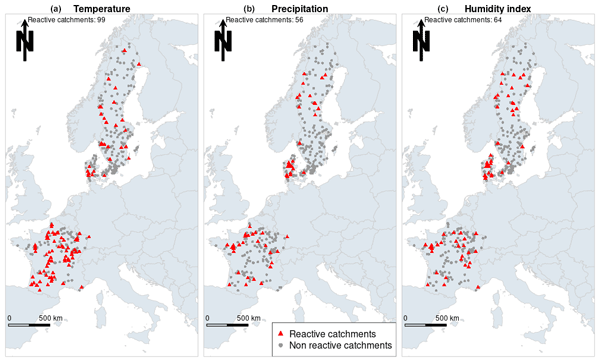
This work investigates how hydrological models are transferred to a period in which climate conditions are different to the ones of the period in which they were set up. The robustness assessment test built to detect dependencies between model error and climatic drivers was applied to three hydrological models in 352 catchments in Denmark, France and Sweden. Potential issues are seen in a significant number of catchments for the models, even though the catchments differ for each model.
Guillaume Thirel, Léonard Santos, Olivier Delaigue, and Charles Perrin
Hydrol. Earth Syst. Sci., 28, 4837–4860, https://doi.org/10.5194/hess-28-4837-2024, https://doi.org/10.5194/hess-28-4837-2024, 2024
Short summary
Short summary
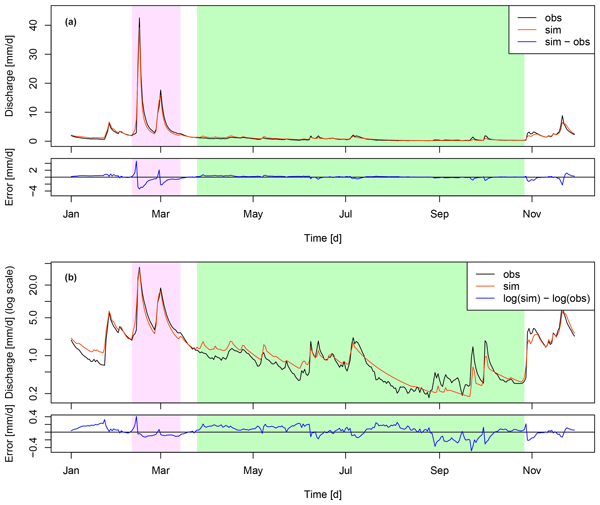
We discuss how mathematical transformations impact calibrated hydrological model simulations. We assess how 11 transformations behave over the complete range of streamflows. Extreme transformations lead to models that are specialized for extreme streamflows but show poor performance outside the range of targeted streamflows and are less robust. We show that no a priori assumption about transformations can be taken as warranted.
Paul Zarpas, Maria-Helena Ramos, Gaëlle Tallec, Denis Allard, and Fanny J. Sarrazin
EGUsphere, https://doi.org/10.5194/egusphere-2026-4287, https://doi.org/10.5194/egusphere-2026-4287, 2026
This preprint is open for discussion and under review for Hydrology and Earth System Sciences (HESS).
Short summary
Short summary
Long-term information on irrigation water withdrawal is crucial to understand how agriculture affects water resources, but observations are often too short. We developed a statistical model to reconstruct annual irrigation water withdrawal in France from 2000 to 2022 at the catchment scale using a national database. The reconstructed time series reveal widespread increases in irrigation water withdrawal and provide a basis for water management and climate change impact studies.
Eric Sauquet, Guillaume Evin, Sonia Siauve, Ryma Aissat, Patrick Arnaud, Maud Bérel, Jérémie Bonneau, Flora Branger, Yvan Caballero, François Colléoni, Agnès Ducharne, Joël Gailhard, Florence Habets, Frédéric Hendrickx, Louis Héraut, Benoît Hingray, Peng Huang, Tristan Jaouen, Alexis Jeantet, Sandra Lanini, Matthieu Le Lay, Claire Magand, Louise Mimeau, Céline Monteil, Simon Munier, Charles Perrin, Olivier Robelin, Fabienne Rousset, Jean-Michel Soubeyroux, Laurent Strohmenger, Guillaume Thirel, Flore Tocquer, Yves Tramblay, Jean-Pierre Vergnes, and Jean-Philippe Vidal
Hydrol. Earth Syst. Sci., 30, 2277–2300, https://doi.org/10.5194/hess-30-2277-2026, https://doi.org/10.5194/hess-30-2277-2026, 2026
Short summary
Short summary
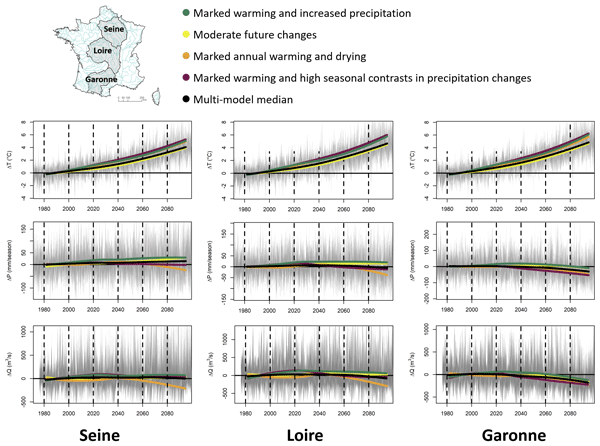
The Explore2 project has provided an unprecedented set of hydrological projections in terms of the number of hydrological models used and the spatial and temporal resolution. The results have been made available through various media. Under the high-emission scenario, the hydrological models mostly agree on the decrease in seasonal flows in the south of France, confirming its hotspot status, and on the decrease in summer flows throughout France, with the exception of the northern part of France.
Simon Filhol, Clément Misset, Noélie Bontemps, Diego Cusicanqui, Emmanuel Paquet, Marie Dumont, Olivier Gagliardini, Pascal Lacroix, Simon Gascoin, Guillaume Thirel, Julien Brondex, Pascal Hagenmuller, Eric Larose, Philipp Schoeneich, Denis Roy, Emmanuel Thibert, Nicolas Eckert, Félix de Montety, Robin Mainieri, Alexandre Hauet, Frédéric Gottardi, Johan Berthet, Alexandre Baratier, Frédéric Liébault, Małgorzata Chmiel, Guillaume Piton, Guillaume Chambon, Guillaume James, Philippe Frey, Philip Deline, Laurent Astrade, Christian Vincent, Dominique Laigle, Alain Recking, Fatima Karbou, Adrien Mauss, Mylène Bonnefoy-Demongeot, Firmin Fontaine, Mickael Langlais, Etienne Berthier, and Antoine Blanc
EGUsphere, https://doi.org/10.5194/egusphere-2026-971, https://doi.org/10.5194/egusphere-2026-971, 2026
Short summary
Short summary
On June 21 2024, the village of La Bérarde, in the French Alps, was devastated by a flood destroying centuries old buildings. This study is an interdisciplinary work to decipher the causes and chronology of the event. The flood started with decadal rain falling on a thick snowpack. A lake observed on top of a glacier few days prior, had drained post event. With climate change, should we expect more similar compound events for alpine communities?
Guillaume Evin, Benoit Hingray, Guillaume Thirel, Agnès Ducharne, Laurent Strohmenger, Lola Corre, Yves Tramblay, Jean-Philippe Vidal, Jérémie Bonneau, François Colleoni, Joël Gailhard, Florence Habets, Frédéric Hendrickx, Louis Héraut, Peng Huang, Matthieu Le Lay, Claire Magand, Paola Marson, Céline Monteil, Simon Munier, Alix Reverdy, Jean-Michel Soubeyroux, Yoann Robin, Jean-Pierre Vergnes, Mathieu Vrac, and Eric Sauquet
Hydrol. Earth Syst. Sci., 30, 1023–1051, https://doi.org/10.5194/hess-30-1023-2026, https://doi.org/10.5194/hess-30-1023-2026, 2026
Short summary
Short summary
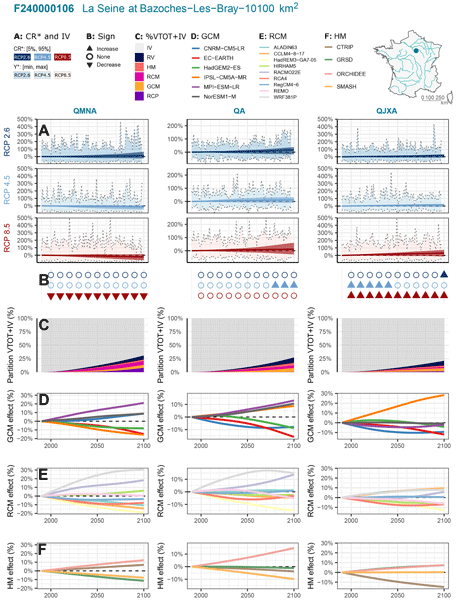
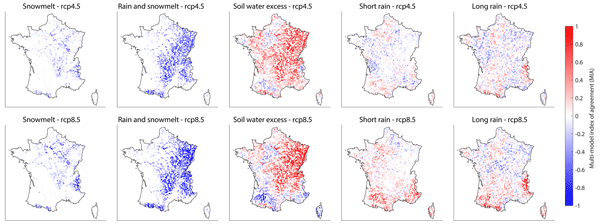
Explore2 provides hydrological projections for 1,735 French catchments. Using QUALYPSO (Quasi-Ergodic Analysis of Climate Projections Using Data Augmentation), this study assesses uncertainties, including internal variability. By the end of the century, low flows are projected to decline in southern France under high emissions, while other indicators remain uncertain. Emission scenarios and regional climate models are key uncertainty sources. Internal variability is often as large as climate-driven changes.
Yves Tramblay, Guillaume Thirel, Laurent Strohmenger, Guillaume Evin, Lola Corre, Louis Heraut, and Eric Sauquet
Hydrol. Earth Syst. Sci., 29, 7023–7039, https://doi.org/10.5194/hess-29-7023-2025, https://doi.org/10.5194/hess-29-7023-2025, 2025
Short summary
Short summary
How does climate change impact floods in France? Using simulations for 3727 rivers with climate projections, results show that flood trends vary depending on the region. In the north, floods may become more severe, but in the south, the trends are mixed. Floods from intense rainfall are becoming more frequent, while snowmelt floods are strongly decreasing. Overall, the study shows that understanding what causes floods is key to predicting how they are likely to change with the climate.
Léonard Santos, Vazken Andréassian, Torben O. Sonnenborg, Göran Lindström, Alban de Lavenne, Charles Perrin, Lila Collet, and Guillaume Thirel
Hydrol. Earth Syst. Sci., 29, 683–700, https://doi.org/10.5194/hess-29-683-2025, https://doi.org/10.5194/hess-29-683-2025, 2025
Short summary
Short summary
This work investigates how hydrological models are transferred to a period in which climate conditions are different to the ones of the period in which they were set up. The robustness assessment test built to detect dependencies between model error and climatic drivers was applied to three hydrological models in 352 catchments in Denmark, France and Sweden. Potential issues are seen in a significant number of catchments for the models, even though the catchments differ for each model.
Guillaume Thirel, Léonard Santos, Olivier Delaigue, and Charles Perrin
Hydrol. Earth Syst. Sci., 28, 4837–4860, https://doi.org/10.5194/hess-28-4837-2024, https://doi.org/10.5194/hess-28-4837-2024, 2024
Short summary
Short summary
We discuss how mathematical transformations impact calibrated hydrological model simulations. We assess how 11 transformations behave over the complete range of streamflows. Extreme transformations lead to models that are specialized for extreme streamflows but show poor performance outside the range of targeted streamflows and are less robust. We show that no a priori assumption about transformations can be taken as warranted.
Bruno J. Lemaire, Cédric Chaumont, Julien Tournebize, and Hocine Henine
Proc. IAHS, 385, 135–140, https://doi.org/10.5194/piahs-385-135-2024, https://doi.org/10.5194/piahs-385-135-2024, 2024
Short summary
Short summary
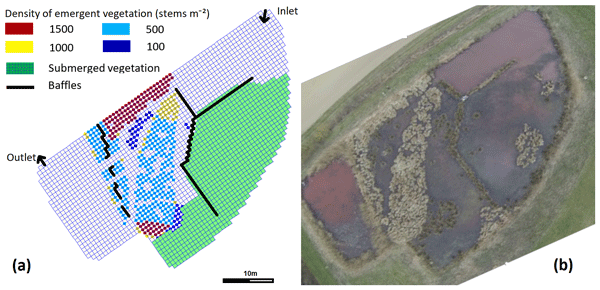
The potential of constructed wetland to remove nitrate and pesticides increases with the residence time. The aim of this work is to investigate how the hydraulic performance changes with the flow rate in a party vegetated wetland, using the 3D hydrodynamic model. It was calibrated on continuous outflow concentration and tracing experiment. The simulation matched satisfactorily with observation. Results showed a limited increase of the hydraulic performance with the flow rate.
Cyril Thébault, Charles Perrin, Vazken Andréassian, Guillaume Thirel, Sébastien Legrand, and Olivier Delaigue
Hydrol. Earth Syst. Sci., 28, 1539–1566, https://doi.org/10.5194/hess-28-1539-2024, https://doi.org/10.5194/hess-28-1539-2024, 2024
Short summary
Short summary
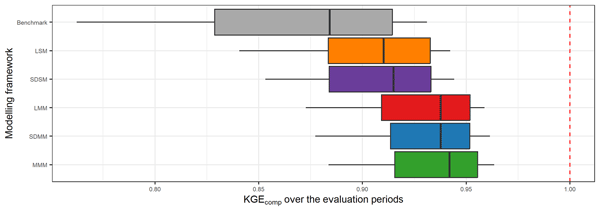
Streamflow forecasting is useful for many applications, ranging from population safety (e.g. floods) to water resource management (e.g. agriculture or hydropower). To this end, hydrological models must be optimized. However, a model is inherently wrong. This study aims to analyse the contribution of a multi-model approach within a variable spatial framework to improve streamflow simulations. The underlying idea is to take advantage of the strength of each modelling framework tested.
Nils Poncet, Philippe Lucas-Picher, Yves Tramblay, Guillaume Thirel, Humberto Vergara, Jonathan Gourley, and Antoinette Alias
Nat. Hazards Earth Syst. Sci., 24, 1163–1183, https://doi.org/10.5194/nhess-24-1163-2024, https://doi.org/10.5194/nhess-24-1163-2024, 2024
Short summary
Short summary
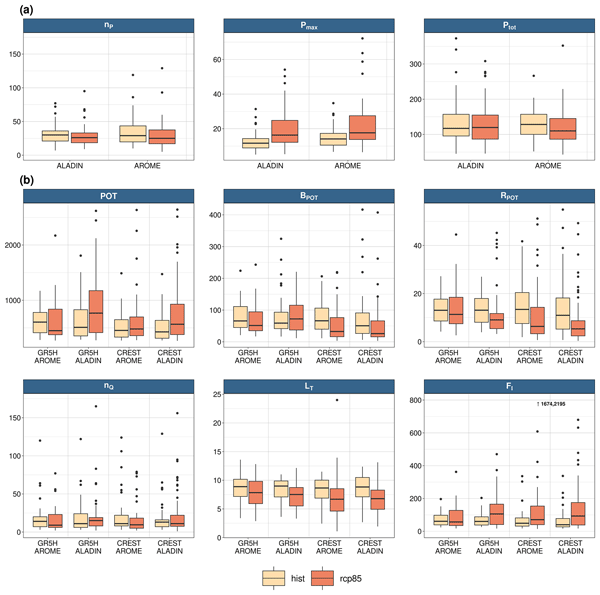
High-resolution convection-permitting climate models (CPMs) are now available to better simulate rainstorm events leading to flash floods. In this study, two hydrological models are compared to simulate floods in a Mediterranean basin, showing a better ability of the CPM to reproduce flood peaks compared to coarser-resolution climate models. Future projections are also different, with a projected increase for the most severe floods and a potential decrease for the most frequent events.
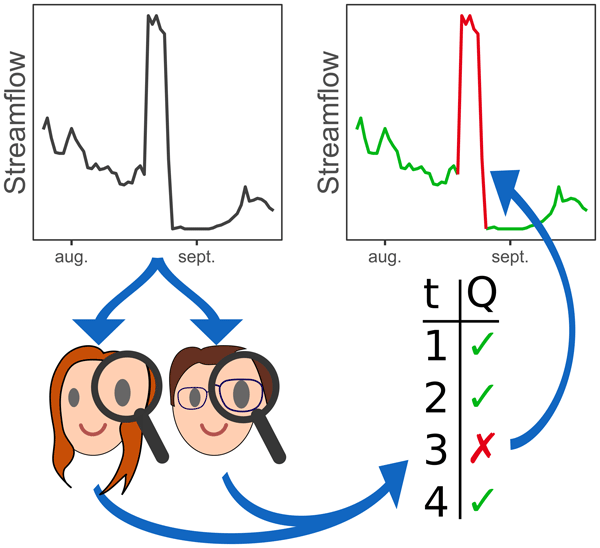
Laurent Strohmenger, Eric Sauquet, Claire Bernard, Jérémie Bonneau, Flora Branger, Amélie Bresson, Pierre Brigode, Rémy Buzier, Olivier Delaigue, Alexandre Devers, Guillaume Evin, Maïté Fournier, Shu-Chen Hsu, Sandra Lanini, Alban de Lavenne, Thibault Lemaitre-Basset, Claire Magand, Guilherme Mendoza Guimarães, Max Mentha, Simon Munier, Charles Perrin, Tristan Podechard, Léo Rouchy, Malak Sadki, Myriam Soutif-Bellenger, François Tilmant, Yves Tramblay, Anne-Lise Véron, Jean-Philippe Vidal, and Guillaume Thirel
Hydrol. Earth Syst. Sci., 27, 3375–3391, https://doi.org/10.5194/hess-27-3375-2023, https://doi.org/10.5194/hess-27-3375-2023, 2023
Short summary
Short summary
We present the results of a large visual inspection campaign of 674 streamflow time series in France. The objective was to detect non-natural records resulting from instrument failure or anthropogenic influences, such as hydroelectric power generation or reservoir management. We conclude that the identification of flaws in flow time series is highly dependent on the objectives and skills of individual evaluators, and we raise the need for better practices for data cleaning.
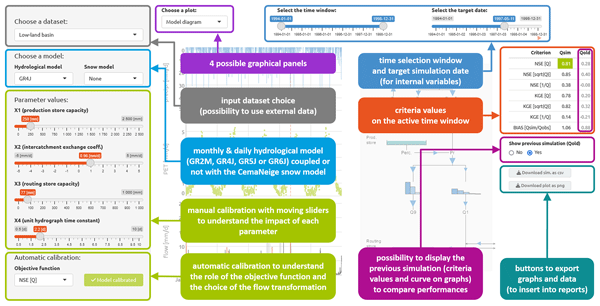
Olivier Delaigue, Pierre Brigode, Guillaume Thirel, and Laurent Coron
Hydrol. Earth Syst. Sci., 27, 3293–3327, https://doi.org/10.5194/hess-27-3293-2023, https://doi.org/10.5194/hess-27-3293-2023, 2023
Short summary
Short summary
Teaching hydrological modeling is an important, but difficult, matter. It requires appropriate tools and teaching material. In this article, we present the airGRteaching package, which is an open-source software tool relying on widely used hydrological models. This tool proposes an interface and numerous hydrological modeling exercises representing a wide range of hydrological applications. We show how this tool can be applied to simple but real-life cases.
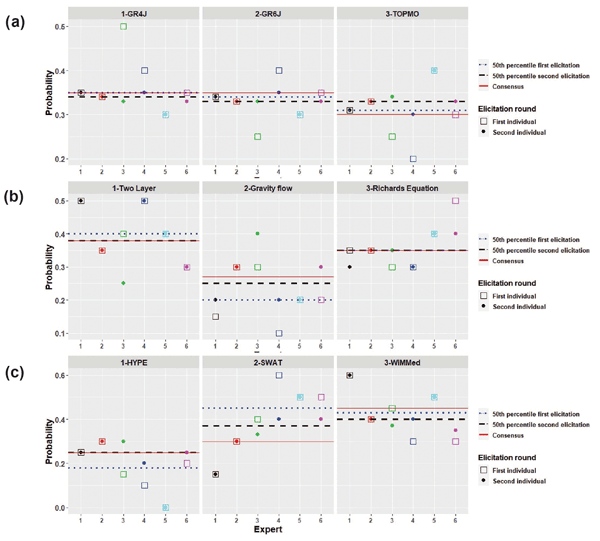
Eva Sebok, Hans Jørgen Henriksen, Ernesto Pastén-Zapata, Peter Berg, Guillaume Thirel, Anthony Lemoine, Andrea Lira-Loarca, Christiana Photiadou, Rafael Pimentel, Paul Royer-Gaspard, Erik Kjellström, Jens Hesselbjerg Christensen, Jean Philippe Vidal, Philippe Lucas-Picher, Markus G. Donat, Giovanni Besio, María José Polo, Simon Stisen, Yvan Caballero, Ilias G. Pechlivanidis, Lars Troldborg, and Jens Christian Refsgaard
Hydrol. Earth Syst. Sci., 26, 5605–5625, https://doi.org/10.5194/hess-26-5605-2022, https://doi.org/10.5194/hess-26-5605-2022, 2022
Short summary
Short summary
Hydrological models projecting the impact of changing climate carry a lot of uncertainty. Thus, these models usually have a multitude of simulations using different future climate data. This study used the subjective opinion of experts to assess which climate and hydrological models are the most likely to correctly predict climate impacts, thereby easing the computational burden. The experts could select more likely hydrological models, while the climate models were deemed equally probable.
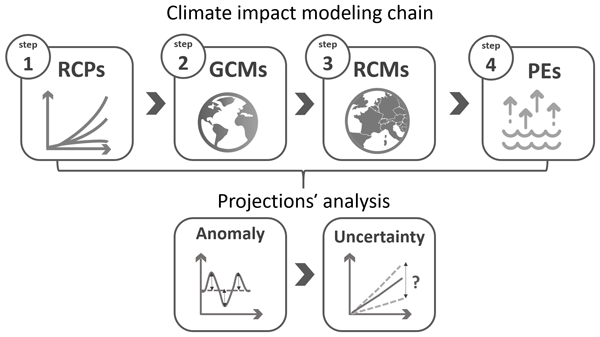
Thibault Lemaitre-Basset, Ludovic Oudin, Guillaume Thirel, and Lila Collet
Hydrol. Earth Syst. Sci., 26, 2147–2159, https://doi.org/10.5194/hess-26-2147-2022, https://doi.org/10.5194/hess-26-2147-2022, 2022
Short summary
Short summary
Increasing temperature will impact evaporation and water resource management. Hydrological models are fed with an estimation of the evaporative demand of the atmosphere, called potential evapotranspiration (PE). The objectives of this study were (1) to compute the future PE anomaly over France and (2) to determine the impact of the choice of the method to estimate PE. Our results show that all methods present similar future trends. No method really stands out from the others.
Paul Royer-Gaspard, Vazken Andréassian, and Guillaume Thirel
Hydrol. Earth Syst. Sci., 25, 5703–5716, https://doi.org/10.5194/hess-25-5703-2021, https://doi.org/10.5194/hess-25-5703-2021, 2021
Short summary
Short summary
Most evaluation studies based on the differential split-sample test (DSST) endorse the consensus that rainfall–runoff models lack climatic robustness. In this technical note, we propose a new performance metric to evaluate model robustness without applying the DSST and which can be used with a single hydrological model calibration. Our work makes it possible to evaluate the temporal transferability of any hydrological model, including uncalibrated models, at a very low computational cost.
Cited articles
Abramowitz, G., Herger, N., Gutmann, E., Hammerling, D., Knutti, R., Leduc, M., Lorenz, R., Pincus, R., and Schmidt, G. A.: ESD Reviews: Model dependence in multi-model climate ensembles: weighting, sub-selection and out-of-sample testing, Earth Syst. Dynam., 10, 91–105, https://doi.org/10.5194/esd-10-91-2019, 2019.
Ahmad, S., Waseem, M., Wahab, H., Khan, A. Q., Jehan, Z., Ahmad, I., and Leta, M. K.: Assessing water demand and supply in the Upper Indus Basin using integrated hydrological modeling under varied socioeconomic scenarios, Applied Water Science, 15, https://doi.org/10.1007/s13201-024-02310-3, 2025.
Allen, R. G., Pereira, L. S., Raes, D., and Smith, M.: FAO Irrigation and drainage paper No. 56. Technical Report, Roma: Food et Agriculture Organization of the United Nations. 333 pp., https://www.fao.org/3/X0490E/x0490e00.htm (last access: 1 April 2026), 1998.
Arnell, N. W.: The effect of climate change on hydrological regimes in Europe: a continental perspective, Global Environ. Chang., 9, 5–23, https://doi.org/10.1016/S0959-3780(98)00015-6, 1999.
Aslam, M. F., Masia, S., Spano, D. Mereu, V., Debolini, M., Snyder, R. L., Borgo, A., and Trabucco, A.: Modelling crop water demand under climate change: the case of Sardinia region, Irrigation Sci., 43, 1681–1698, https://doi.org/10.1007/s00271-025-01027-8, 2025.
Badham, J., Elsawah, S., Guillaume, J. H. A., Hamilton, S. H., Hunt, R. J., Jakeman, A. J., Pierce, S. A., Snow, V. O., Babbar-Sebens, M., Fu, B., Gober, P., Hill, M. C., Iwanaga, T., Loucks, D. P., Merritt, W. S., Peckham, S. D., Richmond, A. K., Zare, F., Ames, D., and Bammer, G.: Effective modeling for Integrated Water Resource Management: A guide to contextual practices by phases and steps and future opportunities, Environ. Modell. Softw., 116, 40–56, https://doi.org/10.1016/j.envsoft.2019.02.013, 2019.
Beck, L. and Bernauer, T.: How will combined changes in water demand and climate affect water availability in the Zambezi river basin? Global Environmental Change, Symposium on Social Theory and the Environment in the New World (dis)Order 21, 1061–1072, https://doi.org/10.1016/j.gloenvcha.2011.04.001, 2011.
Berthet, L., Bourgin, F., Perrin, C., Viatgé, J., Marty, R., and Piotte, O.: A crash-testing framework for predictive uncertainty assessment when forecasting high flows in an extrapolation context, Hydrol. Earth Syst. Sci., 24, 2017–2041, https://doi.org/10.5194/hess-24-2017-2020, 2020.
Boé, J., Somot, S., Corre, L., and Nabat, P.: Large discrepancies in summer climate change over Europe as projected by global and regional climate models: causes and consequences, Clim. Dynam., 54, 2981–3002, https://doi.org/10.1007/s00382-020-05153-1, 2020.
Brêda, J. P. L. F., de Paiva, R. C. D., Collischon, W. Bravo, J. M., Siqueira, V. A., and Steinke, E. B.: Climate change impacts on South American water balance from a continental-scale hydrological model driven by CMIP5 projections, Climatic Change, 159, 503–522, https://doi.org/10.1007/s10584-020-02667-9, 2020.
Broderick, C., Murphy, C., Wilby, R. L., Matthews, T., Prudhomme, C., Adamson, M.: Using a Scenario-Neutral Framework to Avoid Potential Maladaptation to Future Flood Risk, Water Resour. Res., 55, 1079–1104, https://doi.org/10.1029/2018WR023623, 2019.
Brown, C., Ghile, Y., Laverty, M., and Li, K.: Decision scaling: Linking bottom-up vulnerability analysis with climate projections in the water sector, Water Resour. Res., 48, https://doi.org/10.1029/2011WR011212, 2012.
Carmona, G., Varela-Ortega, C., and Bromley, J.: Supporting decision making under uncertainty: Development of a participatory integrated model for water management in the middle Guadiana river basin, Environ. Modell. Softw., 50, 144–157, https://doi.org/10.1016/j.envsoft.2013.09.007, 2013.
Cheng, H., Wang, W., van Oel, P. R., Lu, J., Wang, G., and Wang, H.: Impacts of different human activities on hydrological drought in the Huaihe River Basin based on scenario comparison, J. Hydrol. Reg. Stud., 37, 100909, https://doi.org/10.1016/j.ejrh.2021.100909, 2021.
Coron, L., Delaigue, O., Thirel, G., Perrin, C., and Michel, C.: airGR: Suite of GR Hydrological Models for Precipitation-Runoff Modelling, R package version 1.4.3.65, https://doi.org/10.15454/EX11NA, 2020.
Coron, L., Thirel, G., Delaigue, O., Perrin, C., and Andréassian, V.: The Suite of Lumped GR Hydrological Models in an R package, Environ. Modell. Softw., 94, 166–171, https://doi.org/10.1016/j.envsoft.2017.05.002, 2017.
Corre, L., Ribes, A., Bernus, S., Drouin, A., Morin, S., and Soubeyroux, J.-M.: Using regional warming levels to describe future climate change for services and adaptation: Application to the French reference trajectory for adaptation, Climate Services, 38, 100553, https://doi.org/10.1016/j.cliser.2025.100553, 2025.
Danner, A. G., Safeeq, M., Grant, G. E., Wickham, C., Tullos, D., and Santelmann, M. V.: Scenario-Based and Scenario-Neutral Assessment of Climate Change Impacts on Operational Performance of a Multipurpose Reservoir, JAWRA J. Am. Water Resour. As., 53, 1467–1482, https://doi.org/10.1111/1752-1688.12589, 2017.
de Boer-Euser, T., Bouaziz, L., De Niel, J., Brauer, C., Dewals, B., Drogue, G., Fenicia, F., Grelier, B., Nossent, J., Pereira, F., Savenije, H., Thirel, G., and Willems, P.: Looking beyond general metrics for model comparison – lessons from an international model intercomparison study, Hydrol. Earth Syst. Sci., 21, 423–440, https://doi.org/10.5194/hess-21-423-2017, 2017.
de Lavenne, A., Andréassian, V., Thirel, G., Ramos, M.-H., and Perrin, C.: A regularization approach to improve the sequential calibration of a semi-distributed hydrological model, Water Resour. Res., 55, 8821–8839, https://doi.org/10.1029/2018WR024266, 2019.
Dong, N., Wei, J., Yang, M., Yan, D., Yang, C., Gao, H., Arnault, J., Laux, P., Zhang, X., Liu, Y., Niu, J., Wang, H., Wang, H., Kunstmann, H., and Yu, Z.: Model estimates of China's terrestrial water storage variation due to reservoir operation, Water Resour. Res., 58, e2021WR031787, https://doi.org/10.1029/2021WR031787, 2022.
Dorchies, D., Delaigue, O., and Thirel, G.: airGRiwrm: Modeling of Integrated Water Resources Management based on airGR, R package version 0.6.2.9000, https://doi.org/10.57745/XKN6NC, 2023.
Dufeu, E., Mougin, F., Foray, A., Baillon, M., Lamblin, R., Hebrard, F., Chaleon, C., Romon, S., Cobos, L., Gouin, P., Audouy, J.-N., Martin, R., and Poligot-Pitsch, S. Finalisation of the French national hydrometric data information system modernisation operation (Hydro3), LHB, 108:1, https://doi.org/10.1080/27678490.2022.2099317, 2022.
EPTB Vienne: Etude “ Hydrologie Milieux Usages Climat ” (H.M.U.C.) pour la mise en œuvre du SAGE Clain Phase 2 – Synthèse, https://www.vienne.gouv.fr/contenu/telechargement/44569/277507/file/EPTB_Vienne_HMUC_Clain_synthese_ph2_V202402.pdf (last access: 1 April 2026), 2024.
Etablissement Public Loire: Etude “ Hydrologie, Milieux, Usages, Climat ” (HMUC) sur le bassin versant de l'Argance – Phase 1 | Analyse du fonctionnement hydro(géo)logique du bassin en régime influencé et désinfluencé, https://sage-loir.fr/wp-content/uploads/2024/10/HMUC-Argance-Phase1-Hydrologie-VF-HMUC-Argance-Phase1-Hydrologie-VF.pdf (last access: 1 April 2026), 2024.
Evin, G., Hingray, B., Thirel, G., Ducharne, A., Strohmenger, L., Corre, L., Tramblay, Y., Vidal, J.-P., Bonneau, J., Colleoni, F., Gailhard, J., Habets, F., Hendrickx, F., Héraut, L., Huang, P., Le Lay, M., Magand, C., Marson, P., Monteil, C., Munier, S., Reverdy, A., Soubeyroux, J.-M., Robin, Y., Vergnes, J.-P., Vrac, M., and Sauquet, E.: Uncertainty sources in a large ensemble of hydrological projections: Regional Climate Models and Internal Variability matter, Hydrol. Earth Syst. Sci., 30, 1023–1051, https://doi.org/10.5194/hess-30-1023-2026, 2026.
Fard, M. D. and Sarjoughian, H. S.: A RESTful framework design for componentizing the water evaluation and planning (WEAP) system, Simul. Model. Pract. Th., 106, https://doi.org/10.1016/j.simpat.2020.102199, 2021
Gleckler, P. J., Taylor, K. E., and Doutriaux, C.: Performance metrics for climate models, J. Geophys. Res.-Atmos., 113. https://doi.org/10.1029/2007JD008972, 2008.
Gleick, P. H.: Climate change, hydrology, and water resources, Rev. Geophys., 27, 329–344, https://doi.org/10.1029/RG027i003p00329, 1989.
Global Water Partnership: Integrated Water Resources Management, Global Water Partnership, Stockholm, https://www.gwp.org/globalassets/global/toolbox/publications/background-papers/04-integrated-water-resources-management-2000-english.pdf (last access: 1 April 2026), 2000.
Gupta, H. V., Kling, H., Yilmaz, K. K., and Martinez, G. F.: Decomposition of the mean squared error and NSE performance criteria: Implications for improving hydrological modelling, J. Hydrol., 377, 80–91, https://doi.org/10.1016/j.jhydrol.2009.08.003, 2009.
Hadri, A., Saidi, M. E. M., El Khalki, E. M., Aachrine, B., Saouabe, T., and Elmaki, A. A.: Integrated water management under climate change through the application of the WEAP model in a Mediterranean arid region, J. Water Clim. Change, 13, 2414–2442, https://doi.org/10.2166/wcc.2022.039, 2022.
Hargreaves, H. G. and Samani, A. Z.: Reference Crop Evapotranspiration from Temperature, Appl. Eng. Agric., 1, 96–99, https://doi.org/10.13031/2013.26773, 1985.
Harou, J. J., Pulido-Velazquez, M., Rosenberg, D. E., Medellín-Azuara, J., Lund, J. R., and Howitt, R. E.: Hydro-economic models: Concepts, design, applications, and future prospects, J. Hydrol., 375, 627–643, https://doi.org/10.1016/j.jhydrol.2009.06.037, 2009.
Hrachowitz, M. and Clark, M. P.: HESS Opinions: The complementary merits of competing modelling philosophies in hydrology, Hydrol. Earth Syst. Sci., 21, 3953–3973, https://doi.org/10.5194/hess-21-3953-2017, 2017.
Jacob, D., Petersen, J., Eggert, B., Alias, A., Christensen, O. B., Bouwer, L. M., Braun, A., Colette, A., Déqué, M., Georgievski, G., Georgopoulou, E., Gobiet, A., Menut, L., Nikulin, G., Haensler, A., Hempelmann, N., Jones, C., Keuler, K., Kovats, S., Kröner, N., Kotlarski, S., Kriegsmann, A., Martin, E., van Meijgaard, E., Moseley, C., Pfeifer, S., Preuschmann, S., Radermacher, C., Radtke, K., Rechid, D., Rounsevell, M., Samuelsson, P., Somot, S., Soussana, J.-F., Teichmann, C., Valentini, R., Vautard, R., Weber, B., and Yiou, P.: EURO-CORDEX: new high-resolution climate change projections for European impact research, Reg. Environ. Change, 14, 563–578, https://doi.org/10.1007/s10113-013-0499-2, 2014.
Jacob, D., Teichmann, C., Sobolowski, S. Katragkou, E., Anders, I., Belda, M., Benestad, R., Boberg, F., Buonomo, E., Cardoso, R. M., Casanueva, A., Christensen, O. B., Christensen, J. H., Coppola, E., De Cruz, L., Davin, E. L. Dobler, A., Domínguez, M., Fealy, R., Fernandez, J., Gaertner, M. A., García-Díez, M., Giorgi, F., Gobiet, A., Goergen, K., Gómez-Navarro, J. J., González Alemán, J. J., Gutiérrez, C., Gutiérrez, J. M., Güttler, I., Haensler, A., Halenka, T., Jerez, S., Jiménez-Guerrero, P,. Jones, R. G., Keuler, K., Kjellström, E., Knist, S., Kotlarski, S., Maraun, D., van Meijgaard, E., Mercogliano, P., Montávez, J. P., Navarra, A., Nikulin, G., de Noblet-Ducoudré, N., Panitz, H.-J., Pfeifer, S., Piazza, M., Pichelli, E., Pietikäinen, J.-P., Prein, A. F., Preuschmann, S., Rechid, D., Rockel, B., Romera, R., Sánchez, E., Sieck, K., Soares, P. M. M., Somot, S., Srnec, L., Lund Sørland, S., Termonia, P., Truhetz, H., Vautard, R., Warrach-Sagi, K., and Wulfmeyer, V.:. Regional climate downscaling over Europe: perspectives from the EURO-CORDEX community, Reg. Environ. Change, 20, 51, https://doi.org/10.1007/s10113-020-01606-9, 2020.
Klemeš, V.: Operational testing of hydrologic simulation models, Hydrolog. Sci. J., 311, 13–24, https://doi.org/10.1080/02626668609491024, 1986.
Konzmann, M., Gerten, D., and Heinke, J.: Climate impacts on global irrigation requirements under 19 GCMs, simulated with a vegetation and hydrology model, Hydrolog. Sci. J., 58, 88–105, https://doi.org/10.1080/02626667.2013.746495, 2012.
Krysanova, V. and White, M.: Advances in water resources assessment with SWAT – an overview, Hydrolog. Sci. J., 1–13, https://doi.org/10.1080/02626667.2015.1029482, 2015.
Lemaitre-Basset, T., Collet, L., Thirel, T., Parajka, J., Evin, G., and Hingray, B.: Climate change impact and uncertainty analysis on hydrological extremes in a French Mediterranean catchment, Hydrolog. Sci. J., 66, 888–903, https://doi.org/10.1080/02626667.2021.1895437, 2021.
Lemaitre-Basset, T., Thirel, G., Oudin, L., and Dorchies, D.: Water use scenarios versus climate change: investigating future water management of the French part of the Moselle, J. Hydrol. Reg. Stud., 54, https://doi.org/10.1016/j.ejrh.2024.101855, 2024.
Li, Z., Sun, F., Liu, W., Wang, T., Wang, H., and Feng, Y.: China's carbon neutrality policy facilitates halving industrial water withdrawal, Environ. Res. Lett., 19, 114082, https://doi.org/10.1088/1748-9326/ad7f6f, 2024.
Lobligeois, F., Andréassian, V., Perrin, C., Tabary, P., and Loumagne, C.: When does higher spatial resolution rainfall information improve streamflow simulation? An evaluation using 3620 flood events, Hydrol. Earth Syst. Sci., 18, 575–594, https://doi.org/10.5194/hess-18-575-2014, 2014.
Lopez, S. F., Knight, J. E., Tilman, F. D., Masbruch, M. D., Wise, D. R., Jones, C. J., and Miller, M. P.: Database of surface water diversion sites and daily withdrawals for the Upper Colorado River Basin, 1980–2022, Scientific Data, 11, 1266, https://doi.org/10.1038/s41597-024-04123-0, 2024.
Ludwig, F., van Slobbe, E., and Cofino, W.: Climate change adaptation and Integrated Water Resource Management in the water sector, J. Hydrol., 518, 235–242, https://doi.org/10.1016/j.jhydrol.2013.08.010, 2014.
Marson, P., Corre, L., Soubeyroux, J.-M., and Sauquet, E.: Rapport de synthèse sur les projections climatiques régionalisées, V1, Recherche Data Gouv, https://doi.org/10.57745/PUR7ML, 2024.
Mirzaei, A. and Zibaei, M. Water Conflict Management between Agriculture and Wetland under Climate Change: Application of Economic-Hydrological-Behavioral Modelling, Water Resour. Manag., 35, 1–21, https://doi.org/10.1007/s11269-020-02703-4, 2021.
Nicolle, P., Pushpalatha, R., Perrin, C., François, D., Thiéry, D., Mathevet, T., Le Lay, M., Besson, F., Soubeyroux, J.-M., Viel, C., Regimbeau, F., Andréassian, V., Maugis, P., Augeard, B., and Morice, E.: Benchmarking hydrological models for low-flow simulation and forecasting on French catchments, Hydrol. Earth Syst. Sci., 18, 2829–2857, https://doi.org/10.5194/hess-18-2829-2014, 2014.
Noto, L. V., Cipolla, G., Francipane, A., and Pumo, D.: Climate Change in the Mediterranean Basin (Part I): Induced Alterations on Climate Forcings and Hydrological Processes, Water Resour. Manag., 37, 2287–2305, https://doi.org/10.1007/s11269-022-03400-0, 2023
O'Shea, D., Nathan, R., Wasko, C., Ho, M., and Sharma, A.: Evaluation of key flood risk drivers under climate change using a bottom-up approach, J. Hydrol., 640, 131694, https://doi.org/10.1016/j.jhydrol.2024.131694, 2024.
Pastén-Zapata, E., Jones, J. M., Moggridge, H., and Widmann, M.: Evaluation of the performance of Euro-CORDEX Regional Climate Models for assessing hydrological climate change impacts in Great Britain: A comparison of different spatial resolutions and quantile mapping bias correction methods, J. Hydrol., 584, 124653, https://doi.org/10.1016/j.jhydrol.2020.124653, 2020.
Pedro-Monzonís, M., Solera, A., Ferrer, J., Andreu, J., and Estrela, T.: Water accounting for stressed river basins based on water resources management models, Sci. Total Environ., 565, 181–190, https://doi.org/10.1016/j.scitotenv.2016.04.161, 2016.
Pelletier, A. and Andréassian, V.: On constraining a lumped hydrological model with both piezometry and streamflow: results of a large sample evaluation, Hydrol. Earth Syst. Sci., 26, 2733–2758, https://doi.org/10.5194/hess-26-2733-2022, 2022.
Peñas, F. J. and Barquín, J.: Assessment of large-scale patterns of hydrological alteration caused by dams, J. Hydrol., 572, 706–718, https://doi.org/10.1016/j.jhydrol.2019.03.056, 2019.
Perrin, C., Michel, C., and Andréassian, V.: Improvement of a parsimonious model for streamflow simulation, J. Hydrol., 279, 275–289, https://doi.org/10.1016/S0022-1694(03)00225-7, 2003.
Préfet de la Loire-Atlantique, Préfet de Maine-et-Loire, Préfet des Deux-Sèvres, Préfet de la Vendée: Arrêté interdépartemental délimitant des zones d'alerte et définissant les mesures de limitation ou de suspension provisoire des usages de l'eau dans le bassin de la Sèvre Nantaise situé en régions Nouvelle Aquitaine et Pays de la Loire pour faire face à une menace ou aux conséquences d'une sécheresse ou à un risque de pénurie, 21 pp., https://www.deux-sevres.gouv.fr/index.php/contenu/telechargement/40208/302357/file/AC_SNa_complet_20210617_signe.pdf (last access: 1 April 2026), 2021.
Prudhomme, C., Wilby, R. L., Crooks, S., Kay, A. L., and Reynard, N. S.: Scenario-neutral approach to climate change impact studies: Application to flood risk, J. Hydrol., 390, 198–209, https://doi.org/10.1016/j.jhydrol.2010.06.043, 2010.
Purnamasari, D., Verseveld, W. J. V., Buitink, J., Weiland, F. S., Dalmijn, B., Teuling, A. J., and Weerts, A. H.: Improving realism of high-resolution hydrological modeling with anthropogenic water use: a study on the Rhine basin, ESS Open Archive [preprint], https://doi.org/10.22541/essoar.175336966.62234347/v1, 2025.
Pushpalatha, R., Perrin, C., Le Moine, N., Mathevet, T., and Andréassian, V.: A downward structural sensitivity analysis of hydrological models to improve low-flow simulation, J. Hydrol., 411, 66–76, https://doi.org/10.1016/j.jhydrol.2011.09.034, 2011.
Roach, T., Kapelan, Z., and Ledbetter, R.: Comparison of Info-gap and Robust Optimisation Methods for Integrated Water Resource Management under Severe Uncertainty. Procedia Engineering, Computing and Control for the Water Industry (CCWI2015) Sharing the best practice in water management 119, 874–883, https://doi.org/10.1016/j.proeng.2015.08.955, 2015.
Royer-Gaspard, P., Bourgin, F., Perrin, C., Andréassian, V., De Lavenne, A., Thirel, G., and Tilmant, F.: Benefits of upstream data for downstream streamflow forecasting: data assimilation in a semi-distributed flood forecasting model, LHB, 2374081, https://doi.org/10.1080/27678490.2024.2374081, 2024.
Salam, S., Popescu, I., and Scrieciu, A.: Defining a water-energy-food nexus framework for water allocation in the lower Danube between iron gates and zimnicea, GeoEcoMarina, 28, 115–130, https://journal.geoecomar.ro/geo-eco-marina/article/view/09_2022 (last access: 2 April 2026), 2022.
Sánchez-Gómez, A., Arnold, J. G., Bieger, K., Čerkasova, N., Sammons, N. B., Martínez-Pérez, S., and Molina-Navarro, E.: Modelling Water Management using SWAT+: Application of Reservoirs Release Tables and the New Water Allocation Module in a Highly Managed River Basin, Water Resour. Manag., 39, 2357–2399, https://doi.org/10.1007/s11269-024-04071-9, 2025.
Santos, L., Thirel, G., and Perrin, C.: Technical note: Pitfalls in using log-transformed flows within the KGE criterion, Hydrol. Earth Syst. Sci., 22, 4583–4591, https://doi.org/10.5194/hess-22-4583-2018, 2018.
Santos, L., Thomas, A., Mounereau, L., and Thirel, G.: Etude HMUC: Rapport Phase 1 – Analyse des données et définition des besoins complémentaires, 115 pp., https://hal.inrae.fr/hal-03962321 (last access: 1 April 2026), 2022.
Santos, L., Tales, E., Bluche, A., Thomas, A., Mounereau, L., and Thirel, G.: Etude HMUC: Rapport Phase 2. État des lieux/Diagnostic/Constitution de la modélisation, 197 pp., https://hal.inrae.fr/hal-04008873 (last access: 1 April 2026), 2023a.
Santos, L., Tallec, G., Tales, E., Bluche, A., You B., Thomas, A., Mounereau, L., and Thirel, G.: Étude HMUC: Rapport Phase 3. Définition des débits biologiques – Analyses prospectives: besoins futurs et changement climatique, 441 pp., https://hal.inrae.fr/hal-04355199 (last access: 1 April 2026), 2023b.
Sauquet, E., Strohmenger, L., Thirel, G., and Le Lay, M.: Quelles évolutions des régimes hydrologiques en France hexagonale ?, Research report, Recherche Data Gouv, https://doi.org/10.57745/TLUTKF, 2024.
Sauquet, E., Evin, G., Siauve, S., Aissat, R., Arnaud, P., Bérel, M., Bonneau, J., Branger, F., Caballero, Y., Colléoni, F., Ducharne, A., Gailhard, J., Habets, F., Hendrickx, F., Héraut, L., Hingray, B., Huang, P., Jaouen, T., Jeantet, A., Lanini, S., Le Lay, M., Magand, C., Mimeau, L., Monteil, C., Munier, S., Perrin, C., Robelin, O., Rousset, F., Soubeyroux, J.-M., Strohmenger, L., Thirel, G., Tocquer, F., Tramblay, Y., Vergnes, J.-P., and Vidal, J.-P.: A large transient multi-scenario multi-model ensemble of future streamflow and groundwater projections in France, EGUsphere [preprint], https://doi.org/10.5194/egusphere-2025-1788, 2025.
Savenije, H. H. G. and Van der Zaag, P.: Integrated water resources management: Concepts and issues, Phys. Chem. Earth, Parts A/B/C, 33, 290–297, https://doi.org/10.1016/j.pce.2008.02.003, 2008.
Shepherd, T. G., Boyd, E., Calel, R. A., Chapman, S. C., Dessai, S., Dima-West, I. M., Fowler, H. J., James, R., Maraun, D., Martius, O., Senior, C. A., Sobel, A. H., Stainforth, D. A., Tett, S. F. B., Trenberth, K. E., van den Hurk, B. J. J. M. , Watkins, N. W., Wilby, R. L., and Zenghelis, D. A.: Storylines: an alternative approach to representing uncertainty in physical aspects of climate change, Clim. Change, 151, 555–571, https://doi.org/10.1007/s10584-018-2317-9, 2018.
Soncini-Sessa, R., Cellina, F., Pianosi, F., and Weber, E.: Integrated and Participatory Water Resources Management: Practice, Elsevier, ISBN 9780444530127, https://shop.elsevier.com/books/integrated-and-participatory-water-resources-management-practice/soncini-sessa/978-0-444-53012-7 (last access: 1 April 2026), 2007.
Sousa, D. S., Silva, E. P., de M. A. Alves, C., Minoti, R. T., and Vergara, F. E.: Coupling data-driven agent-based and hydrological modelling to explore the effect of collective water allocation strategies in environmental flows, J. Hydrol., 652, 132670, https://doi.org/10.1016/j.jhydrol.2025.132670, 2025.
Soutif-Bellenger, M., Thirel, G., Therond, O., and Villerd, J.: As simple as possible but not simpler?: the case of irrigation modeling at catchment scale in southwestern France, Irrigation Sci., 41, 713–736, https://doi.org/10.1007/s00271-023-00846-x, 2023.
Starr, G. and Levison, J.: Identification of Crop Groundwater and Surface Water Consumption Using Blue and Green Virtual Water Contents at a Subwatershed Scale, Environmental Processes, 1, 497–515, https://doi.org/10.1007/s40710-014-0040-8, 2014.
Strohmenger, L., Collet, L., Andréassian, V., Corre, L., Rousset, L., and Thirel, G.: Köppen–Geiger climate classification across France based on an ensemble of high-resolution climate projections, CR. Géosci., 356, 67–82, https://doi.org/10.5802/crgeos.263, 2024.
Syndicat Grand Lieu Estuaire: Rapport phase 2 volet climat HMUC Grand Lieu, https://www.sgle.fr/wp-content/uploads/2025/02/RAPPORT-PHASE-2-VOLET-CLIMAT-HMUC-GRAND-LIEU.pdf (last access: 1 April 2026), 2024.
Taylor, K. E., Stouffer, R. J., and Meehl, G. A.: An Overview of CMIP5 and the Experiment Design, B. Am. Meteorol. Soc., 93, 485–498, https://doi.org/10.1175/BAMS-D-11-00094.1, 2012.
Thirel, G., Santos, L., Delaigue, O., and Perrin, C.: On the use of streamflow transformations for hydrological model calibration, Hydrol. Earth Syst. Sci., 28, 4837–4860, https://doi.org/10.5194/hess-28-4837-2024, 2024.
Thirel, G., Collet, L., Rousset, F., Delaigue, O., François, D., Gailhard, J., Lay, M. L., Perrin, C., Reverdy, M., Samacoits, R., Terrier, M., Vidal, J.-P., and Wagner, J.-P.: Future streamflow along the French part of the Meuse River – a closer look at uncertainties, Houille Blanche, 111, 2484192, https://doi.org/10.1080/27678490.2025.2484192, 2025.
Tilmant, F., Nicolle, P., Bourgin, F., Besson, F., Delaigue, O., Etchevers, P., François, D., Le Lay, M., Perrin, C., Rousset, F., Thiéry, D., Magand, C., Leurent, T., and Jacob, É.: PREMHYCE: un outil opérationnel pour la prévision des étiages, Houille Blanche, 106, 37–44, https://doi.org/10.1051/lhb/2020043, 2020.
Tra, T. V., Thinh, N. X., and Greiving, S.: Combined top-down and bottom-up climate change impact assessment for the hydrological system in the Vu Gia- Thu Bon River Basin, Sci. Total Environ., 630, 718–727, https://doi.org/10.1016/j.scitotenv.2018.02.250, 2018.
van der Laan, L., Cholibois, K., El Menuawy, A., and Förster, K.: A scenario–neutral approach to climate change in glacier mass balance modeling, Ann. Glaciol., 64, 411–424, https://doi.org/10.1017/aog.2024.22, 2023.
van Oel, P. R., Krol, M. S., Hoekstra, A. Y., and Taddei, R. R.: Feedback mechanisms between water availability and water use in a semi-arid river basin: A spatially explicit multi-agent simulation approach, Environ. Modell. Softw., 25, 433–443, https://doi.org/10.1016/j.envsoft.2009.10.018, 2010.
Verfaillie, D., Déqué, M., Morin, S., and Lafaysse, M.: The method ADAMONT v1.0 for statistical adjustment of climate projections applicable to energy balance land surface models, Geosci. Model Dev., 10, 4257–4283, https://doi.org/10.5194/gmd-10-4257-2017, 2017.
Vidal, J.-P., Martin, E., Franchistéguy, L., Baillon, M., and Soubeyroux, J.-M.: A 50-year high-resolution atmospheric reanalysis over France with the Safran system, Int. J. Climatol., 30, 1627–1644, https://doi.org/10.1002/joc.2003, 2010.
Vidal, J.-P., Hingray, B., Magand, C., Sauquet, E., and Ducharne, A.: Hierarchy of climate and hydrological uncertainties in transient low-flow projections, Hydrol. Earth Syst. Sci., 20, 3651–3672, https://doi.org/10.5194/hess-20-3651-2016, 2016.
Voisin, N., Liu, L., Hejazi, M., Tesfa, T., Li, H., Huang, M., Liu, Y., and Leung, L. R.: One-way coupling of an integrated assessment model and a water resources model: evaluation and implications of future changes over the US Midwest, Hydrol. Earth Syst. Sci., 17, 4555–4575, https://doi.org/10.5194/hess-17-4555-2013, 2013.
Voisin, N., Hejazi, M. I., Leung, L. R., Liu, L., Huang, M., Li, H.-Y., and Tesfa, T.: Effects of spatially distributed sectoral water management on the redistribution of water resources in an integrated water model, Water Resour. Res., 53, 4253–4270, https://doi.org/10.1002/2016WR019767, 2017.
Wang, K., Davies, E. G. R., and Liu, J.: Integrated water resources management and modeling: A case study of Bow river basin, Canada, J. Clean. Prod., 240, 118242, https://doi.org/10.1016/j.jclepro.2019.118242, 2019.
Wu, J., Yen, H., Arnold, J. G., Yang, Y. C. E., Cai, X., White, M. J., Santhi, C., Miao, C., and Srinivasan, R.: Development of reservoir operation functions in SWAT+ for national environmental assessments, J. Hydrol., 583, 124556, https://doi.org/10.1016/j.jhydrol.2020.124556, 2020.
Yalvaç, S., Alemdağ, S., Zeybek, H. İ., and Yalvaç, M.: Excessive groundwater withdrawal and resultant land subsidence in the Küçük Menderes River Basin, Turkey as estimated from InSAR-SBAS and GNSS measurements, Adv. Space Res., 72, 4282–4297, https://doi.org/10.1016/j.asr.2023.08.001, 2023.
Yang, X., Wu, F., Yuan, S., Ren, L., Sheffield, J., Fang, X., Jiang, S., and Liu, Y.: Quantifying the impact of human activities on hydrological drought and drought propagation in China using the PCR-GLOBWB v2.0 model, Water Resour. Res., 60, e2023WR035443, https://doi.org/10.1029/2023WR035443, 2024.
Yates, D., Sieber, J., Purkey, D., and Huber-Lee, A.: WEAP21 – A Demand-, Priority-, and Preference-Driven Water Planning Model: Part 1: Model Characteristics, Water Int., 30, 487–500, https://doi.org/10.1080/02508060508691893, 2005.
Zhang, Z., Getahun, E., Mu, M., and Chandrasekaran, S.: Water Supply Planning Considering Uncertainties in Future Water Demand and Climate: A Case Study in an Illinois Watershed, JAWRA J. Am. Water Resour. As., 59, 449–465, https://doi.org/10.1111/1752-1688.12948, 2023.
Short summary
Water resources will be heavily impacted by climate change in the future, with low flows and water demand satisfaction expected to decline. This study uses an integrated water resources management model to examine future water demand scenarios, revealing that climate change will be the primary driver of changes. While adapting water uses could mitigate negative impacts, this will not be enough to adapt to climate change. The irrigation sector is expected to be the most impacted.
Water resources will be heavily impacted by climate change in the future, with low flows and...


