
Articles | Volume 30, issue 11
https://doi.org/10.5194/hess-30-3549-2026
© Author(s) 2026. This work is distributed under
the Creative Commons Attribution 4.0 License.
the Creative Commons Attribution 4.0 License.
https://doi.org/10.5194/hess-30-3549-2026
© Author(s) 2026. This work is distributed under
the Creative Commons Attribution 4.0 License.
the Creative Commons Attribution 4.0 License.
Research article
| 
12 Jun 2026
Research article |
| 12 Jun 2026
| 12 Jun 2026
Multi-site learning for hydrological uncertainty prediction: the case of quantile random forests
Taha-Abderrahman El Ouahabi
CORRESPONDING AUTHOR

Université Paris-Saclay, INRAE, HYCAR, Antony, France
François Bourgin
CORRESPONDING AUTHOR
Université Paris-Saclay, INRAE, HYCAR, Antony, France
Charles Perrin
Université Paris-Saclay, INRAE, HYCAR, Antony, France
Vazken Andréassian
Université Paris-Saclay, INRAE, HYCAR, Antony, France
Related authors
No articles found.
Matteo Rosales, Fanny J. Sarrazin, Frédéric Hendrickx, and Vazken Andréassian
EGUsphere, https://doi.org/10.5194/egusphere-2026-5491, https://doi.org/10.5194/egusphere-2026-5491, 2026
This preprint is open for discussion and under review for Hydrology and Earth System Sciences (HESS).
Short summary
Short summary
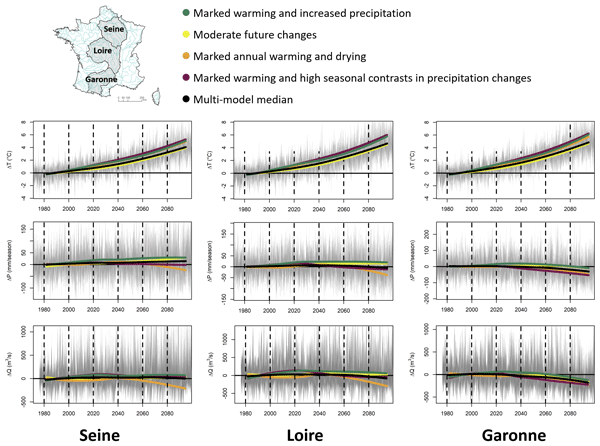
To shed new light on the enduring problem of long-term water balance non-closure, we hypothesize that the spatial variability of non-closure can help us untangle its many causes and extract the contribution of the climate forcing biases. To test the idea, we analyse the low-frequency variability of the water balance anomaly over 3614 near-natural gauged catchments across Europe. The study paves the way for hydrologically-grounded corrections of the forcing variables in large-scale models.
Eric Sauquet, Guillaume Evin, Sonia Siauve, Ryma Aissat, Patrick Arnaud, Maud Bérel, Jérémie Bonneau, Flora Branger, Yvan Caballero, François Colléoni, Agnès Ducharne, Joël Gailhard, Florence Habets, Frédéric Hendrickx, Louis Héraut, Benoît Hingray, Peng Huang, Tristan Jaouen, Alexis Jeantet, Sandra Lanini, Matthieu Le Lay, Claire Magand, Louise Mimeau, Céline Monteil, Simon Munier, Charles Perrin, Olivier Robelin, Fabienne Rousset, Jean-Michel Soubeyroux, Laurent Strohmenger, Guillaume Thirel, Flore Tocquer, Yves Tramblay, Jean-Pierre Vergnes, and Jean-Philippe Vidal
Hydrol. Earth Syst. Sci., 30, 2277–2300, https://doi.org/10.5194/hess-30-2277-2026, https://doi.org/10.5194/hess-30-2277-2026, 2026
Short summary
Short summary
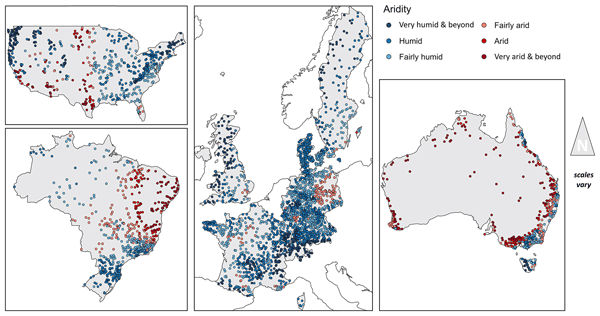
The Explore2 project has provided an unprecedented set of hydrological projections in terms of the number of hydrological models used and the spatial and temporal resolution. The results have been made available through various media. Under the high-emission scenario, the hydrological models mostly agree on the decrease in seasonal flows in the south of France, confirming its hotspot status, and on the decrease in summer flows throughout France, with the exception of the northern part of France.
Vazken Andréassian, Guilherme M. Guimarães, Julien Lerat, and Alban de Lavenne
Hydrol. Earth Syst. Sci., 30, 1865–1876, https://doi.org/10.5194/hess-30-1865-2026, https://doi.org/10.5194/hess-30-1865-2026, 2026
Short summary
Short summary
We study the variations in annual streamflow and explicit their dependence to climate variations, in order to understand their causes and to provide tools for a rapid assessment of the impact of climate change on water resources. By making explicit the dependency of streamflow elasticity to aridity, we are able to propose a regionalized elasticity formula with physically-realistic elasticity coefficients.
Antoine Degenne, François Bourgin, Charles Perrin, and Vazken Andréassian
EGUsphere, https://doi.org/10.5194/egusphere-2026-1197, https://doi.org/10.5194/egusphere-2026-1197, 2026
Short summary
Short summary
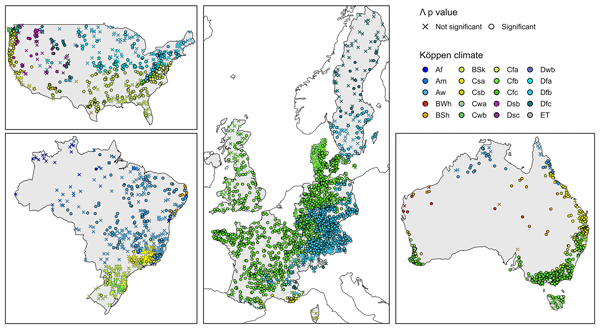
We tested whether a simple model combining basic water balance principles with artificial intelligence can predict yearly river flow across many regions and years. Using data from over 3,000 river basins in eight countries, we found that the model works well when predicting future years in the same basin, but is less accurate in new regions because estimating long-term average flow remains difficult. This highlights both the promise and limits of this approach for large-scale water management.
Vazken Andréassian, Guilherme Mendoza Guimarães, Alban de Lavenne, and Julien Lerat
Hydrol. Earth Syst. Sci., 29, 5477–5491, https://doi.org/10.5194/hess-29-5477-2025, https://doi.org/10.5194/hess-29-5477-2025, 2025
Short summary
Short summary
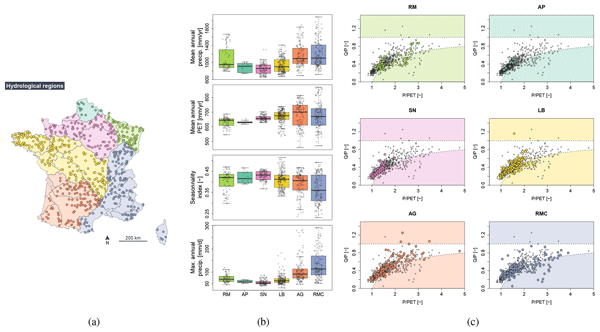
Using 4122 catchments from four continents, we investigate how annual streamflow depends on climate variables (rainfall and potential evaporation) and on the season when precipitation occurs, using an index representing the synchronicity between precipitation and potential evaporation. In all countries and under the main climates represented, synchronicity is, after precipitation, the second most important factor in explaining annual streamflow variations.
Olivier Delaigue, Guilherme Mendoza Guimarães, Pierre Brigode, Benoît Génot, Charles Perrin, Jean-Michel Soubeyroux, Bruno Janet, Nans Addor, and Vazken Andréassian
Earth Syst. Sci. Data, 17, 1461–1479, https://doi.org/10.5194/essd-17-1461-2025, https://doi.org/10.5194/essd-17-1461-2025, 2025
Short summary
Short summary
This dataset covers 654 rivers all flowing in France. The provided time series and catchment attributes will be of interest to those modelers wishing to analyze hydrological behavior and perform model assessments.
Léonard Santos, Vazken Andréassian, Torben O. Sonnenborg, Göran Lindström, Alban de Lavenne, Charles Perrin, Lila Collet, and Guillaume Thirel
Hydrol. Earth Syst. Sci., 29, 683–700, https://doi.org/10.5194/hess-29-683-2025, https://doi.org/10.5194/hess-29-683-2025, 2025
Short summary
Short summary
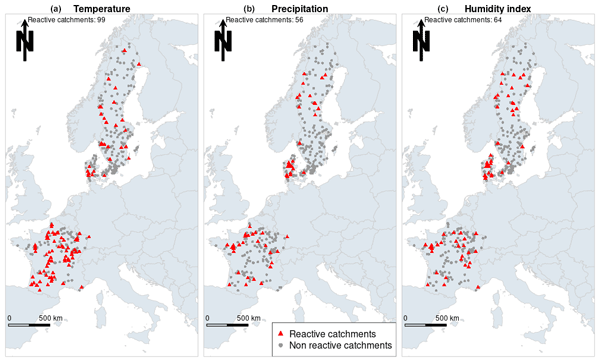
This work investigates how hydrological models are transferred to a period in which climate conditions are different to the ones of the period in which they were set up. The robustness assessment test built to detect dependencies between model error and climatic drivers was applied to three hydrological models in 352 catchments in Denmark, France and Sweden. Potential issues are seen in a significant number of catchments for the models, even though the catchments differ for each model.
Guillaume Thirel, Léonard Santos, Olivier Delaigue, and Charles Perrin
Hydrol. Earth Syst. Sci., 28, 4837–4860, https://doi.org/10.5194/hess-28-4837-2024, https://doi.org/10.5194/hess-28-4837-2024, 2024
Short summary
Short summary
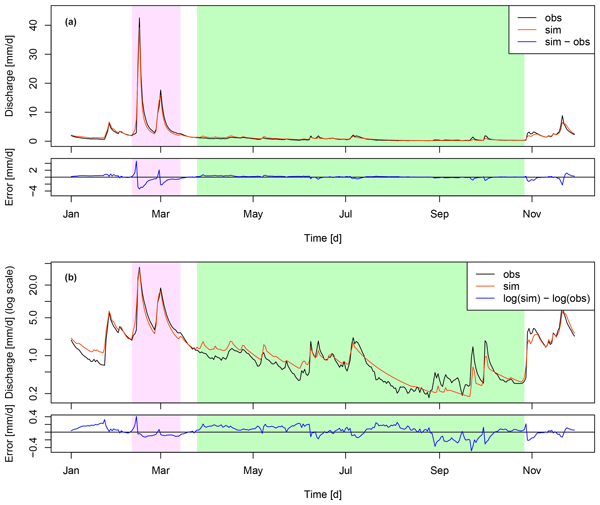
We discuss how mathematical transformations impact calibrated hydrological model simulations. We assess how 11 transformations behave over the complete range of streamflows. Extreme transformations lead to models that are specialized for extreme streamflows but show poor performance outside the range of targeted streamflows and are less robust. We show that no a priori assumption about transformations can be taken as warranted.

Thibault Hallouin, François Bourgin, Charles Perrin, Maria-Helena Ramos, and Vazken Andréassian
Geosci. Model Dev., 17, 4561–4578, https://doi.org/10.5194/gmd-17-4561-2024, https://doi.org/10.5194/gmd-17-4561-2024, 2024
Short summary
Short summary
The evaluation of the quality of hydrological model outputs against streamflow observations is widespread in the hydrological literature. In order to improve on the reproducibility of published studies, a new evaluation tool dedicated to hydrological applications is presented. It is open source and usable in a variety of programming languages to make it as accessible as possible to the community. Thus, authors and readers alike can use the same tool to produce and reproduce the results.
Ralph Bathelemy, Pierre Brigode, Vazken Andréassian, Charles Perrin, Vincent Moron, Cédric Gaucherel, Emmanuel Tric, and Dominique Boisson
Earth Syst. Sci. Data, 16, 2073–2098, https://doi.org/10.5194/essd-16-2073-2024, https://doi.org/10.5194/essd-16-2073-2024, 2024
Short summary
Short summary
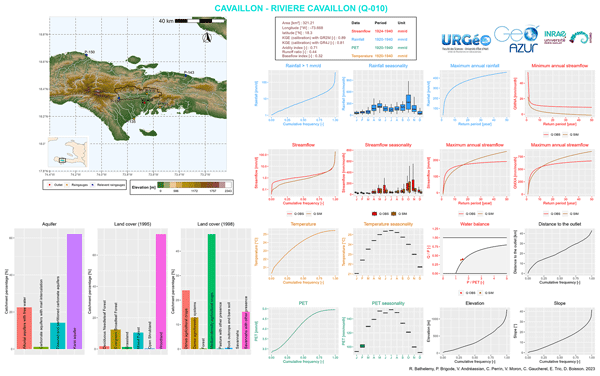
The aim of this work is to provide the first hydroclimatic database for Haiti, a Caribbean country particularly vulnerable to meteorological and hydrological hazards. The resulting database, named Simbi, provides hydroclimatic time series for around 150 stations and 24 catchment areas.
Cyril Thébault, Charles Perrin, Vazken Andréassian, Guillaume Thirel, Sébastien Legrand, and Olivier Delaigue
Hydrol. Earth Syst. Sci., 28, 1539–1566, https://doi.org/10.5194/hess-28-1539-2024, https://doi.org/10.5194/hess-28-1539-2024, 2024
Short summary
Short summary
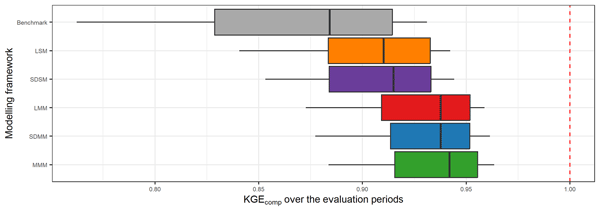
Streamflow forecasting is useful for many applications, ranging from population safety (e.g. floods) to water resource management (e.g. agriculture or hydropower). To this end, hydrological models must be optimized. However, a model is inherently wrong. This study aims to analyse the contribution of a multi-model approach within a variable spatial framework to improve streamflow simulations. The underlying idea is to take advantage of the strength of each modelling framework tested.
Laurent Strohmenger, Eric Sauquet, Claire Bernard, Jérémie Bonneau, Flora Branger, Amélie Bresson, Pierre Brigode, Rémy Buzier, Olivier Delaigue, Alexandre Devers, Guillaume Evin, Maïté Fournier, Shu-Chen Hsu, Sandra Lanini, Alban de Lavenne, Thibault Lemaitre-Basset, Claire Magand, Guilherme Mendoza Guimarães, Max Mentha, Simon Munier, Charles Perrin, Tristan Podechard, Léo Rouchy, Malak Sadki, Myriam Soutif-Bellenger, François Tilmant, Yves Tramblay, Anne-Lise Véron, Jean-Philippe Vidal, and Guillaume Thirel
Hydrol. Earth Syst. Sci., 27, 3375–3391, https://doi.org/10.5194/hess-27-3375-2023, https://doi.org/10.5194/hess-27-3375-2023, 2023
Short summary
Short summary
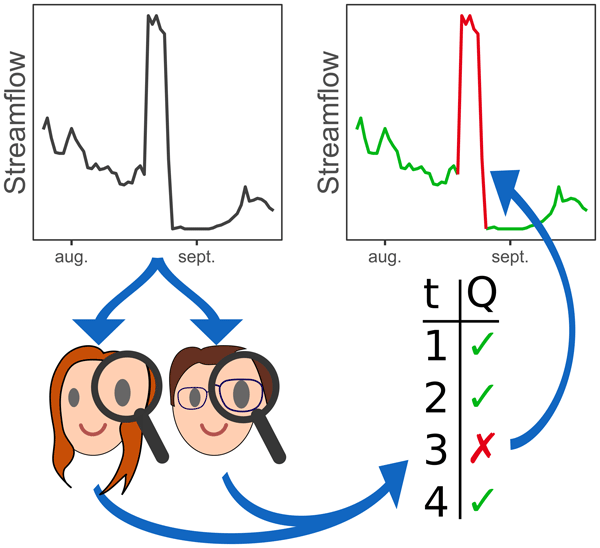
We present the results of a large visual inspection campaign of 674 streamflow time series in France. The objective was to detect non-natural records resulting from instrument failure or anthropogenic influences, such as hydroelectric power generation or reservoir management. We conclude that the identification of flaws in flow time series is highly dependent on the objectives and skills of individual evaluators, and we raise the need for better practices for data cleaning.
Alban de Lavenne, Vazken Andréassian, Louise Crochemore, Göran Lindström, and Berit Arheimer
Hydrol. Earth Syst. Sci., 26, 2715–2732, https://doi.org/10.5194/hess-26-2715-2022, https://doi.org/10.5194/hess-26-2715-2022, 2022
Short summary
Short summary
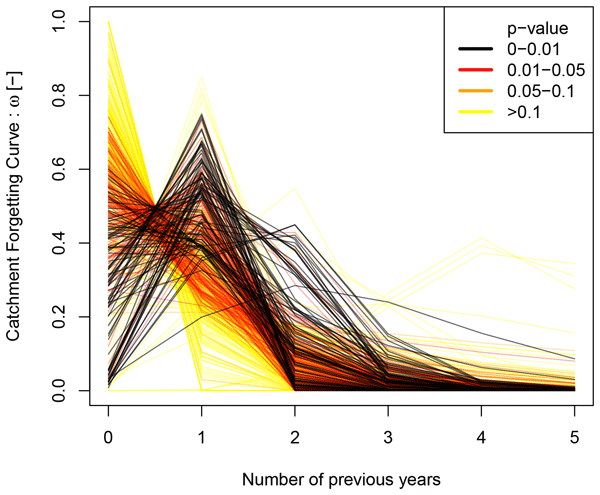
A watershed remembers the past to some extent, and this memory influences its behavior. This memory is defined by the ability to store past rainfall for several years. By releasing this water into the river or the atmosphere, it tends to forget. We describe how this memory fades over time in France and Sweden. A few watersheds show a multi-year memory. It increases with the influence of groundwater or dry conditions. After 3 or 4 years, they behave independently of the past.
Antoine Pelletier and Vazken Andréassian
Hydrol. Earth Syst. Sci., 26, 2733–2758, https://doi.org/10.5194/hess-26-2733-2022, https://doi.org/10.5194/hess-26-2733-2022, 2022
Short summary
Short summary
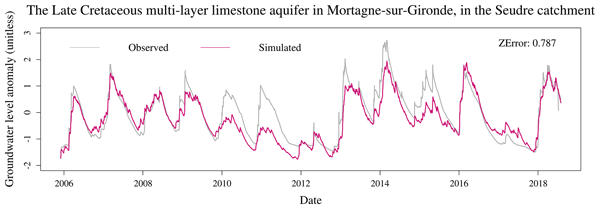
A large part of the water cycle takes place underground. In many places, the soil stores water during the wet periods and can release it all year long, which is particularly visible when the river level is low. Modelling tools that are used to simulate and forecast the behaviour of the river struggle to represent this. We improved an existing model to take underground water into account using measurements of the soil water content. Results allow us make recommendations for model users.
Paul Royer-Gaspard, Vazken Andréassian, and Guillaume Thirel
Hydrol. Earth Syst. Sci., 25, 5703–5716, https://doi.org/10.5194/hess-25-5703-2021, https://doi.org/10.5194/hess-25-5703-2021, 2021
Short summary
Short summary
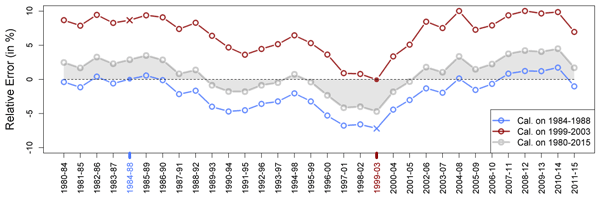
Most evaluation studies based on the differential split-sample test (DSST) endorse the consensus that rainfall–runoff models lack climatic robustness. In this technical note, we propose a new performance metric to evaluate model robustness without applying the DSST and which can be used with a single hydrological model calibration. Our work makes it possible to evaluate the temporal transferability of any hydrological model, including uncalibrated models, at a very low computational cost.
Cited articles
Auer, A., Gauch, M., Kratzert, F., Nearing, G., Hochreiter, S., and Klotz, D.: A data-centric perspective on the information needed for hydrological uncertainty predictions, Hydrol. Earth Syst. Sci., 28, 4099–4126, https://doi.org/10.5194/hess-28-4099-2024, 2024. a, b, c
Bates, B. C. and Campbell, E. P.: A Markov chain Monte Carlo scheme for parameter estimation and inference in conceptual rainfall-runoff modeling, Water Resour. Res., 37, 937–947, 2001. a
Bellier, J., Zin, I., and Bontron, G.: Sample stratification in verification of ensemble forecasts of continuous scalar variables: Potential benefits and pitfalls, Mon. Weather Rev., 145, 3529–3544, https://doi.org/10.1175/MWR-D-16-0487.1, 2017. a
Bennett, J. C., Robertson, D. E., Wang, Q. J., Li, M., and Perraud, J.-M.: Propagating reliable estimates of hydrological forecast uncertainty to many lead times, J. Hydrol., 603, 126798, https://doi.org/10.1016/j.jhydrol.2021.126798, 2021. a
Bertola, M., Blöschl, G., Bohac, M., Borga, M., Castellarin, A., Chirico, G. B., Claps, P., Dallan, E., Danilovich, I., Ganora, D., Gorbachova, L., Ledvinka, O., Mavrova-Guirguinova, M., Montanari, A., Ovcharuk, V., Viglione, A., Volpi, E., Arheimer, B., Aronica, G. T., Bonacci, O., Čanjevac, I., Csik, A., Frolova, N., Gnandt, B., Gribovszki, Z., Gül, A., Günther, K., Guse, B., Hannaford, J., Harrigan, S., Kireeva, M., Kohnová, S., Komma, J., Kriauciuniene, J., Kronvang, B., Lawrence, D., Lüdtke, S., Mediero, L., Merz, B., Molnar, P., Murphy, C., Oskoruš, D., Osuch, M., Parajka, J., Pfister, L., Radevski, I., Sauquet, E., Schröter, K., Šraj, M., Szolgay, J., Turner, S., Valent, P., Veijalainen, N., Ward, P. J., Willems, P., and Zivkovic, N.: Megafloods in Europe can be anticipated from observations in hydrologically similar catchments, Nat. Geosci., 16, 982–988, 2023. a, b
Bourgin, F., Andréassian, V., Perrin, C., and Oudin, L.: Transferring global uncertainty estimates from gauged to ungauged catchments, Hydrol. Earth Syst. Sci., 19, 2535–2546, https://doi.org/10.5194/hess-19-2535-2015, 2015. a
Breiman, L., Friedman, J., Olshen, R. A., and Stone, C. J.: Classification and regression trees, Routledge, https://doi.org/10.1201/9781315139470, 2017. a, b
Coron, L., Thirel, G., Delaigue, O., Perrin, C., and Andréassian, V.: The Suite of Lumped GR Hydrological Models in an R package, Environ. Modell. Softw., 94, 166–171, https://doi.org/10.1016/j.envsoft.2017.05.002, 2017. a
Coron, L., Delaigue, O., Thirel, G., Dorchies, D., Perrin, C., and Michel, C.: airGR: Suite of GR Hydrological Models for Precipitation-Runoff Modelling, r package version 1.7.4, https://doi.org/10.15454/EX11NA, 2023. a
Coron, L., Delaigue, O., Thirel, G., Dorchies, D., Perrin, C., Michel, C., Andréassian, V., Bourgin, F., Brigode, P., Le Moine, N., Mathevet, T., Mouelhi, S., Oudin, L., Pushpalatha, R., and Valéry, A.: airGR: Suite of GR Hydrological Models for Precipitation-Runoff Modelling Version 1.7.8, CRAN [code], https://doi.org/10.32614/CRAN.package.airGR, 2025. a
Delaigue, O., Guimarães, G. M., Brigode, P., Génot, B., Perrin, C., and Andréassian, V.: CAMELS-FR dataset, Recherche Data Gouv, V3 [data set], https://doi.org/10.57745/WH7FJR, 2024. a
Delaigue, O., Guimarães, G. M., Brigode, P., Génot, B., Perrin, C., Soubeyroux, J.-M., Janet, B., Addor, N., and Andréassian, V.: CAMELS-FR dataset: a large-sample hydroclimatic dataset for France to explore hydrological diversity and support model benchmarking, Earth Syst. Sci. Data, 17, 1461–1479, https://doi.org/10.5194/essd-17-1461-2025, 2025. a
Delle Monache, L., Eckel, F. A., Rife, D. L., Nagarajan, B., and Searight, K.: Probabilistic weather prediction with an analog ensemble, Mon. Weather Rev., 141, 3498–3516, 2013. a
Dufeu, E., Mougin, F., Foray, A., Baillon, M., Lamblin, R., Hebrard, F., Chaleon, C., Romon, S., Cobos, L., Gouin, P., Audouy, J.-N., Martin, R., and Poligot-Pitsch, S.: Finalisation de l’opération HYDRO 3 de modernisation du système d’information national des données hydrométriques, LHB, 108, 2099317, https://doi.org/10.1080/27678490.2022.2099317, 2022. a
Fang, S., Johnson, J. M., Yeghiazarian, L., and Sankarasubramanian, A.: Improved national-scale above-normal flow prediction for gauged and ungauged basins using a spatio-temporal hierarchical model, Water Resour. Res., 60, e2023WR034557, https://doi.org/10.1029/2023WR034557, 2024. a, b, c
Georgakakos, K. P., Seo, D.-J., Gupta, H., Schaake, J., and Butts, M. B.: Towards the characterization of streamflow simulation uncertainty through multimodel ensembles, J. Hydrol., 298, 222–241, 2004. a
Gneiting, T., Raftery, A. E., Westveld, A. H., and Goldman, T.: Calibrated Probabilistic Forecasting Using Ensemble Model Output Statistics and Minimum CRPS Estimation, Mon. Weather Rev., 133, 1098–1118, https://doi.org/10.1175/MWR2904.1, 2005. a
Golian, S., Murphy, C., and Meresa, H.: Regionalization of hydrological models for flow estimation in ungauged catchments in Ireland, Journal of Hydrology: Regional Studies, 36, 100859, https://doi.org/10.1016/j.ejrh.2021.100859, 2021. a
Gupta, A., Hantush, M. M., Govindaraju, R. S., and Beven, K.: Evaluation of hydrological models at gauged and ungauged basins using machine learning-based limits-of-acceptability and hydrological signatures, J. Hydrol., 641, 131774, https://doi.org/10.1016/j.jhydrol.2024.131774, 2024. a
Hallouin, T., Bourgin, F., Perrin, C., Ramos, M.-H., and Andréassian, V.: EvalHyd v0.1.2: a polyglot tool for the evaluation of deterministic and probabilistic streamflow predictions, Geosci. Model Dev., 17, 4561–4578, https://doi.org/10.5194/gmd-17-4561-2024, 2024. a, b
Hashemi, R., Brigode, P., Garambois, P.-A., and Javelle, P.: How can we benefit from regime information to make more effective use of long short-term memory (LSTM) runoff models?, Hydrol. Earth Syst. Sci., 26, 5793–5816, https://doi.org/10.5194/hess-26-5793-2022, 2022. a, b, c
Hastie, T., Tibshirani, R., and Friedman, J.: The Elements of Statistical Learning, Springer Series in Statistics, Springer New York Inc., New York, NY, USA, https://doi.org/10.1007/978-0-387-84858-7, 2001. a, b
Hu, W., Cervone, G., Young, G., and Delle Monache, L.: Machine learning weather analogs for near-surface variables, Bound.-Lay. Meteorol., 186, 711–735, 2023. a
Hwang, J., Orenstein, P., Cohen, J., Pfeiffer, K., and Mackey, L.: Improving subseasonal forecasting in the western US with machine learning, in: Proceedings of the 25th ACM SIGKDD International Conference on Knowledge Discovery & Data Mining, 2325–2335, https://doi.org/10.1145/3292500.3330674, 2019. a
Jehn, F. U., Bestian, K., Breuer, L., Kraft, P., and Houska, T.: Using hydrological and climatic catchment clusters to explore drivers of catchment behavior, Hydrol. Earth Syst. Sci., 24, 1081–1100, https://doi.org/10.5194/hess-24-1081-2020, 2020. a
Johnson, J. M., Fang, S., Sankarasubramanian, A., Rad, A. M., Kindl da Cunha, L., Jennings, K. S., Clarke, K. C., Mazrooei, A., and Yeghiazarian, L.: Comprehensive analysis of the NOAA National Water Model: A call for heterogeneous formulations and diagnostic model selection, J. Geophys. Res.-Atmos., 128, e2023JD038534, https://doi.org/10.1029/2023JD038534, 2023. a, b
Johnson, R. A.: quantile-forest: A Python Package for Quantile Regression Forests, Journal of Open Source Software, 9, 5976, https://doi.org/10.21105/joss.05976, 2024. a
Kling, H., Fuchs, M., and Paulin, M.: Runoff conditions in the upper Danube basin under an ensemble of climate change scenarios, J. Hydrol., 424, 264–277, 2012. a
Kratzert, F., Klotz, D., Brenner, C., Schulz, K., and Herrnegger, M.: Rainfall–runoff modelling using Long Short-Term Memory (LSTM) networks, Hydrol. Earth Syst. Sci., 22, 6005–6022, https://doi.org/10.5194/hess-22-6005-2018, 2018. a, b
Kratzert, F., Gauch, M., Klotz, D., and Nearing, G.: HESS Opinions: Never train a Long Short-Term Memory (LSTM) network on a single basin, Hydrol. Earth Syst. Sci., 28, 4187–4201, https://doi.org/10.5194/hess-28-4187-2024, 2024. a, b
Kuczera, G. and Parent, E.: Monte Carlo assessment of parameter uncertainty in conceptual catchment models: the Metropolis algorithm, J. Hydrol., 211, 69–85, 1998. a
Leleu, I., Tonnelier, I., Puechberty, R., Gouin, P., Viquendi, I., Cobos, L., Foray, A., Baillon, M., and Ndima, P.-O.: La refonte du système d'information national pour la gestion et la mise à disposition des données hydrométriques, La Houille Blanche, 100, 25–32, https://doi.org/10.1051/lhb/2014004, 2014. a
Li, M., Wang, Q. J., Bennett, J. C., and Robertson, D. E.: Error reduction and representation in stages (ERRIS) in hydrological modelling for ensemble streamflow forecasting, Hydrol. Earth Syst. Sci., 20, 3561–3579, https://doi.org/10.5194/hess-20-3561-2016, 2016. a, b
Louppe, G.: Understanding random forests: From theory to practice, Universite de Liege (Belgium), 2014. a
McInerney, D., Kavetski, D., Thyer, M., Lerat, J., and Kuczera, G.: Benefits of explicit treatment of zero flows in probabilistic hydrological modeling of ephemeral catchments, Water Resour. Res., 55, 11035–11060, 2019. a
Nash, J. E. and Sutcliffe, J. V.: River flow forecasting through conceptual models part I—A discussion of principles, J. Hydrol., 10, 282–290, 1970. a
Oshiro, T. M., Perez, P. S., and Baranauskas, J. A.: How many trees in a random forest?, in: International workshop on machine learning and data mining in pattern recognition, Springer, 154–168, https://doi.org/10.1007/978-3-642-31537-4_13, 2012. a
Oudin, L., Hervieu, F., Michel, C., Perrin, C., Andréassian, V., Anctil, F., and Loumagne, C.: Which potential evapotranspiration input for a lumped rainfall–runoff model?: Part 2—Towards a simple and efficient potential evapotranspiration model for rainfall–runoff modelling, J. Hydrol., 303, 290–306, 2005. a
Oudin, L., Andréassian, V., Perrin, C., Michel, C., and Le Moine, N.: Spatial proximity, physical similarity, regression and ungaged catchments: A comparison of regionalization approaches based on 913 French catchments, Water Resour. Res., 44, https://doi.org/10.1029/2007WR006240, 2008. a
Papacharalampous, G. and Langousis, A.: Probabilistic water demand forecasting using quantile regression algorithms, Water Resour. Res., 58, e2021WR030216, https://doi.org/10.1029/2021WR030216, 2022. a, b, c
Pham, L. T., Luo, L., and Finley, A.: Evaluation of random forests for short-term daily streamflow forecasting in rainfall- and snowmelt-driven watersheds, Hydrol. Earth Syst. Sci., 25, 2997–3015, https://doi.org/10.5194/hess-25-2997-2021, 2021. a
Poncelet, C., Merz, R., Merz, B., Parajka, J., Oudin, L., Andréassian, V., and Perrin, C.: Process-based interpretation of conceptual hydrological model performance using a multinational catchment set, Water Resour. Res., 53, 7247–7268, 2017. a
Pushpalatha, R., Perrin, C., Le Moine, N., Mathevet, T., and Andréassian, V.: A downward structural sensitivity analysis of hydrological models to improve low-flow simulation, J. Hydrol., 411, 66–76, https://doi.org/10.1016/j.jhydrol.2011.09.034, 2011. a
Pushpalatha, R., Perrin, C., Moine, N. L., and Andréassian, V.: A review of efficiency criteria suitable for evaluating low-flow simulations, J. Hydrol., 420–421, 171–182, https://doi.org/10.1016/j.jhydrol.2011.11.055, 2012. a
Raschka, S., Patterson, J., and Nolet, C.: Machine Learning in Python: Main developments and technology trends in data science, machine learning, and artificial intelligence, arXiv [preprint], arXiv:2002.04803, 2020. a
Razavi, T. and Coulibaly, P.: Streamflow prediction in ungauged basins: review of regionalization methods, J. Hydrol. Eng., 18, 958–975, 2013. a
Renard, B., Kavetski, D., Kuczera, G., Thyer, M., and Franks, S. W.: Understanding predictive uncertainty in hydrologic modeling: The challenge of identifying input and structural errors, Water Resour. Res., 46, https://doi.org/10.1029/2009WR008328, 2010. a
Shen, Y., Ruijsch, J., Lu, M., Sutanudjaja, E. H., and Karssenberg, D.: Random forests-based error-correction of streamflow from a large-scale hydrological model: Using model state variables to estimate error terms, Comput. Geosci., 159, 105019, https://doi.org/10.1016/j.cageo.2021.105019, 2022. a, b, c, d
Solomatine, D. P. and Shrestha, D. L.: A novel method to estimate model uncertainty using machine learning techniques, Water Resour. Res., 45, https://doi.org/10.1029/2008WR006839, 2009. a
Taillardat, M. and Mestre, O.: From research to applications – examples of operational ensemble post-processing in France using machine learning, Nonlin. Processes Geophys., 27, 329–347, https://doi.org/10.5194/npg-27-329-2020, 2020. a
Tanguy, M., Chevuturi, A., Marchant, B. P., Mackay, J. D., Parry, S., and Hannaford, J.: How will climate change affect the spatial coherence of streamflow and groundwater droughts in Great Britain?, Environ. Res. Lett., 18, 064048, https://doi.org/10.1088/1748-9326/acd655, 2023. a
Teja, K. N., Manikanta, V., Das, J., and Umamahesh, N.: Enhancing the predictability of flood forecasts by combining Numerical Weather Prediction ensembles with multiple hydrological models, J. Hydrol., 625, 130176, https://doi.org/10.1016/j.jhydrol.2023.130176, 2023. a
Thirel, G., Santos, L., Delaigue, O., and Perrin, C.: On the use of streamflow transformations for hydrological model calibration, Hydrol. Earth Syst. Sci., 28, 4837–4860, https://doi.org/10.5194/hess-28-4837-2024, 2024. a
Tiberi-Wadier, A.-L., Goutal, N., Ricci, S., Sergent, P., Taillardat, M., Bouttier, F., and Monteil, C.: Strategies for hydrologic ensemble generation and calibration: On the merits of using model-based predictors, J. Hydrol., 599, 126233, https://doi.org/10.1016/j.jhydrol.2021.126233, 021. a
Todini, E.: A model conditional processor to assess predictive uncertainty in flood forecasting, International Journal of River Basin Management, 6, 123–137, https://doi.org/10.1080/15715124.2008.9635342, 2008. a, b
Troin, M., Arsenault, R., Wood, A. W., Brissette, F., and Martel, J.-L.: Generating ensemble streamflow forecasts: A review of methods and approaches over the past 40 years, Water Ressour. Res., 57, https://doi.org/10.1029/2020WR028392, 2021. a
Tyralis, H. and Papacharalampous, G.: A review of predictive uncertainty estimation with machine learning, Artif. Intell. Rev., 57, 94, https://doi.org/10.1007/s10462-023-10698-8, 2024. a
Tyralis, H., Papacharalampous, G., Burnetas, A., and Langousis, A.: Hydrological post-processing using stacked generalization of quantile regression algorithms: Large-scale application over CONUS, J. Hydrol., 577, 123957, https://doi.org/10.1016/j.jhydrol.2019.123957, 2019. a, b
Valéry, A., Andréassian, V., and Perrin, C.: ‘As simple as possible but not simpler’: What is useful in a temperature-based snow-accounting routine? Part 2–Sensitivity analysis of the Cemaneige snow accounting routine on 380 catchments, J. Hydrol., 517, 1176–1187, https://doi.org/10.1016/j.jhydrol.2014.04.058, 2014. a
Vidal, J.-P., Martin, E., Franchisteguy, L., Baillon, M., and Soubeyroux, J.-M.: A 50-year high-resolution atmospheric reanalysis over France with the Safran system, Int. J. Climat., 30, https://doi.org/10.1002/joc.2003, 2010. a
Wani, O., Beckers, J. V. L., Weerts, A. H., and Solomatine, D. P.: Residual uncertainty estimation using instance-based learning with applications to hydrologic forecasting, Hydrol. Earth Syst. Sci., 21, 4021–4036, https://doi.org/10.5194/hess-21-4021-2017, 2017. a
White, C. J., Carlsen, H., Robertson, A. W., Klein, R. J. T., Lazo, J., Kumar, A., Vitart, F., Coughlan de Perez, E., Ray, A. J., Murray, V., Bharwani, S., Macleod, D., James, R., Fleming, L. E., Morse, A. P., Eggen, B., Graham, R., Kjellström, E., Becker, E., Pegion, K. V., Holbrook, N. J., McEvoy, D., Depledge, M., Perkins-Kirkpatrick, S. E., Brown, T. J., Street, R., Jones, L., Remenyi, T., Hodgson-Johnston, I., Buontempo, C., Lamb, R., Meinke, H., Arheimer, B., and Zebiak, S.: Potential applications of subseasonal-to-seasonal (S2S) predictions, Meteorol. Appl., 24, 315–325, 2017. a
Zhang, Y., Ye, A., Analui, B., Nguyen, P., Sorooshian, S., Hsu, K., and Wang, Y.: Comparing quantile regression forest and mixture density long short-term memory models for probabilistic post-processing of satellite precipitation-driven streamflow simulations, Hydrol. Earth Syst. Sci., 27, 4529–4550, https://doi.org/10.5194/hess-27-4529-2023, 2023. a, b, c, d, e, f
Short summary
To improve hydrological uncertainty estimation, recent studies have explored machine learning (ML)-based post-processing approaches. Among these, quantile random forests (QRF) are increasingly used for their balance between interpretability and performance. We develop a hydrologically informed QRF trained in a multi-site setting. Our results show that the regional QRF approach is beneficial, particularly in catchments where local information is insufficient.
To improve hydrological uncertainty estimation, recent studies have explored machine learning...


