Articles | Volume 17, issue 6
https://doi.org/10.5194/hess-17-2185-2013
© Author(s) 2013. This work is distributed under
the Creative Commons Attribution 3.0 License.
https://doi.org/10.5194/hess-17-2185-2013
© Author(s) 2013. This work is distributed under
the Creative Commons Attribution 3.0 License.
Assessing the hydrological effect of the check dams in the Loess Plateau, China, by model simulations
Y. D. Xu
State Key Laboratory of Urban and Regional Ecology, Research Center for Eco-Environmental Sciences,Chinese Academy of Sciences, P.O. Box 2871, Beijing 100085, China
State Environmental Protection Key Laboratory of Regional Ecological Processes and Functions Assessment, Chinese Research Academy of Environmental Sciences, Beijing 100012, China
B. J. Fu
State Key Laboratory of Urban and Regional Ecology, Research Center for Eco-Environmental Sciences,Chinese Academy of Sciences, P.O. Box 2871, Beijing 100085, China
Center for Dryland Water Resources Research and Watershed Science, Key Laboratory of West China's Environmental System (Ministry of Education), Lanzhou University, Lanzhou 730000, China
Department of Geography, Western Michigan University, Kalamazoo, Michigan 49008-5424, USA
Related authors
No articles found.
Shan Sang, Yan Li, Shuang Zong, Lu Yu, Shuai Wang, Yanxu Liu, Xutong Wu, Shuang Song, Wenwu Zhao, Xuhui Wang, and Bojie Fu
EGUsphere, https://doi.org/10.5194/egusphere-2025-5597, https://doi.org/10.5194/egusphere-2025-5597, 2025
This preprint is open for discussion and under review for Geoscientific Model Development (GMD).
Short summary
Short summary
Regional coupled human–natural systems models are essential for regional sustainability. We developed a new model, CHANS-SD-YRB, using System Dynamics for the Yellow River Basin in China, which faces severe human-water conflicts. The model links 10 components, including Population, Economy, Energy, Food, Water, Sediment, Land, Carbon, and Climate to simulate basin’s key human-natural interactions. The model is applicable for sustainable development through scenario analyses and predictions.
Yichu Huang, Xiaoming Feng, Chaowei Zhou, and Bojie Fu
EGUsphere, https://doi.org/10.5194/egusphere-2024-3393, https://doi.org/10.5194/egusphere-2024-3393, 2024
Preprint archived
Short summary
Short summary
This study uses an integrated water-energy-land optimization model to explore sustainable water use pathways in the Yellow River Basin. We find water conflicts between energy and irrigation water use, and quantify the mitigation and spillover effects of water transfer. We also highlight the critical role of energy production, implying that the energy sector transformation is key to the water system of the Yellow River Basin.
Nannan An, Nan Lu, Weiliang Chen, Yongzhe Chen, Hao Shi, Fuzhong Wu, and Bojie Fu
Earth Syst. Sci. Data, 16, 1771–1810, https://doi.org/10.5194/essd-16-1771-2024, https://doi.org/10.5194/essd-16-1771-2024, 2024
Short summary
Short summary
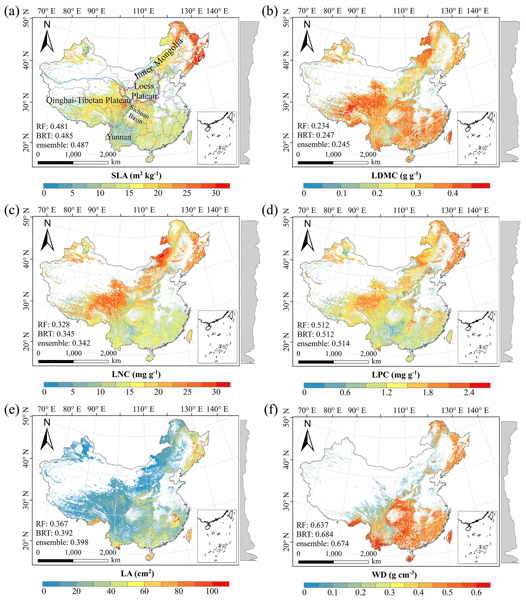
This study generated a spatially continuous plant functional trait dataset (~1 km) in China in combination with field observations, environmental variables and vegetation indices using machine learning methods. Results showed that wood density, leaf P concentration and specific leaf area showed good accuracy with an average R2 of higher than 0.45. This dataset could provide data support for development of Earth system models to predict vegetation distribution and ecosystem functions.
Yongzhe Chen, Xiaoming Feng, Bojie Fu, Haozhi Ma, Constantin M. Zohner, Thomas W. Crowther, Yuanyuan Huang, Xutong Wu, and Fangli Wei
Earth Syst. Sci. Data, 15, 897–910, https://doi.org/10.5194/essd-15-897-2023, https://doi.org/10.5194/essd-15-897-2023, 2023
Short summary
Short summary
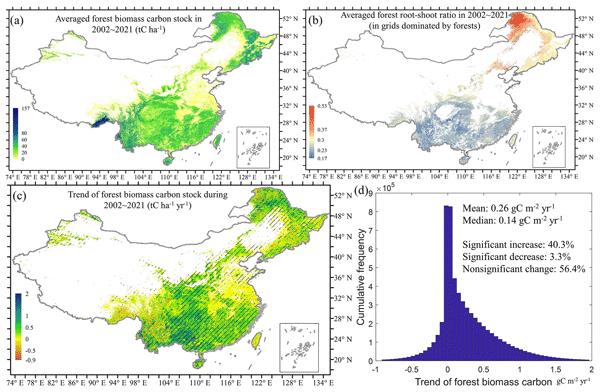
This study presented a long-term (2002–2021) above- and belowground biomass dataset for woody vegetation in China at 1 km resolution. It was produced by combining various types of remote sensing observations with adequate plot measurements. Over 2002–2021, China’s woody biomass increased at a high rate, especially in the central and southern parts. This dataset can be applied to evaluate forest carbon sinks across China and the efficiency of ecological restoration programs in China.
Jinxia An, Guangyao Gao, Chuan Yuan, Juan Pinos, and Bojie Fu
Hydrol. Earth Syst. Sci., 26, 3885–3900, https://doi.org/10.5194/hess-26-3885-2022, https://doi.org/10.5194/hess-26-3885-2022, 2022
Short summary
Short summary
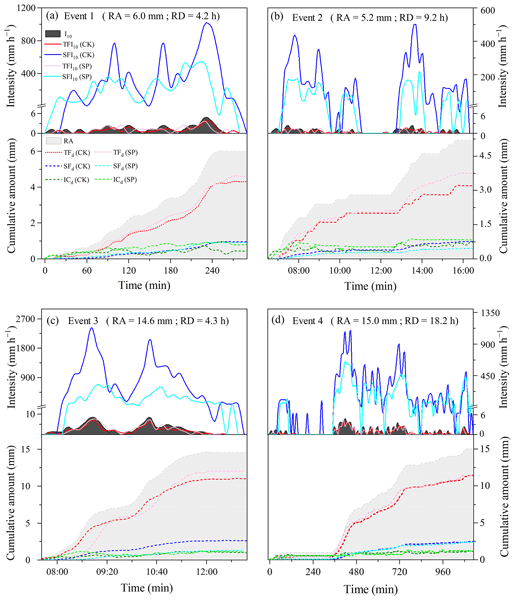
An in-depth investigation was conducted of all rainfall-partitioning components at inter- and intra-event scales for two xerophytic shrubs. Inter-event rainfall partitioning amount and percentage depended more on rainfall amount, and rainfall intensity and duration controlled intra-event rainfall-partitioning variables. One shrub has larger branch angle, small branch and smaller canopy area to produce stemflow more efficiently, and the other has larger biomass to intercept more rainfall.
Shuang Song, Shuai Wang, Xutong Wu, Yongyuan Huang, and Bojie Fu
Hydrol. Earth Syst. Sci., 26, 2035–2044, https://doi.org/10.5194/hess-26-2035-2022, https://doi.org/10.5194/hess-26-2035-2022, 2022
Short summary
Short summary
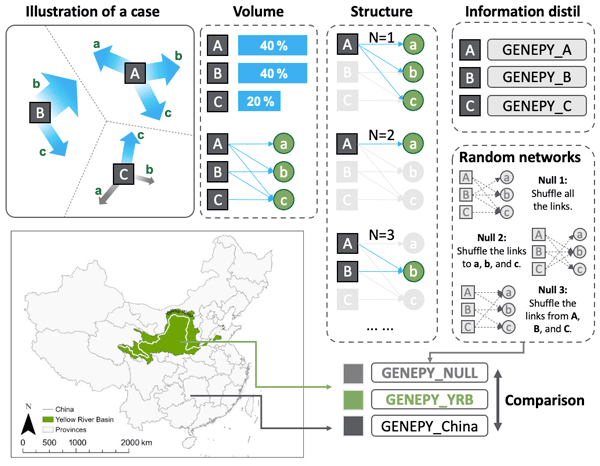
A reasonable assessment of the contribution of the water resources in a river basin to domestic crops supplies will be the first step in balancing the water–food nexus. Our results showed that although the Yellow River basin had reduced its virtual water outflow, its importance to crop production in China had been increasing when water footprint networks were considered. Our complexity-based approach provides a new perspective for understanding changes in a basin with a severe water shortage.
Bojie Fu, Xutong Wu, Zhuangzhuang Wang, Xilin Wu, and Shuai Wang
Earth Syst. Dynam., 13, 795–808, https://doi.org/10.5194/esd-13-795-2022, https://doi.org/10.5194/esd-13-795-2022, 2022
Short summary
Short summary
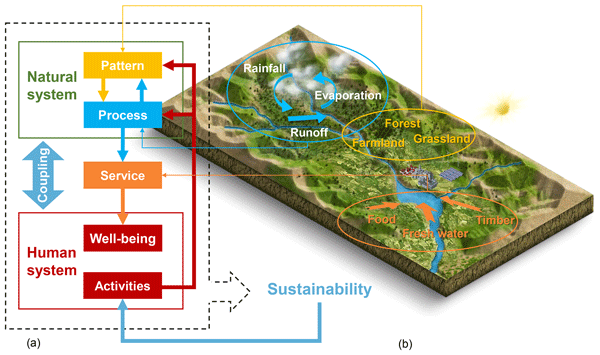
To understand the dynamics of a coupled human and natural system (CHANS) and promote its sustainability, we propose a conceptual
pattern–process–service–sustainabilitycascade framework. The use of this framework is systematically illustrated by a review of CHANS research experience in China's Loess Plateau in terms of coupling landscape patterns and ecological processes, linking ecological processes to ecosystem services, and promoting social–ecological sustainability.
Jie Tian, Baoqing Zhang, Xuejin Wang, and Chansheng He
Earth Syst. Sci. Data Discuss., https://doi.org/10.5194/essd-2022-21, https://doi.org/10.5194/essd-2022-21, 2022
Preprint withdrawn
Short summary
Short summary
Based on soil profile data at depths of 5 cm and 25 cm from 238 sampling sites, and on soil data from 32 soil moisture (SM) stations at depths of 5 cm, 15 cm, 25 cm, 40 cm, and 60 cm, we compiled a soil hydraulic properties (SHP) and SM dataset for a mountainous area, Northeastern QTP. The dataset provides information about SHP variability and SM trends at a large-scale mountainous area, thus offers opportunity for further understanding of water and energy processes over the QTP.
Maierdang Keyimu, Zongshan Li, Bojie Fu, Guohua Liu, Fanjiang Zeng, Weiliang Chen, Zexin Fan, Keyan Fang, Xiuchen Wu, and Xiaochun Wang
Clim. Past, 17, 2381–2392, https://doi.org/10.5194/cp-17-2381-2021, https://doi.org/10.5194/cp-17-2381-2021, 2021
Short summary
Short summary
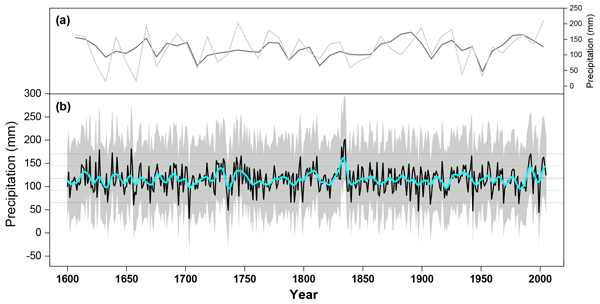
We created a residual tree-ring width chronology and reconstructed non-growth-season precipitation (NGSP) over the period spanning 1600–2005 in the southeastern Tibetan Plateau (SETP), China. Reconstruction model verification as well as similar variations of NGSP reconstruction and Palmer Drought Severity Index reconstructions from the surrounding region indicate the reliability of the present reconstruction. Our reconstruction is representative of NGSP variability of a large region in the SETP.
Xuejing Leng, Xiaoming Feng, Bojie Fu, and Yu Zhang
Hydrol. Earth Syst. Sci. Discuss., https://doi.org/10.5194/hess-2021-377, https://doi.org/10.5194/hess-2021-377, 2021
Manuscript not accepted for further review
Short summary
Short summary
At present, there is a lack of time series of runoff generated by glacial regions in the world. In this paper, we quantified glacial runoff (including meltwater runoff and delayed runoff) in arid regions of China from 1961 to 2015 by using remote sensing datasets of glacier mass balance with high resolution. Glacier runoff is the water resource used by oases in arid regions of China. The long-term glacial runoff data can indicate the climate risk faced by different basins in arid regions.
Cited articles
Arnold, J. G., Srinivasan, R., Muttiah, R. S., and Williams, J.: Large area hydrologic modeling and assessment part I: Model development, J. Am. Water Resour. As., 34, 73–89, 1998.
Bádossy, A.: Calibration of hydrological model parameters for ungauged catchments, Hydrol. Earth Syst. Sci., 11, 703–710, https://doi.org/10.5194/hess-11-703-2007, 2007.
Boix Fayos, C., Barberá, G., López Bermúdez, F., and Castillo, V.: Effects of check dams, reforestation and land-use changes on river channel morphology: Case study of the Rogativa catchment (Murcia, Spain), Geomorphology, 91, 103–123, 2007.
Boix Fayos, C., de Vente, J., Martínez Mena, M., Barberá, G. G., and Castillo, V.: The impact of land use change and check-dams on catchment sediment yield, Hydrol. Process., 22, 4922–4935, 2008.
Bombino, G., Gurnell, A. M., Tamburino, V., Zema, D. A., and Zimbone, S. M.: Adjustments in channel form, sediment calibre and vegetation around check-dams in the headwater reaches of mountain torrents,Calabria, Italy, Earth Surf. Proc. Land., 34, 1011–1021, 2009.
Callow, J., and Smettem, K.: The effect of farm dams and constructed banks on hydrologic connectivity and runoff estimation in agricultural landscapes, Environ. Modell. Softw., 24, 959–968, 2009.
Castillo, V., Mosch, W., Garcia, C. C., Barberá, G., Cano, J., and López-Bermúdez, F.: Effectiveness and geomorphological impacts of check dams for soil erosion control in a semiarid Mediterranean catchment: El Cárcavo (Murcia, Spain), Catena, 70, 416–427, 2007.
Conesa García, C., López Bermúdez, F., and García Lorenzo, R.: Bed stability variations after check dam construction in torrential channels (South-East Spain), Earth Surf. Proc. Land, 32, 2165–2184, 2007.
Fu, B., Zhao, W., Chen, L., Zhang, Q., Lü, Y., Gulinck, H., and Poesen, J.: Assessment of soil erosion at large watershed scale using RUSLE and GIS: a case study in the Loess Plateau of China, Land Degrad. Develop., 16, 73–85, 2005.
Guo, Z. Y., Huang, Z. L., and Feng, L. X.: Shaanxi Soil, Science Press, Beijing, 1992.
Hassanli, A. M., Nameghi, A. E., and Beecham, S.: Evaluation of the effect of porous check dam location on fine sediment retention (a case study), Environ. Monit. Assess., 152, 319–326, 2009.
Hui, Y. Y., Ji, W. H., and Liu, T. H.: Study on the variation and trend of the runoff and sediment in the Yanhe watershed, in: Study on the variation of the runoff and sediment in the Yellow River watershed (Volume 1) (in Chinese), edited by: Wang, G. and Fan, Z., Yellow River Water Conservancy Press, Zhengzhou, 717–736, 2002.
Lü, Y., Sun, R., Fu, B., and Wang, Y.: Carbon retention by check dams: Regional scale estimation, Ecol. Eng., 44, 139–146, 2012.
Martín Rosales, W., Gisbert, J., Pulido-Bosch, A., Vallejos, A., and Fernández Cortés, A.: Estimating groundwater recharge induced by engineering systems in a semiarid area (southeastern Spain), Environ. Geol., 52, 985–995, 2007.
Ministry of Water Resources of the People's Republic of China, Chinese Academy of Sciences, and Chinese Academy of Engineering: Soil erosion prevetion and ecological safety in China, The volume for the Loess Plateau (in Chinese), Science Press, Beijing, 2010.
Nash, J., and Sutcliffe, J.: River flow forecasting through conceptual models part I – A discussion of principles, J. Hydrol., 10, 282–290, 1970.
Ran, D. C., Luo, Q. H., Zhou, Z. H., Wang, G. Q., and Zhang, X. H.: Sediment retention by check dams in the Hekouzhen-Longmen Section of the Yellow River, Int. J. Sediment. Res., 23, 159–166, 2008.
Rema\^itre, A., van Asch, Th. W. J., Malet, J.-P., and Maquaire, O.: Influence of check dams on debris-flow run-out intensity, Nat. Hazards Earth Syst. Sci., 8, 1403–1416, https://doi.org/10.5194/nhess-8-1403-2008, 2008.
Wittenberg, H.: Effects of season and man-made changes on baseflow and flow recession: case studies, Hydrol. Process., 17, 2113–2123, 2003.
Xu, X., Zhang, H., Feng, S., Dong, Z., and Gan, Z.: Check-dam system in gullies – the most effective measure to conserve soil and water in Chinese Loess Plateau, 12th ISCO Conference, Beijing, 2002.
Xu., X., Zhang., H., and Zhang., O.: Development of check-dam systems in gullies on the Loess Plateau, China, Environ. Sci. Policy, 7, 79–86, 2004.
Xu, Y. D.: Modeling research on the spatial and temporal heterogeneity of the eco-hydrological processes in the Yanhe watershed (PhD thesis), Chinese Academy of Sciences, Beijing, 2012.
Xu, Y. D., Fu, B. J., He, C. S., and Gao, G. Y.: Watershed discretization based on multiple factors and its application in the Chinese Loess Plateau, Hydrol. Earth Syst. Sci., 16, 59–68, https://doi.org/10.5194/hess-16-59-2012, 2012.