Articles | Volume 30, issue 3
https://doi.org/10.5194/hess-30-893-2026
© Author(s) 2026. This work is distributed under
the Creative Commons Attribution 4.0 License.
https://doi.org/10.5194/hess-30-893-2026
© Author(s) 2026. This work is distributed under
the Creative Commons Attribution 4.0 License.
Incorporating natural variability in master recession curves
Thomas A. McMahon
Department of Infrastructure Engineering, The University of Melbourne, Melbourne, Australia
Rory J. Nathan
CORRESPONDING AUTHOR
Department of Infrastructure Engineering, The University of Melbourne, Melbourne, Australia
Richard George
Department of Primary Industries and Regional Development, Government of Western Australia, South Perth, Australia
Related authors
No articles found.
Michelle Ho, Declan O'Shea, Conrad Wasko, Rory Nathan, and Ashish Sharma
Hydrol. Earth Syst. Sci., 29, 5851–5870, https://doi.org/10.5194/hess-29-5851-2025, https://doi.org/10.5194/hess-29-5851-2025, 2025
Short summary
Short summary
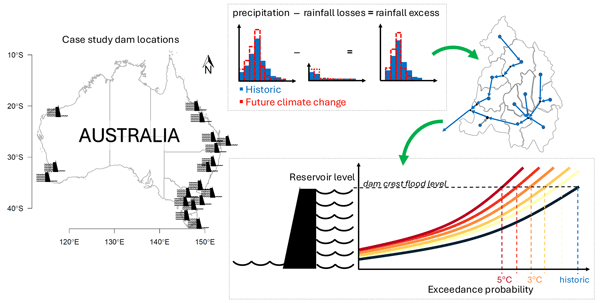
There is unequivocal evidence that climate change will impact the risk profile of dams, which are critical for water supply and flood mitigation. We project changes in the overtopping risk for 18 large dams in Australia in response to global warming. We consider the impacts of climate change on rainfall depth, rainfall temporal pattern, and rainfall losses. Under 4 °C of global warming, the risk of overtopping floods was 2.4–17 times that of historical conditions.
Conrad Wasko, Seth Westra, Rory Nathan, Acacia Pepler, Timothy H. Raupach, Andrew Dowdy, Fiona Johnson, Michelle Ho, Kathleen L. McInnes, Doerte Jakob, Jason Evans, Gabriele Villarini, and Hayley J. Fowler
Hydrol. Earth Syst. Sci., 28, 1251–1285, https://doi.org/10.5194/hess-28-1251-2024, https://doi.org/10.5194/hess-28-1251-2024, 2024
Short summary
Short summary
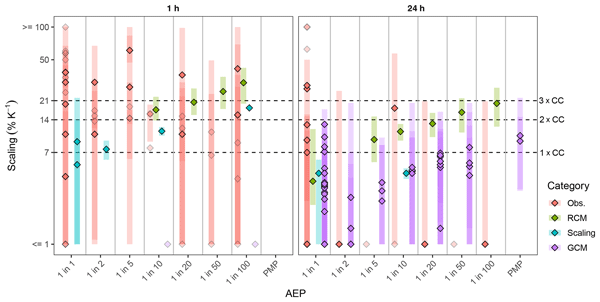
In response to flood risk, design flood estimation is a cornerstone of infrastructure design and emergency response planning, but design flood estimation guidance under climate change is still in its infancy. We perform the first published systematic review of the impact of climate change on design flood estimation and conduct a meta-analysis to provide quantitative estimates of possible future changes in extreme rainfall.
Keirnan Fowler, Murray Peel, Margarita Saft, Tim J. Peterson, Andrew Western, Lawrence Band, Cuan Petheram, Sandra Dharmadi, Kim Seong Tan, Lu Zhang, Patrick Lane, Anthony Kiem, Lucy Marshall, Anne Griebel, Belinda E. Medlyn, Dongryeol Ryu, Giancarlo Bonotto, Conrad Wasko, Anna Ukkola, Clare Stephens, Andrew Frost, Hansini Gardiya Weligamage, Patricia Saco, Hongxing Zheng, Francis Chiew, Edoardo Daly, Glen Walker, R. Willem Vervoort, Justin Hughes, Luca Trotter, Brad Neal, Ian Cartwright, and Rory Nathan
Hydrol. Earth Syst. Sci., 26, 6073–6120, https://doi.org/10.5194/hess-26-6073-2022, https://doi.org/10.5194/hess-26-6073-2022, 2022
Short summary
Short summary
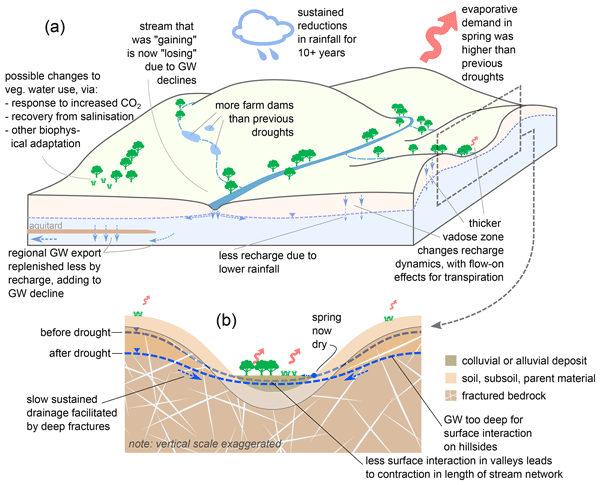
Recently, we have seen multi-year droughts tending to cause shifts in the relationship between rainfall and streamflow. In shifted catchments that have not recovered, an average rainfall year produces less streamflow today than it did pre-drought. We take a multi-disciplinary approach to understand why these shifts occur, focusing on Australia's over-10-year Millennium Drought. We evaluate multiple hypotheses against evidence, with particular focus on the key role of groundwater processes.
Cited articles
Ambroise, B.: Variable water-saturated areas and streamflow generation in the small Ringelbach catchment (Vosges Mountains, France): the master recession curve as an equilibrium curve for interactions between atmosphere, surface and ground waters, Hydrol. Process., 30, 3560–3577, 2016.
Arnold, J. G., Allen, P. M., Muttiah, R., and Bernhardt, G.: Automated base flow separation and recession analysis techniques, Groundwater, 33, 1010–1018, 1995.
Barnes, B. S.: The structure of discharge-recession curves, Transactions AGU, 20, 721–725, 1939.
Bart, R. and Hope, A.: Inter-seasonal variability in baseflow recession rates: The role of aquifer antecedent storage in central California watersheds, J. Hydrol., 519, 205–213, 2014.
Beran, M. A. and Gustard, A.: A study into the low-flow characteristics of British Rivers, J. Hydrol., 35, 147–157, 1977.
Berhail, S., Ouerdachi, L., and Boutaghane, H.: The use of the recession index as indicator for components of flow, Energy Procedia, 18, 741–750, 2012.
Boughton, W. C.: Baseflow recessions, Austral. Civ. Eng. T., CE37, 9–13, 1995.
Boughton, W. C.: Master recession analysis of transmission loss in some Australian streams, Austral. J. Water Resour., 19, 43–51, 2015.
Brodie, R. S. and Hostetler, S.: A review of techniques for analysing baseflow from stream hydrographs, Proceeding of the NZHS305 IAHNZSSS, 2005 Conference, 28 November–2 December 2005, Auckland, New Zealand, ISBN 9780473106270, 2005.
Brown, H. E.: Characteristics of Recession Flows from Small Watersheds in a Semiarid Region of Arizona, Water Resour. Res., 1, 517–522, 1965.
Brutsaert, W. and Nieber, J. L.: Regionalized drought flow hydrographs from a mature glaciated plateau, Water Resour. Res., 13, 637–643, 1977.
Brutsaert, W. and Lopez, J. P.: Basin-scale geohydrologic drought flow features of riparian aquifers in the southern Great Plains, Water Resour. Res., 34, 233–240, https://doi.org/10.1029/97WR03068, 1998.
Callow, J. N., Pope, T., and Coles, N. A.: Surface water flow redistribution processes: Toolibin Lake natural diversity recovery catchment, CER 07/01 – SESE129, Report by the ARWA – Centre for Ecohydrology for the Department of Environment and Conservation, Perth, Western Australia, 2007.
Callow, J. N., Hipsey, M. R., and Vogwill, R. I. J.: Surface water as a cause of land degradation from dryland salinity, Hydrol. Earth Syst. Sci., 24, 717–734, https://doi.org/10.5194/hess-24-717-2020, 2020.
Carlotto, T. and Chaffe, P. L. B.: Master recession curve parameterization tool (MRCPtool): Different approaches to recession curve analysis, Comput. Geosci.-UK, 132, 1–8, 2019.
Chapman, T. G.: Modelling stream recession flows, Environ. Modell. Softw., 18, 683–692, 2003.
Chen, X., Zhang, Y.-F., Xue, X., Zhang, Z., and Wei, L.: Estimation of baseflow recession constants and effective hydraulic parameters in the karst basins of southwest China, Hydrol. Res., 43, 102–112, https://doi.org/10.2166/nh.2011.136, 2012.
Chow, V. T., Maidment, D. R., and Mays, L. W.: Applied Hydrology, McGraw-Hill Book Co, ISBN 0-07-010810-2, 1988.
Duncan, H.: Baseflow separation – A practical approach, J. Hydrol., 575, 308–313, 2019.
Federer, C. A.: Forest transpiration greatly speeds streamflow recession, Water Resour. Res., 9, 1599–1604, 1973.
Fiorotto, V. and Caroni, E.: A new approach to master recession curve analysis, Hydrolog. Sci. J., 58, 966–975, https://doi.org/10.1080/02626667.2013.788248, 2013.
French, R.: Discussion on “Master recession analysis of transmission loss in some Australian streams” by W. Boughton, Austral. J. Water Resour., 19, 150–152, 2015.
Gao, M., Chen, X., Liu, J., Zhang, Z., and Cheng, Q.: Using Two Parallel Linear Reservoirs to Express Multiple Relations of Power-Law Recession Curve, J. Hydrol. Eng., 22, 04017013, https://doi.org/10.1061/(ASCE)HE.1943-5584.0001518, 2017.
Gao, M., Chen, X., Singh, S. K., Dong, J., and Wei, L.: A probabilistic framework for robust master recession curve parameterization, J. Hydrol., 625, https://doi.org/10.1016/j.jhydrol.2023.129922, 2023.
George, R. J. and Conacher, A. J.: Mechanisms responsible for streamflow generation on a small, salt-affected and deeply weathered hillslope, Earth Surf. Proc. Landf., 18, 291–309, 1993.
Gregor, M. and Malik, P.: Construction of master recession curve using genetic algorithms, J. Hydrol. Hydromech., 60, 3–15, https://doi.org/10.2478/v10098-012-0001-8, 2012.
Griffiths, G. A. and McKerchar, A. T.: Recession of streamflow supplied from channel bed and bank storage, J. Hydrol. (NZ), 49, 99–109, 2010.
Griffiths, G. A. and McKerchar, A. T.: Comparison of a deterministic and a statistical model for predicting streamflow recession curves, J. Hydrol. (NZ), 54, 53–62, 2015.
Grundy, F.: The ground-water depletion curve, its construction and uses, Assemblee Gen. De Bruxelles, International Association of Hydrological Sciences, 2, 213–217, 1951.
Hall, F. R.: Base flow recession – a review, Water Resour. Res., 4, 973–983, 1968.
Hameed, M., Nayak, M. A., and Ahanger, M. A.: Event-based recession analysis for estimation of basin-wide characteristic drainage timescale and groundwater storage trends, Water Resour. Res., 59, e2023WR035829, https://doi.org/10.1029/2023WR035829, 2023.
Horner, W. W. and Flynt, F. L.: Relation between rainfall and runoff from small urban areas, Transactions ASCE, Paper 1926, 141–183, 1936.
Horton, R. E.: The role of infiltration in the hydrologic cycle, Trans. Amer. Geophys. Union, 14, 446–460, 1933.
Institute of Hydrology: Low Flow Studies Report, Wallingford, UK, https://nora.nerc.ac.uk/id/eprint/9093 (last access: 27 January 2026), 1980.
James, L. D. and Thompson, W. O.: Least Squares Estimation of Constants in a Linear Recession Model, Water Resour. Res., 6, 1062–1069, 1970.
Johnson, E. A. and Dils, R. E.: Outline for compiling precipitation, runoff, and groundwater data from small watersheds, Southeastern Forest Expt., Paper 68, 1956.
Kavousi, A. and Raeisi, E.: Estimation of groundwater mean residence time in unconfined Karst aquifers using recession curves, J. Cave Karst Stud., 77, 108–119, 2015.
Kienzle, S.: The use of the recession index as an indicator for streamflow recovery after a multi-Year drought, Water Resour. Manag., 20, 991–1006, https://doi.org/10.1007/s11269-006-9019-1, 2006.
Kim, M., Bauser, H. H., Bevan, K., and Troch, P. A.: Time-variability of flow recession dynamics: Application of machine learning and learning from the machine, Water Resour. Res., 59, e2022WR032690, https://doi.org/10.1029/2022WR032690, 2023.
Knisel, W. G.: Baseflow recession analysis for comparison of drainage basins and geology, J. Geophys. Res., 68, 3649–3653, 1963.
Lamb, R. and Beven, K.: Using interactive recession curve analysis to specify a general catchment storage model, Hydrol. Earth Syst. Sci., 1, 101–113, https://doi.org/10.5194/hess-1-101-1997, 1997.
Langbein, W. B.: Some channel storage studies and their application to the determination of infiltration, Trans. AGU (EOS), 19, 435–447, 1938.
Latuamury, B., Mardiatmoko, G., and Kastanya, A.: Comparing master recession curves usings baseflow recession models, Indonesian J. Geog., 56, 219–228, 2024.
Linsley, R. K., Kohler, M. A., and Paulhus, J. L. H.: Hydrology for Engineers, McGraw-Hill Book Company Inc, New York-Toronto-London, ISBN 0833009230, 1958.
Linsley, R. K., Kohler, M. A., and Paulhus, J. L. H.: Hydrology for Engineers, 2nd edn., McGraw-Hill Book Company Inc, New York-Toronto-London, ISBN 0-07-037956-4, 1982.
Margreth, M., Lustenberger, F., Hug Peter, D., Schlunegger, F., and Zappa, M.: Applying recession models for low-flow prediction: a comparison of regression and matching strip approaches, Nat. Hazards Earth Syst. Sci. Discuss. [preprint], https://doi.org/10.5194/nhess-2024-78, in review, 2024.
McMahon, T. A. and Peel, M. C.: Uncertainty in stage–discharge rating curves: application to Australian Hydrologic Reference Stations data, Hydrol. Sci. J., 64, 255–275, https://doi.org/10.1080/02626667.2019.1577555, 2019.
McMahon, T. A. and Nathan, R. J.: Baseflow and transmission loss: A review, WIREs Water, 8, e1527, https://doi.org/10.1002/wat2.1527, 2021.
McMahon, T. A. and Nathan, R. J.: Estimating hydraulic properties and residence times of unconfined aquifers, J. Hydrol., 654, 132861, https://doi.org/10.1016/j.jhydrol.2025.132861, 2025.
Millares, A., Polo, M. J., and Losada, M. A.: The hydrological response of baseflow in fractured mountain areas, Hydrol. Earth Syst. Sci., 13, 1261–1271, https://doi.org/10.5194/hess-13-1261-2009, 2009.
Mizumura, K.: Analyses of Flow Mechanism Based on Master Recession Curves, J. Hydrol. Eng., 10, 468–476, 2005.
Moore, R. D.: Storage-outflow modelling of streamflow recessions, with application to a shallow-soil forested catchment, J. Hydrol., 198, 260–270, 1997.
Nash, J. E. and Sutcliffe, J. V.: River flow forecasting through conceptual models, Part I – a discussion of principles, J. Hydrol., 10, 282–290, 1970.
Nathan, R. J. and McMahon, T. A.: Evaluation of automated techniques for base flow and recession analysis, Water Resour. Res., 26, 360, 1465–1473, 1990.
Nimmo, J. R. and Perkins, K. S.: Episodic master recession evaluation of groundwater and streamflow hydrographs for water-resource estimation, Vadose Zone J., 17, 180050, https://doi.org/10.2136/vzj2018.03.0050, 2018.
O'Brien, R. J., Misstear, B. D., Gill, L. W., Johnston, P. M., and Flynn, R.: Quantifying flows along hydrological pathways by applying a new filtering algorithm in conjunction with master recession curve analysis, Hydrol. Process., 28, 6211–6221, 2014.
Parra, V., Munoz, E., Arumí, J. L., and Medina, Y.: Analysis of the behavior of groundwater storage systems at different time scales in basins of South Central Chile: A study based on flow recession records, Water, 15, 2503, https://doi.org/10.3390/w15142503, 2023.
Peel, M. C., Finlayson, B. L., and McMahon, T. A.: Updated world map of the Köppen-Geiger climate classification, Hydrol. Earth Syst. Sci., 11, 1633–1644, https://doi.org/10.5194/hess-11-1633-2007, 2007.
Pereira, L. S. and Keller, H. M.: Recession characterization of small mountain basins, derivation of master recession curves and optimization of recession parameters, Proc. Exeter Symposium, IAHS Publ., 138, 243–255, 1982.
Petras, I.: An approach to the mathematical expression of recession curves, Water SA, 12, 145–150, 1986.
Posavec, K., Parlov, J., and Nakić, Z.: Fully automated objective-based method for master recession curve separation, Ground Water, 48, 598–603, 2010.
Rupp, D. E., Schmidt, J., Woods, R. A., and Bidwell, V. J.: Analytical assessment and parameter estimation of a low-dimensional groundwater model, J. Hydrol., 377, 143–154, https://doi.org/10.1016/j.jhydrol.2009.08.018, 2009.
Shaw, E. M.: Hydrology in Practice, 3rd edn., Chapman & Hall, London, ISBN 0-412-48290-8, 1994.
Singh, S. K. and Griffiths, G. A.: Prediction of streamflow recession curves in gauged and ungauged basins, Water Resour. Res., 57, https://doi.org/10.1029/2021WR030618, 2021.
Smakhtin, V. U.: Low flow hydrology: a review, J. Hydrol., 240, 147–186, 2001.
Snyder, W. M.: A concept of runoff-phenomena, Trans. Amer. Geophys. Union (EOS), 20, 725–738, 1939.
Snyder, W. M.: Some possibilities for multivariate analysis in hydrologic studies, J. Geophys. Res., 67, 721–729, 1962.
Strahler, A. N.: Quantitative analysis of water shed geomorphology, Trans. Amer. Geophys. Union, 38, 913–920, 1957.
Sujono, J., Shikasho, S., and Hiramatsu, K.: A comparison of techniques for hydrograph recession analysis, Hydrol. Process., 18, 403–413, 2004.
Tallaksen, L. M.: A review of baseflow recession analysis, J. Hydrol., 165, 349–370, 1995.
Toebes, C. and Strang, D. D.: On recession curves 1: Recession equations, J. Hydrol. (NZ), 3, 2–15, 1964.
Trotter, L., Saft, M., Peel, M. C., and Fowler, K. J. A.: Recession constants are non-stationary: Impacts of multi-annual drought on catchment recession behaviour and storage dynamics, J. Hydrol., 630, https://doi.org/10.1016/j.jhydrol.2024.130707, 2024.
van Dijk, A. I. J. M.: Climate and terrain factors explaining streamflow response and recession in Australian catchments, Hydrol. Earth Syst. Sci., 14, 159–169, https://doi.org/10.5194/hess-14-159-2010, 2010.
Wang, Q. J., Chiew, F. H. S., McConachy, F. L. N., James, R., de Hoedt, G. C., and Wright, W. J.: Climatic Atlas of Australia Evapotranspiration, Cooperative Research Centre for Catchment Hydrology and Bureau of Meteorology (Australia), 2001.
Whitaker, A. C., Chapasa, S. N., Sagras, C., Theogene, U., Veremu, R., and Sugiyama, H.: Estimation of base flow recession constant and regression of low flow indices in eastern Japan, Hydrol. Sci. J., 67, 191–204, https://doi.org/10.1080/02626667.2021.2003368, 2022.
Yang, D., Lee, S., Lee, G., Lim, J., Lim, K. J., and Kim, K.-S.: Estimation of Baseflow based on Master Recession Curves (MRCs) Considering Seasonality and Flow Condition, J. Wetland Res., 21, 34–42, 2019.
Short summary
Master Recession Curves have long been used to estimate the decline in streamflows following rainfall. Although the approach has wide practical application in water management, it can be overly simple and not match all observations. We propose an approach that represents the changes in streamflow behaviour due to variations in climate and geology. The approach matches observed behaviour well, is consistent with field observations, and is well suited to uncertainty analysis.
Master Recession Curves have long been used to estimate the decline in streamflows following...