
Articles | Volume 30, issue 20
https://doi.org/10.5194/hess-30-6579-2026
© Author(s) 2026. This work is distributed under
the Creative Commons Attribution 4.0 License.
the Creative Commons Attribution 4.0 License.
https://doi.org/10.5194/hess-30-6579-2026
© Author(s) 2026. This work is distributed under
the Creative Commons Attribution 4.0 License.
the Creative Commons Attribution 4.0 License.
Technical note
| Highlight paper
| 
27 Oct 2026
Technical note | Highlight paper |
| 27 Oct 2026
| 27 Oct 2026
Technical note: Machine learning metamodelling for global sensitivity analysis
Patricio Yeste
CORRESPONDING AUTHOR

Institute of Environmental Science and Geography, University of Potsdam, Karl-Liebknecht-Straße 24–25, 14476 Potsdam, Germany
GFZ Helmholtz Centre for Geosciences, 14473 Potsdam, Germany
Department of Applied Physics, University of Granada, Granada, Spain
Lieke A. Melsen
Hydrology and Environmental Hydraulics Group, Wageningen University, Wageningen, the Netherlands
João Paulo L. F. Brêda
Instituto de Pesquisas Hidráulicas, Universidade Federal do Rio Grande do Sul (IPH/UFRGS), Porto Alegre, Brazil
Nicolás Tacoronte
Department of Applied Physics, University of Granada, Granada, Spain
Andrea Saltelli
University Pompeu Fabra, Barcelona School of Management, Carrer de Balmes, 132, 08008 Barcelona, Spain
Centre for the Study of the Sciences and the Humanities, University of Bergen, Parkveien 9, PB 7805, 5020 Bergen, Norway
Giulia Vannucci
Department of Electrical Engineering and Information Technology, Polytechnic and Basic Sciences School, University of Naples Federico II, Via Claudio, 21, 80125 Napoli, Italy
Roberta Siciliano
Department of Electrical Engineering and Information Technology, Polytechnic and Basic Sciences School, University of Naples Federico II, Via Claudio, 21, 80125 Napoli, Italy
Axel Bronstert
Institute of Environmental Science and Geography, University of Potsdam, Karl-Liebknecht-Straße 24–25, 14476 Potsdam, Germany
Related authors
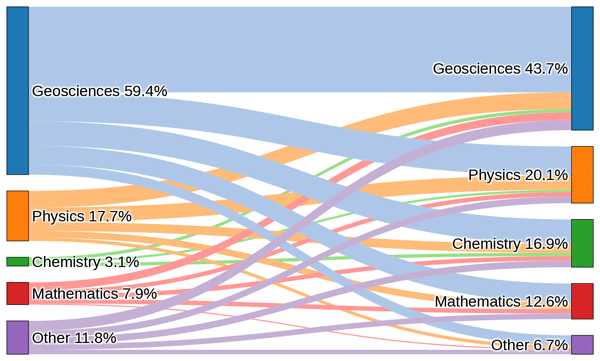
Inge Wiekenkamp, Valby van Schijndel, Jacob Hardt, Jonas Kuppler, Ramesh Glückler, Izabella Baisheva, Patricio Yeste, Paul Einhäupl, Maria Rosa Scicchitano, and Simeon Lisovski
Geosci. Commun., 9, 461–471, https://doi.org/10.5194/gc-9-461-2026, https://doi.org/10.5194/gc-9-461-2026, 2026
Short summary
Short summary
We conducted a survey on the topic of “interdisciplinarity” among early-career researchers in order to learn about their experiences. There are very different views on what interdisciplinarity means and many positive aspects are cited that enhance research, but there are also a few obstacles when it comes to communication, time management, and publication. It is precisely these obstacles that should be given greater consideration in education and research funding.
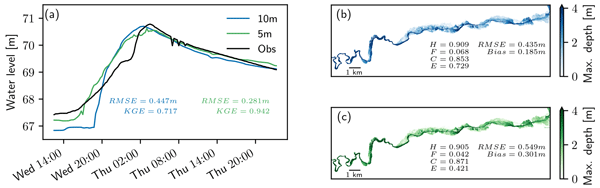
Shahin Khosh Bin Ghomash, Patricio Yeste, Heiko Apel, and Viet Dung Nguyen
Nat. Hazards Earth Syst. Sci., 25, 975–990, https://doi.org/10.5194/nhess-25-975-2025, https://doi.org/10.5194/nhess-25-975-2025, 2025
Short summary
Short summary
Hydrodynamic models are vital for predicting floods, like those in Germany's Ahr region in July 2021. We refine the RIM2D model for the Ahr region, analyzing the impact of various factors using Monte Carlo simulations. Accurate parameter assignment is crucial, with channel roughness and resolution playing key roles. Coarser resolutions are suitable for flood extent predictions, aiding early-warning systems. Our work provides guidelines for optimizing hydrodynamic models in the Ahr region.
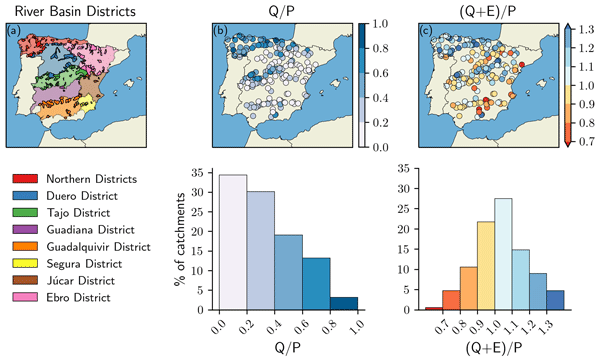
Patricio Yeste, Matilde García-Valdecasas Ojeda, Sonia R. Gámiz-Fortis, Yolanda Castro-Díez, Axel Bronstert, and María Jesús Esteban-Parra
Hydrol. Earth Syst. Sci., 28, 5331–5352, https://doi.org/10.5194/hess-28-5331-2024, https://doi.org/10.5194/hess-28-5331-2024, 2024
Short summary
Short summary
Integrating streamflow and evaporation data can help improve the physical realism of hydrologic models. We investigate the capabilities of the Variable Infiltration Capacity (VIC) to reproduce both hydrologic variables for 189 headwater located in Spain. Results from sensitivity analyses indicate that adding two vegetation parameters is enough to improve the representation of evaporation and that the performance of VIC exceeded that of the largest modelling effort currently available in Spain.
Inge Wiekenkamp, Valby van Schijndel, Jacob Hardt, Jonas Kuppler, Ramesh Glückler, Izabella Baisheva, Patricio Yeste, Paul Einhäupl, Maria Rosa Scicchitano, and Simeon Lisovski
Geosci. Commun., 9, 461–471, https://doi.org/10.5194/gc-9-461-2026, https://doi.org/10.5194/gc-9-461-2026, 2026
Short summary
Short summary
We conducted a survey on the topic of “interdisciplinarity” among early-career researchers in order to learn about their experiences. There are very different views on what interdisciplinarity means and many positive aspects are cited that enhance research, but there are also a few obstacles when it comes to communication, time management, and publication. It is precisely these obstacles that should be given greater consideration in education and research funding.
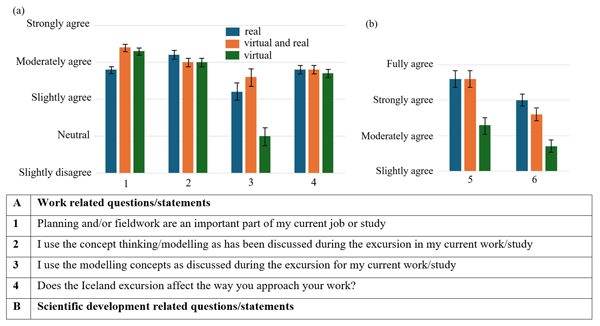
Roel Dijksma, Adriaan J. Teuling, Lieke A. Melsen, Victor F. Bense, and Martine J. van der Ploeg
Geosci. Commun., 9, 437–450, https://doi.org/10.5194/gc-9-437-2026, https://doi.org/10.5194/gc-9-437-2026, 2026
Short summary
Short summary
Scientific field work is an expensive and time consuming teaching method is the scientific community. A survey among former participants of a hydrological Master excursion to Iceland, organized by Wageningen University (the Netherlands) showed that real excursions have a long lasting impact on the scientific development of students, in contrast to virtual excursions. As quoted by one of the participants: "You can learn a lot in a classroom, but an excursion makes you remember".
Sophia Dobkowitz, Leon Frederik De Vos, Deva Charan Jarajapu, Sarah Lindenlaub, Guilherme Samprogna Mohor, Omar Seleem, and Axel Bronstert
Hydrol. Earth Syst. Sci., 30, 3041–3060, https://doi.org/10.5194/hess-30-3041-2026, https://doi.org/10.5194/hess-30-3041-2026, 2026
Short summary
Short summary
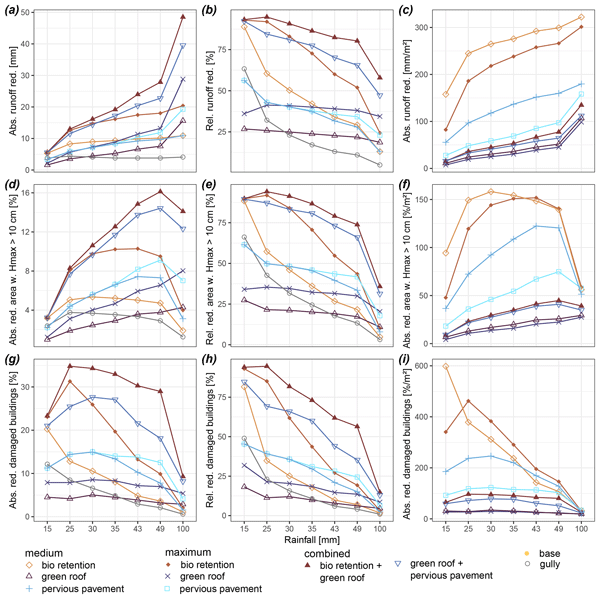
Surface sealing makes cities vulnerable to flooding caused by heavy rain. Green infrastructure, such as green roofs, can reduce flooding. This modelling study investigates the potential of green infrastructure to reduce runoff, flood water depth and building damage. Bioretention systems turned out to be the most space efficient compared to green roofs and pervious pavement. For larger rain events, more green infrastructure implementation is needed to achieve relevant flood mitigation.
Amalie Skålevåg, Lena Katharina Schmidt, Nele Eggers, Jana Tjeda Brettin, Oliver Korup, and Axel Bronstert
Hydrol. Earth Syst. Sci., 30, 2717–2739, https://doi.org/10.5194/hess-30-2717-2026, https://doi.org/10.5194/hess-30-2717-2026, 2026
Short summary
Short summary
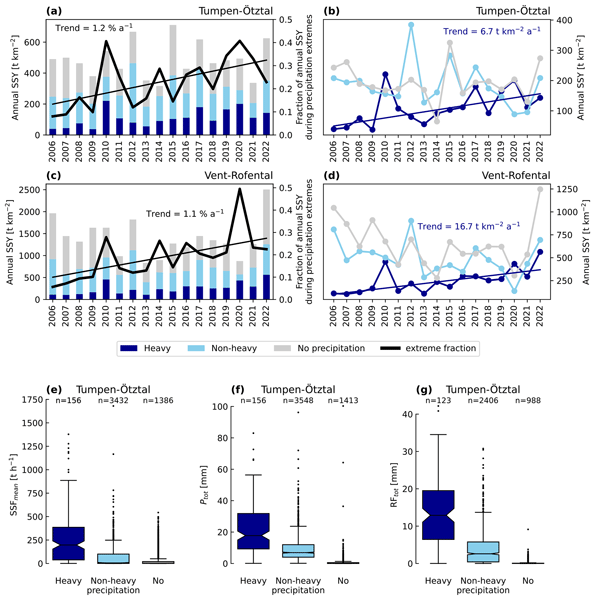
As glaciers retreat in mountain regions, heavy rainstorms increasingly control how much soil and sediment rivers carry downstream. We analysed rainfall and sediment data over 21 years in the Austrian Alps and found heavy precipitation events becoming more important for sediment movement, although total annual suspended sediment transport is declining as glaciers shrink. This shift may increase flood hazards, affecting ecosystems and water quality downstream.
Janneke O. E. Remmers, Rozemarijn ter Horst, Ehsan Nabavi, Ulrike Proske, Adriaan J. Teuling, Jeroen Vos, and Lieke A. Melsen
Hydrol. Earth Syst. Sci., 29, 5371–5382, https://doi.org/10.5194/hess-29-5371-2025, https://doi.org/10.5194/hess-29-5371-2025, 2025
Short summary
Short summary
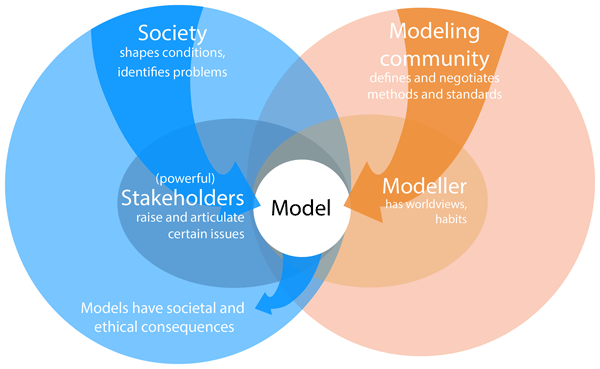
Hydrological models are generally seen as neutral, despite acknowledged uncertainties. This notion has several, possibly harmful, consequences. In critical social sciences, non-neutrality in methods and results is an established topic of debate. We propose that in order to deal with it in hydrological modelling, the hydrological modelling network can learn from, and with, critical social sciences. The main lesson, from our perspective, is that responsible modelling is a shared responsibility.
Shahin Khosh Bin Ghomash, Patricio Yeste, Heiko Apel, and Viet Dung Nguyen
Nat. Hazards Earth Syst. Sci., 25, 975–990, https://doi.org/10.5194/nhess-25-975-2025, https://doi.org/10.5194/nhess-25-975-2025, 2025
Short summary
Short summary
Hydrodynamic models are vital for predicting floods, like those in Germany's Ahr region in July 2021. We refine the RIM2D model for the Ahr region, analyzing the impact of various factors using Monte Carlo simulations. Accurate parameter assignment is crucial, with channel roughness and resolution playing key roles. Coarser resolutions are suitable for flood extent predictions, aiding early-warning systems. Our work provides guidelines for optimizing hydrodynamic models in the Ahr region.
Sarra Kchouk, Louise Cavalcante, Lieke A. Melsen, David W. Walker, Germano Ribeiro Neto, Rubens Gondim, Wouter J. Smolenaars, and Pieter R. van Oel
Nat. Hazards Earth Syst. Sci., 25, 893–912, https://doi.org/10.5194/nhess-25-893-2025, https://doi.org/10.5194/nhess-25-893-2025, 2025
Short summary
Short summary
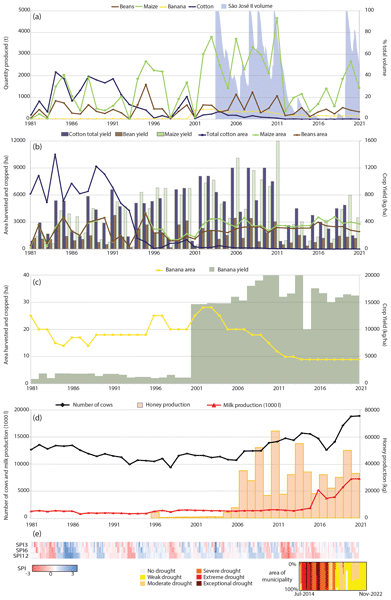
Droughts impact water and people, yet monitoring often overlooks impacts on people. In northeastern Brazil, we compare official data to local experiences, finding data mismatches and blind spots. Mismatches occur due to the data's broad scope missing finer details. Blind spots arise from ignoring diverse community responses and vulnerabilities to droughts. We suggest enhanced monitoring by technical extension officers for both severe and mild droughts.
Patricio Yeste, Matilde García-Valdecasas Ojeda, Sonia R. Gámiz-Fortis, Yolanda Castro-Díez, Axel Bronstert, and María Jesús Esteban-Parra
Hydrol. Earth Syst. Sci., 28, 5331–5352, https://doi.org/10.5194/hess-28-5331-2024, https://doi.org/10.5194/hess-28-5331-2024, 2024
Short summary
Short summary
Integrating streamflow and evaporation data can help improve the physical realism of hydrologic models. We investigate the capabilities of the Variable Infiltration Capacity (VIC) to reproduce both hydrologic variables for 189 headwater located in Spain. Results from sensitivity analyses indicate that adding two vegetation parameters is enough to improve the representation of evaporation and that the performance of VIC exceeded that of the largest modelling effort currently available in Spain.

Amalie Skålevåg, Oliver Korup, and Axel Bronstert
Hydrol. Earth Syst. Sci., 28, 4771–4796, https://doi.org/10.5194/hess-28-4771-2024, https://doi.org/10.5194/hess-28-4771-2024, 2024
Short summary
Short summary
We present a cluster-based approach for inferring sediment discharge event types from suspended sediment concentration and streamflow. Applying it to a glacierised catchment, we find event magnitude and shape complexity to be the key characteristics separating event types, while hysteresis is less important. The four event types are attributed to compound rainfall–melt extremes, high snowmelt and glacier melt, freeze–thaw-modulated snow-melt and precipitation, and late-season glacier melt.
Lena Katharina Schmidt, Till Francke, Peter Martin Grosse, and Axel Bronstert
Hydrol. Earth Syst. Sci., 28, 139–161, https://doi.org/10.5194/hess-28-139-2024, https://doi.org/10.5194/hess-28-139-2024, 2024
Short summary
Short summary
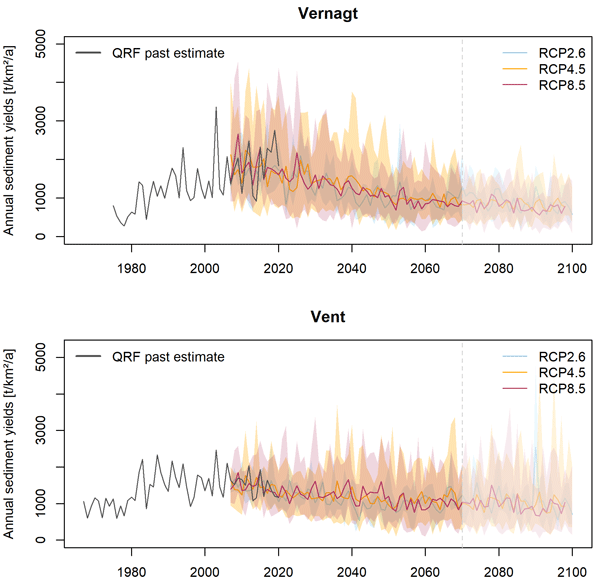
How suspended sediment export from glacierized high-alpine areas responds to future climate change is hardly assessable as many interacting processes are involved, and appropriate physical models are lacking. We present the first study, to our knowledge, exploring machine learning to project sediment export until 2100 in two high-alpine catchments. We find that uncertainties due to methodological limitations are small until 2070. Negative trends imply that peak sediment may have already passed.
Germano G. Ribeiro Neto, Sarra Kchouk, Lieke A. Melsen, Louise Cavalcante, David W. Walker, Art Dewulf, Alexandre C. Costa, Eduardo S. P. R. Martins, and Pieter R. van Oel
Hydrol. Earth Syst. Sci., 27, 4217–4225, https://doi.org/10.5194/hess-27-4217-2023, https://doi.org/10.5194/hess-27-4217-2023, 2023
Short summary
Short summary
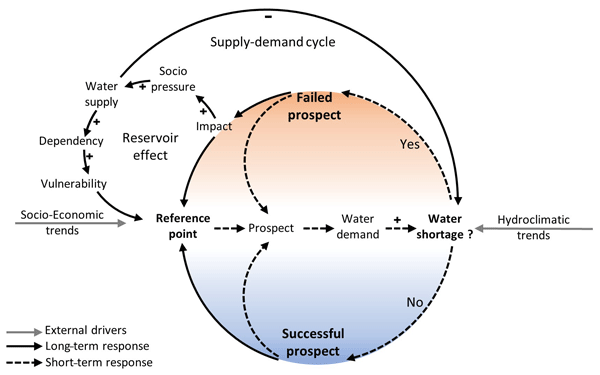
People induce and modify droughts. However, we do not know exactly how relevant human and natural processes interact nor how to evaluate the co-evolution of people and water. Prospect theory can help us to explain the emergence of drought impacts leading to failed welfare expectations (“prospects”) due to water shortage. Our approach helps to explain socio-hydrological phenomena, such as reservoir effects, and can contribute to integrated drought management considering the local context.
Awad M. Ali, Lieke A. Melsen, and Adriaan J. Teuling
Hydrol. Earth Syst. Sci., 27, 4057–4086, https://doi.org/10.5194/hess-27-4057-2023, https://doi.org/10.5194/hess-27-4057-2023, 2023
Short summary
Short summary
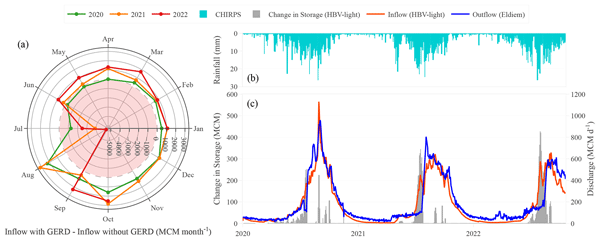
Using a new approach based on a combination of modeling and Earth observation, useful information about the filling of the Grand Ethiopian Renaissance Dam can be obtained with limited data and proper rainfall selection. While the monthly streamflow into Sudan has decreased significantly (1.2 × 10⁹–5 × 10⁹ m3) with respect to the non-dam scenario, the negative impact has been masked due to higher-than-average rainfall. We reveal that the dam will need 3–5 more years to complete filling.

Lena Katharina Schmidt, Till Francke, Peter Martin Grosse, Christoph Mayer, and Axel Bronstert
Hydrol. Earth Syst. Sci., 27, 1841–1863, https://doi.org/10.5194/hess-27-1841-2023, https://doi.org/10.5194/hess-27-1841-2023, 2023
Short summary
Short summary
We present a suitable method to reconstruct sediment export from decadal records of hydroclimatic predictors (discharge, precipitation, temperature) and shorter suspended sediment measurements. This lets us fill the knowledge gap on how sediment export from glacierized high-alpine areas has responded to climate change. We find positive trends in sediment export from the two investigated nested catchments with step-like increases around 1981 which are linked to crucial changes in glacier melt.
Omar Seleem, Georgy Ayzel, Axel Bronstert, and Maik Heistermann
Nat. Hazards Earth Syst. Sci., 23, 809–822, https://doi.org/10.5194/nhess-23-809-2023, https://doi.org/10.5194/nhess-23-809-2023, 2023
Short summary
Short summary
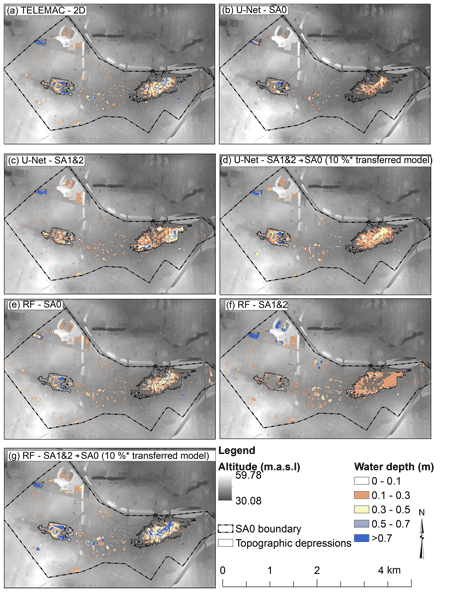
Data-driven models are becoming more of a surrogate that overcomes the limitations of the computationally expensive 2D hydrodynamic models to map urban flood hazards. However, the model's ability to generalize outside the training domain is still a major challenge. We evaluate the performance of random forest and convolutional neural networks to predict urban floodwater depth and investigate their transferability outside the training domain.
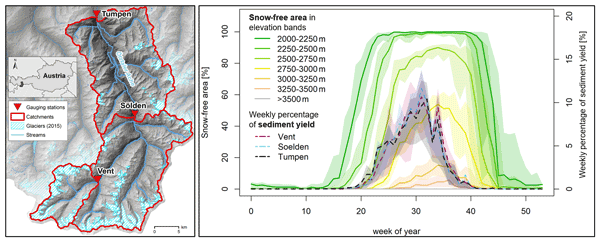
Lena Katharina Schmidt, Till Francke, Erwin Rottler, Theresa Blume, Johannes Schöber, and Axel Bronstert
Earth Surf. Dynam., 10, 653–669, https://doi.org/10.5194/esurf-10-653-2022, https://doi.org/10.5194/esurf-10-653-2022, 2022
Short summary
Short summary
Climate change fundamentally alters glaciated high-alpine areas, but it is unclear how this affects riverine sediment transport. As a first step, we aimed to identify the most important processes and source areas in three nested catchments in the Ötztal, Austria, in the past 15 years. We found that areas above 2500 m were crucial and that summer rainstorms were less influential than glacier melt. These findings provide a baseline for studies on future changes in high-alpine sediment dynamics.
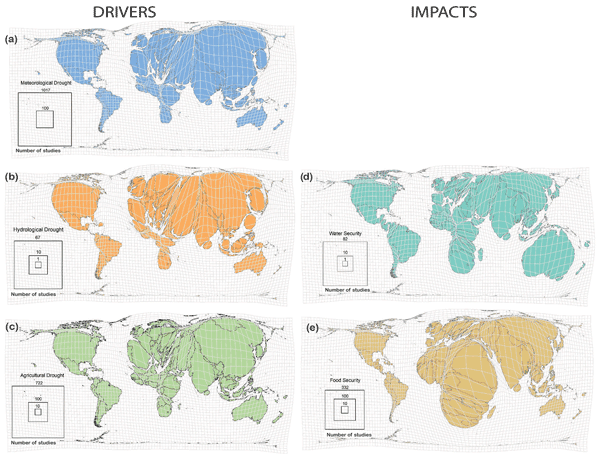
Sarra Kchouk, Lieke A. Melsen, David W. Walker, and Pieter R. van Oel
Nat. Hazards Earth Syst. Sci., 22, 323–344, https://doi.org/10.5194/nhess-22-323-2022, https://doi.org/10.5194/nhess-22-323-2022, 2022
Short summary
Short summary
The aim of our study was to question the validity of the assumed direct linkage between drivers of drought and its impacts on water and food securities, mainly found in the frameworks of drought early warning systems (DEWSs). We analysed more than 5000 scientific studies leading us to the conclusion that the local context can contribute to drought drivers resulting in these drought impacts. Our research aims to increase the relevance and utility of the information provided by DEWSs.
Cited articles
Abadi, M., Agarwal, A., Barham, P., Brevdo, E., Chen, Z., Citro, C., Corrado, G. S., Davis, A., Dean, J., Devin, M., Ghemawat, S., Goodfellow, I., Harp, A., Irving, G., Isard, M., Jia, Y., Jozefowicz, R., Kaiser, L., Kudlur, M., Levenberg, J., Mane, D., Monga, R., Moore, S., Murray, D., Olah, C., Schuster, M., Shlens, J., Steiner, B., Sutskever, I., Talwar, K., Tucker, P., Vanhoucke, V., Vasudevan, V., Viegas, F., Vinyals, O., Warden, P., Wattenberg, M., Wicke, M., Yu, Y., and Zheng, X.: TensorFlow: Large-Scale Machine Learning on Heterogeneous Distributed Systems, arXiv [preprint], https://doi.org/10.48550/arXiv.1603.04467, 2016. a
Addor, N., Nearing, G., Prieto, C., Newman, A. J., Le Vine, N., and Clark, M. P.: A Ranking of Hydrological Signatures Based on Their Predictability in Space, Water Resour. Res., 54, 8792–8812, https://doi.org/10.1029/2018WR022606, 2018. a
Antoniadis, A., Lambert-Lacroix, S., and Poggi, J.-M.: Random forests for global sensitivity analysis: A selective review, Reliab. Eng. Syst. Safe., 206, 107312, https://doi.org/10.1016/j.ress.2020.107312, 2021. a, b, c
Azzini, I., Mara, T. A., and Rosati, R.: Comparison of two sets of Monte Carlo estimators of Sobol’ indices, Environ. Model. Softw., 144, 105 167, https://doi.org/10.1016/j.envsoft.2021.105167, 2021. a
Benoumechiara, N.: Treatment of dependency in sensitivity analysis for industrial reliability, PhD thesis, Sorbonne Université, https://doi.org/10.70675/d5422653z5ecfz41a6z9e5czba00e20b0650 2019. a
Bertsekas, D. and Tsitsiklis, J. N.: Introduction to Probability, Athena Scientific, ISBN 978-1-886529-23-6, 2008. a
Borgonovo, E., Castaings, W., and Tarantola, S.: Moment Independent Importance Measures: New Results and Analytical Test Cases, Risk Analysis, 31, 404–428, https://doi.org/10.1111/j.1539-6924.2010.01519.x, 2011. a
Brêda, J. P. L. F., Melsen, L. A., Athanasiadis, I., Van Dijk, A., Siqueira, V. A., Verhoef, A., Zeng, Y., and van der Ploeg, M.: Predictor Importance for Hydrological Fluxes of Global Hydrological and Land Surface Models, Water Resour. Res., 60, https://doi.org/10.1029/2023WR036418, 2024. a
Breiman, L.: Random Forests, Mach. Learn., 45, 5–32, https://doi.org/10.1023/A:1010933404324, 2001. a
Chastaing, G., Gamboa, F., and Prieur, C.: Generalized Sobol sensitivity indices for dependent variables: numerical methods, J. Stat. Comput. Simul., 85, 1306–1333, https://doi.org/10.1080/00949655.2014.960415, 2015. a
Chen, T. and Guestrin, C.: XGBoost: A Scalable Tree Boosting System, in: Proceedings of the 22nd ACM SIGKDD International Conference on Knowledge Discovery and Data Mining, 785–794, Assoc. Comput. Mach., https://doi.org/10.1145/2939672.2939785, 2016. a
Dell'Oca, A., Guadagnini, A., and Riva, M.: Copula density-driven metrics for sensitivity analysis: Theory and application to flow and transport in porous media, Adv. Water Res., 145, 103714, https://doi.org/10.1016/j.advwatres.2020.103714, 2020. a
Farahani, M. A., Wood, A. W., Tang, G., and Mizukami, N.: Calibrating a large-domain land/hydrology process model in the age of AI: the SUMMA CAMELS emulator experiments, Hydrol. Earth Syst. Sci., 29, 4515–4537, https://doi.org/10.5194/hess-29-4515-2025, 2025. a
Gu, H., Xu, Y.-P., Ma, D., Xie, J., Liu, L., and Bai, Z.: A surrogate model for the Variable Infiltration Capacity model using deep learning artificial neural network, J. Hydrol., 588, 125019, https://doi.org/10.1016/j.jhydrol.2020.125019, 2020. a
Hamman, J. J., Nijssen, B., Bohn, T. J., Gergel, D. R., and Mao, Y.: The Variable Infiltration Capacity model version 5 (VIC-5): infrastructure improvements for new applications and reproducibility, Geosci. Model Dev., 11, 3481–3496, https://doi.org/10.5194/gmd-11-3481-2018, 2018. a
Herman, J. and Usher, W.: SALib: An open-source Python library for Sensitivity Analysis, Journal of Open Source Software, 2, 97, https://doi.org/10.21105/joss.00097, 2017. a, b
Hochreiter, S. and Schmidhuber, J.: Long Short-Term Memory, Neural Comput., 9, 1735–1780, https://doi.org/10.1162/neco.1997.9.8.1735, 1997. a
Homma, T. and Saltelli, A.: Importance measures in global sensitivity analysis of nonlinear models, Reliab. Eng. Syst. Safe., 52, 1–17, https://doi.org/10.1016/0951-8320(96)00002-6, 1996. a, b
Il Idrissi, M., Chabridon, V., and Iooss, B.: Developments and applications of Shapley effects to reliability-oriented sensitivity analysis with correlated inputs, Environ. Model. Softw., 143, 105115, https://doi.org/10.1016/j.envsoft.2021.105115, 2021. a
Jacques, J., Lavergne, C., and Devictor, N.: Sensitivity analysis in presence of model uncertainty and correlated inputs, Reliab. Eng. Syst. Safe., 91, 1126–1134, https://doi.org/10.1016/j.ress.2005.11.047, 2006. a
James, G., Witten, D., Hastie, T., Tibshirani, R., and Taylor, J.: An Introduction to Statistical Learning: with Applications in Python, Springer International Publishing, https://doi.org/10.1007/978-3-031-38747-0, 2023. a
Jansen, M. J. W.: Analysis of variance designs for model output, Comput. Phys. Commun., 117, 35–43, https://doi.org/10.1016/S0010-4655(98)00154-4, 1999. a, b
Kollat, J. B., Reed, P. M., and Wagener, T.: When are multiobjective calibration trade-offs in hydrologic models meaningful?, Water Resour. Res., 48, 1–19, https://doi.org/10.1029/2011WR011534, 2012. a
Kucherenko, S., Klymenko, O. V., and Shah, N.: Sobol' indices for problems defined in non-rectangular domains, Reliab. Eng. Syst. Safe., 167, 218–231, https://doi.org/10.1016/j.ress.2017.06.001, 2017. a
Li, G., Rabitz, H., Yelvington, P. E., Oluwole, O. O., Bacon, F., Kolb, C. E., and Schoendorf, J.: Global Sensitivity Analysis for Systems with Independent and/or Correlated Inputs, J. Phys. Chem. A, 114, 6022–6032, https://doi.org/10.1021/jp9096919, 2010. a
Lim, T. and Wang, K.: Comparison of machine learning algorithms for emulation of a gridded hydrological model given spatially explicit inputs, Comput. Geosci., 159, 105025, https://doi.org/10.1016/j.cageo.2021.105025, 2022. a
Liu, Y., Wagener, T., Beck, H. E., and Hartmann, A.: What is the hydrologically effective area of a catchment?, Environ. Res. Lett., 15, https://doi.org/10.1088/1748-9326/aba7e5, 2020. a
Lo Piano, S., Ferretti, F., Puy, A., Albrecht, D., and Saltelli, A.: Variance-based sensitivity analysis: The quest for better estimators and designs between explorativity and economy, Reliab. Eng. Syst. Safe., 206, 107300, https://doi.org/10.1016/j.ress.2020.107300, 2021. a, b
Loritz, R., Dolich, A., Acuña Espinoza, E., Ebeling, P., Guse, B., Götte, J., Hassler, S. K., Hauffe, C., Heidbüchel, I., Kiesel, J., Mälicke, M., Müller-Thomy, H., Stölzle, M., and Tarasova, L.: CAMELS-DE: hydro-meteorological time series and attributes for 1582 catchments in Germany, Earth Syst. Sci. Data, 16, 5625–5642, https://doi.org/10.5194/essd-16-5625-2024, 2024. a
Lundberg, S. M. and Lee, S.-I.: A unified approach to interpreting model predictions, in: Proceedings of the 31st International Conference on Neural Information Processing Systems, 4768–4777, Curran Associates Inc., https://proceedings.neurips.cc/paper/2017/hash/8a20a8621978632d76c43dfd28b67767-Abstract.html (last access: 23 October 2026), 2017. a, b, c
Mai, J.: Ten strategies towards successful calibration of environmental models, J. Hydrol., 620, 129414, https://doi.org/10.1016/j.jhydrol.2023.129414, 2023. a
Mara, T. A., Tarantola, S., and Annoni, P.: Non-parametric methods for global sensitivity analysis of model output with dependent inputs, Environ. Model. Softw., 72, 173–183, https://doi.org/10.1016/j.envsoft.2015.07.010, 2015. a
Owen, A. B.: Sobol' Indices and Shapley Value, SIAM/ASA Journal on Uncertainty Quantification, 2, 245–251, https://doi.org/10.1137/130936233, 2014. a
Panigrahi, B., Razavi, S., Doig, L. E., Cordell, B., Gupta, H. V., and Liber, K.: On Robustness of the Explanatory Power of Machine Learning Models: Insights From a New Explainable AI Approach Using Sensitivity Analysis, Water Resour. Res., 61, e2024WR037398, https://doi.org/10.1029/2024WR037398, 2025. a
Panigrahi, B., Razavi, S., Doig, L. E., Gupta, H., and Liber, K.: On the complementary roles of XVARS and SHAP in explainable AI, Environ. Model. Softw., 203, 107007, https://doi.org/10.1016/j.envsoft.2026.107007, 2026. a
Pedregosa, F., Varoquaux, G., Gramfort, A., Michel, V., Thirion, B., Grisel, O., Blondel, M., Prettenhofer, P., Weiss, R., Dubourg, V., Vanderplas, J., Passos, A., Cournapeau, D., Brucher, M., Perrot, M., and Duchesnay, É.: Scikit-learn: Machine Learning in Python, J. Mach. Learn. Res., 12, 2825–2830, 2011. a, b, c
Puy, A., Piano, S. L., Saltelli, A., and Levin, S. A.: sensobol: An R Package to Compute Variance-Based Sensitivity Indices, J. Stat. Softw., 102, 1–37, https://doi.org/10.18637/jss.v102.i05, 2022. a, b, c, d
Rakovec, O., Hill, M. C., Clark, M. P., Weerts, A. H., Teuling, A. J., and Uijlenhoet, R.: Distributed Evaluation of Local Sensitivity Analysis (DELSA), with application to hydrologic models, Water Resour. Res., 50, 409–426, https://doi.org/10.1002/2013WR014063, 2014. a, b
Razavi, S. and Gupta, H. V.: What do we mean by sensitivity analysis? The need for comprehensive characterization of “global” sensitivity in Earth and Environmental systems models, Water Resour. Res., 51, 3070–3092, https://doi.org/10.1002/2014WR016527, 2015. a, b
Razavi, S. and Gupta, H. V.: A new framework for comprehensive, robust, and efficient global sensitivity analysis: 1. Theory, Water Resour. Res., 52, 423–439, https://doi.org/10.1002/2015WR017558, 2016. a, b
Razavi, S., Tolson, B. A., and Burn, D. H.: Review of surrogate modeling in water resources, Water Resour. Res., 48, https://doi.org/10.1029/2011WR011527, 2012. a
Razavi, S., Jakeman, A., Saltelli, A., Prieur, C., Iooss, B., Borgonovo, E., Plischke, E., Lo Piano, S., Iwanaga, T., Becker, W., Tarantola, S., Guillaume, J. H. A., Jakeman, J., Gupta, H., Melillo, N., Rabitti, G., Chabridon, V., Duan, Q., Sun, X., Smith, S., Sheikholeslami, R., Hosseini, N., Asadzadeh, M., Puy, A., Kucherenko, S., and Maier, H. R.: The Future of Sensitivity Analysis: An essential discipline for systems modeling and policy support, Environ. Model. Softw., 137, 104954, https://doi.org/10.1016/j.envsoft.2020.104954, 2021. a
Rouzies, E., Lauvernet, C., Sudret, B., and Vidard, A.: How is a global sensitivity analysis of a catchment-scale, distributed pesticide transfer model performed? Application to the PESHMELBA model, Geosci. Model Dev., 16, 3137–3163, https://doi.org/10.5194/gmd-16-3137-2023, 2023. a, b, c
Saltelli, A. and Tarantola, S.: On the Relative Importance of Input Factors in Mathematical Models, J. Am. Stat. Assoc., 97, 702–709, https://doi.org/10.1198/016214502388618447, 2002. a
Schaperow, J. R., Li, D., Margulis, S. A., and Lettenmaier, D. P.: A near-global, high resolution land surface parameter dataset for the variable infiltration capacity model, Sci. Data, 8, 1–14, https://doi.org/10.1038/s41597-021-00999-4, 2021. a, b
Schnorbus, M. A. and Cannon, A. J.: Statistical emulation of streamflow projections from a distributed hydrological model: Application to CMIP3 and CMIP5 climate projections for British Columbia, Canada, Water Resour. Res., 50, 8907–8926, https://doi.org/10.1002/2014WR015279, 2014. a
Seibert, J.: Estimation of Parameter Uncertainty in the HBV Model: Paper presented at the Nordic Hydrological Conference (Akureyri, Iceland – August 1996), Hydrol. Res., 28, 247–262, https://doi.org/10.2166/nh.1998.15, 1997. a
Shapley, L. S.: 17. A Value for n-Person Games, in: Contributions to the Theory of Games (AM-28), Volume II, 307–318, Princeton University Press, https://doi.org/10.1515/9781400881970-018, 1953. a
Sheikholeslami, R., Gharari, S., Papalexiou, S. M., and Clark, M. P.: VISCOUS: A Variance-Based Sensitivity Analysis Using Copulas for Efficient Identification of Dominant Hydrological Processes, Water Resour. Res., 57, 1–24, https://doi.org/10.1029/2020WR028435, 2021. a
Stein, L., Clark, M. P., Knoben, W. J. M., Pianosi, F., and Woods, R. A.: How Do Climate and Catchment Attributes Influence Flood Generating Processes? A Large-Sample Study for 671 Catchments Across the Contiguous USA, Water Resour. Res., 57, e2020WR028300, https://doi.org/10.1029/2020WR028300, 2021. a
Sun, R., Pan, B., and Duan, Q.: A surrogate modeling method for distributed land surface hydrological models based on deep learning, J. Hydrol., 624, 129944, https://doi.org/10.1016/j.jhydrol.2023.129944, 2023. a
Tang, G., Wood, A. W., and Swenson, S.: On Using AI-Based Large-Sample Emulators for Land/Hydrology Model Calibration and Regionalization, Water Resour. Res., 61, e2024WR039525, https://doi.org/10.1029/2024WR039525, 2025. a
Vannucci, G., Siciliano, R., and Saltelli, A.: Global sensitivity analysis in random forests: unveiling generative variable importance, Stat. Method. Appl., 35, 285–317, https://doi.org/10.1007/s10260-026-00839-y, 2026. a
Wagener, T., Boyle, D. P., Lees, M. J., Wheater, H. S., Gupta, H. V., and Sorooshian, S.: A framework for development and application of hydrological models, Hydrol. Earth Syst. Sci., 5, 13–26, https://doi.org/10.5194/hess-5-13-2001, 2001. a
Wei, P., Lu, Z., and Song, J.: A comprehensive comparison of two variable importance analysis techniques in high dimensions: Application to an environmental multi-indicators system, Environ. Model. Softw., 70, 178–190, https://doi.org/10.1016/j.envsoft.2015.04.015, 2015. a, b
Yeste, P., García-Valdecasas Ojeda, M., Gámiz-Fortis, S. R., Castro-Díez, Y., and Esteban-Parra, M. J.: Integrated sensitivity analysis of a macroscale hydrologic model in the north of the Iberian Peninsula, J. Hydrol., 590, 125230, https://doi.org/10.1016/j.jhydrol.2020.125230, 2020. a
Yeste, P., Melsen, L. A., García-Valdecasas Ojeda, M., Gámiz-Fortis, S. R., Castro-Díez, Y., and Esteban-Parra, M. J.: A Pareto-Based Sensitivity Analysis and Multiobjective Calibration Approach for Integrating Streamflow and Evaporation Data, Water Resour. Res., 59, e2022WR033235, https://doi.org/10.1029/2022WR033235, 2023. a
Yeste, P., García-Valdecasas Ojeda, M., Gámiz-Fortis, S. R., Castro-Díez, Y., Bronstert, A., and Esteban-Parra, M. J.: A large-sample modelling approach towards integrating streamflow and evaporation data for the Spanish catchments, Hydrol. Earth Syst. Sci., 28, 5331–5352, https://doi.org/10.5194/hess-28-5331-2024, 2024. a
Yeste, P., Melsen, L., Lyra Fialho Brêda, J. P., Tacoronte, N., Saltelli, A., Vannucci, G., Siciliano, R., and Bronstert, A.: Data and Code Supplement to “Technical note: Machine learning metamodelling for global sensitivity analysis”, Zenodo [data set], https://doi.org/10.5281/ZENODO.19222162, 2026. a
Zhang, Q., Zhang, K., Bárdossy, A., Li, Y., and Wu, N.: Improving representation of hydrological process heterogeneity in grid-Xin’anjiang model through a stepwise approach, J. Hydrol., 655, 132897, https://doi.org/10.1016/j.jhydrol.2025.132897, 2025. a
Zhu, R., , Donglin, Z., , and Kosorok, M. R.: Reinforcement Learning Trees, J. Am. Stat. Assoc., 110, 1770–1784, https://doi.org/10.1080/01621459.2015.1036994, 2015. a, b
Editorial statement
This timely, meticulous and accessible technical note brings important insights to the hydrological community on the new opportunities for sensitivity analysis (SA) offered by explainable AI. It also addresses the issue of computational efficiency, which remains an important barrier to application of SA to complex models. By reconciling machine leaning techniques with classical SA, the paper is relevant to the broader environmental modelling, sensitivity analysis, and explainable AI communities.
This timely, meticulous and accessible technical note brings important insights to the...
Short summary
Understanding which factors most influence streamflow is key for accurate hydrologic modelling. This study shows that machine learning methods, like random forests and neural networks, can efficiently identify the most important model inputs, producing results similar to traditional sensitivity analysis but with far less computation. This approach helps scientists explore complex models faster and more reliably, improving insights into how catchments respond to changing conditions.
Understanding which factors most influence streamflow is key for accurate hydrologic modelling....


