
Articles | Volume 30, issue 6
https://doi.org/10.5194/hess-30-1463-2026
© Author(s) 2026. This work is distributed under
the Creative Commons Attribution 4.0 License.
the Creative Commons Attribution 4.0 License.
https://doi.org/10.5194/hess-30-1463-2026
© Author(s) 2026. This work is distributed under
the Creative Commons Attribution 4.0 License.
the Creative Commons Attribution 4.0 License.
Research article
| 
23 Mar 2026
Research article |
| 23 Mar 2026
| 23 Mar 2026
Future changes in seasonal drought in Australia

ARC Centre of Excellence for Climate Extremes, UNSW Sydney, High Street, Kensington, New South Wales 2052, Australia
Climate Change Research Centre, UNSW Sydney, High Street, Kensington, New South Wales 2052, Australia
Steven Thomas
ARC Centre of Excellence for Climate Extremes, UNSW Sydney, High Street, Kensington, New South Wales 2052, Australia
Bureau of Meteorology, 700 Collins Street, Docklands, Victoria 3008, Australia
Elisabeth Vogel
ARC Centre of Excellence for Climate Extremes, UNSW Sydney, High Street, Kensington, New South Wales 2052, Australia
Water Research Centre, UNSW Sydney, High Street, Kensington, New South Wales 2052, Australia
Ulrike Bende-Michl
Bureau of Meteorology, 1 & 2 B Block Treasury Building, Parkes, Australian Capital Territory 2600, Australia
Steven Siems
School of Earth, Atmosphere and Environment, Monash University, 9 Rainforest Walk, Clayton, Victoria 3800, Australia
Vjekoslav Matic
Bureau of Meteorology, 700 Collins Street, Docklands, Victoria 3008, Australia
Wendy Sharples
Bureau of Meteorology, 700 Collins Street, Docklands, Victoria 3008, Australia
Related authors
Simon P. Heselschwerdt, Thorsten Wagener, Lan Wang-Erlandsson, Anna M. Ukkola, Yannis Markonis, Yuting Yang, and Peter Greve
Earth Syst. Dynam., 17, 811–827, https://doi.org/10.5194/esd-17-811-2026, https://doi.org/10.5194/esd-17-811-2026, 2026
Short summary
Short summary
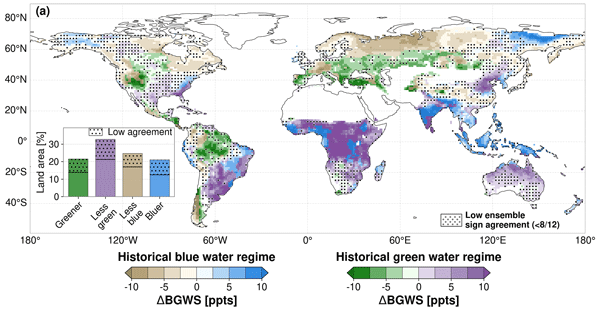
Precipitation on land is split into different pathways, contributing to runoff (blue water) or to plant water use (green water). Climate change alters this balance and shapes how future precipitation is divided. We use Earth system models to study these changes and their controls. We find that stronger extreme five-day precipitation is the main control and routes more future precipitation into blue water, even where average precipitation decreases, with implications for freshwater availability.

Jon Cranko Page, Martin G. De Kauwe, Andy J. Pitman, Isaac R. Towers, Gabriele Arduini, Martin J. Best, Craig R. Ferguson, Jürgen Knauer, Hyungjun Kim, David M. Lawrence, Tomoko Nitta, Keith W. Oleson, Catherine Ottlé, Anna Ukkola, Nicholas Vuichard, Xiaoni Wang-Faivre, and Gab Abramowitz
Biogeosciences, 23, 263–282, https://doi.org/10.5194/bg-23-263-2026, https://doi.org/10.5194/bg-23-263-2026, 2026
Short summary
Short summary
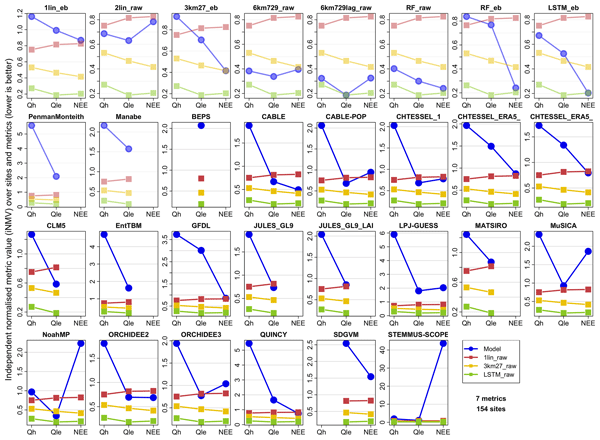
This paper used a large dataset of observations, machine learning predictions, and computer model simulations to test how well land surface models represent the water, energy, and carbon cycles. We found that the models work well under "normal" weather but do not meet performance expectations during coinciding extreme conditions. Since these extremes are relatively rare, targeted model improvements could deliver major performance gains.
Matthew O. Grant, Anna M. Ukkola, Elisabeth Vogel, Sanaa Hobeichi, Andy J. Pitman, Alex Raymond Borowiak, and Keirnan Fowler
Hydrol. Earth Syst. Sci., 29, 5555–5573, https://doi.org/10.5194/hess-29-5555-2025, https://doi.org/10.5194/hess-29-5555-2025, 2025
Short summary
Short summary
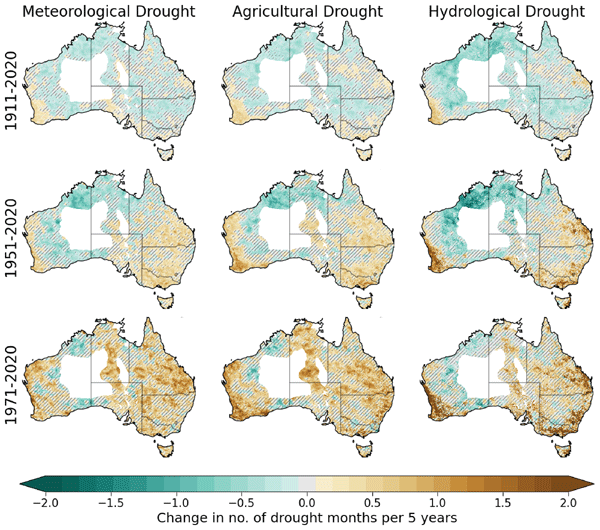
Australia is regularly subjected to severe and widespread drought. By using multiple drought indicators, we show that although there have been widespread decreases in droughts since the beginning of the 20th century, many regions have seen an increase in droughts in more recent decades. Despite these changes, our analysis shows that they remain within the range of observed variability and are not unprecedented in the context of past droughts.
Gab Abramowitz, Anna Ukkola, Sanaa Hobeichi, Jon Cranko Page, Mathew Lipson, Martin G. De Kauwe, Samuel Green, Claire Brenner, Jonathan Frame, Grey Nearing, Martyn Clark, Martin Best, Peter Anthoni, Gabriele Arduini, Souhail Boussetta, Silvia Caldararu, Kyeungwoo Cho, Matthias Cuntz, David Fairbairn, Craig R. Ferguson, Hyungjun Kim, Yeonjoo Kim, Jürgen Knauer, David Lawrence, Xiangzhong Luo, Sergey Malyshev, Tomoko Nitta, Jerome Ogee, Keith Oleson, Catherine Ottlé, Phillipe Peylin, Patricia de Rosnay, Heather Rumbold, Bob Su, Nicolas Vuichard, Anthony P. Walker, Xiaoni Wang-Faivre, Yunfei Wang, and Yijian Zeng
Biogeosciences, 21, 5517–5538, https://doi.org/10.5194/bg-21-5517-2024, https://doi.org/10.5194/bg-21-5517-2024, 2024
Short summary
Short summary
This paper evaluates land models – computer-based models that simulate ecosystem dynamics; land carbon, water, and energy cycles; and the role of land in the climate system. It uses machine learning and AI approaches to show that, despite the complexity of land models, they do not perform nearly as well as they could given the amount of information they are provided with about the prediction problem.
Georgina M. Falster, Nicky M. Wright, Nerilie J. Abram, Anna M. Ukkola, and Benjamin J. Henley
Hydrol. Earth Syst. Sci., 28, 1383–1401, https://doi.org/10.5194/hess-28-1383-2024, https://doi.org/10.5194/hess-28-1383-2024, 2024
Short summary
Short summary
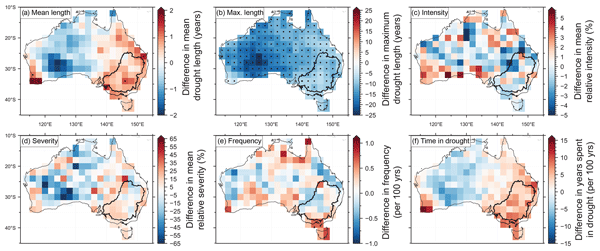
Multi-year droughts have severe environmental and economic impacts, but the instrumental record is too short to characterise multi-year drought variability. We assessed the nature of Australian multi-year droughts using simulations of the past millennium from 11 climate models. We show that multi-decadal
megadroughtsare a natural feature of the Australian hydroclimate. Human-caused climate change is also driving a tendency towards longer droughts in eastern and southwestern Australia.
Keirnan Fowler, Murray Peel, Margarita Saft, Tim J. Peterson, Andrew Western, Lawrence Band, Cuan Petheram, Sandra Dharmadi, Kim Seong Tan, Lu Zhang, Patrick Lane, Anthony Kiem, Lucy Marshall, Anne Griebel, Belinda E. Medlyn, Dongryeol Ryu, Giancarlo Bonotto, Conrad Wasko, Anna Ukkola, Clare Stephens, Andrew Frost, Hansini Gardiya Weligamage, Patricia Saco, Hongxing Zheng, Francis Chiew, Edoardo Daly, Glen Walker, R. Willem Vervoort, Justin Hughes, Luca Trotter, Brad Neal, Ian Cartwright, and Rory Nathan
Hydrol. Earth Syst. Sci., 26, 6073–6120, https://doi.org/10.5194/hess-26-6073-2022, https://doi.org/10.5194/hess-26-6073-2022, 2022
Short summary
Short summary
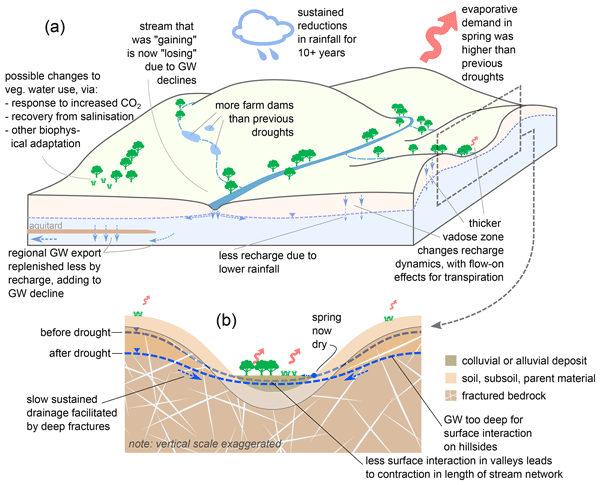
Recently, we have seen multi-year droughts tending to cause shifts in the relationship between rainfall and streamflow. In shifted catchments that have not recovered, an average rainfall year produces less streamflow today than it did pre-drought. We take a multi-disciplinary approach to understand why these shifts occur, focusing on Australia's over-10-year Millennium Drought. We evaluate multiple hypotheses against evidence, with particular focus on the key role of groundwater processes.
Anna M. Ukkola, Gab Abramowitz, and Martin G. De Kauwe
Earth Syst. Sci. Data, 14, 449–461, https://doi.org/10.5194/essd-14-449-2022, https://doi.org/10.5194/essd-14-449-2022, 2022
Short summary
Short summary
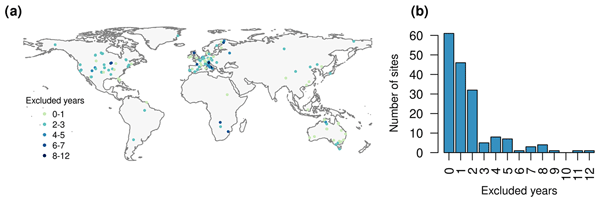
Flux towers provide measurements of water, energy, and carbon fluxes. Flux tower data are invaluable in improving and evaluating land models but are not suited to modelling applications as published. Here we present flux tower data tailored for land modelling, encompassing 170 sites globally. Our dataset resolves several key limitations hindering the use of flux tower data in land modelling, including incomplete forcing variable, data format, and low data quality.

Sami W. Rifai, Martin G. De Kauwe, Anna M. Ukkola, Lucas A. Cernusak, Patrick Meir, Belinda E. Medlyn, and Andy J. Pitman
Biogeosciences, 19, 491–515, https://doi.org/10.5194/bg-19-491-2022, https://doi.org/10.5194/bg-19-491-2022, 2022
Short summary
Short summary
Australia's woody ecosystems have experienced widespread greening despite a warming climate and repeated record-breaking droughts and heat waves. Increasing atmospheric CO2 increases plant water use efficiency, yet quantifying the CO2 effect is complicated due to co-occurring effects of global change. Here we harmonized a 38-year satellite record to separate the effects of climate change, land use change, and disturbance to quantify the CO2 fertilization effect on the greening phenomenon.
Nicolai Meinshausen, Malte Meinshausen, Jared Lewis, Zebedee R. J. Nicholls, Sarah Schöngart, Alister Self, Xinwei Shen, Karla Spiller, and Elisabeth Vogel
EGUsphere, https://doi.org/10.5194/egusphere-2026-5176, https://doi.org/10.5194/egusphere-2026-5176, 2026
This preprint is open for discussion and under review for Geoscientific Model Development (GMD).
Short summary
Short summary
To help societies prepare for climate change, we built a fast climate model combining climate science and machine learning. It produces projections of temperature, precipitation, humidity and seven other climate variables across many emissions futures, aligned with observations and IPCC warming ranges. Applied to Iran, it shows that human-caused climate change strongly influenced the severe 2025 drought and projects rising drought risk, supporting faster regional risk assessment and planning.
Lara S. Richards, Yi Huang, Michael A. Barnes, Chenhui Jin, Fadhlil R. Muhammad, Daniel P. Harrison, and Steven T. Siems
Weather Clim. Dynam., 7, 1977–1993, https://doi.org/10.5194/wcd-7-1977-2026, https://doi.org/10.5194/wcd-7-1977-2026, 2026
Short summary
Short summary
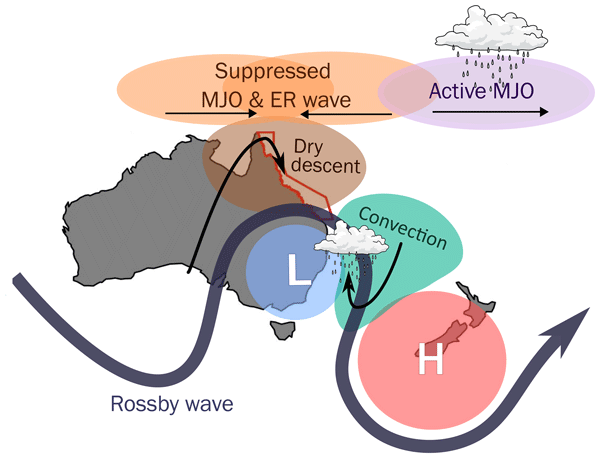
The doldrums are regions of light winds and relatively clear skies found in the tropics. They often occur during severe coral bleaching events on the Great Barrier Reef yet remain poorly understood. This study examines why the doldrums form and persist, identifying how both tropical and extratropical weather systems align to first form the doldrums and how the stalling of these weather systems prolongs the doldrums over the Great Barrier Reef.
Caleb Mynard, Emily B. Franklin, Joel Alroe, Karen Westwood, Brandon J. McNabb, Robert Strzepek, Philippe D. Tortell, Steven T. Siems, Antonio Patti, Suzie Molloy, Alan Griffiths, Branka Miljevic, Marc D. Mallet, Ruhi Humphries, and Erin Dunne
Atmos. Chem. Phys., 26, 11583–11604, https://doi.org/10.5194/acp-26-11583-2026, https://doi.org/10.5194/acp-26-11583-2026, 2026
Short summary
Short summary
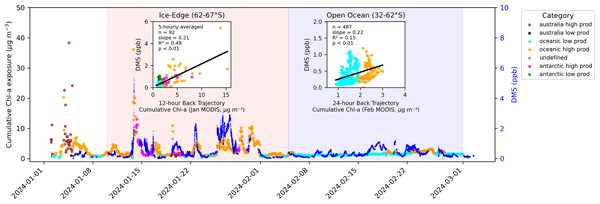
Marine sulfur gases help form climate-cooling particles, but their controls over the Southern Ocean are unclear. During a summer research voyage we measured these gases and linked them to ocean and atmospheric conditions. Near Antarctica, coastal blooms drove sharp rises in dimethyl sulfide while methanethiol remained low. Over the open ocean, both gases varied together, mainly influenced by ocean mixing and temperature, suggesting models should treat coastal and open ocean regions separately.
A. V. Sreenath, Peter T. May, Steven Siems, Heather Corden, and Alexis Berne
EGUsphere, https://doi.org/10.5194/egusphere-2026-4159, https://doi.org/10.5194/egusphere-2026-4159, 2026
Short summary
Short summary
We investigated how synoptic weather regimes control cloud growth and surface precipitation at Dumont d’Urville, East Antarctica. Multi-instrument observations show that synoptic forcing determines hydrometeor growth and precipitation formation aloft, while boundary-layer conditions, including local downslope flow and near-surface moisture, control how much precipitation reaches the surface.
Jiawei Hou, Wendy Sharples, Jayaram Pudashine, Mandi Thran, Carlos Velasco-Forero, Paul Fox-Hughes, Elisabetta Carrara, and Holger R. Maier
EGUsphere, https://doi.org/10.5194/egusphere-2026-3401, https://doi.org/10.5194/egusphere-2026-3401, 2026
Short summary
Short summary
Floods can develop rapidly, leaving little time for communities and emergency services to respond. This study uses deep learning and radar data to forecast river levels from 90 minutes to 12 hours in advance and generate high-resolution flood inundation maps. Tested across different flood regimes in eastern Australia, the approach produced accurate and timely flood forecasts, demonstrating its potential to improve flood preparedness, emergency response, and community safety.
Xiaoshen Sun, Chris Medcraft, Ramon Braga, Peter Butcherine, Zoran Ristovski, Steven Siems, Christian J. Sanders, and Daniel P. Harrison
EGUsphere, https://doi.org/10.5194/egusphere-2026-1729, https://doi.org/10.5194/egusphere-2026-1729, 2026
This preprint is open for discussion and under review for Atmospheric Measurement Techniques (AMT).
Short summary
Short summary
We propose a novel method to detect and track sea spray particles released during marine cloud brightening (MCB) over the Great Barrier Reef. Using aircraft measurements, we showed that these released particles can be separated from the research ship and aircraft exhaust and tracked as they spread horizontally and vertically. This improves our ability to trace added sea spray aerosols and supports future work on how they may affect clouds.
Simon P. Heselschwerdt, Thorsten Wagener, Lan Wang-Erlandsson, Anna M. Ukkola, Yannis Markonis, Yuting Yang, and Peter Greve
Earth Syst. Dynam., 17, 811–827, https://doi.org/10.5194/esd-17-811-2026, https://doi.org/10.5194/esd-17-811-2026, 2026
Short summary
Short summary
Precipitation on land is split into different pathways, contributing to runoff (blue water) or to plant water use (green water). Climate change alters this balance and shapes how future precipitation is divided. We use Earth system models to study these changes and their controls. We find that stronger extreme five-day precipitation is the main control and routes more future precipitation into blue water, even where average precipitation decreases, with implications for freshwater availability.
Wenhui Zhao, Yi Huang, Steven Siems, and Daniel Harrison
EGUsphere, https://doi.org/10.5194/egusphere-2026-1251, https://doi.org/10.5194/egusphere-2026-1251, 2026
Short summary
Short summary
Using convection-permitting WRF simulations, this study examines how marine cloud brightening over the GBR depends on aerosol emission strength and spatial distribution. Densely spaced sources generate more uniform aerosol enhancements and stronger cloud microphysical responses than sparsely distributed sources, despite identical emissions. CDNC and optical depth increase strongly, indicating a dominant Twomey effect, while cloud water and coverage respond weakly.

Arathy A. Kurup, Caroline Poulsen, Steven T. Siems, and Daniel J. V. Robbins
Atmos. Meas. Tech., 19, 1487–1514, https://doi.org/10.5194/amt-19-1487-2026, https://doi.org/10.5194/amt-19-1487-2026, 2026
Short summary
Short summary
Southern Ocean (SO) clouds are crucial in defining the Earth's radiation budget. They are primarily observed by satellites, due to a lack of surface observations. This study validated cloud top height and cloud mask and compared the microphysics products from 3 satellite cloud datasets over the SO. The study revealed significant differences in cloud property retrievals between the sensors. Multilayer clouds play a major role in the differences when validated with active satellite measurements.

Lara S. Richards, Steven T. Siems, Yi Huang, Daniel P. Harrison, and Wenhui Zhao
Weather Clim. Dynam., 7, 109–127, https://doi.org/10.5194/wcd-7-109-2026, https://doi.org/10.5194/wcd-7-109-2026, 2026
Short summary
Short summary
By studying the variability of the trade winds during the Great Barrier Reef coral bleaching season, we show that ocean heating and a higher risk of coral bleaching are linked to the breakdown of the trade winds into either calm and clear conditions or a monsoon-like northerly flow. Years with mass coral bleaching are also associated with more "calm and clear" days in the warmest months and fewer strong trade wind days on the fringe months of the bleaching season.
Jon Cranko Page, Martin G. De Kauwe, Andy J. Pitman, Isaac R. Towers, Gabriele Arduini, Martin J. Best, Craig R. Ferguson, Jürgen Knauer, Hyungjun Kim, David M. Lawrence, Tomoko Nitta, Keith W. Oleson, Catherine Ottlé, Anna Ukkola, Nicholas Vuichard, Xiaoni Wang-Faivre, and Gab Abramowitz
Biogeosciences, 23, 263–282, https://doi.org/10.5194/bg-23-263-2026, https://doi.org/10.5194/bg-23-263-2026, 2026
Short summary
Short summary
This paper used a large dataset of observations, machine learning predictions, and computer model simulations to test how well land surface models represent the water, energy, and carbon cycles. We found that the models work well under "normal" weather but do not meet performance expectations during coinciding extreme conditions. Since these extremes are relatively rare, targeted model improvements could deliver major performance gains.
A. V. Sreenath, Tahereh Alinejadtabrizi, Steven Siems, Peter T. May, Haifeng Zhang, and Eric Schulz
Weather Clim. Dynam., 6, 1797–1813, https://doi.org/10.5194/wcd-6-1797-2025, https://doi.org/10.5194/wcd-6-1797-2025, 2025
Short summary
Short summary
Using 14 years of observations from mooring, we reported that cold air advection creates intense surface flux exchange over the southern ocean, linked with strong boundary layer instability. Results also indicate that cold air advection creates frequent open mesoscale cellular convective clouds. The flux exchange for open and closed mesoscale cellular convective clouds is comparable, suggesting a limited role of the surface flux in the transition of these boundary layer clouds.
Zhaoyang Kong, Andrew T. Prata, Peter T. May, Ariaan Purich, Yi Huang, and Steven T. Siems
Weather Clim. Dynam., 6, 1643–1660, https://doi.org/10.5194/wcd-6-1643-2025, https://doi.org/10.5194/wcd-6-1643-2025, 2025
Short summary
Short summary
To investigate why ERA5 (European Centre for Medium-Range Weather Forecasts Reanalysis v5) does not accurately capture the observed increase in annual precipitation at Macquarie Island during 1979 to 2023, we classify daily synoptic systems using k-means clustering. Find that the increase in mean intensity across all systems is the main contributor to the observed annual precipitation trend and the resulting discrepancy, rather than changes in the frequency. And this increase may also have a substantial impact on the freshwater fluxes over the Southern Ocean.
Matthew O. Grant, Anna M. Ukkola, Elisabeth Vogel, Sanaa Hobeichi, Andy J. Pitman, Alex Raymond Borowiak, and Keirnan Fowler
Hydrol. Earth Syst. Sci., 29, 5555–5573, https://doi.org/10.5194/hess-29-5555-2025, https://doi.org/10.5194/hess-29-5555-2025, 2025
Short summary
Short summary
Australia is regularly subjected to severe and widespread drought. By using multiple drought indicators, we show that although there have been widespread decreases in droughts since the beginning of the 20th century, many regions have seen an increase in droughts in more recent decades. Despite these changes, our analysis shows that they remain within the range of observed variability and are not unprecedented in the context of past droughts.
Christopher A. Pickett-Heaps, Patrick Sunter, Wendy Sharples, Michael Pegios, Catherine Wilson, Alex Cornish, Richard Laugesen, and Elisabetta Carrara
EGUsphere, https://doi.org/10.5194/egusphere-2025-1379, https://doi.org/10.5194/egusphere-2025-1379, 2025
Short summary
Short summary
This study evaluates seasonal forecast skill of river discharge from (1) a gridded hydrological model coupled with statistical post-processing and (2) a locally calibrated statistical hydrological model dependant on recent hydrological observations. Results indicate a similar level of forecast skill. The statistical post-processor is not dependant on recent observations to maintain forecast skill, a finding that will have a positive impact on operational hydrological forecasting.
Tahereh Alinejadtabrizi, Yi Huang, Francisco Lang, Steven Siems, Michael Manton, Luis Ackermann, Melita Keywood, Ruhi Humphries, Paul Krummel, Alastair Williams, and Greg Ayers
Atmos. Chem. Phys., 25, 2631–2648, https://doi.org/10.5194/acp-25-2631-2025, https://doi.org/10.5194/acp-25-2631-2025, 2025
Short summary
Short summary
Clouds over the Southern Ocean are crucial to Earth's energy balance, but understanding the factors that control them is complex. Our research examines how weather patterns affect tiny particles called cloud condensation nuclei (CCN), which influence cloud properties. Using data from Kennaook / Cape Grim, we found that winter air from Antarctica brings cleaner conditions with lower CCN, while summer patterns from Australia transport more particles. Precipitation also helps reduce CCN in winter.
Gab Abramowitz, Anna Ukkola, Sanaa Hobeichi, Jon Cranko Page, Mathew Lipson, Martin G. De Kauwe, Samuel Green, Claire Brenner, Jonathan Frame, Grey Nearing, Martyn Clark, Martin Best, Peter Anthoni, Gabriele Arduini, Souhail Boussetta, Silvia Caldararu, Kyeungwoo Cho, Matthias Cuntz, David Fairbairn, Craig R. Ferguson, Hyungjun Kim, Yeonjoo Kim, Jürgen Knauer, David Lawrence, Xiangzhong Luo, Sergey Malyshev, Tomoko Nitta, Jerome Ogee, Keith Oleson, Catherine Ottlé, Phillipe Peylin, Patricia de Rosnay, Heather Rumbold, Bob Su, Nicolas Vuichard, Anthony P. Walker, Xiaoni Wang-Faivre, Yunfei Wang, and Yijian Zeng
Biogeosciences, 21, 5517–5538, https://doi.org/10.5194/bg-21-5517-2024, https://doi.org/10.5194/bg-21-5517-2024, 2024
Short summary
Short summary
This paper evaluates land models – computer-based models that simulate ecosystem dynamics; land carbon, water, and energy cycles; and the role of land in the climate system. It uses machine learning and AI approaches to show that, despite the complexity of land models, they do not perform nearly as well as they could given the amount of information they are provided with about the prediction problem.
Daniel J. V. Robbins, Caroline A. Poulsen, Steven T. Siems, Simon R. Proud, Andrew T. Prata, Roy G. Grainger, and Adam C. Povey
Atmos. Meas. Tech., 17, 3279–3302, https://doi.org/10.5194/amt-17-3279-2024, https://doi.org/10.5194/amt-17-3279-2024, 2024
Short summary
Short summary
Extreme wildfire events are becoming more common with climate change. The smoke plumes associated with these wildfires are not captured by current operational satellite products due to their high optical thickness. We have developed a novel aerosol retrieval for the Advanced Himawari Imager to study these plumes. We find very high values of optical thickness not observed in other operational satellite products, suggesting these plumes have been missed in previous studies.
Wendy Sharples, Katayoon Bahramian, Kesav Unnithan, Christoph Rüdiger, Jiawei Hou, Christopher Pickett-Heaps, and Elisabetta Carrara
Proc. IAHS, 386, 237–249, https://doi.org/10.5194/piahs-386-237-2024, https://doi.org/10.5194/piahs-386-237-2024, 2024
Short summary
Short summary
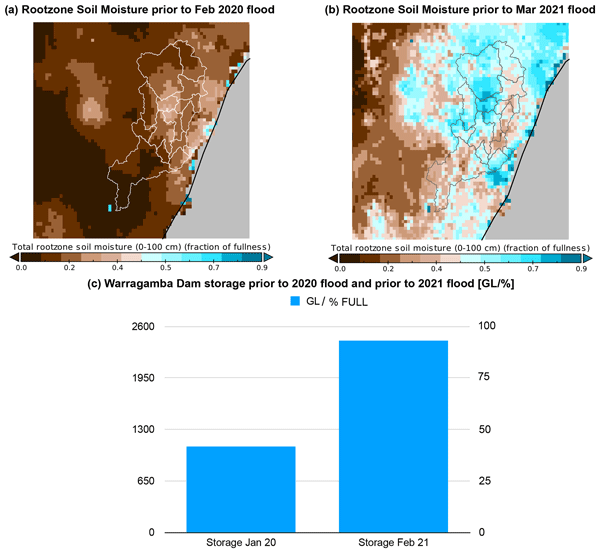
Two flood events occurred in the Hawkesbury-Nepean valley in 2020 and 2021, however, the impact of each of those events was different in terms of lives lost (2 fatalities compared to none) and economic losses (more than 2 billion compared to less than 1 billion AUD). Reasons for the variation in impacts are explored by determining the inundation extents, and examining antecedent and climatic conditions. We found that antecedent conditions exerted a major control on the size of the impact.
Justin Peter, Elisabeth Vogel, Wendy Sharples, Ulrike Bende-Michl, Louise Wilson, Pandora Hope, Andrew Dowdy, Greg Kociuba, Sri Srikanthan, Vi Co Duong, Jake Roussis, Vjekoslav Matic, Zaved Khan, Alison Oke, Margot Turner, Stuart Baron-Hay, Fiona Johnson, Raj Mehrotra, Ashish Sharma, Marcus Thatcher, Ali Azarvinand, Steven Thomas, Ghyslaine Boschat, Chantal Donnelly, and Robert Argent
Geosci. Model Dev., 17, 2755–2781, https://doi.org/10.5194/gmd-17-2755-2024, https://doi.org/10.5194/gmd-17-2755-2024, 2024
Short summary
Short summary
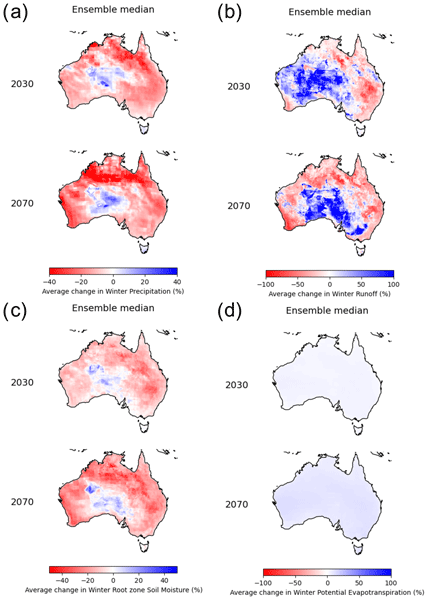
We detail the production of datasets and communication to end users of high-resolution projections of rainfall, runoff, and soil moisture for the entire Australian continent. This is important as previous projections for Australia were for small regions and used differing techniques for their projections, making comparisons difficult across Australia's varied climate zones. The data will be beneficial for research purposes and to aid adaptation to climate change.
Georgina M. Falster, Nicky M. Wright, Nerilie J. Abram, Anna M. Ukkola, and Benjamin J. Henley
Hydrol. Earth Syst. Sci., 28, 1383–1401, https://doi.org/10.5194/hess-28-1383-2024, https://doi.org/10.5194/hess-28-1383-2024, 2024
Short summary
Short summary
Multi-year droughts have severe environmental and economic impacts, but the instrumental record is too short to characterise multi-year drought variability. We assessed the nature of Australian multi-year droughts using simulations of the past millennium from 11 climate models. We show that multi-decadal
megadroughtsare a natural feature of the Australian hydroclimate. Human-caused climate change is also driving a tendency towards longer droughts in eastern and southwestern Australia.
Francisco Lang, Steven T. Siems, Yi Huang, Tahereh Alinejadtabrizi, and Luis Ackermann
Atmos. Chem. Phys., 24, 1451–1466, https://doi.org/10.5194/acp-24-1451-2024, https://doi.org/10.5194/acp-24-1451-2024, 2024
Short summary
Short summary
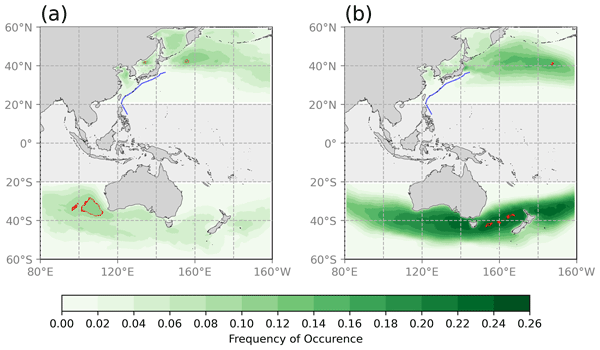
Marine low-level clouds play a crucial role in the Earth's energy balance, trapping heat from the surface and reflecting sunlight back into space. These clouds are distinguishable by their large-scale spatial structures, primarily characterized as hexagonal patterns with either filled (closed) or empty (open) cells. Utilizing satellite observations, these two cloud type patterns have been categorized over the Southern Ocean and North Pacific Ocean through a pattern recognition program.

Bibi S. Naz, Wendy Sharples, Yueling Ma, Klaus Goergen, and Stefan Kollet
Geosci. Model Dev., 16, 1617–1639, https://doi.org/10.5194/gmd-16-1617-2023, https://doi.org/10.5194/gmd-16-1617-2023, 2023
Short summary
Short summary
It is challenging to apply a high-resolution integrated land surface and groundwater model over large spatial scales. In this paper, we demonstrate the application of such a model over a pan-European domain at 3 km resolution and perform an extensive evaluation of simulated water states and fluxes by comparing with in situ and satellite data. This study can serve as a benchmark and baseline for future studies of climate change impact projections and for hydrological forecasting.
Keirnan Fowler, Murray Peel, Margarita Saft, Tim J. Peterson, Andrew Western, Lawrence Band, Cuan Petheram, Sandra Dharmadi, Kim Seong Tan, Lu Zhang, Patrick Lane, Anthony Kiem, Lucy Marshall, Anne Griebel, Belinda E. Medlyn, Dongryeol Ryu, Giancarlo Bonotto, Conrad Wasko, Anna Ukkola, Clare Stephens, Andrew Frost, Hansini Gardiya Weligamage, Patricia Saco, Hongxing Zheng, Francis Chiew, Edoardo Daly, Glen Walker, R. Willem Vervoort, Justin Hughes, Luca Trotter, Brad Neal, Ian Cartwright, and Rory Nathan
Hydrol. Earth Syst. Sci., 26, 6073–6120, https://doi.org/10.5194/hess-26-6073-2022, https://doi.org/10.5194/hess-26-6073-2022, 2022
Short summary
Short summary
Recently, we have seen multi-year droughts tending to cause shifts in the relationship between rainfall and streamflow. In shifted catchments that have not recovered, an average rainfall year produces less streamflow today than it did pre-drought. We take a multi-disciplinary approach to understand why these shifts occur, focusing on Australia's over-10-year Millennium Drought. We evaluate multiple hypotheses against evidence, with particular focus on the key role of groundwater processes.
Daniel Robbins, Caroline Poulsen, Steven Siems, and Simon Proud
Atmos. Meas. Tech., 15, 3031–3051, https://doi.org/10.5194/amt-15-3031-2022, https://doi.org/10.5194/amt-15-3031-2022, 2022
Short summary
Short summary
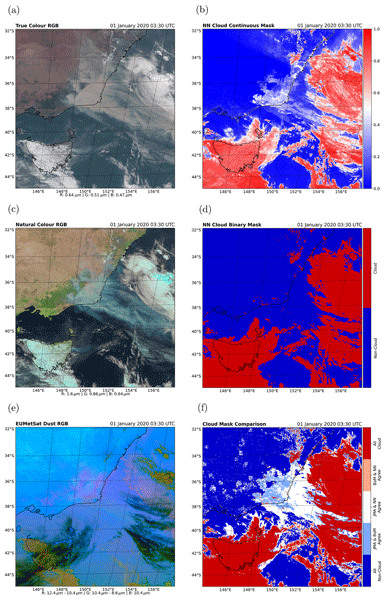
A neural network (NN)-based cloud mask for a geostationary satellite instrument, AHI, is developed using collocated data and is better at not classifying thick aerosols as clouds versus the Japanese Meteorological Association and the Bureau of Meteorology masks, identifying 1.13 and 1.29 times as many non-cloud pixels than each mask, respectively. The improvement during the day likely comes from including the shortest wavelength bands from AHI in the NN mask, which the other masks do not use.
Francisco Lang, Luis Ackermann, Yi Huang, Son C. H. Truong, Steven T. Siems, and Michael J. Manton
Atmos. Chem. Phys., 22, 2135–2152, https://doi.org/10.5194/acp-22-2135-2022, https://doi.org/10.5194/acp-22-2135-2022, 2022
Short summary
Short summary
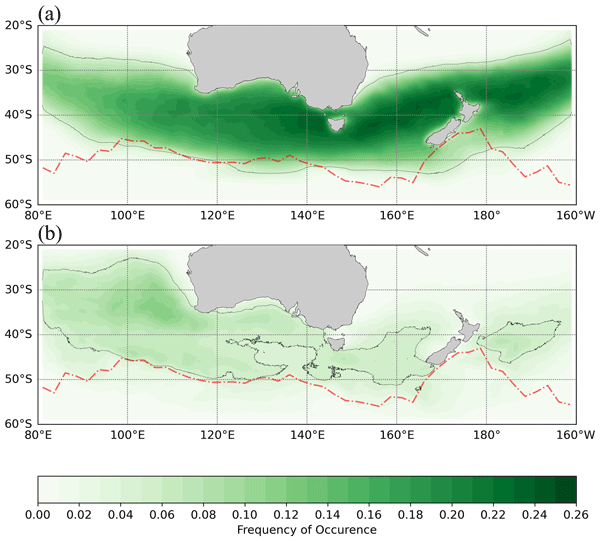
Marine low-level clouds cover vast areas of the Southern Ocean, and they are essential to the Earth system energy balance. We use 3 years of satellite observations to group low-level clouds by their spatial structure using a pattern-recognizing program. We studied two primary cloud type patterns, i.e. open and closed clouds. Open clouds are uniformly distributed over the storm track, while closed clouds are most predominant in the southeastern Indian Ocean. Closed clouds exhibit a daily cycle.
Anna M. Ukkola, Gab Abramowitz, and Martin G. De Kauwe
Earth Syst. Sci. Data, 14, 449–461, https://doi.org/10.5194/essd-14-449-2022, https://doi.org/10.5194/essd-14-449-2022, 2022
Short summary
Short summary
Flux towers provide measurements of water, energy, and carbon fluxes. Flux tower data are invaluable in improving and evaluating land models but are not suited to modelling applications as published. Here we present flux tower data tailored for land modelling, encompassing 170 sites globally. Our dataset resolves several key limitations hindering the use of flux tower data in land modelling, including incomplete forcing variable, data format, and low data quality.
Sami W. Rifai, Martin G. De Kauwe, Anna M. Ukkola, Lucas A. Cernusak, Patrick Meir, Belinda E. Medlyn, and Andy J. Pitman
Biogeosciences, 19, 491–515, https://doi.org/10.5194/bg-19-491-2022, https://doi.org/10.5194/bg-19-491-2022, 2022
Short summary
Short summary
Australia's woody ecosystems have experienced widespread greening despite a warming climate and repeated record-breaking droughts and heat waves. Increasing atmospheric CO2 increases plant water use efficiency, yet quantifying the CO2 effect is complicated due to co-occurring effects of global change. Here we harmonized a 38-year satellite record to separate the effects of climate change, land use change, and disturbance to quantify the CO2 fertilization effect on the greening phenomenon.
Danlu Guo, Camille Minaudo, Anna Lintern, Ulrike Bende-Michl, Shuci Liu, Kefeng Zhang, and Clément Duvert
Hydrol. Earth Syst. Sci., 26, 1–16, https://doi.org/10.5194/hess-26-1-2022, https://doi.org/10.5194/hess-26-1-2022, 2022
Short summary
Short summary
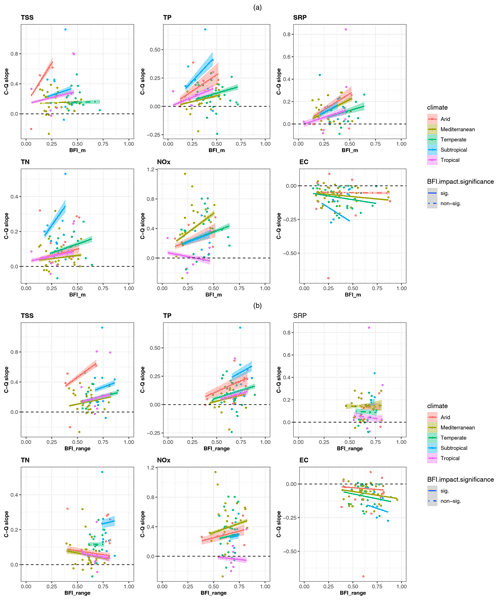
We investigate the impact of baseflow contribution on concentration–flow (C–Q) relationships across the Australian continent. We developed a novel Bayesian hierarchical model for six water quality variables across 157 catchments that span five climate zones. For sediments and nutrients, the C–Q slope is generally steeper for catchments with a higher median and a greater variability of baseflow contribution, highlighting the key role of variable flow pathways in particulate and solute export.
Cited articles
ABARES: Drought in Australia: Context, policy and management, ABARES report to client (GHD Pty. Ltd.) prepared for the Australia China Environment Development Partnership, Canberra, Australia, https://www.droughtmanagement.info/literature/GovAustr_drought_in_australia_2012.pdf (last access: 19 March 2026), 2012.
Abram, N. J., Henley, B. J., Sen Gupta, A., Lippmann, T. J. R., Clarke, H., Dowdy, A. J., Sharples, J. J., Nolan, R. H., Zhang, T., Wooster, M. J., Wurtzel, J. B., Meissner, K. J., Pitman, A. J., Ukkola, A. M., Murphy, B. P., Tapper, N. J., and Boer, M. M.: Connections of climate change and variability to large and extreme forest fires in southeast Australia, Commun. Earth Environ., 2, 1–17, https://doi.org/10.1038/s43247-020-00065-8, 2021.
Australian Bureau of Meteorology: Australian Gridded Climate Data (AGCD) v1.0.0/ Australian Water Availability Project (AWAP), NCI Data Catalogue [data set], https://doi.org/10.25914/6009600b58196, 2020.
Australian Bureau of Meteorology: The Bureau of Meteorology's National Hydrological Projection data collection on changes to Australia's hydrological water balance, NCI Data Catalogue [data set], https://doi.org/10.25914/6198463da4f22, 2021.
Azarvinand, A., Sharples, W., Bende-Michl, U., Shokri, A., Srikanthan, S., Frost, A. J., and Baron-Hay, S.: Analysing the uncertainty of modelling hydrologic states of AWRA-L – understanding impacts from parameter uncertainty for the National Hydrological Projections, Bureau Research Report, Bureau of Meteorology, Melbourne, Australia, ISBN 978-1-925738-48-3, 2022.
Baldwin, D., Manfreda, S., Keller, K., and Smithwick, E. A. H.: Predicting root zone soil moisture with soil properties and satellite near-surface moisture data across the conterminous United States, J. Hydrol., 546, 393–404, https://doi.org/10.1016/j.jhydrol.2017.01.020, 2017.
Boer, M. M., Resco de Dios, V., and Bradstock, R. A.: Unprecedented burn area of Australian mega forest fires, Nat. Clim. Change, 10, 171–172, https://doi.org/10.1038/s41558-020-0716-1, 2020.
Broich, M., Huete, A., Tulbure, M. G., Ma, X., Xin, Q., Paget, M., Restrepo-Coupe, N., Davies, K., Devadas, R., and Held, A.: Land surface phenological response to decadal climate variability across Australia using satellite remote sensing, Biogeosciences, 11, 5181–5198, https://doi.org/10.5194/bg-11-5181-2014, 2014.
Chapman, S., Syktus, J., Trancoso, R., Thatcher, M., Toombs, N., Wong, K. K.-H., and Takbash, A.: Evaluation of Dynamically Downscaled CMIP6-CCAM Models Over Australia, Earth's Future, 11, e2023EF003548, https://doi.org/10.1029/2023EF003548, 2023.
Chiew, F. H. S. and McMahon, T. A.: Detection of trend or change in annual flow of Australian rivers, Int. J. Climatol., 13, 643–653, https://doi.org/10.1002/joc.3370130605, 1993.
Choat, B., Brodribb, T. J., Brodersen, C. R., Duursma, R. A., López, R., and Medlyn, B. E.: Triggers of tree mortality under drought, Nature, 558, 531–539, https://doi.org/10.1038/s41586-018-0240-x, 2018.
Collier, M. and Uhe, P.: CMIP5 datasets from the ACCESS1.0 and ACCESS1.3 coupled climate models CAWCR Technical Report No. 059, CSIRO, Aspendale, Australia, ISBN 978-1-922173-29-4, 2012.
Cook, B. I., Mankin, J. S., Marvel, K., Williams, A. P., Smerdon, J. E., and Anchukaitis, K. J.: Twenty-First Century Drought Projections in the CMIP6 Forcing Scenarios, Earth's Future, 8, https://doi.org/10.1029/2019EF001461, 2020.
CSIRO and Bureau of Meteorology: Downscaling and evaluating data sets. Electricity Sector Climate Information Project Technical Report (ESCI Technical Report), CSIRO and BoM, Melbourne, Australia, https://www.climatechangeinaustralia.gov.au/media/ccia/2.2/cms_page_media/799/Draft - Downscaling Technical Report.pdf (last access: 19 March 2026), 2021.
Devanand, A., Falster, G. M., Gillett, Z. E., Hobeichi, S., Holgate, C. M., Jin, C., Mu, M., Parker, T., Rifai, S. W., Rome, K. S., Stojanovic, M., Vogel, E., Abram, N. J., Abramowitz, G., Coats, S., Evans, J. P., Gallant, A. J. E., Pitman, A. J., Power, S. B., Rauniyar, S. P., Taschetto, A. S., and Ukkola, A. M.: Australia's Tinderbox Drought: An extreme natural event likely worsened by human-caused climate change, Sci. Adv., 10, eadj3460, https://doi.org/10.1126/sciadv.adj3460, 2024.
Dey, R., Lewis, S. C., Arblaster, J. M., and Abram, N. J.: A review of past and projected changes in Australia's rainfall, WIREs Clim. Change, 10, e577, https://doi.org/10.1002/wcc.577, 2019.
Di Virgilio, G., Evans, J. P., Di Luca, A., Grose, M. R., Round, V., and Thatcher, M.: Realised added value in dynamical downscaling of Australian climate change, Clim. Dynam., 54, 4675–4692, https://doi.org/10.1007/s00382-020-05250-1, 2020.
Dix, M., Vohralik, P., Bi, D., Rashid, H., Marsland, S., O'Farrell, S., Uotila, P., Hirst, T., Kowalczyk, E., Sullivan, A., Yan, H., Franklin, C., Sun, Z., Watterson, I., Collier, M., Noonan, J., Rotstayn, L., Stevens, L., Uhe, P., and Puri, K.: The ACCESS coupled model: documentation of core CMIP5 simulations and initial results, Aust. Meteorol. Ocean., 63, 83–99, 2013.
Donohue, R. J., Roderick, M. L., and McVicar, T. R.: Assessing the differences in sensitivities of runoff to changes in climatic conditions across a large basin, J. Hydrol., 406, 234–244, https://doi.org/10.1016/j.jhydrol.2011.07.003, 2011.
Donohue, R. J., Roderick, M. L., McVicar, T. R., and Farquhar, G. D.: Impact of CO2 fertilization on maximum foliage cover across the globe's warm, arid environments: CO2 fertilization and foliage cover, Geophys. Res. Lett., 40, 3031–3035, https://doi.org/10.1002/grl.50563, 2013.
Douville, H., Raghavan, K., Renwick, J., Allan, R. P., Arias, P. A., Barlow, M., Cerezo-Mota, R., Cherchi, A., Gan, T. Y., Gergis, J., Jiang, D., Khan, A., Pokam Mba, W., Rosenfeld, D., Tierney, J. E., and Zolina, O.: Water Cycle Changes, in: Climate Change 2021: The Physical Science Basis. Contribution of Working Group I to the Sixth Assessment Report of the Intergovernmental Panel on Climate Change, Cambridge University Press, 1055–1210, https://doi.org/10.1017/9781009157896.010, 2021.
Dowdy, A. J.: A bias correction method designed for weather and climate extremes, Bureau Research Report – 087, Bureau of Meteorology, Melbourne, Australia, ISBN 978-1-925738-75-9, 2023.
Dumedah, G. P., Walker, J., and Merlin, O.: Root-zone soil moisture estimation from assimilation of downscaled Soil Moisture and Ocean Salinity data, Adv. Water Resour., 84, 14–22, https://doi.org/10.1016/j.advwatres.2015.07.021, 2015.
Dunne, J. P., John, J. G., Adcroft, A. J., Griffies, S. M., Hallberg, R. W., Shevliakova, E., Stouffer, R. J., Cooke, W., Dunne, K. A., Harrison, M. J., Krasting, J. P., Malyshev, S. L., Milly, P. C. D., Phillipps, P. J., Sentman, L. T., Samuels, B. L., Spelman, M. J., Winton, M., Wittenberg, A. T., and Zadeh, N.: GFDL's ESM2 Global Coupled Climate–Carbon Earth System Models. Part I: Physical Formulation and Baseline Simulation Characteristics, J. Climate, https://doi.org/10.1175/JCLI-D-11-00560.1, 2012.
Eccles, R., Trancoso, R., Syktus, J., Chapman, S., Toombs, N., Zhang, H., Ma, S., and McGloin, R.: High-resolution downscaled CMIP6 drought projections for Australia, Hydrol. Earth Syst. Sci., 29, 4689–4710, https://doi.org/10.5194/hess-29-4689-2025, 2025.
Fowler, K., Peel, M., Saft, M., Peterson, T. J., Western, A., Band, L., Petheram, C., Dharmadi, S., Tan, K. S., Zhang, L., Lane, P., Kiem, A., Marshall, L., Griebel, A., Medlyn, B. E., Ryu, D., Bonotto, G., Wasko, C., Ukkola, A., Stephens, C., Frost, A., Gardiya Weligamage, H., Saco, P., Zheng, H., Chiew, F., Daly, E., Walker, G., Vervoort, R. W., Hughes, J., Trotter, L., Neal, B., Cartwright, I., and Nathan, R.: Explaining changes in rainfall–runoff relationships during and after Australia's Millennium Drought: a community perspective, Hydrol. Earth Syst. Sci., 26, 6073–6120, https://doi.org/10.5194/hess-26-6073-2022, 2022.
Fowler, K. J. A., Zhang, Z., and Hou, X.: CAMELS-AUS v2: updated hydrometeorological time series and landscape attributes for an enlarged set of catchments in Australia, Earth Syst. Sci. Data, 17, 4079–4095, https://doi.org/10.5194/essd-17-4079-2025, 2025.
Frost, A., Ramchurn, A., and Smith, A.: The Australian Landscape Water Balance model (AWRA-L v6), Technical description of the Australian Water Resources Assessment Landscape model version 6, Bureau of Meteorology, https://nla.gov.au/nla.obj-2988767115/view (last access: 19 March 2026), 2018.
Frost, A. J. and Wright, D. P.: Evaluation of the Australian Landscape Water Balance model: AWRA-L v6. A comparison of AWRA-L v6 against Observed Hydrological Data and Peer Models, Bureau of Meteorology, Melbourne, Australia, https://awo.bom.gov.au/assets/notes/publications/AWRALv6_Model_Evaluation_Report.pdf (last access: 19 March 2026), 2018.
Gallant, A. J. E., Reeder, M. J., Risbey, J. S., and Hennessy, K. J.: The characteristics of seasonal-scale droughts in Australia, 1911–2009, Int. J. Climatol., 33, 1658–1672, https://doi.org/10.1002/joc.3540, 2013.
Giorgi, F. and Gutowski, W. J.: Regional Dynamical Downscaling and the CORDEX Initiative, Annu. Rev. Env. Resour., 40, 467–490, https://doi.org/10.1146/annurev-environ-102014-021217, 2015.
González Tánago, I., Urquijo, J., Blauhut, V., Villarroya, F., and De Stefano, L.: Learning from experience: a systematic review of assessments of vulnerability to drought, Nat. Hazards, 80, 951–973, https://doi.org/10.1007/s11069-015-2006-1, 2016.
Grant, I., Jones, D., Wang, W., Fawcett, R., and Barratt, D.: Meteorological and Remotely Sensed Datasets for Hydrological Modelling: A Contribution to the Australian Water Availability Project, in: Catchment-scale Hydrological Modelling & Data Assimilation (CAHMDA-3) International Workshop on Hydrological Prediction: Modelling, Observation and Data Assimilation, 1–4, 2008.
Grose, M. R., Narsey, S., Delage, F. P., Dowdy, A. J., Bador, M., Boschat, G., Chung, C., Kajtar, J. B., Rauniyar, S., Freund, M. B., Lyu, K., Rashid, H., Zhang, X., Wales, S., Trenham, C., Holbrook, N. J., Cowan, T., Alexander, L., Arblaster, J. M., and Power, S.: Insights From CMIP6 for Australia's Future Climate, Earth's Future, 8, https://doi.org/10.1029/2019EF001469, 2020.
Hempel, S., Frieler, K., Warszawski, L., Schewe, J., and Piontek, F.: A trend-preserving bias correction – the ISI-MIP approach, Earth Syst. Dynam., 4, 219–236, https://doi.org/10.5194/esd-4-219-2013, 2013.
Holgate, C. M., De Jeu, R. A. M., van Dijk, A. I. J. M., Liu, Y. Y., Renzullo, L. J., Vinodkumar, Dharssi, I., Parinussa, R. M., Van Der Schalie, R., Gevaert, A., Walker, J., McJannet, D., Cleverly, J., Haverd, V., Trudinger, C. M., and Briggs, P. R.: Comparison of remotely sensed and modelled soil moisture data sets across Australia, Remote Sens. Environ., 186, 479–500, https://doi.org/10.1016/j.rse.2016.09.015, 2016.
Johnson, F. and Sharma, A.: A nesting model for bias correction of variability at multiple time scales in general circulation model precipitation simulations, Water Resour. Res., 48, https://doi.org/10.1029/2011WR010464, 2012.
Jones, D., Wang, W., and Fawcett, R.: High-quality spatial climate data-sets for Australia, Aust. Meteorol. Ocean., 58, 233–248, https://doi.org/10.22499/2.5804.003, 2009.
Khan, M. S., Baik, J., and Choi, M.: Inter-comparison of evapotranspiration datasets over heterogeneous landscapes across Australia, Adv. Space Res., 66, 533–545, https://doi.org/10.1016/j.asr.2020.04.037, 2020.
Kiem, A. S., Johnson, F., Westra, S., van Dijk, A., Evans, J. P., O'Donnell, A., Rouillard, A., Barr, C., Tyler, J., Thyer, M., Jakob, D., Woldemeskel, F., Sivakumar, B., and Mehrotra, R.: Natural hazards in Australia: droughts, Climatic Change, 139, 37–54, https://doi.org/10.1007/s10584-016-1798-7, 2016.
King, A. D., Pitman, A. J., Henley, B. J., Ukkola, A. M., and Brown, J. R.: The role of climate variability in Australian drought, Nat. Clim. Change, 10, 173–174, https://doi.org/10.1038/s41558-020-0712-5, 2020.
Kirby, M.: Irrigation, in: Water: Science and Solutions for Australia, CSIRO Publishing, Collingwood, Australia, ISBN 9780643103283, 2011.
Kirono, D. G. C., Round, V., Heady, C., Chiew, F. H. S., and Osbrough, S.: Drought projections for Australia: Updated results and analysis of model simulations, Weather and Climate Extremes, 30, 100280, https://doi.org/10.1016/j.wace.2020.100280, 2020.
Lange, S.: Trend-preserving bias adjustment and statistical downscaling with ISIMIP3BASD (v1.0), Geosci. Model Dev., 12, 3055–3070, https://doi.org/10.5194/gmd-12-3055-2019, 2019.
Martínez-de la Torre, A., Blyth, E. M., and Robinson, E. L.: Evaluation of Drydown Processes in Global Land Surface and Hydrological Models Using Flux Tower Evapotranspiration, Water, 11, 356, https://doi.org/10.3390/w11020356, 2019.
McGregor, J. L. and Dix, M. R.: An Updated Description of the Conformal-Cubic Atmospheric Model, in: High Resolution Numerical Modelling of the Atmosphere and Ocean, edited by: Hamilton, K. and Ohfuchi, W., Springer, New York, NY, https://doi.org/10.1007/978-0-387-49791-4_4, 2008.
McKee, T. B., Doesken, N. J., and Kleist, J.: The relationship of drought frequency and duration to time scales, Eighth Conference on Applied Climatology, 6, 1993.
McVicar, T. R., Van Niel, T. G., Li, L. T., Roderick, M. L., Rayner, D. P., Ricciardulli, L., and Donohue, R. J.: Wind speed climatology and trends for Australia, 1975–2006: Capturing the stilling phenomenon and comparison with near-surface reanalysis output, Geophys. Res. Lett., 35, L20403, https://doi.org/10.1029/2008GL035627, 2008.
Meehl, G. A., Stocker, T. F., Collins, W. D., Friedlingstein, P., Gaye, A. T., Gregory, J. M., Kitoh, A., Knutti, R., Murphy, J. M., Noda, A., Raper, S. C. B., Watterson, I. G., Weaver, A. J., Zhao, Z.-C., Alley, R. B., Annan, J., Arblaster, J., Bitz, C., Brockmann, P., Brovkin, V., Driesschaert, E., Diansky, N. A., Dyurgerov, M., Eby, M., Edwards, N. R., Emori, S., Forster, P., Furrer, R., Gleckler, P., Hansen, J., Harris, G., Huybrechts, P., Jones, C., Joos, F., Jungclaus, J. H., Kettleborough, J., Kimoto, M., Knutson, T., Krynytzky, M., Lawrence, D., Brocq, A. L., Matthews, H. D., Meinshausen, M., Müller, S. A., Nawrath, S., Oerlemans, J., Oppenheimer, M., Orr, J., Overpeck, J., Palmer, T., Payne, A., Räisänen, J., Rinke, A., Roeckner, E., Russell, G. L., Schmidt, G., Schmittner, A., Schneider, B., Shepherd, A., Sokolov, A., Stainforth, D., Stott, P. A., Stouffer, R. J., Taylor, K. E., Tebaldi, C., Teng, H., Terray, L., van de Wal, R., Vaughan, D., Volodin, E. M., Wild, M., Yoshimura, J., Yu, R., Yukimoto, S., Allen, M., and Pant, G. B.: Global Climate Projections, in: Climate Change 2007: The physical science basis. Contribution of Working Group I to the Fourth Assessment Report of the Intergovernmental Panel on Climate Change, Cambridge University Press, Cambridge, United Kingdom and New York, NY, USA, 1412–1416, ISBN 978-0-521-88009-1, 2007.
Mehrotra, R. and Sharma, A.: Correcting for systematic biases in multiple raw GCM variables across a range of timescales, J. Hydrol., 520, 214–223, https://doi.org/10.1016/j.jhydrol.2014.11.037, 2015.
Mehrotra, R. and Sharma, A.: A Multivariate Quantile-Matching Bias Correction Approach with Auto- and Cross-Dependence across Multiple Time Scales: Implications for Downscaling, J. Climate, https://doi.org/10.1175/JCLI-D-15-0356.1, 2016.
Moise, A., Wilson, L., Grose, M., Whetton, P., Watterson, I., Bhend, J., Bathols, J., Hanson, L., Erwin, T., Bedin, T., Heady, C., and Rafter, T.: Evaluation of CMIP3 and CMIP5 models over the Australian region to inform confidence in projections, Aust. Meteorol. Ocean., 65, 19–53, https://doi.org/10.22499/2.6501.004, 2015.
Moon, H., Gudmundsson, L., and Seneviratne, S. I.: Drought Persistence Errors in Global Climate Models, J. Geophys. Res.-Atmos., 123, 3483–3496, https://doi.org/10.1002/2017JD027577, 2018.
Morin, E.: To know what we cannot know: Global mapping of minimal detectable absolute trends in annual precipitation: minimal detectable precipitation trends, Water Resour. Res., 47, https://doi.org/10.1029/2010WR009798, 2011.
Narsey, S. Y., Brown, J. R., Colman, R. A., Delage, F., Power, S. B., Moise, A. F., and Zhang, H.: Climate Change Projections for the Australian Monsoon From CMIP6 Models, Geophys. Res. Lett., 47, e2019GL086816, https://doi.org/10.1029/2019GL086816, 2020.
Oh, H., Kim, H. J., Mehboob, M. S., Kim, J., and Kim, Y.: Sources and uncertainties of future global drought risk with ISIMIP2b climate scenarios and socioeconomic indicators, Sci. Total Environ., 859, 160371, https://doi.org/10.1016/j.scitotenv.2022.160371, 2023.
Orlowsky, B. and Seneviratne, S. I.: Elusive drought: uncertainty in observed trends and short- and long-term CMIP5 projections, Hydrol. Earth Syst. Sci., 17, 1765–1781, https://doi.org/10.5194/hess-17-1765-2013, 2013.
Papalexiou, S. M., Rajulapati, C. R., Andreadis, K. M., Foufoula-Georgiou, E., Clark, M. P., and Trenberth, K. E.: Probabilistic Evaluation of Drought in CMIP6 Simulations, Earth's Future, 9, e2021EF002150, https://doi.org/10.1029/2021EF002150, 2021.
Perkins, S. E., Pitman, A. J., Holbrook, N. J., and McAneney, J.: Evaluation of the AR4 Climate Models' Simulated Daily Maximum Temperature, Minimum Temperature, and Precipitation over Australia Using Probability Density Functions, J. Climate, 20, 4356–4376, https://doi.org/10.1175/JCLI4253.1, 2007.
Peter, J., Vogel, E., Sharples, W., Bende-Michl, U., Wilson, L., Hope, P., Dowdy, A., Kociuba, G., Srikanthan, S., Duong, V. C., Roussis, J., Matic, V., Khan, Z., Oke, A., Turner, M., Baron-Hay, S., Johnson, F., Mehrotra, R., Sharma, A., Thatcher, M., Azarvinand, A., Thomas, S., Boschat, G., Donnelly, C., and Argent, R.: Continental-scale bias-corrected climate and hydrological projections for Australia, Geosci. Model Dev., 17, 2755–2781, https://doi.org/10.5194/gmd-17-2755-2024, 2024.
Peterson, T. J., Saft, M., Peel, M. C., and John, A.: Watersheds may not recover from drought, Science, 372, 745–749, https://doi.org/10.1126/science.abd5085, 2021.
Petrone, K. C., Hughes, J. D., Van Niel, T. G., and Silberstein, R. P.: Streamflow decline in southwestern Australia, 1950-2008, Geophys. Res. Lett., 37, L11401, https://doi.org/10.1029/2010GL043102, 2010.
Pickett-Heaps, C. and Vogel, E.: Seasonal hydrological ensemble forecasts for Australia using AWRA-L – Hindcast verification report, Bureau of Meteorology, Melbourne, Australia, ISBN 978-1-925738-54-4, 2022.
Prudhomme, C., Giuntoli, I., Robinson, E. L., Clark, D. B., Arnell, N. W., Dankers, R., Fekete, B. M., Franssen, W., Gerten, D., Gosling, S. N., Hagemann, S., Hannah, D. M., Kim, H., Masaki, Y., Satoh, Y., Stacke, T., Wada, Y., and Wisser, D.: Hydrological droughts in the 21st century, hotspots and uncertainties from a global multimodel ensemble experiment, P. Natl. Acad. Sci. USA, 111, 3262–3267, https://doi.org/10.1073/pnas.1222473110, 2014.
Rifai, S. W., De Kauwe, M. G., Ukkola, A. M., Cernusak, L. A., Meir, P., Medlyn, B. E., and Pitman, A. J.: Thirty-eight years of CO2 fertilization has outpaced growing aridity to drive greening of Australian woody ecosystems, Biogeosciences, 19, 491–515, https://doi.org/10.5194/bg-19-491-2022, 2022.
Rocheta, E., Sugiyanto, M., Johnson, F., Evans, J., and Sharma, A.: How well do general circulation models represent low-frequency rainfall variability?, Water Resour. Res., 50, 2108–2123, https://doi.org/10.1002/2012WR013085, 2014.
Saft, M., Western, A. W., Zhang, L., Peel, M. C., and Potter, N. J.: The influence of multiyear drought on the annual rainfall-runoff relationship: An Australian perspective, Water Resour. Res., 51, 2444–2463, https://doi.org/10.1002/2014WR015348, 2015.
Sarmadi, F., Huang, Y., Siems, S. T., and Manton, M. J.: Sensitivity of the orographic precipitation across the Australian Snowy Mountains to regional climate indices, JSHESS, 69, 196–204, https://doi.org/10.1071/ES19014, 2020.
Satoh, Y., Shiogama, H., Hanasaki, N., Pokhrel, Y., Boulange, J. E. S., Burek, P., Gosling, S. N., Grillakis, M., Koutroulis, A., Schmied, H. M., Thiery, W., and Yokohata, T.: A quantitative evaluation of the issue of drought definition: a source of disagreement in future drought assessments, Environ. Res. Lett., 16, 104001, https://doi.org/10.1088/1748-9326/ac2348, 2021.
Seneviratne, S., Zhang, X., Adnan, M., Badi, W., Dereczynski, C., Di Luca, A., Ghosh, S., Iskandar, I., Kossin, J., Lewis, S., Otto, F. E. L., Pinto, I., Satoh, M., Vicente-Serrano, S. M., Wehner, M., and Zhou, B.: Weather and climate extreme events in a changing climate, in: Climate Change 2021 – The Physical Science Basis: Working Group I Contribution to the Sixth Assessment Report of the Intergovernmental Panel on Climate Change, Cambridge University Press, Cambridge, United Kingdom and New York, NY, USA, https://doi.org/10.1017/9781009157896, 2021.
Sheffield, J. and Wood, E.: Drought: past problems and future scenarios, Earthscan, London, UK and Washington, United States, ISBN 9781849775250, 2011.
Shi, L., Feng, P., Wang, B., Liu, D. L., and Yu, Q.: Quantifying future drought change and associated uncertainty in southeastern Australia with multiple potential evapotranspiration models, J. Hydrol., 590, 125394, https://doi.org/10.1016/j.jhydrol.2020.125394, 2020.
Shukla, S. and Wood, A. W.: Use of a standardized runoff index for characterizing hydrologic drought, Geophys. Res. Lett., 35, L02405, https://doi.org/10.1029/2007GL032487, 2008.
Spinoni, J., Barbosa, P., Bucchignani, E., Cassano, J., Cavazos, T., Christensen, J. H., Christensen, O. B., Coppola, E., Evans, J., Geyer, B., Giorgi, F., Hadjinicolaou, P., Jacob, D., Katzfey, J., Koenigk, T., Laprise, R., Lennard, C. J., Kurnaz, M. L., Li, D., Llopart, M., McCormick, N., Naumann, G., Nikulin, G., Ozturk, T., Panitz, H.-J., Porfirio da Rocha, R., Rockel, B., Solman, S. A., Syktus, J., Tangang, F., Teichmann, C., Vautard, R., Vogt, J. V., Winger, K., Zittis, G., and Dosio, A.: Future Global Meteorological Drought Hot Spots: A Study Based on CORDEX Data, J. Climate, 33, 3635–3661, https://doi.org/10.1175/JCLI-D-19-0084.1, 2020.
Srikanthan, S., Bende-Michl, U., Wilson, L., Sharples, W., Vogel, E., Peter, J., Hope, P., Loh, S., Khan, Z., Duong, V. C., Roussis, J., Dowdy, A., Oke, A., Matic, V., Turner, M., Kociuba, G., Thomas, S., Azarvinand, A., Donnelly, C., and Carrara, E.: National Hydrological Projections – design and methodology, Bureau of Meteorology, ISBN 978-1-925738-37-7, 2022.
Swann, A. L. S., Hoffman, F. M., Koven, C. D., and Randerson, J. T.: Plant responses to increasing CO 2 reduce estimates of climate impacts on drought severity, P. Natl. Acad. Sci. USA, 113, 10019–10024, https://doi.org/10.1073/pnas.1604581113, 2016.
Taylor, K. E., Stouffer, R. J., and Meehl, G. A.: An Overview of CMIP5 and the Experiment Design, B. Am. Meteorol. Soc., 93, 485–498, https://doi.org/10.1175/BAMS-D-11-00094.1, 2012.
Tian, S., Renzullo, L. J., Pipunic, R. C., Lerat, J., Sharples, W., and Donnelly, C.: Satellite soil moisture data assimilation for improved operational continental water balance prediction, Hydrol. Earth Syst. Sci., 25, 4567–4584, https://doi.org/10.5194/hess-25-4567-2021, 2021.
Tijdeman, E., Blauhut, V., Stoelzle, M., Menzel, L., and Stahl, K.: Different drought types and the spatial variability in their hazard, impact, and propagation characteristics, Nat. Hazards Earth Syst. Sci., 22, 2099–2116, https://doi.org/10.5194/nhess-22-2099-2022, 2022.
Timbal, B., Abbs, D., Bhend, J., Chiew, F. H. S., Church, J., Ekström, M., Kirono, D. G. C., Lenton, A., Lucas, C., McInnes, K., Moise, A., Monselesan, D., Mpelasoka, F., Webb, L., and Whetton, P.: Murray Basin cluster report, Climate change in Australia: projections for Australia's natural resource management regions, CSIRO and Bureau of Meteorology, Australia, ISBN 978-1-4863-0425-7, 2015.
Trancoso, R., Larsen, J. R., McVicar, T. R., Phinn, S. R., and McAlpine, C. A.: CO2-vegetation feedbacks and other climate changes implicated in reducing base flow, Geophys. Res. Lett., 44, 2310–2318, https://doi.org/10.1002/2017GL072759, 2017.
Trenberth, K. E., Dai, A., van der Schrier, G., Jones, P. D., Barichivich, J., Briffa, K. R., and Sheffield, J.: Global warming and changes in drought, Nat. Clim. Change, 4, 17–22, https://doi.org/10.1038/nclimate2067, 2014.
Ukkola, A.: Analysis codes for “Future changes in seasonal drought in Australia”, v1.0, Zenodo [code], https://doi.org/10.5281/zenodo.19104304, 2026.
Ukkola, A. M., De Kauwe, M. G., Pitman, A. J., Best, M. J., Abramowitz, G., Haverd, V., Decker, M., and Haughton, N.: Land surface models systematically overestimate the intensity, duration and magnitude of seasonal-scale evaporative droughts, Environ. Res. Lett., 11, 104012, https://doi.org/10.1088/1748-9326/11/10/104012, 2016a.
Ukkola, A. M., Prentice, I. C., Keenan, T. F., van Dijk, A. I. J. M., Viney, N. R., Myneni, R. B., and Bi, J.: Reduced streamflow in water-stressed climates consistent with CO2 effects on vegetation, Nat. Clim. Change, 6, 75–78, https://doi.org/10.1038/nclimate2831, 2016b.
Ukkola, A. M., Pitman, A. J., De Kauwe, M. G., Abramowitz, G., Herger, N., Evans, J. P., and Decker, M.: Evaluating CMIP5 Model Agreement for Multiple Drought Metrics, J. Hydrometeorol., 19, 969–988, https://doi.org/10.1175/JHM-D-17-0099.1, 2018.
Ukkola, A. M., De Kauwe, M. G., Roderick, M. L., Abramowitz, G., and Pitman, A. J.: Robust Future Changes in Meteorological Drought in CMIP6 Projections Despite Uncertainty in Precipitation, Geophys. Res. Lett., 47, https://doi.org/10.1029/2020GL087820, 2020.
van Dijk, A. I. J. M., Beck, H. E., Crosbie, R. S., de Jeu, R. A. M., Liu, Y. Y., Podger, G. M., Timbal, B., and Viney, N. R.: The Millennium Drought in southeast Australia (2001–2009): Natural and human causes and implications for water resources, ecosystems, economy, and society: CAUSES AND IMPACTS OF AUSTRALIA'S RECORD DROUGHT, Water Resour. Res., 49, 1040–1057, https://doi.org/10.1002/wrcr.20123, 2013.
Van Loon, A. F.: Hydrological drought explained: Hydrological drought explained, WIREs Water, 2, 359–392, https://doi.org/10.1002/wat2.1085, 2015.
Van Loon, A. F., Stahl, K., Di Baldassarre, G., Clark, J., Rangecroft, S., Wanders, N., Gleeson, T., Van Dijk, A. I. J. M., Tallaksen, L. M., Hannaford, J., Uijlenhoet, R., Teuling, A. J., Hannah, D. M., Sheffield, J., Svoboda, M., Verbeiren, B., Wagener, T., and Van Lanen, H. A. J.: Drought in a human-modified world: reframing drought definitions, understanding, and analysis approaches, Hydrol. Earth Syst. Sci., 20, 3631–3650, https://doi.org/10.5194/hess-20-3631-2016, 2016.
Vogel, E., Lerat, J., Pipunic, R., Frost, A. J., Donnelly, C., Griffiths, M., Hudson, D., and Loh, S.: Seasonal ensemble forecasts for soil moisture, evapotranspiration and runoff across Australia, J. Hydrol., 601, 126620, https://doi.org/10.1016/j.jhydrol.2021.126620, 2021.
Vogel, E., Johnson, F., Marshall, L., Bende-Michl, U., Wilson, L., Peter, J. R., Wasko, C., Srikanthan, S., Sharples, W., Dowdy, A., Hope, P., Khan, Z., Mehrotra, R., Sharma, A., Matic, V., Oke, A., Turner, M., Thomas, S., Donnelly, C., and Duong, V. C.: An evaluation framework for downscaling and bias correction in climate change impact studies, J. Hydrol., 622, 129693, https://doi.org/10.1016/j.jhydrol.2023.129693, 2023.
Voldoire, A., Sanchez-Gomez, E., Salas y Mélia, D., Decharme, B., Cassou, C., Sénési, S., Valcke, S., Beau, I., Alias, A., Chevallier, M., Déqué, M., Deshayes, J., Douville, H., Fernandez, E., Madec, G., Maisonnave, E., Moine, M.-P., Planton, S., Saint-Martin, D., Szopa, S., Tyteca, S., Alkama, R., Belamari, S., Braun, A., Coquart, L., and Chauvin, F.: The CNRM-CM5.1 global climate model: description and basic evaluation, Clim. Dynam., 40, 2091–2121, https://doi.org/10.1007/s00382-011-1259-y, 2013.
Wasko, C., Shao, Y., Vogel, E., Wilson, L., Wang, Q. J., Frost, A., and Donnelly, C.: Understanding trends in hydrologic extremes across Australia, J. Hydrol., 593, 125877, https://doi.org/10.1016/j.jhydrol.2020.125877, 2021.
Watanabe, M., Suzuki, T., O'ishi, R., Komuro, Y., Watanabe, S., Emori, S., Takemura, T., Chikira, M., Ogura, T., Sekiguchi, M., Takata, K., Yamazaki, D., Yokohata, T., Nozawa, T., Hasumi, H., Tatebe, H., and Kimoto, M.: Improved Climate Simulation by MIROC5: Mean States, Variability, and Climate Sensitivity, J. Climate, https://doi.org/10.1175/2010JCLI3679.1, 2010.
Wilson, L., Bende-Michl, U., Sharples, W., Vogel, E., Peter, J., Srikanthan, S., Khan, Z., Matic, V., Oke, A., Turner, M., Co Duong, V., Loh, S., Baron-Hay, S., Roussis, J., Kociuba, G., Hope, P., Dowdy, A., Donnelly, C., Argent, R., Thomas, S., Kitsios, A., and Bellhouse, J.: A national hydrological projections service for Australia, Climate Services, 28, 100331, https://doi.org/10.1016/j.cliser.2022.100331, 2022.
Xu, Z., Han, Y., Tam, C.-Y., Yang, Z.-L., and Fu, C.: Bias-corrected CMIP6 global dataset for dynamical downscaling of the historical and future climate (1979–2100), Sci. Data, 8, 293, https://doi.org/10.1038/s41597-021-01079-3, 2021.
Yang, Y., Roderick, M. L., Zhang, S., McVicar, T. R., and Donohue, R. J.: Hydrologic implications of vegetation response to elevated CO2 in climate projections, Nat. Clim. Change, 9, 44–48, https://doi.org/10.1038/s41558-018-0361-0, 2019.
Zhang, X. S., Amirthanathan, G. E., Bari, M. A., Laugesen, R. M., Shin, D., Kent, D. M., MacDonald, A. M., Turner, M. E., and Tuteja, N. K.: How streamflow has changed across Australia since the 1950s: evidence from the network of hydrologic reference stations, Hydrol. Earth Syst. Sci., 20, 3947–3965, https://doi.org/10.5194/hess-20-3947-2016, 2016.
Short summary
Future drought changes in Australia –the driest inhabited continent on Earth– have remained stubbornly uncertain. We assess future drought changes in Australia using projections from climate and hydrological models. We show an increasing probability of drought in highly-populated and agricultural regions of Australia in coming decades, suggesting potential impacts on agricultural activities, ecosystems and urban water supply.
Future drought changes in Australia –the driest inhabited continent on Earth– have remained...


