
Articles | Volume 30, issue 3
https://doi.org/10.5194/hess-30-797-2026
© Author(s) 2026. This work is distributed under
the Creative Commons Attribution 4.0 License.
the Creative Commons Attribution 4.0 License.
https://doi.org/10.5194/hess-30-797-2026
© Author(s) 2026. This work is distributed under
the Creative Commons Attribution 4.0 License.
the Creative Commons Attribution 4.0 License.
Research article
| 
12 Feb 2026
Research article |
| 12 Feb 2026
| 12 Feb 2026
AI image-based method for a robust automatic real-time water level monitoring: a long-term application case
Institute of Photogrammetry and Remote Sensing, Dresden University of Technology, Dresden, Germany
Department of Civil and Environmental Engineering, Universitat Politècnica de Catalunya-BarcelonaTech, Barcelona, Spain
Jens Grundmann
Institute of Hydrology and Meteorology, Dresden University of Technology, Dresden, Germany
Ralf Hedel
Fraunhofer-Institut für Verkehrs- und Infrastruktursysteme IVI, Dresden, Germany
Anette Eltner
CORRESPONDING AUTHOR
Institute of Photogrammetry and Remote Sensing, Dresden University of Technology, Dresden, Germany
Related authors
Pedro Zamboni, Robert Krüger, László Bertalan, Xabier Blanch, Paul Hindorf, and Anette Eltner
Int. Arch. Photogramm. Remote Sens. Spatial Inf. Sci., XLIX-B2-2026, 321–326, https://doi.org/10.5194/isprs-archives-XLIX-B2-2026-321-2026, https://doi.org/10.5194/isprs-archives-XLIX-B2-2026-321-2026, 2026
Laura Camila Duran Vergara, Xabier Blanch Gorriz, Bindusara Nagathihalli Lokesh, and Anette Eltner
ISPRS Ann. Photogramm. Remote Sens. Spatial Inf. Sci., XI-2-2026, 615–622, https://doi.org/10.5194/isprs-annals-XI-2-2026-615-2026, https://doi.org/10.5194/isprs-annals-XI-2-2026-615-2026, 2026
Oliver Grothum, Lea Epple, Anne Bienert, Xabier Blanch, and Anette Eltner
SOIL, 11, 1007–1028, https://doi.org/10.5194/soil-11-1007-2025, https://doi.org/10.5194/soil-11-1007-2025, 2025
Short summary
Short summary
Soil erosion threatens landscapes worldwide, and understanding how surfaces change over time is key to addressing this issue. We developed a new camera-based system that automatically captures and analyzes daily surface changes on a hillside over several years. Triggered by rain and a clock, the system showed how weather and farming impact the land. Our method offers a powerful way to monitor surface changes and can help improve predictions and solutions for soil erosion.
Hanne Hendrickx, Melanie Elias, Xabier Blanch, Reynald Delaloye, and Anette Eltner
Earth Surf. Dynam., 13, 705–721, https://doi.org/10.5194/esurf-13-705-2025, https://doi.org/10.5194/esurf-13-705-2025, 2025
Short summary
Short summary
This study presents a novel AI-based method for tracking and analysing the movement of rock glaciers and landslides, key landforms in high mountain regions. By utilising time-lapse images, our approach generates detailed velocity data, uncovering movement patterns often missed by traditional methods. This cost-effective tool enhances geohazard monitoring, providing insights into environmental drivers, improving process understanding, and contributing to better safety in alpine areas.
Robert Krüger, Xabier Blanch, Jens Grundmann, Ghazi Al-Rawas, and Anette Eltner
Int. Arch. Photogramm. Remote Sens. Spatial Inf. Sci., XLVIII-2-W8-2024, 243–250, https://doi.org/10.5194/isprs-archives-XLVIII-2-W8-2024-243-2024, https://doi.org/10.5194/isprs-archives-XLVIII-2-W8-2024-243-2024, 2024
Xabier Blanch, Marta Guinau, Anette Eltner, and Antonio Abellan
Nat. Hazards Earth Syst. Sci., 23, 3285–3303, https://doi.org/10.5194/nhess-23-3285-2023, https://doi.org/10.5194/nhess-23-3285-2023, 2023
Short summary
Short summary
We present cost-effective photogrammetric systems for high-resolution rockfall monitoring. The paper outlines the components, assembly, and programming codes required. The systems utilize prime cameras to generate 3D models and offer comparable performance to lidar for change detection monitoring. Real-world applications highlight their potential in geohazard monitoring which enables accurate detection of pre-failure deformation and rockfalls with a high temporal resolution.
Bindusara Nagathihalli Lokesh, Laura Camila Duran Vergara, Hans-Gerd Maas, and Anette Eltner
Int. Arch. Photogramm. Remote Sens. Spatial Inf. Sci., XLIX-B3-2026, 205–212, https://doi.org/10.5194/isprs-archives-XLIX-B3-2026-205-2026, https://doi.org/10.5194/isprs-archives-XLIX-B3-2026-205-2026, 2026
Felix Rocco Matzke, Hans-Gerd Maas, and Anette Eltner
Int. Arch. Photogramm. Remote Sens. Spatial Inf. Sci., XLIX-B2-2026, 1183–1189, https://doi.org/10.5194/isprs-archives-XLIX-B2-2026-1183-2026, https://doi.org/10.5194/isprs-archives-XLIX-B2-2026-1183-2026, 2026
Pedro Zamboni, Robert Krüger, László Bertalan, Xabier Blanch, Paul Hindorf, and Anette Eltner
Int. Arch. Photogramm. Remote Sens. Spatial Inf. Sci., XLIX-B2-2026, 321–326, https://doi.org/10.5194/isprs-archives-XLIX-B2-2026-321-2026, https://doi.org/10.5194/isprs-archives-XLIX-B2-2026-321-2026, 2026
Carolin Rünger, Stefan Binapfl, Sophia Böhme, Ferdinand Maiwald, and Anette Eltner
Int. Arch. Photogramm. Remote Sens. Spatial Inf. Sci., XLIX-B2-2026, 261–269, https://doi.org/10.5194/isprs-archives-XLIX-B2-2026-261-2026, https://doi.org/10.5194/isprs-archives-XLIX-B2-2026-261-2026, 2026
Stefan Binapfl, Carolin Rünger, Gunnar Lelle-Neumann, Anette Eltner, and Ferdinand Maiwald
Int. Arch. Photogramm. Remote Sens. Spatial Inf. Sci., XLIX-B1-2026, 129–136, https://doi.org/10.5194/isprs-archives-XLIX-B1-2026-129-2026, https://doi.org/10.5194/isprs-archives-XLIX-B1-2026-129-2026, 2026
Laura Camila Duran Vergara, Xabier Blanch Gorriz, Bindusara Nagathihalli Lokesh, and Anette Eltner
ISPRS Ann. Photogramm. Remote Sens. Spatial Inf. Sci., XI-2-2026, 615–622, https://doi.org/10.5194/isprs-annals-XI-2-2026-615-2026, https://doi.org/10.5194/isprs-annals-XI-2-2026-615-2026, 2026
Lea Epple, Oliver Grothum, Anne Bienert, and Anette Eltner
Earth Syst. Sci. Data, 18, 1275–1286, https://doi.org/10.5194/essd-18-1275-2026, https://doi.org/10.5194/essd-18-1275-2026, 2026
Short summary
Short summary
The present study offers a unique, nested, high-resolution dataset that captures soil surface changes every 20 seconds during rainfall events, as well as over seasonal variations, across a range of spatial scales – plot, slope, and catchment. It was collected over a period of 3.5 years and facilitated by a camera-based approach. This open-access resource assists scientists in evaluating and refining existing models, improving process understanding, and training artificial intelligence.
Oliver Grothum, Lea Epple, Anne Bienert, Xabier Blanch, and Anette Eltner
SOIL, 11, 1007–1028, https://doi.org/10.5194/soil-11-1007-2025, https://doi.org/10.5194/soil-11-1007-2025, 2025
Short summary
Short summary
Soil erosion threatens landscapes worldwide, and understanding how surfaces change over time is key to addressing this issue. We developed a new camera-based system that automatically captures and analyzes daily surface changes on a hillside over several years. Triggered by rain and a clock, the system showed how weather and farming impact the land. Our method offers a powerful way to monitor surface changes and can help improve predictions and solutions for soil erosion.
Felix Rocco Matzke, Tushar Jayesh Barot, Shreeja Sridharan, Nikolaus Ammann, Christoph Kessler, Hans-Gerd Maas, Frank H. P. Fitzek, and Anette Eltner
Int. Arch. Photogramm. Remote Sens. Spatial Inf. Sci., XLVIII-2-W11-2025, 211–218, https://doi.org/10.5194/isprs-archives-XLVIII-2-W11-2025-211-2025, https://doi.org/10.5194/isprs-archives-XLVIII-2-W11-2025-211-2025, 2025
Hanne Hendrickx, Melanie Elias, Xabier Blanch, Reynald Delaloye, and Anette Eltner
Earth Surf. Dynam., 13, 705–721, https://doi.org/10.5194/esurf-13-705-2025, https://doi.org/10.5194/esurf-13-705-2025, 2025
Short summary
Short summary
This study presents a novel AI-based method for tracking and analysing the movement of rock glaciers and landslides, key landforms in high mountain regions. By utilising time-lapse images, our approach generates detailed velocity data, uncovering movement patterns often missed by traditional methods. This cost-effective tool enhances geohazard monitoring, providing insights into environmental drivers, improving process understanding, and contributing to better safety in alpine areas.
Anette Eltner, David Favis-Mortlock, Oliver Grothum, Martin Neumann, Tomáš Laburda, and Petr Kavka
SOIL, 11, 413–434, https://doi.org/10.5194/soil-11-413-2025, https://doi.org/10.5194/soil-11-413-2025, 2025
Short summary
Short summary
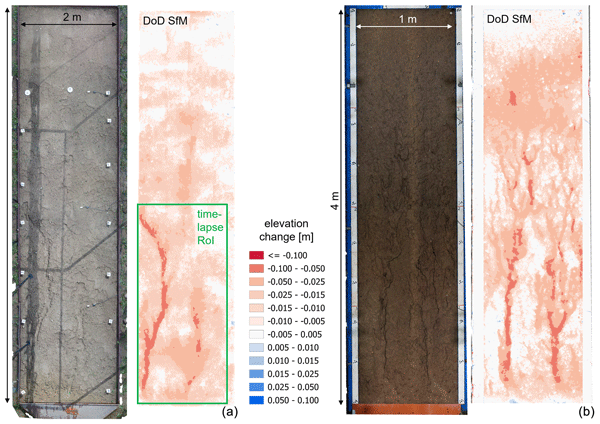
This study develops a new method to improve the calibration and evaluation of models that predict soil erosion by water. By using advanced imaging techniques, we can capture detailed changes in the soil surface over time. This helps improve models that forecast erosion, especially as climate change creates new and unpredictable conditions. Our findings highlight the need for more precise tools to better model erosion of our land and environment in the future.
Pedro Alberto Pereira Zamboni, Hanne Hendrickx, Dennis Sprute, Holger Flatt, Muhtasimul Islam Rushdi, Florian Brodrecht, and Anette Eltner
Int. Arch. Photogramm. Remote Sens. Spatial Inf. Sci., XLVIII-2-W8-2024, 483–490, https://doi.org/10.5194/isprs-archives-XLVIII-2-W8-2024-483-2024, https://doi.org/10.5194/isprs-archives-XLVIII-2-W8-2024-483-2024, 2024
Robert Krüger, Xabier Blanch, Jens Grundmann, Ghazi Al-Rawas, and Anette Eltner
Int. Arch. Photogramm. Remote Sens. Spatial Inf. Sci., XLVIII-2-W8-2024, 243–250, https://doi.org/10.5194/isprs-archives-XLVIII-2-W8-2024-243-2024, https://doi.org/10.5194/isprs-archives-XLVIII-2-W8-2024-243-2024, 2024
Melanie Elias, Steffen Isfort, Anette Eltner, and Hans-Gerd Maas
ISPRS Ann. Photogramm. Remote Sens. Spatial Inf. Sci., X-2-2024, 57–64, https://doi.org/10.5194/isprs-annals-X-2-2024-57-2024, https://doi.org/10.5194/isprs-annals-X-2-2024-57-2024, 2024
Robert Krüger, Pierre Karrasch, and Anette Eltner
Geosci. Instrum. Method. Data Syst., 13, 163–176, https://doi.org/10.5194/gi-13-163-2024, https://doi.org/10.5194/gi-13-163-2024, 2024
Short summary
Short summary
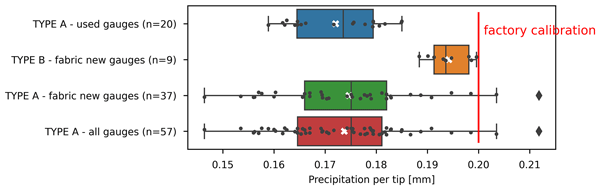
Low-cost sensors could fill gaps in existing observation networks. To ensure data quality, the quality of the factory calibration of a given sensor has to be evaluated if the sensor is used out of the box. Here, the factory calibration of a widely used low-cost rain gauge type has been tested both in the lab (66) and in the field (20). The results of the study suggest that the calibration of this particular type should at least be checked for every sensor before being used.
O. Grothum, A. Bienert, M. Bluemlein, and A. Eltner
Int. Arch. Photogramm. Remote Sens. Spatial Inf. Sci., XLVIII-1-W2-2023, 163–170, https://doi.org/10.5194/isprs-archives-XLVIII-1-W2-2023-163-2023, https://doi.org/10.5194/isprs-archives-XLVIII-1-W2-2023-163-2023, 2023
Xabier Blanch, Marta Guinau, Anette Eltner, and Antonio Abellan
Nat. Hazards Earth Syst. Sci., 23, 3285–3303, https://doi.org/10.5194/nhess-23-3285-2023, https://doi.org/10.5194/nhess-23-3285-2023, 2023
Short summary
Short summary
We present cost-effective photogrammetric systems for high-resolution rockfall monitoring. The paper outlines the components, assembly, and programming codes required. The systems utilize prime cameras to generate 3D models and offer comparable performance to lidar for change detection monitoring. Real-world applications highlight their potential in geohazard monitoring which enables accurate detection of pre-failure deformation and rockfalls with a high temporal resolution.
R. Blaskow and A. Eltner
Int. Arch. Photogramm. Remote Sens. Spatial Inf. Sci., XLVIII-1-W1-2023, 45–50, https://doi.org/10.5194/isprs-archives-XLVIII-1-W1-2023-45-2023, https://doi.org/10.5194/isprs-archives-XLVIII-1-W1-2023-45-2023, 2023
Robert Ljubičić, Dariia Strelnikova, Matthew T. Perks, Anette Eltner, Salvador Peña-Haro, Alonso Pizarro, Silvano Fortunato Dal Sasso, Ulf Scherling, Pietro Vuono, and Salvatore Manfreda
Hydrol. Earth Syst. Sci., 25, 5105–5132, https://doi.org/10.5194/hess-25-5105-2021, https://doi.org/10.5194/hess-25-5105-2021, 2021
Short summary
Short summary
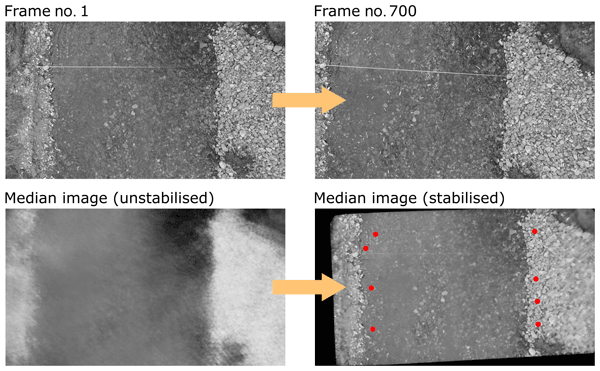
The rise of new technologies such as drones (unmanned aerial systems – UASs) has allowed widespread use of image velocimetry techniques in place of more traditional, usually slower, methods during hydrometric campaigns. In order to minimize the velocity estimation errors, one must stabilise the acquired videos. In this research, we compare the performance of different UAS video stabilisation tools and provide guidelines for their use in videos with different flight and ground conditions.
Lea Epple, Andreas Kaiser, Marcus Schindewolf, and Anette Eltner
SOIL Discuss., https://doi.org/10.5194/soil-2021-85, https://doi.org/10.5194/soil-2021-85, 2021
Revised manuscript not accepted
Short summary
Short summary
Intensified extreme weather events due to climate change can result in changes of soil erosion. These unclear developments make an improvement of soil erosion modelling all the more important. Assuming that soil erosion models cannot keep up with the current data, this work gives an overview of 44 models, their strengths and weaknesses and discusses their potential for further development with respect to new and improved soil and soil erosion assessment techniques.
Cited articles
Bartos, M., Wong, B., and Kerkez, B.: Open storm: a complete framework for sensing and control of urban watersheds, Environ. Sci. Water Res. Technol., 4, 346–358, https://doi.org/10.1039/C7EW00374A, 2018.
Blanch, X., Guinau, M., Eltner, A., and Abellan, A.: Fixed photogrammetric systems for natural hazard monitoring with high spatio-temporal resolution, Nat. Hazards Earth Syst. Sci., 23, 3285–3303, https://doi.org/10.5194/nhess-23-3285-2023, 2023a.
Blanch, X., Wagner, F., and Eltner, A.: River Water Segmentation Dataset (RIWA), Kaggle [data set], https://doi.org/10.34740/kaggle/dsv/4901781, 2023b.
Blanch, X., Guinau, M., Eltner, A., and Abellan, A.: A cost-effective image-based system for 3D geomorphic monitoring: An application to rockfalls, Geomorphology, 449, 109065, https://doi.org/10.1016/j.geomorph.2024.109065, 2024.
Blanch, X., Jäschke, A., Elias, M., and Eltner, A.: Subpixel Automatic Detection of GCP Coordinates in Time-Lapse Images Using a Deep Learning Keypoint Network, IEEE Trans. Geosci. Remote Sens., 63, 1–14, https://doi.org/10.1109/TGRS.2024.3514854, 2025a.
Blanch, X., Eltner, A., Grundmann, J., and Hedel, R.: Water level results at Lauenstein gauge station – KIWA Project, Zenodo [video], https://doi.org/10.5281/zenodo.14875801, 2025b.
Blanch, X.: KIWA Software for Water Level (wl_opt) – KIWA Project, in: Hydrology and Earth System Sciences (HESS), Zenodo [code], https://doi.org/10.5281/zenodo.17675672, 2025.
Buslaev, A., Parinov, A., Khvedchenya, E., Iglovikov, V. I., and Kalinin, A. A.: Albumentations: fast and flexible image augmentations, Information, 11, 125, https://doi.org/10.3390/info11020125, 2020.
Chureesampant, K. and Susaki, J.: Automatic GCP Extraction of Fully Polarimetric SAR Images, IEEE Trans. Geosci. Remote Sens., 52, 137–148, https://doi.org/10.1109/TGRS.2012.2236890, 2014.
Dietrich, J. T.: Bathymetric Structure-from-Motion: extracting shallow stream bathymetry from multi-view stereo photogrammetry, Earth Surf. Process. Landf., 42, 355–364, https://doi.org/10.1002/esp.4060, 2017.
Elias, M., Kehl, C., and Schneider, D.: Photogrammetric water level determination using smartphone technology, Photogramm. Rec., 34, 198–223, https://doi.org/10.1111/phor.12280, 2019.
Elias, M., Eltner, A., Liebold, F., and Maas, H.-G.: Assessing the Influence of Temperature Changes on the Geometric Stability of Smartphone- and Raspberry Pi Cameras, Sensors, 20, 643, https://doi.org/10.3390/s20030643, 2020.
Elias, M., Weitkamp, A., and Eltner, A.: Multi-modal image matching to colorize a SLAM based point cloud with arbitrary data from a thermal camera, ISPRS Open J. Photogramm. Remote Sens., 9, 100041, https://doi.org/10.1016/j.ophoto.2023.100041, 2023.
Eltner, A. and Sofia, G.: Chapter 1 – Structure from motion photogrammetric technique, in: Developments in Earth Surface Processes, vol. 23, edited by: Tarolli, P. and Mudd, S. M., Elsevier, 1–24, https://doi.org/10.1016/B978-0-444-64177-9.00001-1, 2020.
Eltner, A., Kaiser, A., Abellan, A., and Schindewolf, M.: Time lapse structure-from-motion photogrammetry for continuous geomorphic monitoring, Earth Surf. Process. Landf., 42, 2240–2253, https://doi.org/10.1002/esp.4178, 2017.
Eltner, A., Elias, M., Sardemann, H., and Spieler, D.: Automatic Image-Based Water Stage Measurement for Long-Term Observations in Ungauged Catchments, Water Resour. Res., 54, https://doi.org/10.1029/2018WR023913, 2018.
Eltner, A., Sardemann, H., and Grundmann, J.: Technical Note: Flow velocity and discharge measurement in rivers using terrestrial and unmanned-aerial-vehicle imagery, Hydrol. Earth Syst. Sci., 24, 1429–1445, https://doi.org/10.5194/hess-24-1429-2020, 2020.
Eltner, A., Bressan, P. O., Akiyama, T., Gonçalves, W. N., and Marcato Junior, J.: Using Deep Learning for Automatic Water Stage Measurements, Water Resour. Res., 57, e2020WR027608, https://doi.org/10.1029/2020WR027608, 2021.
Epple, L., Grothum, O., Bienert, A., and Eltner, A.: Decoding rainfall effects on soil surface changes: Empirical separation of sediment yield in time-lapse SfM photogrammetry measurements, Soil Tillage Res., 248, 106384, https://doi.org/10.1016/j.still.2024.106384, 2025.
Erfani, S. M. H., Smith, C., Wu, Z., Shamsabadi, E. A., Khatami, F., Downey, A. R. J., Imran, J., and Goharian, E.: Eye of Horus: a vision-based framework for real-time water level measurement, Hydrol. Earth Syst. Sci., 27, 4135–4149, https://doi.org/10.5194/hess-27-4135-2023, 2023.
Fernandes, F. E., Nonato, L. G., and Ueyama, J.: A river flooding detection system based on deep learning and computer vision, Multimed. Tools Appl., 81, 40231–40251, https://doi.org/10.1007/s11042-022-12813-3, 2022.
Grundmann, J., Blanch, X., Kutscher, A., Hedel, R., and Eltner, A.: Towards a comprehensive optical workflow for monitoring and estimation of water levels and discharge in watercourses, EGU General Assembly 2024, Vienna, Austria, 14–19 April 2024, EGU24-12507, https://doi.org/10.5194/egusphere-egu24-12507, 2024.
Herschy, R. W.: Streamflow Measurement, 3rd edn., CRC Press, London, 536 pp., https://doi.org/10.1201/9781482265880, 2008.
Iglhaut, J., Cabo, C., Puliti, S., Piermattei, L., O'Connor, J., and Rosette, J.: Structure from Motion Photogrammetry in Forestry: a Review, Curr. For. Rep., 5, 155–168, https://doi.org/10.1007/s40725-019-00094-3, 2019.
Ioli, F., Bruno, E., Calzolari, D., Galbiati, M., Mannocchi, A., Manzoni, P., Martini, M., Bianchi, A., Cina, A., De Michele, C., and Pinto, L.: A Replicable Open-Source Multi-Camera System for Low-Cost 4d Glacier Monitoring, Int. Arch. Photogramm. Remote Sens. Spat. Inf. Sci., XLVIII-M-1–2023, 137–144, https://doi.org/10.5194/isprs-archives-XLVIII-M-1-2023-137-2023, 2023.
Isikdogan, F., Bovik, A. C., and Passalacqua, P.: Surface Water Mapping by Deep Learning, IEEE J. Sel. Top. Appl. Earth Obs. Remote Sens., 10, 4909–4918, https://doi.org/10.1109/JSTARS.2017.2735443, 2017.
ISO 18365: Hydrometry – Selection, establishment and operation of a gauging station, ISO (International Organization for Standardization), Geneva, Switzerland, 2013.
Kirillov, A., Mintun, E., Ravi, N., Mao, H., Rolland, C., Gustafson, L., Xiao, T., Whitehead, S., Berg, A. C., Lo, W.-Y., Dollár, P., and Girshick, R.: Segment Anything, arXiv [preprint], https://doi.org/10.48550/arXiv.2304.02643, 2023.
Krüger, R., Blanch, X., Grundmann, J., Al-Rawas, G., and Eltner, A.: Low-Cost sensors for measuring wadi discharge – a Raspberry Pi based seismometer and time-lapse camera setup, Int. Arch. Photogramm. Remote Sens. Spat. Inf. Sci., XLVIII-2/W8-2024, 243–250, https://doi.org/10.5194/isprs-archives-XLVIII-2-W8-2024-243-2024, 2024.
Kuo, L.-C. and Tai, C.-C.: Robust Image-Based Water-Level Estimation Using Single-Camera Monitoring, IEEE Trans. Instrum. Meas., 71, 1–11, https://doi.org/10.1109/TIM.2022.3161691, 2022.
LAWA – Bund/Länderarbeitsgemeinschaft Wasser: Leitfaden zur Hydrometrie des Bundes und der Länder – Pegelhandbuch, https://www.lawa.de/documents/02_anhang_2_lawa_pegelhandbuch_2_3_1552303807.pdf (last access: 11 February 2026), 2018.
Leduc, P., Ashmore, P., and Sjogren, D.: Technical note: Stage and water width measurement of a mountain stream using a simple time-lapse camera, Hydrol. Earth Syst. Sci., 22, 1–11, https://doi.org/10.5194/hess-22-1-2018, 2018.
Li, D., Wang, Z., Chen, Y., Jiang, R., Ding, W., and Okumura, M.: A Survey on Deep Active Learning: Recent Advances and New Frontiers, arXiv [preprint], https://doi.org/10.48550/arXiv.2405.00334, 15 July 2024.
Liang, Y., Jafari, N., Luo, X., Chen, Q., Cao, Y., and Li, X.: WaterNet: An adaptive matching pipeline for segmenting water with volatile appearance, Comput. Vis. Media, 6, 65–78, https://doi.org/10.1007/s41095-020-0156-x, 2020.
Liebold, F., Mader, D., Sardemann, H., Eltner, A., and Maas, H.-G.: A Bi-Radial Model for Lens Distortion Correction of Low-Cost UAV Cameras, Remote Sens., 15, 5283, https://doi.org/10.3390/rs15225283, 2023.
Maalek, R. and Lichti, D. D.: Robust detection of non-overlapping ellipses from points with applications to circular target extraction in images and cylinder detection in point clouds, ISPRS J. Photogramm. Remote Sens., 176, 83–108, https://doi.org/10.1016/j.isprsjprs.2021.04.010, 2021.
Manfreda, S., Miglino, D., Saddi, K. C., Jomaa, S., Eltner, A., Perks, M., Peña-Haro, S., Bogaard, T., Van Emmerik, T. H. M., Mariani, S., Maddock, I., Tauro, F., Grimaldi, S., Zeng, Y., Gonçalves, G., Strelnikova, D., Bussettini, M., Marchetti, G., Lastoria, B., Su, Z., and Rode, M.: Advancing river monitoring using image-based techniques: challenges and opportunities, Hydrol. Sci. J., 69, 657–677, https://doi.org/10.1080/02626667.2024.2333846, 2024.
Miglino, D., Jomaa, S., Rode, M., Saddi, K. C., Isgrò, F., and Manfreda, S.: Technical note: Image processing for continuous river turbidity monitoring – full-scale tests and potential applications, Hydrol. Earth Syst. Sci., 29, 4133–4151, https://doi.org/10.5194/hess-29-4133-2025, 2025.
Moghimi, A., Welzel, M., Celik, T., and Schlurmann, T.: A Comparative Performance Analysis of Popular Deep Learning Models and Segment Anything Model (SAM) for River Water Segmentation in Close-Range Remote Sensing Imagery, IEEE Access, 1–1, https://doi.org/10.1109/ACCESS.2024.3385425, 2024.
Morgenschweis, G.: Hydrometrie: Theorie und Praxis der Durchflussmessung in offenen Gerinnen, Springer, Berlin, Heidelberg, https://doi.org/10.1007/978-3-662-55314-5, 2018.
Moy de Vitry, M., Kramer, S., Wegner, J. D., and Leitão, J. P.: Scalable flood level trend monitoring with surveillance cameras using a deep convolutional neural network, Hydrol. Earth Syst. Sci., 23, 4621–4634, https://doi.org/10.5194/hess-23-4621-2019, 2019.
Muhadi, N. A., Abdullah, A. F., Bejo, S. K., Mahadi, M. R., and Mijic, A.: Deep Learning Semantic Segmentation for Water Level Estimation Using Surveillance Camera, Appl. Sci., 11, 9691, https://doi.org/10.3390/app11209691, 2021.
Mydlarz, C., Sai Venkat Challagonda, P., Steers, B., Rucker, J., Brain, T., Branco, B., Burnett, H. E., Kaur, A., Fischman, R., Graziano, K., Krueger, K., Hénaff, E., Ignace, V., Jozwiak, E., Palchuri, J., Pierone, P., Rothman, P., Toledo-Crow, R., and Silverman, A. I.: FloodNet: Low-Cost Ultrasonic Sensors for Real-Time Measurement of Hyperlocal, Street-Level Floods in New York City, Water Resour. Res., 60, e2023WR036806, https://doi.org/10.1029/2023WR036806, 2024.
Pan, J., Yin, Y., Xiong, J., Luo, W., Gui, G., and Sari, H.: Deep Learning-Based Unmanned Surveillance Systems for Observing Water Levels, IEEE Access, 6, 73561–73571, https://doi.org/10.1109/ACCESS.2018.2883702, 2018.
Peña-Haro, S., Carrel, M., Lüthi, B., Hansen, I., and Lukes, R.: Robust Image-Based Streamflow Measurements for Real-Time Continuous Monitoring, Front. Water, 3, 766918, https://doi.org/10.3389/frwa.2021.766918, 2021.
Ran, Q., Li, W., Liao, Q., Tang, H., and Wang, M.: Application of an automated LSPIV system in a mountainous stream for continuous flood flow measurements, Hydrol. Process., 30, 3014–3029, https://doi.org/10.1002/hyp.10836, 2016.
Ridolfi, E. and Manciola, P.: Water Level Measurements from Drones: A Pilot Case Study at a Dam Site, Water, 10, 297, https://doi.org/10.3390/w10030297, 2018.
Ronneberger, O., Fischer, P., and Brox, T.: U-Net: Convolutional Networks for Biomedical Image Segmentation, in: Medical Image Computing and Computer-Assisted Intervention – MICCAI 2015, vol. 9351, edited by: Navab, N., Hornegger, J., Wells, W. M., and Frangi, A. F., Springer International Publishing, Cham, 234–241, https://doi.org/10.1007/978-3-319-24574-4_28, 2015.
Smith, M. W., Carrivick, J. L., and Quincey, D. J.: Structure from motion photogrammetry in physical geography, Prog. Phys. Geogr. Earth Environ., 40, 247–275, https://doi.org/10.1177/0309133315615805, 2016.
Stumpf, A., Augereau, E., Delacourt, C., and Bonnier, J.: Photogrammetric discharge monitoring of small tropical mountain rivers: A case study at Rivière des Pluies, Réunion Island, Water Resour. Res., 52, 4550–4570, https://doi.org/10.1002/2015WR018292, 2016.
Vandaele, R., Dance, S. L., and Ojha, V.: Deep learning for automated river-level monitoring through river-camera images: an approach based on water segmentation and transfer learning, Hydrol. Earth Syst. Sci., 25, 4435–4453, https://doi.org/10.5194/hess-25-4435-2021, 2021.
Wagner, F., Eltner, A., and Maas, H.-G.: River water segmentation in surveillance camera images: A comparative study of offline and online augmentation using 32 CNNs, Int. J. Appl. Earth Obs. Geoinformation, 119, 103305, https://doi.org/10.1016/j.jag.2023.103305, 2023.
Wang, Z., Lyu, H., Zhou, S., and Zhang, C.: Toward Transferable Water Level Trend Monitoring Using River Cameras: Integrating Domain-Specific Models and Segment Anything Model (SAM) for Water Segmentation, ESS Open Archive, https://doi.org/10.22541/essoar.171104253.38492313/v2, 25 March 2024.
Westoby, M. J., Brasington, J., Glasser, N. F., Hambrey, M. J., and Reynolds, J. M.: “Structure-from-Motion” photogrammetry: A low-cost, effective tool for geoscience applications, Geomorphology, 179, 300–314, https://doi.org/10.1016/j.geomorph.2012.08.021, 2012.
Xiao, T., Liu, Y., Zhou, B., Jiang, Y., and Sun, J.: Unified Perceptual Parsing for Scene Understanding, in: Computer Vision – ECCV 2018, vol. 11209, edited by: Ferrari, V., Hebert, M., Sminchisescu, C., and Weiss, Y., Springer International Publishing, Cham, 432–448, https://doi.org/10.1007/978-3-030-01228-1_26, 2018.
Young, D. S., Hart, J. K., and Martinez, K.: Image analysis techniques to estimate river discharge using time-lapse cameras in remote locations, Comput. Geosci., 76, 1–10, https://doi.org/10.1016/j.cageo.2014.11.008, 2015.
Zamboni, P. A. P., Gorriz, X. B., Junior, J. M., Nunes, W., and Eltner, A.: Do we need to label large datasets for river water segmentation? Benchmark and stage estimation with minimum to non-labeled image time series, International Journal of Remote Sensing, 46, 2719–2747, https://doi.org/10.1080/01431161.2025.2457131, 2025.
Zhou, B., Zhao, H., Puig, X., Xiao, T., Fidler, S., Barriuso, A., and Torralba, A.: Semantic Understanding of Scenes Through the ADE20K Dataset, Int. J. Comput. Vis., 127, 302–321, https://doi.org/10.1007/s11263-018-1140-0, 2019.
Zhou, N., Chen, H., Chen, N., and Liu, B.: An Approach Based on Video Image Intelligent Recognition for Water Turbidity Monitoring in River, ACS EST Water, 4, 543–554, https://doi.org/10.1021/acsestwater.3c00596, 2024.
Short summary
This study presents a low-cost, automated system for monitoring river water levels using cameras and AI. By combining AI-based image analysis with photogrammetry, it accurately measures water levels in real-time, even in challenging conditions. Tested over 2.5 years at four sites, it achieved high accuracy (errors of 1.0–2.3 cm) and processed over 219 000 images. Its resilience makes it ideal for flood detection and water management in remote areas.
This study presents a low-cost, automated system for monitoring river water levels using cameras...


