
Articles | Volume 30, issue 3
https://doi.org/10.5194/hess-30-757-2026
© Author(s) 2026. This work is distributed under
the Creative Commons Attribution 4.0 License.
the Creative Commons Attribution 4.0 License.
https://doi.org/10.5194/hess-30-757-2026
© Author(s) 2026. This work is distributed under
the Creative Commons Attribution 4.0 License.
the Creative Commons Attribution 4.0 License.
Research article
| 
09 Feb 2026
Research article |
| 09 Feb 2026
| 09 Feb 2026
Better continental-scale streamflow predictions for Australia: LSTM as a land surface model post-processor and standalone hydrological model

Commonwealth Scientific and Industrial Research Organisation (CSIRO), Clayton 3168, Australia
James C. Bennett
Commonwealth Scientific and Industrial Research Organisation (CSIRO), Clayton 3168, Australia
David E. Robertson
Commonwealth Scientific and Industrial Research Organisation (CSIRO), Clayton 3168, Australia
Jean-Michel Perraud
Commonwealth Scientific and Industrial Research Organisation (CSIRO), Mountain View 2460, Australia
Andrew J. Frost
Australian Bureau of Meteorology (BoM), Sydney 2000, Australia
Eric A. Lehmann
Commonwealth Scientific and Industrial Research Organisation (CSIRO), Mountain View 2460, Australia
Related authors
Ashkan Shokri, James C. Bennett, and David E. Robertson
EGUsphere, https://doi.org/10.5194/egusphere-2026-2950, https://doi.org/10.5194/egusphere-2026-2950, 2026
Short summary
Short summary
Predicting streamflow in ungauged river catchments, where no flow measurements exist, is a long-standing challenge in hydrology. We developed a method that takes an artificial-intelligence model trained on many gauged catchments across Australia and finetuned it to each ungauged catchment using data from nearby gauged ones, giving closer catchments more weight. Tested on 218 catchments, it improved streamflow predictions, offering an efficient way to predicting flow in poorly gauged regions.
Ashkan Shokri, James C. Bennett, and David E. Robertson
EGUsphere, https://doi.org/10.5194/egusphere-2026-2950, https://doi.org/10.5194/egusphere-2026-2950, 2026
Short summary
Short summary
Predicting streamflow in ungauged river catchments, where no flow measurements exist, is a long-standing challenge in hydrology. We developed a method that takes an artificial-intelligence model trained on many gauged catchments across Australia and finetuned it to each ungauged catchment using data from nearby gauged ones, giving closer catchments more weight. Tested on 218 catchments, it improved streamflow predictions, offering an efficient way to predicting flow in poorly gauged regions.
Yuhang Zhang, Quan J. Wang, Andrew J. Frost, Jayaram Pudashine, Blair Trewin, Carlos Velasco-Forero, Chun-Hsu Su, and Vincent Villani
EGUsphere, https://doi.org/10.5194/egusphere-2026-666, https://doi.org/10.5194/egusphere-2026-666, 2026
Short summary
Short summary
This study develops and tests a new system that combines satellite, radar, and rain gauge measurements to produce hourly rainfall maps at 2-kilometre resolution across Australia. The results show clearer and more reliable rainfall patterns than existing operational methods and products. The approach is efficient and supports both real-time monitoring and the reconstruction of historical rainfall. It also provides a practical reference for large-scale rainfall analysis in other regions.
Kevin K. W. Cheung, Fei Ji, Nidhi Nishant, Jin Teng, James Bennett, and De Li Liu
Hydrol. Earth Syst. Sci., 29, 3527–3543, https://doi.org/10.5194/hess-29-3527-2025, https://doi.org/10.5194/hess-29-3527-2025, 2025
Short summary
Short summary
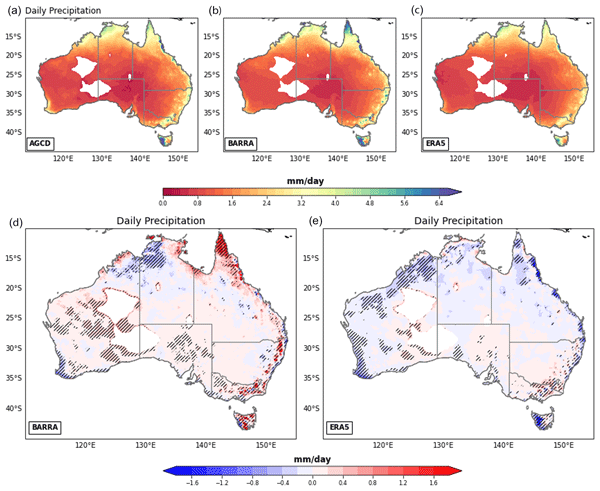
This study evaluates two reanalysis datasets, which are critical in climate, weather research, and water resources analysis, for the Australian region in terms of simulating daily mean precipitation and six other selected precipitation extremes. While spatial patterns of mean precipitation are well reproduced, substantial biases exist in precipitation variability, trends, and extremes. Caution in applying these datasets is thus advised in terms of the latter aspects.
Arash Aghakhani, David E. Robertson, and Valentijn R. N. Pauwels
EGUsphere, https://doi.org/10.5194/egusphere-2025-553, https://doi.org/10.5194/egusphere-2025-553, 2025
Preprint archived
Short summary
Short summary
Australia's shifting climate, with recurring droughts and wet periods, makes streamflow prediction challenging. This study combines GR4J model with machine learning to improve daily streamflow forecasts in Western Victoria. By identifying key factors affecting river flow, it offers valuable insights for water management. The findings show that machine learning can reveal limitations in traditional models, leading to more accurate predictions in drought-prone regions.
Stephanie R. Clark, Julien Lerat, Jean-Michel Perraud, and Peter Fitch
Hydrol. Earth Syst. Sci., 28, 1191–1213, https://doi.org/10.5194/hess-28-1191-2024, https://doi.org/10.5194/hess-28-1191-2024, 2024
Short summary
Short summary
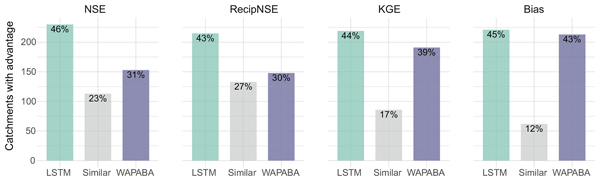
To determine if deep learning models are in general a viable alternative to traditional hydrologic modelling techniques in Australian catchments, a comparison of river–runoff predictions is made between traditional conceptual models and deep learning models in almost 500 catchments spread over the continent. It is found that the deep learning models match or outperform the traditional models in over two-thirds of the river catchments, indicating feasibility in a wide variety of conditions.
Jenny Choo, Nagur Cherukuru, Eric Lehmann, Matt Paget, Aazani Mujahid, Patrick Martin, and Moritz Müller
Biogeosciences, 19, 5837–5857, https://doi.org/10.5194/bg-19-5837-2022, https://doi.org/10.5194/bg-19-5837-2022, 2022
Short summary
Short summary
This study presents the first observation of water quality changes over space and time in the coastal systems of Sarawak, Malaysian Borneo, using remote sensing technologies. While our findings demonstrate that the southwestern coast of Sarawak is within local water quality standards, historical patterns of water quality degradation that were detected can help to alert local authorities and enhance management and monitoring strategies of coastal waters in this region.
Keirnan Fowler, Murray Peel, Margarita Saft, Tim J. Peterson, Andrew Western, Lawrence Band, Cuan Petheram, Sandra Dharmadi, Kim Seong Tan, Lu Zhang, Patrick Lane, Anthony Kiem, Lucy Marshall, Anne Griebel, Belinda E. Medlyn, Dongryeol Ryu, Giancarlo Bonotto, Conrad Wasko, Anna Ukkola, Clare Stephens, Andrew Frost, Hansini Gardiya Weligamage, Patricia Saco, Hongxing Zheng, Francis Chiew, Edoardo Daly, Glen Walker, R. Willem Vervoort, Justin Hughes, Luca Trotter, Brad Neal, Ian Cartwright, and Rory Nathan
Hydrol. Earth Syst. Sci., 26, 6073–6120, https://doi.org/10.5194/hess-26-6073-2022, https://doi.org/10.5194/hess-26-6073-2022, 2022
Short summary
Short summary
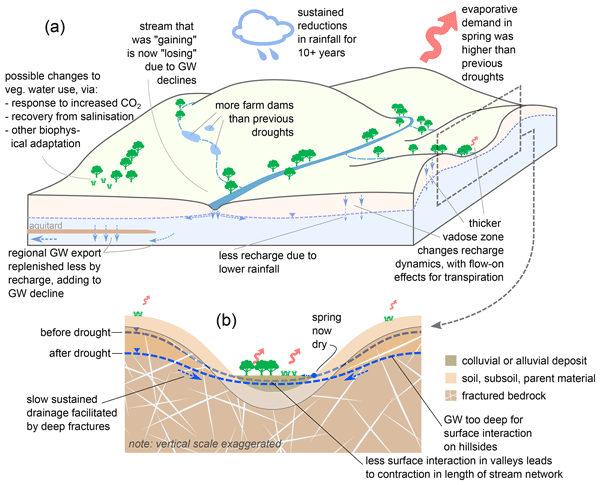
Recently, we have seen multi-year droughts tending to cause shifts in the relationship between rainfall and streamflow. In shifted catchments that have not recovered, an average rainfall year produces less streamflow today than it did pre-drought. We take a multi-disciplinary approach to understand why these shifts occur, focusing on Australia's over-10-year Millennium Drought. We evaluate multiple hypotheses against evidence, with particular focus on the key role of groundwater processes.
Hapu Arachchige Prasantha Hapuarachchi, Mohammed Abdul Bari, Aynul Kabir, Mohammad Mahadi Hasan, Fitsum Markos Woldemeskel, Nilantha Gamage, Patrick Daniel Sunter, Xiaoyong Sophie Zhang, David Ewen Robertson, James Clement Bennett, and Paul Martinus Feikema
Hydrol. Earth Syst. Sci., 26, 4801–4821, https://doi.org/10.5194/hess-26-4801-2022, https://doi.org/10.5194/hess-26-4801-2022, 2022
Short summary
Short summary
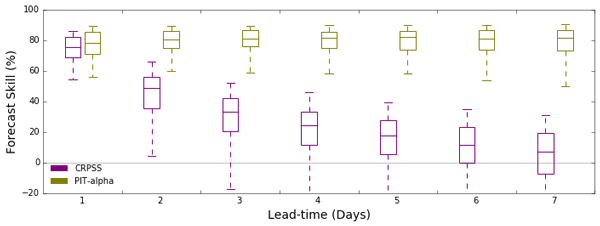
Methodology for developing an operational 7-day ensemble streamflow forecasting service for Australia is presented. The methodology is tested for 100 catchments to learn the characteristics of different NWP rainfall forecasts, the effect of post-processing, and the optimal ensemble size and bootstrapping parameters. Forecasts are generated using NWP rainfall products post-processed by the CHyPP model, the GR4H hydrologic model, and the ERRIS streamflow post-processor inbuilt in the SWIFT package
Cited articles
Coron, L., Andréassian, V., Perrin, C., Lerat, J., Vaze, J., Bourqui, M., and Hendrickx, F.: Crash testing hydrological models in contrasted climate conditions: An experiment on 216 Australian catchments, Water. Resour. Res., 48, https://doi.org/10.1029/2011WR011721, 2012.
Duan, Q., Sorooshian, S., and Gupta, V. K.: Optimal use of the SCE-UA global optimization method for calibrating watershed models, J. Hydrol., 158, 265–284, https://doi.org/10.1016/0022-1694(94)90057-4, 1994.
Fowler, K. J. A., Acharya, S. C., Addor, N., Chou, C., and Peel, M. C.: CAMELS-AUS: hydrometeorological time series and landscape attributes for 222 catchments in Australia, Earth Syst. Sci. Data, 13, 3847–3867, https://doi.org/10.5194/essd-13-3847-2021, 2021.
Fowler, K. J. A., Zhang, Z., and Hou, X.: CAMELS-AUS v2: updated hydrometeorological time series and landscape attributes for an enlarged set of catchments in Australia, Earth Syst. Sci. Data, 17, 4079–4095, https://doi.org/10.5194/essd-17-4079-2025, 2025.
Frame, J. M., Kratzert, F., Raney, A., Rahman, M., Salas, F. R., and Nearing, G. S.: Post-Processing the National Water Model with Long Short-Term Memory Networks for Streamflow Predictions and Model Diagnostics, J. Am. Water. Resour. Assoc., 57, https://doi.org/10.1111/1752-1688.12964, 2021.
Frost, A. and Shokri, A.: The Australian Landscape Water Balance model (AWRA-L v7), Bureau of Meteorology Technical Report, Melbourne, https://awo.bom.gov.au/assets/notes/publications/AWRA-Lv7_Model_Evaluation_Report.pdf (last access: 6 February 2026), 2021.
Frost, A., Shokri, A., Kier, G., Bahramian, K., and Azarnivand, A.: Evaluation of the Australian Landscape Water Balance model (AWRA-L v7), Bureau of Meteorology, Technical Report, https://awo.bom.gov.au/assets/notes/publications/AWRA-Lv7_Model_Description_Report.pdf (last access: 6 February 2026) 2021.
Grigg, A. H. and Hughes, J. D.: Nonstationarity driven by multidecadal change in catchment groundwater storage: A test of modifications to a common rainfall–run-off model, Hydrol. Process., 32, https://doi.org/10.1002/hyp.13282, 2018.
Hapuarachchi, H. A. P., Bari, M. A., Kabir, A., Hasan, M. M., Woldemeskel, F. M., Gamage, N., Sunter, P. D., Zhang, X. S., Robertson, D. E., Bennett, J. C., and Feikema, P. M.: Development of a national 7-day ensemble streamflow forecasting service for Australia, Hydrol. Earth Syst. Sci., 26, 4801–4821, https://doi.org/10.5194/hess-26-4801-2022, 2022.
Ho, M., Wasko, C., O'Shea, D., Nathan, R., Vogel, E., and Sharma, A.: Changes in flood-associated rainfall losses under climate change, J. Hydrol. (Amst.), 625, https://doi.org/10.1016/j.jhydrol.2023.129950, 2023.
Hochreiter, S. and Schmidhuber, J.: Long Short-Term Memory, Neural Comput., 9, 1735–1780, https://doi.org/10.1162/neco.1997.9.8.1735, 1997.
Hughes, J. D., Petrone, K. C., and Silberstein, R. P.: Drought, groundwater storage and stream flow decline in southwestern Australia, Geophys. Res. Lett., 39, https://doi.org/10.1029/2011GL050797, 2012.
Konapala, G., Kao, S. C., Painter, S. L., and Lu, D.: Machine learning assisted hybrid models can improve streamflow simulation in diverse catchments across the conterminous US, Environ. Res. Lett., 15, https://doi.org/10.1088/1748-9326/aba927, 2020.
Kratzert, F., Klotz, D., Brenner, C., Schulz, K., and Herrnegger, M.: Rainfall–runoff modelling using Long Short-Term Memory (LSTM) networks, Hydrol. Earth Syst. Sci., 22, 6005–6022, https://doi.org/10.5194/hess-22-6005-2018, 2018.
Kratzert, F., Klotz, D., Shalev, G., Klambauer, G., Hochreiter, S., and Nearing, G.: Towards learning universal, regional, and local hydrological behaviors via machine learning applied to large-sample datasets, Hydrol. Earth Syst. Sci., 23, 5089–5110, https://doi.org/10.5194/hess-23-5089-2019, 2019.
Kratzert, F., Gauch, M., Klotz, D., and Nearing, G.: HESS Opinions: Never train a Long Short-Term Memory (LSTM) network on a single basin, Hydrol. Earth Syst. Sci., 28, 4187–4201, https://doi.org/10.5194/hess-28-4187-2024, 2024.
Li, H., Wigmosta, M. S., Wu, H., Huang, M., Ke, Y., Coleman, A. M., and Leung, L. R.: A physically based runoff routing model for land surface and Earth system models, J. Hydrometeorol., 14, 808–828, https://doi.org/10.1175/JHM-D-12-015.1, 2013.
Lima, M., Deck, K., Dunbar, O. R. A., and Schneider, T.: Toward Routing River Water in Land Surface Models with Recurrent Neural Networks, arXiv [preprint], https://doi.org/10.48550/arXiv.2404.14212, 2024.
Malerba, M. E., Wright, N., and Macreadie, P. I.: A continental-scale assessment of density, size, distribution and historical trends of farm dams using deep learning convolutional neural networks, Remote Sens. (Basel), 13, https://doi.org/10.3390/rs13020319, 2021.
Nagesh Kumar, D., Srinivasa Raju, K., and Sathish, T.: River Flow Forecasting using Recurrent Neural Networks, Water Resour. Manag., 18, 143–161, https://doi.org/10.1023/B:WARM.0000024727.94701.12, 2004.
Nash, J. E. and Sutcliffe, J. V.: River flow forecasting through conceptual models, Part I – A discussion of principles, J. Hydrol., 10, 282–290, https://doi.org/10.1016/0022-1694(70)90255-6, 1970.
Nearing, G. S., Kratzert, F., Sampson, A. K., Pelissier, C. S., Klotz, D., Frame, J. M., Prieto, C., and Gupta, H. V.: What Role Does Hydrological Science Play in the Age of Machine Learning?, Water Resour. Res., 57, e2020WR028091, https://doi.org/10.1029/2020WR028091, 2021.
Peña-Arancibia, J. L., Malerba, M. E., Wright, N., and Robertson, D. E.: Characterising the regional growth of on-farm storages and their implications for water resources under a changing climate, J. Hydrol. (Amst.), 625, https://doi.org/10.1016/j.jhydrol.2023.130097, 2023.
Perrin, C., Michel, C., and Andréassian, V.: Improvement of a parsimonious model for streamflow simulation, J. Hydrol., 279, 275–289, https://doi.org/10.1016/S0022-1694(03)00225-7, 2003.
Petrone, K. C., Hughes, J. D., Van Niel, T. G., and Silberstein, R. P.: Streamflow decline in southwestern Australia, 1950–2008, Geophys. Res. Lett., 37, https://doi.org/10.1029/2010GL043102, 2010.
Saft, M., Western, A. W., Zhang, L., Peel, M. C., and Potter, N. J.: The influence of multiyear drought on the annual rainfall–runoff relationship: An Australian perspective, Water Resour. Res., 51, https://doi.org/10.1002/2014WR015348, 2015.
Sharples, W., Bende-Michl, U., Wilson, L., Shokri, A., Frost, A., and Baron-Hay, S.: Improving continental hydrological models for future climate conditions via multi-objective optimisation, Environ. Modell. Softw., 176, https://doi.org/10.1016/j.envsoft.2024.106018, 2024.
Shokri, A., Walker, J. P., van Dijk, A. I. J. M., Wright, A. J., and Pauwels, V. R. N.: Application of the patient rule induction method to detect hydrologic model behavioural parameters and quantify uncertainty, Hydrol. Process., 32, https://doi.org/10.1002/hyp.11464, 2018.
Slater, L. J., Arnal, L., Boucher, M.-A., Chang, A. Y.-Y., Moulds, S., Murphy, C., Nearing, G., Shalev, G., Shen, C., Speight, L., Villarini, G., Wilby, R. L., Wood, A., and Zappa, M.: Hybrid forecasting: blending climate predictions with AI models, Hydrol. Earth Syst. Sci., 27, 1865–1889, https://doi.org/10.5194/hess-27-1865-2023, 2023.
Stern, H., De Hoedt, G., and Ernst, J.: Objective classification of Australian climates, Aust. Meteorol. Mag., 49, 87–96, https://doi.org/10.1071/ES00009, 2000.
Tang, S., Sun, F., Liu, W., Wang, H., Feng, Y., and Li, Z.: Optimal Postprocessing Strategies With LSTM for Global Streamflow Prediction in Ungauged Basins, Water Resour. Res., 59, https://doi.org/10.1029/2022WR034352, 2023.
Wasko, C. and Nathan, R.: Influence of changes in rainfall and soil moisture on trends in flooding, J. Hydrol. (Amst.), 575, https://doi.org/10.1016/j.jhydrol.2019.05.054, 2019.
Wu, H., Adler, R. F., Tian, Y., Huffman, G. J., Li, H., and Wang, J.: Real-time global flood estimation using satellite-based precipitation and a coupled land surface and routing model, Water Resour. Res., 50, 2693–2717, https://doi.org/10.1002/2013WR014710, 2014.
Yamazaki, D., Kanae, S., Kim, H., and Oki, T.: A physically based description of floodplain inundation dynamics in a global river routing model, Water Resour. Res., 47, https://doi.org/10.1029/2010WR009726, 2011.
Yassin, F., Razavi, S., Elshamy, M., Davison, B., Sapriza-Azuri, G., and Wheater, H.: Representation and improved parameterization of reservoir operation in hydrological and land-surface models, Hydrol. Earth Syst. Sci., 23, 3735–3764, https://doi.org/10.5194/hess-23-3735-2019, 2019.
Yu, Q., Tolson, B. A., Shen, H., Han, M., Mai, J., and Lin, J.: Enhancing long short-term memory (LSTM)-based streamflow prediction with a spatially distributed approach, Hydrol. Earth Syst. Sci., 28, 2107–2122, https://doi.org/10.5194/hess-28-2107-2024, 2024.
Zhang, Y., Brooks, M., Campbell, N., Chen, Y., Frost, A., Oke, A., and Viney, N.: Collation of Australian modeller's streamflow dataset for 780 unregulated Australian catchments, CSIRO, Canberra, Australia, vol. 115, 2013.
Zheng, H., Chiew, F. H. S., Post, D. A., Robertson, D. E., Charles, S. P., Grose, M. R., and Potter, N. J.: Projections of future streamflow for Australia informed by CMIP6 and previous generations of global climate models, J. Hydrol. (Amst.), 636, 131286, https://doi.org/10.1016/j.jhydrol.2024.131286, 2024.
Short summary
Predicting river flow accurately is crucial for managing water resources, especially in a changing climate. This study used deep learning to improve streamflow predictions across Australia. By either enhancing existing models or working independently with climate data, the deep learning approaches provided more reliable results than traditional methods. These findings can help water managers better plan for floods, droughts, and long-term water availability.
Predicting river flow accurately is crucial for managing water resources, especially in a...


