
Articles | Volume 30, issue 18
https://doi.org/10.5194/hess-30-5857-2026
© Author(s) 2026. This work is distributed under
the Creative Commons Attribution 4.0 License.
the Creative Commons Attribution 4.0 License.
https://doi.org/10.5194/hess-30-5857-2026
© Author(s) 2026. This work is distributed under
the Creative Commons Attribution 4.0 License.
the Creative Commons Attribution 4.0 License.
Research article
| 
16 Sep 2026
Research article |
| 16 Sep 2026
| 16 Sep 2026
Setting the bar: benchmarks for model performances in large-sample hydrology

Department of Geography, University of Zurich, Winterthurerstrasse 190, 8057 Zurich, Switzerland
Department of Geography, University of Zurich, Winterthurerstrasse 190, 8057 Zurich, Switzerland
Sandra Pool
Eawag, Swiss Federal Institute of Aquatic Science and Technology, Department Water Resources and Drinking Water, Überlandstrasse 133, 8600 Dübendorf, Switzerland
Related authors
Tamara Leins, Nikolai Späth, Jan Seibert, Francesca Pianosi, Christian Reinhardt-Imjela, and Andreas Hartmann
EGUsphere, https://doi.org/10.5194/egusphere-2026-4470, https://doi.org/10.5194/egusphere-2026-4470, 2026
This preprint is open for discussion and under review for Hydrology and Earth System Sciences (HESS).
Short summary
Short summary
In this study, we found large uncertainties in the simulation of Subsurface Stormflow (SSF) in a lumped hydrological model using only discharge data for parameter estimation. High-flow-based parameter estimation could extract some additional information, but SSF-specific data remain necessary to achieve more realistic SSF simulations. Occurrence uncertainty dominated total SSF uncertainty, suggesting proxy data on SSF occurrence could already substantially reduce SSF simulation uncertainties.
Mirjam Scheller, Nicola Durighetto, Anja Fischer, Reinhard Furrer, Marc Vis, Jan Seibert, Gianluca Botter, and Ilja van Meerveld
EGUsphere, https://doi.org/10.5194/egusphere-2026-4479, https://doi.org/10.5194/egusphere-2026-4479, 2026
This preprint is open for discussion and under review for Hydrology and Earth System Sciences (HESS).
Short summary
Short summary
Many streams do not always contain flowing water. Because these streams are rarely monitored, we tested whether observations by citizen scientists could be used to track whether streams were flowing. Although these observations were irregular in space and time, identifying the order in which sites started or stopped flowing allowed us to fill data gaps and estimate daily flow conditions across the area. This shows that volunteers can effectively monitor streams that sometimes dry up.
Thiago V. M. do Nascimento, Julia Rudlang, Sebastian Gnann, Jan Seibert, Markus Hrachowitz, and Fabrizio Fenicia
Hydrol. Earth Syst. Sci., 29, 7173–7200, https://doi.org/10.5194/hess-29-7173-2025, https://doi.org/10.5194/hess-29-7173-2025, 2025
Short summary
Short summary
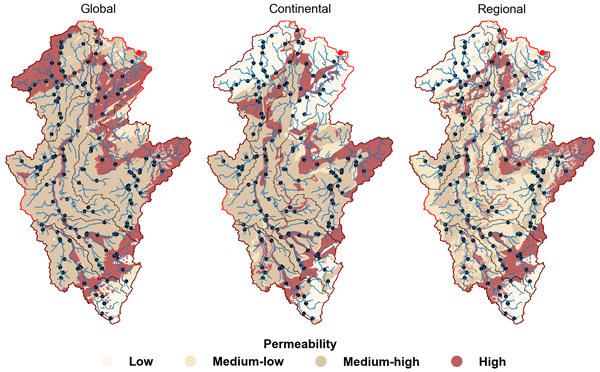
We show that geological maps with varying levels of detail may influence the identification of geology–streamflow relationships across European catchments at multiple scales. At the large scale, controls varied between basins, with no map consistently superior. At the intermediate and small scales, however, higher geological detail consistently strengthened correlations, particularly for baseflow signatures, with the regional map highlighting controls more consistent with process understanding.
Ondrej Hotovy, Ondrej Nedelcev, Jan Seibert, and Michal Jenicek
Hydrol. Earth Syst. Sci., 29, 4199–4217, https://doi.org/10.5194/hess-29-4199-2025, https://doi.org/10.5194/hess-29-4199-2025, 2025
Short summary
Short summary
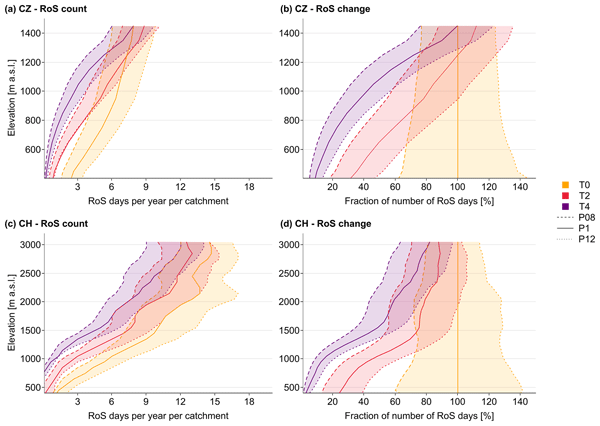
Rain falling on snow (RoS) can accelerate snowmelt and affect runoff, potentially causing severe flooding. We assessed the regional and seasonal variations in the occurrence of RoS in mountainous catchments in central Europe under different perturbations of future climate. Our results showed that RoS changes driven by climate change vary greatly among regions, across elevations, and within the cold season. However, most projections suggested a decrease in RoS events and RoS-driven runoff.
Inhye Kong, Jan Seibert, and Ross S. Purves
Hydrol. Earth Syst. Sci., 29, 3795–3808, https://doi.org/10.5194/hess-29-3795-2025, https://doi.org/10.5194/hess-29-3795-2025, 2025
Short summary
Short summary
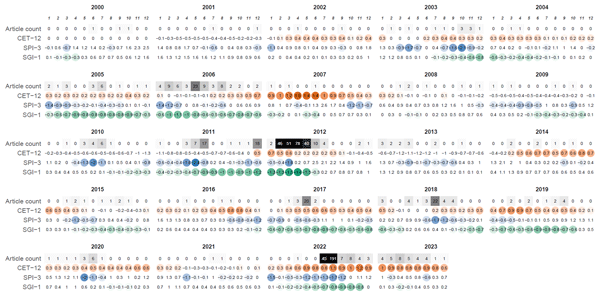
This study examines the timing and topics of newspaper coverage of droughts in England. Media attention correlated with drought-prone hydroclimatic conditions, particularly low precipitation and low groundwater levels, but also showed a seasonality bias, with more coverage in spring and summer, as exemplified by the 2022 summer drought. The findings reveal complex media dynamics in science communication, suggesting potential gaps in how droughts are framed by scientists versus the media.
Franziska Clerc-Schwarzenbach, Giovanni Selleri, Mattia Neri, Elena Toth, Ilja van Meerveld, and Jan Seibert
Hydrol. Earth Syst. Sci., 28, 4219–4237, https://doi.org/10.5194/hess-28-4219-2024, https://doi.org/10.5194/hess-28-4219-2024, 2024
Short summary
Short summary
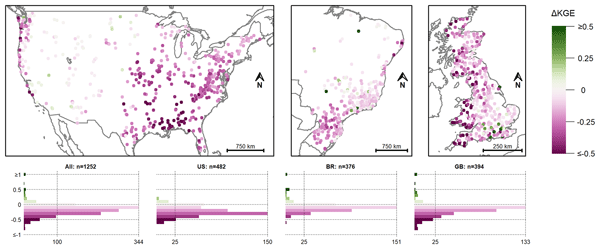
We show that the differences between the forcing data included in three CAMELS datasets (US, BR, GB) and the forcing data included for the same catchments in the Caravan dataset affect model calibration considerably. The model performance dropped when the data from the Caravan dataset were used instead of the original data. Most of the model performance drop could be attributed to the differences in precipitation data. However, differences were largest for the potential evapotranspiration data.
Jana Erdbrügger, Ilja van Meerveld, Jan Seibert, and Kevin Bishop
Earth Syst. Sci. Data, 15, 1779–1800, https://doi.org/10.5194/essd-15-1779-2023, https://doi.org/10.5194/essd-15-1779-2023, 2023
Short summary
Short summary
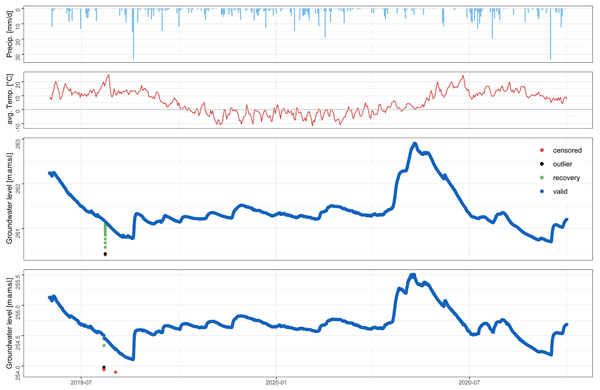
Groundwater can respond quickly to precipitation and is the main source of streamflow in most catchments in humid, temperate climates. To better understand shallow groundwater dynamics, we installed a network of groundwater wells in two boreal headwater catchments in Sweden. We recorded groundwater levels in 75 wells for 2 years and sampled the water and analyzed its chemical composition in one summer. This paper describes these datasets.
Rosanna A. Lane, Gemma Coxon, Jim Freer, Jan Seibert, and Thorsten Wagener
Hydrol. Earth Syst. Sci., 26, 5535–5554, https://doi.org/10.5194/hess-26-5535-2022, https://doi.org/10.5194/hess-26-5535-2022, 2022
Short summary
Short summary
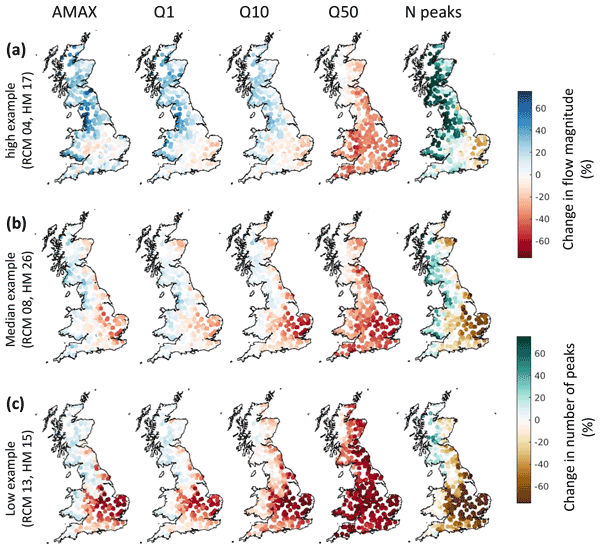
This study modelled the impact of climate change on river high flows across Great Britain (GB). Generally, results indicated an increase in the magnitude and frequency of high flows along the west coast of GB by 2050–2075. In contrast, average flows decreased across GB. All flow projections contained large uncertainties; the climate projections were the largest source of uncertainty overall but hydrological modelling uncertainties were considerable in some regions.
Daniel Viviroli, Anna E. Sikorska-Senoner, Guillaume Evin, Maria Staudinger, Martina Kauzlaric, Jérémy Chardon, Anne-Catherine Favre, Benoit Hingray, Gilles Nicolet, Damien Raynaud, Jan Seibert, Rolf Weingartner, and Calvin Whealton
Nat. Hazards Earth Syst. Sci., 22, 2891–2920, https://doi.org/10.5194/nhess-22-2891-2022, https://doi.org/10.5194/nhess-22-2891-2022, 2022
Short summary
Short summary
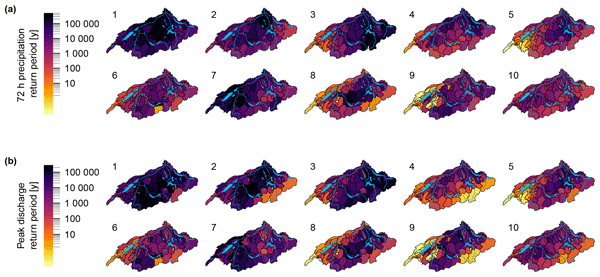
Estimating the magnitude of rare to very rare floods is a challenging task due to a lack of sufficiently long observations. The challenge is even greater in large river basins, where precipitation patterns and amounts differ considerably between individual events and floods from different parts of the basin coincide. We show that a hydrometeorological model chain can provide plausible estimates in this setting and can thus inform flood risk and safety assessments for critical infrastructure.

Jan Seibert and Sten Bergström
Hydrol. Earth Syst. Sci., 26, 1371–1388, https://doi.org/10.5194/hess-26-1371-2022, https://doi.org/10.5194/hess-26-1371-2022, 2022
Short summary
Short summary
Hydrological catchment models are commonly used as the basis for water resource management planning. The HBV model, which is a typical example of such a model, was first applied about 50 years ago in Sweden. We describe and reflect on the model development and applications. The aim is to provide an understanding of the background of model development and a basis for addressing the balance between model complexity and data availability that will continue to face hydrologists in the future.
Tamara Leins, Nikolai Späth, Jan Seibert, Francesca Pianosi, Christian Reinhardt-Imjela, and Andreas Hartmann
EGUsphere, https://doi.org/10.5194/egusphere-2026-4470, https://doi.org/10.5194/egusphere-2026-4470, 2026
This preprint is open for discussion and under review for Hydrology and Earth System Sciences (HESS).
Short summary
Short summary
In this study, we found large uncertainties in the simulation of Subsurface Stormflow (SSF) in a lumped hydrological model using only discharge data for parameter estimation. High-flow-based parameter estimation could extract some additional information, but SSF-specific data remain necessary to achieve more realistic SSF simulations. Occurrence uncertainty dominated total SSF uncertainty, suggesting proxy data on SSF occurrence could already substantially reduce SSF simulation uncertainties.
Mirjam Scheller, Nicola Durighetto, Anja Fischer, Reinhard Furrer, Marc Vis, Jan Seibert, Gianluca Botter, and Ilja van Meerveld
EGUsphere, https://doi.org/10.5194/egusphere-2026-4479, https://doi.org/10.5194/egusphere-2026-4479, 2026
This preprint is open for discussion and under review for Hydrology and Earth System Sciences (HESS).
Short summary
Short summary
Many streams do not always contain flowing water. Because these streams are rarely monitored, we tested whether observations by citizen scientists could be used to track whether streams were flowing. Although these observations were irregular in space and time, identifying the order in which sites started or stopped flowing allowed us to fill data gaps and estimate daily flow conditions across the area. This shows that volunteers can effectively monitor streams that sometimes dry up.
Sandra Pool, Keirnan Fowler, Hansini Gardiya Weligamage, and Murray Peel
Hydrol. Earth Syst. Sci., 30, 2797–2815, https://doi.org/10.5194/hess-30-2797-2026, https://doi.org/10.5194/hess-30-2797-2026, 2026
Short summary
Short summary
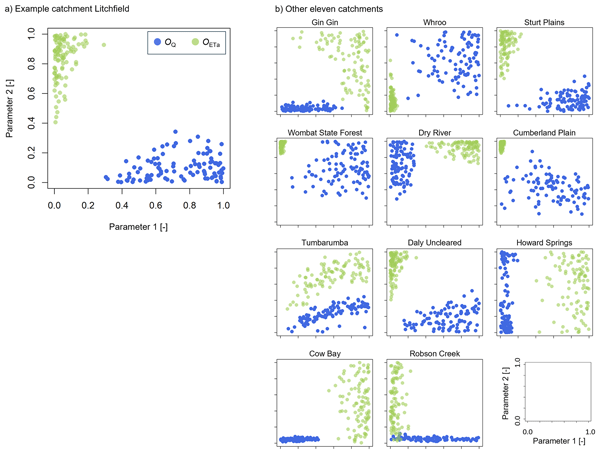
Multivariate calibration has become a widely used method to improve model realism. We found that multivariate calibration can lead to less constrained flux maps and more uncertain hydrographs relative to univariate calibration. These symptoms could be caused by non-overlapping behavioural parameter distributions for the individual calibration variables. The results emphasize that the value of non-discharge data in calibration is contingent on the suitability of the model structure.
Eleni Kritidou, Martina Kauzlaric, Maria Staudinger, Guillaume Evin, Marc Vis, and Daniel Viviroli
EGUsphere, https://doi.org/10.5194/egusphere-2026-2338, https://doi.org/10.5194/egusphere-2026-2338, 2026
Short summary
Short summary
In mountain regions, precipitation varies with elevation, but models often simplify this relationship. We used simulations combining a weather generator and a hydrological model to explore how different precipitation different lapse rates affect runoff and floods in Switzerland. We found that they impact yearly and seasonal river flow and flood behavior. Higher-elevation catchments were less sensitive, and higher lapse rates increased summer floods, while lower rates increased winter floods.
Thiago V. M. do Nascimento, Julia Rudlang, Sebastian Gnann, Jan Seibert, Markus Hrachowitz, and Fabrizio Fenicia
Hydrol. Earth Syst. Sci., 29, 7173–7200, https://doi.org/10.5194/hess-29-7173-2025, https://doi.org/10.5194/hess-29-7173-2025, 2025
Short summary
Short summary
We show that geological maps with varying levels of detail may influence the identification of geology–streamflow relationships across European catchments at multiple scales. At the large scale, controls varied between basins, with no map consistently superior. At the intermediate and small scales, however, higher geological detail consistently strengthened correlations, particularly for baseflow signatures, with the regional map highlighting controls more consistent with process understanding.
Maria Staudinger, Anna Herzog, Ralf Loritz, Tobias Houska, Sandra Pool, Diana Spieler, Paul D. Wagner, Juliane Mai, Jens Kiesel, Stephan Thober, Björn Guse, and Uwe Ehret
Hydrol. Earth Syst. Sci., 29, 5005–5029, https://doi.org/10.5194/hess-29-5005-2025, https://doi.org/10.5194/hess-29-5005-2025, 2025
Short summary
Short summary
Three process-based and four data-driven hydrological models are compared using different training data. We found that process-based models perform better with small datasets but stop learning soon, while data-driven models learn longer. The study highlights the importance of memory in data and the impact of different data sampling methods on model performance. The direct comparison of these models is novel and provides a clear understanding of their performance under various data conditions.
Ondrej Hotovy, Ondrej Nedelcev, Jan Seibert, and Michal Jenicek
Hydrol. Earth Syst. Sci., 29, 4199–4217, https://doi.org/10.5194/hess-29-4199-2025, https://doi.org/10.5194/hess-29-4199-2025, 2025
Short summary
Short summary
Rain falling on snow (RoS) can accelerate snowmelt and affect runoff, potentially causing severe flooding. We assessed the regional and seasonal variations in the occurrence of RoS in mountainous catchments in central Europe under different perturbations of future climate. Our results showed that RoS changes driven by climate change vary greatly among regions, across elevations, and within the cold season. However, most projections suggested a decrease in RoS events and RoS-driven runoff.
Inhye Kong, Jan Seibert, and Ross S. Purves
Hydrol. Earth Syst. Sci., 29, 3795–3808, https://doi.org/10.5194/hess-29-3795-2025, https://doi.org/10.5194/hess-29-3795-2025, 2025
Short summary
Short summary
This study examines the timing and topics of newspaper coverage of droughts in England. Media attention correlated with drought-prone hydroclimatic conditions, particularly low precipitation and low groundwater levels, but also showed a seasonality bias, with more coverage in spring and summer, as exemplified by the 2022 summer drought. The findings reveal complex media dynamics in science communication, suggesting potential gaps in how droughts are framed by scientists versus the media.
Franziska Clerc-Schwarzenbach, Giovanni Selleri, Mattia Neri, Elena Toth, Ilja van Meerveld, and Jan Seibert
Hydrol. Earth Syst. Sci., 28, 4219–4237, https://doi.org/10.5194/hess-28-4219-2024, https://doi.org/10.5194/hess-28-4219-2024, 2024
Short summary
Short summary
We show that the differences between the forcing data included in three CAMELS datasets (US, BR, GB) and the forcing data included for the same catchments in the Caravan dataset affect model calibration considerably. The model performance dropped when the data from the Caravan dataset were used instead of the original data. Most of the model performance drop could be attributed to the differences in precipitation data. However, differences were largest for the potential evapotranspiration data.
Marvin Höge, Martina Kauzlaric, Rosi Siber, Ursula Schönenberger, Pascal Horton, Jan Schwanbeck, Marius Günter Floriancic, Daniel Viviroli, Sibylle Wilhelm, Anna E. Sikorska-Senoner, Nans Addor, Manuela Brunner, Sandra Pool, Massimiliano Zappa, and Fabrizio Fenicia
Earth Syst. Sci. Data, 15, 5755–5784, https://doi.org/10.5194/essd-15-5755-2023, https://doi.org/10.5194/essd-15-5755-2023, 2023
Short summary
Short summary
CAMELS-CH is an open large-sample hydro-meteorological data set that covers 331 catchments in hydrologic Switzerland from 1 January 1981 to 31 December 2020. It comprises (a) daily data of river discharge and water level as well as meteorologic variables like precipitation and temperature; (b) yearly glacier and land cover data; (c) static attributes of, e.g, topography or human impact; and (d) catchment delineations. CAMELS-CH enables water and climate research and modeling at catchment level.
Jana Erdbrügger, Ilja van Meerveld, Jan Seibert, and Kevin Bishop
Earth Syst. Sci. Data, 15, 1779–1800, https://doi.org/10.5194/essd-15-1779-2023, https://doi.org/10.5194/essd-15-1779-2023, 2023
Short summary
Short summary
Groundwater can respond quickly to precipitation and is the main source of streamflow in most catchments in humid, temperate climates. To better understand shallow groundwater dynamics, we installed a network of groundwater wells in two boreal headwater catchments in Sweden. We recorded groundwater levels in 75 wells for 2 years and sampled the water and analyzed its chemical composition in one summer. This paper describes these datasets.
Rosanna A. Lane, Gemma Coxon, Jim Freer, Jan Seibert, and Thorsten Wagener
Hydrol. Earth Syst. Sci., 26, 5535–5554, https://doi.org/10.5194/hess-26-5535-2022, https://doi.org/10.5194/hess-26-5535-2022, 2022
Short summary
Short summary
This study modelled the impact of climate change on river high flows across Great Britain (GB). Generally, results indicated an increase in the magnitude and frequency of high flows along the west coast of GB by 2050–2075. In contrast, average flows decreased across GB. All flow projections contained large uncertainties; the climate projections were the largest source of uncertainty overall but hydrological modelling uncertainties were considerable in some regions.
Daniel Viviroli, Anna E. Sikorska-Senoner, Guillaume Evin, Maria Staudinger, Martina Kauzlaric, Jérémy Chardon, Anne-Catherine Favre, Benoit Hingray, Gilles Nicolet, Damien Raynaud, Jan Seibert, Rolf Weingartner, and Calvin Whealton
Nat. Hazards Earth Syst. Sci., 22, 2891–2920, https://doi.org/10.5194/nhess-22-2891-2022, https://doi.org/10.5194/nhess-22-2891-2022, 2022
Short summary
Short summary
Estimating the magnitude of rare to very rare floods is a challenging task due to a lack of sufficiently long observations. The challenge is even greater in large river basins, where precipitation patterns and amounts differ considerably between individual events and floods from different parts of the basin coincide. We show that a hydrometeorological model chain can provide plausible estimates in this setting and can thus inform flood risk and safety assessments for critical infrastructure.
Jan Seibert and Sten Bergström
Hydrol. Earth Syst. Sci., 26, 1371–1388, https://doi.org/10.5194/hess-26-1371-2022, https://doi.org/10.5194/hess-26-1371-2022, 2022
Short summary
Short summary
Hydrological catchment models are commonly used as the basis for water resource management planning. The HBV model, which is a typical example of such a model, was first applied about 50 years ago in Sweden. We describe and reflect on the model development and applications. The aim is to provide an understanding of the background of model development and a basis for addressing the balance between model complexity and data availability that will continue to face hydrologists in the future.
Cited articles
Addor, N., Newman, A. J., Mizukami, N., and Clark, M. P.: The CAMELS data set: catchment attributes and meteorology for large-sample studies, Hydrol. Earth Syst. Sci., 21, 5293–5313, https://doi.org/10.5194/hess-21-5293-2017, 2017.
Alvarez-Garreton, C., Mendoza, P. A., Boisier, J. P., Addor, N., Galleguillos, M., Zambrano-Bigiarini, M., Lara, A., Puelma, C., Cortes, G., Garreaud, R., McPhee, J., and Ayala, A.: The CAMELS-CL dataset: catchment attributes and meteorology for large sample studies – Chile dataset, Hydrol. Earth Syst. Sci., 22, 5817–5846, https://doi.org/10.5194/hess-22-5817-2018, 2018a.
Alvarez-Garreton, C., Mendoza, P. A., Boisier, J. P., Addor, N., Galleguillos, M., Zambrano-Bigiarini, M., Lara, A., Puelma, C., Cortes, G., Garreaud, R., McPhee, J., and Ayala, A.: The CAMELS-CL dataset – links to files, PANGAEA [data set], https://doi.org/10.1594/PANGAEA.894885, 2018b.
Arsenault, R., Martel, J.-L., Brunet, F., Brissette, F., and Mai, J.: Continuous streamflow prediction in ungauged basins: long short-term memory neural networks clearly outperform traditional hydrological models, Hydrol. Earth Syst. Sci., 27, 139–157, https://doi.org/10.5194/hess-27-139-2023, 2023.
Beven, K. and Westerberg, I.: On red herrings and real herrings: disinformation and information in hydrological inference, Hydrol. Process., 25, 1676–1680, https://doi.org/10.1002/hyp.7963, 2011.
Breiman, L.: Random Forests, Mach. Learn., 45, 5–32, 2001.
Casado Rodríguez, J.: CAMELS-ES: Catchment Attributes and Meteorology for Large-Sample Studies – Spain (Version 1.0.2), Zenodo [data set], https://doi.org/10.5281/zenodo.8428374, 2023.
Casado-Rodríguez, J., Ramos-Gomes, G., and Salamon, P.: Simulación del caudal en España utilizando redes neuronales Long Short-Term Memory, Ingeniería del Agua, 30, 63–78, https://doi.org/10.4995/ia.25084, 2026.
Chagas, V. B. P., Chaffe, P. L. B., Addor, N., Fan, F. M., Fleischmann, A. S., Paiva, R. C. D., and Siqueira, V. A.: CAMELS-BR: hydrometeorological time series and landscape attributes for 897 catchments in Brazil, Earth Syst. Sci. Data, 12, 2075–2096, https://doi.org/10.5194/essd-12-2075-2020, 2020.
Chagas, V. B. P., Chaffe, P. L. B., Addor, N., Fan, F. M., Fleischmann, A. S., Paiva, R. C. D., and Siqueira, V. A.: CAMELS-BR: Hydrometeorological time series and landscape attributes for 897 catchments in Brazil - link to files. (Version 1.2), Zenodo [data set], https://doi.org/10.5281/zenodo.15025488, 2025.
Coxon, G., Addor, N., Bloomfield, J. P., Freer, J., Fry, M., Hannaford, J., Howden, N. J. K., Lane, R., Lewis, M., Robinson, E. L., Wagener, T., and Woods, R.: CAMELS-GB: hydrometeorological time series and landscape attributes for 671 catchments in Great Britain, Earth Syst. Sci. Data, 12, 2459–2483, https://doi.org/10.5194/essd-12-2459-2020, 2020a.
Coxon, G., Addor, N., Bloomfield, J. P., Freer, J., Fry, M., Hannaford, J., Howden, N. J. K.; Lane, R., Lewis, M., Robinson, E. L., Wagener, T., and Woods, R.: Catchment attributes and hydro-meteorological timeseries for 671 catchments across Great Britain (CAMELS-GB), NERC Environmental Information Data Centre [data set], https://doi.org/10.5285/8344e4f3-d2ea-44f5-8afa-86d2987543a9, 2020b.
Crochemore, L., Perrin, C., Andréassian, V., Ehret, U., Seibert, S. P., Grimaldi, S. S., Gupta, H., and Paturel, J.-E.: Comparing expert judgement and numerical criteria for hydrograph evaluation, Hydrol. Sci. J., 60, 402–423, https://doi.org/10.1080/02626667.2014.903331, 2015.
Dakhlaoui, H., Ruelland, D., Tramblay, Y., and Bargaoui, Z.: Evaluating the robustness of conceptual rainfall-runoff models under climate variability in northern Tunisia, J. Hydrol. (Amst.), 550, 201–217, https://doi.org/10.1016/j.jhydrol.2017.04.032, 2017.
Delaigue, O., Guimarães, G. M., Brigode, P., Génot, B., Perrin, C., and Andréassian, V.: CAMELS-FR dataset, Recherche Data Gouv, V3 [data set], https://doi.org/10.57745/WH7FJR, 2024.
Delaigue, O., Guimarães, G. M., Brigode, P., Génot, B., Perrin, C., Soubeyroux, J.-M., Janet, B., Addor, N., and Andréassian, V.: CAMELS-FR dataset: a large-sample hydroclimatic dataset for France to explore hydrological diversity and support model benchmarking, Earth Syst. Sci. Data, 17, 1461–1479, https://doi.org/10.5194/essd-17-1461-2025, 2025.
de Lavenne, A., Thirel, G., Andréassian, V., Perrin, C., and Ramos, M.-H.: Spatial variability of the parameters of a semi-distributed hydrological model, Proc. IAHS, 373, 87–94, https://doi.org/10.5194/piahs-373-87-2016, 2016.
Dolich, A., Espinoza, E. A., Ebeling, P., Guse, B., Götte, J., Hassler, S., Hauffe, C., Kiesel, J., Heidbüchel, I., Mälicke, M., Müller-Thomy, H., Stölzle, M., Tarasova, L., and Loritz, R.: CAMELS-DE: hydrometeorological time series and attributes for 1582 catchments in Germany (Version 1.1.0), Zenodo [data set], https://doi.org/10.5281/zenodo.16755906, 2025.
Fowler, K., Knoben, W., Peel, M., Peterson, T., Ryu, D., Saft, M., Seo, K. W., and Western, A.: Many Commonly Used Rainfall-Runoff Models Lack Long, Slow Dynamics: Implications for Runoff Projections, Water Resour. Res., 56, https://doi.org/10.1029/2019WR025286, 2020.
Fowler, K. J. A., Acharya, S. C., Addor, N., Chou, C., and Peel, M. C.: CAMELS-AUS: hydrometeorological time series and landscape attributes for 222 catchments in Australia, Earth Syst. Sci. Data, 13, 3847–3867, https://doi.org/10.5194/essd-13-3847-2021, 2021.
Fowler, K., Zhang, Z., and Hou, X.: CAMELS-AUS v2: updated hydrometeorological timeseries and landscape attributes for an enlarged set of catchments in Australia (Version 2.03), Zenodo [data set], https://doi.org/10.5281/zenodo.14289037, 2024.
Fowler, K. J. A., Zhang, Z., and Hou, X.: CAMELS-AUS v2: updated hydrometeorological time series and landscape attributes for an enlarged set of catchments in Australia, Earth Syst. Sci. Data, 17, 4079–4095, https://doi.org/10.5194/essd-17-4079-2025, 2025.
Girons Lopez, M. and Seibert, J.: Influence of hydro-meteorological data spatial aggregation on streamflow modelling, J. Hydrol. (Amst.), 541, 1212–1220, https://doi.org/10.1016/j.jhydrol.2016.08.026, 2016.
Gupta, H. V., Kling, H., Yilmaz, K. K., and Martinez, G. F.: Decomposition of the mean squared error and NSE performance criteria: Implications for improving hydrological modelling, J. Hydrol. (Amst.), 377, 80–91, https://doi.org/10.1016/j.jhydrol.2009.08.003, 2009.
Heudorfer, B., Gupta, H. V., and Loritz, R.: Are Deep Learning Models in Hydrology Entity Aware?, Geophys. Res. Lett., 52, https://doi.org/10.1029/2024GL113036, 2025.
Höge, M., Kauzlaric, M., Siber, R., Schönenberger, U., Horton, P., Schwanbeck, J., Floriancic, M. G., Viviroli, D., Wilhelm, S., Sikorska-Senoner, A. E., Addor, N., Brunner, M., Pool, S., Zappa, M., and Fenicia, F.: CAMELS-CH: hydro-meteorological time series and landscape attributes for 331 catchments in hydrologic Switzerland, Earth Syst. Sci. Data, 15, 5755–5784, https://doi.org/10.5194/essd-15-5755-2023, 2023.
Höge, M., Kauzlaric, M., Siber, R., Schönenberger, U., Horton, P., Schwanbeck, J., Floriancic, M. G., Viviroli, D., Wilhelm, S., Sikorska-Senoner, A. E., Addor, N., Brunner, M., Pool, S., Zappa, M., and Fenicia, F.: Catchment attributes and hydro-meteorological time series for large-sample studies across hydrologic Switzerland (CAMELS-CH) (Version 0.9), Zenodo [data set], https://doi.org/10.5281/zenodo.15025258, 2025.
Johansson, B.: Areal Precipitation and Temperature in the Swedish Mountains – An Evaluation from a Hydrological Perspective, Nord. Hydrol., 3, 207–228, 2000.
Klingler, C., Kratzert, F., Schulz, K., and Herrnegger, M.: LamaH-CE: LArge-SaMple DAta for Hydrology and Environmental Sciences for Central Europe – files (Version 1.0), Zenodo [data set], https://doi.org/10.5281/zenodo.5153305, 2021a.
Klingler, C., Schulz, K., and Herrnegger, M.: LamaH-CE: LArge-SaMple DAta for Hydrology and Environmental Sciences for Central Europe, Earth Syst. Sci. Data, 13, 4529–4565, https://doi.org/10.5194/essd-13-4529-2021, 2021b.
Knoben, W. J. M.: Setting expectations for hydrologic model performance with an ensemble of simple benchmarks, Hydrol. Process., 38, e15288, https://doi.org/10.1002/hyp.15288, 2024.
Knoben, W. J. M., Raman, A., Gründemann, G. J., Kumar, M., Pietroniro, A., Shen, C., Song, Y., Thébault, C., van Werkhoven, K., Wood, A. W., and Clark, M. P.: Technical note: How many models do we need to simulate hydrologic processes across large geographical domains?, Hydrol. Earth Syst. Sci., 29, 2361–2375, https://doi.org/10.5194/hess-29-2361-2025, 2025.
Koch, J., Liu, J., Stisen, S., Troldborg, L., Højberg, A. L., Thodsen, H., Hansen, M. F. T., and Schneider, R. J. M.: CAMELS-DK: Hydrometeorological Time Series and Landscape Attributes for 3330 Catchments in Denmark, GEUS Dataverse, V6 [data set], https://doi.org/10.22008/FK2/AZXSYP, 2024.
Kratzert, F., Klotz, D., Brenner, C., Schulz, K., and Herrnegger, M.: Rainfall–runoff modelling using Long Short-Term Memory (LSTM) networks, Hydrol. Earth Syst. Sci., 22, 6005–6022, https://doi.org/10.5194/hess-22-6005-2018, 2018.
Lee, S. C. and Kim, D.: A comparative assessment of a hybrid approach against conventional and machine-learning daily streamflow prediction in ungauged basins, J. Hydrol. Reg. Stud., 62, https://doi.org/10.1016/j.ejrh.2025.102854, 2025.
Liaw, A. and Wiener, M.: Classification and Regression by randomForest, R News, 2/3, 18–22, 2002.
Lindström, G., Johansson, B., Persson, M., Gardelin, M., and Bergström, S.: Development and test of the distributed HBV-96 hydrological model, J. Hydrol. (Amst.), 201, 272–288, 1997.
Liu, J., Koch, J., Stisen, S., Troldborg, L., Højberg, A. L., Thodsen, H., Hansen, M. F. T., and Schneider, R. J. M.: CAMELS-DK: hydrometeorological time series and landscape attributes for 3330 Danish catchments with streamflow observations from 304 gauged stations, Earth Syst. Sci. Data, 17, 1551–1572, https://doi.org/10.5194/essd-17-1551-2025, 2025.
Loritz, R., Dolich, A., Acuña Espinoza, E., Ebeling, P., Guse, B., Götte, J., Hassler, S. K., Hauffe, C., Heidbüchel, I., Kiesel, J., Mälicke, M., Müller-Thomy, H., Stölzle, M., and Tarasova, L.: CAMELS-DE: hydro-meteorological time series and attributes for 1582 catchments in Germany, Earth Syst. Sci. Data, 16, 5625–5642, https://doi.org/10.5194/essd-16-5625-2024, 2024.
Maier, H. R., Zheng, F., Gupta, H., Chen, J., Mai, J., Savic, D., Loritz, R., Wu, W., Guo, D., Bennett, A., Jakeman, A., Razavi, S., and Zhao, J.: On how data are partitioned in model development and evaluation: Confronting the elephant in the room to enhance model generalization, Environ. Model. Softw., 167, https://doi.org/10.1016/j.envsoft.2023.105779, 2023.
Melsen, L. A., Puy, A., Torfs, P. J. J. F., and Saltelli, A.: The rise of the Nash-Sutcliffe efficiency in hydrology, Hydrol. Sci. J., 70, 1248–1259, https://doi.org/10.1080/02626667.2025.2475105, 2025.
Moriasi, D. N., Arnold, J. G., Van Liew, M. W., Bingner, R. L., Harmel, R. D., and Veith, T. L.: Model evaluation guidelines for systematic quantification of accuracy in watershed simulations, Trans. ASABE, 50, 885–900, https://doi.org/10.13031/2013.23153, 2007.
Nash, J. E. and Sutcliffe, J. V: River flow forecasting through conceptual models Part I – A discussion of principles, J. Hydrol. (Amst.), 10, 282–290, https://doi.org/10.1016/0022-1694(70)90255-6, 1970.
Newman, A. J., Clark, M. P., Sampson, K., Wood, A., Hay, L. E., Bock, A., Viger, R. J., Blodgett, D., Brekke, L., Arnold, J. R., Hopson, T., and Duan, Q.: Development of a large-sample watershed-scale hydrometeorological data set for the contiguous USA: data set characteristics and assessment of regional variability in hydrologic model performance, Hydrol. Earth Syst. Sci., 19, 209–223, https://doi.org/10.5194/hess-19-209-2015, 2015.
Newman, A. J., Sampson, K., Clark, M., Bock, A., Viger, R., Blodgett, D., Addor, N., and Mizukami, M.: CAMELS: Catchment Attributes and MEteorology for Large-sample Studies (Version 1.2), Zenodo [data set], https://doi.org/10.5065/D6MW2F4D, 2022.
Nicolle, P., Pushpalatha, R., Perrin, C., François, D., Thiéry, D., Mathevet, T., Le Lay, M., Besson, F., Soubeyroux, J.-M., Viel, C., Regimbeau, F., Andréassian, V., Maugis, P., Augeard, B., and Morice, E.: Benchmarking hydrological models for low-flow simulation and forecasting on French catchments, Hydrol. Earth Syst. Sci., 18, 2829–2857, https://doi.org/10.5194/hess-18-2829-2014, 2014.
Nijzink, J., Loritz, R., Gourdol, L., Zoccatelli, D., Iffly, J. F., and Pfister, L.: CAMELS-LUX: Highly Resolved Hydro-Meteorological and Atmospheric Data for Physiographically Characterized Catchments around Luxembourg, Earth Syst. Sci. Data Discuss. [preprint], https://doi.org/10.5194/essd-2024-482, in review, 2025.
Nijzink, J., Zoccatelli, D., Gourdol, L., Iffly, J. F., Loritz, R., and Pfister, L.: CAMELS-LUX: Highly Resolved Hydro-Meteorological and Atmospheric Data for Physiographically Characterized Catchments around Luxembourg, Zenodo [data set], https://doi.org/10.5281/zenodo.13846619, 2026.
Palash, W., Akanda, A. S., and Islam, S.: A data-driven global flood forecasting system for medium to large rivers, Sci. Rep., 14, https://doi.org/10.1038/s41598-024-59145-w, 2024.
Peel, M. C., Finlayson, B. L., and McMahon, T. A.: Updated world map of the Köppen-Geiger climate classification, Hydrol. Earth Syst. Sci., 11, 1633–1644, https://doi.org/10.5194/hess-11-1633-2007, 2007.
Poncelet, C., Merz, R., Merz, B., Parajka, J., Oudin, L., Andréassian, V., and Perrin, C.: Process-based interpretation of conceptual hydrological model performance using a multinational catchment set, Water Resour. Res., 53, 7247–7268, https://doi.org/10.1002/2016WR019991, 2017.
Pool, S., Vis, M., Seibert, J., Pool, S., and Vis, M.: Evaluating model performance : towards a non- parametric variant of the Kling-Gupta efficiency Kling-Gupta efficiency, Hydrol. Sci. J., 63, 1941–1953, https://doi.org/10.1080/02626667.2018.1552002, 2018.
Pool, S., Fowler, K., and Peel, M.: Benefit of Multivariate Model Calibration for Different Climatic Regions, Water Resour. Res., 60, https://doi.org/10.1029/2023WR036364, 2024.
Rakovec, O., Kumar, R., Mai, J., Cuntz, M., Thober, S., Zink, M., Attinger, S., Schãfer, D., Schrön, M., and Samaniego, L.: Multiscale and multivariate evaluation of water fluxes and states over european river Basins, J. Hydrometeorol., 17, 287–307, https://doi.org/10.1175/JHM-D-15-0054.1, 2016.
Schaefli, B. and Gupta, H. V: Do Nash values have value?, Hydrol. Process., 21, 2075–2080, https://doi.org/10.1002/hyp.6825, 2007.
Seibert, J.: Multi-criteria calibration of a conceptual runoff model using a genetic algorithm, Hydrol. Earth Syst. Sci., 4, 215–224, https://doi.org/10.5194/hess-4-215-2000, 2000.
Seibert, J. and Bergström, S.: A retrospective on hydrological catchment modelling based on half a century with the HBV model, Hydrol. Earth Syst. Sci., 26, 1371–1388, https://doi.org/10.5194/hess-26-1371-2022, 2022.
Seibert, J. and Vis, M. J. P.: Teaching hydrological modeling with a user-friendly catchment-runoff-model software package, Hydrol. Earth Syst. Sci., 16, 3315–3325, https://doi.org/10.5194/hess-16-3315-2012, 2012.
Seibert, J., Vis, M. J. P., Lewis, E., and van Meerveld, H. J.: Upper and lower benchmarks in hydrological modelling, Hydrol. Process., 1–6, https://doi.org/10.1002/hyp.11476, 2018.
Shen, H., Tolson, B. A., and Mai, J.: Time to Update the Split-Sample Approach in Hydrological Model Calibration, Water Resour. Res., 58, https://doi.org/10.1029/2021WR031523, 2022.
Teutschbein, C.: CAMELS-SE: Long-term hydroclimatic observations (1961–2020) across 50 catchments in Sweden as a resource for modelling, education, and collaboration, Geosci. Data J., 11, 655–668, https://doi.org/10.1002/gdj3.239, 2024a.
Teutschbein, C.: Swedish Hydroclimatic Data 1961–2020 – Precipitation, Temperature and Streamflow Observations across 50 Catchments (CAMELS-SE) (Version 1), Uppsala University [data set], https://doi.org/10.57804/t3rm-v029, 2024b.
Vis, M., Pool, S., and Seibert, J.: Upper and lower benchmarks for Large-Sample Hydrological datasets, Zenodo [data set], https://doi.org/10.5281/zenodo.20039003, 2026.
Wallace, J. M. and Hobbs, P. V.: Atmospheric Science – An Introductory Survey (Second Edition), Elsevier Academic Press, 483 pp., https://doi.org/10.1016/C2009-0-00034-8, 2006.
Short summary
We studied how well simple bucket-type models can reproduce observed river flow using large data sets from many regions in the world. Model performance varies widely depending on local conditions, so fixed performance thresholds are misleading. To better judge model performances, we propose lower and upper benchmarks. These benchmarks help to better understand what level of model performance is achievable and, thus, enable us to compare models across different catchments.
We studied how well simple bucket-type models can reproduce observed river flow using large data...


