
Articles | Volume 30, issue 17
https://doi.org/10.5194/hess-30-5685-2026
© Author(s) 2026. This work is distributed under
the Creative Commons Attribution 4.0 License.
the Creative Commons Attribution 4.0 License.
https://doi.org/10.5194/hess-30-5685-2026
© Author(s) 2026. This work is distributed under
the Creative Commons Attribution 4.0 License.
the Creative Commons Attribution 4.0 License.
Research article
| 
08 Sep 2026
Research article |
| 08 Sep 2026
| 08 Sep 2026
Spectral analysis of groundwater level time series for robust estimation of aquifer response times

Department of Computational Hydrosystems, Helmholtz Centre for Environmental Research – UFZ, Permoserstraße 15, 04318 Leipzig, Germany
Institute of Environmental Science and Geography, University of Potsdam, Karl-Liebknecht-Str. 24–25, 14476 Potsdam, Germany
Christian Siebert
Department Catchment Hydrology, Helmholtz Centre for Environmental Research – UFZ, Theodor-Lieser-Str. 4, 06120 Halle, Germany
Thomas Kalbacher
Department of Environmental Informatics, Helmholtz Centre for Environmental Research – UFZ, Permoserstraße 15, 04318 Leipzig, Germany
Mariaines Di Dato
Department of Computational Hydrosystems, Helmholtz Centre for Environmental Research – UFZ, Permoserstraße 15, 04318 Leipzig, Germany
Thomas Fischer
Department of Environmental Informatics, Helmholtz Centre for Environmental Research – UFZ, Permoserstraße 15, 04318 Leipzig, Germany
Sabine Attinger
Department of Computational Hydrosystems, Helmholtz Centre for Environmental Research – UFZ, Permoserstraße 15, 04318 Leipzig, Germany
Institute of Environmental Science and Geography, University of Potsdam, Karl-Liebknecht-Str. 24–25, 14476 Potsdam, Germany
Related authors
Timo Houben, Thomas Müller, Peter Lünenschloss, Jens Voigtländer, Thomas Trabert, Ema Vosgerau, David Schäfer, and Jan Bumberger
EGUsphere, https://doi.org/10.5194/egusphere-2026-235, https://doi.org/10.5194/egusphere-2026-235, 2026
Short summary
Short summary
We developed a workflow for automated quality control of atmospheric measurements for two specialized instruments that track aerosols in the air. Our method detects sensor failures and abnormal values while keeping real variability in aerosol concentration. It runs fast enough for real‑time use and can be adapted to other instruments and stations, helping provide trustworthy data for air quality monitoring and downstream tasks such as AI applications.
Peter Lünenschloß, Antje Claussnitzer, Thomas Schartner, Mirjam Brunner, Timo Houben, David Schäfer, and Jan Bumberger
EGUsphere, https://doi.org/10.5194/egusphere-2025-6349, https://doi.org/10.5194/egusphere-2025-6349, 2026
Short summary
Short summary
This study presents a compact and efficient method to reconstruct missing data in high-frequency rainfall records, relying only on weather radar information. Tested across more than one thousand stations in Germany, the approach reliably restored gaps of any length with good accuracy. The results show that radar data can strongly improve the completeness of precipitation sampled at a 10-minute rate, which is an essential input for forecasting, climate analysis, and environmental monitoring.
Timo Houben, Thomas Müller, Peter Lünenschloss, Jens Voigtländer, Thomas Trabert, Ema Vosgerau, David Schäfer, and Jan Bumberger
EGUsphere, https://doi.org/10.5194/egusphere-2026-235, https://doi.org/10.5194/egusphere-2026-235, 2026
Short summary
Short summary
We developed a workflow for automated quality control of atmospheric measurements for two specialized instruments that track aerosols in the air. Our method detects sensor failures and abnormal values while keeping real variability in aerosol concentration. It runs fast enough for real‑time use and can be adapted to other instruments and stations, helping provide trustworthy data for air quality monitoring and downstream tasks such as AI applications.
Peter Lünenschloß, Antje Claussnitzer, Thomas Schartner, Mirjam Brunner, Timo Houben, David Schäfer, and Jan Bumberger
EGUsphere, https://doi.org/10.5194/egusphere-2025-6349, https://doi.org/10.5194/egusphere-2025-6349, 2026
Short summary
Short summary
This study presents a compact and efficient method to reconstruct missing data in high-frequency rainfall records, relying only on weather radar information. Tested across more than one thousand stations in Germany, the approach reliably restored gaps of any length with good accuracy. The results show that radar data can strongly improve the completeness of precipitation sampled at a 10-minute rate, which is an essential input for forecasting, climate analysis, and environmental monitoring.
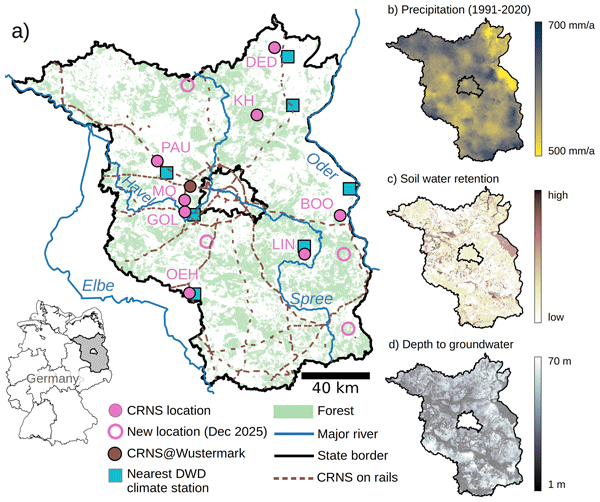
Maik Heistermann, Daniel Altdorff, Till Francke, Martin Schrön, Peter M. Grosse, Arvid Markert, Albrecht Bauriegel, Peter Biró, Sabine Attinger, Frank Beyrich, Peter Dietrich, Rebekka Eichstädt, Jakob Terschlüsen, Ariane Walz, Steffen Zacharias, and Sascha E. Oswald
Nat. Hazards Earth Syst. Sci., 26, 465–486, https://doi.org/10.5194/nhess-26-465-2026, https://doi.org/10.5194/nhess-26-465-2026, 2026
Short summary
Short summary
The German federal state of Brandenburg is particularly prone to soil moisture droughts. To support the management of related risks, we introduce a novel soil moisture monitoring network based on cosmic-ray neutron sensing technology. The resulting observations can be particularly helpful to evaluate and improve soil moisture products from modelling or remote sensing.
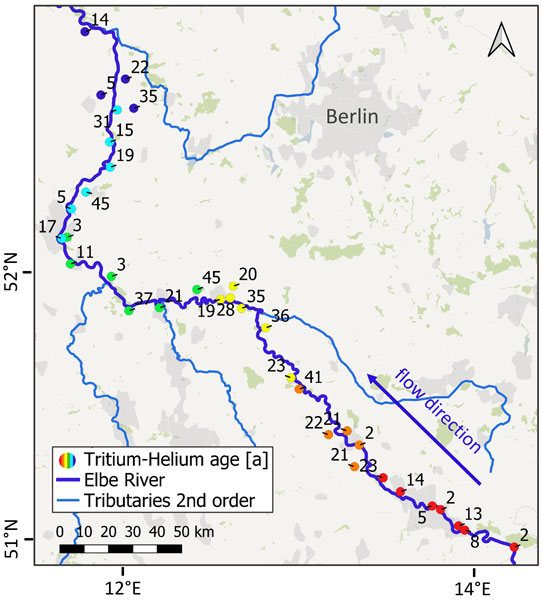
Julia Zill, Axel Suckow, Ulf Mallast, Jürgen Sültenfuß, Axel Schmidt, and Christian Siebert
Hydrol. Earth Syst. Sci., 29, 6885–6900, https://doi.org/10.5194/hess-29-6885-2025, https://doi.org/10.5194/hess-29-6885-2025, 2025
Short summary
Short summary
Groundwater in agricultural regions can transport nutrients and contaminants into rivers, affecting water quality. This study examines nutrient flux in the German Elbe River using multi-environmental tracers. Groundwater takes a few decades to reach the river, mostly infiltrating after 1985. This means that massive nutrient inputs from past fertilization have peaked and will decline in the future. These findings guide management strategies to reduce eutrophication and protect aquatic ecosystems.

Sebastian Müller, Martin Lange, Thomas Fischer, Sara König, Matthias Kelbling, Jeisson Javier Leal Rojas, and Stephan Thober
Geosci. Model Dev., 18, 4483–4498, https://doi.org/10.5194/gmd-18-4483-2025, https://doi.org/10.5194/gmd-18-4483-2025, 2025
Short summary
Short summary
This study presents FINAM (
FINAM is not a model), a new coupling framework written in Python to dynamically connect independently developed models. Python, as the ultimate glue language, enables the use of codes from nearly any programming language like Fortran, C++, Rust, and others. FINAM is designed to simplify the integration of various models with minimal effort, as demonstrated through various examples ranging from simple to complex systems.
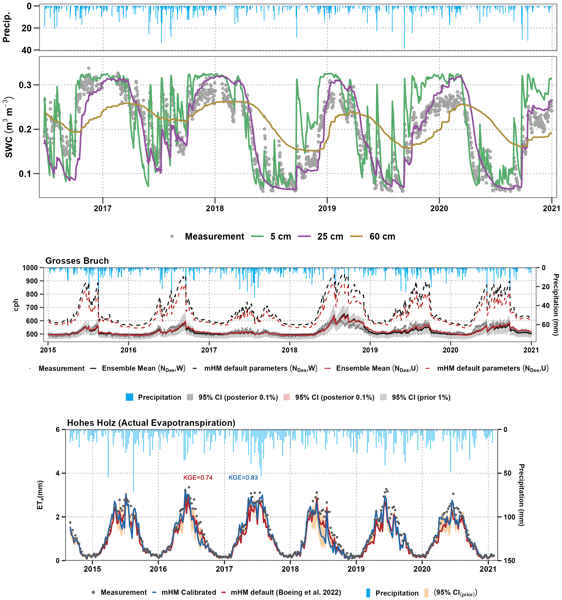
Eshrat Fatima, Rohini Kumar, Sabine Attinger, Maren Kaluza, Oldrich Rakovec, Corinna Rebmann, Rafael Rosolem, Sascha E. Oswald, Luis Samaniego, Steffen Zacharias, and Martin Schrön
Hydrol. Earth Syst. Sci., 28, 5419–5441, https://doi.org/10.5194/hess-28-5419-2024, https://doi.org/10.5194/hess-28-5419-2024, 2024
Short summary
Short summary
This study establishes a framework to incorporate cosmic-ray neutron measurements into the mesoscale Hydrological Model (mHM). We evaluate different approaches to estimate neutron counts within the mHM using the Desilets equation, with uniformly and non-uniformly weighted average soil moisture, and the physically based code COSMIC. The data improved not only soil moisture simulations but also the parameterisation of evapotranspiration in the model.
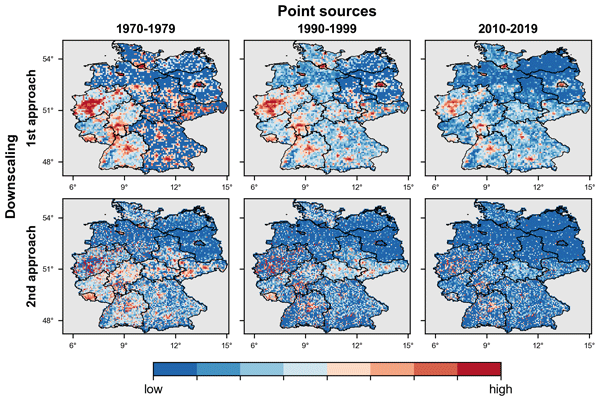
Fanny J. Sarrazin, Sabine Attinger, and Rohini Kumar
Earth Syst. Sci. Data, 16, 4673–4708, https://doi.org/10.5194/essd-16-4673-2024, https://doi.org/10.5194/essd-16-4673-2024, 2024
Short summary
Short summary
Nitrogen (N) and phosphorus (P) contamination of water bodies is a long-term issue due to the long history of N and P inputs to the environment and their persistence. Here, we introduce a long-term and high-resolution dataset of N and P inputs from wastewater (point sources) for Germany, combining data from different sources and conceptual understanding. We also account for uncertainties in modelling choices, thus facilitating robust long-term and large-scale water quality studies.
Bjorn Stevens, Stefan Adami, Tariq Ali, Hartwig Anzt, Zafer Aslan, Sabine Attinger, Jaana Bäck, Johanna Baehr, Peter Bauer, Natacha Bernier, Bob Bishop, Hendryk Bockelmann, Sandrine Bony, Guy Brasseur, David N. Bresch, Sean Breyer, Gilbert Brunet, Pier Luigi Buttigieg, Junji Cao, Christelle Castet, Yafang Cheng, Ayantika Dey Choudhury, Deborah Coen, Susanne Crewell, Atish Dabholkar, Qing Dai, Francisco Doblas-Reyes, Dale Durran, Ayoub El Gaidi, Charlie Ewen, Eleftheria Exarchou, Veronika Eyring, Florencia Falkinhoff, David Farrell, Piers M. Forster, Ariane Frassoni, Claudia Frauen, Oliver Fuhrer, Shahzad Gani, Edwin Gerber, Debra Goldfarb, Jens Grieger, Nicolas Gruber, Wilco Hazeleger, Rolf Herken, Chris Hewitt, Torsten Hoefler, Huang-Hsiung Hsu, Daniela Jacob, Alexandra Jahn, Christian Jakob, Thomas Jung, Christopher Kadow, In-Sik Kang, Sarah Kang, Karthik Kashinath, Katharina Kleinen-von Königslöw, Daniel Klocke, Uta Kloenne, Milan Klöwer, Chihiro Kodama, Stefan Kollet, Tobias Kölling, Jenni Kontkanen, Steve Kopp, Michal Koran, Markku Kulmala, Hanna Lappalainen, Fakhria Latifi, Bryan Lawrence, June Yi Lee, Quentin Lejeun, Christian Lessig, Chao Li, Thomas Lippert, Jürg Luterbacher, Pekka Manninen, Jochem Marotzke, Satoshi Matsouoka, Charlotte Merchant, Peter Messmer, Gero Michel, Kristel Michielsen, Tomoki Miyakawa, Jens Müller, Ramsha Munir, Sandeep Narayanasetti, Ousmane Ndiaye, Carlos Nobre, Achim Oberg, Riko Oki, Tuba Özkan-Haller, Tim Palmer, Stan Posey, Andreas Prein, Odessa Primus, Mike Pritchard, Julie Pullen, Dian Putrasahan, Johannes Quaas, Krishnan Raghavan, Venkatachalam Ramaswamy, Markus Rapp, Florian Rauser, Markus Reichstein, Aromar Revi, Sonakshi Saluja, Masaki Satoh, Vera Schemann, Sebastian Schemm, Christina Schnadt Poberaj, Thomas Schulthess, Cath Senior, Jagadish Shukla, Manmeet Singh, Julia Slingo, Adam Sobel, Silvina Solman, Jenna Spitzer, Philip Stier, Thomas Stocker, Sarah Strock, Hang Su, Petteri Taalas, John Taylor, Susann Tegtmeier, Georg Teutsch, Adrian Tompkins, Uwe Ulbrich, Pier-Luigi Vidale, Chien-Ming Wu, Hao Xu, Najibullah Zaki, Laure Zanna, Tianjun Zhou, and Florian Ziemen
Earth Syst. Sci. Data, 16, 2113–2122, https://doi.org/10.5194/essd-16-2113-2024, https://doi.org/10.5194/essd-16-2113-2024, 2024
Short summary
Short summary
To manage Earth in the Anthropocene, new tools, new institutions, and new forms of international cooperation will be required. Earth Virtualization Engines is proposed as an international federation of centers of excellence to empower all people to respond to the immense and urgent challenges posed by climate change.
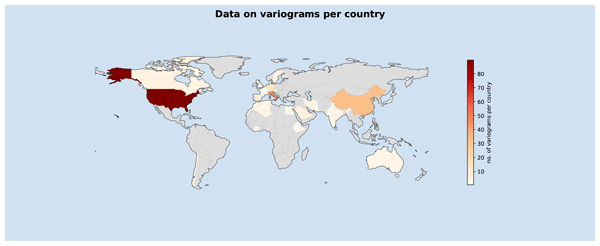
Falk Heße, Sebastian Müller, and Sabine Attinger
Hydrol. Earth Syst. Sci., 28, 357–374, https://doi.org/10.5194/hess-28-357-2024, https://doi.org/10.5194/hess-28-357-2024, 2024
Short summary
Short summary
In this study, we have presented two different advances for the field of subsurface geostatistics. First, we present data of variogram functions from a variety of different locations around the world. Second, we present a series of geostatistical analyses aimed at examining some of the statistical properties of such variogram functions and their relationship to a number of widely used variogram model functions.
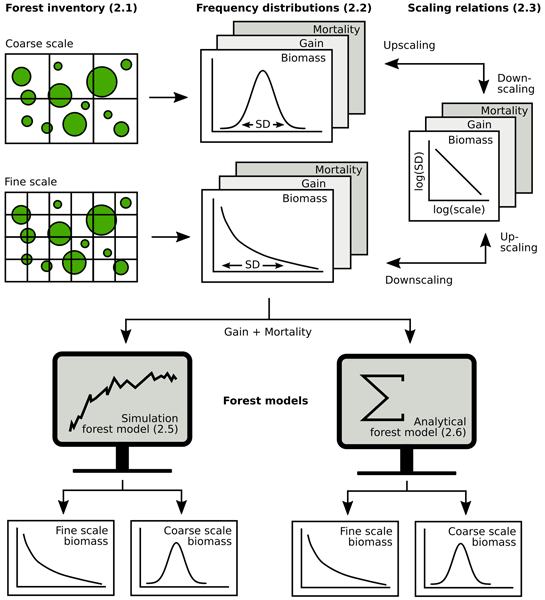
Nikolai Knapp, Sabine Attinger, and Andreas Huth
Biogeosciences, 19, 4929–4944, https://doi.org/10.5194/bg-19-4929-2022, https://doi.org/10.5194/bg-19-4929-2022, 2022
Short summary
Short summary
The biomass of forests is determined by forest growth and mortality. These quantities can be estimated with different methods such as inventories, remote sensing and modeling. These methods are usually being applied at different spatial scales. The scales influence the obtained frequency distributions of biomass, growth and mortality. This study suggests how to transfer between scales, when using forest models of different complexity for a tropical forest.
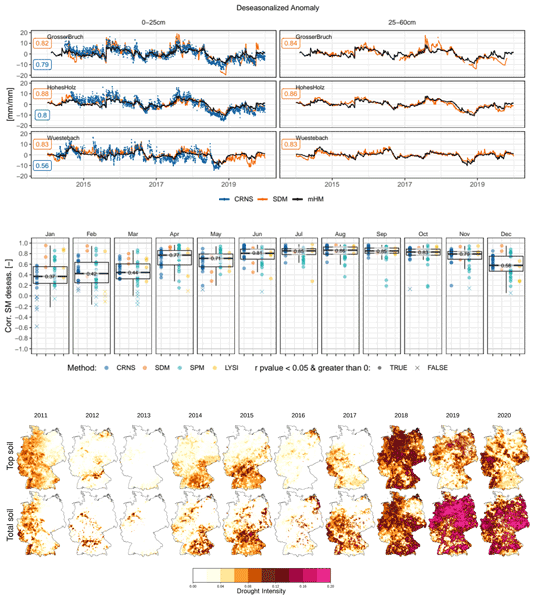
Friedrich Boeing, Oldrich Rakovec, Rohini Kumar, Luis Samaniego, Martin Schrön, Anke Hildebrandt, Corinna Rebmann, Stephan Thober, Sebastian Müller, Steffen Zacharias, Heye Bogena, Katrin Schneider, Ralf Kiese, Sabine Attinger, and Andreas Marx
Hydrol. Earth Syst. Sci., 26, 5137–5161, https://doi.org/10.5194/hess-26-5137-2022, https://doi.org/10.5194/hess-26-5137-2022, 2022
Short summary
Short summary
In this paper, we deliver an evaluation of the second generation operational German drought monitor (https://www.ufz.de/duerremonitor) with a state-of-the-art compilation of observed soil moisture data from 40 locations and four different measurement methods in Germany. We show that the expressed stakeholder needs for higher resolution drought information at the one-kilometer scale can be met and that the agreement of simulated and observed soil moisture dynamics can be moderately improved.
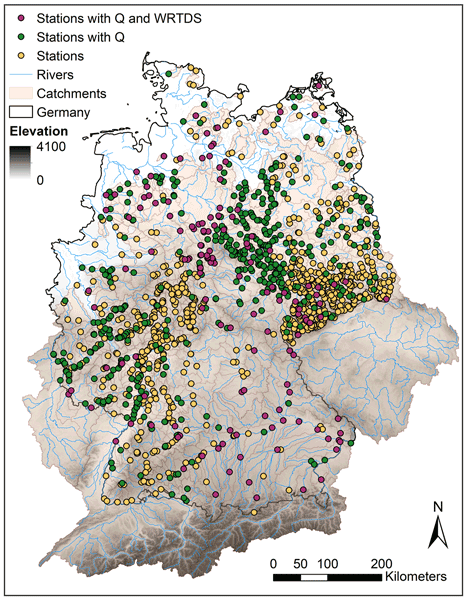
Pia Ebeling, Rohini Kumar, Stefanie R. Lutz, Tam Nguyen, Fanny Sarrazin, Michael Weber, Olaf Büttner, Sabine Attinger, and Andreas Musolff
Earth Syst. Sci. Data, 14, 3715–3741, https://doi.org/10.5194/essd-14-3715-2022, https://doi.org/10.5194/essd-14-3715-2022, 2022
Short summary
Short summary
Environmental data are critical for understanding and managing ecosystems, including the mitigation of water quality degradation. To increase data availability, we present the first large-sample water quality data set (QUADICA) of riverine macronutrient concentrations combined with water quantity, meteorological, and nutrient forcing data as well as catchment attributes. QUADICA covers 1386 German catchments to facilitate large-sample data-driven and modeling water quality assessments.
Robert Schweppe, Stephan Thober, Sebastian Müller, Matthias Kelbling, Rohini Kumar, Sabine Attinger, and Luis Samaniego
Geosci. Model Dev., 15, 859–882, https://doi.org/10.5194/gmd-15-859-2022, https://doi.org/10.5194/gmd-15-859-2022, 2022
Short summary
Short summary
The recently released multiscale parameter regionalization (MPR) tool enables
environmental modelers to efficiently use extensive datasets for model setups.
It flexibly ingests the datasets using user-defined data–parameter relationships
and rescales parameter fields to given model resolutions. Modern
land surface models especially benefit from MPR through increased transparency and
flexibility in modeling decisions. Thus, MPR empowers more sound and robust
simulations of the Earth system.
Cited articles
Bear, J.: Dynamics of fluids in porous media, American Elsevier Pub. Co, New York, ISBN 044400114X, https://doi.org/10.1097/00010694-197508000-00022, 1972. a
Bloomfield, J. P. and Marchant, B. P.: Analysis of groundwater drought building on the standardised precipitation index approach, Hydrol. Earth Syst. Sci., 17, 4769–4787, https://doi.org/10.5194/hess-17-4769-2013, 2013. a
Boeing, F., Rakovec, O., Kumar, R., Samaniego, L., Schrön, M., Hildebrandt, A., Rebmann, C., Thober, S., Müller, S., Zacharias, S., Bogena, H., Schneider, K., Kiese, R., Attinger, S., and Marx, A.: High-resolution drought simulations and comparison to soil moisture observations in Germany, Hydrol. Earth Syst. Sci., 26, 5137–5161, https://doi.org/10.5194/hess-26-5137-2022, 2022. a, b, c
Boumaiza, L., Chesnaux, R., Walter, J., and Meghnefi, F.: Assessing response times of an alluvial aquifer experiencing seasonally variable meteorological inputs, Groundwater for Sustainable Development, 14, 100647, https://doi.org/10.1016/j.gsd.2021.100647, 2021. a, b, c
Brutsaert, W.: Long‐term groundwater storage trends estimated from streamflow records: Climatic perspective, Water Resour. Res., 44, https://doi.org/10.1029/2007wr006518, 2008. a
Carr, E. J. and Simpson, M. J.: Accurate and efficient calculation of response times for groundwater flow, J. Hydrol., 558, 470–481, https://doi.org/10.1016/j.jhydrol.2017.12.023, 2018. a, b, c
Changnon, S. A.: Detecting drought conditions in Illinois, no. 36 p. in Circular/State of Illinois, no. 169, Department of Energy and Natural Resources, Illinois State Water Survey, Champaign, IL, https://www.ideals.illinois.edu/items/103814/bitstreams/329654/data.pdf (last access: 6 September 2026), 1987. a
Ciscar, J.-C., Rising, J., Kopp, R. E., and Feyen, L.: Assessing future climate change impacts in the EU and the USA: insights and lessons from two continental-scale projects, Environ. Res. Lett., 14, 084010, https://doi.org/10.1088/1748-9326/ab281e, 2019. a
Cuthbert, M. O., Gleeson, T., Moosdorf, N., Befus, K. M., Schneider, A., Hartmann, J., and Lehner, B.: Global patterns and dynamics of climate–groundwater interactions, Nat. Clim. Change, 9, 137–141, https://doi.org/10.1038/s41558-018-0386-4, 2019. a
de Rooij, G. H.: Transient flow between aquifers and surface water: analytically derived field-scale hydraulic heads and fluxes, Hydrol. Earth Syst. Sci., 16, 649–669, https://doi.org/10.5194/hess-16-649-2012, 2012. a
de Rooij, G. H.: Aquifer-scale flow equations as generalized linear reservoir models for strip and circular aquifers: Links between the Darcian and the aquifer scale, Water Resour. Res., 49, 8605–8615, https://doi.org/10.1002/2013wr014873, 2013. a
Ebeling, P., Musolff, A., Kumar, R., Hartmann, A., and Fleckenstein, J. H.: Groundwater head responses to droughts across Germany, Hydrol. Earth Syst. Sci., 29, 2925–2950, https://doi.org/10.5194/hess-29-2925-2025, 2025. a, b, c, d
Erskine, A. and Papaioannou, A.: The use of aquifer response rate in the assessment of groundwater resources, J. Hydrol., 202, 373–391, https://doi.org/10.1016/s0022-1694(97)00058-9, 1997. a
European Commission, J. R. C.: Droughts in Europe and Worldwide 2019-2020, Publications Office, LU, ISBN 978-92-76-38040-5, https://doi.org/10.2760/415204, 2021. a
Freeze, R.: Groundwater, Prentice-Hall, Englewood Cliffs, N.J, ISBN 0133653129, 1979. a
Fritsch, F. N. and Carlson, R. E.: Monotone Piecewise Cubic Interpolation, SIAM J. Numer. Anal., 17, 238–246, https://doi.org/10.1137/0717021, 1980. a
Gelhar, L. W. and Wilson, J. L.: Ground-Water Quality Modeling, Ground Water, 12, 399–408, https://doi.org/10.1111/j.1745-6584.1974.tb03050.x, 1974. a
Hameed, M., Nayak, M. A., and Ahanger, M. A.: Event‐Based Recession Analysis for Estimation of Basin‐Wide Characteristic Drainage Timescale and Groundwater Storage Trends, Water Resour. Res., 59, https://doi.org/10.1029/2023wr035829, 2023. a, b
Hellwig, J. and Stahl, K.: An assessment of trends and potential future changes in groundwater-baseflow drought based on catchment response times, Hydrol. Earth Syst. Sci., 22, 6209–6224, https://doi.org/10.5194/hess-22-6209-2018, 2018. a, b
Houben, T.: timohouben/AquiPy: HESS-v0.1, Zenodo [code], https://doi.org/10.5281/ZENODO.17610247, 2025. a, b
Houben, T.: Data accompanying the manuscript: Spectral Analysis of Groundwater Level Time Series for Robust Estimation of Aquifer Response Times, Zenodo [data set], https://doi.org/10.5281/ZENODO.17610313, 2026. a, b, c
IPCC: Climate Change 2022 – Impacts, Adaptation and Vulnerability: Working Group II Contribution to the Sixth Assessment Report of the Intergovernmental Panel on Climate Change, Cambridge University Press, ISBN 9781009325844, https://doi.org/10.1017/9781009325844, 2023. a
Jankiewicz, P., Neumann, J., Duijnisveld, W. H., Wessolek, G., Wycisk, P., and Hennings, V.: Abflusshöhe – Sickerwasserrate – Grundwasserneubildung – Drei Themen im Hydrologischen Atlas von Deutschland, Hydrologie und Wasserbewirtschaftung, 2–13, Bundesanstalt für Gewässerkunde, im Auftrag der Fachverwaltungen des Bundes und der Länder, ISSN 1439-1783, https://www.hywa-online.de/abflusshoehe-sickerwasserrate-grundwasserneubildung-drei-themen-im-hydrologischen-atlas -von-deutschland/ (last access: 4 September 2026), 2005. a
Jasechko, S., Seybold, H., Perrone, D., Fan, Y., Shamsudduha, M., Taylor, R. G., Fallatah, O., and Kirchner, J. W.: Rapid groundwater decline and some cases of recovery in aquifers globally, Nature, 625, 715–721, https://doi.org/10.1038/s41586-023-06879-8, 2024. a
Jiménez‐Martínez, J., Longuevergne, L., Le Borgne, T., Davy, P., Russian, A., and Bour, O.: Temporal and spatial scaling of hydraulic response to recharge in fractured aquifers: Insights from a frequency domain analysis, Water Resour. Res., 49, 3007–3023, https://doi.org/10.1002/wrcr.20260, 2013. a
Kirchner, J. W., Benettin, P., and van Meerveld, I.: Instructive Surprises in the Hydrological Functioning of Landscapes, Annu. Rev. Earth Planet. Sc., 51, 277–299, https://doi.org/10.1146/annurev-earth-071822-100356, 2023. a, b
Koutsoyiannis, D.: A toy model of climatic variability with scaling behaviour, J. Hydrol., 322, 25–48, https://doi.org/10.1016/j.jhydrol.2005.02.030, 2006. a
Kumar, R.: Distributed Hydrologic Model Parameterization: Application in a Mesoscale River Basin, Ph.D. thesis, Chemisch-Geowissenschaftlichen Fakultät derFriedrich-Schiller-Universität Jena, 2010. a
Kumar, R., Samaniego, L., and Attinger, S.: Implications of distributed hydrologic model parameterization on water fluxes at multiple scales and locations, Water Resour. Res., 49, 360–379, https://doi.org/10.1029/2012wr012195, 2013. a
Kumar, R., Musuuza, J. L., Van Loon, A. F., Teuling, A. J., Barthel, R., Ten Broek, J., Mai, J., Samaniego, L., and Attinger, S.: Multiscale evaluation of the Standardized Precipitation Index as a groundwater drought indicator, Hydrol. Earth Syst. Sci., 20, 1117–1131, https://doi.org/10.5194/hess-20-1117-2016, 2016. a, b, c, d, e, f, g, h
Kumar, R., Samaniego, L., Thober, S., Rakovec, O., Marx, A., Wanders, N., Pan, M., Hesse, F., and Attinger, S.: Multi‐Model Assessment of Groundwater Recharge Across Europe Under Warming Climate, Earth's Future, 13, https://doi.org/10.1029/2024ef005020, 2025. a
Lee, S. and Ajami, H.: Comprehensive assessment of baseflow responses to long-term meteorological droughts across the United States, J. Hydrol., 626, 130256, https://doi.org/10.1016/j.jhydrol.2023.130256, 2023. a, b, c, d
Lehr, C. and Lischeid, G.: Efficient screening of groundwater head monitoring data for anthropogenic effects and measurement errors, Hydrol. Earth Syst. Sci., 24, 501–513, https://doi.org/10.5194/hess-24-501-2020, 2020. a
Liang, X. Y. and Zhang, Y.-K.: Analyses of uncertainties and scaling of groundwater level fluctuations, Hydrol. Earth Syst. Sci., 19, 2971–2979, https://doi.org/10.5194/hess-19-2971-2015, 2015. a
Liesch, T. and Wunsch, A.: Aquifer responses to long-term climatic periodicities, J. Hydrol., 572, 226–242, https://doi.org/10.1016/j.jhydrol.2019.02.060, 2019. a, b
Lischeid, G., Dannowski, R., Kaiser, K., Nützmann, G., Steidl, J., and Stüve, P.: Inconsistent hydrological trends do not necessarily imply spatially heterogeneous drivers, J. Hydrol., 596, 126096, https://doi.org/10.1016/j.jhydrol.2021.126096, 2021. a
Luetkemeier, R., Söller, L., and Frick-Trzebitzky, F.: Anthropogenic Pressures on Groundwater, 548–559, Elsevier, ISBN 9780128220412, https://doi.org/10.1016/b978-0-12-819166-8.00183-3, 2022. a
Marx, A., Boeing, F., Rakovec, O., Müller, S., Özge Can, Malla, C., Peichl, M., and Samaniego, L.: Auswirkungen des Klimawandels auf Wasserbedarf und -dargebot, Wasserwirtschaft, Wasserwirtschaft, vol. 11, 2021, Springerprofessional, https://www.springerprofessional.de/wasserwirtschaft-11-2021/19821316 (4 September 2026), 2021. a, b, c, d, e, f, g
OpenTopography: Shuttle Radar Topography Mission (SRTM) Global, OpenTopography [data set], https://doi.org/10.5069/G9445JDF, 2013. a, b, c, d
Parry, S., Prudhomme, C., Wilby, R. L., and Wood, P. J.: Drought termination: Concept and characterisation, Prog. Phys. Geogr.: Earth and Environment, 40, 743–767, https://doi.org/10.1177/0309133316652801, 2016. a
Pujades, E., Kumar, R., Houben, T., Jing, M., Rakovec, O., Kalbacher, T., and Attinger, S.: Towards the construction of representative regional hydro(geo)logical numerical models: Modelling the upper Danube basin as a starting point, Front. Earth Sci., 11, https://doi.org/10.3389/feart.2023.1061420, 2023. a
Samaniego, L., Kumar, R., and Attinger, S.: Multiscale parameter regionalization of a grid-based hydrologic model at the mesoscale, Water Resour. Res., 46, https://doi.org/10.1029/2008wr007327, 2010. a
Samaniego, L., Thober, S., Kumar, R., Wanders, N., Rakovec, O., Pan, M., Zink, M., Sheffield, J., Wood, E. F., and Marx, A.: Anthropogenic warming exacerbates European soil moisture droughts, Nat. Clim. Change, 8, 421–426, https://doi.org/10.1038/s41558-018-0138-5, 2018. a
Schilling, K. E. and Zhang, Y.-K.: Temporal Scaling of Groundwater Level Fluctuations Near a Stream, Ground Water, 50, 59–67, https://doi.org/10.1111/j.1745-6584.2011.00804.x, 2011. a
Schmidt, L., Schäfer, D., Geller, J., Lünenschloss, P., Palm, B., Rinke, K., Rebmann, C., Rode, M., and Bumberger, J.: System for automated Quality Control (SaQC) to enable traceable and reproducible data streams in environmental science, Environ. Model. Softw., 169, 105809, https://doi.org/10.1016/j.envsoft.2023.105809, 2023. a
Tóth, J.: A Theoretical and Analysis of Groundwater and Flow and in Small and Drainage Basins, J. Geophys. Res., 68, 4795–4812, 1963. a
Tsypin, M., Cacace, M., Guse, B., Lischeid, G., Güntner, A., and Scheck-Wenderoth, M.: Damped groundwater response to recharge: From spectral analysis to regional modeling, J. Hydrol., 658, 133193, https://doi.org/10.1016/j.jhydrol.2025.133193, 2025. a, b, c
Wanders, N. and Wada, Y.: Human and climate impacts on the 21st century hydrological drought, J. Hydrol., 526, 208–220, https://doi.org/10.1016/j.jhydrol.2014.10.047, 2015. a
Welch: The use of the fast Fourier transform for the estimation of power spectra: A method based on time averaging over short, modified periodograms, IEEE Trans. Audio, 15, 70–73, 1967. a
Zhang, X., Li, H., J., J. J., Luo, X., Kuang, X., Mao, R., and Hu, W.: Fractal Behaviors of Hydraulic Head and Surface Runoff of the Nested Groundwater Flow Systems in Response to Rainfall Fluctuations, Geophys. Res. Lett., 49, https://doi.org/10.1029/2021gl093784, 2022. a
Zhang, Y.-K. and Li, Z.: Effect of temporally correlated recharge on fluctuations of groundwater levels, Water Resour. Res., 42, https://doi.org/10.1029/2005wr004828, 2006. a
Zhang, Y.-K. and Schilling, K.: Temporal scaling of hydraulic head and river base flow and its implication for groundwater recharge, Water Resour. Res., 40, https://doi.org/10.1029/2003wr002094, 2004. a, b
Zhang, Y.-K. and Schilling, K.: Temporal variations and scaling of streamflow and baseflow and their nitrate-nitrogen concentrations and loads, Adv. Water Resour., 28, 701–710, https://doi.org/10.1016/j.advwatres.2004.12.014, 2005. a
Zhang, Y.-K. and Yang, X.: Effects of variations of river stage and hydraulic conductivity on temporal scaling of groundwater levels: numerical simulations, Stoch. Env. Res. Risk A., 24, 1043–1052, https://doi.org/10.1007/s00477-010-0437-5, 2010. a
Zink, M., Kumar, R., Cuntz, M., and Samaniego, L.: A high-resolution dataset of water fluxes and states for Germany accounting for parametric uncertainty, Hydrol. Earth Syst. Sci., 21, 1769–1790, https://doi.org/10.5194/hess-21-1769-2017, 2017. a
Short summary
Groundwater is vital but increasingly stressed by climate change and rising water demand. This study estimates how quickly aquifers respond to changes in recharge using a signal-analysis method. Most aquifers reacted within one to ten months, while deeper responded more slowly and proved more resilient to short droughts. The method uses existing monitoring data, offering a practical way to identify vulnerable aquifers and guide groundwater management under climate change.
Groundwater is vital but increasingly stressed by climate change and rising water demand....


