
the Creative Commons Attribution 4.0 License.
the Creative Commons Attribution 4.0 License.
 | 19 Aug 2026
Progressive groundwater decoupling may drive a shift toward shallower and faster terrestrial water cycling
Aoqi Sun
Wenjie Xu
Enze Ma
Hua Yuan
Chen Yang
Groundwater is widely regarded as a critical buffer that sustains evapotranspiration (ET) and streamflow under hydrologic stress. However, whether this buffering capacity persists under sustained increases in ET demand remains unclear. Here we test whether sustained increases in ET demand can reorganize subsurface connectivity and undermine effective groundwater buffering, using controlled hillslope simulations with integrated hydrologic modeling and particle tracking. Under baseline semi-arid forcing, ET and outflow exhibit coexisting young and older age components. Following late-summer groundwater drawdown, intermediate-age flow paths weaken, eventually producing a temporary age gap that separates shallow and deep sources. Outflow responds more abruptly than ET due to hydraulic disconnection at the outlet. Warming and vegetation greening amplify this intrinsic seasonal age-segregation pattern. Intermediate-age contributions collapse earlier and recover more slowly, amplifying the polarization between shallow and deep water pools and further suppressing older groundwater inputs. Outflow becomes increasingly dominated by very young water, indicating strengthened groundwater–surface decoupling. These results suggest that sustained hydrologic stress structurally reduces effective groundwater connectivity, weakening subsurface buffering and shortening hydrologic memory. This shift persists across parameter perturbations. As a consequence, water cycling shifts toward shallower and faster pathways. Progressive groundwater decoupling therefore represents not merely a change in source depth, but a structural transition toward a more rapidly recycled and potentially less predictable mode of terrestrial water cycling under sustained increases in terrestrial water use.
- Article
(4460 KB) - Full-text XML
-
Supplement
(3708 KB) - BibTeX
- EndNote


Many terrestrial systems are increasingly exposed to hydrologic stress as atmospheric evaporative demand intensifies and biological water use expands. In this context, warming and vegetation enhancement act to amplify evapotranspiration (ET), increasing subsurface water extraction and tightening constraints on groundwater storage.
Groundwater is widely regarded as a critical buffer against such hydrologic stress (Condon et al., 2020; Miguez-Macho and Fan, 2025). Recent studies increasingly challenge the traditional separation of surface water and groundwater, arguing that they form a connected hydrologic continuum rather than two independent “water worlds” (Berkowitz and Zehe, 2020; Schiavo et al., 2022). By acting as a long-term storage reservoir and maintaining hydraulic connectivity with the shallow subsurface, groundwater regulates the timing and magnitude of surface water fluxes (Villaruel et al., 2025; Zipper et al., 2024; Tran et al., 2020; Xie et al., 2024), sustains ET and streamflow during dry periods (Betterle and Bellin, 2024; Knighton and Berghuijs, 2023), and provides hydrologic “memory” to the land surface system (Getirana et al., 2025; Liang et al., 2021; Bierkens and van den Hurk, 2007; Brooks et al., 2021). Under this prevailing view, drought is interpreted as a progressive shift toward deeper groundwater reliance: as shallow soil moisture is depleted, the relative contribution of groundwater increases, leading to older water signatures in both ET and streamflow due to the growing dominance of longer-residence subsurface water (Yang et al., 2021b, 2023a; Swenson et al., 2024; Li et al., 2024; Visser et al., 2019). Implicit in this interpretation is the assumption that groundwater buffering remains effective even under sustained and intensifying hydrologic stress.
Carroll et al. (2024) examined how sustained warming alters groundwater–stream interactions using a high-resolution, observation-constrained integrated hydrologic model. Their simulations indicate that progressive groundwater storage decline lowers regional water tables and weakens hydraulic gradients toward stream channels, with some reaches shifting from historically groundwater-gaining to losing or weakly connected states during low-flow periods. Similarly, Betterle and Bellin (2024) showed that declining recharge lowers water tables and reduces subsurface storage. Under these conditions, the fraction of baseflow generated by groundwater increases, while the permanently active drainage network shrinks and shifts downstream, further reducing surface drainage density. In a drought-focused ecohydrological study, Yang et al. (2021b) reported that transpiration could initially be maintained during the early stages of drought despite increasing water age, but declined sharply as drought conditions intensified, while evaporation remained comparatively stable. Collectively, these studies suggest that hydrologic responses to sustained stress may not be gradual, but instead involve substantial reorganization of groundwater connectivity, drainage networks, and vegetation water use.
In other words, these studies indicate that sustained hydrologic stress may alter not only the magnitude of water fluxes, but also the depth and pace at which water circulates through terrestrial systems. Rather than supporting the prevailing expectation that intensifying drought progressively increases groundwater dependence and shifts fluxes toward older water, these findings imply a different response: prolonged stress may reduce the effective contribution of deeper storage and favor younger, more rapidly recycled water sources. This possibility raises a broader and largely unresolved question: can sustained hydrologic stress shift terrestrial water cycling toward a shallower and faster regime, rather than simply intensifying groundwater dependence?
Here we hypothesize that persistent increases in ET demand may shift terrestrial water cycling toward shallower and faster pathways, manifested through a systematic reorganization of internal water age structure. As groundwater storage declines beyond a critical threshold, intermediate-age contributions may collapse, leading to a separation between shallow, rapidly recycled water and deeper, longer-residence storage (Fig. 1). This age polarization reflects a weakening of hydraulic connectivity between deep and shallow domains and signals a shift from a coupled regime – where multiple storage pools jointly regulate surface fluxes – to a decoupled regime dominated by shallower and faster flow paths. Here, reorganization refers to this structural redistribution of water-age contributions driven by changing subsurface connectivity, including the contraction or loss of intermediate flow paths rather than a simple shift in the relative magnitude of existing contributions.
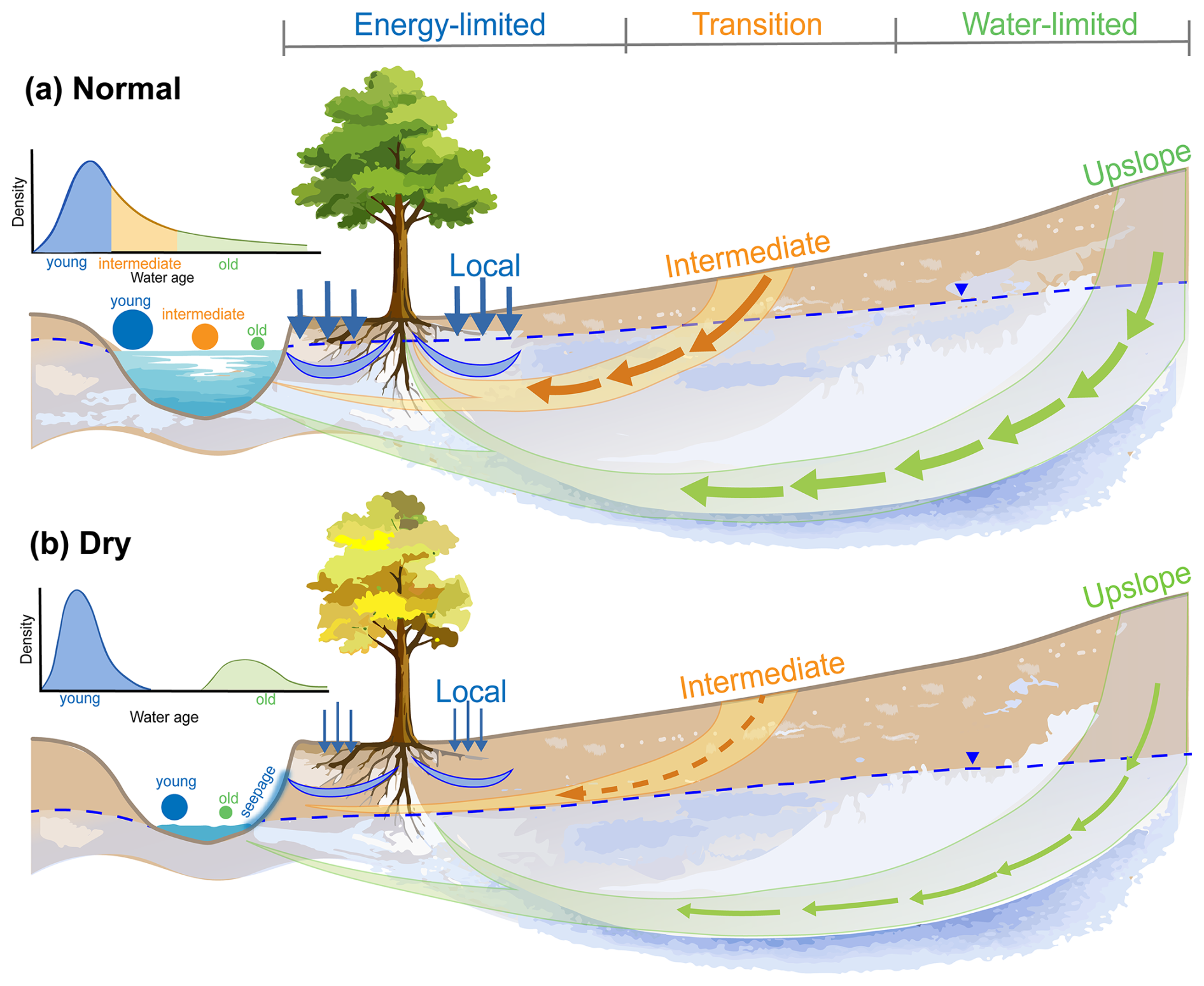
Figure 1Shift from coupled to segregated flow structure with age polarization under groundwater decline. (a) Under wetter conditions, shallow, intermediate, and deep flow paths jointly contribute to ET and streamflow. (b) Under drier conditions, weakening hydraulic connectivity suppresses intermediate-age contributions, producing age segregation between young local water and older deep storage. Arrows illustrate dominant source regions rather than exact flow trajectories.
To examine this possibility, we design a set of controlled hillslope experiments that systematically increase ET forcing and track the resulting evolution of water storage partitioning and water age structure. The hillslope represents the fundamental hydrologic unit (Fan et al., 2019) where vertical and lateral processes interact, and subsurface flow organization is most directly expressed. This framework allows ET and streamflow age dynamics to be interpreted jointly within a common hillslope-scale context. The controlled configuration enables clear diagnosis of mechanism, providing a baseline understanding that can inform interpretation of more complex real-world systems where multiple interacting processes operate simultaneously.
To examine how enhanced ET forcing influences subsurface storage partitioning and internal water age distribution, we conducted controlled numerical experiments in a synthetic quasi-three-dimensional domain (Bearup et al., 2016; Danesh-Yazdi et al., 2018; Mikkelson et al., 2013). The domain represents a 100 m long, 1 m wide, and 9.4 m deep hillslope with a uniform surface gradient of 0.1 (Fig. S3 in the Supplement). The hillslope was discretized using a terrain-following grid (Maxwell, 2013) at 5 m resolution along-slope and 0.2 m across-slope, with 20 vertical layers of variable thickness: 0.5 m in the deeper subsurface, gradually refining to 0.3 and 0.1 m near the surface to better resolve shallow processes. The upper 10 layers (4.4 m) constitute the root zone, where ParFlow and CLM exchange water fluxes. Subsurface hydraulic properties were specified uniformly. Saturated hydraulic conductivity was set to 0.05 m h−1, porosity to 0.20, and van Genuchten parameters to α=1.0 m−1 and n=2, and residual saturation (Sres) to 0.2. These hydraulic properties were adopted from previous ParFlow–EcoSLIM studies (Maxwell et al., 2019; Yang et al., 2022). Together with the prescribed tree-covered vegetation, these parameter values are broadly representative of semi-arid woody hillslopes commonly characterized by shallow soils, weathered bedrock, and limited subsurface water storage. This configuration serves as the reference state for subsequent perturbation experiments.
Water fluxes were simulated using the integrated hydrologic model ParFlow–CLM (Kollet and Maxwell, 2008, 2006; Maxwell and Miller, 2005), which resolves coupled land surface processes and variably saturated subsurface flow with lateral groundwater dynamics. The governing equations of ParFlow–CLM and the particle-tracking formulation used in EcoSLIM are summarized in Text S1 of the Supplement. The system was forced with a representative semi-arid meteorological record from the Little Washita watershed in Oklahoma (USA), providing realistic atmospheric demand and precipitation variability for a water-limited hillslope environment (Maxwell et al., 2019; Kollet and Maxwell, 2008). The model was spun up for three years, and the third-year state was used to initiate particle tracking. EcoSLIM (Maxwell et al., 2019; Yang et al., 2021a, 2022) simulations were then conducted for 20 years to allow age distributions to approach dynamic equilibrium. All ParFlow–CLM and EcoSLIM simulations were performed with an hourly time step.
EcoSLIM uses the transient flow fields and ET fluxes generated by ParFlow–CLM to simulate particle advection and molecular diffusion, thereby explicitly tracking the transport pathways and residence times of water within the coupled land–groundwater system. Diagnostics were derived from the twentieth year. During the final analysis year, the domain consistently contained on the order of 106 actively circulating particles. Over the course of that year, 2.17 × 10⁵ particles exited the domain as subsurface outflow and 2.48 × 10⁵ were removed via ET. Because particle inflow and release were continuous, the in-domain particle population remained approximately constant while flux-specific particles were sampled as they exited. This high particle density and sustained turnover enable robust, high-resolution characterization of flux age structure under different ET forcing scenarios.
Building upon this baseline configuration, four primary forcing scenarios were constructed: a baseline case, a +1 °C warming perturbation, a 50 % increase in maximum leaf area index (LAI), and a combined warming–greening scenario. The +1 °C warming perturbation represents a moderate future climate signal (IPCC, 2021). The LAI perturbation magnitude reflects an enhanced yet plausible continuation of observed multi-decadal greening trends (Piao et al., 2020). Satellite observations indicate widespread increases in vegetation greenness globally, with particularly strong greening occurring in several hotspot regions (Chen et al., 2019). These greening trends have various drivers, such as CO2 fertilization, climate change, and land management (Chen et al., 2019; Piao et al., 2020). The imposed 50 % increase in maximum LAI is therefore intended as an enhanced perturbation to explore the hydrologic consequences of sustained vegetation expansion rather than to reproduce a specific observed magnitude of change. Baseline and perturbed LAI values are summarized in Tables S1–S2.
To evaluate structural robustness, three additional experimental groups were conducted in which key system properties were modified relative to the reference parameter set. In the first group, vegetation type was changed from trees to shrubs, representing shallower rooting systems and reduced transpiration demand. In the second group, subsurface hydraulic parameters were adjusted, with saturated hydraulic conductivity set to 0.1 m h−1, porosity to 0.39, van Genuchten parameters to α=3.5 m−1 and n=2, and Sres to 0.01 (Mikkelson et al., 2013), representing a transition from relatively low-porosity, semi-arid soils to more permeable, coarse-textured subsurface conditions. In the third group, hillslope gradient was reduced to 0.05, representing weaker topographic control on lateral drainage and groundwater convergence.
In total, four hillslope configurations – the reference, modified vegetation, modified hydraulic properties, and reduced slope configurations – were each simulated under four ET forcing scenarios: baseline, +1 °C warming, a 50 % increase in maximum LAI, and combined warming–greening, yielding a total of 16 model scenarios. Each scenario employed particle tracking to characterize the evolution of subsurface water age structure. The objective of this experimental design is not to reproduce a specific field site or exhaustively sample parameter uncertainty, but rather to diagnose how key controls on terrestrial water cycling influence system behavior under increasing ET demand. Representative baseline values were therefore adopted and systematically perturbed to examine the direction and robustness of hydrologic responses across contrasting system configurations.
3.1 Water fluxes
Under baseline conditions, seasonal water fluxes exhibit a pronounced late-summer transition governed by the interaction between groundwater storage and ET demand (Fig. 2). Following gradual recovery during winter and spring, groundwater levels continue to rise and reach their shallowest condition between May and July (Fig. 2c). Air temperature increases after early spring (Fig. S1), and following a rainfall event in June, ET reaches its annual maximum in July (Fig. 2a).
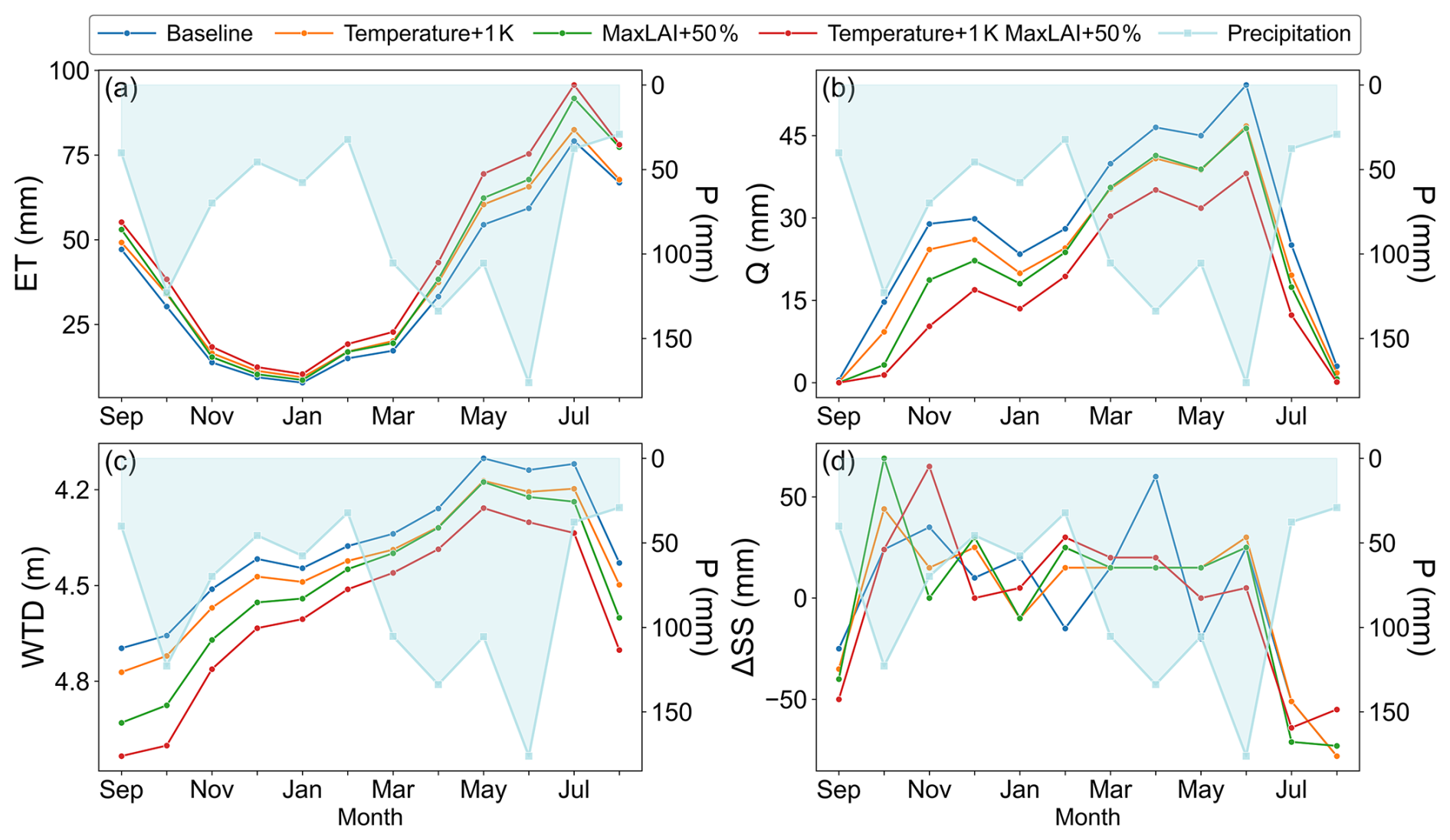
Figure 2Seasonal evolution of water fluxes and states under baseline and enhanced ET-forcing scenarios. Panels show monthly mean (a) evapotranspiration (ET), (b) streamflow (Q), (c) water table depth (WTD), and (d) saturated storage change (ΔSS), calculated from hourly model outputs during the corresponding analysis year. Precipitation (P) is shown on the secondary axis in each panel. Enhanced ET forcing through warming (+1 °C), greening (MaxLAI + 50 %), and their combination amplifies seasonal groundwater depletion, resulting in deeper water tables and larger storage losses during the late growing season.
The July ET peak triggers a rapid groundwater decline. With relatively modest rainfall in July and August, groundwater drawdown continues even though ET weakens slightly in August; ET remains substantial through August–September, pushing the water table to its annual maximum depth in September (deepest condition). Consistent with this progression, saturated storage shows pronounced net losses over July–September (Fig. 2d), indicating that ET during this period is supported in part by groundwater withdrawal. Concurrently, the domain-averaged ET age increases (Fig. 3a), consistent with greater reliance on older subsurface storage.
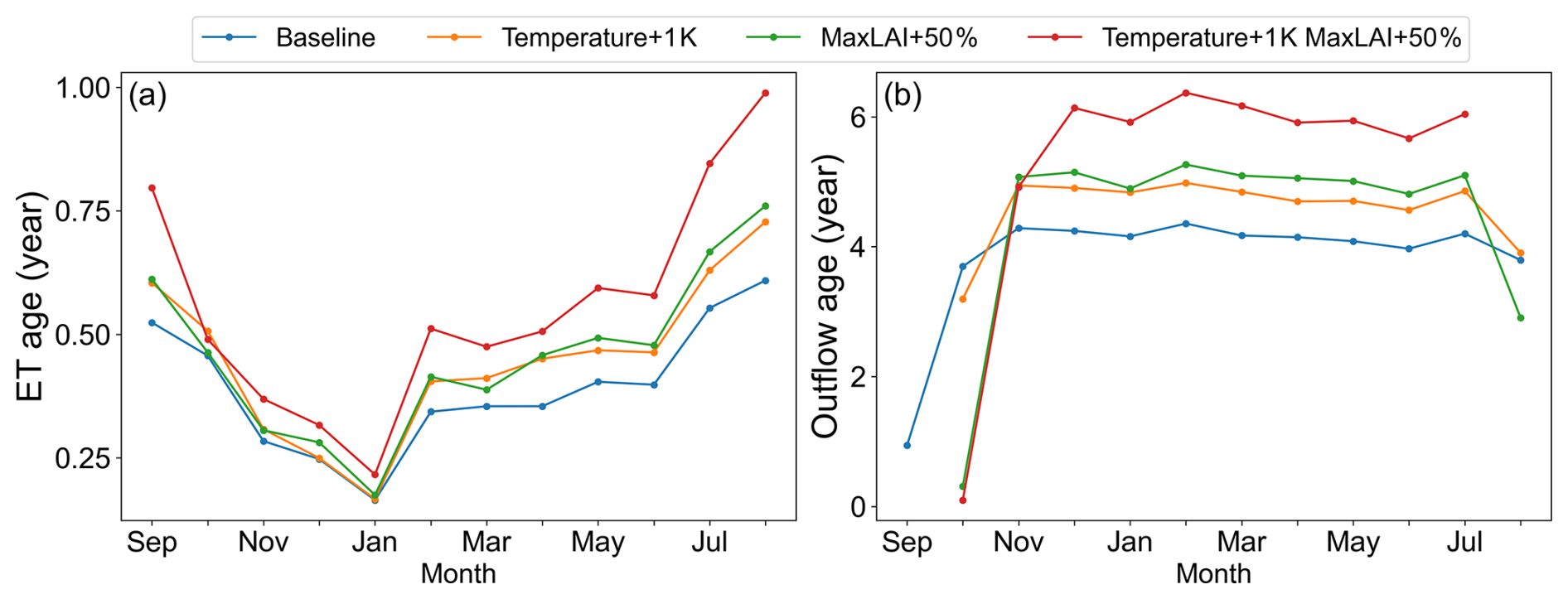
Figure 3Monthly mean (a) ET age and (b) outflow age under baseline and enhanced ET-forcing scenarios. Values represent monthly averages calculated from hourly outputs during the corresponding analysis year. Missing outflow-age values indicate months with zero outflow, during which no outflow age could be computed. Enhanced ET forcing generally increases both ET and outflow ages and amplifies seasonal age contrasts, while periods of absent outflow reflect temporary groundwater–surface decoupling at the hillslope outlet.
After September, ET declines from late-summer levels (September) and continues decreasing through autumn (October–November), reaching a minimum in mid-winter (December–January), before gradually increasing again in late spring (April–May). Although precipitation remains moderate during autumn and winter (October–February), both atmospheric demand and vegetation activity are strongly reduced (Fig. S1). Lower air temperature suppresses evaporative demand, while reduced LAI during the dormant season limits transpiration, jointly constraining ET. As a result, water inputs exceed atmospheric losses during this period, allowing groundwater storage to progressively recover from autumn through spring, with groundwater levels becoming shallow again by May.
Streamflow closely tracks seasonal groundwater dynamics (Fig. 2b). Discharge reaches its annual maximum in June, when groundwater levels are shallow, and declines toward a minimum in September as the water table reaches its deepest condition. In contrast to the maximum ET age observed during late-summer groundwater drawdown, outflow age changes in the opposite direction during August–October, declining sharply as outflow becomes dominated by very young water (Fig. 3b). This age decrease reflects hydraulic disconnection between the channel and deeper groundwater once the water table drops below the outlet elevation (Fig. S2), effectively suppressing older groundwater contributions.
In addition to the late-summer minimum in streamflow, two secondary discharge declines are evident (Fig. 2b): one in January and another in May. The January dip reflects a delayed drainage adjustment following enhanced recharge and temporarily strengthened hydraulic connectivity in autumn. After the October rainfall temporarily increases subsurface water availability, the system undergoes accelerated drainage through November and December, progressively depleting stored water. By January, despite a modest precipitation peak, discharge declines because much of the transiently accumulated storage has already been drained (Fig. S3). The May reduction, in contrast, corresponds to a sharp increase in ET relative to April. As atmospheric demand rises and vegetation activity resumes, increased ET suppresses groundwater discharge, producing a secondary decline before peak flow is reached in June.
This seasonal transition sets the stage for the structural reorganization of internal water age described below.
3.2 Age distributions
Under baseline conditions, ET and outflow exhibit two persistent age components: young, locally recharged water and older groundwater-sourced water (Figs. 4–6 and S4–S6). These components vary seasonally but generally coexist. Although ET ages are computed across the entire hillslope, the discussion below focuses on the downslope portion (approximately the lower 20 m). In this zone, soil saturation remains close to unity for much of the year (Fig. S3), maintaining strong lateral convergence and vertical hydraulic connectivity across the profile. The shallow subsurface therefore remains well coupled to deeper groundwater storage, and water availability is rarely limiting. As a result, the ET age spectrum in this region reflects contributions from both locally recharged downslope water and older upslope groundwater storage.
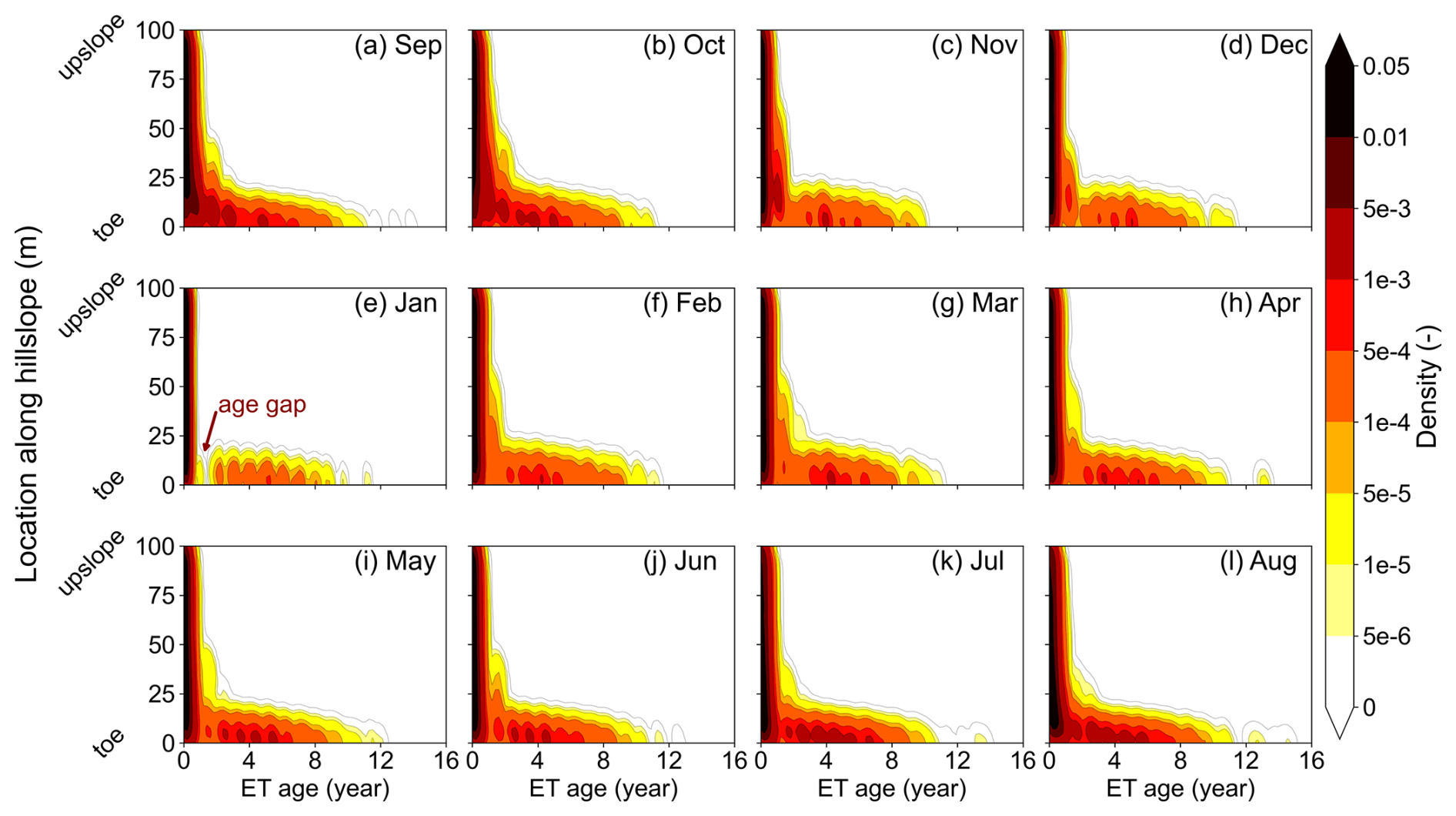
Figure 4Monthly spatial distribution of ET age along the hillslope under baseline conditions. The vertical axis represents x-location along the hillslope, with 0 m corresponding to the hillslope toe and 100 m to the upslope boundary. Colors indicate the probability density of ET ages. Under baseline conditions, ET age distributions evolve seasonally from a relatively continuous age structure in autumn to a pronounced depletion of intermediate-age contributions in winter (January), producing a temporary age gap that separates younger and older water components before reconnecting during the subsequent recovery period.
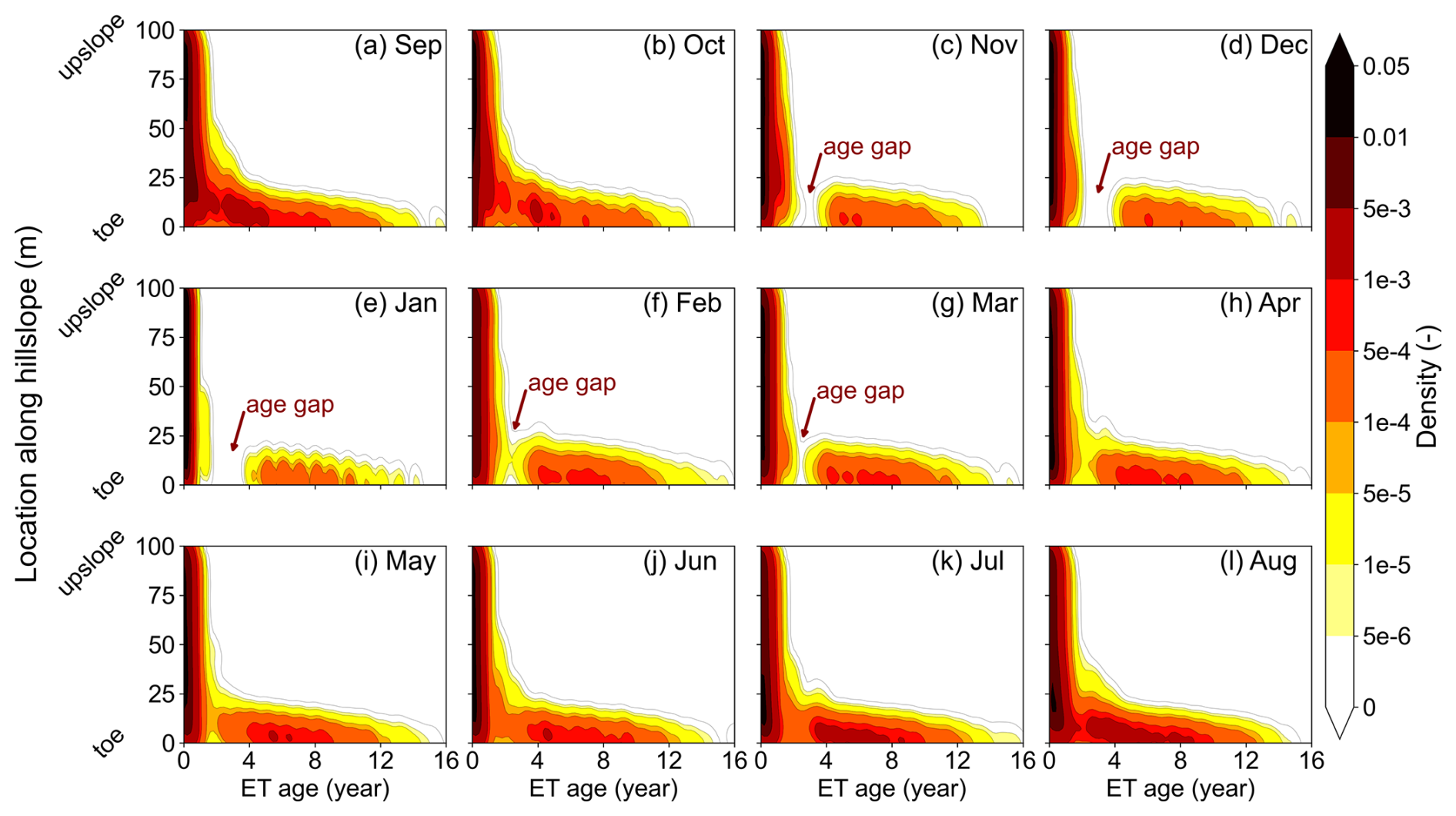
Figure 5Monthly spatial distribution of ET age along the hillslope under combined warming–greening forcing. Colors indicate the probability density of ET ages. Compared with the baseline case (Fig. 4), enhanced ET forcing promotes earlier and more pronounced depletion of intermediate-age contributions, resulting in a larger and more persistent age gap and stronger separation between young and old water components.
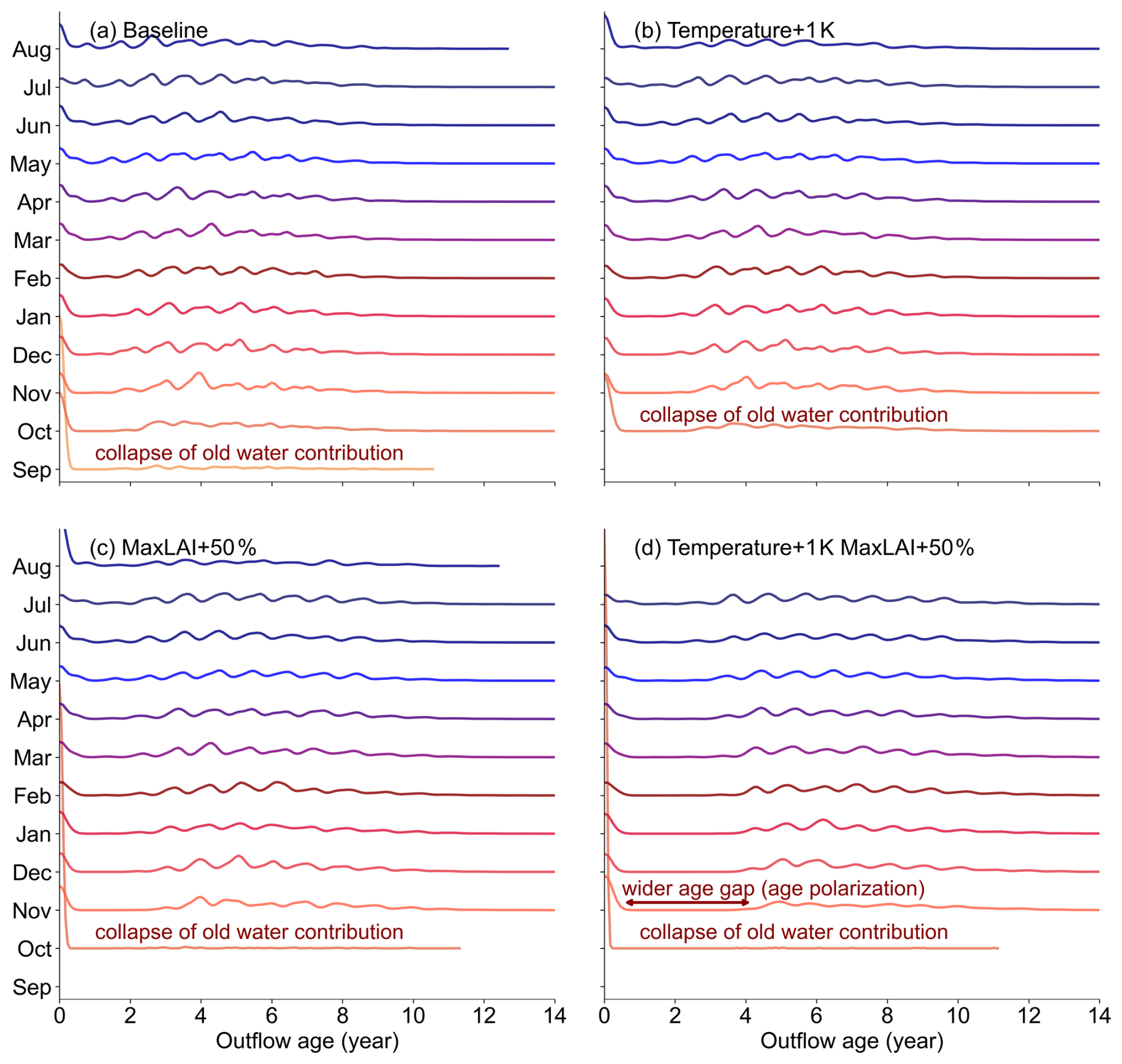
Figure 6Monthly outflow age distributions under four ET-forcing scenarios: (a) baseline, (b) warming (+1 °C), (c) greening (MaxLAI + 50 %), and (d) combined warming–greening forcing. The horizontal axis shows outflow age, and the vertical axis represents individual months from September to August. Each colored curve represents the probability density distribution of outflow ages for a given month. All monthly distributions use the same probability-density scale and are vertically offset only for visual clarity. Under baseline conditions, the older-age component temporarily disappears in September. Under the enhanced ET-forcing scenarios, a similar collapse occurs in October. Enhanced ET forcing also produces a wider separation between younger and older age components, resulting in a more pronounced age gap and stronger age polarization under the combined warming–greening scenario.
Particle source diagnostics further confirm this spatial separation of age components. ET particles with ages between 0.5–1 year predominantly originate within the lower ∼ 20 m of the hillslope, indicating a locally recharged downslope water source (Fig. S7). In contrast, particles with ages between 1–2.5 years are traced to positions upslope of 20 m, demonstrating that older ET contributions are supplied by more distal upslope groundwater storage (Fig. S8). This age-dependent upslope shift in source location confirms that the two age components correspond to locally recharged downslope water and older upslope groundwater storage.
Following the late-summer drying (around September), the water table deepens. As the system desaturates, intermediate subsurface flow paths that connect shallow storage to deeper groundwater weaken. In the subsequent months, ET remains at a moderate level and continues to draw partly on deeper soil water, so the intermediate-age component does not vanish immediately. However, as ET gradually decreases toward winter, its reliance on deeper water diminishes and the contribution of locally stored shallow water becomes more prominent. This seasonal shift in water use progressively reduces the relative contribution of older water in the ET age distribution, as reflected by the gradual fading of high-density colors in the older age range (Figs. 4 and 5).
By January, when ET demand is minimal, water use is largely confined to shallow near-surface storage (Fig. S9). Meanwhile, portions of the intermediate-age water stored in deeper soil layers were reduced during transient drainage in the preceding months, and the delayed drying signal from upslope areas has propagated downslope. The combined effect of prior drainage and delayed signal transmission results in a temporary loss of intermediate-age contributions, producing the pronounced age gap observed in early winter (January, Figs. 4 and 5). Here, the term age gap refers to a marked depletion of intermediate-age contributions that separates younger and older water components within the age distribution. Notably, this age-gap formation coincides with the January dip in streamflow (Fig. 2b), indicating that the short-lived autumn recharge did not fully reverse the preceding drying signal.
Particle source diagnostics (Fig. 7) reveal two spatially distinct ET source regions, with contributions originating from both proximal downslope storage and more distal upslope portions of the hillslope. Following late-summer depletion, contributions from the slope segment immediately upslope of the lower 20 m zone are markedly reduced. This segment corresponds to the transition from energy-limited to water-limited conditions (Fig. S10) and represents a key bridging pathway linking deeper upslope storage to downslope ET (Fig. 1). ET increases markedly along the downslope transition zone (approximately 20–60 m), particularly during July–September (Fig. S10). However, soil saturation in this region does not reach the more favorable moisture conditions observed at the hillslope toe (lower 20 m, Fig. S3), rendering it more vulnerable to moisture limitation during dry or drought periods. This vulnerability likely disrupts intermediate subsurface flow paths, contributing to the observed contraction of bridging connectivity and the emergence of the ET age gap.
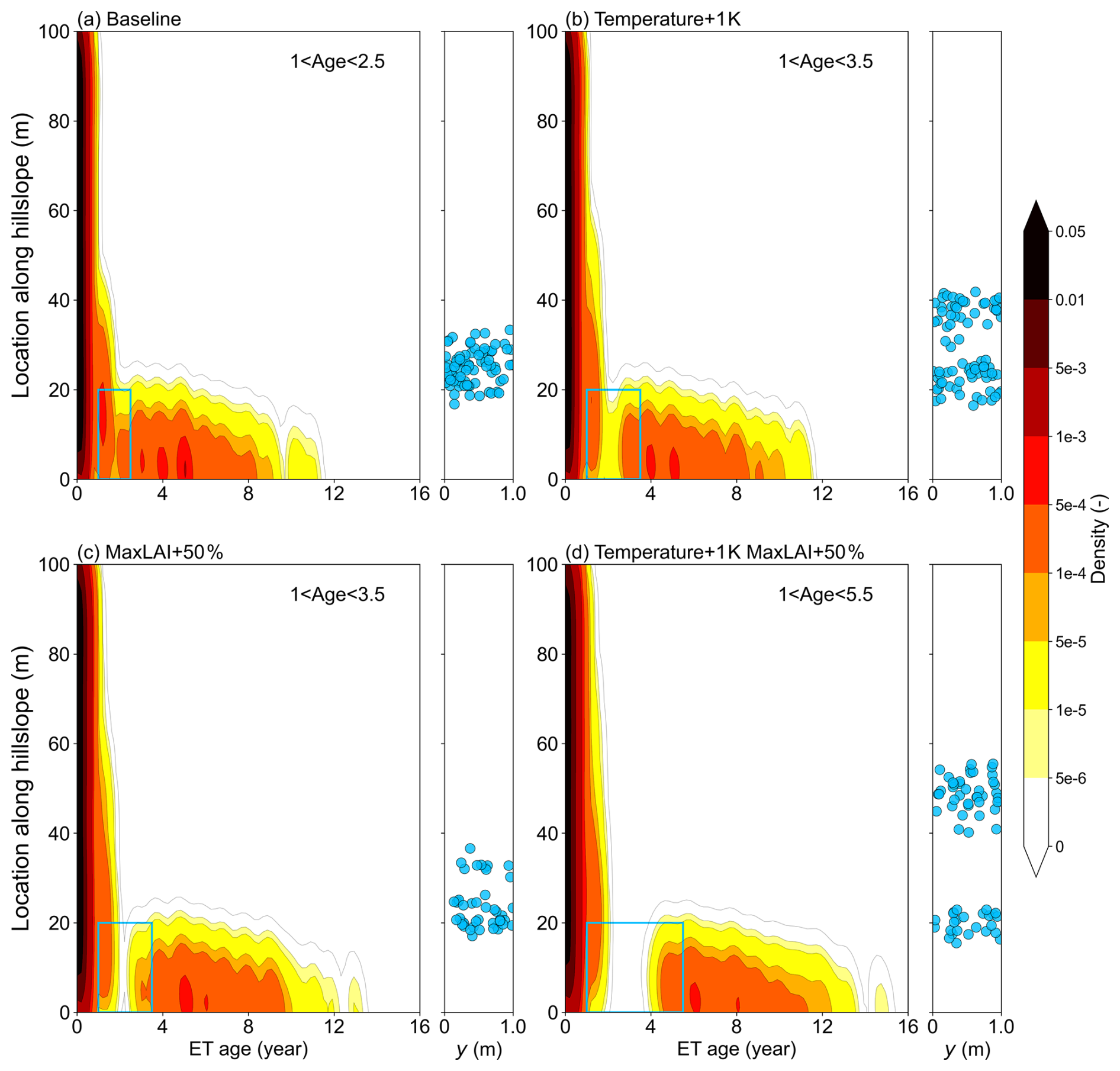
Figure 7Source regions of particles contributing to December ET in the lower 20 m zone of the hillslope for selected age ranges under different ET-forcing scenarios. Left panels show the corresponding ET age distributions as a function of distance along the hillslope. Blue rectangles indicate the selected age intervals used to identify the particle populations shown in the right panels. Right panels show the inferred source locations of these ET-contributing particles in the x–y domain, where x represents distance along the hillslope and y represents the across-slope direction.
Outflow responds more abruptly than ET. In September, groundwater levels reach their annual minimum, and at the hillslope outlet the water table drops below the land surface elevation, effectively disconnecting deeper groundwater from the channel. As a result, older groundwater contributions rapidly diminish, leaving outflow dominated by very young, locally recharged water generated primarily through saturation-excess runoff (Fig. 6a).
As precipitation increases in October, older groundwater contributions begin to reappear at the outlet. However, this re-emergence remains separated from the young component by a pronounced age gap, reflecting the incomplete recovery of intermediate-age contributions (Fig. 6a). Unlike ET, which can actively tap locally stored deeper soil water through root uptake and thus temporarily retain intermediate-age contributions, outflow behaves as a passive drainage flux. Once hydraulic connectivity weakens, intermediate-age contributions decline immediately and remain suppressed until subsurface connectivity is progressively restored through seasonal recharge.
By mid-winter (January–February), the earlier drying signal has largely drained through the system, while concurrent recharge gradually rebuilds storage (Fig. 6a). Consequently, the age gap narrows progressively through late winter and spring, signaling the seasonal reactivation of intermediate pathways and the gradual restoration of subsurface connectivity.
3.3 Warming and greening
Warming and vegetation greening both intensify this seasonal reorganization of ET age structure. Under these scenarios, intermediate-age contributions collapse more abruptly during late summer, so that a clear age gap emerges earlier than in the baseline case and remains prominent through the subsequent months (Figs. S4–S5). The combined warming–greening scenario shows the strongest amplification: a distinct separation between shallow and deep age components is already evident by November, and the two components remain largely disconnected through winter and spring. Only by the following May does a weak partial reconnection begin to appear, indicating a delayed and incomplete return of intermediate-age contributions (Fig. 5). Overall, enhanced ET forcing advances the onset of age segregation and prolongs the period over which ET draws from two separated shallow and deep source pools.
Outflow exhibits an even more abrupt response under warming and greening (Fig. 6b–d). In September, discharge effectively collapses. Under the combined warming–greening scenario, October outflow is almost entirely composed of very young water, with older groundwater contributions nearly absent and a pronounced age gap separating the young and older components. Throughout the following months, the reconnection between young and older components remains weak. Even into early summer (around May), the restoration of intermediate-age connectivity remains incomplete, indicating a delayed and structurally weakened recovery of groundwater–surface water coupling.
Importantly, these perturbations do not introduce a fundamentally new behavior but amplify the baseline seasonal pattern of groundwater–surface decoupling. Warming and greening advance its onset, extend its duration, and in some cases push the system toward a quasi-persistent decoupled regime. In addition to advancing the onset of age segregation, warming and greening also enhance the polarization of the age spectrum, with young components becoming increasingly concentrated at very short residence times while older contributions are either shifted toward longer ages or temporarily suppressed. Taken together, these patterns indicate that progressive groundwater decoupling under enhanced ET forcing drives a shift toward faster and shallower terrestrial water cycling.
3.4 Structural robustness across parameter configurations
To evaluate whether the age-gap formation and deep–shallow decoupling depend on a specific parameter choice, we examined three additional parameter groups involving vegetation type, subsurface hydraulic properties, and hillslope gradient. Across all configurations, the qualitative reorganization pathway identified under the reference parameter configuration remains evident, although its magnitude varies. When vegetation was changed from trees to shrubs (Figs. S11–S12), overall ET demand and seasonal water stress were reduced. As expected, both ET and outflow age structures became less polarized, and the seasonal age gap weakened, yet the separation between shallow and deep contributions remained discernible. This behavior is consistent with the stress-controlled nature of the mechanism: reduced water demand dampens, but does not eliminate, connectivity-driven reorganization.
Modifying subsurface hydraulic properties (Figs. S13–S14) altered the balance of connectivity pathways without disrupting the underlying pattern. Higher saturated hydraulic conductivity and porosity enhanced lateral groundwater movement toward the hillslope toe, increasing the relative contribution of older groundwater to outflow. At the same time, larger α and lower residual saturation weakened capillary linkage between the root zone and deeper storage, reducing the older-water fraction in ET. As a result, outflow exhibited a greater proportion of old water, whereas ET shifted toward younger sources. In both fluxes, the age gap remained detectable but substantially muted, primarily reflecting a redistribution between young and old contributions. In contrast, reducing hillslope gradient (Figs. S15–S16) weakened both lateral drainage and vertical hydraulic connectivity, amplifying seasonal decoupling. Under these conditions, old-water contributions nearly vanished during winter months in both ET and outflow, and the age gap became more pronounced during the rest of the year.
Together, these results indicate that parameter perturbations modulate the intensity and manifestation of groundwater–surface decoupling, but do not alter the underlying reorganization of flow paths. The emergence of age segregation under sustained stress therefore appears robust across variations in vegetation, hydraulic properties, and slope gradient.
Fan et al. (2017) has emphasized that vegetation water use is regulated by two hydrologic regimes: shallow soil moisture supplied by rainfall infiltration and deeper groundwater accessible through hydraulic connectivity. Similarly, tracer studies show that streamflow integrates a fast, young-water regime and a slower, old-water regime linked to deeper storage (Floriancic et al., 2024). Our findings refine this dual-regime perspective by showing that under dry or drought conditions, declining hydraulic connectivity weakens the groundwater-controlled regime and may even lead to partial decoupling from deeper storage. Importantly, this mechanism does not contradict observations from many drought studies reporting an increase in the fraction of “old water” during dry periods (von Freyberg et al., 2018; Wilusz et al., 2019). Even when groundwater contributions diminish, source water ages may remain elevated because vegetation increasingly relies on water stored below the actively recycled shallow soil layer. Such water corresponds to deeper vadose-zone storage recharged by past infiltration events (Miguez-Macho and Fan, 2021), rather than groundwater stored below the water table. What we emphasize here is that increasing hydrologic stress does not necessarily lead to progressively greater dependence on the deepest groundwater reservoir; rather, its contribution may be suppressed as connectivity contracts (Fig. 1). While derived from controlled hillslope experiments, the mechanism identified here isolates a fundamental reorganization pathway that may operate in real catchments under sustained stress.
The structural shift identified here is unlikely to weaken under ongoing global change. Sustained warming and widespread vegetation greening increase atmospheric and biological water demand from above (Yang et al., 2023b; Pokhrel et al., 2021), while groundwater extraction reduces subsurface storage from below (Jasechko et al., 2024). These combined pressures intensify overall water stress and weaken deep–shallow hydraulic connectivity. The documented eastward shift of the hydroclimatic dry–wet boundary along the 100th meridian west in North America – reported to have migrated approximately 225 km (140 miles) eastward since 1980 (Seager et al., 2018a, b) – suggests that an expanding fraction of landscapes is becoming increasingly water-limited, a condition under which subsurface connectivity is more prone to weakening. Recurrent groundwater drought and widespread baseflow decline further reflect this progressive loss of subsurface buffering (Elsaidy et al., 2025; Tan et al., 2020). Under such conditions, contraction of intermediate flow paths and groundwater–surface decoupling may become increasingly prevalent rather than exceptional.
A gradual loss of groundwater connectivity weakens the subsurface buffering capacity that stabilizes surface fluxes. As deep storage becomes less engaged, the hydrologic memory carried by long-residence water diminishes. Consequently, antecedent storage conditions exert a weaker influence on subsequent ET and streamflow, and fluxes become more directly controlled by short-term atmospheric forcing. With reduced temporal persistence, the capacity to infer future fluxes from present storage states declines. At the same time, the diminished participation of deep storage reduces the system's ability to absorb and moderate climatic extremes, weakening its resilience. Such a system is therefore both more sensitive to external forcing and inherently more difficult to predict under sustained stress (Shi et al., 2022).
Although the additional parameter configurations examined here consistently preserved the underlying reorganization pattern, natural catchments involve simultaneous variations in vegetation, topography, subsurface properties, and climatic forcing, all of which may vary across spatial and temporal scales. As emphasized by Blöschl and Sivapalan (1995), different processes may dominate at different spatial and temporal scales, and their interactions may amplify, suppress, or otherwise modify the manifestation of the mechanism identified in this study. In addition, several processes not explicitly represented here, including snow accumulation and melt, mountain-block recharge, and other forms of scale-dependent catchment heterogeneity, may alter the timing and magnitude of groundwater connectivity changes (Jencso et al., 2009; Somers and McKenzie, 2020). For example, in snow-influenced mountain catchments, sustained drought and declining groundwater storage may favor the development of age segregation and deep–shallow decoupling, whereas seasonal snow storage and delayed snowmelt recharge may buffer or postpone this development. These competing effects highlight that, when upscaling from idealized hillslopes to real catchments, the connectivity-driven reorganization identified here may exhibit greater spatial heterogeneity and temporal variability, depending on which processes dominate at a given scale. Future work is therefore needed to evaluate this connectivity-driven reorganization across nested spatial scales in real catchments where multiple processes interact simultaneously. Such evaluation could combine groundwater-level, streamflow, and ET observations to diagnose the loss and recovery of hydraulic connectivity with stable water isotopes and geochemical tracers to fingerprint the associated changes in water-source contributions.
This study demonstrates that sustained increases in ET demand may fundamentally reorganize the internal age structure of terrestrial water cycling. Using controlled hillslope experiments with integrated hydrologic modeling and particle tracking, we show that progressive groundwater storage decline weakens intermediate-age flow paths and separates shallow, rapidly recycled water from deeper, long-residence storage. Under enhanced warming and greening, this seasonal age polarization emerges earlier, persists longer, and becomes more pronounced, driving outflow and ET toward increasingly young water sources. This connectivity-driven shift remains evident across variations in vegetation type, soil hydraulic properties, and slope gradient. Rather than progressively increasing groundwater dependence under drought, sustained hydrologic stress can suppress effective groundwater engagement, shorten hydrologic memory, and shift landscapes toward a shallower and faster mode of water cycling. Progressive groundwater decoupling therefore represents a structural transition in terrestrial water systems, with implications for predictability, resilience, and water resource stability under ongoing climate and vegetation change.
ParFlow v3.14.1 (Smith et al., 2025), available at https://doi.org/10.5281/zenodo.16916171, was used for the hydrological simulations. EcoSLIM v1.31 (Condon et al., 2023), available at https://doi.org/10.5281/zenodo.8371241, was used for particle tracking. The EcoSLIM v1.31 archive contains the complete synthetic hillslope model setup and all input data required for the simulations. Neither the ParFlow nor the EcoSLIM source code was modified; only the relevant vegetation, subsurface hydraulic, topographic, and meteorological forcing parameters were adjusted to construct the experimental scenarios investigated in this study. All ParFlow and EcoSLIM run scripts and modified parameter settings for the complete set of scenarios, together with the post-processing and figure-generation scripts, are available from Figshare (Sun, 2026) at https://doi.org/10.6084/m9.figshare.31410108. The complete model outputs underlying this study can be reproduced using the publicly available input data, parameter settings, and scripts described above and are therefore not archived separately.
The supplement related to this article is available online at https://doi.org/10.5194/hess-30-5215-2026-supplement.
Conceptualization: CY. Methodology: CY and AS. Investigation: CY, AS, and WX. Resources: CY. Writing (original draft): CY, AS, and WX. Writing (review and editing): CY, AS, WX, EM, and HY.
The contact author has declared that none of the authors has any competing interests.
Publisher's note: Copernicus Publications remains neutral with regard to jurisdictional claims made in the text, published maps, institutional affiliations, or any other geographical representation in this paper. The authors bear the ultimate responsibility for providing appropriate place names. Views expressed in the text are those of the authors and do not necessarily reflect the views of the publisher.
We sincerely thank the three anonymous reviewers and the handling editor for their constructive comments and suggestions, which substantially improved the manuscript.
This research was supported by the National Natural Science Fund for Excellent Young Scientists (Overseas) (grant no. 2025HY00260101), the Fundamental Research Funds for the Central Universities – Young Faculty Development Program (grant no. 25hytd008), the National High-Level Young Talent Program (Provincial Government Matching Research Funds) (grant no. 2025HYSPT0705), and the Guangdong Major Project of Basic and Applied Basic Research (grant no. 2021B0301030007).
This paper was edited by Margaret Zimmer and reviewed by three anonymous referees.
Bearup, L. A., Maxwell, R. M., and McCray, J. E.: Hillslope response to insect-induced land-cover change: an integrated model of end-member mixing, Ecohydrology, 9, 195-203, https://doi.org/10.1002/eco.1729, 2016.
Berkowitz, B. and Zehe, E.: Surface water and groundwater: unifying conceptualization and quantification of the two “water worlds”, Hydrol. Earth Syst. Sci., 24, 1831–1858, https://doi.org/10.5194/hess-24-1831-2020, 2020.
Betterle, A. and Bellin, A.: Morphological and Hydrogeological Controls of Groundwater Flows and Water Age Distribution in Mountain Aquifers and Streams, Water Resour. Res., 60, e2024WR037407, https://doi.org/10.1029/2024WR037407, 2024.
Bierkens, M. F. P. and van den Hurk, B. J. J. M.: Groundwater convergence as a possible mechanism for multi-year persistence in rainfall, Geophys. Res. Lett., 34, https://doi.org/10.1029/2006GL028396, 2007.
Blöschl, G. and Sivapalan, M.: Scale issues in hydrological modelling: A review, Hydrol. Process, 9, 251–290, https://doi.org/10.1002/hyp.3360090305, 1995.
Brooks, P. D., Gelderloos, A., Wolf, M. A., Jamison, L. R., Strong, C., Solomon, D. K., Bowen, G. J., Burian, S., Tai, X., Arens, S., Briefer, L., Kirkham, T., and Stewart, J.: Groundwater-Mediated Memory of Past Climate Controls Water Yield in Snowmelt-Dominated Catchments, Water Resour. Res., 57, e2021WR030605, https://doi.org/10.1029/2021WR030605, 2021.
Carroll, R. W. H., Niswonger, R. G., Ulrich, C., Varadharajan, C., Siirila-Woodburn, E. R., and Williams, K. H.: Declining groundwater storage expected to amplify mountain streamflow reductions in a warmer world, Nat. Water, 2, 419–433, https://doi.org/10.1038/s44221-024-00239-0, 2024.
Chen, C., Park, T., Wang, X., Piao, S., Xu, B., Chaturvedi, R. K., Fuchs, R., Brovkin, V., Ciais, P., Fensholt, R., Tømmervik, H., Bala, G., Zhu, Z., Nemani, R. R., and Myneni, R. B.: China and India lead in greening of the world through land-use management, Nat. Sustain., 2, 122–129, https://doi.org/10.1038/s41893-019-0220-7, 2019.
Condon, L. E., Atchley, A. L., and Maxwell, R. M.: Evapotranspiration depletes groundwater under warming over the contiguous United States, Nat. Commun., 11, 873, https://doi.org/10.1038/s41467-020-14688-0, 2020.
Condon, L., zperzan, Smith, S., reedmaxwell, and aureliayang: reedmaxwell/EcoSLIM: v1.31 (Version v1.31), Zenodo [software], https://doi.org/10.5281/zenodo.8371241, 2023.
Danesh-Yazdi, M., Klaus, J., Condon, L. E., and Maxwell, R. M.: Bridging the gap between numerical solutions of travel time distributions and analytical storage selection functions, Hydrol. Process, 32, 1063–1076, https://doi.org/10.1002/hyp.11481, 2018.
Elsaidy, A., Yimer, E. A., Mogheir, Y., Huysmans, M., Villani, L., and van Griensven, A.: Groundwater drought and anthropogenic amplifiers: A review of assessment and response strategies in arid and semi-arid areas, Sci. Tot. Environ., 978, 179406, https://doi.org/10.1016/j.scitotenv.2025.179406, 2025.
Fan, Y., Miguez-Macho, G., Jobbágy, E. G., Jackson, R. B., and Otero-Casal, C.: Hydrologic regulation of plant rooting depth, Proc. Natl. Aca. Sci., 114, 10572–10577, https://doi.org/10.1073/pnas.1712381114, 2017.
Fan, Y., Clark, M., Lawrence, D. M., Swenson, S., Band, L. E., Brantley, S. L., Brooks, P. D., Dietrich, W. E., Flores, A., Grant, G., Kirchner, J. W., Mackay, D. S., McDonnell, J. J., Milly, P. C. D., Sullivan, P. L., Tague, C., Ajami, H., Chaney, N., Hartmann, A., Hazenberg, P., McNamara, J., Pelletier, J., Perket, J., Rouholahnejad-Freund, E., Wagener, T., Zeng, X., Beighley, E., Buzan, J., Huang, M., Livneh, B., Mohanty, B. P., Nijssen, B., Safeeq, M., Shen, C., van Verseveld, W., Volk, J., and Yamazaki, D.: Hillslope Hydrology in Global Change Research and Earth System Modeling, Water Resour. Res., 55, 1737–1772, https://doi.org/10.1029/2018wr023903, 2019.
Floriancic, M. G., Allen, S. T., and Kirchner, J. W.: Young and new water fractions in soil and hillslope waters, Hydrol. Earth Syst. Sci., 28, 4295–4308, https://doi.org/10.5194/hess-28-4295-2024, 2024.
Getirana, A., Kumar, S., and Rodell, M.: Inconsistencies in GRACE-Based Groundwater Storage Estimation – A Call for a Proper Use of Land Surface Models, Geophys. Res. Lett., 52, e2025GL119197, https://doi.org/10.1029/2025GL119197, 2025.
IPCC: Climate Change 2021: The Physical Science Basis. Contribution of Working Group I to the Sixth Assessment Report of the Intergovernmental Panel on Climate Change, Cambridge University Press, Cambridge, United Kingdom, and New York, NY, USA, https://doi.org/10.1017/9781009157896, 2021.
Jasechko, S., Seybold, H., Perrone, D., Fan, Y., Shamsudduha, M., Taylor, R. G., Fallatah, O., and Kirchner, J. W.: Rapid groundwater decline and some cases of recovery in aquifers globally, Nature, 625, 715–721, https://doi.org/10.1038/s41586-023-06879-8, 2024.
Jencso, K. G., McGlynn, B. L., Gooseff, M. N., Wondzell, S. M., Bencala, K. E., and Marshall, L. A.: Hydrologic connectivity between landscapes and streams: Transferring reach- and plot-scale understanding to the catchment scale, Water Resour. Res., 45, https://doi.org/10.1029/2008WR007225, 2009.
Knighton, J. and Berghuijs, W. R.: Water Ages Explain Tradeoffs Between Long-Term Evapotranspiration and Ecosystem Drought Resilience, Geophys. Res. Lett., 50, e2023GL103649, https://doi.org/10.1029/2023GL103649, 2023.
Kollet, S. J. and Maxwell, R. M.: Integrated surface-groundwater flow modeling: A free-surface overland flow boundary condition in a parallel groundwater flow model, Adv. Water Resour., 29, 945–958, https://doi.org/10.1016/j.advwatres.2005.08.006, 2006.
Kollet, S. J. and Maxwell, R. M.: Capturing the influence of groundwater dynamics on land surface processes using an integrated, distributed watershed model, Water Resour. Res., 44, https://doi.org/10.1029/2007wr006004, 2008.
Li, L., Knapp, J. L. A., Lintern, A., Ng, G. H. C., Perdrial, J., Sullivan, P. L., and Zhi, W.: River water quality shaped by land–river connectivity in a changing climate, Nat. Clim. Change, 14, 225–237, https://doi.org/10.1038/s41558-023-01923-x, 2024.
Liang, X., Schilling, K. E., Jones, C. S., and Zhang, Y.-K.: Temporal scaling of long-term co-occurring agricultural contaminants and the implications for conservation planning, Environ. Res. Lett., 16, 094015, https://doi.org/10.1088/1748-9326/ac19dd, 2021.
Maxwell, R. M.: A terrain-following grid transform and preconditioner for parallel, large-scale, integrated hydrologic modeling, Adv. Water Resour., 53, 109–117, https://doi.org/10.1016/j.advwatres.2012.10.001, 2013.
Maxwell, R. M. and Miller, N. L.: Development of a coupled land surface and groundwater model, J. Hydrometeorol., 6, 233–247, https://doi.org/10.1175/JHM422.1, 2005.
Maxwell, R. M., Condon, L. E., Danesh-Yazdi, M., and Bearup, L. A.: Exploring source water mixing and transient residence time distributions of outflow and evapotranspiration with an integrated hydrologic model and Lagrangian particle tracking approach, Ecohydrology, 12, https://doi.org/10.1002/eco.2042, 2019.
Miguez-Macho, G. and Fan, Y.: Spatiotemporal origin of soil water taken up by vegetation, Nature, 598, 624–628, https://doi.org/10.1038/s41586-021-03958-6, 2021.
Miguez-Macho, G. and Fan, Y.: A global humidity index with lateral hydrologic flows, Nature, 644, 413–419, https://doi.org/10.1038/s41586-025-09359-3, 2025.
Mikkelson, K. M., Maxwell, R. M., Ferguson, I., Stednick, J. D., McCray, J. E., and Sharp, J. O.: Mountain pine beetle infestation impacts: modeling water and energy budgets at the hill-slope scale, Ecohydrology, 6, 64–72, https://doi.org/10.1002/eco.278, 2013.
Piao, S. L., Wang, X. H., Park, T., Chen, C., Lian, X., He, Y., Bjerke, J. W., Chen, A. P., Ciais, P., Tommervik, H., Nemani, R. R., and Myneni, R. B.: Characteristics, drivers and feedbacks of global greening, Nat. Rev. Earth Env., 1, 14–27, https://doi.org/10.1038/s43017-019-0001-x, 2020.
Pokhrel, Y., Felfelani, F., Satoh, Y., Boulange, J., Burek, P., Gädeke, A., Gerten, D., Gosling, S. N., Grillakis, M., Gudmundsson, L., Hanasaki, N., Kim, H., Koutroulis, A., Liu, J., Papadimitriou, L., Schewe, J., Müller Schmied, H., Stacke, T., Telteu, C.-E., Thiery, W., Veldkamp, T., Zhao, F., and Wada, Y.: Global terrestrial water storage and drought severity under climate change, Nat. Clim. Change, 11, 226–233, https://doi.org/10.1038/s41558-020-00972-w, 2021.
Schiavo, M., Riva, M., Guadagnini, L., Zehe, E., and Guadagnini, A.: Probabilistic identification of Preferential Groundwater Networks, J. Hydrol., 610, 127906, https://doi.org/10.1016/j.jhydrol.2022.127906, 2022.
Seager, R., Feldman, J., Lis, N., Ting, M., Williams, A. P., Nakamura, J., Liu, H., and Henderson, N.: Whither the 100th Meridian? The Once and Future Physical and Human Geography of America's Arid–Humid Divide, Part II: The Meridian Moves East, Earth Interact., 22, 1–24, https://doi.org/10.1175/EI-D-17-0012.1, 2018a.
Seager, R., Lis, N., Feldman, J., Ting, M., Williams, A. P., Nakamura, J., Liu, H., and Henderson, N.: Whither the 100th Meridian? The Once and Future Physical and Human Geography of America's Arid–Humid Divide, Part I: The Story So Far, Earth Interactions, 22, 1–22, https://doi.org/10.1175/EI-D-17-0011.1, 2018b.
Shi, H., Jin, F.-F., Wills, R. C. J., Jacox, M. G., Amaya, D. J., Black, B. A., Rykaczewski, R. R., Bograd, S. J., García-Reyes, M., and Sydeman, W. J.: Global decline in ocean memory over the 21st century, Sci. Adv., 8, eabm3468, https://doi.org/10.1126/sciadv.abm3468, 2022.
Smith, S., i-ferguson, Artavanis, G., Rigor, P., Engdahl, N., FabianGasper, Chennault, C., reedmaxwell, Acero Triana, J. S., Avery, P., Azeemi, M. F., Condon, L., grapp1, Jourdain, S. (Kitware), Bennett, A., Kulkarni, K., Bansal, V., xy124, alanquits, Beisman, J., elena-leo, de Rooij, R., Swilley, J., DrewLazzeriKitware, Thompson, D., basileh, Perzan, Z., westb2, and edimunv: parflow/parflow: ParFlow Version 3.14.1, Zenodo [software], https://doi.org/10.5281/zenodo.16916171, 2025.
Somers, L. D. and McKenzie, J. M.: A review of groundwater in high mountain environments, WIREs Water, 7, e1475, https://doi.org/10.1002/wat2.1475, 2020.
Sun, A.: Hillslope with ParFlow and EcoSLIM, Figshare [code], https://doi.org/10.6084/m9.figshare.31410108, 2026.
Swenson, L. J., Zipper, S., Peterson, D. M., Jones, C. N., Burgin, A. J., Seybold, E., Kirk, M. F., and Hatley, C.: Changes in Water Age During Dry-Down of a Non-Perennial Stream, Water Resour. Res., 60, e2023WR034623, https://doi.org/10.1029/2023WR034623, 2024.
Tan, X., Liu, B., and Tan, X.: Global Changes in Baseflow Under the Impacts of Changing Climate and Vegetation, Water Resour. Res., 56, e2020WR027349, https://doi.org/10.1029/2020WR027349, 2020.
Tran, H., Zhang, J., Cohard, J.-M., Condon, L. E., and Maxwell, R. M.: Simulating Groundwater-Streamflow Connections in the Upper Colorado River Basin, Groundwater, 58, 392–405, https://doi.org/10.1111/gwat.13000, 2020.
Villaruel, A. J., Seck, A., and Schultz, C.: Evaluating time-lagged relationships between groundwater storage and river discharge using GRACE-based data: insights from the Potomac Basin, Environ. Res. Commun., 7, 075003, https://doi.org/10.1088/2515-7620/ade36f, 2025.
Visser, A., Thaw, M., Deinhart, A., Bibby, R., Safeeq, M., Conklin, M., Esser, B., and Van der Velde, Y.: Cosmogenic Isotopes Unravel the Hydrochronology and Water Storage Dynamics of the Southern Sierra Critical Zone, Water Resour. Res., 55, 1429–1450, https://doi.org/10.1029/2018WR023665, 2019.
von Freyberg, J., Allen, S. T., Seeger, S., Weiler, M., and Kirchner, J. W.: Sensitivity of young water fractions to hydro-climatic forcing and landscape properties across 22 Swiss catchments, Hydrol. Earth Syst. Sci., 22, 3841–3861, https://doi.org/10.5194/hess-22-3841-2018, 2018.
Wilusz, D. C., Harman, C. J., Ball, W. B., Maxwell, R. M., and Buda, A. R.: Using particle tracking to understand flow paths, age distributions, and the paradoxical origins of the inverse storage effect in an experimental catchment, Water Resour. Res., e24397, https://doi.org/10.1029/2019wr025140, 2019.
Xie, J., Liu, X., Jasechko, S., Berghuijs, W. R., Wang, K., Liu, C., Reichstein, M., Jung, M., and Koirala, S.: Majority of global river flow sustained by groundwater, Nat. Geosci., 17, 770–777, https://doi.org/10.1038/s41561-024-01483-5, 2024.
Yang, C., Maxwell, R. M., and Valent, R.: Accelerating the Lagrangian simulation of water ages on distributed, multi-GPU platforms: The importance of dynamic load balancing, Comp. Geosci., 166, 105189, https://doi.org/10.1016/j.cageo.2022.105189, 2022.
Yang, C., Maxwell, R., McDonnell, J., Yang, X., and Tijerina-Kreuzer, D.: The Role of Topography in Controlling Evapotranspiration Age, J. Geophys Res.: Atmos., 128, e2023JD039228, https://doi.org/10.1029/2023JD039228, 2023a.
Yang, C., Zhang, Y. K., Liang, X. Y., Olschanowsky, C., Yang, X. F., and Maxwell, R.: Accelerating the Lagrangian particle tracking of residence time distributions and source water mixing towards large scales, Comp. Geosci., 151, https://doi.org/10.1016/j.cageo.2021.104760, 2021a.
Yang, X., Tetzlaff, D., Soulsby, C., Smith, A., and Borchardt, D.: Catchment Functioning Under Prolonged Drought Stress: Tracer-Aided Ecohydrological Modeling in an Intensively Managed Agricultural Catchment, Water Resour. Res., 57, e2020WR029094, https://doi.org/10.1029/2020WR029094, 2021b.
Yang, Y., Roderick, M. L., Guo, H., Miralles, D. G., Zhang, L., Fatichi, S., Luo, X., Zhang, Y., McVicar, T. R., Tu, Z., Keenan, T. F., Fisher, J. B., Gan, R., Zhang, X., Piao, S., Zhang, B., and Yang, D.: Evapotranspiration on a greening Earth, Nat. Rev. Earth Env., 4, 626–641, https://doi.org/10.1038/s43017-023-00464-3, 2023b.
Zipper, S., Brookfield, A., Ajami, H., Ayers, J. R., Beightel, C., Fienen, M. N., Gleeson, T., Hammond, J., Hill, M., Kendall, A. D., Kerr, B., Lapides, D., Porter, M., Parimalarenganayaki, S., Rohde, M. M., and Wardropper, C.: Streamflow Depletion Caused by Groundwater Pumping: Fundamental Research Priorities for Management-Relevant Science, Water Resour. Res., 60, e2023WR035727, https://doi.org/10.1029/2023WR035727, 2024.