
Articles | Volume 30, issue 15
https://doi.org/10.5194/hess-30-4867-2026
© Author(s) 2026. This work is distributed under
the Creative Commons Attribution 4.0 License.
the Creative Commons Attribution 4.0 License.
https://doi.org/10.5194/hess-30-4867-2026
© Author(s) 2026. This work is distributed under
the Creative Commons Attribution 4.0 License.
the Creative Commons Attribution 4.0 License.
Research article
| 
04 Aug 2026
Research article |
| 04 Aug 2026
| 04 Aug 2026
Metrics that matter: objective functions and their impact on signature representation in conceptual hydrological models

Institute of Hydrology and Meteorology, TUD Dresden University of Technology, Dresden, Germany
Schulich School of Engineering, Department of Civil Engineering, University of Calgary, Calgary, Canada
Wouter J. M. Knoben
Schulich School of Engineering, Department of Civil Engineering, University of Calgary, Calgary, Canada
Niels Schütze
Institute of Hydrology and Meteorology, TUD Dresden University of Technology, Dresden, Germany
Diana Spieler
Institute of Hydrology and Meteorology, TUD Dresden University of Technology, Dresden, Germany
Schulich School of Engineering, Department of Civil Engineering, University of Calgary, Calgary, Canada
Related authors
No articles found.
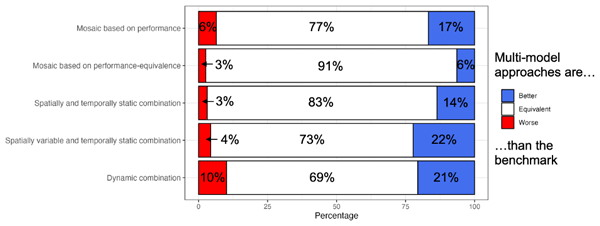
Cyril Thébault, Wouter J. M. Knoben, Nans Addor, Andrew J. Newman, Diana Spieler, Nicolás A. Vásquez, Yalan Song, Gaby J. Gründemann, Shaun Carney, Mukesh Kumar, Katie van Werkhoven, Chaopeng Shen, Andrew W. Wood, and Martyn P. Clark
Hydrol. Earth Syst. Sci., 30, 3945–3977, https://doi.org/10.5194/hess-30-3945-2026, https://doi.org/10.5194/hess-30-3945-2026, 2026
Short summary
Short summary
Reliable river flow prediction guide water supply planning and flood protection. We tested whether selecting or combining multiple models improves accuracy compared with a single model. 78 models were used and tested in 559 river basins across the United States. A carefully chosen single model nearly matched more complex multi-model approaches, while combining models gave slightly higher accuracy and lower uncertainty. However, no approach worked best everywhere.
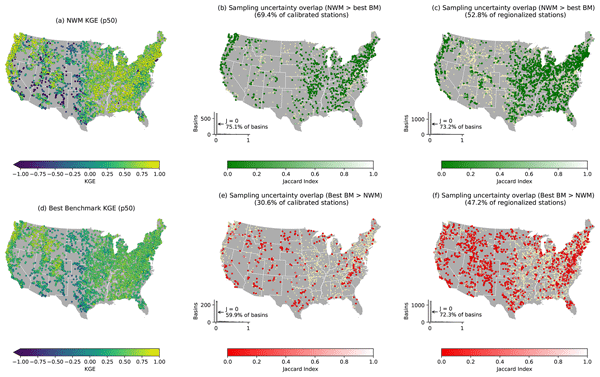
Gaby J. Gründemann, Wouter J. M. Knoben, Yalan Song, Katie van Werkhoven, and Martyn P. Clark
Hydrol. Earth Syst. Sci., 30, 3439–3453, https://doi.org/10.5194/hess-30-3439-2026, https://doi.org/10.5194/hess-30-3439-2026, 2026
Short summary
Short summary
The quality of large-domain hydrologic model simulations is often quantified with so-called accuracy metrics. Here we use simple benchmarks to provide relevant context for these accuracy metrics. Results show that areas where the model cannot beat the benchmarks do not always align with areas where the accuracy metrics are low. This suggests that model improvements are possible in regions that under more typical model evaluation approaches (i.e., without benchmarks) might not be obvious.
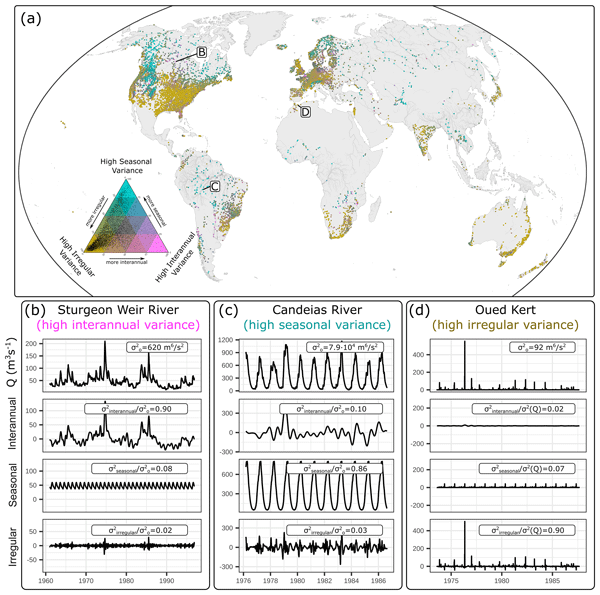
Sacha W. Ruzzante, Wouter J. M. Knoben, Thorsten Wagener, Tom Gleeson, and Markus Schnorbus
Hydrol. Earth Syst. Sci., 30, 2337–2355, https://doi.org/10.5194/hess-30-2337-2026, https://doi.org/10.5194/hess-30-2337-2026, 2026
Short summary
Short summary
Common metrics used to evaluate hydrologic models make it relatively easy to achieve high performance scores in highly seasonal catchments. However, we analysed 18 hydrologic models and found that almost all were worse at simulating interannual variability and change in seasonal streamflow regimes. This suggests that climate change impacts on streamflow may not be accurately predicted in highly seasonal tropical, alpine, and polar regions, which are highly vulnerable to climate change.
Nicolás A. Vásquez, Pablo A. Mendoza, Wouter Knoben, Martyn Clark, Tricia Stadnyk, and Naoki Mizukami
EGUsphere, https://doi.org/10.5194/egusphere-2026-1363, https://doi.org/10.5194/egusphere-2026-1363, 2026
Short summary
Short summary
Although distributed hydrological models are often calibrated using only streamflow data, this practice may provide unrealistic representations of the water cycle. We show that, while streamflow annual cycles can be reasonably simulated, the seasonality of other key variables - such as evapotranspiration, soil moisture, and snow cover - may be severely misrepresented. Our results highlight the need to assess seasonal patterns of variables beyond streamflow when calibrating hydrological models.
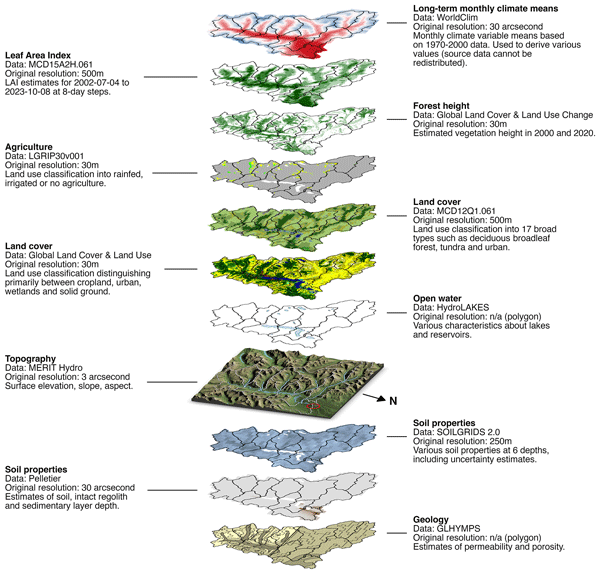
Wouter J. M. Knoben, Cyril Thébault, Kasra Keshavarz, Laura Torres-Rojas, Nathaniel W. Chaney, Alain Pietroniro, and Martyn P. Clark
Hydrol. Earth Syst. Sci., 29, 5791–5833, https://doi.org/10.5194/hess-29-5791-2025, https://doi.org/10.5194/hess-29-5791-2025, 2025
Short summary
Short summary
Many existing datasets for hydrologic analysis tend to treat catchments as single spatially homogeneous units focusing on daily data and typically do not support more complex models. This paper introduces a dataset that goes beyond this set-up by (1) providing data at a higher spatial and temporal resolution, (2) specifically considering the data requirements of all common hydrologic model types, and (3) using statistical summaries of the data aimed at quantifying spatial and temporal heterogeneity.
Maria Staudinger, Anna Herzog, Ralf Loritz, Tobias Houska, Sandra Pool, Diana Spieler, Paul D. Wagner, Juliane Mai, Jens Kiesel, Stephan Thober, Björn Guse, and Uwe Ehret
Hydrol. Earth Syst. Sci., 29, 5005–5029, https://doi.org/10.5194/hess-29-5005-2025, https://doi.org/10.5194/hess-29-5005-2025, 2025
Short summary
Short summary
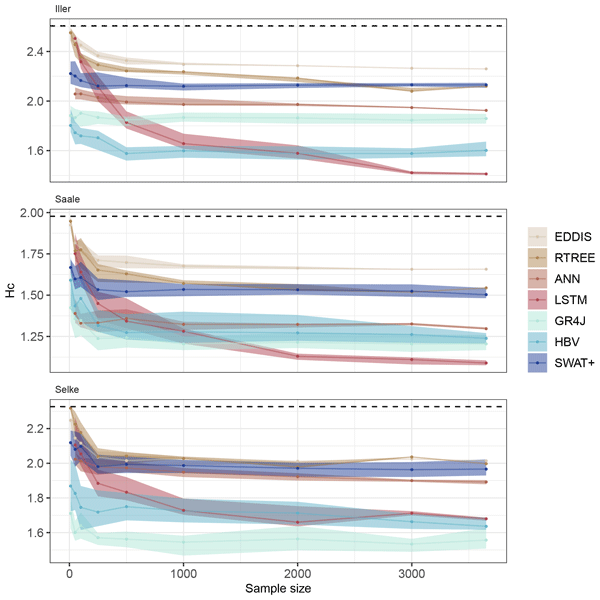
Three process-based and four data-driven hydrological models are compared using different training data. We found that process-based models perform better with small datasets but stop learning soon, while data-driven models learn longer. The study highlights the importance of memory in data and the impact of different data sampling methods on model performance. The direct comparison of these models is novel and provides a clear understanding of their performance under various data conditions.
Aatralarasi Saravanan, Daniel Karthe, Selvaprakash Ramalingam, and Niels Schütze
Hydrol. Earth Syst. Sci., 29, 4847–4870, https://doi.org/10.5194/hess-29-4847-2025, https://doi.org/10.5194/hess-29-4847-2025, 2025
Short summary
Short summary
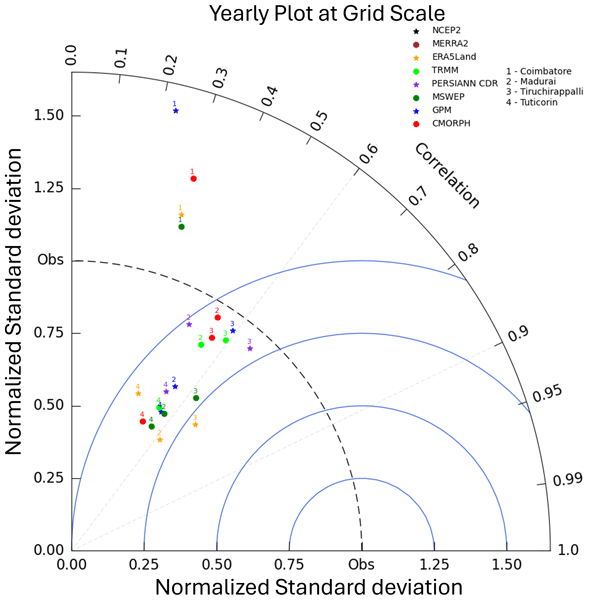
In water-scarce regions, precipitation is a highly variable and essential resource for crop production. Developing countries like India have an uneven distribution of rain gauges, so reliance on satellite- and reanalysis-based precipitation products is critical for their prudent management. Hence, this study statistically evaluated different precipitation products against station data for water-scarce regions in Tamil Nadu and found that the European Centre for Medium-Range Weather Forecasts Reanalysis version 5 Land (ERA5-Land) performed the best, followed by the Multi-Source Weighted-Ensemble Precipitation (MSWEP).
Wouter J. M. Knoben, Ashwin Raman, Gaby J. Gründemann, Mukesh Kumar, Alain Pietroniro, Chaopeng Shen, Yalan Song, Cyril Thébault, Katie van Werkhoven, Andrew W. Wood, and Martyn P. Clark
Hydrol. Earth Syst. Sci., 29, 2361–2375, https://doi.org/10.5194/hess-29-2361-2025, https://doi.org/10.5194/hess-29-2361-2025, 2025
Short summary
Short summary
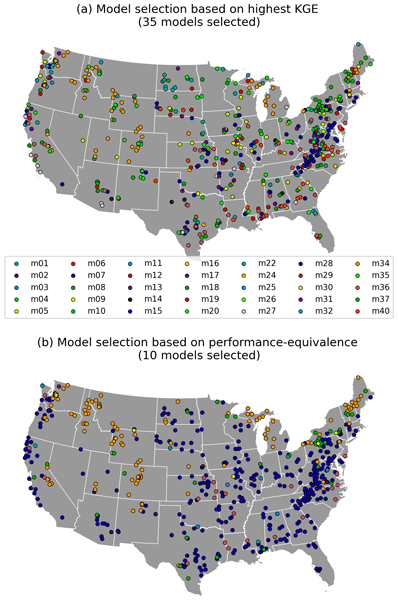
Hydrologic models are needed to provide simulations of water availability, floods, and droughts. The accuracy of these simulations is often quantified with so-called performance scores. A common thought is that different models are more or less applicable to different landscapes, depending on how the model works. We show that performance scores are not helpful in distinguishing between different models and thus cannot easily be used to select an appropriate model for a specific place.
Louise Arnal, Martyn P. Clark, Alain Pietroniro, Vincent Vionnet, David R. Casson, Paul H. Whitfield, Vincent Fortin, Andrew W. Wood, Wouter J. M. Knoben, Brandi W. Newton, and Colleen Walford
Hydrol. Earth Syst. Sci., 28, 4127–4155, https://doi.org/10.5194/hess-28-4127-2024, https://doi.org/10.5194/hess-28-4127-2024, 2024
Short summary
Short summary
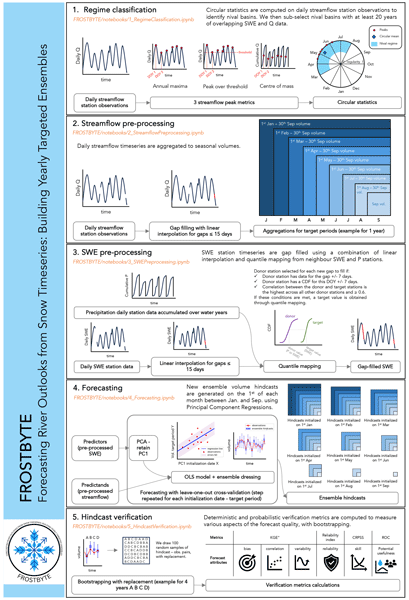
Forecasting river flow months in advance is crucial for water sectors and society. In North America, snowmelt is a key driver of flow. This study presents a statistical workflow using snow data to forecast flow months ahead in North American snow-fed rivers. Variations in the river flow predictability across the continent are evident, raising concerns about future predictability in a changing (snow) climate. The reproducible workflow hosted on GitHub supports collaborative and open science.
Yalan Song, Wouter J. M. Knoben, Martyn P. Clark, Dapeng Feng, Kathryn Lawson, Kamlesh Sawadekar, and Chaopeng Shen
Hydrol. Earth Syst. Sci., 28, 3051–3077, https://doi.org/10.5194/hess-28-3051-2024, https://doi.org/10.5194/hess-28-3051-2024, 2024
Short summary
Short summary
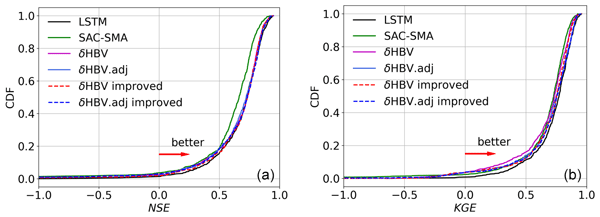
Differentiable models (DMs) integrate neural networks and physical equations for accuracy, interpretability, and knowledge discovery. We developed an adjoint-based DM for ordinary differential equations (ODEs) for hydrological modeling, reducing distorted fluxes and physical parameters from errors in models that use explicit and operation-splitting schemes. With a better numerical scheme and improved structure, the adjoint-based DM matches or surpasses long short-term memory (LSTM) performance.
Diogo Costa, Kyle Klenk, Wouter Knoben, Andrew Ireson, Raymond J. Spiteri, and Martyn Clark
EGUsphere, https://doi.org/10.5194/egusphere-2023-2787, https://doi.org/10.5194/egusphere-2023-2787, 2023
Preprint archived
Short summary
Short summary
This work helps improve water quality simulations in aquatic ecosystems through a new modeling concept, which we termed “OpenWQ”. It allows tailoring biogeochemistry calculations and integration with existing hydrological (water quantity) simulation tools. The integration is demonstrated with two hydrological models. The models were tested for different pollution scenarios. This paper helps improve interoperability, transparency, flexibility, and reproducibility in water quality simulations.
Luca Trotter, Wouter J. M. Knoben, Keirnan J. A. Fowler, Margarita Saft, and Murray C. Peel
Geosci. Model Dev., 15, 6359–6369, https://doi.org/10.5194/gmd-15-6359-2022, https://doi.org/10.5194/gmd-15-6359-2022, 2022
Short summary
Short summary
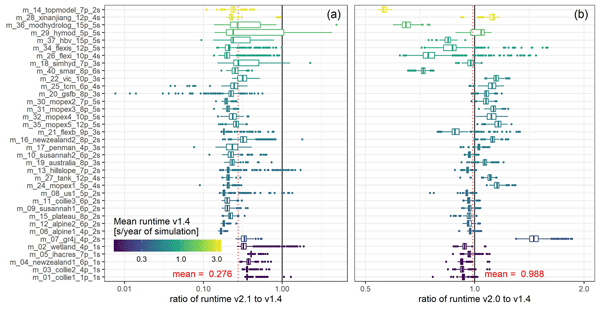
MARRMoT is a piece of software that emulates 47 common models for hydrological simulations. It can be used to run and calibrate these models within a common environment as well as to easily modify them. We restructured and recoded MARRMoT in order to make the models run faster and to simplify their use, while also providing some new features. This new MARRMoT version runs models on average 3.6 times faster while maintaining very strong consistency in their outputs to the previous version.
Wouter J. M. Knoben and Diana Spieler
Hydrol. Earth Syst. Sci., 26, 3299–3314, https://doi.org/10.5194/hess-26-3299-2022, https://doi.org/10.5194/hess-26-3299-2022, 2022
Short summary
Short summary
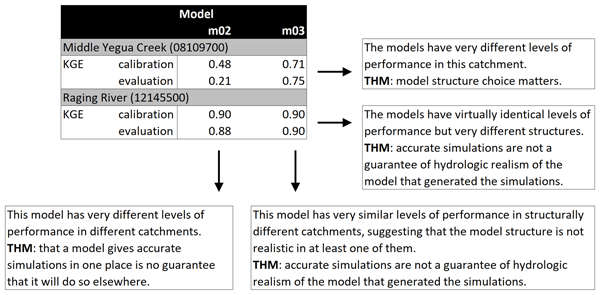
This paper introduces educational materials that can be used to teach students about model structure uncertainty in hydrological modelling. There are many different hydrological models and differences between these models impact their usefulness in different places. Such models are often used to support decision making about water resources and to perform hydrological science, and it is thus important for students to understand that model choice matters.
Cited articles
Addor, N., Newman, A. J., Mizukami, N., and Clark, M. P.: The CAMELS data set: catchment attributes and meteorology for large-sample studies, Hydrol. Earth Syst. Sci., 21, 5293–5313, https://doi.org/10.5194/hess-21-5293-2017, 2017. a
Addor, N., Nearing, G., Prieto, C., Newman, A. J., Vine, N. L., and Clark, M. P.: A Ranking of Hydrological Signatures Based on Their Predictability in Space, Water Resour. Res., 54, 8792–8812, https://doi.org/10.1029/2018WR022606, 2018. a, b
Alvarez-Garreton, C., Mendoza, P. A., Boisier, J. P., Addor, N., Galleguillos, M., Zambrano-Bigiarini, M., Lara, A., Puelma, C., Cortes, G., Garreaud, R., McPhee, J., and Ayala, A.: The CAMELS-CL dataset: catchment attributes and meteorology for large sample studies – Chile dataset, Hydrol. Earth Syst. Sci., 22, 5817–5846, https://doi.org/10.5194/hess-22-5817-2018, 2018. a
Araya, D., Mendoza, P. A., Muñoz-Castro, E., and McPhee, J.: Towards robust seasonal streamflow forecasts in mountainous catchments: impact of calibration metric selection in hydrological modeling, Hydrol. Earth Syst. Sci., 27, 4385–4408, https://doi.org/10.5194/hess-27-4385-2023, 2023. a, b, c, d
Arsenault, R., Brissette, F., Martel, J.-L., Troin, M., Lévesque, G., Davidson-Chaput, J., Gonzalez, M. C., Ameli, A., and Poulin, A.: A comprehensive, multisource database for hydrometeorological modeling of 14,425 North American watersheds, Scientific Data, 7, 243, https://doi.org/10.1038/s41597-020-00583-2, 2020. a
Bennett, N. D., Croke, B. F., Guariso, G., Guillaume, J. H., Hamilton, S. H., Jakeman, A. J., Marsili-Libelli, S., Newham, L. T., Norton, J. P., Perrin, C., Pierce, S. A., Robson, B., Seppelt, R., Voinov, A. A., Fath, B. D., and Andreassian, V.: Characterising performance of environmental models, Environ. Modell. Softw., 40, 1–20, https://doi.org/10.1016/j.envsoft.2012.09.011, 2013. a
Berghuijs, W. R., Larsen, J. R., Van Emmerik, T. H. M., and Woods, R. A.: A Global Assessment of Runoff Sensitivity to Changes in Precipitation, Potential Evaporation, and Other Factors, Water Resour. Res., 53, 8475–8486, https://doi.org/10.1002/2017WR021593, 2017. a
Carrillo, G., Troch, P. A., Sivapalan, M., Wagener, T., Harman, C., and Sawicz, K.: Catchment classification: hydrological analysis of catchment behavior through process-based modeling along a climate gradient, Hydrol. Earth Syst. Sci., 15, 3411–3430, https://doi.org/10.5194/hess-15-3411-2011, 2011. a
Chagas, V. B. P., Chaffe, P. L. B., Addor, N., Fan, F. M., Fleischmann, A. S., Paiva, R. C. D., and Siqueira, V. A.: CAMELS-BR: hydrometeorological time series and landscape attributes for 897 catchments in Brazil, Earth Syst. Sci. Data, 12, 2075–2096, https://doi.org/10.5194/essd-12-2075-2020, 2020. a
Cinkus, G., Mazzilli, N., Jourde, H., Wunsch, A., Liesch, T., Ravbar, N., Chen, Z., and Goldscheider, N.: When best is the enemy of good – critical evaluation of performance criteria in hydrological models, Hydrol. Earth Syst. Sci., 27, 2397–2411, https://doi.org/10.5194/hess-27-2397-2023, 2023. a
Clerc-Schwarzenbach, F., Selleri, G., Neri, M., Toth, E., van Meerveld, I., and Seibert, J.: Large-sample hydrology – a few camels or a whole caravan?, Hydrol. Earth Syst. Sci., 28, 4219–4237, https://doi.org/10.5194/hess-28-4219-2024, 2024. a
Coxon, G., Addor, N., Bloomfield, J. P., Freer, J., Fry, M., Hannaford, J., Howden, N. J. K., Lane, R., Lewis, M., Robinson, E. L., Wagener, T., and Woods, R.: CAMELS-GB: hydrometeorological time series and landscape attributes for 671 catchments in Great Britain, Earth Syst. Sci. Data, 12, 2459–2483, https://doi.org/10.5194/essd-12-2459-2020, 2020. a
Duan, Q., Schaake, J., Andréassian, V., Franks, S., Goteti, G., Gupta, H., Gusev, Y., Habets, F., Hall, A., Hay, L., Hogue, T., Huang, M., Leavesley, G., Liang, X., Nasonova, O., Noilhan, J., Oudin, L., Sorooshian, S., Wagener, T., and Wood, E.: Model Parameter Estimation Experiment (MOPEX): An overview of science strategy and major results from the second and third workshops, J. Hydrol., 320, 3–17, https://doi.org/10.1016/j.jhydrol.2005.07.031, 2006. a
Efstratiadis, A. and Koutsoyiannis, D.: One decade of multi-objective calibration approaches in hydrological modelling: a review, Hydrolog. Sci. J., 55, 58–78, https://doi.org/10.1080/02626660903526292, 2010. a
Ehret, U. and Zehe, E.: Series distance – an intuitive metric to quantify hydrograph similarity in terms of occurrence, amplitude and timing of hydrological events, Hydrol. Earth Syst. Sci., 15, 877–896, https://doi.org/10.5194/hess-15-877-2011, 2011. a
Euser, T., Winsemius, H. C., Hrachowitz, M., Fenicia, F., Uhlenbrook, S., and Savenije, H. H. G.: A framework to assess the realism of model structures using hydrological signatures, Hydrol. Earth Syst. Sci., 17, 1893–1912, https://doi.org/10.5194/hess-17-1893-2013, 2013. a
Fowler, K., Peel, M., Western, A., and Zhang, L.: Improved Rainfall‐Runoff Calibration for Drying Climate: Choice of Objective Function, Water Resour. Res., 54, 3392–3408, https://doi.org/10.1029/2017WR022466, 2018. a, b, c
Fowler, K. J. A., Acharya, S. C., Addor, N., Chou, C., and Peel, M. C.: CAMELS-AUS: hydrometeorological time series and landscape attributes for 222 catchments in Australia, Earth Syst. Sci. Data, 13, 3847–3867, https://doi.org/10.5194/essd-13-3847-2021, 2021. a
Färber, C., Plessow, H., Mischel, S. A., Kratzert, F., Addor, N., Shalev, G., and Looser, U.: GRDC-Caravan: extending Caravan with data from the Global Runoff Data Centre, Earth Syst. Sci. Data, 17, 4613–4625, https://doi.org/10.5194/essd-17-4613-2025, 2025. a
Garcia, F., Folton, N., and Oudin, L.: Which objective function to calibrate rainfall–runoff models for low-flow index simulations?, Hydrolog. Sci. J., 62, 1149–1166, https://doi.org/10.1080/02626667.2017.1308511, 2017. a
Gnann, S. J., Coxon, G., Woods, R. A., Howden, N. J., and McMillan, H. K.: TOSSH: A Toolbox for Streamflow Signatures in Hydrology, Environ. Modell. Softw., 138, 104983, https://doi.org/10.1016/j.envsoft.2021.104983, 2021. a
Gupta, H. V., Wagener, T., and Liu, Y.: Reconciling theory with observations: elements of a diagnostic approach to model evaluation, Hydrol. Process., 22, 3802–3813, https://doi.org/10.1002/hyp.6989, 2008. a
Gupta, H. V., Kling, H., Yilmaz, K. K., and Martinez, G. F.: Decomposition of the mean squared error and NSE performance criteria: Implications for improving hydrological modelling, J. Hydrol., 377, 80–91, https://doi.org/10.1016/j.jhydrol.2009.08.003, 2009. a, b, c
Gupta, H. V., Perrin, C., Blöschl, G., Montanari, A., Kumar, R., Clark, M., and Andréassian, V.: Large-sample hydrology: a need to balance depth with breadth, Hydrol. Earth Syst. Sci., 18, 463–477, https://doi.org/10.5194/hess-18-463-2014, 2014. a, b, c
Hallouin, T., Bruen, M., and O'Loughlin, F. E.: Calibration of hydrological models for ecologically relevant streamflow predictions: a trade-off between fitting well to data and estimating consistent parameter sets?, Hydrol. Earth Syst. Sci., 24, 1031–1054, https://doi.org/10.5194/hess-24-1031-2020, 2020. a, b, c
Hansen, N., Müller, S. D., and Koumoutsakos, P.: Reducing the Time Complexity of the Derandomized Evolution Strategy with Covariance Matrix Adaptation (CMA-ES), Evol. Comput., 11, 1–18, https://doi.org/10.1162/106365603321828970, 2003. a
Hernandez-Suarez, J. S., Nejadhashemi, A. P., Kropp, I. M., Abouali, M., Zhang, Z., and Deb, K.: Evaluation of the impacts of hydrologic model calibration methods on predictability of ecologically-relevant hydrologic indices, J. Hydrol., 564, 758–772, https://doi.org/10.1016/j.jhydrol.2018.07.056, 2018. a, b
Jackson, E. K., Roberts, W., Nelsen, B., Williams, G. P., Nelson, E. J., and Ames, D. P.: Introductory overview: Error metrics for hydrologic modelling – A review of common practices and an open source library to facilitate use and adoption, Environ. Modell. Softw., 119, 32–48, https://doi.org/10.1016/j.envsoft.2019.05.001, 2019. a, b
Jacobs, B., Tobi, H., and Hengeveld, G. M.: Linking error measures to model questions, Ecol. Model., 487, 110562, https://doi.org/10.1016/j.ecolmodel.2023.110562, 2024. a
Jakeman, A., Letcher, R., and Norton, J.: Ten iterative steps in development and evaluation of environmental models, Environ. Modell. Softw., 21, 602–614, https://doi.org/10.1016/j.envsoft.2006.01.004, 2006. a
Jakeman, A. J., Sawah, S. E., Cuddy, S., Robson, B., McIntyre, N., and Cook, F.: Good Modelling Practice Principles, Tech. rep., The State of Queensland (Department of Environment and Science, https://science.desi.qld.gov.au/__data/assets/pdf_file/0011/81110/qwmn-good-modelling-practice-principles.pdf (last access: 23 July 2026), 2018. a
Kiraz, M., Coxon, G., and Wagener, T.: A Signature‐Based Hydrologic Efficiency Metric for Model Calibration and Evaluation in Gauged and Ungauged Catchments, Water Resour. Res., 59, https://doi.org/10.1029/2023WR035321, 2023. a, b, c
Kirchner, J. W.: Getting the right answers for the right reasons: Linking measurements, analyses, and models to advance the science of hydrology, Water Resour. Res., 42, https://doi.org/10.1029/2005WR004362, 2006. a
Klingler, C., Schulz, K., and Herrnegger, M.: LamaH-CE: LArge-SaMple DAta for Hydrology and Environmental Sciences for Central Europe, Earth Syst. Sci. Data, 13, 4529–4565, https://doi.org/10.5194/essd-13-4529-2021, 2021. a
Knoben, W. J. M.: Setting expectations for hydrologic model performance with an ensemble of simple benchmarks, Hydrol. Process., 38, https://doi.org/10.1002/hyp.15288, 2024. a, b
Knoben, W. J. M., Woods, R. A., and Freer, J. E.: A Quantitative Hydrological Climate Classification Evaluated With Independent Streamflow Data, Water Resour. Res., 54, 5088–5109, https://doi.org/10.1029/2018WR022913, 2018. a
Knoben, W. J. M., Freer, J. E., Fowler, K. J. A., Peel, M. C., and Woods, R. A.: Modular Assessment of Rainfall–Runoff Models Toolbox (MARRMoT) v1.2: an open-source, extendable framework providing implementations of 46 conceptual hydrologic models as continuous state-space formulations, Geosci. Model Dev., 12, 2463–2480, https://doi.org/10.5194/gmd-12-2463-2019, 2019a. a, b
Knoben, W. J. M., Freer, J. E., and Woods, R. A.: Technical note: Inherent benchmark or not? Comparing Nash–Sutcliffe and Kling–Gupta efficiency scores, Hydrol. Earth Syst. Sci., 23, 4323–4331, https://doi.org/10.5194/hess-23-4323-2019, 2019b. a
Knoben, W. J. M., Freer, J. E., Peel, M. C., Fowler, K. J. A., and Woods, R. A.: A Brief Analysis of Conceptual Model Structure Uncertainty Using 36 Models and 559 Catchments, Water Resour. Res., 56, https://doi.org/10.1029/2019wr025975, 2020. a
Kratzert, F., Nearing, G., Addor, N., Erickson, T., Gauch, M., Gilon, O., Gudmundsson, L., Hassidim, A., Klotz, D., Nevo, S., Shalev, G., and Matias, Y.: Caravan – A global community dataset for large-sample hydrology, Scientific Data, 10, https://doi.org/10.1038/s41597-023-01975-w, 2023. a, b
Krause, P., Boyle, D. P., and Bäse, F.: Comparison of different efficiency criteria for hydrological model assessment, Adv. Geosci., 5, 89–97, https://doi.org/10.5194/adgeo-5-89-2005, 2005. a, b
Mai, J.: Ten strategies towards successful calibration of environmental models, J. Hydrol., 620, 129414, https://doi.org/10.1016/j.jhydrol.2023.129414, 2023. a, b, c
McMillan, H.: Linking hydrologic signatures to hydrologic processes: A review, Hydrol. Process., 34, 1393–1409, https://doi.org/10.1002/hyp.13632, 2020. a
Melsen, L. A., Teuling, A. J., Torfs, P. J., Zappa, M., Mizukami, N., Mendoza, P. A., Clark, M. P., and Uijlenhoet, R.: Subjective modeling decisions can significantly impact the simulation of flood and drought events, J. Hydrol., 568, 1093–1104, https://doi.org/10.1016/j.jhydrol.2018.11.046, 2019. a, b, c
Melsen, L. A., Puy, A., Torfs, P. J. J. F., and Saltelli, A.: The rise of the Nash-Sutcliffe efficiency in hydrology, Hydrolog. Sci. J., 70, 1248–1259, https://doi.org/10.1080/02626667.2025.2475105, 2025. a
Mendoza, P. A., Clark, M. P., Mizukami, N., Gutmann, E. D., Arnold, J. R., Brekke, L. D., and Rajagopalan, B.: How do hydrologic modeling decisions affect the portrayal of climate change impacts?, Hydrol. Process., 30, 1071–1095, https://doi.org/10.1002/hyp.10684, 2016. a, b
Nash, J. and Sutcliffe, J.: River flow forecasting through conceptual models part I – A discussion of principles, J. Hydrol., 10, 282–290, https://doi.org/10.1016/0022-1694(70)90255-6, 1970. a
Nemri, S. and Kinnard, C.: Comparing calibration strategies of a conceptual snow hydrology model and their impact on model performance and parameter identifiability, J. Hydrol., 582, 124474, https://doi.org/10.1016/j.jhydrol.2019.124474, 2020. a
Pool, S., Vis, M., and Seibert, J.: Evaluating model performance: towards a non-parametric variant of the Kling-Gupta efficiency, Hydrolog. Sci. J., 63, 1941–1953, https://doi.org/10.1080/02626667.2018.1552002, 2018. a, b
Santos, L., Thirel, G., and Perrin, C.: Technical note: Pitfalls in using log-transformed flows within the KGE criterion, Hydrol. Earth Syst. Sci., 22, 4583–4591, https://doi.org/10.5194/hess-22-4583-2018, 2018. a
Schaefli, B. and Gupta, H. V.: Do Nash values have value?, Hydrol. Process., 21, 2075–2080, https://doi.org/10.1002/hyp.6825, 2007. a
Schwemmle, R., Demand, D., and Weiler, M.: Technical note: Diagnostic efficiency – specific evaluation of model performance, Hydrol. Earth Syst. Sci., 25, 2187–2198, https://doi.org/10.5194/hess-25-2187-2021, 2021. a
Seibert, J.: On the need for benchmarks in hydrological modelling, Hydrol. Process., 15, 1063–1064, https://doi.org/10.1002/hyp.446, 2001. a
Seiller, G., Roy, R., and Anctil, F.: Influence of three common calibration metrics on the diagnosis of climate change impacts on water resources, J. Hydrol., 547, 280–295, https://doi.org/10.1016/j.jhydrol.2017.02.004, 2017. a, b, c
Thirel, G., Santos, L., Delaigue, O., and Perrin, C.: On the use of streamflow transformations for hydrological model calibration, Hydrol. Earth Syst. Sci., 28, 4837–4860, https://doi.org/10.5194/hess-28-4837-2024, 2024. a, b, c
Trotter, L. and Knoben, W. J. M.: MARRMoT v2.1, Zenodo [code], https://doi.org/10.5281/zenodo.6484372, 2022. a
Trotter, L., Knoben, W. J. M., Fowler, K. J. A., Saft, M., and Peel, M. C.: Modular Assessment of Rainfall–Runoff Models Toolbox (MARRMoT) v2.1: an object-oriented implementation of 47 established hydrological models for improved speed and readability, Geosci. Model Dev., 15, 6359–6369, https://doi.org/10.5194/gmd-15-6359-2022, 2022. a
van Waveren, R. H., Groot, S., Scholten, H., Geer, F. v., Wösten, J., Koeze, R., and Noort, J.: Good Modelling Practice Handbook, Tech. rep., Dutch Dept. of Public Works, Institute for Inland Water Management and Waste Water Treatment, report 99.036, ISBN 9057730561, 1999. a
van Werkhoven, K., Wagener, T., Reed, P., and Tang, Y.: Characterization of watershed model behavior across a hydroclimatic gradient, Water Resour. Res., 44, https://doi.org/10.1029/2007WR006271, 2008. a
Wagener, T. and Montanari, A.: Convergence of approaches toward reducing uncertainty in predictions in ungauged basins, Water Resour. Res., 47, 2010WR009469, https://doi.org/10.1029/2010WR009469, 2011. a
Wagener, P.: Code for Analysis and Visualization, GitHub [code], https://github.com/peterwagener/OF_Signature_Code.git (last access: 16 July 2026), 2025. a
Wagener, P.: Calibration and Evaluation Data for Objective Function Impact on Hydrologic Signatures, Zenodo [data set], https://doi.org/10.5281/zenodo.21399824, 2026. a
Yapo, P. O., Gupta, H. V., and Sorooshian, S.: Multi-objective global optimization for hydrologic models, J. Hydrol., 204, 83–97, https://doi.org/10.1016/S0022-1694(97)00107-8, 1998. a
Yilmaz, K. K., Gupta, H. V., and Wagener, T.: A process‐based diagnostic approach to model evaluation: Application to the NWS distributed hydrologic model, Water Resour. Res., 44, 2007WR006716, https://doi.org/10.1029/2007WR006716, 2008. a
Short summary
Hydrologic models help predict floods and droughts, but how we calibrate them changes what they get right. Across 47 model structures and 10 diverse catchments, we tested how 8 metrics shape the reproduction of 15 streamflow features, from runoff ratios to high and low flows. Metric choice often mattered more than model structure, yet no single metric is best for all flow conditions. We provide guidance on metric strengths and weaknesses to help match the calibration metric to the study purpose.
Hydrologic models help predict floods and droughts, but how we calibrate them changes what they...


