
Articles | Volume 30, issue 14
https://doi.org/10.5194/hess-30-4823-2026
© Author(s) 2026. This work is distributed under
the Creative Commons Attribution 4.0 License.
the Creative Commons Attribution 4.0 License.
https://doi.org/10.5194/hess-30-4823-2026
© Author(s) 2026. This work is distributed under
the Creative Commons Attribution 4.0 License.
the Creative Commons Attribution 4.0 License.
Research article
| 
30 Jul 2026
Research article |
| 30 Jul 2026
| 30 Jul 2026
Enhancing runoff-infiltration partitioning in the SVS land surface model improves streamflow simulations under frozen soil conditions
Benjamin Bouchard
CORRESPONDING AUTHOR

Numerical Modelling and Prediction Research Division, Environment and Climate Change Canada, Dorval, H9P 1J3, Canada
Vincent Vionnet
Numerical Modelling and Prediction Research Division, Environment and Climate Change Canada, Dorval, H9P 1J3, Canada
Étienne Gaborit
Numerical Modelling and Prediction Research Division, Environment and Climate Change Canada, Dorval, H9P 1J3, Canada
Vincent Fortin
Numerical Modelling and Prediction Research Division, Environment and Climate Change Canada, Dorval, H9P 1J3, Canada
Related authors
Jérémie Labelle, Pierre-Erik Isabelle, Benjamin Bouchard, Nicolas Breton, André Bégin-Drolet, and Daniel F. Nadeau
EGUsphere, https://doi.org/10.5194/egusphere-2026-2196, https://doi.org/10.5194/egusphere-2026-2196, 2026
This preprint is open for discussion and under review for Atmospheric Measurement Techniques (AMT).
Short summary
Short summary
Snow accumulation on radiometer lenses can obstruct radiation measurements. In this paper, we propose the Snow Removal Device (SRD) for remote and off-grid radiometers affected by this problem. Its average energy cost per cycle (for 1472 events) is comparable to 17s of heating. Two side-by-side radiometers were used for this study: one with the SRD and the another without. For the full winter, results show that radiometer measurements differed by +37.20 MJ m⁻² for LW↓ and −1.79 MJ m⁻² for SW↓.
Florent Domine, Mireille Quémener, Ludovick Bégin, Benjamin Bouchard, Valérie Dionne, Sébastien Jerczynski, Raphaël Larouche, Félix Lévesque-Desrosiers, Simon-Olivier Philibert, Marc-André Vigneault, Ghislain Picard, and Daniel C. Côté
The Cryosphere, 19, 1757–1774, https://doi.org/10.5194/tc-19-1757-2025, https://doi.org/10.5194/tc-19-1757-2025, 2025
Short summary
Short summary
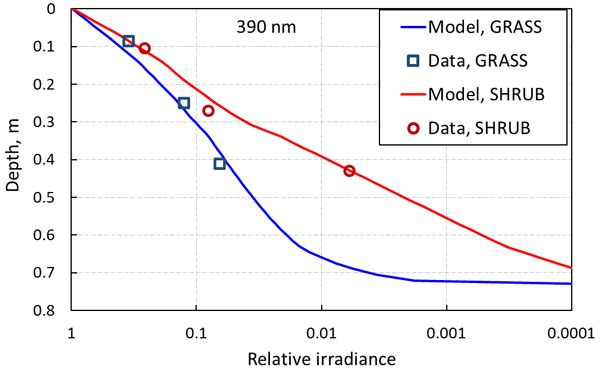
Shrubs buried in snow absorb solar radiation and reduce irradiance in the snowpack. This decreases photochemical reaction rates and emissions to the atmosphere. By monitoring irradiance in snowpacks with and without shrubs, we conclude that shrubs absorb solar radiation as much as 140 ppb of soot and reduce irradiance by a factor of 2. Shrub expansion in the Arctic may therefore affect tropospheric composition during the snow season with climatic effects.
Benjamin Bouchard, Daniel F. Nadeau, Florent Domine, François Anctil, Tobias Jonas, and Étienne Tremblay
Hydrol. Earth Syst. Sci., 28, 2745–2765, https://doi.org/10.5194/hess-28-2745-2024, https://doi.org/10.5194/hess-28-2745-2024, 2024
Short summary
Short summary
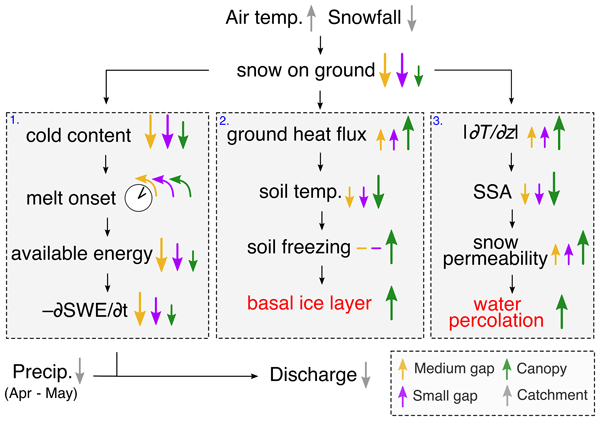
Observations and simulations from an exceptionally low-snow and warm winter, which may become the new norm in the boreal forest of eastern Canada, show an earlier and slower snowmelt, reduced soil temperature, stronger vertical temperature gradients in the snowpack, and a significantly lower spring streamflow. The magnitude of these effects is either amplified or reduced with regard to the complex structure of the canopy.
Benjamin Bouchard, Daniel F. Nadeau, Florent Domine, Nander Wever, Adrien Michel, Michael Lehning, and Pierre-Erik Isabelle
The Cryosphere, 18, 2783–2807, https://doi.org/10.5194/tc-18-2783-2024, https://doi.org/10.5194/tc-18-2783-2024, 2024
Short summary
Short summary
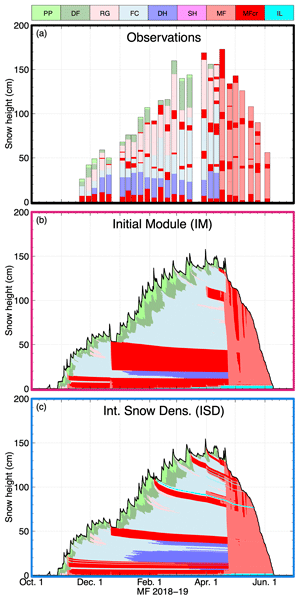
Observations over several winters at two boreal sites in eastern Canada show that rain-on-snow (ROS) events lead to the formation of melt–freeze layers and that preferential flow is an important water transport mechanism in the sub-canopy snowpack. Simulations with SNOWPACK generally show good agreement with observations, except for the reproduction of melt–freeze layers. This was improved by simulating intercepted snow microstructure evolution, which also modulates ROS-induced runoff.
Mickaël Lalande, Alexandre Roy, Libo Wang, Diana Verseghy, Vincent Vionnet, Florent Dominé, and Christophe Kinnard
Geosci. Model Dev., 19, 9581–9625, https://doi.org/10.5194/gmd-19-9581-2026, https://doi.org/10.5194/gmd-19-9581-2026, 2026
Short summary
Short summary
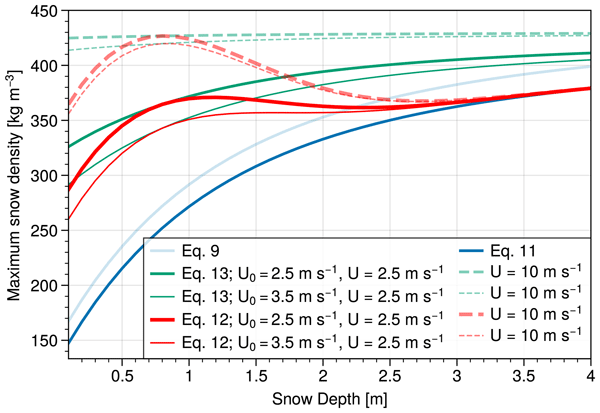
This study enhances a snow model for Arctic environments by improving the heat exchanges within the snowpack and at its interfaces, revising the compaction scheme, and adding consideration of blowing snow sublimation losses. Simulations at ten Arctic, mid-latitude, and Alpine sites show significant reductions in simulated soil and snow temperature biases and improved simulated snow depth and density, which are key features to improve simulated energy, water, and carbon budgets in the Arctic.
Dikraa Khedhaouiria, Nicolas Gasset, Vincent Fortin, Milena Dimitrijevic, Maxim Bulat, and Xihong Wang
Hydrol. Earth Syst. Sci., 30, 5971–5998, https://doi.org/10.5194/hess-30-5971-2026, https://doi.org/10.5194/hess-30-5971-2026, 2026
Short summary
Short summary
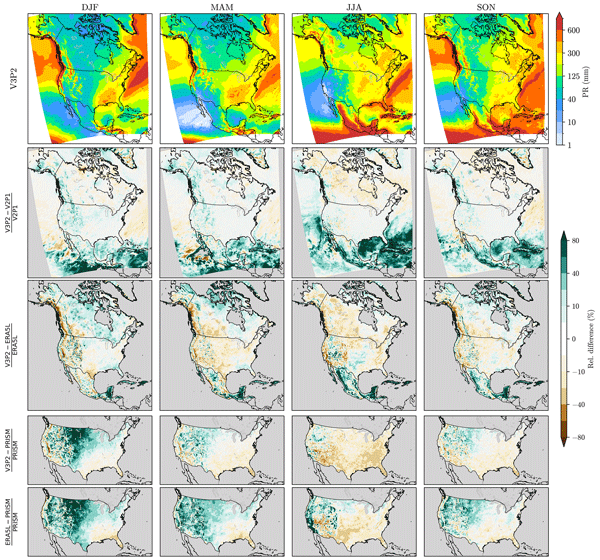
This study presents a new high-resolution precipitation dataset covering North America over the past 45 years. Unlike most reanalysis products that rely mainly on weather models, it directly incorporates ground-based weather station observations. This results in more reliable precipitation estimates than the previous version and commonly used reanalyses, especially in regions with few measurements, supporting studies of water resources, floods, droughts, and climate impacts.
Jérémie Labelle, Pierre-Erik Isabelle, Benjamin Bouchard, Nicolas Breton, André Bégin-Drolet, and Daniel F. Nadeau
EGUsphere, https://doi.org/10.5194/egusphere-2026-2196, https://doi.org/10.5194/egusphere-2026-2196, 2026
This preprint is open for discussion and under review for Atmospheric Measurement Techniques (AMT).
Short summary
Short summary
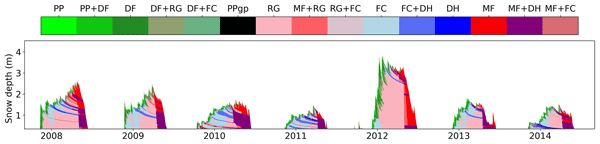
Snow accumulation on radiometer lenses can obstruct radiation measurements. In this paper, we propose the Snow Removal Device (SRD) for remote and off-grid radiometers affected by this problem. Its average energy cost per cycle (for 1472 events) is comparable to 17s of heating. Two side-by-side radiometers were used for this study: one with the SRD and the another without. For the full winter, results show that radiometer measurements differed by +37.20 MJ m⁻² for LW↓ and −1.79 MJ m⁻² for SW↓.
Matthieu Lafaysse, Marie Dumont, Basile De Fleurian, Mathieu Fructus, Rafife Nheili, Léo Viallon-Galinier, Matthieu Baron, Aaron Boone, Axel Bouchet, Julien Brondex, Carlo Carmagnola, Bertrand Cluzet, Kévin Fourteau, Ange Haddjeri, Pascal Hagenmuller, Giulia Mazzotti, Marie Minvielle, Samuel Morin, Louis Quéno, Léon Roussel, Pierre Spandre, François Tuzet, and Vincent Vionnet
Geosci. Model Dev., 19, 6273–6334, https://doi.org/10.5194/gmd-19-6273-2026, https://doi.org/10.5194/gmd-19-6273-2026, 2026
Short summary
Short summary
This article is a comprehensive description of the 3.0.2 stable release of the Crocus snowpack model. It describes various new implementations since the last reference article in 2012 and a review of the available scientific evaluations and applications of the model. This provides guidance for the future of numerical snow modelling.
Nicolas R. Leroux, Vincent Vionnet, Courtney Bayer, Julien Meloche, Arlan Dirkson, Franck Lespinas, Mark Buehner, Marco Carrera, Benoit Montpetit, Bernard Bilodeau, Maria Abrahamowicz, and Chris Derksen
The Cryosphere, 20, 2773–2792, https://doi.org/10.5194/tc-20-2773-2026, https://doi.org/10.5194/tc-20-2773-2026, 2026
Short summary
Short summary
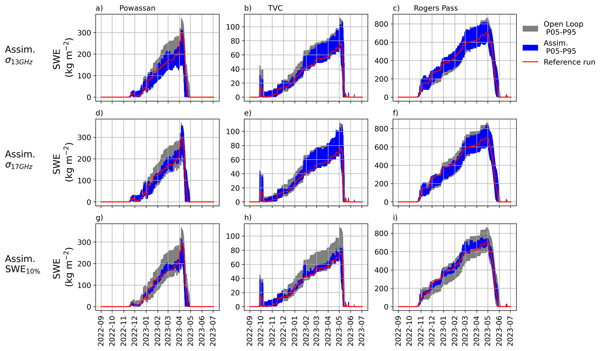
This study evaluates the assimilation of Ku-band radar backscatter into a multilayer snowpack model to support the upcoming Terrestrial Snow Mass Mission. Synthetic experiments were conducted at Arctic, continental, and alpine sites over three winters using a particle filter. Results show that assimilating backscatter improves estimates of snow water equivalent, depth, and vertical snow properties, laying the groundwork for future satellite missions focused on radar-based snow monitoring.
Georgina J. Woolley, Nick Rutter, Leanne Wake, Vincent Vionnet, Chris Derksen, Julien Meloche, Benoit Montpetit, Nicolas R. Leroux, Richard Essery, Gabriel Hould Gosselin, and Philip Marsh
The Cryosphere, 20, 1315–1338, https://doi.org/10.5194/tc-20-1315-2026, https://doi.org/10.5194/tc-20-1315-2026, 2026
Short summary
Short summary
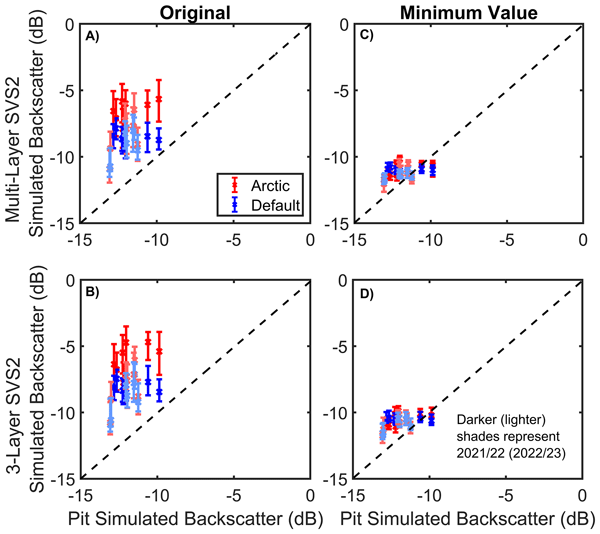
The impact of uncertainties in the simulation of density and specific surface area (SSA) by the snow model Crocus (embedded in the Soil, Vegetation and Snow v2 land surface model) on the simulation of snow backscatter (13.5 GHz) using the Snow Microwave Radiative Transfer model were quantified. The simulation of SSA was found to be a key model uncertainty. Underestimated SSA values lead to high errors in the simulation of backscatter, reduced by implementing a minimum SSA value (8.7 m2 kg−1).
Vincent Vionnet, Nicolas R. Leroux, Vincent Fortin, Maria Abrahamowicz, Georgina Woolley, Giulia Mazzotti, Manon Gaillard, Matthieu Lafaysse, Alain Royer, Florent Domine, Nathalie Gauthier, Nick Rutter, Chris Derksen, and Stéphane Bélair
Geosci. Model Dev., 18, 9119–9147, https://doi.org/10.5194/gmd-18-9119-2025, https://doi.org/10.5194/gmd-18-9119-2025, 2025
Short summary
Short summary
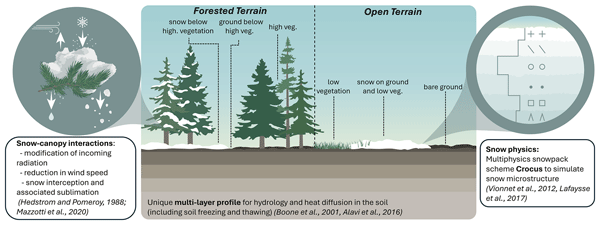
Snow microstructure controls snowpack properties, but most land surface models overlook this factor. To support future satellite missions, we created a new land surface model based on the Crocus scheme that simulates snow microstructure. Key improvements include better snow albedo representation, enhanced Arctic snow modeling, and improved forest module to capture Canada's diverse snow conditions. Results demonstrate improved simulations of snow density and melt across large regions of Canada.
Benoit Montpetit, Julien Meloche, Vincent Vionnet, Chris Derksen, Georgina Woolley, Nicolas R. Leroux, Paul Siqueira, J. Max Adam, and Mike Brady
The Cryosphere, 19, 5465–5484, https://doi.org/10.5194/tc-19-5465-2025, https://doi.org/10.5194/tc-19-5465-2025, 2025
Short summary
Short summary
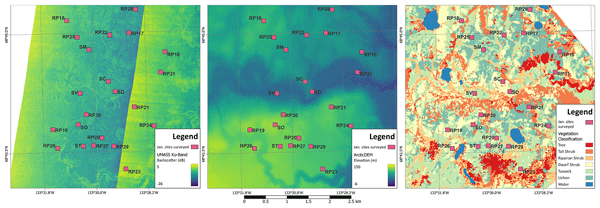
This paper presents the workflow to retrieve snow water equivalent from radar measurements for the future Canadian radar satellite mission, Terrestrial Snow Mass Mission. The workflow is validated by using airborne radar data collected at Trail Valley Creek, Canada, during winter 2018–2019. We detail important considerations to have in the context of a satellite mission over a vast region such as Canada. Results show that it is possible to achieve the desired accuracy over an Arctic environment.
Julien Meloche, Nicolas R. Leroux, Benoit Montpetit, Vincent Vionnet, and Chris Derksen
The Cryosphere, 19, 2949–2962, https://doi.org/10.5194/tc-19-2949-2025, https://doi.org/10.5194/tc-19-2949-2025, 2025
Short summary
Short summary
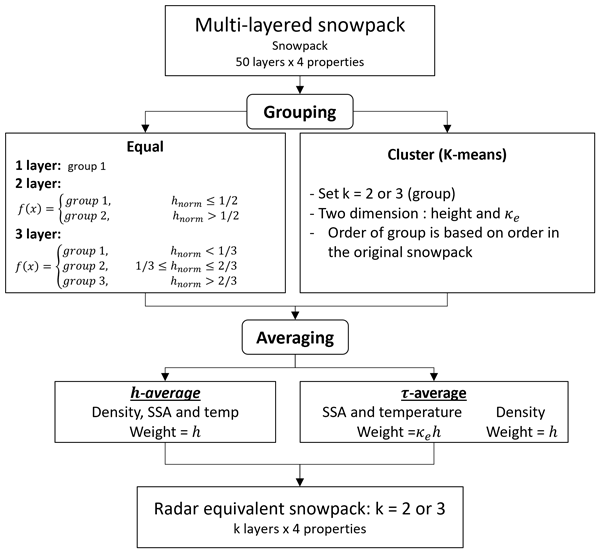
Measuring snow mass from radar measurements is possible with information on snow and a radar model to link the measurements to snow. A key variable in a retrieval is the number of snow layers, with more layers yielding richer information but at increased computational cost. Here, we show the capabilities of a new method for simplifying a complex snowpack while preserving the scattering behavior of the snowpack and conserving its mass.
Colleen Mortimer and Vincent Vionnet
Earth Syst. Sci. Data, 17, 3619–3640, https://doi.org/10.5194/essd-17-3619-2025, https://doi.org/10.5194/essd-17-3619-2025, 2025
Short summary
Short summary
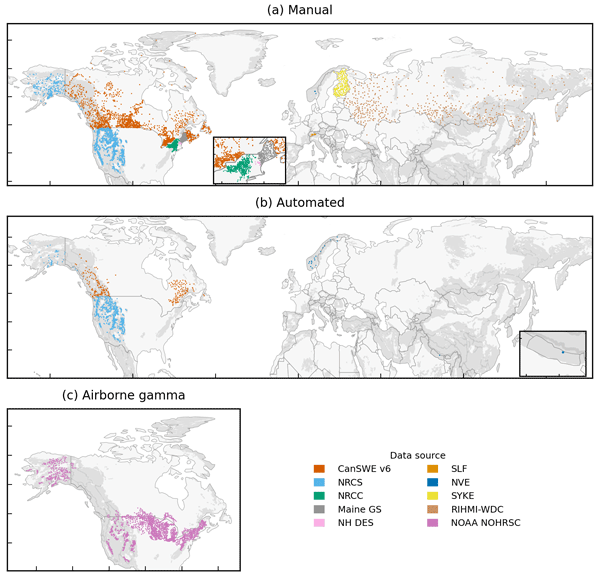
In situ observations of snow water equivalent (SWE) are critical for climate applications and resource management. NorSWE is a dataset of in situ SWE observations covering North America, Norway, Finland, Switzerland, Russia, and Nepal over the period 1979–2021. It includes more than 11.5 million observations from more than 10 000 different locations compiled from nine different sources. Snow depth and derived bulk snow density are included when available.

Alireza Amani, Marie-Amélie Boucher, Alexandre R. Cabral, Vincent Vionnet, and Étienne Gaborit
Hydrol. Earth Syst. Sci., 29, 2445–2465, https://doi.org/10.5194/hess-29-2445-2025, https://doi.org/10.5194/hess-29-2445-2025, 2025
Short summary
Short summary
Accurately estimating groundwater recharge using numerical models is particularly difficult in cold regions with snow and soil freezing. This study evaluated a physics-based model against high-resolution field measurements. Our findings highlight a need for a better representation of soil-freezing processes, offering a roadmap for future model development. This leads to more accurate models to aid in water resource management decisions in cold climates.
Florent Domine, Mireille Quémener, Ludovick Bégin, Benjamin Bouchard, Valérie Dionne, Sébastien Jerczynski, Raphaël Larouche, Félix Lévesque-Desrosiers, Simon-Olivier Philibert, Marc-André Vigneault, Ghislain Picard, and Daniel C. Côté
The Cryosphere, 19, 1757–1774, https://doi.org/10.5194/tc-19-1757-2025, https://doi.org/10.5194/tc-19-1757-2025, 2025
Short summary
Short summary
Shrubs buried in snow absorb solar radiation and reduce irradiance in the snowpack. This decreases photochemical reaction rates and emissions to the atmosphere. By monitoring irradiance in snowpacks with and without shrubs, we conclude that shrubs absorb solar radiation as much as 140 ppb of soot and reduce irradiance by a factor of 2. Shrub expansion in the Arctic may therefore affect tropospheric composition during the snow season with climatic effects.
Manon Gaillard, Vincent Vionnet, Matthieu Lafaysse, Marie Dumont, and Paul Ginoux
The Cryosphere, 19, 769–792, https://doi.org/10.5194/tc-19-769-2025, https://doi.org/10.5194/tc-19-769-2025, 2025
Short summary
Short summary
This study presents an efficient method to improve large-scale snow albedo simulations by considering the spatial variability in light-absorbing particles (LAPs) like black carbon and dust. A global climatology of LAP deposition was created and used to optimize a parameter in the Crocus snow model. Testing at 10 global sites improved albedo predictions by 10 % on average and over 25 % in the Arctic. This method can enhance other snow models' predictions without complex simulations.
Georgina J. Woolley, Nick Rutter, Leanne Wake, Vincent Vionnet, Chris Derksen, Richard Essery, Philip Marsh, Rosamond Tutton, Branden Walker, Matthieu Lafaysse, and David Pritchard
The Cryosphere, 18, 5685–5711, https://doi.org/10.5194/tc-18-5685-2024, https://doi.org/10.5194/tc-18-5685-2024, 2024
Short summary
Short summary
Parameterisations of Arctic snow processes were implemented into the multi-physics ensemble version of the snow model Crocus (embedded within the Soil, Vegetation, and Snow version 2 land surface model) and evaluated at an Arctic tundra site. Optimal combinations of parameterisations that improved the simulation of density and specific surface area featured modifications that raise wind speeds to increase compaction in surface layers, prevent snowdrift, and increase viscosity in basal layers.
Giulia Mazzotti, Jari-Pekka Nousu, Vincent Vionnet, Tobias Jonas, Rafife Nheili, and Matthieu Lafaysse
The Cryosphere, 18, 4607–4632, https://doi.org/10.5194/tc-18-4607-2024, https://doi.org/10.5194/tc-18-4607-2024, 2024
Short summary
Short summary
As many boreal and alpine forests have seasonal snow, models are needed to predict forest snow under future environmental conditions. We have created a new forest snow model by combining existing, very detailed model components for the canopy and the snowpack. We applied it to forests in Switzerland and Finland and showed how complex forest cover leads to a snowpack layering that is very variable in space and time because different processes prevail at different locations in the forest.
Louise Arnal, Martyn P. Clark, Alain Pietroniro, Vincent Vionnet, David R. Casson, Paul H. Whitfield, Vincent Fortin, Andrew W. Wood, Wouter J. M. Knoben, Brandi W. Newton, and Colleen Walford
Hydrol. Earth Syst. Sci., 28, 4127–4155, https://doi.org/10.5194/hess-28-4127-2024, https://doi.org/10.5194/hess-28-4127-2024, 2024
Short summary
Short summary
Forecasting river flow months in advance is crucial for water sectors and society. In North America, snowmelt is a key driver of flow. This study presents a statistical workflow using snow data to forecast flow months ahead in North American snow-fed rivers. Variations in the river flow predictability across the continent are evident, raising concerns about future predictability in a changing (snow) climate. The reproducible workflow hosted on GitHub supports collaborative and open science.
Benoit Montpetit, Joshua King, Julien Meloche, Chris Derksen, Paul Siqueira, J. Max Adam, Peter Toose, Mike Brady, Anna Wendleder, Vincent Vionnet, and Nicolas R. Leroux
The Cryosphere, 18, 3857–3874, https://doi.org/10.5194/tc-18-3857-2024, https://doi.org/10.5194/tc-18-3857-2024, 2024
Short summary
Short summary
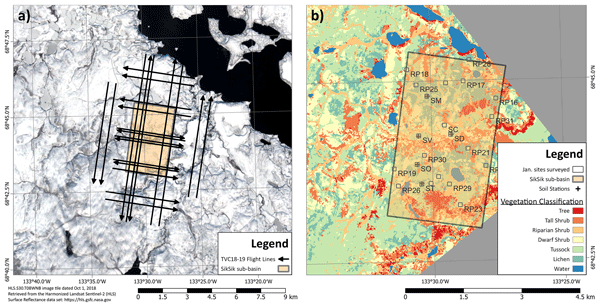
This paper validates the use of free open-source models to link distributed snow measurements to radar measurements in the Canadian Arctic. Using multiple radar sensors, we can decouple the soil from the snow contribution. We then retrieve the "microwave snow grain size" to characterize the interaction between the snow mass and the radar signal. This work supports future satellite mission development to retrieve snow mass information such as the future Canadian Terrestrial Snow Mass Mission.
Ange Haddjeri, Matthieu Baron, Matthieu Lafaysse, Louis Le Toumelin, César Deschamps-Berger, Vincent Vionnet, Simon Gascoin, Matthieu Vernay, and Marie Dumont
The Cryosphere, 18, 3081–3116, https://doi.org/10.5194/tc-18-3081-2024, https://doi.org/10.5194/tc-18-3081-2024, 2024
Short summary
Short summary
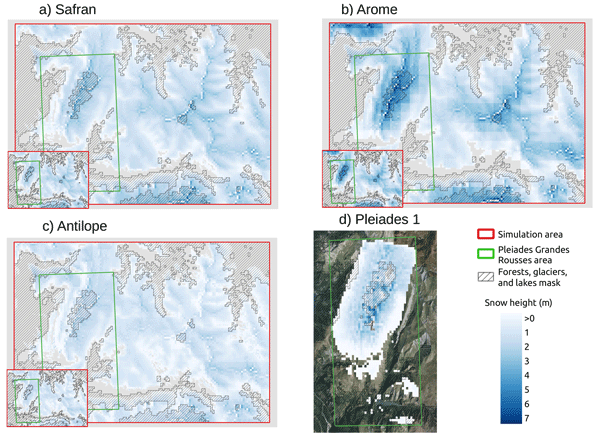
Our study addresses the complex challenge of evaluating distributed alpine snow simulations with snow transport against snow depths from Pléiades stereo imagery and snow melt-out dates from Sentinel-2 and Landsat-8 satellites. Additionally, we disentangle error contributions between blowing snow, precipitation heterogeneity, and unresolved subgrid variability. Snow transport enhances the snow simulations at high elevations, while precipitation biases are the main error source in other areas.
Benjamin Bouchard, Daniel F. Nadeau, Florent Domine, François Anctil, Tobias Jonas, and Étienne Tremblay
Hydrol. Earth Syst. Sci., 28, 2745–2765, https://doi.org/10.5194/hess-28-2745-2024, https://doi.org/10.5194/hess-28-2745-2024, 2024
Short summary
Short summary
Observations and simulations from an exceptionally low-snow and warm winter, which may become the new norm in the boreal forest of eastern Canada, show an earlier and slower snowmelt, reduced soil temperature, stronger vertical temperature gradients in the snowpack, and a significantly lower spring streamflow. The magnitude of these effects is either amplified or reduced with regard to the complex structure of the canopy.
Benjamin Bouchard, Daniel F. Nadeau, Florent Domine, Nander Wever, Adrien Michel, Michael Lehning, and Pierre-Erik Isabelle
The Cryosphere, 18, 2783–2807, https://doi.org/10.5194/tc-18-2783-2024, https://doi.org/10.5194/tc-18-2783-2024, 2024
Short summary
Short summary
Observations over several winters at two boreal sites in eastern Canada show that rain-on-snow (ROS) events lead to the formation of melt–freeze layers and that preferential flow is an important water transport mechanism in the sub-canopy snowpack. Simulations with SNOWPACK generally show good agreement with observations, except for the reproduction of melt–freeze layers. This was improved by simulating intercepted snow microstructure evolution, which also modulates ROS-induced runoff.
Matthieu Baron, Ange Haddjeri, Matthieu Lafaysse, Louis Le Toumelin, Vincent Vionnet, and Mathieu Fructus
Geosci. Model Dev., 17, 1297–1326, https://doi.org/10.5194/gmd-17-1297-2024, https://doi.org/10.5194/gmd-17-1297-2024, 2024
Short summary
Short summary
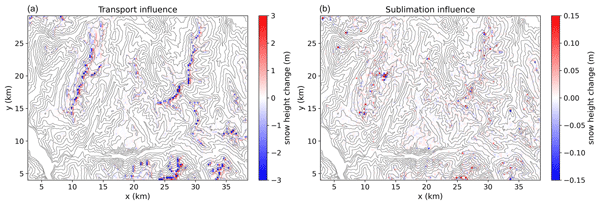
Increasing the spatial resolution of numerical systems simulating snowpack evolution in mountain areas requires representing small-scale processes such as wind-induced snow transport. We present SnowPappus, a simple scheme coupled with the Crocus snow model to compute blowing-snow fluxes and redistribute snow among grid points at 250 m resolution. In terms of numerical cost, it is suitable for large-scale applications. We present point-scale evaluations of fluxes and snow transport occurrence.
Hadleigh D. Thompson, Julie M. Thériault, Stephen J. Déry, Ronald E. Stewart, Dominique Boisvert, Lisa Rickard, Nicolas R. Leroux, Matteo Colli, and Vincent Vionnet
Earth Syst. Sci. Data, 15, 5785–5806, https://doi.org/10.5194/essd-15-5785-2023, https://doi.org/10.5194/essd-15-5785-2023, 2023
Short summary
Short summary
The Saint John River experiment on Cold Season Storms was conducted in northwest New Brunswick, Canada, to investigate the types of precipitation that can lead to ice jams and flooding along the river. We deployed meteorological instruments, took precipitation measurements and photographs of snowflakes, and launched weather balloons. These data will help us to better understand the atmospheric conditions that can affect local communities and townships downstream during the spring melt season.
Dikraa Khedhaouiria, Stéphane Bélair, Vincent Fortin, Guy Roy, and Franck Lespinas
Nonlin. Processes Geophys., 29, 329–344, https://doi.org/10.5194/npg-29-329-2022, https://doi.org/10.5194/npg-29-329-2022, 2022
Short summary
Short summary
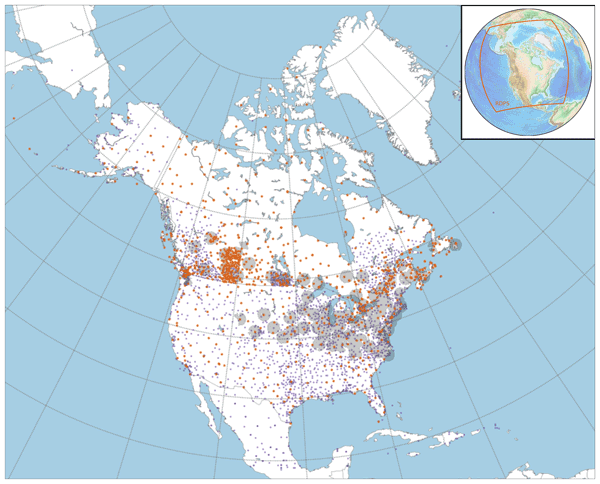
This study introduces a well-known use of hybrid methods in data assimilation (DA) algorithms that has not yet been explored for precipitation analyses. Our approach combined an ensemble-based DA approach with an existing deterministically based DA. Both DA scheme families have desirable aspects that can be leveraged if combined. The DA hybrid method showed better precipitation analyses in regions with a low rate of assimilated surface observations, which is typically the case in winter.
Juliane Mai, Hongren Shen, Bryan A. Tolson, Étienne Gaborit, Richard Arsenault, James R. Craig, Vincent Fortin, Lauren M. Fry, Martin Gauch, Daniel Klotz, Frederik Kratzert, Nicole O'Brien, Daniel G. Princz, Sinan Rasiya Koya, Tirthankar Roy, Frank Seglenieks, Narayan K. Shrestha, André G. T. Temgoua, Vincent Vionnet, and Jonathan W. Waddell
Hydrol. Earth Syst. Sci., 26, 3537–3572, https://doi.org/10.5194/hess-26-3537-2022, https://doi.org/10.5194/hess-26-3537-2022, 2022
Short summary
Short summary
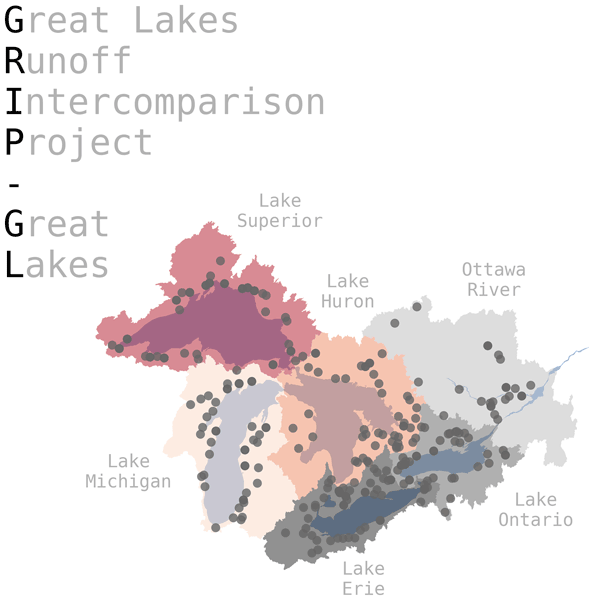
Model intercomparison studies are carried out to test various models and compare the quality of their outputs over the same domain. In this study, 13 diverse model setups using the same input data are evaluated over the Great Lakes region. Various model outputs – such as streamflow, evaporation, soil moisture, and amount of snow on the ground – are compared using standardized methods and metrics. The basin-wise model outputs and observations are made available through an interactive website.
Cited articles
Agnihotri, J., Behrangi, A., Tavakoly, A., Geheran, M., Farmani, M. A., and Niu, G.: Higher Frozen Soil Permeability Represented in a Hydrological Model Improves Spring Streamflow Prediction From River Basin to Continental Scales, Water Resour. Res., 59, e2022WR033075, https://doi.org/10.1029/2022WR033075, 2023.
Ala-Aho, P., Autio, A., Bhattacharjee, J., Isokangas, E., Kujala, K., Marttila, H., Menberu, M., Meriö, L.-J., Postila, H., Rauhala, A., Ronkanen, A.-K., Rossi, P. M., Saari, M., Haghighi, A. T., and Kløve, B.: What conditions favor the influence of seasonally frozen ground on hydrological partitioning? A systematic review, Environ. Res. Lett., 16, 043008, https://doi.org/10.1088/1748-9326/abe82c, 2021.
Alaoui, A.: Modelling susceptibility of grassland soil to macropore flow, J. Hydrol., 525, 536–546, https://doi.org/10.1016/j.jhydrol.2015.04.016, 2015.
Alavi, N., Bélair, S., Fortin, V., Zhang, S., Husain, S. Z., Carrera, M. L., and Abrahamowicz, M.: Warm Season Evaluation of Soil Moisture Prediction in the Soil, Vegetation, and Snow (SVS) Scheme, J. Hydrometeorol., 17, 2315–2332, https://doi.org/10.1175/jhm-d-15-0189.1, 2016.
Amani, A., Boucher, M.-A., Cabral, A. R., Vionnet, V., and Gaborit, É.: Cold climates, complex hydrology: can a land surface model accurately simulate deep percolation?, Hydrol. Earth Syst. Sci., 29, 2445–2465, https://doi.org/10.5194/hess-29-2445-2025, 2025.
Appels, W. M., Coles, A. E., and McDonnell, J. J.: Infiltration into frozen soil: From core‐scale dynamics to hillslope‐scale connectivity, Hydrol. Process., 32, 66–79, https://doi.org/10.1002/hyp.11399, 2018.
Barredo, J. I.: Major flood disasters in Europe: 1950–2005, Nat. Hazards, 42, 125–148, https://doi.org/10.1007/s11069-006-9065-2, 2007.
Bauer, J., Müller, S., Heinze, T., Khanahmadi, H., and Baselt, I.: Thermohydraulic experiments on water infiltration into frozen slopes: the role of macropores and initial water content, The Cryosphere, 20, 3483–3509, https://doi.org/10.5194/tc-20-3483-2026, 2026.
Bernier, N. B., Bélair, S., Bilodeau, B., and Tong, L.: Near-Surface and Land Surface Forecast System of the Vancouver 2010 Winter Olympic and Paralympic Games, J. Hydrometeorol., 12, 508–530, https://doi.org/10.1175/2011JHM1250.1, 2011.
Beven, K. and Germann, P.: Macropores and water flow in soils revisited: REVIEW, Water Resour. Res., 49, 3071–3092, https://doi.org/10.1002/wrcr.20156, 2013.
Boone, A., Masson, V., Meyers, T., and Noilhan, J.: The Influence of the Inclusion of Soil Freezing on Simulations by a Soil–Vegetation–Atmosphere Transfer Scheme, J. Appl. Meteorol., 39, 1544–1569, https://doi.org/10.1175/1520-0450(2000)039<1544:TIOTIO>2.0.CO;2, 2000.
Bouchard, B., Nadeau, D. F., Domine, F., Anctil, F., Jonas, T., and Tremblay, É.: How does a warm and low-snow winter impact the snow cover dynamics in a humid and discontinuous boreal forest? Insights from observations and modeling in eastern Canada, Hydrol. Earth Syst. Sci., 28, 2745–2765, https://doi.org/10.5194/hess-28-2745-2024, 2024.
Bouchard, B., Vionnet, V., Gaborit, É., and Fortin, V.: Code of the Soil Vegetation and Snow (SVS) land surface scheme integrated in the ECCC Surface Prediction System with the official physics package that includes the enhanced frozen soil infiltration configuration (Versions Version 6.3.0-a15), Zenodo [code], https://doi.org/10.5281/zenodo.18664365, 2026.
Boussetta, S., Balsamo, G., Arduini, G., Dutra, E., McNorton, J., Choulga, M., Agustí-Panareda, A., Beljaars, A., Wedi, N., Munõz-Sabater, J., De Rosnay, P., Sandu, I., Hadade, I., Carver, G., Mazzetti, C., Prudhomme, C., Yamazaki, D., and Zsoter, E.: ECLand: The ECMWF Land Surface Modelling System, Atmopshere, 12, 723, https://doi.org/10.3390/atmos12060723, 2021.
Brooks, E. S., Boll, J., and McDaniel, P. A.: A hillslope‐scale experiment to measure lateral saturated hydraulic conductivity, Water Resour. Res., 40, 2003WR002858, https://doi.org/10.1029/2003WR002858, 2004.
Burt, T. P. and Williams, P. J.: Hydraulic conductivity in frozen soils, Earth Surf. Process., 1, 349–360, https://doi.org/10.1002/esp.3290010404, 1976.
Campbell, J. L., Socci, A. M., and Templer, P. H.: Increased nitrogen leaching following soil freezing is due to decreased root uptake in a northern hardwood forest, Glob. Change Biol., 20, 2663–2673, https://doi.org/10.1111/gcb.12532, 2014.
Carrera, M. L., Bélair, S., and Bilodeau, B.: The Canadian Land Data Assimilation System (CaLDAS): Description and Synthetic Evaluation Study, J. Hydrometeorol., 16, 1293–1314, https://doi.org/10.1175/JHM-D-14-0089.1, 2015.
Changwei, X. and Gough, W. A.: A Simple Thaw‐Freeze Algorithm for a Multi‐Layered Soil using the Stefan Equation, Permafrost. Periglac., 24, 252–260, https://doi.org/10.1002/ppp.1770, 2013.
Clapp, R. B. and Hornberger, G. M.: Empirical equations for some soil hydraulic properties, Water Resour. Res., 14, 601–604, https://doi.org/10.1029/WR014i004p00601, 1978.
Covino, T.: Hydrologic connectivity as a framework for understanding biogeochemical flux through watersheds and along fluvial networks, J. Geomorph., 277, 133–144, https://doi.org/10.1016/j.geomorph.2016.09.030, 2017.
Craig, J. R., Brown, G., Chlumsky, R., Jenkinson, R. W., Jost, G., Lee, K., Mai, J., Serrer, M., Sgro, N., Shafii, M., Snowdon, A. P., and Tolson, B. A.: Flexible watershed simulation with the Raven hydrological modelling framework, Environ. Model. Software, 129, 104728, https://doi.org/10.1016/j.envsoft.2020.104728, 2020.
Dall'Amico, M., Endrizzi, S., Gruber, S., and Rigon, R.: A robust and energy-conserving model of freezing variably-saturated soil, The Cryosphere, 5, 469–484, https://doi.org/10.5194/tc-5-469-2011, 2011.
Decharme, B.: A process-based modeling of soil organic matter physical properties for land surface models – Part 1: Soil mixture theory, Geosci. Model Dev., 18, 9349–9384, https://doi.org/10.5194/gmd-18-9349-2025, 2025.
Decharme, B., Martin, E., and Faroux, S.: Reconciling soil thermal and hydrological lower boundary conditions in land surface models, J. Geophys. Res.-Atmos., 118, 7819–7834, https://doi.org/10.1002/jgrd.50631, 2013.
Demand, D., Selker, J. S., and Weiler, M.: Influences of Macropores on Infiltration into Seasonally Frozen Soil, Vadose Zone J., 18, 1–14, https://doi.org/10.2136/vzj2018.08.0147, 2019.
Durnford, D., Fortin, V., Smith, G., Carrera, M., Deacu, D., Dupont, F., Gaborit, É., Gauthier, N., Garnaud, C., Vionnet, V., Lan Shin, Y., Lespinas, F., Bekcic, B., and Sétigui, K.: Hydrological prediction systems at Environment and Climate Change Canada, American Meteorological Society Annual Meeting, online, 10–15 January 2021, 2021AMS10183559D, https://hpfx.collab.science.gc.ca/~scar700/rcas-casr/index.html (last access: 27 July 2026), 2021.
Flerchinger, G. N. and Saxton, K. E.: Simultaneous Heat and Water Model of a Freezing Snow-Residue-Soil System I. Theory and Development, T. ASAE, 32, 0565–0571, https://doi.org/10.13031/2013.31040, 1989.
Fortin, V., Roy, G., Donaldson, N., and Mahidjiba, A.: Assimilation of radar quantitative precipitation estimations in the Canadian Precipitation Analysis (CaPA), J. Hydrol., 531, 296–307, https://doi.org/10.1016/j.jhydrol.2015.08.003, 2015.
Gaborit, É., Fortin, V., Xu, X., Seglenieks, F., Tolson, B., Fry, L. M., Hunter, T., Anctil, F., and Gronewold, A. D.: A hydrological prediction system based on the SVS land-surface scheme: efficient calibration of GEM-Hydro for streamflow simulation over the Lake Ontario basin, Hydrol. Earth Syst. Sci., 21, 4825–4839, https://doi.org/10.5194/hess-21-4825-2017, 2017.
Gaborit, É., Fortin, V., and Durnford, D.: On the implementation of the dynamically zoned target release reservoir model in the GEM-Hydro streamflow forecasting system, Can. J. Civil. Eng., 49, 1582–1594, https://doi.org/10.1139/cjce-2021-0507, 2022.
Gaborit, É., Mai, J., Princz, D., Shen, H., Vionnet, V., Tolson, B., and Fortin, V.: Hydrologic outputs generated over the Great Lakes with a calibrated version of the GEM-Hydro model, Sci. Data, 12, 127, https://doi.org/10.1038/s41597-025-04409-x, 2025.
Ganji, A., Sushama, L., Verseghy, D., and Harvey, R.: On improving cold region hydrological processes in the Canadian Land Surface Scheme, Theor. Appl. Climatol., 127, 45–59, https://doi.org/10.1007/s00704-015-1618-4, 2017.
Gasset, N., Fortin, V., Dimitrijevic, M., Carrera, M., Bilodeau, B., Muncaster, R., Gaborit, É., Roy, G., Pentcheva, N., Bulat, M., Wang, X., Pavlovic, R., Lespinas, F., Khedhaouiria, D., and Mai, J.: A 10 km North American precipitation and land-surface reanalysis based on the GEM atmospheric model, Hydrol. Earth Syst. Sci., 25, 4917–4945, https://doi.org/10.5194/hess-25-4917-2021, 2021.
Gasset, N., Khedhaouiria, D., Fortin, V., Lauer, A., Dimitrijevic, M., Bulat, M., Pentcheva, N., Wang, X., and Muncaster, R.: Réanalyse canadienne de surface (RCaS-CaSR) version 3.1 d'Environnement et Changement Climatique Canada (ECCC), Symposium Ouranos, Online, 28–29 January, https://www.ouranos.ca/sites/default/files/2025-02/03_Gasset_Nicolas_Jour_1_Salle2_session9_16h.pdf (last access: 27 July 2026), 2025.
Gray, D. M., Landine, P. G., and Granger, R. J.: Simulating infiltration into frozen Prairie soils in streamflow models, Can. J. Earth Sci., 22, 464–472, https://doi.org/10.1139/e85-045, 1985.
Gronewold, A. D., Do, H. X., Mei, Y., and Stow, C. A.: A Tug‐of‐War Within the Hydrologic Cycle of a Continental Freshwater Basin, Geophys. Res. Lett., 48, e2020GL090374, https://doi.org/10.1029/2020GL090374, 2021.
Hansson, K., Šimůnek, J., Mizoguchi, M., Lundin, L.-C., and Van Genuchten, M. Th.: Water Flow and Heat Transport in Frozen Soil: Numerical Solution and Freeze–Thaw Applications, Vadose Zone J., 3, 93–704, https://doi.org/10.2136/vzj2004.0693, 2005.
Hardie, M. A., Cotching, W. E., Doyle, R. B., Holz, G., Lisson, S., and Mattern, K.: Effect of antecedent soil moisture on preferential flow in a texture-contrast soil, J. Hydrol., 398, 191–201, https://doi.org/10.1016/j.jhydrol.2010.12.008, 2011.
Harlan, R. L.: Analysis of coupled heat‐fluid transport in partially frozen soil, Water Resour. Res., 9, 1314–1323, https://doi.org/10.1029/WR009i005p01314, 1973.
Hayashi, M., Goeller, N., Quinton, W. L., and Wright, N.: A simple heat‐conduction method for simulating the frost‐table depth in hydrological models, Hydrol. Process., 21, 2610–2622, https://doi.org/10.1002/hyp.6792, 2007.
Henry, H. A. L.: Climate change and soil freezing dynamics: historical trends and projected changes, Climatic Change, 87, 421–434, https://doi.org/10.1007/s10584-007-9322-8, 2008.
Hersbach, H., Bell, B., Berrisford, P., Hirahara, S., Horányi, A., Muñoz‐Sabater, J., Nicolas, J., Peubey, C., Radu, R., Schepers, D., Simmons, A., Soci, C., Abdalla, S., Abellan, X., Balsamo, G., Bechtold, P., Biavati, G., Bidlot, J., Bonavita, M., De Chiara, G., Dahlgren, P., Dee, D., Diamantakis, M., Dragani, R., Flemming, J., Forbes, R., Fuentes, M., Geer, A., Haimberger, L., Healy, S., Hogan, R. J., Hólm, E., Janisková, M., Keeley, S., Laloyaux, P., Lopez, P., Lupu, C., Radnoti, G., De Rosnay, P., Rozum, I., Vamborg, F., Villaume, S., and Thépaut, J.: The ERA5 global reanalysis, Q. J. Roy. Meteor. Soc., 146, 1999–2049, https://doi.org/10.1002/qj.3803, 2020.
Husain, S. Z., Alavi, N., Bélair, S., Carrera, M., Zhang, S., Fortin, V., Abrahamowicz, M., and Gauthier, N.: The Multibudget Soil, Vegetation, and Snow (SVS) Scheme for Land Surface Parameterization: Offline Warm Season Evaluation, J. Hydrometeorol., 17, 2293–2313, https://doi.org/10.1175/jhm-d-15-0228.1, 2016.
Jame, Y. and Norum, D. I.: Heat and mass transfer in a freezing unsaturated porous medium, Water Resour. Res., 16, 811–819, https://doi.org/10.1029/WR016i004p00811, 1980.
Jarvis, N. J.: A review of non‐equilibrium water flow and solute transport in soil macropores: principles, controlling factors and consequences for water quality, Eur. J. Soil Sci., 71, 279–302, https://doi.org/10.1111/ejss.12973, 2007.
Jean, V., Boucher, M.-A., Frini, A., and Roussel, D.: Fully integrating probabilistic flood forecasts into the decision-making process across southern Quebec, Canada: some factors to consider, Can. Water Resour. J., 49, 153–170, https://doi.org/10.1080/07011784.2023.2238696, 2024.
Khedhaouiria, D., Gasset, N., Fortin, V., Dimitrijevic, M., Bulat, M., and Wang, X.: The Canadian Surface Reanalysis (CaSR) v3.2 precipitation dataset: A 45-year high-resolution analysis for North America (1980–2024), EGUsphere [preprint], https://doi.org/10.5194/egusphere-2026-620, 2026.
Kling, H., Fuchs, M., and Paulin, M.: Runoff conditions in the upper Danube basin under an ensemble of climate change scenarios, J. Hydrol., 424–425, 264–277, https://doi.org/10.1016/j.jhydrol.2012.01.011, 2012.
Knoben, W. J. M., Freer, J. E., and Woods, R. A.: Technical note: Inherent benchmark or not? Comparing Nash–Sutcliffe and Kling–Gupta efficiency scores, Hydrol. Earth Syst. Sci., 23, 4323–4331, https://doi.org/10.5194/hess-23-4323-2019, 2019.
Koren, V., Schaake, J., Mitchell, K., Duan, Q. ‐Y., Chen, F., and Baker, J. M.: A parameterization of snowpack and frozen ground intended for NCEP weather and climate models, J. Geophys. Res., 104, 19569–19585, https://doi.org/10.1029/1999JD900232, 1999.
Koren, V., Smith, M., and Cui, Z.: Physically-based modifications to the Sacramento Soil Moisture Accounting model. Part A: Modeling the effects of frozen ground on the runoff generation process, J. Hydrol., 519, 3475–3491, https://doi.org/10.1016/j.jhydrol.2014.03.004, 2014.
Kouwen, N.: WATFLOOD/WATROUTE Hydrological Model Routing & Flow Forecasting System, Department of Civil and Water Engineering, University of Waterloo, Waterloo, Canada, 267 pp., http://www.watflood.ca/ (last access: 28 July 2026), 2010.
Krogh, S. A. and Pomeroy, J. W.: Simulating site-scale permafrost hydrology: Sensitivity to modelling decisions and air temperature, J. Hydrol., 602, 126771, https://doi.org/10.1016/j.jhydrol.2021.126771, 2021.
Krogh, S. A., Pomeroy, J. W., and Marsh, P.: Diagnosis of the hydrology of a small Arctic basin at the tundra-taiga transition using a physically based hydrological model, J. Hydrol., 550, 685–703, https://doi.org/10.1016/j.jhydrol.2017.05.042, 2017.
Kurylyk, B. L. and Watanabe, K.: The mathematical representation of freezing and thawing processes in variably-saturated, non-deformable soils, Adv. Water Resour., 60, 160–177, https://doi.org/10.1016/j.advwatres.2013.07.016, 2013.
Lampe, D. C.: Hydrogeologic Framework of Bedrock Units and Initial Salinity Distribution for a Simulation of Groundwater Flow for the Lake Michigan Basin, U.S. Geological Survey, Reston, Virginia, 58 pp., https://pubs.usgs.gov/sir/2009/5060/pdf/sir20095060.pdf (last access: 26 July 2026), 2009.
Larsbo, M., Roulier, S., Stenemo, F., Kasteel, R., and Jarvis, N.: An Improved Dual‐Permeability Model of Water Flow and Solute Transport in the Vadose Zone, Vadose Zone J., 4, 398–406, https://doi.org/10.2136/vzj2004.0137, 2005.
Leonardini, G., Anctil, F., Abrahamowicz, M., Gaborit, É., Vionnet, V., Nadeau, D. F., and Fortin, V.: Evaluation of the Soil, Vegetation, and Snow (SVS) Land Surface Model for the Simulation of Surface Energy Fluxes and Soil Moisture under Snow-Free Conditions, Atmopshere, 11, 278, https://doi.org/10.3390/atmos11030278, 2020.
Leonardini, G., Anctil, F., Vionnet, V., Abrahamowicz, M., Nadeau, D. F., and Fortin, V.: Evaluation of the snow cover in the Soil, Vegetation, and Snow (SVS) land surface model, J. Hydrometeorol., https://doi.org/10.1175/JHM-D-20-0249.1, 2021.
Lindström, G., Bishop, K., and Löfvenius, M. O.: Soil frost and runoff at Svartberget, northern Sweden – measurements and model analysis, Hydrol. Processes, 16, 3379–3392, https://doi.org/10.1002/hyp.1106, 2002.
Liu, H. and Lennartz, B.: Hydraulic properties of peat soils along a bulk density gradient – A meta study, Hydrol. Process., 33, 101–114, https://doi.org/10.1002/hyp.13314, 2019.
Liu, Y., Wang, X., Wen, Y., Cai, H., Song, X., and Zhang, Z.: Effects of freeze-thaw cycles on soil greenhouse gas emissions: A systematic review, Environ. Res., 248, 118386, https://doi.org/10.1016/j.envres.2024.118386, 2024.
Lundin, L.-C.: Hydraulic Properties in an Operational Model of Frozen Soil, J. Hydrol., 118, 289–310, https://doi.org/10.1016/0022-1694(90)90264-X, 1990.
Mao, L., Wang, C.-Y., and Tabuchi, Y.: A Multiphase Model for Cold Start of Polymer Electrolyte Fuel Cells, J. Electrochem. Soc., 154, B341, https://doi.org/10.1149/1.2430651, 2007.
McTaggart‐Cowan, R., Vaillancourt, P. A., Zadra, A., Chamberland, S., Charron, M., Corvec, S., Milbrandt, J. A., Paquin‐Ricard, D., Patoine, A., Roch, M., Separovic, L., and Yang, J.: Modernization of Atmospheric Physics Parameterization in Canadian NWP, J. Adv. Model. Earth Sy., 11, 3593–3635, https://doi.org/10.1029/2019MS001781, 2019.
Merdun, H., Meral, R., and Riza Demirkiran, A.: Effect of the initial soil moisture content on the spatial distribution of the water retention, Eurasian Soil Sc., 41, 1098–1106, https://doi.org/10.1134/S1064229308100128, 2008.
Miller, R. D.: Scaling of Freezing Phenomena in Soils, in: Applications of Soil Physics: edited by: Hillel D., Elsevier, Amsterdam, the Netherlands, 254–299, https://doi.org/10.1016/B978-0-12-348580-9.50016-X, 1980.
Mohammed, A. A., Cey, E. E., and Hayashi, M.: Snowmelt Infiltration and Macropore Flow in Frozen Soils: Overview, Knowledge Gaps, and a Conceptual Framework, Vadose Zone J., 17, 1–15, https://doi.org/10.2136/vzj2018.04.0084, 2018.
Mohammed, A. A., Pavlovskii, I., Cey, E. E., and Hayashi, M.: Effects of preferential flow on snowmelt partitioning and groundwater recharge in frozen soils, Hydrol. Earth Syst. Sci., 23, 5017–5031, https://doi.org/10.5194/hess-23-5017-2019, 2019.
Mohammed, A. A., Cey, E. E., Hayashi, M., Callaghan, M. V., Park, Y., Miller, K. L., and Frey, S. K.: Dual‐permeability modeling of preferential flow and snowmelt partitioning in frozen soils, Vadose Zone J., 20, e20101, https://doi.org/10.1002/vzj2.20101, 2021.
Mohammed, G. A., Hayashi, M., Farrow, C. R., and Takano, Y.: Improved characterization of frozen soil processes in the Versatile Soil Moisture Budget model, Can. J. Soil. Sci., 93, 511–531, https://doi.org/10.4141/cjss2012-005, 2013.
Nash, J. E. and Sutcliffe, J. V.: River flow forecasting through conceptual models part I – A discussion of principles, J. Hydrol., 10, 282–290, https://doi.org/10.1016/0022-1694(70)90255-6, 1970.
Neri, A., Villarini, G., Slater, L. J., and Napolitano, F.: On the statistical attribution of the frequency of flood events across the U.S. Midwest, Adv. Water Resour., 127, 225–236, https://doi.org/10.1016/j.advwatres.2019.03.019, 2019.
Niu, G. and Yang, Z.: An observation‐based formulation of snow cover fraction and its evaluation over large North American river basins, J. Geophys. Res.-Atmos., 112, 2007JD008674, https://doi.org/10.1029/2007JD008674, 2007.
Niu, G.-Y. and Yang, Z.-L.: Effects of Frozen Soil on Snowmelt Runoff and Soil Water Storage at a Continental Scale, J. Hydrometeorol., 7, 937–952, https://doi.org/10.1175/JHM538.1, 2006.
NOAA: 2021 annual climate trends and impacts summary for the Great Lakes Basin, NOAA, Ann Arbor, Michigan, USA, https://glisa.umich.edu/wp-content/uploads/2024/06/2021-Climate-Trends-and-Impacts-Summary.pdf (last access: 27 July 2026), 2021.
Patel, K. F., Tatariw, C., MacRae, J. D., Ohno, T., Nelson, S. J., and Fernandez, I. J.: Soil carbon and nitrogen responses to snow removal and concrete frost in a northern coniferous forest, Can. J. Soil. Sci., 98, 436–447, https://doi.org/10.1139/cjss-2017-0132, 2018.
Penfound, E. and Vaz, E.: Analysis of 200 years of change in ontario wetland systems, Appl. Geogr., 138, 102625, https://doi.org/10.1016/j.apgeog.2021.102625, 2022.
Perry, C. A.: Significant Floods in the United States During the 20th Century – USGS Measures a Century of Floods, U.S. Geological Survey, Reston, Virginia, 3 pp., https://doi.org/10.3133/fs02400, 2000.
Pitman, A. J., Yang, Z.-L., Cogley, G., and Henderson-Sellers, A.: Description of bare essentials of surface transfer for the Bureau of Meteorology Research Centre AGCM, School of Earth Sciences, Macquarie University, Melbourne, Australia, 117 pp., https://maths.anu.edu.au/files/CMAProcVol25-Pitman.pdf (last access: 27 July 2026), 1991.
Ross, P. J. and Smettem, K. R. J.: A Simple Treatment of Physical Nonequilibrium Water Flow in Soils, Soil Sci. Soc. Am. J., 64, 1926–1930, https://doi.org/10.2136/sssaj2000.6461926x, 2000.
Shanley, J. B. and Chalmers, A.: The effect of frozen soil on snowmelt runoff at Sleepers River, Vermont, Hydrol. Process., 13, 1843–1857, https://doi.org/10.1002/(SICI)1099-1085(199909)13:12/13<1843::AID-HYP879>3.0.CO;2-G, 1999.
Šimůnek, J., Jarvis, N. J., Van Genuchten, M. Th., and Gärdenäs, A.: Review and comparison of models for describing non-equilibrium and preferential flow and transport in the vadose zone, J. Hydrol., 272, 14–35, https://doi.org/10.1016/S0022-1694(02)00252-4, 2003.
Six, J., Bossuyt, H., Degryze, S., and Denef, K.: A history of research on the link between (micro)aggregates, soil biota, and soil organic matter dynamics, Soil Till. Res., 79, 7–31, https://doi.org/10.1016/j.still.2004.03.008, 2004.
Smirnova, T. G., Brown, J. M., Benjamin, S. G., and Kim, D.: Parameterization of cold‐season processes in the MAPS land‐surface scheme, J. Geophys. Res., 105, 4077–4086, https://doi.org/10.1029/1999JD901047, 2000.
Soulis, E. D., Snelgrove, K. R., Kouwen, N., Seglenieks, F., and Verseghy, D. L.: Towards closing the vertical water balance in Canadian atmospheric models: Coupling of the land surface scheme class with the distributed hydrological model watflood, Atmos. Ocean, 38, 251–269, https://doi.org/10.1080/07055900.2000.9649648, 2000.
Soulis, E. D., Craig, J. R., Fortin, V., and Liu, G.: A simple expression for the bulk field capacity of a sloping soil horizon, Hydrol. Process., 25, 112–116, https://doi.org/10.1002/hyp.7827, 2011.
Stähli, M.: Hydrological significance of soil frost for pre-alpine areas, J. Hydrol., 546, 90–102, https://doi.org/10.1016/j.jhydrol.2016.12.032, 2017.
Stähli, M., Jansson, P.-E., and Lundin, L.-C.: Preferential Water Flow in a Frozen Soil – A Two-Domain Model Approach, Hydrol. Process., 10, 1305–1316, https://doi.org/10.1002/(SICI)1099-1085(199610)10:10<1305::AID-HYP462>3.0.CO;2-F, 1996.
Stähli, M., Jansson, P., and Lundin, L.: Soil moisture redistribution and infiltration in frozen sandy soils, Water Resour. Res., 35, 95–103, https://doi.org/10.1029/1998WR900045, 1999.
Stenemo, F. and Jarvis, N.: Users guide to MACRO 5.2, a model of water flow and solute transport in macroporous soil, Swedish University of Agricultural Sciences, Stockholm, Sweden. 47 pp., http://www.slu.se/contentassets/ef53682cf8bf47b6b2166e7b89bc7712/macro-users-guide-2010.pdf (last access: 27 July 2026), 2010.
Swenson, S. C., Lawrence, D. M., and Lee, H.: Improved simulation of the terrestrial hydrological cycle in permafrost regions by the Community Land Model, J. Adv. Model. Earth Sy., 4, 2012MS000165, https://doi.org/10.1029/2012MS000165, 2012.
Taylor, G. S. and Luthin, J. N.: A model for coupled heat and moisture transfer during soil freezing, Can. Geotech. J., 15, 548–555, https://doi.org/10.1139/t78-058, 1978.
Vereecken, H., Weihermüller, L., Assouline, S., Šimůnek, J., Verhoef, A., Herbst, M., Archer, N., Mohanty, B., Montzka, C., Vanderborght, J., Balsamo, G., Bechtold, M., Boone, A., Chadburn, S., Cuntz, M., Decharme, B., Ducharne, A., Ek, M., Garrigues, S., Goergen, K., Ingwersen, J., Kollet, S., Lawrence, D. M., Li, Q., Or, D., Swenson, S., De Vrese, P., Walko, R., Wu, Y., and Xue, Y.: Infiltration from the Pedon to Global Grid Scales: An Overview and Outlook for Land Surface Modeling, Vadose Zone J., 18, 1–53, https://doi.org/10.2136/vzj2018.10.0191, 2019.
Verseghy, D.: The Canadian Land Surface Scheme Technical Documentation – Version 3.4, Climate Research Division of Environment Canada, Toronto, Canada, 178 pp., https://gwfnet.net/sites/ip3/download/CLASS_v3_4_Documentation_v1_1.pdf (last access: 27 July 2026), 2008.
Vionnet, V., Fortin, V., Gaborit, E., Roy, G., Abrahamowicz, M., Gasset, N., and Pomeroy, J. W.: Assessing the factors governing the ability to predict late-spring flooding in cold-region mountain basins, Hydrol. Earth Syst. Sci., 24, 2141–2165, https://doi.org/10.5194/hess-24-2141-2020, 2020.
Vionnet, V., Leroux, N. R., Fortin, V., Abrahamowicz, M., Woolley, G., Mazzotti, G., Gaillard, M., Lafaysse, M., Royer, A., Domine, F., Gauthier, N., Rutter, N., Derksen, C., and Bélair, S.: Enhancing simulations of snowpack properties in land surface models with the Soil, Vegetation and Snow scheme v2.0 (SVS2), Geosci. Model Dev., 18, 9119–9147, https://doi.org/10.5194/gmd-18-9119-2025, 2025.
Wang, J., Zhang, J., Xie, D., Ma, J., Zhao, Y., Ning, S., Song, C., Zhang, Z., Zhu, J., He, J.-S., and Wang, H.: Shifts in soil freeze-thaw cycle and their climate impacts along the alpine wetland-grassland continuum, Agr. Forest Meteorol., 367, 110506, https://doi.org/10.1016/j.agrformet.2025.110506, 2025.
Wang, Y., Broxton, P., Fang, Y., Behrangi, A., Barlage, M., Zeng, X., and Niu, G.: A Wet‐Bulb Temperature‐Based Rain‐Snow Partitioning Scheme Improves Snowpack Prediction Over the Drier Western United States, Geophys. Res. Lett., 46, 13825–13835, https://doi.org/10.1029/2019GL085722, 2019.
Watanabe, K.: Water and heat flow in a directionnaly frozen silty soil, in: Proceedings of the Third Hydrus Workshops, 15–22, ISBN 978-4-9901192-5-6, 2008.
Wei, X., Huang, C., Wei, N., Zhao, H., He, Y., and Wu, X.: The impact of freeze–thaw cycles and soil moisture content at freezing on runoff and soil loss, Land Degrad. Dev., 30, 515–523, https://doi.org/10.1002/ldr.3243, 2019.
Weigert, A. and Schmidt, J.: Water transport under winter conditions, CATENA, 64, 193–208, https://doi.org/10.1016/j.catena.2005.08.009, 2005.
Wheater, H. S., Pomeroy, J. W., Pietroniro, A., Davison, B., Elshamy, M., Yassin, F., Rokaya, P., Fayad, A., Tesemma, Z., Princz, D., Loukili, Y., DeBeer, C. M., Ireson, A. M., Razavi, S., Lindenschmidt, K., Elshorbagy, A., MacDonald, M., Abdelhamed, M., Haghnegahdar, A., and Bahrami, A.: Advances in modelling large river basins in cold regions with Modélisation Environmentale Communautaire–Surface and Hydrology (MESH), the Canadian hydrological land surface scheme, Hydrol. Process., 36, e14557, https://doi.org/10.1002/hyp.14557, 2022 (code available at: https://github.com/MESH-Model/MESH-Releases, last access: 28 July 2026).
Yassin, F., Razavi, S., Elshamy, M., Davison, B., Sapriza-Azuri, G., and Wheater, H.: Representation and improved parameterization of reservoir operation in hydrological and land-surface models, Hydrol. Earth Syst. Sci., 23, 3735–3764, https://doi.org/10.5194/hess-23-3735-2019, 2019.
Zhang, L., Yang, C., Wang, D., Zhang, P., and Zhang, Y.: Freezing point depression of soil water depending on its non-uniform nature in pore water pressure, Geoderma, 412, 115724, https://doi.org/10.1016/j.geoderma.2022.115724, 2022.
Zhang, T., Barry, R. G., Knowles K., Ling, F., and Armstrong, R. L.: Distribution of seasonally and perennialy frozen ground in the Northern Hemisphere, in: Proceedings of the Eighth International Conference on Permafrost, ISBN 90 5809 582 7, 2003.
Zhang, Y., Cao, Z., Hou, F., and Cheng, J.: Characterizing Preferential Flow Paths in Texturally Similar Soils under Different Land Uses by Combining Drainage and Dye-Staining Methods, Water, 13, 219, https://doi.org/10.3390/w13020219, 2021.
Zhao, L. and Gray, D. M.: Numerical analysis of simultaneous heat and mass transfer during infiltration into frozen ground, J. Hydrol., 200, 345–363, https://doi.org/10.1016/S0022-1694(97)00028-0, 1997.
Short summary
Enhancing frozen soil infiltration based on soil liquid water significantly improves streamflow simulation in the SVS land surface model. Tested at over 580 stations in the Great-Lakes and Saint-Lawrence region for five years, this approach can be easily transferred to other land surface models (LSM). Our results suggest that promoting frozen soil infiltration in LSM is key for realistic large-scale streamflow simulations and critical for operational hydrological prediction in cold regions.
Enhancing frozen soil infiltration based on soil liquid water significantly improves streamflow...


