
Articles | Volume 30, issue 2
https://doi.org/10.5194/hess-30-401-2026
© Author(s) 2026. This work is distributed under
the Creative Commons Attribution 4.0 License.
the Creative Commons Attribution 4.0 License.
https://doi.org/10.5194/hess-30-401-2026
© Author(s) 2026. This work is distributed under
the Creative Commons Attribution 4.0 License.
the Creative Commons Attribution 4.0 License.
Research article
| 
27 Jan 2026
Research article |
| 27 Jan 2026
| 27 Jan 2026
Generating Boundary Conditions for Compound Flood Modeling in a Probabilistic Framework

Department of Civil, Environmental and Construction Engineering, University of Central Florida, Orlando, FL 32816, USA
National Center for Integrated Coastal Research, University of Central Florida, Orlando, FL 32816, USA
Thomas Wahl
Department of Civil, Environmental and Construction Engineering, University of Central Florida, Orlando, FL 32816, USA
National Center for Integrated Coastal Research, University of Central Florida, Orlando, FL 32816, USA
Sara Santamaria-Aguilar
Department of Civil, Environmental and Construction Engineering, University of Central Florida, Orlando, FL 32816, USA
National Center for Integrated Coastal Research, University of Central Florida, Orlando, FL 32816, USA
Robert Jane
Department of Civil, Environmental and Construction Engineering, University of Central Florida, Orlando, FL 32816, USA
National Center for Integrated Coastal Research, University of Central Florida, Orlando, FL 32816, USA
Sönke Dangendorf
Department of River-Coastal Science and Engineering, Tulane University, 6823 St. Charles Avenue, New Orleans, LA 70118-5698, USA
Hanbeen Kim
Department of Civil and Environmental Engineering, Princeton University, Princeton, NJ 08544, USA
High Meadows Environmental Institute, Princeton University, Princeton, NJ 08544, USA
Gabriele Villarini
Department of Civil and Environmental Engineering, Princeton University, Princeton, NJ 08544, USA
High Meadows Environmental Institute, Princeton University, Princeton, NJ 08544, USA
Related authors
Robert Jane, Thomas Wahl, Pravin Maduwantha, and Gabriele Villarini
EGUsphere, https://doi.org/10.5194/egusphere-2026-5872, https://doi.org/10.5194/egusphere-2026-5872, 2026
This preprint is open for discussion and under review for Natural Hazards and Earth System Sciences (NHESS).
Short summary
Short summary
Rainfall and coastal flooding often occur together because they're driven by the same storms. In New Jersey's Mullica River watershed, tropical storms show higher but more spatially variable rainfall–surge correlations and contribute more to yearly flood risk than non-tropical storms. A simulation method using basin-average rainfall showed some bias, particularly for tropical storms, and underestimated tide-driven water levels.
Sara Santamaria-Aguilar, Pravin Maduwantha, Alejandra R. Enriquez, and Thomas Wahl
Nat. Hazards Earth Syst. Sci., 26, 571–586, https://doi.org/10.5194/nhess-26-571-2026, https://doi.org/10.5194/nhess-26-571-2026, 2026
Short summary
Short summary
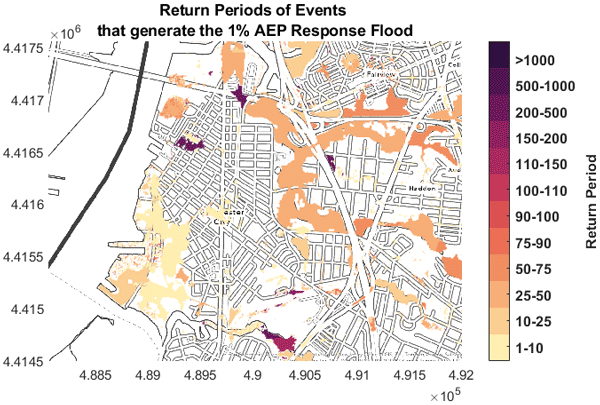
Traditional flood assessments use an event-based approach, assuming flood risk matches the chance of flood drivers. However, flooding also depends on topography and the spatio-temporal features of events. The response-based approach uses many events to estimate flood hazard directly. In Gloucester City (NJ, U.S.), we find that frequent events can cause rare (1 %) flood levels due to their spatio-temporal characteristics. Including these factors is key for accurate flood hazard estimates.
Pravin Maduwantha, Thomas Wahl, Sara Santamaria-Aguilar, Robert Jane, James F. Booth, Hanbeen Kim, and Gabriele Villarini
Nat. Hazards Earth Syst. Sci., 24, 4091–4107, https://doi.org/10.5194/nhess-24-4091-2024, https://doi.org/10.5194/nhess-24-4091-2024, 2024
Short summary
Short summary
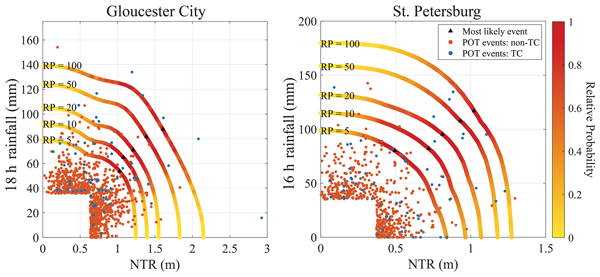
When assessing the likelihood of compound flooding, most studies ignore that it can arise from different storm types with distinct statistical characteristics. Here, we present a new statistical framework that accounts for these differences and shows how neglecting these can impact the likelihood of compound flood potential.
Robert Jane, Thomas Wahl, Pravin Maduwantha, and Gabriele Villarini
EGUsphere, https://doi.org/10.5194/egusphere-2026-5872, https://doi.org/10.5194/egusphere-2026-5872, 2026
This preprint is open for discussion and under review for Natural Hazards and Earth System Sciences (NHESS).
Short summary
Short summary
Rainfall and coastal flooding often occur together because they're driven by the same storms. In New Jersey's Mullica River watershed, tropical storms show higher but more spatially variable rainfall–surge correlations and contribute more to yearly flood risk than non-tropical storms. A simulation method using basin-average rainfall showed some bias, particularly for tropical storms, and underestimated tide-driven water levels.
Angel Amores, Roberto Alcaraz, Marta Marcos, Philip Thompson, Ariadna Martín, and Thomas Wahl
EGUsphere, https://doi.org/10.5194/egusphere-2026-5073, https://doi.org/10.5194/egusphere-2026-5073, 2026
This preprint is open for discussion and under review for Natural Hazards and Earth System Sciences (NHESS).
Short summary
Short summary
Coastal sea level records are short, full of gaps and often affected by instrument faults, which limits the study of extreme events and of how they are changing. We trained a neural network on these records to rebuild hourly sea level at 373 coastal sites worldwide, from 1940 to the present, driven mainly by weather data. It reproduces the observed sea level down to the largest storm surges, extends the records back in time, and can also flag faulty stretches in the measurements themselves.
Sara Santamaria-Aguilar, Pravin Maduwantha, Alejandra R. Enriquez, and Thomas Wahl
Nat. Hazards Earth Syst. Sci., 26, 571–586, https://doi.org/10.5194/nhess-26-571-2026, https://doi.org/10.5194/nhess-26-571-2026, 2026
Short summary
Short summary
Traditional flood assessments use an event-based approach, assuming flood risk matches the chance of flood drivers. However, flooding also depends on topography and the spatio-temporal features of events. The response-based approach uses many events to estimate flood hazard directly. In Gloucester City (NJ, U.S.), we find that frequent events can cause rare (1 %) flood levels due to their spatio-temporal characteristics. Including these factors is key for accurate flood hazard estimates.
Huazhi Li, Robert A. Jane, Dirk Eilander, Alejandra R. Enríquez, Toon Haer, and Philip J. Ward
Nat. Hazards Earth Syst. Sci., 26, 391–409, https://doi.org/10.5194/nhess-26-391-2026, https://doi.org/10.5194/nhess-26-391-2026, 2026
Short summary
Short summary
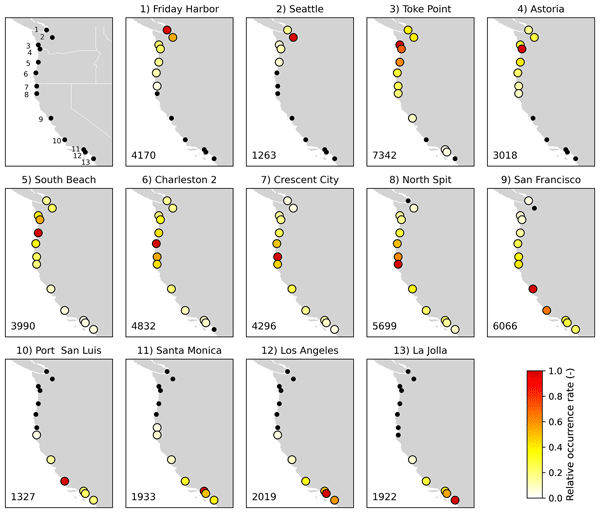
We assess the likelihood of widespread compound flooding along the U.S. coastline. Using a large set of generated plausible events preserving observed dependence, we find that nearly half of compound floods on the West coast affect multiple sites. Such events are rarer on the East coast while most compound events affect single sites on the Gulf coast. Our results underscore the importance of including spatial dependence in compound flood risk assessment and can help in better risk management.
Ziyu Chen, Philip M. Orton, James F. Booth, Thomas Wahl, Arthur DeGaetano, Joel Kaatz, and Radley M. Horton
Hydrol. Earth Syst. Sci., 29, 3101–3117, https://doi.org/10.5194/hess-29-3101-2025, https://doi.org/10.5194/hess-29-3101-2025, 2025
Short summary
Short summary
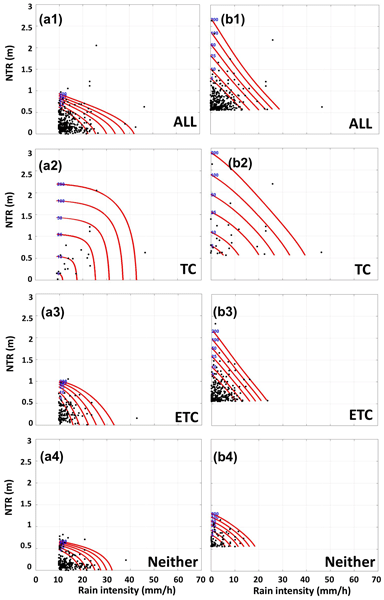
Urban flooding can be driven by rain and storm surge or the combination of the two, which is called compound flooding. In this study, we analyzed hourly historical rain and surge data for New York City to provide a more detailed statistical analysis than prior studies of this topic. The analyses reveal that tropical cyclones (e.g., hurricanes) have potential for causing more extreme compound floods than other storms, while extratropical cyclones cause less extreme, more frequent compound events.
Joshua Green, Ivan D. Haigh, Niall Quinn, Jeff Neal, Thomas Wahl, Melissa Wood, Dirk Eilander, Marleen de Ruiter, Philip Ward, and Paula Camus
Nat. Hazards Earth Syst. Sci., 25, 747–816, https://doi.org/10.5194/nhess-25-747-2025, https://doi.org/10.5194/nhess-25-747-2025, 2025
Short summary
Short summary
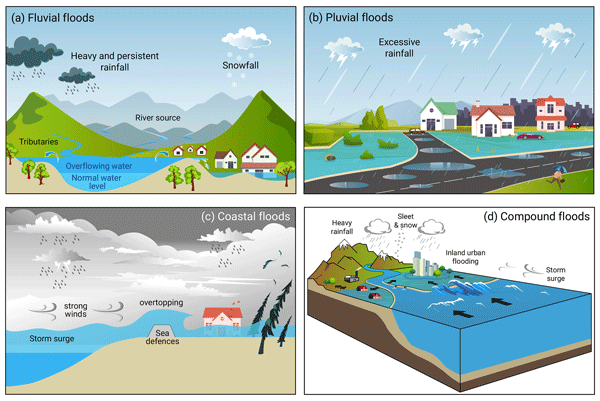
Compound flooding, involving the combination or successive occurrence of two or more flood drivers, can amplify flood impacts in coastal/estuarine regions. This paper reviews the practices, trends, methodologies, applications, and findings of coastal compound flooding literature at regional to global scales. We explore the types of compound flood events, their mechanistic processes, and the range of terminology. Lastly, this review highlights knowledge gaps and implications for future practices.
Pravin Maduwantha, Thomas Wahl, Sara Santamaria-Aguilar, Robert Jane, James F. Booth, Hanbeen Kim, and Gabriele Villarini
Nat. Hazards Earth Syst. Sci., 24, 4091–4107, https://doi.org/10.5194/nhess-24-4091-2024, https://doi.org/10.5194/nhess-24-4091-2024, 2024
Short summary
Short summary
When assessing the likelihood of compound flooding, most studies ignore that it can arise from different storm types with distinct statistical characteristics. Here, we present a new statistical framework that accounts for these differences and shows how neglecting these can impact the likelihood of compound flood potential.
Sönke Dangendorf, Qiang Sun, Thomas Wahl, Philip Thompson, Jerry X. Mitrovica, and Ben Hamlington
Earth Syst. Sci. Data, 16, 3471–3494, https://doi.org/10.5194/essd-16-3471-2024, https://doi.org/10.5194/essd-16-3471-2024, 2024
Short summary
Short summary
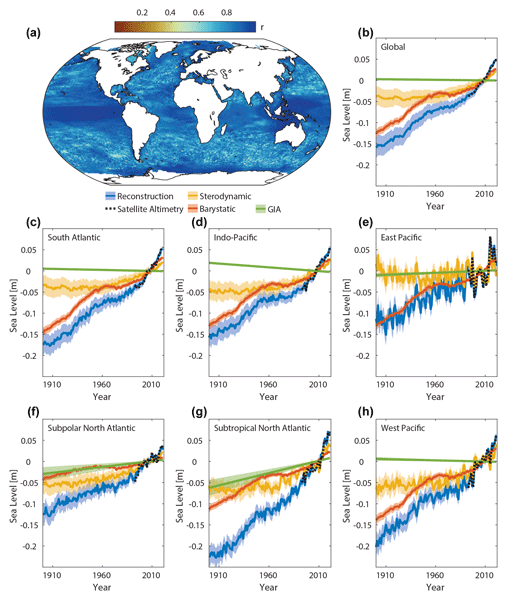
Sea-level information from the global ocean is sparse in time and space, with comprehensive data being limited to the period since 2005. Here we provide a novel reconstruction of sea level and its contributing causes, as determined by a Kalman smoother approach applied to tide gauge records over the period 1900–2021. The new reconstruction shows a continuing acceleration in global mean sea-level rise since 1970 that is dominated by melting land ice. Contributors vary significantly by region.
Conrad Wasko, Seth Westra, Rory Nathan, Acacia Pepler, Timothy H. Raupach, Andrew Dowdy, Fiona Johnson, Michelle Ho, Kathleen L. McInnes, Doerte Jakob, Jason Evans, Gabriele Villarini, and Hayley J. Fowler
Hydrol. Earth Syst. Sci., 28, 1251–1285, https://doi.org/10.5194/hess-28-1251-2024, https://doi.org/10.5194/hess-28-1251-2024, 2024
Short summary
Short summary
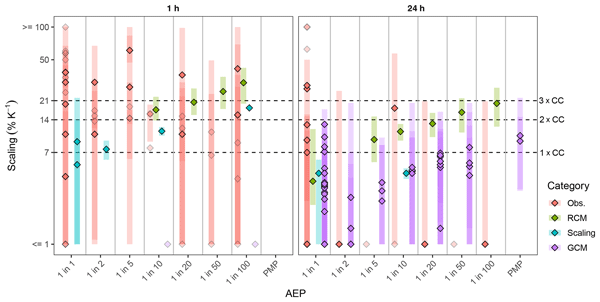
In response to flood risk, design flood estimation is a cornerstone of infrastructure design and emergency response planning, but design flood estimation guidance under climate change is still in its infancy. We perform the first published systematic review of the impact of climate change on design flood estimation and conduct a meta-analysis to provide quantitative estimates of possible future changes in extreme rainfall.
Simon Treu, Sanne Muis, Sönke Dangendorf, Thomas Wahl, Julius Oelsmann, Stefanie Heinicke, Katja Frieler, and Matthias Mengel
Earth Syst. Sci. Data, 16, 1121–1136, https://doi.org/10.5194/essd-16-1121-2024, https://doi.org/10.5194/essd-16-1121-2024, 2024
Short summary
Short summary
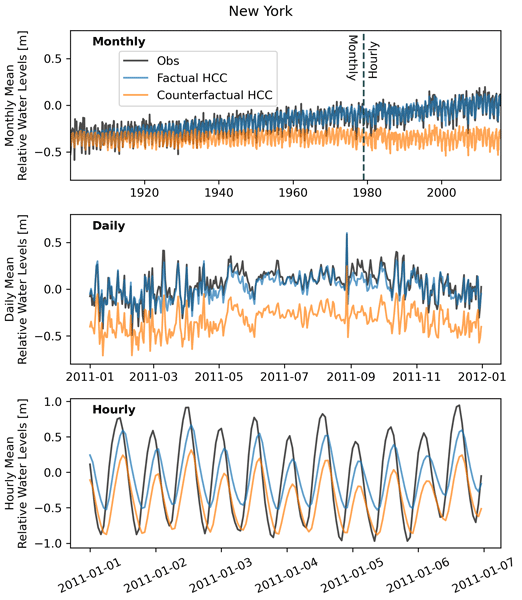
This article describes a reconstruction of monthly coastal water levels from 1900–2015 and hourly data from 1979–2015, both with and without long-term sea level rise. The dataset is based on a combination of three datasets that are focused on different aspects of coastal water levels. Comparison with tide gauge records shows that this combination brings reconstructions closer to the observations compared to the individual datasets.
Louise J. Slater, Louise Arnal, Marie-Amélie Boucher, Annie Y.-Y. Chang, Simon Moulds, Conor Murphy, Grey Nearing, Guy Shalev, Chaopeng Shen, Linda Speight, Gabriele Villarini, Robert L. Wilby, Andrew Wood, and Massimiliano Zappa
Hydrol. Earth Syst. Sci., 27, 1865–1889, https://doi.org/10.5194/hess-27-1865-2023, https://doi.org/10.5194/hess-27-1865-2023, 2023
Short summary
Short summary
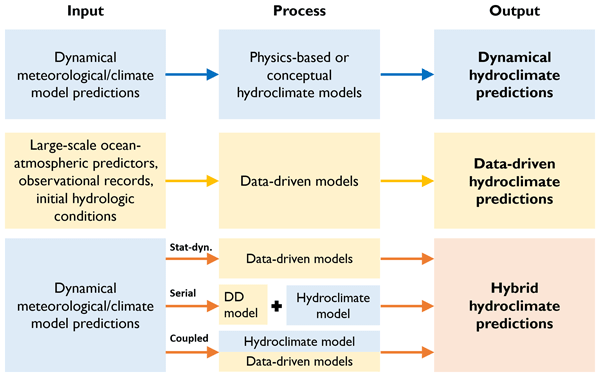
Hybrid forecasting systems combine data-driven methods with physics-based weather and climate models to improve the accuracy of predictions for meteorological and hydroclimatic events such as rainfall, temperature, streamflow, floods, droughts, tropical cyclones, or atmospheric rivers. We review recent developments in hybrid forecasting and outline key challenges and opportunities in the field.
Víctor Malagón-Santos, Aimée B. A. Slangen, Tim H. J. Hermans, Sönke Dangendorf, Marta Marcos, and Nicola Maher
Ocean Sci., 19, 499–515, https://doi.org/10.5194/os-19-499-2023, https://doi.org/10.5194/os-19-499-2023, 2023
Short summary
Short summary
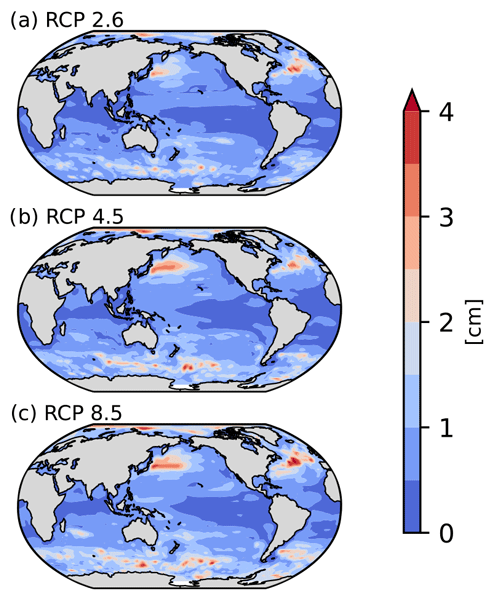
Climate change will alter heat and freshwater fluxes as well as ocean circulation, driving local changes in sea level. This sea-level change component is known as ocean dynamic sea level (DSL), and it is usually projected using computationally expensive global climate models. Statistical models are a cheaper alternative for projecting DSL but may contain significant errors. Here, we partly remove those errors (driven by internal climate variability) by using pattern recognition techniques.
Katherine L. Towey, James F. Booth, Alejandra Rodriguez Enriquez, and Thomas Wahl
Nat. Hazards Earth Syst. Sci., 22, 1287–1300, https://doi.org/10.5194/nhess-22-1287-2022, https://doi.org/10.5194/nhess-22-1287-2022, 2022
Short summary
Short summary
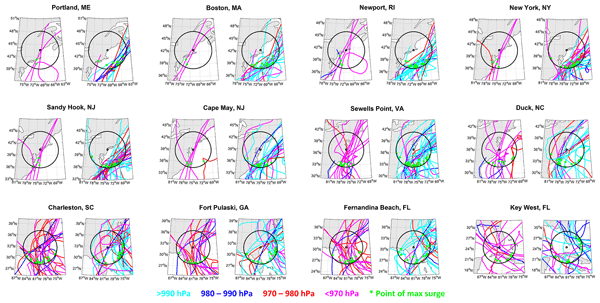
Coastal flooding due to storm surge from tropical cyclones is a significant hazard. The influence of tropical cyclone characteristics, including its proximity, intensity, path angle, and speed, on the magnitude of storm surge is examined along the eastern United States. No individual characteristic was found to be strongly related to how much surge occurred at a site, though there is an increased likelihood of high surge occurring when tropical cyclones are both strong and close to a location.
Sunna Kupfer, Sara Santamaria-Aguilar, Lara van Niekerk, Melanie Lück-Vogel, and Athanasios T. Vafeidis
Nat. Hazards Earth Syst. Sci., 22, 187–205, https://doi.org/10.5194/nhess-22-187-2022, https://doi.org/10.5194/nhess-22-187-2022, 2022
Short summary
Short summary
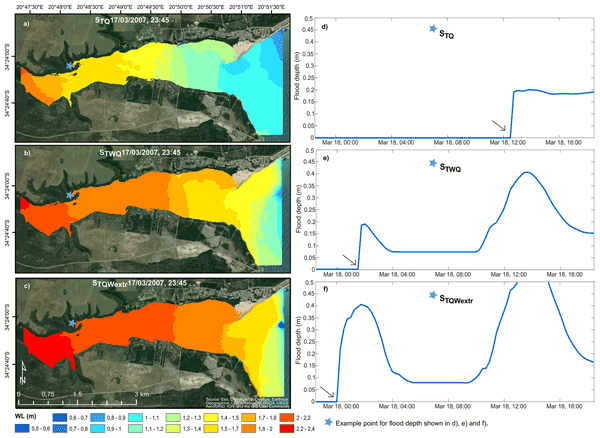
In coastal regions, flooding can occur from combined tides, storms, river discharge, and waves. Effects of waves are commonly neglected when assessing flooding, although these may strongly contribute to extreme water levels. We find that waves combined with tides and river discharge at Breede Estuary, South Africa, increased flood extent and depth and caused earlier flooding than when waves were neglected. This highlights the need to consider all major flood drivers in future flood assessments.
Ahmed A. Nasr, Thomas Wahl, Md Mamunur Rashid, Paula Camus, and Ivan D. Haigh
Hydrol. Earth Syst. Sci., 25, 6203–6222, https://doi.org/10.5194/hess-25-6203-2021, https://doi.org/10.5194/hess-25-6203-2021, 2021
Short summary
Short summary
We analyse dependences between different flooding drivers around the USA coastline, where the Gulf of Mexico and the southeastern and southwestern coasts are regions of high dependence between flooding drivers. Dependence is higher during the tropical season in the Gulf and at some locations on the East Coast but higher during the extratropical season on the West Coast. The analysis gives new insights on locations, driver combinations, and the time of the year when compound flooding is likely.
Cited articles
Akaike, H.: A new look at the statistical model identification, IEEE Trans. Automat. Contr., 19, 716–723, https://doi.org/10.1109/TAC.1974.1100705, 1974.
Arns, A., Wahl, T., Wolff, C., Vafeidis, A. T., Haigh, I. D., Woodworth, P., Niehüser, S., and Jensen, J.: Non-linear interaction modulates global extreme sea levels, coastal flood exposure, and impacts, Nat. Commun., 11, https://doi.org/10.1038/s41467-020-15752-5, 2020.
Bader, B., Yan, J., and Zhang, X.: Automated threshold selection for extreme value analysis via ordered goodness-of-fit tests with adjustment for false discovery rate, Ann. Appl. Stat., 12, 310–329, https://doi.org/10.1214/17-AOAS1092, 2018.
Barnard, P. L., Erikson, L. H., Foxgrover, A. C., Hart, J. A. F., Limber, P., O'Neill, A. C., van Ormondt, M., Vitousek, S., Wood, N., Hayden, M. K., and Jones, J. M.: Dynamic flood modeling essential to assess the coastal impacts of climate change, Sci. Rep., 9, 4309, https://doi.org/10.1038/s41598-019-40742-z, 2019.
Barroso, A., Wahl, T., Li, S., Enriquez, A., Morim, J., Dangendorf, S., Piecuch, C., and Thompson, P.: Observed Spatiotemporal Variability in the Annual Sea Level Cycle Along the Global Coast, J. Geophys. Res.-Oceans, 129, e2023JC020300, https://doi.org/10.1029/2023JC020300, 2024.
Bass, B. and Bedient, P.: Surrogate modeling of joint flood risk across coastal watersheds, J. Hydrol., 558, 159–173, https://doi.org/10.1016/j.jhydrol.2018.01.014, 2018.
Bates, P. D., Quinn, N., Sampson, C., Smith, A., Wing, O., Sosa, J., Savage, J., Olcese, G., Neal, J., Schumann, G., Giustarini, L., Coxon, G., Porter, J. R., Amodeo, M. F., Chu, Z., Lewis-Gruss, S., Freeman, N. B., Houser, T., Delgado, M., Hamidi, A., Bolliger, I., E. McCusker, K., Emanuel, K., Ferreira, C. M., Khalid, A., Haigh, I. D., Couasnon, A., E. Kopp, R., Hsiang, S., and Krajewski, W. F.: Combined Modeling of US Fluvial, Pluvial, and Coastal Flood Hazard Under Current and Future Climates, Water Resour. Res., 57, e2020WR028673, https://doi.org/10.1029/2020WR028673, 2021.
Breilh, J. F., Chaumillon, E., Bertin, X., and Gravelle, M.: Assessment of static flood modeling techniques: application to contrasting marshes flooded during Xynthia (western France), Nat. Hazards Earth Syst. Sci., 13, 1595–1612, https://doi.org/10.5194/nhess-13-1595-2013, 2013.
Brissette, F. P., Khalili, M., and Leconte, R.: Efficient stochastic generation of multi-site synthetic precipitation data, J. Hydrol., 345, 121–133, https://doi.org/10.1016/j.jhydrol.2007.06.035, 2007.
Burton, A., Kilsby, C. G., Fowler, H. J., Cowpertwait, P. S. P., and O'Connell, P. E.: RainSim: A spatial–temporal stochastic rainfall modelling system, Environmental Modelling & Software, 23, 1356–1369, https://doi.org/10.1016/j.envsoft.2008.04.003, 2008.
Camus, P., Haigh, I. D., Nasr, A. A., Wahl, T., Darby, S. E., and Nicholls, R. J.: Regional analysis of multivariate compound coastal flooding potential around Europe and environs: sensitivity analysis and spatial patterns, Nat. Hazards Earth Syst. Sci., 21, 2021–2040, https://doi.org/10.5194/nhess-21-2021-2021, 2021.
Chow, V. T. , Maidment, D.R., and Mays, L. W.: Applied Hydrology, McGraw-Hill Book Company, New York, ISBN 0-07-100174-3, 1988.
Codiga, D.: Unified tidal analysis and prediction using the UTide Matlab functions, https://doi.org/10.13140/RG.2.1.3761.2008, 2011.
Couasnon, A., Sebastian, A., and Morales-Nápoles, O.: A Copula-based bayesian network for modeling compound flood hazard from riverine and coastal interactions at the catchment scale: An application to the houston ship channel, Texas, Water, 10, https://doi.org/10.3390/w10091190, 2018.
Couasnon, A., Eilander, D., Muis, S., Veldkamp, T. I. E., Haigh, I. D., Wahl, T., Winsemius, H. C., and Ward, P. J.: Measuring compound flood potential from river discharge and storm surge extremes at the global scale, Nat. Hazards Earth Syst. Sci., 20, 489–504, https://doi.org/10.5194/nhess-20-489-2020, 2020.
Cowpertwait, P. S. P., Kilsby, C. G., and O'Connell, P. E.: A space-time Neyman-Scott model of rainfall: Empirical analysis of extremes, Water Resour. Res., 38, 6-1–6-14, https://doi.org/10.1029/2001WR000709, 2002.
Dangendorf, S., Wahl, T., Mudersbach, C., and Jensen, J.: The Seasonal Mean Sea Level Cycle in the Southeastern North Sea, J. Coast. Res., ., 29, 1915–1920, 2013.
Danielson, J. J., Poppenga, S. K., Brock, J., Evans, G. A., Tyler, D. J., Gesch, D. B., Thatcher, C. A., and Barras, J.: Topobathymetric elevation model development using a new methodology: Coastal National Elevation Database, J. Coastal Res., Special Issue 76, 75–89, https://doi.org/10.2112/SI76-008, 2016.
Dawson, R. J., Hall, J. W., Bates, P. D., and Nicholls, R. J.: Quantified Analysis of the Probability of Flooding in the Thames Estuary under Imaginable Worst-case Sea Level Rise Scenarios, Int. J. Water Resour. Dev., 21, 577–591, https://doi.org/10.1080/07900620500258380, 2005.
Dullaart, J. C. M., Muis, S., de Moel, H., Ward, P. J., Eilander, D., and Aerts, J. C. J. H.: Enabling dynamic modelling of coastal flooding by defining storm tide hydrographs, Nat. Hazards Earth Syst. Sci., 23, 1847–1862, https://doi.org/10.5194/nhess-23-1847-2023, 2023.
Emanuel, K., Ravela, S., Vivant, E., and Risi, C.: A statistical deterministic approach to hurricane risk assessment, Bull. Am. Meteorol. Soc., 87, 299–314, https://doi.org/10.1175/BAMS-87-3-299, 2006.
Enríquez, A. R., Wahl, T., Baranes, H. E., Talke, S. A., Orton, P. M., Booth, J. F., and Haigh, I. D.: Predictable Changes in Extreme Sea Levels and Coastal Flood Risk Due To Long-Term Tidal Cycles, J. Geophys. Res.-Oceans, 127, e2021JC018157, https://doi.org/10.1029/2021JC018157, 2022.
Evin, G., Favre, A.-C., and Hingray, B.: Stochastic generation of multi-site daily precipitation focusing on extreme events, Hydrol. Earth Syst. Sci., 22, 655–672, https://doi.org/10.5194/hess-22-655-2018, 2018.
FEMA: Flood Risk Report Camden County Coastal Project Area, https://map1.msc.fema.gov/data/FRP/FRR_Coastal_34007_20170424.pdf?LOC=6c60f6776821e59ef746b3ecd45fd27c (last access: 21 January 2026), 2016.
Gallien, T. W.: Validated coastal flood modeling at Imperial Beach, California: Comparing total water level, empirical and numerical overtopping methodologies, Coastal Engineering, 111, 95–104, https://doi.org/10.1016/j.coastaleng.2016.01.014, 2016.
Gao, S., Zhang, J., Li, D., Jiang, H., and Fang, Z. N.: Evaluation of multiradar multisensor and stage IV quantitative precipitation estimates during Hurricane Harvey, Nat. Hazards Rev., 22, 04020057, https://doi.org/10.1061/(ASCE)NH.1527-6996.0000435, 2021.
Gloucester City New Jersey: Gloucester City, New Jersey, https://www.cityofgloucester.org/, last access: 24 February 2024.
Gomez, F. J., Jafarzadegan, K., Moftakhari, H., and Moradkhani, H.: Probabilistic flood inundation mapping through copula Bayesian multi-modeling of precipitation products, Nat. Hazards Earth Syst. Sci., 24, 2647–2665, https://doi.org/10.5194/nhess-24-2647-2024, 2024.
Gori, A., Lin, N., and Xi, D.: Tropical Cyclone Compound Flood Hazard Assessment: From Investigating Drivers to Quantifying Extreme Water Levels, Earth's Future, 8, e2020EF001660, https://doi.org/10.1029/2020EF001660, 2020.
Green, A. C., Kilsby, C., and Bárdossy, A.: A framework for space–time modelling of rainfall events for hydrological applications of weather radar, J. Hydrol., 630, https://doi.org/10.1016/j.jhydrol.2024.130630, 2024.
Haigh, I. D., Wadey, M. P., Wahl, T., Ozsoy, O., Nicholls, R. J., Brown, J. M., Horsburgh, K., and Gouldby, B.: Spatial and temporal analysis of extreme sea level and storm surge events around the coastline of the UK, Sci. Data, 3, 160107, https://doi.org/10.1038/sdata.2016.107, 2016.
Harrison, L. M., Coulthard, T. J., Robins, P. E., and Lewis, M. J.: Sensitivity of Estuaries to Compound Flooding, Estuaries and Coasts, 45, 1250–1269, https://doi.org/10.1007/s12237-021-00996-1, 2022.
Hendry, A., Haigh, I. D., Nicholls, R. J., Winter, H., Neal, R., Wahl, T., Joly-Laugel, A., and Darby, S. E.: Assessing the characteristics and drivers of compound flooding events around the UK coast, Hydrol. Earth Syst. Sci., 23, 3117–3139, https://doi.org/10.5194/hess-23-3117-2019, 2019.
Hersbach, H., Bell, B., Berrisford, P., Hirahara, S., Horányi, A., Muñoz-Sabater, J., Nicolas, J., Peubey, C., Radu, R., Schepers, D., Simmons, A., Soci, C., Abdalla, S., Abellan, X., Balsamo, G., Bechtold, P., Biavati, G., Bidlot, J., Bonavita, M., De Chiara, G., Dahlgren, P., Dee, D., Diamantakis, M., Dragani, R., Flemming, J., Forbes, R., Fuentes, M., Geer, A., Haimberger, L., Healy, S., Hogan, R. J., Hólm, E., Janisková, M., Keeley, S., Laloyaux, P., Lopez, P., Lupu, C., Radnoti, G., de Rosnay, P., Rozum, I., Vamborg, F., Villaume, S., and Thépaut, J.-N.: The ERA5 global reanalysis, Quarterly Journal of the Royal Meteorological Society, 146, 1999–2049, https://doi.org/10.1002/qj.3803, 2020.
Hong, Y., Kessler, J., Titze, D., Yang, Q., Shen, X., and Anderson, E. J.: Towards efficient coastal flood modeling: A comparative assessment of bathtub, extended hydrodynamic, and total water level approaches, Ocean Dynam., 74, 391–405, https://doi.org/10.1007/s10236-024-01610-1, 2024.
Jane, R., Cadavid, L., Obeysekera, J., and Wahl, T.: Multivariate statistical modelling of the drivers of compound flood events in south Florida, Nat. Hazards Earth Syst. Sci., 20, 2681–2699, https://doi.org/10.5194/nhess-20-2681-2020, 2020.
Jane, R. A., Malagón-Santos, V., Rashid, M. M., Doebele, L., Wahl, T., Timmers, S. R., Serafin, K. A., Schmied, L., and Lindemer, C.: A Hybrid Framework for Rapidly Locating Transition Zones: A Comparison of Event- and Response-Based Return Water Levels in the Suwannee River FL, Water Resour. Res., 58, e2022WR032481, https://doi.org/10.1029/2022WR032481, 2022.
Jane, R. A., Wahl, T., Peña, F., Obeysekera, J., Murphy-Barltrop, C., Ali, J., Maduwantha, P., Li, H., and Malagón Santos, V.: MultiHazard: copula-based joint probability analysis in R, J. Open Source Softw., 11, 8350, https://doi.org/10.21105/joss.08350, 2026.
Jones, K. A., Niknami L. S., Buto S. G., and Decker D.: Federal standards and procedures for the national Watershed Boundary Dataset (WBD), vol. 11-A3, U.S. Department of the Interior/U.S. Geological Survey, https://pubs.usgs.gov/tm/11/a3/ (last access: 9 October 2023), 2022.
Kim, H. and Villarini, G.: Evaluation of the Analysis of Record for Calibration (AORC) Rainfall across Louisiana, Remote Sens., 14, 3284, https://doi.org/10.3390/rs14143284, 2022.
Kim, H., Villarini, G., Jane, R., Wahl, T., Misra, S., and Michalek, A.: On the generation of high-resolution probabilistic design events capturing the joint occurrence of rainfall and storm surge in coastal basins, International Journal of Climatology, 43, 761–771, https://doi.org/10.1002/joc.7825, 2023.
Kitzmiller, D. H., Wu, W., Zhang, Z., Patrick, N., and Tan, X.: The Analysis of Record for Calibration: A High-Resolution Precipitation and Surface Weather Dataset for the United States, in: AGU Fall Meeting Abstracts, H41H-06, https://agu.confex.com/agu/fm18/meetingapp.cgi/Paper/390693 (last access date: 21 January 2026), 2018.
Kleiber, W., Katz, R. W., and Rajagopalan, B.: Daily spatiotemporal precipitation simulation using latent and transformed Gaussian processes, Water Resour. Res., 48, https://doi.org/10.1029/2011WR011105, 2012.
Kumbier, K., Carvalho, R. C., Vafeidis, A. T., and Woodroffe, C. D.: Comparing static and dynamic flood models in estuarine environments: A case study from south-east Australia, Mar. Freshw. Res., 70, 781–793, https://doi.org/10.1071/MF18239, 2019.
Landsea, C. W. and Franklin, J. L.: Atlantic hurricane database uncertainty and presentation of a new database format, Mon. Weather Rev., 141, 3576–3592, https://doi.org/10.1175/MWR-D-12-00254.1, 2013.
Leblois, E. and Creutin, J.-D.: Space-time simulation of intermittent rainfall with prescribed advection field: Adaptation of the turning band method, Water Resour. Res., 49, 3375–3387, https://doi.org/10.1002/wrcr.20190, 2013.
Leijnse, T., van Ormondt, M., Nederhoff, K., and van Dongeren, A.: Modeling compound flooding in coastal systems using a computationally efficient reduced-physics solver: Including fluvial, pluvial, tidal, wind- and wave-driven processes, Coastal Engineering, 163, 103796, https://doi.org/10.1016/j.coastaleng.2020.103796, 2021.
Lewis, M., Bates, P., Horsburgh, K., Neal, J., and Schumann, G.: A storm surge inundation model of the northern Bay of Bengal using publicly available data, Quarterly Journal of the Royal Meteorological Society, 139, 358–369, https://doi.org/10.1002/qj.2040, 2013.
Liang, B., Shao, Z., Li, H., Shao, M., and Lee, D.: An automated threshold selection method based on the characteristic of extrapolated significant wave heights, Coast. Eng., 144, 22–32, https://doi.org/10.1016/j.coastaleng.2018.12.001, 2019.
Liu, Y., Zhang, T., Ding, Y., Kang, A., Lei, X., and Li, J.: Exploring the driving factors of compound flood severity in coastal cities: a comprehensive analytical approach, Hydrol. Earth Syst. Sci., 28, 5541–5555, https://doi.org/10.5194/hess-28-5541-2024, 2024.
Luettich Jr., R. A., Westerink, J. J., and Scheffner, N. W.: ADCIRC: An advanced three-dimensional circulation model for shelves, coasts, and estuaries. Report 1: Theory and methodology of ADCIRC-2DDI and ADCIRC-3DL, Technical Report, Coastal Engineering Research Center, U.S. Army Engineer Waterways Experiment Station, Vicksburg, MS, USA, 143 pp., 1992.
MacPherson, L. R., Arns, A., Dangendorf, S., Vafeidis, A. T., and Jensen, J.: A Stochastic Extreme Sea Level Model for the German Baltic Sea Coast, J. Geophys. Res.-Oceans, 124, 2054–2071, https://doi.org/10.1029/2018JC014718, 2019.
Maduwantha, P.: Synthetic Compound Storm Event Generation Using Copula-Based non-tidal residual–Rainfall Modeling, Version V1, Zenodo [code], https://doi.org/10.5281/zenodo.18216090, 2026.
Maduwantha, P., Wahl, T., Santamaria-Aguilar, S., Jane, R., Booth, J. F., Kim, H., and Villarini, G.: A multivariate statistical framework for mixed storm types in compound flood analysis, Nat. Hazards Earth Syst. Sci., 24, 4091–4107, https://doi.org/10.5194/nhess-24-4091-2024, 2024.
Merz, B., Blöschl, G., Jüpner, R., Kreibich, H., Schröter, K., and Vorogushyn, S.: Invited perspectives: safeguarding the usability and credibility of flood hazard and risk assessments, Nat. Hazards Earth Syst. Sci., 24, 4015–4030, https://doi.org/10.5194/nhess-24-4015-2024, 2024.
Moftakhari, H., Schubert, J. E., AghaKouchak, A., Matthew, R. A., and Sanders, B. F.: Linking statistical and hydrodynamic modeling for compound flood hazard assessment in tidal channels and estuaries, Adv Water Resour., 128, 28–38, https://doi.org/10.1016/j.advwatres.2019.04.009, 2019.
Molinari, D., De Bruijn, K. M., Castillo-Rodríguez, J. T., Aronica, G. T., and Bouwer, L. M.: Validation of flood risk models: Current practice and possible improvements, International Journal of Disaster Risk Reduction, 33, 441–448, https://doi.org/10.1016/j.ijdrr.2018.10.022, 2019.
Nasr, A. A., Wahl, T., Rashid, M. M., Jane, R. A., Camus, P., and Haigh, I. D.: Temporal changes in dependence between compound coastal and inland flooding drivers around the contiguous United States coastline, Weather Clim. Extrem., 41, 100594, https://doi.org/10.1016/j.wace.2023.100594, 2023.
Nederhoff, K., Leijnse, T. W. B., Parker, K., Thomas, J., O'Neill, A., van Ormondt, M., McCall, R., Erikson, L., Barnard, P. L., Foxgrover, A., Klessens, W., Nadal-Caraballo, N. C., and Massey, T. C.: Tropical or extratropical cyclones: what drives the compound flood hazard, impact, and risk for the United States Southeast Atlantic coast?, Natural Hazards, 120, 8779–8825, https://doi.org/10.1007/s11069-024-06552-x, 2024.
Orton, P. M., Hall, T. M., Talke, S. A., Blumberg, A. F., Georgas, N., and Vinogradov, S.: A validated tropical-extratropical flood hazard assessment for New York Harbor, J. Geophys. Res.-Oceans, 121, 8904–8929, https://doi.org/10.1002/2016JC011679, 2016.
Orton, P. M., Conticello, F. R., Cioffi, F., Hall, T. M., Georgas, N., Lall, U., Blumberg, A. F., and MacManus, K.: Flood hazard assessment from storm tides, rain and sea level rise for a tidal river estuary, Natural Hazards, 102, 729–757, https://doi.org/10.1007/s11069-018-3251-x, 2020.
Papalexiou, S. M., Serinaldi, F., and Porcu, E.: Advancing Space-Time Simulation of Random Fields: From Storms to Cyclones and Beyond, Water Resour. Res., 57, e2020WR029466, https://doi.org/10.1029/2020WR029466, 2021.
Pfahl, S. and Wernli, H.: Quantifying the relevance of cyclones for precipitation extremes, J. Climate, 25, 6770–6780, https://doi.org/10.1175/JCLI-D-11-00705.1, 2012.
Pollack, A. B., Santamaria-Aguilar, S., Maduwantha, P., Helgeson, C., Wahl, T., and Keller, K.: Funding rules that promote equity in climate adaptation outcomes, Proceedings of the National Academy of Sciences, 122, https://doi.org/10.1073/pnas.2418711121, 2025.
Quinn, N., Lewis, M., Wadey, M. P., and Haigh, I. D.: Assessing the temporal variability in extreme storm-tide time series for coastal flood risk assessment, J. Geophys. Res.-Oceans, 119, 4983–4998, https://doi.org/10.1002/2014JC010197, 2014.
Radfar, S., Shafieefar, M., and Akbari, H.: Impact of copula model selection on reliability-based design optimization of a rubble mound breakwater, Ocean Eng., 260, 112023, https://doi.org/10.1016/j.oceaneng.2022.112023, 2022.
Ramirez, J. A., Lichter, M., Coulthard, T. J., and Skinner, C.: Hyper-resolution mapping of regional storm surge and tide flooding: comparison of static and dynamic models, Natural Hazards, 82, 571–590, https://doi.org/10.1007/s11069-016-2198-z, 2016.
Salvadori, G. and De Michele, C.: Multivariate Extreme Value Methods, in: Extremes in a Changing Climate: Detection, Analysis and Uncertainty, edited by: AghaKouchak, A., Easterling, D., Hsu, K., Schubert, S., and Sorooshian, S., Springer Netherlands, Dordrecht, 115–162, https://doi.org/10.1007/978-94-007-4479-0_5, 2013.
Santamaria-Aguilar, S., Maduwantha, P., Enriquez, A. R., and Wahl, T.: Large discrepancies between event- and response-based compound flood hazard estimates, EGUsphere [preprint], https://doi.org/10.5194/egusphere-2025-1938, 2025.
Santos, V. M., Jane, R., Misra, S. K., White, K. D., and Wahl, T.: Assessing compound flooding potential with multivariate statistical models in a complex estuarine system under data constraints, J. Flood Risk Manage., 14, e12749, https://doi.org/10.1111/jfr3.12749, 2021.
Schertzer, D. and Lovejoy, S.: Physical modeling and analysis of rain and clouds by anisotropic scaling multiplicative processes, Journal of Geophysical Research: Atmospheres, 92, 9693–9714, https://doi.org/10.1029/JD092iD08p09693, 1987.
Seenath, A., Wilson, M., and Miller, K.: Hydrodynamic versus GIS modelling for coastal flood vulnerability assessment: Which is better for guiding coastal management?, Ocean Coast. Manag., 120, 99–109, https://doi.org/10.1016/j.ocecoaman.2015.11.019, 2016.
Semmendinger, K., Foley, J., and Steinschneider, S.: A Probabilistic, Parcel-Level Inundation Prediction Tool for Medium-Range Flood Forecasting in Large Lake Systems, JAWRA Journal of the American Water Resources Association, 57, 57–74, https://doi.org/10.1111/1752-1688.12893, 2021.
Serafin, K. A., Ruggiero, P., Parker, K., and Hill, D. F.: What's streamflow got to do with it? A probabilistic simulation of the competing oceanographic and fluvial processes driving extreme along-river water levels, Nat. Hazards Earth Syst. Sci., 19, 1415–1431, https://doi.org/10.5194/nhess-19-1415-2019, 2019.
Shen, Y., Morsy, M. M., Huxley, C., Tahvildari, N., and Goodall, J. L.: Flood risk assessment and increased resilience for coastal urban watersheds under the combined impact of storm tide and heavy rainfall, J. Hydrol., 579, https://doi.org/10.1016/j.jhydrol.2019.124159, 2019.
Silva Lomba, J. and Fraga Alves, M. I.: L-moments for automatic threshold selection in extreme value analysis, Stoch. Environ. Res. Risk Assess., 34, 465–491, https://doi.org/10.1007/s00477-020-01789-x, 2020.
Sinclair, V. A., Rantanen, M., Haapanala, P., Räisänen, J., and Järvinen, H.: The characteristics and structure of extra-tropical cyclones in a warmer climate, Weather Clim. Dynam., 1, 1–25, https://doi.org/10.5194/wcd-1-1-2020, 2020.
Terlinden-Ruhl, L., Couasnon, A., Eilander, D., Hendrickx, G. G., Mares-Nasarre, P., and Antolínez, J. A. Á.: Accelerating compound flood risk assessments through active learning: A case study of Charleston County (USA), Nat. Hazards Earth Syst. Sci., 25, 1353–1375, https://doi.org/10.5194/nhess-25-1353-2025, 2025.
Thompson, P. R., Widlansky, M. J., Hamlington, B. D., Merrifield, M. A., Marra, J. J., Mitchum, G. T., and Sweet, W.: Rapid increases and extreme months in projections of United States high-tide flooding, Nat. Clim. Change, 11, 584–590, https://doi.org/10.1038/s41558-021-01077-8, 2021.
Towey, K. L., Booth, J. F., Rodriguez Enriquez, A., and Wahl, T.: Tropical cyclone storm surge probabilities for the east coast of the United States: a cyclone-based perspective, Nat. Hazards Earth Syst. Sci., 22, 1287–1300, https://doi.org/10.5194/nhess-22-1287-2022, 2022.
United States Army Corps of Engineers (USACE): National Structure Inventory technical documentation, U.S. Army Corps of Engineers, Washington, DC, USA, https://www.hec.usace.army.mil/confluence/nsi/technicalreferences/latest/technical-documentation (last access: 5 March 2024), 2022.
Vousdoukas, M. I., Voukouvalas, E., Mentaschi, L., Dottori, F., Giardino, A., Bouziotas, D., Bianchi, A., Salamon, P., and Feyen, L.: Developments in large-scale coastal flood hazard mapping, Nat. Hazards Earth Syst. Sci., 16, 1841–1853, https://doi.org/10.5194/nhess-16-1841-2016, 2016.
Wahl, T., Mudersbach, C., and Jensen, J.: Assessing the hydrodynamic boundary conditions for risk analyses in coastal areas: a stochastic storm surge model, Nat. Hazards Earth Syst. Sci., 11, 2925–2939, https://doi.org/10.5194/nhess-11-2925-2011, 2011.
Wahl, T., Mudersbach, C., and Jensen, J.: Assessing the hydrodynamic boundary conditions for risk analyses in coastal areas: a multivariate statistical approach based on Copula functions, Nat. Hazards Earth Syst. Sci., 12, 495–510, https://doi.org/10.5194/nhess-12-495-2012, 2012.
Wahl, T., Jain, S., Bender, J., Meyers, S. D., and Luther, M. E.: Increasing risk of compound flooding from storm surge and rainfall for major US cities, Nat. Clim. Change, 5, 1093–1097, https://doi.org/10.1038/nclimate2736, 2015.
Ward, P. J., Couasnon, A., Eilander, D., Haigh, I. D., Hendry, A., Muis, S., Veldkamp, T. I. E., Winsemius, H. C., and Wahl, T.: Dependence between high sea-level and high river discharge increases flood hazard in global deltas and estuaries, Environmental Research Letters, 13, 084012, https://doi.org/10.1088/1748-9326/aad400, 2018.
Xu, H., Ragno, E., Jonkman, S. N., Wang, J., Bricker, J. D., Tian, Z., and Sun, L.: Combining statistical and hydrodynamic models to assess compound flood hazards from rainfall and storm surge: a case study of Shanghai, Hydrol. Earth Syst. Sci., 28, 3919–3930, https://doi.org/10.5194/hess-28-3919-2024, 2024.
Zellou, B. and Rahali, H.: Assessment of the joint impact of extreme rainfall and storm surge on the risk of flooding in a coastal area, J. Hydrol., 569, 647–665, https://doi.org/10.1016/j.jhydrol.2018.12.028, 2019
Short summary
Compound flooding occurs when multiple drivers, such as heavy rain and storm surge, occur simultaneously. Comprehensive compound flood risk assessments require simulating many storm events using flood models, but such historical data are limited. To address this, we developed a statistical framework to generate large numbers of synthetic yet realistic storm events for use in compound flood modeling.
Compound flooding occurs when multiple drivers, such as heavy rain and storm surge, occur...


