
Articles | Volume 30, issue 11
https://doi.org/10.5194/hess-30-3623-2026
© Author(s) 2026. This work is distributed under
the Creative Commons Attribution 4.0 License.
the Creative Commons Attribution 4.0 License.
https://doi.org/10.5194/hess-30-3623-2026
© Author(s) 2026. This work is distributed under
the Creative Commons Attribution 4.0 License.
the Creative Commons Attribution 4.0 License.
Research article
| 
15 Jun 2026
Research article |
| 15 Jun 2026
| 15 Jun 2026
Which strategy to improve the performances of an LSTM-based model for extreme stream temperature values?
Mohamed Saadi
CORRESPONDING AUTHOR

Institut de Mécanique des Fluides de Toulouse, Université de Toulouse, Toulouse INP, CNRS, 31400 Toulouse, France
Louis Guichard
Institut de Mécanique des Fluides de Toulouse, Université de Toulouse, Toulouse INP, CNRS, 31400 Toulouse, France
now at: UMR 5600 Environnement Ville Société (EVS), 69372 Lyon CEDEX 08, France
Gabrielle Cognot
Institut de Mécanique des Fluides de Toulouse, Université de Toulouse, Toulouse INP, CNRS, 31400 Toulouse, France
Laurent Labbouz
Eaucea, 31000 Toulouse, France
Hélène Roux
Institut de Mécanique des Fluides de Toulouse, Université de Toulouse, Toulouse INP, CNRS, 31400 Toulouse, France
Related authors
Mohamed Amine Berkaoui, Mohamed Saadi, François Colleoni, Ngo Nghi Truyen Huynh, Ahmad Akhtari, Kevin Larnier, Hélène Roux, and Pierre-André Garambois
EGUsphere, https://doi.org/10.5194/egusphere-2026-1557, https://doi.org/10.5194/egusphere-2026-1557, 2026
Short summary
Short summary
We present an integrated hydrological–hydraulic (H&H) modeling framework that combines grid-based hydrology with vector-based river routing, leveraging sub-grid information derived from high-resolution topography. This approach improves the representation of river networks and drainage areas across spatial resolutions, reducing errors and spatial distortions associated with regular grid discretization, and leading to more stable streamflow simulations across scales.
Mohamed Saadi, Carina Furusho-Percot, Alexandre Belleflamme, Ju-Yu Chen, Silke Trömel, and Stefan Kollet
Nat. Hazards Earth Syst. Sci., 23, 159–177, https://doi.org/10.5194/nhess-23-159-2023, https://doi.org/10.5194/nhess-23-159-2023, 2023
Short summary
Short summary
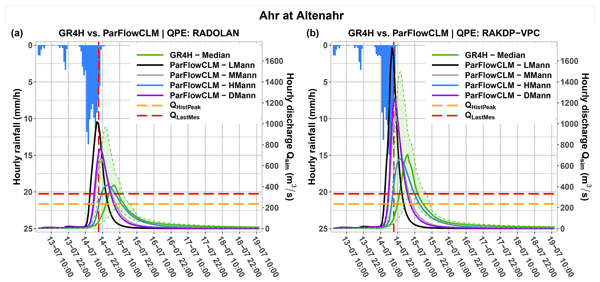
On 14 July 2021, heavy rainfall fell over central Europe, causing considerable damage and human fatalities. We analyzed how accurate our estimates of rainfall and peak flow were for these flooding events in western Germany. We found that the rainfall estimates from radar measurements were improved by including polarimetric variables and their vertical gradients. Peak flow estimates were highly uncertain due to uncertainties in hydrological model parameters and rainfall measurements.
Mohamed Amine Berkaoui, Mohamed Saadi, François Colleoni, Ngo Nghi Truyen Huynh, Ahmad Akhtari, Kevin Larnier, Hélène Roux, and Pierre-André Garambois
EGUsphere, https://doi.org/10.5194/egusphere-2026-1557, https://doi.org/10.5194/egusphere-2026-1557, 2026
Short summary
Short summary
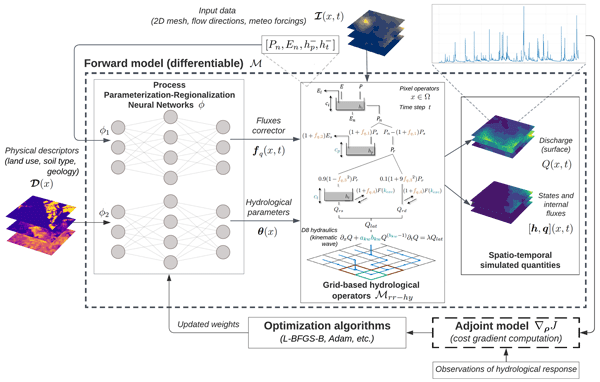
We present an integrated hydrological–hydraulic (H&H) modeling framework that combines grid-based hydrology with vector-based river routing, leveraging sub-grid information derived from high-resolution topography. This approach improves the representation of river networks and drainage areas across spatial resolutions, reducing errors and spatial distortions associated with regular grid discretization, and leading to more stable streamflow simulations across scales.
Ngo Nghi Truyen Huynh, Pierre-André Garambois, Benjamin Renard, François Colleoni, Jérôme Monnier, and Hélène Roux
Hydrol. Earth Syst. Sci., 29, 3589–3613, https://doi.org/10.5194/hess-29-3589-2025, https://doi.org/10.5194/hess-29-3589-2025, 2025
Short summary
Short summary
Understanding and modeling flash-flood-prone areas remains challenging due to limited data and scale-relevant hydrological theory. While machine learning shows promise, its integration with process-based models is difficult. We present an approach incorporating machine learning into a high-resolution hydrological model to correct internal fluxes and transfer parameters between watersheds. Results show improved accuracy, advancing the development of learnable and interpretable process-based models.
Rabab Yassine, Ludovic Cassan, Hélène Roux, Olivier Frysou, and François Pérès
Earth Surf. Dynam., 11, 1199–1221, https://doi.org/10.5194/esurf-11-1199-2023, https://doi.org/10.5194/esurf-11-1199-2023, 2023
Short summary
Short summary
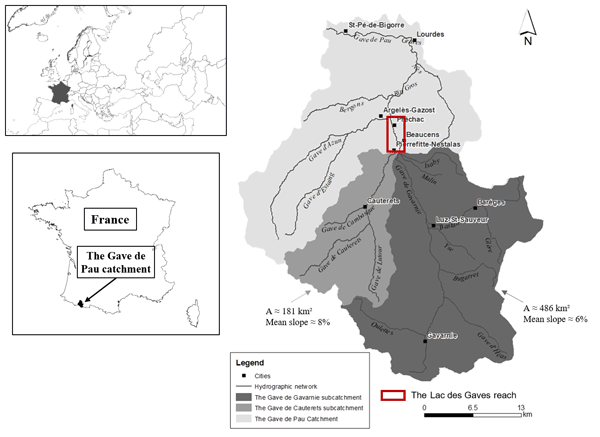
Predicting river morphology evolution is very complicated, especially for mountain rivers with complex morphologies such as the Lac des Gaves reach in France. A 2D hydromorphological model was developed to reproduce the channel's evolution and provide reliable volumetric predictions while revealing the challenge of choosing adapted sediment transport and friction laws. Our model can provide decision-makers with reliable predictions to design suitable restoration measures for this reach.
Mohamed Saadi, Carina Furusho-Percot, Alexandre Belleflamme, Ju-Yu Chen, Silke Trömel, and Stefan Kollet
Nat. Hazards Earth Syst. Sci., 23, 159–177, https://doi.org/10.5194/nhess-23-159-2023, https://doi.org/10.5194/nhess-23-159-2023, 2023
Short summary
Short summary
On 14 July 2021, heavy rainfall fell over central Europe, causing considerable damage and human fatalities. We analyzed how accurate our estimates of rainfall and peak flow were for these flooding events in western Germany. We found that the rainfall estimates from radar measurements were improved by including polarimetric variables and their vertical gradients. Peak flow estimates were highly uncertain due to uncertainties in hydrological model parameters and rainfall measurements.
Jean-Pierre Chaboureau, Laurent Labbouz, Cyrille Flamant, and Alma Hodzic
Atmos. Chem. Phys., 22, 8639–8658, https://doi.org/10.5194/acp-22-8639-2022, https://doi.org/10.5194/acp-22-8639-2022, 2022
Short summary
Short summary
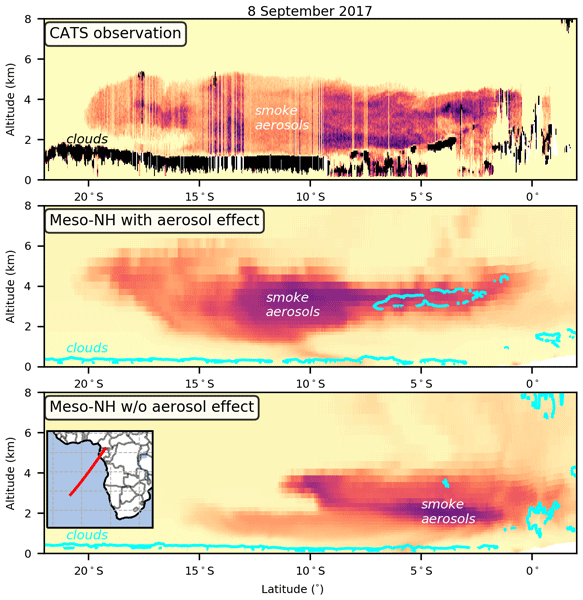
Ground-based, spaceborne and rare airborne observations of biomass burning aerosols (BBAs) during the AEROCLO-sA field campaign in 2017 are complemented with convection-permitting simulations with online trajectories. The results show that the radiative effect of the BBA accelerates the southern African easterly jet and generates upward motions that transport the BBAs to higher altitudes and farther southwest.
Abubakar Haruna, Pierre-Andre Garambois, Helene Roux, Pierre Javelle, and Maxime Jay-Allemand
Hydrol. Earth Syst. Sci. Discuss., https://doi.org/10.5194/hess-2021-414, https://doi.org/10.5194/hess-2021-414, 2021
Manuscript not accepted for further review
Short summary
Short summary
We compared three hydrological models in a flash flood modelling framework. We first identified the sensitive parameters of each model, then compared their performances in terms of outlet discharge and soil moisture simulation. We found out that resulting from the differences in their complexities/process representation, performance depends on the aspect/measure used. The study then highlights and proposed some future investigations/modifications to improve the models.
Cited articles
Alfonso, S., Gesto, M., and Sadoul, B.: Temperature increase and its effects on fish stress physiology in the context of global warming, J. Fish Biol., 98, 1496–1508, https://doi.org/10.1111/jfb.14599, 2021.
Armstrong, J. B., Fullerton, A. H., Jordan, C. E., Ebersole, J. L., Bellmore, J. R., Arismendi, I., Penaluna, B. E., and Reeves, G. H.: The importance of warm habitat to the growth regime of cold-water fishes, Nat. Clim. Change, 11, 354–361, https://doi.org/10.1038/s41558-021-00994-y, 2021.
Arora, R., Tockner, K., and Venohr, M.: Changing river temperatures in northern Germany: trends and drivers of change, Hydrol. Process., 30, 3084–3096, https://doi.org/10.1002/hyp.10849, 2016.
Arsenault, R., Martel, J.-L., Brunet, F., Brissette, F., and Mai, J.: Continuous streamflow prediction in ungauged basins: long short-term memory neural networks clearly outperform traditional hydrological models, Hydrol. Earth Syst. Sci., 27, 139–157, https://doi.org/10.5194/hess-27-139-2023, 2023.
Audouy, J.-N., Pitsch, S., Renard, B., and Chaleon, C.: Statistiques hydrologiques en crue: de la Banque HYDRO à l'HydroPortail, LHB, 110, 2317798, https://doi.org/10.1080/27678490.2024.2317798, 2024.
Beaufort, A., Moatar, F., Curie, F., Ducharne, A., Bustillo, V., and Thiéry, D.: River Temperature Modelling by Strahler Order at the Regional Scale in the Loire River Basin, France, River Res. Appl., 32, 597–609, https://doi.org/10.1002/rra.2888, 2016.
Beaufort, A., Diamond, J. S., Sauquet, E., and Moatar, F.: Spatial extrapolation of stream thermal peaks using heterogeneous time series at a national scale, Hydrol. Earth Syst. Sci., 26, 3477–3495, https://doi.org/10.5194/hess-26-3477-2022, 2022.
Benyahya, L., Caissie, D., St-Hilaire, A., Ouarda, T. B. M. J., and Bobée, B.: A Review of Statistical Water Temperature Models, Can. Water Resour. J., 32, 179–192, https://doi.org/10.4296/cwrj3203179, 2007.
Bonacina, L., Fasano, F., Mezzanotte, V., and Fornaroli, R.: Effects of water temperature on freshwater macroinvertebrates: a systematic review, Biol. Rev., 98, 191–221, https://doi.org/10.1111/brv.12903, 2023.
Bowerman, T., Roumasset, A., Keefer, M. L., Sharpe, C. S., and Caudill, C. C.: Prespawn Mortality of Female Chinook Salmon Increases with Water Temperature and Percent Hatchery Origin, T. Am. Fish. Soc., 147, 31–42, https://doi.org/10.1002/tafs.10022, 2018.
Buisson, L., Blanc, L., and Grenouillet, G.: Modelling stream fish species distribution in a river network: the relative effects of temperature versus physical factors, Ecol. Freshw. Fish, 17, 244–257, https://doi.org/10.1111/j.1600-0633.2007.00276.x, 2008.
Bustillo, V., Moatar, F., Ducharne, A., Thiéry, D., and Poirel, A.: A multimodel comparison for assessing water temperatures under changing climate conditions via the equilibrium temperature concept: case study of the Middle Loire River, France, Hydrol. Process., 28, 1507–1524, https://doi.org/10.1002/hyp.9683, 2014.
Caissie, D.: The thermal regime of rivers: a review, Freshwater Biol., 51, 1389–1406, https://doi.org/10.1111/j.1365-2427.2006.01597.x, 2006.
Caissie, D., Kurylyk, B. L., St-Hilaire, A., El-Jabi, N., and MacQuarrie, K. T. B.: Streambed temperature dynamics and corresponding heat fluxes in small streams experiencing seasonal ice cover, J. Hydrol., 519, 1441–1452, https://doi.org/10.1016/j.jhydrol.2014.09.034, 2014.
Comte, L., Buisson, L., Daufresne, M., and Grenouillet, G.: Climate-induced changes in the distribution of freshwater fish: observed and predicted trends, Freshwater Biol., 58, 625–639, https://doi.org/10.1111/fwb.12081, 2013.
Coron, L., Thirel, G., Delaigue, O., Perrin, C., and Andréassian, V.: The suite of lumped GR hydrological models in an R package, Environ. Model. Softw., 94, 166–171, https://doi.org/10.1016/j.envsoft.2017.05.002, 2017.
Coron, L., Delaigue, O., Thirel, G., Dorchies, D., Perrin, C., and Michel, C.: airGR: Suite of GR Hydrological Models for Precipitation-Runoff Modelling, R package version 1.7.6, Recherche Data Gouv, V1 [code], https://doi.org/10.15454/EX11NA, 2023.
Daufresne, M. and Boët, P.: Climate change impacts on structure and diversity of fish communities in rivers, Glob. Change Biol., 13, 2467–2478, https://doi.org/10.1111/j.1365-2486.2007.01449.x, 2007.
De la Fuente, L. A., Ehsani, M. R., Gupta, H. V., and Condon, L. E.: Toward interpretable LSTM-based modeling of hydrological systems, Hydrol. Earth Syst. Sci., 28, 945–971, https://doi.org/10.5194/hess-28-945-2024, 2024.
Delpla, I., Jung, A.-V., Baures, E., Clement, M., and Thomas, O.: Impacts of climate change on surface water quality in relation to drinking water production, Environ. Int., 35, 1225–1233, https://doi.org/10.1016/j.envint.2009.07.001, 2009.
Ducharne, A.: Importance of stream temperature to climate change impact on water quality, Hydrol. Earth Syst. Sci., 12, 797–810, https://doi.org/10.5194/hess-12-797-2008, 2008.
Dugdale, S. J., Hannah, D. M., and Malcolm, I. A.: River temperature modelling: A review of process-based approaches and future directions, Earth-Sci. Rev., 175, 97–113, https://doi.org/10.1016/j.earscirev.2017.10.009, 2017.
Dugdale, S. J., Malcolm, I. A., and Hannah, D. M.: Understanding the effects of spatially variable riparian tree planting strategies to target water temperature reductions in rivers, J. Hydrol., 635, 131163, https://doi.org/10.1016/j.jhydrol.2024.131163, 2024.
Edinger, J. E., Duttweiler, D. W., and Geyer, J. C.: The Response of Water Temperatures to Meteorological Conditions, Water Resour. Res., 4, 1137–1143, https://doi.org/10.1029/WR004i005p01137, 1968.
Eilander, D., van Verseveld, W., Yamazaki, D., Weerts, A., Winsemius, H. C., and Ward, P. J.: A hydrography upscaling method for scale-invariant parametrization of distributed hydrological models, Hydrol. Earth Syst. Sci., 25, 5287–5313, https://doi.org/10.5194/hess-25-5287-2021, 2021.
Essaid, H. I. and Caldwell, R. R.: Evaluating the impact of irrigation on surface water – groundwater interaction and stream temperature in an agricultural watershed, Sci. Total Environ., 599–600, 581–596, https://doi.org/10.1016/j.scitotenv.2017.04.205, 2017.
FAO and IIASA: Harmonized World Soil Database version 2.0, Rome and Laxenburg, FAO, International Institute for Applied Systems Analysis (IIASA), https://doi.org/10.4060/cc3823en, 2023.
Farr, T. G., Rosen, P. A., Caro, E., Crippen, R., Duren, R., Hensley, S., Kobrick, M., Paller, M., Rodriguez, E., Roth, L., Seal, D., Shaffer, S., Shimada, J., Umland, J., Werner, M., Oskin, M., Burbank, D., and Alsdorf, D.: The Shuttle Radar Topography Mission, Rev. Geophys., 45, https://doi.org/10.1029/2005RG000183, 2007.
Feigl, M., Lebiedzinski, K., Herrnegger, M., and Schulz, K.: Machine-learning methods for stream water temperature prediction, Hydrol. Earth Syst. Sci., 25, 2951–2977, https://doi.org/10.5194/hess-25-2951-2021, 2021.
Fidal, J. and Kjeldsen, T. R.: Operational comparison of rainfall-runoff models through hypothesis testing, J. Hydrol. Eng., 25, 04020005, https://doi.org/10.1061/(ASCE)HE.1943-5584.0001892, 2020.
Frame, J. M., Kratzert, F., Klotz, D., Gauch, M., Shalev, G., Gilon, O., Qualls, L. M., Gupta, H. V., and Nearing, G. S.: Deep learning rainfall–runoff predictions of extreme events, Hydrol. Earth Syst. Sci., 26, 3377–3392, https://doi.org/10.5194/hess-26-3377-2022, 2022.
Gallice, A., Schaefli, B., Lehning, M., Parlange, M. B., and Huwald, H.: Stream temperature prediction in ungauged basins: review of recent approaches and description of a new physics-derived statistical model, Hydrol. Earth Syst. Sci., 19, 3727–3753, https://doi.org/10.5194/hess-19-3727-2015, 2015.
Garcia, F., Folton, N., and Oudin, L.: Which objective function to calibrate rainfall–runoff models for low-flow index simulations?, Hydrol. Sci. J., 62, 1149–1166, https://doi.org/10.1080/02626667.2017.1308511, 2017.
Hannah, D. M. and Garner, G.: River water temperature in the United Kingdom: Changes over the 20th century and possible changes over the 21st century, Prog. Phys. Geogr.: Earth and Environment, 39, 68–92, https://doi.org/10.1177/0309133314550669, 2015.
Hare, D. K., Helton, A. M., Johnson, Z. C., Lane, J. W., and Briggs, M. A.: Continental-scale analysis of shallow and deep groundwater contributions to streams, Nat. Commun., 12, 1450, https://doi.org/10.1038/s41467-021-21651-0, 2021.
Hashemi, R., Brigode, P., Garambois, P.-A., and Javelle, P.: How can we benefit from regime information to make more effective use of long short-term memory (LSTM) runoff models?, Hydrol. Earth Syst. Sci., 26, 5793–5816, https://doi.org/10.5194/hess-26-5793-2022, 2022.
Hochreiter, S. and Schmidhuber, J.: Long Short-Term Memory, Neural Comput., 9, 1735–1780, https://doi.org/10.1162/neco.1997.9.8.1735, 1997.
Hoedt P.-J., Kratzert, F., Klotz, D., Halmich, C., Holzleitner, M., Nearing, G. S., Hochreiter, S., and Klambauer, G.: MC-LSTM: Mass-Conserving LSTM, in: Proceedings of the 38th International Conference on Machine Learning, PMLR 139, 4275–4286, 2021.
Hufkens, K.: The hwsdr package: an interface to ORNL DAAC HWSD API endpoints, GitHub [code], https://bluegreen-labs.github.io/hwsdr (last access: 2 June 2026), 2021.
Isaak, D. J., Peterson, E. E., Ver Hoef, J. M., Wenger, S. J., Falke, J. A., Torgersen, C. E., Sowder, C., Steel, E. A., Fortin, M., Jordan, C. E., Ruesch, A. S., Som, N., and Monestiez, P.: Applications of spatial statistical network models to stream data, WIREs Water, 1, 277–294, https://doi.org/10.1002/wat2.1023, 2014.
Jackson, F. L., Fryer, R. J., Hannah, D. M., Millar, C. P., and Malcolm, I. A.: A spatio-temporal statistical model of maximum daily river temperatures to inform the management of Scotland's Atlantic salmon rivers under climate change, Sci. Total Environ., 612, 1543–1558, https://doi.org/10.1016/j.scitotenv.2017.09.010, 2018.
Jadon, A., Patil, A., and Jadon, S.: A Comprehensive Survey of Regression-Based Loss Functions for Time Series Forecasting, in: Data Management, Analytics and Innovation, 117–147, https://doi.org/10.1007/978-981-97-3245-6_9, 2024.
Jiang, S., Zheng, Y., Wang, C., and Babovic, V.: Uncovering Flooding Mechanisms Across the Contiguous United States Through Interpretive Deep Learning on Representative Catchments, Water Resour. Res., 58, e2021WR030185, https://doi.org/10.1029/2021WR030185, 2022.
Jones, R., Travers, C., Rodgers, C., Lazar, B., English, E., Lipton, J., Vogel, J., Strzepek, K., and Martinich, J.: Climate change impacts on freshwater recreational fishing in the United States, Mitigation and Adaptation Strategies for Global Change, 18, 731–758, https://doi.org/10.1007/s11027-012-9385-3, 2013.
Kędra, M. and Wiejaczka, Ł.: Climatic and dam-induced impacts on river water temperature: Assessment and management implications, Sci. Total Environ., 626, 1474–1483, https://doi.org/10.1016/j.scitotenv.2017.10.044, 2018.
Kingma, D. P. and Ba, J.: Adam: A Method for Stochastic Optimization, arXiv [preprint], https://doi.org/10.48550/arXiv.1412.6980, 2017.
Kraft, B., Schirmer, M., Aeberhard, W. H., Zappa, M., Seneviratne, S. I., and Gudmundsson, L.: CH-RUN: a deep-learning-based spatially contiguous runoff reconstruction for Switzerland, Hydrol. Earth Syst. Sci., 29, 1061–1082, https://doi.org/10.5194/hess-29-1061-2025, 2025.
Kratzert, F., Klotz, D., Brenner, C., Schulz, K., and Herrnegger, M.: Rainfall–runoff modelling using Long Short-Term Memory (LSTM) networks, Hydrol. Earth Syst. Sci., 22, 6005–6022, https://doi.org/10.5194/hess-22-6005-2018, 2018.
Kratzert, F., Klotz, D., Shalev, G., Klambauer, G., Hochreiter, S., and Nearing, G.: Towards learning universal, regional, and local hydrological behaviors via machine learning applied to large-sample datasets, Hydrol. Earth Syst. Sci., 23, 5089–5110, https://doi.org/10.5194/hess-23-5089-2019, 2019.
Kratzert, F., Gauch, M., Klotz, D., and Nearing, G.: HESS Opinions: Never train a Long Short-Term Memory (LSTM) network on a single basin, Hydrol. Earth Syst. Sci., 28, 4187–4201, https://doi.org/10.5194/hess-28-4187-2024, 2024.
Kurylyk, B. L., MacQuarrie, K. T. B., Caissie, D., and McKenzie, J. M.: Shallow groundwater thermal sensitivity to climate change and land cover disturbances: derivation of analytical expressions and implications for stream temperature modeling, Hydrol. Earth Syst. Sci., 19, 2469–2489, https://doi.org/10.5194/hess-19-2469-2015, 2015.
Larnier, K., Roux, H., Dartus, D., and Croze, O.: Water temperature modeling in the Garonne River (France), Knowl. Manage. Aquat. Ec., 04, https://doi.org/10.1051/kmae/2010031, 2010.
Leach, J. A., Kelleher, C., Kurylyk, B. L., Moore, R. D., and Neilson, B. T.: A primer on stream temperature processes, WIREs Water, 10, e1643, https://doi.org/10.1002/wat2.1643, 2023.
Lees, T., Reece, S., Kratzert, F., Klotz, D., Gauch, M., De Bruijn, J., Kumar Sahu, R., Greve, P., Slater, L., and Dadson, S. J.: Hydrological concept formation inside long short-term memory (LSTM) networks, Hydrol. Earth Syst. Sci., 26, 3079–3101, https://doi.org/10.5194/hess-26-3079-2022, 2022.
Ma, Y., Montzka, C., Bayat, B., and Kollet, S.: Using Long Short-Term Memory networks to connect water table depth anomalies to precipitation anomalies over Europe, Hydrol. Earth Syst. Sci., 25, 3555–3575, https://doi.org/10.5194/hess-25-3555-2021, 2021.
Macedo, M. N., Coe, M. T., DeFries, R., Uriarte, M., Brando, P. M., Neill, C., and Walker, W. S.: Land-use-driven stream warming in southeastern Amazonia, Philos. T. R. Soc. B, 368, 20120153, https://doi.org/10.1098/rstb.2012.0153, 2013.
Maire, A., Thierry, E., Viechtbauer, W., and Daufresne, M.: Poleward shift in large-river fish communities detected with a novel meta-analysis framework, Freshwater Biol., 64, 1143–1156, https://doi.org/10.1111/fwb.13291, 2019.
Michel, A., Schaefli, B., Wever, N., Zekollari, H., Lehning, M., and Huwald, H.: Future water temperature of rivers in Switzerland under climate change investigated with physics-based models, Hydrol. Earth Syst. Sci., 26, 1063–1087, https://doi.org/10.5194/hess-26-1063-2022, 2022.
Moatar, F. and Gailhard, J.: Water temperature behaviour in the River Loire since 1976 and 1881, Comptes Rendus Geoscience, 338, 319–328, https://doi.org/10.1016/j.crte.2006.02.011, 2006.
Mohseni, O., Stefan, H. G., and Erickson, T. R.: A nonlinear regression model for weekly stream temperatures, Water Resour. Res., 34, 2685–2692, https://doi.org/10.1029/98WR01877, 1998.
Moore, R. D., Sutherland, P., Gomi, T., and Dhakal, A.: Thermal regime of a headwater stream within a clear-cut, coastal British Columbia, Canada, Hydrol. Process., 19, 2591–2608, https://doi.org/10.1002/hyp.5733, 2005.
Nash, J. E. and Sutcliffe, J. V.: River flow forecasting through conceptual models part I – A discussion of principles, J. Hydrol., 10, 282–290, https://doi.org/10.1016/0022-1694(70)90255-6, 1970.
Nearing, G., Cohen, D., Dube, V., Gauch, M., Gilon, O., Harrigan, S., Hassidim, A., Klotz, D., Kratzert, F., Metzger, A., Nevo, S., Pappenberger, F., Prudhomme, C., Shalev, G., Shenzis, S., Tekalign, T. Y., Weitzner, D., and Matias, Y.: Global prediction of extreme floods in ungauged watersheds, Nature, 627, 559–563, https://doi.org/10.1038/s41586-024-07145-1, 2024.
Niemeyer, R. J., Cheng, Y., Mao, Y., Yearsley, J. R., and Nijssen, B.: A Thermally Stratified Reservoir Module for Large-Scale Distributed Stream Temperature Models With Application in the Tennessee River Basin, Water Resour. Res., 54, 8103–8119, https://doi.org/10.1029/2018WR022615, 2018.
Orr, H. G., Simpson, G. L., des Clers, S., Watts, G., Hughes, M., Hannaford, J., Dunbar, M. J., Laizé, C. L. R., Wilby, R. L., Battarbee, R. W., and Evans, R.: Detecting changing river temperatures in England and Wales, Hydrol. Process., 29, 752–766, https://doi.org/10.1002/hyp.10181, 2015.
Oudin, L., Hervieu, F., Michel, C., Perrin, C., Andréassian, V., Anctil, F., and Loumagne, C.: Which potential evapotranspiration input for a lumped rainfall–runoff model?: Part 2—Towards a simple and efficient potential evapotranspiration model for rainfall–runoff modelling, J. Hydrol., 303, 290–306, https://doi.org/10.1016/j.jhydrol.2004.08.026, 2005.
Ouellet, V., St-Hilaire, A., Dugdale, S. J., Hannah, D. M., Krause, S., and Proulx-Ouellet, S.: River temperature research and practice: Recent challenges and emerging opportunities for managing thermal habitat conditions in stream ecosystems, Sci. Total Environ., 736, 139679, https://doi.org/10.1016/j.scitotenv.2020.139679, 2020.
Padrón, R. S., Zappa, M., Bernhard, L., and Bogner, K.: Extended-range forecasting of stream water temperature with deep-learning models, Hydrol. Earth Syst. Sci., 29, 1685–1702, https://doi.org/10.5194/hess-29-1685-2025, 2025.
Paszke, A., Gross, S., Massa, F., Lerer, A., Bradbury, J., Chanan, G., Killeen, T., Lin, Z., Gimelshein, N., Antiga, L., Desmaison, A., Köpf, A., Yang, E., DeVito, Z., Raison, M., Tejani, A., Chilamkurthy, S., Steiner, B., Fang, L., Bai, J., and Chintala, S.: PyTorch: An Imperative Style, High-Performance Deep Learning Library, arXiv, https://doi.org/10.48550/arXiv.1912.01703, 2019.
Picard, C., Floury, M., Seyedhashemi, H., Morel, M., Pella, H., Lamouroux, N., Buisson, L., Moatar, F., and Maire, A.: Direct habitat descriptors improve the understanding of the organization of fish and macroinvertebrate communities across a large catchment, PLOS ONE, 17, e0274167, https://doi.org/10.1371/journal.pone.0274167, 2022.
Pushpalatha, R., Perrin, C., Le Moine, N., Mathevet, T., and Andréassian, V.: A downward structural sensitivity analysis of hydrological models to improve low-flow simulation, J. Hydrol., 411, 66–76, https://doi.org/10.1016/j.jhydrol.2011.09.034, 2011.
Pushpalatha, R., Perrin, C., Moine, N. L., and Andréassian, V.: A review of efficiency criteria suitable for evaluating low-flow simulations, J. Hydrol., 420–421, 171–182, https://doi.org/10.1016/j.jhydrol.2011.11.055, 2012.
Qiu, R., Wang, Y., Rhoads, B., Wang, D., Qiu, W., Tao, Y., and Wu, J.: River water temperature forecasting using a deep learning method, J. Hydrol., 595, 126016, https://doi.org/10.1016/j.jhydrol.2021.126016, 2021.
Quintana-Seguí, P., Moigne, P. L., Durand, Y., Martin, E., Habets, F., Baillon, M., Canellas, C., Franchisteguy, L., and Morel, S.: Analysis of Near-Surface Atmospheric Variables: Validation of the SAFRAN Analysis over France, J. Appl. Meteorol. Climatol., 47, 92–107, https://doi.org/10.1175/2007JAMC1636.1, 2008.
Rahmani, F., Lawson, K., Ouyang, W., Appling, A., Oliver, S., and Shen, C.: Exploring the exceptional performance of a deep learning stream temperature model and the value of streamflow data, Environ. Res. Lett., 16, 024025, https://doi.org/10.1088/1748-9326/abd501, 2021a.
Rahmani, F., Shen, C., Oliver, S., Lawson, K., and Appling, A.: Deep learning approaches for improving prediction of daily stream temperature in data-scarce, unmonitored, and dammed basins, Hydrol. Process., 35, e14400, https://doi.org/10.1002/hyp.14400, 2021b.
Rahmani, F., Appling, A., Feng, D., Lawson, K., and Shen, C.: Identifying Structural Priors in a Hybrid Differentiable Model for Stream Water Temperature Modeling, Water Resour. Res., 59, e2023WR034420, https://doi.org/10.1029/2023WR034420, 2023.
Rivière, A., Flipo, N., Goblet, P., and Berrhouma, A.: Thermal reactivity at the stream–aquifer interface, Hydrogeol. J., 28, 1735–1753, https://doi.org/10.1007/s10040-020-02154-6, 2020.
Saadi, M.: Scripts for the paper “Which strategy to improve the performances of an LSTM-based model for extreme stream temperature values?”, Zenodo [code], https://doi.org/10.5281/zenodo.15864784, 2025.
Saadi, M. and Furusho-Percot, C.: Which range of streamflow data is most informative in the calibration of an hourly hydrological model?, Hydrol. Sci. J., 69, 1–20, https://doi.org/10.1080/02626667.2023.2277835, 2024.
Saadi, M., Oudin, L., and Ribstein, P.: Physically consistent conceptual rainfall–runoff model for urbanized catchments, J. Hydrol., 599, 126394, https://doi.org/10.1016/j.jhydrol.2021.126394, 2021.
Sadler, J. M., Appling, A. P., Read, J. S., Oliver, S. K., Jia, X., Zwart, J. A., and Kumar, V.: Multi-Task Deep Learning of Daily Streamflow and Water Temperature, Water Resour. Res., 58, e2021WR030138, https://doi.org/10.1029/2021WR030138, 2022.
Segura, C., Caldwell, P., Sun, G., McNulty, S., and Zhang, Y.: A model to predict stream water temperature across the conterminous USA, Hydrol. Process., 29, 2178–2195, https://doi.org/10.1002/hyp.10357, 2015.
Seyedhashemi, H., Moatar, F., Vidal, J.-P., Diamond, J. S., Beaufort, A., Chandesris, A., and Valette, L.: Thermal signatures identify the influence of dams and ponds on stream temperature at the regional scale, Sci. Total Environ., 766, 142667, https://doi.org/10.1016/j.scitotenv.2020.142667, 2021.
Seyedhashemi, H., Moatar, F., Vidal, J.-P., and Thiéry, D.: Past and future discharge and stream temperature at high spatial resolution in a large European basin (Loire basin, France), Earth Syst. Sci. Data, 15, 2827–2839, https://doi.org/10.5194/essd-15-2827-2023, 2023.
Song, Y., Chaemchuen, P., Rahmani, F., Zhi, W., Li, L., Liu, X., Boyer, E., Bindas, T., Lawson, K., and Shen, C.: Deep learning insights into suspended sediment concentrations across the conterminous United States: Strengths and limitations, J. Hydrol., 639, 131573, https://doi.org/10.1016/j.jhydrol.2024.131573, 2024.
Souaissi, Z., Ouarda, T. B. M. J., and St-Hilaire, A.: Non-parametric, semi-parametric, and machine learning models for river temperature frequency analysis at ungauged basins, Ecol. Inform., 75, 102107, https://doi.org/10.1016/j.ecoinf.2023.102107, 2023.
Srivastava, N., Hinton, G., Krizhevsky, A., Sutskever, I., and Salakhutdinov, R.: Dropout: A Simple Way to Prevent Neural Networks from Overfitting, J. Mach. Learn. Res., 15, 1929–1958, 2014.
Stefan, H. G. and Preud'homme, E. B.: Stream Temperature Estimation from Air Temperature, JAWRA J. Am. Water Resour. As., 29, 27–45, https://doi.org/10.1111/j.1752-1688.1993.tb01502.x, 1993.
Tabary, P., Dupuy, P., L'Henaff, G., Gueguen, C., Moulin, L., Laurantin, O., Merlier, C., and Soubeyroux, J.-M.: A 10-year (1997–2006) reanalysis of Quantitative Precipitation Estimation over France: methodology and first results, IAHS Publication, 351, 255–260, 2012.
Thirel, G., Santos, L., Delaigue, O., and Perrin, C.: On the use of streamflow transformations for hydrological model calibration, Hydrol. Earth Syst. Sci., 28, 4837–4860, https://doi.org/10.5194/hess-28-4837-2024, 2024.
Toffolon, M. and Piccolroaz, S.: A hybrid model for river water temperature as a function of air temperature and discharge, Environ. Res. Lett., 10, 114011, https://doi.org/10.1088/1748-9326/10/11/114011, 2015.
Topp, S. N., Barclay, J., Diaz, J., Sun, A. Y., Jia, X., Lu, D., Sadler, J. M., and Appling, A. P.: Stream Temperature Prediction in a Shifting Environment: Explaining the Influence of Deep Learning Architecture, Water Resour. Res., 59, e2022WR033880, https://doi.org/10.1029/2022WR033880, 2023.
van Hamel, A. and Brunner, M. I.: Trends and Drivers of Water Temperature Extremes in Mountain Rivers, Water Resour. Res., 60, e2024WR037518, https://doi.org/10.1029/2024WR037518, 2024.
van Vliet, M. T. H., Yearsley, J. R., Ludwig, F., Vögele, S., Lettenmaier, D. P., and Kabat, P.: Vulnerability of US and European electricity supply to climate change, Nat. Clim. Change, 2, 676–681, https://doi.org/10.1038/nclimate1546, 2012.
van Vliet, M. T. H., Franssen, W. H. P., Yearsley, J. R., Ludwig, F., Haddeland, I., Lettenmaier, D. P., and Kabat, P.: Global river discharge and water temperature under climate change, Global Environ. Chang., 23, 450–464, https://doi.org/10.1016/j.gloenvcha.2012.11.002, 2013.
Vidal, J.-P., Martin, E., Franchistéguy, L., Baillon, M., and Soubeyroux, J.-M.: A 50-year high-resolution atmospheric reanalysis over France with the Safran system, Int. J. Climatol., 30, 1627–1644, https://doi.org/10.1002/joc.2003, 2010.
Wade, J., Kelleher, C., and Hannah, D. M.: Machine learning unravels controls on river water temperature regime dynamics, J. Hydrol., 623, 129821, https://doi.org/10.1016/j.jhydrol.2023.129821, 2023.
Wanders, N., van Vliet, M. T. H., Wada, Y., Bierkens, M. F. P., and van Beek, L. P. H.: High-Resolution Global Water Temperature Modeling, Water Resour. Res., 55, 2760–2778, https://doi.org/10.1029/2018WR023250, 2019.
Yearsley, J. R.: A semi-Lagrangian water temperature model for advection-dominated river systems, Water Resour. Res., 45, https://doi.org/10.1029/2008WR007629, 2009.
Yu, Q., Jiang, L., Schneider, R., Zheng, Y., and Liu, J.: Deciphering the Mechanism of Better Predictions of Regional LSTM Models in Ungauged Basins, Water Resour. Res., 60, e2023WR035876, https://doi.org/10.1029/2023WR035876, 2024.
Zhi, W., Feng, D., Tsai, W.-P., Sterle, G., Harpold, A., Shen, C., and Li, L.: From Hydrometeorology to River Water Quality: Can a Deep Learning Model Predict Dissolved Oxygen at the Continental Scale?, Environ. Sci. Technol., 55, 2357–2368, https://doi.org/10.1021/acs.est.0c06783, 2021.
Zhi, W., Ouyang, W., Shen, C., and Li, L.: Temperature outweighs light and flow as the predominant driver of dissolved oxygen in US rivers, Nature Water, 1, 249–260, https://doi.org/10.1038/s44221-023-00038-z, 2023.
Zhi, W., Appling, A. P., Golden, H. E., Podgorski, J., and Li, L.: Deep learning for water quality, Nature Water, 2, 228–241, https://doi.org/10.1038/s44221-024-00202-z, 2024.
Zwart, J. A., Oliver, S. K., Watkins, W. D., Sadler, J. M., Appling, A. P., Corson-Dosch, H. R., Jia, X., Kumar, V., and Read, J. S.: Near-term forecasts of stream temperature using deep learning and data assimilation in support of management decisions, JAWRA J. Am. Water Resour. As., 59, 317–337, https://doi.org/10.1111/1752-1688.13093, 2023.
Short summary
LSTM (Long Short-Term Memory) networks are excellent deep-learning tools to reproduce stream temperature observations, but their performances over the range of extreme (summer) stream temperature values have been overlooked. We tested strategies to improve the LSTM performances over the highest 10 % values of stream temperature observations. We found that the best strategy is to train the LSTM models at several locations with input variables that include static, catchment and reach attributes.
LSTM (Long Short-Term Memory) networks are excellent deep-learning tools to reproduce stream...


