
Articles | Volume 30, issue 2
https://doi.org/10.5194/hess-30-267-2026
© Author(s) 2026. This work is distributed under
the Creative Commons Attribution 4.0 License.
the Creative Commons Attribution 4.0 License.
https://doi.org/10.5194/hess-30-267-2026
© Author(s) 2026. This work is distributed under
the Creative Commons Attribution 4.0 License.
the Creative Commons Attribution 4.0 License.
Research article
| 
20 Jan 2026
Research article |
| 20 Jan 2026
| 20 Jan 2026
Tracing near-surface runoff in a pre-Alpine headwater catchment

Department of Geography, University of Zurich, Zurich, Switzerland
Victor Aloyse Gauthier
CORRESPONDING AUTHOR
Department of Geography, University of Zurich, Zurich, Switzerland
Ilja van Meerveld
Department of Geography, University of Zurich, Zurich, Switzerland
Related authors
Victor Aloyse Gauthier, Anna Leuteritz, and Ilja van Meerveld
Hydrol. Earth Syst. Sci., 29, 3889–3905, https://doi.org/10.5194/hess-29-3889-2025, https://doi.org/10.5194/hess-29-3889-2025, 2025
Short summary
Short summary
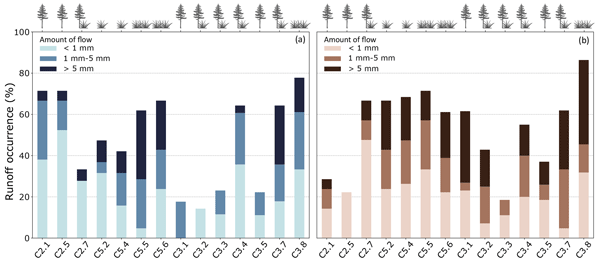
This study explored the occurrence of flow on and just below the soil surface for 14 small vegetated plots across a pre-Alpine catchment. Overland flow and lateral flow through the topsoil occurred frequently. The spatial variation in the occurrence and amount of flow depended on site characteristics, particularly the topographic wetness index. The amount of flow also depended on the antecedent-wetness conditions and total precipitation.
Mirjam Scheller, Nicola Durighetto, Anja Fischer, Reinhard Furrer, Marc Vis, Jan Seibert, Gianluca Botter, and Ilja van Meerveld
EGUsphere, https://doi.org/10.5194/egusphere-2026-4479, https://doi.org/10.5194/egusphere-2026-4479, 2026
This preprint is open for discussion and under review for Hydrology and Earth System Sciences (HESS).
Short summary
Short summary
Many streams do not always contain flowing water. Because these streams are rarely monitored, we tested whether observations by citizen scientists could be used to track whether streams were flowing. Although these observations were irregular in space and time, identifying the order in which sites started or stopped flowing allowed us to fill data gaps and estimate daily flow conditions across the area. This shows that volunteers can effectively monitor streams that sometimes dry up.
Marco M. Lehmann, Josie Geris, Ilja van Meerveld, Daniele Penna, Youri Rothfuss, Matteo Verdone, Pertti Ala-Aho, Matyas Arvai, Alise Babre, Philippe Balandier, Fabian Bernhard, Lukrecija Butorac, Simon D. Carrière, Natalie C. Ceperley, Zuosinan Chen, Alicia Correa, Haoyu Diao, David Dubbert, Maren Dubbert, Fabio Ercoli, Marius G. Floriancic, Alligin Ghazoul, Teresa E. Gimeno, Damien Gounelle, Frank Hagedorn, Christophe Hissler, Frédéric Huneau, Alberto Iraheta, Tamara Jakovljević, Nerantzis Kazakis, Zoltan Kern, Laura Kinzinger, Karl Knaebel, Johannes Kobler, Jiri Kocum, Charlotte Koeber, Gerbrand Koren, Angelika Kübert, Dawid Kupka, Samuel Le Gall, Aleksi Lehtonen, Thomas Leydier, Philippe Malagoli, Francesca Sofia Manca di Villahermosa, Chiara Marchina, Núria Martínez-Carreras, Nicolas Martin-StPaul, Hannu Marttila, Aline Meyer Oliveira, Gael Monvoisin, Natalie Orlowski, Kadi Palmik-Das, Aurel Persoiu, Andrei Popa, Egor Prikaziuk, Cécile Quantin, Katja T. Rinne-Garmston, Clara Rohde, Martin Sanda, Matthias Saurer, Daniel Schulz, Michael P. Stockinger, Christine Stumpp, Jean-Stéphane Vénisse, Lukas Vlcek, Stylianos Voudouris, Björn Weeser, Mark E. Wilkinson, Giulia Zuecco, and Katrin Meusburger
Earth Syst. Sci. Data, 17, 6129–6147, https://doi.org/10.5194/essd-17-6129-2025, https://doi.org/10.5194/essd-17-6129-2025, 2025
Short summary
Short summary
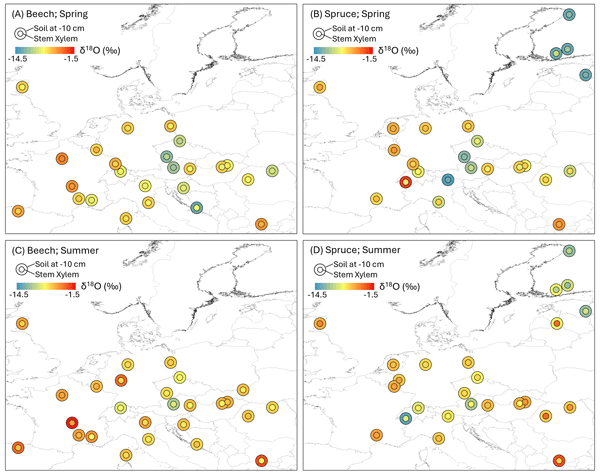
This study describes a unique large-scale isotope dataset to study water dynamics in European forests. Researchers collected data from 40 beech and spruce forest sites in spring and summer 2023, using a standardized method to ensure consistency. The results show that water sources for trees change between seasons and vary by tree species. This large dataset offers valuable information for understanding plant water use, improving ecohydrological models, and mapping water cycles across Europe.
Theresa Blume, Peter Chifflard, Stefan Achleitner, Andreas Hartmann, Stefan Hergarten, Luisa Hopp, Bernhard Kohl, Florian Leese, Ilja van Meerveld, Christian Reinhardt-Imjela, and Markus Weiler
EGUsphere, https://doi.org/10.5194/egusphere-2025-4424, https://doi.org/10.5194/egusphere-2025-4424, 2025
Short summary
Short summary
Subsurface stormflow (SSF) is one of the least studied and therefore least understood runoff generation processes because detecting and quantifying SSF is extremely challenging. We present an ongoing concerted experimental effort to systematically investigate SSF across four catchments using a variety of methods covering different spatial scales. Centerpiece of this effort is the construction of 12 large trenches to capture and monitor SSF.
Victor Aloyse Gauthier, Anna Leuteritz, and Ilja van Meerveld
Hydrol. Earth Syst. Sci., 29, 3889–3905, https://doi.org/10.5194/hess-29-3889-2025, https://doi.org/10.5194/hess-29-3889-2025, 2025
Short summary
Short summary
This study explored the occurrence of flow on and just below the soil surface for 14 small vegetated plots across a pre-Alpine catchment. Overland flow and lateral flow through the topsoil occurred frequently. The spatial variation in the occurrence and amount of flow depended on site characteristics, particularly the topographic wetness index. The amount of flow also depended on the antecedent-wetness conditions and total precipitation.
Izabela Bujak-Ozga, Jana von Freyberg, Margaret Zimmer, Andrea Rinaldo, Paolo Benettin, and Ilja van Meerveld
Hydrol. Earth Syst. Sci., 29, 2339–2359, https://doi.org/10.5194/hess-29-2339-2025, https://doi.org/10.5194/hess-29-2339-2025, 2025
Short summary
Short summary
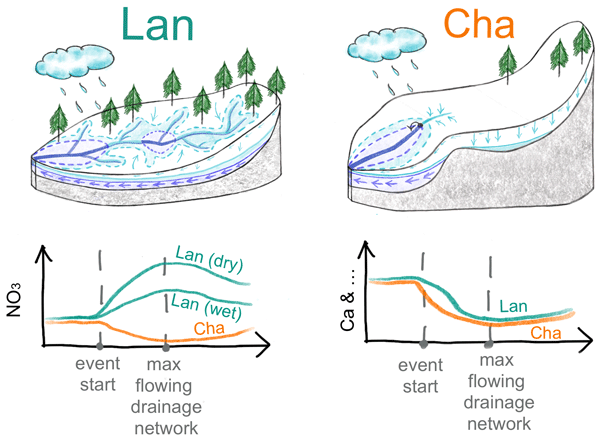
Stream networks expand and contract, affecting the amount and quality of water in perennial streams. This study presents measurements of changes in water chemistry and the flowing portion of the drainage network during rainfall events in two neighboring catchments. Despite the proximity and similar size, soil, and bedrock, water chemistry and stream network dynamics differed substantially in the two catchments. These differences are attributed to the differences in the slope and channel network.
Paolo Nasta, Günter Blöschl, Heye R. Bogena, Steffen Zacharias, Roland Baatz, Gabriëlle De Lannoy, Karsten H. Jensen, Salvatore Manfreda, Laurent Pfister, Ana M. Tarquis, Ilja van Meerveld, Marc Voltz, Yijian Zeng, William Kustas, Xin Li, Harry Vereecken, and Nunzio Romano
Hydrol. Earth Syst. Sci., 29, 465–483, https://doi.org/10.5194/hess-29-465-2025, https://doi.org/10.5194/hess-29-465-2025, 2025
Short summary
Short summary
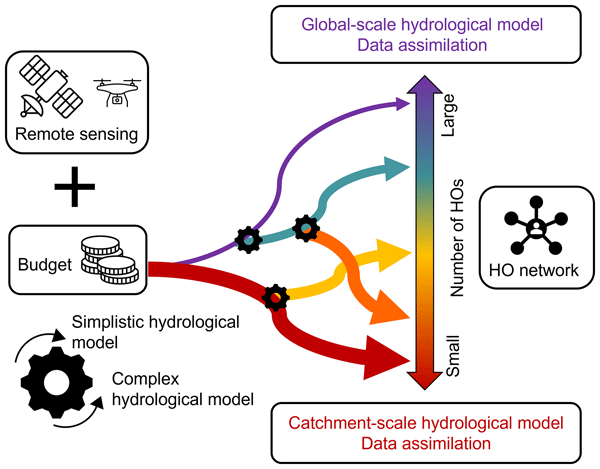
The Unsolved Problems in Hydrology (UPH) initiative has emphasized the need to establish networks of multi-decadal hydrological observatories to tackle catchment-scale challenges on a global scale. This opinion paper provocatively discusses two endmembers of possible future hydrological observatory (HO) networks for a given hypothesized community budget: a comprehensive set of moderately instrumented observatories or, alternatively, a small number of highly instrumented supersites.
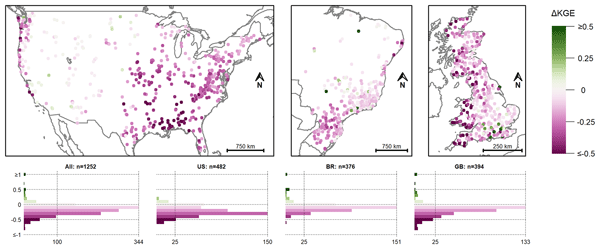
Franziska Clerc-Schwarzenbach, Giovanni Selleri, Mattia Neri, Elena Toth, Ilja van Meerveld, and Jan Seibert
Hydrol. Earth Syst. Sci., 28, 4219–4237, https://doi.org/10.5194/hess-28-4219-2024, https://doi.org/10.5194/hess-28-4219-2024, 2024
Short summary
Short summary
We show that the differences between the forcing data included in three CAMELS datasets (US, BR, GB) and the forcing data included for the same catchments in the Caravan dataset affect model calibration considerably. The model performance dropped when the data from the Caravan dataset were used instead of the original data. Most of the model performance drop could be attributed to the differences in precipitation data. However, differences were largest for the potential evapotranspiration data.
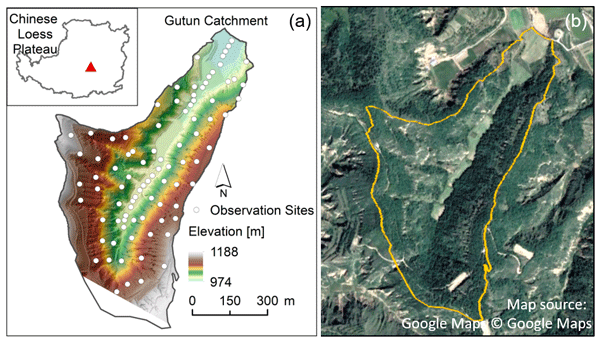
Shaozhen Liu, Ilja van Meerveld, Yali Zhao, Yunqiang Wang, and James W. Kirchner
Hydrol. Earth Syst. Sci., 28, 205–216, https://doi.org/10.5194/hess-28-205-2024, https://doi.org/10.5194/hess-28-205-2024, 2024
Short summary
Short summary
We study the seasonal and spatial patterns of soil moisture in 0–500 cm soil using 89 monitoring sites in a loess catchment with monsoonal climate. Soil moisture is highest during the months of least precipitation and vice versa. Soil moisture patterns at the hillslope scale are dominated by the aspect-controlled evapotranspiration variations (a local control), not by the hillslope convergence-controlled downslope flow (a nonlocal control), under both dry and wet conditions.
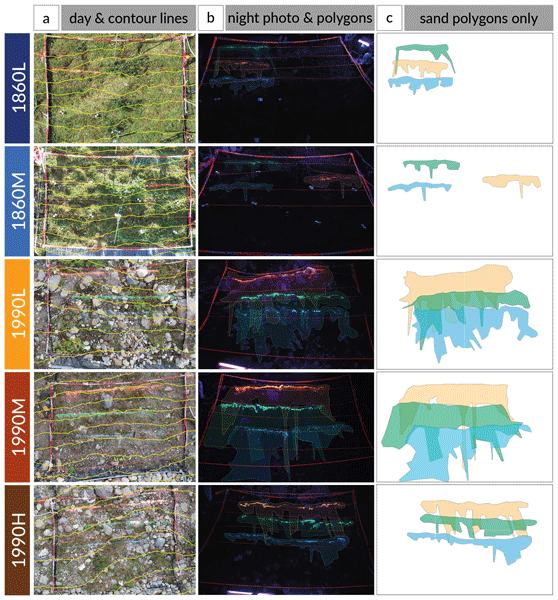
Fabian Maier, Florian Lustenberger, and Ilja van Meerveld
Hydrol. Earth Syst. Sci., 27, 4609–4635, https://doi.org/10.5194/hess-27-4609-2023, https://doi.org/10.5194/hess-27-4609-2023, 2023
Short summary
Short summary
We used a fluorescent sand tracer with afterglow in combination with sprinkling experiments to visualize and determine the movement of sediments on natural hillslopes. We compared the observed transport patterns with the characteristics of the hillslopes. Results show that the fluorescent sand can be used to monitor sediment redistribution on the soil surface and that infiltration on older hillslopes decreased sediment transport due to more developed vegetation cover and root systems.
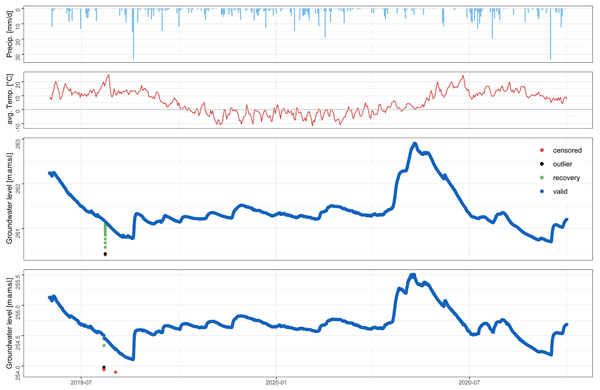
Jana Erdbrügger, Ilja van Meerveld, Jan Seibert, and Kevin Bishop
Earth Syst. Sci. Data, 15, 1779–1800, https://doi.org/10.5194/essd-15-1779-2023, https://doi.org/10.5194/essd-15-1779-2023, 2023
Short summary
Short summary
Groundwater can respond quickly to precipitation and is the main source of streamflow in most catchments in humid, temperate climates. To better understand shallow groundwater dynamics, we installed a network of groundwater wells in two boreal headwater catchments in Sweden. We recorded groundwater levels in 75 wells for 2 years and sampled the water and analyzed its chemical composition in one summer. This paper describes these datasets.
Fabian Maier, Florian Lustenberger, and Ilja van Meerveld
EGUsphere, https://doi.org/10.5194/egusphere-2022-165, https://doi.org/10.5194/egusphere-2022-165, 2022
Preprint archived
Short summary
Short summary
Knowledge on overland flow generation and sediment transport is limited due to a lack of observational methods. Thus, we used sprinkling experiments on two natural hillslopes and tested a novel method using fluorescent sand to visualize the movement of soil particles. The results show, that the applied method is suitable to track the movement of individual sediment particles and the particle transport distance depends on the surface characteristics of the hillslopes.
Cited articles
Anderson, A. E., Weiler, M., Alila, Y., and Hudson, R. O.: Dye staining and excavation of a lateral preferential flow network, Hydrol. Earth Syst. Sci., 13, 935–944, https://doi.org/10.5194/hess-13-935-2009, 2009a.
Anderson, A. E., Weiler, M., Alila, Y., and Hudson, R. O.: Subsurface flow velocities in a hillslope with lateral preferential flow, Water Resources Research, 45, https://doi.org/10.1029/2008WR007121, 2009b.
Anderson, S. P., Dietrich, W. E., Montgomery, D. R., Torres, R., Conrad, M. E., and Loague, K.: Subsurface flow paths in a steep, unchanneled catchment, Water Resources Research, 33, 2637–2653, https://doi.org/10.1029/97WR02595, 1997.
Bachmair, S. and Weiler, M.: Hillslope characteristics as controls of subsurface flow variability, Hydrol. Earth Syst. Sci., 16, 3699–3715, https://doi.org/10.5194/hess-16-3699-2012, 2012.
Basset, C., Abou Najm, M., Ghezzehei, T., Hao, X., and Daccache, A.: How does soil structure affect water infiltration? A meta-data systematic review, Soil and Tillage Research, 226, 105577, https://doi.org/10.1016/j.still.2022.105577, 2023.
Bazemore, D. E., Eshleman, K. N., and Hollenbeck, K. J.: The role of soil water in stormflow generation in a forested headwater catchment: synthesis of natural tracer and hydrometric evidence, Journal of Hydrology, 162, 47–75, https://doi.org/10.1016/0022-1694(94)90004-3, 1994.
Beiter, D., Weiler, M., and Blume, T.: Characterising hillslope–stream connectivity with a joint event analysis of stream and groundwater levels, Hydrol. Earth Syst. Sci., 24, 5713–5744, https://doi.org/10.5194/hess-24-5713-2020, 2020.
Bond, S., Kirkby, M. J., Johnston, J., Crowle, A., and Holden, J.: Seasonal vegetation and management influence overland flow velocity and roughness in upland grasslands, Hydrological Processes, 34, 3777–3791, https://doi.org/10.1002/hyp.13842, 2020.
Brown, V. A., McDonnell, J. J., Burns, D. A., and Kendall, C.: The role of event water, a rapid shallow flow component, and catchment size in summer stormflow, Journal of Hydrology, 217, 171–190, https://doi.org/10.1016/S0022-1694(98)00247-9, 1999.
Bujak-Ozga, I., von Freyberg, J., Zimmer, M., Rinaldo, A., Benettin, P., and van Meerveld, I.: Changes in the flowing drainage network and stream chemistry during rainfall events for two pre-Alpine catchments, Hydrol. Earth Syst. Sci., 29, 2339–2359, https://doi.org/10.5194/hess-29-2339-2025, 2025.
Buttle, J. M. and McDonald, D. J.: Coupled vertical and lateral preferential flow on a forested slope, Water Resources Research, 38, 18–1, https://doi.org/10.1029/2001WR000773, 2002.
Camporese, M., Penna, D., Borga, M., and Paniconi, C.: A field and modeling study of nonlinear storage-discharge dynamics for an Alpine headwater catchment, Water Resources Research, 50, 806–822, https://doi.org/10.1002/2013WR013604, 2014.
Dunne, T.: Field Studies of Hillslope Flow Processes, Hillslope Hydrology, edited by: Kirkby, M. J., John Wiley & Sons, Chichester, UK, ISBN 978-0-471-99510-4, 1978.
Ehrhardt, A., Berger, K., Filipović, V., Wöhling, T., Vogel, H., and Gerke, H. H.: Tracing lateral subsurface flow in layered soils by undisturbed monolith sampling, targeted laboratory experiments, and model-based analysis, Vadose Zone Journal, 21, e20206, https://doi.org/10.1002/vzj2.20206, 2022.
Essig, E. T., Corradini, C., Morbidelli, R., and Govindaraju, R. S.: Infiltration and deep flow over sloping surfaces: Comparison of numerical and experimental results, Journal of Hydrology, 374, 30–42, https://doi.org/10.1016/j.jhydrol.2009.05.017, 2009.
Feyen, H., Wunderli, H., Wydler, H., and Papritz, A.: A tracer experiment to study flow paths of water in a forest soil, Journal of Hydrology, 225, https://doi.org/10.1016/S0022-1694(99)00159-6, 1999.
Franzluebbers, A. J.: Water infiltration and soil structure related to organic matter and its stratification with depth, Soil & Tillage Research, 66, 97–205, https://doi.org/10.1016/S0167-1987(02)00027-2, 2001.
Freer, J., McDonnell, J., Beven, K. J., Brammer, D., Burns, D., Hooper, R. P., and Kendal, C.: Hydrological processes – Letters. Topographic controls on subsurface storm flow at the hillslope scale for two hydrologically distinct small catchmetns, Hydrological Processes, 11, 1347–1352, https://doi.org/10.1002/(SICI)1099-1085(199707)11:9<1347::AID-HYP592>3.0.CO;2-R, 1997.
Freer, J., McDonnell, J. J., Beven, K. J., Peters, N. E., Burns, D. A., Hooper, R. P., Aulenbach, B., and Kendall, C.: The role of bedrock topography on subsurface storm flow, Water Resources Research, 38, 5-1–5-16, https://doi.org/10.1029/2001wr000872, 2002.
Gauthier, V. and Leuteritz, A.: Flow and tracer data for overland flow and topsoil interflow during rainfall simulation experiments in the Studibach catchment – Alptal – Switzerland, EnviDat [data set], https://doi.org/10.16904/envidat.685, 2025.
Gauthier, V. A., Leuteritz, A., and van Meerveld, I.: When and where does near-surface runoff occur in a pre-Alpine headwater catchment?, Hydrol. Earth Syst. Sci., 29, 3889–3905, https://doi.org/10.5194/hess-29-3889-2025, 2025.
Gelmini, Y., Zuecco, G., Zaramella, M., Penna, D., and Borga, M.: Hysteresis in streamflow-water table relation provides a new classification system of rainfall-runoff events, Hydrological Processes, 36, e14685, https://doi.org/10.1002/hyp.14685, 2022.
Gerke, K. M., Sidle, R. C., and Mallants, D.: Preferential flow mechanisms identified from staining experiments in forested hillslopes, Hydrological Processes, 29, 4562–4578, https://doi.org/10.1002/hyp.10468, 2015.
Graham, C. B., Woods, R. A., and McDonnell, J. J.: Hillslope threshold response to rainfall: (1) A field based forensic approach, Journal of Hydrology, 393, 65–76, https://doi.org/10.1016/j.jhydrol.2009.12.015, 2010.
Hagedorn, F., Schleppi, P., Waldner, P., and Flühler, H.: Export of dissolved organic carbon and nitrogen from Gleysol dominated catchments – The significance of water flow paths, Biogeochemistry, 50, https://doi.org/10.1023/A:1006398105953, 2000.
Hallema, D. W., Moussa, R., Sun, G., and McNulty, S. G.: Surface storm flow prediction on hillslopes based on topography and hydrologic connectivity, Ecol. Process., 5, 13, https://doi.org/10.1186/s13717-016-0057-1, 2016.
Hiltbrunner, D., Schulze, S., Hagedorn, F., Schmidt, M. W. I., and Zimmmermann, S.: Cattle trampling alters soil properties and changes soil microbial communities in a Swiss sub-alpine pasture, Geoderma, 170, 369–377, https://doi.org/10.1016/j.geoderma.2011.11.026, 2012.
Holden, J., Kirkby, M. J., Lane, S. N., Milledge, D. G., Brookes, C. J., Holden, V., and McDonald, A. T.: Overland flow velocity and roughness properties in peatlands, Water Resources Research, 44, https://doi.org/10.1029/2007WR006052, 2008.
Hrachowitz, M., Benettin, P., van Breukelen, B. M., Fovet, O., Howden, N. J. K., Ruiz, L., van der Velde, Y., and Wade, A. J.: Transit times – the link between hydrology and water quality at the catchment scale, WIREs Water, 3, 629–657, https://doi.org/10.1002/wat2.1155, 2016.
Jackson, C. R., Du, E., Klaus, J., Griffiths, N. A., Bitew, M., and McDonnell, J. J.: Interactions among hydraulic conductivity distributions, subsurface topography, and transport thresholds revealed by a multitracer hillslope irrigation experiment, Water Resources Research, 52, 6186–6206, https://doi.org/10.1002/2015WR018364, 2016.
Jones, J. A. A.: Soil piping and catchment response, Hydrological Processes, 24, 1548–1566, https://doi.org/10.1002/hyp.7634, 2010.
Kienzler, P. M. and Naef, F.: Subsurface storm flow formation at different hillslopes and implications for the “old water paradox,” Hydrological Processes, 22, 104–116, https://doi.org/10.1002/hyp.6687, 2008.
Klaus, J., Zehe, E., Elsner, M., Külls, C., and McDonnell, J. J.: Macropore flow of old water revisited: experimental insights from a tile-drained hillslope, Hydrol. Earth Syst. Sci., 17, 103–118, https://doi.org/10.5194/hess-17-103-2013, 2013.
Kochiieru, M., Lamorski, K., Feizienė, D., Feiza, V., Šlepetienė, A., and Volungevičius, J.: Land use and soil types affect macropore network, organic carbon and nutrient retention, Lithuania, Geoderma Regional, 28, e00473, https://doi.org/10.1016/j.geodrs.2021.e00473, 2022.
Maier, F. and van Meerveld, I.: Long-Term Changes in Runoff Generation Mechanisms for Two Proglacial Areas in the Swiss Alps I: Overland Flow, Water Resources Research, 57, https://doi.org/10.1029/2021WR030221, 2021.
Maier, F., Lustenberger, F., and van Meerveld, I.: Assessment of plot-scale sediment transport on young moraines in the Swiss Alps using a fluorescent sand tracer, Hydrol. Earth Syst. Sci., 27, 4609–4635, https://doi.org/10.5194/hess-27-4609-2023, 2023.
McDonnell, J. J.: A Rationale for Old Water Discharge Through Macropores in a Steep, Humid Catchment, Water Resources Research, 26, 2821–2832, https://doi.org/10.1029/WR026i011p02821, 1990.
McDonnell, J. J. and Beven, K.: Debates – The future of hydrological sciences: A (common) path forward? A call to action aimed at understanding velocities, celerities and residence time distributions of the headwater hydrograph, Water Resources Research, 50, 5342–5350, https://doi.org/10.1002/2013WR015141, 2014.
McGuire, K. J. and McDonnell, J. J.: Hydrological connectivity of hillslopes and streams: Characteristic time scales and nonlinearities, Water Resources Research, 46, 2010WR009341, https://doi.org/10.1029/2010WR009341, 2010.
Meißl, G., Geitner, C., Batliner, A., Klebinder, K., Kohl, B., and Markart, G.: Brixenbach research catchment: Quantification of runoff process proportions in a small Alpine catchment depending on soil moisture states and precipitation characteristics, Hydrological Processes, 35, https://doi.org/10.1002/hyp.14186, 2021.
Meißl, G., Klebinder, K., Zieher, T., Lechner, V., Kohl, B., and Markart, G.: Influence of antecedent soil moisture content and land use on the surface runoff response to heavy rainfall simulation experiments investigated in Alpine catchments, Heliyon, 9, e18597, https://doi.org/10.1016/j.heliyon.2023.e18597, 2023.
Mohn, J., Schürmann, A., Hagedorn, F., Schleppi, P., and Bachofen, R.: Increased rates of denitrification in nitrogen-treated forest soils, Forest Ecology and Management, 137, 113–119, https://doi.org/10.1016/S0378-1127(99)00320-5, 2000.
Monger, F., Bond, S., Spracklen, D. V., and Kirkby, M. J.: Overland flow velocity and soil properties in established semi-natural woodland and wood pasture in an upland catchment, Hydrological Processes, 36, https://doi.org/10.1002/hyp.14567, 2022.
Montgomery, D. R., Dietrich, W. E., Torres, R., Anderson, S. P., Heffner, J. T., and Loague, K.: Hydrologic response of a steep, unchanneled valley to natural and applied rainfall, Water Resources Research, 33, 91–109, https://doi.org/10.1029/96WR02985, 1997.
Morbidelli, R., Corradini, C., Saltalippi, C., Flammini, A., and Govindaraju, R. S.: The role of slope on the overland flow production, WIT Transactions on Ecology and the Environment, 172, 63–71, https://doi.org/10.2495/RBM130061, 2013.
Mosley, M. P.: Streamflow generation in a forested watershed, New Zealand, Water Resources Research, 15, https://doi.org/10.1029/WR015i004p00795, 1979.
Mosley, M. P.: Subsurface flow velocities through selected forest soils, South Island, New Zealand, Journal of Hydrology, 55, 65–92, https://doi.org/10.1016/0022-1694(82)90121-4, 1982.
Ni, K., Fang, H., Yu, Z., and Fan, Z.: The velocity dependence of viscosity of flowing water, Journal of Molecular Liquids, 278, 234–238, https://doi.org/10.1016/j.molliq.2019.01.055, 2019.
Noguchi, S., Tsuboyama, Y., Sidle, R. C., and Hosoda, I.: Morphological Characteristics of Macropores and the Distribution of Preferential Flow Pathways in a Forested Slope Segment, Soil Science Soc. of Amer. J., 63, 1413–1423, https://doi.org/10.2136/sssaj1999.6351413x, 1999.
Pavlin, L., Széles, B., Strauss, P., Blaschke, A. P., and Blöschl, G.: Event and seasonal hydrologic connectivity patterns in an agricultural headwater catchment, Hydrol. Earth Syst. Sci., 25, 2327–2352, https://doi.org/10.5194/hess-25-2327-2021, 2021.
Putty, M. R. Y. and Prasad, R.: Runoff processes in headwater catchments – an experimental study in Western Ghats, South India, Journal of Hydrology, 235, 63–71, https://doi.org/10.1016/S0022-1694(00)00262-6, 2000.
Rasmussen, T. C., Baldwin, R. H., Dowd, J. F., and Williams, A. G.: Tracer vs. Pressure Wave Velocities through Unsaturated Saprolite, Soil Science Soc. of Amer. J., 64, 75–85, https://doi.org/10.2136/sssaj2000.64175x, 2000.
Rinderer, M., Van Meerveld, H. J., and Seibert, J.: Topographic controls on shallow groundwater levels in a steep, prealpine catchment: When are the TWI assumptions valid?, Water Resources Research, 50, https://doi.org/10.1002/2013WR015009, 2014.
Rinderer, M., van Meerveld, I., Stähli, M., and Seibert, J.: Is groundwater response timing in a pre-alpine catchment controlled more by topography or by rainfall?, Hydrological Processes, 30, 1036–1051, https://doi.org/10.1002/hyp.10634, 2016.
Saco, P. M. and Kumar, P.: Kinematic dispersion effects of hillslope velocities, Water Resources Research, 40, 2003WR002024, https://doi.org/10.1029/2003WR002024, 2004.
Scaini, A., Audebert, M., Hissler, C., Fenicia, F., Gourdol, L., Pfister, L., and Beven, K. J.: Velocity and celerity dynamics at plot scale inferred from artificial tracing experiments and time-lapse ERT, Journal of Hydrology, 546, 28–43, https://doi.org/10.1016/j.jhydrol.2016.12.035, 2017.
Scaini, A., Hissler, C., Fenicia, F., Juilleret, J., Iffly, J. F., Pfister, L., and Beven, K.: Hillslope response to sprinkling and natural rainfall using velocity and celerity estimates in a slate-bedrock catchment, Journal of Hydrology, 558, 366–379, https://doi.org/10.1016/j.jhydrol.2017.12.011, 2018.
Scherrer, S., Naef, F., Faeh, A. O., and Cordery, I.: Formation of runoff at the hillslope scale during intense precipitation, Hydrol. Earth Syst. Sci., 11, 907–922, https://doi.org/10.5194/hess-11-907-2007, 2007.
Schleppi, P., Muller, N., Feyen, H., Papritz, A., Bucher, J. B., and Flühler, H.: Nitrogen budgets of two small experimental forested catchments at Alptal, Switzerland, Forest Ecology and Management, 101, 177–185, https://doi.org/10.1016/S0378-1127(97)00134-5, 1998.
Schneider, P., Pool, S., Strouhal, L., and Seibert, J.: True colors – experimental identification of hydrological processes at a hillslope prone to slide, Hydrol. Earth Syst. Sci., 18, 875–892, https://doi.org/10.5194/hess-18-875-2014, 2014.
Schwab, M., Klaus, J., Pfister, L., and Weiler, M.: Diel discharge cycles explained through viscosity fluctuations in riparian inflow, Water Resources Research, 52, 8744–8755, https://doi.org/10.1002/2016WR018626, 2016.
Shannon, J., Liu, F., Van Grinsven, M., Kolka, R., and Pypker, T.: Magnitude, consequences and correction of temperature-derived errors for absolute pressure transducers under common monitoring scenarios, Hydrological Processes, 36, https://doi.org/10.1002/hyp.14457, 2022.
Sidle, R. C., Tsuboyama, Y., Noguchi, S., Hosoda, I., Fujieda, M., and Shimizu, T.: Stormflow generation in steep forested headwaters: a linked hydrogeomorphic paradigm, Hydrol. Process., 14, 369–385, https://doi.org/10.1002/(SICI)1099-1085(20000228)14:3<369::AID-HYP943>3.0.CO;2-P, 2000.
Sidle, R. C., Noguchi, S., Tsuboyama, Y., and Laursen, K.: A conceptual model of preferential flow systems in forested hillslopes: evidence of self-organization, Hydrological Processes, 15, 1675–1692, https://doi.org/10.1002/hyp.233, 2001.
Sidle, R. C., Hirano, T., Gomi, T., and Terajima, T.: Hortonian overland flow from Japanese forest plantations – An aberration, the real thing, or something in between?, Hydrological Processes, 21, 3237–3247, https://doi.org/10.1002/hyp.6876, 2007.
Stähli, M. and Gustafsson, D.: Long-term investigations of the snow cover in a subalpine semi-forested catchment, Hydrological Processes, 20, 411–428, https://doi.org/10.1002/hyp.6058, 2006.
Stähli, M., Seibert, J., Kirchner, J. W., von Freyberg, J., and van Meerveld, I.: Hydrological trends and the evolution of catchment research in the Alptal valley, central Switzerland, Hydrological Processes, 35, https://doi.org/10.1002/hyp.14113, 2021.
Stewart, R. D., Liu, Z., Rupp, D. E., Higgins, C. W., and Selker, J. S.: A new instrument to measure plot-scale runoff, Geosci. Instrum. Method. Data Syst., 4, 57–64, https://doi.org/10.5194/gi-4-57-2015, 2015.
Swiss Federal Office of Topography: band product image, airline no. 12501201906020851, resolution: 1m, 2019-06-02, SwissImage, https://www.swisstopo.admin.ch/en/orthoimage-swissimage-10 (last access: 26 November 2025), 2019.
Tani, M.: Runoff generation processes estimated from hydrological observations on a steep forested hillslope with a thin soil layer, Journal of Hydrology, 200, 84–109, https://doi.org/10.1016/S0022-1694(97)00018-8, 1997.
Torres, R., Dietrich, W. E., Montgomery, D. R., Anderson, S. P., and Loague, K.: Unsaturated zone processes and the hydrologic response of a steep, unchanneled catchment, Water Resources Research, 34, 1865–1879, https://doi.org/10.1029/98WR01140, 1998.
Tromp-van Meerveld, H. J. and McDonnell, J. J.: Threshold relations in subsurface stormflow: 1. A 147-storm analysis of the Panola hillslope, Water Resources Research, 42, 2004WR003778, https://doi.org/10.1029/2004WR003778, 2006a.
Tromp-Van Meerveld, H. J. and McDonnell, J. J.: Threshold relations in subsurface stormflow: 2. The fill and spill hypothesis, Water Resources Research, 42, https://doi.org/10.1029/2004WR003800, 2006b.
Tsuboyama, Y., Sidle, R. C., Noguchi, S., and Hosoda, I.: Flow and solute transport through the soil matrix and macropores of a hillslope segment, Water Resources Research, 30, 879–890, https://doi.org/10.1029/93WR03245, 1994.
Uchida, T., Asano, Y., Ohte, N., and Mizuyama, T.: Seepage area and rate of bedrock groundwater discharge at a granitic unchanneled hillslope, Water Resources Research, 39, https://doi.org/10.1029/2002WR001298, 2003.
Uchida, T., Tromp-van Meerveld, I., and McDonnell, J. J.: The role of lateral pipe flow in hillslope runoff response: an intercomparison of non-linear hillslope response, Journal of Hydrology, 311, 117–133, https://doi.org/10.1016/j.jhydrol.2005.01.012, 2005.
van Meerveld, H. J., Baird, E. J., and Floyd, W. C.: Controls on sediment production from an unpaved resource road in a Pacific maritime watershed, Water Resources Research, 50, 4803–4820, https://doi.org/10.1002/2013WR014605, 2014.
van Meerveld, H. J., Fischer, B. M. C., Rinderer, M., Stähli, M., and Seibert, J.: Runoff generation in a pre-alpine catchment: A discussion between a tracer and a shallow groundwater hydrologist, Geographical Research Letters, 44, https://doi.org/10.18172/cig.3349, 2018.
van Verseveld, W. J., Barnard, H. R., Graham, C. B., McDonnell, J. J., Brooks, J. R., and Weiler, M.: A sprinkling experiment to quantify celerity–velocity differences at the hillslope scale, Hydrol. Earth Syst. Sci., 21, 5891–5910, https://doi.org/10.5194/hess-21-5891-2017, 2017.
Vlček, L., Falátková, K., and Schneider, P.: Identification of runoff formation with two dyes in a mid-latitude mountain headwater, Hydrol. Earth Syst. Sci., 21, 3025–3040, https://doi.org/10.5194/hess-21-3025-2017, 2017.
Wadman, M.: Spatial variability of infiltration in a pre-alpine catchment, Wageningen University, Wageningen, 2023.
Weiler, M. and Flühler, H.: Inferring flow types from dye patterns in macroporous soils, Geoderma, 120, 137–153, https://doi.org/10.1016/j.geoderma.2003.08.014, 2004.
Weiler, M. and Naef, F.: An experimental tracer study of the role of macropores in infiltration in grassland soils, Hydrological Processes, 17, 477–493, https://doi.org/10.1002/hyp.1136, 2003.
Weiler, M., Naef, F., and Leibundgut, C.: Study of runoff generation on hillslopes using tracer experiments and a physically based numerical hillslope model, IAHS publication, 248, 353–360, 1998.
Weiler, M., Scherrer, S. C., Naef, F., and Burlando, P.: Hydrograph separation of runoff components based on measuring hydraulic state variables, tracer experiments, and weighting methods, IAHS-AISH publication, 258, 249–255, 1999.
Weiler, M., McDonnell, J. J., Tromp-van Meerveld, I., and Uchida, T.: Subsurface Stormflow, in: Encyclopedia of Hydrological Sciences, Wiley, https://doi.org/10.1002/0470848944.hsa119, 2006.
Wienhöfer, J., Germer, K., Lindenmaier, F., Färber, A., and Zehe, E.: Applied tracers for the observation of subsurface stormflow at the hillslope scale, Hydrol. Earth Syst. Sci., 13, 1145–1161, https://doi.org/10.5194/hess-13-1145-2009, 2009.
Wilson, G. V., Rigby, J. R., Ursic, M., and Dabney, S. M.: Soil pipe flow tracer experiments: 1. Connectivity and transport characteristics, Hydrological Processes, 30, 1265–1279, https://doi.org/10.1002/hyp.10713, 2016.
Wolstenholme, J. M., Smith, M. W., Baird, A. J., and Sim, T. G.: A new approach for measuring surface hydrological connectivity, Hydrological Processes, 34, 538–552, https://doi.org/10.1002/hyp.13602, 2020.
Woods, R. and Rowe, L.: The Changing Spatial Variability of Subsurface Flow Across a Hillside, Journal of Hydrology (NZ), 35, 51–86, 1996.
Zhang, S., Grip, H., and Lövdahl, L.: Effect of soil compaction on hydraulic properties of two loess soils in China, Soil and Tillage Research, 90, 117–125, https://doi.org/10.1016/j.still.2005.08.012, 2006.
Short summary
We applied rainfall and tracers on two 8 m wide runoff plots to better understand runoff generation processes in pre-Alpine catchments with low permeability gleysols. The results highlight the frequent occurrence of infiltration and exfiltration of water, the importance of preferential flow, and the quick runoff response (i.e., high celerity) and transport of solutes (i.e., high velocity). These results help to understand why streams in the study region respond very quickly to rainfall.
We applied rainfall and tracers on two 8 m wide runoff plots to better understand runoff...


