
Articles | Volume 30, issue 6
https://doi.org/10.5194/hess-30-1755-2026
© Author(s) 2026. This work is distributed under
the Creative Commons Attribution 4.0 License.
the Creative Commons Attribution 4.0 License.
https://doi.org/10.5194/hess-30-1755-2026
© Author(s) 2026. This work is distributed under
the Creative Commons Attribution 4.0 License.
the Creative Commons Attribution 4.0 License.
Research article
| 
31 Mar 2026
Research article |
| 31 Mar 2026
| 31 Mar 2026
Exploring groundwater-surface water interactions and recharge in fractured mountain systems: an integrated approach
Sofia Ortenzi
Department of Physics and Geology, University of Perugia, Perugia, 06123, Italy
National Research Council, Research Institute for Geo-Hydrological Protection, Perugia, 06126, Italy

Department of Physics and Geology, University of Perugia, Perugia, 06123, Italy
Daniela Valigi
Department of Physics and Geology, University of Perugia, Perugia, 06123, Italy
Marco Donnini
National Research Council, Research Institute for Geo-Hydrological Protection, Perugia, 06126, Italy
Marco Dionigi
National Research Council, Research Institute for Geo-Hydrological Protection, Perugia, 06126, Italy
Davide Fronzi
Department of Science and Matter Engineering, Environment, and Urban Planning, Marche Polytechnic University, Ancona, 60131, Italy
Josie Geris
School of Geosciences, University of Aberdeen, Aberdeen, AB24 3UE, UK
Fabio Guadagnano
Department of Physics and Geology, University of Perugia, Perugia, 06123, Italy
Ivan Marchesini
National Research Council, Research Institute for Geo-Hydrological Protection, Perugia, 06126, Italy
Paolo Filippucci
National Research Council, Research Institute for Geo-Hydrological Protection, Perugia, 06126, Italy
Francesco Avanzi
CIMA Research Foundation, University Campus of Savona, Savona, 17100, Italy
Daniele Penna
National Research Council, Research Institute for Geo-Hydrological Protection, Perugia, 06126, Italy
Department of Agriculture, Food, Environment and Forestry, University of Florence, Firenze, 50145, Italy
Forest Engineering Resources and Management Department, Oregon State University, Corvallis, OR 97331, USA
Christian Massari
National Research Council, Research Institute for Geo-Hydrological Protection, Perugia, 06126, Italy
Related authors
No articles found.
Giuseppe Esposito, Rosa Maria Cavalli, Ginevra Chelli, Ivan Marchesini, Daniela Molinari, Roberto Passarella, Paola Salvati, Simone Sterlacchini, Debora Voltolina, Marco Zazzeri, and Marco Milella
EGUsphere, https://doi.org/10.5194/egusphere-2026-5297, https://doi.org/10.5194/egusphere-2026-5297, 2026
This preprint is open for discussion and under review for Geoscience Communication (GC).
Short summary
Short summary
This interdisciplinary study bridges natural and social sciences through active collaboration among community members and researchers. By testing a series of participatory approaches in areas at risk, the work aims to enhance students' flood risk knowledge and foster self-protection behaviors. Field activities and peer-to-peer events provided valuable feedback on the proposed communication strategies and data collection procedures aimed at effective flood risk reduction.
Marco Dionigi, Tommaso Moramarco, Domenico De Santis, Christian Massari, Silvia Barbetta, and Stefania Camici
EGUsphere, https://doi.org/10.5194/egusphere-2026-5965, https://doi.org/10.5194/egusphere-2026-5965, 2026
This preprint is open for discussion and under review for Natural Hazards and Earth System Sciences (NHESS).
Short summary
Short summary
Flood forecasting is challenging in river basins with sparse monitoring networks. We developed a database of pre-computed flood simulations for the Crati River basin in southern Italy, combining stochastically generated rainfall and air temperature with a hydrological model run under different soil moisture conditions. Satellite soil moisture observations select the most relevant simulations, providing river flows in real time. The same approach could be applied to other poorly gauged basins.
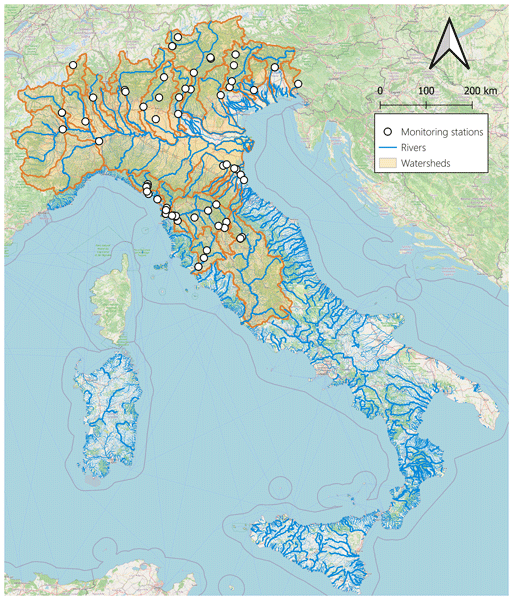
Marco Luppichini, Francesco Comiti, Andrea Andreoli, Barbara Aldighieri, Paolo Billi, Irene Maria Bollati, Andrea Brenna, Diletta Chirici, Paolo Ciavola, Silvia Cilli, Marco Donnini, Simona Francalanci, Lorenzo Innocenti, Laura Longoni, Luca Mao, Ivan Marchesini, Ilenia Murgia, Giacomo Pellegrini, Daniele Penna, Lorenzo Picco, Riccardo Rainato, Leonardo Schippa, Luca Solari, Gianluca Tronti, Bruno Testa, Matteo Verdone, and Monica Bini
Earth Syst. Sci. Data, 18, 7021–7041, https://doi.org/10.5194/essd-18-7021-2026, https://doi.org/10.5194/essd-18-7021-2026, 2026
Short summary
Short summary
Rivers carry sediment that shapes landscapes and coasts, but in Italy these data are scattered and often incomplete. We created a national database and online platform to gather and organize past and present sediment measurements in one place. By linking data with clear information about where, when, and how they were collected, we made them easier to explore and compare over time.
Nunzio Romano, Harry Vereecken, Heye R. Bogena, Giorgio Cassiani, Matteo Censini, Giovanna Armiento, Marco Proposito, Lorenzo De Silvestri, Eyal Ben Dor, Nicolas Francos, Christian Massari, János Mészáros, Tünde Takáts, Caterina Mazzitelli, Benedetto Sica, Ugo Lazzaro, and Paolo Nasta
Earth Syst. Sci. Data Discuss., https://doi.org/10.5194/essd-2026-725, https://doi.org/10.5194/essd-2026-725, 2026
Preprint under review for ESSD
Short summary
Short summary
Understanding how climate and land-use change affect water resources requires observations that connect processes from soils and vegetation to groundwater and streams. The Alento dataset is presented that integrates environmental monitoring with targeted field observations across multiple Critical Zone components and scales. The dataset offers a distinctive resource for studying water storage and movement, evaluating environmental models, and improving understanding of water-limited regions.
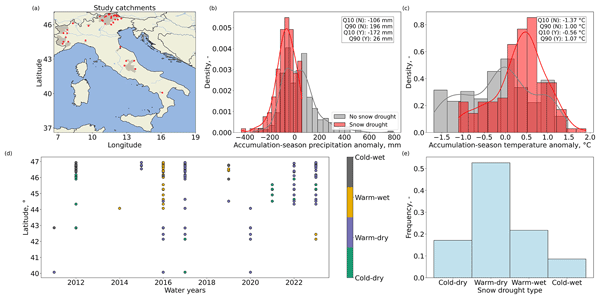
Francesco Avanzi, Stefano Terzi, Mariapina Castelli, Francesca Munerol, Margherita Andreaggi, Marta Galvagno, Andrea Galletti, Tessa Maurer, Christian Massari, Grace Carlson, Manuela Girotto, Giacomo Bertoldi, Edoardo Cremonese, Simone Gabellani, Umberto Morra di Cella, Marco Altamura, Lauro Rossi, and Luca Ferraris
Hydrol. Earth Syst. Sci., 30, 5769–5790, https://doi.org/10.5194/hess-30-5769-2026, https://doi.org/10.5194/hess-30-5769-2026, 2026
Short summary
Short summary
Snow droughts are periods with below-average snow accumulation and are becoming more frequent in a warming climate, yet their ecosystem and societal impacts remain poorly known. Using 13 years of data from 38 Italian catchments, we show that snow droughts reduced snow duration, increased winter melt-out events, and cut summer runoff by ~50 %. Photosynthesis increased by up to 10 % due to earlier meltout. These events also caused widespread water-supply reductions, especially in foothills.
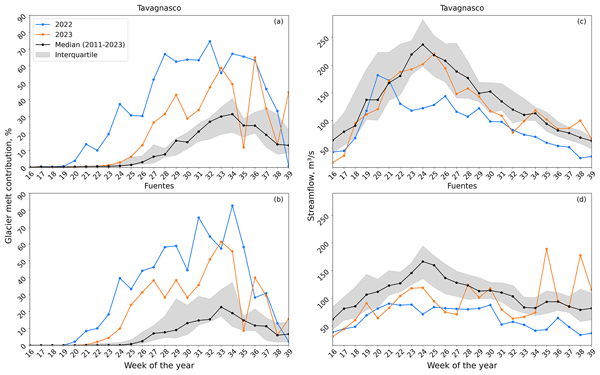
Martina Leone, Francesco Avanzi, Umberto Morra di Cella, Simone Gabellani, Edoardo Cremonese, Michel Isabellon, Paolo Pogliotti, Riccardo Scotti, Andrea Monti, Luca Ferraris, and Roberto Colombo
Hydrol. Earth Syst. Sci., 30, 4649–4666, https://doi.org/10.5194/hess-30-4649-2026, https://doi.org/10.5194/hess-30-4649-2026, 2026
Short summary
Short summary
We investigated how glaciers helped sustain summer river flow during the severe snow shortages of 2022 and 2023 in the Italian Alps. Using high-resolution modeling and long-term data, we found that glacier melt contributed up to three times more than in average years. This enhanced melt partly compensated for low snow and precipitation, showing the critical role of glaciers in supporting water resources during droughts.
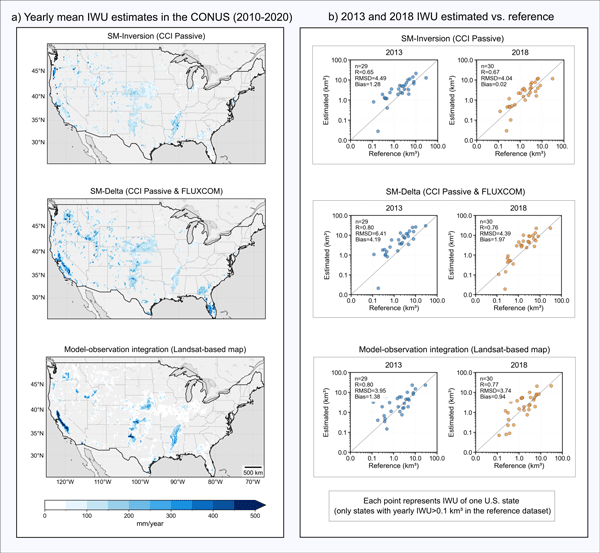
Pierre Laluet, Jacopo Dari, Louise Busschaert, Zdenko Heyvaert, Gabrielle De Lannoy, Pia Langhans, Sara Modanesi, Christian Massari, Luca Brocca, Carla Saltalippi, Renato Morbidelli, Clément Albergel, and Wouter Dorigo
Earth Syst. Sci. Data, 18, 4833–4853, https://doi.org/10.5194/essd-18-4833-2026, https://doi.org/10.5194/essd-18-4833-2026, 2026
Short summary
Short summary
We developed a long-term dataset collection of irrigation water use based on about two decades of satellite observations, three distinct approaches, and many input datasets. The collection provides monthly estimates for major agricultural regions and helps describe how irrigation varies across locations, seasons, and years. It offers a foundation for improving how irrigation is quantified, compared across methods, and integrated into large-scale hydrological and climate studies.
Francesco Avanzi, Hans Lievens, Michael Matiu, Paolo Filippucci, Oscar M. Baez Villanueva, Simone Gabellani, Fabio Delogu, Lorenzo Alfieri, Andrea Libertino, Pere Quintana-Seguì, Diego G. Miralles, Luca Brocca, Christian Massari, and Gabriëlle J. M. De Lannoy
EGUsphere, https://doi.org/10.5194/egusphere-2026-2851, https://doi.org/10.5194/egusphere-2026-2851, 2026
Short summary
Short summary
We developed a new system to map and monitor snow and stored water across large mountain regions using satellite data and computer simulations. Tested in four major European river basins, the system reproduced snow conditions with high accuracy and realistically captured how snow changes with elevation. Because it does not rely on ground measurements, it can help provide consistent information on snow-water resources worldwide, supporting water management and climate adaptation.
Ather Abbas, Yuan Yang, Ming Pan, Yves Tramblay, Chaopeng Shen, Haoyu Ji, Solomon H. Gebrechorkos, Florian Pappenberger, JongCheol Pyo, Dapeng Feng, George Huffman, Phu Nguyen, Christian Massari, Luca Brocca, Jackson Tan, and Hylke E. Beck
Hydrol. Earth Syst. Sci., 30, 3399–3423, https://doi.org/10.5194/hess-30-3399-2026, https://doi.org/10.5194/hess-30-3399-2026, 2026
Short summary
Short summary
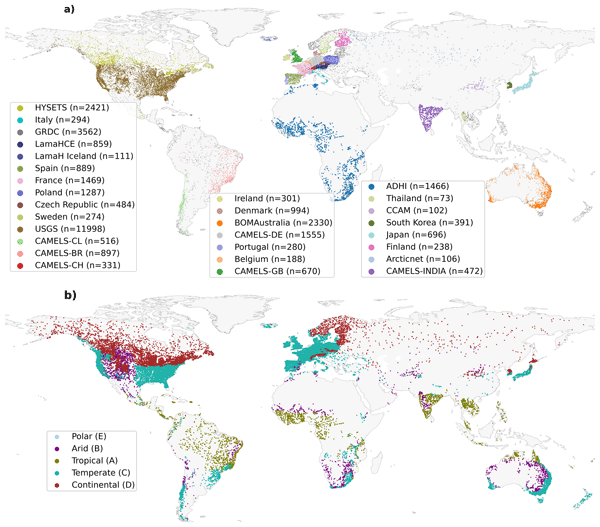
Our study evaluated 24 precipitation datasets using a hydrological model at global scale to assess their suitability and accuracy. We found that MSWEP (Multi-Source Weighted-Ensemble Precipitation) V2.8 excels due to its ability to integrate data from multiple sources, while others, such as IMERG (Integrated Multi-satellitE Retrievals for Global Precipitation Mission) and GDAS (Global Data Assimilation System), demonstrated strong regional performances. This research assists in selecting the appropriate dataset for applications in water resource management, hazard assessment, agriculture, and environmental monitoring.
Gökhan Sarigil, Mattia Neri, Francesco Avanzi, and Elena Toth
EGUsphere, https://doi.org/10.5194/egusphere-2026-2484, https://doi.org/10.5194/egusphere-2026-2484, 2026
Short summary
Short summary
The study evaluates Snow Water Equivalent estimates from three large-scale land-surface products against a national reference dataset in Italy. Highlighting the performances of the products over the different regions and relating them to the biases in the meteorological forcing, the results provide insights for using SWE estimates in long-term hydro-climatological assessments in Italy and for data selection when evaluating snow dynamics in mountainous regions lacking high-quality benchmark data.
Süleyman Selim Çallı, Kübra Özdemir Çallı, Brahim Akdim, Bruno Arfib, Aleksey Benderev, Sandra Beranger, Avi Burg, Onur Can, Jean-Baptiste Charlier, Mehmet Çelik, Arda Melih Çetin, Fehdi Chemseddine, Miroslava Deliyska, Lucio Di Matteo, Marco Dionigi, Romeo Eftimi, Jutta Eybl, Davide Fronzi, Nico Goldscheider, Ergin Gökkaya, Jorge Jodar, Herve Jourde, Eva Kaminsky, Konstantina Katsanou, Alireza Kavousi, Melike Kaya, David Labat, Tanja Liesch, Peter Malik, Christian Massari, Cyril Mayaud, Naomi Mazzilli, Pavel Pracny, Natasa Ravbar, Nathan Rispal, Simon Seelig, Vianney Sivelle, Marc Steinmann, Daniela Valigi, Gerfried Winkler, Ahmet Kemal Yahşi, and Andreas Hartmann
Earth Syst. Sci. Data Discuss., https://doi.org/10.5194/essd-2026-281, https://doi.org/10.5194/essd-2026-281, 2026
Revised manuscript under review for ESSD
Short summary
Short summary
Karst groundwater systems are vital but highly sensitive to climate change. Their complex underground flow makes them hard to manage without good data, so we gathered 118 high-quality records of spring discharge across Mediterranean mountain ranges. With an average of 19 years of data – including one nearly century-long record – this collection provides the detailed information needed to better predict water availability and protect these vulnerable groundwater sources.
Louise Busschaert, Michel Bechtold, Sara Modanesi, Christian Massari, Dirk Raes, Sujay V. Kumar, and Gabriëlle J. M. De Lannoy
Hydrol. Earth Syst. Sci., 30, 2579–2611, https://doi.org/10.5194/hess-30-2579-2026, https://doi.org/10.5194/hess-30-2579-2026, 2026
Short summary
Short summary
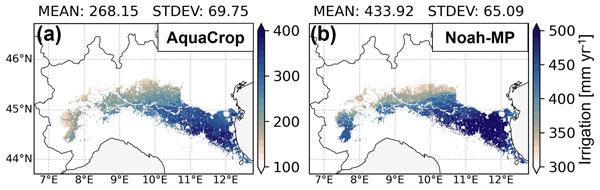
Two models, AquaCrop (crop model) and Noah-MP (land surface model), were compared estimating irrigation in Italy's Po Valley. Noah-MP simulated higher water use (434 mm/yr) than AquaCrop (268 mm/yr), mainly due to extra water losses like runoff. Once losses were accounted for, both aligned with basin-scale reports of around 500 to 600 mm/yr. The study highlights how complex irrigation modeling is, and the need for better observational data to validate results.
Han Fu, Ming Gao, Huijie Li, Daniele Penna, Junming Liu, Bingcheng Si, and Wenxiu Zou
Hydrol. Earth Syst. Sci., 30, 1951–1968, https://doi.org/10.5194/hess-30-1951-2026, https://doi.org/10.5194/hess-30-1951-2026, 2026
Short summary
Short summary
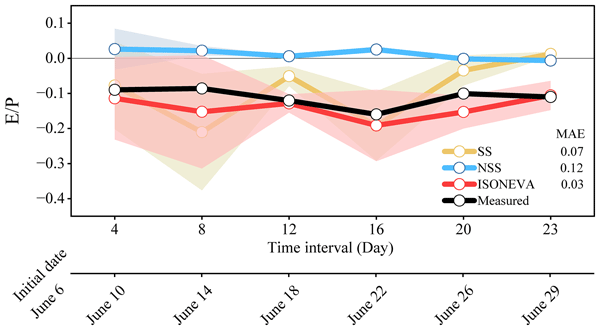
We present ISONEVA, a new isotope-based framework for estimating soil water evaporation that explicitly accounts for dynamic soil water storage and non-evaporative fluxes. Numerical and field validations demonstrate that ISONEVA substantially improves evaporation estimates compared to traditional steady-state and non-steady-state approaches, and provides a robust basis for assessing long-term average evaporation to precipitation (E/P) ratios.
Oscar M. Baez-Villanueva, Alfredo Crespo-Otero, Sara Modanesi, Pierre Laluet, Sergio Vicente-Serrano, Jaap Schellekens, Jacopo Dari, Hylke E. Beck, Wouter Dorigo, Christian Massari, Chiara Corbari, Joppe Massant, Kwint Delbare, Olivier Bonte, Aaron Boone, Diego Fernández-Prieto, and Diego G. Miralles
EGUsphere, https://doi.org/10.5194/egusphere-2026-1856, https://doi.org/10.5194/egusphere-2026-1856, 2026
Short summary
Short summary
We developed a new method to estimate daily land evaporation at high resolution across the Iberian Peninsula, explicitly accounting for irrigation. By combining satellite and meteorological data, we show that irrigation can strongly increase evaporation in agricultural areas. The results better match ground observations and improve understanding of water use. This approach can support farming decisions and water management at the regional scale, and will be extended to global applications.
Ehsan Modiri, Oldrich Rakovec, Pallav Kumar Shrestha, Almudena García-García, Leandro Avila, Katie Blackford, Elizabeth Cooper, Bram Droppers, Paolo Filippucci, Milan Fischer, Matěj Orság, Pietro Stradiotti, Luca Brocca, Douglas B. Clark, Wouter Dorigo, Stefan Kollet, Jian Peng, Niko Wanders, and Luis Samaniego
EGUsphere, https://doi.org/10.5194/egusphere-2026-1012, https://doi.org/10.5194/egusphere-2026-1012, 2026
Short summary
Short summary
Drought impacts water supply, agriculture, and ecosystems, yet hydrological models often disagree on when and where drought occurs. This study tested whether satellite observations can improve how models represent soil moisture drought in the Rhine River basin. Using several models and major drought events, we show that satellite data improve spatial realism and reveal important differences among models, helping to better understand uncertainty in drought monitoring and early warning.
Shima Azimi, Manuela Girotto, Riccardo Rigon, Gaia Roati, Silvia Barbetta, and Christian Massari
EGUsphere, https://doi.org/10.5194/egusphere-2026-793, https://doi.org/10.5194/egusphere-2026-793, 2026
Short summary
Short summary
Even ground-based precipitation observations, often considered the most reliable, can introduce substantial uncertainty into snow modeling due to sparse gauge coverage at high elevations in mountainous catchments.This challenge motivates the present study, in which we propose a data assimilation framework that integrates satellite-based snow depth into a hydrological model to correct snowfall estimates over the Italian Alps, with implications for water management in data-scarce mountain regions.
Domenico De Santis, Silvia Barbetta, Sumit Sen, Viviana Maggioni, Farhad Bahmanpouri, Ashutosh Sharma, Ankit Agarwal, Sagar Gupta, Francesco Avanzi, and Christian Massari
Nat. Hazards Earth Syst. Sci., 26, 1075–1104, https://doi.org/10.5194/nhess-26-1075-2026, https://doi.org/10.5194/nhess-26-1075-2026, 2026
Short summary
Short summary
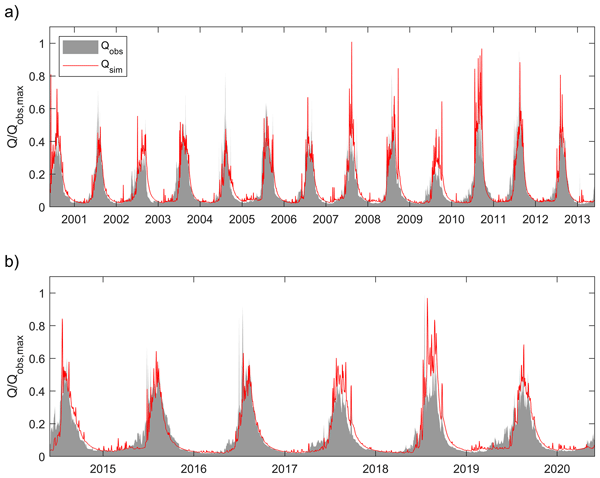
A conceptual, semi-distributed hydrological model was tailored to simulate high flows in monsoon-dominated, glacier-influenced and flood-prone Himalayan basins. Multi-data calibration using satellite-based glacier mass loss and evapotranspiration estimates improved process realism in data-scarce environments. The proposed modelling approach captured key streamflow features despite significant input uncertainties, proving to be a useful tool for exploring the local hydrological response dynamics.
Senna Bouabdelli, Martin Morlot, Christian Massari, and Giuseppe Formetta
EGUsphere, https://doi.org/10.5194/egusphere-2026-464, https://doi.org/10.5194/egusphere-2026-464, 2026
Short summary
Short summary
Drought is becoming more common in the Alps as warmer winters reduce snow and alter river flow. We used hydrological model simulations in the Adige basin to understand when and why droughts occur. Results show that droughts are happening earlier, becoming more intense, and increasingly driven by lack of rain instead of melting snow at high elevations. This shift toward lower-elevation river behaviour calls for new strategies to manage water for hydropower, agriculture, and tourism.
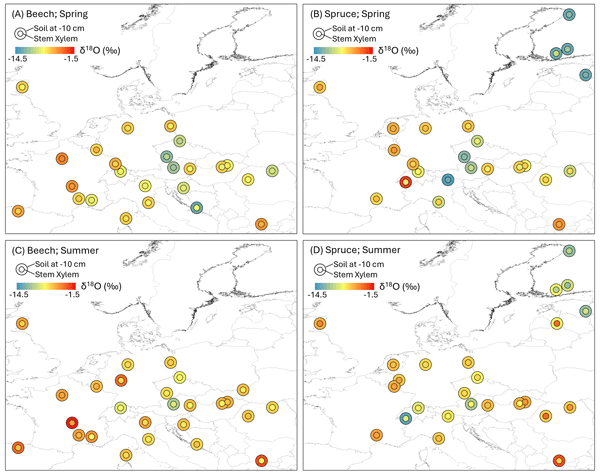
Marco M. Lehmann, Josie Geris, Ilja van Meerveld, Daniele Penna, Youri Rothfuss, Matteo Verdone, Pertti Ala-Aho, Matyas Arvai, Alise Babre, Philippe Balandier, Fabian Bernhard, Lukrecija Butorac, Simon D. Carrière, Natalie C. Ceperley, Zuosinan Chen, Alicia Correa, Haoyu Diao, David Dubbert, Maren Dubbert, Fabio Ercoli, Marius G. Floriancic, Alligin Ghazoul, Teresa E. Gimeno, Damien Gounelle, Frank Hagedorn, Christophe Hissler, Frédéric Huneau, Alberto Iraheta, Tamara Jakovljević, Nerantzis Kazakis, Zoltan Kern, Laura Kinzinger, Karl Knaebel, Johannes Kobler, Jiri Kocum, Charlotte Koeber, Gerbrand Koren, Angelika Kübert, Dawid Kupka, Samuel Le Gall, Aleksi Lehtonen, Thomas Leydier, Philippe Malagoli, Francesca Sofia Manca di Villahermosa, Chiara Marchina, Núria Martínez-Carreras, Nicolas Martin-StPaul, Hannu Marttila, Aline Meyer Oliveira, Gael Monvoisin, Natalie Orlowski, Kadi Palmik-Das, Aurel Persoiu, Andrei Popa, Egor Prikaziuk, Cécile Quantin, Katja T. Rinne-Garmston, Clara Rohde, Martin Sanda, Matthias Saurer, Daniel Schulz, Michael P. Stockinger, Christine Stumpp, Jean-Stéphane Vénisse, Lukas Vlcek, Stylianos Voudouris, Björn Weeser, Mark E. Wilkinson, Giulia Zuecco, and Katrin Meusburger
Earth Syst. Sci. Data, 17, 6129–6147, https://doi.org/10.5194/essd-17-6129-2025, https://doi.org/10.5194/essd-17-6129-2025, 2025
Short summary
Short summary
This study describes a unique large-scale isotope dataset to study water dynamics in European forests. Researchers collected data from 40 beech and spruce forest sites in spring and summer 2023, using a standardized method to ensure consistency. The results show that water sources for trees change between seasons and vary by tree species. This large dataset offers valuable information for understanding plant water use, improving ecohydrological models, and mapping water cycles across Europe.
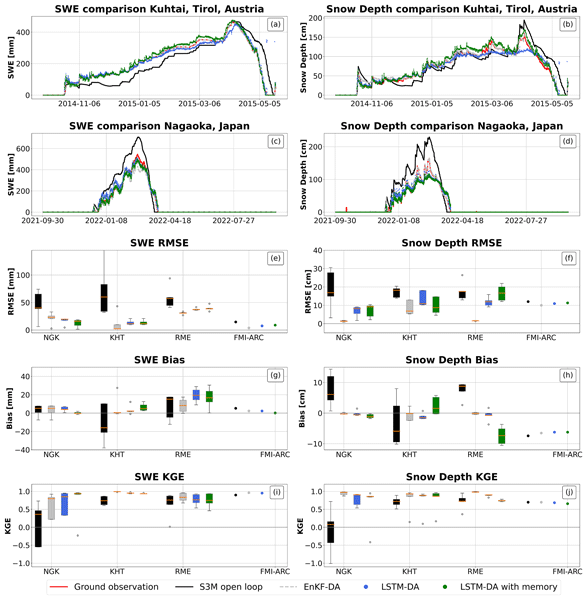
Giulia Blandini, Francesco Avanzi, Lorenzo Campo, Simone Gabellani, Kristoffer Aalstad, Manuela Girotto, Satoru Yamaguchi, Hiroyuki Hirashima, and Luca Ferraris
The Cryosphere, 19, 4759–4783, https://doi.org/10.5194/tc-19-4759-2025, https://doi.org/10.5194/tc-19-4759-2025, 2025
Short summary
Short summary
Reliable snow water equivalent and snow depth estimates are key for water management in snow regions. To tackle computational challenges in data assimilation, we propose a Long Short-Term Memory neural network for operational use in snow hydrology. Once trained, it reduces computational cost by 70 percent compared to the Ensemble Kalman Filter, with a slight decrease in performances. This deep learning approach provides a scalable, efficient, and cost-effective modeling solution for hydrology.
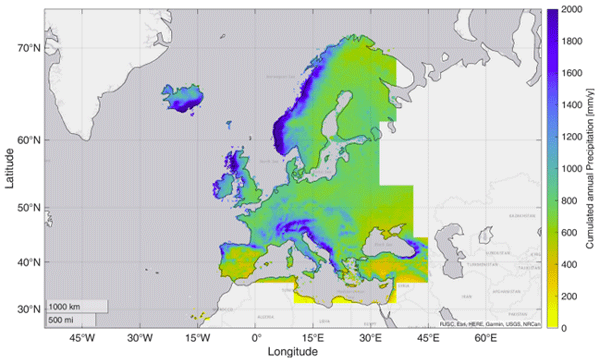
Paolo Filippucci, Luca Brocca, Luca Ciabatta, Hamidreza Mosaffa, Francesco Avanzi, and Christian Massari
Earth Syst. Sci. Data, 17, 5221–5258, https://doi.org/10.5194/essd-17-5221-2025, https://doi.org/10.5194/essd-17-5221-2025, 2025
Short summary
Short summary
Accurate rainfall data is essential, yet measuring daily precipitation worldwide is challenging. This research presents HYdroclimatic PERformance-enhanced Precipitation (HYPER-P), a dataset combining satellite, ground, and reanalysis data to estimate precipitation at a 1 km scale from 2000 to 2022. HYPER-P improves accuracy, especially in areas with few rain gauges. This dataset supports scientists and decision-makers in understanding and managing water resources more effectively.
Xiangmei Liu, Peng Shen, Jiaqi Chen, David Andrew Barry, Christian Massari, Jiansheng Chen, Mingming Feng, Xi Zhang, Fenyan Ma, Fei Yang, and Haixia Jin
EGUsphere, https://doi.org/10.5194/egusphere-2025-4263, https://doi.org/10.5194/egusphere-2025-4263, 2025
Preprint archived
Short summary
Short summary
Our research in the Songnen Basin of Northeast China has revealed why numerous lakes remain unfrozen during winter. By studying Lake Chagan, we discovered that deep groundwater sustains these lakes, likely flowing through subterranean channels from the Tibetan Plateau. When earthquakes disrupt these conduits, water rises along fault lines to replenish the lakes. This finding challenges the theory that graben lakes primarily depend on local precipitation.
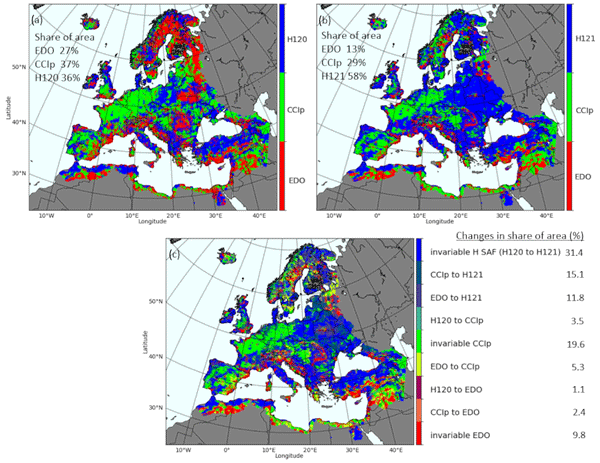
Jaime Gaona, Davide Bavera, Guido Fioravanti, Sebastian Hahn, Pietro Stradiotti, Paolo Filippucci, Stefania Camici, Luca Ciabatta, Hamidreza Mosaffa, Silvia Puca, Nicoletta Roberto, and Luca Brocca
Hydrol. Earth Syst. Sci., 29, 3865–3888, https://doi.org/10.5194/hess-29-3865-2025, https://doi.org/10.5194/hess-29-3865-2025, 2025
Short summary
Short summary
Soil moisture is crucial for the water cycle since it is at the front line of drought. Satellite, model and in situ data help identify soil moisture stress but are challenged by data uncertainties. This study evaluates trends and data coherence of common active/passive microwave sensors and model-based soil moisture data against in situ stations across Europe from 2007 to 2022. Data reliability is increasing, but combining data types improves soil moisture monitoring capabilities.
Eva Savina Malinverni, Francesco Di Stefano, Stefano Chiappini, Giovanna Darvini, Davide Fronzi, Roberto Pierdicca, and Alberto Tazioli
Int. Arch. Photogramm. Remote Sens. Spatial Inf. Sci., XLVIII-G-2025, 1035–1042, https://doi.org/10.5194/isprs-archives-XLVIII-G-2025-1035-2025, https://doi.org/10.5194/isprs-archives-XLVIII-G-2025-1035-2025, 2025
Marco Donnini, Francesco Bucci, Michele Santangelo, Mauro Cardinali, and Paola Reichenbach
EGUsphere, https://doi.org/10.5194/egusphere-2025-2096, https://doi.org/10.5194/egusphere-2025-2096, 2025
Preprint archived
Short summary
Short summary
The lack of standard for estimating landslide hazard severely impacts practical applications for territorial management. Using a new method, this work highlights the impact of landslide mapping on hazard estimation, focusing on the key role of recognizing and treating complex landslide clusters. While the results encourage future widespread tests and application, they raise questions on the reliability and availability of landslide inventory maps, shedding light on future research needs.
Louise Busschaert, Michel Bechtold, Sara Modanesi, Christian Massari, Dirk Raes, Sujay V. Kumar, and Gabrielle J. M. De Lannoy
EGUsphere, https://doi.org/10.2139/ssrn.4974019, https://doi.org/10.2139/ssrn.4974019, 2024
Preprint archived
Short summary
Short summary
This study estimates irrigation in the Po Valley using AquaCrop and Noah-MP models with sprinkler irrigation. Noah-MP shows higher annual rates than AquaCrop due to more water losses. After adjusting, both align with reported irrigation ranges (500–600 mm/yr). Soil moisture estimates from both models match satellite data, though both have limitations in vegetation and evapotranspiration modeling. The study emphasizes the need for observations to improve irrigation estimates.
Salim Goudarzi, Chris Soulsby, Jo Smith, Jamie Lee Stevenson, Alessandro Gimona, Scot Ramsay, Alison Hester, Iris Aalto, and Josie Geris
EGUsphere, https://doi.org/10.5194/egusphere-2024-2258, https://doi.org/10.5194/egusphere-2024-2258, 2024
Preprint archived
Short summary
Short summary
Planting trees on farmlands is now considered as one of the potential solutions to climate change. Trees can suck CO2 out of our atmosphere and store it in their trunks and in the soil beneath them. They can promote biodiversity, protect against soil erosion and drought. They can even help reduce flood risk for downstream communities. But we need models that can tell us the likely impact of trees at different locations and scales. Our study provides such a model.
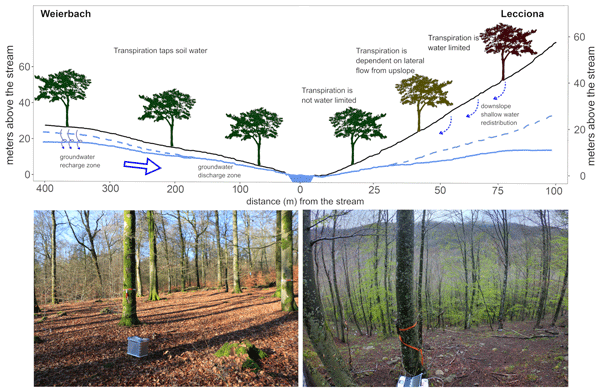
Ginevra Fabiani, Julian Klaus, and Daniele Penna
Hydrol. Earth Syst. Sci., 28, 2683–2703, https://doi.org/10.5194/hess-28-2683-2024, https://doi.org/10.5194/hess-28-2683-2024, 2024
Short summary
Short summary
There is a limited understanding of the role that topography and climate play in tree water use. Through a cross-site comparison in Luxembourg and Italy, we investigated beech water use along slopes in different climates. Our findings indicate that in landscapes characterized by stronger hydraulic and climatic gradients there is greater spatial variation in tree physiological responses. This highlights how differing growing conditions across landscapes can lead to contrasting tree performances.
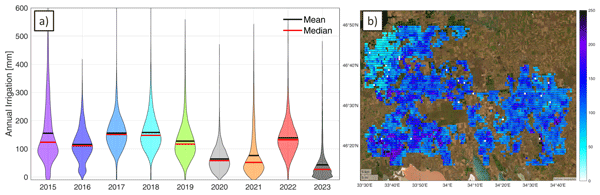
Jacopo Dari, Paolo Filippucci, and Luca Brocca
Hydrol. Earth Syst. Sci., 28, 2651–2659, https://doi.org/10.5194/hess-28-2651-2024, https://doi.org/10.5194/hess-28-2651-2024, 2024
Short summary
Short summary
We have developed the first operational system (10 d latency) for estimating irrigation water use from accessible satellite and reanalysis data. As a proof of concept, the method has been implemented over an irrigated area fed by the Kakhovka Reservoir, in Ukraine, which collapsed on June 6, 2023. Estimates for the period 2015–2023 reveal that, as expected, the irrigation season of 2023 was characterized by the lowest amounts of irrigation.
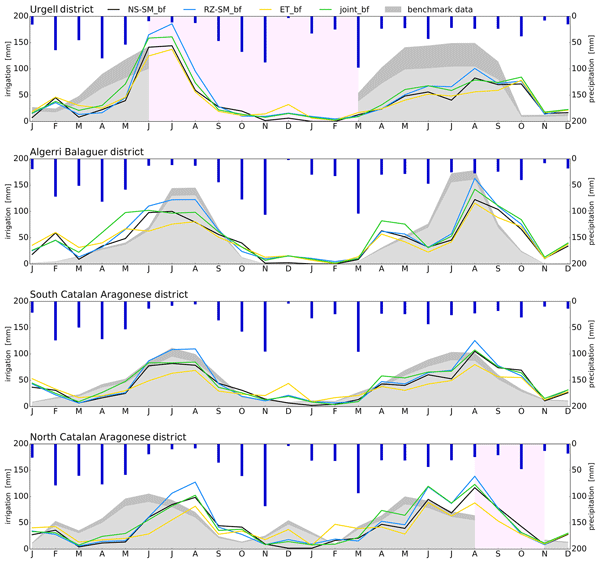
Søren Julsgaard Kragh, Jacopo Dari, Sara Modanesi, Christian Massari, Luca Brocca, Rasmus Fensholt, Simon Stisen, and Julian Koch
Hydrol. Earth Syst. Sci., 28, 441–457, https://doi.org/10.5194/hess-28-441-2024, https://doi.org/10.5194/hess-28-441-2024, 2024
Short summary
Short summary
This study provides a comparison of methodologies to quantify irrigation to enhance regional irrigation estimates. To evaluate the methodologies, we compared various approaches to quantify irrigation using soil moisture, evapotranspiration, or both within a novel baseline framework, together with irrigation estimates from other studies. We show that the synergy from using two equally important components in a joint approach within a baseline framework yields better irrigation estimates.
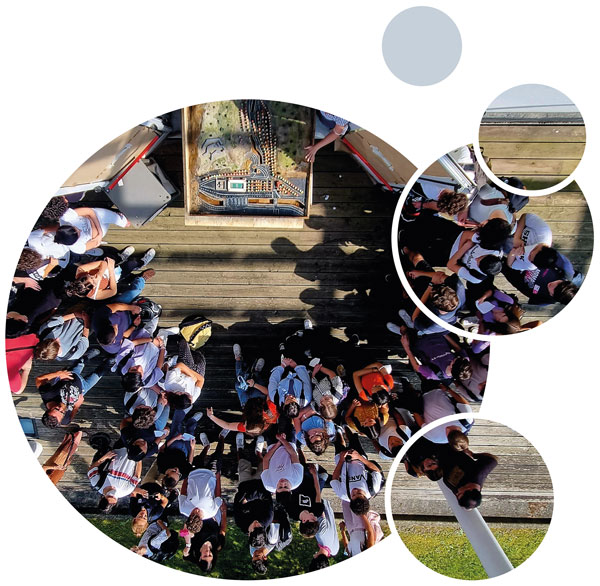
Francesca Munerol, Francesco Avanzi, Eleonora Panizza, Marco Altamura, Simone Gabellani, Lara Polo, Marina Mantini, Barbara Alessandri, and Luca Ferraris
Geosci. Commun., 7, 1–15, https://doi.org/10.5194/gc-7-1-2024, https://doi.org/10.5194/gc-7-1-2024, 2024
Short summary
Short summary
To contribute to advancing education in a warming climate and prepare the next generations to play their role in future societies, we designed “Water and Us”, a three-module initiative focusing on the natural and anthropogenic water cycle, climate change, and conflicts. This study aims to introduce the initiative's educational objectives, methods, and early results.
Shima Azimi, Christian Massari, Giuseppe Formetta, Silvia Barbetta, Alberto Tazioli, Davide Fronzi, Sara Modanesi, Angelica Tarpanelli, and Riccardo Rigon
Hydrol. Earth Syst. Sci., 27, 4485–4503, https://doi.org/10.5194/hess-27-4485-2023, https://doi.org/10.5194/hess-27-4485-2023, 2023
Short summary
Short summary
We analyzed the water budget of nested karst catchments using simple methods and modeling. By utilizing the available data on precipitation and discharge, we were able to determine the response lag-time by adopting new techniques. Additionally, we modeled snow cover dynamics and evapotranspiration with the use of Earth observations, providing a concise overview of the water budget for the basin and its subbasins. We have made the data, models, and workflows accessible for further study.
Giulia Blandini, Francesco Avanzi, Simone Gabellani, Denise Ponziani, Hervé Stevenin, Sara Ratto, Luca Ferraris, and Alberto Viglione
The Cryosphere, 17, 5317–5333, https://doi.org/10.5194/tc-17-5317-2023, https://doi.org/10.5194/tc-17-5317-2023, 2023
Short summary
Short summary
Automatic snow depth data are a valuable source of information for hydrologists, but they also tend to be noisy. To maximize the value of these measurements for real-world applications, we developed an automatic procedure to differentiate snow cover from grass or bare ground data, as well as to detect random errors. This procedure can enhance snow data quality, thus providing more reliable data for snow models.
Jacopo Dari, Luca Brocca, Sara Modanesi, Christian Massari, Angelica Tarpanelli, Silvia Barbetta, Raphael Quast, Mariette Vreugdenhil, Vahid Freeman, Anaïs Barella-Ortiz, Pere Quintana-Seguí, David Bretreger, and Espen Volden
Earth Syst. Sci. Data, 15, 1555–1575, https://doi.org/10.5194/essd-15-1555-2023, https://doi.org/10.5194/essd-15-1555-2023, 2023
Short summary
Short summary
Irrigation is the main source of global freshwater consumption. Despite this, a detailed knowledge of irrigation dynamics (i.e., timing, extent of irrigated areas, and amounts of water used) are generally lacking worldwide. Satellites represent a useful tool to fill this knowledge gap and monitor irrigation water from space. In this study, three regional-scale and high-resolution (1 and 6 km) products of irrigation amounts estimated by inverting the satellite soil moisture signals are presented.
Francesco Avanzi, Simone Gabellani, Fabio Delogu, Francesco Silvestro, Flavio Pignone, Giulia Bruno, Luca Pulvirenti, Giuseppe Squicciarino, Elisabetta Fiori, Lauro Rossi, Silvia Puca, Alexander Toniazzo, Pietro Giordano, Marco Falzacappa, Sara Ratto, Hervè Stevenin, Antonio Cardillo, Matteo Fioletti, Orietta Cazzuli, Edoardo Cremonese, Umberto Morra di Cella, and Luca Ferraris
Earth Syst. Sci. Data, 15, 639–660, https://doi.org/10.5194/essd-15-639-2023, https://doi.org/10.5194/essd-15-639-2023, 2023
Short summary
Short summary
Snow cover has profound implications for worldwide water supply and security, but knowledge of its amount and distribution across the landscape is still elusive. We present IT-SNOW, a reanalysis comprising daily maps of snow amount and distribution across Italy for 11 snow seasons from September 2010 to August 2021. The reanalysis was validated using satellite images and snow measurements and will provide highly needed data to manage snow water resources in a warming climate.
Giulia Bruno, Doris Duethmann, Francesco Avanzi, Lorenzo Alfieri, Andrea Libertino, and Simone Gabellani
Hydrol. Earth Syst. Sci. Discuss., https://doi.org/10.5194/hess-2022-416, https://doi.org/10.5194/hess-2022-416, 2022
Manuscript not accepted for further review
Short summary
Short summary
Hydrological models often have issues during droughts. We used the distributed Continuum model over the Po river basin and independent datasets of streamflow (Q), evapotranspiration (ET), and storage. Continuum simulated Q well during wet years and moderate droughts. Performances declined for a severe drought and we explained this drop with an increased uncertainty in ET anomalies in human-affected croplands. These findings provide guidelines for assessments of model robustness during droughts.
Riccardo Rigon, Giuseppe Formetta, Marialaura Bancheri, Niccolò Tubini, Concetta D'Amato, Olaf David, and Christian Massari
Hydrol. Earth Syst. Sci., 26, 4773–4800, https://doi.org/10.5194/hess-26-4773-2022, https://doi.org/10.5194/hess-26-4773-2022, 2022
Short summary
Short summary
The
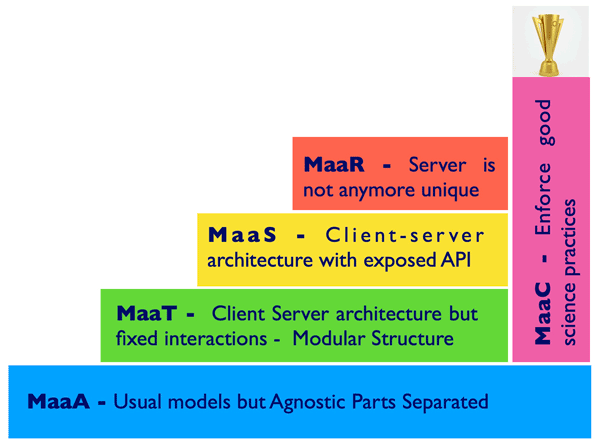
Digital Earth(DE) metaphor is very useful for both end users and hydrological modelers. We analyse different categories of models, with the view of making them part of a Digital eARth Twin Hydrology system (called DARTH). We also stress the idea that DARTHs are not models in and of themselves, rather they need to be built on an appropriate information technology infrastructure. It is remarked that DARTHs have to, by construction, support the open-science movement and its ideas.
Sara Modanesi, Christian Massari, Michel Bechtold, Hans Lievens, Angelica Tarpanelli, Luca Brocca, Luca Zappa, and Gabriëlle J. M. De Lannoy
Hydrol. Earth Syst. Sci., 26, 4685–4706, https://doi.org/10.5194/hess-26-4685-2022, https://doi.org/10.5194/hess-26-4685-2022, 2022
Short summary
Short summary
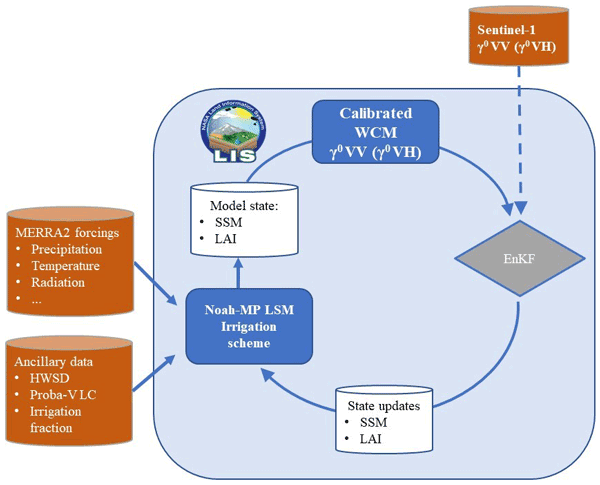
Given the crucial impact of irrigation practices on the water cycle, this study aims at estimating irrigation through the development of an innovative data assimilation system able to ingest high-resolution Sentinel-1 radar observations into the Noah-MP land surface model. The developed methodology has important implications for global water resource management and the comprehension of human impacts on the water cycle and identifies main challenges and outlooks for future research.

Stefania Camici, Gabriele Giuliani, Luca Brocca, Christian Massari, Angelica Tarpanelli, Hassan Hashemi Farahani, Nico Sneeuw, Marco Restano, and Jérôme Benveniste
Geosci. Model Dev., 15, 6935–6956, https://doi.org/10.5194/gmd-15-6935-2022, https://doi.org/10.5194/gmd-15-6935-2022, 2022
Short summary
Short summary
This paper presents an innovative approach, STREAM (SaTellite-based Runoff Evaluation And Mapping), to derive daily river discharge and runoff estimates from satellite observations of soil moisture, precipitation, and terrestrial total water storage anomalies. Potentially useful for multiple operational and scientific applications, the added value of the STREAM approach is the ability to increase knowledge on the natural processes, human activities, and their interactions on the land.
Francesco Bucci, Michele Santangelo, Lorenzo Fongo, Massimiliano Alvioli, Mauro Cardinali, Laura Melelli, and Ivan Marchesini
Earth Syst. Sci. Data, 14, 4129–4151, https://doi.org/10.5194/essd-14-4129-2022, https://doi.org/10.5194/essd-14-4129-2022, 2022
Short summary
Short summary
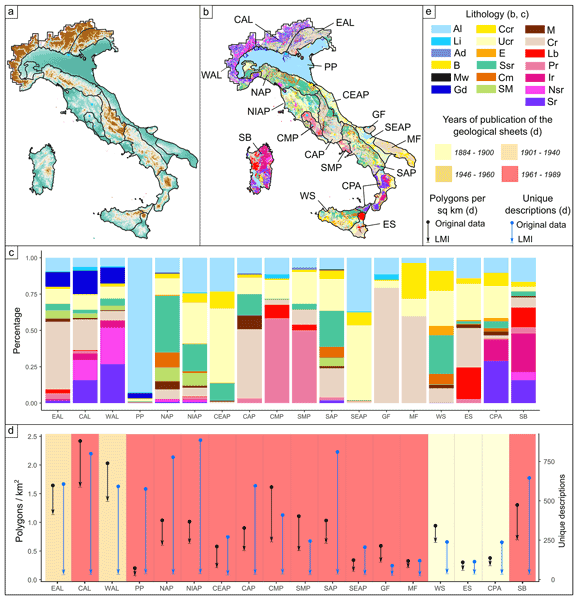
The paper describes a new lithological map of Italy at a scale of 1 : 100 000 obtained from classification of a digital database following compositional and geomechanical criteria. The map represents the national distribution of the lithological classes at high resolution. The outcomes of this study can be relevant for a wide range of applications, including statistical and physically based modelling of slope stability assessment and other geoenvironmental studies.

Txomin Bornaetxea, Ivan Marchesini, Sumit Kumar, Rabisankar Karmakar, and Alessandro Mondini
Nat. Hazards Earth Syst. Sci., 22, 2929–2941, https://doi.org/10.5194/nhess-22-2929-2022, https://doi.org/10.5194/nhess-22-2929-2022, 2022
Short summary
Short summary
One cannot know if there is a landslide or not in an area that one has not observed. This is an obvious statement, but when landslide inventories are obtained by field observation, this fact is seldom taken into account. Since fieldwork campaigns are often done following the roads, we present a methodology to estimate the visibility of the terrain from the roads, and we demonstrate that fieldwork-based inventories are underestimating landslide density in less visible areas.
Lorenzo Alfieri, Francesco Avanzi, Fabio Delogu, Simone Gabellani, Giulia Bruno, Lorenzo Campo, Andrea Libertino, Christian Massari, Angelica Tarpanelli, Dominik Rains, Diego G. Miralles, Raphael Quast, Mariette Vreugdenhil, Huan Wu, and Luca Brocca
Hydrol. Earth Syst. Sci., 26, 3921–3939, https://doi.org/10.5194/hess-26-3921-2022, https://doi.org/10.5194/hess-26-3921-2022, 2022
Short summary
Short summary
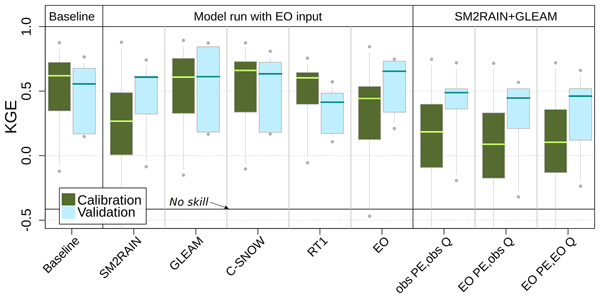
This work shows advances in high-resolution satellite data for hydrology. We performed hydrological simulations for the Po River basin using various satellite products, including precipitation, evaporation, soil moisture, and snow depth. Evaporation and snow depth improved a simulation based on high-quality ground observations. Interestingly, a model calibration relying on satellite data skillfully reproduces observed discharges, paving the way to satellite-driven hydrological applications.
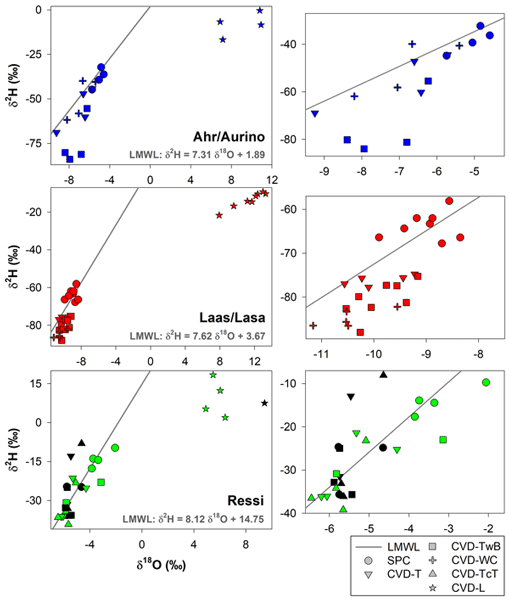
Giulia Zuecco, Anam Amin, Jay Frentress, Michael Engel, Chiara Marchina, Tommaso Anfodillo, Marco Borga, Vinicio Carraro, Francesca Scandellari, Massimo Tagliavini, Damiano Zanotelli, Francesco Comiti, and Daniele Penna
Hydrol. Earth Syst. Sci., 26, 3673–3689, https://doi.org/10.5194/hess-26-3673-2022, https://doi.org/10.5194/hess-26-3673-2022, 2022
Short summary
Short summary
We analyzed the variability in the isotopic composition of plant water extracted by two different methods, i.e., cryogenic vacuum distillation (CVD) and Scholander-type pressure chamber (SPC). Our results indicated that the isotopic composition of plant water extracted by CVD and SPC was significantly different. We concluded that plant water extraction by SPC is not an alternative for CVD as SPC mostly extracts the mobile plant water whereas CVD retrieves all water stored in the sampled tissue.
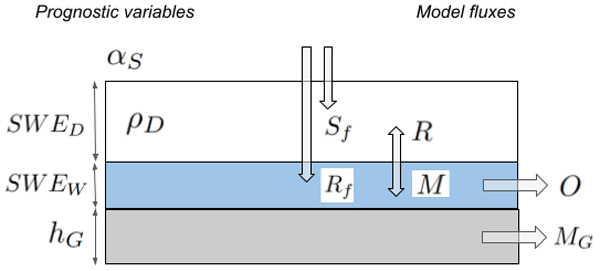
Francesco Avanzi, Simone Gabellani, Fabio Delogu, Francesco Silvestro, Edoardo Cremonese, Umberto Morra di Cella, Sara Ratto, and Hervé Stevenin
Geosci. Model Dev., 15, 4853–4879, https://doi.org/10.5194/gmd-15-4853-2022, https://doi.org/10.5194/gmd-15-4853-2022, 2022
Short summary
Short summary
Knowing in real time how much snow and glacier ice has accumulated across the landscape has significant implications for water-resource management and flood control. This paper presents a computer model – S3M – allowing scientists and decision makers to predict snow and ice accumulation during winter and the subsequent melt during spring and summer. S3M has been employed for real-world flood forecasting since the early 2000s but is here being made open source for the first time.
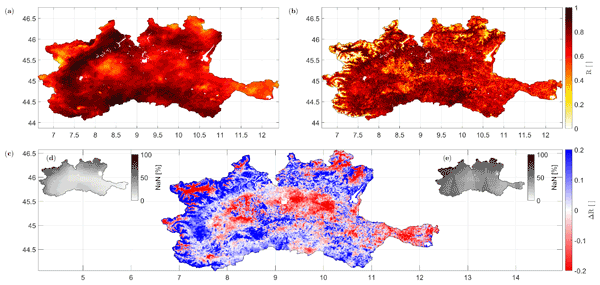
Paolo Filippucci, Luca Brocca, Raphael Quast, Luca Ciabatta, Carla Saltalippi, Wolfgang Wagner, and Angelica Tarpanelli
Hydrol. Earth Syst. Sci., 26, 2481–2497, https://doi.org/10.5194/hess-26-2481-2022, https://doi.org/10.5194/hess-26-2481-2022, 2022
Short summary
Short summary
A high-resolution (1 km) rainfall product with 10–30 d temporal resolution was obtained starting from SM data from Sentinel-1. Good performances are achieved using observed data (gauge and radar) over the Po River Valley, Italy, as a benchmark. The comparison with a product characterized by lower spatial resolution (25 km) highlights areas where the high spatial resolution of Sentinel-1 has great benefits. Possible applications include water management, agriculture and index-based insurances.

Christian Massari, Francesco Avanzi, Giulia Bruno, Simone Gabellani, Daniele Penna, and Stefania Camici
Hydrol. Earth Syst. Sci., 26, 1527–1543, https://doi.org/10.5194/hess-26-1527-2022, https://doi.org/10.5194/hess-26-1527-2022, 2022
Short summary
Short summary
Droughts are a creeping disaster, meaning that their onset, duration and recovery are challenging to monitor and forecast. Here, we provide further evidence of an additional challenge of droughts, i.e. the fact that the deficit in water supply during droughts is generally much more than expected based on the observed decline in precipitation. At a European scale we explain this with enhanced evapotranspiration, sustained by higher atmospheric demand for moisture during such dry periods.
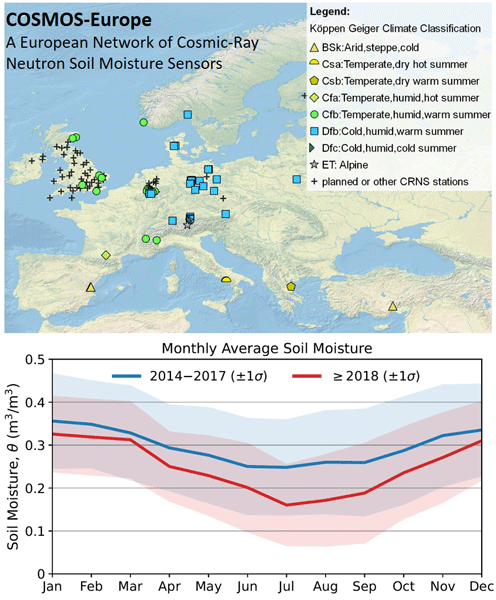
Heye Reemt Bogena, Martin Schrön, Jannis Jakobi, Patrizia Ney, Steffen Zacharias, Mie Andreasen, Roland Baatz, David Boorman, Mustafa Berk Duygu, Miguel Angel Eguibar-Galán, Benjamin Fersch, Till Franke, Josie Geris, María González Sanchis, Yann Kerr, Tobias Korf, Zalalem Mengistu, Arnaud Mialon, Paolo Nasta, Jerzy Nitychoruk, Vassilios Pisinaras, Daniel Rasche, Rafael Rosolem, Hami Said, Paul Schattan, Marek Zreda, Stefan Achleitner, Eduardo Albentosa-Hernández, Zuhal Akyürek, Theresa Blume, Antonio del Campo, Davide Canone, Katya Dimitrova-Petrova, John G. Evans, Stefano Ferraris, Félix Frances, Davide Gisolo, Andreas Güntner, Frank Herrmann, Joost Iwema, Karsten H. Jensen, Harald Kunstmann, Antonio Lidón, Majken Caroline Looms, Sascha Oswald, Andreas Panagopoulos, Amol Patil, Daniel Power, Corinna Rebmann, Nunzio Romano, Lena Scheiffele, Sonia Seneviratne, Georg Weltin, and Harry Vereecken
Earth Syst. Sci. Data, 14, 1125–1151, https://doi.org/10.5194/essd-14-1125-2022, https://doi.org/10.5194/essd-14-1125-2022, 2022
Short summary
Short summary
Monitoring of increasingly frequent droughts is a prerequisite for climate adaptation strategies. This data paper presents long-term soil moisture measurements recorded by 66 cosmic-ray neutron sensors (CRNS) operated by 24 institutions and distributed across major climate zones in Europe. Data processing followed harmonized protocols and state-of-the-art methods to generate consistent and comparable soil moisture products and to facilitate continental-scale analysis of hydrological extremes.

Tessa Maurer, Francesco Avanzi, Steven D. Glaser, and Roger C. Bales
Hydrol. Earth Syst. Sci., 26, 589–607, https://doi.org/10.5194/hess-26-589-2022, https://doi.org/10.5194/hess-26-589-2022, 2022
Short summary
Short summary
Predicting how much water will end up in rivers is more difficult during droughts because the relationship between precipitation and streamflow can change in unexpected ways. We differentiate between changes that are predictable based on the weather patterns and those harder to predict because they depend on the land and vegetation of a particular region. This work helps clarify why models are less accurate during droughts and helps predict how much water will be available for human use.
Sara Modanesi, Christian Massari, Alexander Gruber, Hans Lievens, Angelica Tarpanelli, Renato Morbidelli, and Gabrielle J. M. De Lannoy
Hydrol. Earth Syst. Sci., 25, 6283–6307, https://doi.org/10.5194/hess-25-6283-2021, https://doi.org/10.5194/hess-25-6283-2021, 2021
Short summary
Short summary
Worldwide, the amount of water used for agricultural purposes is rising and the quantification of irrigation is becoming a crucial topic. Land surface models are not able to correctly simulate irrigation. Remote sensing observations offer an opportunity to fill this gap as they are directly affected by irrigation. We equipped a land surface model with an observation operator able to transform Sentinel-1 backscatter observations into realistic vegetation and soil states via data assimilation.
Cited articles
Abhishek, Kinouchi, T., Abolafia-Rosenzweig, R., and Ito, M.: Water Budget Closure in the Upper Chao Phraya River Basin, Thailand Using Multisource Data, Remote Sens., 14, 173, https://doi.org/10.3390/rs14010173, 2022.
Abirifard, M., Birk, S., Raeisi, E., and Sauter, M.: Dynamic volume in karst aquifers: Parameters affecting the accuracy of estimates from recession analysis, J. Hydrol., 612, 128286, https://doi.org/10.1016/j.jhydrol.2022.128286, 2022.
Abolafia-Rosenzweig, R., Pan, M., Zeng, J., and Livneh, B.: Remotely sensed ensembles of the terrestrial water budget over major global river basins: An assessment of three closure techniques, Remote Sens. Environ., 252, 112191, https://doi.org/10.1016/j.rse.2020.112191, 2020.
Acreman, M. C. and Dunbar, M. J.: Defining environmental river flow requirements – a review, Hydrol. Earth Syst. Sci., 8, 861–876, https://doi.org/10.5194/hess-8-861-2004, 2004.
Adler, C. , Wester, P., Bhatt, I., Huggel, C., Insarov, G., Morecroft, M., Muccione, V., Prakash, A., Alcántara-Ayala, I., Allen, S. K., Bader, M., Bigler, S., Camac, J., Chakraborty, R., Sanchez, A. C., Cuvi, N., Drenkhan, F., Hussain, A., Maharjan, A., Marchant, R., McDowell, G., Morin, S., Niggli, L., Ochoa, A., Pandey, A., Postigo, J., Razanatsoa, E., Rudloff, V. M., Scott, C., Stevens, M., Stone, D., Thorn, J. P. R., Thornton, J., Viviroli, D., and Werners, S.: Cross-chapter paper 5: mountains, in: Climate change 2022: impacts, adaptation, and vulnerability: Contribution of Working Group II to the Sixth Assessment Report of the Intergovernmental Panel on Climate Change, edited by: Pörtner, H.-O., Roberts, D. C., Tignor, M. M. B., Poloczanska, E., Mintenbeck, K., Alegría, A., Craig, M., Langsdorf, S., Löschke, S., Möller, V., Okem, A., and Rama, B., Cambridge University Press, Cambridge, 2273–2318, https://doi.org/10.1017/9781009325844.022, 2023.
Anderson, M. P., Woessner, W. W., and Hunt, R. J.: Modeling Purpose and Conceptual Model, Applied Groundwater Modeling, Elsevier Inc, 27–67, https://doi.org/10.1016/B978-0-08-091638-5.00002-X, 2015.
Avanzi, F., Gabellani, S., Delogu, F., Silvestro, F., Pignone, F., Bruno, G., Pulvirenti, L., Squicciarino, G., Fiori, E., Rossi, L., Puca, S., Toniazzo, A., Giordano, P., Falzacappa, M., Ratto, S., Stevenin, H., Cardillo, A., Fioletti, M., Cazzuli, O., Cremonese, E., Morra di Cella, U., and Ferraris, L.: IT-SNOW: a snow reanalysis for Italy blending modeling, in situ data, and satellite observations (2010–2021), Earth Syst. Sci. Data, 15, 639–660, https://doi.org/10.5194/essd-15-639-2023, 2023.
Avanzi, F., Gabellani, S., Delogu, F., Silvestro, F., Pignone, F., Bruno, G., Pulvirenti, L., Squicciarino, G., Fiori, E., Rossi, L., Puca, S., Toniazzo, A., Giordano, P., Falzacappa, M., Ratto, S., Stevenin, H., Cardillo, A., Fioletti, M., Cazzuli, O., and Ferraris, L.: IT-SNOW: a snow reanalysis for Italy blending modeling, in-situ data, and satellite observations, In IT-SNOW: a snow reanalysis for Italy blending modeling, in situ data, and satellite observations (2010–2021) (Version v4, Vol. 15, pp. 639–660), Zenodo [data set], https://doi.org/10.5281/zenodo.14093436, 2024a.
Avanzi, F., Munerol, F., Milelli, M., Gabellani, S., Massari, C., Girotto, M., Cremonese, E., Galvagno, M., Bruno, G., Mora di Cella, U., Rossi, L., Altamura, M., and Ferraris, L.: Winter snow deficit was a harbinger of summer 2022 socio-hydrologic drought in the Po Basin, Italy, Commun. Earth Environ., 5, 64, https://doi.org/10.1038/s43247-024-01222-z, 2024b.
Azimi, S., Massari, C., Formetta, G., Barbetta, S., Tazioli, A., Fronzi, D., Modanesi, S., Tarpanelli, A., and Rigon, R.: On understanding mountainous carbonate basins of the Mediterranean using parsimonious modeling solutions, Hydrol. Earth Syst. Sci., 27, 4485–4503, https://doi.org/10.5194/hess-27-4485-2023, 2023.
Barbosa, L. R., Coelho, V. H. R., Gusmão, A. C. V., Fernandes, L. A., da Silva, B. B., Galvão, C. D. O., Caicedo, N. O. L., da Paz, A. R., Xuan, Y., Bertrand, G. F., Melo, D. C. D., Montenegro S. M. G. L., Oswald, S. E., and Almeida C. D. N.: A satellite-based approach to estimating spatially distributed groundwater recharge rates in a tropical wet sedimentary region despite cloudy conditions, J. Hydrol., 607, 127503, https://doi.org/10.1016/j.jhydrol.2022.127503, 2022.
Beven, K.: Towards integrated environmental models of everywhere: uncertainty, data and modelling as a learning process, Hydrol. Earth Syst. Sci., 11, 460–467, https://doi.org/10.5194/hess-11-460-2007, 2007.
Bloomfield, J. P., Allen, D. J., and Griffiths, K. J.: Examining geological controls on baseflow index (BFI) using regression analysis: An illustration from the Thames Basin, UK, J. Hydrol., 373, 164–176, https://doi.org/10.1016/j.jhydrol.2009.04.025, 2009.
Bonacci, O.: Karst springs hydrographs as indicators of karst aquifers, Hydrol. Sci. J., 38, 51–62, https://doi.org/10.1080/02626669309492639, 1993.
Bonanno, R., Lacavalla, M., and Sperati, S.: A new high-resolution meteorological reanalysis Italian dataset: MERIDA, Q. J. Roy. Meteor. Soc., 145, 1756–1779, https://doi.org/10.1002/qj.3530, 2019.
Boni, C. F., Bono, P., and Capelli, G.: Carta idrogeologica (scala 1:500 000); B) Carta idrologica (scala 1:500 000); C) Carta dei bilanci idrogeologici e delle risorse idriche sotterranee (scala 1:1 000 000), Mem. Soc. Geol. It., 35, 991–1012, 1986.
Boni, C., Baldoni, T., Banzato, F., Cascone, D., and Petitta, M.: Hydrogeological study for identification, characterisation and management of groundwater resources in the Sibillini Mountains National Park (Central Italy), Italian Journal of Engineering Geology and Environment, 2, 21–39, https://doi.org/10.4408/IJEGE.2010-02.O-02, 2010.
Bouaziz, L., Weerts, A., Schellekens, J., Sprokkereef, E., Stam, J., Savenije, H., and Hrachowitz, M.: Redressing the balance: quantifying net intercatchment groundwater flows, Hydrol. Earth Syst. Sci., 22, 6415–6434, https://doi.org/10.5194/hess-22-6415-2018, 2018.
Braca, G., Mariani, S., Lastoria, B., Tropeano, R., Casaioli, M., Piva, F., Marchetti, G., and Bussettini, M.: Bilancio idrologico nazionale: stime BIGBANG e indicatori sulla risorsa idrica, Update 2023, Report n. 401/2024, ISPRA, Roma, ISBN 978-88-448-1232-4, 2024.
Brozzetti, F., Boncio, P., Cirillo, D., Ferrarini, F., De Nardis, R., Testa, A., Liberi, F., and Lavecchia, G.: High-resolution field mapping and analysis of the August–October 2016 coseismic surface faulting (central Italy earthquakes): Slip distribution, parameterization, and comparison with global earthquakes, Tectonics, 38, 417–439, https://doi.org/10.1029/2018TC005305, 2019.
C3S: Copernicus Climate Change Service: ERA5-Land monthly averaged data from 1950 to present, Copernicus Climate Change Service (C3S) Climate Data Store (CDS) [data set], https://doi.org/10.24381/cds.68d2bb30, 2022,
Cambi, C., Valigi, D., and Di Matteo, L.: Hydrogeological study of data-scarce limestone massifs: the case of Gualdo Tadino and Monte Cucco structures (central Apennines, Italy), B. Geofis. Teor. Appl., 51, 2010.
Cambi, C., Mirabella, F., Petitta, M., Banzato, F., Beddini, G., Cardellini, C., Fronzi, D., Mastrolillo, L., Tazioli, A., and Valigi, D.: Reaction of the carbonate Sibillini Mountains Basal aquifer (Central Italy) to the extensional 2016–2017 seismic sequence, Sci. Rep., 12, 22428, https://doi.org/10.1038/s41598-022-26681-2, 2022.
Carlotto, T. and Chaffe, P. L. B.: Master recession curve parameterization tool (MRCPtool): different approaches to recession curve analysis, Comput. Geosci., 132, 1–8, https://doi.org/10.1016/j.cageo.2019.06.016, 2019.
Carrillo-Rivera, J.: Application of the groundwater-balance equation to indicate interbasin and vertical flow in two semi-arid drainage basins, Mexico, Hydrogeol. J., 8, 503–520, https://doi.org/10.1007/s100400000093, 2000.
Chapman, T. G.: Comment on “Evaluation of automated techniques for base flow and recession analyses” by R.J., Nathan and T.A., McMahon, Water Resour. Res., 27, 1783–1784, https://doi.org/10.1029/91WR01007, 1991.
Clark, M. P., Bierkens, M. F. P., Samaniego, L., Woods, R. A., Uijlenhoet, R., Bennett, K. E., Pauwels, V. R. N., Cai, X., Wood, A. W., and Peters-Lidard, C. D.: The evolution of process-based hydrologic models: historical challenges and the collective quest for physical realism, Hydrol. Earth Syst. Sci., 21, 3427–3440, https://doi.org/10.5194/hess-21-3427-2017, 2017.
Conant Jr., B., Robinson, C. E., Hinton, M. J., and Russell, H. A.: A framework for conceptualizing groundwater-surface water interactions and identifying potential impacts on water quality, water quantity, and ecosystems, J. Hydrol., 574, 609–627, https://doi.org/10.1016/j.jhydrol.2019.04.050, 2019.
Craig, H.: Isotopic variations in meteoric waters, Science, 133, 1702–1703, https://doi.org/10.1126/science.133.3465.1702, 1961.
Daly, C., Slater, M. E., Roberti, J. A., Laseter, S. H., and Swift Jr., L. W.: High-resolution precipitation mapping in a mountainous watershed: ground truth for evaluating uncertainty in a national precipitation dataset, Int. J. Climatol., 37, 124–137, https://doi.org/10.1002/joc.4986, 2017.
Dettinger, M.: Impacts in the third dimension, Nat. Geosci., 7, 166–167, https://doi.org/10.1038/ngeo2096, 2014.
Dewandel, B., Lachassagne, P., Bakalowicz, M., Weng, P., and Al-Malki, A.: Evaluation of aquifer thickness by analysing recession hydrographs. Application to the Oman ophiolite hard-rock aquifer, J. Hydrol., 274, 248–269, https://doi.org/10.1016/S0022-1694(02)00418-3, 2003.
Di Domenicantonio, A., Cassiani, B., Ruisi, M., and Traversa, P.: Quantitative hydrogeology in the Tevere River basin management planning (central Italy), Italian Journal of Engineering Geology and Environment, 1, 69–82, https://doi.org/10.4408/IJEGE.2009-01.O-04, 2009.
Di Matteo, L., Dragoni, W., Maccari, D., and Piacentini, S. M.: Climate change, water supply and environmental problems of headwaters: The paradigmatic case of the Tiber, Savio and Marecchia rivers (Central Italy), Sci. Total Environ., 598, 733–748, https://doi.org/10.1016/j.scitotenv.2017.04.153, 2017.
Di Matteo, L., Dragoni, W., Azzaro, S., Pauselli, C., Porreca, M., Bellina, G., and Cardaci, W.: Effects of earthquakes on the discharge of groundwater systems: The case of the 2016 seismic sequence in the Central Apennines, Italy, J. Hydrol., 583, 124509, https://doi.org/10.1016/j.jhydrol.2019.124509, 2020.
Di Matteo, L., Capoccioni, A., Porreca, M., and Pauselli, C.: Groundwater-surface water interaction in the Nera River Basin (Central Italy): new insights after the 2016 seismic sequence, Hydrology, 8, 97, https://doi.org/10.3390/hydrology8030097, 2021.
Dragoni, W., Mottola, A., and Cambi, C.: Modeling the effects of pumping wells in spring management: the case of Scirca spring (central Apennines, Italy), J. Hydrol., 493, 115–123, https://doi.org/10.1016/j.jhydrol.2013.03.032, 2013.
Duncan, H. P.: Baseflow separation–A practical approach, J. Hydrol., 575, 308–313, https://doi.org/10.1016/j.jhydrol.2019.05.040, 2019.
Farvolden, R. N.: Geologic controls on ground-water storage and base flow, J. Hydrol., 1, 219–249, https://doi.org/10.1016/0022-1694(63)90004-0, 1963.
Enemark, T., Peeters, L. J., Mallants, D., and Batelaan, O.: Hydrogeological conceptual model building and testing: A review, J. Hydrol., 569, 310–329, https://doi.org/10.1016/j.jhydrol.2018.12.007, 2019.
Fayad, A., Gascoin, S., Faour, G., López-Moreno, J. I., Drapeau, L., Le Page, M., and Escadafal, R.: Snow hydrology in Mediterranean mountain regions: A review, J. Hydrol., 551, 374–396, https://doi.org/10.1016/j.jhydrol.2017.05.063, 2017.
Fernández-Martínez, M., Barquin, J., Bonada, N., Cantonati, M., Churro, C., Corbera, J., Delgado, C., Dulsat-Masvidal, M., Garcia, G., Margalef, O., Pascual, R., Peñuelas J., Preece, C., Sabater, F., Seiler, H., Zamora-Marín, J. M., and Romero, E.: Mediterranean springs: Keystone ecosystems and biodiversity refugia threatened by global change, Glob. Change Biol., 30, e16997, https://doi.org/10.1111/gcb.16997, 2024.
Filippini, M., Stumpp, C., Nijenhuis, I., Richnow, H. H., and Gargini, A.: Evaluation of aquifer recharge and vulnerability in an alluvial lowland using environmental tracers, J. Hydrol., 529, 1657–1668, https://doi.org/10.1016/j.jhydrol.2015.07.055, 2015.
Fronzi, D., Di Curzio, D., Rusi, S., Valigi, D., and Tazioli, A.: Comparison between periodic tracer tests and time-series analysis to assess mid-and long-term recharge model changes due to multiple strong seismic events in carbonate aquifers, Water, 12, 3073, https://doi.org/10.3390/w12113073, 2020.
Fronzi, D., Mirabella, F., Cardellini, C., Caliro, S., Palpacelli, S., Cambi, C., Caliro, S., Palpacelli, S., Cambi, C., Valigi, D., and Tazioli, A.: The role of faults in groundwater circulation before and after seismic events: Insights from tracers, water isotopes and geochemistry, Water, 13, 1499, https://doi.org/10.3390/w13111499, 2021.
Furey, P. R. and Gupta, V. K.: A physically based filter for separating base flow from streamflow time series, Water Resour. Res., 37, 2709–2722, https://doi.org/10.1029/2001WR000243, 2001.
Gallego, F., Sans, G. C., Di Bella, C. M., Tiscornia, G., and Paruelo, J. M.: Performance of real evapotranspiration products and water yield estimations in Uruguay, Remote Sens. Appl. Soc. Environ., 32, 101043, https://doi.org/10.1016/j.rsase.2023.101043, 2023.
Genereux, D. P., Wood, S. J., and Pringle, C. M.: Chemical tracing of interbasin groundwater transfer in the lowland rainforest of Costa Rica, J. Hydrol., 258, 163–178, https://doi.org/10.1016/S0022-1694(01)00568-6, 2002.
Gentilucci, M., Bufalini, M., D'Aprile, F., Materazzi, M., and Pambianchi, G.: Comparison of data from rain gauges and the IMERG product to analyse precipitation in mountain areas of central Italy, Internationation Journal of Geo-Information, 10, 795, https://doi.org/10.3390/ijgi10120795, 2021.
Girotto, M., Formetta, G., Azimi, S., Bachand, C., Cowherd, M., De Lannoy, G., Lievens, H., Modanesi, S., Raleigh, M. S., Rigon, R., and Massari, C.: Identifying snowfall elevation patterns by assimilating satellite-based snow depth retrievals, Sci.Total Environ., 906, 167312, https://doi.org/10.1016/j.scitotenv.2023.167312, 2024.
Goldscheider, N., Chen, Z., Auler, A. S., Bakalowicz, M., Broda, S., Drew, D., Hartmann, J., Jiang, G., Moosdorf, N., Stevanovic, Z., and Veni, G.: Global distribution of carbonate rocks and karst water resources, Hydrogeol. J., 28, 1661–1677, https://doi.org/10.1007/s10040-020-02139-5, 2020.
Gregor, M. and Malik, P.: Construction of master recession curve using genetic algorithms, J. Hydrol. Hydromech., 60, https://doi.org/10.2478/v10098-012-0001-8, 2012.
Hameed, M., Nayak, M. A., and Ahangar, M. A.: Groundwater storage changes in the United States using baseflow recession method: Comparison with GRACE and well observations, Journal of Hydrology: Regional Studies, 62, 102946, https://doi.org/10.1016/j.ejrh.2025.102946, 2025.
Hammett, S., Day-Lewis, F. D., Trottier, B., Barlow, P. M., Briggs, M. A., Delin, G., Harvey, J. W, Johnson, C. D., Lane Jr., J. W., Rosenberry, D. O., and Werkema, D. D.: GW/SW-MST: A groundwater/surface-water method selection tool, Groundwater, 60, 784–791, https://doi.org/10.1111/gwat.13194, 2022.
Hartmann, J., Jansen, N., Dürr, H. H., Kempe, S., and Köhler, P.: Global CO2-consumption by chemical weathering: What is the contribution of highly active weathering regions?, Global Planet. Change, 69, 185–194, https://doi.org/10.1016/j.gloplacha.2009.07.007, 2009.
Healy, R. W., Winter, T. C., LaBaugh, J. W., and Franke, O. L.: Water budgets: Foundations for effective water resources and environmental management: U.S. Geological Survey Circular 1308, 90 p., https://water.usgs.gov/watercensus/AdHocComm/Background (last access: 13 May 2025), 2007.
Hilton, R. G. and West, A. J.: Mountains, erosion and the carbon cycle, Nat. Rev. Earth Environ., 1, 284–299, https://doi.org/10.1038/s43017-020-0058-6, 2020.
Hook, S. and Halverson, G.: ECOSTRESS Tiled Evapotranspiration Instantaneous and Daytime L3 Global 70 m v002, NASA Land Processes Distributed Active Archive Center [data set], https://doi.org/10.5067/ECOSTRESS/ECO_L3T_JET.002, 2024.
Huffman, G. J., Stocker, E. F., Bolvin, D. T., Nelkin, E. J., and Tan, J.: GPM IMERG Final Precipitation L3 1 day 0.1 degree x 0.1 degree V07, Edited by Andrey Savtchenko, Greenbelt, MD, Goddard Earth Sciences Data and Information Services Center (GES DISC) [data set], https://doi.org/10.5067/GPM/IMERGDF/DAY/07, 2023.
Irvine, D. J., Singha, K., Kurylyk, B. L., Briggs, M. A., Sebastian, Y., Tait, D. R., and Helton, A. M.: Groundwater-Surface water interactions research: Past trends and future directions, J. Hydrol., 644, 132061, https://doi.org/10.1016/j.jhydrol.2024.132061, 2024.
Kang, T., Lee, S., Lee, N., and Jin, Y.: Baseflow separation using the digital filter method: Review and sensitivity analysis, Water, 14, 485, https://doi.org/10.3390/w14030485, 2022.
Kavetski, D. and Fenicia, F.: Elements of a flexible approach for conceptual hydrological modeling: 2. Application and experimental insights, Water Resour. Res., 47, https://doi.org/10.1029/2010WR010174, 2011.
Kirchner, J. W.: Catchments as simple dynamical systems: Catchment characterization, rainfall-runoff modeling, and doing hydrology backward, Water Resour. Res., 45, https://doi.org/10.1029/2008WR006912, 2009.
Korkmaz, N.: The estimation of groundwater recharge from spring hydrographs, Hydrol. Sci. J., 35, 209–217, https://doi.org/10.1080/02626669009492419, 1990.
Krakauer, N. Y. and Temimi, M.: Stream recession curves and storage variability in small watersheds, Hydrol. Earth Syst. Sci., 15, 2377–2389, https://doi.org/10.5194/hess-15-2377-2011, 2011.
Kump, L. R., Brantley, S. L., and Arthur, M. A.: Chemical weathering, atmospheric CO2, and climate, Annu. Rev. Earth Planet. Sc., 28, 611-667, https://doi.org/10.1146/annurev.earth.28.1.611, 2000.
Lancia, M., Petitta, M., Zheng, C., and Saroli, M.: Hydrogeological insights and modelling for sustainable use of a stressed carbonate aquifer in the Mediterranean area: From passive withdrawals to active management, J. Hydrol. Reg. Stud., 32, 100749, https://doi.org/10.1016/j.ejrh.2020.100749, 2020.
Ladson, A. R., Brown, R., Neal, B., and Nathan, R.: A standard approach to baseflow separation using the Lyne and Hollick filter, Australas J. Wat. Reso., 17, 25–34, https://doi.org/10.7158/13241583.2013.11465417, 2013.
Landwehr, J. M. and Coplen, T. B.: Line-conditioned excess: a new method for characterizing stable hydrogen and oxygen isotope ratios in hydrologic systems, in: Isotopes in Environmental Studies, Aquatic Forum 2004, IAEA-CSP-26, International Atomic Energy Agency, Vienna, 132–135, ISBN 9–0-111305-X, 2006.
Levin, S. B., Briggs, M. A., Foks, S. S., Goodling, P. J., Raffensperger, J. P., Rosenberry, D. O., Scholl, M. A., Tiedeman, C. R., and Webb, R. M.: Uncertainties in measuring and estimating water-budget components: Current state of the science, WIREs Water, 10, e1646, https://doi.org/10.1002/wat2.1646, 2023.
Longinelli, A. and Selmo, E.: Isotopic composition of precipitation in Italy: a first overall map, J. Hydrol., 270, 75–88, https://doi.org/10.1016/S0022-1694(02)00281-0, 2003.
Longobardi, A. and Villani, P: Baseflow index characterization in typical temperate to dry climates: conceptual analysis and simulation experiment to assess the relative role of climate forcing features and catchment geological settings, Hydrol. Res., 54, 136–148, https://doi.org/10.2166/nh.2023.026, 2023.
Lorenzi, V., Barberio, M. D., Sbarbati, C., and Petitta, M.: Groundwater recharge distribution due to snow cover in shortage conditions (2019–22) on the Gran Sasso carbonate aquifer (Central Italy), Environ. Earth Sci., 82, 206, https://doi.org/10.1007/s12665-023-10889-0, 2023.
Lorenzoni, M., Carosi, A., Giovannotti, M., La Porta, G., Splendiani, A., and Barucchi, V. C.: Ecology and conservation of the Mediterranean trout in the central Apennines (Italy), J. Limnol., 78, https://doi.org/10.4081/jlimnol.2018.1806, 2019.
Ly, S., Charles, C., and Degré, A.: Different methods for spatial interpolation of rainfall data for operational hydrology and hydrological modeling at watershed scale: a review, BASE, 17, https://hdl.handle.net/2268/136084, 2013.
Lyne, V. and Hollick, M.: Stochastic time-variable rainfall-runoff modelling, in: Institute of engineers Australia national conference, 79, 89–93, Barton, Australia: Institute of Engineers Australia, https://www.researchgate.net/publication/399600351_Stochastic_Time-Variable_Rainfall-Runoff_Modelling#fullTextFileContent (last access: 1 July 2025), 1979.
Luo, Z., Li, H., Zhang, S., Wang, L., Wang, S., and Wang, L.: A Novel Two-Step Method for Enforcing Water Budget Closure and an Intercomparison of Budget Closure Correction Methods Based on Satellite Hydrological Products, Water Resour. Res., 59, e2022WR032176, https://doi.org/10.1029/2022WR032176, 2023.
Ma, R., Chen, K., Andrews, C. B., Loheide, S. P., Sawyer, A. H., Jiang, X., Briggs, M. A., Cook, P. G., Gorelick, S. M., Prommer, H., Scanlon, B. R., Guo, Z., and Zheng, C.: Methods for quantifying interactions between groundwater and surface water, Annu. Rev. Environ. Resour., 49, https://doi.org/10.1146/annurev-environ-111522-104534, 2024.
Maillet, E.: Essai d'hydraulique souterraine et fluviale: Librairie scientifique, Paris: A. Hermann, 1905.
Malik, P. and Vojtková, S.: Use of recession-curve analysis for estimation of karstification degree and its application in assessing overflow/underflow conditions in closely spaced karstic springs, Environ. Earth Sci., 65, 2245–2257, https://doi.org/10.1007/s12665-012-1596-0, 2012
Mammoliti, E., Fronzi, D., Cambi, C., Mirabella, F., Cardellini, C., Patacchiola, E., Tazioli, A., Caliro, S., and Valigi, D.: A holistic approach to study groundwater-surface water modifications induced by strong earthquakes: The case of Campiano catchment (Central Italy), Hydrology, 9, 97, https://doi.org/10.3390/hydrology9060097, 2022.
Marti, E., Leray, S., Villela, D., Maringue, J., Yáñez, G., Salazar, E., Poblete, F., Jimenez, J., Reyes, G., Poblete, G., Huamán, Z., Figueroa, R., Vargas, J. A., Sanhueza, J., Muñoz, M., Charrier, R., and Fernández, G.: Unravelling geological controls on groundwater flow and surface water-groundwater interaction in mountain systems: A multi-disciplinary approach, J. Hydrol., 623, 129786, https://doi.org/10.1016/j.jhydrol.2023.129786, 2023.
Mastrorillo, L., Baldoni, T., Banzato, F., Boscherini, A., Cascone, D., Checcucci, R., Petitta, M., and Boni, C.: Quantitative hydrogeological analysis of the carbonate domain of the Umbria Region (Central Italy), Italian Journal of Engineering Geology and Environment, 1, 137–156, https://doi.org/10.4408/IJEGE.2009-01.O-08, 2009.
Mastrorillo, L., Saroli, M., Viaroli, S., Banzato, F., Valigi, D., and Petitta, M.: Sustained post-seismic effects on groundwater flow in fractured carbonate aquifers in Central Italy, Hydrol. Process., 34, 1167–1181, https://doi.org/10.1002/hyp.13662, 2020.
Mastrorillo, L., Viaroli, S., and Petitta, M.: Co-Occurrence of Earthquake and Climatic Events on Groundwater Budget Alteration in a Fractured Carbonate Aquifer (Sibillini Mts.-Central Italy), Water, 15, 2355, https://doi.org/10.3390/w15132355, 2023.
Miralles, D. G., Bonte, O., Koppa, A., Baez-Villanueva, O. M., Tronquo, E., Zhong, F., Beck, H. E., Hulsman, P., Dorigo, W. A., Verhoest, N. E. C., and Haghdoost, S.: GLEAM4: global land evaporation and soil moisture dataset at 0.1° resolution from 1980 to near present, Sci. Data, 12, 416, https://doi.org/10.1038/s41597-025-04610-y, 2025.
Mitsch, W. J. and Gosselink, J. G.: The value of wetlands: importance of scale and landscape setting, Ecol. Econ., 35, 25–33, https://doi.org/10.1016/S0921-8009(00)00165-8, 2000.
Mo, C., Jiang, C., Long, S., and Cen, W.: Comprehensive evaluation and attribution analysis of baseflow variation in a typical karst basin, Southwest China, Journal of Hydrology: Regional Studies, 57, 102185, https://doi.org/10.1016/j.ejrh.2025.102185, 2025.
Mu, Q., Zhao, M., and Running, S. W.: Improvements to a MODIS global terrestrial evapotranspiration algorithm, Remote Sens. Environ., 115, 1781–1800, https://doi.org/10.1016/j.rse.2011.02.019, 2011.
Munier, S., Aires, F., Schlaffer, S., Prigent, C., Papa, F., Maisongrande, P., and Pan, M.: Combining data sets of satellite-retrieved products for basin-scale water balance study: 2. Evaluation on the Mississippi Basin and closure correction model, J. Geophys. Res.-Atmos., 119, 12100–12116, https://doi.org/10.1002/2014JD021953, 2014.
Muñoz, R., Vaghefi, S. A., Drenkhan, F., Santos, M. J., Viviroli, D., Muccione, V., and Huggel, C.: Assessing water management strategies in data-scarce mountain regions under uncertain climate and socio-economic changes, Int. Water Resour. Manag., 38, 4083–4100, https://doi.org/10.1007/s11269-024-03853-5, 2024.
Muñoz-Sabater, J., Dutra, E., Agustí-Panareda, A., Albergel, C., Arduini, G., Balsamo, G., Boussetta, S., Choulga, M., Harrigan, S., Hersbach, H., Martens, B., Miralles, D. G., Piles, M., Rodríguez-Fernández, N. J., Zsoter, E., Buontempo, C., and Thépaut, J.-N.: ERA5-Land: a state-of-the-art global reanalysis dataset for land applications, Earth Syst. Sci. Data, 13, 4349–4383, https://doi.org/10.5194/essd-13-4349-2021, 2021.
Mustafa, S. M. T., Nossent, J., Ghysels, G., and Huysmans, M.: Integrated Bayesian Multi-model approach to quantify input, parameter and conceptual model structure uncertainty in groundwater modeling, Environ. Modell. Softw., 126, 104654, https://doi.org/10.1016/j.envsoft.2020.104654, 2020.
Nagy, E. D., Szilagyi, J., and Torma, P.: Calibrating the Lyne-Hollick filter for baseflow separation based on catchment response time, J. Hydrol., 638, 131483, https://doi.org/10.1016/j.jhydrol.2024.131483, 2024.
Nanni, T., Vivalda, P. M., Palpacelli, S., Marcellini, M., and Tazioli, A.: Groundwater circulation and earthquake-related changes in hydrogeological karst environments: A case study of the Sibillini Mountains (central Italy) involving artificial tracers, Hydrogeol. J., 28, 2409–2428, https://doi.org/10.1007/s10040-020-02207-w, 2020.
Nathan, R. J. and McMahon, T. A.: Evaluation of automated techniques for base flow and recession analyses, Water Resour. Res., 26, 1465–1473, https://doi.org/10.1029/WR026i007p01465, 1990.
Noor, K., Marttila, H., Klöve, B., Welker, J. M., and Ala-aho, P.: The spatiotemporal variability of snowpack and snowmelt water 18O and 2H isotopes in a subarctic catchment, Water Resour. Res., 59, e2022WR033101, https://doi.org/10.1029/2022WR033101, 2023.
Ofterdinger, U., MacDonald, A. M., Comte, J. C. and Young, M. E. (Eds.): Groundwater in fractured bedrock environments: managing catchment and subsurface resources – an introduction, Geological Society, London, Special Publications, 479, 1–9, https://doi.org/10.1144/SP479-2018-170, 2019.
Pan, M. and Wood, E.: Data Assimilation for Estimating the Terrestrial Water Budget Using a Constrained Ensemble Kalman Filter, J. Hydrometeorol., 7, 534–547, https://doi.org/10.1175/JHM495.1, 2006.
Petitta, M., Scarascia Mugnozza, G., Barbieri, M., Bianchi Fasani, G., and Esposito, C.: Hydrodynamic and isotopic investigations for evaluating the mechanisms and amount of groundwater seepage through a rockslide dam, Hydrol. Process., 24, 3510–3520, https://doi.org/10.1002/hyp.7773, 2010.
Petitta, M., Mastrorillo, L., Preziosi, E., Banzato, F., Barberio, M. D., Billi, A., Cambi, C., De Luca, G., Di Carlo, G., Di Curzio, D., Di Salvo, C., Nanni, T., Palpacelli, S., Rusi, S., Saroli, M., Tallini, M., Tazioli, A., Valigi, D., Vivalda, P., and Doglioni, C.: Water-table and discharge changes associated with the 2016–2017 seismic sequence in central Italy: hydrogeological data and a conceptual model for fractured carbonate aquifers, Hydrogeol. J., 26, 1009–1026, https://doi.org/10.1007/s10040-017-1717-7, 2018.
Pierantoni, P., Deiana, G., and Galdenzi, S.: Stratigraphic and structural features of the Sibillini mountains (Umbria-Marche Apennines, Italy), Ital. J. Geosci., 132, 497–520, https://doi.org/10.3301/IJG.2013.08, 2013.
Pignone, F., Rebora, N., Silvestro, F., and Castelli, F.: GRISO – Rain, CIMA Research Foundation, Savona, Italy, Operational Agreement 778/2009 DPC-CIMA, Year-1 Activity Report 272/2010, 353 pp., 2010.
Pignone, F., Rebora, N., and Silvestro, F.: Modified Conditional Merging technique: a new method to estimate a rainfall field combining remote sensed data and raingauge observations, Geophysical Research Abstracts, 17, EGU2015-3013, https://meetingorganizer.copernicus.org/EGU2015/EGU2015-3013.pdf (last access: 6 May 2025), 2015.
Płaczkowska, E., Siwek, J., Maciejczyk, K., Mostowik, K., Murawska, M., and Rzonca, B.: Groundwater capacity of a flysch-type aquifer feeding springs in the Outer Eastern Carpathians (Poland), Hydrol. Res., 49, 1946–1959, https://doi.org/10.2166/nh.2018.200, 2018.
Polo, M. J., Pimentel, R., Gascoin, S., and Notarnicola, C.: Chapter 3 – Mountain hydrology in the Mediterranean region, Water Resources in the Mediterranean Region, 51–75, Elsevier, https://doi.org/10.1016/B978-0-12-818086-0.00003-0, 2020.
Posavec, K., Bačani, A., and Nakić, Z.: A visual basic spreadsheet macro for recession curve analysis, Groundwater, 44, 764–767, https://doi.org/10.1111/j.1745-6584.2006.00226.x, 2006.
Preziosi, E.: Simulazioni Numeriche di Acquiferi Carbonatici in Aree Corrugate: Applicazioni al Sistema Idrogeologico Della Valnerina (Italia Centrale), Quad IRSA-CNR, Istituto di Ricerca Sulle Acque-CNR: Rome, Italy, 125, p. 225, ISSN 0390-6329, 2007.
Preziosi, E., Guyennon, N., Petrangeli, A. B., Romano, E., and Di Salvo, C.: A stepwise modelling approach to identifying structural features that control groundwater flow in a folded carbonate aquifer system, Water, 14, 2475, https://doi.org/10.3390/w14162475, 2022.
Raeisi, E.: Groundwater storage calculation in karst aquifers with alluvium or no-flow boundaries, J. Cav. Karst Stud., 70, 62–70, 2008.
Rateb, A., Scanlon, B. R., Pool, D. R., Sun, A., Zhang, Z., Chen, J., Clark, B., Faunt, C. C., Haugh, C. J., Hill, M., Hobza, C., McGuire, V. L., Reitz, M., Müller Schmied, H., Sutanudjaja, E. H., Swenson, S., Wiese, D., Xia, Y., and Zell, W.: Comparison of groundwater storage changes from GRACE satellites with monitoring and modeling of major US aquifers, Water Resour. Res., 56, e2020WR027556, https://doi.org/10.1029/2020WR027556, 2020.
Refsgaard, J. C., Van der Sluijs, J. P., Brown, J., and Van der Keur, P.: A framework for dealing with uncertainty due to model structure error. Adv. Water Resour., 29, 1586–159, https://doi.org/10.1016/j.advwatres.2005.11.013, 2006.
Rodell, M. and Famiglietti, J. S.: The potential for satellite-based monitoring of groundwater storage changes using GRACE: the High Plains aquifer, Central US, J. Hydrol., 263, 245–256, https://doi.org/10.1016/S0022-1694(02)00060-4, 2002.
Rojas, R., Kahunde, S., Peeters, L., Batelaan, O., Feyen, L., and Dassargues, A.: Application of a multimodel approach to account for conceptual model and scenario uncertainties in groundwater modelling, J. Hydrol., 394, 416–435, https://doi.org/10.1016/j.jhydrol.2010.09.016, 2010.
Rusi, S. and Di Giovanni, A.: Assessing the Impact of Often Overlooked Snowfall on the Hydrological Balance of Apennine Mountain Aquifers in Central Italy, Water, 17, 864, https://doi.org/10.3390/w17060864, 2024.
Samani, S. and Kardan Moghaddam, H.: Optimizing groundwater level monitoring networks with hydrogeological complexity and grid-based mapping methods, Environ. Earth Sci., 81, 453, https://doi.org/10.1007/s12665-022-10569-5, 2022.
Scanlon, B. R., Healy, R. W., and Cook, P. G.: Choosing appropriate techniques for quantifying groundwater recharge, Hydrogeol. J., 10, 18–39, https://doi.org/10.1007/s10040-001-0176-2, 2002.
Scanlon, B. R., Fakhreddine, S., Rateb, A., de Graaf, I., Famiglietti, J., Gleeson, T., Grafton, R. Q., Jobbagy, E., Kebede, S., Kolusu, S. R., Konikow, L. F., Long, D., Mekonnen, M., Müller Schmied, H., Mukherjee, A., MacDonald, A., Reedy, R. C., Shamsudduha, M., Simmons, C. T., Sun, A., Taylor, R. G., Villholth, K. G., Vörösmarty, C. J., and Zheng, C.: Global water resources and the role of groundwater in a resilient water future, Nat. Rev. Earth Environ., 4, 87–101, https://doi.org/10.1038/s43017-022-00378-6, 2023.
Schaller, M. F. and Fan, Y.: River basins as groundwater exporters and importers: Implications for water cycle and climate modeling, J. Geophys. Res.-Atmos., 114, https://doi.org/10.1029/2008JD010636, 2009.
Segura, C., Noone, D., Warren, D., Jones, J. A., Tenny, J., and Ganio, L. M.: Climate, landforms, and geology affect baseflow sources in a mountain catchment, Water Resour. Res., 55, 5238–5254, https://doi.org/10.1029/2018WR023551, 2019.
Shakti, P. C. and Sawazaki, K.: River discharge prediction for ungauged mountainous river basins during heavy rain events based on seismic noise data, Prog. Earth Planet. Sci., 8, 58, https://doi.org/10.1186/s40645-021-00448-1, 2021.
Shuai, P., Chen, X., Mital, U., Coon, E. T., and Dwivedi, D.: The effects of spatial and temporal resolution of gridded meteorological forcing on watershed hydrological responses, Hydrol. Earth Syst. Sci., 26, 2245–2276, https://doi.org/10.5194/hess-26-2245-2022, 2022.
Silberstein, R. P.: Hydrological models are so good, do we still need data?, Environ. Modell. Softw., 21, 1340–1352, https://doi.org/10.1016/j.envsoft.2005.04.019, 2006.
Singh, V. P. and Woolhiser, D. A.: Mathematical modeling of watershed hydrology, J. Hydrol. Eng., 7, 270–292, https://doi.org/10.1061/(ASCE)1084-0699(2002)7:4(270), 2002.
Smakhtin, V. U.: Low flow hydrology: a review, J. Hydrol., 240, 147–186, https://doi.org/10.1016/S0022-1694(00)00340-1, 2001.
Somers, L. D. and McKenzie, J. M.: A review of groundwater in high mountain environments, WIREs Water, 7, e1475, https://doi.org/10.1002/wat2.1475, 2020.
Sprenger, M., Leistert, H., Gimbel, K., and Weiler, M.: Illuminating hydrological processes at the soil-vegetation-atmosphere interface with water stable isotopes, Rev. Geophys., 54, 674–704, https://doi.org/10.1002/2015RG000515, 2016.
Tallaksen, L. M.: A review of baseflow recession analysis, J. Hydrol., 165, 349–370, https://doi.org/10.1016/0022-1694(94)02540-R,1995.
Staudinger, M., Stoelzle, M., Cochand, F., Seibert, J., Weiler, M., and Hunkeler, D.: Your work is my boundary condition!: Challenges and approaches for a closer collaboration between hydrologists and hydrogeologists, J. Hydrol., 571, 235–243, https://doi.org/10.1016/j.jhydrol.2019.01.058, 2019.
Tan, S. B., Lo, E. Y. M., Shuy, E. B., Chua, L. H., and Lim, W. H.: Hydrograph separation and development of empirical relationships using single-parameter digital filters, J. Hydrol. Eng., 14, 271–279, https://doi.org/10.1061/(ASCE)1084-0699(2009)14:3(271), 2009.
Tarragoni, C.: Determinazione della “quota isotopica” del bacino di alimentazione delle principali sorgenti dell'alta Valnerina, Geologica Romana, 39, 55–62, 2006.
Tazioli, A., Fronzi, D., and Palpacelli, S.: Regional vs. Local Isotopic Gradient: Insights and Modeling from Mid-Mountain Areas in Central Italy, Groundwater, 62, 714–734, https://doi.org/10.1111/gwat.13395, 2024.
Thornthwaite, C. W. and Mather, J. R.: The Water Balance, Laboratory in Climatology, Johns Hopkins University, Baltimore, MD, USA, 8, 1–104, 1955.
Thornthwaite, C. W. and Mather, J. R.: Instructions and Tables for Computing Potential Evapotranspiration and the Water Balance, Laboratory in Climatology, Johns Hopkins University, Baltimore, MD, USA, 10, 181–311, 1957.
Tipper, E. T., Bickle, M. J., Galy, A., West, A. J., Pomiès, C., and Chapman, H. J: The short term climatic sensitivity of carbonate and silicate weathering fluxes: insight from seasonal variations in river chemistry, Geochim. Cosmochim. Ac., 70, 2737–2754, https://doi.org/10.1016/j.gca.2006.03.005, 2006.
Tomkins, K. M.: Uncertainty in streamflow rating curves: methods, controls and consequences, Hydrol. Process., 28, 464–481, https://doi.org/10.1002/hyp.9567, 2014.
Tramblay, Y., Koutroulis, A., Samaniego, L., Vicente-Serrano, S. M., Volaire, F., Boone, A., Le Page, M., Llasat, M. C., Albergel, C., Burak, S., Cailleret, M., Kalin, K. C., Davi, H., Dupuy, J. L., Greve, P., Grillakis, M., Hanich, L., Jarlan, L., Martin-StPaul, N., Martínez-Vilalta, J., Mouillot F., Pulido-Velazquez D., Quintana-Seguí, P., Renard, D., Turco, M., Türkeş, M., Trigo, R., Vidal J. P., Vilagrosa, A., Zribi, M., and Polcher, J.: Challenges for drought assessment in the Mediterranean region under future climate scenarios, Earth-Sci. Rev., 210, 103348, https://doi.org/10.1016/j.earscirev.2020.103348, 2020.
Trigo, I. F., DaCamara, C.C., Viterbo, P., Roujean, J.-L., Olesen, F., Barroso, C., Camacho-de Coca, F., Carrer, D., Freitas, S. C., García-Haro, J., Geiger, B., Gellens-Meulenberghs, F., Ghilain, N., Meliá, J., Pessanha, L., Siljamo, N., and Arboleda, A.: The Satellite Application Facility on Land Surface Analysis, Int. J. Remote Sens., 32, 2725–2744, https://doi.org/10.1080/01431161003743199, 2011.
Valigi, D., Cambi, C., Checcucci, R., and Di Matteo, L.: Transmissivity estimates by specific capacity data of some fractured Italian carbonate aquifers, Water, 13, 1374, https://doi.org/10.3390/w13101374, 2021.
Vargas Godoy, M. R., Markonis, Y., Rakovec, O., Jenicek, M., Dutta, R., Pradhan, R. K., Bešťáková, Z., Kyselý, J., Juras, R., Papalexiou, S. M., and Hanel, M.: Water cycle changes in Czechia: a multi-source water budget perspective, Hydrol. Earth Syst. Sci., 28, 1–19, https://doi.org/10.5194/hess-28-1-2024, 2024.
Viaroli, S., Mastrorillo, L., Lotti, F., Paolucci, V., and Mazza, R.: The groundwater budget: a tool for preliminary estimation of the hydraulic connection between neighboring aquifers, J. Hydrol., 556, 72–86, https://doi.org/10.1016/j.jhydrol.2017.10.066, 2018.
Weligamage, H., Fowler, K., Peterson, T., Saft, M., Peel, M., and Ryu, D.: Partitioning of Precipitation Into Terrestrial Water Balance Components Under a Drying Climate, Water Resour. Res., 59, e2022WR033538, https://doi.org/10.1029/2022WR033538, 2023.
White, J. C., Khamis, K., Dugdale, S., Jackson, F. L., Malcolm, I. A., Krause, S., and Hannah, D. M.: Drought impacts on river water temperature: A process-based understanding from temperate climates, Hydrol. Process., 37, e14958, https://doi.org/10.1002/hyp.14958, 2023.
Winter, T. C.: The concept of hydrologic landscapes 1, J. Am. Water Resour. Assoc., 37, 335–349, https://doi.org/10.1111/j.1752-1688.2001.tb00973.x, 2007.
Xanke, J., Goldscheider, N., Bakalowicz, M., Barberá, J. A., Broda, S., Chen, Z., Ghanmi, M., Günther, A., Hartmann, A., Jourde, H., Liesch, T., Mudarra, M., Petitta, M., Ravbar, N., and Stevanović, Z.: Carbonate rocks and karst water resources in the Mediterranean region, Hydrogeol. J., 32, 1397–1418, https://doi.org/10.1007/s10040-024-02810-1, 2024.
Xie, J., Liu, X., Wang, K., Yang, T., Liang, K., and Liu, C.: Evaluation of typical methods for baseflow separation in the contiguous United States, J. Hydrol., 583, 124628, https://doi.org/10.1016/j.jhydrol.2020.124628, 2020.
Yin, W., Zhang, G., Han, S. C., Yeo, I. Y., and Zhang, M.: Improving the resolution of GRACE-based water storage estimates based on machine learning downscaling schemes, J. Hydrol., 613, 128447, https://doi.org/10.1016/j.jhydrol.2022.128447, 2022.
Yoon, Y., Kumar, S. V., Forman, B. A., Zaitchik, B. F., Kwon, Y., Qian, Y., Rupper, S., Maggioni, V., Houser, P., Kirschbaum, D., Richey, A., Arendt, A., Mocko, D., Jacob, J., Bhanja, S., and Mukherjee, A.: Evaluating the uncertainty of terrestrial water budget components over high mountain Asia, Front. Earth Sci., 7, 120, https://doi.org/10.3389/feart.2019.00120, 2019.
Zheng, X., Liu, D., Huang, S., Wang, H., and Meng, X.: Achieving water budget closure through physical hydrological process modelling: insights from a large-sample study, Hydrol. Earth Syst. Sci., 29, 627–653, https://doi.org/10.5194/hess-29-627-2025, 2025.
Short summary
The study presents an integrated approach to analyze groundwater–surface water interactions in a Central Italy catchment, combining hydrological, hydrochemical–isotopic, thermal drone, and satellite data. Results indicate that fractured limestone aquifers sustain streamflow, with snowmelt accounting for about 18 % of recharge. The workflow is transferable and suitable for similar data-scarce Mediterranean basins.
The study presents an integrated approach to analyze groundwater–surface water interactions in a...


