Articles | Volume 30, issue 5
https://doi.org/10.5194/hess-30-1421-2026
© Author(s) 2026. This work is distributed under
the Creative Commons Attribution 4.0 License.
https://doi.org/10.5194/hess-30-1421-2026
© Author(s) 2026. This work is distributed under
the Creative Commons Attribution 4.0 License.
Enhanced Markov-type Categorical Prediction with geophysical soft constraints for hydrostratigraphic modeling

Liming Guo
CORRESPONDING AUTHOR
Department of Geology, Ghent University, Krijgslaan 281-S8, 9000 Ghent, Belgium
Thomas Hermans
Department of Geology, Ghent University, Krijgslaan 281-S8, 9000 Ghent, Belgium
Nicolas Benoit
Geological Survey of Canada (Natural Resources Canada), Quebec City, Canada
David Dudal
Department of Physics, KU Leuven Campus Kortrijk–Kulak, Etienne Sabbelaan 53 bus 7657, 8500 Kortrijk, Belgium
Ellen Van De Vijver
Department of Geology, Ghent University, Krijgslaan 281-S8, 9000 Ghent, Belgium
Rasmus Madsen
Geological Survey of Denmark and Greenland (GEUS), 8000 Aarhus, Denmark
Jesper Nørgaard
Geological Survey of Denmark and Greenland (GEUS), 8000 Aarhus, Denmark
Wouter Deleersnyder
Department of Geology, Ghent University, Krijgslaan 281-S8, 9000 Ghent, Belgium
Department of Physics, KU Leuven Campus Kortrijk–Kulak, Etienne Sabbelaan 53 bus 7657, 8500 Kortrijk, Belgium
Related authors
No articles found.
Gaston Mendoza, Guillaume Blanchy, Ellen Van De Vijver, Jeroen Verhegge, Wim Cornelis, and Philippe De Smedt
Hydrol. Earth Syst. Sci., 29, 2837–2850, https://doi.org/10.5194/hess-29-2837-2025, https://doi.org/10.5194/hess-29-2837-2025, 2025
Short summary
Short summary
This study explores two methods for predicting soil properties using the frequency domain electromagnetic induction technique in Belgium. We compared deterministic models, which often require extensive data adjustments, to empirical models. Our findings suggest that empirical models are generally more effective for soil analysis, although each method has its limitations. This research helps improve soil property prediction, crucial for agriculture and environmental management.
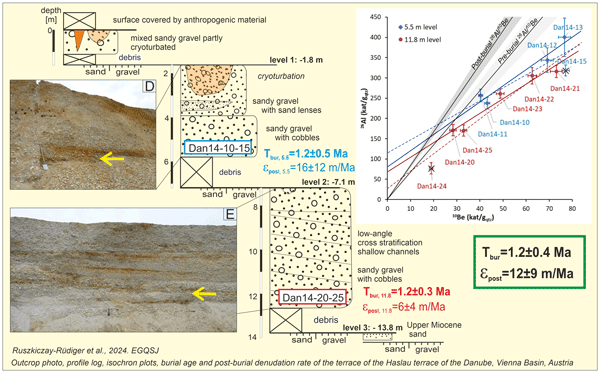
Zsófia Ruszkiczay-Rüdiger, Stephanie Neuhuber, Esther Hintersberger, and Jesper Nørgaard
E&G Quaternary Sci. J., 74, 59–78, https://doi.org/10.5194/egqsj-74-59-2025, https://doi.org/10.5194/egqsj-74-59-2025, 2025
Short summary
Short summary
Accurateness of dates and rates of landscape evolution depends on the precision of the geochronological data. This study offers a robust methodology of outlier identification for modelling the cosmogenic nuclide isochron burial age of fluvial sediments. The method is tested on a fluvial terrace of the Danube River in the Vienna Basin and provides novel information for the quantification of the uplift rate of the area. The presented methodology is applicable in other fluvial settings as well.
Trine Enemark, Rasmus Bødker Madsen, Torben O. Sonnenborg, Lærke Therese Andersen, Peter B. E. Sandersen, Jacob Kidmose, Ingelise Møller, Thomas Mejer Hansen, Karsten Høgh Jensen, and Anne-Sophie Høyer
Hydrol. Earth Syst. Sci., 28, 505–523, https://doi.org/10.5194/hess-28-505-2024, https://doi.org/10.5194/hess-28-505-2024, 2024
Short summary
Short summary
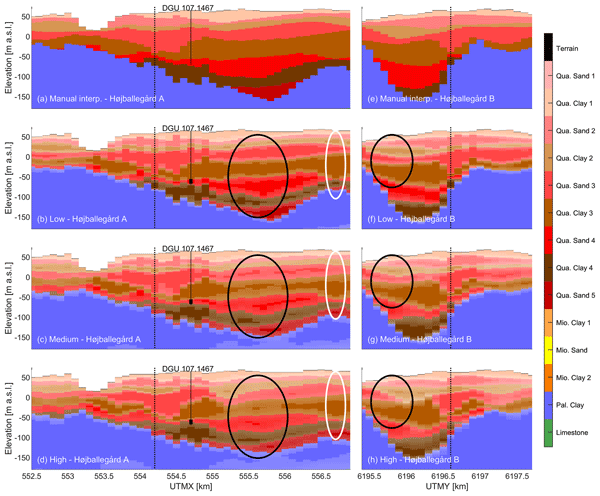
In this study, we demonstrate an approach to evaluate the interpretation uncertainty within a manually interpreted geological model in a groundwater model. Using qualitative estimates of uncertainties, several geological realizations are developed and implemented in groundwater models. We confirm existing evidence that if the conceptual model is well defined, interpretation uncertainties within the conceptual model have limited impact on groundwater model predictions.
Thomas Hermans, Pascal Goderniaux, Damien Jougnot, Jan H. Fleckenstein, Philip Brunner, Frédéric Nguyen, Niklas Linde, Johan Alexander Huisman, Olivier Bour, Jorge Lopez Alvis, Richard Hoffmann, Andrea Palacios, Anne-Karin Cooke, Álvaro Pardo-Álvarez, Lara Blazevic, Behzad Pouladi, Peleg Haruzi, Alejandro Fernandez Visentini, Guilherme E. H. Nogueira, Joel Tirado-Conde, Majken C. Looms, Meruyert Kenshilikova, Philippe Davy, and Tanguy Le Borgne
Hydrol. Earth Syst. Sci., 27, 255–287, https://doi.org/10.5194/hess-27-255-2023, https://doi.org/10.5194/hess-27-255-2023, 2023
Short summary
Short summary
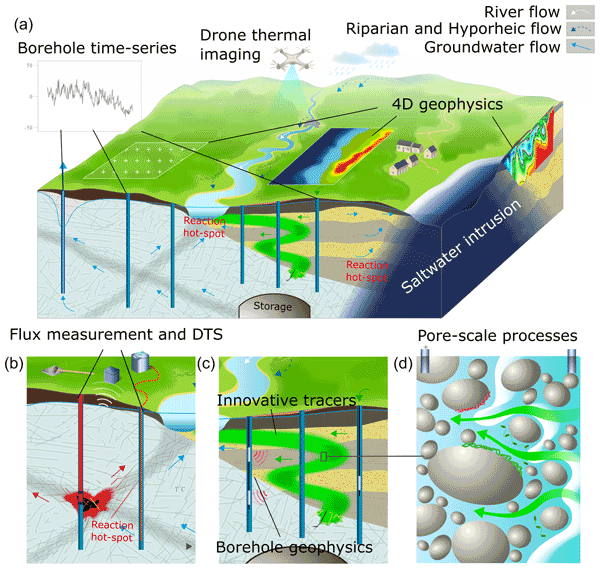
Although invisible, groundwater plays an essential role for society as a source of drinking water or for ecosystems but is also facing important challenges in terms of contamination. Characterizing groundwater reservoirs with their spatial heterogeneity and their temporal evolution is therefore crucial for their sustainable management. In this paper, we review some important challenges and recent innovations in imaging and modeling the 4D nature of the hydrogeological systems.
Rasmus Bødker Madsen, Hyojin Kim, Anders Juhl Kallesøe, Peter B. E. Sandersen, Troels Norvin Vilhelmsen, Thomas Mejer Hansen, Anders Vest Christiansen, Ingelise Møller, and Birgitte Hansen
Hydrol. Earth Syst. Sci., 25, 2759–2787, https://doi.org/10.5194/hess-25-2759-2021, https://doi.org/10.5194/hess-25-2759-2021, 2021
Short summary
Short summary
The protection of subsurface aquifers from contamination is an ongoing environmental challenge. Some areas of the underground have a natural capacity for reducing contaminants. In this research these areas are mapped in 3D along with information about, e.g., sand and clay, which indicates whether contaminated water from the surface will travel through these areas. This mapping technique will be fundamental for more reliable risk assessment in water quality protection.
Cited articles
Andersen, L. T.: 3D hydrogeological layer model of the Egebjerg area, GEUS Dataverse, V1 [data set], https://doi.org/10.22008/FK2/FHP1XK, 2024. a
Auken, E., Christiansen, A. V., Jacobsen, B. H., Foged, N., and Sørensen, K. I.: Piecewise 1D laterally constrained inversion of resistivity data, Geophys. Prospect., 53, 497–506, https://doi.org/10.1111/j.1365-2478.2005.00486.x, 2005. a
Barfod, A. A. S., Møller, I., Christiansen, A. V., Høyer, A.-S., Hoffimann, J., Straubhaar, J., and Caers, J.: Hydrostratigraphic modeling using multiple-point statistics and airborne transient electromagnetic methods, Hydrol. Earth Syst. Sci., 22, 3351–3373, https://doi.org/10.5194/hess-22-3351-2018, 2018. a, b, c, d, e, f, g
Bongajum, E., Milkereit, B., and Huang, J.: Building 3D Stochastic Exploration Models from Borehole Geophysical and Petrophysical Data: A Case Study, Canadian Journal of Exploration Geophysics, 38, 40–50, 2013. a
Boyd, D. L., Walton, G., and Trainor-Guitton, W.: Quantifying Spatial Uncertainty in Rock Through Geostatistical Integration of Borehole Data and a Geologist's Cross-Section, Eng. Geol., 260, 105246, https://doi.org/10.1016/j.enggeo.2019.105246, 2019. a
Constable, S. C., Parker, R. L., and Constable, C. G.: Occam's inversion: A practical algorithm for generating smooth models from electromagnetic sounding data, Geophysics, 52, 289–300, 1987. a
Cordua, K., Hansen, T., Gulbrandsen, M., Barnes, C., and Mosegaard, K.: Mixed‐Point Geostatistical Simulation: A Combination of Two‐ and Multiple‐Point Geostatistics, Geophys. Res. Lett., 43, 9030–9037, https://doi.org/10.1002/2016GL070348, 2016. a
Dai, H., Chen, X., Ye, M., Song, X., and Zachara, J. M.: A Geostatistics‐Informed Hierarchical Sensitivity Analysis Method for Complex Groundwater Flow and Transport Modeling, Water Resour. Res., 53, 4327–4343, https://doi.org/10.1002/2016WR019756, 2017. a
Enemark, T., Madsen, R. B., Sonnenborg, T. O., Andersen, L. T., Sandersen, P. B. E., Kidmose, J., Møller, I., Hansen, T. M., Jensen, K. H., and Høyer, A.-S.: Incorporating interpretation uncertainties from deterministic 3D hydrostratigraphic models in groundwater models, Hydrol. Earth Syst. Sci., 28, 505–523, https://doi.org/10.5194/hess-28-505-2024, 2024. a
Enemark, T., Peeters, L., Mallants, D., and Batelaan, O.: Influence of geological model complexity on groundwater model results, Hydrogeol. J., 30, 101–119, https://doi.org/10.1007/s10040-022-02458-2, 2022. a
Feyen, L. and Caers, J.: Quantifying Geological Uncertainty for Flow and Transport Modeling in Multi-Modal Heterogeneous Formations, Adv. Water Resour., 29, 912–929, 2006. a
Guardiano, F. B. and Srivastava, R. M.: Multivariate geostatistics: beyond bivariate moments, in: Geostatistics Tróia’92, 1, 133–144, Springer, 1993. a
Guo, L., Hermans, T., Dudal, D., Van De Vijver, E., Benoit, N., and Deleersnyder, W.: Integrating Geophysical Inversion with Markov-Type Categorical Prediction for Improved Geological Modelling, in: NSG 2024 30th European Meeting of Environmental and Engineering Geophysics, 2024, 1–5, European Association of Geoscientists & Engineers, 2024. a
Hall, P., Sheather, S. J., Jones, M. C., and Marron, J. S.: On optimal data-based bandwidth selection in kernel density estimation, Biometrika, 78, 263–269, https://doi.org/10.1093/biomet/78.2.263, 1991. a
Hansen, M. and Pjetursson, B.: Free, online Danish shallow geological data, GEUS Bulletin, 23, 53–56, https://doi.org/10.34194/geusb.v23.4842, 2011. a
He, X. L., Sonnenborg, T. O., Jørgensen, F., and Jensen, K. H.: The effect of training image and secondary data integration with multiple-point geostatistics in groundwater modelling, Hydrol. Earth Syst. Sci., 18, 2943–2954, https://doi.org/10.5194/hess-18-2943-2014, 2014. a
He, X., Koch, J., Sonnenborg, T. O., Jørgensen, F., Schamper, C., and Refsgaard, J. C.: Transition Probability‐Based Stochastic Geological Modeling Using Airborne Geophysical Data and Borehole Data, Water Resour. Res., 50, 3147–3169, https://doi.org/10.1002/2013WR014593, 2014. a
Heagy, L. J., Kang, S., Cockett, R., and Oldenburg, D. W.: Open-source software for simulations and inversions of airborne electromagnetic data, Exploration Geophysics, 51, 38–44, 2020. a
Hermans, T. and Irving, J.: Facies discrimination with electrical resistivity tomography using a probabilistic methodology: effect of sensitivity and regularisation, Near Surf. Geophys., 15, 13–25, https://doi.org/10.3997/1873-0604.2016044, 2017. a, b, c, d
Hermans, T., Nguyen, F., and Caers, J.: Uncertainty in training image‐based inversion of hydraulic head data constrained to ERT data: Workflow and case study, Water Resour. Res., 51, 5332–5352, https://doi.org/10.1002/2014WR016460, 2015. a, b, c, d
Hermans, T., Goderniaux, P., Jougnot, D., Fleckenstein, J. H., Brunner, P., Nguyen, F., Linde, N., Huisman, J. A., Bour, O., Lopez Alvis, J., Hoffmann, R., Palacios, A., Cooke, A.-K., Pardo-Álvarez, Á., Blazevic, L., Pouladi, B., Haruzi, P., Fernandez Visentini, A., Nogueira, G. E. H., Tirado-Conde, J., Looms, M. C., Kenshilikova, M., Davy, P., and Le Borgne, T.: Advancing measurements and representations of subsurface heterogeneity and dynamic processes: towards 4D hydrogeology, Hydrol. Earth Syst. Sci., 27, 255–287, https://doi.org/10.5194/hess-27-255-2023, 2023. a
Høyer, A.-S., Jørgensen, F., and He, X.: Integration of geophysical data for geological modeling: Examples from Denmark, Eng. Geol., 195, 237–247, 2015. a
Høyer, A.-S., Vignoli, G., Hansen, T. M., Vu, L. T., Keefer, D. A., and Jørgensen, F.: Multiple-point statistical simulation for hydrogeological models: 3-D training image development and conditioning strategies, Hydrol. Earth Syst. Sci., 21, 6069–6089, https://doi.org/10.5194/hess-21-6069-2017, 2017. a
Javed, A., Ghazia, S., Alia, S., Muhammadb, S., Rasoolb, U., and Darc, Q. U. Z.: 3D interpretation of resistivity data for groundwater potential assessment of Pakhli Plain, Mansehra District, Pakistan, Pakistan Journal of Geology, 3, 51–58, 2019. a
Jha, S. K., Comunian, A., Mariethoz, G., and Kelly, B. F.: Parameterization of Training Images for Aquifer 3‐D Facies Modeling Integrating Geological Interpretations and Statistical Inference, Water Resour. Res., 50, 7731–7749, https://doi.org/10.1002/2013WR014274, 2014. a
Journel, A.: Combining knowledge from diverse sources, in: Geostatistics Rio 2000, edited by: Armstrong, M., Bettini, C., Lajaunie, C., and Wellmer, F.-W., Kluwer Academic Publishers, Dordrecht, the Netherlands, 1–15, https://doi.org/10.1007/978-94-010-0610-1_1, 2002. a
Jørgensen, F., Møller, R. R., Sandersen, P. B., and Nebel, L.: 3-D geological modelling of the Egebjerg area, Denmark, based on hydrogeophysical data, Geol. Surv. Den. Greenl., 20, 27–30, 2010a. a
Jørgensen, F., Møller, I., and Høyer, A.-S.: Advances in hydrogeophysical mapping for groundwater modeling in Denmark, Hydrogeol. J., 23, 339–353, 2015. a
Kim, H., Chung, C., and Kim, J.: Three-Dimensional Geostatistical Integration of Borehole and Geophysical Datasets in Developing Geological Unit Boundaries for Geotechnical Investigations, Q. J. Eng. Geol., 51, 79–95, https://doi.org/10.1144/qjegh2016-012, 2017. a
Koch, J., He, X., Jensen, K. H., and Refsgaard, J. C.: Challenges in conditioning a stochastic geological model of a heterogeneous glacial aquifer to a comprehensive soft data set, Hydrol. Earth Syst. Sci., 18, 2907–2923, https://doi.org/10.5194/hess-18-2907-2014, 2014. a
Levy, S., Friedli, L., Mariéthoz, G., and Linde, N.: Conditioning of Multiple-Point Statistics Simulations to Indirect Geophysical Data, Comput. Geosci., 187, 105581, https://doi.org/10.1016/j.cageo.2024.105581, 2024. a, b
Madsen, R. B., Møller, I., and Hansen, T. M.: Choosing Between Gaussian and MPS Simulation: The Role of Data Information Content – A Case Study Using Uncertain Interpretation Data Points, Stoch. Env. Res. Risk A., 35, 1563–1583, https://doi.org/10.1007/s00477-020-01954-2, 2021. a, b
Madsen, R. B., Høyer, A.-S., Andersen, L. T., Møller, I., and Hansen, T. M.: Geology-driven modeling: A new probabilistic approach for incorporating uncertain geological interpretations in 3D geological modeling, Eng. Geol., 309, 106833, https://doi.org/10.1016/j.enggeo.2022.106833, 2022. a, b, c, d, e, f, g
Manrique, I. I., Hermans, T., Caterina, D., Jougnot, D., Mignon, B., Masse, A., and Nguyen, F.: Integrated methodology to link geochemical and geophysical-lab data in a geophysical investigation of a slag heap for resource quantification, J. Environ. Manage., 349, 119366, https://doi.org/10.1016/j.jenvman.2023.119366, 2024. a, b
Marcotte, D.: Fast variogram computation with FFT, Comput. Geosci., 22, 1175–1186, https://doi.org/10.1016/S0098-3004(96)00026-X, 1996. a
Mariethoz, G. and Caers, J.: Multiple-point geostatistics: stochastic modeling with training images, John Wiley & Sons, Chichester, UK, ISBN 978-1-118-66296-0, https://doi.org/10.1002/9781118662960, 2014. a
Maurya, P., Foged, N., Madsen, L. M., and Christiansen, A.: Comparison of towed electromagnetic with airborne electromagnetic and electrical resistivity tomography in a hydrogeophysical context, Geophys. J. Int., 235, 817–830, https://doi.org/10.1093/gji/ggad276, 2023. a
Meerschman, E., Pirot, G., Mariethoz, G., Straubhaar, J., Van Meirvenne, M., and Renard, P.: A practical guide to performing multiple-point statistical simulations with the Direct Sampling algorithm, Comput. Geosci., 52, 307–324, https://doi.org/10.1016/j.cageo.2012.09.019, 2013. a
Michel, H., Nguyen, F., Kremer, T., Elen, A., and Hermans, T.: 1D Geological Imaging of the Subsurface from Geophysical Data with Bayesian Evidential Learning, Comput. Geosci., 138, 104456, https://doi.org/10.1016/j.cageo.2020.104456, 2020. a
Pirot, G., Linde, N., Mariethoz, G., and Bradford, J. H.: Probabilistic inversion with graph cuts: Application to the Boise Hydrogeophysical R esearch S ite, Water Resour. Res., 53, 1231–1250, 2017. a
Pirot, G., Joshi, R., Giraud, J., Lindsay, M. D., and Jessell, M. W.: loopUI-0.1: indicators to support needs and practices in 3D geological modelling uncertainty quantification, Geosci. Model Dev., 15, 4689–4708, https://doi.org/10.5194/gmd-15-4689-2022, 2022. a
Prikhodko, A., Bagrianski, A., Wilson, R., Belyakov, S., and Esimkhanova, N.: Detecting and recovering critical mineral resource systems using broadband total-field airborne natural source audio frequency magnetotellurics measurements, Geophysics, 89, WB13–WB23, 2024. a
Rochlitz, R., Becken, M., and Günther, T.: Three-dimensional inversion of semi-airborne electromagnetic data with a second-order finite-element forward solver, Geophys. J. Int., 234, 528–545, 2023. a
Satopää, V. A., Baron, J., Foster, D. P., Mellers, B. A., Tetlock, P. E., and Ungar, L. H.: Combining multiple probability predictions using a simple logit model, Int. J. Forecasting, 30, 344–356, https://doi.org/10.1016/j.ijforecast.2013.09.001, 2014. a
Song, X., Chen, X., Ye, M., Dai, Z., Hammond, G., and Zachara, J.: Delineating Facies Spatial Distribution by Integrating Ensemble Data Assimilationand Indicator Geostatistics With Level‐Set Transformation, Water Resour. Res., 55, 2652–2671, https://doi.org/10.1029/2018WR023262, 2019. a
Vilhelmsen, T. N., Auken, E., Christiansen, A. V., Barfod, A. S., Marker, P. A., and Bauer-Gottwein, P.: Combining Clustering Methods with MPS to Estimate Structural Uncertainty for Hydrological Models, Front. Earth Sci., 7, 181, https://doi.org/10.3389/feart.2019.00181, 2019. a
Zuo, C., Li, Z., Dai, Z., Wang, X., and Wang, Y.: A Pattern Classification Distribution Method for Geostatistical Modeling Evaluation and Uncertainty Quantification, Remote. Sens., 15, 2708, https://doi.org/10.3390/rs15112708, 2023. a
Short summary
Understanding what lies beneath the ground is often difficult due to limited drilling data. Our research combines geostatistical method with large-scale geophysical surveys to create more realistic underground maps. We developed a method that merges both data sources to better predict underground layers, helping improve decisions in groundwater management and future geological studies.
Understanding what lies beneath the ground is often difficult due to limited drilling data. Our...