
Articles | Volume 30, issue 1
https://doi.org/10.5194/hess-30-141-2026
© Author(s) 2026. This work is distributed under
the Creative Commons Attribution 4.0 License.
the Creative Commons Attribution 4.0 License.
https://doi.org/10.5194/hess-30-141-2026
© Author(s) 2026. This work is distributed under
the Creative Commons Attribution 4.0 License.
the Creative Commons Attribution 4.0 License.
Research article
| 
13 Jan 2026
Research article |
| 13 Jan 2026
| 13 Jan 2026
Evaluation of high-resolution meteorological data products using flux tower observations across Brazil
Jamie R. C. Brown
CORRESPONDING AUTHOR

School of Civil Aerospace and Design Engineering, University of Bristol, Bristol, BS8 1TR, UK
Ross Woods
School of Civil Aerospace and Design Engineering, University of Bristol, Bristol, BS8 1TR, UK
Humberto Ribeiro da Rocha
Instituto de Astronomia, Geofísica, e Ciências Atmosféricas, Universidade de São Paulo, São Paulo, 13083-8782, Brazil
Debora Regina Roberti
Departamento de Física, Universidade Federal de Santa Maria, Santa Maria, 97105-900, Brazil
Rafael Rosolem
CORRESPONDING AUTHOR
School of Civil Aerospace and Design Engineering, University of Bristol, Bristol, BS8 1TR, UK
Cabot Institute for the Environment, University of Bristol, Bristol, BS8 1UH, UK
Related authors
No articles found.
Adrià Fontrodona-Bach, Bettina Schaefli, Ross Woods, and Joshua R. Larsen
Hydrol. Earth Syst. Sci., 30, 2613–2636, https://doi.org/10.5194/hess-30-2613-2026, https://doi.org/10.5194/hess-30-2613-2026, 2026
Short summary
Short summary
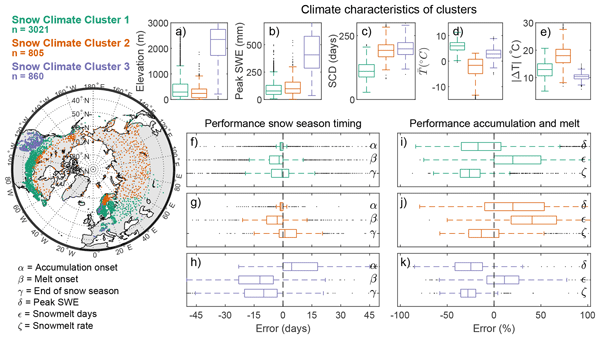
Investigating changing snow in response to global warming can be done with a simple model and only temperature and precipitation data, simplifying snow dynamics with assumptions and parameters. We provide a large-scale and long-term evaluation of this approach and its performance across diverse climates. Temperature thresholds are more robust over cold climates but melt parameters are more robust over warmer climates with deep snow. The model performs well across climates despite its simplicity.
Rafaela Cruz Alves Alberti, Thomas Lauvaux, Angel Liduvino Vara-Vela, Ricard Segura Barrero, Christoffer Karoff, Maria de Fátima Andrade, Márcia Talita Amorim Marques, Noelia Rojas Benavente, Osvaldo Machado Rodrigues Cabral, Humberto Ribeiro da Rocha, and Rita Yuri Ynoue
Atmos. Chem. Phys., 25, 9803–9829, https://doi.org/10.5194/acp-25-9803-2025, https://doi.org/10.5194/acp-25-9803-2025, 2025
Short summary
Short summary
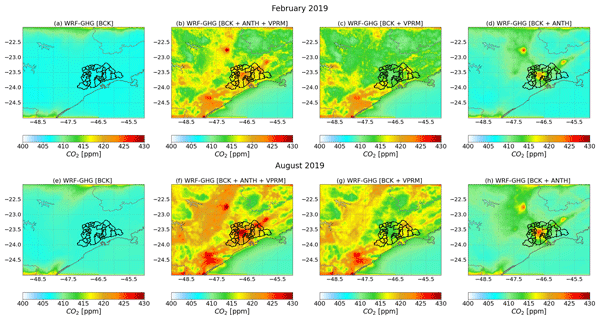
This study addresses uncertainties in atmospheric models by analyzing CO2 dynamics in a complex urban environment characterized by a dense population and tropical vegetation. High-accuracy sensors were deployed, and the Weather Research and Forecasting model coupled with Chemistry (WRF-Chem) was utilized to simulate CO2 transport, capturing variations and assessing contributions from both anthropogenic and biogenic sources.
Yanchen Zheng, Gemma Coxon, Mostaquimur Rahman, Ross Woods, Saskia Salwey, Youtong Rong, and Doris E. Wendt
Geosci. Model Dev., 18, 4247–4271, https://doi.org/10.5194/gmd-18-4247-2025, https://doi.org/10.5194/gmd-18-4247-2025, 2025
Short summary
Short summary
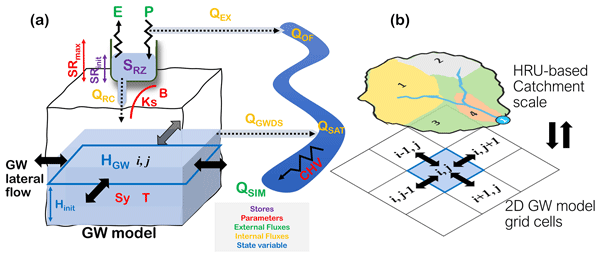
Groundwater is vital for people and ecosystems, but most physical models lack the representation of surface–groundwater interactions, leading to inaccurate streamflow predictions in groundwater-rich areas. This study presents DECIPHeR-GW v1, which links surface and groundwater systems to improve predictions of streamflow and groundwater levels. Tested across England and Wales, DECIPHeR-GW shows high accuracy, especially in southeast England, making it a valuable tool for large-scale water management.
Wouter R. Berghuijs, Ross A. Woods, Bailey J. Anderson, Anna Luisa Hemshorn de Sánchez, and Markus Hrachowitz
Hydrol. Earth Syst. Sci., 29, 1319–1333, https://doi.org/10.5194/hess-29-1319-2025, https://doi.org/10.5194/hess-29-1319-2025, 2025
Short summary
Short summary
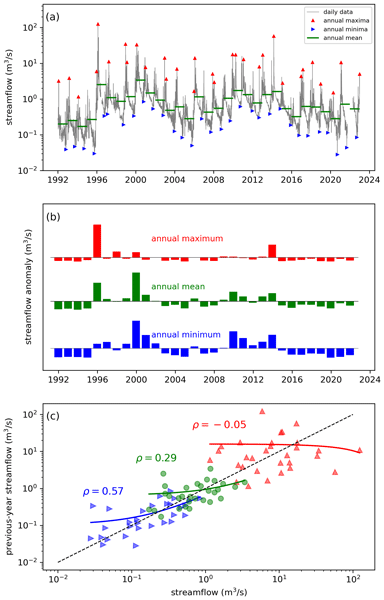
Water balances of catchments will often strongly depend on their state in the recent past, but such memory effects may persist at annual timescales. We use global data sets to show that annual memory is typically absent in precipitation but strong in terrestrial water stores and also present in evaporation and streamflow (including low flows and floods). Our experiments show that hysteretic models provide behaviour that is consistent with these observed memory behaviours.
Eshrat Fatima, Rohini Kumar, Sabine Attinger, Maren Kaluza, Oldrich Rakovec, Corinna Rebmann, Rafael Rosolem, Sascha E. Oswald, Luis Samaniego, Steffen Zacharias, and Martin Schrön
Hydrol. Earth Syst. Sci., 28, 5419–5441, https://doi.org/10.5194/hess-28-5419-2024, https://doi.org/10.5194/hess-28-5419-2024, 2024
Short summary
Short summary
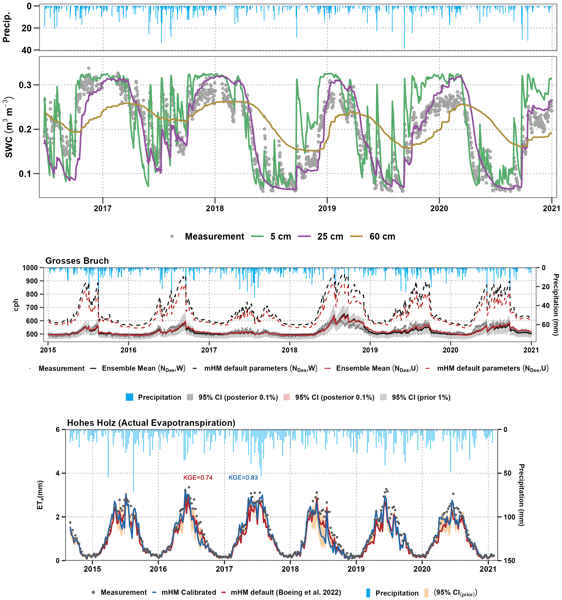
This study establishes a framework to incorporate cosmic-ray neutron measurements into the mesoscale Hydrological Model (mHM). We evaluate different approaches to estimate neutron counts within the mHM using the Desilets equation, with uniformly and non-uniformly weighted average soil moisture, and the physically based code COSMIC. The data improved not only soil moisture simulations but also the parameterisation of evapotranspiration in the model.
Yanchen Zheng, Gemma Coxon, Ross Woods, Daniel Power, Miguel Angel Rico-Ramirez, David McJannet, Rafael Rosolem, Jianzhu Li, and Ping Feng
Hydrol. Earth Syst. Sci., 28, 1999–2022, https://doi.org/10.5194/hess-28-1999-2024, https://doi.org/10.5194/hess-28-1999-2024, 2024
Short summary
Short summary
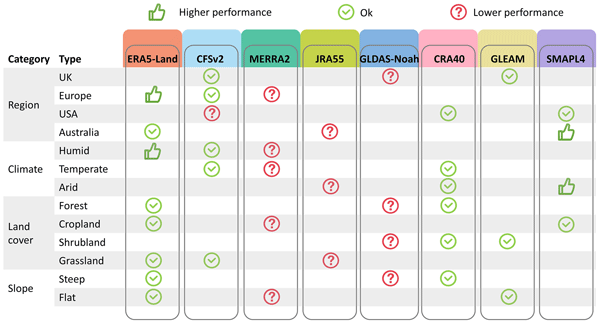
Reanalysis soil moisture products are a vital basis for hydrological and environmental research. Previous product evaluation is limited by the scale difference (point and grid scale). This paper adopts cosmic ray neutron sensor observations, a novel technique that provides root-zone soil moisture at field scale. In this paper, global harmonized CRNS observations were used to assess products. ERA5-Land, SMAPL4, CFSv2, CRA40 and GLEAM show better performance than MERRA2, GLDAS-Noah and JRA55.
Adrià Fontrodona-Bach, Bettina Schaefli, Ross Woods, Adriaan J. Teuling, and Joshua R. Larsen
Earth Syst. Sci. Data, 15, 2577–2599, https://doi.org/10.5194/essd-15-2577-2023, https://doi.org/10.5194/essd-15-2577-2023, 2023
Short summary
Short summary
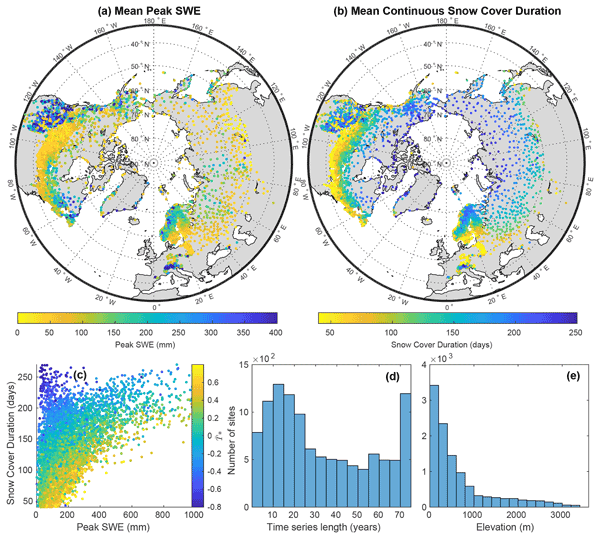
We provide a dataset of snow water equivalent, the depth of liquid water that results from melting a given depth of snow. The dataset contains 11 071 sites over the Northern Hemisphere, spans the period 1950–2022, and is based on daily observations of snow depth on the ground and a model. The dataset fills a lack of accessible historical ground snow data, and it can be used for a variety of applications such as the impact of climate change on global and regional snow and water resources.
Dagmawi Teklu Asfaw, Michael Bliss Singer, Rafael Rosolem, David MacLeod, Mark Cuthbert, Edisson Quichimbo Miguitama, Manuel F. Rios Gaona, and Katerina Michaelides
Geosci. Model Dev., 16, 557–571, https://doi.org/10.5194/gmd-16-557-2023, https://doi.org/10.5194/gmd-16-557-2023, 2023
Short summary
Short summary
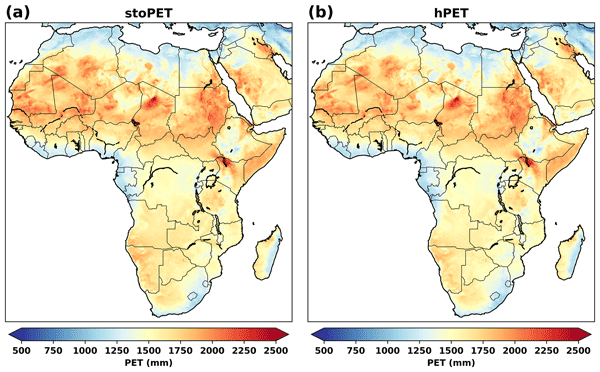
stoPET is a new stochastic potential evapotranspiration (PET) generator for the globe at hourly resolution. Many stochastic weather generators are used to generate stochastic rainfall time series; however, no such model exists for stochastically generating plausible PET time series. As such, stoPET represents a significant methodological advance. stoPET generate many realizations of PET to conduct climate studies related to the water balance, agriculture, water resources, and ecology.
Xu Zhang, Jinbao Li, Qianjin Dong, and Ross A. Woods
Hydrol. Earth Syst. Sci. Discuss., https://doi.org/10.5194/hess-2022-309, https://doi.org/10.5194/hess-2022-309, 2022
Manuscript not accepted for further review
Short summary
Short summary
Accurately estimating long-term evaporation is important for describing water balance. Budyko framework already incorporates precipitation and potential evaporation, while water storage capacity and climate seasonality are usually ignored. Here, we analytically generalize Budyko framework through the Ponce-Shetty model, and physically account these two factors. Our generalized equations perform better than varying Budyko-type equations, and improve the robustness and physical interpretation.
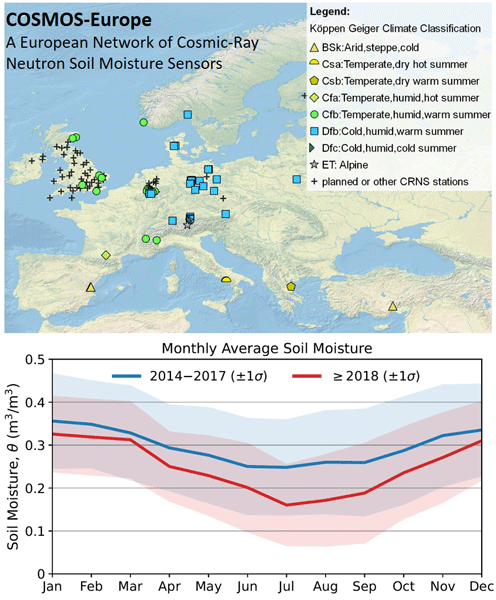
Heye Reemt Bogena, Martin Schrön, Jannis Jakobi, Patrizia Ney, Steffen Zacharias, Mie Andreasen, Roland Baatz, David Boorman, Mustafa Berk Duygu, Miguel Angel Eguibar-Galán, Benjamin Fersch, Till Franke, Josie Geris, María González Sanchis, Yann Kerr, Tobias Korf, Zalalem Mengistu, Arnaud Mialon, Paolo Nasta, Jerzy Nitychoruk, Vassilios Pisinaras, Daniel Rasche, Rafael Rosolem, Hami Said, Paul Schattan, Marek Zreda, Stefan Achleitner, Eduardo Albentosa-Hernández, Zuhal Akyürek, Theresa Blume, Antonio del Campo, Davide Canone, Katya Dimitrova-Petrova, John G. Evans, Stefano Ferraris, Félix Frances, Davide Gisolo, Andreas Güntner, Frank Herrmann, Joost Iwema, Karsten H. Jensen, Harald Kunstmann, Antonio Lidón, Majken Caroline Looms, Sascha Oswald, Andreas Panagopoulos, Amol Patil, Daniel Power, Corinna Rebmann, Nunzio Romano, Lena Scheiffele, Sonia Seneviratne, Georg Weltin, and Harry Vereecken
Earth Syst. Sci. Data, 14, 1125–1151, https://doi.org/10.5194/essd-14-1125-2022, https://doi.org/10.5194/essd-14-1125-2022, 2022
Short summary
Short summary
Monitoring of increasingly frequent droughts is a prerequisite for climate adaptation strategies. This data paper presents long-term soil moisture measurements recorded by 66 cosmic-ray neutron sensors (CRNS) operated by 24 institutions and distributed across major climate zones in Europe. Data processing followed harmonized protocols and state-of-the-art methods to generate consistent and comparable soil moisture products and to facilitate continental-scale analysis of hydrological extremes.
Shaini Naha, Miguel Angel Rico-Ramirez, and Rafael Rosolem
Hydrol. Earth Syst. Sci., 25, 6339–6357, https://doi.org/10.5194/hess-25-6339-2021, https://doi.org/10.5194/hess-25-6339-2021, 2021
Short summary
Short summary
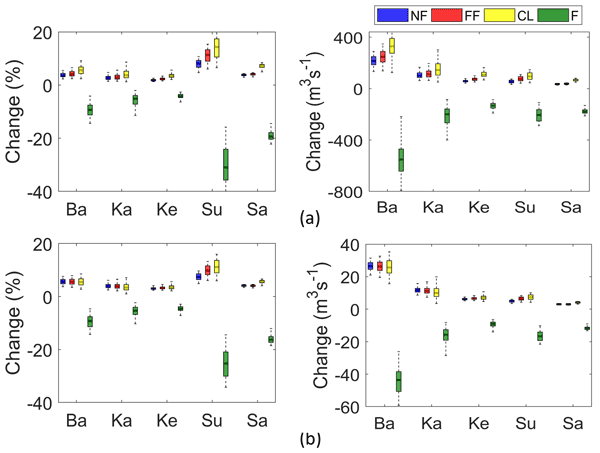
Rapid growth in population in developing countries leads to an increase in food demand, and as a consequence, percentages of land are being converted to cropland which alters river flow processes. This study describes how the hydrology of a flood-prone river basin in India would respond to the current and future changes in land cover. Our findings indicate that the recurrent flood events occurring in the basin might be influenced by these changes in land cover at the catchment scale.
Tom Gleeson, Thorsten Wagener, Petra Döll, Samuel C. Zipper, Charles West, Yoshihide Wada, Richard Taylor, Bridget Scanlon, Rafael Rosolem, Shams Rahman, Nurudeen Oshinlaja, Reed Maxwell, Min-Hui Lo, Hyungjun Kim, Mary Hill, Andreas Hartmann, Graham Fogg, James S. Famiglietti, Agnès Ducharne, Inge de Graaf, Mark Cuthbert, Laura Condon, Etienne Bresciani, and Marc F. P. Bierkens
Geosci. Model Dev., 14, 7545–7571, https://doi.org/10.5194/gmd-14-7545-2021, https://doi.org/10.5194/gmd-14-7545-2021, 2021
Short summary
Short summary
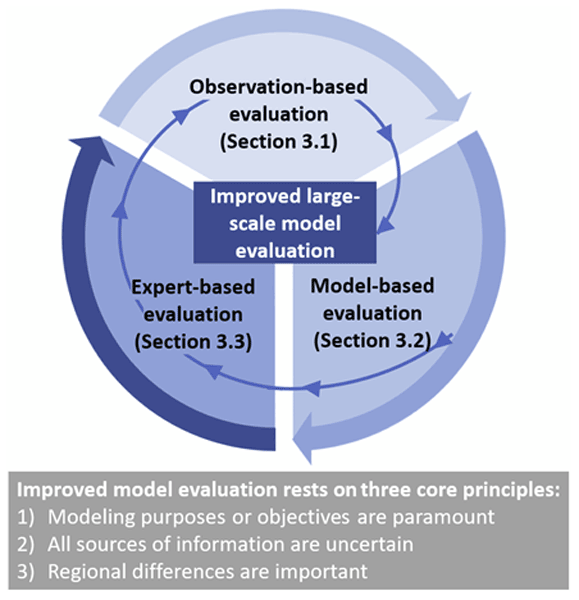
Groundwater is increasingly being included in large-scale (continental to global) land surface and hydrologic simulations. However, it is challenging to evaluate these simulations because groundwater is
hiddenunderground and thus hard to measure. We suggest using multiple complementary strategies to assess the performance of a model (
model evaluation).

Daniel Power, Miguel Angel Rico-Ramirez, Sharon Desilets, Darin Desilets, and Rafael Rosolem
Geosci. Model Dev., 14, 7287–7307, https://doi.org/10.5194/gmd-14-7287-2021, https://doi.org/10.5194/gmd-14-7287-2021, 2021
Short summary
Short summary
Cosmic-ray neutron sensors estimate root-zone soil moisture at sub-kilometre scales. There are national-scale networks of these sensors across the globe; however, methods for converting neutron signals to soil moisture values are inconsistent. This paper describes our open-source Python tool that processes raw sensor data into soil moisture estimates. The aim is to allow a user to ensure they have a harmonized data set, along with informative metadata, to facilitate both research and teaching.
E. Andrés Quichimbo, Michael Bliss Singer, Katerina Michaelides, Daniel E. J. Hobley, Rafael Rosolem, and Mark O. Cuthbert
Geosci. Model Dev., 14, 6893–6917, https://doi.org/10.5194/gmd-14-6893-2021, https://doi.org/10.5194/gmd-14-6893-2021, 2021
Short summary
Short summary
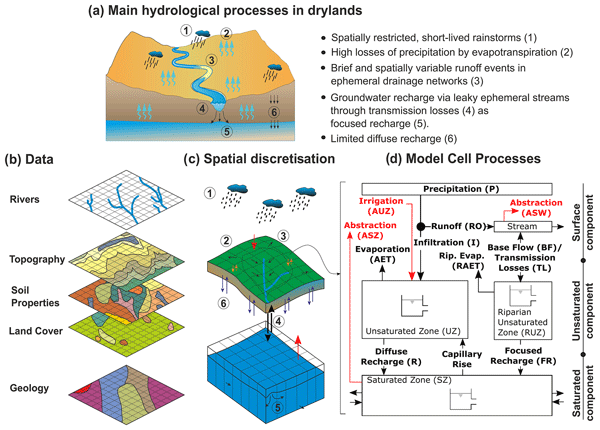
Understanding and quantifying water partitioning in dryland regions are of key importance to anticipate the future impacts of climate change in water resources and dryland ecosystems. Here, we have developed a simple hydrological model (DRYP) that incorporates the key processes of water partitioning in drylands. DRYP is a modular, versatile, and parsimonious model that can be used to anticipate and plan for climatic and anthropogenic changes to water fluxes and storage in dryland regions.
Cited articles
Alijanian, M., Rakhshandehroo, G. R., Mishra, A., and Dehghani, M.: Evaluation of remotely sensed precipitation estimates using PERSIANN-CDR and MSWEP for spatio-temporal drought assessment over Iran, Journal of Hydrology, 579, 124189, https://doi.org/10.1016/j.jhydrol.2019.124189, 2019.
Allen, R., Pereira, L., Raes, D., and Smith, M.: FAO Irrigation and drainage paper No. 56, Rome, Food and Agriculture Organization of the United Nations, 56, 26–40, https://www.fao.org/4/x0490e/x0490e00.htm (last access: 5 May 2024), 1998.
Alvares, C. A., Stape, J. L., Sentelhas, P. C., De Moraes Gonçalves, J. L., and Sparovek, G.: Köppen's climate classification map for Brazil, Meteorologische Zeitschrift, 22, 711–728, https://doi.org/10.1127/0941-2948/2013/0507, 2013.
Araújo, A. C., Nobre, A. D., Kruijt, B., Elbers, J. A., Dallarosa, R., Stefani, P., von Randow, C., Manzi, A. O., Culf, A. D., Gash, J. H. C., Valentini, R., and Kabat, P.: Comparative measurements of carbon dioxide fluxes from two nearby towers in a central Amazonian rainforest: The Manaus LBA site, Journal of Geophysical Research, 107, https://doi.org/10.1029/2001jd000676, 2002.
Baez-Villanueva, O. M., Zambrano-Bigiarini, M., Ribbe, L., Nauditt, A., Giraldo-Osorio, J. D., and Thinh, N. X.: Temporal and spatial evaluation of satellite rainfall estimates over different regions in Latin-America, Atmospheric Research, 213, 34–50, https://doi.org/10.1016/j.atmosres.2018.05.011, 2018.
Baldocchi, D., Falge, E., Gu, L., Olson, R., Hollinger, D., Running, S., Anthoni, P., Bermhofer. C., Davis, K., Evans, R., Fuentes, J., Goldstein, A., Katul, G., Law, B., Lee, X., Malhi, Y., Meyers, T., Munger, W., Oechel, W., Paw, K. T., Pilegaard, K., Schmid, H. P., Valentini, R., Verma, S., Vesala, T., Wilson, K., and Wofsy, S.: FLUXNET: A new tool to study the temporal and spatial variability of ecosystem-scale carbon dioxide, water vapor, and energy flux densities, Bull. Am. Meteorol. Soc., 82, 2415–2434, https://doi.org/10.1175/1520-0477(2001)082<2415:FANTTS>2.3.CO;2, 2001.
Beck, H. E., Wood, E. F., Pan, M., and Fisher, C. K.: MSWEP V2 Global 3-Hourly 0.1° Precipitation: Methodology and Quantitative Assessment, Bulletin of the American Meteological Society, 100, 473–500, https://doi.org/10.1175/BAMS-D-17-0138.1, 2019.
Beck, H. E., Pan, M., Miralles, D. G., Reichle, R. H., Dorigo, W. A., Hahn, S., Sheffield, J., Karthikeyan, L., Balsamo, G., Parinussa, R. M., van Dijk, A. I. J. M., Du, J., Kimball, J. S., Vergopolan, N., and Wood, E. F.: Evaluation of 18 satellite-and model-based soil moisture products using in situ measurements from 826 sensors, Hydrol. Earth Syst. Sci., 25, 17–40, https://doi.org/10.5194/hess-25-17-2021, 2021.
Beven, K. and Westerberg, I.: On red herrings and real herrings: disinformation and information in hydrological inference, Hydrological Processes, 25, 1676–1680, https://doi.org/10.1002/hyp.7963, 2011.
Blankenau, P. A., Kilic, A., and Allen, R.: An evaluation of gridded weather data sets for the purpose of estimating reference evapotranspiration in the United States, Agricultural Water Management, 242, https://doi.org/10.1016/j.agwat.2020.106376, 2020.
Bolton, D.: The Computation of Equivalent Potential Temperature, Monthly Weather Review, 108, 1046–1053, https://doi.org/10.1175/1520-0493(1980)108<1046:TCOEPT>2.0.CO;2, 1980.
Bonal, D., Burban, B., Stahl, C., Wagner, F., and Hérault, B.: The response of tropical rainforests to drought – lessons from recent research and future prospects, Annals of Forest Science, 73, 27–44, https://doi.org/10.1007/s13595-015-0522-5, 2016.
Brunke, M. A., Fairall, C. W., Zend, X., Eymard, L., and Curry, J. A.: Which Bulk Aerodynamic Algorithms are Least Problematic in Computing Ocean Surface Turbulent Fluxes?, Journal of Climate, 16, 619–635, https://doi.org/10.1175/1520-0442(2003)016<0619:WBAAAL>2.0.CO;2, 2003.
Borma, L. D. S., Da Rocha, H. R., Cabral, O. M., Von Randow, C., Collicchio, E., Kurzatkowski, D., Brugger, P. J., Freitas, H., Tannus, R., Oliveira, L., and Rennó, C. D.: Atmosphere and hydrological controls of the evapotranspiration over a floodplain forest in the Bananal Island region, Amazonia, Journal of Geophysical Research: Biogeosciences, 114, https://doi.org/10.1029/2007JG000641, 2009.
Cabral, O. M., da Rocha, H. R., Gash, J. H., Ligo, M. A., Freitas, H. C., and Tatsch, J. D.: The energy and water balance of a Eucalyptus plantation in southeast Brazil., Journal of Hydrology, 388, 208–216, https://doi.org/10.1016/j.jhydrol.2010.04.041, 2010.
Cabral, O. M. R., Rocha, H. R., Gash, J. H., Ligo, M. A. V., Ramos, N. P., Packer, A. P., and Batista, E. R.: Fluxes of CO2 above a sugarcane plantation in Brazil, Agricultural and Forest Meteorology, 182/183, 54–66, https://doi.org/10.1016/j.agrformet.2013.08.004, 2013.
Coe, M. T., Macedo, M. N., Brando, P. M., Lefebvre, P., Panday, P., and Silvério, D.: The Hydrology and Energy Balance of the Amazon Basin, in: Interactions Between Biosphere, Atmosphere and Human Land Use in the Amazon Basin, edited by: Nagy, L., Forsberg, B., and Artaxo, P., Ecological Studies, Vol. 227, Springer, Berlin, Heidelberg, https://doi.org/10.1007/978-3-662-49902-3_3, 2016.
Cox, S. J., Stackhouse, P. W., Gupta, S. K., Mikovitz, C. J., and Zhang, T.: NASA/GEWEX shortwave surface radiation budget: Integrated data product with reprocessed radiance, cloud, and meteorology inputs, and new surface albedo treatment, AIP Conference Proceedings, 1810, 090001, https://doi.org/10.1063/1.4975541, 2017.
de Andrade, B. C., Laipelt, L., Fleischmann, A., Huntington, J., Morton, C., Melton, F., Erickson, T., Roberti, D. R., Souza, V. dA., Biudes, M., Machado, N. G., Santos, C. A. C., Cosio, E. G., and Ruhoff, A.: geeSEBAL-MODIS: Continental-scale evapotranspiration based on the surface energy balance for South America, ISPRS Journal of Photogrammetry and Remote Sensing, 207, 141–163, https://doi.org/10.1016/j.isprsjprs.2023.12.001, 2024.
De Gonçalves, L. G. G., Borak, J. S., Costa, M. H., Saleska, S. R., Baker, I., Restrepo-Coupe, N., Muza, M. N., Poulter, B., Verbeeck, H., Fisher, J. B., and Arain, M. A.: Overview of the large-scale biosphere–atmosphere experiment in Amazonia Data Model Intercomparison Project (LBA-DMIP), Agricultural and Forest meteorology, 182, 111–127, https://doi.org/10.1016/j.agrformet.2013.04.030, 2013.
da Rocha, H. R., Freitas, H. C., Rosolem, R., Juárez, R. I. N., Tannus, R. N.,, Ligo, M. A., Cabral, O. M. R., and Dias, M. A. F. S.: Measurements of CO exchange over a woodland savanna 2 (Cerrado Sensu stricto) in southeast Brasil, Biota Neotropica, 2, 1–11, https://doi.org/10.1590/S1676-06032002000100009, 2002.
Decker, M., Brunke, M., Wang, Z., Sakaguchi, K., Zeng, X., and Bosilovich, M.: Evaluation of the reanalysis products from GSFC, NCEP, and ECMWF using flux tower observations, Journal of Climate, 25, 1916–1944, https://doi.org/10.1175/JCLI-D-11-00004.1, 2012.
Díaz, M. F., Bigelow, S., and Armesto, J. J.: Alteration of the hydrologic cycle due to forest clearing and its consequences for rainforest succession, Forest Ecology and Management, 244, 32–40, https://doi.org/10.1016/j.foreco.2007.03.030, 2007.
Dullaart, J. C. M., Muis, S., Bloemendaal, N., and Aerts, J. C. J. H.: Advancing global storm surge modelling using the new ERA5 climate reanalysis, Climate Dynamics, 54, 1007–1021, https://doi.org/10.1007/s00382-019-05044-0, 2019.
Filho, A. J. P., Vemado, F., Vemado, G., Vieira Reis, F. A. G., do Carmo Giordano, L., Cerri, R. I., dos Santos, C. C., Lopes, E. S. S., Gramani, M. F., Ogura, A. T., Zaine, J. E., da Silva Cerri, L. E., Filho, O. A., D'Affonseca, F. M., and dos Santos Amaral, C.: A step towards integrating CMORPH precipitation estimation with rain gauge measurements, Advances in Meteorology, ID 2095304, 1–24, https://doi.org/10.1155/2018/2095304, 2018.
Gampe, D. and Ludwig, R.: Evaluation of Gridded Precipitation Data Products for Hydrological Applications in Complex Topography, Hydrology, 4, 53, https://doi.org/10.3390/hydrology4040053, 2017.
Gomis-Cebolla, J., Jimenez, J. C., Sobrino, J. A., Corbari, C., and Mancini, M.: Intercomparison of remote-sensing based evapotranspiration algorithms over amazonian forests, International Journal of Applied Earth Observation and Geoinformation, 80, 280–294, https://doi.org/10.1016/j.jag.2019.04.009, 2019.
Goulden, M. L., Miller, S. D., Da Rocha, H. R., Menton, M. C., de Freitas, H. C., e Silva Figueira, A. M., and de Sousa, C. A. D.: Diel and seasonal patterns of tropical forest CO2 exchange, Ecological Applications, 14, 42–54, https://doi.org/10.1890/02-6008, 2004.
Gupta, H. V., Kling, H., Yilmaz, K. K., and Martinez, G. F.: Decomposition of the mean squared error and NSE performance criteria: Implications for improving hydrological modelling, Journal of Hydrology, 377, 80–91, https://doi.org/10.1016/j.jhydrol.2009.08.003, 2009.
Hofstra, N., Haylock, M., New, M., Jones, P., and Frei, C.: Comparison of six methods for the interpolation of daily, European climate data, Journal of Geophysical Research, 113, D21110, https://doi.org/10.1029/2008JD010100, 2008.
Hollinger, D. Y. and Richardson, A. D.: Uncertainty in eddy covariance measurements and its application to physiological models, Tree Physiology, 25, 873–885, https://doi.org/10.1093/treephys/25.7.873, 2005.
Hughes, D. A. and Slaughter, A.: Daily disaggregation of simulated monthly flows using different rainfall datasets in southern Africa, Journal of Hydrology: Regional Studies, 4, 153–171, https://doi.org/10.1016/j.ejrh.2015.05.011, 2015.
IPCC: Managing the Risks of Extreme Events and Disasters to Advance Climate Change Adaptation, edited by: Field, C. B., Barros, V., Stocker, T. F., Qin, D., Dokken, D. J., Ebi, K. L., Mastrandrea, M. D., Mach, K. J., Plattner, G.-K., Allen, S. K., Tignor, M., and Midgley, P. M., Cambridge University Press, The Edinburgh Building, Shaftesbury Road, Cambridge CB2 8RU ENGLAND, 582 pp., https://doi.org/10.1017/CBO9781139177245, 2012.
Iwema, J., Rosolem, R., Rahman, M., Blyth, E., and Wagener, T.: Land surface model performance using cosmic-ray and point-scale soil moisture measurements for calibration, Hydrol. Earth Syst. Sci., 21, 2843–2861, https://doi.org/10.5194/hess-21-2843-2017, 2017.
Jiang, H., Yang, Y., Bai, Y., and Wang, H.: Evaluation of the Total, Direct, and Diffuse Solar Radiations from the ERA5 reanalysis data in China, Geoscience and Remote Sensing Letters, 17, 47–51, https://doi.org/10.1109/LGRS.2019.2916410, 2020.
Jung, M., Nelson, J., Migliavacca, M., El-Madany, T., Papale, D., Reichstein, M., Walther, S., and Wutzler, T.: Technical note: Flagging inconsistencies in flux tower data, Biogeosciences, 21, 1827–1846, https://doi.org/10.5194/bg-21-1827-2024, 2024.
Kalnay, E., Kanamitsu, M., Kistler, R., Collins, W., Deaven, D., Gandin, L., Iredell, M., Saha, S., White, G., Woollen, J., Zhu, Y., Leetmaa, A., Reynolds, R., Chelliah, M., Ebisuzaki, W., Higgins, W., Janowiak, J., Mo, K. C., Ropelewski, C., Wang, J., Jenne, R., and Joseph, D.: The NCEP/NCAR 40-year reanalysis project, Bulletin of the American Meteorological Society, 77, 437–471, https://doi.org/10.1175/1520-0477(1996)077<0437:TNYRP>2.0.CO;2, 1996.
Kauffeldt, A., Halldin, S., Rodhe, A., Xu, C. Y., and Westerberg, I. K.: Disinformative data in large-scale hydrological modelling, Hydrol. Earth Syst. Sci., 17, 2845–2857, https://doi.org/10.5194/hess-17-2845-2013, 2013.
Kirkman, G. A., Gut, A., Ammann, C., Gatti, L. V., Cordova, A. M., Moura, M. A. L., Andreae, M. O., and Meixner, F. X.: Surface exchange of nitric oxide, nitrogen dioxide, and ozone at a cattle pasture in Rondônia, Brazil, Journal of Geophysical Research, 107, https://doi.org/10.1029/2001JD000523, 2002.
Liebmann, B. and Allured, D.: Daily precipitation grids for South America, Bulletin for the American Meteorological Society, 86, 1567–1570, https://doi.org/10.1175/BAMS-86-11-1567, 2005.
Melo, D. C. D., Anache, J. A. A., Borges, V. P., Miralles, D. G., Martens, B., Fisher, J. B., Nóbrega, R. L. B., Moreno, A., Cabral, O. M. R., Rodrigues, T. R., Bezerra, B., Silva, C. M. S., Meira Neto, A. A., Moura, M. S. B., Marques, T. V., Campos, S., Nogueira, J. S., Rosolem, R., Souza, R. M. S., Antonino, A. C. D., Holl, D., Galleguillos, M., Perez-Quezada, J. F., Verhoef, A., Kutzbach, L., Lima, J. R. S., Souza, E. S., Gassman, M. I., Perez, C. F., Tonti, N., Posse, G., Rains, D., Oliveira, P. T. S., and Wendland E.: Are remote sensing evapotranspiration models reliable across South American ecoregions?, Water Resources Research, 57, e2020WR028752, https://doi.org/10.1029/2020WR028752, 2021.
Miralles, D. G., Gentine, P., Seneviratne, S. I., and Teuling, A. J.: Land-atmospheric feedbacks during droughts and heatwaves: state of the science and current challenges, Annals of the New York Academy of Sciences, 1436, 19–35, https://doi.org/10.1111/nyas.13912, 2019.
Moreira, A. A., Ruhoff, A. L., Roberti, D. R., Souza, V. d. A., da Rocha, H. R., and de Pavia, R. C. D.: Assessment of terrestrial water balance using remote sensing data in South America, Journal of Hydrology, 575, 131–147, https://doi.org/10.1016/j.jhydrol.2019.05.021, 2019.
Moreira, V. S., Candido, L. A., Roberti, D. R., Webler, G., Diaz, M. B., de Gonçalves, L. G. G., Pousa, R., and Degrazia, G. A.: Influence of soil properties in different management systems: Estimating soybean water changes in the agro-IBIS model, Earth Interactions, 22, 1–19, https://doi.org/10.1175/EI-D-16-0033.1, 2018.
Muñoz-Sabater, J.: ERA5-Land hourly data from 1981 to present, Copernicus Climate Change Service (C3S) Climate Data Store (CDS) [data set], https://doi.org/10.24381/cds.e2161bac, 2019.
Oliveira, R. S., Bezerra, L., Davidson, E. A., Pinto, F., Klink, C. A., Nepstad, D. C., and Moreira, A.: Deep root function in soil water dynamics in cerrado savannas of central Brazil, Functional Ecology, 19, 574–581, https://doi.org/10.1111/j.1365-2435.2005.01003.x, 2005.
Pelosi, A., Terribile, F., D'Urso, G., and Chirico, G. B.: Comparison of ERA5-Land and UERRA MESCAN-SURFEX reanalysis Data with spatially interpolated weather observations for the regional assessment of reference evapotranspiration, Water, 12, 1669, https://doi.org/10.3390/w12061669, 2020.
Rice, A. H., Pyle, E. H., Saleska, S. R., Hutyra, L., Palace, M., Keller, M., De Camargo, P. B., Portilho, K., Marques, D. F., and Wofsy, S. C.: Carbon balance and vegetation dynamics in an old-growth amazonian forest, Ecological Applications, 14, S55–S71, https://doi.org/10.1890/02-6006, 2004.
Rodell, M., Houser, P. R., Jambor, U., Gottschalck, J., Mitchell, K., Meng, C.-J., Arsenault, K., Cosgrove, B., Radakovich, J., Bosilovich, M., Entin, J. K., Walker, J. P., Lohmann, D., and Toll, D.: The Global Land Data Assimilation System, Bulletin of the American Meteorological Society, 85, 381–394, https://doi.org/10.1175/BAMS-85-3-381, 2004.
Sakai, R. K., Fitzjarrald, D. R., Moraes, O. L. L., Staebler, R. M., Acevedo, O. C., Czikowsky, M. J., da Silva, R., Brait, E., and Miranda, V.: Land-use change effects on local energy, water, and carbon balances in an Amazonian agricultural field, Global Change Biology, 10, 895–907, https://doi.org/10.1111/j.1529-8817.2003.00773.x, 2004.
Schymanski, S. J., Roderick, M. L., and Sivapalan, M.: Using an optimality model to understand medium and long-term responses of vegetation water use to elevated atmospheric CO2 concentrations, AoB Plants, 7, plv060, https://doi.org/10.1093/aobpla/plv060, 2015.
Sheffield, J., Goteti, G., and Wood, E. F.: Development of a 50-Year High-Resolution Global Dataset of Meteorological Forcings for Land Surface Modeling, Journal of Climate, 19, 3088–3111, https://doi.org/10.1175/JCLI3790.1, 2006.
Sikder, M. S., David, C. H., Allen, G. H., Qiao, X., Nelson, E. J., and Matin, M. A.: Evaluation of Available Global Runoff Datasets Through a River Model in Support of Transboundary Water Management in South and Southeast Asia, Frontiers in Environmental Science, 7, https://doi.org/10.3389/fenvs.2019.00171, 2019
Shuttleworth, W. J.: Terrestrial hydrometeorology, John Wiley and Sons, https://doi.org/10.1002/9781119951933, 2012.
Sörensson, A. A. and Ruscica, R. C.: Intercomparison and uncertainty assessment of nine evapotranspiration estimates over South America, Water Resources Research, 54, 2891–2908, https://doi.org/10.1002/2017WR021682, 2018.
Soti, V., Puech, C., Lo Seen, D., Bertran, A., Vignolles, C., Mondet, B., Dessay, N., and Tran, A.: The potential for remote sensing and hydrologic modelling to assess the spatio-temporal dynamics of ponds in the Ferlo Region (Senegal), Hydrol. Earth Syst. Sci., 14, 1449–1464, https://doi.org/10.5194/hess-14-1449-2010, 2010.
Syed, T. H., Famiglietti, J. S., Rodell, M., Chen, J., and Wilson, C. R.: Analysis of terrestrial water storage changes from GRACE and GLDAS, Water Resources Research, 44, W02433, https://doi.org/10.1029/2006WR005779, 2008.
Terzago, S., Andreoli, V., Arduini, G., Balsamo, G., Campo, L., Cassardo, C., Cremonese, E., Dolia, D., Gabellani, S., von Hardenberg, J., Morra Di Cella, U., Palazzi, E., Piazzi, G., Pogliotti, P., and Provenzale, A.: Sensitivity of snow models to the accuracy of meteorological forcings in mountain environments. Hydrol. Earth Syst. Sci., 24(8), 4061–4090, https://doi.org/10.5194/hess-24-4061-2020, 2020.
Thornton, P. E., Shrestha, R., Thornton, M., Kao, S. C., Wei, Y., and Wilson, B. E.: Gridded daily weather data for North America with comprehensive uncertainty quantification, Scientific Data, 8, 190, https://doi.org/10.1038/s41597-021-00973-0, 2021.
Tian, S., Renzullo, L. J., van Dijk, A. I. J. M., Tregoning, P., and Walker, J. P.: Global joint assimilation of GRACE and SMOS for improved estimation of root-zone soil moisture and vegetation response, Hydrol. Earth Syst. Sci., 23, 1067–1081, https://doi.org/10.5194/hess-23-1067-2019, 2019.
Viana, F. de S., J., Maria Gico Lima Montenegro, S., Barbosa da Silva, B., Srinivasan, R., Augusto Guimarães Santos, C., Cezar dos Santos Araújo, D., and Gadelha Tavares, C.: Evaluation of gridded meteorological datasets and their potential hydrological application to a humid area with scarce data for Pirapama River basin, northeastern Brazil, Theoretical and Applied Climatology, 145, 393–419, https://doi.org/10.1007/s00704-021-03628-7 , 2021.
Vissa, N. K., Anandh, P. C., Behera, M. M., and Mishra, S.: ENSO-induced groundwater changes in India derived from GRACE and GLDAS, Journal of Earth System Science, 128, 1–9, https://doi.org/10.1007/s12040-019-1148-z, 2019.
von Randow, C., Manzi, A. O., Kruijt, B., de Oliveira, P. J., Zanchi, F. B., Silva, R. L., Hodnett, M. G., Gash, J. H. C., Elbers, J. A., Waterloo, M. J., Cardoso, F. L., and Kabat, P.: Comparative measurements and seasonal variations in energy and carbon exchange over forest and pasture in South West Amazonia, Theoretical and Applied Climatology, 78, 5–26, https://doi.org/10.1007/s00704-004-0041-z, 2004.
Wagner, S., Widmann, M., Jones, J., Haberzettl, T., Lücke, A., Mayr, C., Ohlendorf, C., Schäbitz, F., and Zolitschka, B.: Transient simulations, empirical reconstructions and forcing mechanisms for the Mid-holocene hydrological climate in southern Patagonia, Clim. Dyn., 29, 333–355, https://doi.org/10.1007/s00382-007-0229-x, 2007.
Wang, A. and Zeng, X.: Evaluation of multireanalysis products with in situ observations over the Tibetan Plateau, Journal of Geophysical Research, 117, D05102, https://doi.org/10.1029/2011JD016553, 2012.
Webler, G., Roberti, D. R., Cuadra, S. V., Moreira, V. S., and Costa, M. H.: Evaluation of a dynamic agroecosystem model (Agro-IBIS) for soybean in Southern Brazil, Earth Interactions, 16, 1–15, https://doi.org/10.1175/2012EI000452.1, 2012.
Weber, M., Koch, F., Bernhardt, M., and Schulz, K.: The evaluation of the potential of global data products for snow hydrological modelling in ungauged high-alpine catchments, Hydrol. Earth Syst. Sci., 25, 2869–2894, https://doi.org/10.5194/hess-25-2869-2021, 2021.
Xavier, A. C., King, C. W., and Scanlon B. R.: Daily gridded meteorological variables in Brazil (1980–2013), Interntational Journal of Climatology, 36, 2644–2659, https://doi.org/10.1002/joc.4518, 2016.
Xi, Y., Peng, S., Ciais, P., and Chen, Y.: Future impacts of climate change on inland Ramsar wetlands, Nat. Clim. Change, 11, 45–51, https://doi.org/10.1038/s41558-020-00942-2, 2021.
Xu, Z., Wu, Z., He, H., Wu, X., Zhou, J., Zhang, Y., and Guo, X.: Evaluating the accuracy of MSWEP V2.1 and its performance for drought monitoring over mainland China, Atmospheric Research, 226, 17–31, https://doi.org/10.1016/j.atmosres.2019.04.008, 2019.
Zandler, H., Senftl, T., and Vanselow K. A.: Reanalysis datasets outperform other gridded climate products in vegetation change analysis in peripheral conservation areas of central Asia, Nature, 10, 22446, https://doi.org/10.1038/s41598-020-79480-y, 2020.
Short summary
In recent years, global and regional weather datasets have emerged, but validation with real-world data is crucial, especially in diverse regions like Brazil. This study compares seven key weather variables from five datasets with measurements from 11 sites across Brazil’s main biomes. Results show varying performance across variables and timescales, with one reanalysis product outperforming others overall. Findings suggest it may be a strong choice for multi-variable studies in Brazil.
In recent years, global and regional weather datasets have emerged, but validation with...


