Articles | Volume 30, issue 4
https://doi.org/10.5194/hess-30-1247-2026
© Author(s) 2026. This work is distributed under
the Creative Commons Attribution 4.0 License.
https://doi.org/10.5194/hess-30-1247-2026
© Author(s) 2026. This work is distributed under
the Creative Commons Attribution 4.0 License.
Technical note: Transit times of reactive tracers under time-variable hydrologic conditions

Institute of Earth Surface Dynamics, Faculty of Geoscience and the Environment, Université de Lausanne, Lausanne, Switzerland
Paolo Benettin
Institute of Earth Surface Dynamics, Faculty of Geoscience and the Environment, Université de Lausanne, Lausanne, Switzerland
Related authors
No articles found.
Quentin Duchemin, Maria Grazia Zanoni, Marius G. Floriancic, Hansjörg Seybold, Guillaume Obozinski, James W. Kirchner, and Paolo Benettin
Geosci. Model Dev., 18, 8663–8678, https://doi.org/10.5194/gmd-18-8663-2025, https://doi.org/10.5194/gmd-18-8663-2025, 2025
Short summary
Short summary
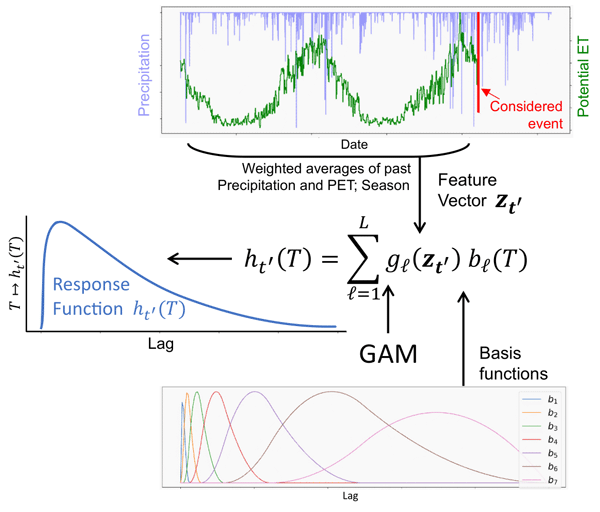
We introduce GAMCR (Generalized Additive Models for Catchment Responses), a data-driven model that estimates how catchments respond to individual precipitation events. We validate GAMCR on synthetic data and demonstrate its ability to investigate the characteristic runoff responses from real-world hydrologic series. GAMCR provides new data-driven opportunities to understand and compare hydrological behavior across different catchments.
Izabela Bujak-Ozga, Jana von Freyberg, Margaret Zimmer, Andrea Rinaldo, Paolo Benettin, and Ilja van Meerveld
Hydrol. Earth Syst. Sci., 29, 2339–2359, https://doi.org/10.5194/hess-29-2339-2025, https://doi.org/10.5194/hess-29-2339-2025, 2025
Short summary
Short summary
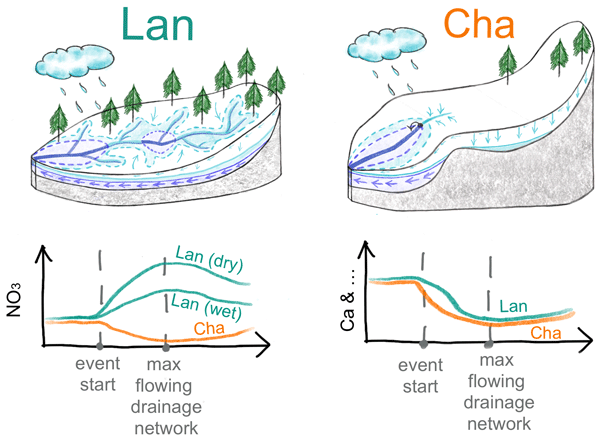
Stream networks expand and contract, affecting the amount and quality of water in perennial streams. This study presents measurements of changes in water chemistry and the flowing portion of the drainage network during rainfall events in two neighboring catchments. Despite the proximity and similar size, soil, and bedrock, water chemistry and stream network dynamics differed substantially in the two catchments. These differences are attributed to the differences in the slope and channel network.
Christina Franziska Radtke, Xiaoqiang Yang, Christin Müller, Jarno Rouhiainen, Ralf Merz, Stefanie R. Lutz, Paolo Benettin, Hong Wei, and Kay Knöller
Hydrol. Earth Syst. Sci. Discuss., https://doi.org/10.5194/hess-2024-109, https://doi.org/10.5194/hess-2024-109, 2024
Revised manuscript not accepted
Short summary
Short summary
Most studies assume no difference between transit times of water and nitrate, because nitrate is transported by water. With an 8-year high-frequency dataset of isotopic signatures of both, water and nitrate, and a transit time model, we show the temporal varying difference of nitrate and water transit times. This finding is highly relevant for applied future research related to nutrient dynamics in landscapes under anthropogenic forcing and for managing impacts of nitrate on aquatic ecosystems.
Matthias Sprenger, Pilar Llorens, Francesc Gallart, Paolo Benettin, Scott T. Allen, and Jérôme Latron
Hydrol. Earth Syst. Sci., 26, 4093–4107, https://doi.org/10.5194/hess-26-4093-2022, https://doi.org/10.5194/hess-26-4093-2022, 2022
Short summary
Short summary
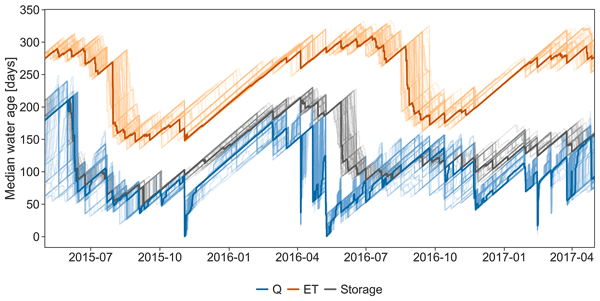
Our catchment-scale transit time modeling study shows that including stable isotope data on evapotranspiration in addition to the commonly used stream water isotopes helps constrain the model parametrization and reveals that the water taken up by plants has resided longer in the catchment storage than the water leaving the catchment as stream discharge. This finding is important for our understanding of how water is stored and released, which impacts the water availability for plants and humans.
Cited articles
Benettin, P., Rinaldo, A., and Botter, G.: Kinematics of age mixing in advection-dispersion models, Water Resour. Res., 49, 8539–8551, https://doi.org/10.1002/2013wr014708, 2013a. a
Benettin, P., van der Velde, Y., van der Zee, S. E. A. T. M., Rinaldo, A., and Botter, G.: Chloride circulation in a lowland catchment and the formulation of transport by travel time distributions, Water Resour. Res., 49, 4619–4632, https://doi.org/10.1002/wrcr.20309, 2013b. a
Benettin, P., Bailey, S. W., Campbell, J. L., Green, M. B., Rinaldo, A., Likens, G. E., McGuire, K. J., and Botter, G.: Linking water age and solute dynamics in streamflow at the Hubbard Brook Experimental Forest, NH, USA, Water Resour. Res., 51, 9256–9272, https://doi.org/10.1002/2015WR017552, 2015a. a
Benettin, P., Rinaldo, A., and Botter, G.: Tracking residence times in hydrological systems: forward and backward formulations, Hydrol. Process., 29, 5203–5213, https://doi.org/10.1002/hyp.10513, 2015b. a
Benettin, P., Soulsby, C., Birkel, C., Tetzlaff, D., Botter, G., and Rinaldo, A.: Using SAS functions and high-resolution isotope data to unravel travel time distributions in headwater catchments, Water Resour. Res., 53, 1864–1878, https://doi.org/10.1002/2016WR020117, 2017. a
Benettin, P., Queloz, P., Bensimon, M., McDonnell, J. J., and Rinaldo, A.: Velocities, residence times, tracer breakthroughs in a vegetated lysimeter: a multitracer experiment, Water Resour. Res., 55, 21–33, https://doi.org/10.1029/2018WR023894, 2019. a
Benettin, P., Rodriguez, N. B., Sprenger, M., Kim, M., Klaus, J., Harman, C. J., Van Der Velde, Y., Hrachowitz, M., Botter, G., McGuire, K. J., Kirchner, J. W., Rinaldo, A., and McDonnell, J. J.: Transit Time Estimation in Catchments: Recent Developments and Future Directions, Water Resour. Res., 58, e2022WR033096, https://doi.org/10.1029/2022WR033096, 2022. a, b, c
Bertuzzo, E., Thomet, M., Botter, G., and Rinaldo, A.: Catchment-scale herbicides transport: Theory and application, Adv. Water Resour., 52, 232–242, https://doi.org/10.1016/j.advwatres.2012.11.007, 2013. a, b, c, d
Botter, G.: Catchment mixing processes and travel time distributions, Water Resour. Res., 48, https://doi.org/10.1029/2011WR011160, 2012. a, b
Botter, G., Bertuzzo, E., Bellin, A., and Rinaldo, A.: On the Lagrangian formulations of reactive solute transport in the hydrologic response, Water Resour. Res., 41, https://doi.org/10.1029/2004wr003544, 2005. a
Botter, G., Bertuzzo, E., and Rinaldo, A.: Transport in the hydrologic response: Travel time distributions, soil moisture dynamics, and the old water paradox, Water Resour. Res., 46, https://doi.org/10.1029/2009WR008371, 2010. a, b, c
Cornaton, F. and Perrochet, P.: Groundwater age, life expectancy and transit time distributions in advective–dispersive systems: 1. Generalized reservoir theory, Adv. Water Resour., 29, 1267–1291, https://doi.org/10.1016/j.advwatres.2005.10.009, 2006. a
Cvetkovic, V. and Dagan, G.: Transport of kinetically sorbing solute by steady random velocity in heterogeneous porous formations, J. Fluid Mech., 265, 189–215, https://doi.org/10.1017/s0022112094000807, 1994. a
Cvetkovic, V., Carstens, C., Selroos, J., and Destouni, G.: Water and solute transport along hydrological pathways, Water Resour. Res., 48, https://doi.org/10.1029/2011wr011367, 2012. a
Druhan, J. L. and Benettin, P.: Isotope Ratio – Discharge Relationships of Solutes Derived From Weathering Reactions, Am. J. Sci., 323, https://doi.org/10.2475/001c.84469, 2023. a
Druhan, J. L. and Bouchez, J.: Ecological regulation of chemical weathering recorded in rivers, Earth Planet. Sc. Lett., 641, 118800, https://doi.org/10.1016/j.epsl.2024.118800, 2024. a, b
Duchemin, Q., Miazza, R., Kirchner, J. W., and Benettin, P.: A Data-Driven Model to Estimate Time-Variable Catchment Transit Time Distributions, Social Science Research Network [preprint], https://doi.org/10.2139/ssrn.5354564, 2025. a, b, c, d
Genuchten, M. T. V.: Analytical Solutions of the One-dimensional Convective-dispersive Solute Transport Equation, U.S. Department of Agriculture, Agricultural Research Service, google-Books-ID: LHps6Cz81OAC, 1982. a
Gerritse, R. G. and Adeney, J. A.: Tracers in recharge – Effects of partitioning in soils, J. Hydrol., 131, 255–268, https://doi.org/10.1016/0022-1694(92)90221-g, 1992. a
Ginn, T. R.: On the distribution of multicomponent mixtures over generalized exposure time in subsurface flow and reactive transport: Foundations, and formulations for groundwater age, chemical heterogeneity, and biodegradation, Water Resour. Res., 35, 1395–1407, https://doi.org/10.1029/1999WR900013, 1999. a
Ginn, T. R., Haeri, H., Massoudieh, A., and Foglia, L.: Notes on Groundwater Age in Forward and Inverse Modeling, Transport Porous Med., 79, 117–134, https://doi.org/10.1007/s11242-009-9406-1, 2009. a
Grandi, G., Catalán, N., Bernal, S., Fasching, C., Battin, T. I., and Bertuzzo, E.: Water Transit Time Explains the Concentration, Quality and Reactivity of Dissolved Organic Carbon in an Alpine Stream, Water Resour. Res., 61, e2024WR039392, https://doi.org/10.1029/2024WR039392, 2025. a
Groh, J., Stumpp, C., Lücke, A., Pütz, T., Vanderborght, J., and Vereecken, H.: Inverse Estimation of Soil Hydraulic and Transport Parameters of Layered Soils from Water Stable Isotope and Lysimeter Data, Vadose Zone J., 17, https://doi.org/10.2136/vzj2017.09.0168, 2018. a
Harman, C. J.: Time-variable transit time distributions and transport: Theory and application to storage-dependent transport of chloride in a watershed, Water Resour. Res., 51, 1–30, https://doi.org/10.1002/2014WR015707, 2015. a, b, c, d
Hrachowitz, M., Fovet, O., Ruiz, L., and Savenije, H. H. G.: Transit time distributions, legacy contamination and variability in biogeochemical scaling: how are hydrological response dynamics linked to water quality at the catchment scale?, Hydrol. Process., 29, 5241–5256, https://doi.org/10.1002/hyp.10546, 2015. a
Hrachowitz, M., Benettin, P., van Breukelen, B. M., Fovet, O., Howden, N. J., Ruiz, L., van der Velde, Y., and Wade, A. J.: Transit times—the link between hydrology and water quality at the catchment scale, WIREs Water, 3, 629–657, https://doi.org/10.1002/wat2.1155, 2016. a
Kirchner, J. W.: Aggregation in environmental systems – Part 1: Seasonal tracer cycles quantify young water fractions, but not mean transit times, in spatially heterogeneous catchments, Hydrol. Earth Syst. Sci., 20, 279–297, https://doi.org/10.5194/hess-20-279-2016, 2016a. a
Kirchner, J. W.: Aggregation in environmental systems – Part 2: Catchment mean transit times and young water fractions under hydrologic nonstationarity, Hydrol. Earth Syst. Sci., 20, 299–328, https://doi.org/10.5194/hess-20-299-2016, 2016b. a
Kirchner, J. W.: Quantifying new water fractions and transit time distributions using ensemble hydrograph separation: theory and benchmark tests, Hydrol. Earth Syst. Sci., 23, 303–349, https://doi.org/10.5194/hess-23-303-2019, 2019. a
Kuppel, S., Tetzlaff, D., Maneta, M. P., and Soulsby, C.: EcH2O-iso 1.0: water isotopes and age tracking in a process-based, distributed ecohydrological model, Geosci. Model Dev., 11, 3045–3069, https://doi.org/10.5194/gmd-11-3045-2018, 2018. a
Leray, S., Engdahl, N. B., Massoudieh, A., Bresciani, E., and McCallum, J.: Residence time distributions for hydrologic systems: Mechanistic foundations and steady-state analytical solutions, J. Hydrol., 543, 67–87, https://doi.org/10.1016/j.jhydrol.2016.01.068, 2016. a
Li, L., Sullivan, P. L., Benettin, P., Cirpka, O. A., Bishop, K., Brantley, S. L., Knapp, J. L. A., van Meerveld, I., Rinaldo, A., Seibert, J., Wen, H., and Kirchner, J. W.: Toward catchment hydro-biogeochemical theories, WIREs Water, 8, e1495, https://doi.org/10.1002/wat2.1495, 2021. a
Lutz, S. R., Velde, Y. V. D., Elsayed, O. F., Imfeld, G., Lefrancq, M., Payraudeau, S., and van Breukelen, B. M.: Pesticide fate on catchment scale: conceptual modelling of stream CSIA data, Hydrol. Earth Syst. Sci., 21, 5243–5261, https://doi.org/10.5194/hess-21-5243-2017, 2017. a
Małoszewski, P. and Zuber, A.: Determining the turnover time of groundwater systems with the aid of environmental tracers: 1. Models and their applicability, J. Hydrol., 57, 207–231, https://doi.org/10.1016/0022-1694(82)90147-0, 1982. a, b
McGuire, K. J. and McDonnell, J. J.: A review and evaluation of catchment transit time modeling, J. Hydrol., 330, 543–563, https://doi.org/10.1016/j.jhydrol.2006.04.020, 2006. a
Metzler, H., Müller, M., and Sierra, C. A.: Transit-time and age distributions for nonlinear time-dependent compartmental systems, P. Natl. Acad. Sci., 115, 1150–1155, https://doi.org/10.1073/pnas.1705296115, 2018. a
Miazza, R.: Supplementary code and data for “Technical note: Transit times of reactive solutes under time-variable hydrologic conditions”, Zenodo [code, data set], https://doi.org/10.5281/zenodo.18428618, 2026. a, b
Morgenstern, U., Stewart, M. K., and Stenger, R.: Dating of streamwater using tritium in a post nuclear bomb pulse world: continuous variation of mean transit time with streamflow, Hydrol. Earth Syst. Sci., 14, 2289–2301, https://doi.org/10.5194/hess-14-2289-2010, 2010. a
Nguyen, T. V., Kumar, R., Lutz, S. R., Musolff, A., Yang, J., and Fleckenstein, J. H.: Modeling Nitrate Export From a Mesoscale Catchment Using StorAge Selection Functions, Water Resour. Res., 57, https://doi.org/10.1029/2020wr028490, 2021. a
Nguyen, T. V., Kumar, R., Musolff, A., Lutz, S. R., Sarrazin, F., Attinger, S., and Fleckenstein, J. H.: Disparate Seasonal Nitrate Export From Nested Heterogeneous Subcatchments Revealed With StorAge Selection Functions, Water Resour. Res., 58, e2021WR030797, https://doi.org/10.1029/2021WR030797, 2022. a
Niemi, A. J.: Residence time distributions of variable flow processes, Int. J. Appl. Radiat. Is., 28, 855–860, https://doi.org/10.1016/0020-708x(77)90026-6, 1977. a, b
Polyanin, A. D., Zaitsev, V. F., and Moussiaux, A.: Handbook of First-Order Partial Differential Equations, CRC Press, London, ISBN 978-0-429-17296-0, https://doi.org/10.1201/b16828, 2001. a, b, c
Queloz, P., Carraro, L., Benettin, P., Botter, G., Rinaldo, A., and Bertuzzo, E.: Transport of fluorobenzoate tracers in a vegetated hydrologic control volume: 2. Theoretical inferences and modeling, Water Resour. Res., 51, 2793–2806, https://doi.org/10.1002/2014WR016508, 2015. a
Remondi, F., Kirchner, J. W., Burlando, P., and Fatichi, S.: Water Flux Tracking With a Distributed Hydrological Model to Quantify Controls on the Spatio-temporal Variability of Transit Time Distributions, Water Resour. Res., 54, 3081–3099, https://doi.org/10.1002/2017WR021689, 2018. a
Rigon, R. and Bancheri, M.: On the relations between the hydrological dynamical systems of water budget, travel time, response time and tracer concentrations, Hydrol. Process., 35, e14007, https://doi.org/10.1002/hyp.14007, 2021. a
Rigon, R., Bancheri, M., and Green, T. R.: Age-ranked hydrological budgets and a travel time description of catchment hydrology, Hydrol. Earth Syst. Sci., 20, 4929–4947, https://doi.org/10.5194/hess-20-4929-2016, 2016. a
Rinaldo, A., Marani, A., and Bellin, A.: On mass response functions, Water Resour. Res., 25, 1603–1617, https://doi.org/10.1029/WR025i007p01603, 1989. a
Rodriguez, N. B., McGuire, K. J., and Klaus, J.: Time-Varying Storage–Water Age Relationships in a Catchment With a Mediterranean Climate, Water Resour. Res., 54, 3988–4008, https://doi.org/10.1029/2017WR021964, 2018. a
Rodriguez, N. B., Pfister, L., Zehe, E., and Klaus, J.: A comparison of catchment travel times and storage deduced from deuterium and tritium tracers using StorAge Selection functions, Hydrol. Earth Syst. Sci., 25, 401–428, https://doi.org/10.5194/hess-25-401-2021, 2021. a
van der Velde, Y., Torfs, P. J. J. F., van der Zee, S. E. a. T. M., and Uijlenhoet, R.: Quantifying catchment-scale mixing and its effect on time-varying travel time distributions, Water Resour. Res., 48, https://doi.org/10.1029/2011WR011310, 2012. a, b
van Huijgevoort, M. H. J., Tetzlaff, D., Sutanudjaja, E. H., and Soulsby, C.: Using high resolution tracer data to constrain water storage, flux and age estimates in a spatially distributed rainfall-runoff model, Hydrol. Process., 30, 4761–4778, https://doi.org/10.1002/hyp.10902, 2016. a
Wang, S., Hrachowitz, M., Schoups, G., and Stumpp, C.: Stable water isotopes and tritium tracers tell the same tale: no evidence for underestimation of catchment transit times inferred by stable isotopes in StorAge Selection (SAS)-function models, Hydrol. Earth Syst. Sci., 27, 3083–3114, https://doi.org/10.5194/hess-27-3083-2023, 2023. a
Yu, Z., Hu, Y., Gentry, L. E., Yang, W. H., Margenot, A. J., Guan, K., Mitchell, C. A., and Hu, M.: Linking Water Age, Nitrate Export Regime, and Nitrate Isotope Biogeochemistry in a Tile-Drained Agricultural Field, Water Resour. Res., 59, e2023WR034948, https://doi.org/10.1029/2023WR034948, 2023. a
Zenger, K. and Niemi, A. J.: Modelling and control of a class of time-varying continuous flow processes, J. Process Contr., 19, 1511–1518, https://doi.org/10.1016/j.jprocont.2009.07.008, 2009. a
Short summary
We studied the time it takes for solutes like pollutants to travel through the landscape and reach streams compared to water. Although water and solutes travel together, they can take different paths and exit at different times due to different processes like sorption, decay, or uptake by plants. Using a simple modeling approach, we identified the conditions under which these travel time differences occur. This helps improve how we understand and predict water quality in natural environments.
We studied the time it takes for solutes like pollutants to travel through the landscape and...