
Articles | Volume 29, issue 23
https://doi.org/10.5194/hess-29-7093-2025
© Author(s) 2025. This work is distributed under
the Creative Commons Attribution 4.0 License.
the Creative Commons Attribution 4.0 License.
https://doi.org/10.5194/hess-29-7093-2025
© Author(s) 2025. This work is distributed under
the Creative Commons Attribution 4.0 License.
the Creative Commons Attribution 4.0 License.
Research article
| 
12 Dec 2025
Research article |
| 12 Dec 2025
| 12 Dec 2025
The impact of convection-permitting model rainfall on the dryland water balance

School of Geographical Sciences, University of Bristol, Bristol, BS8 BSS, United Kingdom
Katerina Michaelides
School of Geographical Sciences, University of Bristol, Bristol, BS8 BSS, United Kingdom
Elizabeth Kendon
School of Geographical Sciences, University of Bristol, Bristol, BS8 BSS, United Kingdom
Met Office Hadley Centre, Fitzroy Road, Exeter, EX1 3PB, United Kingdom
Mark Cuthbert
School of Earth and Environmental Sciences, Cardiff University, Cardiff, CF10 3AT, United Kingdom
Michael Bliss Singer
School of Earth and Environmental Sciences, Cardiff University, Cardiff, CF10 3AT, United Kingdom
Earth Research Institute, University of California, Santa Barbara, CA 93106, USA
Related authors
No articles found.
Edisson Andrés Quichimbo, Michael Bliss Singer, Katerina Michaelides, and Mark O. Cuthbert
EGUsphere, https://doi.org/10.5194/egusphere-2025-5316, https://doi.org/10.5194/egusphere-2025-5316, 2025
Short summary
Short summary
DRYP 2.0 is a substantially enhanced version of the DRYland water Partition model designed to improve large-scale water balance simulations. It integrates critical new capabilities for simulating ephemeral ponds/lakes, interacting hydrogeological domains, and explicit vegetation interception, while remaining computationally efficient. Tested over the Horn of Africa, DRYP 2.0 reproduces global satellite observations without calibration, advancing hydrological modelling across aridity gradients.
Geert Lenderink, Nikolina Ban, Erwan Brisson, Ségolène Berthou, Virginia Edith Cortés-Hernández, Elizabeth Kendon, Hayley J. Fowler, and Hylke de Vries
Hydrol. Earth Syst. Sci., 29, 1201–1220, https://doi.org/10.5194/hess-29-1201-2025, https://doi.org/10.5194/hess-29-1201-2025, 2025
Short summary
Short summary
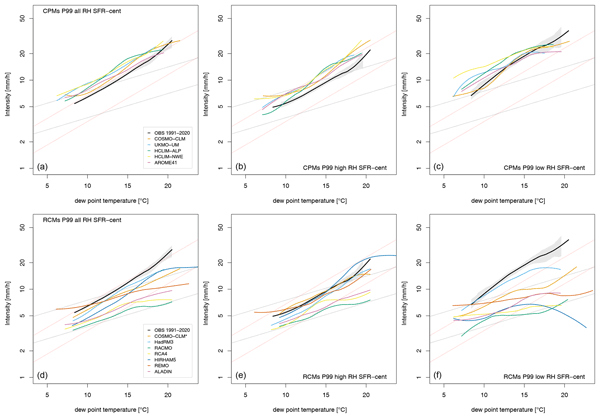
Future extreme rainfall events are influenced by changes in both absolute and relative humidity. The impact of increasing absolute humidity is reasonably well understood, but the role of relative humidity decreases over land remains largely unknown. Using hourly observations from France and the Netherlands, we find that lower relative humidity generally leads to more intense rainfall extremes. This relation is only captured well in recently developed convection-permitting climate models.

Colin G. Jones, Fanny Adloff, Ben B. B. Booth, Peter M. Cox, Veronika Eyring, Pierre Friedlingstein, Katja Frieler, Helene T. Hewitt, Hazel A. Jeffery, Sylvie Joussaume, Torben Koenigk, Bryan N. Lawrence, Eleanor O'Rourke, Malcolm J. Roberts, Benjamin M. Sanderson, Roland Séférian, Samuel Somot, Pier Luigi Vidale, Detlef van Vuuren, Mario Acosta, Mats Bentsen, Raffaele Bernardello, Richard Betts, Ed Blockley, Julien Boé, Tom Bracegirdle, Pascale Braconnot, Victor Brovkin, Carlo Buontempo, Francisco Doblas-Reyes, Markus Donat, Italo Epicoco, Pete Falloon, Sandro Fiore, Thomas Frölicher, Neven S. Fučkar, Matthew J. Gidden, Helge F. Goessling, Rune Grand Graversen, Silvio Gualdi, José M. Gutiérrez, Tatiana Ilyina, Daniela Jacob, Chris D. Jones, Martin Juckes, Elizabeth Kendon, Erik Kjellström, Reto Knutti, Jason Lowe, Matthew Mizielinski, Paola Nassisi, Michael Obersteiner, Pierre Regnier, Romain Roehrig, David Salas y Mélia, Carl-Friedrich Schleussner, Michael Schulz, Enrico Scoccimarro, Laurent Terray, Hannes Thiemann, Richard A. Wood, Shuting Yang, and Sönke Zaehle
Earth Syst. Dynam., 15, 1319–1351, https://doi.org/10.5194/esd-15-1319-2024, https://doi.org/10.5194/esd-15-1319-2024, 2024
Short summary
Short summary
We propose a number of priority areas for the international climate research community to address over the coming decade. Advances in these areas will both increase our understanding of past and future Earth system change, including the societal and environmental impacts of this change, and deliver significantly improved scientific support to international climate policy, such as future IPCC assessments and the UNFCCC Global Stocktake.
Manuel F. Rios Gaona, Katerina Michaelides, and Michael Bliss Singer
Geosci. Model Dev., 17, 5387–5412, https://doi.org/10.5194/gmd-17-5387-2024, https://doi.org/10.5194/gmd-17-5387-2024, 2024
Short summary
Short summary
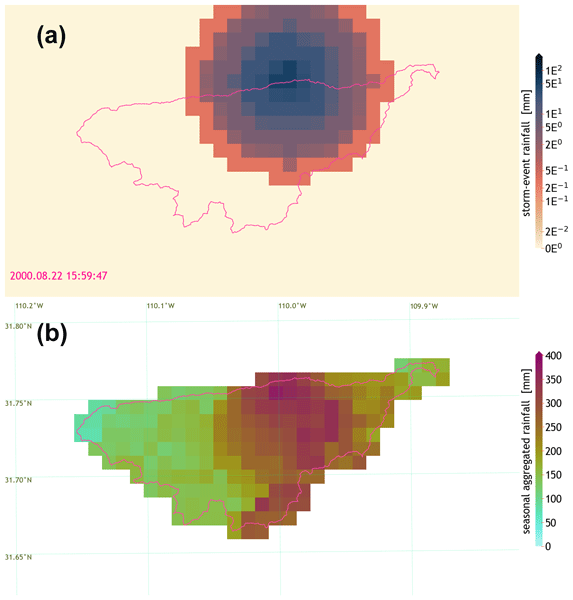
STORM v.2 (short for STOchastic Rainfall Model version 2.0) is an open-source and user-friendly modelling framework for simulating rainfall fields over a basin. It also allows simulating the impact of plausible climate change either on the total seasonal rainfall or the storm’s maximum intensity.
Dagmawi Teklu Asfaw, Michael Bliss Singer, Rafael Rosolem, David MacLeod, Mark Cuthbert, Edisson Quichimbo Miguitama, Manuel F. Rios Gaona, and Katerina Michaelides
Geosci. Model Dev., 16, 557–571, https://doi.org/10.5194/gmd-16-557-2023, https://doi.org/10.5194/gmd-16-557-2023, 2023
Short summary
Short summary
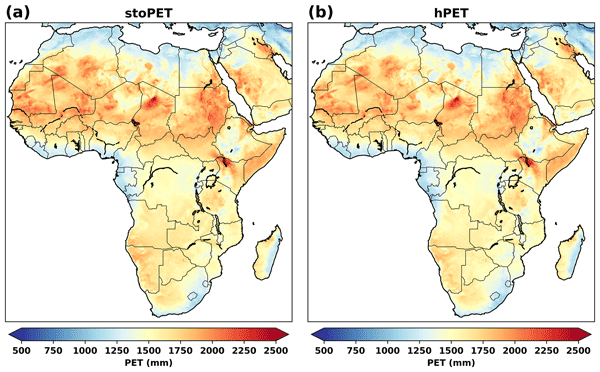
stoPET is a new stochastic potential evapotranspiration (PET) generator for the globe at hourly resolution. Many stochastic weather generators are used to generate stochastic rainfall time series; however, no such model exists for stochastically generating plausible PET time series. As such, stoPET represents a significant methodological advance. stoPET generate many realizations of PET to conduct climate studies related to the water balance, agriculture, water resources, and ecology.
Shiuan-An Chen, Katerina Michaelides, David A. Richards, and Michael Bliss Singer
Earth Surf. Dynam., 10, 1055–1078, https://doi.org/10.5194/esurf-10-1055-2022, https://doi.org/10.5194/esurf-10-1055-2022, 2022
Short summary
Short summary
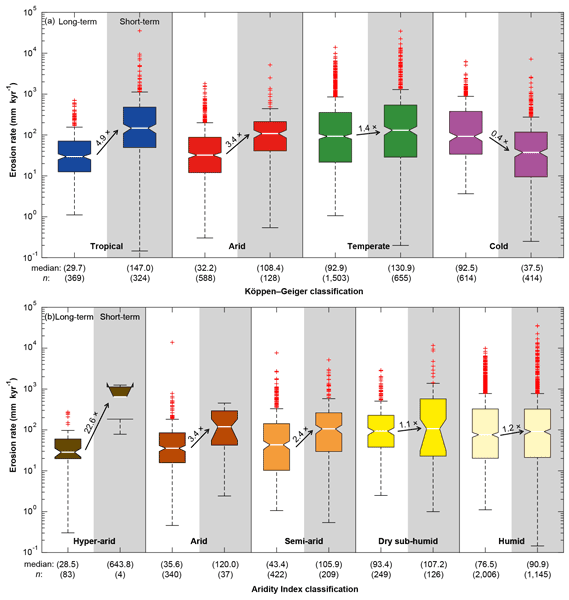
Drainage basin erosion rates influence landscape evolution through controlling land surface lowering and sediment flux, but gaps remain in understanding their large-scale patterns and drivers between timescales. We analysed global erosion rates and show that long-term erosion rates are controlled by rainfall, former glacial processes, and basin landform, whilst human activities enhance short-term erosion rates. The results highlight the complex interplay of controls on land surface processes.

Louise J. Slater, Chris Huntingford, Richard F. Pywell, John W. Redhead, and Elizabeth J. Kendon
Earth Syst. Dynam., 13, 1377–1396, https://doi.org/10.5194/esd-13-1377-2022, https://doi.org/10.5194/esd-13-1377-2022, 2022
Short summary
Short summary
This work considers how wheat yields are affected by weather conditions during the three main wheat growth stages in the UK. Impacts are strongest in years with compound weather extremes across multiple growth stages. Future climate projections are beneficial for wheat yields, on average, but indicate a high risk of unseen weather conditions which farmers may struggle to adapt to and mitigate against.
William Rust, John P. Bloomfield, Mark Cuthbert, Ron Corstanje, and Ian Holman
Hydrol. Earth Syst. Sci., 26, 2449–2467, https://doi.org/10.5194/hess-26-2449-2022, https://doi.org/10.5194/hess-26-2449-2022, 2022
Short summary
Short summary
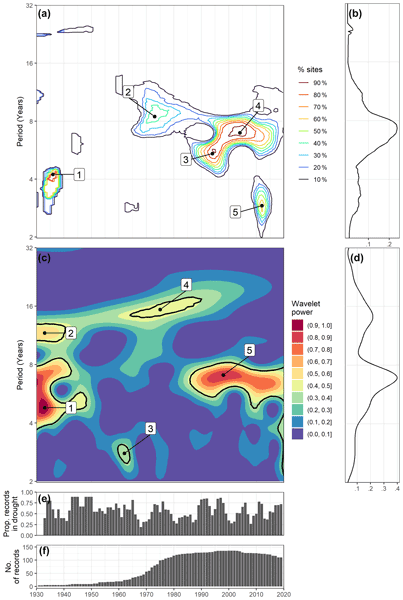
We highlight the importance of the North Atlantic Oscillation in controlling droughts in the UK. Specifically, multi-year cycles in the NAO are shown to influence the frequency of droughts and this influence changes considerably over time. We show that the influence of these varying controls is similar to the projected effects of climate change on water resources. We also show that these time-varying behaviours have important implications for water resource forecasts used for drought planning.
Tom Gleeson, Thorsten Wagener, Petra Döll, Samuel C. Zipper, Charles West, Yoshihide Wada, Richard Taylor, Bridget Scanlon, Rafael Rosolem, Shams Rahman, Nurudeen Oshinlaja, Reed Maxwell, Min-Hui Lo, Hyungjun Kim, Mary Hill, Andreas Hartmann, Graham Fogg, James S. Famiglietti, Agnès Ducharne, Inge de Graaf, Mark Cuthbert, Laura Condon, Etienne Bresciani, and Marc F. P. Bierkens
Geosci. Model Dev., 14, 7545–7571, https://doi.org/10.5194/gmd-14-7545-2021, https://doi.org/10.5194/gmd-14-7545-2021, 2021
Short summary
Short summary
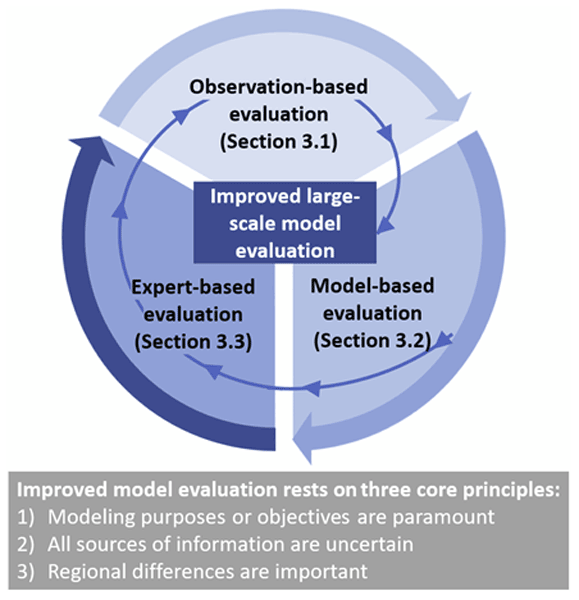
Groundwater is increasingly being included in large-scale (continental to global) land surface and hydrologic simulations. However, it is challenging to evaluate these simulations because groundwater is
hiddenunderground and thus hard to measure. We suggest using multiple complementary strategies to assess the performance of a model (
model evaluation).
E. Andrés Quichimbo, Michael Bliss Singer, Katerina Michaelides, Daniel E. J. Hobley, Rafael Rosolem, and Mark O. Cuthbert
Geosci. Model Dev., 14, 6893–6917, https://doi.org/10.5194/gmd-14-6893-2021, https://doi.org/10.5194/gmd-14-6893-2021, 2021
Short summary
Short summary
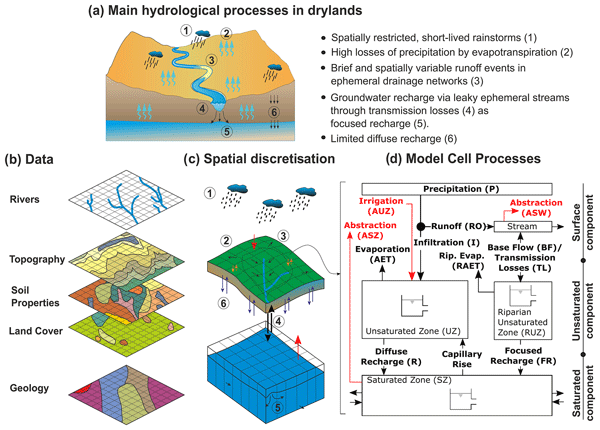
Understanding and quantifying water partitioning in dryland regions are of key importance to anticipate the future impacts of climate change in water resources and dryland ecosystems. Here, we have developed a simple hydrological model (DRYP) that incorporates the key processes of water partitioning in drylands. DRYP is a modular, versatile, and parsimonious model that can be used to anticipate and plan for climatic and anthropogenic changes to water fluxes and storage in dryland regions.
Cited articles
Adloff, M., Singer, M. B., MacLeod, D. A., Michaelides, K., Mehrnegar, N., Hansford, E., Funk, C., and Mitchell, D.: Sustained water storage in Horn of Africa drylands dominated by seasonal rainfall extremes, Geophys. Res. Lett., 49, https://doi.org/10.1029/2022GL099299, 2022.
Ageet, S., Fink, A. H., Maranan, M., Diem, J. E., Hartter, J., Ssali, A. L., and Ayabagabo, P.: Validation of satellite rainfall estimates over equatorial East Africa, J. Hydrometeorol., 23, 129–151, https://doi.org/10.1175/JHM-D-21-0145.1, 2022.
Alduchov, O. A. and Eskridge, R. E.: Improved Magnus form approximation of saturation vapor pressure, Journal of Applied Meteorology, 601–609, https://www.jstor.org/stable/26187406 (last access: March 2025), 1996.
Allen, R. G., Pereira, L. S., Raes, D., and Smith, M.: Crop evapotranspiration-Guidelines for computing crop water requirements-FAO Irrigation and Drainage Paper 56, FAO, Rome, 300 pp., ISBN 92-5-104219-5, 1998.
Apurv, T., Sivapalan, M., and Cai, X.: Understanding the role of climate characteristics in drought propagation, Water Resources Research, 53, 9304–9329, https://doi.org/10.1002/2017WR021445, 2017.
Archer, L., Hatchard, S., Devitt, L., Neal, J. C., Coxon, G., Bates, P. D., Kendon, E. J., and Savage, J.: Future Change in Urban Flooding Using New Convection-Permitting Climate Projections, Water Resources Research, 60, https://doi.org/10.1029/2023WR035533, 2024.
Aryal, S. K., Silberstein, R. P., Fu, G., Hodgson, G., Charles, S. P., and McFarlane, D.: Understanding spatio-temporal rainfall-runoff changes in a semi-arid region, Hydrological Processes, 34, 2510–2530, https://doi.org/10.1002/hyp.13744, 2020.
Ascott, M. J., Christelis, V., Lapworth, D. J., Macdonald, D. M. J., Tindimugaya, C., Iragena, A., Finney, D., Fitzpatrick, R., Marsham, J. H., and Rowell, D. P.: On the application of rainfall projections from a convection-permitting climate model to lumped catchment models, Journal of Hydrology, 617, 129097, https://doi.org/10.1016/j.jhydrol.2023.129097, 2023.
Ban, N., Schmidli, J., and Schär, C.: Evaluation of the convection-resolving regional climate modeling approach in decade-long simulations, J. Geophys. Res.-Atmos., 119, 7889–7907, https://doi.org/10.1002/2014JD021478, 2014.
Batalha, M. S., Barbosa, M. C., Faybishenko, B., and Van Genuchten, M. T.: Effect of temporal averaging of meteorological data on predictions of groundwater recharge, J. Hydrol. Hydromech., 66, 143–152, https://doi.org/10.1515/johh-2017-0051, 2018.
Berthou, S., Rowell, D. P., Kendon, E. J., Roberts, M. J., Stratton, R. A., Crook, J. A., and Wilcox, C.: Improved climatological precipitation characteristics over West Africa at convection-permitting scales, Clim. Dyn., 53, https://doi.org/10.1007/s00382-019-04759-4, 2019.
Blake, G.: CP4A & P25 Hourly Potential Evapotranspiration Dataset, Figshare [code and data set], https://doi.org/10.6084/m9.figshare.28187072.v3, 2025.
Boas, T. and Mallants, D.: Episodic extreme rainfall events drive groundwater recharge in arid zone environments of central Australia, J. Hydrol. Reg. Stud., 40, https://doi.org/10.1016/j.ejrh.2022.101005, 2022.
Bonsor, H. C. and MacDonald, A. M..: An initial estimate of depth to groundwater across Africa, https://nora.nerc.ac.uk/id/eprint/17907 (last access: August 24), 2011.
Cheechi, F. and Robinson, C. H.: Mortality among populations of southern and central Somalia affected by severe food insecurity and famine during 2010–2012, FAO, Rome, 87 pp., 2013.
Clark, P., Roberts, N., Lean, H., Ballard, S. P., and Charlton-Perez, C.: Convection-permitting models: A step-change in rainfall forecasting, Meteorol. Appl., 23, 165–181, https://doi.org/10.1002/met.1538, 2016.
Cocking, K., Singer, M. B., MacLeod, D., Cuthbert, M. O., Rosolem, R., Muthusi, F., Paron, P., Kimutai, J., Omondi, P., Hassan, A. M., and Teshome, A.: Locally defined seasonal rainfall characteristics within the Horn of Africa drylands from rain gauge observations, Journal of Hydrometeorology, 25, 1845–1861, https://doi.org/10.1175/JHM-D-23-0228.1, 2024.
Cook, P. A., Black, E. C., Verhoef, A., Macdonald, D. M. J., and Sorensen, J. P. R.: Projected increases in potential groundwater recharge and reduced evapotranspiration under future climate conditions in West Africa, J. Hydrol. Reg. Stud., 41, 101076, https://doi.org/10.1016/j.ejrh.2022.101076, 2022.
Corona, C. R. and Ge, S.: Examining subsurface response to an extreme precipitation event using HYDRUS-1D, Vadose Zone J., 21, https://doi.org/10.1002/vzj2.20189, 2022.
Crosbie, R. S., McCallum, J. L., Walker, G. R., Francis, H., and Chiew, S.: Modelling climate-change impacts on groundwater recharge in the Murray-Darling Basin, Australia, Hydrogeol. J., 18, https://doi.org/10.1007/s10040-010-0625-x, 2010.
Cuthbert, M. O., Acworth, R. I., Andersen, M. S., Larsen, J. R., McCallum, A. M., Rau, G. C., and Tellam, J. H.: Understanding and quantifying focused, indirect groundwater recharge from ephemeral streams using water table fluctuations, Water Resour. Res., 52, 827–840, https://doi.org/10.1002/2015WR017503, 2016.
Cuthbert, M. O., Gleeson, T., Moosdorf, N., Befus, K. M., Schneider, A., Hartmann, J., and Lehner, B.: Global patterns and dynamics of climate–groundwater interactions, Nature Climate Change, 9, https://doi.org/10.1038/s41558-018-0386-4, 2019.
Davenport, F., Grace, K., Funk, C., and Shukla, S.: Child health outcomes in sub-Saharan Africa: a comparison of changes in climate and socio-economic factors, Global Environ. Change, 46, 72–87, https://doi.org/10.1016/j.gloenvcha.2017.04.009, 2017.
Davenport, F., Funk, C., and Galu, G.: How will East African maize yields respond to climate change and can agricultural development mitigate this response?, Clim. Change, 147, 491–506, https://doi.org/10.1007/s10584-018-2149-7, 2018.
Dezfuli, A. K., Ichoku, C. M., Huffman, G. J., Mohr, K. I., Selker, J. S., van de Giesen, N., Hochreutener, R., and Annor, F. O.: Validation of IMERG precipitation in Africa, Journal of Hydrometeorology, 18, 2817–2825, https://doi.org/10.1175/JHM-D-17-0139.1, 2017.
Fan, Y., Li, H., and Miguez-Macho, G.: Global patterns of groundwater table depth, Science, 339, 940–943, https://doi.org/10.1126/science.1229881, 2013.
Feddes, R. A.: Simulation of field water use and crop yield, in: Simulation of Plant Growth and Crop Production, 194–209, https://edepot.wur.nl/172222 (last access: August 2024), 1978.
Finney, D. L., Marsham, J. H., Jackson, L. S., Kendon, E. J., Rowell, D. P., Boorman, P. M., Keane, R. J., Stratton, R. A., and Senior, C. A.: Implications of improved representation of convection for the East Africa water budget using a convection-permitting model, J. Climate, 32, 2109–2129, https://doi.org/10.1175/JCLI-D-18-0387.1, 2019.
Finney, D. L., Marsham, J. H., Rowell, D. P., Kendon, E. J., Tucker, S. O., Stratton, R. A., and Jackson, L. S.: Effects of explicit convection on future projections of mesoscale circulations, rainfall, and rainfall extremes over Eastern Africa, J. Climate, 33, 2701–2718, https://doi.org/10.1175/JCLI-D-19-0328.1, 2020.
Folwell, S. S., Taylor, C. M., and Stratton, R. A.: Contrasting contributions of surface hydrological pathways in convection permitting and parameterised climate simulations over Africa and their feedbacks on the atmosphere, Climate Dynamics, 59, 633–648, https://doi.org/10.1007/s00382-022-06144-0, 2022.
Funk, C., Shukla, S., Thiaw, W. M., Rowland, J., Hoell, A., McNally, A., Husak, G., Novella, N., Budde, M., Peters-Lidard, C., and Adoum, A.: Recognizing the famine early warning systems network: Over 30 years of drought early warning science advances and partnerships promoting global food security, Am. Meteorol. Soc., 100, 1011–1027, https://doi.org/10.1175/BAMS-D-17-0233.1, 2019.
Geißler, K., Heblack, J., Uugulu, S., Wanke, H., and Blaum, N.: Partitioning of water between differently sized shrubs and potential groundwater recharge in a semiarid savanna in Namibia, Front. Plant Sci., 10, 1411, https://doi.org/10.3389/fpls.2019.01411, 2019.
Halladay, K., Kahana, R., Johnson, B., Still, C., Fosser, G., and Alves, L.: Convection-permitting climate simulations for South America with the met office unified model, Climate Dynamics, 61, 5247–5269, https://doi.org/10.1007/s00382-023-06853-0, 2023.
Hengl, T., Miller, M. A., Križan, J., Shepherd, K. D., Sila, A., Kilibarda, M., Antonijević, O., Glušica, L., Dobermann, A., Haefele, S. M., and McGrath, S. P.: African soil properties and nutrients mapped at 30 m spatial resolution using two-scale ensemble machine learning, Sci. Rep., 11, 6130, https://doi.org/10.1038/s41598-021-85639-y, 2021.
Hijmans, R. J., Cameron, S. E., Parra, J. L., Jones, P. G., and Jarvis, A.: Very high-resolution interpolated climate surfaces for global land areas, International Journal of Climatology, 25, 1965–1978, https://doi.org/10.1002/joc.1276, 2005.
Hill, P. G., Stein, T. H., and Cafaro, C.: Convective systems and rainfall in East Africa, Q. J. R. Meteorol. Soc., https://doi.org/10.1002/qj.4540, 2023.
Hoffmann, R., Wiederkehr, C., Dimitrova, A., and Hermans, K.: Agricultural livelihoods, adaptation, and environmental migration in sub-Saharan drylands: a meta-analytical review, Environ. Res. Lett., 17, 083003, https://doi.org/10.1088/1748-9326/ac7d65, 2022.
Horton, R. E.: The role of infiltration in the hydrologic cycle, Eos, Transactions American Geophysical Union, 14, 446–460, https://doi.org/10.1029/TR014i001p00446, 1933.
Hsu, H., Lo, M. H., Guillod, B. P., Miralles, D. G., and Kumar, S.: Relation between precipitation location and antecedent/subsequent soil moisture spatial patterns, J. Geophys. Res.-Atmos., 122, 6319–6328, https://doi.org/10.1002/2016JD026042, 2017.
Huang, J., Yu, H., Dai, A., Wei, Y., and Kang, L.: Drylands face potential threat under 2 C global warming target, Nature Climate Change, 7, 417–422, https://doi.org/10.1038/nclimate3275, 2017.
Huffman, G. J., Stocker, E. F., Bolvin, D. T., Nelkin, E. J., and Tan, J.: GPM IMERG Final Precipitation L3 Half Hourly 0.1 degree x 0.1 degree V07, Greenbelt, MD, Goddard Earth Sciences Data and Information Services Center (GES DISC) [data set], https://doi.org/10.5067/GPM/IMERG/3B-HH/07, 2023.
iSDA: The first field-level soil map for Africa, iSDA [data set], https://www.isda-africa.com/isdasoil/, last access: 20 October 2024.
Kendon, E. J., Ban, N., Roberts, N. M., Fowler, H. J., Roberts, M. J., Chan, S. C., Evans, J. P., Fosser, G., and Wilkinson, J. M.: Do convection-permitting regional climate models improve projections of future precipitation change?, Am. Meteorol. Soc., 98, 79–93, https://doi.org/10.1175/BAMS-D-15-0004.1, 2017.
Kendon, E. J., Stratton, R. A., Tucker, S., Marsham, J. H., Berthou, S., Rowell, D. P., and Senior, C. A.: Enhanced future changes in wet and dry extremes over Africa at convection-permitting scale, Nat. Commun., 10, 1794, https://doi.org/10.1038/s41467-019-09776-9, 2019.
Kimutai, J., Barnes, C., Zachariah, M., Philip, S., Kew, S., Pinto, I., Wolski, P., Koren, G., Vecchi, G., Yang, W., and Li, S.: Human-induced climate change increased drought severity in Horn of Africa, Weather and Climate Extremes, 47, https://doi.org/10.1016/j.wace.2025.100745, 2025.
Kipkemoi, I., Michaelides, K., Rosolem, R., and Singer, M. B.: Climatic expression of rainfall on soil moisture dynamics in drylands, Hydrol. Earth Syst. Sci. Discuss. [preprint], https://doi.org/10.5194/hess-2021-48, 2021.
Klein, C., Jackson, L. S., Parker, D. J., Marsham, J. H., Taylor, C. M., Rowell, D. P., Guichard, F., Vischel, T., Famien, A. M., and Diedhiou, A.: Combining CMIP data with a regional convection-permitting model and observations to project extreme rainfall under climate change, Environ. Res. Lett., 16, https://doi.org/10.1088/1748-9326/ac26f1, 2021.
Kouadio, K., Bastin, S., Konare, A., and Ajayi, V. O.: Does convection-permitting simulate better rainfall distribution and extreme over Guinean coast and surroundings?, Clim. Dyn., 55, 153–174, https://doi.org/10.1007/s00382-018-4308-y, 2020.
Lee, J. and Hohenegger, C.: Weaker land–atmosphere coupling in global storm-resolving simulation, Proceedings of the National Academy of Sciences, 121, https://doi.org/10.1073/pnas.2314265121, 2024.
Leterme, B., Mallants, D., and Jacques, D.: Sensitivity of groundwater recharge using climatic analogues and HYDRUS-1D, Hydrol. Earth Syst. Sci., 16, 2485–2497, https://doi.org/10.5194/hess-16-2485-2012, 2012.
Luu, L. N., Vautard, R., Yiou, P., and Soubeyroux, J.-M.: Evaluation of convection-permitting extreme precipitation simulations for the south of France, Earth Syst. Dynam., 13, 687–702, https://doi.org/10.5194/esd-13-687-2022, 2022.
Lyon, B.: Seasonal drought in the Greater Horn of Africa and its recent increase during the March–May long rains, Journal of Climate, 27, https://doi.org/10.1175/JCLI-D-13-00459.1, 2014.
Lyon, B. and DeWitt, D. G.: A recent and abrupt decline in the East African long rains, Geophysical Research Letters, 39, https://doi.org/10.1029/2011GL050337, 2012.
Lyon, B. and Vigaud, N.: Unraveling East Africa's climate paradox, Climate extremes: Patterns and mechanisms, https://doi.org/10.1002/9781119068020.ch16, 2017.
MacDonald, A. M., Bonsor, H. C., Dochartaigh, B.É.Ó., and Taylor, R. G.: Quantitative maps of groundwater resources in Africa, Environmental Research Letters, 7, https://doi.org/10.1088/1748-9326/7/2/024009, 2012.
Maeght, J. L., Rewald, B., and Pierret, A.: How to study deep roots – and why it matters, Front. Plant Sci., 4, 299, https://doi.org/10.3389/fpls.2013.00299, 2013.
McKenna, O. P. and Sala, O. E.: Groundwater recharge in desert playas: current rates and future effects of climate change, Environ. Res. Lett., 13, https://doi.org/10.1088/1748-9326/aa9eb6, 2017.
Mirzabaev, A., Wu, J., Evans, J., García-Oliva, F., Hussein, I. A. G., Iqbal, M. H., Kimutai, J., Knowles, T., Meza, F., Nedjraoui, D., Tena, F., Türkeş, M., Vázquez, R. J., and Weltz, M.: Desertification, in: Climate Change and Land: an IPCC special report on climate change, desertification, land degradation, sustainable land management, food security, and greenhouse gas fluxes in terrestrial ecosystems, https://doi.org/10.1017/9781009157988.005, 2019.
Muñoz Sabater, J.: ERA5-Land hourly data from 1950 to present, Copernicus Climate Change Service (C3S) Climate Data Store (CDS) [data set], https://doi.org/10.24381/cds.e2161bac, 2019.
Muñoz-Sabater, J., Dutra, E., Agustí-Panareda, A., Albergel, C., Arduini, G., Balsamo, G., Boussetta, S., Choulga, M., Harrigan, S., Hersbach, H., Martens, B., Miralles, D. G., Piles, M., Rodríguez-Fernández, N. J., Zsoter, E., Buontempo, C., and Thépaut, J.-N.: ERA5-Land: a state-of-the-art global reanalysis dataset for land applications, Earth Syst. Sci. Data, 13, 4349–4383, https://doi.org/10.5194/essd-13-4349-2021, 2021.
Nazarieh, F., Ansari, H., Ziaei, A. N., Izady, A., Davari, K., and Brunner, P.: Spatial and temporal dynamics of deep percolation, lag time and recharge in an irrigated semi-arid region, Hydrogeol. J., 26, 2507–2520, https://doi.org/10.1007/s10040-018-1789-z, 2018.
Nicholson, S. E.: Dryland Climatology, Cambridge University Press, Cambridge, ISBN 978-1-108-44654-9, 2011.
Nicholson, S. E.: A detailed look at the recent drought situation in the Greater Horn of Africa, Journal of Arid Environments, 103, https://doi.org/10.1016/j.jaridenv.2013.12.003, 2014.
Osborn, H. B.: Timing and duration of high rainfall rates in the southwestern United States, Water Resour. Res., 19, 1036–1042, https://doi.org/10.1029/WR019i004p01036, 1983.
Prein, A. F., Gobiet, A., Suklitsch, M., Truhetz, H., Awan, N. K., Keuler, K., and Georgievski, G.: Added value of convection-permitting seasonal simulations, Clim. Dyn., 41, 2655–2677, https://doi.org/10.1007/s00382-013-1744-6, 2013.
Prein, A. F., Langhans, W., Fosser, G., Ferrone, A., Ban, N., Goergen, K., Keller, M., Tölle, M., Gutjahr, O., Feser, F., and Brisson, E.: A review on regional convection-permitting climate modeling: Demonstrations, prospects, and challenges, Rev. Geophys., 53, 323–361, https://doi.org/10.1002/2014RG000475, 2015.
Quichimbo, E. A., Singer, M. B., and Cuthbert, M. O.: Characterising groundwater–surface water interactions in idealised ephemeral stream systems, Hydrol. Process., 34, 3792–3806, https://doi.org/10.1002/hyp.13847, 2021a.
Quichimbo, E. A., Singer, M. B., Michaelides, K., Hobley, D. E. J., Rosolem, R., and Cuthbert, M. O.: DRYP 1.0: a parsimonious hydrological model of DRYland Partitioning of the water balance, Geosci. Model Dev., 14, 6893–6917, https://doi.org/10.5194/gmd-14-6893-2021, 2021b.
Quichimbo, E. A., Singer, M. B., Michaelides, K., Rosolem, R., MacLeod, D. A., Asfaw, D. T., and Cuthbert, M. O.: Assessing the sensitivity of modelled water partitioning to global precipitation datasets in a data-scarce dryland region, Hydrol. Process., 37, e15047, https://doi.org/10.1002/hyp.15047, 2023.
Razack, M., Jalludin, M., and Houmed-Gaba, A.: Simulation of climate change impact on a coastal aquifer under arid climate. The Tadjourah Aquifer (Republic of Djibouti, Horn of Africa), Water, https://doi.org/10.3390/w11112347, 2019.
Reynolds, J. F., Smith, D. M. S., Lambin, E. F., Turner, B. L., Mortimore, M., Batterbury, S. P., Downing, T. E., Dowlatabadi, H., Fernández, R. J., Herrick, J. E., and Huber-Sannwald, E.: Global desertification: building a science for dryland development, Science, 316, 847–851, https://doi.org/10.1126/science.1131634, 2007a.
Reynolds, R. W., Smith, T. M., Liu, C., Chelton, D. B., Casey, K. S., and Schlax, M. G.: Daily high-resolution-blended analyses for sea surface temperature, J. Clim., 20, 5473–5496, https://doi.org/10.1175/2007JCLI1824.1, 2007b.
Richards, L. A.: Capillary conduction of liquids through porous mediums, Phys., 1, 318–333, https://doi.org/10.1063/1.1745010, 1931.
Rios Gaona, M. F., Michaelides, K., and Singer, M. B.: STORM v.2: A simple, stochastic rainfall model for exploring the impacts of climate and climate change at and near the land surface in gauged watersheds, Geosci. Model Dev., 17, 5387–5412, https://doi.org/10.5194/gmd-17-5387-2024, 2024.
Rodriguez, P., Giménez, R., Nosetto, M. D., Jobbágy, E. G., and Magliano, P. N.: Changes in water fluxes partition related to the replacement of native dry forests by crops in the Dry Chaco, J. Arid Environ., 183, 104281, https://doi.org/10.1016/j.jaridenv.2020.104281, 2020.
Scanlon, B. R., Keese, K. E., Flint, A. L., Flint, L. E., Gaye, C. B., Edmunds, W. M., and Simmers, I.: Global synthesis of groundwater recharge in semiarid and arid regions, Hydrol. Process., 20, 3335–3370, https://doi.org/10.1002/hyp.6335, 2006.
Schimel, D. S.: Drylands in the earth system, Science, 327, 418–419, https://doi.org/10.1126/science.11849, 2010.
Schoener, G.: Soil Moisture Dependent Runoff in a Dryland Region: An Investigation of the Role of Antecedent Conditions, Monitoring, and Modeling Strategies, PhD Thesis, University of New Mexico, https://digitalrepository.unm.edu/ce_etds/255 (last access: 8 December 2025), 2021.
Schoener, G. and Stone, M. C.: Impact of antecedent soil moisture on runoff from a semiarid catchment, J. Hydrol., 569, 627–636, https://doi.org/10.1016/j.jhydrol.2018.12.025, 2019.
Schreiner-McGraw, A. P., Ajami, H., and Vivoni, E. R.: Extreme weather events and transmission losses in arid streams, Environmental Research Letters, 14, https://doi.org/10.1088/1748-9326/ab2949, 2019.
Schwarzwald, K. and Seager, R.: Revisiting the “East African Paradox”: CMIP6 models also fail to simulate observed drying trends in the Horn of Africa Long Rains, EGU General Assembly 2024, Vienna, Austria, 14–19 April 2024, EGU24-4687, https://doi.org/10.5194/egusphere-egu24-4687, 2024.
Schwarzwald, K., Goddard, L., Seager, R., Ting, M., and Marvel, K.: Understanding CMIP6 biases in the representation of the Greater Horn of Africa long and short rains, Clim. Dyn., 61, 1229–1255, https://doi.org/10.1007/s00382-022-06622-5, 2023.
Seddon, D., Kashaigili, J. J., Taylor, R. G., Cuthbert, M. O., Mwihumbo, C., and MacDonald, A. M.: Focused groundwater recharge in a tropical dryland: Empirical evidence from central, semi-arid Tanzania, J. Hydrol. Reg. Stud., 37, https://doi.org/10.1016/j.ejrh.2021.100919, 2021.
Sela, S., Svoray, T., and Assouline, S.: The effect of soil surface sealing on vegetation water uptake along a dry climatic gradient, Water Resour. Res., 51, 7452–7466, https://doi.org/10.1002/2015WR017109, 2015.
Seneviratne, S. I., Corti, T., Davin, E. L., Hirschi, M., Jaeger, E. B., Lehner, I., Orlowsky, B., and Teuling, A. J.: Investigating soil moisture–climate interactions in a changing climate: A review, Earth-Science Reviews, 99, 125–161, https://doi.org/10.1016/j.earscirev.2010.02.004, 2010.
Shadwell, E. and February, E.: Effects of groundwater abstraction on two keystone tree species in an arid savanna national park, PeerJ, 5, https://doi.org/10.7717/peerj.2923, 2017.
Shepherd, T. G., Boyd, E., Calel, R. A., Chapman, S. C., Dessai, S., Dima-West, I. M., Fowler, H. J., James, R., Maraun, D., Martius, O., and Senior, C. A.: Storylines: an alternative approach to representing uncertainty in physical aspects of climate change, Climatic change, 151, 555–571, https://doi.org/10.1007/s10584-018-2317-9, 2018.
Šimunek, J., Van Genuchten, M. T., and Šejna, M.: HYDRUS: Model use, calibration, and validation, Transactions of the ASABE, 55, https://doi.org/10.13031/2013.42239, 2012.
Singer, M. B. and Michaelides, K.: Deciphering the expression of climate change within the Lower Colorado River basin by stochastic simulation of convective rainfall, Environ. Res. Lett., 12, https://doi.org/10.1088/1748-9326/aa8e50, 2017.
Singer, M. B., Michaelides, K., and Hobley, D. E. J.: STORM 1.0: a simple, flexible, and parsimonious stochastic rainfall generator for simulating climate and climate change, Geosci. Model Dev., 11, 3713–3726, https://doi.org/10.5194/gmd-11-3713-2018, 2018.
Singer, M., Asfaw, D., Rosolem, R., Cuthbert, M. O., Miralles, D. G., Quichimbo Miguitama, E., MacLeod, D., and Michaelides, K.: Hourly potential evapotranspiration (hPET) at 0.1degs grid resolution for the global land surface from 1981–present, University of Bristol [data set], https://doi.org/10.5523/bris.qb8ujazzda0s2aykkv0oq0ctp, 2020.
Singer, M. B., Asfaw, D. T., Rosolem, R., Cuthbert, M. O., Miralles, D. G., MacLeod, D., Quichimbo, E. A., and Michaelides, K.: Hourly potential evapotranspiration at 0.1 resolution for the global land surface from 1981–present, Scientific Data, 8, https://doi.org/10.1038/s41597-021-01003-9, 2021.
Stephens, G. L., L'Ecuyer, T., Forbes, R., Gettelmen, A., Golaz, J. C., Bodas-Salcedo, A., Suzuki, K., Gabriel, P., and Haynes, J.: Dreary state of precipitation in global models, J. Geophys. Res.-Atmos., 115, D24211, https://doi.org/10.1029/2010JD014532, 2010.
Stone, E. L. and Kalisz, P. J.: On the maximum extent of tree roots, For. Ecol. Manage., 46, 59–102, https://doi.org/10.1016/0378-1127(91)90245-Q, 1991.
Stratton, R. A. and Stirling, A. J.: Improving the diurnal cycle of convection in GCMs, Q. J. R. Meteorol. Soc., 138, 1121–1134, https://doi.org/10.1002/qj.991, 2012.
Stratton, R. A., Senior, C. A., Vosper, S. B., Folwell, S. S., Boutle, I. A., Earnshaw, P. D., Kendon, E., Lock, A. P., Malcolm, A., Manners, J., and Morcrette, C. J.: A Pan-African convection-permitting regional climate simulation with the Met Office Unified Model: CP4-Africa, J. Clim., 31, 3485–3508, https://doi.org/10.1175/JCLI-D-17-0503.1, 2018.
Stringer, L. C., Dyer, J. C., Reed, M. S., Dougill, A. J., Twyman, C., and Mkwambisi, D.: Adaptations to climate change, drought and desertification: local insights to enhance policy in southern Africa, Environ. Sci. Policy, 12, 748–765, https://doi.org/10.1016/j.envsci.2009.04.002, 2009.
Taylor, C. M., Gounou, A., Guichard, F., Harris, P. P., Ellis, R. J., Couvreux, F., and De Kauwe, M.: Frequency of Sahelian storm initiation enhanced over mesoscale soil-moisture patterns, Nat. Geosci., 4, 430–433, https://doi.org/10.1038/ngeo1173, 2011.
Taylor, C. M., de Jeu, R. A., Guichard, F., Harris, P. P., and Dorigo, W. A.: Afternoon rain more likely over drier soils, Nature, 489, 423–426, https://doi.org/10.1038/nature11377, 2012.
Taylor, R. G., Todd, M. C., Kongola, L., Maurice, L., Nahozya, E., Sanga, H., and MacDonald, A. M.: Evidence of the dependence of groundwater resources on extreme rainfall in East Africa, Nat. Clim. Change, 3, 374–378, https://doi.org/10.1038/nclimate1731, 2013.
Tetens, O.: Uber einige meteorologische Begriffe, Z. Geophys, 6, 297–309, 1930.
Van Genuchten, M. T.: A closed-form equation for predicting the hydraulic conductivity of unsaturated soils, Soil Sci. Soc. Am. J., 44, 892–898, https://doi.org/10.2136/sssaj1980.03615995004400050002x, 1980.
Vermote, E.: NOAA Climate Data Record (CDR) of AVHRR Leaf Area Index (LAI) and Fraction of Absorbed Photosynthetically Active Radiation (FAPAR), Version 5, NOAA National Centers for Environmental Information [data set], https://doi.org/10.7289/V5TT4P69, 2019.
Vicente-Serrano, S. M., McVicar, T. R., Miralles, D. G., Yang, Y., and Tomas-Burguera, M.: Unraveling the influence of atmospheric evaporative demand on drought and its response to climate change, Wiley Interdisciplinary Reviews: Climate Change, 11, https://doi.org/10.1002/wcc.632, 2020.
Wainwright, C. M., Marsham, J. H., Keane, R. J., Rowell, D. P., Finney, D. L., Black, E., and Allan, R. P.: “Eastern African Paradox” rainfall decline due to shorter not less intense Long Rains, npj Climate and Atmospheric Science, 2, https://doi.org/10.1038/s41612-019-0091-7, 2019.
Wainwright, C. M., Finney, D. L., Kilavi, M., Black, E., and Marsham, J. H.: Extreme rainfall in East Africa, October 2019–January 2020 and context under future climate change, Weather, 76, 26–31, https://doi.org/10.1002/wea.3824, 2021.
Walters, D., Boutle, I., Brooks, M., Melvin, T., Stratton, R., Vosper, S., Wells, H., Williams, K., Wood, N., Allen, T., Bushell, A., Copsey, D., Earnshaw, P., Edwards, J., Gross, M., Hardiman, S., Harris, C., Heming, J., Klingaman, N., Levine, R., Manners, J., Martin, G., Milton, S., Mittermaier, M., Morcrette, C., Riddick, T., Roberts, M., Sanchez, C., Selwood, P., Stirling, A., Smith, C., Suri, D., Tennant, W., Vidale, P. L., Wilkinson, J., Willett, M., Woolnough, S., and Xavier, P.: The Met Office Unified Model Global Atmosphere 6.0/6.1 and JULES Global Land 6.0/6.1 configurations, Geosci. Model Dev., 10, 1487–1520, https://doi.org/10.5194/gmd-10-1487-2017, 2017.
Watson, A.: The use of environmental isotopes, soil water measurements and soil water modelling to understand tree water use of an Acacia mearnsii (Black Wattle) stand in KwaZulu-Natal, MSc Thesis, University of KwaZulu-Natal, 135 pp., http://researchspace.ukzn.ac.za/bitstream/handle/10413/12089/Watson_Andrew_2015.pdf?isAllowed=y&sequence=1 (last access: 8 December 2025), 2015.
Wesseling, J. G. and Brandyk, T.: Introduction of the occurrence of high groundwater levels and surface water storage in computer program SWATRE, Nota/Instituut voor Cultuurtechniek en Waterhuishouding, no. 1636, ICW, Wageningen, https://edepot.wur.nl/214032 (last access: 8 December 2025), 1985.
Xia, Y. Q. and Shao, M. A.: Soil water carrying capacity for vegetation: a hydrologic and biogeochemical process model solution, Ecological Modelling, 214, https://doi.org/10.1016/j.ecolmodel.2008.01.024, 2008.
Zarate, E., Hobley, D., MacDonald, A. M., Swift, R. T., Chambers, J., Kashaigili, J. J., Mutayoba, E., Taylor, R. G., and Cuthbert, M. O.: The role of superficial geology in controlling groundwater recharge in the weathered crystalline basement of semi-arid Tanzania, J. Hydrol. Reg. Stud., 36, 100833, https://doi.org/10.1016/j.ejrh.2021.100833, 2021.
Zhang, Y. K. and Schilling, K. E.: Effects of land cover on water table, soil moisture, evapotranspiration, and groundwater recharge: a field observation and analysis, J. Hydrol., 319, 328–338, https://doi.org/10.1016/j.jhydrol.2005.06.044, 2006.
Zhou, S., Williams, A. P., Lintner, B. R., Berg, A. M., Zhang, Y., Keenan, T. F., Cook, B. I., Hagemann, S. I., Seneviratne, S. I., and Gentine, P.: Soil moisture–atmosphere feedbacks mitigate declining water availability in drylands, Nat. Clim. Change, 11, 38–44, https://doi.org/10.1038/s41558-020-00945-z, 2021.
Zhu, Z., Wright, D. B., and Yu, G.: The impact of rainfall space-time structure in flood frequency analysis, Water Resources Research, 54, 8983–8998, https://doi.org/10.1029/2018WR023550, 2018.
Zinyengere, N., Mhizha, T., Mashonjowa, E., Chipindu, B., Geerts, S., and Raes, D.: Using seasonal climate forecasts to improve maize production decision support in Zimbabwe, Agric. For. Meteorol., 151, 1792–1799, https://doi.org/10.1016/j.agrformet.2011.07.015, 2011.
Zomer, R., Trabucco, A., van Straaten, O., and Bossio, D.: Carbon, land and water: A global analysis of the hydrologic dimensions of climate change mitigation through afforestation/reforestation, IWMI, Vol. 101, https://hdl.handle.net/10568/39888 (last access: 8 December 2025), 2007.
Short summary
In drylands, rainfall mainly falls during short-lived and localised storms, with the rainfall characteristics of these storms key in controlling how water moves through the landscape. But most climate models cannot represent dryland storms and their characteristics accurately. By using a simple hydrological model at four sites in the Horn of Africa (HOA), we show that using a model that can represent these storms results in higher soil moisture for plants and groundwater for humans.
In drylands, rainfall mainly falls during short-lived and localised storms, with the rainfall...


