
Articles | Volume 30, issue 1
https://doi.org/10.5194/hess-30-91-2026
© Author(s) 2026. This work is distributed under
the Creative Commons Attribution 4.0 License.
the Creative Commons Attribution 4.0 License.
https://doi.org/10.5194/hess-30-91-2026
© Author(s) 2026. This work is distributed under
the Creative Commons Attribution 4.0 License.
the Creative Commons Attribution 4.0 License.
Research article
| 
12 Jan 2026
Research article |
| 12 Jan 2026
| 12 Jan 2026
Developing Intensity-Duration-Frequency (IDF) curves using sub-daily gridded and in situ datasets: characterising precipitation extremes in a drying climate
Cristóbal Soto-Escobar
ICASS, Santiago, Chile
Mauricio Zambrano-Bigiarini
CORRESPONDING AUTHOR

Department of Civil Engineering, Universidad de la Frontera, Temuco, Chile
Center for Climate and Resilience Research, Universidad de Chile, Santiago, Chile
Violeta Tolorza
Universidad de la Frontera, Temuco, Chile
René Garreaud
Department of Geophysics, Universidad de Chile, Santiago, Chile
Center for Climate and Resilience Research, Universidad de Chile, Santiago, Chile
Related authors
No articles found.
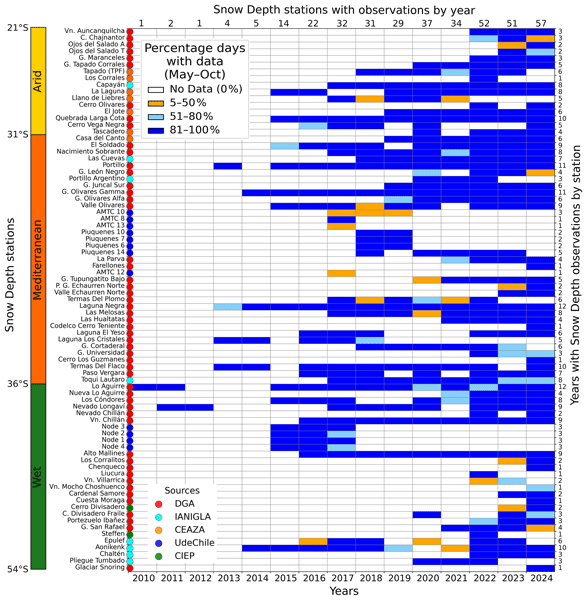
Alexis Caro, Javier Medina, Freddy Saavedra, Fernando Gimeno, Jorge Huenante, Mariano Masiokas, Cristian Orrego, Ana Hernández, James McPhee, Pierre Pitte, Sebastián Krogh, David Farías-Barahona, Nevenka Bulovic, Iñigo Irarrázaval, Shelley MacDonell, Mauricio Zambrano-Bigiarini, and Carlos Romero
Earth Syst. Sci. Data, 18, 7097–7123, https://doi.org/10.5194/essd-18-7097-2026, https://doi.org/10.5194/essd-18-7097-2026, 2026
Short summary
Short summary
Snowpack dynamics in the Southern Andes remain poorly quantified due to sparse and inconsistent in situ data, limiting hydrological modeling. We compile and quality-control daily snow depth observations from 81 stations (21–54° S, 2010–2024). The resulting dataset improves the Physical Consistency Index (up to 95 %) despite reduced data availability, reveals a north–south increase in snow depth but no consistent positive relationship with elevation across river basins.
Matías Moreno, Pablo Mendoza, Eduardo Muñoz-Castro, Mauricio Zambrano-Bigiarini, and Alonso Pizarro
EGUsphere, https://doi.org/10.5194/egusphere-2026-2912, https://doi.org/10.5194/egusphere-2026-2912, 2026
Short summary
Short summary
We developed a new method called SPEAK to better evaluate how well hydrological models reproduce spatial patterns such as evapotranspiration across different regions. We tested it in 99 Chilean catchments with different climates and terrain types. Compared with existing methods, SPEAK more accurately represented spatial patterns and was less affected by map resolution or catchment characteristics. This could help improve water resource modelling and planning across diverse local conditions.
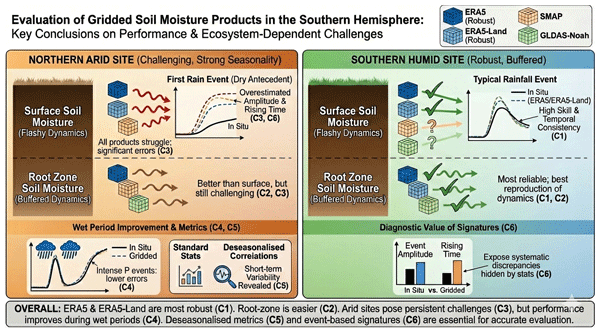
Daniel A. Núñez-Ibarra, Mauricio Zambrano-Bigiarini, and Mauricio Galleguillos
Hydrol. Earth Syst. Sci., 30, 1813–1847, https://doi.org/10.5194/hess-30-1813-2026, https://doi.org/10.5194/hess-30-1813-2026, 2026
Short summary
Short summary
Soil moisture plays a key role in how land and climate interact, yet it remains difficult to measure in remote or natural areas. This study compared four state-of-the-art soil moisture datasets against ground data from ten sites in Chile. Results show that some products perform better in humid areas, while others do better in dry regions. The work highlights which datasets are most reliable and suggests new ways to assess how well they track changes after precipitation events.
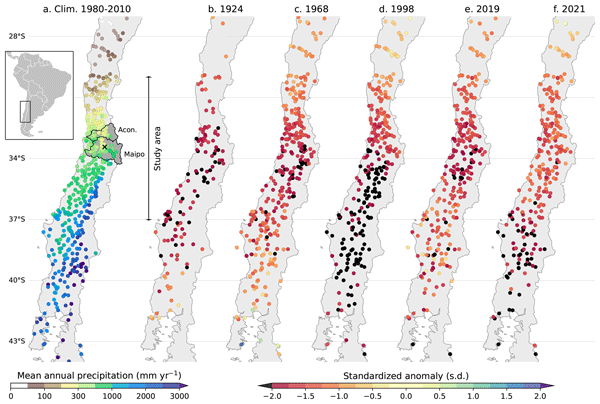
René Garreaud, Juan Pablo Boisier, Camila Alvarez-Garreton, Duncan A. Christie, Tomás Carrasco-Escaff, Iván Vergara, Roberto O. Chávez, Paulina Aldunce, Pablo Camus, Manuel Suazo-Álvarez, Mariano Masiokas, Gabriel Castro, Ariel Muñoz, Mauricio Zambrano-Bigiarini, Rodrigo Fuster, and Lintsiee Godoy
Hydrol. Earth Syst. Sci., 29, 5347–5369, https://doi.org/10.5194/hess-29-5347-2025, https://doi.org/10.5194/hess-29-5347-2025, 2025
Short summary
Short summary
This study focuses on hyperdroughts (HDs) in central Chile, defined as years with a regional rainfall deficit exceeding 75 %. Only five HDs occurred in the last century (1924, 1968, 1998, 2019, 2021), but they caused disproportionate environmental and social impacts. In some systems, the effects were larger than expected from those considering moderate droughts and dependent on the antecedent conditions. HDs have analogs from the remote past, and they are expected to increase in the near future.
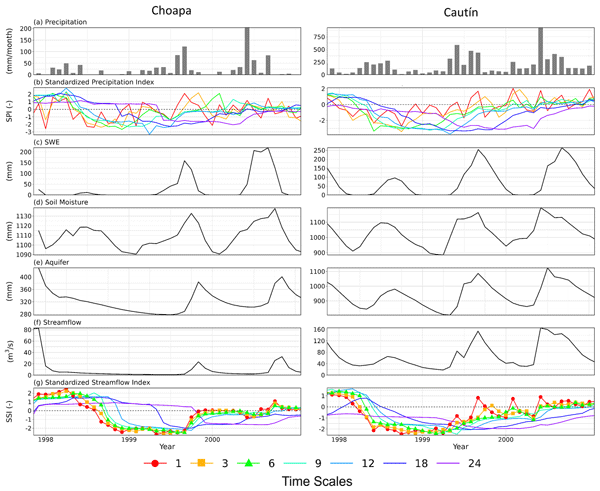
Fabián Lema, Pablo A. Mendoza, Nicolás A. Vásquez, Naoki Mizukami, Mauricio Zambrano-Bigiarini, and Ximena Vargas
Hydrol. Earth Syst. Sci., 29, 1981–2002, https://doi.org/10.5194/hess-29-1981-2025, https://doi.org/10.5194/hess-29-1981-2025, 2025
Short summary
Short summary
Hydrological droughts affect ecosystems and socioeconomic activities worldwide. Despite the fact that they are commonly described with the Standardized Streamflow Index (SSI), there is limited understanding of what they truly reflect in terms of water cycle processes. Here, we used state-of-the-art hydrological models in Andean basins to examine drivers of SSI fluctuations. The results highlight the importance of careful selection of indices and timescales for accurate drought characterization and monitoring.
Anne F. Van Loon, Sarra Kchouk, Alessia Matanó, Faranak Tootoonchi, Camila Alvarez-Garreton, Khalid E. A. Hassaballah, Minchao Wu, Marthe L. K. Wens, Anastasiya Shyrokaya, Elena Ridolfi, Riccardo Biella, Viorica Nagavciuc, Marlies H. Barendrecht, Ana Bastos, Louise Cavalcante, Franciska T. de Vries, Margaret Garcia, Johanna Mård, Ileen N. Streefkerk, Claudia Teutschbein, Roshanak Tootoonchi, Ruben Weesie, Valentin Aich, Juan P. Boisier, Giuliano Di Baldassarre, Yiheng Du, Mauricio Galleguillos, René Garreaud, Monica Ionita, Sina Khatami, Johanna K. L. Koehler, Charles H. Luce, Shreedhar Maskey, Heidi D. Mendoza, Moses N. Mwangi, Ilias G. Pechlivanidis, Germano G. Ribeiro Neto, Tirthankar Roy, Robert Stefanski, Patricia Trambauer, Elizabeth A. Koebele, Giulia Vico, and Micha Werner
Nat. Hazards Earth Syst. Sci., 24, 3173–3205, https://doi.org/10.5194/nhess-24-3173-2024, https://doi.org/10.5194/nhess-24-3173-2024, 2024
Short summary
Short summary
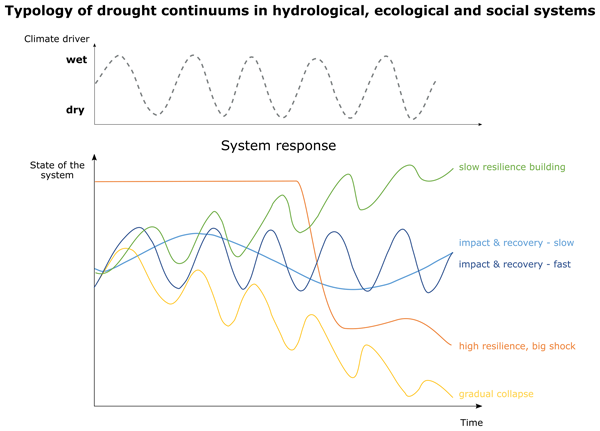
Drought is a creeping phenomenon but is often still analysed and managed like an isolated event, without taking into account what happened before and after. Here, we review the literature and analyse five cases to discuss how droughts and their impacts develop over time. We find that the responses of hydrological, ecological, and social systems can be classified into four types and that the systems interact. We provide suggestions for further research and monitoring, modelling, and management.
Ivan Vergara, Fernanda Santibañez, René Garreaud, and Germán Aguilar
Earth Syst. Dynam. Discuss., https://doi.org/10.5194/esd-2024-27, https://doi.org/10.5194/esd-2024-27, 2024
Manuscript not accepted for further review
Short summary
Short summary
The denudation rate was modelled in over a thousand basins across the Earth. The results suggest that water and associated life have a positive effect across their whole range, which is regulated by topography. Because of this, bioclimatic effect is weak in flat landscapes, but it could vary denudation forty times in mountain settings. It was also observed that other things being equal, water availability steepens basins, so climate also has an indirect effect acting on geological timeframes.
Rodrigo J. Seguel, Lucas Castillo, Charlie Opazo, Néstor Y. Rojas, Thiago Nogueira, María Cazorla, Mario Gavidia-Calderón, Laura Gallardo, René Garreaud, Tomás Carrasco-Escaff, and Yasin Elshorbany
Atmos. Chem. Phys., 24, 8225–8242, https://doi.org/10.5194/acp-24-8225-2024, https://doi.org/10.5194/acp-24-8225-2024, 2024
Short summary
Short summary
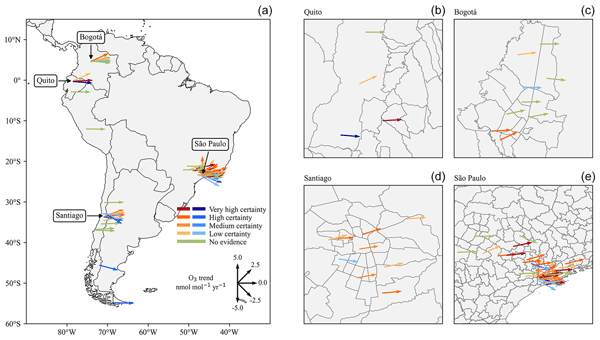
Trends of surface ozone were examined across South America. Our findings indicate that ozone trends in major South American cities either increase or remain steady, with no signs of decline. The upward trends can be attributed to chemical regimes that efficiently convert nitric oxide into nitrogen dioxide. Additionally, our results suggest a climate penalty for ozone driven by meteorological conditions that favor wildfire propagation in Chile and extensive heat waves in southern Brazil.
Violeta Tolorza, Christian H. Mohr, Mauricio Zambrano-Bigiarini, Benjamín Sotomayor, Dagoberto Poblete-Caballero, Sebastien Carretier, Mauricio Galleguillos, and Oscar Seguel
Earth Surf. Dynam., 12, 841–861, https://doi.org/10.5194/esurf-12-841-2024, https://doi.org/10.5194/esurf-12-841-2024, 2024
Short summary
Short summary
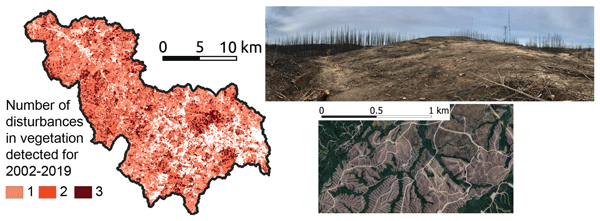
We calculated disturbances and landscape-lowering rates across various timescales in a ~ 406 km2 catchment in the Chilean Coastal Range. Intensive management of exotic tree plantations involves short rotational cycles (planting and harvesting by replanting clear-cuts) lasting 9–25 years, dense forestry road networks (increasing connectivity), and a recent increase in wildfires. Concurrently, persistent drought conditions and the high water demand of fast-growing trees reduce water availability.
Camila Alvarez-Garreton, Juan Pablo Boisier, René Garreaud, Javier González, Roberto Rondanelli, Eugenia Gayó, and Mauricio Zambrano-Bigiarini
Hydrol. Earth Syst. Sci., 28, 1605–1616, https://doi.org/10.5194/hess-28-1605-2024, https://doi.org/10.5194/hess-28-1605-2024, 2024
Short summary
Short summary
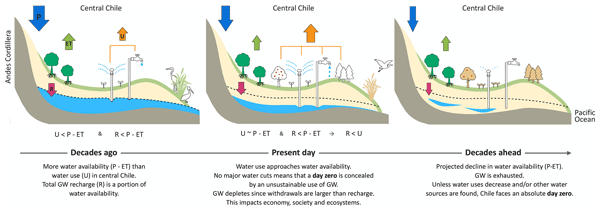
This opinion paper reflects on the risks of overusing groundwater savings to supply permanent water use requirements. Using novel data recently developed for Chile, we reveal how groundwater is being overused, causing ecological and socioeconomic impacts and concealing a Day Zero
scenario. Our argument underscores the need for reformed water allocation rules and sustainable management, shifting from a perception of groundwater as an unlimited source to a finite and vital one.
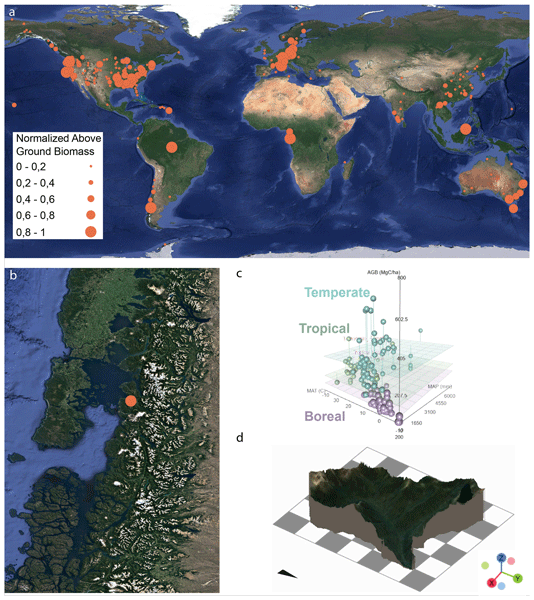
Christian H. Mohr, Michael Dietze, Violeta Tolorza, Erwin Gonzalez, Benjamin Sotomayor, Andres Iroume, Sten Gilfert, and Frieder Tautz
Biogeosciences, 21, 1583–1599, https://doi.org/10.5194/bg-21-1583-2024, https://doi.org/10.5194/bg-21-1583-2024, 2024
Short summary
Short summary
Coastal temperate rainforests, among Earth’s carbon richest biomes, are systematically underrepresented in the global network of critical zone observatories (CZOs). Introducing here a first CZO in the heart of the Patagonian rainforest, Chile, we investigate carbon sink functioning, biota-driven landscape evolution, fluxes of matter and energy, and disturbance regimes. We invite the community to join us in cross-disciplinary collaboration to advance science in this particular environment.
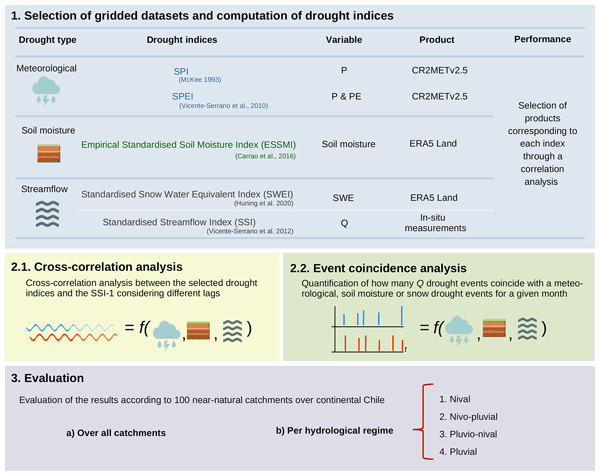
Oscar M. Baez-Villanueva, Mauricio Zambrano-Bigiarini, Diego G. Miralles, Hylke E. Beck, Jonatan F. Siegmund, Camila Alvarez-Garreton, Koen Verbist, René Garreaud, Juan Pablo Boisier, and Mauricio Galleguillos
Hydrol. Earth Syst. Sci., 28, 1415–1439, https://doi.org/10.5194/hess-28-1415-2024, https://doi.org/10.5194/hess-28-1415-2024, 2024
Short summary
Short summary
Various drought indices exist, but there is no consensus on which index to use to assess streamflow droughts. This study addresses meteorological, soil moisture, and snow indices along with their temporal scales to assess streamflow drought across hydrologically diverse catchments. Using data from 100 Chilean catchments, findings suggest that there is not a single drought index that can be used for all catchments and that snow-influenced areas require drought indices with larger temporal scales.
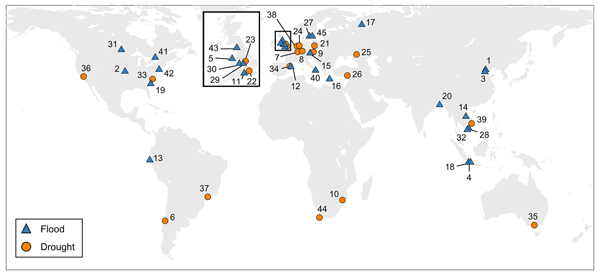
Heidi Kreibich, Kai Schröter, Giuliano Di Baldassarre, Anne F. Van Loon, Maurizio Mazzoleni, Guta Wakbulcho Abeshu, Svetlana Agafonova, Amir AghaKouchak, Hafzullah Aksoy, Camila Alvarez-Garreton, Blanca Aznar, Laila Balkhi, Marlies H. Barendrecht, Sylvain Biancamaria, Liduin Bos-Burgering, Chris Bradley, Yus Budiyono, Wouter Buytaert, Lucinda Capewell, Hayley Carlson, Yonca Cavus, Anaïs Couasnon, Gemma Coxon, Ioannis Daliakopoulos, Marleen C. de Ruiter, Claire Delus, Mathilde Erfurt, Giuseppe Esposito, Didier François, Frédéric Frappart, Jim Freer, Natalia Frolova, Animesh K. Gain, Manolis Grillakis, Jordi Oriol Grima, Diego A. Guzmán, Laurie S. Huning, Monica Ionita, Maxim Kharlamov, Dao Nguyen Khoi, Natalie Kieboom, Maria Kireeva, Aristeidis Koutroulis, Waldo Lavado-Casimiro, Hong-Yi Li, Maria Carmen LLasat, David Macdonald, Johanna Mård, Hannah Mathew-Richards, Andrew McKenzie, Alfonso Mejia, Eduardo Mario Mendiondo, Marjolein Mens, Shifteh Mobini, Guilherme Samprogna Mohor, Viorica Nagavciuc, Thanh Ngo-Duc, Huynh Thi Thao Nguyen, Pham Thi Thao Nhi, Olga Petrucci, Nguyen Hong Quan, Pere Quintana-Seguí, Saman Razavi, Elena Ridolfi, Jannik Riegel, Md Shibly Sadik, Nivedita Sairam, Elisa Savelli, Alexey Sazonov, Sanjib Sharma, Johanna Sörensen, Felipe Augusto Arguello Souza, Kerstin Stahl, Max Steinhausen, Michael Stoelzle, Wiwiana Szalińska, Qiuhong Tang, Fuqiang Tian, Tamara Tokarczyk, Carolina Tovar, Thi Van Thu Tran, Marjolein H. J. van Huijgevoort, Michelle T. H. van Vliet, Sergiy Vorogushyn, Thorsten Wagener, Yueling Wang, Doris E. Wendt, Elliot Wickham, Long Yang, Mauricio Zambrano-Bigiarini, and Philip J. Ward
Earth Syst. Sci. Data, 15, 2009–2023, https://doi.org/10.5194/essd-15-2009-2023, https://doi.org/10.5194/essd-15-2009-2023, 2023
Short summary
Short summary
As the adverse impacts of hydrological extremes increase in many regions of the world, a better understanding of the drivers of changes in risk and impacts is essential for effective flood and drought risk management. We present a dataset containing data of paired events, i.e. two floods or two droughts that occurred in the same area. The dataset enables comparative analyses and allows detailed context-specific assessments. Additionally, it supports the testing of socio-hydrological models.

Tomás Carrasco-Escaff, Maisa Rojas, René Darío Garreaud, Deniz Bozkurt, and Marius Schaefer
The Cryosphere, 17, 1127–1149, https://doi.org/10.5194/tc-17-1127-2023, https://doi.org/10.5194/tc-17-1127-2023, 2023
Short summary
Short summary
In this study, we investigate the interplay between climate and the Patagonian Icefields. By modeling the glacioclimatic conditions of the southern Andes, we found that the annual variations in net surface mass change experienced by these icefields are mainly controlled by annual variations in the air pressure field observed near the Drake Passage. Little dependence on main modes of variability was found, suggesting the Drake Passage as a key region for understanding the Patagonian Icefields.
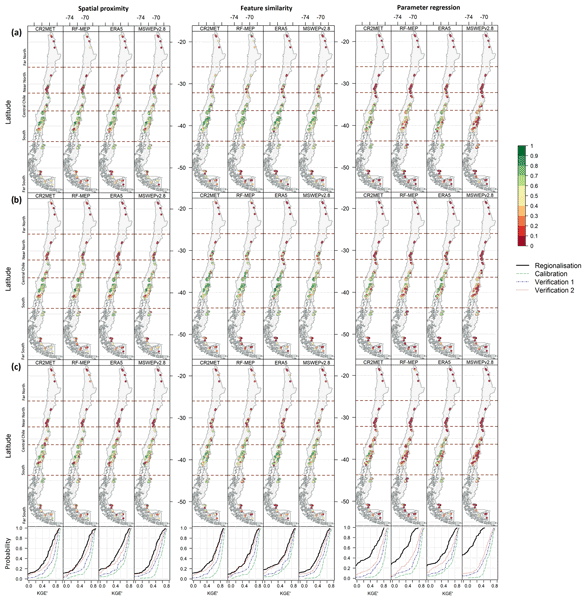
Oscar M. Baez-Villanueva, Mauricio Zambrano-Bigiarini, Pablo A. Mendoza, Ian McNamara, Hylke E. Beck, Joschka Thurner, Alexandra Nauditt, Lars Ribbe, and Nguyen Xuan Thinh
Hydrol. Earth Syst. Sci., 25, 5805–5837, https://doi.org/10.5194/hess-25-5805-2021, https://doi.org/10.5194/hess-25-5805-2021, 2021
Short summary
Short summary
Most rivers worldwide are ungauged, which hinders the sustainable management of water resources. Regionalisation methods use information from gauged rivers to estimate streamflow over ungauged ones. Through hydrological modelling, we assessed how the selection of precipitation products affects the performance of three regionalisation methods. We found that a precipitation product that provides the best results in hydrological modelling does not necessarily perform the best for regionalisation.
Cited articles
Abarca, R., Olivares, M., and Venegas, T.: Determinación de umbrales críticos de precipitación asociados a impactos para la zona central de Chile, Revista Stratus, https://revistastratus.meteochile.gob.cl/index.php/2024/02/21/ determinacion-de-umbrales-criticos-de-precipitacion-asociados -a-impactos-para-la-zona-central-de-chile/ (last access: 18 December 2025), 2024. a, b
Aghakouchak, A., Behrangi, A., Sorooshian, S., Hsu, K., and Amitai, E.: Evaluation of satellite-retrieved extreme precipitation rates across the central United States, J. Geophys. Res.-Atmos., 116, D02115, https://doi.org/10.1029/2010JD014741, 2011. a
Agilan, V. and Umamahesh, N. V.: Is the covariate based non-stationary rainfall IDF curve capable of encompassing future rainfall changes?, J. Hydrol., 541, 1441–1455, https://doi.org/10.1016/j.jhydrol.2016.08.052, 2016. a
Agilan, V. and Umamahesh, N. V.: Modelling nonlinear trend for developing non-stationary rainfall intensity-duration-frequency curve, Int. J. Climatol., 37, 1265–1281, https://doi.org/10.1002/joc.4774, 2017. a
Agilan, V. and Umamahesh, N. V.: Covariate and parameter uncertainty in non-stationary rainfall IDF curve, Int. J. Climatol., 38, 365–383, https://doi.org/10.1002/joc.5181, 2018. a, b
Aguayo, R., León-Muñoz, J., Aguayo, M., Baez-Villanueva, O. M., Zambrano-Bigiarini, M., Fernández, A., and Jacques-Coper, M.: PatagoniaMet: a multi-source hydrometeorological dataset for Western Patagonia, Scientific Data, 11, https://doi.org/10.1038/s41597-023-02828-2, 2024. a
Allen, M. R. and Ingram, W. J.: Constraints on future changes in climate and the hydrologic cycle, Nature, 419, 224–232, 2002. a
Arias-Hidalgo, M., Bhattacharya, B., Mynett, A. E., and van Griensven, A.: Experiences in using the TMPA-3B42R satellite data to complement rain gauge measurements in the Ecuadorian coastal foothills, Hydrol. Earth Syst. Sci., 17, 2905–2915, https://doi.org/10.5194/hess-17-2905-2013, 2013. a
Baez-Villanueva, O. M., Zambrano-Bigiarini, M., Ribbe, L., Nauditt, A., Giraldo-Osorio, J. D., and Thinh, N. X.: Temporal and spatial evaluation of satellite rainfall estimates over different regions in Latin-America, Atmos. Res., https://doi.org/10.1016/j.atmosres.2018.05.011, 2018. a, b
Baez-Villanueva, O. M., Zambrano-Bigiarini, M., Beck, H. E., McNamara, I., Ribbe, L., Nauditt, A., Birkel, C., Verbist, K., Giraldo-Osorio, J. D., and Xuan Thinh, N.: RF-MEP: a novel Random Forest method for merging gridded precipitation products and ground-based measurements, Remote Sens. Environ., 239, 111606, https://doi.org/10.1016/j.rse.2019.111606, 2020. a, b
Baez-Villanueva, O. M., Zambrano-Bigiarini, M., Mendoza, P. A., McNamara, I., Beck, H. E., Thurner, J., Nauditt, A., Ribbe, L., and Thinh, N. X.: On the selection of precipitation products for the regionalisation of hydrological model parameters, Hydrol. Earth Syst. Sci., 25, 5805–5837, https://doi.org/10.5194/hess-25-5805-2021, 2021. a
Bates, J. J. and Barkstrom, B. R.: A maturity model for satellite-derived climate data records, in: 14th Conference on Satellite Meteorology and Oceanography, Vol. 2, https://ams.confex.com/ams/pdfpapers/100658.pdf (last access: 18 December 2025), 2006. a
Beck, H. E., Pan, M., Roy, T., Weedon, G. P., Pappenberger, F., van Dijk, A. I. J. M., Huffman, G. J., Adler, R. F., and Wood, E. F.: Daily evaluation of 26 precipitation datasets using Stage-IV gauge-radar data for the CONUS, Hydrol. Earth Syst. Sci., 23, 207–224, https://doi.org/10.5194/hess-23-207-2019, 2019a. a, b
Beck, H. E., Wood, E. F., Pan, M., Fisher, C. K., Miralles, D. G., van Dijk, A. I., McVicar, T. R., and Adler, R. F.: MSWEP V2 global 3-hourly 0.1° precipitation: methodology and quantitative assessment, B. Am. Meteorol. Soc., 100, 473–500, https://doi.org/10.1175/BAMS-D-17-0138.1, 2019b. a
Beck, H. E., Westra, S., Tan, J., Pappenberger, F., Huffman, G. J., McVicar, T. R., Gründemann, G. J., Vergopolan, N., Fowler, H. J., Lewis, E., Verbist, K., and Wood, E. F.: PPDIST, global 0.1° daily and 3-hourly precipitation probability distribution climatologies for 1979–2018, Sci. Data, 7, 302, https://doi.org/10.1038/s41597-020-00631-x, 2020. a, b
Beck, H. E., van Dijk, A. I. J. M., Larraondo, P. R., McVicar, T. R., Pan, M., Dutra, E., and Miralles, D. G.: MSWX: global 3-hourly 0.1° bias-corrected meteorological data including near-real-time updates and forecast ensembles, B. Am. Meteorol. Soc., 103, E710, https://doi.org/10.1175/BAMS-D-21-0145.1, 2022. a
Beck, H. E., McVicar, T. R., Vergopolan, N., Berg, A., Lutsko, N. J., Dufour, A., Zeng, Z., Jiang, X., van Dijk, A. I. J. M., and Miralles, D. G.: High-resolution (1 km) Köppen-Geiger maps for 1901–2099 based on constrained CMIP6 projections, Sci Data, 10, 724, https://doi.org/10.1038/s41597-023-02549-6, 2023. a, b
Bernard, M. M.: Formulas for rainfall intensities of long duration, Transactions of the American Society of Civil Engineers, 96, 592–606, https://doi.org/10.1061/TACEAT.0004323, 1932. a
Beven, K.: Facets of uncertainty: epistemic uncertainty, non-stationarity, likelihood, hypothesis testing, and communication, Hydrolog. Sci. J., 61, 1652–1665, https://doi.org/10.1080/02626667.2015.1031761, 2016. a
Bisselink, B., Zambrano-Bigiarini, M., Burek, P., and de Roo, A.: Assessing the role of uncertain precipitation estimates on the robustness of hydrological model parameters under highly variable climate conditions, J. Hydrol., 8, 112–129, https://doi.org/10.1016/j.ejrh.2016.09.003, 2016. a
Blenkinsop, S., Lewis, E., Chan, S. C., and Fowler, H. J.: Quality-control of an hourly rainfall dataset and climatology of extremes for the UK, Int. J. Climatol., 37, 722, https://doi.org/10.1002/joc.4735, 2017. a
Boisier, J. P.: CR2MET: a high-resolution precipitation and temperature dataset for the period 1960–2021 in continental Chile, Tech. rep., Zenodo [code], https://doi.org/10.5281/zenodo.7529682, 2023. a
Boisier, J. P., Alvarez-Garretón, C., Cordero, R. R., Damiani, A., Gallardo, L., Garreaud, R. D., Lambert, F., Ramallo, C., Rojas, M., and Rondanelli, R.: Anthropogenic drying in central-southern Chile evidenced by long-term observations and climate model simulations, Elementa Science of the Anthropocene, 6, 74, https://doi.org/10.1525/elementa.328, 2018. a
Casse, C., Gosset, M., Peugeot, C., Pedinotti, V., Boone, A., Tanimoun, B., and Decharme, B.: Potential of satellite rainfall products to predict Niger River flood events in Niamey, Atmos. Res., 163, 162–176, https://doi.org/10.1016/j.atmosres.2015.01.010, 2015. a
Chen, F., Wang, R., Liu, P., Yu, L., Feng, Y., Zheng, X., and Gao, J.: Evaluation of GPM IMERG and error sources for tropical cyclone precipitation over eastern China, J. Hydrol., 627, 130384, https://doi.org/10.1016/j.jhydrol.2023.130384, 2023. a
Chen, S., Hong, Y., Gourley, J. J., Huffman, G. J., Tian, Y., Cao, Q., Yong, B., Kirstetter, P.-E., Hu, J., Hardy, J., Li, Z., Khan, S. I., and Xue, X.: Evaluation of the successive V6 and V7 TRMM multisatellite precipitation analysis over the Continental United States, Water Resour. Res., 49, 8174, https://doi.org/10.1002/2012WR012795, 2013. a
Cheng, L. and Aghakouchak, A.: Nonstationary precipitation intensity-duration-frequency curves for infrastructure design in a changing climate, Sci. Rep.-UK, 4, 7093, https://doi.org/10.1038/srep07093, 2014. a, b, c, d
Chow, V. T., Maidment, D. R., and Larry, W.: Applied Hydrology, McGRAW-Hill, ISBN-10 007-010810-2, 1988. a
Coles, S., Bawa, J., Trenner, L., and Dorazio, P.: An introduction to statistical modeling of extreme values, Springer, https://doi.org/10.1007/978-1-4471-3675-0, 2001. a, b
Courty, L. G., Wilby, R. L., Hillier, J. K., and Slater, L. J.: Intensity-duration-frequency curves at the global scale, Environ. Res. Lett., 14, 084045, https://doi.org/10.1088/1748-9326/ab370a, 2019. a
Delignette-Muller, M. L. and Dutang, C.: fitdistrplus: an R package for fitting distributions, J. Stat. Softw., 64, 1–34, https://doi.org/10.18637/jss.v064.i04, 2015. a
DGA: Precipitaciones máximas en 1, 2 y 3 días, Direcciòn General de Aguas, Ministerio de Obras Pùblicas, Santiago, Chile, SEB N° 1 edn., https://bibliotecadigital.ciren.cl/server/api/core/bitstreams/61c878db-aba2-435a-982e-128c688ec093/content (last access: 7 February 2021), 1991. a
DGA: Manual de cálculo de crecidas y caudales mínimos en cuencas sin información fluviométrica, Dirección General de Aguas, Ministerio de Obras Públicas, Santiago, Chile, SEB N° 4 edn., https://repositoriodirplan.mop.gob.cl/biblioteca/bitstreams/af89bbfd-d043-4bd1-a5cf-ec373b4b3dbb/download (last access: 7 February 2021), 1995. a
Dimitriadis, P., Koutsoyiannis, D., and Efstratiadis, A.: Examination of observed and simulated rainfall extremes using stationary models with long-term persistence, Hydrology, 8, 59, https://doi.org/10.3390/hydrology8020059, 2021. a, b
Dong, S., Li, D., and Chen, X.: Assessment of stationary and nonstationary frequency analysis of extreme precipitation, J. Hydrol., 594, 125005, https://doi.org/10.1016/j.jhydrol.2020.125005, 2021. a
Duan, Z., Liu, J., Tuo, Y., Chiogna, G., and Disse, M.: Evaluation of eight high spatial resolution gridded precipitation products in Adige Basin (Italy) at multiple temporal and spatial scales, Sci. Total Environ., 573, 1536–1553, https://doi.org/10.1016/j.scitotenv.2016.08.213, 2016. a
Endreny, T. A. and Imbeah, N.: Generating robust rainfall intensity-duration-frequency estimates with short-record satellite data, J. Hydrol., 371, 182–191, https://doi.org/10.1016/j.jhydrol.2009.03.027, 2009. a, b, c
Fadhel, S. and Saleh, M. S.: Exploration of Rain Gauge Quality Issues in Northern England, IOP Conference Series: Earth and Environmental Science, Vol. 849, 012003, https://doi.org/10.1088/1755-1315/849/1/012003, 2021. a
Falvey, M. and Garreaud, R.: Wintertime precipitation episodes in Central Chile: associated meteorological conditions and orographic influences, J. Hydrometeorol., 8, 171–193, https://doi.org/10.1175/JHM562.1, 2007. a
Faridzad, M., Yang, T., Hsu, K., Sorooshian, S., and Xiao, C.: Rainfall frequency analysis for ungauged regions using remotely sensed precipitation information, J. Hydrol., 563, 123–142, https://doi.org/10.1016/j.jhydrol.2018.05.071, 2018. a, b
Fernandez-Palomino, C. A., Hattermann, F. F., Krysanova, V., Lobanova, A., Vega-Jácome, F., Lavado, W., Santini, W., Aybar, C., and Bronstert, A.: A novel high-resolution gridded precipitation dataset for Peruvian and Ecuadorian watersheds: development and hydrological evaluation, J. Hydrometeorol., 23, 309–336, https://doi.org/10.1175/jhm-d-20-0285.1, 2022. a
Fowler, H. J., Ali, H., Allan, R. P., Ban, N., Barbero, R., Berg, P., Blenkinsop, S., Cabi, N. S., Chan, S., Dale, M., Dunn, R. J. H., Ekström, M., Evans, J. P., Fosser, G., Golding, B., Guerreiro, S. B., Hegerl, G. C., Kahraman, A., Kendon, E. J., Lenderink, G., Lewis, E., Li, X., O'Gorman, P. A., Orr, H. G., Peat, K. L., Prein, A. F., Pritchard, D., Schär, C., Sharma, A., Stott, P. A., Villalobos-Herrera, R., Villarini, G., Wasko, C., Wehner, M. F., Westra, S., and Whitford, A.: Towards advancing scientific knowledge of climate change impacts on short-duration rainfall extremes, Philos. T. Roy. Soc. A, 379, 20190542, https://doi.org/10.1098/rsta.2019.0542, 2021a. a
Fowler, H. J., Lenderink, G., Prein, A. F., Westra, S., Allan, R. P., Ban, N., Barbero, R., Berg, P., Blenkinsop, S., Do, H. X., Guerreiro, S., Haerter, J. O., Kendon, E. J., Lewis, E., Schaer, C., Sharma, A., Villarini, G., Wasko, C., and Zhang, X.: Anthropogenic intensification of short-duration rainfall extremes, Nature Reviews Earth and Environment, 2, 107–122, https://doi.org/10.1038/s43017-020-00128-6, 2021b. a
Funk, C., Peterson, P., Landsfeld, M., Pedreros, D., Verdin, J., Shukla, S., Husak, G., Rowland, J., Harrison, L., Hoell, A., and Michaelsen, J.: The climate hazards infrared precipitation with stations-a new environmental record for monitoring extremes, Sci Data, 2, 150066, https://doi.org/10.1038/sdata.2015.66, 2015. a
Ganguli, P. and Coulibaly, P.: Does nonstationarity in rainfall require nonstationary intensity–duration–frequency curves?, Hydrol. Earth Syst. Sci., 21, 6461–6483, https://doi.org/10.5194/hess-21-6461-2017, 2017. a, b
Garreaud, R. D.: Multiscale analysis of the summertime precipitation over the Central Andes, Mon. Weather Rev., 127, 901–921, https://doi.org/10.1175/1520-0493(1999)127<0901:MAOTSP>2.0.CO;2, 1999. a
Garreaud, R., Falvey, M., and Montecinos, A.: Orographic precipitation in Coastal Southern Chile: mean distribution, temporal variability, and linear contribution, J. Hydrometeorol., 17, 1185–1202, https://doi.org/10.1175/JHM-D-15-0170.1, 2016. a
Garreaud, R. D., Alvarez-Garreton, C., Barichivich, J., Boisier, J. P., Christie, D., Galleguillos, M., LeQuesne, C., McPhee, J., and Zambrano-Bigiarini, M.: The 2010–2015 megadrought in central Chile: impacts on regional hydroclimate and vegetation, Hydrol. Earth Syst. Sci., 21, 6307–6327, https://doi.org/10.5194/hess-21-6307-2017, 2017. a
Garreaud, R. D., Boisier, J. P., Rondanelli, R., Montecinos, A., Sepúlveda, H. H., and Veloso-Aguila, D.: The Central Chile Mega Drought (2010–2018): a climate dynamics perspective, Int. J. Climatol., 40, 421–439, https://doi.org/10.1002/joc.6219, 2019. a
Gianotti, D., Anderson, B. T., and Salvucci, G. D.: What do rain gauges tell us about the limits of precipitation predictability?, J. Climate, 26, 5682–5688, https://doi.org/10.1175/JCLI-D-12-00718.1, 2013. a
Gilleland, E. and Katz, R. W.: New software to analyze how extremes change over time, EOS T. Am. Geophys. Un., 92, 13–14, https://doi.org/10.1029/2011EO020001, 2011. a
Gilleland, E. and Katz, R. W.: extRemes 2.0: an extreme value analysis package in R, J. Stat. Softw., 72, 1–39, https://doi.org/10.18637/jss.v072.i08, 2016. a
Habib, E., Krajewski, W. F., and Kruger, A.: Sampling errors of tipping-bucket rain gauge measurements, J. Hydrol. Eng., 6, 159–166, https://doi.org/10.1061/(ASCE)1084-0699(2001)6:2(159), 2001. a
Hamed, K. H. and Rao, A. R.: A modified Mann-Kendall trend test for autocorrelated data, J. Hydrol., 204, 182–196, https://doi.org/10.1016/S0022-1694(97)00125-X, 1998. a
Haruna, A., Blanchet, J., and Favre, A.: Modeling intensity duration frequency curves for the whole range of non zero precipitation: a comparison of models, Water Resour. Res., 59, https://doi.org/10.1029/2022WR033362, 2023. a, b
Hersbach, H., Bell, B., Berrisford, P., Biavati, G., Horányi, A., Muñoz Sabater, J., Nicolas, J., Peubey, C., Radu, R., Rozum, I., Schepers, D., Simmons, A., Soci, C., Dee, D., and Thépaut, J.: ERA5 hourly data on single levels from 1940 to present, Copernicus Climate Change Service (C3S) Climate Data Store (CDS) [data set], https://doi.org/10.24381/cds.adbb2d47, 2018. a, b
Hersbach, H., Bell, B., Berrisford, P., Hirahara, S., Horányi, A., Muñoz Sabater, J., Nicolas, J., Peubey, C., Radu, R., Schepers, D., Simmons, A., Soci, C., Abdalla, S., Abellan, X., Balsamo, G., Bechtold, P., Biavati, G., Bidlot, J., Bonavita, M., Chiara, G., Dahlgren, P., Dee, D., Diamantakis, M., Dragani, R., Flemming, J., Forbes, R., Fuentes, M., Geer, A., Haimberger, L., Healy, S., Hogan, R. J., Hólm, E., Janisková, M., Keeley, S., Laloyaux, P., Lopez, P., Lupu, C., Radnoti, G., Rosnay, P., Rozum, I., Vamborg, F., Villaume, S., and Thépaut, J.: The ERA5 global reanalysis, Q. J. Roy. Meteor. Soc., 146, 1999–2049, https://doi.org/10.1002/qj.3803, 2020. a, b, c
Hijmans, R. J.: terra: Spatial Data Analysis, R package version 1.8-10, https://CRAN.R-project.org/package=terra (last access: 15 December 2025), 2025. a
Huffman, G. J., Bolvin, D. T., Braithwaite, D., Hsu, K., Joyce, R., Xie, P., and Yoo, S.-H.: NASA global precipitation measurement (GPM) integrated multi-satellite retrievals for GPM (IMERG). Algorithm Theoretical Basis Document (ATBD)Version 4.5., https://gpm.nasa.gov/sites/default/files/document_files/IMERG_ATBD_V4.5.pdf (last access: 18 December 2025), 2015. a, b
Huffman, G. J., Bolvin, D. T., Joyce, R., Kelley, O. A., Nelkin, E. J., Tan, J., Watters, D. C., and West, B. J.: Integrated Multi-satellitE Retrievals for GPM (IMERG) Technical Documentation, https://gpm.nasa.gov/sites/default/files/2023-07/IMERG_TechnicalDocumentation_final_230713.pdf (last access: 18 December 2025), 2023. a
Iliopoulou, T. and Koutsoyiannis, D.: Revealing hidden persistence in maximum rainfall records, Hydrolog. Sci. J., 64, 1673–1689, https://doi.org/10.1080/02626667.2019.1657578, 2019. a
Iliopoulou, T., Koutsoyiannis, D., Malamos, N., Koukouvinos, A., Dimitriadis, P., Mamassis, N., Tepetidis, N., and Markantonis, D.: A stochastic framework for rainfall intensity–time scale–return period relationships. Part II: point modelling and regionalization over Greece, Hydrolog. Sci. J., 69, 1092–1112, https://doi.org/10.1080/02626667.2024.2345814, 2024. a
Joyce, R. J., Janowiak, J. E., Arkin, P. A., and Xie, P.: CMORPH: a method that produces global precipitation estimates from passive microwave and infrared data at high spatial and temporal resolution, J. Hydrometeorol., 5, 487–503, https://doi.org/10.1175/1525-7541(2004)005<0487:CAMTPG>2.0.CO;2, 2004. a, b
Karger, D. N., Wilson, A. M., Mahony, C., Zimmermann, N. E., and Jetz, W.: Global daily 1 km land surface precipitation based on cloud cover-informed downscaling, Sci Data, 8, 307, https://doi.org/10.1038/s41597-021-01084-6, 2021. a, b
Katz, R. W.: Statistics of extremes in climate change, Climatic Change, 100, 71–76, https://doi.org/10.1007/s10584-010-9834-5, 2010. a
Katz, R. W., Parlange, M. B., and Naveau, P.: Statistics of extremes in hydrology, Adv. Water Resour., 25, 1287–1304, https://doi.org/10.1016/S0309-1708(02)00056-8, 2002. a
Koutsoyiannis, D.: Statistics of extremes and estimation of extreme rainfall: I. Theoretical investigation, Hydrolog. Sci. J., 49, https://doi.org/10.1623/hysj.49.4.575.54430, 2004a. a
Koutsoyiannis, D.: Statistics of extremes and estimation of extreme rainfall: II. Empirical investigation of long rainfall records, Hydrolog. Sci. J., 49, https://doi.org/10.1623/hysj.49.4.591.54424, 2004b. a
Koutsoyiannis, D. and Montanari, A.: Negligent killing of scientific concepts: the stationarity case, Hydrolog. Sci. J., 60, 1174–1183, https://doi.org/10.1080/02626667.2014.959959, 2015. a
Koutsoyiannis, D. and Papalexiou, S. M.: Extreme rainfall: global perspective, in: Handbook of applied hydrology, Second Edition, Vol. 74, McGraw-Hill New York, 1–74 pp., 2017. a
Koutsoyiannis, D., Kozonis, D., and Manetas, A.: A mathematical framework for studying rainfall intensity-duration-frequency relationships, J. Hydrol., 206, 118–135, https://doi.org/10.1016/S0022-1694(98)00097-3, 1998. a, b, c
Koutsoyiannis, D., Iliopoulou, T., Koukouvinos, A., and Malamos, N.: A stochastic framework for rainfall intensity–time scale–return period relationships. Part I: theory and estimation strategies, Hydrolog. Sci. J., 69, 1082–1091, https://doi.org/10.1080/02626667.2024.2345813, 2024. a
Lagos-Zúñiga, M., Mendoza, P. A., Campos, D., and Rondanelli, R.: Trends in seasonal precipitation extremes and associated temperatures along continental Chile, Clim. Dynam., 62, 4205–4222, https://doi.org/10.1007/s00382-024-07127-z, 2024. a
Lazoglou, G., Anagnostopoulou, C., Tolika, K., and Kolyva-Machera, F.: A review of statistical methods to analyze extreme precipitation and temperature events in the Mediterranean region, Theor. Appl. Climatol., 136, 99–117, https://doi.org/10.1007/s00704-018-2467-8, 2019. a
Liu, B., Xu, M., Henderson, M., and Qi, Y.: Observed trends of precipitation amount, frequency, and intensity in China, 1960–2000, J. Geophys. Res.-Atmos., 110, https://doi.org/10.1029/2004JD004864, 2005. a
Maggioni, V. and Massari, C.: On the performance of satellite precipitation products in riverine flood modeling: a review, J. Hydrol., 558, 214–224, https://doi.org/10.1016/j.jhydrol.2018.01.039, 2018. a
Marra, F., Morin, E., Peleg, N., Mei, Y., and Anagnostou, E. N.: Intensity–duration–frequency curves from remote sensing rainfall estimates: comparing satellite and weather radar over the eastern Mediterranean, Hydrol. Earth Syst. Sci., 21, 2389–2404, https://doi.org/10.5194/hess-21-2389-2017, 2017. a, b, c
Martinez-Villalobos, C. and Neelin, J. D.: Regionally high risk increase for precipitation extreme events under global warming, Sci. Rep.-UK, 13, 5579, https://doi.org/10.1038/s41598-023-32372-3, 2023. a, b
Milly, P. C. D., Betancourt, J., Falkenmark, M., Hirsch, R. M., Kundzewicz, Z. W., Lettenmaier, D. P., and Stouffer, R. J.: Climate change. Stationarity is dead: whither water management?, Science, 319, 573–574, https://doi.org/10.1126/science.1151915, 2008. a
Milly, P. C. D., Betancourt, J., Falkenmark, M., Hirsch, R. M., Kundzewicz, Z. W., Lettenmaier, D. P., Stouffer, R. J., Dettinger, M. D., and Krysanova, V.: On critiques of “Stationarity is dead: whither water management?”, Water Resour. Res., 51, 7785–7789, https://doi.org/10.1002/2015WR017408, 2015. a
Mohan, M. G., AR, A., S, A., S, B., Krishnan, A., and Rajan, A.: Hydrologic regionalization of non-stationary intensity-duration-frequency relationships for Indian mainland, H2Open Journal, 6, 223–241, https://doi.org/10.2166/h2oj.2023.023, 2023. a
Montanari, A. and Koutsoyiannis, D.: Modeling and mitigating natural hazards: Stationarity is immortal!, Water Resour. Res., 50, 9748–9756, https://doi.org/10.1002/2014WR016092, 2014. a
Moraga, J., Riquelme, C., Cárdenas, D., and Meier, C.: Subestimación de los valores IDF en Chile, in: XXII Congreso Chileno de Hidráulica, Sociedad Chilena de Ingeniería Hidráulica, https://www.sochid.cl/publicaciones-sochid/congresos-chilenos/congreso-xxii-2/congreso-xxii-trabajo-58/ (last access: 18 December 2025) 2015. a
Morbidelli, R., Saltalippi, C., Flammini, A., Cifrodelli, M., Picciafuoco, T., Corradini, C., Casas-Castillo, M. C., Fowler, H. J., and Wilkinson, S. M.: Effect of temporal aggregation on the estimate of annual maximum rainfall depths for the design of hydraulic infrastructure systems, J. Hydrol., 554, 710–720, https://doi.org/10.1016/j.jhydrol.2017.09.050, 2017. a
Morbidelli, R., García-Marín, A. P., Mamun, A. A., Atiqur, R. M., Ayuso-Muñoz, J. L., Taouti, M. B., Baranowski, P., Bellocchi, G., Sangüesa-Pool, C., Bennett, B., Oyunmunkh, B., Bonaccorso, B., Brocca, L., Caloiero, T., Caporali, E., Caracciolo, D., Casas-Castillo, M. C., G. Catalini, C., Chettih, M., Kamal Chowdhury, A. F. M., Chowdhury, R., Corradini, C., Custò, J., Dari, J., Diodato, N., Doesken, N., Dumitrescu, A., Estévez, J., Flammini, A., Fowler, H. J., Freni, G., Fusto, F., García-Barrón, L., Manea, A., Goenster-Jordan, S., Hinson, S., Kanecka-Geszke, E., Kar, K. K., Kasperska-Wołowicz, W., Krabbi, M., Krzyszczak, J., Llabrés-Brustenga, A., Ledesma, J. L. J., Liu, T., Lompi, M., Marsico, L., Mascaro, G., Moramarco, T., Newman, N., Orzan, A., Pampaloni, M., Pizarro-Tapia, R., Puentes Torres, A., Rashid, M. M., Rodríguez-Solà, R., Manzor, M. S., Siwek, K., Sousa, A., Timbadiya, P. V., Filippos, T., Vilcea, M. G., Viterbo, F., Yoo, C., Zeri, M., Zittis, G., and Saltalippi, C.: The history of rainfall data time-resolution in a wide variety of geographical areas, J. Hydrol., 590, 125258, https://doi.org/10.1016/j.jhydrol.2020.125258, 2020. a, b
Muñoz-Sabater, J.: ERA5-Land hourly data from 1950 to present, Copernicus Climate Change Service (C3S) Climate Data Store (CDS) [data set], https://doi.org/10.24381/cds.e2161bac, 2019. a, b
Muñoz-Sabater, J., Dutra, E., Agustí-Panareda, A., Albergel, C., Arduini, G., Balsamo, G., Boussetta, S., Choulga, M., Harrigan, S., Hersbach, H., Martens, B., Miralles, D. G., Piles, M., Rodríguez-Fernández, N. J., Zsoter, E., Buontempo, C., and Thépaut, J.-N.: ERA5-Land: a state-of-the-art global reanalysis dataset for land applications, Earth Syst. Sci. Data, 13, 4349–4383, https://doi.org/10.5194/essd-13-4349-2021, 2021. a, b, c, d, e, f
Neelin, J. D., Martinez-Villalobos, C., Stechmann, S. N., Ahmed, F., Chen, G., Norris, J. M., Kuo, Y.-H., and Lenderink, G.: Precipitation extremes and water vapor: relationships in current climate and implications for climate change, Current Climate Change Reports, 8, 17–33, https://doi.org/10.1007/s40641-021-00177-z, 2022. a
Nguyen, P., Ombadi, M., Gorooh, V. A., Shearer, E. J., Sadeghi, M., Sorooshian, S., Hsu, K., Bolvin, D., and Ralph, M. F.: PERSIANN Dynamic Infrared-Rain Rate (PDIR-Now): a near-real-time, quasi-global satellite precipitation dataset, J. Hydrometeorol., 21, 2893–2906, https://doi.org/10.1175/JHM-D-20-0177.1, 2020. a, b, c
Noor, M., Ismail, T., Shahid, S., Asaduzzaman, M., and Dewan, A.: Evaluating intensity-duration-frequency (IDF) curves of satellite-based precipitation datasets in Peninsular Malaysia, Atmos. Res., 248, 105203, https://doi.org/10.1016/j.atmosres.2020.105203, 2021. a, b
Nwaogazie, I. L. and Sam, M. G.: A review study on stationary and non-stationary IDF models used in rainfall data analysis around the world from 1951–2020, International Journal of Environment and Climate Change, 10, 465–482, https://doi.org/10.9734/ijecc/2020/v10i1230322, 2020. a
Nychka, D., Furrer, R., Paige, J., and Sain, S.: fields: Tools for spatial data, r package version 14.1, https://github.com/dnychka/fieldsRPackage (last access: 18 December 2025), 2021. a
O, S., Foelsche, U., Kirchengast, G., Fuchsberger, J., Tan, J., and Petersen, W. A.: Evaluation of GPM IMERG Early, Late, and Final rainfall estimates using WegenerNet gauge data in southeastern Austria, Hydrol. Earth Syst. Sci., 21, 6559–6572, https://doi.org/10.5194/hess-21-6559-2017, 2017. a
Ouarda, T. B. M. J., Yousef, L. A., and Charron, C.: Non-stationary intensity-duration-frequency curves integrating information concerning teleconnections and climate change, Int. J. Climatol., 39, 2306–2323, https://doi.org/10.1002/joc.5953, 2019. a, b
Pall, P., Allen, M., and Stone, D. A.: Testing the Clausius–Clapeyron constraint on changes in extreme precipitation under CO2 warming, Clim. Dynam., 28, 351–363, 2007. a
Papalexiou, S. M. and Koutsoyiannis, D.: Battle of extreme value distributions: a global survey on extreme daily rainfall, Water Resour. Res., 49, 187–201, https://doi.org/10.1029/2012WR012557, 2013. a, b
Patakamuri, S. K. and O'Brien, N.: modifiedmk: modified versions of Mann Kendall and Spearman's Rho trend tests, R package version 1.6, https://CRAN.R-project.org/package=modifiedmk (last access: 18 December 2025), 2021. a
Pollock, M. D., O'Donnell, G., Quinn, P., Dutton, M., Black, A., Wilkinson, M. E., Colli, M., Stagnaro, M., Lanza, L. G., Lewis, E., Kilsby, C. G., and O'Connell, P. E.: Quantifying and mitigating wind-induced undercatch in rainfall measurements, Water Resour. Res., 54, 3863–3875, https://doi.org/10.1029/2017WR022421, 2018. a
Prosdocimi, I. and Kjeldsen, T.: Parametrisation of change-permitting extreme value models and its impact on the description of change, Stoch. Env. Res. Risk. A., 35, 307–324, https://doi.org/10.1007/s00477-020-01940-8, 2021. a
Renard, B., Sun, X., and Lang, M.: Bayesian methods for non-stationary extreme value analysis, in: Extremes in a Changing Climate: Detection, Analysis and Uncertainty, Springer, https://doi.org/10.1007/978-94-007-4479-0_3, 39–95, 2012. a
Rojas, Y., Minder, J. R., Campbell, L. S., Massmann, A., and Garreaud, R.: Assessment of GPM IMERG satellite precipitation estimation and its dependence on microphysical rain regimes over the mountains of south-central Chile, Atmos. Res., 253, 105454, https://doi.org/10.1016/j.atmosres.2021.105454, 2021. a
Sadeghi, M., Nguyen, P., Naeini, M. R., Hsu, K., Braithwaite, D., and Sorooshian, S.: PERSIANN-CCS-CDR, a 3-hourly 0.04° global precipitation climate data record for heavy precipitation studies, Scientific Data, 8, 157, https://doi.org/10.1038/s41597-021-00940-9, 2021. a
Salas, J. D., Obeysekera, J., and Vogel, R. M.: Techniques for assessing water infrastructure for nonstationary extreme events: a review, Hydrolog. Sci. J., 63, 325–352, https://doi.org/10.1080/02626667.2018.1426858, 2018. a
Schlef, K. E., Kunkel, K. E., Brown, C., Demissie, Y., Lettenmaier, D. P., Wagner, A., Wigmosta, M. S., Karl, T. R., Easterling, D. R., Wang, K. J., François, B., and Yan, E.: Incorporating non-stationarity from climate change into rainfall frequency and intensity-duration-frequency (IDF) curves, J. Hydrol., 616, 128757, https://doi.org/10.1016/j.jhydrol.2022.128757, 2023. a, b, c
Serinaldi, F.: Dismissing return periods!, Stoch. Env. Res. Risk. A., 29, 1179–1189, https://doi.org/10.1007/s00477-014-0916-1, 2015. a
Serinaldi, F. and Kilsby, C. G.: Stationarity is undead: uncertainty dominates the distribution of extremes, Adv. Water Resour., 77, 17–36, https://doi.org/10.1016/j.advwatres.2014.12.013, 2015. a
Serrano-Notivoli, R., Beguería, S., Saz, M. A., and de Luis, M.: Recent trends reveal decreasing intensity of daily precipitation in Spain, Int. J. Climatol., 38, 4211–4224, https://doi.org/10.1002/joc.5562, 2018. a
Sherman, C. W.: Frequency and intensity of excessive rainfalls at boston, massachusetts, Transactions of the American Society of Civil Engineers, 95, 951–960, https://doi.org/10.1061/TACEAT.0004286, 1931. a
Silva, D. F., Simonovic, S. P., Schardong, A., and Goldenfum, J. A.: Assessment of non-stationary IDF curves under a changing climate: case study of different climatic zones in Canada, J. Hydrol., 36, 100870, https://doi.org/10.1016/j.ejrh.2021.100870, 2021. a
Sivapalan, M. and Blöschl, G.: Transformation of point rainfall to areal rainfall: intensity-duration-frequency curves, J. Hydrol., 204, 150–167, https://doi.org/10.1016/S0022-1694(97)00117-0, 1998. a
Soto, X. and Mier, C.: Subestimación de los valores IDF en Concepción. 1: Derivación completa y comparación con otras metodologías, in: XXI Congreso Chileno de Hidráulica, Sociedad Chilena de Ingeniería Hidráulica, https://www.sochid.cl/publicaciones-sochid/congresos-chilenos/congreso-xxi/xxi-congreso-2013-trabajo-42/ (last access: 18 December 2025), 2013a. a
Soto, X. and Mier, C.: Subestimación de los valores IDF en Concepción. 2: Posibles causas del sesgo, in: XXI Congreso Chileno de Hidráulica, Sociedad Chilena de Ingeniería Hidráulica, https://www.sochid.cl/publicaciones-sochid/congresos-chilenos/congreso-xxi/xxi-congreso-2013-trabajo-07/ (last access: 18 December 2025), 2013b. a
Soto-Escobar, C., Zambrano-Bigiarini, M., Tolorza, V., and Garreaud, R.: Supplementary material for manuscript egusphere-2025-621 “Developing Intensity-Duration-Frequency (IDF) curves using sub-daily gridded and in situ datasets: characterising precipitation extremes in a drying climate” by Soto-Escobar, Zambrano-Bigiarini, Tolorza and Garreaud (2.0). Zenodo [data set], https://doi.org/10.5281/zenodo.16956066, 2025. a, b, c, d, e, f, g, h, i, j, k, l, m, n, o, p
Soto-Escobar, C. J.: Construcción de curvas Intensidad-Duración-Frecuencia de alta resolución espacial para la zona Centro-Sur de Chile, Trabajo para optar al título de ingeniero civil, Facultad de Ingeniería y Ciencias, Universidad de La Frontera, Temuco, Chile, Profesor Guía: Zambrano-Bigiarini, Mauricio, https://bibliotecadigital.ufro.cl/?a=view&item=1678 (last access: 18 December 2025), 2019. a
Sun, Y., Wendi, D., Kim, D. E., and Liong, S.-Y.: Deriving intensity-duration-frequency (IDF) curves using downscaled in situ rainfall assimilated with remote sensing data, Geoscience Letters, 6, 17, https://doi.org/10.1186/s40562-019-0147-x, 2019. a, b, c
Tan, J., Huffman, G. J., Bolvin, D. T., Nelkin, E., and Joyce, R.: Major Changes to the IMERG Algorithm from V06 to V07, in: AGU Fall Meeting Abstracts, Vol. 2022, 35, https://ui.adsabs.harvard.edu/abs/2022AGUFM.H35P1321T/abstract (last access: 3 February 2025), 2022. a
Trenberth, K. E.: Conceptual framework for changes of extremes of the hydrological cycle with climate change, Climatic Change, 42, 327–339, 1999. a
Utsumi, N., Seto, S., Kanae, S., Maeda, E. E., and Oki, T.: Does higher surface temperature intensify extreme precipitation?, Geophys. Res. Lett., 38, L16708, https://doi.org/10.1029/2011GL048426, 2011. a
Vargas, G., Ortlieb, L., and Rutllant, J.: Historic mudflows in Antofagasta, Chile, and their relationship to the El Niño/Southern Oscillation events, Rev. Geol. Chile, 27, 157–176, 2000. a
Venkatesh, K., Maheswaran, R., and Devacharan, J.: Framework for developing IDF curves using satellite precipitation: a case study using GPM-IMERG V6 data, Earth Sci. Inform., 15, 671–687, https://doi.org/10.1007/s12145-021-00708-0, 2022. a, b, c
Viale, M. and Garreaud, R.: Orographic effects of the subtropical and extratropical Andes on upwind precipitating clouds, J. Geophys. Res.-Atmos., 120, 4962–4974, https://doi.org/10.1002/2014JD023014, 2015. a
Villarini, G., Mandapaka, P. V., Krajewski, W. F., and Moore, R. J.: Rainfall and sampling uncertainties: a rain gauge perspective, J. Geophys. Res.-Atmos., 113, D11102, https://doi.org/10.1029/2007JD009214, 2008. a
Vinnarasi, R. and Dhanya, C. T.: Time-varying Intensity-Duration-Frequency relationship through climate-informed covariates, J. Hydrol., 604, 127178, https://doi.org/10.1016/j.jhydrol.2021.127178, 2022. a
Ward, E., Buytaert, W., Peaver, L., and Wheater, H.: Evaluation of precipitation products over complex mountainous terrain: a water resources perspective, Adv. Water Resour., 34, 1222–1231, https://doi.org/10.1016/j.advwatres.2011.05.007, 2011. a
Watkins, David W., J., Link, G. A., and Johnson, D.: Mapping regional precipitation intensity duration frequency estimates, J. Am. Water Resour. As., 41, 157–170, https://doi.org/10.1111/j.1752-1688.2005.tb03725.x, 2005. a
Wilcox, A. C., Escauriaza, C., Agredano, R., Mignot, E., Zuazo, V., Otárola, S., Castro, L., Gironás, J., Cienfuegos, R., and Mao, L.: An integrated analysis of the March 2015 Atacama floods, Geophys. Res. Lett., 43, 8035–8043, https://doi.org/10.1002/2016GL069751, 2016. a
Wood, S. J., Jones, D. A., and Moore, R. J.: Accuracy of rainfall measurement for scales of hydrological interest, Hydrol. Earth Syst. Sci., 4, 531–543, https://doi.org/10.5194/hess-4-531-2000, 2000. a
Xie, P., Joyce, R., Wu, S., Yoo, S.-H., Yarosh, Y., Sun, F., and Lin, R.: Reprocessed, bias-corrected CMORPH global high-resolution precipitation estimates from 1998, J. Hydrometeorol., 18, 1617–1641, https://doi.org/10.1175/JHM-D-16-0168.1, 2017. a, b, c, d
Xie, P., Joyce, R., Wu, S., Yoo, S., Yarosh, Y., Sun, F., Lin, R., and NOAA CDR Program: NOAA Climate Data Record (CDR) of CPC Morphing Technique (CMORPH) High Resolution Global Precipitation Estimates, Version 1, NOAA National Centers for Environmental Information (NCEI) [data set], https://doi.org/10.25921/W9VA-Q159, 2018. a, b, c, d
Xiong, J., Tang, G., and Yang, Y.: Continental evaluation of GPM IMERG V07B precipitation on a sub-daily scale, Remote Sens. Environ., 321, 114690, https://doi.org/10.1016/j.rse.2025.114690, 2025. a
Yan, L., Xiong, L., Jiang, C., Zhang, M., Wang, D., and Xu, C.: Updating intensity-duration-frequency curves for urban infrastructure design under a changing environment, WIREs Water, 8, https://doi.org/10.1002/wat2.1519, 2021. a, b, c
Yilmaz, A. G. and Perera, B. J. C.: Extreme rainfall nonstationarity investigation and intensity–frequency–duration relationship, J. Hydrol. Eng., 19, 1160–1172, https://doi.org/10.1061/(ASCE)HE.1943-5584.0000878, 2014. a
Yilmaz, A. G., Hossain, I., and Perera, B. J. C.: Effect of climate change and variability on extreme rainfall intensity–frequency–duration relationships: a case study of Melbourne, Hydrol. Earth Syst. Sci., 18, 4065–4076, https://doi.org/10.5194/hess-18-4065-2014, 2014. a
Zambrano-Bigiarini, M. and Bernal Vallejos, S.: A new software for spatio-temporal analysis of gridded data sources, EGU General Assembly 2023, Vienna, Austria, 24–28 Apr 2023, EGU23-16978, https://doi.org/10.5194/egusphere-egu23-16978, 2023. a
Zambrano-Bigiarini, M., Nauditt, A., Birkel, C., Verbist, K., and Ribbe, L.: Temporal and spatial evaluation of satellite-based rainfall estimates across the complex topographical and climatic gradients of Chile, Hydrol. Earth Syst. Sci., 21, 1295–1320, https://doi.org/10.5194/hess-21-1295-2017, 2017. a, b, c
Short summary
This study assesses how spatial patterns, temporal trends, and record length in hourly precipitation data affect annual maximum intensities estimated with stationary and non-stationary models across a climatically and topographically diverse region. Comparing five gridded datasets, we find consistent spatial patterns but notable differences in intensities, with non-stationary estimates generally slightly lower.
This study assesses how spatial patterns, temporal trends, and record length in hourly...


