
Articles | Volume 30, issue 3
https://doi.org/10.5194/hess-30-629-2026
© Author(s) 2026. This work is distributed under
the Creative Commons Attribution 4.0 License.
the Creative Commons Attribution 4.0 License.
https://doi.org/10.5194/hess-30-629-2026
© Author(s) 2026. This work is distributed under
the Creative Commons Attribution 4.0 License.
the Creative Commons Attribution 4.0 License.
Research article
| 
04 Feb 2026
Research article |
| 04 Feb 2026
| 04 Feb 2026
When physics gets in the way: an entropy-based evaluation of conceptual constraints in hybrid hydrological models
Manuel Álvarez Chaves
CORRESPONDING AUTHOR

Stuttgart Center for Simulation Science, Cluster of Excellence EXC 2075, University of Stuttgart, 70569 Stuttgart, Germany
Eduardo Acuña Espinoza
Institute of Water and Environment, Karlsruhe Institute of Technology (KIT), 76131 Karlsruhe, Germany
Uwe Ehret
Institute of Water and Environment, Karlsruhe Institute of Technology (KIT), 76131 Karlsruhe, Germany
Anneli Guthke
Stuttgart Center for Simulation Science, Cluster of Excellence EXC 2075, University of Stuttgart, 70569 Stuttgart, Germany
Related authors
Eduardo Jose Acuna Espinoza, Manuel Álvarez Chaves, Frederik Kratzert, Daniel Klotz, Martin Gauch, Robert Lang, Dominik Elfgang, Alexander Dolich, Ralf Loritz, and Uwe Ehret
EGUsphere, https://doi.org/10.5194/egusphere-2026-4885, https://doi.org/10.5194/egusphere-2026-4885, 2026
This preprint is open for discussion and under review for Hydrology and Earth System Sciences (HESS).
Short summary
Short summary
We present the Multi-Frequency Masked-Forecasting LSTM (MF2LSTM), a pipeline unifying multi-frequency modeling, missing-data handling, and real-time data assimilation for hourly streamflow forecasting. Forced with ICON-D2 weather data, MF2LSTM yields higher performance than LARSIM, the operational model used in Baden-Württemberg, Germany. Using a single-cell baseline, this work proves that simple deep learning models can deliver high-level operational performance without extra complexity.
Eduardo Acuña Espinoza, Frederik Kratzert, Daniel Klotz, Martin Gauch, Manuel Álvarez Chaves, Ralf Loritz, and Uwe Ehret
Hydrol. Earth Syst. Sci., 29, 1749–1758, https://doi.org/10.5194/hess-29-1749-2025, https://doi.org/10.5194/hess-29-1749-2025, 2025
Short summary
Short summary
Long short-term memory (LSTM) networks have demonstrated state-of-the-art performance for rainfall-runoff hydrological modelling. However, most studies focus on predictions at a daily scale, limiting the benefits of sub-daily (e.g. hourly) predictions in applications like flood forecasting. In this study, we introduce a new architecture, multi-frequency LSTM (MF-LSTM), designed to use inputs of various temporal frequencies to produce sub-daily (e.g. hourly) predictions at a moderate computational cost.
Eduardo Acuña Espinoza, Ralf Loritz, Frederik Kratzert, Daniel Klotz, Martin Gauch, Manuel Álvarez Chaves, and Uwe Ehret
Hydrol. Earth Syst. Sci., 29, 1277–1294, https://doi.org/10.5194/hess-29-1277-2025, https://doi.org/10.5194/hess-29-1277-2025, 2025
Short summary
Short summary
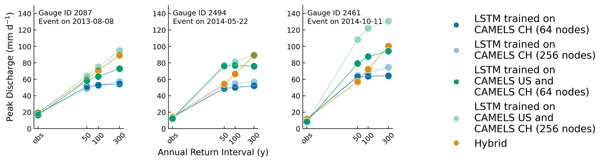
Data-driven techniques have shown the potential to outperform process-based models in rainfall–runoff simulations. Hybrid models, combining both approaches, aim to enhance accuracy and maintain interpretability. Expanding the set of test cases to evaluate hybrid models under different conditions, we test their generalization capabilities for extreme hydrological events.
Eduardo Acuña Espinoza, Ralf Loritz, Manuel Álvarez Chaves, Nicole Bäuerle, and Uwe Ehret
Hydrol. Earth Syst. Sci., 28, 2705–2719, https://doi.org/10.5194/hess-28-2705-2024, https://doi.org/10.5194/hess-28-2705-2024, 2024
Short summary
Short summary
Hydrological hybrid models promise to merge the performance of deep learning methods with the interpretability of process-based models. One hybrid approach is the dynamic parameterization of conceptual models using long short-term memory (LSTM) networks. We explored this method to evaluate the effect of the flexibility given by LSTMs on the process-based part.
Uwe Ehret, Jieyu Chen, Fedor Scholz, Sam Allen, and Sebastian Lerch
EGUsphere, https://doi.org/10.5194/egusphere-2026-4514, https://doi.org/10.5194/egusphere-2026-4514, 2026
This preprint is open for discussion and under review for Geoscientific Model Development (GMD).
Short summary
Short summary
Data sets in the geosciences are often very large, therefore data compression methods are required. In this study, we test four such methods: Block Averaging, Principal Component Analysis, Autoencoder, and Ramer-Douglas-Peucker algorithm. "Lossy" means that the original data cannot fully be restored from the compressed data. We tested the methods on rainfall and air temperature data. All methods worked very well, and for the air temperature and rainfall, different methods were best.
Eduardo Jose Acuna Espinoza, Manuel Álvarez Chaves, Frederik Kratzert, Daniel Klotz, Martin Gauch, Robert Lang, Dominik Elfgang, Alexander Dolich, Ralf Loritz, and Uwe Ehret
EGUsphere, https://doi.org/10.5194/egusphere-2026-4885, https://doi.org/10.5194/egusphere-2026-4885, 2026
This preprint is open for discussion and under review for Hydrology and Earth System Sciences (HESS).
Short summary
Short summary
We present the Multi-Frequency Masked-Forecasting LSTM (MF2LSTM), a pipeline unifying multi-frequency modeling, missing-data handling, and real-time data assimilation for hourly streamflow forecasting. Forced with ICON-D2 weather data, MF2LSTM yields higher performance than LARSIM, the operational model used in Baden-Württemberg, Germany. Using a single-cell baseline, this work proves that simple deep learning models can deliver high-level operational performance without extra complexity.
Sarah Quynh-Giang Ho, Robert Lang, and Uwe Ehret
Hydrol. Earth Syst. Sci., 30, 4847–4865, https://doi.org/10.5194/hess-30-4847-2026, https://doi.org/10.5194/hess-30-4847-2026, 2026
Short summary
Short summary
Small flood reservoirs are modelled to determine whether they can still provide water for farms and low-flows under uncertain forecasts. Though forecasts did affect how much water was available, reservoirs were still able to provide water for raising river levels and for crops. At the same time, they were able to ensure that flooding conditions were maintained. This shows that such flood reservoirs could be converted into water supply reservoirs to expand water resources in a warming world.
Alexander Dolich, Eduardo Acuña Espinoza, Uwe Ehret, Michael Kraft, Jan Bondy, Johannes Meuer, and Ralf Loritz
Earth Syst. Sci. Data Discuss., https://doi.org/10.5194/essd-2026-289, https://doi.org/10.5194/essd-2026-289, 2026
Preprint under review for ESSD
Short summary
Short summary
CAMELS-DE-1h provides a unified collection of hourly river flow and weather time series for 1,611 German catchments from 2001 to 2024, alongside operational weather forecasts. Benchmark simulation results serve as a baseline for future model development. This dataset allows researchers to investigate small and medium-sized catchments that react quickly to heavy rainfall and to test models under operational conditions, improving future flood forecasting and early warning systems.
Shaoting Ren, Evan S. Miles, Michael McCarthy, Achille Jouberton, Thomas E. Shaw, Pascal Buri, Marin Kneib, Prateek Gantayat, Anneli Guthke, and Francesca Pellicciotti
EGUsphere, https://doi.org/10.5194/egusphere-2026-2524, https://doi.org/10.5194/egusphere-2026-2524, 2026
Short summary
Short summary
Local meteorology is curial to understand glaciers’ response to climate change, yet is hard to quantify due to rare measurements. By combining physical modeling and satellite observations, this study develops a new inference framework to accurately estimate on-glacier temperature and precipitation, therefore derive reliable seasonal glacier melt. Reliable accuracy of this framework paves a way to map these key two meteorological variables for regional and global unmonitored glacier.
Tianlong Jia, Guoding Chen, Yao Li, Xinyu Chang, and Uwe Ehret
EGUsphere, https://doi.org/10.5194/egusphere-2026-1637, https://doi.org/10.5194/egusphere-2026-1637, 2026
Short summary
Short summary
Supervised learning-based streamflow prediction models typically rely on large volumes of meteorological forcing data paired with streamflow observations, but the data scarcity of streamflow observations limits their applicability. To address this, we propose a novel method to improve prediction performance in data-scarce regions, that first pre-trains on abundant meteorological forcing data, and then fine-tunes using limited meteorological forcing data paired with streamflow observations.
Sanika Baste, Daniel Klotz, Eduardo Acuña Espinoza, Andras Bardossy, and Ralf Loritz
Hydrol. Earth Syst. Sci., 29, 5871–5891, https://doi.org/10.5194/hess-29-5871-2025, https://doi.org/10.5194/hess-29-5871-2025, 2025
Short summary
Short summary
This study evaluates the extrapolation performance of long short-term memory (LSTM) networks in rainfall–runoff modeling, specifically under extreme precipitation conditions. The findings reveal that the LSTM cannot predict discharge values beyond a theoretical limit and that this limit is well below the extremity of its training data. This behavior results from the LSTM's gating structures rather than saturation of the cell states alone.
Maria Staudinger, Anna Herzog, Ralf Loritz, Tobias Houska, Sandra Pool, Diana Spieler, Paul D. Wagner, Juliane Mai, Jens Kiesel, Stephan Thober, Björn Guse, and Uwe Ehret
Hydrol. Earth Syst. Sci., 29, 5005–5029, https://doi.org/10.5194/hess-29-5005-2025, https://doi.org/10.5194/hess-29-5005-2025, 2025
Short summary
Short summary
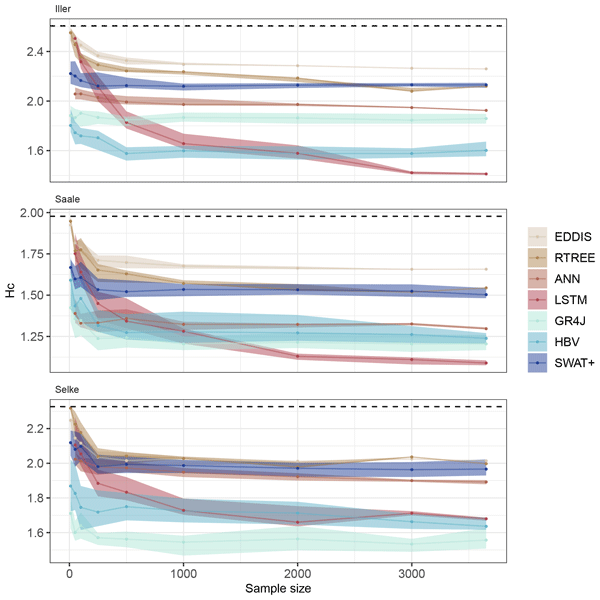
Three process-based and four data-driven hydrological models are compared using different training data. We found that process-based models perform better with small datasets but stop learning soon, while data-driven models learn longer. The study highlights the importance of memory in data and the impact of different data sampling methods on model performance. The direct comparison of these models is novel and provides a clear understanding of their performance under various data conditions.
Andrea L. Campoverde, Uwe Ehret, Patrick Ludwig, and Joaquim G. Pinto
EGUsphere, https://doi.org/10.5194/egusphere-2025-3988, https://doi.org/10.5194/egusphere-2025-3988, 2025
Short summary
Short summary
Droughts are becoming more common in Europe. Our study used vast climate data to uncover extreme unseen low-water events. These simulations show the potential droughts becoming more severe and lasting longer than the damaging 2018 event, which impacted shipping and industry. This research highlights the urgent need for adaptation measures to prevent costly economic and ecological consequences for the Rhine's waterway.
Sarah Quỳnh-Giang Ho and Uwe Ehret
Hydrol. Earth Syst. Sci., 29, 2785–2810, https://doi.org/10.5194/hess-29-2785-2025, https://doi.org/10.5194/hess-29-2785-2025, 2025
Short summary
Short summary
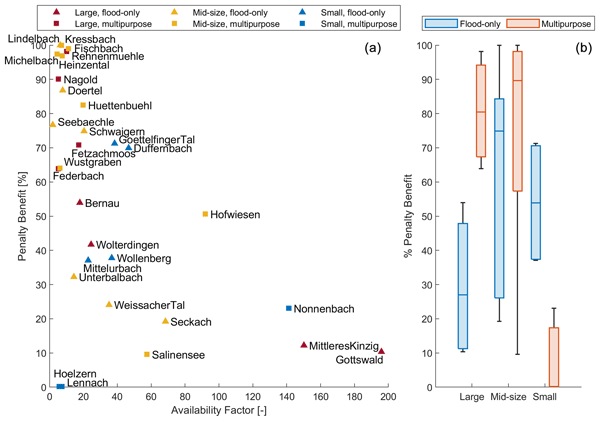
In this paper, we use models to demonstrate that even small flood reservoirs – which capture water to avoid floods downstream – can be repurposed to release water in drier conditions without affecting their ability to protect against floods. By capturing water and releasing it once levels are low, we show that reservoirs can greatly increase the water available in drought. Having more water available to the reservoir, however, is not necessarily better for drought protection.
Eduardo Acuña Espinoza, Frederik Kratzert, Daniel Klotz, Martin Gauch, Manuel Álvarez Chaves, Ralf Loritz, and Uwe Ehret
Hydrol. Earth Syst. Sci., 29, 1749–1758, https://doi.org/10.5194/hess-29-1749-2025, https://doi.org/10.5194/hess-29-1749-2025, 2025
Short summary
Short summary
Long short-term memory (LSTM) networks have demonstrated state-of-the-art performance for rainfall-runoff hydrological modelling. However, most studies focus on predictions at a daily scale, limiting the benefits of sub-daily (e.g. hourly) predictions in applications like flood forecasting. In this study, we introduce a new architecture, multi-frequency LSTM (MF-LSTM), designed to use inputs of various temporal frequencies to produce sub-daily (e.g. hourly) predictions at a moderate computational cost.
Eduardo Acuña Espinoza, Ralf Loritz, Frederik Kratzert, Daniel Klotz, Martin Gauch, Manuel Álvarez Chaves, and Uwe Ehret
Hydrol. Earth Syst. Sci., 29, 1277–1294, https://doi.org/10.5194/hess-29-1277-2025, https://doi.org/10.5194/hess-29-1277-2025, 2025
Short summary
Short summary
Data-driven techniques have shown the potential to outperform process-based models in rainfall–runoff simulations. Hybrid models, combining both approaches, aim to enhance accuracy and maintain interpretability. Expanding the set of test cases to evaluate hybrid models under different conditions, we test their generalization capabilities for extreme hydrological events.
Ralf Loritz, Alexander Dolich, Eduardo Acuña Espinoza, Pia Ebeling, Björn Guse, Jonas Götte, Sibylle K. Hassler, Corina Hauffe, Ingo Heidbüchel, Jens Kiesel, Mirko Mälicke, Hannes Müller-Thomy, Michael Stölzle, and Larisa Tarasova
Earth Syst. Sci. Data, 16, 5625–5642, https://doi.org/10.5194/essd-16-5625-2024, https://doi.org/10.5194/essd-16-5625-2024, 2024
Short summary
Short summary
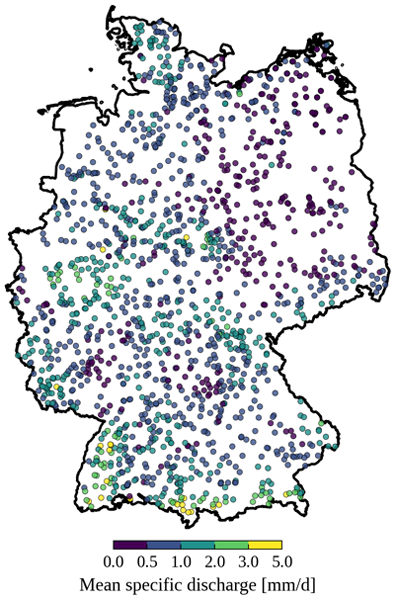
The CAMELS-DE dataset features data from 1582 streamflow gauges across Germany, with records spanning from 1951 to 2020. This comprehensive dataset, which includes time series of up to 70 years (median 46 years), enables advanced research on water flow and environmental trends and supports the development of hydrological models.
Andrea L. Campoverde, Uwe Ehret, Patrick Ludwig, and Joaquim G. Pinto
Geosci. Model Dev. Discuss., https://doi.org/10.5194/gmd-2024-134, https://doi.org/10.5194/gmd-2024-134, 2024
Revised manuscript not accepted
Short summary
Short summary
We looked at how well the model WRF-Hydro performed during the 2018 drought event in the River Rhine basin, even though it is typically used for floods. We used the meteorological ERA5 reanalysis dataset to simulate River Rhine’s streamflow and adjusted the model using parameters and actual discharge measurements. We focused on Lake Constance, a key part of the basin, but found issues with the model’s lake outflow simulation. By removing the lake module, we obtained more accurate results.
Eduardo Acuña Espinoza, Ralf Loritz, Manuel Álvarez Chaves, Nicole Bäuerle, and Uwe Ehret
Hydrol. Earth Syst. Sci., 28, 2705–2719, https://doi.org/10.5194/hess-28-2705-2024, https://doi.org/10.5194/hess-28-2705-2024, 2024
Short summary
Short summary
Hydrological hybrid models promise to merge the performance of deep learning methods with the interpretability of process-based models. One hybrid approach is the dynamic parameterization of conceptual models using long short-term memory (LSTM) networks. We explored this method to evaluate the effect of the flexibility given by LSTMs on the process-based part.
Uwe Ehret and Pankaj Dey
Hydrol. Earth Syst. Sci., 27, 2591–2605, https://doi.org/10.5194/hess-27-2591-2023, https://doi.org/10.5194/hess-27-2591-2023, 2023
Short summary
Short summary
We propose the
c-u-curvemethod to characterize dynamical (time-variable) systems of all kinds.
Uis for uncertainty and expresses how well a system can be predicted in a given period of time.
Cis for complexity and expresses how predictability differs between different periods, i.e. how well predictability itself can be predicted. The method helps to better classify and compare dynamical systems across a wide range of disciplines, thus facilitating scientific collaboration.

Patrick Ludwig, Florian Ehmele, Mário J. Franca, Susanna Mohr, Alberto Caldas-Alvarez, James E. Daniell, Uwe Ehret, Hendrik Feldmann, Marie Hundhausen, Peter Knippertz, Katharina Küpfer, Michael Kunz, Bernhard Mühr, Joaquim G. Pinto, Julian Quinting, Andreas M. Schäfer, Frank Seidel, and Christina Wisotzky
Nat. Hazards Earth Syst. Sci., 23, 1287–1311, https://doi.org/10.5194/nhess-23-1287-2023, https://doi.org/10.5194/nhess-23-1287-2023, 2023
Short summary
Short summary
Heavy precipitation in July 2021 led to widespread floods in western Germany and neighboring countries. The event was among the five heaviest precipitation events of the past 70 years in Germany, and the river discharges exceeded by far the statistical 100-year return values. Simulations of the event under future climate conditions revealed a strong and non-linear effect on flood peaks: for +2 K global warming, an 18 % increase in rainfall led to a 39 % increase of the flood peak in the Ahr river.
Susanna Mohr, Uwe Ehret, Michael Kunz, Patrick Ludwig, Alberto Caldas-Alvarez, James E. Daniell, Florian Ehmele, Hendrik Feldmann, Mário J. Franca, Christian Gattke, Marie Hundhausen, Peter Knippertz, Katharina Küpfer, Bernhard Mühr, Joaquim G. Pinto, Julian Quinting, Andreas M. Schäfer, Marc Scheibel, Frank Seidel, and Christina Wisotzky
Nat. Hazards Earth Syst. Sci., 23, 525–551, https://doi.org/10.5194/nhess-23-525-2023, https://doi.org/10.5194/nhess-23-525-2023, 2023
Short summary
Short summary
The flood event in July 2021 was one of the most severe disasters in Europe in the last half century. The objective of this two-part study is a multi-disciplinary assessment that examines the complex process interactions in different compartments, from meteorology to hydrological conditions to hydro-morphological processes to impacts on assets and environment. In addition, we address the question of what measures are possible to generate added value to early response management.
Cited articles
Aboelyazeed, D., Xu, C., Hoffman, F. M., Liu, J., Jones, A. W., Rackauckas, C., Lawson, K., and Shen, C.: A differentiable, physics-informed ecosystem modeling and learning framework for large-scale inverse problems: demonstration with photosynthesis simulations, Biogeosciences, 20, 2671–2692, https://doi.org/10.5194/bg-20-2671-2023, 2023. a
Acuna, E., Álvarez Chaves, M., Dolich, A., and Manoj J, A.: Hy2DL: Hybrid Hydrological modeling using Deep Learning methods, Zenodo [code], https://doi.org/10.5281/zenodo.17251944, 2025. a
Acuña Espinoza, E., Loritz, R., Álvarez Chaves, M., Bäuerle, N., and Ehret, U.: To bucket or not to bucket? Analyzing the performance and interpretability of hybrid hydrological models with dynamic parameterization, Hydrol. Earth Syst. Sci., 28, 2705–2719, https://doi.org/10.5194/hess-28-2705-2024, 2024. a, b, c, d, e, f, g, h
Addor, N. and Melsen, L. A.: Legacy, Rather Than Adequacy, Drives the Selection of Hydrological Models, Water Resources Research, 55, 378–390, https://doi.org/10.1029/2018WR022958, 2019. a
Addor, N., Newman, A. J., Mizukami, N., and Clark, M. P.: The CAMELS data set: catchment attributes and meteorology for large-sample studies, Hydrol. Earth Syst. Sci., 21, 5293–5313, https://doi.org/10.5194/hess-21-5293-2017, 2017. a, b
Álvarez Chaves, M.: Replication Data for: An entropy-based evaluation of conceptual constraints in hybrid hydrological models, V1, Data Repository of the University of Stuttgart (DaRUS) [data set] and [code], https://doi.org/10.18419/DARUS-4920, 2025. a, b
Álvarez Chaves, M., Ehret, U., and Guthke, A.: UNITE Toolbox, V1, Data Repository of the University of Stuttgart (DaRUS) [code], https://doi.org/10.18419/DARUS-4188, 2024. a
Ansel, J., Yang, E., He, H., Gimelshein, N., Jain, A., Voznesensky, M., Bao, B., Bell, P., Berard, D., Burovski, E., Chauhan, G., Chourdia, A., Constable, W., Desmaison, A., DeVito, Z., Ellison, E., Feng, W., Gong, J., Gschwind, M., Hirsh, B., Huang, S., Kalambarkar, K., Kirsch, L., Lazos, M., Lezcano, M., Liang, Y., Liang, J., Lu, Y., Luk, C. K., Maher, B., Pan, Y., Puhrsch, C., Reso, M., Saroufim, M., Siraichi, M. Y., Suk, H., Zhang, S., Suo, M., Tillet, P., Zhao, X., Wang, E., Zhou, K., Zou, R., Wang, X., Mathews, A., Wen, W., Chanan, G., Wu, P., and Chintala, S.: PyTorch 2: Faster Machine Learning Through Dynamic Python Bytecode Transformation and Graph Compilation, in: 29th ACM International Conference on Architectural Support for Programming Languages and Operating Systems, Volume 2 (ASPLOS '24), ACM, https://doi.org/10.1145/3620665.3640366, 2024. a
Azmi, E., Ehret, U., Weijs, S. V., Ruddell, B. L., and Perdigão, R. A. P.: Technical note: “Bit by bit”: a practical and general approach for evaluating model computational complexity vs. model performance, Hydrol. Earth Syst. Sci., 25, 1103–1115, https://doi.org/10.5194/hess-25-1103-2021, 2021. a
Bandai, T., Ghezzehei, T. A., Jiang, P., Kidger, P., Chen, X., and Steefel, C. I.: Learning Constitutive Relations From Soil Moisture Data via Physically Constrained Neural Networks, Water Resources Research, 60, e2024WR037318, https://doi.org/10.1029/2024WR037318, 2024. a
Beck, H. E., van Dijk, A. I. J. M., de Roo, A., Miralles, D. G., McVicar, T. R., Schellekens, J., and Bruijnzeel, L. A.: Global-scale regionalization of hydrologic model parameters, Water Resources Research, 52, 3599–3622, https://doi.org/10.1002/2015WR018247, 2016. a
Beck, H. E., Pan, M., Lin, P., Seibert, J., van Dijk, A. I. J. M., and Wood, E. F.: Global Fully Distributed Parameter Regionalization Based on Observed Streamflow From 4,229 Headwater Catchments, Journal of Geophysical Research: Atmospheres, 125, e2019JD031485, https://doi.org/10.1029/2019JD031485, 2020. a
Beirlant, J., Dudewicz, E. J., Györfi, L., and Van der Meulen, E. C.: Nonparametric Entropy Estimation: An Overview, International Journal of Mathematical and Statistical Sciences, 6, 17–39, http://jimbeck.caltech.edu/summerlectures/references/Entropy estimation.pdf (last access: 20 January 2026), 1997. a
Bergström, S. and Forsman, A.: Development of a conceptual deterministc rainfall-runoff model, Hydrology Research, 4, 147–170, https://doi.org/10.2166/nh.1973.0012, 1973. a
Beven, K.: Deep learning, hydrological processes and the uniqueness of place, Hydrological Processes, 34, 3608–3613, https://doi.org/10.1002/hyp.13805, 2020. a
Bindas, T., Tsai, W.-P., Liu, J., Rahmani, F., Feng, D., Bian, Y., Lawson, K., and Shen, C.: Improving River Routing Using a Differentiable Muskingum-Cunge Model and Physics-Informed Machine Learning, Water Resources Research, 60, e2023WR035337, https://doi.org/10.1029/2023WR035337, 2024. a
Blougouras, G., Reichstein, M., Migliavacca, M., Brenning, A., and Jiang, S.: Interpretable Machine Learning to Uncover Key Compound Drivers of Hydrological Droughts, EGU General Assembly 2024, Vienna, Austria, 14–19 Apr 2024, EGU24-9639, https://doi.org/10.5194/egusphere-egu24-9639, 2024. a
Bradbury, J., Frostig, R., Hawkins, P., Johnson, M. J., Leary, C., Maclaurin, D., Necula, G., Paszke, A., VanderPlas, J., Wanderman-Milne, S., and Zhang, Q.: JAX: composable transformations of Python+NumPy programs, GitHub [code], http://github.com/jax-ml/jax (last access: 20 January 2026), 2018. a
Camus, A.: The myth of Sisyphus and other essays, Vintage Books, New York, 1st vintage international edn., ISBN 978-0-679-73373-7, 1991. a
Chlumsky, R., Mai, J., Craig, J. R., and Tolson, B. A.: Advancement of a blended hydrologic model for robust model performance, Hydrol. Earth Syst. Sci. Discuss. [preprint], https://doi.org/10.5194/hess-2023-69, 2023. a
Clark, M. P., Slater, A. G., Rupp, D. E., Woods, R. A., Vrugt, J. A., Gupta, H. V., Wagener, T., and Hay, L. E.: Framework for Understanding Structural Errors (FUSE): A modular framework to diagnose differences between hydrological models, Water Resources Research, 44, https://doi.org/10.1029/2007WR006735, 2008. a, b, c
Clark, M. P., Kavetski, D., and Fenicia, F.: Pursuing the method of multiple working hypotheses for hydrological modeling, Water Resources Research, 47, https://doi.org/10.1029/2010WR009827, 2011. a, b
Cover, T. M. and Thomas, J. A.: Elements of Information Theory, Wiley, Hoboken, N.J, 2 edn., ISBN 978-0-471-24195-9, 2006. a
Coxon, G., Addor, N., Bloomfield, J. P., Freer, J., Fry, M., Hannaford, J., Howden, N. J. K., Lane, R., Lewis, M., Robinson, E. L., Wagener, T., and Woods, R.: CAMELS-GB: hydrometeorological time series and landscape attributes for 671 catchments in Great Britain, Earth Syst. Sci. Data, 12, 2459–2483, https://doi.org/10.5194/essd-12-2459-2020, 2020a. a
Coxon, G., Addor, N., Bloomfield, J. P., Freer, J., Fry, M., Hannaford, J., Howden, N. J. K., Lane, R., Lewis, M., Robinson, E. L., Wagener, T., and Woods, R.: Catchment attributes and hydro-meteorological timeseries for 671 catchments across Great Britain (CAMELS-GB), NERC Environmental Information Data Centre [data set], https://doi.org/10.5285/8344e4f3-d2ea-44f5-8afa-86d2987543a9, 2020b. a
Craig, J. R., Brown, G., Chlumsky, R., Jenkinson, R. W., Jost, G., Lee, K., Mai, J., Serrer, M., Sgro, N., Shafii, M., Snowdon, A. P., and Tolson, B. A.: Flexible watershed simulation with the Raven hydrological modelling framework, Environmental Modelling & Software, 129, 104728, https://doi.org/10.1016/j.envsoft.2020.104728, 2020. a
Dal Molin, M., Kavetski, D., and Fenicia, F.: SuperflexPy 1.3.0: an open-source Python framework for building, testing, and improving conceptual hydrological models, Geosci. Model Dev., 14, 7047–7072, https://doi.org/10.5194/gmd-14-7047-2021, 2021. a
De la Fuente, L. A., Ehsani, M. R., Gupta, H. V., and Condon, L. E.: Toward interpretable LSTM-based modeling of hydrological systems, Hydrol. Earth Syst. Sci., 28, 945–971, https://doi.org/10.5194/hess-28-945-2024, 2024. a
Ehret, U., van Pruijssen, R., Bortoli, M., Loritz, R., Azmi, E., and Zehe, E.: Adaptive clustering: reducing the computational costs of distributed (hydrological) modelling by exploiting time-variable similarity among model elements, Hydrol. Earth Syst. Sci., 24, 4389–4411, https://doi.org/10.5194/hess-24-4389-2020, 2020. a, b
Feng, D., Liu, J., Lawson, K., and Shen, C.: Differentiable, Learnable, Regionalized Process‐Based Models With Multiphysical Outputs can Approach State‐Of‐The‐Art Hydrologic Prediction Accuracy, Water Resources Research, 58, e2022WR032404, https://doi.org/10.1029/2022WR032404, 2022. a, b, c, d
Feng, D., Beck, H., Lawson, K., and Shen, C.: The suitability of differentiable, physics-informed machine learning hydrologic models for ungauged regions and climate change impact assessment, Hydrol. Earth Syst. Sci., 27, 2357–2373, https://doi.org/10.5194/hess-27-2357-2023, 2023. a
Feng, D., Beck, H., de Bruijn, J., Sahu, R. K., Satoh, Y., Wada, Y., Liu, J., Pan, M., Lawson, K., and Shen, C.: Deep dive into hydrologic simulations at global scale: harnessing the power of deep learning and physics-informed differentiable models (δHBV-globe1.0-hydroDL), Geosci. Model Dev., 17, 7181–7198, https://doi.org/10.5194/gmd-17-7181-2024, 2024a. a
Feng, J., Li, J., Xu, C., Wang, Z., Zhang, Z., Wu, X., Lai, C., Zeng, Z., Tong, H., and Jiang, S.: Viewing Soil Moisture Flash Drought Onset Mechanism and Their Changes Through XAI Lens: A Case Study in Eastern China, Water Resources Research, 60, e2023WR036297, https://doi.org/10.1029/2023WR036297, 2024b. a
Fenicia, F., Kavetski, D., and Savenije, H. H. G.: Elements of a flexible approach for conceptual hydrological modeling: 1. Motivation and theoretical development, Water Resources Research, 47, https://doi.org/10.1029/2010WR010174, 2011. a, b, c, d
Frame, J. M., Kratzert, F., Raney II, A., Rahman, M., Salas, F. R., and Nearing, G. S.: Post-Processing the National Water Model with Long Short-Term Memory Networks for Streamflow Predictions and Model Diagnostics, JAWRA Journal of the American Water Resources Association, 57, 885–905, https://doi.org/10.1111/1752-1688.12964, 2021. a, b
Frame, J. M., Kratzert, F., Gupta, H. V., Ullrich, P., and Nearing, G. S.: On strictly enforced mass conservation constraints for modelling the Rainfall-Runoff process, Hydrological Processes, 37, e14847, https://doi.org/10.1002/hyp.14847, 2023. a
Gajamannage, K., Jayathilake, D. I., Park, Y., and Bollt, E. M.: Recurrent neural networks for dynamical systems: Applications to ordinary differential equations, collective motion, and hydrological modeling, Chaos: An Interdisciplinary Journal of Nonlinear Science, 33, 013109, https://doi.org/10.1063/5.0088748, 2023. a
Galatolo, S., Hoyrup, M., and Rojas, C.: Effective symbolic dynamics, random points, statistical behavior, complexity and entropy, Information and Computation, 208, 23–41, https://doi.org/10.1016/j.ic.2009.05.001, 2010. a
Gauch, M., Mai, J., and Lin, J.: The proper care and feeding of CAMELS: How limited training data affects streamflow prediction, Environmental Modelling & Software, 135, 104926, https://doi.org/10.1016/j.envsoft.2020.104926, 2021. a
Gong, W., Gupta, H. V., Yang, D., Sricharan, K., and Hero III, A. O.: Estimating epistemic and aleatory uncertainties during hydrologic modeling: An information theoretic approach, Water Resources Research, 49, 2253–2273, https://doi.org/10.1002/wrcr.20161, 2013. a
Goodfellow, I., Bengio, Y., and Courville, A.: Deep Learning, Adaptive computation and machine learning, MIT Press, Cambridge, Massachusetts, ISBN 978-0-262-03561-3, http://www.deeplearningbook.org (last access: 20 January 2026), 2016. a
Gupta, H. V., Wagener, T., and Liu, Y.: Reconciling Theory with Observations: Elements of a Diagnostic Approach to Model Evaluation, Hydrological Processes, 22, 3802–3813, https://doi.org/10.1002/hyp.6989, 2008. a
Harper, M.: 10 years on from the Cumbrian and Carlisle Floods of 2005, https://environmentagency.blog.gov.uk/2015/01/08/10-years-on-from-the-cumbrian-and-carlisle-floods-of-2005 (last access: 20 January 2026), 2015. a
Hochreiter, S. and Schmidhuber, J.: Long Short-Term Memory, Neural Computation, 9, 1735–1780, https://doi.org/10.1162/neco.1997.9.8.1735, 1997. a
Horton, P., Schaefli, B., and Kauzlaric, M.: Why do we have so many different hydrological models? A review based on the case of Switzerland, WIREs Water, 9, e1574, https://doi.org/10.1002/wat2.1574, 2022. a
Hrachowitz, M. and Clark, M. P.: HESS Opinions: The complementary merits of competing modelling philosophies in hydrology, Hydrol. Earth Syst. Sci., 21, 3953–3973, https://doi.org/10.5194/hess-21-3953-2017, 2017. a
Höge, M., Scheidegger, A., Baity-Jesi, M., Albert, C., and Fenicia, F.: Improving hydrologic models for predictions and process understanding using neural ODEs, Hydrol. Earth Syst. Sci., 26, 5085–5102, https://doi.org/10.5194/hess-26-5085-2022, 2022. a
Jiang, S., Zheng, Y., and Solomatine, D.: Improving AI System Awareness of Geoscience Knowledge: Symbiotic Integration of Physical Approaches and Deep Learning, Geophysical Research Letters, 47, e2020GL088229, https://doi.org/10.1029/2020GL088229, 2020. a
Kingma, D. P. and Ba, J.: Adam: A Method for Stochastic Optimization, arXiv [preprint], https://doi.org/10.48550/arXiv.1412.6980, 2017. a
Kirchner, J. W.: Catchments as simple dynamical systems: Catchment characterization, rainfall-runoff modeling, and doing hydrology backward, Water Resources Research, 45, https://doi.org/10.1029/2008WR006912, 2009. a
Kozachenko, L. F. and Leonenko, N. N.: A statistical estimate for the entropy of a random vector, Probl. Inf. Transm., 23, 95–101, https://zbmath.org/?q=an:0633.62005 (last access: 20 January 2026), 1987. a
Kratzert, F., Klotz, D., Brenner, C., Schulz, K., and Herrnegger, M.: Rainfall–runoff modelling using Long Short-Term Memory (LSTM) networks, Hydrol. Earth Syst. Sci., 22, 6005–6022, https://doi.org/10.5194/hess-22-6005-2018, 2018. a, b
Kratzert, F., Herrnegger, M., Klotz, D., Hochreiter, S., and Klambauer, G.: NeuralHydrology – Interpreting LSTMs in Hydrology, in: Explainable AI: Interpreting, Explaining and Visualizing Deep Learning, edited by: Samek, W., Montavon, G., Vedaldi, A., Hansen, L. K., and Müller, K.-R., Springer International Publishing, Cham, 347–362, ISBN 978-3-030-28954-6, https://doi.org/10.1007/978-3-030-28954-6_19, 2019a. a
Kratzert, F., Klotz, D., Herrnegger, M., Sampson, A. K., Hochreiter, S., and Nearing, G. S.: Toward Improved Predictions in Ungauged Basins: Exploiting the Power of Machine Learning, Water Resources Research, 55, 11344–11354, https://doi.org/10.1029/2019WR026065, 2019b. a
Kratzert, F., Klotz, D., Shalev, G., Klambauer, G., Hochreiter, S., and Nearing, G.: Towards learning universal, regional, and local hydrological behaviors via machine learning applied to large-sample datasets, Hydrol. Earth Syst. Sci., 23, 5089–5110, https://doi.org/10.5194/hess-23-5089-2019, 2019c. a, b
Kratzert, F., Gauch, M., Klotz, D., and Nearing, G.: HESS Opinions: Never train a Long Short-Term Memory (LSTM) network on a single basin, Hydrol. Earth Syst. Sci., 28, 4187–4201, https://doi.org/10.5194/hess-28-4187-2024, 2024. a, b, c, d
Kuhn, T. S. and Hacking, I.: The structure of scientific revolutions, University of Chicago press, Chicago, 4th edn., ISBN 978-0-226-45811-3 978-0-226-45812-0, 2012. a
Lees, T., Buechel, M., Anderson, B., Slater, L., Reece, S., Coxon, G., and Dadson, S. J.: Benchmarking data-driven rainfall–runoff models in Great Britain: a comparison of long short-term memory (LSTM)-based models with four lumped conceptual models, Hydrol. Earth Syst. Sci., 25, 5517–5534, https://doi.org/10.5194/hess-25-5517-2021, 2021. a, b
Lees, T., Reece, S., Kratzert, F., Klotz, D., Gauch, M., De Bruijn, J., Kumar Sahu, R., Greve, P., Slater, L., and Dadson, S. J.: Hydrological concept formation inside long short-term memory (LSTM) networks, Hydrol. Earth Syst. Sci., 26, 3079–3101, https://doi.org/10.5194/hess-26-3079-2022, 2022. a
Li, B., Sun, T., Tian, F., and Ni, G.: Enhancing Process-Based Hydrological Models with Embedded Neural Networks: A Hybrid Approach, Journal of Hydrology, 625, 130107, https://doi.org/10.1016/j.jhydrol.2023.130107, 2023. a
Loritz, R., Dolich, A., Acuña Espinoza, E., Ebeling, P., Guse, B., Götte, J., Hassler, S. K., Hauffe, C., Heidbüchel, I., Kiesel, J., Mälicke, M., Müller-Thomy, H., Stölzle, M., and Tarasova, L.: CAMELS-DE: hydro-meteorological time series and attributes for 1582 catchments in Germany, Earth Syst. Sci. Data, 16, 5625–5642, https://doi.org/10.5194/essd-16-5625-2024, 2024. a, b
MacKay, D. J. C.: Information theory, inference, and learning algorithms, Cambridge University Press, Cambridge, UK, New York, ISBN 978-0-521-64298-9, 2003. a
Montavon, G., Samek, W., and Müller, K.-R.: Methods for interpreting and understanding deep neural networks, Digital Signal Processing, 73, 1–15, https://doi.org/10.1016/j.dsp.2017.10.011, 2018. a
Muñoz-Sabater, J., Dutra, E., Agustí-Panareda, A., Albergel, C., Arduini, G., Balsamo, G., Boussetta, S., Choulga, M., Harrigan, S., Hersbach, H., Martens, B., Miralles, D. G., Piles, M., Rodríguez-Fernández, N. J., Zsoter, E., Buontempo, C., and Thépaut, J.-N.: ERA5-Land: a state-of-the-art global reanalysis dataset for land applications, Earth Syst. Sci. Data, 13, 4349–4383, https://doi.org/10.5194/essd-13-4349-2021, 2021. a
Nearing, G. S., Kratzert, F., Sampson, A. K., Pelissier, C. S., Klotz, D., Frame, J. M., Prieto, C., and Gupta, H. V.: What Role Does Hydrological Science Play in the Age of Machine Learning?, Water Resources Research, 57, e2020WR028091, https://doi.org/10.1029/2020WR028091, 2021. a
Rackauckas, C., Ma, Y., Martensen, J., Warner, C., Zubov, K., Supekar, R., Skinner, D., Ramadhan, A., and Edelman, A.: Universal Differential Equations for Scientific Machine Learning, arxiv [preprint], http://arxiv.org/abs/2001.04385, 2021. a
Rahmani, F., Appling, A., Feng, D., Lawson, K., and Shen, C.: Identifying Structural Priors in a Hybrid Differentiable Model for Stream Water Temperature Modeling, Water Resources Research, 59, e2023WR034420, https://doi.org/10.1029/2023WR034420, 2023. a, b
Reichert, P. and Mieleitner, J.: Analyzing input and structural uncertainty of nonlinear dynamic models with stochastic, time-dependent parameters, Water Resources Research, 45, https://doi.org/10.1029/2009WR007814, 2009. a
Reichert, P., Ammann, L., and Fenicia, F.: Potential and Challenges of Investigating Intrinsic Uncertainty of Hydrological Models With Stochastic, Time‐Dependent Parameters, Water Resources Research, 57, e2020WR028400, https://doi.org/10.1029/2020WR028400, 2021. a
Reichstein, M., Camps-Valls, G., Stevens, B., Jung, M., Denzler, J., Carvalhais, N., and Prabhat: Deep learning and process understanding for data-driven Earth system science, Nature, 566, 195–204, https://doi.org/10.1038/s41586-019-0912-1, 2019. a
Shen, C., Appling, A. P., Gentine, P., Bandai, T., Gupta, H., Tartakovsky, A., Baity-Jesi, M., Fenicia, F., Kifer, D., Li, L., Liu, X., Ren, W., Zheng, Y., Harman, C. J., Clark, M., Farthing, M., Feng, D., Kumar, P., Aboelyazeed, D., Rahmani, F., Song, Y., Beck, H. E., Bindas, T., Dwivedi, D., Fang, K., Höge, M., Rackauckas, C., Mohanty, B., Roy, T., Xu, C., and Lawson, K.: Differentiable modelling to unify machine learning and physical models for geosciences, Nature Reviews Earth & Environment, 4, 552–567, https://doi.org/10.1038/s43017-023-00450-9, 2023. a, b, c
Song, Y., Knoben, W. J. M., Clark, M. P., Feng, D., Lawson, K., Sawadekar, K., and Shen, C.: When ancient numerical demons meet physics-informed machine learning: adjoint-based gradients for implicit differentiable modeling, Hydrol. Earth Syst. Sci., 28, 3051–3077, https://doi.org/10.5194/hess-28-3051-2024, 2024. a
Spieler, D., Mai, J., Craig, J. R., Tolson, B. A., and Schütze, N.: Automatic Model Structure Identification for Conceptual Hydrologic Models, Water Resources Research, 56, e2019WR027009, https://doi.org/10.1029/2019WR027009, 2020. a, b
Staudinger, M., Herzog, A., Loritz, R., Houska, T., Pool, S., Spieler, D., Wagner, P. D., Mai, J., Kiesel, J., Thober, S., Guse, B., and Ehret, U.: How well do process-based and data-driven hydrological models learn from limited discharge data?, Hydrol. Earth Syst. Sci., 29, 5005–5029, https://doi.org/10.5194/hess-29-5005-2025, 2025. a
Tsai, W.-P., Feng, D., Pan, M., Beck, H., Lawson, K., Yang, Y., Liu, J., and Shen, C.: From calibration to parameter learning: Harnessing the scaling effects of big data in geoscientific modeling, Nature Communications, 12, 5988, https://doi.org/10.1038/s41467-021-26107-z, 2021. a, b
Vrugt, J. A.: Markov chain Monte Carlo simulation using the DREAM software package: Theory, concepts, and MATLAB implementation, Environmental Modelling & Software, 75, 273–316, https://doi.org/10.1016/j.envsoft.2015.08.013, 2016. a
Wang, Y.-H. and Gupta, H. V.: A Mass-Conserving-Perceptron for Machine-Learning-Based Modeling of Geoscientific Systems, Water Resources Research, 60, e2023WR036461, https://doi.org/10.1029/2023WR036461, 2024. a
Waskom, M.: seaborn: statistical data visualization, Journal of Open Source Software, 6, 3021, https://doi.org/10.21105/joss.03021, 2021. a
Weiler, M. and Beven, K.: Do we need a Community Hydrological Model?, Water Resources Research, 51, 7777–7784, https://doi.org/10.1002/2014WR016731, 2015. a
Young, P., Parkinson, S., and Lees, M.: Simplicity out of complexity in environmental modelling: Occam's razor revisited, Journal of Applied Statistics, 23, 165–210, https://doi.org/10.1080/02664769624206, 1996. a
Young, P. C. and Beven, K. J.: Data-based mechanistic modelling and the rainfall-flow non-linearity, Environmetrics, 5, 335–363, https://doi.org/10.1002/env.3170050311, 1994. a
Zhang, C., Li, H., Hu, Y., Shen, D., Xu, B., Chen, M., Chu, W., and Li, R.: A Differentiability-Based Processes and Parameters Learning Hydrologic Model for Advancing Runoff Prediction and Process Understanding, Journal of Hydrology, 661, 133594, https://doi.org/10.1016/j.jhydrol.2025.133594, 2025. a
Álvarez Chaves, M., Gupta, H. V., Ehret, U., and Guthke, A.: On the Accurate Estimation of Information-Theoretic Quantities from Multi-Dimensional Sample Data, Entropy, 26, 387, https://doi.org/10.3390/e26050387, 2024. a
Short summary
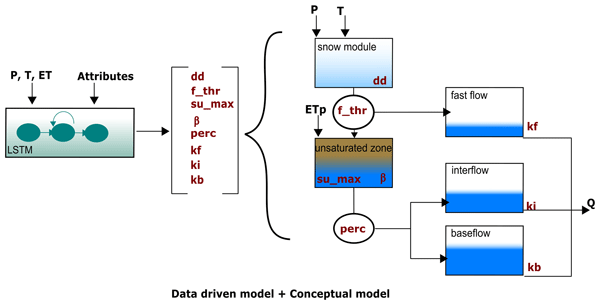
This study evaluates hybrid hydrological models combining physics-based and data-driven components, using Information Theory to measure their relative contributions. When testing conceptual models with Long Short-Term Memory (LSTM) networks that adjust parameters over time, we found performance primarily comes from the data-driven component, with physics constraints adding minimal value. We propose a quantitative tool to analyse this behaviour and suggest a workflow for diagnosing hybrid models.
This study evaluates hybrid hydrological models combining physics-based and data-driven...


