
Articles | Volume 30, issue 18
https://doi.org/10.5194/hess-30-6075-2026
© Author(s) 2026. This work is distributed under
the Creative Commons Attribution 4.0 License.
the Creative Commons Attribution 4.0 License.
https://doi.org/10.5194/hess-30-6075-2026
© Author(s) 2026. This work is distributed under
the Creative Commons Attribution 4.0 License.
the Creative Commons Attribution 4.0 License.
Research article
| 
29 Sep 2026
Research article |
| 29 Sep 2026
| 29 Sep 2026
Incorporating spatial heterogeneity into evapotranspiration estimates for bioretention basins

Department of Environmental Design, Temple University, Ambler, PA 19002, USA
Martin Bouda
Department of Geoecology, Institute of Botany of the Czech Academy of Sciences, 252 43 Průhonice, Czechia
current address: Department of Plant Ecophysiology and Cluster of Excellence GreenRobust, University of Hohenheim, 70599 Stuttgart, Germany
Allyson B. Salisbury
Department of Environmental Design, Temple University, Ambler, PA 19002, USA
current address: Department of Ecology, Evolution and Natural Resources, Rutgers – the State University of New Jersey, New Brunswick, NJ 08901, USA
Michael Alonzo
Department of Environmental Science, American University, Washington, DC 20016, USA
Jonathan E. Nyquist
Department of Earth and Environmental Science, Temple University, Philadelphia, PA 19122, USA
Laura Toran
Department of Earth and Environmental Science, Temple University, Philadelphia, PA 19122, USA
Sasha W. Eisenman
Department of Environmental Design, Temple University, Ambler, PA 19002, USA
Related authors
Julien Lamour, Shawn P. Serbin, Alistair Rogers, Kelvin T. Acebron, Elizabeth Ainsworth, Loren P. Albert, Michael Alonzo, Jeremiah Anderson, Owen K. Atkin, Nicolas Barbier, Mallory L. Barnes, Carl J. Bernacchi, Ninon Besson, Angela C. Burnett, Joshua S. Caplan, Jérôme Chave, Alexander W. Cheesman, Ilona Clocher, Onoriode Coast, Sabrina Coste, Holly Croft, Boya Cui, Clément Dauvissat, Kenneth J. Davidson, Christopher Doughty, Kim S. Ely, John R. Evans, Jean-Baptiste Féret, Iolanda Filella, Claire Fortunel, Peng Fu, Robert T. Furbank, Maquelle Garcia, Bruno O. Gimenez, Kaiyu Guan, Zhengfei Guo, David Heckmann, Patrick Heuret, Marney Isaac, Shan Kothari, Etsushi Kumagai, Thu Ya Kyaw, Liangyun Liu, Lingli Liu, Shuwen Liu, Joan Llusià, Troy Magney, Isabelle Maréchaux, Adam R. Martin, Katherine Meacham-Hensold, Christopher M. Montes, Romà Ogaya, Joy Ojo, Regison Oliveira, Alain Paquette, Josep Peñuelas, Antonia Debora Placido, Juan M. Posada, Xiaojin Qian, Heidi J. Renninger, Milagros Rodriguez-Caton, Andrés Rojas-González, Urte Schlüter, Giacomo Sellan, Courtney M. Siegert, Viridiana Silva-Perez, Guangqin Song, Charles D. Southwick, Daisy C. Souza, Clément Stahl, Yanjun Su, Leeladarshini Sujeeun, To-Chia Ting, Vicente Vasquez, Amrutha Vijayakumar, Marcelo Vilas-Boas, Diane R. Wang, Sheng Wang, Han Wang, Jing Wang, Xin Wang, Andreas P. M. Weber, Christopher Y. S. Wong, Jin Wu, Fengqi Wu, Shengbiao Wu, Zhengbing Yan, Dedi Yang, and Yingyi Zhao
Earth Syst. Sci. Data, 18, 245–265, https://doi.org/10.5194/essd-18-245-2026, https://doi.org/10.5194/essd-18-245-2026, 2026
Short summary
Short summary
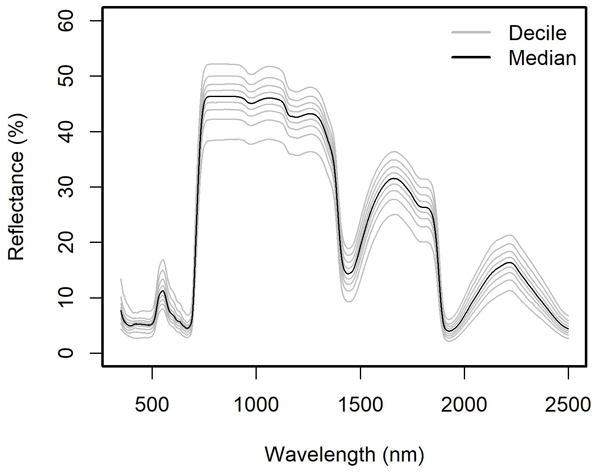
We present the Global Spectra-Trait Initiative (GSTI), a collaborative repository of paired leaf hyperspectral and gas exchange measurements from diverse ecosystems. This repository provides a unique source of information for creating hyperspectral models for predicting photosynthetic traits and associated leaf traits in terrestrial plants.
Yining Zang, Pauline C. Treble, Kei Yoshimura, Jayson Gabriel Pinza, Fengbo Zhang, Kübra Özdemir Çallı, Xiaojun Mei, Admin Husic, Alena Gessert, Andrej Stroj, Bartolomé Andreo, Bernard Ladouche, Christine Stumpp, Diana Mance, Eleni Zagana, Fen Huang, Giuseppe Sappa, Harald Kunstmann, Heike Brielmann, Hong Zhou, Huaying Wu, Jakob Garvelmann, James Berglund, Jean-Baptiste Charlier, Jens Lange, Juan Antonio Barberá Fornell, Junbing Pu, Konstantina Katsanou, Kun Ren, Laura Toran, Laurence Gill, Maria Filippini, Martin Kralik, Matías Mudarra Martínez, Min Zhao, Mingming Luo, Nico Goldscheider, Nikolaos Lambrakis, Pantaleone De Vita, Qiong Xiao, Shi Yu, Silvia Iacurto, Silvio Coda, Ted McCormack, Vincenzo Allocca, W. George Darling, Walter D'Alessandro, Xulei Guo, Yundi Hu, Zhijun Wang, Eva Kaminsky, Jiří Faimon, Marek Lang, Pavel Pracný, Aurel Persoiu, and Andreas Hartmann
Earth Syst. Sci. Data, 18, 7199–7225, https://doi.org/10.5194/essd-18-7199-2026, https://doi.org/10.5194/essd-18-7199-2026, 2026
Short summary
Short summary
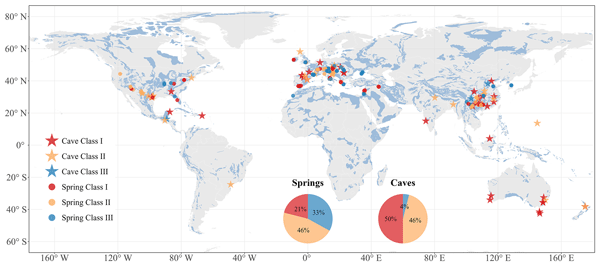
We developed the first global database of water from karst springs and cave drips that records different forms of oxygen and hydrogen, which naturally trace how rainwater moves through rocks. By gathering and checking thousands of measurements from around the globe and linking them with flow and rainfall data, the database provides a comprehensive view of water movement, allows scientists to compare regions, understand groundwater processes, and support sustainable water management worldwide.
Julien Lamour, Shawn P. Serbin, Alistair Rogers, Kelvin T. Acebron, Elizabeth Ainsworth, Loren P. Albert, Michael Alonzo, Jeremiah Anderson, Owen K. Atkin, Nicolas Barbier, Mallory L. Barnes, Carl J. Bernacchi, Ninon Besson, Angela C. Burnett, Joshua S. Caplan, Jérôme Chave, Alexander W. Cheesman, Ilona Clocher, Onoriode Coast, Sabrina Coste, Holly Croft, Boya Cui, Clément Dauvissat, Kenneth J. Davidson, Christopher Doughty, Kim S. Ely, John R. Evans, Jean-Baptiste Féret, Iolanda Filella, Claire Fortunel, Peng Fu, Robert T. Furbank, Maquelle Garcia, Bruno O. Gimenez, Kaiyu Guan, Zhengfei Guo, David Heckmann, Patrick Heuret, Marney Isaac, Shan Kothari, Etsushi Kumagai, Thu Ya Kyaw, Liangyun Liu, Lingli Liu, Shuwen Liu, Joan Llusià, Troy Magney, Isabelle Maréchaux, Adam R. Martin, Katherine Meacham-Hensold, Christopher M. Montes, Romà Ogaya, Joy Ojo, Regison Oliveira, Alain Paquette, Josep Peñuelas, Antonia Debora Placido, Juan M. Posada, Xiaojin Qian, Heidi J. Renninger, Milagros Rodriguez-Caton, Andrés Rojas-González, Urte Schlüter, Giacomo Sellan, Courtney M. Siegert, Viridiana Silva-Perez, Guangqin Song, Charles D. Southwick, Daisy C. Souza, Clément Stahl, Yanjun Su, Leeladarshini Sujeeun, To-Chia Ting, Vicente Vasquez, Amrutha Vijayakumar, Marcelo Vilas-Boas, Diane R. Wang, Sheng Wang, Han Wang, Jing Wang, Xin Wang, Andreas P. M. Weber, Christopher Y. S. Wong, Jin Wu, Fengqi Wu, Shengbiao Wu, Zhengbing Yan, Dedi Yang, and Yingyi Zhao
Earth Syst. Sci. Data, 18, 245–265, https://doi.org/10.5194/essd-18-245-2026, https://doi.org/10.5194/essd-18-245-2026, 2026
Short summary
Short summary
We present the Global Spectra-Trait Initiative (GSTI), a collaborative repository of paired leaf hyperspectral and gas exchange measurements from diverse ecosystems. This repository provides a unique source of information for creating hyperspectral models for predicting photosynthetic traits and associated leaf traits in terrestrial plants.
Cited articles
Achanta, R., Shaji, A., Smith, K., Lucchi, A., Fua, P., and Süsstrunk, S.: SLIC superpixels compared to state-of-the-art superpixel methods, IEEE T. Pattern Anal., 34, 2274–2282, https://doi.org/10.1109/TPAMI.2012.120, 2012.
Allen, R. G., Pereira, L. S., Raes, D., and Smith, M.: Crop evapotranspiration: Guidelines for computing crop water requirements, FAO Irrigation and Drainage Paper No. 56, Food and Agriculture Organization of the United Nations, Rome, ISBN 92-5-104219-5, 1998.
Alonzo, M., Dial, R. J., Schulz, B. K., Andersen, H.-E., Lewis-Clark, E., Cook, B. D., and Morton, D. C.: Mapping tall shrub biomass in Alaska at landscape scale using structure-from-motion photogrammetry and lidar, Remote Sens. Environ., 245, 111841, https://doi.org/10.1016/j.rse.2020.111841, 2020.
Ampomah, R., Holt, D., Smith, C., Smith, V., Sample-Lord, K., and Nyquist, J.: Modeling bioinfiltration surface dynamics through a hybrid geomorphic-infiltration model, Blue-Green Sys., 5, 152–168, https://doi.org/10.2166/bgs.2023.027, 2023.
Bansal, S., Creed, I. F., Tangen, B. A., Bridgham, S. D., Desai, A. R., Krauss, K. W., Neubauer, S. C., Noe, G. B., Rosenberry, D. O., Trettin, C., Wickland, K. P., Allen, S. T., Arias-Ortiz, A., Armitage, A. R., Baldocchi, D., Banerjee, K., Bastviken, D., Berg, P., Bogard, M. J., Chow, A. T., Conner, W. H., Craft, C., Creamer, C., DelSontro, T., Duberstein, J. A., Eagle, M., Fennessy, M. S., Finkelstein, S. A., Göckede, M., Grunwald, S., Halabisky, M., Herbert, E., Jahangir, M. M. R., Johnson, O. F., Jones, M. C., Kelleway, J. J., Knox, S., Kroeger, K. D., Kuehn, K. A., Lobb, D., Loder, A. L., Ma, S., Maher, D. T., McNicol, G., Meier, J., Middleton, B. A., Mills, C., Mistry, P., Mitra, A., Mobilian, C., Nahlik, A. M., Newman, S., O’Connell, J. L., Oikawa, P., van der Burg, M. P., Schutte, C. A., Song, C., Stagg, C. L., Turner, J., Vargas, R., Waldrop, M. P., Wallin, M. B., Wang, Z. A., Ward, E. J., Willard, D. A., Yarwood, S., and Zhu, X.: Practical guide to measuring wetland carbon pools and fluxes, Wetlands, 43, 105, https://doi.org/10.1007/s13157-023-01722-2, 2023.
Bates, D., Mächler, M., Bolker, B., and Walker, S.: Fitting linear mixed-effects models using lme4, J. Stat. Softw., 67, 1–48, https://doi.org/10.18637/jss.v067.i01, 2015.
Blaschke, T.: Object based image analysis for remote sensing, ISPRS J. Photogramm., 65, 2–16, https://doi.org/10.1016/j.isprsjprs.2009.06.004, 2010.
Bowman, D. H. and King, K. M.: Determination of evapotranspiration using the neutron scattering method, Can. J. Soil Sci., 45, 117–126, 1965.
Brown, R. A. and Hunt, W. F.: Impacts of media depth on effluent water quality and hydrologic performance of undersized bioretention cells, J. Irrig. Drain. Eng., 137, 132–143, https://doi.org/10.1061/(ASCE)IR.1943-4774.0000167, 2011.
Caplan, J.: Data for “Incorporating spatial heterogeneity into evapotranspiration estimates for bioretention basins”, HydroShare [code, data set], https://doi.org/10.4211/hs.ba487d9c6e4b473f88d8298499ee1c6d, 2026.
Caplan, J. S., Galanti, R. C., Olshevski, S., and Eisenman, S. W.: Water relations of street trees in green infrastructure tree trench systems, Urban For. Urban Gree., 41, 170–178, https://doi.org/10.1016/j.ufug.2019.03.016, 2019.
Caplan, J. S., Salisbury, A. B., McKenzie, E. R., Behbahani, A., and Eisenman, S. W.: Spatial, temporal, and biological factors influencing plant responses to deicing salt in roadside bioinfiltration basins, J. Environ. Manage., 359, 120761, https://doi.org/10.1016/j.jenvman.2024.120761, 2024.
City of Philadelphia: Philadelphia LiDAR – LAS files 2018, Pennsylvania Spatial Data Access, https://www.pasda.psu.edu/uci/DataSummary.aspx?dataset=2021 (last access: 1 November 2023), 2018.
Coleman, T. F. and Li, Y.: On the convergence of interior-reflective Newton methods for nonlinear minimization subject to bounds, Math. Program., 67, 189–224, https://doi.org/10.1007/BF01582221, 1994.
Coleman, T. F. and Li, Y.: An interior trust region approach for nonlinear minimization subject to bounds, SIAM J. Optimiz., 6, 418–445, https://doi.org/10.1137/0806023, 1996.
Costello, L. R., Matheny, N. P., and Clark, J. R.: A guide to estimating irrigation water needs of landscape plantings in California: the landscape coefficient method and WUCOLS III, California Dep. Water Resour., https://cimis-legacy.water.ca.gov/Content/PDF/wucols00.pdf (last access: 21 September 2026), 2000.
Daniels, B. J. and Yeakley, J. A.: Catchment-scale hydrologic effectiveness of residential rain gardens: A case study in Columbia, Maryland, USA, Water, 16, 1304, https://doi.org/10.3390/w16091304, 2024.
Denich, C. and Bradford, A.: Estimation of evapotranspiration from bioretention areas using weighing lysimeters, J. Hydrol. Eng., 15, 522–530, https://doi.org/10.1061/(ASCE)HE.1943-5584.0000134, 2010.
Ebrahimian, A., Wadzuk, B., and Traver, R.: Evapotranspiration in green stormwater infrastructure systems, Sci. Total Environ., 688, 797–810, https://doi.org/10.1016/j.scitotenv.2019.06.256, 2019.
Fox, J. and Weisberg, S.: An R Companion to Applied Regression, 3rd edn., Sage, Thousand Oaks, CA, ISBN 9781544336473, 2019.
Garcia, A., Johnson, M. J., Andraski, B. J., Halford, K. J., and Mayers, C. J.: Portable chamber measurements of evapotranspiration at the Amargosa Desert Research Site near Beatty, Nye County, Nevada, 2003-06, Reston, VA, Report 2008-5135, https://doi.org/10.3133/sir20085135, 2008.
Geoghegan, E. K., Caplan, J. S., Leech, F. N., Weber, P. E., Bauer, C. E., and Mozdzer, T. J.: Nitrogen enrichment alters carbon fluxes in a New England salt marsh, Ecosyst. Health Sustain., 4, 277–287, https://doi.org/10.1080/20964129.2018.1532772, 2018.
Granger, R. J. and Gray, D. M.: Evaporation from natural nonsaturated surfaces, J. Hydrol., 111, 21–29, https://doi.org/10.1016/0022-1694(89)90249-7, 1989.
Groh, J., Pütz, T., Gerke, H. H., Vanderborght, J., and Vereecken, H.: Quantification and prediction of nighttime evapotranspiration for two distinct grassland ecosystems, Water Resour. Res., 55, 2961–2975, https://doi.org/10.1029/2018WR024072, 2019.
Guo, D., Westra, S., and Maier, H. R.: An R package for modelling actual, potential and reference evapotranspiration, Environ. Modell. Softw., 78, 216–224, https://doi.org/10.1016/j.envsoft.2015.12.019, 2016.
Hamel, P., McHugh, I., Coutts, A., Daly, E., Beringer, J., and Fletcher, T. D.: Automated chamber system to measure field evapotranspiration rates, J. Hydrol. Eng., 20, 04014037, https://doi.org/10.1061/(ASCE)HE.1943-5584.0001006, 2015.
Hess, A., Wadzuk, B. M., and Welker, A. L.: Evapotranspiration in rain gardens using weighing lysimeters, J. Irrig. Drain. Eng., 143, 04017004, https://doi.org/10.1061/(ASCE)IR.1943-4774.0001157, 2017.
Hess, A., Wadzuk, B., and Welker, A.: Evapotranspiration estimation in rain gardens using soil moisture sensors, Vadose Zone J., 20, e20100, https://doi.org/10.1002/vzj2.20100, 2021.
Huang, T., Sage, J., Técher, D., and Gromaire, M.-C.: Hydrological performance of bioretention in field experiments and models: A review from the perspective of design characteristics and local contexts, Sci. Total Environ., 965, 178684, https://doi.org/10.1016/j.scitotenv.2025.178684, 2025.
Hung, F., Harman, C. J., Hobbs, B. F., and Sivapalan, M.: Assessment of climate, sizing, and location controls on green infrastructure efficacy: A timescale framework, Water Resour. Res., 56, e2019WR026141, https://doi.org/10.1029/2019WR026141, 2020.
Houdeshel, C. D., Pomeroy, C. A., and Hultine, K. R.: Bioretention design for xeric climates based on ecological principles, J. Am. Water Resour. As., 48, 1178–1190, https://doi.org/10.1111/j.1752-1688.2012.00678.x, 2012.
Johnston, M. R., Balster, N. J., and Thompson, A. M.: Vegetation alters soil water drainage and retention of replicate rain gardens, Water, 12, 3151, https://doi.org/10.3390/w12113151, 2020.
Joshi, P., Leitão, J. P., Maurer, M., and Bach, P. M.: Not all SuDS are created equal: Impact of different approaches on combined sewer overflows, Water Res., 191, 116780, https://doi.org/10.1016/j.watres.2020.116780, 2021.
Kool, D., Agam, N., Lazarovitch, N., Heitman, J. L., Sauer, T. J., and Ben-Gal, A.: A review of approaches for evapotranspiration partitioning, Agr. Forest Meteorol., 184, 56–70, https://doi.org/10.1016/j.agrformet.2013.09.003, 2014.
Kohler, M. A. and Linsley, R. K.: Predicting the runoff from storm rainfall, U.S. Weather Bureau Research Paper 34, U.S. Department of Commerce, Weather Bureau, Washington, D.C., https://library.oarcloud.noaa.gov/noaa_documents.lib/NOAA_historic_documents/WB/Research_papers/WB_Research_Paper_34.pdf (last access: 8 December 2025), 1951.
Li, C., Peng, C., Chiang, P.-C., Cai, Y., Wang, X., and Yang, Z.: Mechanisms and applications of green infrastructure practices for stormwater control: A review, J. Hydrol., 568, 626–637, 10.1016/j.jhydrol.2018.10.074, 2019.
Li, H., Sharkey, L. J., Hunt, W. F., and Davis, A. P.: Mitigation of impervious surface hydrology using bioretention in North Carolina and Maryland, J. Hydrol. Eng., 14, 407–415, https://doi.org/10.1061/(ASCE)1084-0699(2009)14:4(407), 2009.
Lin, L. I.-K.: A concordance correlation coefficient to evaluate reproducibility, Biometrics, 45, 255–268, https://doi.org/10.2307/2532051, 1989.
Litvak, E., McCarthy, H. R., and Pataki, D. E.: A method for estimating transpiration of irrigated urban trees in California, Landscape Urban Plan., 158, 48–61, https://doi.org/10.1016/j.landurbplan.2016.09.021, 2017.
Luo, C., Wang, Z., Sauer, T. J., Helmers, M. J., and Horton, R.: Portable canopy chamber measurements of evapotranspiration in corn, soybean, and reconstructed prairie, Agr. Water Manage., 198, 1–9, https://doi.org/10.1016/j.agwat.2017.11.024, 2018.
McEvoy, D. J., Roj, S., Dunkerly, C., McGraw, D., Huntington, J. L., Hobbins, M. T., and Ott, T.: Validation and bias correction of forecast reference evapotranspiration for agricultural applications in Nevada, J. Water Res. Plan. Man., 148, 04022057, https://doi.org/10.1061/(ASCE)WR.1943-5452.0001595, 2022.
McMahon, T. A., Peel, M. C., Lowe, L., Srikanthan, R., and McVicar, T. R.: Estimating actual, potential, reference crop and pan evaporation using standard meteorological data: a pragmatic synthesis, Hydrol. Earth Syst. Sci., 17, 1331–1363, https://doi.org/10.5194/hess-17-1331-2013, 2013.
McPhillips, L. E. and Matsler, A. M.: Temporal evolution of green stormwater infrastructure strategies in three US cities, Front. Built Environ., 4, 26, https://doi.org/10.3389/fbuil.2018.00026, 2018.
Muerdter, C. P., Wong, C. K., and LeFevre, G. H.: Emerging investigator series: The role of vegetation in bioretention for stormwater treatment in the built environment: pollutant removal, hydrologic function, and ancillary benefits, Environ. Sci.: Water Res. Technol., 4, 592–612, https://doi.org/10.1039/C7EW00511C, 2018.
Myers, D., Wadzuk, B., Hess, A., and Caplan, J. S.: An integration of multiple bioretention design manuals and data sources to improve plant selection and outcomes, Journal of Sustainable Water in the Built Environment, 12, 04026007, https://doi.org/10.1061/JSWBAY.SWENG-702, 2026.
Nakagawa, S., Johnson, P. C. D., and Schielzeth, H.: The coefficient of determination R2 and intra-class correlation coefficient from generalized linear mixed-effects models revisited and expanded, J. R. Soc. Interface, 14, 20170213, https://doi.org/10.1098/rsif.2017.0213, 2017.
Nasrollahpour, R., Skorobogatov, A., He, J., Valeo, C., Chu, A., and van Duin, B.: The impact of vegetation and media on evapotranspiration in bioretention systems, Urban For. Urban Gree., 74, 127680, https://doi.org/10.1016/j.ufug.2022.127680, 2022.
Nocco, M. A., Rouse, S. E., and Balster, N. J.: Vegetation type alters water and nitrogen budgets in a controlled, replicated experiment on residential-sized rain gardens planted with prairie, shrub, and turfgrass, Urban Ecosyst., 19, 1665–1691, https://doi.org/10.1007/s11252-016-0568-7, 2016.
Norman, J. M., Kucharik, C. J., Gower, S. T., Baldocchi, D. D., Crill, P. M., Rayment, M., Savage, K., and Striegl, R. G.: A comparison of six methods for measuring soil-surface carbon dioxide fluxes, J. Geophys. Res., 102, 28771–28777, https://doi.org/10.1029/97JD01440, 1997.
Nouri, H., Beecham, S., Hassanli, A. M., and Kazemi, F.: Water requirements of urban landscape plants: a comparison of three factor-based approaches, Ecol. Eng., 57, 276–284, https://doi.org/10.1016/j.ecoleng.2013.04.025, 2013.
Orr, A. M.: Transpiration performance in bioretention systems designed for semiarid climates, MS thesis, Department of Civil and Environmental Engineering, University of Utah, Salt Lake City, Utah, https://collections.lib.utah.edu/ark:/87278/s6zp7f8q (last access: 15 September 2026), 2013.
Ouédraogo, A. A., Berthier, E., Ramier, D., Tan, Y., and Gromaire, M.-C.: Quantifying evapotranspiration fluxes on green roofs: A comparative analysis of observational methods, Sci. Total Environ., 902, 166135, https://doi.org/10.1016/j.scitotenv.2023.166135, 2023.
Pannkuk, T. R., White, R. H., Steinke, K., Aitkenhead-Peterson, J. A., Chalmers, D. R., and Thomas, J. C.: Landscape coefficients for single- and mixed-species landscapes, HortScience, 45, 1529–1533, https://doi.org/10.21273/HORTSCI.45.10.1529, 2010.
Paredes, P., Martins, D. S., Pereira, L. S., Cadima, J., and Pires, C.: Accuracy of daily estimation of grass reference evapotranspiration using ERA-Interim reanalysis products with assessment of alternative bias correction schemes, Agr. Water Manage., 210, 340–353, https://doi.org/10.1016/j.agwat.2018.08.003, 2018.
Pennsylvania Department of Transportation (PennDOT): Traffic volume maps, https://www.penndot.pa.gov/ProjectAndPrograms/Planning/Maps/Pages/Traffic-Volume.aspx (last access: 22 June 2022), 2022.
Pennino, M. J., McDonald, R. I., and Jaffe, P. R.: Watershed-scale impacts of stormwater green infrastructure on hydrology, nutrient fluxes, and combined sewer overflows in the mid-Atlantic region, Sci. Total Environ., 565, 1044–1053, https://doi.org/10.1016/j.scitotenv.2016.05.101, 2016.
Pope, G. G., Toran, L., Caplan, J. S., and Nyquist, J.: Spatiotemporal dynamics of road salt in a highway bioswale: a comparison of point and continuous monitoring methods, Water Air Soil Poll., 236, 654, https://doi.org/10.1007/s11270-025-08281-8, 2025.
Shakya, M., Hess, A., Wadzuk, B. M., and Traver, R. G.: A soil moisture profile conceptual framework to identify water availability and recovery in green stormwater infrastructure, Hydrology, 10, 197, https://doi.org/10.3390/hydrology10100197, 2023.
Scharenbroch, B. C., Morgenroth, J., and Maule, B.: Tree species suitability to bioswales and impact on the urban water budget, J. Environ. Qual., 45, 199–206, https://doi.org/10.2134/jeq2015.01.0060, 2016.
Shuttleworth, W. J.: Putting the “vap” into evaporation, Hydrol. Earth Syst. Sci., 11, 210–244, https://doi.org/10.5194/hess-11-210-2007, 2007.
Shuttleworth, W. J. and Wallace, J. S.: Calculating the water requirements of irrigated crops in Australia using the Matt–Shuttleworth approach, T. ASABE, 52, 1895–1906, https://doi.org/10.13031/2013.29217, 2009.
Skorobogatov, A., He, J., Chu, A., Valeo, C., and van Duin, B.: The impact of media, plants and their interactions on bioretention performance: a review, Sci. Total Environ., 715, 136918, https://doi.org/10.1016/j.scitotenv.2020.136918, 2020.
Steduto, P. and Hsiao, T. C.: Maize canopies under two soil water regimes: II. Seasonal trends of evapotranspiration, carbon dioxide assimilation and canopy conductance, and as related to leaf area index, Agr. Forest Meteorol., 89, 185–200, https://doi.org/10.1016/S0168-1923(97)00084-1, 1998.
Stineman, R. W.: A consistently well behaved method of interpolation, Creative Comput., 6, 54–57, 1980.
Sun, H., Kopp, K., and Kjelgren, R.: Water-efficient urban landscapes: integrating different water use categorizations and plant types, HortScience, 47, 254–263, https://doi.org/10.21273/HORTSCI.47.2.254, 2012.
Toran, L., Eisenman, S., Caplan, J., van Aken, B., McKenzie, E., Nyquist, J., Ryan, R., Traver, R., Tu, M.-C., Schmidt, N., and Calt, E.: Stormwater control management and monitoring, report, Pennsylvania Department of Transportation, https://rosap.ntl.bts.gov/view/dot/35094 (last access: 21 September 2026), 2017.
Traver, R. G. and Ebrahimian, A.: Dynamic design of green stormwater infrastructure, Front. Environ. Sci. En., 11, 15, https://doi.org/10.1007/s11783-017-0973-z, 2017.
Wadzuk, B. M., Hickman, J. M., and Traver, R. G.: Understanding the role of evapotranspiration in bioretention: mesocosm study, J. Sustain. Water Built Environ., 1, 04014002, https://doi.org/10.1061/JSWBAY.0000794, 2015.
Wagner, W. and Pruss, A.: International equations for the saturation properties of ordinary water substance. Revised according to the international temperature scale of 1990, J. Phys. Chem. Ref. Data, 22, 783–787, https://doi.org/10.1063/1.555926, 1993.
Xue, Y., Zhang, Z., Li, X., Liang, H., and Yin, L.: A review of evapotranspiration estimation models: advances and future development, Water Resour. Manage., 39, 3641–3657, https://doi.org/10.1007/s11269-025-04191-w, 2025.
Short summary
We sought to test and improve the modeling tools used to quantify evapotranspiration (ET) in urban bioretention basins, where plant size and shade vary widely. Using direct measurements and spatially detailed data from a basin in Philadelphia, we found that common models often produce ET estimates that differ substantially from empirical estimates. Simple corrections to standard models greatly improve agreement, helping cities better predict green stormwater infrastructure performance.
We sought to test and improve the modeling tools used to quantify evapotranspiration (ET) in...


