Articles | Volume 30, issue 18
https://doi.org/10.5194/hess-30-5947-2026
© Author(s) 2026. This work is distributed under
the Creative Commons Attribution 4.0 License.
https://doi.org/10.5194/hess-30-5947-2026
© Author(s) 2026. This work is distributed under
the Creative Commons Attribution 4.0 License.
Characterising runoff processes for Australia: insights from a parsimonious rainfall-runoff event identification method

Mohammad Masoud Mohammadpour Khoie
CORRESPONDING AUTHOR
School of Engineering, ANU College of Systems and Society, Australian National University, Canberra, Australian Capital Territory, Australia
Institute for Water Futures, The Australian National University, Canberra, Australian Capital Territory, Australia
Danlu Guo
School of Engineering, ANU College of Systems and Society, Australian National University, Canberra, Australian Capital Territory, Australia
Institute for Water Futures, The Australian National University, Canberra, Australian Capital Territory, Australia
Conrad Wasko
School of Civil Engineering, The University of Sydney, Sydney, New South Wales, Australia
Related authors
No articles found.
Danlu Guo, Qian Wang, and Peter Hairsine
EGUsphere, https://doi.org/10.5194/egusphere-2025-6244, https://doi.org/10.5194/egusphere-2025-6244, 2026
Short summary
Short summary
Wildfires can substantially alter sediment sources and transport in forested catchments, affecting downstream water quality. Using high-frequency data from 14 eastern Australian catchments after the 2019–2020 Black Summer fires, this event-scale study shows that severe burning often increases sediment mobilization during storms, with effects stronger than short-term hydrologic conditions. Fire impacts varied with the location of extreme burning and forest type.
Olaleye Babatunde, Meenakshi Arora, Siva Naga Venkat Nara, Danlu Guo, Ian Cartwright, and Andrew W. Western
Biogeosciences, 22, 7647–7668, https://doi.org/10.5194/bg-22-7647-2025, https://doi.org/10.5194/bg-22-7647-2025, 2025
Short summary
Short summary
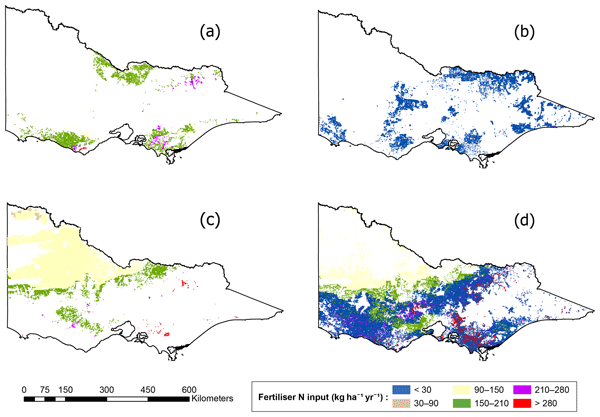
Excess nitrogen from agriculture can pollute streams and degrade water quality. We estimated fertiliser-nitrogen inputs across land uses, incorporated contributions from other sources, and compared these with long-term stream measurements. Only a small share of inputs left via rivers. Land use, rainfall, and flow regimes strongly influenced nitrogen dynamics and export. These findings support strategies to reduce stream pollution and protect water quality in agricultural areas.
Michelle Ho, Declan O'Shea, Conrad Wasko, Rory Nathan, and Ashish Sharma
Hydrol. Earth Syst. Sci., 29, 5851–5870, https://doi.org/10.5194/hess-29-5851-2025, https://doi.org/10.5194/hess-29-5851-2025, 2025
Short summary
Short summary
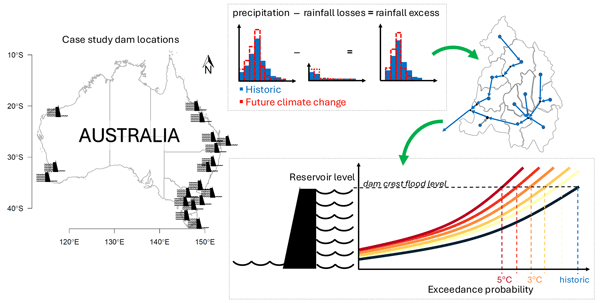
There is unequivocal evidence that climate change will impact the risk profile of dams, which are critical for water supply and flood mitigation. We project changes in the overtopping risk for 18 large dams in Australia in response to global warming. We consider the impacts of climate change on rainfall depth, rainfall temporal pattern, and rainfall losses. Under 4 °C of global warming, the risk of overtopping floods was 2.4–17 times that of historical conditions.
Conrad Wasko, Seth Westra, Rory Nathan, Acacia Pepler, Timothy H. Raupach, Andrew Dowdy, Fiona Johnson, Michelle Ho, Kathleen L. McInnes, Doerte Jakob, Jason Evans, Gabriele Villarini, and Hayley J. Fowler
Hydrol. Earth Syst. Sci., 28, 1251–1285, https://doi.org/10.5194/hess-28-1251-2024, https://doi.org/10.5194/hess-28-1251-2024, 2024
Short summary
Short summary
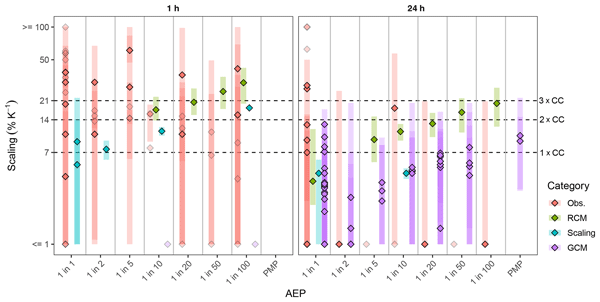
In response to flood risk, design flood estimation is a cornerstone of infrastructure design and emergency response planning, but design flood estimation guidance under climate change is still in its infancy. We perform the first published systematic review of the impact of climate change on design flood estimation and conduct a meta-analysis to provide quantitative estimates of possible future changes in extreme rainfall.
Keirnan Fowler, Murray Peel, Margarita Saft, Tim J. Peterson, Andrew Western, Lawrence Band, Cuan Petheram, Sandra Dharmadi, Kim Seong Tan, Lu Zhang, Patrick Lane, Anthony Kiem, Lucy Marshall, Anne Griebel, Belinda E. Medlyn, Dongryeol Ryu, Giancarlo Bonotto, Conrad Wasko, Anna Ukkola, Clare Stephens, Andrew Frost, Hansini Gardiya Weligamage, Patricia Saco, Hongxing Zheng, Francis Chiew, Edoardo Daly, Glen Walker, R. Willem Vervoort, Justin Hughes, Luca Trotter, Brad Neal, Ian Cartwright, and Rory Nathan
Hydrol. Earth Syst. Sci., 26, 6073–6120, https://doi.org/10.5194/hess-26-6073-2022, https://doi.org/10.5194/hess-26-6073-2022, 2022
Short summary
Short summary
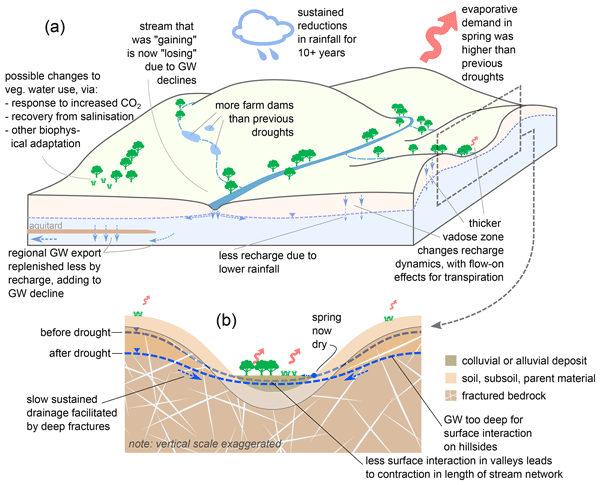
Recently, we have seen multi-year droughts tending to cause shifts in the relationship between rainfall and streamflow. In shifted catchments that have not recovered, an average rainfall year produces less streamflow today than it did pre-drought. We take a multi-disciplinary approach to understand why these shifts occur, focusing on Australia's over-10-year Millennium Drought. We evaluate multiple hypotheses against evidence, with particular focus on the key role of groundwater processes.
Danlu Guo, Camille Minaudo, Anna Lintern, Ulrike Bende-Michl, Shuci Liu, Kefeng Zhang, and Clément Duvert
Hydrol. Earth Syst. Sci., 26, 1–16, https://doi.org/10.5194/hess-26-1-2022, https://doi.org/10.5194/hess-26-1-2022, 2022
Short summary
Short summary
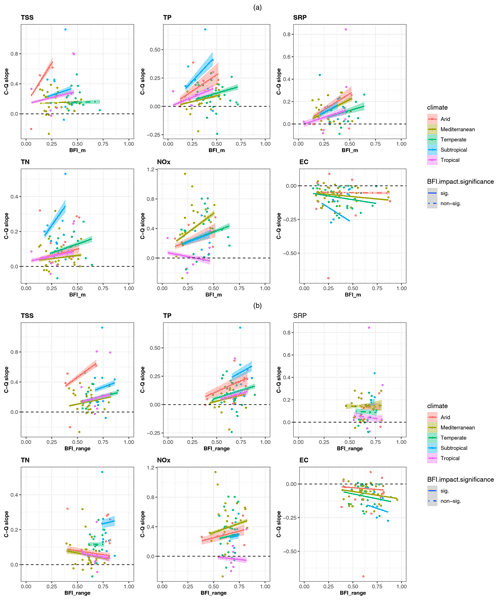
We investigate the impact of baseflow contribution on concentration–flow (C–Q) relationships across the Australian continent. We developed a novel Bayesian hierarchical model for six water quality variables across 157 catchments that span five climate zones. For sediments and nutrients, the C–Q slope is generally steeper for catchments with a higher median and a greater variability of baseflow contribution, highlighting the key role of variable flow pathways in particulate and solute export.
Cited articles
Amirthanathan, G. E., Bari, M. A., Woldemeskel, F. M., Tuteja, N. K., and Feikema, P. M.: Regional significance of historical trends and step changes in Australian streamflow, Hydrol. Earth Syst. Sci., 27, 229–254, https://doi.org/10.5194/hess-27-229-2023, 2023.
Ashcroft, L., Karoly, D. J., and Dowdy, A. J.: Historical extreme rainfall events in southeastern Australia, Weather and Climate Extremes, 25, 100210, https://doi.org/10.1016/j.wace.2019.100210, 2019.
Beven, K.: Towards a methodology for testing models as hypotheses in the inexact sciences, P. R. Soc. A, 475, 20180862, https://doi.org/10.1098/rspa.2018.0862, 2019.
Beven, K. J.: Rainfall-runoff modelling: the primer, John Wiley & Sons, https://doi.org/10.1002/9781119951001, 2012.
Breinl, K., Lun, D., Müller-Thomy, H., and Blöschl, G.: Understanding the relationship between rainfall and flood probabilities through combined intensity-duration-frequency analysis, J. Hydrol., 602, 126759, https://doi.org/10.1016/j.jhydrol.2021.126759, 2021.
Bureau of Meteorology: Hydrologic Reference Stations, http://www.bom.gov.au/water/hrs/ (last access: 8 September 2026), 2025a.
Bureau of Meteorology: Average annual and monthly evapotranspiration maps: http://www.bom.gov.au/climate/maps/averages/evapotranspiration/ (last access: 8 September 2026), 2025b.
Bureau of Meteorology: Australian Water Outlook: https://awo.bom.gov.au/products/historical/soilMoisture-rootZone/ (last access: 8 September 2026), 2025c.
Chen, L., Liu, C., Li, Y., and Wang, G.: Impacts of climatic factors on runoff coefficients in source regions of the Huanghe River, Chinese Geogr. Sci., 17, 047-055, https://doi.org/10.1007/s11769-007-0047-4, 2007.
Chen, X., Parajka, J., Széles, B., Valent, P., Viglione, A., and Blöschl, G.: Impact of climate and geology on event runoff characteristics at the regional scale, Water, 12, 3457, https://doi.org/10.3390/w12123457, 2020.
Douinot, A., Iffly, J. F., Tailliez, C., Meisch, C., and Pfister, L.: Flood patterns in a catchment with mixed bedrock geology and a hilly landscape: identification of flashy runoff contributions during storm events, Hydrol. Earth Syst. Sci., 26, 5185–5206, https://doi.org/10.5194/hess-26-5185-2022, 2022.
Duvert, C., Lim, H.-S., Irvine, D. J., Bird, M. I., Bass, A. M., Tweed, S. O., Hutley, L. B., and Munksgaard, N. C.: Hydrological processes in tropical Australia: Historical perspective and the need for a catchment observatory network to address future development, J. Hydrol.-Regional Studies, 43, 101194, https://doi.org/10.1016/j.ejrh.2022.101194, 2022.
Fischer, S. and Schumann, A. H.: Temporal changes in the frequency of flood types and their impact on flood statistics, J. Hydrol. X, 22, 100171, https://doi.org/10.1016/j.hydroa.2024.100171, 2024.
Fischer, S., Schumann, A., and Bühler, P.: A statistics-based automated flood event separation, J. Hydrol. X, 10, 100070, https://doi.org/10.1016/j.hydroa.2020.100070, 2021.
Gao, H., Pfister, L., and Kirchner, J. W.: Quantifying controls on rapid and delayed runoff response in double-peak hydrographs using ensemble rainfall-runoff analysis (ERRA), Hydrol. Earth Syst. Sci., 29, 6529–6547, https://doi.org/10.5194/hess-29-6529-2025, 2025.
Giani, G., Tarasova, L., Woods, R. A., and Rico‐Ramirez, M. A.: An objective time‐series‐analysis method for rainfall‐runoff event identification, Water Resour. Res., 58, e2021WR031283, https://doi.org/10.1029/2021WR031283, 2022.
Guo, D., Zheng, F., Gupta, H., and Maier, H. R.: On the Robustness of Conceptual Rainfall-Runoff Models to Calibration and Evaluation Data Set Splits Selection: A Large Sample Investigation, Water Resour. Res., 56, e2019WR026752, https://doi.org/10.1029/2019WR026752, 2020.
Ho, M., Nathan, R., Wasko, C., Vogel, E., and Sharma, A.: Projecting changes in flood event runoff coefficients under climate change, J. Hydrol., 615, 128689, https://doi.org/10.1016/j.jhydrol.2022.128689, 2022.
Hu, C., Ran, G., Li, G., Yu, Y., Wu, Q., Yan, D., and Jian, S.: The effects of rainfall characteristics and land use and cover change on runoff in the Yellow River basin, China, J. Hydrol. Hydromech., 69, 29–40, 2021.
Johnson, F., White, C. J., van Dijk, A., Ekstrom, M., Evans, J. P., Jakob, D., Kiem, A. S., Leonard, M., Rouillard, A., and Westra, S.: Natural hazards in Australia: floods, Climatic Change, 139, 21–35, https://doi.org/10.1007/s10584-016-1689-y, 2016.
Jones, D. A., Wang, W., and Fawcett, R.: High-quality spatial climate data-sets for Australia, Aust. Meteorol. Ocean., 58, 233–248, https://doi.org/10.22499/2.5804.003, 2009.
Kaur, S., Horne, A., Stewardson, M. J., Nathan, R., Costa, A. M., Szemis, J. M., and Webb, J. A.: Challenges for determining frequency of high flow spells for varying thresholds in environmental flows programmes, Journal of Ecohydraulics, 2, 28–37, https://doi.org/10.1080/24705357.2016.1276418, 2017.
Kemp, D. and Alankarage, G. H.: Benchmarking three event-based rainfall-runoff routing models on Australian catchments, Hydrology, 10, 131, https://doi.org/10.3390/hydrology10060131, 2023.
Kidron, G. J.: Comparing overland flow processes between semiarid and humid regions: Does saturation overland flow take place in semiarid regions?, J. Hydrol., 593, 125624, https://doi.org/10.1016/j.jhydrol.2020.125624, 2021.
Koskelo, A. I., Fisher, T. R., Utz, R. M., and Jordan, T. E.: A new precipitation-based method of baseflow separation and event identification for small watersheds (< 50 km2), J. Hydrol., 450, 267–278, 2012.
Ladson, A. R., Brown, R., Neal, B., and Nathan, R.: A Standard Approach to Baseflow Separation Using The Lyne and Hollick Filter, Australasian Journal of Water Resources, 17, 25–34, https://doi.org/10.7158/13241583.2013.11465417, 2013.
Leenman, A. S., Slater, L. J., Dadson, S. J., Wortmann, M., and Boothroyd, R.: Quantifying the Geomorphic Effect of Floods Using Satellite Observations of River Mobility, Geophys. Res. Lett., 50, e2023GL103875, https://doi.org/10.1029/2023GL103875, 2023.
Lyne, V. and Hollick, M.: Stochastic Time-Variable Rainfall-Runoff Modeling, Institute of Engineers Australia National Conference, https://www.researchgate.net/publication/272491803_Stochastic_Time-Variable_Rainfall-Runoff_Modeling (last access: 8 September 2026), 1979.
Mei, Y., Wang, D., Zhu, J., Tang, G., Cai, C., Shen, X., Hong, Y., and Zhang, X.: Optimal Baseflow Separation Through Chemical Mass Balance: Comparing the Usages of Two Tracers, Two Concentration Estimation Methods, and Four Baseflow Filters, Water Res. Res., 60, e2023WR036386, https://doi.org/10.1029/2023WR036386, 2024.
Merz, R. and Blöschl, G.: A regional analysis of event runoff coefficients with respect to climate and catchment characteristics in Austria, Water Resour. Res., 45, https://doi.org/10.1029/2008WR007163, 2009.
Merz, R., Blöschl, G., and Parajka, J.: Spatio-temporal variability of event runoff coefficients, J. Hydrol., 331, 591–604, https://doi.org/10.1016/j.jhydrol.2006.06.008, 2006.
Metcalfe, R. and Schmidt, B.: Streamflow Analysis and Assessment Software, Version 4.1, Ontario Ministry of Natural Resources and Forestry [code], Peterborough, ON, Canada, http://people.trentu.ca/rmetcalfe/SAAS.html (last access: 8 September 2026), 2016.
Miao, C., Zheng, H., Jiao, J., Feng, X., Duan, Q., and Mpofu, E.: The changing relationship between rainfall and surface runoff on the Loess Plateau, China, J. Geophys. Res.-Atmos., 125, e2019JD032053, https://doi.org/10.1029/2019JD032053, 2020.
Mirus, B. B. and Loague, K.: How runoff begins (and ends): Characterizing hydrologic response at the catchment scale, Water Resour. Res., 49, 2987–3006, https://doi.org/10.1002/wrcr.20218, 2013.
Mohammadpour Khoie, M. M., Guo, D., and Wasko, C.: Improving the consistency of hydrologic event identification, Environ. Modell. Softw., 191, 106521, https://doi.org/10.1016/j.envsoft.2025.106521, 2025.
Nathan, R., Jordan, P., Scorah, M., Lang, S., Kuczera, G., Schaefer, M., and Weinmann, E.: Estimating the exceedance probability of extreme rainfalls up to the probable maximum precipitation, J. Hydrol., 543, 706–720, https://doi.org/10.1016/j.jhydrol.2016.10.044, 2016.
Nathan, R. J. and McMahon, T. A.: Evaluation of automated techniques for base flow and recession analyses, Water Resour. Res., 26, 1465–1473, https://doi.org/10.1029/WR026i007p01465, 1990.
Nathan, R. J. and McMahon, T. A.: Recommended practice for hydrologic investigations and reporting, Australian Journal of Water Resources, 21, 3–19, https://doi.org/10.1080/13241583.2017.1362136, 2017.
Norbiato, D., Borga, M., Merz, R., Blöschl, G., and Carton, A.: Controls on event runoff coefficients in the eastern Italian Alps, J. Hydrol., 375, 312–325, https://doi.org/10.1016/j.jhydrol.2009.06.044, 2009.
Peterson, T. J., Wasko, C., Saft, M., and Peel, M. C.: AWAPer: An R package for area weighted catchment daily meteorological data anywhere within Australia, Hydrol. Process., 34, 1301–1306, https://doi.org/10.1002/hyp.13637, 2020.
Rahi, A., Rahmati, M., Dari, J., Saltalippi, C., Brogi, C., and Morbidelli, R.: Unraveling hydroclimatic forces controlling the runoff coefficient trends in central Italy's Upper Tiber Basin, J. Hydrol.: Regional Studies, 50, 101579, https://doi.org/10.1016/j.ejrh.2023.101579, 2023.
Schoener, G. and Stone, M. C.: Impact of antecedent soil moisture on runoff from a semiarid catchment, J. Hydrol., 569, 627–636, https://doi.org/10.1016/j.jhydrol.2018.12.025, 2019.
Sillanpää, N. and Koivusalo, H.: Impacts of urban development on runoff event characteristics and unit hydrographs across warm and cold seasons in high latitudes, J. Hydrol., 521, 328–340, https://doi.org/10.1016/j.jhydrol.2014.12.008, 2015.
Song, S. and Wang, W.: Impacts of antecedent soil moisture on the rainfall-runoff transformation process based on high-resolution observations in soil tank experiments, Water, 11, 296, https://doi.org/10.3390/w11020296, 2019.
Sriwongsitanon, N. and Taesombat, W.: Effects of land cover on runoff coefficient, J. Hydrol., 410, 226–238, https://doi.org/10.1016/j.jhydrol.2011.09.021, 2011.
Stern, H., De Hoedt, G., and Ernst, J.: Objective classification of Australian climates, Aust. Meteorol. Mag., 49, 87–96, 2000.
Tang, W. G. and Carey, S. K.: HydRun: A MATLAB toolbox for rainfall-runoff analysis, Hydrol. Process., 31, 2670–2682, https://doi.org/10.1002/hyp.11185, 2017.
Tarasova, L., Basso, S., Poncelet, C., and Merz, R.: Exploring Controls on Rainfall-Runoff Events: 2. Regional Patterns and Spatial Controls of Event Characteristics in Germany, Water Resour. Res., 54, 7688–7710, https://doi.org/10.1029/2018WR022588, 2018a.
Tarasova, L., Basso, S., Zink, M., and Merz, R.: Exploring Controls on Rainfall-Runoff Events: 1. Time Series-Based Event Separation and Temporal Dynamics of Event Runoff Response in Germany, Water Resour. Res., 54, 7711–7732, https://doi.org/10.1029/2018WR022587, 2018b.
Tarasova, L., Basso, S., and Merz, R.: Transformation of generation processes from small runoff events to large floods, Geophys. Res. Lett., 47, e2020GL090547, https://doi.org/10.1029/2020GL090547, 2020.
Trancoso, R., Larsen, J. R., McAlpine, C., McVicar, T. R., and Phinn, S.: Linking the Budyko framework and the Dunne diagram, J. Hydrol., 535, 581–597, https://doi.org/10.1016/j.jhydrol.2016.02.017, 2016.
Voloh, B., Watson, M. R., König, S., and Womelsdorf, T.: MAD saccade: Statistically robust saccade threshold estimation via the median absolute deviation, Journal of Eye Movement Research, 12, https://doi.org/10.16910/jemr.12.8.3, 2020.
Wang, S., Zhang, Z., McVicar, T. R., Zhang, J., Zhu, J., and Guo, J.: An event-based approach to understanding the hydrological impacts of different land uses in semi-arid catchments, J. Hydrol., 416–417, 50–59, https://doi.org/10.1016/j.jhydrol.2011.11.035, 2012.
Wasko, C. and Guo, D.: Understanding event runoff coefficient variability across Australia using the hydroEvents R package, Hydrol. Process., 36, e14563, https://doi.org/10.1002/hyp.14563, 2022.
Wasko, C., Guo, D., Ho, M., Nathan, R., and Vogel, E.: Diverging projections for flood and rainfall frequency curves, J. Hydrol., 620, 129403, https://doi.org/10.1016/j.jhydrol.2023.129403, 2023.
Wu, Q., Xie, T., Liu, C., Li, W., Zhang, L., Ran, G., Xu, Y., Tang, Y., Han, Z., and Hu, C.: Improving the understanding of rainfall-runoff processes: Temporal dynamic of event runoff response in Loess Plateau, China, J. Environ. Manage., 375, 123436, https://doi.org/10.1016/j.jenvman.2024.123436, 2025.
Zaman, M. A., Rahman, A., and Haddad, K.: Regional flood frequency analysis in arid regions: A case study for Australia, J. Hydrol., 475, 74–83, https://doi.org/10.1016/j.jhydrol.2012.08.054, 2012.
Zhang, X., Alexander, L., Hegerl, G. C., Jones, P., Tank, A. K., Peterson, T. C., Trewin, B., and Zwiers, F. W.: Indices for monitoring changes in extremes based on daily temperature and precipitation data, WIREs Clim. Change, 2, 851–870, https://doi.org/10.1002/wcc.147, 2011.
Short summary
Rainfall-runoff event identification can be highly affected by parameter-driven uncertainty and event definitions that do not always reflect hydrological processes. We introduce RVEIM, a parsimonious method for event identification that improves both robustness and physical plausibility. Applied across 467 Australian catchments, RVEIM reveals systematic shifts in event runoff coefficient distribution, demonstrating how event-scale rainfall-runoff relationships vary with climate regime.
Rainfall-runoff event identification can be highly affected by parameter-driven uncertainty and...