
Articles | Volume 30, issue 3
https://doi.org/10.5194/hess-30-591-2026
© Author(s) 2026. This work is distributed under
the Creative Commons Attribution 4.0 License.
the Creative Commons Attribution 4.0 License.
https://doi.org/10.5194/hess-30-591-2026
© Author(s) 2026. This work is distributed under
the Creative Commons Attribution 4.0 License.
the Creative Commons Attribution 4.0 License.
Research article
| 
03 Feb 2026
Research article |
| 03 Feb 2026
| 03 Feb 2026
An original approach combining biogeochemical signatures and a mixing model to discriminate spatial runoff-generating sources in a peri-urban catchment
Olivier Grandjouan
CORRESPONDING AUTHOR

INRAE, UR Riverly, 5 rue de la Doua, 69625, Villeurbanne, France
present address: INSA Lyon, DEEP, UR7429, 69621 Villeurbanne, France
Flora Branger
INRAE, UR Riverly, 5 rue de la Doua, 69625, Villeurbanne, France
Matthieu Masson
INRAE, UR Riverly, 5 rue de la Doua, 69625, Villeurbanne, France
Benoit Cournoyer
Univ Lyon, UMR Ecologie Microbienne (LEM), Université Claude Bernard Lyon 1, VetAgro Sup, France
Nicolas Robinet
UMR CNRS 5194 Pacte, Université Grenoble Alpes, Cermosem, 1064 chemin du Pradel, 07170 Mirabel, France
Pauline Dusseux
Institut d'Urbanisation et de Géographie Alpine, Université Grenoble-Alpes, CNRS, PACTE, 38100, Grenoble, France
Angélique Dominguez Lage
Univ Lyon, UMR Ecologie Microbienne (LEM), Université Claude Bernard Lyon 1, VetAgro Sup, France
Marina Coquery
INRAE, UR Riverly, 5 rue de la Doua, 69625, Villeurbanne, France
Related authors
No articles found.
Olivier Champagne, Flora Branger, Anthony Lemoine, Jordi Bolibar, Louise Mimeau, Gilles Delaygue, Isabelle Gouttevin, Sophie Cauvy-Fraunié, and Thomas Condom
EGUsphere, https://doi.org/10.5194/egusphere-2026-3523, https://doi.org/10.5194/egusphere-2026-3523, 2026
This preprint is open for discussion and under review for Hydrology and Earth System Sciences (HESS).
Short summary
Short summary
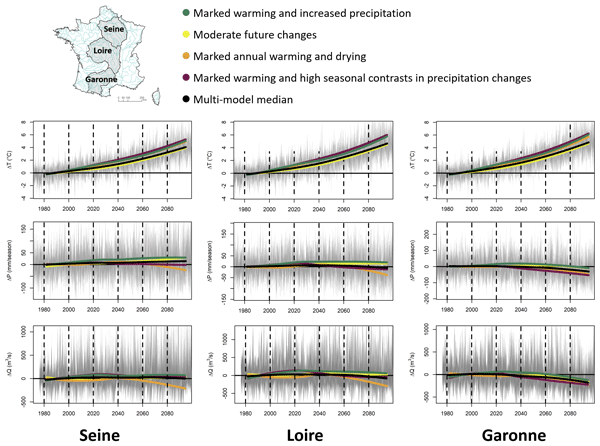
This study using a hydrological model shows the projections of icemelt contribution to streamflow until the end of the century in many rivers in the Rhône basin. The results show a streamflow decrease in summer, due to the decrease of precipitations, snowmelt, and glacier melt. In many catchments, icemelt will completely disappear by the end of the century. In the Arve and highly glaciated catchments of the upper Rhône, icemelt will remains sufficiently large to sustain streamflow in summer.
Eric Sauquet, Guillaume Evin, Sonia Siauve, Ryma Aissat, Patrick Arnaud, Maud Bérel, Jérémie Bonneau, Flora Branger, Yvan Caballero, François Colléoni, Agnès Ducharne, Joël Gailhard, Florence Habets, Frédéric Hendrickx, Louis Héraut, Benoît Hingray, Peng Huang, Tristan Jaouen, Alexis Jeantet, Sandra Lanini, Matthieu Le Lay, Claire Magand, Louise Mimeau, Céline Monteil, Simon Munier, Charles Perrin, Olivier Robelin, Fabienne Rousset, Jean-Michel Soubeyroux, Laurent Strohmenger, Guillaume Thirel, Flore Tocquer, Yves Tramblay, Jean-Pierre Vergnes, and Jean-Philippe Vidal
Hydrol. Earth Syst. Sci., 30, 2277–2300, https://doi.org/10.5194/hess-30-2277-2026, https://doi.org/10.5194/hess-30-2277-2026, 2026
Short summary
Short summary
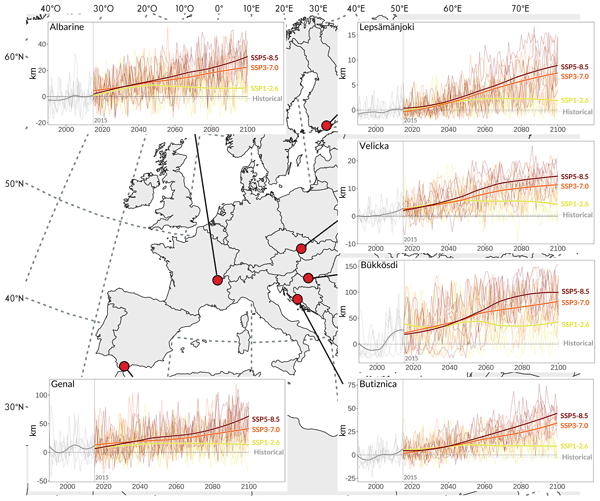
The Explore2 project has provided an unprecedented set of hydrological projections in terms of the number of hydrological models used and the spatial and temporal resolution. The results have been made available through various media. Under the high-emission scenario, the hydrological models mostly agree on the decrease in seasonal flows in the south of France, confirming its hotspot status, and on the decrease in summer flows throughout France, with the exception of the northern part of France.
Louise Mimeau, Annika Künne, Alexandre Devers, Flora Branger, Sven Kralisch, Claire Lauvernet, Jean-Philippe Vidal, Núria Bonada, Zoltán Csabai, Heikki Mykrä, Petr Pařil, Luka Polović, and Thibault Datry
Hydrol. Earth Syst. Sci., 29, 1615–1636, https://doi.org/10.5194/hess-29-1615-2025, https://doi.org/10.5194/hess-29-1615-2025, 2025
Short summary
Short summary
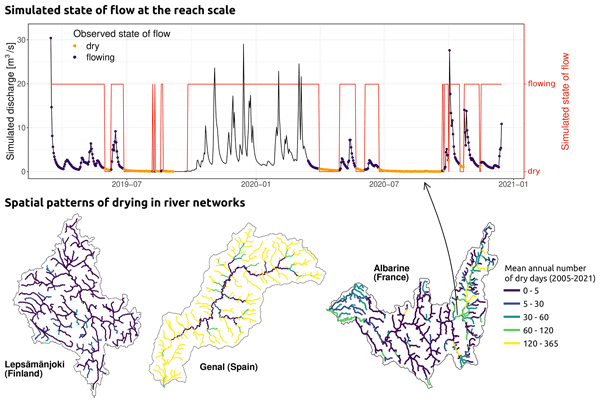
Our study projects how climate change will affect the drying of river segments and stream networks in Europe, using advanced modelling techniques to assess changes in six river networks across diverse ecoregions. We found that drying events will become more frequent and intense and will start earlier or last longer, potentially turning some river sections from perennial to intermittent. The results are valuable for river ecologists for evaluating the ecological health of river ecosystem.
Louise Mimeau, Annika Künne, Flora Branger, Sven Kralisch, Alexandre Devers, and Jean-Philippe Vidal
Hydrol. Earth Syst. Sci., 28, 851–871, https://doi.org/10.5194/hess-28-851-2024, https://doi.org/10.5194/hess-28-851-2024, 2024
Short summary
Short summary
Modelling flow intermittence is essential for predicting the future evolution of drying in river networks and better understanding the ecological and socio-economic impacts. However, modelling flow intermittence is challenging, and observed data on temporary rivers are scarce. This study presents a new modelling approach for predicting flow intermittence in river networks and shows that combining different sources of observed data reduces the model uncertainty.
Samuel Morin, Hugues François, Marion Réveillet, Eric Sauquet, Louise Crochemore, Flora Branger, Étienne Leblois, and Marie Dumont
Hydrol. Earth Syst. Sci., 27, 4257–4277, https://doi.org/10.5194/hess-27-4257-2023, https://doi.org/10.5194/hess-27-4257-2023, 2023
Short summary
Short summary
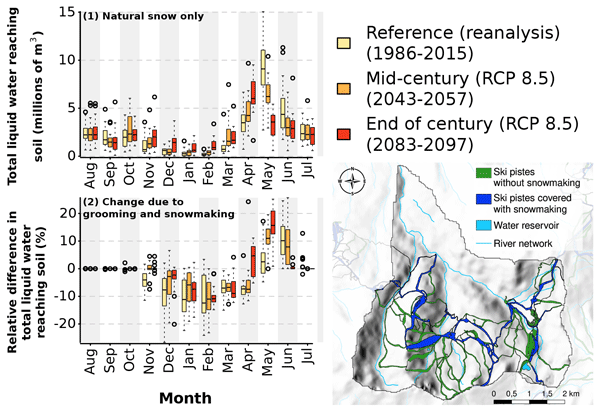
Ski resorts are a key socio-economic asset of several mountain areas. Grooming and snowmaking are routinely used to manage the snow cover on ski pistes, but despite vivid debate, little is known about their impact on water resources downstream. This study quantifies, for the pilot ski resort La Plagne in the French Alps, the impact of grooming and snowmaking on downstream river flow. Hydrological impacts are mostly apparent at the seasonal scale and rather neutral on the annual scale.
Laurent Strohmenger, Eric Sauquet, Claire Bernard, Jérémie Bonneau, Flora Branger, Amélie Bresson, Pierre Brigode, Rémy Buzier, Olivier Delaigue, Alexandre Devers, Guillaume Evin, Maïté Fournier, Shu-Chen Hsu, Sandra Lanini, Alban de Lavenne, Thibault Lemaitre-Basset, Claire Magand, Guilherme Mendoza Guimarães, Max Mentha, Simon Munier, Charles Perrin, Tristan Podechard, Léo Rouchy, Malak Sadki, Myriam Soutif-Bellenger, François Tilmant, Yves Tramblay, Anne-Lise Véron, Jean-Philippe Vidal, and Guillaume Thirel
Hydrol. Earth Syst. Sci., 27, 3375–3391, https://doi.org/10.5194/hess-27-3375-2023, https://doi.org/10.5194/hess-27-3375-2023, 2023
Short summary
Short summary
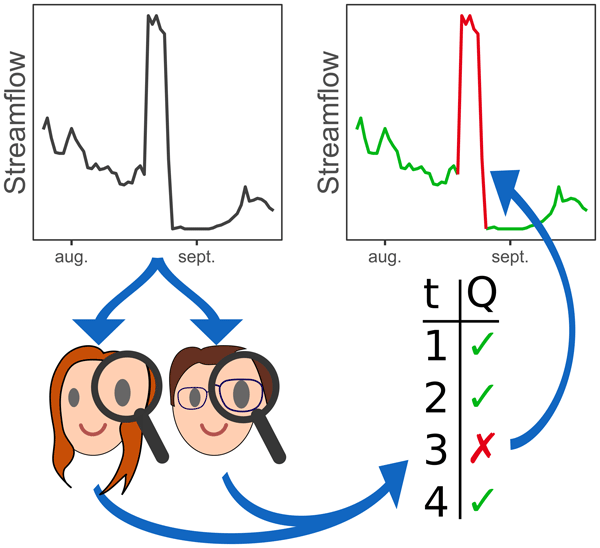
We present the results of a large visual inspection campaign of 674 streamflow time series in France. The objective was to detect non-natural records resulting from instrument failure or anthropogenic influences, such as hydroelectric power generation or reservoir management. We conclude that the identification of flaws in flow time series is highly dependent on the objectives and skills of individual evaluators, and we raise the need for better practices for data cleaning.
Hugo Lepage, Alexandra Gruat, Fabien Thollet, Jérôme Le Coz, Marina Coquery, Matthieu Masson, Aymeric Dabrin, Olivier Radakovitch, Jérôme Labille, Jean-Paul Ambrosi, Doriane Delanghe, and Patrick Raimbault
Earth Syst. Sci. Data, 14, 2369–2384, https://doi.org/10.5194/essd-14-2369-2022, https://doi.org/10.5194/essd-14-2369-2022, 2022
Short summary
Short summary
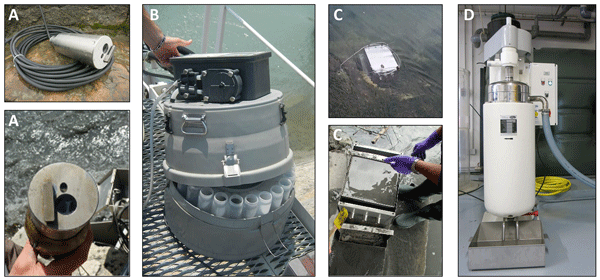
The dataset contains concentrations and fluxes of suspended particle matter (SPM) and several particle-bound contaminants along the Rhône River downstream of Lake Geneva. These data allow us to understand the dynamics and origins. They show the impact of flood events which mainly contribute to a decrease in the contaminant concentrations while fluxes are significant. On the contrary, concentrations are higher during low flow periods probably due to the increase of organic matter.
Cited articles
AFNOR: Standard method NF ISO 11352. Water Quality – Estimation of measurement uncertainty based on validation and quality control data, https://www.boutique.afnor.org/en-gb/standard/nf-iso-11352/water-quality-estimation-of-measurement-uncertainty-based-on-validation-and/fa210567/451490 (last access: 12 May 2025), 2013.
AFNOR: Standard method NF T90-210. Water quality – Protocol for the intial method performance assesment in a laboratory, https://www.boutique.afnor.org/en-gb/standard/nf-t90210/water-quality-protocol-for-the-intial-method-performance-assesment-in-a-lab/fa190833/81632 (last access: 12 May 2025), 2018.
Aussel, H., Bâcle, C. L., and Dornier, G.: Le traitement des eaux usées, INRS, https://www.esst-inrs.fr/3rb/ressources/ed5026.pdf (last access: 18 June 2025), 2004.
Barthold, F. K., Wu, J., Vaché, K. B., Schneider, K., Frede, H.-G., and Breuer, L.: Identification of geographic runoff sources in a data sparse region: hydrological processes and the limitations of tracer-based approaches, Hydrological Processes, 24, 2313–2327, https://doi.org/10.1002/hyp.7678, 2010.
Becouze-Lareure, C.: Caractérisation et estimation des flux de substances prioritaires dans les rejets urbains par temps de pluie sur deux bassins versants expérimentaux, PhD thesis, Lyon, INSA, http://www.theses.fr/2010ISAL0089 (last access: 9 November 2025), 2010.
Begum, M. S., Park, H.-Y., Shin, H.-S., Lee, B.-J., and Hur, J.: Separately tracking the sources of hydrophobic and hydrophilic dissolved organic matter during a storm event in an agricultural watershed, Science of The Total Environment, 873, 162347, https://doi.org/10.1016/j.scitotenv.2023.162347, 2023.
Benjamin, M. M.: Water Chemistry, 2nd edn., Waveland Press, ISBN 1-4786-2308-X, 2014.
Bétemps, M.: Diagnostic de l'occupation du sol et de l'utilisation des produits chimiques sur le bassin versant de l'Yzeron (Rhône): utilisation combinée d'enquêtes et de données cartographiques pour identifier les sources de contaminants et leur localisation, Master thesis, Université Grenobles Alpes, Laboratoire IGE Cermosem, https://hal.inrae.fr/hal-05165926v1 (last access: 9 November 2025), 2021.
Beven, K.: Rainfall-runoff modelling: the primer, 2nd edn., John Wiley & Sons, Ltd, https://doi.org/10.1002/9781119951001, 2012.
Birkel, C. and Soulsby, C.: Advancing tracer-aided rainfall-runoff modelling: A review of progress, problems and unrealised potential, Hydrological Processes, 29, 5227–5240, https://doi.org/10.1002/hyp.10594, 2015.
Birkinshaw, S. J., O'Donnell, G., Glenis, V., and Kilsby, C.: Improved hydrological modelling of urban catchments using runoff coefficients, Journal of Hydrology, 594, 125884, https://doi.org/10.1016/j.jhydrol.2020.125884, 2021.
Bomboï, M. T. and Hernandez, A.: Hydrocarbons in urban runoff: their contribution to thewastewaters, Water Research, 25, 557–565, 1991.
Bouchali, R., Mandon, C., Danty-Berger, E., Géloën, A., Marjolet, L., Youenou, B., Pozzi, A. C. M., Vareilles, S., Galia, W., Kouyi, G. L., Toussaint, J.-Y., and Cournoyer, B.: Runoff microbiome quality assessment of a city center rainwater harvesting zone shows a differentiation of pathogen loads according to human mobility patterns, International Journal of Hygiene and Environmental Health, 260, 114391, https://doi.org/10.1016/j.ijheh.2024.114391, 2024.
Boukra, A., Masson, M., Brosse, C., Sourzac, M., Parlanti, E., and Miège, C.: Sampling terrigenous diffuse sources in watercourse: Influence of land use and hydrological conditions on dissolved organic matter characteristics, Science of The Total Environment, 872, 162104, https://doi.org/10.1016/j.scitotenv.2023.162104, 2023.
Braud, I., Branger, F., Chancibault, K., Jacqueminet, C., Breil, P., Chocat, B., Debionne, S., Dodane, C., Honegger, A., Joliveau, T., Kermadi, S., Leblois, E., Lipeme Kouyi, G., Michel, K., Mosini, M. L., Renard, F., Rodriguez, F., Sarrazin, B., Schmitt, L., Andrieu, H., Bocher, E., Comby, J., and Viallet, P.: Assessing the vulnerability of PeriUrban rivers, Rapport scientifique final du projet AVuPUR (ANR-07-VULN-01), Irstea, https://hal.inrae.fr/hal-02596619v1 (last access: 5 October 2025), 2011.
Braud, I., Breil, P., and Lagouy, M.: Surveillance, prévision des crues et inondations dans le bassin de l'Yzeron: Etude de définition d'un système d'interprétation des relations entre la saturation des sols, les précipitations et les débits, Irstea, https://hal.inrae.fr/hal-02608293v1 (last access: 9 January 2026), 2018.
Bruijnzeel, L. A.: Hydrological functions of tropical forests: not seeing the soil for the trees?, Agriculture, Ecosystems & Environment, 104, 185–228, https://doi.org/10.1016/j.agee.2004.01.015, 2004.
Burns, D. A., McDonnell, J., Hooper, R. P., Peters, N. E., Freer, J. E., Kendall, C., and Beven, K.: Quantifying contributions to storm runoff through end-member mixing analysis and hydrologic measurements at the Panola Mountain research watershed (Georgia, USA), Hydrological Processes, 15, 1903–1924, https://doi.org/10.1002/hyp.246, 2001.
Nascimento, R. C., Jamil Maia, A., Jacques Agra Bezerra da Silva, Y., Farias Amorim, F., Williams Araújo do Nascimento, C., Tiecher, T., Evrard, O., Collins, A. L., Miranda Biondi, C., and Jacques Agra Bezerra da Silva, Y.: Sediment source apportionment using geochemical composite signatures in a large and polluted river system with a semiarid-coastal interface, Brazil, Catena, 220, 106710, https://doi.org/10.1016/j.catena.2022.106710, 2023.
Charters, F. J., Cochrane, T. A., and O'Sullivan, A. D.: Untreated runoff quality from roof and road surfaces in a low intensity rainfall climate, Science of The Total Environment, 550, 265–272, https://doi.org/10.1016/j.scitotenv.2016.01.093, 2016.
Chocat, B., Krebs, P., Marsalek, J., Rauch, W., and Schilling, W.: Urban drainage redefined: from stormwater removal to integrated management, Water Science and Technology, 43, 61–68, https://doi.org/10.2166/wst.2001.0251, 2001.
Christophersen, N. and Hooper, R. P.: Multivariate analysis of stream water chemical data: The use of principal components analysis for the end-member mixing problem, Water Resources Research, 28, 99–107, https://doi.org/10.1029/91WR02518, 1992.
Christophersen, N., Neal, C., Hooper, R., Vogt, R., and Andersen, S.: Modeling streamwater chemistry as a mixture of soil water end-members – a step towards second generation acidification models, Journal of Hydrology, 116, 307–320, https://doi.org/10.1016/0022-1694(90)90130-P, 1990.
Colin, Y., Bouchali, R., Marjolet, L., Marti, R., Vautrin, F., Voisin, J., Bourgeois, E., Rodriguez-Nava, V., Blaha, D., Winiarski, T., Mermillod-Blondin, F., and Cournoyer, B.: Coalescence of bacterial groups originating from urban runoffs and artificial infiltration systems among aquifer microbiomes, Hydrol. Earth Syst. Sci., 24, 4257–4273, https://doi.org/10.5194/hess-24-4257-2020, 2020.
Collins, A. L., Walling, D. E., and Leeks, G. J. L.: Use of the geochemical record preserved in floodplain deposits to reconstruct recent changes in river basin sediment sources, Geomorphology, 19, 151–167, https://doi.org/10.1016/S0169-555X(96)00044-X, 1997.
Collins, A. L., Pulley, S., Foster, I. D. L., Gellis, A., Porto, P., and Horowitz, A. J.: Sediment source fingerprinting as an aid to catchment management: A review of the current state of knowledge and a methodological decision-tree for end-users, Journal of Environmental Management, 194, 86–108, https://doi.org/10.1016/j.jenvman.2016.09.075, 2017.
Cooper, D. M., Jenkins, A., Skeffington, R., and Gannon, B.: Catchment-scale simulation of stream water chemistry by spatial mixing: Theory and application, Journal of Hydrology, 233, 121–137, https://doi.org/10.1016/S0022-1694(00)00230-4, 2000.
Coquery, M., Pomies, M., Martin Ruel, S., Budzinski, H., Miege, C., Esperanza, M., Soulier, C., and Choubert, J. M.: Mesurer les micropolluants dans les eaux usées brutes et traitées. Protocoles et résultats pour l'analyse des concentrations et des flux, Techniques Sciences Méthodes, 1–2, 25–43, 2011.
Cristiano, E., ten Veldhuis, M.-C., and van de Giesen, N.: Spatial and temporal variability of rainfall and their effects on hydrological response in urban areas – a review, Hydrol. Earth Syst. Sci., 21, 3859–3878, https://doi.org/10.5194/hess-21-3859-2017, 2017.
David, L., Elmi, S., and Féraud, J.: Carte géologique de la france au 1/50 000 – Lyon, Feuille XXX-31, BRGM, Service Géologique National, 41, http://ficheinfoterre.brgm.fr/Notices/0698N.pdf (last access: 6 June 2025), 1979.
Deletic, A. and Orr, D. W.: Pollution buildup on road surfaces, Journal of Environmental Engineering, 131, 49–59, https://doi.org/10.1061/(ASCE)0733-9372(2005)131:1(49), 2005.
Delfour, J., Dufour, E., Feybesse, J. I., Johan, V., Kerrien, Y., Lardeaux, J. M., Lemière, B., Mouterde, R., and Tegyey, M.: Notice explicative, carte géol. France (1/50 000), feuille tarare (697), Bureau de recherches géologiques et minières, Orléans, 120, http://ficheinfoterre.brgm.fr/Notices/0697N.pdf (last access: 6 June 2025), 1989.
Dubois, V., Falipou, E., and Boutin, C.: Quantification and qualification of the urban domestic pollution discharged per household and per resident, Water Sci. Technol., 85, 1484–1499, https://doi.org/10.2166/wst.2022.064, 2022.
Dunn, O. J.: Multiple comparisons using rank sums, Technometrics, 6, 241–252, https://doi.org/10.2307/1266041, 1964.
El Azzi, D., Probst, J. L., Teisserenc, R., Merlina, G., Baqué, D., Julien, F., Payre-Suc, V., and Guiresse, M.: Trace element and pesticide dynamics during a flood event in the save agricultural watershed: soil-river transfer pathways and controlling factors, Water, Air, and Soil Pollution, 227, https://doi.org/10.1007/s11270-016-3144-0, 2016.
Eme, C. and Boutin, C.: Composition des eaux usées domestiques par source d'émission à l'échelle de l'habitation, Etude bibliographique, Irstea, https://hal.inrae.fr/hal-02605815v1 (last access: 5 October 2025), 2015.
Emmanuel, I., Andrieu, H., Flahaut, B., and Furusho, C.: Influence of rainfall spatial variability on rainfall runoff modelling: case study on a peri-urban catchment, ERAD: The seventh European Conference on Radar in Meteorology and Hydrology, https://hal.science/hal-00877003v1 (last access: 9 November 2025), 2012.
Fines, R. W., Stone, M., Webster, K. L., Leach, J. A., Buttle, J. M., Emelko, M. B., and Collins, A. L.: Evaluation of Legacy Forest Harvesting Impacts on Dominant Stream Water Sources and Implications for Water Quality Using End Member Mixing Analysis, Water, 15, https://doi.org/10.3390/w15152825, 2023.
Froger, C., Quantin, C., Bordier, L., Monvoisin, G., Evrard, O., and Ayrault, S.: Quantification of spatial and temporal variations in trace element fluxes originating from urban areas at the catchment scale, Journal of Soils and Sediments, 20, 4055–4069, https://doi.org/10.1007/s11368-020-02766-1, 2020.
Fröhlich, H. L., Breuer, L., Frede, H.-G., Huisman, J. A., and Vaché, K. B.: Water source characterization through spatiotemporal patterns of major, minor and trace element stream concentrations in a complex, mesoscale German catchment, Hydrological Processes, 22, 2028–2043, https://doi.org/10.1002/hyp.6804, 2008a.
Fröhlich, H. L., Breuer, L., Vaché, K. B., and Frede, H.-G.: Inferring the effect of catchment complexity on mesoscale hydrologic response, Water Resources Research, 44, https://doi.org/10.1029/2007WR006207, 2008b.
Giri, S. and Qiu, Z.: Understanding the relationship of land uses and water quality in Twenty First Century: A review, Journal of Environmental Management, 173, 41–48, https://doi.org/10.1016/j.jenvman.2016.02.029, 2016.
Gnouma, R.: Aide à la calibration d'un modèle hydrologique distribué au moyen d'une analyse des processus hydrologiques: application au bassin versant de l'Yzeron, PhD thesis, INSA Lyon, https://hal.inrae.fr/tel-02588466v1 (last access: 19 January 2026), 2006.
Gonzales, A. L., Nonner, J., Heijkers, J., and Uhlenbrook, S.: Comparison of different base flow separation methods in a lowland catchment, Hydrol. Earth Syst. Sci., 13, 2055–2068, https://doi.org/10.5194/hess-13-2055-2009, 2009.
Grandjouan, O.: Apports de la biogéochimie pour l'évaluation d'un modèle hydrologique distribué en milieu péri-urbain, PhD thesis, INRAE, https://hal.science/hal-04187479v1 (last access: 19 January 2025), 2024.
Grandjouan, O., Branger, F., Masson, M., Cournoyer, B., and Coquery, M.: Identification and estimation of hydrological contributions in a mixed land-use catchment based on a simple biogeochemical and hydro-meteorological dataset, Hydrological Processes, 37, e15035, https://doi.org/10.1002/hyp.15035, 2023.
Helms, J. R., Stubbins, A., Ritchie, J. D., Minor, E. C., Kieber, D. J., and Mopper, K.: Absorption spectral slopes and slope ratios as indicators of molecular weight, source, and photobleaching of chromophoric dissolved organic matter, Limnology and Oceanography, 53, 955–969, https://doi.org/10.4319/lo.2008.53.3.0955, 2008.
Iorgulescu, I., Beven, K. J., and Musy, A.: Data-based modelling of runoff and chemical tracer concentrations in the Haute-Mentue research catchment (Switzerland), Hydrological Processes, 19, 2557–2573, https://doi.org/10.1002/hyp.5731, 2005.
Jacqueminet, C., Kermadi, S., Michel, K., Béal, D., Gagnage, M., Branger, F., Jankowfsky, S., and Braud, I.: Land cover mapping using aerial and VHR satellite images for distributed hydrological modelling of periurban catchments: Application to the Yzeron catchment (Lyon, France), Journal of Hydrology, 485, 68–83, https://doi.org/10.1016/j.jhydrol.2013.01.028, 2013.
James, R., Amasi, A. I., Wynants, M., Nobert, J., Mtei, K. M., and Njau, K.: Tracing the dominant sources of sediment flowing towards Lake Victoria using geochemical tracers and a Bayesian mixing model, J. Soils Sediments, 23, 1568–1580, https://doi.org/10.1007/s11368-023-03440-y, 2023.
Jankowfsky, S.: Understanding and modelling of hydrological processes in small peri-urban catchments using an object-oriented and modular distributed approach Application to the Chaudanne and Mercier sub-catchments (Yzeron catchment, France), PhD thesis, Thèse de doctorat, spécialité Océan, Atmosphère, Hydrologie, Ecole Doctorale Terre Univers Environnement, Université de Grenoble, https://theses.hal.science/tel-00721988v1 (last access: 9 November 2025), 2011.
Kaown, D., Koh, D.-C., Mayer, B., Mahlknecht, J., Ju, Y., Rhee, S.-K., Kim, J.-H., Park, D. K., Park, I., Lee, H.-L., Yoon, Y.-Y., and Lee, K.-K.: Estimation of nutrient sources and fate in groundwater near a large weir-regulated river using multiple isotopes and microbial signatures, Journal of Hazardous Materials, 446, 130703, https://doi.org/10.1016/j.jhazmat.2022.130703, 2023.
Kermadi, S., Braud, I., Jacqueminet, C., Branger, F., Renard, F., and Michel, K.: Quels liens entre climatologie, occupation des sols et inondations dans le bassin versant de l'Yzeron (ouest Lyonnais)? Apport de l'analyse conjointe de données hydroclimatiques et d'images satellitaires très haute résolution, Climatologie, 9, 83, https://hal.science/hal-00865546v1 (last access: 15 November 2025), 2012.
Klages, M. G. and Hsieh, Y. P.: Suspended Solids Carried by the Gallatin River of Southwestern Montana: II. Using Mineralogy for Inferring Sources, Journal of Environmental Quality, 4, 68–73, https://doi.org/10.2134/jeq1975.00472425000400010016x, 1975.
Kruskal, W. H. and Wallis, W. A.: Use of ranks in one-criterion variance analysis, Journal of the American Statistical Association, 47, 583–621, https://doi.org/10.2307/2280779, 1952.
Kuhlemann, L.-M., Tetzlaff, D., and Soulsby, C.: Spatio-temporal variations in stable isotopes in peri-urban catchments: A preliminary assessment of potential and challenges in assessing streamflow sources, Journal of Hydrology, 600, 126685, https://doi.org/10.1016/j.jhydrol.2021.126685, 2021.
Kumar, N., Ganguly, A., Biswal, K., Keesari, T., Pandey, A., and Deshpande, R. D.: Relative contribution from different water sources to supraglacial runoff in western Himalaya, Journal of Hydrology, 635, 131137, https://doi.org/10.1016/j.jhydrol.2024.131137, 2024.
Labbas, M.: Modélisation hydrologique de bassins versants périurbains et influence de l'occupation du sol et de la gestion des eaux pluviales. Application au bassin de l'Yzeron (130 km2), PhD thesis, Université Grenoble Alpes, https://theses.hal.science/tel-02601677v2 (last access: 19 January 2026), 2014.
Lachassagne, P., Dewandel, B., and Wyns, R.: Review: Hydrogeology of weathered crystalline/hard-rock aquifers – guidelines for the operational survey and management of their groundwater resources, Hydrogeol. J., 29, 2561–2594, https://doi.org/10.1007/s10040-021-02339-7, 2021.
Ladouche, B., Probst, A., Viville, D., Idir, S., Baqué, D., Loubet, M., Probst, J.-L., and Bariac, T.: Hydrograph separation using isotopic, chemical and hydrological approaches (Strengbach catchment, France), Journal of Hydrology, 242, 255–274, https://doi.org/10.1016/S0022-1694(00)00391-7, 2001.
Lafont, M., Vivier, A., Nogueira, S., Namour, P., and Breil, P.: Surface and hyporheic oligochaete assemblages in a french suburban stream, Hydrobiologia, 564, 183–193, https://doi.org/10.1007/s10750-005-1718-8, 2006.
Lagouy, M., Branger, F., Thollet, F., Breil, P., and Dramais, G.: Suivi hydrologique du bassin versant périurbain de l'Yzeron, Irstea, https://doi.org/10.17180/obs.yzeron, 2015.
Lagouy, M., Branger, F., and Breil, P.: Rainfall monitoring on the Yzeron catchment since 1997, https://doi.org/10.57745/VVQ2X9, 2022.
Lamprea, K. and Ruban, V.: Pollutant concentrations and fluxes in both stormwater and wastewater at the outlet of two urban watersheds in Nantes (France), Urban Water Journal, 8, 219–231, https://doi.org/10.1080/1573062X.2011.596211, 2011.
Langlois, J. L. and Mehuys, G. R.: Intra-storm study of solute chemical composition of overland flow water in two agricultural fields, J. Environ. Qual., 32, 2301–2310, https://doi.org/10.2134/jeq2003.2301, 2003.
Le, H. T., Pommier, T., Ribolzi, O., Soulileuth, B., Huon, S., Silvera, N., and Rochelle-Newall, E.: Overland flow during a storm event strongly affects stream water chemistry and bacterial community structure, Aquatic Sciences – Research Across Boundaries, 84, 7, https://doi.org/10.1007/s00027-021-00839-y, 2022.
Li, P. and Hur, J.: Utilization of UV-Vis spectroscopy and related data analyses for dissolved organic matter (DOM) studies: A review, Critical Reviews in Environmental Science and Technology, 47, 131–154, https://doi.org/10.1080/10643389.2017.1309186, 2017.
Lin, B., An, X., Zhao, C., Gao, Y., Liu, Y., Qiu, B., Qi, F., and Sun, D.: Analysis of urban composite non-point source pollution characteristics and its contribution to river DOM based on EEMs and FT-ICR MS, Water Research, 266, 122406, https://doi.org/10.1016/j.watres.2024.122406, 2024.
Liu, W.-R., Zeng, D., She, L., Su, W.-X., He, D.-C., Wu, G.-Y., Ma, X.-R., Jiang, S., Jiang, C.-H., and Ying, G.-G.: Comparisons of pollution characteristics, emission situations, and mass loads for heavy metals in the manures of different livestock and poultry in China, Science of the Total Environment, 734, https://doi.org/10.1016/j.scitotenv.2020.139023, 2020.
Liu, Y., Walling, D. E., Yang, M., and Zhang, F.: Sediment source fingerprinting and the temporal variability of source contributions, Journal of Environmental Management, 338, 117835, https://doi.org/10.1016/j.jenvman.2023.117835, 2023.
Madani, E. M., Jansson, P. E., and Babelon, I.: Differences in water balance between grassland and forest watersheds using long-term data, derived using the CoupModel, Hydrology Research, 49, 72–89, https://doi.org/10.2166/nh.2017.154, 2017.
Marti, R., Ribun, S., Aubin, J.-B., Colinon, C., Petit, S., Marjolet, L., Gourmelon, M., Schmitt, L., Breil, P., Cottet, M., and Cournoyer, B.: Human-driven microbiological contamination of benthic and hyporheic sediments of an intermittent peri-urban river assessed from MST and 16S rRNA genetic structure analyses, Frontiers in Microbiology, 8, 19, https://doi.org/10.3389/fmicb.2017.00019, 2017.
Martins, J., Coquery, M., Robinet, N., Nord, G., Duwig, C., Legout, C., Morel, M. C., Spadini, L., Hachgenei, N., Némery, J., Mao, P., Margoum, C., Miege, C., Daval, A., Mathon, B., and Liger, L.: Origine et devenir des contaminants PHARMAceutiques dans les Bassins Versants agricoles. Le cas de la Claduègne (Ardèche), PHARMA-BV, 2, https://hal.inrae.fr/hal-02609731v1 (last access: 9 November 2025), 2019.
Masson, M., Grandjouan, O., Branger, F., Brosse, C., Dherret, L., Lagouy, M., Richard, L., and Coquery, M.: Analyses de paramètres majeurs et métaux dissous dans les échantillons de sources des bassins versants du Ratier et du Mercier (Lyon, France), https://doi.org/10.57745/HQPIFQ, 2025a.
Masson, M., Grandjouan, O., Branger, F., Brosse, C., Dherret, L., Lagouy, M., Richard, L., and Coquery, M.: Analyses des indicateurs optiques de la matière organique dissoute mesurés dans les échantillons de sources des bassins versants du Ratier et du Mercier (Lyon, France), https://doi.org/10.57745/IYJ2VE, 2025b.
Masson, M., Grandjouan, O., Branger, F., Brosse, C., Cournoyer, B., Dherret, L., Dominguez Lage, A., Lagouy, M., Richard, L., and Coquery, M.: Analyses des indicateurs optiques de la matière organique dissoute mesurés dans les échantillons de sources des bassins versants du Ratier et du Mercier (Lyon, France), https://doi.org/10.57745/K3S9YV, 2025c.
McDonnell, J. J., Spence, C., Karran, D. J., van Meerveld, H. J. (Ilja), and Harman, C. J.: Fill-and-Spill: A Process Description of Runoff Generation at the Scale of the Beholder, Water Resources Research, 57, e2020WR027514, https://doi.org/10.1029/2020WR027514, 2021.
McElmurry, S. P., Long, D. T., and Voice, T. C.: Stormwater dissolved organic matter: Influence of land cover and environmental factors, Environmental Science and Technology, 48, 45–53, https://doi.org/10.1021/es402664t, 2014.
Mejía, A. I. and Moglen, G. E.: Impact of the spatial distribution of imperviousness on the hydrologic response of an urbanizing basin, Hydrological Processes, 24, 3359–3373, https://doi.org/10.1002/hyp.7755, 2010.
Motha, J. A., Wallbrink, P. J., Hairsine, P. B., and Grayson, R. B.: Determining the sources of suspended sediment in a forested catchment in southeastern Australia, Water Resources Research, 39, https://doi.org/10.1029/2001WR000794, 2003.
Nguyen, H., Peche, A., and Venohr, M.: Modelling Of Sewer Exfiltration To Groundwater In Urban Wastewater Systems: A Critical Review, Journal of Hydrology, 126130, https://doi.org/10.1016/j.jhydrol.2021.126130, 2021.
Omogbehin, M. H. and Oluwatimilehin, I. A.: Changes of water chemistry from rainfall to stream flow in Obagbile Catchment, Southwest Nigeria, Regional Sustainability, 3, 170–181, https://doi.org/10.1016/j.regsus.2022.07.006, 2022.
OpenStreetMap contributors: Planet dump retrieved from https://planet.osm.org (last access: 6 January 2026), 2017.
Penuelas, J., Coello, F., and Sardans, J.: A better use of fertilizers is needed for global food security and environmental sustainability, Agriculture & Food Security, 12, 5, https://doi.org/10.1186/s40066-023-00409-5, 2023.
Peuravuori, J. and Pihlaja, K.: Molecular size distribution and spectroscopic properties of aquatic humic substances, Analytica Chimica Acta, 337, 133–149, https://doi.org/10.1016/S0003-2670(96)00412-6, 1997.
Pozzi, A. C. M., Petit, S., Marjolet, L., Youenou, B., Lagouy, M., Namour, P., Schmitt, L., Navratil, O., Breil, P., Branger, F., and Cournoyer, B.: Ecological assessment of combined sewer overflow management practices through the analysis of benthic and hyporheic sediment bacterial assemblages from an intermittent stream, Science of The Total Environment, 907, 167854, https://doi.org/10.1016/j.scitotenv.2023.167854, 2024.
Rai, S. P., Singh, D., Jacob, N., Rawat, Y. S., Arora, M., and BhishmKumar: Identifying contribution of snowmelt and glacier melt to the Bhagirathi River (Upper Ganga) near snout of the Gangotri Glacier using environmental isotopes, Catena, 173, 339–351, https://doi.org/10.1016/j.catena.2018.10.031, 2019.
Ramon, R.: Quantifying sediment source contributions in contrasted agricultural catchments (Uruguay River, Southern Brazil), PhD thesis, Université Paris-Saclay, Universidade Federal do Rio Grande do Sul (Porto Alegre, Brésil), https://theses.hal.science/tel-03434617v1 (last access: 8 October 2025), 2021.
Robinson, M. and Dupeyrat, A.: Effects of commercial timber harvesting on streamflow regimes in the Plynlimon catchments, mid-Wales, Hydrological Processes, 19, 1213–1226, https://doi.org/10.1002/hyp.5561, 2005.
Sandin, M., Piikki, K., Jarvis, N., Larsbo, M., Bishop, K., and Kreuger, J.: Spatial and temporal patterns of pesticide concentrations in streamflow, drainage and runoff in a small Swedish agricultural catchment, Sci. Total Environ., 610–611, 623–634, https://doi.org/10.1016/j.scitotenv.2017.08.068, 2018.
Sanisaca, L. E. G., Gellis, A. C., and Lorenz, D. L.: Determining the sources of fine-grained sediment using the Sediment Source Assessment Tool (Sed_SAT), Open-File Report, Reston, VA, https://doi.org/10.3133/ofr20171062, 2017.
Sarrazin, B.: MNT et observations multi-locales du réseau de drainage d'un petit bassin versant rural dans une perspective d'aide à la modélisation spatialisée, PhD thesis, Université Grenoble Alpes, 2012.
Shi, M.-M., Wang, X.-M., Chen, Q., Han, B.-H., Zhou, B.-R., Xiao, J.-S., and Xiao, H.-B.: Responses of soil moisture to precipitation and infiltration in dry and wet alpine grassland ecosystems, Acta Prataculturae Sinica, 30, 49–58, https://doi.org/10.11686/cyxb2020436, 2021.
Simpson, I. M., Winston, R. J., and Dorsey, J. D.: Monitoring the effects of urban and forested land uses on runoff quality: Implications for improved stormwater management, Science of The Total Environment, 862, 160827, https://doi.org/10.1016/j.scitotenv.2022.160827, 2023.
Singh, S. K. and Stenger, R.: Indirect methods to elucidate water flows and contaminant transfer pathways through meso-scale catchments – A review, Environmental Processes, 5, 683–706, https://doi.org/10.1007/s40710-018-0331-6, 2018.
Spence, C. and Woo, M.: Hydrology of subarctic Canadian shield: soil-filled valleys, Journal of Hydrology, 279, 151–166, https://doi.org/10.1016/S0022-1694(03)00175-6, 2003.
Stock, B. C., Jackson, A. L., Ward, E. J., Parnell, A. C., Phillips, D. L., and Semmens, B. X.: Analyzing mixing systems using a new generation of Bayesian tracer mixing models, PeerJ, 6, https://doi.org/10.7717/peerj.5096, 2018.
Sun, Z.-X., Cui, J.-F., Cheng, J.-H., and Tang, X.-Y.: A novel tool for tracing water sources of streamflow in a mixed land-use catchment, Science of The Total Environment, 912, 168800, https://doi.org/10.1016/j.scitotenv.2023.168800, 2024.
Tardy, Y., Bustillo, V., and Boeglin, J.-L.: Geochemistry applied to the watershed survey: hydrograph separation, erosion and soil dynamics. A case study: the basin of the Niger River, Africa, Applied Geochemistry, 19, 469–518, https://doi.org/10.1016/j.apgeochem.2003.07.003, 2004.
Thorndike, R. L.: Who belongs in the family?, Psychometrika, 18, 267–276, https://doi.org/10.1007/BF02289263, 1953.
Tiecher, T., Caner, L., Minella, J. P. G., and dos Santos, D. R.: Combining visible-based-color parameters and geochemical tracers to improve sediment source discrimination and apportionment, Science of The Total Environment, 527–528, 135–149, https://doi.org/10.1016/j.scitotenv.2015.04.103, 2015.
Tran, N. H., Reinhard, M., Khan, E., Chen, H., Nguyen, V. T., Li, Y., Goh, S. G., Nguyen, Q. B., Saeidi, N., and Gin, K. Y.-H.: Emerging contaminants in wastewater, stormwater runoff, and surface water: Application as chemical markers for diffuse sources, Science of The Total Environment, 676, 252–267, https://doi.org/10.1016/j.scitotenv.2019.04.160, 2019.
Tromp-van Meerveld, H. J. and McDonnell, J.: Threshold relations in subsurface stormflow: 2. The fill and spill hypothesis, Water Resources Research, 42, https://doi.org/10.1029/2004WR003800, 2006.
Uber, M., Legout, C., Nord, G., Crouzet, C., Demory, F., and Poulenard, J.: Comparing alternative tracing measurements and mixing models to fingerprint suspended sediment sources in a mesoscale Mediterranean catchment, Journal of Soils and Sediments, 19, 3255–3273, https://doi.org/10.1007/s11368-019-02270-1, 2019.
Vale, S., Swales, A., Smith, H. G., Olsen, G., and Woodward, B.: Impacts of tracer type, tracer selection, and source dominance on source apportionment with sediment fingerprinting, Science of The Total Environment, 831, 154832, https://doi.org/10.1016/j.scitotenv.2022.154832, 2022.
van Verseveld, W. J., McDonnell, J. J., and Lajtha, K.: A mechanistic assessment of nutrient flushing at the catchment scale, Journal of Hydrology, 358, 268–287, https://doi.org/10.1016/j.jhydrol.2008.06.009, 2008.
Vian, J.-F.: Agriculture biologique et qualité de l'eau. Etat des lieux des forces et faiblesses des systèmes de production conduits en AB, ISARA Lyon, https://reseau-eau.educagri.fr/files/ContributionDeLagricultureBiologiqueALaP_fichierRessource2_synthese-bibliographique-eau-et-ab.pdf (last access: 18 June 2025), 2019.
Walsh, C. J., Roy, A. H., Feminella, J. W., Cottingham, P. D., Groffman, P. M., and Morgan, R. P.: The urban stream syndrome: current knowledge and the search for a cure, Journal of the North American Benthological Society, 24, 706–723, https://doi.org/10.1899/04-028.1, 2005.
Wang, F., Liu, L., Xu, W., Li, Y., Ruan, Q., and Cao, W.: Multiple stable isotopic approaches for tracing nitrate contamination sources: Implications for nitrogen management in complex watersheds, Ecotoxicology and Environmental Safety, 269, 115822, https://doi.org/10.1016/j.ecoenv.2023.115822, 2024.
Wang, Y.-H., Zhang, P., He, C., Yu, J.-C., Shi, Q., Dahlgren, R. A., Spencer, R. G. M., Yang, Z.-B., and Wang, J.-J.: Molecular signatures of soil-derived dissolved organic matter constrained by mineral weathering, Fundamental Research, 3, 377–383, https://doi.org/10.1016/j.fmre.2022.01.032, 2023.
Wellington, B. I. and Driscoll, C. T.: The episodic acidification of a stream with elevated concentrations of dissolved organic carbon, Hydrological Processes, 18, 2663–2680, https://doi.org/10.1002/hyp.5574, 2004.
White, A. F., Bullen, T. D., Vivit, D. V., Schulz, M. S., and Clow, D. W.: The role of disseminated calcite in the chemical weathering of granitoid rocks, Geochimica et Cosmochimica Acta, 63, 1939–1953, https://doi.org/10.1016/S0016-7037(99)00082-4, 1999.
Wilkinson, S. N., Hancock, G. J., Bartley, R., Hawdon, A. A., and Keen, R. J.: Using sediment tracing to assess processes and spatial patterns of erosion in grazed rangelands, Burdekin River basin, Australia, Agriculture, Ecosystems and Environment, 180, 90–102, https://doi.org/10.1016/j.agee.2012.02.002, 2013.
Yokel, J. and Delistraty, D. A.: Arsenic, lead, and other trace elements in soils contaminated with pesticide residues at the Hanford site (USA), Environmental toxicology, 18, 104–114, https://doi.org/10.1002/tox.10106, 2003.
Short summary
This study presents a novel approach aimed at using biogeochemical data from surface water to decompose streamwater flow into spatial and vertical contributions. A selection of tracers was used in a mixing model to estimate contributions at the outlet of a peri-urban catchment. Results provided a better understanding of hydrological processes in the catchment and demonstrated the potential of biogeochemical data to discriminate spatial contributions according to land use.
This study presents a novel approach aimed at using biogeochemical data from surface water to...


