
the Creative Commons Attribution 4.0 License.
the Creative Commons Attribution 4.0 License.
 | 20 Aug 2026
Runoff thresholds, runoff generation mechanisms, and catchment characteristics: a global synthesis
Zhen Cui

Runoff threshold behavior is widely reported in event-based hydrological studies, but its interpretation and cross-catchment variability remain unresolved because threshold metrics, values, and process interpretations vary among studies, climates and landscape settings. This study synthesizes reported storm-runoff thresholds from 138 experimental catchments worldwide, as well as reported dominant runoff mechanisms, documented wetness-dependent mechanism transitions, and soil-geology-hydrogeology associations. Across the reviewed literature, threshold-like responses were identified using rainfall metrics (e.g., event rainfall amount and rainfall intensity), hydrological-state metrics (e.g., antecedent or within-event soil moisture, storage, and groundwater level), and composite rainfall–state indicators. Hydrological-state and composite indicators were reported more frequently than rainfall-only metrics. Subsurface- and saturation-related mechanisms were most frequently reported, particularly among studies in humid catchments. Among the catchments with explicitly documented event-scale transitions in runoff generation mechanisms, shifts from surface-dominated responses toward saturation-, subsurface-, or shallow-groundwater-influenced responses were more frequently reported as catchment wetness increased within the reported transition subset, although reverse and context-dependent pathways are hydrologically possible. Co-occurrence analysis indicates that reported mechanisms are associated with soil-depth, texture, permeability, lithology, and hydrogeological descriptors, which we interpret as structural contexts that condition state-dependent functional connectivity. Together, the synthesis supports a connectivity-based framework in which rainfall forcing interacts with catchment state and structural constraints to activate or connect runoff pathways.
- Article
(2170 KB) - Full-text XML
-
Supplement
(592 KB) - BibTeX
- EndNote


-
Reported runoff thresholds are more often characterized by antecedent or within-event catchment-state indicators than by rainfall metrics alone.
-
Wetness-dependent mechanism shifts were commonly reported from surface- to subsurface-influenced runoff responses.
-
Mechanism-specific soil–geology–hydrogeology associations provide structural context for interpreting threshold behavior.
Storm runoff generation often exhibits nonlinearity or threshold-like behavior, where small changes in rainfall or antecedent wetness conditions can trigger a disproportionately large increase in runoff. Numerous event-based studies show that runoff outcomes vary with catchment wetness, storage conditions, and activation of surface, subsurface, or groundwater pathways (Blume and Van Meerveld, 2015; Penna et al., 2011; Sidle et al., 2000; Tromp‐van Meerveld and McDonnell, 2006a). Threshold-like responses have been documented for infiltration-excess overland flow, saturation-excess overland flow, subsurface stormflow, and shallow groundwater-dominated responses (Deng et al., 2024; Kampf et al., 2018; Ross et al., 2021; Sidle et al., 2000; Scaife et al., 2020), but threshold indicators, mechanism interpretations, and structural controls are often examined separately. Such responses have often been interpreted as the activation of previously inactive flow paths or hydrologic connectivity under sufficiently wet catchment states, emphasizing the joint roles of rainfall forcing, antecedent wetness, storage, and flow-path activation.
Connectivity- and storage-based frameworks have shifted attention from fixed rainfall thresholds to state-dependent activation of flow paths. Fill-and-spill concepts emphasize the episodic filling and coupling of surface, subsurface, or depressional storage (McDonnell et al., 2021; Spence and Woo, 2003; Tromp‐van Meerveld and McDonnell, 2006b), while hydrologic connectivity theory frames runoff responses as an outcome of progressively coupled flow from hillslopes, soils, groundwater, and channels (Blume and Van Meerveld, 2015; Fu et al., 2013; McDonnell, 2013). Connectivity- and storage-based frameworks further demonstrated that threshold-like runoff behavior emerges when incremental rainfall leads to disproportionate increases in hydrologic connectivity and flow (Ares et al., 2020; von Freyberg et al., 2014; McGuire and McDonnell, 2010; Wilson et al., 2017; Zimmermann et al., 2014).
Despite this conceptual progress, a cross-catchment synthesis linking reported threshold indicators, runoff-generation mechanisms, and catchment structural controls remains limited. Existing threshold-focused studies have primarily emphasized threshold detection, typology, or specific climatic settings, whereas broader runoff-process syntheses have focused on dominant pathways, controls, or terminology. As a result, two related questions remain insufficiently resolved across catchments: how threshold-related runoff mechanisms are represented across climatic wetness settings, and how dominant runoff mechanisms change within catchments as event wetness increases. Several studies provide important foundations. Ross et al. (2021) reviewed threshold behavior across contrasting environments and proposed a typology of threshold dynamics and Ali et al. (2015) compared threshold hydrologic responses across northern catchments. Broader syntheses by McMillan (2022), McMillan et al. (2025) and Penna (2026) have further reviewed global runoff-process knowledge, process terminology, and controls on runoff processes in forested catchments. However, these studies have not explicitly linked reported threshold indicators, dominant runoff mechanisms, within-catchment wetness-dependent mechanism transitions, and soil–geology–hydrogeology contexts within a common synthesis framework (James and Roulet, 2007; McGuire and McDonnell, 2010; Mirus and Loague, 2013; Ross et al., 2021; Scaife et al., 2020).
To address this gap, this study synthesizes reported nonlinear and threshold storm-runoff behavior across experimental catchments worldwide, linking threshold indicators, reported dominant runoff generation mechanisms, wetness-dependent mechanism transitions, and soil–geological-hydrogeology context within a common analytical framework. Rather than seeking universal threshold values, this review focuses on repeated trigger-state-structure associations that help explain nonlinear runoff responses across diverse hydrological settings.
Specifically, we address four questions:
-
Which rainfall-based, hydrological-state-based, or composite indicators are used in the literature to identify threshold-like storm-runoff responses?
-
How are reported dominant runoff-generation mechanisms represented across climatic wetness classes within the reviewed literature?
-
Within catchments with explicitly reported wetness-dependent transitions in runoff generation mechanisms, how does the dominant runoff mechanism change as event wetness increases?
-
Which soil–geology–hydrogeology attributes are recurrently associated with different reported runoff mechanisms?
Mechanism transitions here refer specifically to changes in the mechanism dominating stormflow generation within the same catchment during events or event sequences as wetness increases.
2.1 Literature synthesis and catchment database
To investigate event-scale nonlinear and threshold-like runoff generation, we conducted a literature synthesis of peer-reviewed studies reporting rainfall–runoff nonlinearity, abrupt stormflow responses, or runoff threshold behavior. The review focused on observational and process-based studies in experimental catchments that explicitly linked threshold-like runoff responses to runoff generation mechanisms.
We searched the Web of Science Core Collection and Scopus for publications from database inception to 2024. Search terms combined concepts related to thresholds, nonlinearity, and runoff generation, including “runoff threshold”, “threshold behavior”, “nonlinear runoff”, “rainfall-runoff nonlinearity”, “stormflow threshold”, “runoff regime shift”, and “stormflow generation”, together with catchment-related terms such as “catchment”, “watershed”, “hillslope”, and “basin”. The search returned 745 records: 344 from Web of Science and 401 from Scopus. After removing 292 duplicates, 453 unique records remained. All unique records were screened by title and abstract, followed by targeted full-text assessments when title and abstract information was insufficient. This screening identified 153 studies that met the inclusion criteria and provided catchment-scale information on threshold-like runoff behavior and runoff generation mechanisms.
Studies were retained if they: (i) provided well-documented storm-event observations, such as rainfall and runoff time series, hydrograph or hysteresis analyses, soil moisture or groundwater dynamics, tracers or isotopes, or similar process evidence, and (ii) explicitly interpreted nonlinear or threshold-like runoff behavior together with the associated dominant runoff generation mechanism(s). Studies were excluded if they focused only on approximately linear rainfall–runoff relationship, long-term water-balance analysis, or model simulations without event-scale observational evidence of threshold-like behavior.
The 153 retained studies provided information for 176 experimental catchments. After excluding 38 catchments based solely on model simulations without direct field observations, the final dataset contained 138 experimental catchments. Publications reporting multiple catchments were separated into individual catchment records, whereas multiple publications on the same catchment were consolidated to avoid double counting. Additional publications for the same catchment were used only to supplement information on threshold indicators, runoff mechanisms, or catchment attributes.
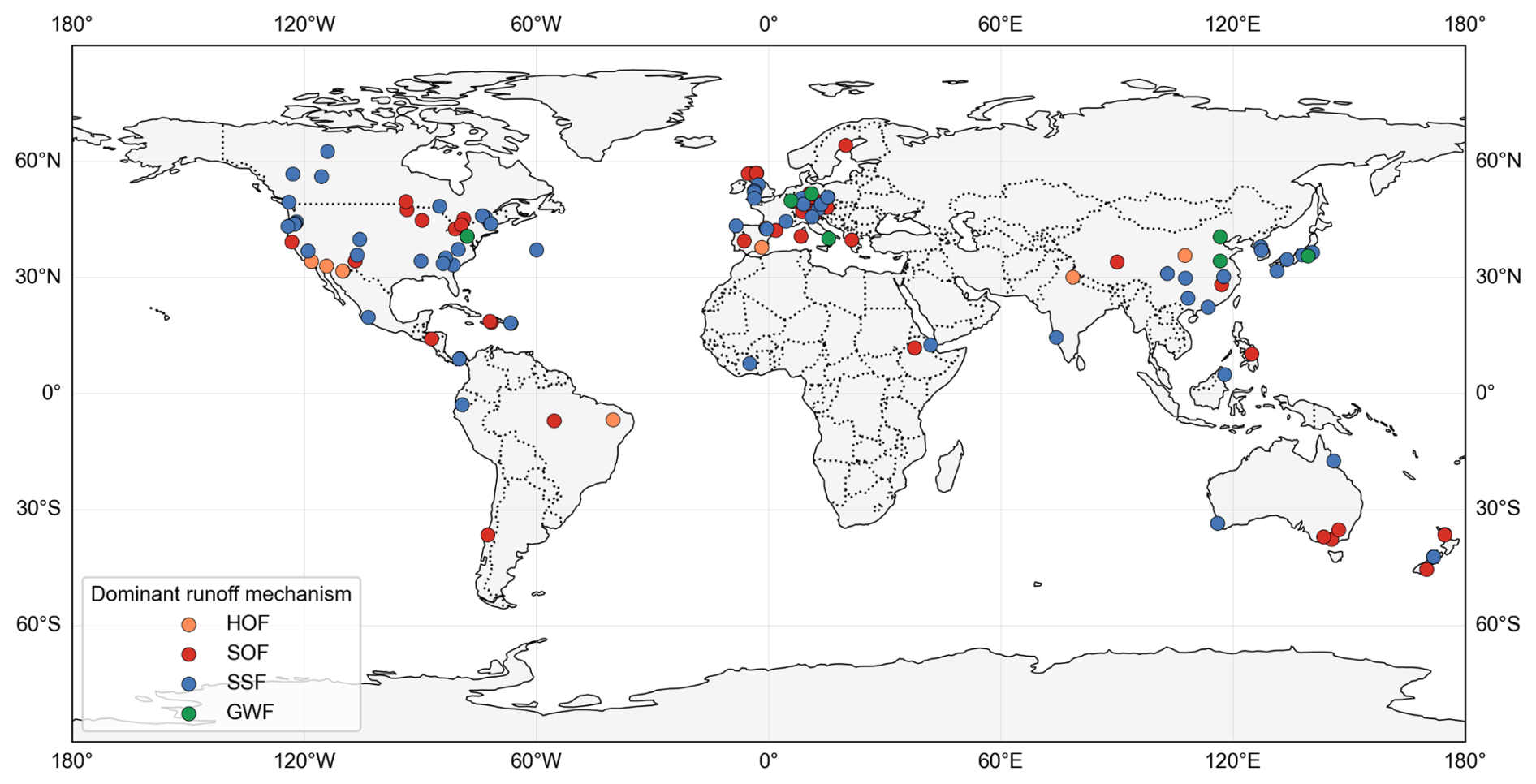
Figure 1Global distribution of study catchments categorized by dominant runoff generation mechanisms. Colored symbols indicate the dominant or combined runoff generation mechanisms reported for each catchment, including HOF, SOF, SSF, GWF.
For each catchment, we extracted information on:
-
Aridity and vegetation type;
-
Soil properties, including depth, texture, and permeability;
-
Geological and hydrogeological characteristics; and
-
Reported dominant runoff generation mechanisms, along with the state variables and indicators used to identify nonlinear or threshold runoff behavior.
2.2 Classification of runoff generation mechanisms
Runoff generation mechanisms were harmonized into four main classes and their combinations: Hortonian overland flow (HOF), saturation-excess overland flow (SOF), subsurface stormflow (SSF), and groundwater flow (GWF). Mechanism classes were extracted from the process interpretations reported in the original studies and were not inferred solely from climate, vegetation, soil, or geological descriptors.
HOF was assigned when the source study interpreted event runoff as infiltration-excess or Hortonian overland flow. SOF was assigned when stormflow was interpreted as saturation-excess overland flow, return flow, or runoff from saturated areas. SSF was assigned when the source study reported event-scale lateral subsurface flow through soil, regolith, preferential flow from macropores, pipes, perched zones, or flow along restrictive layers such as the soil–bedrock interface. Although SOF and SSF can both contribute stormflow, they were distinguished by the dominant reported flow pathway: SOF reaches the channel mainly as surface runoff from saturated areas, whereas SSF is transmitted mainly through lateral subsurface pathways before entering the channel. GWF was assigned only when the original study interpreted stormflow as including event-scale shallow groundwater responses within weathered bedrock or fractured regolith; it does not refer to regional confined aquifers or groundwater dominated baseflow.
Dominance refers to the mechanism interpreted by the source study as the primary contributor to stormflow during event. It does not imply that only one runoff process operated in a catchment. Mixed categories, such as HOF–SOF, SOF–SSF, and SSF–GWF, were assigned when the original studies explicitly reported co-dominant mechanisms or event-dependent switching among mechanisms. These mixed categories were used for mechanism classification, whereas ordered wetness-dependent shifts were analyzed separately in the transition analysis only when the source study explicitly reported changes in the active or dominant mechanism during events or across event sequences.
2.3 Definition of runoff regime shifts and threshold conditions
In this review, threshold behavior refers to an observed nonlinear runoff response pattern reported in the source studies, whereas dominant runoff mechanisms and hydrologic connectivity transitions are treated as process interpretations by the original authors or synthesized conceptually in this review. Runoff regime shifts are defined as abrupt, nonlinear changes in stormflow response that reflect transitions in dominant runoff generation processes or hydrological connectivity, rather than proportional increases in rainfall input alone. A regime shift was identified when one or more of the following conditions were reported during storm events:
-
a distinct breakpoint in the rainfall–runoff relationship;
-
a disproportionate increase in runoff relative to rainfall input;
-
a documented transition in dominant runoff generation mechanism; or
-
enhanced hydrological connectivity, such as hillslope–channel coupling, activation of soil–bedrock interfaces, or rapid groundwater table rise.
Here, structural connectivity refers to relatively persistent catchment attributes that define potential flow-path architecture, including soil depth, permeability contrasts, lithology, weathered or fractured bedrock, topography, and drainage organization (Ali and Roy, 2010; Bracken and Croke, 2007; Western et al., 2001). Functional connectivity refers to the event-scale activation and coupling of these potential pathways as rainfall interacts with antecedent wetness, storage, soil moisture, and groundwater conditions (Blume and Van Meerveld, 2015; Bracken et al., 2013; McDonnell, 2013).
Threshold behavior was interpreted as the joint outcome of event-scale rainfall forcing and catchment hydrological state. Rainfall-based, hydrological-state-based, and composite indicators were distinguished according to the type of information used to identify threshold behavior. Hydrological-state indicators include both antecedent conditions (e.g., API, antecedent moisture condition, antecedent baseflow) and within-event states (e.g., soil moisture, storage, and groundwater level). Rainfall characteristics, including event rainfall amount, rainfall intensity, and rainfall duration, were treated as triggering conditions, whereas antecedent or within-event hydrological states were treated as variables that modulate the emergence of nonlinear runoff responses.
Each catchment record was coded using three linked fields: the reported dominant runoff generation mechanism, the hydrological state domain, and the threshold indicator used to identify or describe the nonlinear response. Hydrological state domains were harmonized into four categories: antecedent moisture condition (AMC), soil water content, groundwater level, and integrated storage state. AMC includes broad pre-event wetness descriptors such as antecedent precipitation, antecedent precipitation index, antecedent baseflow, or qualitative wet/dry catchment-state descriptions. Integrated storage state includes catchment storage, storage deficit, or explicitly coupled soil-moisture–groundwater conditions.
Reported threshold indicators were standardized into a limited set of categories, including event rainfall amount (P), rainfall intensity (Pi), antecedent precipitation index (API), soil water content or soil moisture (SWC), groundwater level or water-table depth (GWL), storage metrics, and composite rainfall–state indicators. When multiple threshold indicators were reported for the same catchment, the indicator identified by the source study as the primary threshold descriptor was retained.
Structural catchment properties (e.g., soil texture and depth, permeability contrasts, bedrock characteristics) were not treated as threshold indicators but as catchment characteristics shaping dominant runoff mechanisms, and were analyzed separately in Sect. 3.4. Because monitoring data availability differed substantially among catchments (e.g., rainfall–runoff observations only versus additional soil-moisture or groundwater measurements), this review synthesizes which indicators were reported in the literature but does not evaluate their comparative predictive or explanatory skill.
2.4 Climate and vegetation classification
Catchments were grouped by climatic wetness and dominant vegetation type to assess how dominant runoff generation mechanisms and regime shifts vary across environmental gradients. These classifications provide contextual interpretation of mechanism occurrence and transition patterns, not as direct explanatory variables.
Climatic wetness was classified into four operational categories: humid, semi-humid, semi-arid, and arid, based on climate descriptions, mean annual precipitation, and, where available, Köppen climate information reported in the source studies. Catchments described as humid, perhumid, tropical humid, or temperate humid were classified as humid; those described as sub-humid or semi-humid were classified as semi-humid; those described as semi-arid or dry steppe were classified as semi-arid; and those described as arid or desert were classified as arid. When source descriptions were ambiguous, mean annual precipitation and regional climate context were used to assign the closest category. Vegetation types were classified as forest, grassland, cropland, shrubland, or mixed vegetation based on study descriptions. Because the reviewed catchments are research catchments rather than a representative sample of the global land surface, aridity and vegetation classes were used to describe the composition of the reviewed literature, not to infer the global prevalence or absence of specific runoff mechanisms.
2.5 Soil–geology–hydrogeology co-occurrence network
To examine associations between dominant runoff generation mechanisms and subsurface characteristics, we conducted a soil–geology–hydrogeology keyword co-occurrence analysis. This analysis identifies combinations of soil, geological, and hydrogeological attributes that frequently co-occur with specific runoff mechanisms across catchments. For each catchment, soil- and geology-related descriptors from the literature were extracted and standardized into a consistent keyword set, including soil depth, texture, permeability, bedrock type, and structural features like fracturing. Only reported attributes explicitly linked to runoff generation (e.g., soil depth, texture, permeability contrasts, lithology) were included.
To ensure consistency across studies, extracted descriptors were standardized using a synonym normalization table (Table S2 in the Supplement), which merged similar terms into unified descriptors (e.g., “shallow regolith”, “thin soils”, and “shallow soils” were combined as “shallow soil”). This normalization focused on preserving the hydrological meaning while reducing linguistic variability. Keyword extraction and standardization were independently reviewed by two researchers to ensure consistency. Discrepancies were resolved through discussion and reference to original study descriptions.
The resulting standardized descriptors were used to construct mechanism–descriptor co-occurrence networks. In this analysis, co-occurrence refers to the presence of a given runoff generation mechanism and a standardized soil–geology–hydrogeology descriptor within the same catchment record. For each mechanism–descriptor pair, the co-occurrence frequency was calculated as the number of independent catchments in which both the mechanism and descriptor were reported. Repeated mentions for the same catchment, or multiple publications describing the same catchment, were counted only once. To reduce the influence of isolated case studies, only mechanism–descriptor links reported in at least two independent catchments were retained in the main network.
2.6 Software
Data extraction and initial standardization were performed in Microsoft Excel, followed by data processing and visualization in Python using the PyCharm integrated development environment [2024.2]. Data cleaning, frequency analysis, and transition-matrix construction were conducted using pandas and NumPy. Sankey diagrams were generated with Plotly, co-occurrence networks were constructed using NetworkX and visualized with Matplotlib, and transition-probability heatmaps were produced using Seaborn. Global catchment maps were generated with Cartopy, using Natural Earth base layers to display coastlines, national borders, and land features.
3.1 Reported dominant mechanisms, state variables, and threshold indicators
Across the 138 reviewed catchments, subsurface- and saturation-related mechanisms were most frequently reported (Fig. 2). SSF was the most common mechanism, accounting for 41 % of all catchments, followed by combined SOF–SSF mechanisms (21 %) and SOF alone (19 %). Together, SSF, SOF, and their combinations represent the majority of reported cases. In contrast, HOF accounts for less than 10 % of the reviewed catchments. GWF and categories involving groundwater represent a smaller fraction of the dataset.
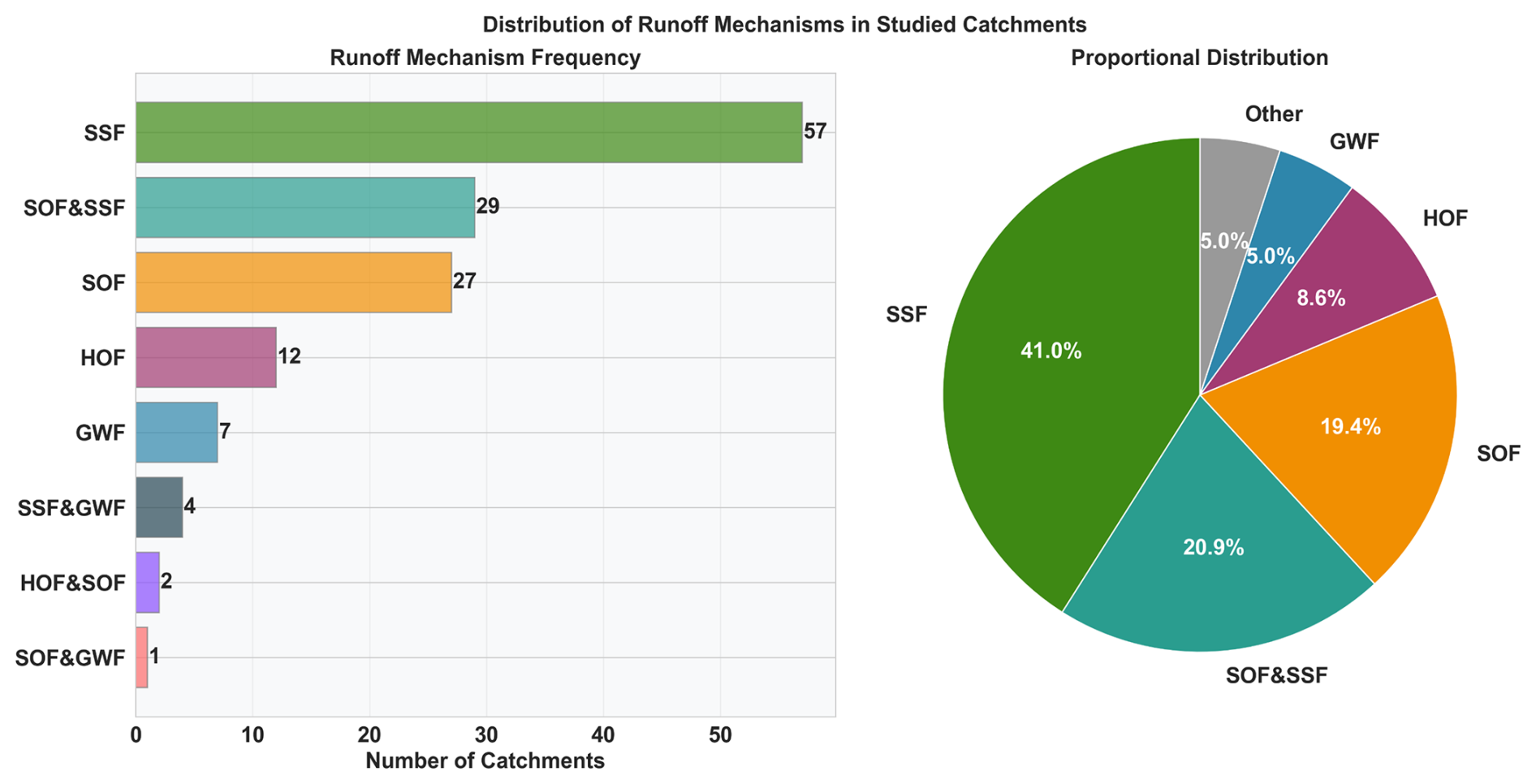
Figure 2Frequency of the reported dominant runoff generation mechanisms in the reviewed catchments. Percentages are calculated relative to all reviewed catchments (n=138), with each catchment counted once.
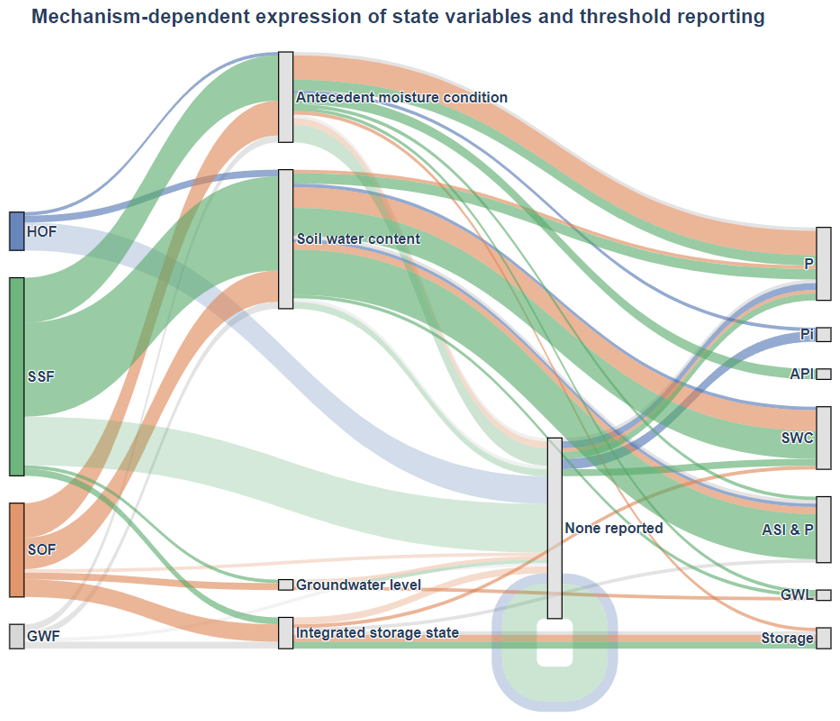
Figure 3Sankey diagram summarizing reported indicators used to identify nonlinear runoff threshold behavior related to different dominant runoff generation mechanisms. Node height and band width are proportional to the number of reviewed catchments. The “None reported” category indicates catchments where source studies did not specify the corresponding state variable or threshold indicator. Specifically, 29 catchments did not report an explicit state variable, and 41 catchments did not report an explicit threshold indicator.
Figure 3 summarizes how reported threshold indicators vary among these runoff mechanism classes. Researchers working in HOF-dominated catchments more often used rainfall-based descriptors, particularly event rainfall amount or rainfall intensity, whereas for SOF-, SSF-, and GWF-dominated catchments, antecedent wetness, soil moisture, storage-related variables, groundwater level, or composite rainfall–state indicators were used more often.
Across the 138 reviewed catchments, a standardized threshold indicator could be identified for 98 catchments (71.0 %). Among these, 40 catchments (40.8 %) used rainfall-only indicators, 35 (35.7 %) used hydrological-state indicators, and 23 (23.5 %) used composite rainfall–state indicators. Hydrological-state and composite indicators therefore accounted for 59.2 % of catchments with an identified threshold indicator. The specific indicators P, Pi, API, SWC, GWL, storage metrics, and composite rainfall–state metrics (Table S4). Because these indicators represent physically different quantities and units, their numerical threshold values were not pooled across indicator types.
Overall, Figs. 2 and 3 show that subsurface- and saturation-related mechanisms are most frequently represented in the reviewed dataset, while the indicators used to characterize threshold-like behavior differ substantially among mechanism classes. These frequencies describe reporting patterns in the reviewed literature and do not constitute a comparison of the predictive or explanatory performance of individual indicators.
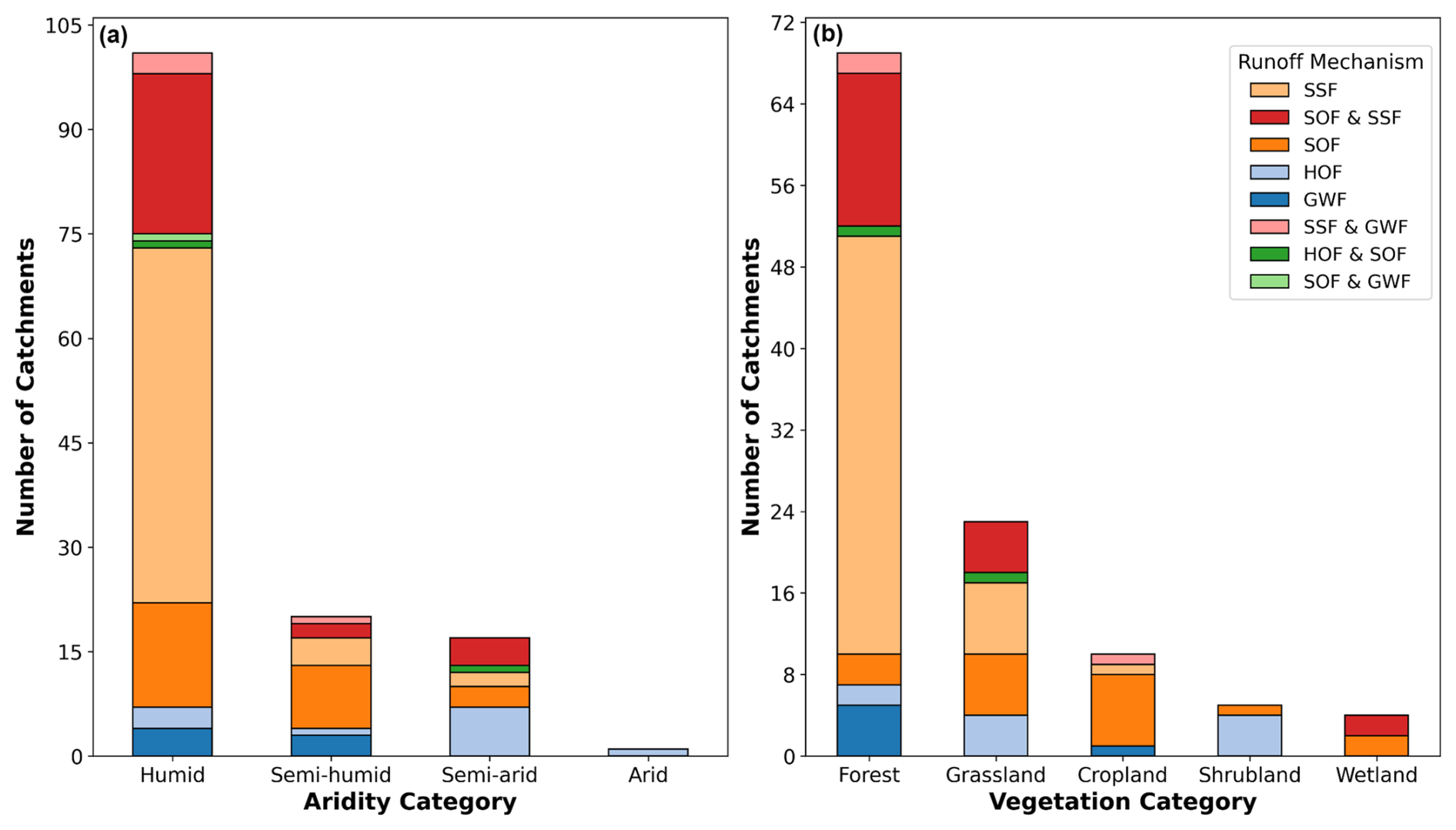
Figure 4Distribution of catchments with reported dominant runoff generation mechanisms across aridity and vegetation categories. Bars show the number of catchments in each aridity or vegetation class, with each catchment counted once. Single and combined mechanisms are shown separately.
3.2 Distribution of reported dominant mechanisms across aridity and vegetation classes
Figure 4 summarizes the distribution of reported dominant runoff generation mechanisms across aridity and vegetation categories within the reviewed catchment sample. These counts describe the composition of the compiled literature dataset and should not be interpreted as estimates of the global prevalence of runoff mechanisms across climate or land-cover classes. The spatial distribution of reviewed catchments is also uneven (Fig. 1), reflecting both where runoff-process studies have been conducted and broader biases in hydrological monitoring networks.
Within the reviewed dataset (Fig. 4a), humid catchments constitute the largest subset and therefore include the widest range of reported runoff generation mechanisms. Among these humid catchments, SSF is the most frequently reported mechanism, followed by SOF and combined SOF–SSF mechanisms. Groundwater-related mechanisms (GWF and SSF–GWF) are represented mainly by humid catchments in this dataset. Semi-humid catchments are fewer in number and most commonly report SOF, with additional cases of SSF and GWF. In the semi-arid subset, the total number of catchments is smaller; SSF and SOF are still represented, while HOF accounts for a larger proportion of the reviewed semi-arid cases. The single arid catchment included in the dataset was classified as HOF-dominated.
Forested catchments are overrepresented in the dataset and dominated by a mix of SSF, SOF, SOF–SSF combinations, and groundwater-related mechanisms (Fig. 4b). Grassland catchments show a mixture of reported SSF, SOF, and HOF. Cropland catchments, less frequently reported, are mainly associated with SOF. Shrubland and wetland catchments are underrepresented; the reported runoff generation mechanism for shrubland catchments is mostly HOF, while the included wetland catchments are mostly SOF and SOF–SSF dominated.
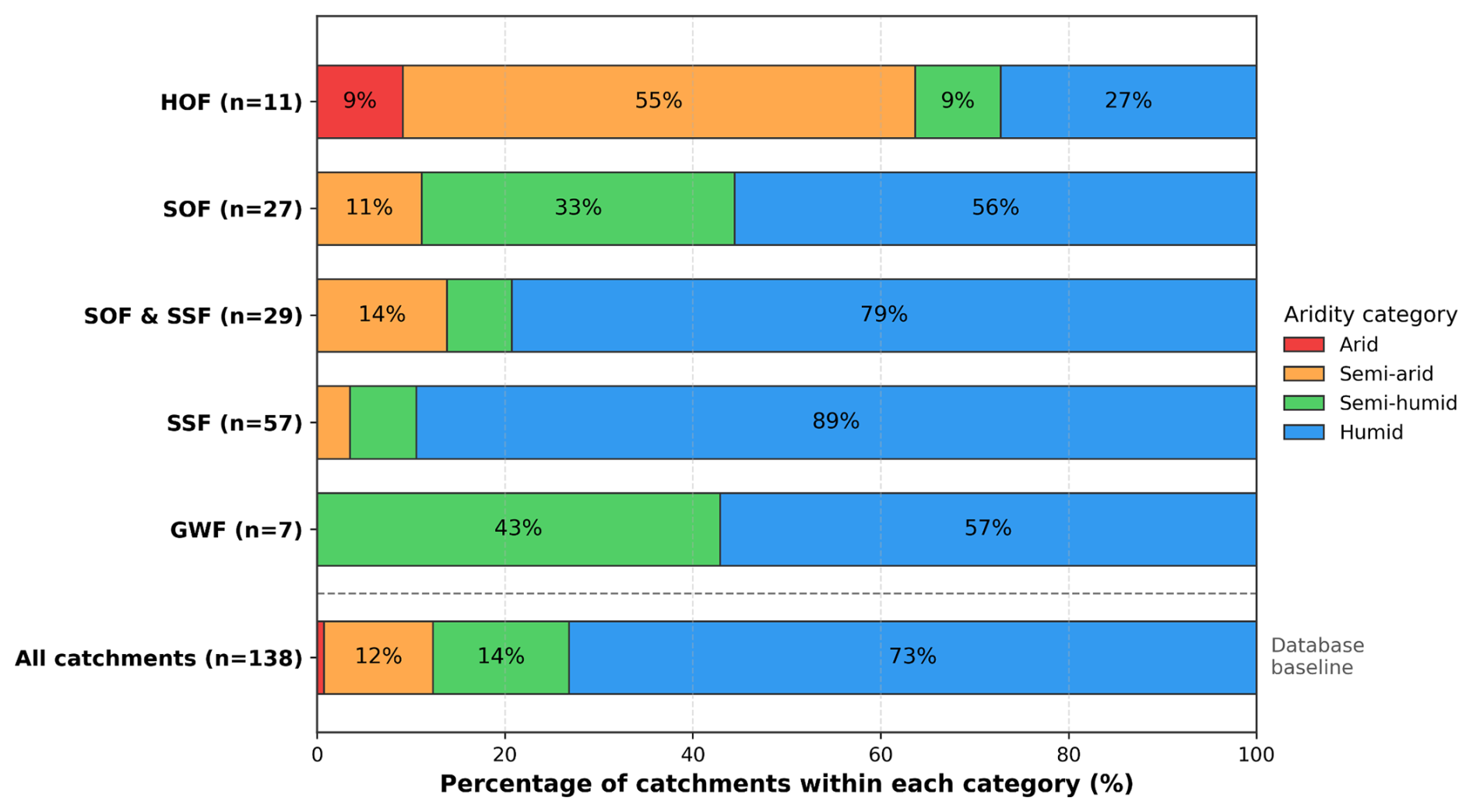
Figure 5Aridity-class composition of catchments reporting each dominant runoff generation mechanism, together with the aridity distribution of the full reviewed database. Numbers in parentheses indicate the number of catchments included in each category (n). Labels within bars indicate percentages of catchments within the corresponding category; therefore, each bar sums to 100 %.
Among the reviewed catchments classified as SSF or SOF–SSF, most are located in humid climates, with smaller numbers from semi-humid and semi-arid regions (Fig. 5). Reviewed SOF-dominated catchments are distributed across humid and semi-humid climates, with some occurrences in semi-arid environments. HOF-dominated catchments occur across the climatic wetness classes represented in the dataset, with the largest proportion in the semi-arid cases. Reviewed GWF-dominated catchments are all humid and semi-humid catchments; this absence from the semi-arid and arid subsets should not be interpreted as evidence that groundwater-related runoff responses cannot occur in drier regions.
Compared with the overall aridity composition of the reviewed database, HOF is relatively more represented in drier catchments, whereas SSF-, SOF–SSF-, and GWF-related responses are more strongly represented in humid and semi-humid subsets.
3.3 Reported event-scale transitions in dominant runoff generation mechanisms
For 23 experimental catchments studies explicitly reported changes in the dominant runoff generation mechanism during storm events or across event sequences as catchment wetness increased. These transitions do not imply that the catchment's structural runoff potential changes during an event; rather, they indicate that different pre-existing runoff pathways become activated and dominate stormflow as functional connectivity develops. The most frequently reported initial mechanisms were HOF and SOF, but the subsequent transition pathways differed among catchments (Figs. 6 and 7).
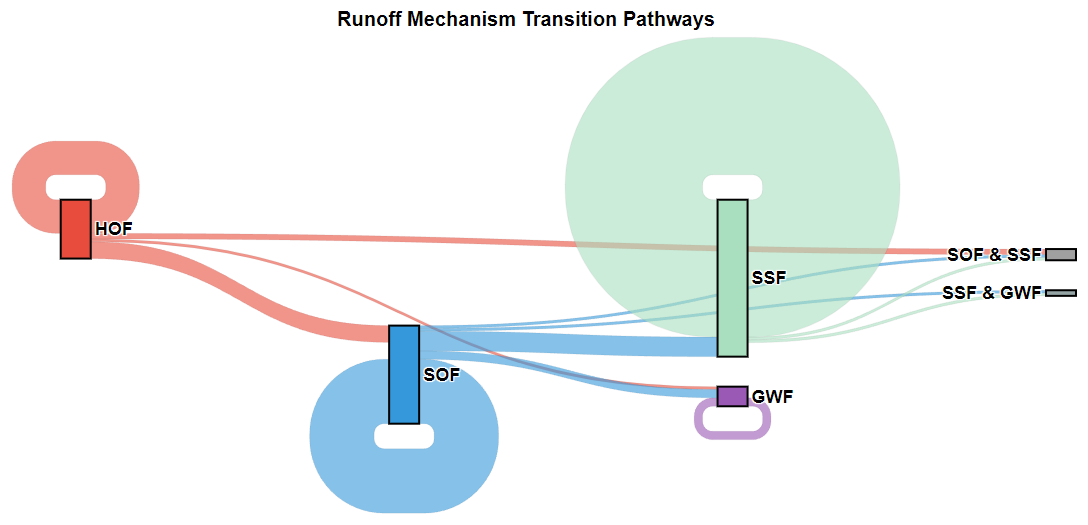
Figure 6Sankey diagram illustrating reported runoff-mechanism transition pathways with increasing catchment wetness. The diagram includes only catchments for which studies explicitly reported wetness-dependent mechanism shifts or persistence. Rectangular node height is proportional to the number of catchments with each initial mechanism. Directed band width is proportional to the number of catchments reporting each transition. Colored self-loop bands around a node indicate cases where the reported dominant mechanism remained unchanged.
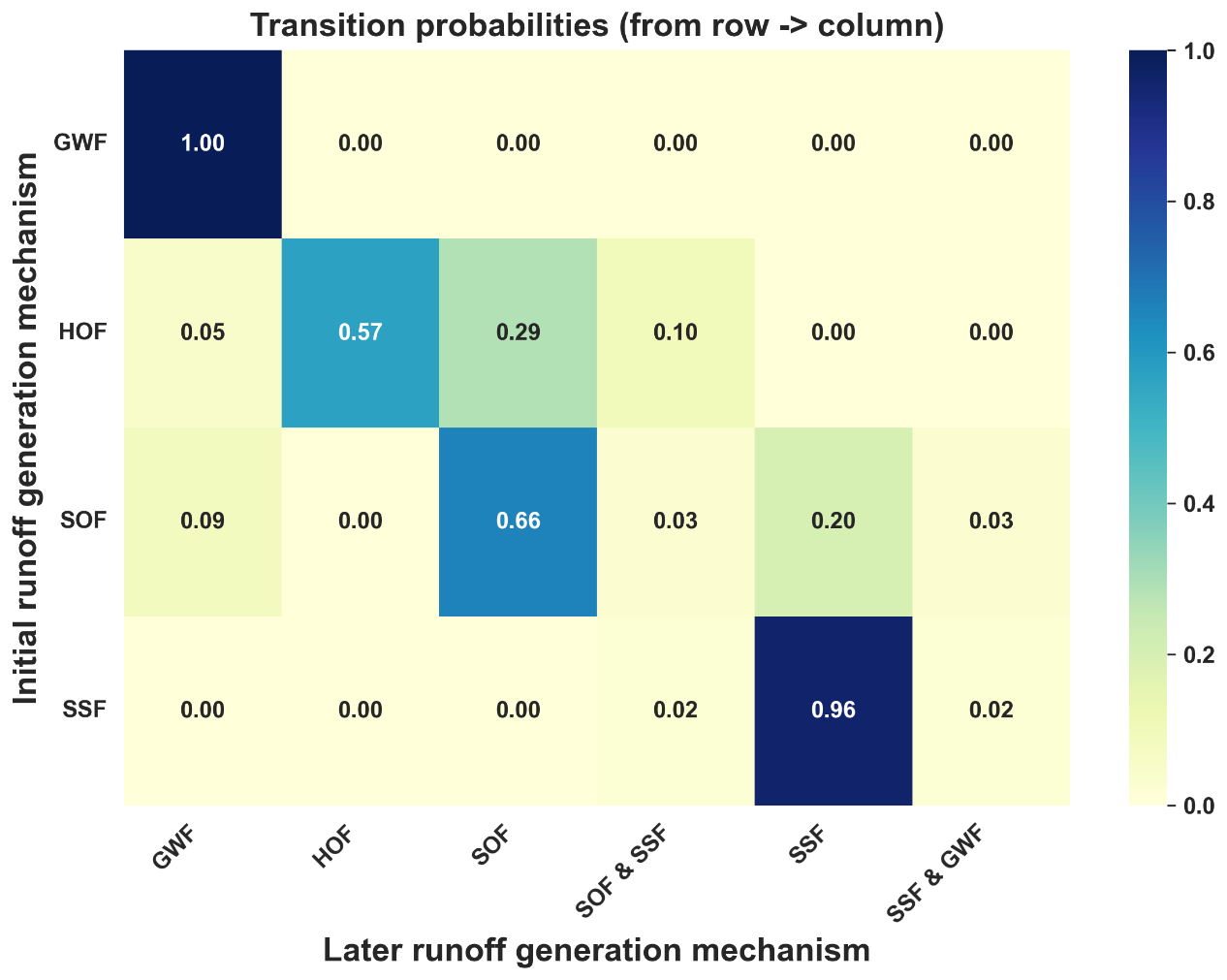
Figure 7Conditional transition probabilities between dominant runoff generation mechanisms under increasing wetness. Values represent the proportion of catchments with a given initial mechanism (rows) that transitioned to each subsequent mechanism (columns). Transition probabilities were calculated using catchments as the unit of analysis, with each row normalized by the number of catchments with the corresponding initial dominant mechanism.
Among the 23 catchments with explicitly reported wetness-dependent mechanism transitions, nine transitions originated from HOF, twelve from SOF, and two from SSF. Of the HOF-originating transitions, six shifted to SOF (66.7 %), two to combined SOF–SSF responses (22.2 %), and one to GWF (11.1 %). Of the SOF-originating transitions, seven shifted to SSF (58.3 %), three to GWF (25.0 %), and one each to SOF–SSF and SSF–GWF (8.3 % each). The two SSF-originating cases shifted to SOF–SSF and SSF–GWF, respectively. A standardized threshold indicator was available for 19 of these 23 catchments: hydrological-state indicators were reported for nine catchments (39.1 % of the transition subset), rainfall-only indicators for five (21.7 %), and composite rainfall–state indicators for five (21.7 %). The remaining four catchments did not have an explicitly standardized threshold indicator. These frequencies describe the reported transition subset and should not be interpreted as a universal sequence of pathway activation.
Within the transition subset, shifts from surface-dominated responses toward subsurface- or groundwater-influenced responses were reported more frequently than in the reverse direction. To evaluate whether this directional tendency differs from random reorganization, we used a one-sided Monte Carlo randomization test under a uniform transition-probability null model, in which later mechanisms were randomly assigned with equal probability. The observed number of surface-to-subsurface or groundwater-influenced transitions was significantly higher than expected under the null model (p<0.05).
3.4 Soil–geology fingerprints of runoff generation mechanisms
Figure 8 summarizes mechanism–descriptor co-occurrence patterns, where links indicate that a runoff mechanism and a standardized soil–geology–hydrogeology descriptor were reported for the same independent catchment. Here, “structural fingerprints” refer to mechanism-specific co-occurrence patterns between reported dominant runoff mechanisms and standardized soil, geological, and hydrogeological descriptors, rather than deterministic soil–geology controls. These descriptors should be interpreted as co-occurring structural settings rather than as individual causal controls. HOF-dominated catchments in the reviewed literature were frequently associated with rock outcrops, shallow soils, gravel, sandy loam, and, in fewer cases, deep soils. In particular, shallow soils and rock outcrops likely represent thin or discontinuous soil cover and limited effective near-surface storage, whereas the occurrence of deep soils in some HOF cases indicates that HOF cannot be attributed solely to limited soil depth or storage.
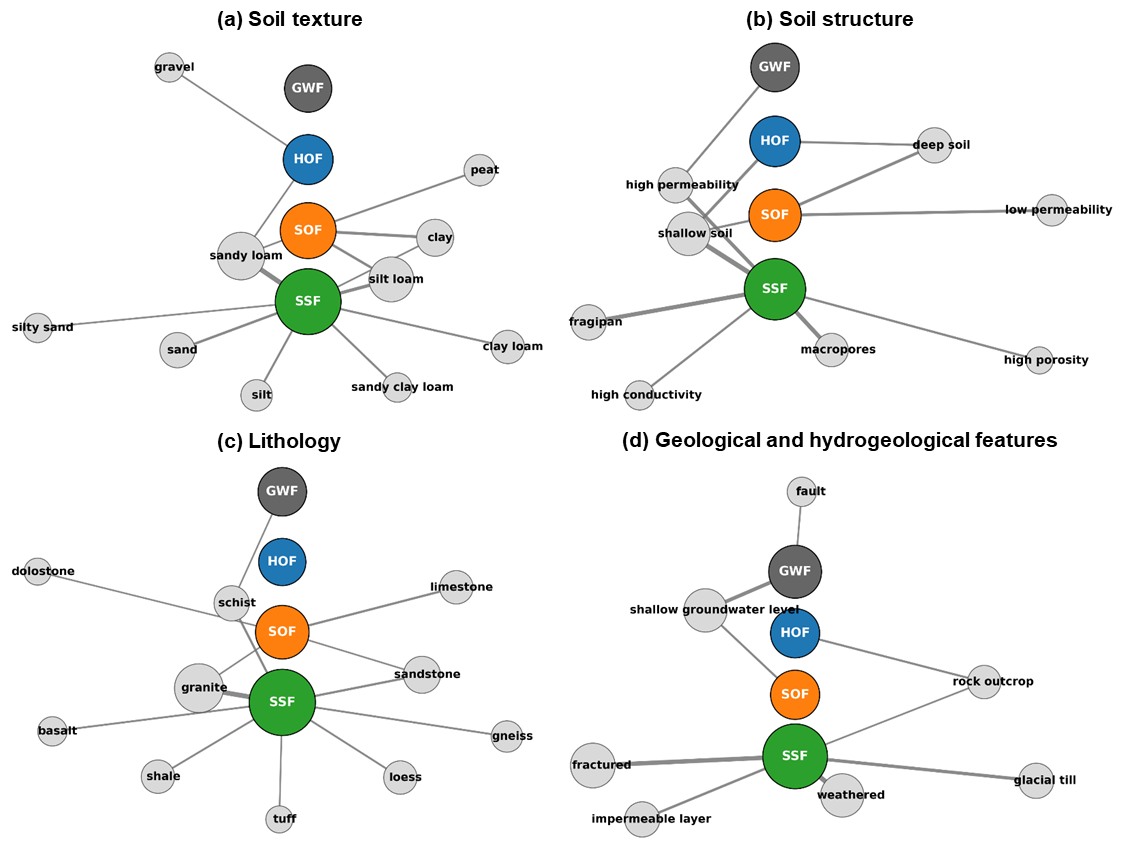
Figure 8Soil–geology–hydrogeology fingerprints of dominant runoff generation mechanisms. Panels show co-occurrence relationships with (a) soil texture, (b) soil structural properties, (c) lithology, and (d) geological and hydrogeological features. Colored nodes represent dominant runoff mechanisms – HOF, SOF, SSF, and GWF – while gray nodes represent soil or geological descriptors extracted from the literature. A co-occurrence means that a given mechanism and descriptor were reported for the same independent catchment. Node size reflects the number of independent catchments in which a mechanism or descriptor was reported. Link thickness represents the number of independent catchments in which a given mechanism–descriptor pair co-occurred; repeated publications on the same catchment were counted only once. Networks were constructed from the subset of catchments with clearly reported dominant mechanisms and sufficient soil–geology–hydrogeology descriptors (n=103).
There are strong co-occurrence links between SOF and clay and loam textures, deep soils, and low permeability. It is also frequently associated with granite, limestone, and dolostone, as well as with shallow groundwater conditions. SSF has the most diverse co-occurrence structure of the four mechanisms. It is commonly associated with shallow soils, fragipans, macropores, and high permeability. Additional links connect SSF to silt loam and sandy loam textures, and to fractured or weathered bedrock types, including granite and shale. GWF, while having a more compact but distinct co-occurrence pattern, is most strongly associated with shallow groundwater levels as a hydrogeological condition, and with structurally conductive geological settings such as schist, faults, and fractured formations.
In contrast, GWF shows weak and non-specific associations with soil textures, and soil structural properties. The absence of strong GWF links to limestone or granite in this network should not be interpreted as evidence that groundwater or shallow bedrock flow does not contribute to storm runoff in those lithologies. Rather, it indicates that event-scale groundwater flow was not reported as a dominant or combined mechanism in enough independent catchments with those descriptors to form a retained network link. In limestone or granite catchments, groundwater contributions may depend strongly on additional structural and hydrogeological features, such as karst development, fractures, weathered zones, shallow water tables, and hillslope–stream connectivity. A sensitivity check to the minimum co-occurrence threshold, we reconstructed the networks using thresholds of three, four, and five independent catchments. The main mechanism-specific associations remained qualitatively similar, indicating that the identified fingerprints are not driven by isolated cases.
Overall, the four co-occurrence networks (Fig. 8) summarize the soil–geology–hydrogeology descriptors reported in association with different dominant runoff-generation mechanisms. The identified associations show partially overlapping distributions among mechanism classes across the reviewed catchments.
4.1 What do runoff thresholds represent across studies?
Across the reviewed literature, “runoff threshold” is consistently used to describe nonlinear stormflow responses (Tromp‐van Meerveld and McDonnell, 2006a; Nanda and Safeeq, 2023; Nanda and Sen, 2021; Ross et al., 2021; Wang et al., 2022), yet Sect. 3.1 shows that these thresholds are reported for a range of rainfall-based, state-based, storage-based, groundwater-based, and composite indicators. This heterogeneity reflects differences in monitoring design, available data, and process interpretation, and it limits direct comparison of threshold values across catchments. Antecedent soil moisture, catchment storage, and groundwater level were among the most commonly reported state descriptors for SOF-, SSF-, and groundwater-influenced responses (Farrick and Branfireun, 2014; Nanda and Safeeq, 2023; Oswald et al., 2011; Penna et al., 2011; Scaife et al., 2020). In HOF-related cases, rainfall intensity was more often reported as the immediate trigger, but connected surface runoff also depends on soil-vegetation-root systems, surface condition, crusting or compaction, macroporosity, microtopography, and vegetation cover (Gao et al., 2024).
The review does not show that rainfall-only indicators are inherently insufficient; rather, it shows that antecedent-state and composite indicators were more frequently reported than rainfall-only metrics. Many source studies interpreted threshold-like responses as rainfall interacting with soil wetness, storage, groundwater rise, saturation expansion, lateral subsurface flow, or hillslope–channel coupling (Ali et al., 2015; Ross et al., 2021; Scaife et al., 2020; Tromp‐van Meerveld and McDonnell, 2006a, b). Ross et al. (2021) emphasized the widespread occurrence and typology of threshold behavior across contrasting environments, whereas McDonnell et al. (2021) used the fill-and-spill concept to organize runoff generation observations around storage activation and flow-path connectivity. The present synthesis builds on these perspectives by linking reported threshold indicators to dominant runoff mechanisms, event-scale mechanism transitions, and soil–geology–hydrogeology settings across the reviewed catchments.
Although recent work has advanced process-based quantification of subsurface hydrological connectivity and its coupling with structural connectivity (Tromp‐van Meerveld and McDonnell, 2006b; Zhang et al., 2026), most studies included in this review inferred connectivity-related threshold behavior from observable proxies such as antecedent precipitation, soil moisture, storage state, groundwater level, saturated-area expansion, or reported mechanism changes (Detty and McGuire, 2010; Penna et al., 2011; Scaife et al., 2020; Tromp‐van Meerveld and McDonnell, 2006a). This distinction also separates event-scale runoff thresholds from relatively stable catchment storage-capacity parameters used in conceptual models. Catchment storage architecture may be treated as a structural property, whereas the rainfall amount or intensity required to trigger nonlinear runoff depends on antecedent storage deficit, soil moisture, groundwater level, API, and event rainfall characteristics, as shown for humid forest stormflow responses by Zhang et al. (2021).
The lower reporting frequency of rainfall intensity in SOF- and SSF-related studies should not be interpreted as evidence that rainfall intensity is hydrologically unimportant. Figure 3 records the variables used to identify or describe threshold-like behavior, rather than all controls on runoff magnitude or flood peaks. In HOF-related studies, rainfall intensity provides a direct diagnostic of infiltration-excess conditions. In contrast, thresholds associated with SOF, SSF, or shallow-groundwater responses are more often described by the storage or wetness state at which saturated areas, lateral subsurface pathways, or groundwater connections become active. Rainfall intensity can still influence the rate of storage filling, percolation, and event runoff magnitude, and its lower reporting frequency may additionally reflect monitoring design and the variables available in individual studies. Therefore, the lower reporting frequency of rainfall intensity in SOF- and SSF-related studies reflects the way threshold conditions are characterized in the literature rather than a lack of rainfall influence on event runoff responses.
The quantitative synthesis therefore does not reveal a single numerical threshold that changes systematically across climatic wetness classes. Rather, numerical thresholds are reported for different physical domains – including rainfall, soil moisture, storage, and groundwater – and are directly comparable only within equivalent indicator types. Cross-catchment comparison is therefore more meaningful in terms of comparable threshold-indicator domains and their associated runoff mechanisms than by pooling raw threshold values across fundamentally different metrics.
4.2 Why do thresholds differ across mechanisms and catchments?
Differences in reported threshold behavior across runoff generation mechanisms and catchments reflect interactions among rainfall forcing, antecedent state, and structural connectivity. Structural connectivity is shaped by vegetation cover and roots, soil texture and structure, macroporosity, soil depth, permeability contrasts, lithology, weathering, fractures, topographic convergence, and groundwater setting (Zehe and Sivapalan, 2009); these properties define potential storage and flow paths (Spence, 2010), whereas event wetness determines which pathways become functionally connected (Blume and Van Meerveld, 2015).
The soil-geology-hydrogeology fingerprints identified in Sect. 3.4 should be read as mechanism-specific co-occurrence patterns rather than deterministic controls. Shallow rocky or discontinuous soils may reduce effective near-surface storage and support rapid surface runoff under intense rainfall, while fine-textured soils, peat, low-permeability layers, shallow groundwater, or convergent topography may promote near-surface saturation and SOF (Devito et al., 2023; Jencso and McGlynn, 2011; de Moraes et al., 2006; Penna et al., 2011). Permeability contrasts, macropores, fractured or weathered bedrock, and soil-bedrock interfaces may support SSF or shallow-groundwater-influenced stormflow when sufficiently connected (Blume and Van Meerveld, 2015; Detty and McGuire, 2010; Sidle et al., 2000; Zhang et al., 2021). These associations are context dependent. Coarse materials do not inherently imply low infiltration (Dunne and Black, 1970), and low-permeability conditions can contribute to either HOF or SOF depending on whether the limitation occurs at the surface or below a more permeable layer (de Moraes et al., 2006). Thus, Fig. 8 provides structural contexts for interpreting reported mechanisms, not one-to-one causal assignments.
The climatic and vegetation patterns in Sect. 3.2 should also be interpreted cautiously because the reviewed catchments are not a representative sample of the global land surface. Humid and forested experimental catchments are overrepresented in our database, whereas dryland, cropland, urban, and suburban systems are underrepresented or absent. This imbalance may reflect both the geographical distribution of runoff-process research and broader spatial biases in hydrological monitoring networks (Sando et al., 2026). In SOF-related settings, rainfall intensity and profile structure can also modify storage behavior and the onset of saturation-excess runoff (Zhang et al., 2022). The results nevertheless align with recent global syntheses showing that runoff processes are shaped by environmental context. McMillan et al. (2025) emphasized the roles of aridity, terrain, and biomes in organizing flow pathways, and Penna (2026) highlighted interacting climatic, hydrological, pedological, vegetational, geological, and geomorphological controls on runoff generation in forested catchments. Our contribution is narrower and threshold-focused: it links reported threshold indicators to dominant mechanisms, event-scale mechanism transitions, and repeated structural associations.
Climate, vegetation, soil development, and rock weathering should therefore be interpreted as coupled controls. Climate influences long-term vegetation cover, weathering intensity, regolith thickness, soil structure, and groundwater storage (Zehe and Sivapalan, 2009); these properties shape structural connectivity (Devito et al., 2023), while event rainfall and antecedent wetness regulate functional connectivity during storms (Blume and Van Meerveld, 2015). Compared with the overall climatic composition of the reviewed database, HOF is relatively more represented in drier catchments, whereas SSF-, SOF–SSF-, and GWF-related responses are more strongly represented in humid and semi-humid subsets. At the same time, HOF, SOF, SSF, and their combinations are reported across more than one climatic wetness class, indicating that these mechanisms are not restricted to a single climate type. Given the strong overrepresentation of humid catchments and the limited dryland sample, these patterns should be interpreted as climatic tendencies within the reviewed literature rather than estimates of global mechanism prevalence. They therefore provide evidence that threshold-related runoff mechanisms occur across contrasting climatic settings represented in the database, but not that their relative frequencies are globally representative.
4.3 A revised conceptual framework for storm runoff generation
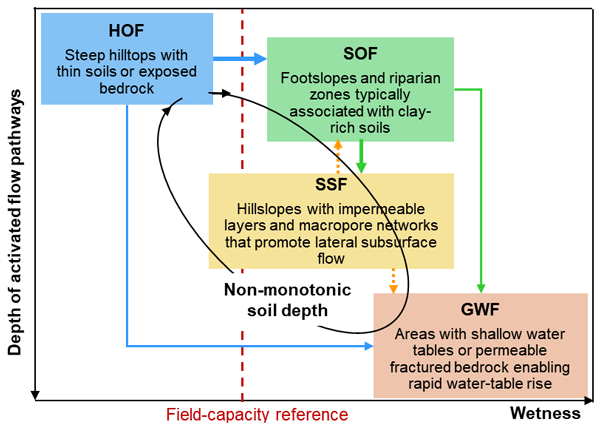
Building on these results, Fig. 9 presents a conceptual, non-metric framework for event-scale transitions in the dominant runoff mechanism within catchments.
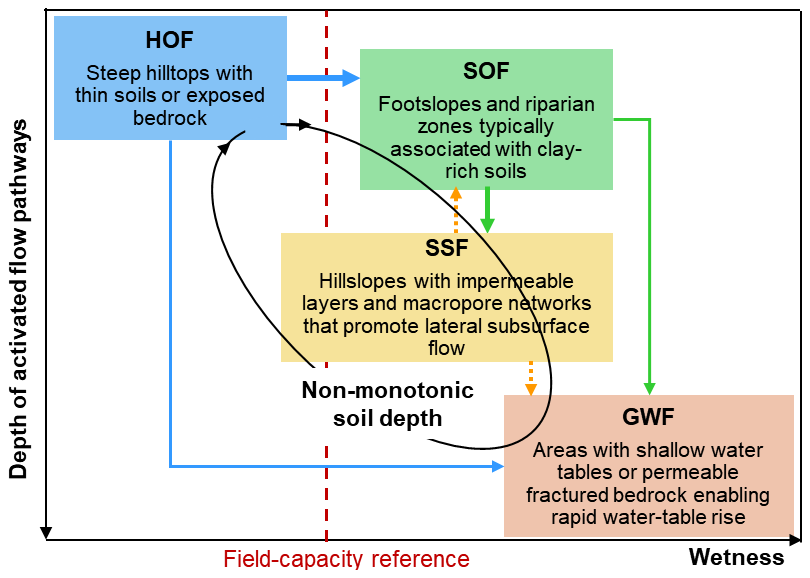
Figure 9Conceptual framework of event-scale runoff mechanism transitions across gradients of wetness and flow-path depth. The x axis represents increasing antecedent and within-event wetness or storage state, whereas the y axis represents increasing depth of activated flow pathways, from surface and near-surface pathways at the top to deeper subsurface and shallow-groundwater pathways at the bottom. The red dashed line indicates an approximate field-capacity reference, not a universal runoff-initiation threshold. The SSF box spans both sides of the field-capacity reference to indicate that subsurface stormflow may occur below field capacity where preferential or interface flow pathways are active. Solid arrows indicate commonly reported within-catchment transition pathways as event wetness increases, with arrow thickness representing relative reporting frequency. Dashed arrows denote less frequent or context-dependent pathways, including SSF-to-SOF transitions where lateral subsurface flow exfiltrates in footslopes, valley floors, or riparian zones, and SSF-to-GWF transitions where continued wetting connects lateral subsurface flow with shallow groundwater, weathered regolith, or fractured bedrock pathways. The soil-depth arrow represents a non-monotonic structural control: very shallow soils or rock outcrops may favor HOF because of limited effective storage, whereas very deep and dry profiles may also be HOF-dominated during extreme rainfall because subsurface storage and groundwater connectivity thresholds are difficult to reach.
Within this framework, runoff thresholds are response conditions arising from interactions among rainfall forcing, catchment state, and structural constraints (Sidle et al., 2000). This framework should be interpreted as a synthesis of reported indicators, mechanisms, and structural contexts rather than a quantitative model.
Mechanism transitions in this framework refer only to reported within-catchment changes in the mechanism dominating stormflow during events or event sequences as wetness increases (Chittolina et al., 2023; Detty and McGuire, 2010; Meyles et al., 2003; Penna et al., 2011; Tromp‐van Meerveld and McDonnell, 2006a, b). They do not imply that the vegetation-soil-geology structure changes during an event; rather, different pre-existing pathways become functionally connected as storage fills, saturated areas expand, preferential pathways activate, or shallow groundwater rises. The observed tendency toward surface-to-subsurface transitions should not be interpreted as indicating that surface pathways are always activated before deeper flow pathways. In humid and highly weathered catchments, preferential flow, soil–bedrock interfaces, or groundwater-connected pathways may contribute to stormflow before surface saturation develops. Therefore, the transition patterns identified here describe changes in the mechanism dominating stormflow reported in the literature, rather than the chronological order in which all flow pathways are activated. Thus, increasing event-scale wetness is associated with a reorganization of the mechanism dominating stormflow in the reviewed transition subset, rather than with a single, universally ordered sequence of pathway activation.
This distinction separates within-catchment event-scale transitions from cross-catchment environmental patterns. Cross-catchment patterns describe differences in structural setting and reported mechanism occurrence among climatic wetness classes and soil-geology-hydrogeology contexts.
The framework also allows non-monotonic and context-dependent pathways. SSF can occur below field capacity where macropores, pipes, perched zones, or soil-bedrock interfaces are active (Detty and McGuire, 2010; Kim, 2009; Scaife et al., 2020; Scaife and Band, 2017); SSF may feed SOF where lateral subsurface flow exfiltrates in footslopes or riparian zones (Srinivasan et al., 2002; Penna et al., 2011) , whereas continued wetting may connect lateral subsurface pathways with shallow groundwater, weathered regolith, or fractured bedrock. Conversely, very deep and dry profiles, such as some arid loess catchments, may remain HOF-dominated during intense events because the storage or groundwater-connectivity conditions required for deeper pathways are difficult to reach (Scaife and Band, 2017). These alternatives reinforce that the framework represents recurrent tendencies in the reviewed literature rather than a deterministic progression among runoff-generation mechanisms.
This review synthesizes reported storm-runoff threshold behavior for 138 experimental catchments by examining event-scale observations, threshold indicators, dominant runoff mechanisms, mechanism transitions, and soil–geology–hydrogeology context. The reviewed literature does not support a single universal threshold metric or directly transferable numeric threshold values across catchments; instead, reported thresholds are best interpreted through rainfall-state-structure combinations.
Antecedent wetness state and composite indicators were more frequently reported than rainfall-only descriptors. In catchments with explicit event-scale transition evidence, the mechanism dominating stormflow commonly shifted from surface-dominated responses toward saturation-, subsurface-, or shallow-groundwater-influenced pathways as wetness increased within the reported transition subset.
Mechanism-specific soil-geology-hydrogeology associations provide structural context for these patterns by indicating potential storage and flow-path architecture, while event wetness controls which pathways become functionally connected.
The compiled catchment dataset and associated metadata used in this study are publicly available through the Zenodo repository: https://doi.org/10.5281/zenodo.21915052 (Cui, 2026). The repository includes the catchment-level database, threshold-indicator information, runoff-generation mechanism classification, and wetness-dependent transition records.
The supplement related to this article is available online at https://doi.org/10.5194/hess-30-5281-2026-supplement.
ZC contributed the conceptualization, formal analysis, investigation and writing; FT contributed the conceptualization, formal analysis and revision.
At least one of the (co-)authors is a member of the editorial board of Hydrology and Earth System Sciences. The peer-review process was guided by an independent editor, and the authors also have no other competing interests to declare.
Publisher's note: Copernicus Publications remains neutral with regard to jurisdictional claims made in the text, published maps, institutional affiliations, or any other geographical representation in this paper. The authors bear the ultimate responsibility for providing appropriate place names. Views expressed in the text are those of the authors and do not necessarily reflect the views of the publisher.
We thank the editor and reviewers for their constructive comments and suggestions during the review process.
This research has been supported by the National Natural Science Foundation of China (grant nos. U2442201 and 52409031).
This paper was edited by Erwin Zehe and reviewed by Jintao Liu and one anonymous referee.
Ali, G., Tetzlaff, D., McDonnell, J. J., Soulsby, C., Carey, S., Laudon, H., McGuire, K., Buttle, J., Seibert, J., and Shanley, J.: Comparison of threshold hydrologic response across northern catchments, Hydrol. Process., 29, 3575–3591, https://doi.org/10.1002/hyp.10527, 2015.
Ali, G. A. and Roy, A. G.: Shopping for hydrologically representative connectivity metrics in a humid temperate forested catchment, Water Resour. Res., 46, 2010WR009442, https://doi.org/10.1029/2010WR009442, 2010.
Ares, M. G., Varni, M., and Chagas, C.: Runoff response of a small agricultural basin in the argentine Pampas considering connectivity aspects, Hydrol. Process., 34, 3102–3119, https://doi.org/10.1002/hyp.13782, 2020.
Blume, T. and Van Meerveld, H. J.: From hillslope to stream: methods to investigate subsurface connectivity, WIREs Water, 2, 177–198, https://doi.org/10.1002/wat2.1071, 2015.
Bracken, L. J. and Croke, J.: The concept of hydrological connectivity and its contribution to understanding runoff‐dominated geomorphic systems, Hydrol. Process., 21, 1749–1763, https://doi.org/10.1002/hyp.6313, 2007.
Bracken, L. J., Wainwright, J., Ali, G. A., Tetzlaff, D., Smith, M. W., Reaney, S. M., and Roy, A. G.: Concepts of hydrological connectivity: Research approaches, pathways and future agendas, Earth-Sci. Rev., 119, 17–34, https://doi.org/10.1016/j.earscirev.2013.02.001, 2013.
Chittolina, M., da Rocha, H. R., Domingues, L. M., and de Araújo Lobo, G.: Hydrological response of a headwater catchment in Southeast Brazil – Threshold patterns of stormflow response, Hydrol. Process., https://doi.org/10.1002/hyp.14879, 2023.
Cui, Z.: Global Synthesis Dataset of Storm Runoff Thresholds, Runoff Generation Mechanisms, and Catchment Characteristics, Zenodo [data set], https://doi.org/10.5281/zenodo.21915052, 2026.
de Moraes, J. M., Schuler, A. E., Dunne, T., Figueiredo, R. de O., and Victoria, R. L.: Water storage and runoff processes in plinthic soils under forest and pasture in eastern Amazonia, Hydrol. Process., 20, 2509–2526, https://doi.org/10.1002/hyp.6213, 2006.
Deng, C., Jiang, X., Tan, Z., and Nie, T.: Spatiotemporal variation of hydrological connectivity and its threshold effects on flood dynamics: An examination in the arid and semi-arid regions, China, Sci. Total Environ., 935, 173406, https://doi.org/10.1016/j.scitotenv.2024.173406, 2024.
Detty, J. M. and McGuire, K. J.: Threshold changes in storm runoff generation at a till‐mantled headwater catchment, Water Resour. Res., 46, 2009WR008102, https://doi.org/10.1029/2009WR008102, 2010.
Devito, K. J., O'Sullivan, A. M., Peters, D. L., Hokanson, K. J., Kettridge, N., and Mendoza, C. A.: Runoff Threshold Responses in Continental Boreal Catchments: Nexus of Subhumid Climate, LowRelief, Surficial Geology, and Land Cover, Water Resour. Res., 59, https://doi.org/10.1029/2023wr034752, 2023.
Dunne, T. and Black, R. D.: An Experimental Investigation of Runoff Production in Permeable Soils, Water Resour. Res., 6, 478–490, https://doi.org/10.1029/WR006i002p00478, 1970.
Farrick, K. K. and Branfireun, B. A.: Soil water storage, rainfall and runoff relationships in a tropical dry forest catchment, Water Resour. Res., 50, 9236–9250, https://doi.org/10.1002/2014WR016045, 2014.
Fu, C., Chen, J., Jiang, H., and Dong, L.: Threshold behavior in a fissured granitic catchment in southern China: 1. Analysis of field monitoring results, Water Resour. Res., 49, 2519–2535, https://doi.org/10.1002/wrcr.20191, 2013.
Gao, H., Hrachowitz, M., Wang-Erlandsson, L., Fenicia, F., Xi, Q., Xia, J., Shao, W., Sun, G., and Savenije, H. H. G.: Root zone in the Earth system, Hydrol. Earth Syst. Sci., 28, 4477–4499, https://doi.org/10.5194/hess-28-4477-2024, 2024.
James, A. L. and Roulet, N. T.: Investigating hydrologic connectivity and its association with threshold change in runoff response in a temperate forested watershed, Hydrol. Process., 21, 3391–3408, https://doi.org/10.1002/hyp.6554, 2007.
Jencso, K. and McGlynn, B.: Hierarchical controls on runoff generation: Topographically driven hydrologic connectivity, geology, and vegetation, Water Resour. Res., 47, https://doi.org/10.1029/2011WR010666, 2011.
Kampf, S. K., Faulconer, J., Shaw, J. R., Lefsky, M., Wagenbrenner, J. W., and Cooper, D. J.: Rainfall Thresholds for Flow Generation in Desert Ephemeral Streams, Water Resour. Res., 54, 9935–9950, https://doi.org/10.1029/2018WR023714, 2018.
Kim, H. J.: Hydrologic contributions of subsurface flow during snowmelt and rainfall in a forest catchment, coastal British Columbia, University of British Columbia, https://doi.org/10.14288/1.0090117, 2009.
McDonnell, J. J.: Are all runoff processes the same?, Hydrol. Process., 27, 4103–4111, https://doi.org/10.1002/hyp.10076, 2013.
McDonnell, J. J., Spence, C., Karran, D. J., Van Meerveld, H. J., and Harman, C. J.: Fill‐and‐Spill: A Process Description of Runoff Generation at the Scale of the Beholder, Water Resour. Res., 57, e2020WR027514, https://doi.org/10.1029/2020WR027514, 2021.
McGuire, K. J. and McDonnell, J. J.: Hydrological connectivity of hillslopes and streams: Characteristic time scales and nonlinearities, Water Resour. Res., 46, 2010WR009341, https://doi.org/10.1029/2010WR009341, 2010.
McMillan, H.: A taxonomy of hydrological processes and watershed function, Hydrol. Process., 36, e14537, https://doi.org/10.1002/hyp.14537, 2022.
McMillan, H., Araki, R., Bolotin, L., Kim, D.-H., Coxon, G., Clark, M., and Seibert, J.: Global patterns in observed hydrologic processes, Nat. Water, 3, 497–506, https://doi.org/10.1038/s44221-025-00407-w, 2025.
Meyles, E., Williams, A., Ternan, L., and Dowd, J.: Runoff generation in relation to soil moisture patterns in a small Dartmoor catchment, Southwest England, Hydrol. Process., 17, 251–264, https://doi.org/10.1002/hyp.1122, 2003.
Mirus, B. B. and Loague, K.: How runoff begins (and ends): Characterizing hydrologic response at th e catchment scale, Water Resour. Res., 49, 2987–3006, https://doi.org/10.1002/wrcr.20218, 2013.
Nanda, A. and Safeeq, M.: Threshold controlling runoff generation mechanisms in Mediterranean headwater catchments, J. Hydrol., 620, 129532, https://doi.org/10.1016/j.jhydrol.2023.129532, 2023.
Nanda, A. and Sen, S.: Exploring Hydrological Connections: A Threshold and Complex Network Based Approach, EGU General Assembly 2021, online, 19–30 Apr 2021, EGU21-7526, https://doi.org/10.5194/egusphere-egu21-7526, 2021.
Oswald, C. J., Richardson, M. C., and Branfireun, B. A.: Water storage dynamics and runoff response of a boreal Shield headwater catchment, Hydrol. Process., 25, 3042–3060, https://doi.org/10.1002/hyp.8036, 2011.
Penna, D.: Controls on runoff processes in forested catchments worldwide, Nat. Water, 4, 102–114, https://doi.org/10.1038/s44221-025-00547-z, 2026.
Penna, D., Tromp-van Meerveld, H. J., Gobbi, A., Borga, M., and Dalla Fontana, G.: The influence of soil moisture on threshold runoff generation processes in an alpine headwater catchment, Hydrol. Earth Syst. Sci., 15, 689–702, https://doi.org/10.5194/hess-15-689-2011, 2011.
Ross, C. A., Ali, G. A., Spence, C., and Courchesne, F.: Evaluating the Ubiquity of Thresholds in Rainfall‐Runoff Response Across Contrasting Environments, Water Resour. Res., 57, e2020WR027498, https://doi.org/10.1029/2020WR027498, 2021.
Sando, R., Jaeger, K. L., Kelleher, C. A., Hammond, J., Christensen, J. R., Segura, C., Golden, H. E., Cheng, F., Husic, A., Jones, C. N., Lane, C. R., Li, L., Mahoney, D. T., McMillan, H. K., Price, A. N., Seybold, E. C., Ward, A. S., Zimmer, M., and Pestana, S.: Streamflow and Surface‐Water Presence Data Availability Across the Conterminous United States: A Review for Headwater Systems, Hydrol. Process., 40, e70572, https://doi.org/10.1002/hyp.70572, 2026.
Scaife, C. I. and Band, L. E.: Nonstationarity in threshold response of stormflow in southern A ppalachian headwater catchments, Water Resour. Res., 53, 6579–6596, https://doi.org/10.1002/2017WR020376, 2017.
Scaife, C. I., Singh, N. K., Emanuel, R. E., Miniat, C. F., and Band, L. E.: Non‐linear quickflow response as indicators of runoff generation mechanisms, Hydrol. Process., 34, 2949–2964, https://doi.org/10.1002/hyp.13780, 2020.
Sidle, R. C., Tsuboyama, Y., Noguchi, S., Hosoda, I., Fujieda, M., and Shimizu, T.: Stormflow generation in steep forested headwaters: a linked hydrogeomorphic paradigm, Hydrol. Process., 14, 369–385, https://doi.org/10.1002/(SICI)1099-1085(20000228)14:3<369::AID-HYP943>3.0.CO;2-P, 2000.
Spence, C.: A Paradigm Shift in Hydrology: Storage Thresholds Across Scales Influe nce Catchment Runoff Generation, Geography Compass, 4, 819–833, https://doi.org/10.1111/j.1749-8198.2010.00341.x, 2010.
Spence, C. and Woo, M.: Hydrology of subarctic Canadian shield: soil-filled valleys, J. Hydrol., 279, 151–166, https://doi.org/10.1016/S0022-1694(03)00175-6, 2003.
Srinivasan, M., Gburek, W., and Hamlett, J.: Dynamics of stormflow generation – A hillslope‐scale field study in east‐central Pennsylvania, USA, Hydrol. Process., 16, 649–665, https://doi.org/10.1002/HYP.311, 2002.
Tromp‐van Meerveld, H. J. and McDonnell, J. J.: Threshold relations in subsurface stormflow: 1. A 147‐storm analysis of the Panola hillslope, Water Resour. Res., 42, 2004WR003778, https://doi.org/10.1029/2004WR003778, 2006a.
Tromp‐van Meerveld, H. J. and McDonnell, J. J.: Threshold relations in subsurface stormflow: 2. The fill and spill hypothesis, Water Resour. Res., 42, 2004WR003800, https://doi.org/10.1029/2004WR003800, 2006b.
von Freyberg, J., Radny, D., Gall, H. E., and Schirmer, M.: Implications of hydrologic connectivity between hillslopes and riparia n zones on streamflow composition, J. Contam. Hydrol., 169, 62–74, https://doi.org/10.1016/j.jconhyd.2014.07.005, 2014.
Wang, Y., Gao, L., Huang, S., and Peng, X.: Combined effects of rainfall types and antecedent soil moisture on runoff generation at a hillslope of red soil region, Eur. J. Soil Sci., 73, e13274, https://doi.org/10.1111/ejss.13274, 2022.
Western, A. W., Blöschl, G., and Grayson, R. B.: Toward capturing hydrologically significant connectivity in spatial patterns, Water Resour. Res., 37, 83–97, https://doi.org/10.1029/2000WR900241, 2001.
Wilson, G. V., Nieber, J. L., Fox, G. A., Dabney, S. M., Ursic, M., and Rigby, J. R.: Hydrologic connectivity and threshold behavior of hillslopes with fragipans and soil pipe networks, Hydrol. Process., 31, 2477–2496, https://doi.org/10.1002/hyp.11212, 2017.
Zehe, E. and Sivapalan, M.: Threshold behaviour in hydrological systems as (human) geo-ecosystems: manifestations, controls, implications, Hydrol. Earth Syst. Sci., 13, 1273–1297, https://doi.org/10.5194/hess-13-1273-2009, 2009.
Zhang, G., Cui, P., Gualtieri, C., Zhang, J., Ahmed Bazai, N., Zhang, Z., Wang, J., Tang, J., Chen, R., and Lei, M.: Stormflow generation in a humid forest watershed controlled by antecedent wetness and rainfall amounts, J. Hydrol., 603, 127107, https://doi.org/10.1016/j.jhydrol.2021.127107, 2021.
Zhang, J., Liu, J., Han, X., Shen, X., Liang, Z., and Wang, S.: Variable storage behavior controlled by rainfall intensity and profile structure upon saturation excess overland flow generation, J. Hydrol., 610, 127860, https://doi.org/10.1016/j.jhydrol.2022.127860, 2022.
Zhang, Y., Guo, L., Xu, H., Liu, H., Liu, J., Sun, X., Mello, C. R., Boyer, E., and Wang, G.: Quantifying Subsurface Hydrological Connectivity and Its Coupling With Structural Connectivity in Headwater Catchments, Water Resour. Res., 62, e2025WR042599, https://doi.org/10.1029/2025WR042599, 2026.
Zimmermann, B., Zimmermann, A., Turner, B. L., Francke, T., and Elsenbeer, H.: Connectivity of overland flow by drainage network expansion in a rain forest catchment, Water Resour. Res., 50, 1457–1473, https://doi.org/10.1002/2012WR012660, 2014.