
Articles | Volume 30, issue 15
https://doi.org/10.5194/hess-30-5145-2026
© Author(s) 2026. This work is distributed under
the Creative Commons Attribution 4.0 License.
the Creative Commons Attribution 4.0 License.
https://doi.org/10.5194/hess-30-5145-2026
© Author(s) 2026. This work is distributed under
the Creative Commons Attribution 4.0 License.
the Creative Commons Attribution 4.0 License.
Research article
| 
14 Aug 2026
Research article |
| 14 Aug 2026
| 14 Aug 2026
Groundwater hysteresis increasingly decouples flowing network length from streamflow as snow shifts to rain
Elijah N. Boardman
CORRESPONDING AUTHOR

Mountain Hydrology LLC, Reno, Nevada, 89503, USA
Graduate Program of Hydrologic Sciences, University of Nevada, Reno, Reno, Nevada, 89557, USA
Mark S. Wigmosta
Energy and Environment Directorate, Pacific Northwest National Laboratory, Richland, WA, 99354, USA
Nicole M. Fernandez
Department of Earth and Planetary Sciences, ETH Zürich, 8092 Zürich, Switzerland
John A. Whiting
Graduate Program of Hydrologic Sciences, University of Nevada, Reno, Reno, Nevada, 89557, USA
Adrian A. Harpold
Graduate Program of Hydrologic Sciences, University of Nevada, Reno, Reno, Nevada, 89557, USA
Department of Natural Resources and Environmental Science, University of Nevada, Reno, Reno, Nevada, 89557, USA
Related authors
Elijah N. Boardman, Karen L. Boardman, Christopher A. Jones, Sean D. Shipman, John A. Whiting, Joseph W. Boardman, and Adrian A. Harpold
The Cryosphere, 20, 4877–4910, https://doi.org/10.5194/tc-20-4877-2026, https://doi.org/10.5194/tc-20-4877-2026, 2026
Short summary
Short summary
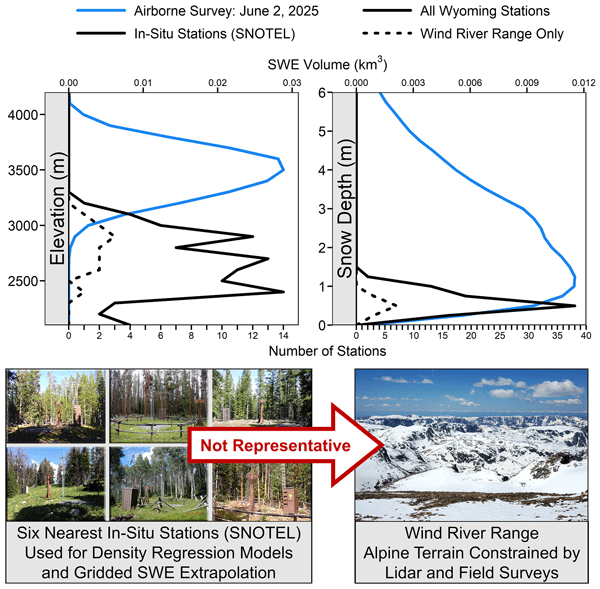
Deep wind drifts are an important component of the mountain snowpack, but drifts are underrepresented by most datasets. Our synthesis of field surveys, statistical modeling, and remote sensing quantifies the contribution of drift depth and bulk density to snowpack heterogeneity across scales, from the vertical structure at a single location to the kilometer-scale patterning of snow across a mountain range.
Elijah N. Boardman, Gabrielle F. S. Boisramé, Mark S. Wigmosta, Robert K. Shriver, and Adrian A. Harpold
Hydrol. Earth Syst. Sci., 29, 6333–6352, https://doi.org/10.5194/hess-29-6333-2025, https://doi.org/10.5194/hess-29-6333-2025, 2025
Short summary
Short summary
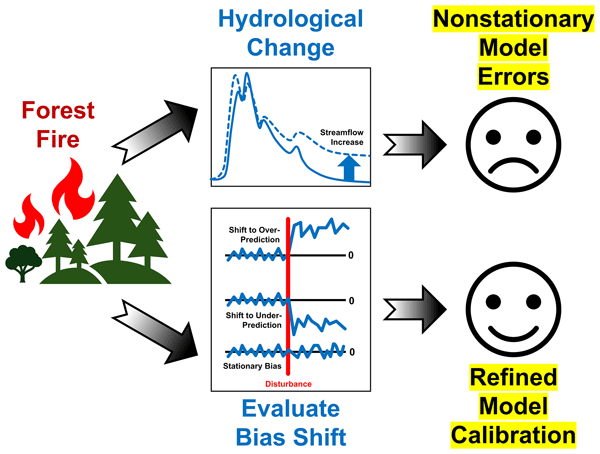
Environmental changes can cause hydrological model biases that vary over time (nonstationarity). We demonstrate a new calibration framework to detect and correct nonstationary streamflow biases after a large wildfire, which reduces predictive uncertainty and constrains parameter equifinality.
Elijah N. Boardman, Andrew G. Fountain, Joseph W. Boardman, Thomas H. Painter, Evan W. Burgess, Laura Wilson, and Adrian A. Harpold
The Cryosphere, 19, 3193–3225, https://doi.org/10.5194/tc-19-3193-2025, https://doi.org/10.5194/tc-19-3193-2025, 2025
Short summary
Short summary
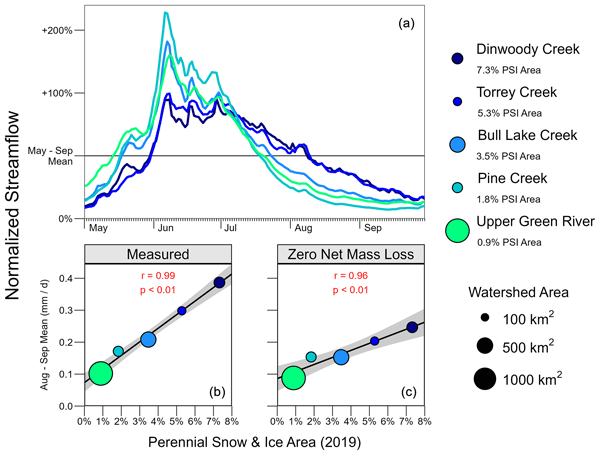
Watersheds on the downwind side of a mountain range have deeper seasonal snow and more abundant glaciers due to topographic controls that favor wind drifting. Despite receiving less total snow, these drift-prone watersheds produce relatively more late-summer streamflow due to a combination of slow-melting snow drifts and mass loss from glaciers (and other perennial snow/ice features).
Elijah N. Boardman, Karen L. Boardman, Christopher A. Jones, Sean D. Shipman, John A. Whiting, Joseph W. Boardman, and Adrian A. Harpold
The Cryosphere, 20, 4877–4910, https://doi.org/10.5194/tc-20-4877-2026, https://doi.org/10.5194/tc-20-4877-2026, 2026
Short summary
Short summary
Deep wind drifts are an important component of the mountain snowpack, but drifts are underrepresented by most datasets. Our synthesis of field surveys, statistical modeling, and remote sensing quantifies the contribution of drift depth and bulk density to snowpack heterogeneity across scales, from the vertical structure at a single location to the kilometer-scale patterning of snow across a mountain range.
Elias C. Massoud, Nathan Collier, Yaoping Wang, Jiafu Mao, Adrian Harpold, Steven A. Kannenberg, Gerbrand Koren, Mukesh Kumar, Pushpendra Raghav, Pallav Ray, Mingjie Shi, Jing Tao, Sreedevi P. Vasu, Huiqi Wang, Qing Zhu, and Forrest M. Hoffman
Geosci. Model Dev., 19, 3427–3453, https://doi.org/10.5194/gmd-19-3427-2026, https://doi.org/10.5194/gmd-19-3427-2026, 2026
Short summary
Short summary
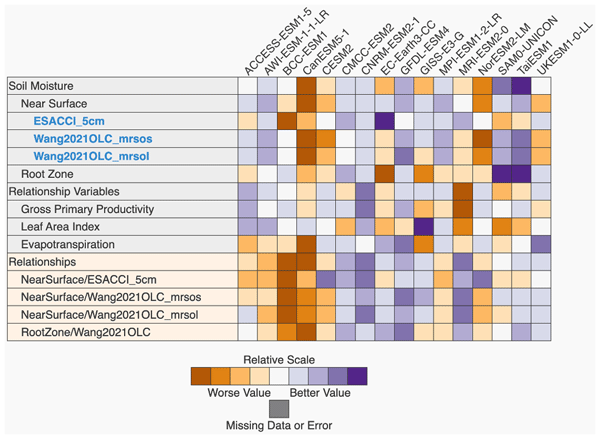
Soil moisture helps control how plants grow and how land exchanges water and energy with the atmosphere. We evaluated how well 16 Earth System Models represent soil moisture and its links to plant activity using a benchmarking system and observational data. Many models simulate surface soil moisture well but show larger errors deeper in the soil and in colder regions. Models that represent plant–soil water interactions more directly better capture how ecosystems respond to water availability.
Esteban Alonso-González, Adrian Harpold, Jessica D. Lundquist, Cara Piske, Laura Sourp, Kristoffer Aalstad, and Simon Gascoin
The Cryosphere, 20, 209–225, https://doi.org/10.5194/tc-20-209-2026, https://doi.org/10.5194/tc-20-209-2026, 2026
Short summary
Short summary
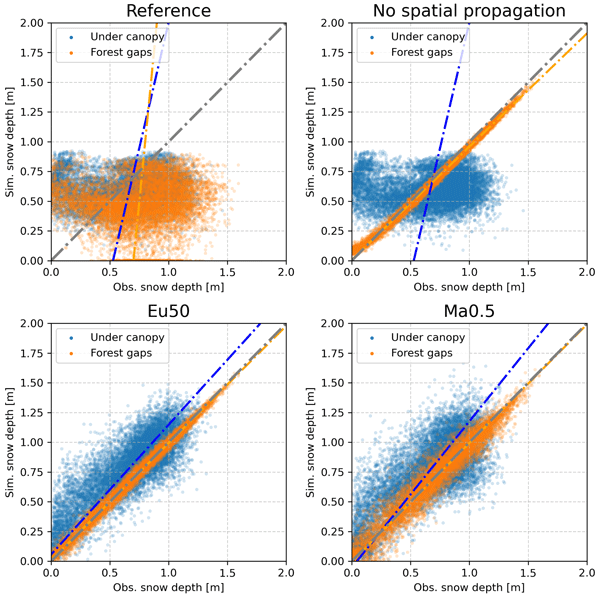
Simulating the snowpack is challenging, as there are several sources of uncertainty due to e.g. the meteorological forcing. Using data assimilation techniques, it is possible to improve the simulations by fusing models and snow observations. However in forests, observations are difficult to obtain, because they cannot be retrieved through the canopy. Here, we explore the possibility of propagating the information obtained in forest clearings to areas covered by the canopy.
Elijah N. Boardman, Gabrielle F. S. Boisramé, Mark S. Wigmosta, Robert K. Shriver, and Adrian A. Harpold
Hydrol. Earth Syst. Sci., 29, 6333–6352, https://doi.org/10.5194/hess-29-6333-2025, https://doi.org/10.5194/hess-29-6333-2025, 2025
Short summary
Short summary
Environmental changes can cause hydrological model biases that vary over time (nonstationarity). We demonstrate a new calibration framework to detect and correct nonstationary streamflow biases after a large wildfire, which reduces predictive uncertainty and constrains parameter equifinality.
Elijah N. Boardman, Andrew G. Fountain, Joseph W. Boardman, Thomas H. Painter, Evan W. Burgess, Laura Wilson, and Adrian A. Harpold
The Cryosphere, 19, 3193–3225, https://doi.org/10.5194/tc-19-3193-2025, https://doi.org/10.5194/tc-19-3193-2025, 2025
Short summary
Short summary
Watersheds on the downwind side of a mountain range have deeper seasonal snow and more abundant glaciers due to topographic controls that favor wind drifting. Despite receiving less total snow, these drift-prone watersheds produce relatively more late-summer streamflow due to a combination of slow-melting snow drifts and mass loss from glaciers (and other perennial snow/ice features).
Gary Sterle, Julia Perdrial, Dustin W. Kincaid, Kristen L. Underwood, Donna M. Rizzo, Ijaz Ul Haq, Li Li, Byung Suk Lee, Thomas Adler, Hang Wen, Helena Middleton, and Adrian A. Harpold
Hydrol. Earth Syst. Sci., 28, 611–630, https://doi.org/10.5194/hess-28-611-2024, https://doi.org/10.5194/hess-28-611-2024, 2024
Short summary
Short summary
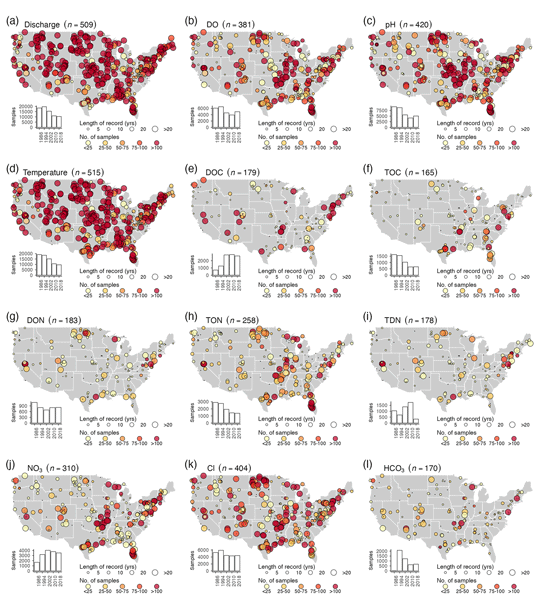
We develop stream water chemistry to pair with the existing CAMELS (Catchment Attributes and Meteorology for Large-sample Studies) dataset. The newly developed dataset, termed CAMELS-Chem, includes common stream water chemistry constituents and wet deposition chemistry in 516 catchments. Examples show the value of CAMELS-Chem to trend and spatial analyses, as well as its limitations in sampling length and consistency.
Sebastian A. Krogh, Lucia Scaff, James W. Kirchner, Beatrice Gordon, Gary Sterle, and Adrian Harpold
Hydrol. Earth Syst. Sci., 26, 3393–3417, https://doi.org/10.5194/hess-26-3393-2022, https://doi.org/10.5194/hess-26-3393-2022, 2022
Short summary
Short summary
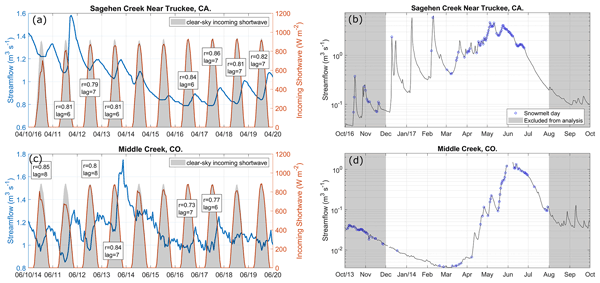
We present a new way to detect snowmelt using daily cycles in streamflow driven by solar radiation. Results show that warmer sites have earlier and more intermittent snowmelt than colder sites, and the timing of early snowmelt events is strongly correlated with the timing of streamflow volume. A space-for-time substitution shows greater sensitivity of streamflow timing to climate change in colder rather than in warmer places, which is then contrasted with land surface simulations.
Cited articles
Abatzoglou, J. T.: Development of gridded surface meteorological data for ecological applications and modelling, Int. J. Climatol., 33, 121–131, https://doi.org/10.1002/joc.3413, 2013.
Abhervé, R., Roques, C., de Dreuzy, J.-R., Van Der Veen, T., Dumaine, L., Chatton, E., Brunner, P., Aquilina, L., and Servière, L.: Projected Climate Change Impacts on Groundwater–Surface Water Connectivity in a Compartmentalized Mountain Headwater Bedrock Aquifer, Water Resour. Res., 61, e2025WR040083, https://doi.org/10.1029/2025WR040083, 2025.
Ahearn, D. S., Sheibley, R. W., Dahlgren, R. A., and Keller, K. E.: Temporal dynamics of stream water chemistry in the last free-flowing river draining the western Sierra Nevada, California, J. Hydrol., 295, 47–63, https://doi.org/10.1016/j.jhydrol.2004.02.016, 2004.
Alexander, R. B., Boyer, E. W., Smith, R. A., Schwarz, G. E., and Moore, R. B.: The Role of Headwater Streams in Downstream Water Quality, JAWRA J. Am. Water Resour. As., 43, 41–59, https://doi.org/10.1111/j.1752-1688.2007.00005.x, 2007.
Allan, J. D., Castillo, M. M., and Capps, K. A.: Stream Ecology: Structure and Function of Running Waters, Springer Nature, 494 pp., ISBN 9783030612863, 2021.
Allen, D. M., Whitfield, P. H., and Werner, A.: Groundwater level responses in temperate mountainous terrain: regime classification, and linkages to climate and streamflow, Hydrol. Process., 24, 3392–3412, https://doi.org/10.1002/hyp.7757, 2010.
Andermann, C., Longuevergne, L., Bonnet, S., Crave, A., Davy, P., and Gloaguen, R.: Impact of transient groundwater storage on the discharge of Himalayan rivers, Nat. Geosci., 5, 127–132, https://doi.org/10.1038/ngeo1356, 2012.
Aufdenkampe, A. K., Mayorga, E., Raymond, P. A., Melack, J. M., Doney, S. C., Alin, S. R., Aalto, R. E., and Yoo, K.: Riverine coupling of biogeochemical cycles between land, oceans, and atmosphere, Front. Ecol. Environ., 9, 53–60, https://doi.org/10.1890/100014, 2011.
Beckers, J., Smerdon, B., Redding, T., Anderson, A., Pike, R., and Werner, A. T.: Hydrologic models for forest management applications. Part 1: Model selection, Streamline Watershed Management Bulletin, 13, 35–44, 2009.
Bennett, A., Hamman, J., and Nijssen, B.: MetSim: A Python package for estimation and disaggregation of meteorological data, The Journal of Open Source Software, 5, 2042, https://doi.org/10.21105/joss.02042, 2020.
Berghuijs, W. R., Woods, R. A., and Hrachowitz, M.: A precipitation shift from snow towards rain leads to a decrease in streamflow, Nat. Clim. Change, 4, 583–586, https://doi.org/10.1038/nclimate2246, 2014.
Beven, K.: On subsurface stormflow: Predictions with simple kinematic theory for saturated and unsaturated flows, Water Resour. Res., 18, 1627–1633, https://doi.org/10.1029/WR018i006p01627, 1982.
Beven, K.: Searching for the Holy Grail of scientific hydrology:
Beven, K. J. and Kirkby, M. J.: A physically based, variable contributing area model of basin hydrology [Un modèle à base physique de zone d'appel variable de l'hydrologie du bassin versant], Hydrol. Sci. B., 24, 43–69, https://doi.org/10.1080/02626667909491834, 1979.
Bieger, K., Rathjens, H., Allen, P. M., and Arnold, J. G.: Development and Evaluation of Bankfull Hydraulic Geometry Relationships for the Physiographic Regions of the United States, JAWRA J. Am. Water Resour. As., 51, 842–858, https://doi.org/10.1111/jawr.12282, 2015.
Blumhagen, E. D. and Clark, J. F.: Carbon sources and signals through time in an Alpine groundwater Basin, Sagehen California, Appl. Geochem., 23, 2284–2291, https://doi.org/10.1016/j.apgeochem.2008.03.010, 2008.
Blyth, K. and Rodda, J. C.: A stream length study, Water Resour. Res., 9, 1454–1461, https://doi.org/10.1029/WR009i005p01454, 1973.
Boardman, E.: Animation of Groundwater and Dynamic Stream Networks in DHSVM, TIB-AV-Portal [video], https://doi.org/10.5446/72156, 2025a.
Boardman, E.: Data and Code for Stream Network Hysteresis Study Using DHSVM in Sagehen Creek Basin, Zenodo [code] and [data set], https://doi.org/10.5281/zenodo.17958146, 2025b.
Boardman, E. N., Boisramé, G. F. S., Wigmosta, M. S., Shriver, R. K., and Harpold, A. A.: Improving model calibrations in a changing world: controlling for nonstationarity after mega disturbance reduces hydrological uncertainty, Hydrol. Earth Syst. Sci., 29, 6333–6352, https://doi.org/10.5194/hess-29-6333-2025, 2025.
Botter, G., Vingiani, F., Senatore, A., Jensen, C., Weiler, M., McGuire, K., Mendicino, G., and Durighetto, N.: Hierarchical climate-driven dynamics of the active channel length in temporary streams, Sci. Rep., 11, 21503, https://doi.org/10.1038/s41598-021-00922-2, 2021.
Breiman, L., Cutler, A., Liaw, A., and Wiener, M.: randomForest: Breiman and Cutlers Random Forests for Classification and Regression, CRAN [code], https://doi.org/10.32614/CRAN.package.randomForest, 2002.
Brown, L. E., Milner, A. M., and Hannah, D. M.: Groundwater influence on alpine stream ecosystems, Freshwater Biol., 52, 878–890, https://doi.org/10.1111/j.1365-2427.2007.01739.x, 2007.
Camporese, M., Penna, D., Borga, M., and Paniconi, C.: A field and modeling study of nonlinear storage-discharge dynamics for an Alpine headwater catchment, Water Resour. Res., 50, 806–822, https://doi.org/10.1002/2013WR013604, 2014.
Cano-Paoli, K., Chiogna, G., and Bellin, A.: Convenient use of electrical conductivity measurements to investigate hydrological processes in Alpine headwaters, Sci. Total Environ., 685, 37–49, https://doi.org/10.1016/j.scitotenv.2019.05.166, 2019.
Carlston, C. W.: Drainage Density and Streamflow, U.S. Government Printing Office, 20 pp., https://www.google.com/books/edition/Drainage_Density_and_Streamflow/FLsvAAAAYAAJ (last access: 11 August 2026), 1963.
Castro, J. M. and Thorne, C. R.: The stream evolution triangle: Integrating geology, hydrology, and biology, River Res. Appl., 35, 315–326, https://doi.org/10.1002/rra.3421, 2019.
Clark, M. P. and Kavetski, D.: Ancient numerical daemons of conceptual hydrological modeling: 1. Fidelity and efficiency of time stepping schemes, Water Resour. Res., 46, https://doi.org/10.1029/2009WR008894, 2010.
Clarke, A., Mac Nally, R., Bond, N., and Lake, P. S.: Macroinvertebrate diversity in headwater streams: a review, Freshwater Biol., 53, 1707–1721, https://doi.org/10.1111/j.1365-2427.2008.02041.x, 2008.
Conway, J. and Gardner, M.: Mathematical Games, Sci. Am., 223, 120–123, 1970.
Cook, M.: Universality in Elementary Cellular Automata, ComplexSystems, 15, 1–40, https://doi.org/10.25088/ComplexSystems.15.1.1, 2004.
Cristea, N. C., Lundquist, J. D., Loheide, S. P., Lowry, C. S., and Moore, C. E.: Modelling how vegetation cover affects climate change impacts on streamflow timing and magnitude in the snowmelt‐dominated upper Tuolumne Basin, Sierra Nevada, Hydrol. Process., 28, 3896–3918, https://doi.org/10.1002/hyp.9909, 2014.
Detty, J. M. and McGuire, K. J.: Threshold changes in storm runoff generation at a till-mantled headwater catchment, Water Resour. Res., 46, https://doi.org/10.1029/2009WR008102, 2010a.
Detty, J. M. and McGuire, K. J.: Topographic controls on shallow groundwater dynamics: implications of hydrologic connectivity between hillslopes and riparian zones in a till mantled catchment, Hydrol. Process., 24, 2222–2236, https://doi.org/10.1002/hyp.7656, 2010b.
De Vries, J. J.: Seasonal expansion and contraction of stream networks in shallow groundwater systems, J. Hydrol., 170, 15–26, https://doi.org/10.1016/0022-1694(95)02684-H, 1995.
Dewitz, J. and U.S. Geological Survey: National Land Cover Database (NLCD) 2019 Products, U.S. Geological Survey, https://doi.org/10.5066/P9JZ7AO3, 2019.
Dhungel, S., Tarboton, D. G., Jin, J., and Hawkins, C. P.: Potential Effects of Climate Change on Ecologically Relevant Streamflow Regimes: Climate Change and Streamflow Regimes, River Res. Appl., 32, 1827–1840, https://doi.org/10.1002/rra.3029, 2016.
Downing, J. A., Cole, J. J., Duarte, C. M., Middelburg, J. J., Melack, J. M., Prairie, Y. T., Kortelainen, P., Striegl, R. G., McDowell, W. H., and Tranvik, L. J.: Global abundance and size distribution of streams and rivers, Inland Waters, 2, 229–236, https://doi.org/10.5268/IW-2.4.502, 2012.
Dralle, D. N., Lapides, D. A., Rempe, D. M., and Hahm, W. J.: Mapping Surface Water Presence and Hyporheic Flow Properties of Headwater Stream Networks With Multispectral Satellite Imagery, Water Resour. Res., 59, e2022WR034169, https://doi.org/10.1029/2022WR034169, 2023.
Druhan, J. L. and Benettin, P.: Isotope Ratio – Discharge Relationships of Solutes Derived From Weathering Reactions, Am. J. Sci., 323, https://doi.org/10.2475/001c.84469, 2023.
Dugdale, S. J., Klaus, J., and Hannah, D. M.: Looking to the Skies: Realising the Combined Potential of Drones and Thermal Infrared Imagery to Advance Hydrological Process Understanding in Headwaters, Water Resour. Res., 58, e2021WR031168, https://doi.org/10.1029/2021WR031168, 2022.
Durighetto, N., Vingiani, F., Bertassello, L. E., Camporese, M., and Botter, G.: Intraseasonal Drainage Network Dynamics in a Headwater Catchment of the Italian Alps, Water Resour. Res., 56, e2019WR025563, https://doi.org/10.1029/2019WR025563, 2020.
Durighetto, N., Britt, R., Schirmer, M., and Botter, G.: Variability in the Shape of the Active Length–Streamflow Relationship in Temporary Streams: Insights From an Empirical Analysis, Water Resour. Res., 61, e2024WR038732, https://doi.org/10.1029/2024WR038732, 2025.
Essaid, H. I. and Hill, B. R.: Watershed-scale modeling of streamflow change in incised montane meadows, Water Resour. Res., 50, 2657–2678, https://doi.org/10.1002/2013WR014420, 2014.
Foster, L. M., Bearup, L. A., Molotch, N. P., Brooks, P. B., and Maxwell, R. M.: Energy budget increases reduce mean streamflow more than snow–rain transitions: using integrated modeling to isolate climate change impacts on Rocky Mountain hydrology, Environ. Res. Lett., 11, 044015, https://doi.org/10.1088/1748-9326/11/4/044015, 2016.
Freeman, M. C., Pringle, C. M., and Jackson, C. R.: Hydrologic Connectivity and the Contribution of Stream Headwaters to Ecological Integrity at Regional Scales, JAWRA J. Am. Water Resour. As., 43, 5–14, https://doi.org/10.1111/j.1752-1688.2007.00002.x, 2007.
Freeze, R. A. and Cherry, J. A.: Groundwater, Prentice-Hall, Englewood Cliffs, N.J, 604 pp., ISBN 9780133653120, 1979.
Fritz, K. M., Hagenbuch, E., D'Amico, E., Reif, M., Wigington, P. J., Leibowitz, S. G., Comeleo, R. L., Ebersole, J. L., and Nadeau, T.: Comparing the Extent and Permanence of Headwater Streams From Two Field Surveys to Values From Hydrographic Databases and Maps, J. Am. Water Resour. As., 49, 867–882, https://doi.org/10.1111/jawr.12040, 2013.
Gao, S., Chen, M., Li, Z., Cook, S., Allen, D., Neeson, T., Yang, T., Yami, T., and Hong, Y.: Mapping dynamic non-perennial stream networks using high-resolution distributed hydrologic simulation: A case study in the upper blue river basin, J. Hydrol., 600, 126522, https://doi.org/10.1016/j.jhydrol.2021.126522, 2021.
Godsey, S. E. and Kirchner, J. W.: Dynamic, discontinuous stream networks: hydrologically driven variations in active drainage density, flowing channels and stream order, Hydrol. Process., 28, 5791–5803, https://doi.org/10.1002/hyp.10310, 2014.
Gordon, B. L., Brooks, P. D., Krogh, S. A., Boisrame, G. F. S., Carroll, R. W. H., McNamara, J. P., and Harpold, A. A.: Why does snowmelt-driven streamflow response to warming vary? A data-driven review and predictive framework, Environ. Res. Lett., 17, 053004, https://doi.org/10.1088/1748-9326/ac64b4, 2022.
Graup, L. J., Tague, C. L., Harpold, A. A., and Krogh, S. A.: Subsurface Lateral Flows Buffer Riparian Water Stress Against Snow Drought, J. Geophys. Res.-Biogeo., 127, e2022JG006980, https://doi.org/10.1029/2022JG006980, 2022.
Gregory, K. J. and Walling, D. E.: The variation of drainage density within a catchment, International Association of Scientific Hydrology. Bulletin, 13, 61–68, https://doi.org/10.1080/02626666809493583, 1968.
Gu, H., Xu, Y.-P., Liu, L., Xie, J., Wang, L., Pan, S., and Guo, Y.: Seasonal catchment memory of high mountain rivers in the Tibetan Plateau, Nat. Commun., 14, 3173, https://doi.org/10.1038/s41467-023-38966-9, 2023.
Gupta, S., Papritz, A., Lehmann, P., Hengl, T., Bonetti, S., and Or, D.: Global Mapping of Soil Water Characteristics Parameters – Fusing Curated Data with Machine Learning and Environmental Covariates, Remote Sensing, 14, 1947, https://doi.org/10.3390/rs14081947, 2022.
Harpold, A. A. and Molotch, N. P.: Sensitivity of soil water availability to changing snowmelt timing in the western U.S., Geophys. Res. Lett., 42, 8011–8020, https://doi.org/10.1002/2015GL065855, 2015.
Hasan, M. M., Strong, C., Brooks, P. D., Burian, S. J., and Barber, M. E.: Quantifying climate change impacts on low flows of small high mountain watersheds: A nonstationary approach, J. Hydrol.: Regional Studies, 48, 101463, https://doi.org/10.1016/j.ejrh.2023.101463, 2023.
Hewlett, J. D. and Hibbert, A. R.: Factors affecting the response of small watersheds to precipitation in humid areas, Forest Hydrology, 11, 275–290, 1967.
Holloway, J. M. and Dahlgren, R. A.: Seasonal and event-scale variations in solute chemistry for four Sierra Nevada catchments, J. Hydrol., 250, 106–121, https://doi.org/10.1016/S0022-1694(01)00424-3, 2001.
Hrachowitz, M. and Clark, M. P.: HESS Opinions: The complementary merits of competing modelling philosophies in hydrology, Hydrol. Earth Syst. Sci., 21, 3953–3973, https://doi.org/10.5194/hess-21-3953-2017, 2017.
Huang, X., Hall, A. D., and Berg, N.: Anthropogenic Warming Impacts on Today's Sierra Nevada Snowpack and Flood Risk, Geophys. Res. Lett., 45, 6215–6222, https://doi.org/10.1029/2018GL077432, 2018.
Jaeger, K. L., Olden, J. D., and Pelland, N. A.: Climate change poised to threaten hydrologic connectivity and endemic fishes in dryland streams, P. Natl. Acad. Sci. UA, 111, 13894–13899, https://doi.org/10.1073/pnas.1320890111, 2014.
Jensen, C. K., McGuire, K. J., and Prince, P. S.: Headwater stream length dynamics across four physiographic provinces of the Appalachian Highlands, Hydrol. Process., 31, 3350–3363, https://doi.org/10.1002/hyp.11259, 2017.
Jensen, C. K., McGuire, K. J., McLaughlin, D. L., and Scott, D. T.: Quantifying spatiotemporal variation in headwater stream length using flow intermittency sensors, Environ. Monit. Assess., 191, 226, https://doi.org/10.1007/s10661-019-7373-8, 2019.
Jones, D. R., Schonlau, M., and Welch, W. J.: Efficient Global Optimization of Expensive Black-Box Functions, J. Global Optim., 13, 455–492, https://doi.org/10.1023/A:1008306431147, 1998.
Kampf, S. K. and Lefsky, M. A.: Transition of dominant peak flow source from snowmelt to rainfall along the Colorado Front Range: Historical patterns, trends, and lessons from the 2013 Colorado Front Range floods, Water Resour. Res., 52, 407–422, https://doi.org/10.1002/2015WR017784, 2016.
Kampf, S. K., Faulconer, J., Shaw, J. R., Sutfin, N. A., and Cooper, D. J.: Rain and channel flow supplements to subsurface water beneath hyper-arid ephemeral stream channels, J. Hydrol., 536, 524–533, https://doi.org/10.1016/j.jhydrol.2016.03.016, 2016.
Kendall, M. G.: Rank Correlation Methods, 4th Edn., Charles Griffin, London, ISBN 9780852641996, 1975.
Kendall, K. A., Shanley, J. B., and McDonnell, J. J.: A hydrometric and geochemical approach to test the transmissivity feedback hypothesis during snowmelt, J. Hydrol., 219, 188–205, https://doi.org/10.1016/S0022-1694(99)00059-1, 1999.
Kirchner, J. W.: Getting the right answers for the right reasons: Linking measurements, analyses, and models to advance the science of hydrology, Water Resour. Res., 42, https://doi.org/10.1029/2005WR004362, 2006.
Kirchner, J. W., Godsey, S. E., Solomon, M., Osterhuber, R., McConnell, J. R., and Penna, D.: The pulse of a montane ecosystem: coupling between daily cycles in solar flux, snowmelt, transpiration, groundwater, and streamflow at Sagehen Creek and Independence Creek, Sierra Nevada, USA, Hydrol. Earth Syst. Sci., 24, 5095–5123, https://doi.org/10.5194/hess-24-5095-2020, 2020.
Klos, P. Z., Link, T. E., and Abatzoglou, J. T.: Extent of the rain-snow transition zone in the western U.S. under historic and projected climate, Geophys. Res. Lett., 41, 4560–4568, https://doi.org/10.1002/2014GL060500, 2014.
La Barbera, P. and Rosso, R.: On the fractal dimension of stream networks, Water Resour. Res., 25, 735–741, https://doi.org/10.1029/WR025i004p00735, 1989.
LANDFIRE: LANDFIRE 2022 Existing Vegetation Type (EVT), U.S. Department of the Interior, Geological Survey, and U.S. Department of Agriculture, https://landfire.gov/data (last access: 11 August 2026), 2022.
Lane, C. R., D'Amico, E., Christensen, J. R., Golden, H. E., Cheng, F. Y., Hammond, J. C., Husic, A., Jaeger, K. L., Jones, C. N., Kelleher, C. A., Li, L., Mahoney, D. T., McMillan, H. K., Price, A. N., Sando, R., Segura, C., Seybold, E. C., Ward, A. S., and Zimmer, M.: Identifying Headwater Streams across the Conterminous United States, Ecosystems, 29, 22, https://doi.org/10.1007/s10021-025-01041-z, 2026.
Lapides, D. A., Leclerc, C. D., Moidu, H., Dralle, D. N., and Hahm, W. J.: Variability of stream extents controlled by flow regime and network hydraulic scaling, Hydrol. Process., 35, e14079, https://doi.org/10.1002/hyp.14079, 2021.
Lee, S.-Y., Fullerton, A. H., Sun, N., and Torgersen, C. E.: Projecting spatiotemporally explicit effects of climate change on stream temperature: A model comparison and implications for coldwater fishes, J. Hydrol., 588, 125066, https://doi.org/10.1016/j.jhydrol.2020.125066, 2020.
Limerinos, J. T.: Determination of the manning coefficient from measured bed roughness in natural channels, U.S. Geological Survey, https://doi.org/10.3133/wsp1898B, 1970.
Liu, S., Kuhn, C., Amatulli, G., Aho, K., Butman, D. E., Allen, G. H., Lin, P., Pan, M., Yamazaki, D., Brinkerhoff, C., Gleason, C., Xia, X., and Raymond, P. A.: The importance of hydrology in routing terrestrial carbon to the atmosphere via global streams and rivers, P. Natl. Acad. Sci. USA, 119, e2106322119, https://doi.org/10.1073/pnas.2106322119, 2022.
Lundquist, J. D. and Cayan, D. R.: Surface temperature patterns in complex terrain: Daily variations and long-term change in the central Sierra Nevada, California, J. Geophys. Res.-Atmos., 112, https://doi.org/10.1029/2006JD007561, 2007.
Mahoney, D. T., Christensen, J. R., Golden, H. E., Lane, C. R., Evenson, G. R., White, E., Fritz, K. M., D'Amico, E., Barton, C. D., Williamson, T. N., Sena, K. L., and Agouridis, C. T.: Dynamics of streamflow permanence in a headwater network: Insights from catchment-scale model simulations, J. Hydrol., 620, 129422, https://doi.org/10.1016/j.jhydrol.2023.129422, 2023.
Mandelbrot, B. B.: The fractal geometry of nature, W. H. Freeman, New York, 468 pp., ISBN 9780716711865, 1982.
Mann, H. B.: Non-parametric tests against trend, Econometrica, 13, 163–171, 1945.
Manning, A. H., Clark, J. F., Diaz, S. H., Rademacher, L. K., Earman, S., and Niel Plummer, L.: Evolution of groundwater age in a mountain watershed over a period of thirteen years, J. Hydrol., 460–461, 13–28, https://doi.org/10.1016/j.jhydrol.2012.06.030, 2012.
Marçais, J., Gauvain, A., Labasque, T., Abbott, B. W., Pinay, G., Aquilina, L., Chabaux, F., Viville, D., and De Dreuzy, J.-R.: Dating groundwater with dissolved silica and CFC concentrations in crystalline aquifers, Sci. Total Environ., 636, 260–272, https://doi.org/10.1016/j.scitotenv.2018.04.196, 2018.
Marx, A., Dusek, J., Jankovec, J., Sanda, M., Vogel, T., van Geldern, R., Hartmann, J., and Barth, J. A. C.: A review of CO2 and associated carbon dynamics in headwater streams: A global perspective, Rev. Geophys., 55, 560–585, https://doi.org/10.1002/2016RG000547, 2017.
McCleskey, R. B., Clor, L. E., Lowenstern, J. B., Evans, W. C., Nordstrom, D. K., Heasler, H., and Huebner, M. A.: Solute and geothermal flux monitoring using electrical conductivity in the Madison, Firehole, and Gibbon Rivers, Yellowstone National Park, Appl. Geochem., 27, 2370–2381, https://doi.org/10.1016/j.apgeochem.2012.07.019, 2012.
McGlynn, B. L. and McDonnell, J. J.: Quantifying the relative contributions of riparian and hillslope zones to catchment runoff, Water Resour. Res., 39, https://doi.org/10.1029/2003WR002091, 2003.
McGlynn, B. L., McDonnell, J. J., Seibert, J., and Kendall, C.: Scale effects on headwater catchment runoff timing, flow sources, and groundwater-streamflow relations, Water Resour Res., 40, https://doi.org/10.1029/2003WR002494, 2004.
Meyer, J. L., Strayer, D. L., Wallace, J. B., Eggert, S. L., Helfman, G. S., and Leonard, N. E.: The Contribution of Headwater Streams to Biodiversity in River Networks, J. Am. Water Resour. As., 43, 86–103, https://doi.org/10.1111/j.1752-1688.2007.00008.x, 2007.
Meyers, Z. P., Rademacher, L. K., Frisbee, M. D., and Warix, S. R.: Extending classical geochemical weathering studies through the mountain block: The effect of increasing scale on geochemical evolution in the Sierra Nevada (CA), Chem. Geol., 598, 120831, https://doi.org/10.1016/j.chemgeo.2022.120831, 2022.
Milly, P. C. D., Betancourt, J., Falkenmark, M., Hirsch, R. M., Kundzewicz, Z. W., Lettenmaier, D. P., and Stouffer, R. J.: Stationarity Is Dead: Whither Water Management?, Science, 319, 573–574, https://doi.org/10.1126/science.1151915, 2008.
Milly, P. C. D., Betancourt, J., Falkenmark, M., Hirsch, R. M., Kundzewicz, Z. W., Lettenmaier, D. P., Stouffer, R. J., Dettinger, M. D., and Krysanova, V.: On Critiques of “Stationarity is Dead: Whither Water Management?”, Water Resour. Res., 51, 7785–7789, https://doi.org/10.1002/2015WR017408, 2015.
Null, S. E., Viers, J. H., and Mount, J. F.: Hydrologic Response and Watershed Sensitivity to Climate Warming in California's Sierra Nevada, PLOS ONE, 5, e9932, https://doi.org/10.1371/journal.pone.0009932, 2010.
Patterson, N. K., Lane, B. A., Sandoval-Solis, S., Persad, G. G., and Ortiz-Partida, J. P.: Projected Effects of Temperature and Precipitation Variability Change on Streamflow Patterns Using a Functional Flows Approach, Earth's Future, 10, e2021EF002631, https://doi.org/10.1029/2021EF002631, 2022.
Patton, N. R., Lohse, K. A., Godsey, S. E., Crosby, B. T., and Seyfried, M. S.: Predicting soil thickness on soil mantled hillslopes, Nat. Commun., 9, 3329, https://doi.org/10.1038/s41467-018-05743-y, 2018.
Payton Gardner, W., Susong, D. D., Kip Solomon, D., and Heasler, H.: Snowmelt hydrograph interpretation: Revealing watershed scale hydrologic characteristics of the Yellowstone volcanic plateau, J. Hydrol., 383, 209–222, https://doi.org/10.1016/j.jhydrol.2009.12.037, 2010.
Penna, D., Tromp-van Meerveld, H. J., Gobbi, A., Borga, M., and Dalla Fontana, G.: The influence of soil moisture on threshold runoff generation processes in an alpine headwater catchment, Hydrol. Earth Syst. Sci., 15, 689–702, https://doi.org/10.5194/hess-15-689-2011, 2011.
Prancevic, J. P. and Kirchner, J. W.: Topographic Controls on the Extension and Retraction of Flowing Streams, Geophys. Res. Lett., 46, 2084–2092, https://doi.org/10.1029/2018GL081799, 2019.
Prancevic, J. P., Seybold, H., and Kirchner, J. W.: Variability of flowing stream network length across the US, Science, 387, 782–786, https://doi.org/10.1126/science.ado2860, 2025.
Price, A. N. and Kaiser, K. E.: Process-Based Hydrologic Model Representations of Non-Perennial Streamflow in the Pacific Northwest, USA, Water Resour. Res., 62, e2025WR040626, https://doi.org/10.1029/2025WR040626, 2026.
Rademacher, L. K., Clark, J. F., Hudson, G. B., Erman, D. C., and Erman, N. A.: Chemical evolution of shallow groundwater as recorded by springs, Sagehen basin; Nevada County, California, Chem. Geol., 179, 37–51, https://doi.org/10.1016/S0009-2541(01)00314-X, 2001.
Rademacher, L. K., Clark, J. F., Clow, D. W., and Hudson, G. B.: Old groundwater influence on stream hydrochemistry and catchment response times in a small Sierra Nevada catchment: Sagehen Creek, California, Water Resour. Res., 41, https://doi.org/10.1029/2003WR002805, 2005.
Ridgeway, J. B. and Surfleet, C. G.: Effects of Streamside Buffers on Stream Temperatures Associated With Forest Management and Harvesting Using DHSVM-RBM; South Fork Caspar Creek, California, Front. For. Glob. Change, 4, https://doi.org/10.3389/ffgc.2021.611380, 2021.
Rigge, M. B., Bunde, B., Shi, H., and Postma, K.: Rangeland Condition Monitoring Assessment and Projection (RCMAP) Fractional Component Time-Series Across the Western U.S. 1985–2020 (2.0, October 2021), U.S. Geological Survey, https://doi.org/10.5066/P95IQ4BT, 2021.
Roberts, M. C. and Archibold, O. W.: VARIATION OF DRAINAGE DENSITY IN A SMALL BRITISH COLUMBIA WATERSHED, J. Am. Water Resour. As., 14, 470–476, https://doi.org/10.1111/j.1752-1688.1978.tb02183.x, 1978.
Rodhe, A. and Seibert, J.: Groundwater dynamics in a till hillslope: flow directions, gradients and delay, Hydrol. Process., 25, 1899–1909, https://doi.org/10.1002/hyp.7946, 2011.
Sen, P. K.: Estimates of the Regression Coefficient Based on Kendall's Tau, J. Am. Stat. Assoc., 63, 1379–1389, https://doi.org/10.1080/01621459.1968.10480934, 1968.
Senatore, A., Micieli, M., Liotti, A., Durighetto, N., Mendicino, G., and Botter, G.: Monitoring and Modeling Drainage Network Contraction and Dry Down in Mediterranean Headwater Catchments, Water Resour. Res., 57, e2020WR028741, https://doi.org/10.1029/2020WR028741, 2021.
Shaw, S. B.: Investigating the linkage between streamflow recession rates and channel network contraction in a mesoscale catchment in New York state, Hydrol. Process., 30, 479–492, https://doi.org/10.1002/hyp.10626, 2016.
Soil Survey Staff: Soil Survey Geographic (SSURGO) Database, https://sdmdataaccess.sc.egov.usda.gov (last access: 11 August 2026) 2022.
Spence, C.: A Paradigm Shift in Hydrology: Storage Thresholds Across Scales Influence Catchment Runoff Generation, Geography Compass, 4, 819–833, https://doi.org/10.1111/j.1749-8198.2010.00341.x, 2010.
Sproles, E. A., Leibowitz, S. G., Reager, J. T., Wigington Jr, P. J., Famiglietti, J. S., and Patil, S. D.: GRACE storage-runoff hystereses reveal the dynamics of regional watersheds, Hydrol. Earth Syst. Sci., 19, 3253–3272, https://doi.org/10.5194/hess-19-3253-2015, 2015.
Stieglitz, M., Shaman, J., McNamara, J., Engel, V., Shanley, J., and Kling, G. W.: An approach to understanding hydrologic connectivity on the hillslope and the implications for nutrient transport, Global Biogeochem. Cy., 17, https://doi.org/10.1029/2003GB002041, 2003.
Strahler, A. N.: Quantitative analysis of watershed geomorphology, Eos Trans. AGU, 38, 913–920, https://doi.org/10.1029/TR038i006p00913, 1957.
Sun, F., Berg, N., Hall, A., Schwartz, M., and Walton, D.: Understanding End-of-Century Snowpack Changes Over California's Sierra Nevada, Geophys. Res. Lett., 46, 933–943, https://doi.org/10.1029/2018GL080362, 2019.
Sun, R., Hernández, F., Liang, X., and Yuan, H.: A Calibration Framework for High-Resolution Hydrological Models Using a Multiresolution and Heterogeneous Strategy, Water Resour. Res., 56, e2019WR026541, https://doi.org/10.1029/2019WR026541, 2020.
Tague, C. and Peng, H.: The sensitivity of forest water use to the timing of precipitation and snowmelt recharge in the California Sierra: Implications for a warming climate, J. Geophys. Res.-Biogeo., 118, 875–887, https://doi.org/10.1002/jgrg.20073, 2013.
Thackeray, C. W., Derksen, C., Fletcher, C. G., and Hall, A.: Snow and Climate: Feedbacks, Drivers, and Indices of Change, Curr. Clim. Change Rep., 5, 322–333, https://doi.org/10.1007/s40641-019-00143-w, 2019.
U.S. Geological Survey: USGS TNM Hydrography (NHD), U.S. Geological Survey, https://www.usgs.gov/national-hydrography/national-hydrography-dataset (last access: 11 August 2026), 2019.
van Meerveld, H. J., Seibert, J., and Peters, N. E.: Hillslope–riparian‐stream connectivity and flow directions at the Panola Mountain Research Watershed, Hydrol. Process., 29, 3556–3574, https://doi.org/10.1002/hyp.10508, 2015.
Venables, W. N. and Ripley, B. D.: Modern Applied Statistics with S, Springer New York, New York, NY, https://doi.org/10.1007/978-0-387-21706-2, 2002.
von Freyberg, J., Radny, D., Gall, H. E., and Schirmer, M.: Implications of hydrologic connectivity between hillslopes and riparian zones on streamflow composition, J. Contam. Hydrol., 169, 62–74, https://doi.org/10.1016/j.jconhyd.2014.07.005, 2014.
Von Schiller, D., Bernal, S., Dahm, C. N., and Martí, E.: Nutrient and Organic Matter Dynamics in Intermittent Rivers and Ephemeral Streams, in: Intermittent Rivers and Ephemeral Streams, Elsevier, 135–160, https://doi.org/10.1016/B978-0-12-803835-2.00006-1, 2017.
Ward, A. S., Schmadel, N. M., and Wondzell, S. M.: Simulation of dynamic expansion, contraction, and connectivity in a mountain stream network, Adv. Water Resour., 114, 64–82, https://doi.org/10.1016/j.advwatres.2018.01.018, 2018.
Ward, A. S., Wondzell, S. M., Schmadel, N. M., and Herzog, S. P.: Climate Change Causes River Network Contraction and Disconnection in the H.J. Andrews Experimental Forest, Oregon, USA, Front. Water, 2, https://doi.org/10.3389/frwa.2020.00007, 2020.
Warix, S. R., Navarre-Sitchler, A., Manning, A. H., and Singha, K.: Local Topography and Streambed Hydraulic Conductivity Influence Riparian Groundwater Age and Groundwater-Surface Water Connection, Water Resour. Res., 59, e2023WR035044, https://doi.org/10.1029/2023WR035044, 2023.
Whiting, J. A. and Godsey, S. E.: Discontinuous headwater stream networks with stable flowheads, Salmon River basin, Idaho, Hydrol. Process., 30, 2305–2316, https://doi.org/10.1002/hyp.10790, 2016.
Wigmosta, M. S. and Perkins, W. A.: Simulating the Effects of Forest Roads on Watershed Hydrology, in: Land Use and Watersheds: Human Influence on Hydrology and Geomorphology in Urban and Forest Areas, American Geophysical Union (AGU), 127–143, https://doi.org/10.1029/WS002p0127, 2001.
Wigmosta, M. S., Vail, L. W., and Lettenmaier, D. P.: A distributed hydrology-vegetation model for complex terrain, Water Resour. Res., 30, 1665–1679, https://doi.org/10.1029/94WR00436, 1994.
Winter, T. C., Harvey, J. W., Franke, O. L., and Alley, W. M.: Ground water and surface water: A single resource, U.S. Geological Survey, https://doi.org/10.3133/cir1139, 1999.
Wolfram, S.: Universality and complexity in cellular automata, Physica D, 10, 1–35, https://doi.org/10.1016/0167-2789(84)90245-8, 1984.
Wondzell, S. M.: The role of the hyporheic zone across stream networks, Hydrol. Process., 25, 3525–3532, https://doi.org/10.1002/hyp.8119, 2011.
Zanetti, F., Durighetto, N., Vingiani, F., and Botter, G.: Technical note: Analyzing river network dynamics and the active length–discharge relationship using water presence sensors, Hydrol. Earth Syst. Sci., 26, 3497–3516, https://doi.org/10.5194/hess-26-3497-2022, 2022.
Zanetti, F., Botter, G., and Camporese, M.: Stream Network Dynamics of Non-Perennial Rivers: Insights From Integrated Surface-Subsurface Hydrological Modeling of Two Virtual Catchments, Water Resour. Res., 60, e2023WR035631, https://doi.org/10.1029/2023WR035631, 2024.
Zimmer, M. A. and McGlynn, B. L.: Bidirectional stream–groundwater flow in response to ephemeral and intermittent streamflow and groundwater seasonality, Hydrol. Process., 31, 3871–3880, https://doi.org/10.1002/hyp.11301, 2017a.
Zimmer, M. A. and McGlynn, B. L.: Ephemeral and intermittent runoff generation processes in a low relief, highly weathered catchment, Water Resour. Res., 53, 7055–7077, https://doi.org/10.1002/2016WR019742, 2017b.
Short summary
Distributed simulations and geochemical data indicate that groundwater hysteresis dampens the elasticity of flowing stream networks. This effect is expected to become more important as intense rainfall events replace gradual snowmelt in a warmer climate.
Distributed simulations and geochemical data indicate that groundwater hysteresis dampens the...


