Articles | Volume 30, issue 2
https://doi.org/10.5194/hess-30-459-2026
© Author(s) 2026. This work is distributed under
the Creative Commons Attribution 4.0 License.
https://doi.org/10.5194/hess-30-459-2026
© Author(s) 2026. This work is distributed under
the Creative Commons Attribution 4.0 License.
Evaluating the feasibility of scaling the FIER framework for large-scale flood inundation prediction
Kel N. Markert
CORRESPONDING AUTHOR
Google LLC, Mountain View, CA 94043, USA
Department of Civil and Construction Engineering, Brigham Young University, Provo, UT 84602, USA
Hyongki Lee
Department of Civil and Environmental Engineering, University of Houston, Houston, TX 77204, USA
Gustavious P. Williams
Department of Civil and Construction Engineering, Brigham Young University, Provo, UT 84602, USA
E. James Nelson
Department of Civil and Construction Engineering, Brigham Young University, Provo, UT 84602, USA
Daniel P. Ames
Department of Civil and Construction Engineering, Brigham Young University, Provo, UT 84602, USA
Robert E. Griffin
Department of Atmospheric and Earth Science, University of Alabama in Huntsville, Huntsville, AL 35899, USA
Franz J. Meyer
Geophysical Institute, University of Alaska Fairbanks, Fairbanks, AK, USA
Related authors
No articles found.
Taha Sadeghi Chorsi, Franz J. Meyer, and Timothy H. Dixon
The Cryosphere, 18, 3723–3740, https://doi.org/10.5194/tc-18-3723-2024, https://doi.org/10.5194/tc-18-3723-2024, 2024
Short summary
Short summary
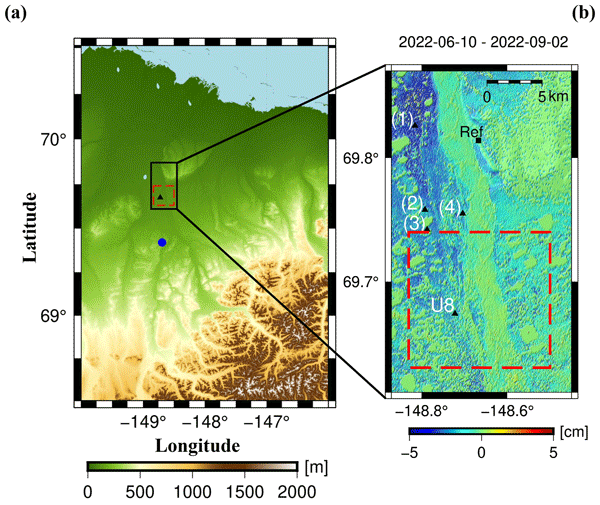
The active layer thaws and freezes seasonally. The annual freeze–thaw cycle of the active layer causes significant surface height changes due to the volume difference between ice and liquid water. We estimate the subsidence rate and active-layer thickness (ALT) for part of northern Alaska for summer 2017 to 2022 using interferometric synthetic aperture radar and lidar. ALT estimates range from ~20 cm to larger than 150 cm in area. Subsidence rate varies between close points (2–18 mm per month).
Sanchit Minocha, Faisal Hossain, Pritam Das, Sarath Suresh, Shahzaib Khan, George Darkwah, Hyongki Lee, Stefano Galelli, Konstantinos Andreadis, and Perry Oddo
Geosci. Model Dev., 17, 3137–3156, https://doi.org/10.5194/gmd-17-3137-2024, https://doi.org/10.5194/gmd-17-3137-2024, 2024
Short summary
Short summary
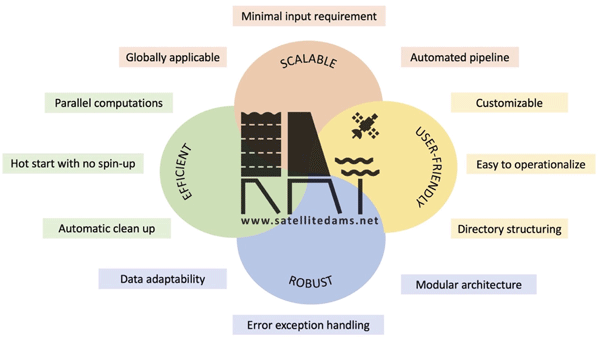
The Reservoir Assessment Tool (RAT) merges satellite data with hydrological models, enabling robust estimation of reservoir parameters like inflow, outflow, surface area, and storage changes around the world. Version 3.0 of RAT lowers the barrier of entry for new users and achieves scalability and computational efficiency. RAT 3.0 also facilitates open-source development of functions for continuous improvement to mobilize and empower the global water management community.
Ibrahim Nourein Mohammed, Elkin Giovanni Romero Bustamante, John Dennis Bolten, and Everett James Nelson
Hydrol. Earth Syst. Sci., 27, 3621–3642, https://doi.org/10.5194/hess-27-3621-2023, https://doi.org/10.5194/hess-27-3621-2023, 2023
Short summary
Short summary
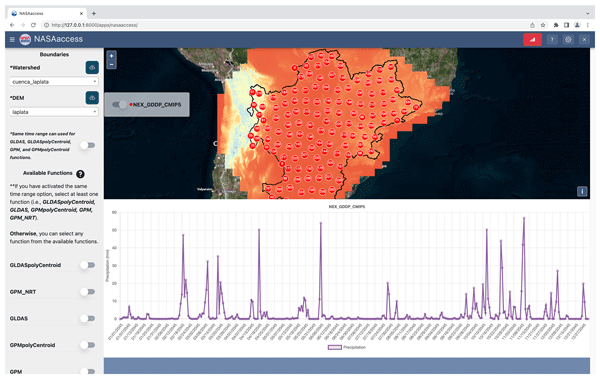
We present an open-source platform in response to the NASA Open-Source Science Initiative for accessing and presenting quantitative remote-sensing earth observation,and climate data. With our platform scientists, stakeholders and concerned citizens can engage in the exploration, modeling, and understanding of data. We envisioned this platform as lowering the technical barriers and simplifying the process of accessing and leveraging additional modeling frameworks for data.
Sarath Suresh, Faisal Hossain, Sanchit Minocha, Pritam Das, Shahzaib Khan, Hyongki Lee, Konstantinos Andreadis, and Perry Oddo
Hydrol. Earth Syst. Sci. Discuss., https://doi.org/10.5194/hess-2023-193, https://doi.org/10.5194/hess-2023-193, 2023
Manuscript not accepted for further review
Short summary
Short summary
Using entirely space-based data we explored how well can we predict the fast evolving dynamics of a flooding event in the mountainous region of Kerala during the 2018 disastrous floods. The tool, Reservoir Assessment Tool (RAT) was applied and found to have actionable accuracy in predicting the state of the Kerala reservoirs entirely from space to foster better coordinated management in future for reservoir operations.
Jack Tarricone, Ryan W. Webb, Hans-Peter Marshall, Anne W. Nolin, and Franz J. Meyer
The Cryosphere, 17, 1997–2019, https://doi.org/10.5194/tc-17-1997-2023, https://doi.org/10.5194/tc-17-1997-2023, 2023
Short summary
Short summary
Mountain snowmelt provides water for billions of people across the globe. Despite its importance, we cannot currently measure the amount of water in mountain snowpacks from satellites. In this research, we test the ability of an experimental snow remote sensing technique from an airplane in preparation for the same sensor being launched on a future NASA satellite. We found that the method worked better than expected for estimating important snowpack properties.
Simon Zwieback and Franz J. Meyer
The Cryosphere, 15, 2041–2055, https://doi.org/10.5194/tc-15-2041-2021, https://doi.org/10.5194/tc-15-2041-2021, 2021
Short summary
Short summary
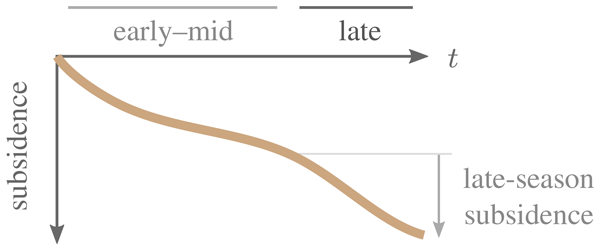
Thawing of ice-rich permafrost leads to subsidence and slumping, which can compromise Arctic infrastructure. However, we lack fine-scale maps of permafrost ground ice, chiefly because it is usually invisible at the surface. We show that subsidence at the end of summer serves as a
fingerprintwith which near-surface permafrost ground ice can be identified. As this can be done with satellite data, this method may help improve ground ice maps and thus sustainably steward the Arctic.
Cited articles
Bates, P. D., Pappenberger, F., and Romanowicz, R. J.: Uncertainty in Flood Inundation Modelling, in: Applied Uncertainty Analysis for Flood Risk Management, Imperial College Press, 232–269, https://doi.org/10.1142/9781848162716_0010, 2014.
Ben-Haim, Z., Anisimov, V., Yonas, A., Gulshan, V., Shafi, Y., Hoyer, S., and Nevo, S.: Inundation Modeling in Data Scarce Regions, arXiv [preprint], https://doi.org/10.48550/arXiv.1910.05006, 30 October 2019.
Chang, C. H., Lee, H., Kim, D., Hwang, E., Hossain, F., Chishtie, F., Jayasinghe, S., and Basnayake, S.: Hindcast and forecast of daily inundation extents using satellite SAR and altimetry data with rotated empirical orthogonal function analysis: Case study in Tonle Sap Lake Floodplain, Remote Sens. Environ., 241, 111732, https://doi.org/10.1016/J.RSE.2020.111732, 2020.
Chang, C.-H., Lee, H., Do, S. K., Du, T. L. T., Markert, K., Hossain, F., Ahmad, S. K., Piman, T., Meechaiya, C., Bui, D. D., Bolten, J. D., Hwang, E., and Jung, H. C.: Operational forecasting inundation extents using REOF analysis (FIER) over lower Mekong and its potential economic impact on agriculture, Environ. Modell. Softw., 162, 105643, https://doi.org/10.1016/j.envsoft.2023.105643, 2023.
Cosgrove, B., Gochis, D., Flowers, T., Dugger, A., Ogden, F., Graziano, T., Clark, E., Cabell, R., Casiday, N., Cui, Z., Eicher, K., Fall, G., Feng, X., Fitzgerald, K., Frazier, N., George, C., Gibbs, R., Hernandez, L., Johnson, D., Jones, R., Karsten, L., Kefelegn, H., Kitzmiller, D., Lee, H., Liu, Y., Mashriqui, H., Mattern, D., McCluskey, A., McCreight, J. L., McDaniel, R., Midekisa, A., Newman, A., Pan, L., Pham, C., RafieeiNasab, A., Rasmussen, R., Read, L., Rezaeianzadeh, M., Salas, F., Sang, D., Sampson, K., Schneider, T., Shi, Q., Sood, G., Wood, A., Wu, W., Yates, D., Yu, W., and Zhang, Y.: NOAA's National Water Model: Advancing operational hydrology through continental-scale modeling, J. American Water Resour. Assoc., 1752–1688, 13184, https://doi.org/10.1111/1752-1688.13184, 2024.
Do, S. K., Du, T. L. T., Lee, H., Chang, C.-H., Bui, D. D., Nguyen, N. T., Markert, K. N., Strömqvist, J., Towashiraporn, P., Darby, S. E., and Bui, L. K.: Assessing Impacts of Hydropower Development on Downstream Inundation Using a Hybrid Modeling Framework Integrating Satellite Data-Driven and Process-Based Models, Water Resour. Res., 61, e2024WR037528, https://doi.org/10.1029/2024WR037528, 2025.
Dommenget, D. and Latif, M.: A Cautionary Note on the Interpretation of EOFs, Journal of Climate, 15, 216–225, https://doi.org/10.1175/1520-0442(2002)015<0216:ACNOTI>2.0.CO;2, 2002.
Du, J., Kimball, J. S., Sheffield, J., Pan, M., Fisher, C. K., Beck, H. E., and Wood, E. F.: Satellite Flood Inundation Assessment and Forecast Using SMAP and Landsat, IEEE J. Sel. Top. Appl., 14, 6707–6715, https://doi.org/10.1109/JSTARS.2021.3092340, 2021.
Enayati, M., Bozorg-Haddad, O., Bazrafshan, J., Hejabi, S., and Chu, X.: Bias correction capabilities of quantile mapping methods for rainfall and temperature variables, Journal of Water and Climate Change, 12, 401–419, https://doi.org/10.2166/wcc.2020.261, 2020.
Farmer, W. H., Over, T. M., and Kiang, J. E.: Bias correction of simulated historical daily streamflow at ungauged locations by using independently estimated flow duration curves, Hydrol. Earth Syst. Sci., 22, 5741–5758, https://doi.org/10.5194/hess-22-5741-2018, 2018.
Getirana, A. C. V., Boone, A., Yamazaki, D., Decharme, B., Papa, F., and Mognard, N.: The Hydrological Modeling and Analysis Platform (HyMAP): Evaluation in the Amazon Basin, J. Hydrometeorol., 13, 1641–1665, https://doi.org/10.1175/JHM-D-12-021.1, 2012.
Gledhill, J. H., Barnett, A. F., Slattery, M., Willett, K. L., Easson, G. L., Otts, S. S., and Gochfeld, D. J.: Mass Mortality of the Eastern Oyster Crassostrea virginica in the Western Mississippi Sound Following Unprecedented Mississippi River Flooding in 2019, shre, 39, 235–244, https://doi.org/10.2983/035.039.0205, 2020.
Gorelick, N., Hancher, M., Dixon, M., Ilyushchenko, S., Thau, D., and Moore, R.: Google Earth Engine: Planetary-scale geospatial analysis for everyone, Remote Sens. Environ., 202, 18–27, https://doi.org/10.1016/j.rse.2017.06.031, 2017.
Hales, R. C., Nelson, E. J., Souffront, M., Gutierrez, A. L., Prudhomme, C., Kopp, S., Ames, D. P., Williams, G. P., and Jones, N. L.: Advancing global hydrologic modeling with the GEOGloWS ECMWF streamflow service, Journal of Flood Risk Management, e12859, https://doi.org/10.1111/jfr3.12859, 2022.
Hallegatte, S., Vogt-Schilb, A., Bangalore, M., and Rozenberg, J.: Unbreakable: Building the Resilience of the Poor in the Face of Natural Disasters, Washington, DC: World Bank, Washington, DC, https://doi.org/10.1596/978-1-4648-1003-9, 2017.
Hannachi, A.: A Primer for EOF Analysis of Climate Data, Department of Meteorology, University of Reading, Reading, UK, 2004.
Jackson, E. K., Roberts, W., Nelsen, B., Williams, G. P., Nelson, E. J., and Ames, D. P.: Introductory overview: Error metrics for hydrologic modelling – A review of common practices and an open source library to facilitate use and adoption, Environ. Modell. Softw., 119, 32–48, https://doi.org/10.1016/j.envsoft.2019.05.001, 2019.
Kaiser, H. F.: The varimax criterion for analytic rotation in factor analysis, Psychometrika, 23, 187–200, https://doi.org/10.1007/BF02289233, 1958.
Landwehr, T., Dasgupta, A., and Waske, B.: Towards robust validation strategies for EO flood maps, Remote Sensing of Environment, 315, 114439, https://doi.org/10.1016/j.rse.2024.114439, 2024.
Li, S., Sun, D., Goldberg, M. D., Sjoberg, B., Santek, D., Hoffman, J. P., DeWeese, M., Restrepo, P., Lindsey, S., and Holloway, E.: Automatic near real-time flood detection using Suomi-NPP/VIIRS data, Remote Sens. Environ., 204, 672–689, https://doi.org/10.1016/J.RSE.2017.09.032, 2018.
Li, S., Goldberg, M. D., Sjoberg, W., Zhou, L., Nandi, S., Chowdhury, N., Straka, W., Yang, T., and Sun, D.: Assessment of the Catastrophic Asia Floods and Potentially Affected Population in Summer 2020 Using VIIRS Flood Products, Remote Sensing, 12, 3176, https://doi.org/10.3390/rs12193176, 2020.
Li, S., Sun, D., Goldberg, M. D., Kalluri, S., Sjoberg, B., Lindsey, D., Hoffman, J. P., DeWeese, M., Connelly, B., Mckee, P., and Lander, K.: A downscaling model for derivation of 3-D flood products from VIIRS imagery and SRTM/DEM, ISPRS Journal of Photogrammetry and Remote Sensing, 192, 279–298, https://doi.org/10.1016/j.isprsjprs.2022.08.025, 2022.
Lorenz, E. N.: Empirical Orthogonal Functions and Statistical Weather Prediction, Massachusetts Institute of Technology, Department of Meteorology, 112 pp., https://www.google.com/books/edition/Empirical_Orthogonal_Functions_and_Stati/FPI_dOG8w68C?hl=en&kptab=overview (last access: 20 September 2024), 1956.
Markert, K. N., Chishtie, F., Anderson, E. R., Saah, D., and Griffin, R. E.: On the merging of optical and SAR satellite imagery for surface water mapping applications, Results in Physics, 9, 275–277, https://doi.org/10.1016/J.RINP.2018.02.054, 2018.
Markert, K. N., Williams, G. P., Nelson, E. J., Ames, D. P., Lee, H., and Griffin, R. E.: Dense Time Series Generation of Surface Water Extents through Optical–SAR Sensor Fusion and Gap Filling, Remote Sensing, 16, 1262, https://doi.org/10.3390/rs16071262, 2024a.
Markert, K. N., da Silva, G., Ames, D. P., Maghami, I., Williams, G. P., Nelson, E. J., Halgren, J., Patel, A., Santos, A., and Ames, M. J.: Design and implementation of a BigQuery dataset and application programmer interface (API) for the U. S. National Water Model, Environ. Modell. Softw., 179, 106123, https://doi.org/10.1016/j.envsoft.2024.106123, 2024b.
Massey, F. J.: The Kolmogorov–Smirnov Test for Goodness of Fit, J. Am. Stat. Assoc., 46, 68–78, https://doi.org/10.2307/2280095, 1951.
Moriasi, D. N., Gitau, M. W., Pai, N., and Daggupati, P.: Hydrologic and Water Quality Models: Performance Measures and Evaluation Criteria, Transactions of the ASABE, 58, 1763–1785, https://doi.org/10.13031/trans.58.10715, 2005.
Muñoz, S. E., Dee, S. G., Luo, X., Haider, M. R., O'Donnell, M., Parazin, B., and Remo, J. W. F.: Mississippi River low-flows: context, causes, and future projections, Environ. Res.: Climate, 2, 031001, https://doi.org/10.1088/2752-5295/acd8e3, 2023.
Nevo, S., Morin, E., Gerzi Rosenthal, A., Metzger, A., Barshai, C., Weitzner, D., Voloshin, D., Kratzert, F., Elidan, G., Dror, G., Begelman, G., Nearing, G., Shalev, G., Noga, H., Shavitt, I., Yuklea, L., Royz, M., Giladi, N., Peled Levi, N., Reich, O., Gilon, O., Maor, R., Timnat, S., Shechter, T., Anisimov, V., Gigi, Y., Levin, Y., Moshe, Z., Ben-Haim, Z., Hassidim, A., and Matias, Y.: Flood forecasting with machine learning models in an operational framework, Hydrol. Earth Syst. Sci., 26, 4013–4032, https://doi.org/10.5194/hess-26-4013-2022, 2022.
Pal, S., Lee, T. R., and Clark, N. E.: The 2019 Mississippi and Missouri River Flooding and Its Impact on Atmospheric Boundary Layer Dynamics, Geophys. Res. Lett., 47, e2019GL086933, https://doi.org/10.1029/2019GL086933, 2020.
Prince, L., Hales, R. C., Markert, K. N., Nelson, E. J., Williams, G. P., Ames, D. P., Lee, H., and Rostami, A.: Assessing Coincidence of Satellite Acquisitions and Flood Events to Predict Suitability for Flood Map Synthesis, Remote Sensing, 17, 1648, https://doi.org/10.3390/rs17091648, 2025.
Renard, B., Kavetski, D., Kuczera, G., Thyer, M., and Franks, S. W.: Understanding predictive uncertainty in hydrologic modeling: The challenge of identifying input and structural errors, Water Resour. Res., 46, https://doi.org/10.1029/2009WR008328, 2010.
Rentschler, J., Salhab, M., and Jafino, B. A.: Flood exposure and poverty in 188 countries, Nat. Commun., 13, 3527, https://doi.org/10.1038/s41467-022-30727-4, 2022.
Rostami, A., Chang, C.-H., Lee, H., Wan, H.-H., Du, T. L. T., Markert, K. N., Williams, G. P., Nelson, E. J., Li, S., Straka III, W., Helfrich, S., and Gutierrez, A. L.: Forecasting Flood Inundation in U. S. Flood-Prone Regions Through a Data-Driven Approach (FIER): Using VIIRS Water Fractions and the National Water Model, Remote Sensing, 16, 4357, https://doi.org/10.3390/rs16234357, 2024.
Sampson, C. C., Fewtrell, T. J., Duncan, A., Shaad, K., Horritt, M. S., and Bates, P. D.: Use of terrestrial laser scanning data to drive decimetric resolution urban inundation models, Adv. Water Resour., 41, 1–17, https://doi.org/10.1016/J.ADVWATRES.2012.02.010, 2012.
Schumann, G. J.-P.: The need for scientific rigour and accountability in flood mapping to better support disaster response, Hydrological Processes, 33, 3138–3142, https://doi.org/10.1002/hyp.13547, 2019.
Smith, A. B.: US Billion-dollar Weather and Climate Disasters, 1980–present (NCEI Accession 0209268), https://doi.org/10.25921/stkw-7w73, 2020.
Tate, E., Rahman, M. A., Emrich, C. T., and Sampson, C. C.: Flood exposure and social vulnerability in the United States, Nat. Hazards, 106, 435–457, https://doi.org/10.1007/s11069-020-04470-2, 2021.
Tellman, B., Sullivan, J. A., Kuhn, C., Kettner, A. J., Doyle, C. S., Brakenridge, G. R., Erickson, T. A., and Slayback, D. A.: Satellite imaging reveals increased proportion of population exposed to floods, Nature, 596, 80–86, https://doi.org/10.1038/s41586-021-03695-w, 2021.
Teng, J., Jakeman, A. J., Vaze, J., Croke, B. F. W., Dutta, D., and Kim, S.: Flood inundation modelling: A review of methods, recent advances and uncertainty analysis, Environ. Modell. Softw., 90, 201–216, https://doi.org/10.1016/j.envsoft.2017.01.006, 2017.
Wan, H.-H., Lee, H., Du, T. L. T., Rostami, A., Chang, C.-H., Markert, K. N., Nelson, E. J., Williams, G. P., Li, S., Straka III, W., Helfrich, S. R., and Meyer, F. J.: An interpretable and scalable model for rapid flood extent forecasting using satellite imagery and machine learning with rotated EOF analysis, Environ. Modell. Softw., 192, 106562, https://doi.org/10.1016/j.envsoft.2025.106562, 2025.
Wang, Z., Bovik, A. C., Sheikh, H. R., and Simoncelli, E. P.: Image quality assessment: from error visibility to structural similarity, IEEE Transactions on Image Processing, 13, 600–612, https://doi.org/10.1109/TIP.2003.819861, 2004.
Watson, C. C., Biedenharn, D. S., and Thorne, C. R.: Analysis of the Impacts of Dikes on Flood Stages in the Middle Mississippi River, J. Hydraul. Eng., 139, 1071–1078, https://doi.org/10.1061/(ASCE)HY.1943-7900.0000786, 2013.
Wing, O. E. J., Lehman, W., Bates, P. D., Sampson, C. C., Quinn, N., Smith, A. M., Neal, J. C., Porter, J. R., and Kousky, C.: Inequitable patterns of US flood risk in the Anthropocene, Nat. Clim. Chang., 12, 156–162, https://doi.org/10.1038/s41558-021-01265-6, 2022.
Wing, O. E. J., Bates, P. D., Quinn, N. D., Savage, J. T. S., Uhe, P. F., Cooper, A., Collings, T. P., Addor, N., Lord, N. S., Hatchard, S., Hoch, J. M., Bates, J., Probyn, I., Himsworth, S., Rodríguez González, J., Brine, M. P., Wilkinson, H., Sampson, C. C., Smith, A. M., Neal, J. C., and Haigh, I. D.: A 30 m Global Flood Inundation Model for Any Climate Scenario, Water Resour. Res., 60, e2023WR036460, https://doi.org/10.1029/2023WR036460, 2024.
Yalcin, E.: Assessing the impact of topography and land cover data resolutions on two-dimensional HEC-RAS hydrodynamic model simulations for urban flood hazard analysis, Nat. Hazards, 101, 995–1017, https://doi.org/10.1007/s11069-020-03906-z, 2020.
Yamazaki, D., Kanae, S., Kim, H., and Oki, T.: A physically based description of floodplain inundation dynamics in a global river routing model, Water Resour. Res., 47, 4501, https://doi.org/10.1029/2010WR009726, 2011.
Yin, S., Gao, G., Li, Y., Xu, Y. J., Turner, R. E., Ran, L., Wang, X., and Fu, B.: Long-term trends of streamflow, sediment load and nutrient fluxes from the Mississippi River Basin: Impacts of climate change and human activities, J. Hydrol., 616, 128822, https://doi.org/10.1016/j.jhydrol.2022.128822, 2023.
Short summary
Flooding is a major problem and predicting it accurately over large areas is tough. This study tested a new approach to forecast floods across a large region in the United States. By dividing the area into smaller areas to develop the prediction models and then combining, the method successfully simulated surface water extent for both high and low flow periods. The results were more accurate than existing approaches with similar methods which can improve flood forecasting for larger areas.
Flooding is a major problem and predicting it accurately over large areas is tough. This study...