
Articles | Volume 30, issue 2
https://doi.org/10.5194/hess-30-371-2026
© Author(s) 2026. This work is distributed under
the Creative Commons Attribution 4.0 License.
the Creative Commons Attribution 4.0 License.
https://doi.org/10.5194/hess-30-371-2026
© Author(s) 2026. This work is distributed under
the Creative Commons Attribution 4.0 License.
the Creative Commons Attribution 4.0 License.
Research article
| 
26 Jan 2026
Research article |
| 26 Jan 2026
| 26 Jan 2026
Probabilistic hierarchical interpolation and interpretable neural network configurations for flood prediction
Mostafa Saberian
Glenn Department of Civil Engineering, Clemson University, Clemson, SC, USA

Department of Agricultural Sciences, Clemson University, Clemson, SC, USA
Artificial Intelligence Research Institute for Science and Engineering (AIRISE), Clemson University, Clemson, SC, USA
Ioana Popescu
Department of Hydroinformatics and Socio-Technical Innovation, IHE Delft Institute for Water Education, Delft, the Netherlands
Faculty of Civil Engineering and Geosciences, Delft University of Technology, Delft, the Netherlands
Related authors
Krishna Panthi, Vidya Samadi, Nima Zafarmomen, Mostafa Saberian, Adarsha Neupane, Carlos Erazo Ramirez, Bijaya Adhikari, Anthony Castronova, and Ibrahim Demir
EGUsphere, https://doi.org/10.5194/egusphere-2026-491, https://doi.org/10.5194/egusphere-2026-491, 2026
Short summary
Short summary
WaterSoftHack is a cybertraining program that bridges water science and modern computational methods through hands-on training in data analytics, machine learning, and cloud and edge computing. Using open-source tools and project-based learning, the program builds reproducible workflows, strengthens interdisciplinary collaboration, and enhances participants’ research capacity and career readiness.
Adarsha Neupane and Vidya Samadi
EGUsphere, https://doi.org/10.5194/egusphere-2026-2300, https://doi.org/10.5194/egusphere-2026-2300, 2026
Short summary
Short summary
We developed a new tool that combines physical science and artificial intelligence to estimate and predict how much water plants need. It automatically gathers weather data and produces reliable short-term forecasts across many locations. Results show strong accuracy in most regions. This approach can help farmers and water managers make better irrigation decisions and use water more efficiently.
Krishna Panthi, Vidya Samadi, Nima Zafarmomen, Mostafa Saberian, Adarsha Neupane, Carlos Erazo Ramirez, Bijaya Adhikari, Anthony Castronova, and Ibrahim Demir
EGUsphere, https://doi.org/10.5194/egusphere-2026-491, https://doi.org/10.5194/egusphere-2026-491, 2026
Short summary
Short summary
WaterSoftHack is a cybertraining program that bridges water science and modern computational methods through hands-on training in data analytics, machine learning, and cloud and edge computing. Using open-source tools and project-based learning, the program builds reproducible workflows, strengthens interdisciplinary collaboration, and enhances participants’ research capacity and career readiness.
Rishav Karanjit, Vidya Samadi, Amanda Hughes, Pamela Murray-Tuite, and Keri Stephens
Nat. Hazards Earth Syst. Sci. Discuss., https://doi.org/10.5194/nhess-2024-25, https://doi.org/10.5194/nhess-2024-25, 2024
Revised manuscript not accepted
Short summary
Short summary
This research paper focused on creating a new paradigm for flood evacuation decisions – so-called human-AI Convergence (HAC) system. A Natural Language Processing (NLP) method was used to mine and filter human data from X posts that were deemed relevant to flooding. The human data along with a river hydraulic model and AI algorithms were integrated into an evacuation re-routing algorithm to forecast flood depth and define evacuation decisions.
Faisal Sardar, Muhammad Haris Ali, Ioana Popescu, Andreja Jonoski, Schalk Jan van Andel, and Claudia Bertini
Hydrol. Earth Syst. Sci. Discuss., https://doi.org/10.5194/hess-2023-276, https://doi.org/10.5194/hess-2023-276, 2023
Manuscript not accepted for further review
Short summary
Short summary
This article analyzes surface and groundwater interactions in a small transboundary lowland catchment. The study also investigates the influence of rainfall representation in model on surface subsurface hydrological simulations. Emphasizing the significance of these interactions, the research highlighted the role of subsurface baseflow in contributing to river discharge. Despite minimal impact on streamflow, spatial variability in rainfall can cause localized fluctuations in groundwater levels.
Betina I. Guido, Ioana Popescu, Vidya Samadi, and Biswa Bhattacharya
Nat. Hazards Earth Syst. Sci., 23, 2663–2681, https://doi.org/10.5194/nhess-23-2663-2023, https://doi.org/10.5194/nhess-23-2663-2023, 2023
Short summary
Short summary
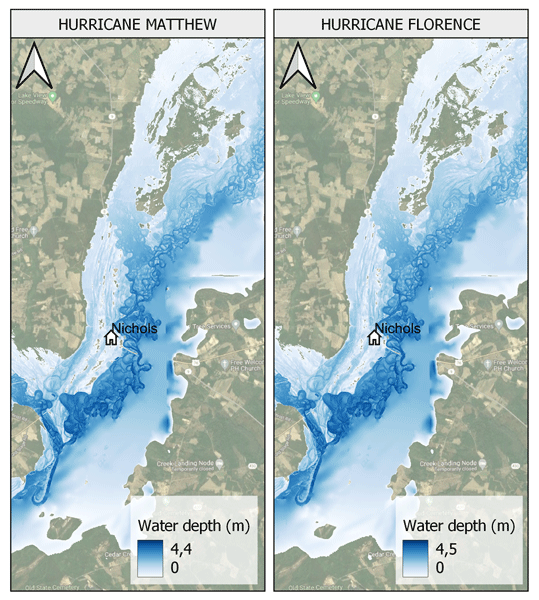
We used an integrated model to evaluate the impacts of nature-based solutions (NBSs) on flood mitigation across the Little Pee Dee and Lumber River watershed, the Carolinas, US. This area is strongly affected by climatic disasters, which are expected to increase due to climate change and urbanization, so exploring an NBS approach is crucial for adapting to future alterations. Our research found that NBSs can have visible effects on the reduction in hurricane-driven flooding.
Cited articles
Abbaspour, K. C., Yang, J., Maximov, I., Siber, R., Bogner, K., Mieleitner, J., Zobrist, J., and Srinivasan, R.: Modelling hydrology and water quality in the pre-alpine/alpine Thur watershed using SWAT, Journal of Hydrology, 333, 413–430, https://doi.org/10.1016/j.jhydrol.2006.09.014, 2007.
Alaa, A. M. and van der Schaar, M.: Attentive State-Space Modeling of Disease Progression, in: Advances in Neural Information Processing Systems, ISBN 9781713807933, 2019.
Asquith, W. H., Roussel, M. C., Thompson, D. B., Cleveland, T. G., and Fang, X.: Summary of dimensionless Texas hyetographs and distribution of storm depth developed for Texas Department of Transportation research project 0–4194, Texas Department of Transportation, https://library.ctr.utexas.edu/digitized/texasarchive/phase1/4194-4-txdot.pdf (last access: 15 January 2026), 2005.
Barnard, P. L., van Ormondt, M., Erikson, L. H., Eshleman, J., Hapke, C., Ruggiero, P., Adams, P. N., and Foxgrover, A. C.: Development of the Coastal Storm Modeling System (CoSMoS) for predicting the impact of storms on high-energy, active-margin coasts, Nat. Hazards, 74, 1095–1125, https://doi.org/10.1007/s11069-014-1236-y, 2014.
Basso, S., Schirmer, M., and Botter, G.: A physically based analytical model of flood frequency curves, Geophysical Research Letters, 43, 9070–9076, https://doi.org/10.1002/2016GL069915, 2016.
Challu, C., Olivares, K. G., Oreshkin, B. N., Garza, F., Mergenthaler-Canseco, M., and Dubrawski, A.: N-HiTS: Neural Hierarchical Interpolation for Time Series Forecasting, arXiv [preprint], https://doi.org/10.48550/arXiv.2201.12886, 29 November 2022.
Chen, Y., Li, J., and Xu, H.: Improving flood forecasting capability of physically based distributed hydrological models by parameter optimization, Hydrol. Earth Syst. Sci., 20, 375–392, https://doi.org/10.5194/hess-20-375-2016, 2016.
Clark, M. P., Nijssen, B., Lundquist, J. D., Kavetski, D., Rupp, D. E., Woods, R. A., Freer, J. E., Gutmann, E. D., Wood, A. W., Brekke, L. D., Arnold, J. R., Gochis, D. J., and Rasmussen, R. M.: A unified approach for process-based hydrologic modeling: 1. Modeling concept, Water Resources Research, 51, 2498–2514, https://doi.org/10.1002/2015WR017198, 2015.
Dasgupta, A., Arnal, L., Emerton, R., Harrigan, S., Matthews, G., Muhammad, A., O'Regan, K., Pérez-Ciria, T., Valdez, E., van Osnabrugge, B., Werner, M., Buontempo, C., Cloke, H., Pappenberger, F., Pechlivanidis, I. G., Prudhomme, C., Ramos, M.-H., and Salamon, P.: Connecting hydrological modelling and forecasting from global to local scales: Perspectives from an international joint virtual workshop, Journal of Flood Risk Management, 18, e12880, https://doi.org/10.1111/jfr3.12880, 2023.
Defontaine, T., Ricci, S., Lapeyre, C., Marchandise, A., and Pape, E. L.: Flood forecasting with Machine Learning in a scarce data layout, IOP Conf. Ser.: Earth Environ. Sci., 1136, 012020, https://doi.org/10.1088/1755-1315/1136/1/012020, 2023.
Duane, S., Kennedy, A. D., Pendleton, B. J., and Roweth, D.: Hybrid Monte Carlo, Physics Letters B, 195, 216–222, https://doi.org/10.1016/0370-2693(87)91197-X, 1987.
Erikson, L. H., Espejo, A., Barnard, P. L., Serafin, K. A., Hegermiller, C. A., O'Neill, A., Ruggiero, P., Limber, P. W., and Mendez, F. J.: Identification of storm events and contiguous coastal sections for deterministic modeling of extreme coastal flood events in response to climate change, Coastal Engineering, 140, 316–330, https://doi.org/10.1016/j.coastaleng.2018.08.003, 2018.
Evin, G., Le Lay, M., Fouchier, C., Penot, D., Colleoni, F., Mas, A., Garambois, P.-A., and Laurantin, O.: Evaluation of hydrological models on small mountainous catchments: impact of the meteorological forcings, Hydrol. Earth Syst. Sci., 28, 261–281, https://doi.org/10.5194/hess-28-261-2024, 2024.
Fan, C., Zhang, Y., Pan, Y., Li, X., Zhang, C., Yuan, R., Wu, D., Wang, W., Pei, J., and Huang, H.: Multi-Horizon Time Series Forecasting with Temporal Attention Learning, in: Proceedings of the 25th ACM SIGKDD International Conference on Knowledge Discovery & Data Mining, New York, NY, USA, 2527–2535, https://doi.org/10.1145/3292500.3330662, 2019.
Fang, K., Kifer, D., Lawson, K., and Shen, C.: Evaluating the Potential and Challenges of an Uncertainty Quantification Method for Long Short-Term Memory Models for Soil Moisture Predictions, Water Resources Research, 56, e2020WR028095, https://doi.org/10.1029/2020WR028095, 2020.
Gotvald, A. J.: Historic flooding in Georgia, 2009, U.S. Geological Survey Open-File Report 2010–1230, 19 pp., https://pubs.usgs.gov/of/2010/1230/ (last access: 5 June 2024), 2010.
Guha-Sapir, D. and Below, R.: Quality and accuracy of disaster data: a comparative analysis of 3 global data sets, Working paper prepared for the Disaster Management Facility, World Bank, CRED, Brussels, https://api.semanticscholar.org/CorpusID:132874120 (last access: 5 June 2024), 2002.
Gupta, H. V., Kling, H., Yilmaz, K. K., and Martinez, G. F.: Decomposition of the mean squared error and NSE performance criteria: Implications for improving hydrological modelling, Journal of Hydrology, 377, 80–91, https://doi.org/10.1016/j.jhydrol.2009.08.003, 2009.
Hochreiter, S., Younger, A. S., and Conwell, P. R.: Learning to Learn Using Gradient Descent, in: Artificial Neural Networks – ICANN 2001, Berlin, Heidelberg, 87–94, https://doi.org/10.1007/3-540-44668-0_13, 2001.
Hsu, K., Gupta, H. V., and Sorooshian, S.: Artificial Neural Network Modeling of the Rainfall-Runoff Process, Water Resources Research, 31, 2517–2530, https://doi.org/10.1029/95WR01955, 1995.
Jonkman, S. N.: Global Perspectives on Loss of Human Life Caused by Floods, Nat. Hazards, 34, 151–175, https://doi.org/10.1007/s11069-004-8891-3, 2005.
Kingma, D. P. and Ba, J.: Adam: A Method for Stochastic Optimization, arXiv [preprint], https://doi.org/10.48550/arXiv.1412.6980, 29 January 2017.
Kratzert, F., Klotz, D., Brenner, C., Schulz, K., and Herrnegger, M.: Rainfall–runoff modelling using Long Short-Term Memory (LSTM) networks, Hydrol. Earth Syst. Sci., 22, 6005–6022, https://doi.org/10.5194/hess-22-6005-2018, 2018.
Lim, B., Arık, S. Ö., Loeff, N., and Pfister, T.: Temporal Fusion Transformers for interpretable multi-horizon time series forecasting, International Journal of Forecasting, 37, 1748–1764, https://doi.org/10.1016/j.ijforecast.2021.03.012, 2021.
Lobligeois, F., Andréassian, V., Perrin, C., Tabary, P., and Loumagne, C.: When does higher spatial resolution rainfall information improve streamflow simulation? An evaluation using 3620 flood events, Hydrol. Earth Syst. Sci., 18, 575–594, https://doi.org/10.5194/hess-18-575-2014, 2014.
MacDonald, L. H. and Coe, D.: Influence of Headwater Streams on Downstream Reaches in Forested Areas, Forest Science, 53, 148–168, https://doi.org/10.1093/forestscience/53.2.148, 2007.
Martinaitis, S. M., Wilson, K. A., Yussouf, N., Gourley, J. J., Vergara, H., Meyer, T. C., Heinselman, P. L., Gerard, A., Berry, K. L., Vergara, A., and Monroe, J.: A Path Toward Short-Term Probabilistic Flash Flood Prediction, https://doi.org/10.1175/BAMS-D-22-0026.1, 2023.
McCallum, B. E. and Gotvald, A. J.: Historic flooding in northern Georgia, September 16–22, 2009, U.S. Geological Survey Fact Sheet 2010–3061, 4 pp., https://pubs.usgs.gov/fs/2010/3061/ (last access: 5 June 2024), 2010.
McCuen, R. H., Knight, Z., and Cutter, A. G.: Evaluation of the Nash–Sutcliffe Efficiency Index, Journal of Hydrologic Engineering, 11, 597–602, https://doi.org/10.1061/(ASCE)1084-0699(2006)11:6(597), 2006.
Munn, M., Sheibley, R., Waite, I., and Meador, M.: Understanding the relationship between stream metabolism and biological assemblages, Freshwater Science, 39, 680–692, https://doi.org/10.1086/711690, 2020.
Nash, J. E. and Sutcliffe, J. V.: River flow forecasting through conceptual models part I – A discussion of principles, Journal of Hydrology, 10, 282–290, https://doi.org/10.1016/0022-1694(70)90255-6, 1970.
Natural Resources Conservation Service (NRCS): National Engineering Handbook Part 630 Hydrology – Chapter 15: Time of Concentration, https://www.hydrocad.net/neh/630ch15.pdf (last access: 23 December 2025), 2010.
Nevo, S., Morin, E., Gerzi Rosenthal, A., Metzger, A., Barshai, C., Weitzner, D., Voloshin, D., Kratzert, F., Elidan, G., Dror, G., Begelman, G., Nearing, G., Shalev, G., Noga, H., Shavitt, I., Yuklea, L., Royz, M., Giladi, N., Peled Levi, N., Reich, O., Gilon, O., Maor, R., Timnat, S., Shechter, T., Anisimov, V., Gigi, Y., Levin, Y., Moshe, Z., Ben-Haim, Z., Hassidim, A., and Matias, Y.: Flood forecasting with machine learning models in an operational framework, Hydrol. Earth Syst. Sci., 26, 4013–4032, https://doi.org/10.5194/hess-26-4013-2022, 2022.
Olivares, K. G., Challú, C., Garza, A., Mergenthaler Canseco, M., and Dubrawski, A.: NeuralForecast: User friendly state-of-the-art neural forecasting models, PyCon Salt Lake City, Utah, US, GitHub [code], https://github.com/Nixtla/neuralforecast (last access: 23 December 2025), 2022.
Olivares, K. G., Meetei, O. N., Ma, R., Reddy, R., Cao, M., and Dicker, L.: Probabilistic hierarchical forecasting with deep Poisson mixtures, International Journal of Forecasting, 40, 470–489, https://doi.org/10.1016/j.ijforecast.2023.04.007, 2024.
Oreshkin, B. N., Carpov, D., Chapados, N., and Bengio, Y.: N-BEATS: Neural basis expansion analysis for interpretable time series forecasting, arXiv [preprint], https://doi.org/10.48550/arXiv.1905.10437, 20 February 2020.
Pally, R. J. and Samadi, V.: Application of image processing and convolutional neural networks for flood image classification and semantic segmentation, Environmental Modelling & Software, 148, 105285, https://doi.org/10.1016/j.envsoft.2021.105285, 2022.
Palmer, T. N.: Towards the probabilistic Earth-system simulator: a vision for the future of climate and weather prediction, Quarterly Journal of the Royal Meteorological Society, 138, 841–861, https://doi.org/10.1002/qj.1923, 2012.
Park, K. and Lee, E. H.: Urban flood vulnerability analysis and prediction based on the land use using Deep Neural Network, International Journal of Disaster Risk Reduction, 101, 104231, https://doi.org/10.1016/j.ijdrr.2023.104231, 2024.
Pourreza-Bilondi, M., Samadi, S. Z., Akhoond-Ali, A.-M., and Ghahraman, B.: Reliability of Semiarid Flash Flood Modeling Using Bayesian Framework, Journal of Hydrologic Engineering, 22, 05016039, https://doi.org/10.1061/(ASCE)HE.1943-5584.0001482, 2017.
Refsgaard, J. C., Stisen, S., and Koch, J.: Hydrological process knowledge in catchment modelling – Lessons and perspectives from 60 years development, Hydrological Processes, 36, e14463, https://doi.org/10.1002/hyp.14463, 2022.
Roelvink, D., Reniers, A., van Dongeren, A., van Thiel de Vries, J., McCall, R., and Lescinski, J.: Modelling storm impacts on beaches, dunes and barrier islands, Coastal Engineering, 56, 1133–1152, https://doi.org/10.1016/j.coastaleng.2009.08.006, 2009.
Russo, S., Perraudin, N., Stalder, S., Perez-Cruz, F., Leitao, J. P., Obozinski, G., and Wegner, J. D.: An evaluation of deep learning models for predicting water depth evolution in urban floods, arXiv [preprint], https://doi.org/10.48550/arXiv.2302.10062, 20 February 2023.
Saberian, M., Zafarmomen, N., Neupane, A., Panthi, K., and Samadi, V.: HydroQuantum: A new quantum-driven Python package for hydrological simulation, Environmental Modelling & Software, 195, 106736, https://doi.org/10.1016/j.envsoft.2025.106736, 2026.
Safaei-Moghadam, A., Tarboton, D., and Minsker, B.: Estimating the likelihood of roadway pluvial flood based on crowdsourced traffic data and depression-based DEM analysis, Nat. Hazards Earth Syst. Sci., 23, 1–19, https://doi.org/10.5194/nhess-23-1-2023, 2023.
Saksena, S., Dey, S., Merwade, V., and Singhofen, P. J.: A Computationally Efficient and Physically Based Approach for Urban Flood Modeling Using a Flexible Spatiotemporal Structure, Water Resources Research, 56, e2019WR025769, https://doi.org/10.1029/2019WR025769, 2020.
Samadi, S., Pourreza-Bilondi, M., Wilson, C. A. M. E., and Hitchcock, D. B.: Bayesian Model Averaging With Fixed and Flexible Priors: Theory, Concepts, and Calibration Experiments for Rainfall-Runoff Modeling, Journal of Advances in Modeling Earth Systems, 12, e2019MS001924, https://doi.org/10.1029/2019MS001924, 2020.
Samadi, V., Fowler, H. J., Lamond, J., Wagener, T., Brunner, M., Gourley, J., Moradkhani, H., Popescu, I., Wasko, C., Wright, D., Wu, H., Zhang, K., Arias, P. A., Duan, Q., Nazemi, A., van Oevelen, P. J., Prein, A. F., Roundy, J. K., Saberian, M., and Umutoni, L.: The Needs, Challenges, and Priorities for Advancing Global Flood Research, WIREs Water, 12, e70026, https://doi.org/10.1002/wat2.70026, 2025.
WCCB Charlotte's CW: Widespread Flooding After Severe Storms, https://www.wccbcharlotte.com/2020/02/08/widespread-flooding-after-severe-storms/ (last access: 5 June 2024), 2020.
Saberian, M. and Samadi, V.: Probabilistic Hierarchical Interpolation and Interpretable Configuration for Flood Prediction, Zenodo [data set], https://doi.org/10.5281/zenodo.13343364, 2024.
Sukovich, E. M., Ralph, F. M., Barthold, F. E., Reynolds, D. W., and Novak, D. R.: Extreme Quantitative Precipitation Forecast Performance at the Weather Prediction Center from 2001 to 2011, Weather and Forecasting, 29, 894–911, https://doi.org/10.1175/WAF-D-13-00061.1, 2014.
Tabas, S. S. and Samadi, S.: Variational Bayesian dropout with a Gaussian prior for recurrent neural networks application in rainfall–runoff modeling, Environ. Res. Lett., 17, 065012, https://doi.org/10.1088/1748-9326/ac7247, 2022.
Thompson, C. M. and Frazier, T. G.: Deterministic and probabilistic flood modeling for contemporary and future coastal and inland precipitation inundation, Applied Geography, 50, 1–14, https://doi.org/10.1016/j.apgeog.2014.01.013, 2014.
Tiwari, M. K. and Chatterjee, C.: Development of an accurate and reliable hourly flood forecasting model using wavelet-bootstrap-ANN (WBANN) hybrid approach, Journal of Hydrology, 394, 458–470, https://doi.org/10.1016/j.jhydrol.2010.10.001, 2010.
UNISDR: Making development sustainable: The future of disaster risk management, Global Assessment Report on Disaster Risk Reduction, Geneva, Switzerland, United Nations Office for Disaster Risk Reduction (UNISDR), ISBN 9789211320428, 2015.
US EPA: Watershed Report, Office of Water, https://watersgeo.epa.gov/watershedreport/?comid=9224629, last access: 5 June 2024.
Wee, G., Chang, L.-C., Chang, F.-J., and Mat Amin, M. Z.: A flood Impact-Based forecasting system by fuzzy inference techniques, Journal of Hydrology, 625, 130117, https://doi.org/10.1016/j.jhydrol.2023.130117, 2023.
Windheuser, L., Karanjit, R., Pally, R., Samadi, S., and Hubig, N. C.: An End-To-End Flood Stage Prediction System Using Deep Neural Networks, Earth and Space Science, 10, e2022EA002385, https://doi.org/10.1029/2022EA002385, 2023.
Zafarmomen, N. and Samadi, V.: Can large language models effectively reason about adverse weather conditions?, Environmental Modelling & Software, 188, 106421, https://doi.org/10.1016/j.envsoft.2025.106421, 2025.
Zafarmomen, N., Alizadeh, H., Bayat, M., Ehtiat, M., and Moradkhani, H.: Assimilation of Sentinel-Based Leaf Area Index for Modeling Surface-Ground Water Interactions in Irrigation Districts, Water Resources Research, 60, e2023WR036080, https://doi.org/10.1029/2023WR036080, 2024.
Zhang, L., Qin, H., Mao, J., Cao, X., and Fu, G.: High temporal resolution urban flood prediction using attention-based LSTM models, Journal of Hydrology, 620, 129499, https://doi.org/10.1016/j.jhydrol.2023.129499, 2023a.
Zhang, Y., Pan, D., Griensven, J. V., Yang, S. X., and Gharabaghi, B.: Intelligent flood forecasting and warning: a survey, Intelligence & Robotics, 3, 190–212, https://doi.org/10.20517/ir.2023.12, 2023b.
Zou, Y., Wang, J., Lei, P., and Li, Y.: A novel multi-step ahead forecasting model for flood based on time residual LSTM, Journal of Hydrology, 620, 129521, https://doi.org/10.1016/j.jhydrol.2023.129521, 2023.
Short summary
Recent progress in NN (neural network) accelerated improvements in the performance of catchment modeling. Yet flood modeling remains a very difficult task. Focusing on two headwater streams, we developed N-HiTS (Neural Hierarchical Interpolation for Time Series Forecasting) and N-BEATS (Network-Based Expansion Analysis for Interpretable Time Series Forecasting) models and benchmarked them with LSTM (long short-term memory) to predict flooding. N-HiTS and N-BEATS outperformed LSTM for flood predictions. We demonstrated how the proposed models can be augmented with an uncertainty approach to predict flooding that is interpretable without considerable loss in accuracy.
Recent progress in NN (neural network) accelerated improvements in the performance of catchment...


