Articles | Volume 30, issue 7
https://doi.org/10.5194/hess-30-2013-2026
© Author(s) 2026. This work is distributed under
the Creative Commons Attribution 4.0 License.
https://doi.org/10.5194/hess-30-2013-2026
© Author(s) 2026. This work is distributed under
the Creative Commons Attribution 4.0 License.
Integrated catchment classification across China based on hydroclimatological and geomorphological similarities using self-organizing map and fuzzy c-means clustering for hydrological modeling
Jiefan Niu
State Key Laboratory of Water Disaster Prevention, Hohai University, Nanjing, Jiangsu, 210098, China
Yangtze Institute for Conservation and Development, Hohai University, Nanjing, Jiangsu, 210024, China
College of Hydrology and Water Resources, Hohai University, Nanjing, Jiangsu, 210024, China
State Key Laboratory of Water Disaster Prevention, Hohai University, Nanjing, Jiangsu, 210098, China
Yangtze Institute for Conservation and Development, Hohai University, Nanjing, Jiangsu, 210024, China
College of Hydrology and Water Resources, Hohai University, Nanjing, Jiangsu, 210024, China
China Meteorological Administration Hydro-Meteorology Key Laboratory, Hohai University, Nanjing, Jiangsu, 210024, China
Key Laboratory of Water Big Data Technology of Ministry of Water Resources, Hohai University, Nanjing, Jiangsu, 210024, China
Xi Li
State Key Laboratory of Water Disaster Prevention, Hohai University, Nanjing, Jiangsu, 210098, China
Yangtze Institute for Conservation and Development, Hohai University, Nanjing, Jiangsu, 210024, China
College of Hydrology and Water Resources, Hohai University, Nanjing, Jiangsu, 210024, China
Hongjun Bao
CORRESPONDING AUTHOR
China Meteorological Administration Hydro-Meteorology Key Laboratory, Hohai University, Nanjing, Jiangsu, 210024, China
National Meteorological Center, China Meteorological Administration, Beijing, 100081, China
Related authors
No articles found.
Nan Wu, Ke Zhang, Amir Naghibi, Hossein Hashemi, Zhongrui Ning, and Jerker Jarsjö
Hydrol. Earth Syst. Sci., 29, 5913–5930, https://doi.org/10.5194/hess-29-5913-2025, https://doi.org/10.5194/hess-29-5913-2025, 2025
Short summary
Short summary
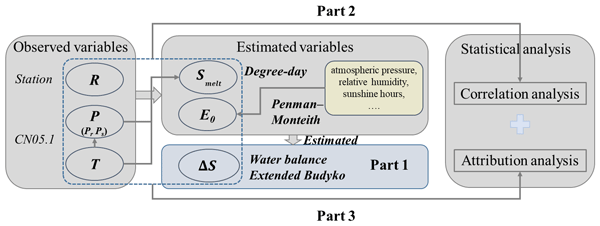
This study explores how snow dynamics and hydropower reservoirs shape monthly runoff in the Yalong River basin, China. Using 15 years of data and an extended Budyko framework, we found that snow accumulation and melt dominate runoff in high-altitude areas, while reservoirs increasingly influence lower elevations. These factors reduce runoff seasonality at the basin outlet, emphasizing how climate change and human activity alter water availability in cold, mountainous regions.
Jin Feng, Ke Zhang, Lijun Chao, Huijie Zhan, and Yunping Li
Earth Syst. Sci. Data, 17, 5039–5064, https://doi.org/10.5194/essd-17-5039-2025, https://doi.org/10.5194/essd-17-5039-2025, 2025
Short summary
Short summary
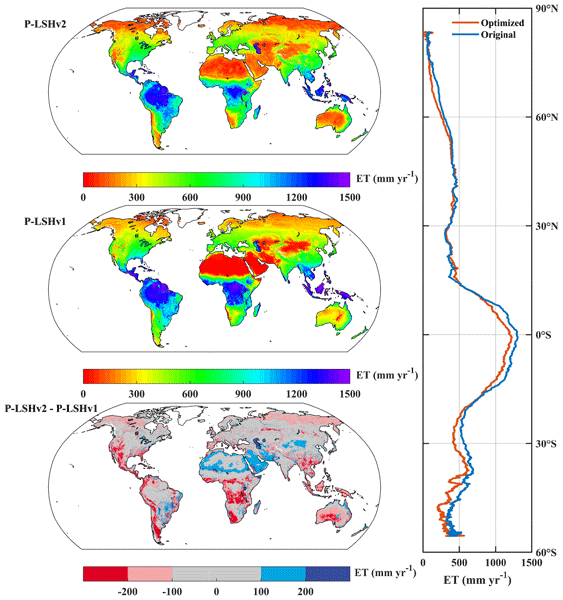
Understanding how soil moisture affects evapotranspiration (ET) is essential for improving ET estimates. However, many global ET datasets overlook soil moisture constraints, causing large uncertainties. In this study, we developed an improved model that better captures the influence of soil moisture on vegetation and soil evaporation. Our model significantly improves ET estimation accuracy and provides a new long-term global ET dataset to support water cycle and climate research.
Haoyu Jin, Ke Zhang, Moyang Liu, Xuan Yu, Xu Yang, Lijun Chao, Pengfei Zhang, and Guoyan Liu
EGUsphere, https://doi.org/10.5194/egusphere-2025-4289, https://doi.org/10.5194/egusphere-2025-4289, 2025
Short summary
Short summary
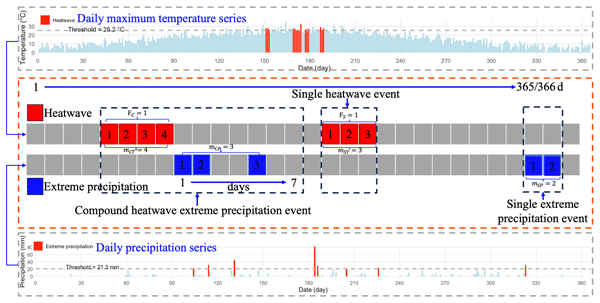
Heatwaves and heavy rainfall are dangerous on their own. But when they occur in quick succession, extreme heat followed by intense rain, they can create even greater risks. Our findings show that compound heatwave-extreme precipitation events are becoming a distinct and worsening type of climate hazard. They can no longer be treated as isolated events. To build resilience, early warning systems, disaster planning, and adaptation strategies must now account for these compound risks.
Nan Wu, Ke Zhang, Amir Naghibi, Hossein Hashemi, Zhongrui Ning, Qinuo Zhang, Xuejun Yi, Haijun Wang, Wei Liu, Wei Gao, and Jerker Jarsjö
Hydrol. Earth Syst. Sci., 29, 3703–3725, https://doi.org/10.5194/hess-29-3703-2025, https://doi.org/10.5194/hess-29-3703-2025, 2025
Short summary
Short summary
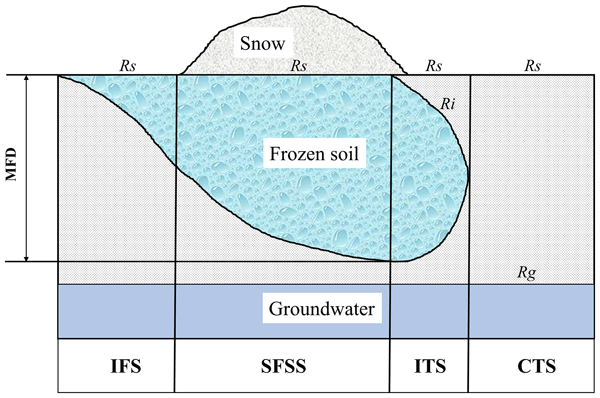
This study enhanced a popular water flow model by adding two components: one for snow melting and another for frozen ground cycles. Tested with satellite data and streamflow, the updated model improved accuracy, especially in winter. Frozen ground delays soil drainage, boosting spring runoff by 39 %–77 % and cutting evaporation by 85 %. These findings reveal that frozen ground drives seasonal water patterns.
Mohammed Abdallah, Ke Zhang, Lijun Chao, Abubaker Omer, Khalid Hassaballah, Kidane Welde Reda, Linxin Liu, Tolossa Lemma Tola, and Omar M. Nour
Hydrol. Earth Syst. Sci., 28, 1147–1172, https://doi.org/10.5194/hess-28-1147-2024, https://doi.org/10.5194/hess-28-1147-2024, 2024
Short summary
Short summary
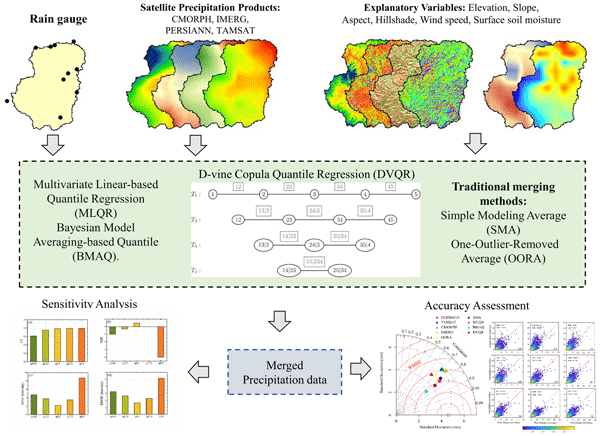
A D-vine copula-based quantile regression (DVQR) model is used to merge satellite precipitation products. The performance of the DVQR model is compared with the simple model average and one-outlier-removed average methods. The nonlinear DVQR model outperforms the quantile-regression-based multivariate linear and Bayesian model averaging methods.
Guoding Chen, Ke Zhang, Sheng Wang, Yi Xia, and Lijun Chao
Geosci. Model Dev., 16, 2915–2937, https://doi.org/10.5194/gmd-16-2915-2023, https://doi.org/10.5194/gmd-16-2915-2023, 2023
Short summary
Short summary
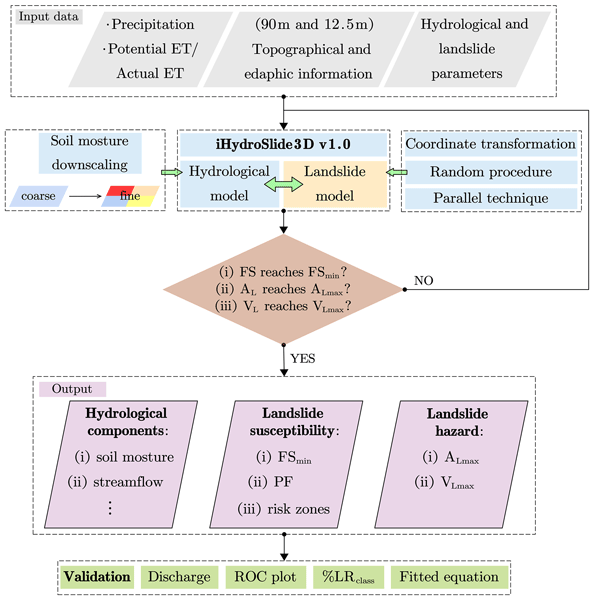
In this study, we developed a novel modeling system called iHydroSlide3D v1.0 by coupling a modified a 3D landslide model with a distributed hydrology model. The model is able to apply flexibly different simulating resolutions for hydrological and slope stability submodules and gain a high computational efficiency through parallel computation. The test results in the Yuehe River basin, China, show a good predicative capability for cascading flood–landslide events.
Jin Feng, Ke Zhang, Huijie Zhan, and Lijun Chao
Hydrol. Earth Syst. Sci., 27, 363–383, https://doi.org/10.5194/hess-27-363-2023, https://doi.org/10.5194/hess-27-363-2023, 2023
Short summary
Short summary
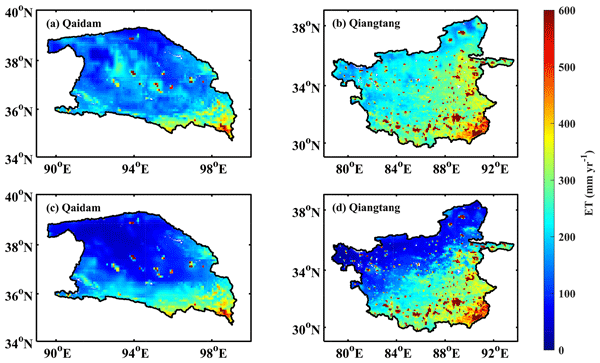
Here we improved a satellite-driven evaporation algorithm by introducing the modified versions of the two constraint schemes. The two moisture constraint schemes largely improved the evaporation estimation on two barren-dominated basins of the Tibetan Plateau. Investigation of moisture constraint uncertainty showed that high-quality soil moisture can optimally represent moisture, and more accessible precipitation data generally help improve the estimation of barren evaporation.
Cited articles
Addor, N., Newman, A. J., Mizukami, N., and Clark, M. P.: The CAMELS data set: catchment attributes and meteorology for large-sample studies, Hydrol. Earth Syst. Sci., 21, 5293–5313, https://doi.org/10.5194/hess-21-5293-2017, 2017.
Addor, N., Nearing, G., Prieto, C., Newman, A., Le Vine, N., and Clark, M. P.: A ranking of hydrological signatures based on their predictability in space, Water Resour. Res., 54, 8792–8812, https://doi.org/10.1029/2018WR022606, 2018.
Berghuijs, W. R., Sivapalan, M., Woods, R. A., and Savenije, H. H. G.: Patterns of similarity of seasonal water balances: A window into streamflow variability over a range of time scales, Water Resour. Res., 50, 5638–5661, https://doi.org/10.1002/2014WR015692, 2014.
Betterle, A., Schirmer, M., and Botter, G.: Flow dynamics at the continental scale: Streamflow correlation and hydrological similarity, Hydrol. Process., 33, 627–646, https://doi.org/10.1002/hyp.13350, 2019.
Bezdek, J. C., Ehrlich, R., and Full, W.: FCM: The fuzzy c-means clustering algorithm, Comput. Geosci., 10, 191–203, https://doi.org/10.1016/0098-3004(84)90020-7, 1984.
Boscarello, L., Ravazzani, G., Cislaghi, A., and Mancini, M.: Regionalization of flow-duration curves through catchment classification with streamflow signatures and physiographic–climate indices, J. Hydrol. Eng., 21, 05015027, https://doi.org/10.1061/(ASCE)HE.1943-5584.0001307, 2016.
Carozza, D. A. and Boudreault, M.: A Global Flood Risk Modeling Framework Built With Climate Models and Machine Learning, J. Adv. Model. Earth Sy., 13, https://doi.org/10.1029/2020MS002221, 2021.
Coopersmith, E., Yaeger, M. A., Ye, S., Cheng, L., and Sivapalan, M.: Exploring the physical controls of regional patterns of flow duration curves – Part 3: A catchment classification system based on regime curve indicators, Hydrol. Earth Syst. Sci., 16, 4467–4482, https://doi.org/10.5194/hess-16-4467-2012, 2012.
Games, P. A. and Howell, J. F.: Pairwise multiple comparison procedures with unequal n's and/or variances: a Monte Carlo study, J. Educ. Stat., 1, 113–125, https://doi.org/10.3102/10769986001002113, 1976.
Gao, H., Birkel, C., Hrachowitz, M., Tetzlaff, D., Soulsby, C., and Savenije, H. H. G.: A simple topography-driven and calibration-free runoff generation module, Hydrol. Earth Syst. Sci., 23, 787–809, https://doi.org/10.5194/hess-23-787-2019, 2019.
Ghotbi, S., Wang, D., Singh, A., Mayo, T., and Sivapalan, M.: Climate and Landscape Controls of Regional Patterns of Flow Duration Curves Across the Continental United States: Statistical Approach, Water Resour. Res., 56, https://doi.org/10.1029/2020WR028041, 2020.
Guo, Y., Zhang, Y., Zhang, L., and Wang, Z.: Regionalization of hydrological modeling for predicting streamflow in ungauged catchments: A comprehensive review, Wiley Interdisciplinary Reviews: Water, 46, https://doi.org/10.1002/wat2.1487, 2020.
Halim, Z., Waqas, M., Baig, A. R., and Rashid, A.: Efficient clustering of large uncertain graphs using neighborhood information, Int. J. Approximate Reason., 90, 274–291, https://doi.org/10.1016/j.ijar.2017.07.013, 2017.
He, M., Jiang, S., Ren, L., Cui, H., Qin, T., Du, S., Zhu, Y., Fang, X., and Xu, C.-Y.: Streamflow prediction in ungauged catchments through use of catchment classification and deep learning, J. Hydrol., 639, 131638, https://doi.org/10.1016/j.jhydrol.2024.131638, 2024.
Hrachowitz, M., Savenije, H., Blöschl, G., McDonnell, J., Sivapalan, M., Pomeroy, J., Arheimer, B., Blume, T., Clark, M., and Ehret, U.: A decade of Predictions in Ungauged Basins (PUB) – a review, Hydrolog. Sci. J., 58, 1198–1255, https://doi.org/10.1080/02626667.2013.803183, 2013.
Jehn, F. U., Bestian, K., Breuer, L., Kraft, P., and Houska, T.: Using hydrological and climatic catchment clusters to explore drivers of catchment behavior, Hydrol. Earth Syst. Sci., 24, 1081–1100, https://doi.org/10.5194/hess-24-1081-2020, 2020.
Jeong, K.-S., Hong, D.-G., Byeon, M.-S., Jeong, J.-C., Kim, H.-G., Kim, D.-K., and Joo, G.-J.: Stream modification patterns in a river basin: Field survey and self-organizing map (SOM) application, Ecol. Inform., 5, 293–303, https://doi.org/10.1016/j.ecoinf.2010.04.005, 2010.
Kiang, M. Y.: Extending the Kohonen self-organizing map networks for clustering analysis, Comput. Stat. Data An., 38, 161–180, https://doi.org/10.1016/S0167-9473(01)00040-8, 2001.
Kittel, C. M. M., Arildsen, A. L., Dybkjær, S., Hansen, E. R., Linde, I., Slott, E., Tøttrup, C., and Bauer-Gottwein, P.: Informing hydrological models of poorly gauged river catchments – A parameter regionalization and calibration approach, J. Hydrol., 587, 124999, https://doi.org/10.1016/j.jhydrol.2020.124999, 2020.
Knoben, W. J., Woods, R. A., and Freer, J. E.: A quantitative hydrological climate classification evaluated with independent streamflow data, Water Resour. Res., 54, 5088–5109, https://doi.org/10.1029/2018WR022913, 2018.
Kohonen, T.: Self-organized formation of topologically correct feature maps, Biol. Cybern., 43, 59–69, 1982.
Kratzert, F., Klotz, D., Herrnegger, M., Sampson, A. K., Hochreiter, S., and Nearing, G. S.: Toward Improved Predictions in Ungauged Basins: Exploiting the Power of Machine Learning, Water Resour. Res., 55, 11344–11354, https://doi.org/10.1029/2019WR026065, 2019.
Kuentz, A., Arheimer, B., Hundecha, Y., and Wagener, T.: Understanding hydrologic variability across Europe through catchment classification, Hydrol. Earth Syst. Sci., 21, 2863–2879, https://doi.org/10.5194/hess-21-2863-2017, 2017.
Lee, K.-J., Yun, S.-T., Yu, S., Kim, K.-H., Lee, J.-H., and Lee, S.-H.: The combined use of self-organizing map technique and fuzzy c-means clustering to evaluate urban groundwater quality in Seoul metropolitan city, South Korea, J. Hydrol., 569, 685–697, https://doi.org/10.1016/j.jhydrol.2018.12.031, 2019.
Lehner, B. and Grill, G.: Global river hydrography and network routing: baseline data and new approaches to study the world's large river systems, Hydrol. Process., 27, 2171–2186, https://doi.org/10.1002/hyp.9740, 2013.
Leibowitz, S. G., Comeleo, R. L., Wigington, P. J., Weber, M. H., Sproles, E. A., and Sawicz, K. A.: Hydrologic Landscape Characterization for the Pacific Northwest, USA, J. Am. Water Resour. As., 52, 473–493, https://doi.org/10.1111/1752-1688.12402, 2016.
Li, Q., Li, Z., Zhu, Y., Deng, Y., Zhang, K., and Yao, C.: Hydrological regionalisation based on available hydrological information for runoff prediction at catchment scale, Proc. IAHS, 379, 13–19, https://doi.org/10.5194/piahs-379-13-2018, 2018.
Liu, C., Zhou, C., and Yu, J.: Chinese Hydrological Geography, Science Press, Beijing, 2014 (in Chinese).
Liu, J., Yang, L., Jiang, J., Yuan, W., and Duan, Z.: Mapping diurnal cycles of precipitation over China through clustering, J. Hydrol., 125804, https://doi.org/10.1016/j.jhydrol.2020.125804, 2020a.
Liu, Y., Zhang, K., Li, Z., Liu, Z., Wang, J., and Huang, P.: A hybrid runoff generation modelling framework based on spatial combination of three runoff generation schemes for semi-humid and semi-arid watersheds, J. Hydrol., 590, 125440, https://doi.org/10.1016/j.jhydrol.2020.125440, 2020b.
Loritz, R., Gupta, H., Jackisch, C., Westhoff, M., Kleidon, A., Ehret, U., and Zehe, E.: On the dynamic nature of hydrological similarity, Hydrol. Earth Syst. Sci., 22, 3663–3684, https://doi.org/10.5194/hess-22-3663-2018, 2018.
Loritz, R., Kleidon, A., Jackisch, C., Westhoff, M., Ehret, U., Gupta, H., and Zehe, E.: A topographic index explaining hydrological similarity by accounting for the joint controls of runoff formation, Hydrol. Earth Syst. Sci., 23, 3807–3821, https://doi.org/10.5194/hess-23-3807-2019, 2019.
Luo, K.: Draft of natural geography regionalization of China, Acta Geographica Sinica, 20, 379–394, 1954.
Ma, K., Feng, D., Lawson, K., Tsai, W. P., Liang, C., Huang, X., Sharma, A., and Shen, C.: Transferring hydrologic data across continents–Leveraging data-rich regions to improve hydrologic prediction in data-sparse regions, Water Resour. Res., 57, e2020WR028600, https://doi.org/10.1029/2020WR028600, 2021.
Moosavi, V., Packmann, S., and Vallés, I.: SOMPY: A Python Library for Self Organizing Map (SOM), GitHub [code], https://github.com/sevamoo/SOMPY (last access: 31 March 2026), 2014.
Moratiel, R., Bravo, R., Saa, A., Tarquis, A. M., and Almorox, J.: Estimation of evapotranspiration by the Food and Agricultural Organization of the United Nations (FAO) Penman–Monteith temperature (PMT) and Hargreaves–Samani (HS) models under temporal and spatial criteria – a case study in Duero basin (Spain), Nat. Hazards Earth Syst. Sci., 20, 859–875, https://doi.org/10.5194/nhess-20-859-2020, 2020.
Nguyen, T. T., Kawamura, A., Tong, T. N., Amaguchi, H., Nakagawa, N., Gilbuena Jr, R., and Du Bui, D.: Identification of spatio-seasonal hydrogeochemical characteristics of the unconfined groundwater in the Red River Delta, Vietnam, Appl. Geochem., 63, 10–21, https://doi.org/10.1016/j.apgeochem.2015.07.009, 2015.
Pagliero, L., Bouraoui, F., Diels, J., Willems, P., and McIntyre, N.: Investigating regionalization techniques for large-scale hydrological modelling, J. Hydrol., 570, 220–235, https://doi.org/10.1016/j.jhydrol.2018.12.071, 2019.
Pakhira, M. K., Bandyopadhyay, S., and Maulik, U.: Validity index for crisp and fuzzy clusters, Pattern Recogn., 37, 487–501, https://doi.org/10.1016/j.patcog.2003.06.005, 2004.
Pal, N. R., Pal, K., Keller, J. M., and Bezdek, J. C.: A possibilistic fuzzy c-means clustering algorithm, IEEE T. Fuzzy Syst., 13, 517–530, https://doi.org/10.1109/TFUZZ.2004.840099, 2005.
Park, Y.-S., Céréghino, R., Compin, A., and Lek, S.: Applications of artificial neural networks for patterning and predicting aquatic insect species richness in running waters, Ecol. Model., 160, 265–280, https://doi.org/10.1016/S0304-3800(02)00258-2, 2003.
Prieto, C., Le Vine, N., Kavetski, D., García, E., and Medina, R.: Flow prediction in ungauged catchments using probabilistic random forests regionalization and new statistical adequacy tests, Water Resour. Res., 55, 4364–4392, https://doi.org/10.1029/2018WR023254, 2019.
Rao, A. R. and Srinivas, V.: Regionalization of watersheds by hybrid-cluster analysis, J. Hydrol., 318, 37–56, https://doi.org/10.1016/j.jhydrol.2005.06.003, 2006.
Rasheed, Z., Aravamudan, A., Sefidmazgi, A. G., Anagnostopoulos, G. C., and Nikolopoulos, E. I.: Advancing flood warning procedures in ungauged basins with machine learning, J. Hydrol., 609, 127736, https://doi.org/10.1016/j.jhydrol.2022.127736, 2022.
Sawicz, K., Wagener, T., Sivapalan, M., Troch, P. A., and Carrillo, G.: Catchment classification: empirical analysis of hydrologic similarity based on catchment function in the eastern USA, Hydrol. Earth Syst. Sci., 15, 2895–2911, https://doi.org/10.5194/hess-15-2895-2011, 2011.
Schwämmle, V. and Jensen, O. N.: A simple and fast method to determine the parameters for fuzzy c-means cluster analysis, Bioinformatics, 26, 2841–2848, https://doi.org/10.1093/bioinformatics/btq534, 2010.
Singh, S. K., McMillan, H., Bárdossy, A., and Fateh, C.: Nonparametric catchment clustering using the data depth function, Hydrolog. Sci. J., 61, 2649–2667, https://doi.org/10.1080/02626667.2016.1168927, 2016.
Tarasova, L., Basso, S., Wendi, D., Viglione, A., Kumar, R., and Merz, R.: A Process-Based Framework to Characterize and Classify Runoff Events: The Event Typology of Germany, Water Resour. Res., 56, https://doi.org/10.1029/2019WR026951, 2020.
Tsegaw, A. T., Alfredsen, K., Skaugen, T., and Muthanna, T. M.: Predicting hourly flows at ungauged small rural catchments using a parsimonious hydrological model, J. Hydrol., 573, 855–871, https://doi.org/10.1016/j.jhydrol.2019.03.090, 2019.
Vesanto, J.: SOM-based data visualization methods, Intell. Data Anal., 3, 111–126, https://doi.org/10.3233/IDA-1999-3203, 1999.
Wagener, T., Sivapalan, M., Troch, P. A., McGlynn, B. L., Harman, C. J., Gupta, H. V., Kumar, P., Rao, P. S. C., Basu, N. B., and Wilson, J. S.: The future of hydrology: An evolving science for a changing world, Water Resour. Res., 46, https://doi.org/10.1029/2009WR008906, 2010.
Wang, S., Zhang, K., Chao, L., Li, D., Tian, X., Bao, H., Chen, G., and Xia, Y.: Exploring the utility of radar and satellite-sensed precipitation and their dynamic bias correction for integrated prediction of flood and landslide hazards, J. Hydrol., 603, 126964, https://doi.org/10.1016/j.jhydrol.2021.126964, 2021.
Willmott, C. J. and Feddema, J. J.: A more rational climatic moisture index, Prof. Geogr., 44, 84–88, https://doi.org/10.1111/j.0033-0124.1992.00084.x, 1992.
Xu, H., Wang, H., and Liu, P.: Identifying control factors of hydrological behavior through catchment classification in Mainland of China, J. Hydrol., 645, 132206, https://doi.org/10.1016/j.jhydrol.2024.132206, 2024.
Yaeger, M., Coopersmith, E., Ye, S., Cheng, L., Viglione, A., and Sivapalan, M.: Exploring the physical controls of regional patterns of flow duration curves – Part 4: A synthesis of empirical analysis, process modeling and catchment classification, Hydrol. Earth Syst. Sci., 16, 4483–4498, https://doi.org/10.5194/hess-16-4483-2012, 2012.
Yamazaki, D., Sato, T., Kanae, S., Hirabayashi, Y., and Bates, P. D.: Regional flood dynamics in a bifurcating mega delta simulated in a global river model, Geophys. Res. Lett., 41, 3127–3135, https://doi.org/10.1002/2014GL059744, 2014.
Yang, X., Magnusson, J., Rizzi, J., and Xu, C.-Y.: Runoff prediction in ungauged catchments in Norway: comparison of regionalization approaches, Hydrol. Res., 49, 487–505, https://doi.org/10.2166/nh.2017.071, 2018.
Yang, X., Magnusson, J., Huang, S., Beldring, S., and Xu, C.-Y.: Dependence of regionalization methods on the complexity of hydrological models in multiple climatic regions, J. Hydrol., 582, 124–357, https://doi.org/10.1016/j.jhydrol.2019.124357, 2020.
Yang, Y., Liu, J., Yang, S., and He, R.: Understanding the hierarchical controls of geographical features on hydrological responses in humid mountainous areas through a stepwise clustering scheme, Stoch. Env. Res. Risk A., https://doi.org/10.1007/s00477-021-02080-3, 2021a.
Yang, Y., Pan, M., Lin, P., Beck, H. E., Zeng, Z., Yamazaki, D., David, C. H., Lu, H., Yang, K., and Hong, Y.: Global reach-level 3-hourly river flood reanalysis (1980–2019), B. Am. Meteorol. Soc., 102, E2086–E2105, https://doi.org/10.1175/BAMS-D-20-0057.1, 2021b.
Yaseen, Z. M., Sulaiman, S. O., Deo, R. C., and Chau, K.-W.: An enhanced extreme learning machine model for river flow forecasting: State-of-the-art, practical applications in water resource engineering area and future research direction, J. Hydrol., 569, 387–408, https://doi.org/10.1016/j.jhydrol.2018.11.069, 2019.
Yi, X. and Jiazhen, Z.: Hydrology Regionalization of China, Science Press, Beijing, 1995 (in Chinese).
Zang, S., Li, Z., Zhang, K., Yao, C., Liu, Z., Wang, J., Huang, Y., and Wang, S.: Improving the flood prediction capability of the Xin'anjiang model by formulating a new physics-based routing framework and a key routing parameter estimation method, J. Hydrol., 603, 126867, https://doi.org/10.1016/j.jhydrol.2021.126867, 2021.
Zeng, P., Sun, F., Liu, Y., Wang, Y., Li, G., and Che, Y.: Mapping future droughts under global warming across China: A combined multi-timescale meteorological drought index and SOM-Kmeans approach, Weather and Climate Extremes, 31, https://doi.org/10.1016/j.wace.2021.100304, 2021.
Short summary
This study developed a new method for classifying catchments, combining machine learning techniques with climate and landscape data. By analyzing catchments across China, we identified six climate regions and 35 unique catchment types, each with distinct streamflow patterns. This classification method improves hydrological predictions, especially in areas lacking direct data.
This study developed a new method for classifying catchments, combining machine learning...