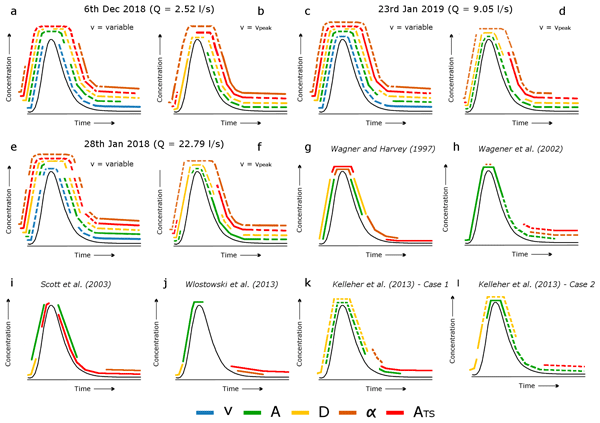
Bonanno, E., Blöschl, G., and Klaus, J.: Exploring tracer information in a small stream to improve parameter identifiability and enhance the process interpretation in transient storage models, Hydrol. Earth Syst. Sci., 26, 6003–6028, https://doi.org/10.5194/hess-26-6003-2022, 2022.
Bonanno, E., Blöschl, G., and Klaus, J.: Discharge, groundwater gradients, and streambed micro-topography control the temporal dynamics of transient storage in a headwater reach, Water Resour. Res., 59, e2022WR034053, https://doi.org/10.1029/2022WR034053, 2023.
Briggs, M. A., Gooseff, M. N., Arp, C. D., and Baker, M. A.: A method for estimating surface transient storage parameters for streams with concurrent hyporheic storage, Water Resour. Res., 45, https://doi.org/10.1029/2008WR006959, 2009.
Briggs, M. A., Goodling, P., Johnson, Z. C., Rogers, K. M., Hitt, N. P., Fair, J. B., and Snyder, C. D.: Bedrock depth influences spatial patterns of summer baseflow, temperature and flow disconnection for mountainous headwater streams, Hydrol. Earth Syst. Sci., 26, 3989–4011, https://doi.org/10.5194/hess-26-3989-2022, 2022.
Camacho, L. A. and González, R. A.: Calibration and predictive ability analysis of longitudinal solute transport models in mountain streams, Environ. Fluid Mech., 8, 597–604, https://doi.org/10.1007/s10652-008-9109-0, 2008.
Cardenas, M. B. and Wilson, J. L.: Exchange across a sediment–water interface with ambient groundwater discharge, J. Hydrol., 346, 69–80, https://doi.org/10.1016/j.jhydrol.2007.08.019, 2007.
Cardenas, M. B.: Surface water-groundwater interface geomorphology leads to scaling of residence times, Geophys. Res. Lett., 35, https://doi.org/10.1029/2008GL033753, 2008.
Cargill, S. K., Segura, C., Villamizar, S. R., and Warren, D. R.: The influence of lithology on stream metabolism in headwater systems, Ecohydrology, 14, e2284, https://doi.org/10.1002/eco.2284, 2021.
Cartwright, I. and Gilfedder, B.: Mapping and quantifying groundwater inflows to Deep Creek (Maribyrnong catchment, SE Australia) using
222Rn, implications for protecting groundwater-dependant ecosystems, Appl. Geochem., 52, 118–129, https://doi.org/10.1016/j.apgeochem.2014.11.020, 2015.
Cecil, L. D. and Green, J. R.: Radon-222, in: Environmental tracers in subsurface hydrology. edited by: Cook, P. G., Herczeg, A. L., Springer New York, NY, USA, 175–194, https://doi.org/10.1007/978-1-4615-4557-6, 2000.
Choi, J., Harvey, J. W., and Conklin, M. H.: Characterizing multiple timescales of stream and storage zone interaction that affect solute fate and transport in streams, Water Resour. Res., 36, 1511–1518, https://doi.org/10.1029/2000WR900051, 2000.
Cook, P. G., Lamontagne, S., Berhane, D., and Clark, J. F.: Quantifying groundwater discharge to Cockburn River, southeastern Australia, using dissolved gas tracers
222Rn and SF
6, Water Resour. Res., 42, 718, https://doi.org/10.1029/2006WR004921, 2006.
Cook, P. G.: Estimating groundwater discharge to rivers from river chemistry surveys, Hydrol. Process., 27, 3694–3707, https://doi.org/10.1002/hyp.9493, 2013.
Corbett, D. R., Burnett, W. C., Cable, P. H., and Clark, S. B.: A multiple approach to the determination of radon fluxes from sediments, J. Radioanal. Nucl. Chem., 236, 247–253, https://doi.org/10.1007/BF02386351, 1998.
Corbett, D. R., Burnett, William C., Cable, P. H., and Clark, S. B.: Radon tracing of groundwater input into Par Pond, Savannah River Site, J. Hydrol., 203, 209–227, https://doi.org/10.1016/S0022-1694(97)00103-0, 1997.
Covino, T., McGlynn, B., and Mallard, J.: Stream-groundwater exchange and hydrologic turnover at the network scale, Water Resour. Res., 47, 41, https://doi.org/10.1029/2011WR010942, 2011.
Covino, T. P. and McGlynn, B. L.: Stream gains and losses across a mountain-to-valley transition: Impacts on watershed hydrology and stream water chemistry, Water Resour. Res., 43, https://doi.org/10.1029/2006WR005544, 2007.
Cranswick, R. H., Cook, P. G., and Lamontagne, S.: Hyporheic zone exchange fluxes and residence times inferred from riverbed temperature and radon data, J. Hydrol., 519, 1870–1881, https://doi.org/10.1016/j.jhydrol.2014.09.059, 2014.
Day, T. J.: On the precision of salt dilution gauging, J. Hydrol., 31, 293–306, https://doi.org/10.1016/0022-1694(76)90130-X, 1976.
Day, T. J.: Observed mixing lengths in mountain streams, J. Hydrol., 35, 125–136, https://doi.org/10.1016/0022-1694(77)90081-6, 1977.
Fleckenstein, J. H., Niswonger, R. G., and Fogg, G. E.: River-aquifer interactions, geologic heterogeneity, and low-flow management, Ground Water, 44, 837–852, https://doi.org/10.1111/j.1745-6584.2006.00190.x, 2006.
Frei, S. and Gilfedder, B. S.: FINIFLUX. An implicit finite element model for quantification of groundwater fluxes and hyporheic exchange in streams and rivers using radon, Water Resour. Res., 51, 6776–6786, https://doi.org/10.1002/2015WR017212, 2015.
Frei, S., Durejka, S., Le Lay, H., Thomas, Z., and Gilfedder, B. S.: Quantification of hyporheic nitrate removal at the reach scale. Exposure times versus residence times, Water Resour. Res., 55, 9808–9825, https://doi.org/10.1029/2019WR025540, 2019.
Genereux, D. P., Hemond, H. F., and Mulholland, P. J.: Spatial and temporal variability in streamflow generation on the West Fork of Walker Branch Watershed, J. Hydrol., 142, 137–166, https://doi.org/10.1016/0022-1694(93)90009-X, 1993.
Gilfedder, B. S., Cartwright, I., Hofmann, H., and Frei, S.: Explicit modeling of radon-222 in HydroGeoSphere during steady state and dynamic transient storage, Ground Water, 57, 36–47, https://doi.org/10.1111/gwat.12847, 2019.
Glaser, C., Schwientek, Marc, Junginger, T., Gilfedder, B. S., Frei, S., Werneburg, M., Zwiener, C., and Zarfl, C.: Comparison of environmental tracers including organic micropollutants as groundwater exfiltration indicators into a small river of a karstic catchment, Hydrol. Process., 34, 4712–4726, https://doi.org/10.1002/hyp.13909, 2020.
Gooseff, M. N., Payn, R. A., Zarnetske, J. P., Bowden, W. B., McNamara, J. P., and Bradford, J. H.: Comparison of in-channel mobile–immobile zone exchange during instantaneous and constant rate stream tracer additions: Implications for design and interpretation of non-conservative tracer experiments, J. Hydrol., 357, 112–124, https://doi.org/10.1016/j.jhydrol.2008.05.006, 2008.
Harvey, J. W. and Bencala, K. E.: The effect of streambed topography on surface-subsurface water exchange in mountain catchments, Water Resour. Res., 29, 89–98, https://doi.org/10.1029/92WR01960, 1993.
Harvey, J. W., Wagner, B. J., and Bencala, K. E.: Evaluating the reliability of the stream tracer approach to characterize stream-subsurface water exchange, Water Resour. Res., 32, 2441–2451, https://doi.org/10.1029/96WR01268, 1996.
Harvey, J. and Gooseff, M.: River corridor science: Hydrologic exchange and ecological consequences from bedforms to basins, Water Resour. Res., 51, 6893–6922, https://doi.org/10.1002/2015WR017617, 2015.
Helton, J. C. and Davis, F. J.: Latin hypercube sampling and the propagation of uncertainty in analyses of complex systems, Reliab. Eng. Syst. Saf., 81, 23–69, https://doi.org/10.1016/S0951-8320(03)00058-9, 2003.
Jackson, T. R., Haggerty, R., and Apte, S. V.: A fluid-mechanics based classification scheme for surface transient storage in riverine environments: quantitatively separating surface from hyporheic transient storage, Hydrol. Earth Syst. Sci., 17, 2747–2779, https://doi.org/10.5194/hess-17-2747-2013, 2013.
Jähne, B., Münnich, K. O., Bösinger, R., Dutzi, A., Huber, W., and Libner, P.: On the parameters influencing air-water gas exchange, J. Geophys. Res., 92, 1937, https://doi.org/10.1029/jc092ic02p01937, 1987.
Jimenez-Fernandez, O., Schwientek, M., Osenbrück, K., Glaser, C., Schmidt, C., and Fleckenstein, J. H.: Groundwater-surface water exchange as key control for instream and groundwate
r nitrate concentrations along a first-order agricultural stream, Hydrol. Process., 36, https://doi.org/10.1002/hyp.14507, 2022.
Katz, S. B., Segura, C., and Warren, D. R.: The influence of channel bed disturbance on benthic Chlorophyll a: A high resolution perspective, Geomorphology, 305, 141–153, https://doi.org/10.1016/j.geomorph.2017.11.010, 2018.
Kelleher, C., Wagener, T., McGlynn, B., Ward, A. S., Gooseff, M. N., and Payn, R. A.: Identifiability of transient storage model parameters along a mountain stream, Water Resour. Res., 49, 5290–5306, https://doi.org/10.1002/wrcr.20413, 2013.
Kelleher, C., Ward, A., Knapp, J. L. A., Blaen, P. J., Kurz, M. J., Drummond, J. D., Zarnetske, J. P., Hannah, D. M., Mendoza-Lera, C., Schmadel, N. M., Datry, T., Lewandowski, J., Milner, A. M., and Krause, S.: Exploring tracer information and model framework trade-offs to improve estimation of stream transient storage processes, Water Resour. Res., 55, 3481–3501, https://doi.org/10.1029/2018WR023585, 2019.
Kilpatrick, F. A. and Cobb, E. D.: Measurement of discharge using tracers: U.S. Geological survey techniques of water-resources investigations, book 3, chap. A16, 52,
https://pubs.usgs.gov/twri/twri3-a16/ (last access: 12 February 2026), 1985.
Knapp, J. L. A. and Kelleher, C.: A Perspective on the future of transient storage modeling: Let's stop chasing our tails, Water Resour. Res., 56, https://doi.org/10.1029/2019WR026257, 2020.
Krause, S. and Blume, T.: Impact of seasonal variability and monitoring mode on the adequacy of fiber-optic distributed temperature sensing at aquifer-river interfaces, Water Resour. Res., 49, 2408–2423, https://doi.org/10.1002/wrcr.20232, 2012.
Krishnaswami, S., Graustein, William C., Turekian, Karl K., and Dowd, J. F.: Radium, thorium and radioactive lead isotopes in groundwaters: Application to the in situ determination of adsorption-desorption rate constants and retardation factors, Water Resour. Res., 18, 1663–1675, https://doi.org/10.1029/WR018i006p01663, 1982.
Lamontagne, S. and Cook, P. G.: Estimation of hyporheic water residence time in situ using
222Rn disequilibrium, Limnol. Oceanogr. Methods, 5, 407–416, https://doi.org/10.4319/lom.2007.5.407, 2007.
Lee, J.-M. and Kim, G.: A simple and rapid method for analyzing radon in coastal and ground waters using a radon-in-air monitor, J. Environ. Radioact., 89, 219–228, https://doi.org/10.1016/j.jenvrad.2006.05.006, 2006.
Loritz, R., Gupta, H., Jackisch, C., Westhoff, M., Kleidon, A., Ehret, U., and Zehe, E.: On the dynamic nature of hydrological similarity, Hydrol. Earth Syst. Sci., 22, 3663–3684, https://doi.org/10.5194/hess-22-3663-2018, 2018.
Mallard, J., McGlynn, B., and Covino, T.: Lateral inflows, stream-groundwater exchange, and network geometry influence stream water composition, Water Resour. Res., 50, 4603–4623, https://doi.org/10.1002/2013WR014944, 2014.
McCallum, J. L., Cook, P. G., Berhane, D., Rumpf, C., and McMahon, G. A.: Quantifying groundwater flows to streams using differential flow gaugings and water chemistry, J. Hydrol., 416–417, 118–132, https://doi.org/10.1016/j.jhydrol.2011.11.040, 2012.
Milhous, R.: Sediment transport in a gravel bottomed stream, PhD thesis, Oregon State University, 232 pp.,
https://ir.library.oregonstate.edu/concern/graduate_thesis_or_dissertations/bv73c272r?locale=de (last access: 12 February 2026), 1973.
Nearing, G. S. and Gupta, H. V.: The quantity and quality of information in hydrologic models, Water Resour. Res., 51, 524–538, https://doi.org/10.1002/2014WR015895, 2015.
Neilson, B. T., Chapra, S. C., Stevens, D. K., and Bandaragoda, C.: Two-zone transient storage modeling using temperature and solute data with multiobjective calibration: 1. Temperature, Water Resour. Res., 46, 2009WR008756, https://doi.org/10.1029/2009WR008756, 2010a.
Neilson, B. T., Stevens, D. K., Chapra, S. C., and Bandaragoda, C.: Two-zone transient storage modeling using temperature and solute data with multiobjective calibration: 2. Temperature and solute, Water Resour. Res., 46, https://doi.org/10.1029/2009WR008759, 2010b.
Nordin, C. F. and Troutman, B. M.: Longitudinal dispersion in rivers: The persistence of skewness in observed data, Water Resour. Res., 16, 123–128, https://doi.org/10.1029/WR016i001p00123, 1980.
Ouyang, S., Puhlmann, H., Wang, S., von Wilpert, K., and Sun, O. J.: Parameter uncertainty and identifiability of a conceptual semi-distributed model to simulate hydrological processes in a small headwater catchment in Northwest China, Ecol. Process., 3, https://doi.org/10.1186/s13717-014-0014-9, 2014.
Payn, R. A., Gooseff, M. N., McGlynn, B. L., Bencala, K. E., and Wondzell, S. M.: Channel water balance and exchange with subsurface flow along a mountain headwater stream in Montana, United States, Water Resour. Res., 45, 1470, https://doi.org/10.1029/2008WR007644, 2009.
Peel, M., Kipfer, R., Hunkeler, D., and Brunner, P.: Variable
222Rn emanation rates in an alluvial aquifer: Limits on using
222Rn as a tracer of surface water – Groundwater interactions, Chem. Geol., 599, 120829, https://doi.org/10.1016/j.chemgeo.2022.120829, 2022.
Pittroff, M., Frei, S., and Gilfedder, B. S.: Quantifying nitrate and oxygen reduction rates in the hyporheic zone using
222Rn to upscale biogeochemical turnover in rivers, Water Resour. Res., 53, 563–579, https://doi.org/10.1002/2016WR018917, 2017.
Raymond, P. A., Zappa, C. J., Butman, D., Bott, T. L., Potter, J., Mulholland, P., Laursen, A. E., McDowell, W. H., and Newbold, D.: Scaling the gas transfer velocity and hydraulic geometry in streams and small rivers, Limnol. Oceanogr., 2, 41–53, https://doi.org/10.1215/21573689-1597669, 2012.
Rodriguez, N. B., Pfister, L., Zehe, E., and Klaus, J.: A comparison of catchment travel times and storage deduced from deuterium and tritium tracers using StorAge Selection functions, Hydrol. Earth Syst. Sci., 25, 401–428, https://doi.org/10.5194/hess-25-401-2021, 2021.
Runkel, L. R.: One dimensional transport with inflow and storage (OTIS): A solute transport model for streams and rivers, US Geol. Surv. Water Resour. Invest. Rep. 98-4018, University of Michigan Library, Denver,
https://water.usgs.gov/software/OTIS/doc/ (last access: 12 February 2026), 1998.
Runkel, R. L.: A new metric for determining the importance of transient storage, J. North American Benthological Society, 21, 529–543, https://doi.org/10.2307/1468428, 2002.
Runkel, R. L., McKnight, D. M., and Andrews, E. D.: Analysis of transient storage subject to unsteady flow: Diel flow variation in an Antarctic stream, J North American Benthological Society, 17, 143–154, https://doi.org/10.2307/1467958, 1998.
Sakoda, A., Ishimori, Y., and Yamaoka, K.: A comprehensive review of radon emanation measurements for mineral, rock, soil, mill tailing and fly ash, Appl. Radiat. Isot., 69, 1422–1435, https://doi.org/10.1016/j.apradiso.2011.06.009, 2011.
Schmadel, N. M., Neilson, B. T., and Stevens, D. K.: Approaches to estimate uncertainty in longitudinal channel water balances, J. Hydrol., 394, 357–369, https://doi.org/10.1016/j.jhydrol.2010.09.011, 2010.
Schubert, M., Knoeller, K., Mueller, C., and Gilfedder, B.: Investigating river water/groundwater interaction along a rivulet section by
222Rn mass balancing, Water, 12, 3027, https://doi.org/10.3390/w12113027, 2020.
Somers, L. D., Gordon, R. P., McKenzie, J. M., Lautz, L. K., Wigmore, O., Glose, A. M., Glaser, R., Aubry-Wake, C., Mark, B., Baraer, M., and Condom, T.: Quantifying groundwater–surface water interactions in a proglacial valley, Cordillera Blanca, Peru, Hydrol. Process., 30, 2915–2929, https://doi.org/10.1002/hyp.10912, 2016.
Sophocleous, M.: Interactions between groundwater and surface water. The state of the science, Hydrogeol. J., 10, 52–67, https://doi.org/10.1007/s10040-001-0170-8, 2002.
Stanford, J. A. and Ward, J. V.: An ecosystem perspective of alluvial rivers: Connectivity and the hyporheic corridor, J. N. Am. Benthol. Soc., 12, 48–60, https://doi.org/10.2307/1467685, 1993.
Stream Solute Workshop: Concepts and methods for assessing solute dynamics in stream ecosystems, JNABS, 9, 95–119, https://doi.org/10.2307/1467445, 1990.
Taylor, G.: Diffusion by continuous movements, P. Lond. Math. Soc., 2–20, 196–212, https://doi.org/10.1112/plms/s2-20.1.196, 1922.
Taylor, G.: The dispersion of matter in turbulent flow through a pipe, Proc. R. Soc. Lond. A, 223, 446–468, https://doi.org/10.1098/rspa.1954.0130, 1954.
Wagener, T., McIntyre, N., Lees, M. J., Wheater, H. S., and Gupta, H. V.: Towards reduced uncertainty in conceptual rainfall-runoff modelling: dynamic identifiability analysis, Hydrol. Process., 17, 455–476, https://doi.org/10.1002/hyp.1135, 2003.
Wagener, T., Camacho, L. A., and Wheater, H. S.: Dynamic identifiability analysis of the transient storage model for solute transport in rivers, J. Hydroinf., 4, 199–211, https://doi.org/10.2166/hydro.2002.0019, 2002.
Wagner, B. J. and Harvey, J. W.: Experimental design for estimating parameters of rate-limited mass transfer: Analysis of stream tracer studies, Water Resour. Res., 33, 1731–1741, https://doi.org/10.1029/97WR01067, 1997.
Wang, S., Hrachowitz, M., Schoups, G., and Stumpp, C.: Stable water isotopes and tritium tracers tell the same tale: no evidence for underestimation of catchment transit times inferred by stable isotopes in StorAge Selection (SAS)-function models, Hydrol. Earth Syst. Sci., 27, 3083–3114, https://doi.org/10.5194/hess-27-3083-2023, 2023.
Ward, A. S., Payn, R. A., Gooseff, M. N., McGlynn, B. L., Bencala, K. E., Kelleher, C. A., Wondzell, S. A., and Wagener, T.: Variations in surface water-ground water interactions along a headwater mountain stream: Comparisons between transient storage and water balance analyses, Water Resour. Res., 49, 3359–3374, https://doi.org/10.1002/wrcr.20148, 2013.
Ward, A. S., Kelleher, C. A., Mason, S. J. K., Wagener, T., McIntyre, N., McGlynn, B., Runkel, R. L., and Payn, R. A.: A software tool to assess uncertainty in transient-storage model parameters using Monte Carlo simulations, Freshwater Science, 36, 195–217, https://doi.org/10.1086/690444, 2017.
Ward, A. S. and Packman, A. I.: Advancing our predictive understanding of river corridor exchange, WIREs Water, 6, https://doi.org/10.1002/wat2.1327, 2019.
Ward, A. S., Wondzell, S. M., Gooseff, M. N., Covino, T., Herzog, S., McGlynn, B., and Payn, R. A.: Breaking the Window of Detection: Using multi-scale solute tracer studies to assess mass recovery at the detection limit, Water Resour. Res., 59, e2022WR032736, https://doi.org/10.1029/2022WR032736, 2023.
Wlostowski, A. N., Gooseff, M. N., and Wagener, T.: Influence of constant rate versus slug injection experiment type on parameter identifiability in a 1-D transient storage model for stream solute transport, Water Resour. Res., 49, 1184–1188, https://doi.org/10.1002/wrcr.20103, 2013.
Wu, L., Gomez-Velez, J. D., Krause, S., Singh, T., Wörman, A., and Lewandowski, J.: Impact of flow alteration and temperature variability on hyporheic exchange, Water Resour. Res., 56, e2019WR026225, https://doi.org/10.1029/2019WR026225, 2020.