
Articles | Volume 30, issue 1
https://doi.org/10.5194/hess-30-1-2026
© Author(s) 2026. This work is distributed under
the Creative Commons Attribution 4.0 License.
the Creative Commons Attribution 4.0 License.
https://doi.org/10.5194/hess-30-1-2026
© Author(s) 2026. This work is distributed under
the Creative Commons Attribution 4.0 License.
the Creative Commons Attribution 4.0 License.
Research article
| 
05 Jan 2026
Research article |
| 05 Jan 2026
| 05 Jan 2026
Comparison of ensemble assimilation methods in a hydrological model dedicated to agricultural best management practices
Emilie Rouzies
INRAE, RiverLy, Lyon-Villeurbanne, 69625 Villeurbanne Cedex, France
Claire Lauvernet
INRAE, RiverLy, Lyon-Villeurbanne, 69625 Villeurbanne Cedex, France
Univ. Grenoble-Alpes, Inria, CNRS, Grenoble-INP, LJK, 38000 Grenoble, France
Related authors
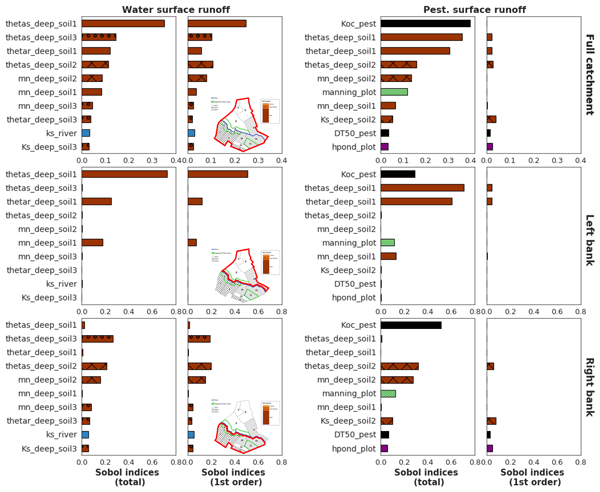
Emilie Rouzies, Claire Lauvernet, Bruno Sudret, and Arthur Vidard
Geosci. Model Dev., 16, 3137–3163, https://doi.org/10.5194/gmd-16-3137-2023, https://doi.org/10.5194/gmd-16-3137-2023, 2023
Short summary
Short summary
Water and pesticide transfer models are complex and should be simplified to be used in decision support. Indeed, these models simulate many spatial processes in interaction, involving a large number of parameters. Sensitivity analysis allows us to select the most influential input parameters, but it has to be adapted to spatial modelling. This study will identify relevant methods that can be transposed to any hydrological and water quality model and improve the fate of pesticide knowledge.
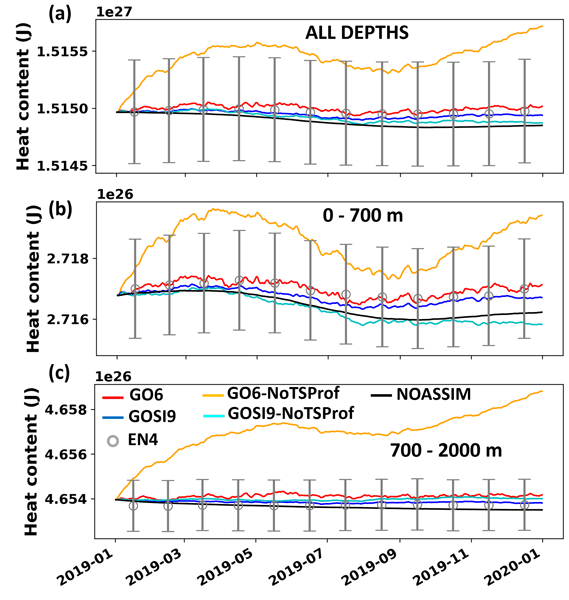
Davi Mignac, Jennifer Waters, Daniel J. Lea, Matthew J. Martin, James While, Anthony T. Weaver, Arthur Vidard, Catherine Guiavarc'h, Dave Storkey, David Ford, Edward W. Blockley, Jonathan Baker, Keith Haines, Martin R. Price, Michael J. Bell, and Richard Renshaw
Geosci. Model Dev., 18, 3405–3425, https://doi.org/10.5194/gmd-18-3405-2025, https://doi.org/10.5194/gmd-18-3405-2025, 2025
Short summary
Short summary
We describe major improvements of the Met Office's global ocean–sea ice forecasting system. The models and the way observations are used to improve the forecasts were changed, which led to a significant error reduction of 1 d forecasts. The new system performance in past conditions, where subsurface observations are scarce, was improved with more consistent ocean heat content estimates. The new system will be of better use for climate studies and will provide improved forecasts for end users.
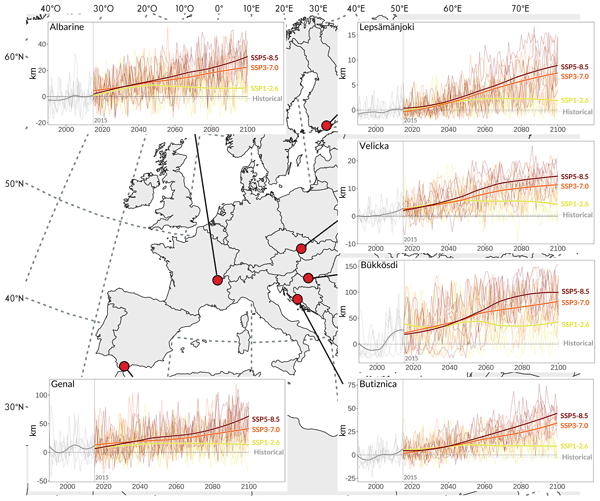
Louise Mimeau, Annika Künne, Alexandre Devers, Flora Branger, Sven Kralisch, Claire Lauvernet, Jean-Philippe Vidal, Núria Bonada, Zoltán Csabai, Heikki Mykrä, Petr Pařil, Luka Polović, and Thibault Datry
Hydrol. Earth Syst. Sci., 29, 1615–1636, https://doi.org/10.5194/hess-29-1615-2025, https://doi.org/10.5194/hess-29-1615-2025, 2025
Short summary
Short summary
Our study projects how climate change will affect the drying of river segments and stream networks in Europe, using advanced modelling techniques to assess changes in six river networks across diverse ecoregions. We found that drying events will become more frequent and intense and will start earlier or last longer, potentially turning some river sections from perennial to intermittent. The results are valuable for river ecologists for evaluating the ecological health of river ecosystem.
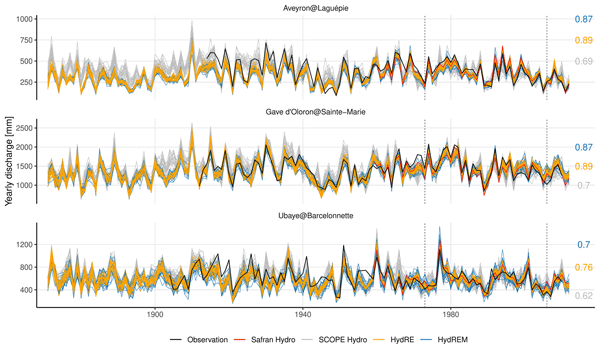
Alexandre Devers, Jean-Philippe Vidal, Claire Lauvernet, Olivier Vannier, and Laurie Caillouet
Hydrol. Earth Syst. Sci., 28, 3457–3474, https://doi.org/10.5194/hess-28-3457-2024, https://doi.org/10.5194/hess-28-3457-2024, 2024
Short summary
Short summary
Daily streamflow series for 661 near-natural French catchments are reconstructed over 1871–2012 using two ensemble datasets: HydRE and HydREM. They include uncertainties coming from climate forcings, streamflow measurement, and hydrological model error (for HydrREM). Comparisons with other hydrological reconstructions and independent/dependent observations show the added value of the two reconstructions in terms of quality, uncertainty estimation, and representation of extremes.
Emilie Rouzies, Claire Lauvernet, Bruno Sudret, and Arthur Vidard
Geosci. Model Dev., 16, 3137–3163, https://doi.org/10.5194/gmd-16-3137-2023, https://doi.org/10.5194/gmd-16-3137-2023, 2023
Short summary
Short summary
Water and pesticide transfer models are complex and should be simplified to be used in decision support. Indeed, these models simulate many spatial processes in interaction, involving a large number of parameters. Sensitivity analysis allows us to select the most influential input parameters, but it has to be adapted to spatial modelling. This study will identify relevant methods that can be transposed to any hydrological and water quality model and improve the fate of pesticide knowledge.
Alexandre Devers, Jean-Philippe Vidal, Claire Lauvernet, Olivier Vannier, and Laurie Caillouet
Hydrol. Earth Syst. Sci. Discuss., https://doi.org/10.5194/hess-2023-78, https://doi.org/10.5194/hess-2023-78, 2023
Publication in HESS not foreseen
Short summary
Short summary
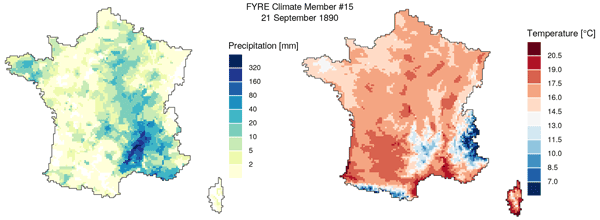
The recent development of the a new meteorological dataset providing precipitation and temperature over France – FYRE Climate – has been transformed to streamflow time series over 1871–2012 through the used of a hydrological model. This led to the creation of the daily hydrological reconstructions called HyDRE and HyDRE. These two reconstructions are evaluated allow to better understand the variability of past hydrology over France.
Alexandre Devers, Jean-Philippe Vidal, Claire Lauvernet, and Olivier Vannier
Clim. Past, 17, 1857–1879, https://doi.org/10.5194/cp-17-1857-2021, https://doi.org/10.5194/cp-17-1857-2021, 2021
Short summary
Short summary
This article presents FYRE Climate, a dataset providing daily precipitation and temperature spanning the 1871–2012 period at 8 km resolution over France. FYRE Climate has been obtained through the combination of daily and yearly observations and a gridded reconstruction already available through a statistical technique called data assimilation. Results highlight the quality of FYRE Climate in terms of both long-term variations and reproduction of extreme events.
Cited articles
Arnold, J. G., Srinivasan, R., Muttiah, R. S., and Williams, J. R.: Large area hydrologic modeling and assessment – Part 1: Model development, J. Am. Water Resour. A., 34, 73–89, https://doi.org/10.1111/j.1752-1688.1998.tb05961.x, 1998. a
Asch, M., Bocquet, M., and Nodet, M.: Data assimilation: methods, algorithms, and applications, in: Fundamentals of Algorithms, v1, SIAM, xviii + 306, halID hal-01402885, 2016. a
Baatz, D., Kurtz, W., Hendricks Franssen, H. J., Vereecken, H., and Kollet, S. J.: Catchment tomography – An approach for spatial parameter estimation, Adv. Water Resour., 107, 147–159, https://doi.org/10.1016/j.advwatres.2017.06.006, 2017. a
Bailey, R. T. and Baù, D.: Estimating geostatistical parameters and spatially-variable hydraulic conductivity within a catchment system using an ensemble smoother, Hydrol. Earth Syst. Sci., 16, 287–304, https://doi.org/10.5194/hess-16-287-2012, 2012. a
Bertino, L., Evensen, G., and Wackernagel, H.: Sequential Data Assimilation Techniques in Oceanography, Int. Stat. Rev., 71, 223–241, https://doi.org/10.1111/j.1751-5823.2003.tb00194.x, 2003. a
Bishop, C. H., Etherton, B. J., and Majumdar, S. J.: Adaptive sampling with the ensemble transform Kalman filter. Part I: Theoretical aspects, Mon. Weather Rev., 129, 420–436, https://doi.org/10.1175/1520-0493(2001)129<0420:ASWTET>2.0.CO;2, 2001. a
Bocquet, M. and Sakov, P.: An iterative ensemble Kalman smoother, Q. J. Roy. Meteor. Soc., 140, 1521–1535, https://doi.org/10.1002/qj.2236, 2014. a, b
Bonan, B., Albergel, C., Zheng, Y., Barbu, A. L., Fairbairn, D., Munier, S., and Calvet, J.-C.: An ensemble square root filter for the joint assimilation of surface soil moisture and leaf area index within the Land Data Assimilation System LDAS-Monde: application over the Euro-Mediterranean region, Hydrol. Earth Syst. Sci., 24, 325–347, https://doi.org/10.5194/hess-24-325-2020, 2020. a
Botto, A., Belluco, E., and Camporese, M.: Multi-source data assimilation for physically based hydrological modeling of an experimental hillslope, Hydrol. Earth Syst. Sci., 22, 4251–4266, https://doi.org/10.5194/hess-22-4251-2018, 2018. a
Bousbih, S., Zribi, M., El Hajj, M., Baghdadi, N., Lili-Chabaane, Z., Gao, Q., and Fanise, P.: Soil moisture and irrigation mapping in a semi-arid region, based on the synergetic use of Sentinel-1 and Sentinel-2 data, Remote Sens., 10, 1953, https://doi.org/10.3390/rs10121953, 2018. a, b
Branger, F., Braud, I., Debionne, S., Viallet, P., Dehotin, J., Henine, H., Nedelec, Y., and Anquetin, S.: Towards multi-scale integrated hydrological models using the LIQUID® framework. Overview of the concepts and first application examples, Environ. Model. Softw., 25, 1672–1681, https://doi.org/10.1016/j.envsoft.2010.06.005, 2010. a, b
Brown, T. A.: Admissible scoring systems for continuous distributions, Tech. rep., The Rand Corporation, 1974. a
Buis, S., Piacentini, A., and Déclat, D.: PALM: a computational framework for assembling high-performance computing applications, Concurrency and Computation: Practice and Experience, 18, 231–245, https://doi.org/10.1002/cpe.914, 2006 (code available at: http://www.cerfacs.fr/globc/PALM_WEB/user.html#download, last access: December 2023). a, b
Buytaert, W., Reusser, D., Krause, S., and J.-P., R.: Why can't we do better than Topmodel?, Hydrol. Process., 22, 4175–4179, https://doi.org/10.1002/hyp.7125, 2008. a
Camporese, M., Paniconi, C., Putti, M., and Salandin, P.: Ensemble Kalman filter data assimilation for a process-based catchment scale model of surface and subsurface flow, Water Resour. Res., 45, https://doi.org/10.1029/2008WR007031, 2009. a
Camporese, M., Paniconi, C., Putti, M., and Orlandini, M.: Surface-subsurface flow modeling with path-based runoff routing, boundary condition-based coupling, and assimilation of multisource observation data, Water Resour. Res., 46, https://doi.org/10.1029/2008WR007536, 2010. a
Carrassi, A., Bocquet, M., Bertino, L., and Evensen, G.: Data assimilation in the geosciences: An overview of methods, issues, and perspectives, Wiley Interdisciplinary Reviews: Climate Change, 9, e535, https://doi.org/10.1002/wcc.535, 2018. a
Crestani, E., Camporese, M., Baú, D., and Salandin, P.: Ensemble Kalman filter versus ensemble smoother for assessing hydraulic conductivity via tracer test data assimilation, Hydrol. Earth Syst. Sci., 17, 1517–1531, https://doi.org/10.5194/hess-17-1517-2013, 2013. a, b
Crow, W. T. and Wood, E. F.: The assimilation of remotely sensed soil brightness temperature imagery into a land surface model using Ensemble Kalman filtering: a case study based on ESTAR measurements during SGP97, Adv. Water Resour., 26, 137–149, https://doi.org/10.1016/S0309-1708(02)00088-X, 2003. a
Cui, F., Bao, J., Cao, Z., Li, L., and Zheng, Q.: Soil hydraulic parameters estimation using ground penetrating radar data via ensemble smoother with multiple data assimilation, J. Hydrol., 583, 124552, https://doi.org/10.1016/j.jhydrol.2020.124552, 2020. a, b
Darcy, H.: Recherches expérimentales relatives au mouvement de l'eau dans les tuyaux, Mallet – Bachelier, 1857. a
Defforge, C. L., Carissimo, B., Bocquet, M., Armand, P., and Bresson, R.: Data assimilation at local scale to improve CFD simulations of atmospheric dispersion: application to 1D shallow-water equations and method comparisons, Int. J. Environ. Pollut., 64, 90–109, https://doi.org/10.1504/IJEP.2018.099151, 2018. a
Dehotin, J.: Prise en compte de l'hétérogénéité des surfaces continentales dans la modélisation hydrologique spatialisée. Application sur le haut-bassin de la Saône., Ph.D. thesis, Institut National Polytechnique de Grenoble, 2007. a
Devers, A., Vidal, J.-P., Lauvernet, C., Graff, B., and Vannier, O.: A framework for high-resolution meteorological surface reanalysis through offline data assimilation in an ensemble of downscaled reconstructions, Q. J. Roy. Meteor. Soc., 146, 153–173, https://doi.org/10.1002/qj.3663, 2020. a
Djabelkhir, K., Lauvernet, C., Kraft, P., and Carluer, N.: Development of a dual permeability model within a hydrological catchment modeling framework: 1D application, Sci. Total Environ., 575, 1429–1437, https://doi.org/10.1016/j.scitotenv.2016.10.012, 2017. a
El Hajj, M., Baghdadi, N., Zribi, M., and Bazzi, H.: Synergic use of Sentinel-1 and Sentinel-2 images for operational soil moisture mapping at high spatial resolution over agricultural areas, Remote Sens., 9, 1292, https://doi.org/10.3390/rs9121292, 2017. a
Emerick, A. A. and Reynolds, A. C.: History-matching production and seismic data in a real field case using the ensemble smoother with multiple data assimilation, in: SPE Reservoir Simulation Symposium, 18–20 February 2013, The Woodlands, Texas, USA, OnePetro, https://doi.org/10.2118/163675-MS, 2013b. a
Evensen, G.: Sequential data assimilation with a nonlinear quasi-geostrophic model using Monte Carlo methods to forecast error statistics, J. Geophys. Res.-Oceans, 99, 10143–10162, https://doi.org/10.1029/94JC00572, 1994. a
Evensen, G.: The ensemble Kalman filter: Theoretical formulation and practical implementation, Ocean Dynam., 53, 343–367, https://doi.org/10.1007/s10236-003-0036-9, 2003. a
Evensen, G.: The ensemble Kalman filter for combined state and parameter estimation, IEEE Contr. Syst. Mag., 29, 83–104, https://doi.org/10.1109/MCS.2009.932223, 2009. a
Fatichi, S., Vivoni, E. R., Ogden, F. L., Ivanov, V. Y., Mirus, B., Gochis, D., Downer, C. W., Camporese, M., Davison, J. H., Ebel, B., Jones, N., Kim, J., Mascaro, G., Niswonger, R., Restrepo, P., Rigon, R., Shen, C., Sulis, M., and Tarboton, D.: An overview of current applications, challenges, and future trends in distributed process-based models in hydrology, J. Hydrol., 537, 45–60, https://doi.org/10.1016/j.jhydrol.2016.03.026, 2016. a
Fouilloux, A. and Piacentini, A.: The PALM Project: MPMD Paradigm for an Oceanic Data Assimilation Software, in: Euro-Par’99 Parallel Processing: 5th International Euro-Par Conference Toulouse, France, 31 August–3 September , 1999 Proceedings, 1423–1430, 1999. a
Gao, Q., Zribi, M., Escorihuela, M., and Baghdadi, N.: Synergetic Use of Sentinel-1 and Sentinel-2 Data for Soil Moisture Mapping at 100 m Resolution, Sensors, 17, 1966, https://doi.org/10.3390/s17091966, 2017. a
Gassmann, M., Stamm, C., Olsson, O., Lange, J., Kümmerer, K., and Weiler, M.: Model-based estimation of pesticides and transformation products and their export pathways in a headwater catchment, Hydrol. Earth Syst. Sci., 17, 5213–5228, https://doi.org/10.5194/hess-17-5213-2013, 2013. a
Hendricks Franssen, H. J. and Kinzelbach, W.: Real-time groundwater flow modeling with the Ensemble Kalman Filter: Joint estimation of states and parameters and the filter inbreeding problem, Water Resour. Res., 44, https://doi.org/10.1029/2007WR006505, 2008. a, b
Herrera, P. A., Marazuela, M. A., and Hofmann, T.: Parameter estimation and uncertainty analysis in hydrological modeling, WIREs Water, 9, e1569, https://doi.org/10.1002/wat2.1569, 2022. a
Hersbach, H.: Decomposition of the Continuous Ranked Probability Score for Ensemble Prediction Systems, Weather Forecast., 15, 559–570, https://doi.org/10.1175/1520-0434(2000)015<0559:DOTCRP>2.0.CO;2, 2000. a, b, c
Hunt, B. R., Kostelich, E. J., and Szunyogh, I.: Efficient data assimilation for spatiotemporal chaos: A local ensemble transform Kalman filter, Physica D, 230, 112–126, https://doi.org/10.1016/j.physd.2006.11.008, data Assimilation, 2007. a
Kalman, R. E.: A New Approach to Linear Filtering and Prediction Problems, Transactions of the ASME–Journal of Basic Engineering, 82, 35–45, https://doi.org/10.1115/1.3662552, 1960. a
Katzfuss, M., Stroud, J. R., and Wikle, C. K.: Understanding the ensemble Kalman filter, Am. Stat., 70, 350–357, https://doi.org/10.1080/00031305.2016.1141709, 2016. a
Kraft, P., Vache, K. B., Frede, H.-G., and Breuer, L.: CMF: A Hydrological Programming Language Extension For Integrated Catchment Models, Environ. Model. Softw., 26, 828–830, https://doi.org/10.1016/j.envsoft.2010.12.009, 2012. a
Kurtz, W., He, G., Kollet, S. J., Maxwell, R. M., Vereecken, H., and Hendricks Franssen, H.-J.: TerrSysMP–PDAF (version 1.0): a modular high-performance data assimilation framework for an integrated land surface–subsurface model, Geosci. Model Dev., 9, 1341–1360, https://doi.org/10.5194/gmd-9-1341-2016, 2016. a
Lei, F., Crow, W. T., Kustas, W. P., Dong, J., Yang, Y., Knipper, K. R., Anderson, M. C., Gao, F., Notarnicola, C., Greifeneder, F., McKee, L. M., Alfieri, J. G., Hain, C., and Dokoozlian, N.: Data assimilation of high-resolution thermal and radar remote sensing retrievals for soil moisture monitoring in a drip-irrigated vineyard, Remote Sens. Environ., 239, 111622, https://doi.org/10.1016/j.rse.2019.111622, 2020. a
Lighthill, M. J. and Whitham, G. B.: On kinematic waves I. Flood movement in long rivers, P. Roy. Soc. Lond. A, 229, 281–316, https://doi.org/10.1098/rspa.1955.0088, 1955. a
Liu, Y. and Gupta, H. V.: Uncertainty in hydrologic modeling: Toward an integrated data assimilation framework, Water Resour. Res., 43, https://doi.org/10.1029/2006WR005756, 2007. a
Miles, J. C.: The representation of flows to partially penetrating rivers using groundwater flow models, J. Hydrol., 82, 341–355, https://doi.org/10.1016/0022-1694(85)90026-5, 1985. a
Moradkhani, H., Sorooshian, S., Gupta, H. V., and Houser, P. R.: Dual state–parameter estimation of hydrological models using ensemble Kalman filter, Adv. Water Resour., 28, 135–147, https://doi.org/10.1016/j.advwatres.2004.09.002, 2005. a
Moussa, R., Colin, F., Dagès, C., Fabre, J.-C.and Lagacherie, P., Louchart, X., Rabotin, M., Raclot, D., and Voltz, M.: Distributed hydrological modelling of farmed catchments (MHYDAS): assessing the impact of man-made structures on hydrological processes, in: International Conference on Integrative Landscape Modelling, LANDMOD2010, Symposcience – Éditions Quae, Section 2. Modelling the biophysical components of landscapes, https://hal.inrae.fr/hal-02753016 (last access: 5 January 2026), 2010. a
Nie, S., Zhu, J., and Luo, Y.: Simultaneous estimation of land surface scheme states and parameters using the ensemble Kalman filter: identical twin experiments, Hydrol. Earth Syst. Sci., 15, 2437–2457, https://doi.org/10.5194/hess-15-2437-2011, 2011. a, b
Paniconi, C. and Putti, M.: A comparison of Picard and Newton iteration in the numerical solution of multidimensional variably saturated flow problems, Water Resour. Res., 30, 3357–3374, https://doi.org/10.1029/94WR02046, 1994. a
Pasetto, D., Niu, G.-Y., Pangle, L., Paniconi, C., Putti, M., and Troch, P. A.: Impact of sensor failure on the observability of flow dynamics at the Biosphere 2 LEO hillslopes, Adv. Water Resour., 86, 327–339, https://doi.org/10.1016/j.advwatres.2015.04.014, 2015. a
Radišić, K., Rouzies, E., Lauvernet, C., and Vidard, A.: Global sensitivity analysis of the dynamics of a distributed hydrological model at the catchment scale, Socio-Environmental Systems Modelling, 5, 18570, https://doi.org/10.18174/sesmo.18570, 2023. a
Richards, A. L.: Capillary conduction of liquids in porous mediums, Physics 1, 1, 318–333, https://doi.org/10.1063/1.1745010, 1931. a
Rochoux, M. C., Ricci, S., Lucor, D., Cuenot, B., and Trouvé, A.: Towards predictive data-driven simulations of wildfire spread – Part I: Reduced-cost Ensemble Kalman Filter based on a Polynomial Chaos surrogate model for parameter estimation, Nat. Hazards Earth Syst. Sci., 14, 2951–2973, https://doi.org/10.5194/nhess-14-2951-2014, 2014. a
Rouzies, E., Lauvernet, C., Barachet, C., Morel, T., Branger, F., Braud, I., and Carluer, N.: From agricultural catchment to management scenarios: A modular tool to assess effects of landscape features on water and pesticide behavior, Sci. Total Environ., 671, 1144–1160, https://doi.org/10.1016/j.scitotenv.2019.03.060, 2019. a, b, c, d
Rouzies, E., Lauvernet, C., and Vidard, A.: Code availability for: Comparison of different ensemble assimilation methods for joint estimation in a pesticide transfer model, Zenodo [code], https://doi.org/10.5281/zenodo.6782073, 2022. a
Rouzies, E., Lauvernet, C., Sudret, B., and Vidard, A.: How is a global sensitivity analysis of a catchment-scale, distributed pesticide transfer model performed? Application to the PESHMELBA model, Geosci. Model Dev., 16, 3137–3163, https://doi.org/10.5194/gmd-16-3137-2023, 2023. a, b, c
Šimůnek, J., Van Genuchten, M. T., and Šejna, M.: HYDRUS-1D - Simulating the one-dimensional movement of water, heat, and multiple solutes in variably-saturated media, Tech. rep., U.S. Salinity Lab., Riverside, CA., 1998. a
Tortrat, F.: Modélisation orientée décision des processus de transfert par ruissellement et subsurface des herbicides dans les bassins versants agricoles., Ph.D. thesis, Ecole nationale supérieure d'agronomie de Rennes, 2005. a
van Leeuwen, P. J. and Evensen, G.: Data Assimilation and Inverse Methods in Terms of a Probabilistic Formulation, Mon. Weather Rev., 124, 2898–2913, https://doi.org/10.1175/1520-0493(1996)124<2898:DAAIMI>2.0.CO;2, 1996. a, b
Wendell, A.-K., Guse, B., Bieger, K., Wagner, P. D., Kiesel, J., Ulrich, U., and Fohrer, N.: A spatio-temporal analysis of environmental fate and transport processes of pesticides and their transformation products in agricultural landscapes dominated by subsurface drainage with SWAT+, Sci. Total Environ., 945, 173629, https://doi.org/10.1016/j.scitotenv.2024.173629, 2024. a
Xie, X. and Zhang, D.: Data assimilation for distributed hydrological catchment modeling via ensemble Kalman filter, Adv. Water Resour., 33, 678–690, https://doi.org/10.1016/j.advwatres.2010.03.012, 2010. a
Short summary
Hydrological models are useful for assessing the impact of landscape organization for effective mitigation strategies. However, using these models requires reducing uncertainties in their results, which can be achieved through model–data fusion. We integrate satellite surface moisture images into a water and pesticide transfer model. We compare three methods, studying their performance and exploring various scenarios. This study helps improve decision support in water quality management.
Hydrological models are useful for assessing the impact of landscape organization for effective...


