
the Creative Commons Attribution 4.0 License.
the Creative Commons Attribution 4.0 License.
 | 02 Nov 2026
HESS Opinions: Operationalizing sociohydrology from systems thinking to systems doing for sustainable and resilient water management

Murugesu Sivapalan
Sondoss Elsawah
Melissa Haeffner
Anthony Jakeman
Heidi Kreibich
Leyang Liu
Haoyang Lyu
Ana Mijic
Jiale Wang
Jing Wei
Günter Blöschl
Sociohydrology has advanced explanations of coupled human-water systems, but its translation into decision support remains uneven. We propose two complementary approaches to move from systems thinking to systems doing: (i) canonical feedback structures, which describe the main components of human-water systems and how they interact and enable comparison across cases while accounting for important local differences; and (ii) critical pathways, which trace how management actions propagate through these components to produce outcomes, including unintended consequences. Drawing on cases such as the levee effect and reservoir effect, these approaches connect system understanding with intervention design, monitoring, and adaptive learning. We then propose a minimal “systems-doing loop” that links the decision setting, feedback mapping, pathway tracing, indicator selection, and iteration, with equity and legitimacy treated as explicit constraints on useful knowledge and acceptable action. This framing complements predictive modelling and integrated water resources management by accounting for potential unintended consequences in decision-making and clarifying what to monitor and revisit as systems change.
- Article
(424 KB) - Full-text XML
- BibTeX
- EndNote


Sociohydrology was established to understand coupled human-water systems (CHWS) as co-evolving systems shaped by feedbacks between hydrology and society (Sivapalan et al., 2012; Di Baldassarre et al., 2019). Yet many studies still stop at explanation: models reproduce observed dynamics, but remain loosely connected to the concrete work of practice, including intervention design, monitoring choices, and iterative learning cycles. A useful opinion-level contribution is therefore not another call for “holistic” approaches, but a compact and defensible bridge that helps move from insight to action.
We suggest two requirements for this bridge. First, case representations should be comparable across places while accounting for important local differences. Shared component labels facilitate comparison, but aggregated variables can obscure differences among actors and institutions. For example, a single urban “water demand” variable can conceal discretionary consumption by affluent households alongside unmet basic needs among poorer households. Savelli et al. (2023) demonstrate the value of distinguishing these consumption patterns and inequalities in water access when explaining scarcity and considering interventions. Second, sociohydrological insights should connect explicitly to decisions: what to do next, what to monitor, and how to adapt when systems surprise us. These moves align with IAHS Panta Rhei and subsequent science-for-solutions efforts (Montanari et al., 2013; Kreibich et al., 2025; Arheimer et al., 2024). They also complement other integrative framings: water security and nexus approaches are valuable for defining risks, trade-offs, and cross-sector interdependence, whereas sociohydrology contributes most when endogenous social feedbacks, path dependence, and unintended consequences must be made explicit within human-water systems.
Comparability does not require uniformity. A practical starting point is to describe CHWS with a minimal anatomy of interacting components (hydrology, infrastructure, institutions, society, economy, and environment, see Fig. 1) and then represent key feedbacks among them (Tian et al., 2026a, b). We use canonical feedback structure, or canonical form, for this simplified representation of system anatomy, which makes cases comparable while retaining local differences. Systems thinking examines how these interactions shape system behaviour over time. Causal loop diagrams and related system dynamics tools provide a compact language for this purpose (Hjorth and Bagheri, 2006): diagrams show how variables influence one another and form feedback loops that amplify or counteract change.
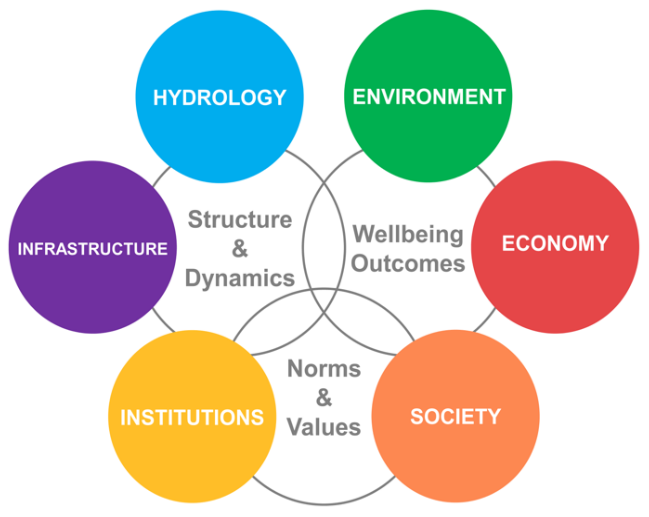
Figure 1A canonical form representing the common anatomy of CHWS. Six interacting components (hydrology, infrastructure, institutions, society, economy, and environment) provide a scaffold for mapping feedbacks and tracing critical pathways from interventions to outcomes.
Quantitative system dynamics models express these relationships as equations describing accumulations and rates of change, enabling simulation (Lyu et al., 2026). These tools complement predictive modelling, including machine-learning and AI-based approaches: predictive skill alone does not establish how interventions affect coupled systems (Runge et al., 2023). Feedbacks and critical pathways help guide model development, scenario analysis, and monitoring.
Two well-studied examples illustrate the value of canonical forms. The levee effect shows how structural protection can reduce perceived flood risk, stimulate development in exposed areas, and thereby increase potential losses if protection is exceeded or fails (Di Baldassarre et al., 2013). Reservoirs can initially buffer drought impacts, but greater dependence on stored water can increase vulnerability when supplies fail (Lucero, 2002; Di Baldassarre et al., 2018). This reservoir effect may involve reduced preparedness; supply expansion can also induce demand growth (Di Baldassarre et al., 2018). These cases share a recognizable structure: an intervention dampens risk in the short term while shifting behavior and exposure in ways that can undermine long-term goals. Flood and drought risks are also connected: retaining reservoir water to cope with drought can reduce the storage available to buffer subsequent floods (Di Baldassarre et al., 2017). Organizing such phenomena in shared meta-models and libraries of canonical forms can support cumulative learning while keeping case-specific detail visible (Mijic et al., 2024; Tian et al., 2026a, b).
Canonical feedbacks help explain why unintended consequences recur. To put these insights into practice, sociohydrology needs a transparent way to connect specific actions to outcomes through the most influential chains of effects. We call these chains critical pathways: empirically grounded sequences of interactions, abstracted from documented cases, that trace how interventions propagate to unintended consequences, including where feedbacks amplify or dampen impacts (Tian et al., 2026a, b). When applied to new settings or proposed interventions, they inform testable hypotheses about local mechanisms and intervention effects. Unintended outcomes may be beneficial or adverse; tracing their pathways supports desirable outcomes and helps avoid or mitigate undesirable ones.
Critical pathways complement established intervention heuristics such as leverage points (Meadows, 2012): places in a system where a small change can substantially alter its behaviour. Leverage points ask where to intervene in a system; critical pathways make those opportunities explicit by tracing how an intervention actually propagates. For the levee effect, a critical pathway can run from levee height to perceived safety to land-use change to exposure and losses (Di Baldassarre et al., 2013; Tian et al., 2026a). Outcomes depend on whether structural protection is combined with land-use planning, risk communication, preparedness, and adaptive management. Such hybrid strategies can interrupt adverse feedbacks while retaining infrastructure benefits (Catalano and Hall, 2026). Similarly, reservoir storage should be assessed together with demand management, allocation rules, and drought preparedness.
For example, water-use restrictions are a potential leverage point: falling storage triggers restrictions, demand adjusts, and reduced withdrawals affect storage. A coupled reservoir-demand model can formalise this feedback (Garcia et al., 2020), with policy-specified thresholds and response rates and delays estimated from records or tested over plausible ranges. Predictive use requires testing these dynamics and evaluating uncertainty. Methodologically, critical pathways are not tied to a single approach. They can be abstracted from case narratives and qualitative and quantitative evidence (Tian et al., 2026a). Participatory mapping can assess local relevance, while simulation experiments explore candidate interventions under stated assumptions. The goal is a small set of plausible pathways that can guide decisions and monitoring.
Comparative synthesis and place-based investigation should form a reciprocal learning process. Canonical feedback structures support comparison across cases, while synthesis identifies recurring mechanisms, case-derived critical pathways, and the conditions under which they have been observed. This helps individual cases learn from experience elsewhere and potentially reduces repeated trial and error. Place-based investigation examines whether and how these mechanisms operate locally, including how institutions, culture, and biophysical conditions shape them. Local findings then refine, extend, or challenge the comparative understanding, improving its relevance to subsequent cases (Tian et al., 2026a; Lyu et al., 2026). Predictive modelling remains essential within this cycle: coupled with systems thinking, it can estimate possible outcomes under explicit assumptions, while pathway analysis and local evidence help investigate why those outcomes may arise and which unintended consequences warrant attention.
This coupling requires reporting that is comparable but not constraining. Rather than a single rigid framework, sociohydrology would benefit from minimum reporting elements with modular extensions. A short core could include: (i) system boundary and time horizon; (ii) key interventions and decision actors; (iii) outcomes of concern and how they are measured; (iv) the main feedbacks and critical pathways, with their evidence and assumptions; and (v) contextual descriptors of governance and infrastructure that condition behaviour. Optional modules can then support different comparative designs, from qualitative typologies to quantitative meta-analysis.
Moving from systems thinking to systems doing requires integrated data that captures not only hydrology and infrastructure, but also social variables that sit on critical pathways, such as risk perception, trust, compliance, and institutional change. Data plans should be designed around the pathway variables that decisions can plausibly influence and around leading indicators that can warn when a system is drifting toward lock-in or failure.
Citizen science, community monitoring, and participatory data collection can strengthen CHWS understanding by expanding spatiotemporal coverage and improving the salience of indicators, but they do not automatically democratise knowledge or represent marginalised groups (Buytaert et al., 2016). Their value is greatest when they are tied to concrete pathway variables, for example by co-defining drought indicators, documenting infrastructure failures, or improving datasets on flood memory and warning response. Participation should therefore be treated as a design choice with clear objectives, roles, safeguards, and resources; Sect. 4 discusses the conditions needed to sustain it and limit unintended burdens. FAIR principles can improve findability and reuse of datasets (Wilkinson et al., 2016), while CARE principles clarify expectations around Indigenous data governance, benefit, and authority (Carroll et al., 2020).
Sociohydrological models can shape decisions, so the standards for useful knowledge extend beyond predictive skill. Equity, legitimacy, and governance should therefore be treated as related but distinct dimensions of systems doing, not as interchangeable labels. A minimal equity-aware stance asks three questions at the outset of a study: who is represented in the model and data, who benefits or bears harm under candidate interventions, and what decision processes are considered legitimate (Arnstein, 1969; Schlosberg, 2007). This does not imply that participation replaces formal accountability, nor that all projects must use the same co-production model. It implies that distributional effects, procedural legitimacy, and recognition of affected communities are treated as first-class variables and constraints, not as afterthoughts.
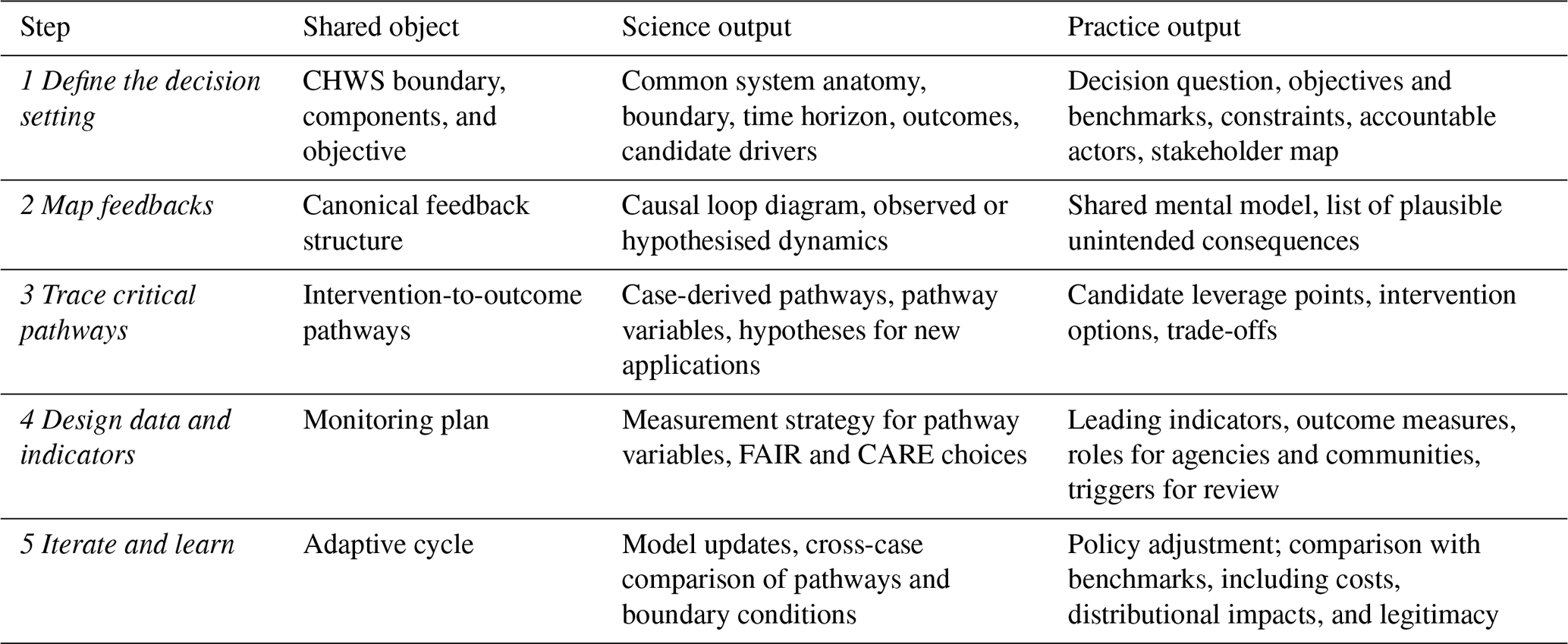
Table 1A minimal systems-doing loop for sociohydrology in science and practice.
Participatory modelling can support shared problem framing and learning, but it does not guarantee interdisciplinarity or transdisciplinarity. Its legitimacy depends on transparent choices about whose knowledge is included, how disagreement is handled, and how contributions influence decisions. Poorly supported participation can also generate delays, tokenism, conflict escalation, fatigue, and procedural overload (Wamsler et al., 2020; Bruley et al., 2026). Effective implementation therefore requires sufficient time and funding, skilled facilitation attentive to power imbalances, support for sustained stakeholder engagement, and institutional capacity to connect modelling with decisions, monitoring, and learning. These requirements should be planned and resourced from the outset, with clear responsibilities, realistic timelines, feedback to participants on how their contributions informed decisions, and continuing evaluation of participants' burdens and influence.
The science-society interface requires fit-for-purpose tools that connect understanding with decisions and implementation. Sociohydrology can complement integrated water resources management by using canonical feedback structures to organise system understanding and case-derived critical pathways to examine potential unintended consequences. For water managers, the practical value lies in a repeatable systems-doing loop: define the decision setting and relevant components, map feedbacks, trace critical pathways and assess proposed interventions, design indicators and monitoring, and revise interventions as evidence accumulates (Table 1). The loop should examine connections among floods, droughts, and other extremes, including how management responses redistribute risks and benefits across places, sectors, and timescales. Intervention choices and monitoring should consider these connections and associated trade-offs, consistent with systemic approaches to nature-based solutions that coordinate objectives across sectors (McKnight et al., 2026).
Sociohydrology should be judged by whether it improves intervention choice, monitoring, and learning in real decision settings, with equity and legitimacy treated as explicit constraints. The systems-doing loop should itself be tested in practice. Evaluation should document whether monitoring informs intervention choices and timely corrections, and whether these changes improve outcomes against objectives agreed in advance, such as water-supply reliability or reduced flood losses, relative to existing practice or credible alternatives. Comparisons should account for external conditions, implementation costs, and the distribution of benefits and harms. Evidence of learning is valuable, but does not alone demonstrate improved outcomes. Canonical forms and critical pathways provide a basis for organising this evaluation and revising decisions as evidence accumulates.
No code or datasets were used in this opinion article.
FT led the conceptualization and drafting. All authors contributed to discussion, writing, and revisions.
At least one of the (co-)authors is a member of the editorial board of Hydrology and Earth System Sciences. The peer-review process was guided by an independent editor, and the authors also have no other competing interests to declare.
Publisher's note: Copernicus Publications remains neutral with regard to jurisdictional claims made in the text, published maps, institutional affiliations, or any other geographical representation in this paper. The authors bear the ultimate responsibility for providing appropriate place names. Views expressed in the text are those of the authors and do not necessarily reflect the views of the publisher.
The authors gratefully acknowledge the support of the IAHS Panta Rhei Decade on Change in Hydrology and Society, which provided the intellectual backdrop and collaborative platform that inspired this opinion piece.
This research has been supported by the National Natural Science Foundation of China (grant no. U2442201). H. Kreibich was supported by the European Research Council (ERC) Synergy project LIMIT2ADAPT (grant no. 101224116).
This paper was edited by Alberto Guadagnini and reviewed by Alberto Montanari and Ursula McKnight.
Arheimer, B., Cudennec, C., Castellarin, A., Grimaldi, S., Heal, K. V., Lupton, C., Sarkar, A., Tian, F., Kileshye Onema, J.-M., Archfield, S., Blöschl, G., Chaffe, P. L. B., Croke, B. F. W., Dembélé, M., Leong, C., Mijic, A., Mosquera, G. M., Nlend, B., Olusola, A. O., Polo, M. J., Sandells, M., Sheffield, J., van Hateren, T. C., Shafiei, M., Adla, S., Agarwal, A., Aguilar, C., Andersson, J. C. M., Andraos, C., Andreu, A., Avanzi, F., Bart, R. R., Bartosova, A., Batelaan, O., Bennett, J. C., Bertola, M., Bezak, N., Boekee, J., Bogaard, T., Booij, M. J., Brigode, P., Buytaert, W., Bziava, K., Castelli, G., Castro, C. V., Ceperley, N. C., Chidepudi, S. K. R., Chiew, F. H. S., Chun, K. P., Dagnew, A. G., Dekongmen, B. W., Del Jesus, M., Dezetter, A., Do Nascimento Batista, J. A., Doble, R. C., Dogulu, N., Eekhout, J. P. C., Elçi, A., Elenius, M., Finger, D. C., Fiori, A., Fischer, S., Förster, K., Ganora, D., Gargouri Ellouze, E., Ghoreishi, M., Harvey, N., Hrachowitz, M., Jampani, M., Jaramillo, F., Jongen, H. J., Kareem, K. Y., Khan, U. T., Khatami, S., Kingston, D. G., Koren, G., Krause, S., Kreibich, H., Lerat, J., Liu, J., Liu, S., Madruga de Brito, M., Mahé, G., Makurira, H., Mazzoglio, P., Merheb, M., Mishra, A., Mohammad, H., Montanari, A., Mujere, N., Nabavi, E., Nkwasa, A., Orduna Alegria, M. E., Orieschnig, C., Ovcharuk, V., Palmate, S. S., Pande, S., Pandey, S., Papacharalampous, G., Pechlivanidis, I., Penny, G., Pimentel, R., Post, D. A., Prieto, C., Razavi, S., Salazar-Galán, S., Sankaran Namboothiri, A., Santos, P. P., Savenije, H., Shanono, N. J., Sharma, A., Sivapalan, M., Smagulov, Z., Szolgay, J., Teng, J., Teuling, A. J., Teutschbein, C., Tyralis, H., van Griensven, A., van Schalkwyk, A. J., van Tiel, M., Viglione, A., Volpi, E., Wagener, T., Wang, X., Wang-Erlandsson, L., Wens, M., and Xia, J.: The IAHS Science for Solutions decade, with Hydrology Engaging Local People IN one Global world (HELPING), Hydrolog. Sci. J., 69, 1417–1435, https://doi.org/10.1080/02626667.2024.2355202, 2024.
Arnstein, S. R.: A ladder of citizen participation, J. Am. Inst. Plan., 35, 216–224, https://doi.org/10.1080/01944366908977225, 1969.
Bruley, E., Scolobig, A., Ellena, M., Pickard, S., Englund, M., Baulenas, E., Erokhin, D., Bharwani, S., Mattera, M., Baldelli, M., Moreno, L., Bielsa, J., Verones, A., Allen, S. K., Komendantova, N., Nachtigall, N., and Stoffel, M.: Advancing stakeholder engagement in climate adaptation: a systematic review of structural barriers and operational enablers, Sustain. Sci., https://doi.org/10.1007/s11625-026-01843-7, 2026.
Buytaert, W., Dewulf, A., De Bièvre, B., Clark, J., and Hannah, D. M.: Citizen science for water resources management: toward polycentric monitoring and governance?, J. Water Resour. Plann. Manage., 142, 01816002, https://doi.org/10.1061/(ASCE)WR.1943-5452.0000641, 2016.
Carroll, S. R., Garba, I., Figueroa-Rodríguez, O. L., Holbrook, J., Lovett, R., Materechera, S., Parsons, M., Raseroka, K., Rodriguez-Lonebear, D., Rowe, R., Sara, R., Walker, J. D., Anderson, J., and Hudson, M.: The CARE Principles for Indigenous Data Governance, Data Sci. J., 19, 43, https://doi.org/10.5334/dsj-2020-043, 2020.
Catalano, A. J. and Hall, D. M.: Reviewing the Levee Effect: From Theory to Practice, J. Flood Risk Manag., 19, e70211, https://doi.org/10.1111/jfr3.70211, 2026.
Di Baldassarre, G., Viglione, A., Carr, G., Kuil, L., Salinas, J. L., and Blöschl, G.: Socio-hydrology: conceptualising human-flood interactions, Hydrol. Earth Syst. Sci., 17, 3295–3303, https://doi.org/10.5194/hess-17-3295-2013, 2013.
Di Baldassarre, G., Martinez, F., Kalantari, Z., and Viglione, A.: Drought and flood in the Anthropocene: feedback mechanisms in reservoir operation, Earth Syst. Dynam., 8, 225–233, https://doi.org/10.5194/esd-8-225-2017, 2017.
Di Baldassarre, G., Wanders, N., AghaKouchak, A., Kuil, L., Rangecroft, S., Veldkamp, T. I. E., Garcia, M., van Oel, P. R., Breinl, K., and Van Loon, A. F.: Water shortages worsened by reservoir effects, Nat. Sustain., 1, 617–622, https://doi.org/10.1038/s41893-018-0159-0, 2018.
Di Baldassarre, G., Sivapalan, M., Rusca, M., Cudennec, C., Garcia, M., Kreibich, H., Konar, M., Mondino, E., Mård, J., Pande, S., Sanderson, M. R., Tian, F., Viglione, A., Wei, J., Wei, Y., Yu, D. J., Srinivasan, V., and Blöschl, G.: Sociohydrology: scientific challenges in addressing the sustainable development goals, Water Resour. Res., 55, 6327–6355, https://doi.org/10.1029/2018WR023901, 2019.
Garcia, M., Ridolfi, E., and Di Baldassarre, G.: The interplay between reservoir storage and operating rules under evolving conditions, J. Hydrol., 590, 125270, https://doi.org/10.1016/j.jhydrol.2020.125270, 2020.
Hjorth, P. and Bagheri, A.: Navigating towards sustainable development: a system dynamics approach, Futures, 38, 74–92, https://doi.org/10.1016/j.futures.2005.04.005, 2006.
Kreibich, H., Sivapalan, M., AghaKouchak, A., Addor, N., Aksoy, H., Arheimer, B., Arnbjerg-Nielsen, K., Vail-Castro, C., Cudennec, C., Madruga de Brito, M., Di Baldassarre, G., Finger, D. C., Fowler, K., Knoben, W., Krueger, T., Liu, J., Macdonald, E., McMillan, H., Mendiondo, E. M., Montanari, A., Muller, M. F., Pande, S., Tian, F., Viglione, A., Wei, Y., Castellarin, A., Loucks, D. P., Oki, T., Polo, M. J., Savenije, H., Van Loon, A. F., Agarwal, A., Alvarez-Garreton, C., Andreu, A., Barendrecht, M. H., Brunner, M., Cavalcante, L., Cavus, Y., Ceola, S., Chaffe, P., Chen, X., Coxon, G., Zhao, D., Davary, K., Dembélé, M., Dewals, B., Frolova (Bibikova), T., Gain, A. K., Gelfan, A., Ghoreishi, M., Grabs, T., Guan, X., Hannah, D. M., Helmschrot, J., Höllermann, B., Hounkpè, J., Koebele, E., Konar, M., Kratzert, F., Lindersson, S., Llasat, M. C., Matanó, A., Mazzoleni, M., Mejia, A., Mendoza, P., Merz, B., Mukherjee, J., Nasiri Saleh, F., Nlend, B., Nonki, R. M., Orieschnig, C., Papagiannaki, K., Penny, G., Petrucci, O., Pimentel, R., Pool, S., Ridolfi, E., Rusca, M., Sairam, N., Sankaran Namboothiri, A., Sarmento Buarque, A. C., Savelli, E., Schoppa, L., Schröter, K., Scolobig, A., Shafiei, M., Sikorska-Senoner, A. E., Smigaj, M., Teutschbein, C., Thaler, T., Todorovic, A., Tootoonchi, F., Tootoonchi, R., Toth, E., van Nooijen, R., Vanelli, F. M., Vásquez, N., Walker, D. W., Wens, M., Yu, D. J., Zarei, H., Zhou, C., and Blöschl, G.: Panta Rhei: a decade of progress in research on change in hydrology and society, Hydrolog. Sci. J., 70, 1210–1236, https://doi.org/10.1080/02626667.2025.2469762, 2025.
Lucero, L. J.: The Collapse of the Classic Maya: A Case for the Role of Water Control, Am. Anthropol., 104, 814–826, https://doi.org/10.1525/aa.2002.104.3.814, 2002.
Lyu, H., Tian, F., Liu, L., Mijic, A., and Wei, J.: Meta-analysis of theoretical frameworks, methods and data for coupled human–water systems: decadal progress and future directions, Hydrolog. Sci. J., 71, 2287–2298, https://doi.org/10.1080/02626667.2026.2674166, 2026.
McKnight, U. S., Carnohan, S. A., Wendling, L. A., Nicolaidis Lindqvist, A., Höss, S., Tuhkanen, H., Gerger Swartling, Å., Barquet, K., Tamm, K., Du, Y., Zedda, L., Ribeiro, I., Olsson, J., Berg, P., Tropp, H., Jones, M., Stadnyk, T. A., and Arheimer, B.: Implementing systemic nature-based solutions as a cross-sector service for resilient landscapes, Nature Water, 4, 699–710, https://doi.org/10.1038/s44221-026-00650-9, 2026.
Meadows, D. H.: Leverage points – places to intervene in a system, in: Thinking in Systems, edited by: Wright, D., Routledge, https://doi.org/10.4324/9781849773386, 2012.
Mijic, A., Liu, L., O’Keeffe, J., Dobson, B., and Chun, K. P.: A meta-model of socio-hydrological phenomena for sustainable water management, Nat. Sustain., 7, 7–14, https://doi.org/10.1038/s41893-023-01240-3, 2024.
Montanari, A., Young, G., Savenije, H. H. G., Hughes, D., Wagener, T., Ren, L. L., Koutsoyiannis, D., Cudennec, C., Toth, E., Grimaldi, S., Blöschl, G., Sivapalan, M., Beven, K., Gupta, H., Hipsey, M., Schaefli, B., Arheimer, B., Boegh, E., Schymanski, S. J., Di Baldassarre, G., Yu, B., Hubert, P., Huang, Y., Schumann, A., Post, D. A., Srinivasan, V., Harman, C., Thompson, S., Rogger, M., Viglione, A., McMillan, H., Characklis, G., Pang, Z., and Belyaev, V.: Panta Rhei - Everything flows: Change in hydrology and society – The IAHS Scientific Decade 2013-2022, Hydrolog. Sci. J., 58, 1256–1275, https://doi.org/10.1080/02626667.2013.809088, 2013.
Runge, J., Gerhardus, A., Varando, G., Eyring, V., and Camps-Valls, G.: Causal inference for time series, Nature Reviews Earth & Environment, 4, 487–505, https://doi.org/10.1038/s43017-023-00431-y, 2023.
Savelli, E., Mazzoleni, M., Di Baldassarre, G., Cloke, H., and Rusca, M.: Urban water crises driven by elites' unsustainable consumption, Nature Sustain., 6, 929–940, https://doi.org/10.1038/s41893-023-01100-0, 2023.
Schlosberg, D.: Defining Environmental Justice, Oxford University Press, https://doi.org/10.1093/acprof:oso/9780199286294.001.0001, 2007.
Sivapalan, M., Savenije, H. H. G., and Blöschl, G.: Socio-hydrology: a new science of people and water, Hydrol. Process., 26, 1270–1276, https://doi.org/10.1002/hyp.8426, 2012.
Tian, F., Lyu, H., Mijic, A., Wei, J., Liu, L., Blöschl, G., and Sivapalan, M.: Critical pathways of coupled human–water systems for understanding unintended consequences of human interventions, Hydrolog. Sci. J., 71, 732–746, https://doi.org/10.1080/02626667.2025.2598334, 2026a.
Tian, F., Wei, J., Haeffner, M., and Kreibich, H. (Eds.): Coevolution and Prediction of Coupled Human-Water Systems, 1st edn., Elsevier, https://doi.org/10.1016/C2024-0-03476-5, ISBN 978-0-443-41736-8, 2026b.
Wamsler, C., Alkan-Olsson, J., Björn, H., Falck, H., Hanson, H., Oskarsson, T., Simonsson, E., and Zelmerlow, F.: Beyond participation: when citizen engagement leads to undesirable outcomes for nature-based solutions and climate change adaptation, Climatic Change, 158, 235–254, https://doi.org/10.1007/s10584-019-02557-9, 2020.
Wilkinson, M. D., Dumontier, M., Aalbersberg, I. J., Appleton, G., Axton, M., Baak, A., Blomberg, N., Boiten, J.-W., da Silva Santos, L. B., Bourne, P. E., Bouwman, J., Brookes, A. J., Clark, T., Crosas, M., Dillo, I., Dumon, O., Edmunds, S., Evelo, C. T., Finkers, R., Gonzalez-Beltran, A., Gray, A. J. G., Groth, P., Goble, C., Grethe, J. S., Heringa, J., ’t Hoen, P. A. C., Hooft, R., Kuhn, T., Kok, R., Kok, J., Lusher, S. J., Martone, M. E., Mons, A., Packer, A. L., Persson, B., Rocca-Serra, P., Roos, M., van Schaik, R., Sansone, S.-A., Schultes, E., Sengstag, T., Slater, T., Strawn, G., Swertz, M. A., Thompson, M., van der Lei, J., van Mulligen, E., Velterop, J., Waagmeester, A., Wittenburg, P., Wolstencroft, K., Zhao, J., and Mons, B.: The FAIR Guiding Principles for scientific data management and stewardship, Sci. Data, 3, 160018, https://doi.org/10.1038/sdata.2016.18, 2016.
- Abstract
- Making sociohydrology actionable
- Canonical feedback structures and critical pathways for systems doing
- Comparative learning, data, and participation
- Equity, legitimacy, and mainstreaming into water management
- Conclusions
- Code and data availability
- Author contributions
- Competing interests
- Disclaimer
- Acknowledgements
- Financial support
- Review statement
- References